
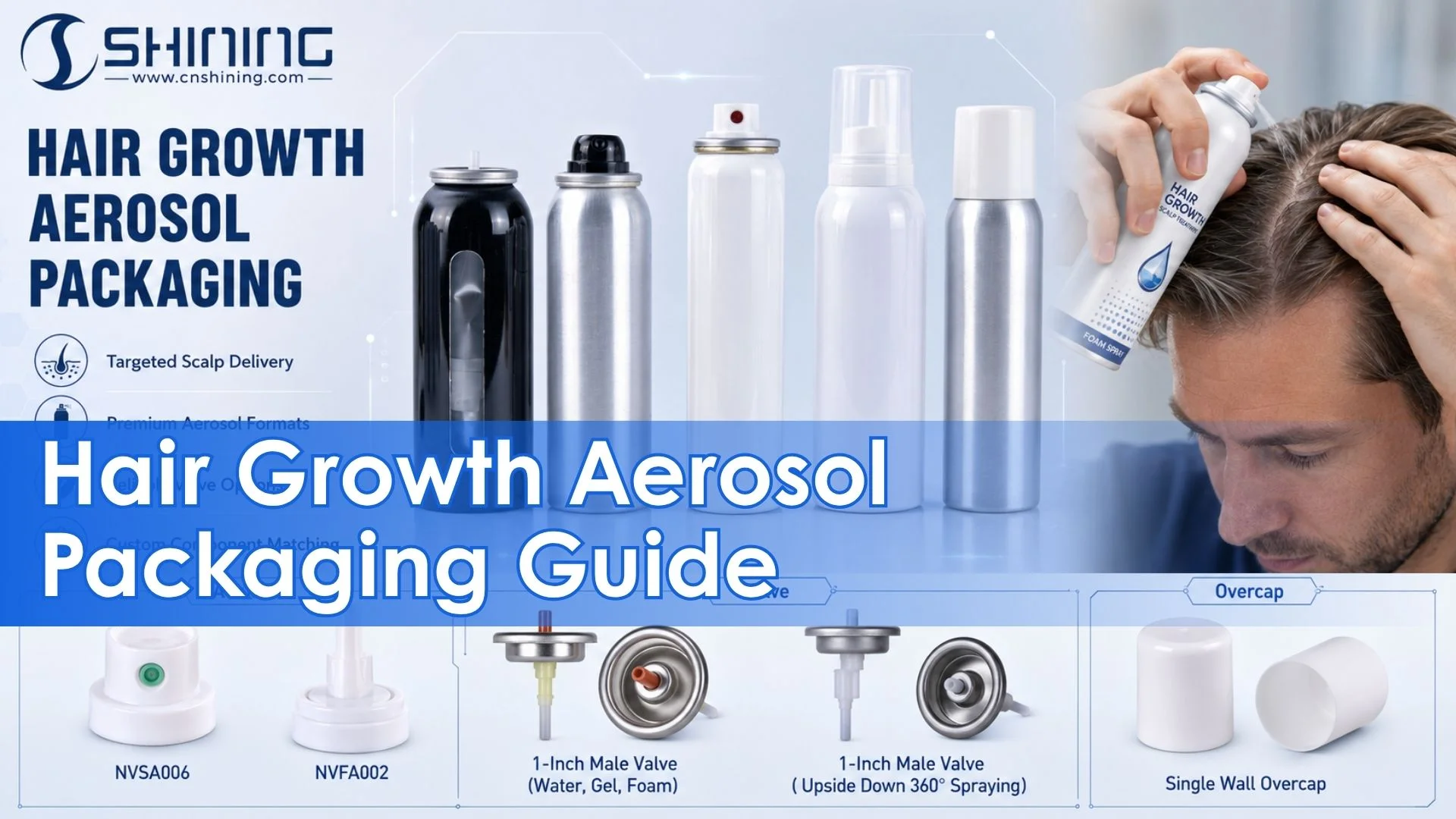
Hair growth aerosol spray is not one fixed dosage form. In market and regulatory work, it covers topical aerosol foam, cutaneous spray solution, pump-based scalp mist, serum spray, and social-commerce products sold under “hair growth spray” wording.
The most technically supported active ingredient remains minoxidil. The delivery system does not make minoxidil more active by itself. It changes where the product lands, how long it stays on the scalp, how much solvent irritation the user tolerates, and whether the user keeps applying it for months.
1. Definition and Search Vocabulary
This article defines Hair Growth Aerosol Spray as scalp-applied products dispensed as spray, mist, foam, or aerosolized topical treatment, with claims around hair regrowth, reduced hair loss, thinning hair, or scalp treatment. It does not include shampoos, conditioners, hair fibers, wigs, or transplant devices.
| Search Layer | Useful English Keywords | Technical Purpose |
|---|---|---|
| Core category | hair growth spray, hair regrowth spray, hair loss treatment spray, thinning hair spray, scalp treatment spray | Find broad spray-format SKUs. |
| Drug / active | minoxidil spray, minoxidil topical aerosol, minoxidil topical foam, minoxidil cutaneous spray solution, 5% minoxidil foam | Locate products with clinical and regulatory status. |
| Dosage engineering | aerosol foam, pump spray, scalp mist, micro-mist scalp spray, metered-dose scalp spray, bag-on-valve hair spray | Identify dispensing and packaging technologies. |
| Clinical use | androgenetic alopecia spray, female pattern hair loss spray, male pattern baldness spray, vertex hair regrowth foam | Connect product claims to real use cases. |
| Regulatory | OTC hair regrowth treatment, Drug Facts minoxidil aerosol, cutaneous spray solution MHRA, first-class OTC minoxidil Japan | Check classification, label, and approval route. |
Global search needs local regulatory terms. A U.S. query may use “minoxidil topical aerosol Drug Facts.” A U.K. query may use “cutaneous spray solution.” Japan uses minoxidil hair-growth drug language and first-class OTC controls.
2. Mechanism and Evidence
2.1 Biological mechanism
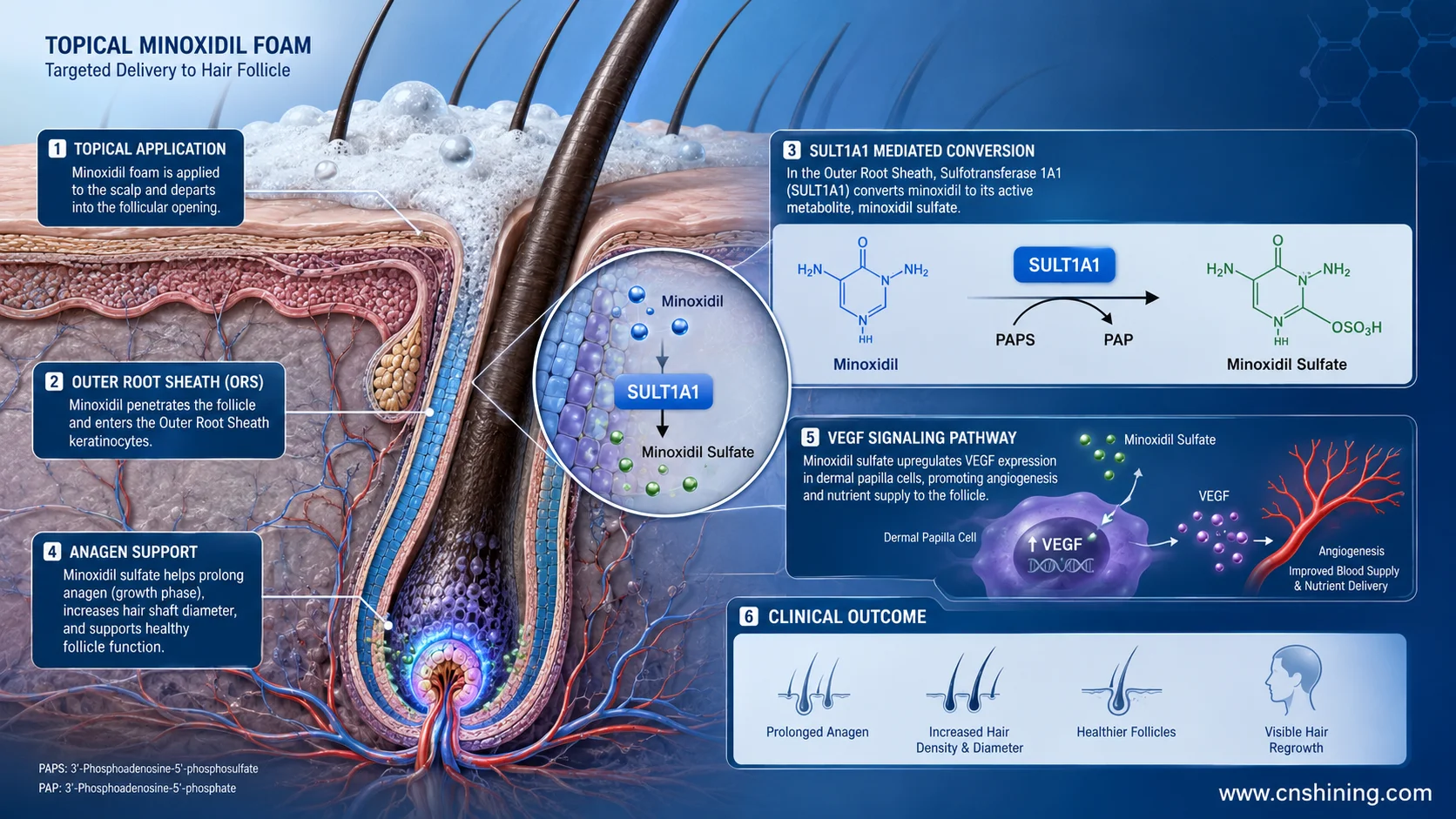
Minoxidil is better described as a prodrug than as a simple vasodilator in this context. It needs sulfotransferase activity, mainly linked to SULT1A1 in the follicle outer root sheath, to form minoxidil sulfate. This helps explain why two users can apply the same 5% foam and see different results.
After activation, minoxidil is associated with longer anagen phase, VEGF up-regulation, prostaglandin pathway changes, and possible potassium-channel related effects. Some of these remain proposed mechanisms. The careful wording is simple: clinical efficacy is established, but the complete molecular mechanism is not fully settled.
2.2 Formulation mechanism
Spray and foam formats matter because they change solubility, deposition, retention, drying speed, and irritation. Traditional solutions often depend on ethanol and propylene glycol. These solvents support solubility and penetration, but they are also tied to itching, dryness, contact dermatitis, and minoxidil crystallization after ethanol evaporation.
PG-free foam has a clear technical role. It reduces exposure to an irritant excipient and improves use experience. Public studies also support 5% minoxidil foam in male androgenetic alopecia and once-daily 5% foam in women.
2.3 Physical spray mechanism
Hair is a barrier. A plume that is too wide, a droplet size that is too large, or an actuator that cannot target the scalp will waste product on the hair shaft. Foam has a commercial advantage because it usually drips less and stays longer on the scalp.
| Mechanism / Claim | Evidence Point | Packaging Meaning |
|---|---|---|
| Minoxidil requires SULT activation | Outer root sheath sulfotransferase activity converts minoxidil to minoxidil sulfate. | Response variability is real; dosing alone does not solve it. |
| SULT activity can predict response | A female AGA study reported 93% sensitivity and 83% specificity. | Personalized response testing can support better user education. |
| Ethanol / PG systems cause irritation risk | High-solvent systems are linked with itching, dermatitis, dryness, and crystallization. | PG-free foam and low-irritation vehicles have practical value. |
| Foam improves retention | Scalp retention and penetration work supports lower drip and longer retention for foam. | No-drip is not only a marketing phrase. It is a dosage-form advantage. |
| Actuator and valve affect dose placement | BOV, airless, and micro-spray systems focus on output control and spray geometry. | Deposition, misuse, complaint rate, and repeat purchase are connected. |
3. Dosage Form, Formulation, and Terminology
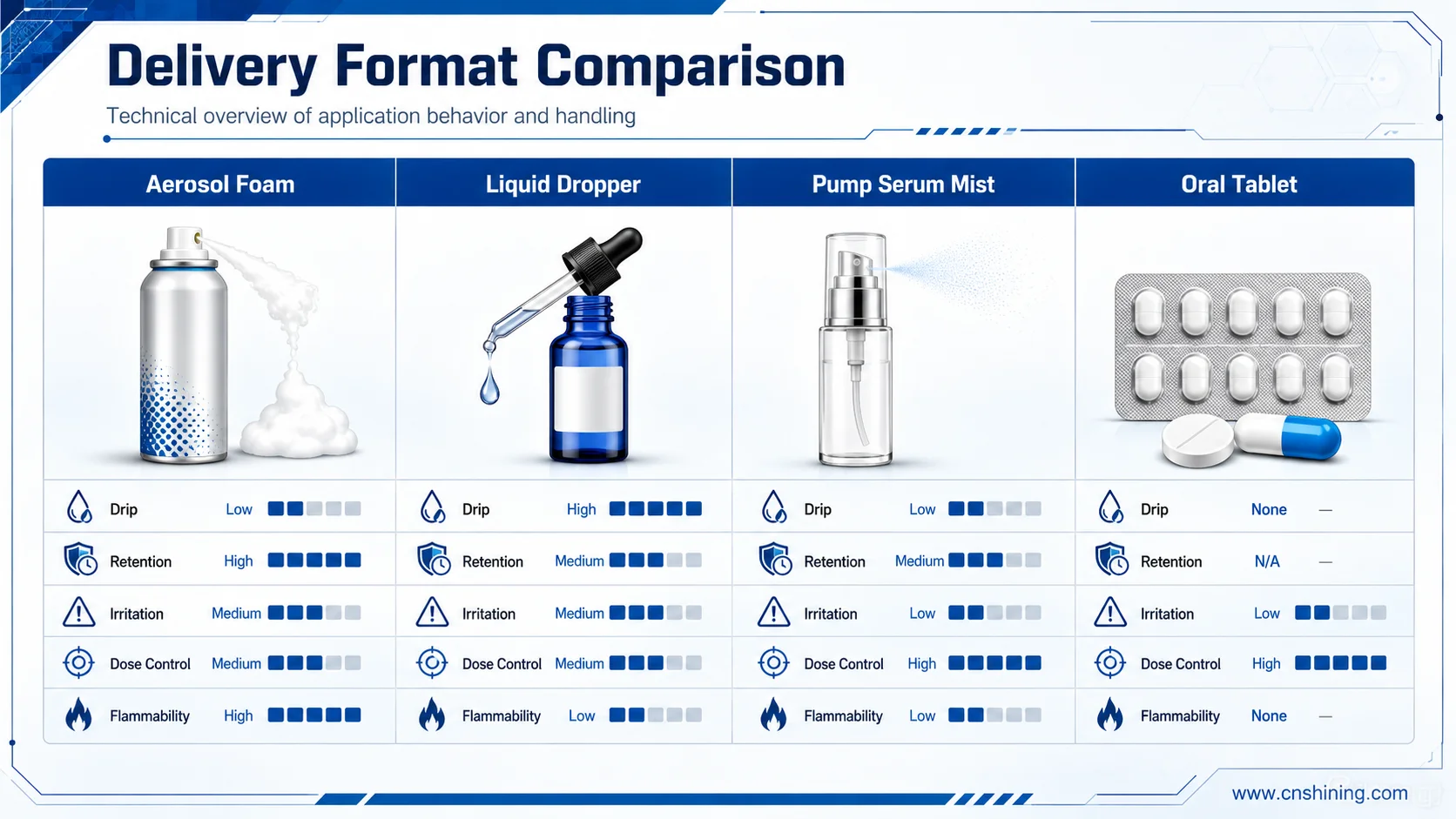
| Format | Typical Product Form | Main Advantages | Main Weak Points | Best-Fit Use Case |
|---|---|---|---|---|
| Aerosol foam / spray | Topical aerosol foam, mist spray, precision nozzle spray | Better scalp retention, less drip, lower PG exposure possible, quick-dry positioning. | Flammable systems, valve/foam consistency risk, product may land on hair. | OTC products targeting better adherence and cleaner use. |
| Liquid dropper | 2% / 5% solution with dropper | Mature, lower cost, visible dose volume. | Greasy feel, drip, PG irritation, long hair contamination. | Price-sensitive pharmacy users. |
| Serum / pump spray | Serum spray, scalp mist | Good for cosmetic feel and content-commerce storytelling. | Without minoxidil, regrowth evidence is usually weaker; concentration may be unclear. | Scalp care, female users, high-frequency cosmetic routines. |
| Oral treatment | Oral minoxidil, finasteride, combinations | No scalp application problem; not affected by hairstyle. | Systemic side effects and physician management are more relevant. | Telehealth and clinic-managed treatment. |
3.1 Formulation categories
| Category | Common Ingredients | Function | Main Challenge |
|---|---|---|---|
| Active | Minoxidil | Regrowth treatment and slowing hair-loss progression. | Low water solubility, crystallization, irritation, long-term adherence. |
| Botanical extracts | Ginger, ginseng, Platycladus orientalis leaf, Angelica extracts | Scalp care, differentiation, supportive cosmetic claims. | Evidence varies; odor, color stability, and claim control need work. |
| Peptides | Copper peptides, minoxidil-peptide conjugates | Differentiation and new mechanism narratives. | Cost, stability, and regulatory evidence are not simple. |
| Vitamins / support ingredients | Biotin, collagen, B vitamins, niacinamide, panthenol | Hair and scalp condition claims. | True regrowth evidence is weaker than drug-active evidence. |
| Vehicle / solvent | Ethanol, water, propylene glycol, butylene glycol, 1,3-propanediol | Solubilization, penetration, drying speed. | Stinging, dryness, crystallization, flammability. |
| Aerosol system | Butane, isobutane, propane, nitrogen, compressed air | Foam or spray delivery. | VOC, flammability, cost, transport, filling compatibility. |
3.2 Terms worth keeping clear
AGA means androgenetic alopecia. ORS means outer root sheath. SULT1A1 is the enzyme family marker often discussed in minoxidil response. Vehicle means the solvent and carrier system. BOV means bag-on-valve. Actuator is the spray button/nozzle unit. Metered dose means a controlled output, such as “3–4 pumps = 1 mL.” Plume geometry decides whether the user sprays scalp or hair.
4. Regulatory Pathways and Compliance Priorities
The main compliance problem is the boundary between cosmetic claims and drug claims. A product that claims to regrow hair with minoxidil is not the same as a cosmetic mist that claims to condition the scalp or improve the appearance of thinning hair. Trying to use both identities in one SKU is a common failure mode.
| Market | Typical Classification | Common Route for Hair Growth Spray / Foam | Packaging and Label Focus |
|---|---|---|---|
| United States | Cosmetic / OTC drug / Rx drug | Minoxidil regrowth products usually follow OTC Drug Facts logic. | Drug Facts, extremely flammable warnings, child-resistant packaging for minoxidil-containing liquids. |
| European Union | Cosmetic / medicine | Care and appearance claims may stay cosmetic; regrowth/treat hair loss claims move toward medicine. | PIF, CPSR, claim support, and increasing attention to HFC and environmental controls. |
| United Kingdom | UK cosmetic rules / medicine | Similar boundary logic; public medicine records include minoxidil cutaneous spray solution. | Local responsible-person, label, and aerosol compliance requirements. |
| Canada | Cosmetic / nonprescription drug / NHP | Minoxidil scalp products can follow nonprescription drug logic. | Active ingredient, indication, pressurized container requirements, VOC rules. |
| Japan | First-class OTC medicine | Minoxidil hair-growth drugs are highly controlled OTC products. | Pharmacist guidance, strict instructions, and mature 1 mL dosing container design. |
| Australia | Registered medicine / poisons scheduling | Minoxidil 50 mg/mL topical products are handled through medicine controls. | Container and label controls are central. |
Seven items should be checked before launch: active-claim match, stability, packaging compatibility, flammability, child-resistant protection, dose consistency, and evidence support.
5. Top 10 Hair Growth Aerosol Spray Brands
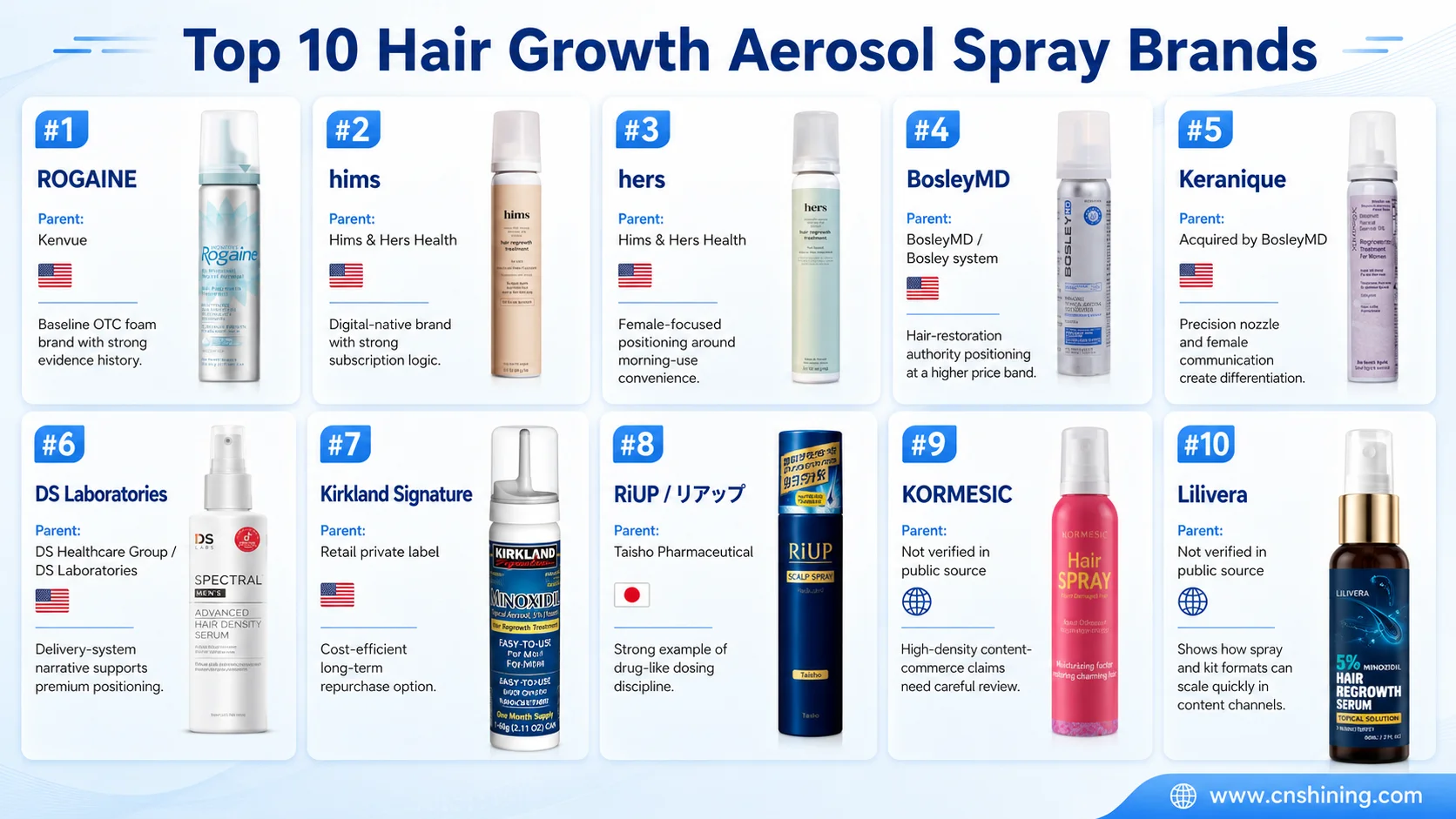
| Brand | Country | Parent | Representative Product | Size | Public Reference Price | Technical Reading |
|---|---|---|---|---|---|---|
| ROGAINE | United States | Kenvue | Women’s 5% Minoxidil Foam | 2 × 2.11 oz | about 40$ | Baseline OTC foam brand with strong evidence history. |
| hims | United States | Hims & Hers Health | 5% Foam for Men | 2.11 fl oz | about 20-26$ | Digital-native brand with strong subscription logic. |
| hers | United States | Hims & Hers Health | 5% Foam for Women | 2.11 oz | about 38-40$ | Female-focused positioning around morning-use convenience. |
| BosleyMD | United States | BosleyMD / Bosley system | Women’s 5% Foam | 2.11 oz | about 46$ | Hair-restoration authority positioning at a higher price band. |
| Keranique | United States | Acquired by BosleyMD | 2% Minoxidil Precision Spray | 2 fl oz | about 24$ | Precision nozzle and female communication create differentiation. |
| DS Laboratories | United States | DS Healthcare Group / DS Laboratories | Spectral.UHP 5% Minoxidil Serum | 60 mL | about 32$ | Delivery-system narrative supports premium positioning. |
| Kirkland Signature | United States | Retail private label | 5% Liquid / Foam | Multi-month supply | about 15$+ | Cost-efficient long-term repurchase option. |
| RiUP / リアップ | Japan | Taisho Pharmaceutical | RiUP X5 | 1 mL metered container | about 41$ | Strong example of drug-like dosing discipline. |
| KORMESIC | TikTok Shop | KORMESIC / SADOER OEM-private-label supply listing | 5% Minoxidil + Keratin Scalp Massage Cream | Multiple sizes | about 24-27$ | High-density content-commerce claims need careful review. |
| Lilivera | TikTok Shop | Guangzhou Haishi Biological Technology Co., Ltd. | 5% Minoxidil Kit with Biotin | Kit | about 28$ | Shows how spray and kit formats can scale quickly in content channels. |
The brand landscape has three layers. The first layer is drug-like evidence brands such as Rogaine and RiUP. The second layer is experience and channel innovation: Hims, Hers, BosleyMD, Keranique, and DS Laboratories. The third layer is social-commerce brands mixing minoxidil, biotin, keratin, rosemary, and scalp-care language. The fast layer is not always the safest layer. Packaging control, claim control, and traceability decide how long it lasts.
6. User Pain Points Seen in the Market
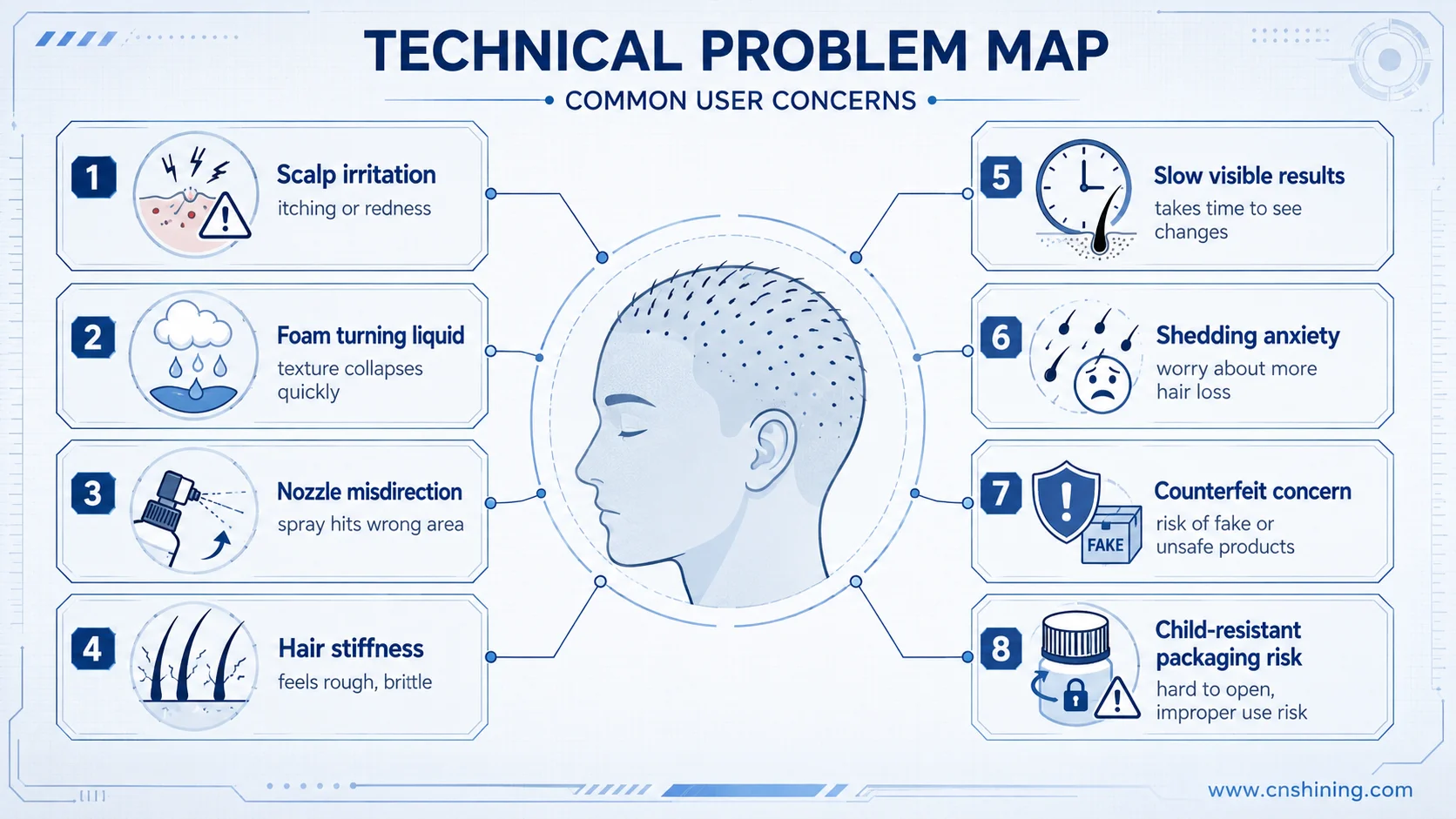
Public reviews and safety notices point to repeated pain points. This is not a controlled survey, but the repetition is too strong to ignore.
| Pain Point | Frequency | Severity | Technical Cause | Engineering Reading |
|---|---|---|---|---|
| Scalp itching, dryness, irritation | High | High | Vehicle irritation, especially ethanol / PG systems. | Tolerance failure directly breaks adherence. |
| Foam turns liquid, nozzle performs poorly | High | Medium-high | Valve, propellant ratio, viscosity, and in-use pressure window mismatch. | Test the second half of the can, not only the first spray. |
| Hair becomes dry, stiff, or dirty-looking | Medium-high | Medium | Residue, crystallization, solvent drying, product landing on hair. | Female and long-hair users are less forgiving. |
| Slow results and “it does not work” perception | High | Medium | Hair cycle biology and weak education around time-to-response. | Label and instruction design are part of the product. |
| Early shedding anxiety | Medium-high | Medium-high | Hair cycle transition can be misread as treatment failure. | Education should explain the 2–6 week shedding concern where applicable. |
| Wrong target area | Medium | Medium | Many OTC labels focus on crown / vertex patterns. | Front hairline users often need clearer expectation control. |
| Spray enters eyes | Medium | High | Over-wide plume, poor directional marker, weak instruction graphics. | Actuator orientation and user cueing matter. |
| Counterfeit or quality uncertainty | Medium | High | Marketplace mixing of sellers and fast social-commerce scaling. | Serialization and tamper evidence are practical controls. |
| Child poisoning risk | Low frequency, severe consequence | Very high | Minoxidil products sold without child-resistant packaging. | This is recall territory, not normal complaint handling. |
Users are not asking for another miracle ingredient. They want five things: less irritation, less hair mess, better targeting, clearer result timing, and safer packaging. Three of those are packaging and experience engineering problems.
7. Packaging Engineering Recommendations
| User / Compliance Problem | Recommended Packaging Solution | Why It Works | Feasibility | Cost Impact |
|---|---|---|---|---|
| Child ingestion / recall risk | PPPA-style child-resistant overcap, CR pump, CR closure, visible warning panel. | Directly addresses recent CPSC recall causes. | High | Low to medium |
| Product lands on hair, not scalp | Extended nozzle, comb-guided applicator, narrow-plume actuator. | Improves directional scalp deposition and reduces wet hair. | High | Low to medium |
| Eye exposure | Directional actuator, orientation mark, “away from face” instruction graphic. | Guides the user mechanically and visually. | High | Low |
| Foam instability in later use | Match valve spec, dip tube, propellant ratio, and formula viscosity; test half-can condition. | Moves complaint risk into validation work. | Medium-high | Medium |
| Irritation and drying | PG-free foam, lower-irritation vehicle, or airless metered pump. | Reduces the sensory penalty that causes users to stop. | Medium | Medium |
| Flammability and VOC pressure | BOV with nitrogen or compressed air for selected SKUs; clear flammable labeling for hydrocarbon foam. | Separates product and propellant and can reduce VOC exposure. | Medium | Medium-high |
| Unclear dose | Metered dose actuator: for example, “3–4 pumps = 1 mL”; or built-in 1 mL dosing chamber. | Reduces overuse and “more is better” mistakes. | High | Low to medium |
| Marketplace trust | Serialization, transparency code, tamper-evident label or overcap. | Useful for Amazon, TikTok Shop, and cross-border distribution. | High | Low |
| Recyclability concern | Aluminum can, simplified material mix, reduced secondary carton, refill logic where suitable. | Long-term-use products create packaging waste; the user notices it. | Medium | Medium |
If one packaging route must be chosen, the decision should be tiered. Mass OTC foam can keep hydrocarbon aerosol, but it needs child-resistant design, better actuator directionality, and full-life foam stability testing. Premium female-use or sensitive-scalp products should evaluate airless metered pump or BOV micro-mist. Social-commerce products should add anti-counterfeit and child-protection controls before spending heavily on traffic.
8. Product Fit: Shining Packaging Actuators, Cans and Valves
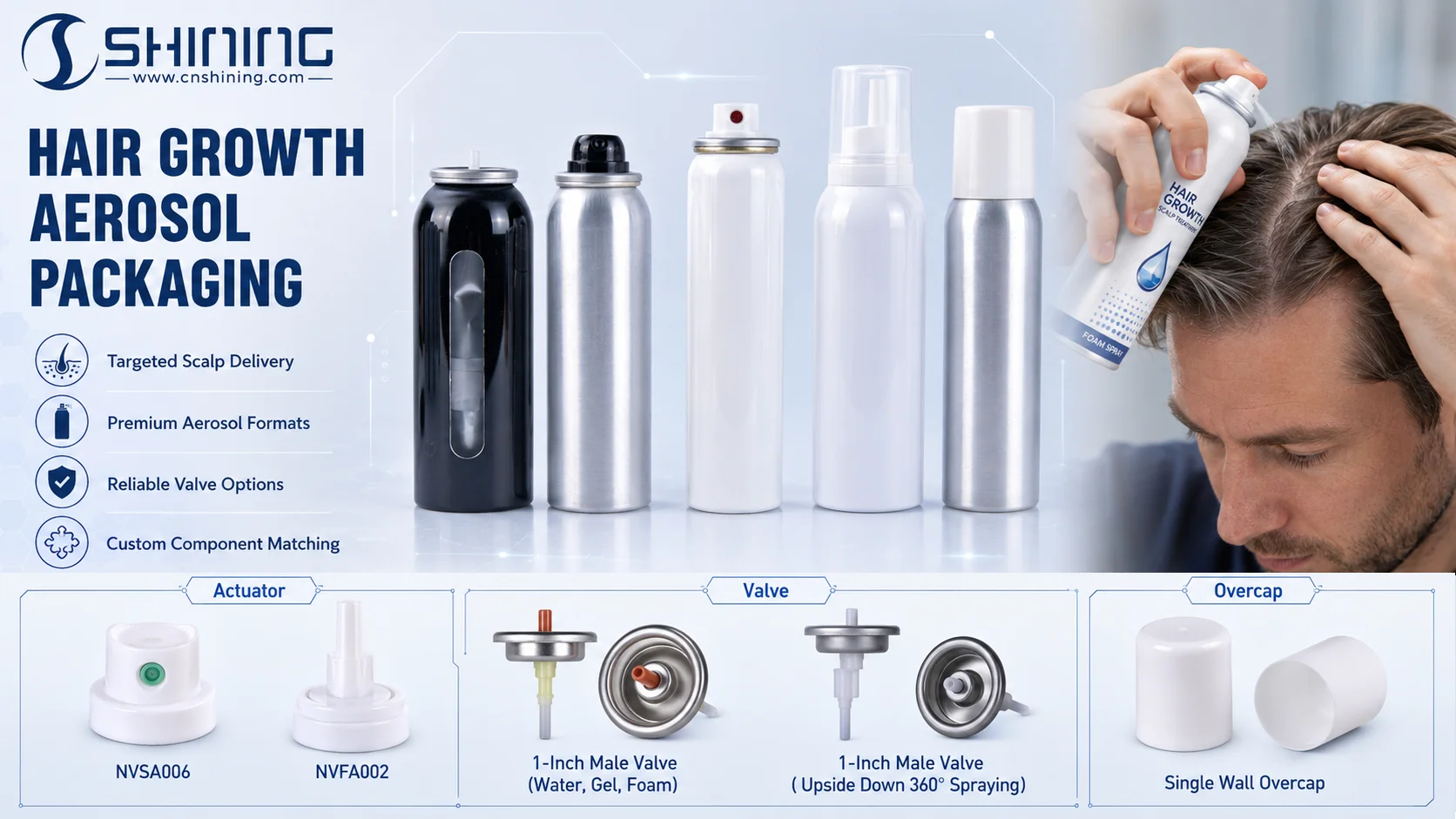
For hair growth aerosol spray, the actuator, can, and valve are not secondary parts. They define the dose feel, plume geometry, foam texture, emptying behavior, leakage risk, and whether the product survives real use.
Shining Packaging can be positioned in this workflow as a packaging component partner for aerosol cans, valves, actuators, caps, and related dispensing structures used in scalp foam, mist spray, and precision application products. The useful work is not to “choose a nice can.” It is to match: formula viscosity, propellant choice, valve output, actuator directionality, can coating, corrosion resistance, crimping condition, and transport requirement.
For minoxidil foam or scalp spray projects, the first validation list should include: output per actuation, spray angle, plume width, foam collapse time, half-can performance, inverted-use behavior, can/valve compatibility, leakage after heat exposure, actuator clogging, and cap child-resistance where required. These checks are unglamorous. They prevent the complaints that usually appear three months after launch.
9. Conclusion
Hair growth aerosol spray is best understood as a delivery and compliance upgrade around an established active, not as a separate miracle category. Minoxidil still carries the strongest evidence. Foam, spray, BOV, airless, and precision nozzles add value only when they improve scalp deposition, tolerance, dose control, safety, and long-term adherence. The practical conclusion is clear: solve the packaging failures before adding more claims.
10. FAQ: Hair Growth Aerosol Spray
Not exactly. Minoxidil foam is one important form of hair growth aerosol spray, but the market also includes cutaneous spray solutions, pump scalp mists, and serum sprays. The technical difference is the dispensing system, vehicle, and regulatory claim. A foam with Drug Facts labeling is not equivalent to a cosmetic scalp mist.
Minoxidil needs conversion to minoxidil sulfate in the hair follicle, with SULT activity playing a major role. Different users may have different enzyme activity in the follicle outer root sheath. This is one reason the same dose and format can produce different visible results, even when application technique is correct.
Foam is not automatically more pharmacologically powerful. Its advantage is usually physical and sensory: less dripping, better scalp retention, lower exposure to propylene glycol in PG-free systems, and cleaner use. Those factors can improve adherence. For a long-cycle treatment such as minoxidil, adherence can strongly affect real outcomes.
Minoxidil has limited water solubility. Many solutions depend on ethanol and glycols to keep it dissolved. As ethanol evaporates, crystallization can appear as white flakes or residue. This may also make hair feel dirty or stiff, especially when product lands on hair rather than scalp.
A scalp spray actuator should control direction, plume width, and dose output. Narrow plume, extended nozzle, or comb-guided designs can help place product onto the scalp instead of the hair shaft. For long-hair users, poor actuator targeting often causes waste, irritation near the face, and negative reviews.
Minoxidil-containing liquids can create serious poisoning risk if swallowed by young children. Recent CPSC recalls focused on minoxidil spray or serum bottles without required child-resistant packaging. For this product family, child-resistant closure design is not only a safety feature. It can decide whether the product remains on the market.
Foam instability can come from poor matching between formula viscosity, propellant ratio, valve specification, dip tube, and internal pressure curve. The first sprays may look acceptable while the second half of the can fails. Full-life in-use testing is needed because users complain after repeated use, not after one lab spray.
Bag-on-valve can be useful when product-propellant separation, high evacuation, 360-degree dispensing, or reduced VOC exposure is desired. It is not always the lowest-cost route. For sensitive scalp mists, premium sprays, or oxygen-sensitive formulas, BOV may solve problems that a conventional aerosol system cannot handle as cleanly.
Cosmetic scalp sprays can discuss conditioning, scalp care, appearance, and hair strength within local rules. Claims such as “regrow hair” or “treat hair loss” may shift the product toward drug or medicine regulation, especially when minoxidil is present. The formula, label, website copy, and ad claims should be aligned before launch.
Minimum tests should include active stability, solvent compatibility, can coating compatibility, valve output, actuator plume geometry, foam quality, leakage, heat exposure, transport safety, child-resistant performance, and dose repeatability. For minoxidil systems, crystallization and irritation risk should be checked early, because both directly affect adherence and complaints.