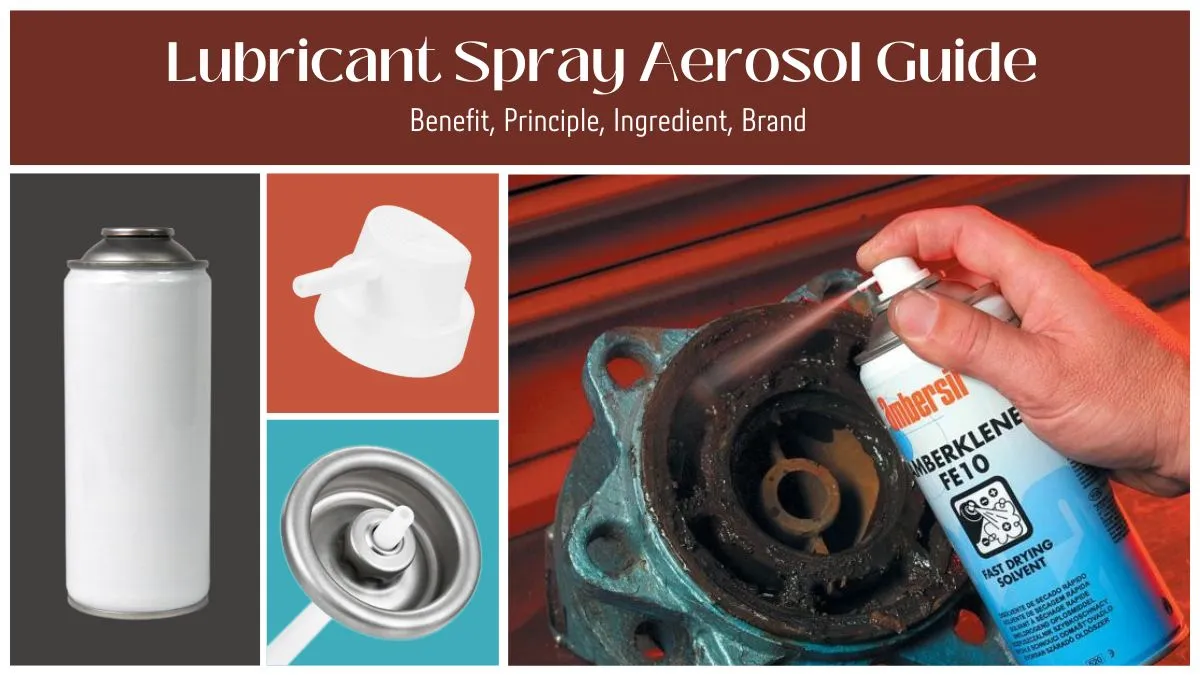
Aerosol lubricant, also called spray lubricant, penetrating oil aerosol, silicone spray, PTFE dry-film spray, or aerosol grease, is not just lubricating oil packed into a pressurized can. It is a formulation-and-packaging system. The spray result depends on the valve, actuator, dip tube, propellant, base oil, solvent, additives, can coating, and label claims working together.
For the user, the value is simple: remote application, point spraying, quick penetration, and less manual handling. For the manufacturer, the hard part is less visible. The barrier is in valve compatibility, actuator design, propellant selection, VOC compliance, dangerous-goods transport, and real-world spray control.

1. Technical Definition and Working Mechanism
A typical aerosol lubricant works through five connected layers. The can body and internal coating provide storage and chemical compatibility. The valve, dip tube, and actuator control opening, flow, and atomization. The propellant supplies internal pressure and affects droplet size, spray distance, cooling, and flammability. The base oil forms the main lubricating film. The additives and volatile carrier handle penetration, drying speed, rust prevention, anti-wear performance, plastic compatibility, and cleaning behavior.
When the actuator is pressed, the internal pressure drives the mixture through the valve and nozzle. After spraying, the solvent and part of the propellant evaporate. What remains on the surface is a higher-boiling lubricating film or dry-film residue. This explains why two products both called “spray lubricant” can behave very differently. One may feel wet, oily, and penetrating. Another may dry fast and collect less dust.
Public SDS examples show the gap clearly. A WD-40 low-VOC aerosol SDS lists 45–50% low vapor pressure aliphatic hydrocarbon, less than 35% petroleum base oil, and 10–<25% aliphatic hydrocarbon. A CRC food-grade silicone aerosol SDS lists light hydrotreated naphtha, 1,1-difluoroethane, PDMS, and a small amount of n-hexane. The first structure is closer to multi-purpose penetration, water displacement, and light lubrication. The second is closer to silicone film, release, water resistance, and rubber or plastic compatibility.

How the Valve, Actuator, Propellant, Base Oil and Additives Work Together
The valve determines opening force, return, sealing, and backflow risk. The actuator determines spray pattern, flow rate, and whether the user can point-spray accurately. The propellant determines pressure curve, spray distance, atomization fineness, flash cooling, and hazard classification. The base oil determines boundary film strength and persistence. Additives determine rust prevention, anti-wear, extreme pressure behavior, metal deactivation, defoaming, plastic compatibility, and food-contact suitability.
In packaging engineering, “good spray” is not always a formulation issue. The same formula can produce overspray, leakage, stream deviation, or hand dripping when the actuator and valve are mismatched.
2. Comparison with Liquid Oil, Grease and Solid Lubricants
The main advantage of aerosol lubricant is not that it always lubricates better. The advantage is access, dosing, and convenience. It reaches tight spaces, works quickly on stuck parts, and limits the amount of oil applied. Its weak points are also clear: higher cost per active lubricant, VOC and flammability constraints, dangerous-goods logistics, and thinner film in many multi-purpose products.
| Измерение | Aerosol Lubricant | Liquid Lubricating Oil | Grease | Solid Lubricant |
|---|---|---|---|---|
| Access to narrow areas | Very strong, especially with straw or long tube actuator | Average, often needs dropper or brush | Слабый | Depends on dispersion method |
| Initial penetration | Strong, useful for stuck hardware | Середина | Слабый | Слабый до среднего |
| Long-term film | Medium to weak, formula-dependent | Середина | Strongest | Средняя или высокая острота |
| Dust attraction | Low to medium; dry-film types are lower | Середина | Высокий | Низкий |
| Application cleanliness | High, but overspray risk exists | Medium, may sag or drip | Low, easy to soil nearby parts | Высокий |
| Reapplication frequency | Выше | Середина | Низкий | Середина |
| Cost per active lubricant | Высокий | Низкий | Середина | Средний до высокого |
| Flammability, VOC and transport complexity | Высокий | Середина | Середина | Carrier-dependent |
| Best-fit uses | Hinges, locks, chains, cables, stuck metal parts, pre-maintenance | Bearings, slides, machining equipment oiling | Heavy load, long-duration, open gears, slow movement | Clean, dusty, high-temperature or low-contamination areas |
| Common misuse | Using multi-purpose spray as the final long-term lubricant | Over-oiling and attracting dust | Using on precision or clean parts | Expecting strong penetration and heavy wet film at once |

| Срок | Простое объяснение | Коммерческое значение |
|---|---|---|
| топливо | Gas or liquefied gas that provides can pressure | Controls flammability, cost, spray feel and regulatory class |
| Base oil | Main oil forming the lubricating film | Decides lubrication and film persistence |
| Carrier solvent | Volatile liquid helping penetration and spreading | Controls drying speed, VOC and odor |
| Stem valve | Valve stem assembly | Controls feel, sealing and backflow |
| Исполнительный механизм | Кнопка или распылительная головка | Controls spray shape and user experience |
| Погружная трубка | Tube drawing liquid from the can bottom | Affects spray stability and residual content |
| Wet film | Oily surface left after spraying | Longer lubrication, higher dust attraction |
| Сухая пленка | Low-friction residue after solvent evaporation | Key for low-dust claims |
| Penetrant | Fluid designed to enter small gaps | Good for loosening rust, not equal to heavy lubrication |
| EP/AW additive | Extreme-pressure or anti-wear additive | Improves chain, rail and boundary lubrication behavior |
| Water displacement | Ability to push water away from surfaces | Useful for automotive, electrical and outdoor maintenance |
| Plastic-safe | Compatible with plastics | Needed for appliances, office equipment and vehicle interiors |
| NSF H1 | Incidental food-contact lubricant category | Access point for food, beverage and pharmaceutical plants |
| ЛОС | Летучее органическое соединение | Affects formula route, compliance and claims |
| ООН1950 | Dangerous-goods transport number for aerosols | Directly affects export, warehousing and e-commerce logistics |
| Умная соломинка | Integrated folding straw actuator | Solves straw loss and point-spray problems |
3. Top 10 Aerosol Lubricant Brands and Positioning

| Бренд | Страна | Материнская компания | Обычный размер | Market Price Sample | Технический комментарий |
|---|---|---|---|---|---|
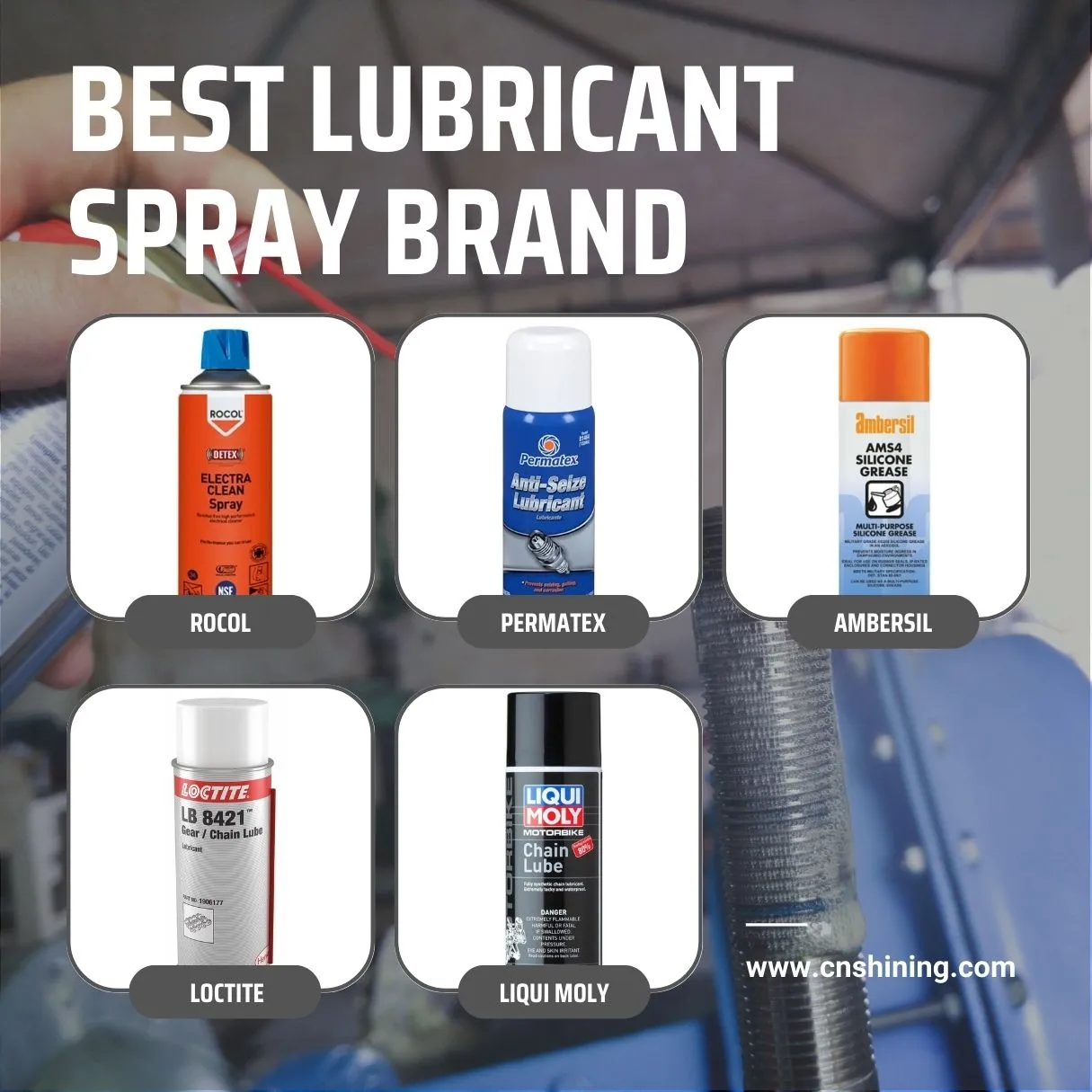
| ВД-40 | НАС. | Компания WD-40 | 8–12 oz / 340 ml | about $6.16 for 8 oz sample | Strong multi-purpose recognition and mature packaging education. |
| CRC 3-36 | НАС. | CRC Industries | 11 wt oz / 16 oz can | about $16.33 for 11 oz sample | Strong industrial MRO association; positioned toward precision lubrication and corrosion protection. |
| 3-IN-ONE PTFE | НАС. | Компания WD-40 | 4 унции | about $5.51 for 4 oz sample | More suited to tools and light precision use than universal maintenance. |
| Liquid Wrench Silicone | НАС. | Commonly associated with RSC Chemical Solutions | 11 унций | about $12.21 for 11 oz sample | Value-oriented bridge between household and automotive aftermarket use. |
| Würth HHS 2000 | Германия | Группа Вюрт | 500 мл | about $10.20–$17.04 sample range | Known for adhesion and higher-pressure professional applications. |
| MOTIP PTFE Dry | Нидерланды | MOTIP public sales system | 500 мл | about $5.47–$6.77 | Dry-film and low-residue route; useful where dust pickup must be reduced. |
| Ambersil Silicone / Amberglide | Великобритания | CRC Industries | 200–400 ml | about $24.89 for 400 ml sample | Industrial and aviation distribution background; professional niche positioning. |
| B’laster Dry Lube | НАС. | B'laster Holdings | 9,3 унции | about $7.98 sample | Clear dry-film and Teflon™ selling point; visible in retail maintenance channels. |
| Loctite LB 8021 | Германия | Хенкель | 400 мл | about $14.27–$16.93 | Strong B2B brand fit, especially for industrial entry points. |
| Super Lube 31110 | НАС. | Synco Chemical | 11 унций | about $21.49 | Synthetic, PTFE and H1 positioning makes it relevant for food and industrial maintenance. |
4. Formula Systems, Typical Ratios and Public Examples
Commercial aerosol lubricants are not built from one universal formula. They split into several routes: multi-purpose penetrating oils, silicone sprays, PTFE dry-film sprays, aerosol greases, corrosion-inhibiting systems and food-grade synthetic lubricants. A common commercial mistake is treating “application” as “chemistry.” Hinges, chains, conveyors, food equipment, electronic slides, rubber seals and rusted bolts do not need the same chemistry.
| Тип формулы | Main Components | Основная функция | Typical Ratio Logic | Commercial Feature |
|---|---|---|---|---|
| Multi-purpose penetrating type | Petroleum base oil, aliphatic carrier, rust-prevention components | Water displacement, light lubrication, cleaning, loosening, light rust protection | Carrier-rich, medium active film | Easy to educate, but long-term lubrication is often overestimated. |
| Silicone type | PDMS, solvent, propellant | Rubber and plastic compatibility, slip, waterproofing, release | PDMS often low to mid single digits; volatile components dominate | Good fit for household, seals, trim and plastic parts. |
| PTFE dry-film type | PTFE, light solvent or alcohol, small amount of synthetic oil | Low friction, low residue, low dust pickup | Solid PTFE is low; volatile carrier is high | Useful where clean, low-tack surfaces matter. |
| Aerosol grease | Base oil, thickener, solvent, propellant | Sprays into narrow areas, then forms a thicker layer | Base oil 3.75–28.5%, thickener 0.2–7.5%, solvent 15–60%, propellant to 100% | Balances spray access with better film persistence. |
| Corrosion-inhibiting type | Base oil, hydrocarbons, wax, metal deactivator, surfactant, rust inhibitor | Longer corrosion protection, anti-seize, oxidation control | Mineral oil 15–25%, hydrocarbon 17–27%, liquid wax 5–15%, solvent 40–50% | High industrial value, with higher compliance pressure. |
| Food-grade synthetic type | Synthetic oil, PTFE or silicone, H1-compatible additive system | Food, beverage and pharmaceutical equipment maintenance | Built around approved base stocks and safer additive choices | Higher cost, but clearer access requirement. |
| Пример | Public Composition | Техническое чтение |
|---|---|---|
| Commercial multi-purpose spray | LVP aliphatic hydrocarbon 45–50%; petroleum base oil <35%; aliphatic hydrocarbon 10–<25% | Shows a typical penetration and light-lubrication structure. User feel is driven strongly by volatile carrier and spray delivery. |
| Food-grade silicone spray | Light hydrotreated naphtha 50–60%; 1,1-difluoroethane 30–40%; PDMS 2–5%; n-hexane <2% | A few percent of silicone film former can still give slip, water resistance and release behavior. |
| Corrosion-inhibiting patent example | Mineral oil 15–25%; petroleum hydrocarbon 17–27%; liquid wax 5–15%; halogenated solvent 40–50%; phosphate ester 0.5–1.5%; metal deactivator 0.05–0.15%; cationic surfactant 0.05–6.0% | Closer to industrial corrosion protection than household light lubrication. It deposits a protective film and suppresses corrosion. |
| Aerosol grease patent example | Base oil 3.75–28.5%; thickener 0.2–7.5%; antioxidant 0.01–0.15%; corrosion inhibitor 0.01–0.60%; anti-wear or anti-scuff agent 0.02–1.5%; solvent 15–60%; propellant to 100% | Useful when the product must spray into a gap but cannot leave a film as thin as a normal multi-purpose penetrant. |
The commercial conclusion is practical. More ingredients do not automatically mean better performance. The formula must match three moments: 30 seconds after spraying, when the user notices spray feel, odor, dripping and overspray; 30 minutes after spraying, when the surface becomes wet film, semi-dry film or dry film; and 30 days after spraying, when the maintenance result becomes clear.

5. Regulations, Compliance and Recent Development
Aerosol lubricant compliance is more complex than ordinary drip oil or grease. It touches chemical classification, VOC rules, pressure containers, dangerous-goods transport, occupational safety and consumer labeling at the same time. The U.S. federal framework, state rules, EU REACH/CLP, F-gas pressure, ADR and label standards, and local language requirements all matter.
| Рынок | VOC / Propellant Focus | Dangerous-Goods Transport | Label / SDS Focus | Коммерческое значение |
|---|---|---|---|---|
| федеральное правительство США | EPA 40 CFR Part 59 covers consumer and commercial product VOC, but not every lubricant spray falls into the same federal subcategory. | 49 CFR, UN1950, limited quantity and container pressure rules apply. | OSHA HazCom 2024 expanded aerosol categories, including non-flammable Category 3. | National sale does not guarantee one national formula. State rules often matter more. |
| California / state rules | CARB consumer product rules define tighter VOC limits for many product categories. Multi-purpose lubricant is a watched category. | Linked with DOT transport rules. | Category definition and sell-through timing must be tracked. | Often sets the upper limit for a “single U.S. formula.” |
| Евросоюз | REACH/CLP forms the base. EU Regulation 2024/573 increases pressure on fluorinated greenhouse gas routes. | ADR 2025, IMDG and IATA may apply. | CLP labels, SDS and multilingual compliance are required. | Long-term sustainability of fluorinated propellant routes declines. |
| Бразилия | New GHS implementation under ABNT NBR 14725:2023 from 2025. | Based on UN dangerous-goods recommendations and local transport rules. | Portuguese SDS and label are hard requirements. | Localization is not translation only. Labels need to be rebuilt. |
| ЮАР | Hazardous Chemical Agents rules continue to push GHS adoption. | Dangerous-goods transport rules apply. | SDS and labeling duties continue to strengthen. | Market size may be smaller, but compliance is not light. |
One detail is worth noting. VOC compliance is not judged only by one percentage value. It depends on the product category definition, the test method and exemption route. For example, a CRC silicone-based multi-purpose lubricant SDS gives VOC information and also states U.S. compliance claims under its category assumptions. That type of case should be read by regulatory category, not by percentage alone.
For legal reference points, see the U.S. 49 CFR §173.306 aerosol transport rule, the OSHA Hazard Communication Standard 2024 final rule, and EU Regulation 2024/573 on fluorinated greenhouse gases.
Recent Development Trends
The newest direction is not simply “more oil.” The more useful movement is in delivery, sustainability and regulatory fit. Propellant-free or lower-pressure platforms are one example. APS twistMist™ was described as a twist-activated, propellant-free aerosol technology in a 2023 U.S. sustainable packaging award report. This suggests that the next packaging step may reduce climate pressure without giving up spray convenience.
Another trend is integrated actuator design. Folding straws, dual-pattern heads, long flexible tubes and anti-drip actuators solve problems that users actually complain about. In many cases, the buyer does not notice a small anti-wear improvement. The buyer notices whether the straw is missing, the spray goes sideways, or liquid runs down the can.

6. Проблемы, с которыми сталкиваются пользователи, и улучшение упаковки.
E-commerce and social media comments are useful because they reveal small problems that affect repeat purchase. Across Amazon, Walmart, Reddit, TikTok, Instagram, Zhihu and Douyin samples, complaints concentrate around packaging and use-case education. The concept of aerosol lubricant is not the problem. The problem is often the delivery system.
| Channel | Typical Comment Pattern | Болевая точка | Инженерное значение |
|---|---|---|---|
| Реддит | The red straw gets lost; flip straw is preferred. | Straw loss and poor point-spray convenience | Integrated straw has moved from bonus feature to baseline expectation. |
| Reddit / fixit | Liquid leaks from the top and runs down the can onto the hand. | Valve leakage, backflow, unclear spray direction | Needs anti-drip actuator, directional marking and better seals. |
| Amazon | Some dry PTFE products clean well but do not strongly lubricate door hinges. | Product-use mismatch | Dry-film products must clearly state low residue does not mean heavy long-life lubrication. |
| Walmart | Positive comments often mention large capacity, included straw and fair price. | Value and convenience | Capacity, accessory tube and ease of use remain basic competitiveness factors. |
| Douyin / Chinese social media | Spray head breaks after falling; silicone lubrication does not last long enough. | Actuator durability and film-life expectation gap | Needs drop-resistant cap design and clearer fast-dry or light-film labeling. |
| Zhihu / brand communication | Messaging highlights no more lost straw. | Validated industry pain point | Straw integration is a packaging selling point because the problem is common. |
| Болевая точка | Рекомендация | Material / Structure | Почему это работает |
|---|---|---|---|
| Straw loss | Use integrated folding straw actuator | PP living hinge + POM micro-nozzle | Turns a loose part into a fixed structure. |
| Hand dripping / backflow | Use anti-drip actuator and better valve sealing | HNBR or FKM gaskets; actuator flow skirt | Reduces residual liquid flowing out after release. |
| Избыточное распыление | Use dual-mode head: narrow stream plus broad spray | Replaceable orifice insert; long guide tube | Lets users choose point spray instead of accepting wide mist. |
| Clogging or spray deviation after storage | Add self-cleaning orifice and dust cap | POM nozzle, cap positioning ribs, cleaning stroke | Improves reuse consistency. |
| Broken actuator after drop | Use protective cap and low-profile button | Thick-wall PP cap, reinforcement ribs | Reduces damage during e-commerce delivery and home storage. |
| Can corrosion or formula instability | Select internal coating by formula polarity, water, amine and acidity | Epoxy phenolic or BPA-NI internal coating, compatibility DOE | Many failures come from package interaction, not weak active chemistry. |
| High residual content | Optimize dip tube length; consider 360° or bag-on-valve where needed | Tight tube-length tolerance; BOV testing for selected SKUs | Improves spray-out rate and orientation flexibility. |
| Давление в сторону устойчивого развития | Use high-recovery aluminum or steel routes and simpler labels | PCR content, reduced composite labels, clearer recycling instructions | Reduces retail and regulatory friction. |
| User cannot select correct product | Put use-case words on front label, not only chemistry | Icons for hinge, chain, plastic, food equipment and electrical maintenance | Reduces mismatch complaints. |

7. Shining Packaging: Actuator, Aerosol Can and Valve Fit for Lubricant Sprays
For aerosol lubricant, the package is part of the formula delivery system. Shining Packaging’s relevant work is around исполнительные механизмы , аэрозольные баллончики и клапаны. These components need to match the lubricant’s viscosity, solvent strength, propellant pressure, desired spray pattern and storage stability.
A light penetrating spray usually needs accurate point delivery and clean shutoff. A silicone spray needs material compatibility and stable atomization. A spray grease needs a valve and actuator that can handle thicker output without clogging too quickly. The metal can and internal coating must also survive the formula, not just hold pressure on day one.
In practice, the useful question is simple: will the spray still point correctly after storage, shipping vibration and repeated use? This is where actuator geometry, valve sealing, dip tube tolerance and can coating selection become real engineering work.

8. Closing Technical View
Aerosol lubricant should be treated as a spray delivery platform, not a single product category. The next stage of competition is unlikely to be won by a more generic “all-purpose” claim. A better route is the right use case, the right actuator, the right valve, the right can coating, the right compliance route and a recycling message users can understand.
The engineering target is modest but difficult: fewer complaints, less overspray, lower leakage, clearer product selection and more reliable film behavior after storage. That is where packaging and formulation stop being separate departments.
9. FAQ: Aerosol Lubricant
Aerosol lubricant combines lubricant chemistry with a pressurized delivery system. The valve, actuator, propellant, solvent and can coating affect spray distance, droplet size, penetration, drying speed and final film. Ordinary oil mainly depends on the oil itself and the user’s application method.
Fast drying usually means the formula contains a high share of volatile carrier solvent or propellant. These components help penetration and spreading, then evaporate. The long-term effect depends on the remaining base oil, silicone, PTFE or grease film, not on the wet look during spraying.
Usually not as the final lubricant. Multi-purpose sprays are strong at penetration, water displacement and light lubrication. For heavy load, slow movement or long service intervals, grease, aerosol grease or a dedicated high-adhesion chain lubricant is often a better technical match.
The actuator controls spray pattern, flow rate, point accuracy and dripping behavior. A poor actuator can cause overspray, hand dripping, stream deviation or wasted product even when the formula is acceptable. For maintenance users, actuator failure is often noticed before chemical performance.
The propellant supplies internal pressure and helps push the formula through the valve. It affects atomization, spray distance, pressure drop, cooling and flammability classification. Propellant choice also influences VOC strategy, transport classification and whether the product can be sold across regions.
Aerosol lubricants are pressurized chemical products. They may fall under VOC rules, GHS classification, pressure-container requirements, OSHA or CLP labeling, SDS duties and dangerous-goods transport as UN1950 aerosols. Bottled oil avoids some of these pressure and propellant-related requirements.
Leakage can come from valve sealing, actuator geometry, residual liquid near the nozzle, damaged gaskets or formula incompatibility with elastomers. Backflow often appears when the actuator does not control remaining liquid after release. Anti-drip actuator design and seal selection reduce this problem.
PTFE dry-film spray is useful where low residue and lower dust pickup matter. It suits sliding parts, clean mechanisms and light-duty contact surfaces. It should not be expected to behave like thick wet oil or grease under heavy load unless the product is designed for that duty.
The formula may contain solvents, oils, additives, water traces, amines or acidic components. These can interact with bare metal or unsuitable coatings. Poor compatibility can cause corrosion, discoloration, pressure change, valve contamination or formula instability. Accelerated storage testing is needed before launch.
Start by matching the product to a clear use case, then test actuator, valve and formula together. Integrated straw, anti-drip design, stable spray direction, clear front-label use cases and honest film-life claims solve more real complaints than a vague “multi-purpose” performance statement.