
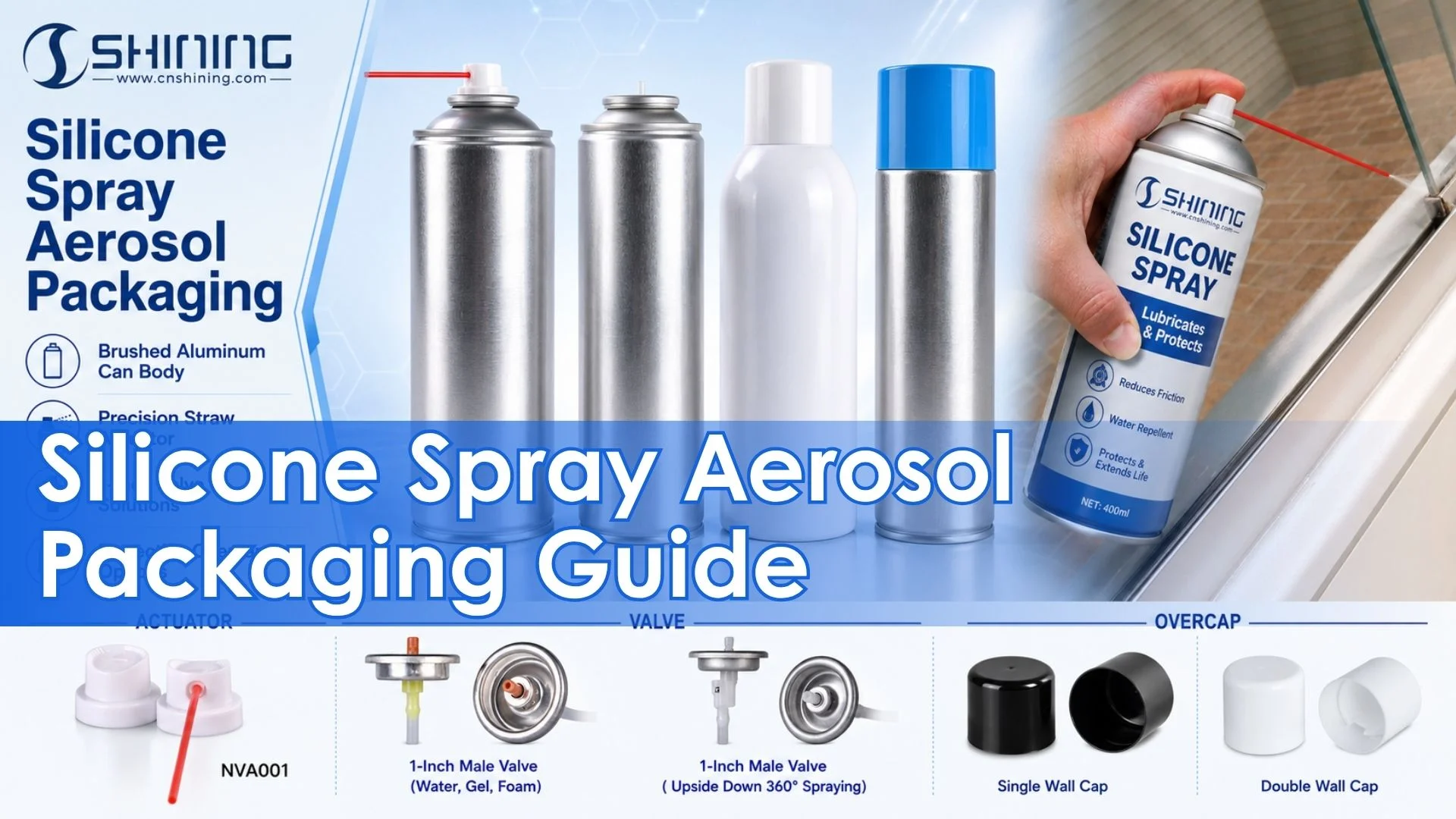
Silicone aerosol spray is not simply silicone oil in a can. It is a pressure-packaged system built from silicone-active material, solvent or diluent, propellant, valve, actuator and spray geometry. In maintenance, automotive, food equipment and light industrial use, the common names include silicone lubricant spray, silicone lube spray, water-resistant silicone spray and silicone release spray. The names vary. The engineering question is the same: can the product put a thin, controlled silicone film on the right surface without creating odor, overspray, slip risk or downstream contamination?
In most maintenance products, the active film former is PDMS, or poly(dimethylsiloxane), rather than a high-dose “pure silicone” load. Public SDS data shows a familiar pattern: low to medium viscosity silicone fluid, hydrocarbon carrier and LPG propellant. Low VOC, food contact and non-flammable routes are moving toward water-based emulsions, compressed gas systems and more controlled valve packages.
1. What Silicone Aerosol Spray Is and How It Works
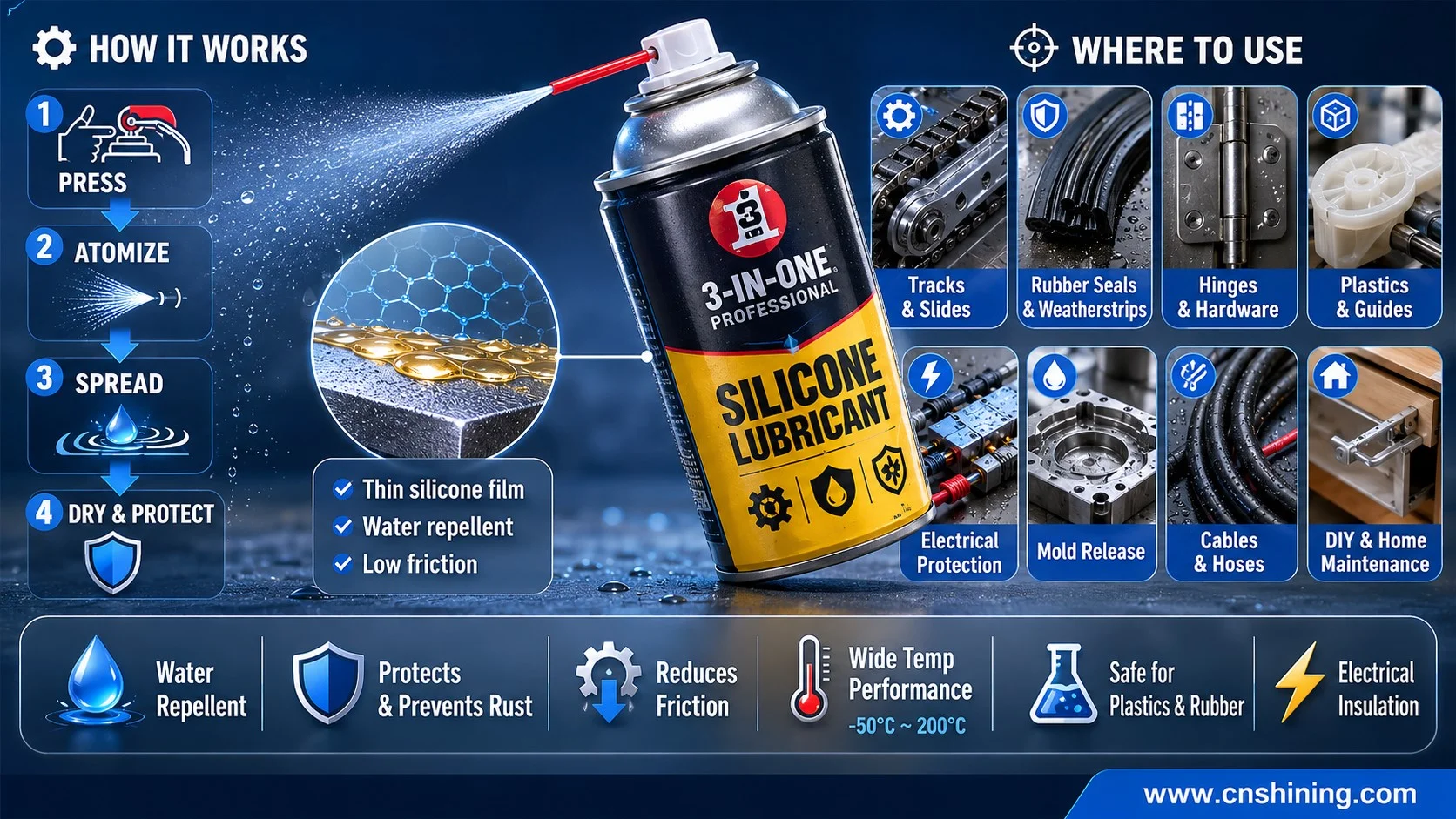
1.1 Definition and material composition
The chemical boundary matters. IUPAC defines silicones as polymeric or oligomeric siloxanes, usually written as [–OSiR2–]n. Siloxanes contain the Si–O–Si backbone. Silanes are a different family and are more often associated with coupling agents, surface reaction chemistry or hydrophobic primers. In lubricant aerosols, the film-forming material is usually PDMS silicone fluid or a modified silicone fluid, not a silane system.
Public SDS data confirms that many maintenance-grade products are low-active, high-carrier systems. The WD-40 Specialist silicone lubricant SDS lists LVP petroleum solvent at 60–80 wt%, propane/n-butane propellant at 10–30 wt% and poly(dimethylsiloxane) at 1–5 wt%. The TSI Silicone Lube SDS lists propane/isobutane/n-butane at 45–55 wt%, heptane at 30–40 wt% and dimethyl polysiloxane at 1–10 wt%.
This does not mean silicone is unimportant. It means the spray is designed to carry a small amount of silicone fluid across a large surface area, then leave a thin hydrophobic boundary film after carrier evaporation.
1.2 Propellant, atomization and film formation
LPG systems based on propane, butane or isobutane remain common because they are mature, cheap and effective for atomization. HFC propellants appeared in some historical and technical routes, but high-GWP pressure is now changing long-term design choices. Nitrogen and compressed air valve systems are gaining attention where lower flammability or lower GWP is part of the product target.
Atomization is a pressure-release and breakup process. When the user presses the actuator, the valve opens. The pressurized liquid and dissolved propellant move through the valve and orifice. At the nozzle, pressure drops, propellant expands, and the liquid stream breaks into droplets. The EPA aerosol application study shows why packaging is not secondary: nozzle size, pressure, liquid viscosity, surface tension and valve technology all affect release rate and particle size. The study sample reported nozzle sizes around 0.013–0.03 inch, common sizes near 0.02 inch, release rates around 0.66–2.8 g/s, container pressure commonly around 40–60 psi, and particle sizes ranging from 16–164 µm.
The working film has three practical mechanisms. First, silicone fluid spreads because of low surface tension. Second, the film reduces light-load friction and stick-slip noise. Third, it gives water repellency, dielectric behavior and broad compatibility with many plastics and rubbers. Silicone oil technical data from Elkem highlights low surface tension, spreading, hydrophobicity and stability as core silicone fluid traits.
The limit is clear. Silicone aerosol spray is a boundary film product, not a heavy-load grease, gear oil or extreme-pressure bearing lubricant. It is a good fit for tracks, rubber seals, light guides, hinges, plastic interfaces, mold release and moisture protection. It is a poor substitute for load-bearing lubrication where additive chemistry and oil film thickness matter.
2. Размер рынка и анализ региональных тенденций.

Asia Pacific looks like the strongest volume center because of industrial production, home maintenance demand, automotive aftersales and aerosol packaging capacity. North America and Europe are more mature markets where formulation compliance, recycling, VOC control, transportation classification and actuator quality carry more weight.
| Область | 2021 Value | 2025 Value | 2033 Forecast | 2025–2033 CAGR |
|---|---|---|---|---|
| Глобальный | 1,282.65 | 1,599.43 | 2,487.03 | 5.673% |
| Северная Америка | 320.66 | 392.06 | 595.25 | 5.358% |
| Европа | 60.28 | 73.73 | 112.84 | 5.463% |
| Азиатско-Тихоокеанский регион | 525.89 | 685.87 | 1,106.91 | 6.166% |
| Латинская Америка | 64.13 | 77.95 | 116.49 | 5.150% |
| Middle East | 65.42 | 82.98 | 135.54 | 6.326% |
| Africa | 246.27 | 286.85 | 420.01 | 4.882% |
Unit: USD million. These figures follow one public market research boundary. The Europe and Africa shares look unusual against common chemical consumption patterns, so they should be used as directional references, not as a direct investment allocation model.
3. Performance Comparison and Formulation Types
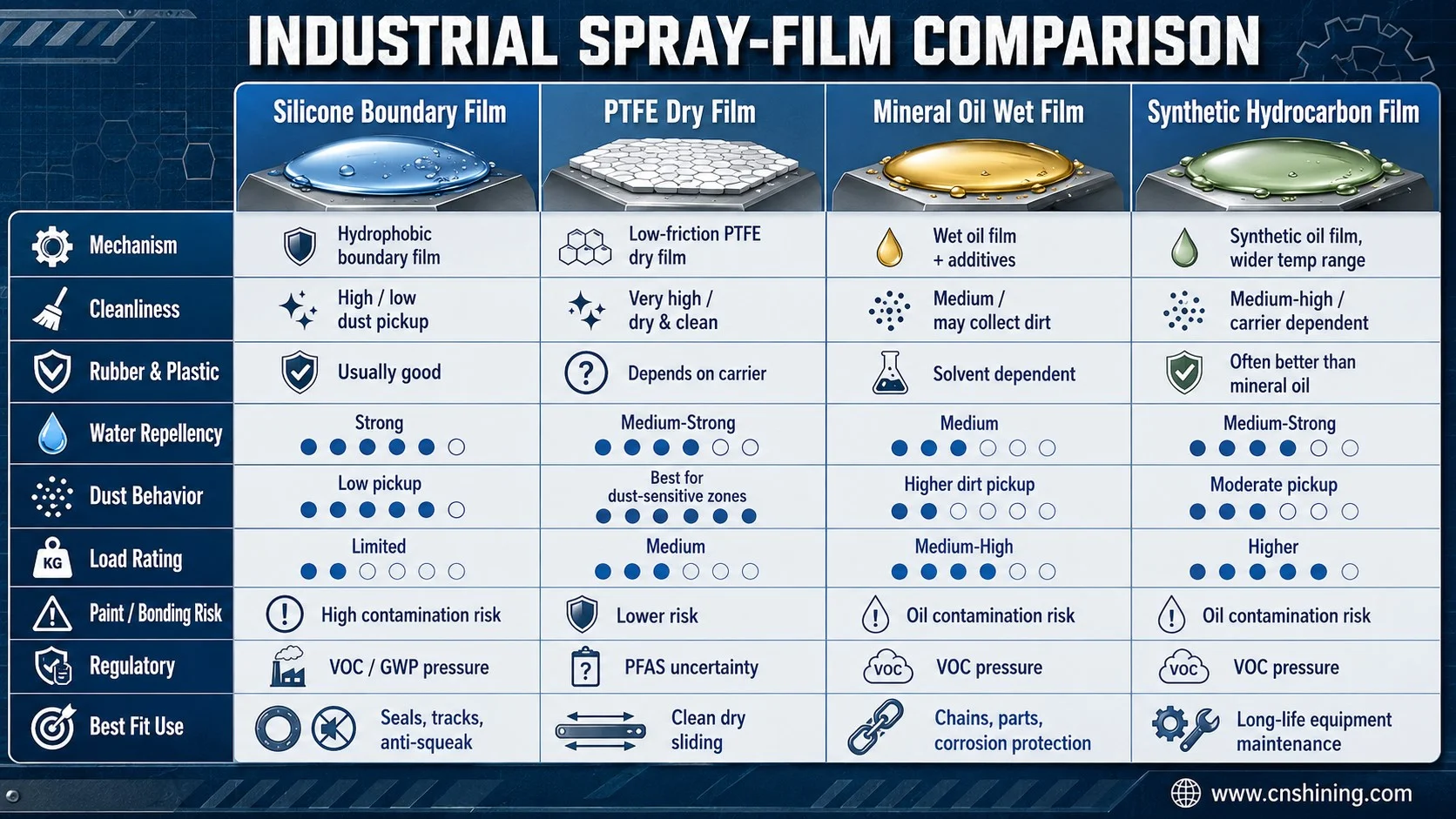
3.1 Silicone, PTFE, mineral oil and synthetic hydrocarbon sprays
Silicone aerosol spray is strong in fast spreading, water repellency, dielectric performance, cleanliness and rubber or plastic friendliness. If the user needs the lowest-friction dry film in a dusty precision mechanism, PTFE can be more attractive. If the user needs higher load capacity, corrosion inhibition or longer wet-film life, mineral oil or PAO/SHC routes often make more sense.
| Измерение | Silicone Aerosol Spray | PTFE Spray | Mineral Oil Aerosol Lubricant | Synthetic Hydrocarbon Spray |
|---|---|---|---|---|
| Основной механизм | Low-surface-energy boundary film, hydrophobic layer, anti-squeak effect | PTFE dry film for low friction | Wet film plus additive package | Synthetic oil film with wider temperature behavior |
| Cleanliness | High; usually low dust pickup | Very high in dry-film use | Medium to low; wet film may collect dirt | Medium to high, depending on carrier |
| Rubber and plastic compatibility | Usually good | Depends on carrier and additives | Solvent-dependent; not always safe | Often better than mineral oil, still formulation-dependent |
| Water repellency | Сильный | Средняя или высокая острота | Середина | Средняя или высокая острота |
| High-load service | Limited | Medium, if solid loading and film retention are suitable | Средний до высокого | Often higher than mineral oil averages |
| Paint or bonding risk | High. Silicone contamination can disturb paint, adhesive and print processes. | Lower, but cleaning is still needed | Oil contamination risk | Oil contamination risk |
| Regulatory pressure | VOC and GWP pressure from carrier and propellant | PFAS uncertainty if PTFE route is used | VOC pressure common | VOC pressure common |
| Наиболее подходящее применение | Seals, tracks, light sliding, anti-squeak, moisture protection | Clean dry sliding, dust-sensitive zones | Chains, mechanical parts, corrosion protection | Longer-life equipment maintenance |
A clean engineering rule is useful: use silicone when surface compatibility and water repellency are the main job; use PTFE when dry low-friction behavior is the main job; use oil or grease when load and life are the main job.
3.2 Common formulation families
| Formulation Type | Main Components and Function | Typical Public Range | Key Performance Metrics |
|---|---|---|---|
| Light silicone oil, fast evaporation | PDMS, petroleum solvent, LPG | PDMS 1–5%, solvent 60–80%, LPG 10–30% | Drying speed, clarity, non-staining behavior, water resistance |
| Medium-active silicone oil or oil-enhanced route | Dimethyl polysiloxane, heptane, petroleum fractions, naphthenic oil, LPG | Propellant 45–55%, heptane 30–40%, silicone oil 1–10% | Film persistence, anti-squeak behavior, perceived lubrication life |
| Water-based or low-VOC emulsion | Silicone emulsion, water phase, emulsifier package | Public product pages rarely show full formula | VOC, odor, flammability, incidental food contact suitability |
| Modified silicone fluid | Amino, phenyl or silicone-polyether modified fluids | Highly application-dependent | Wetting, adhesion, softness, anti-fouling behavior |
| Solid lubricant hybrid | Silicone or other carrier with PTFE, MoS2 or graphite | Usually engineering-specific | Friction coefficient, wear resistance, dust sensitivity |
4. Terminology That Causes Real Specification Errors
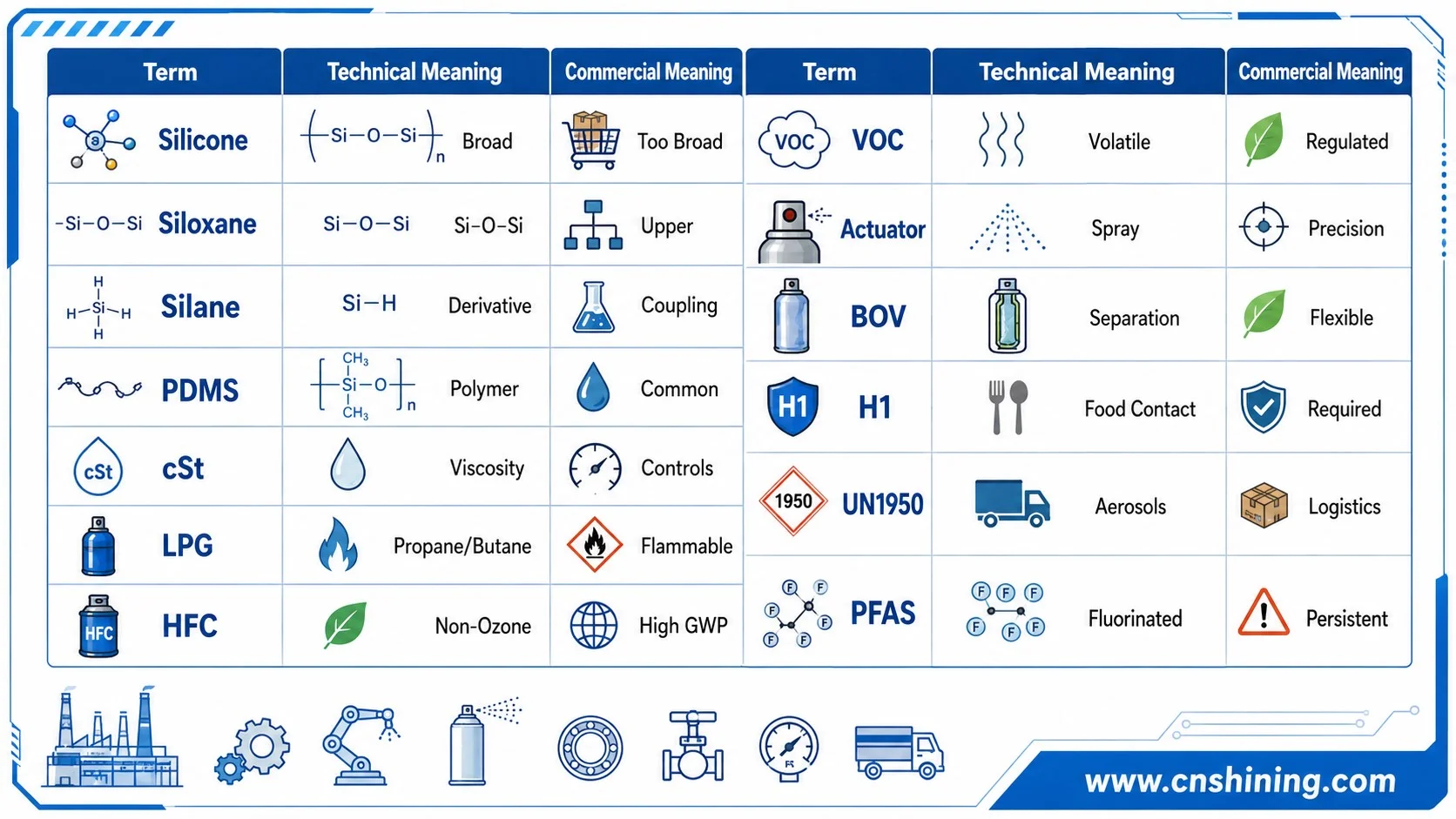
| Срок | Техническое значение | Коммерческое значение |
|---|---|---|
| Silicone | Broad class of polymeric or oligomeric siloxane materials | Too broad for procurement. Check CAS, SDS and intended use. |
| Siloxane | Compound with Si–O–Si backbone | Upper chemistry category behind silicone oils and silicone elastomers. |
| Силане | Silicon hydride derivative family | More common in coupling agents or reactive surface treatment than in lubricant film formation. |
| PDMS | Poly(dimethylsiloxane) | Most common silicone fluid active in lubricant sprays. |
| cSt | Centistokes, kinematic viscosity unit | Controls spreading, film thickness, residue and sprayability. |
| Сжиженный газ | Liquefied petroleum gas, usually propane or butane blend | Mature and cost-effective, but flammable and VOC-sensitive. |
| HFC | Hydrofluorocarbon propellant | Non-ozone-depleting, but high GWP pressure is rising. |
| ЛОС | Летучее органическое соединение | Directly affects California, Canada and low-odor product routes. |
| Исполнительный механизм | Spray button or dispensing head | Controls spray width, force, precision and accidental discharge risk. |
| БОВ | Система "мешок на клапане" | Can separate product from propellant and support non-traditional propellant routes. |
| H1 | Incidental food contact lubricant category | Often required for food equipment customers. |
| ООН1950 | Transport classification for aerosols | Affects shipping, storage, air freight and e-commerce logistics. |
| ПФАС | Large class of persistent fluorinated chemicals | Important variable for PTFE-containing products. |
5. Regulatory and Compliance Pressure
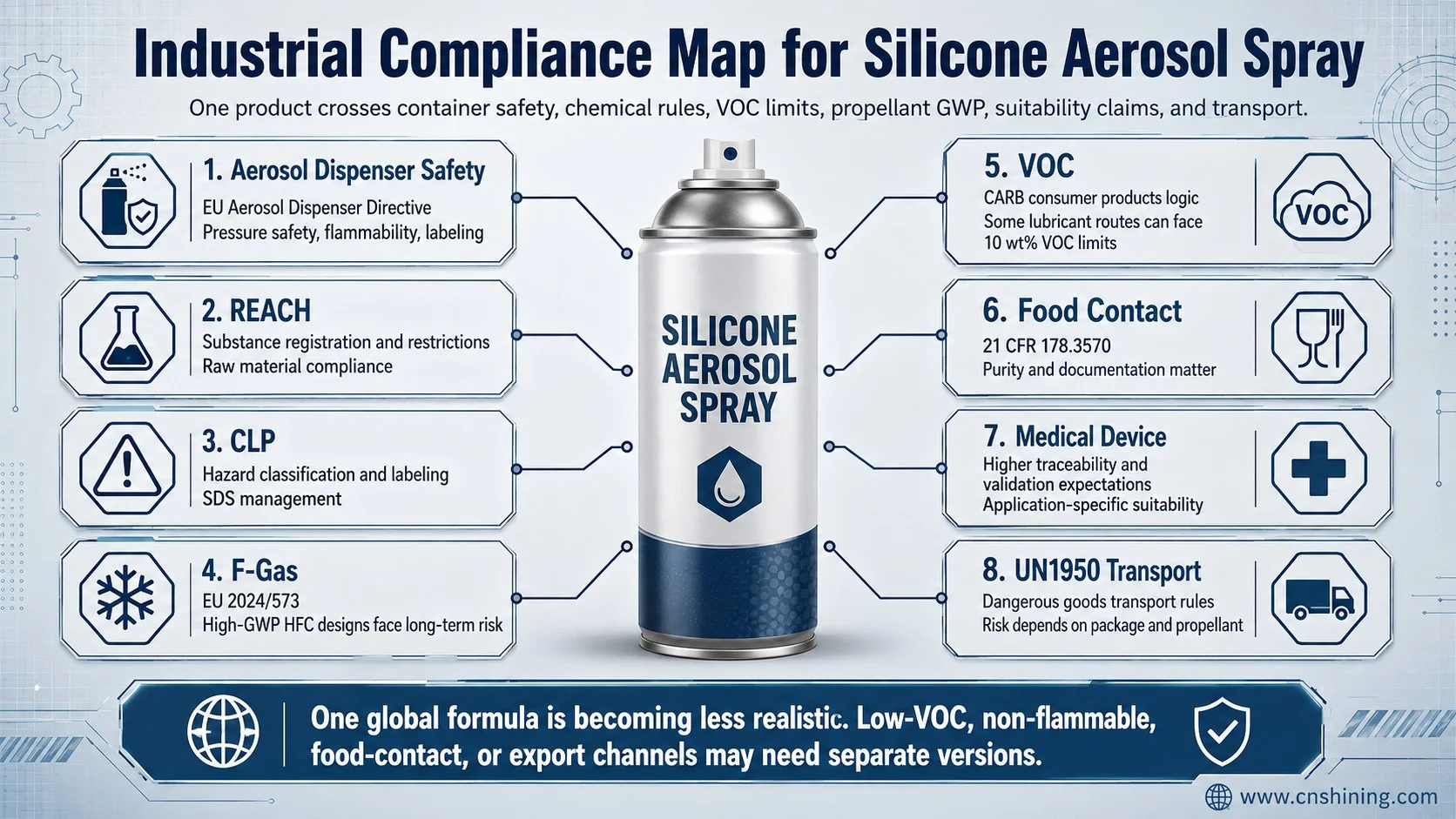
Silicone aerosol spray does not sit under one regulation. It crosses container safety, chemical classification, VOC limits, propellant GWP, food or medical suitability, and dangerous goods transport.
| Topic | Main Requirement | Practical Effect on Silicone Spray |
|---|---|---|
| аэрозольный контейнер ЕС | Директива по аэрозольным дозаторам | Controls dispenser definition, pressure safety, flammability and labeling obligations. |
| Химические вещества ЕС | ДОСТИГАТЬ and CLP logic | Raw material registration, restrictions, SDS management and hazard labeling. |
| EU propellant pressure | Регламент (ЕС) 2024/573 о фторированных парниковых газах | Raises long-term lifecycle risk for high-GWP HFC-dependent aerosol designs. |
| US VOC | CARB Consumer Products Program | Multi-purpose lubricant routes may face 10 wt% VOC limits or alternate reactivity paths. |
| Food equipment | 21 CFR 178.3570 incidental food contact lubricant rule | Formula purity and documentation become more important than general “lubricates well” claims. |
| HFC reduction | US EPA HFC reduction framework | Pushes manufacturers away from high-GWP HFC propellant dependence. |
| Транспорт | UN1950 aerosol classification and related modal rules | Shipping risk is judged by aerosol package and propellant hazard, not only by silicone active. |
For Europe and North America, “one global formula” is becoming less realistic. A maintenance SKU that works in a low-regulation channel may need a separate low-VOC or non-flammable version for California, Canada, food equipment or export customers.
6. 10 ведущих брендов-представителей
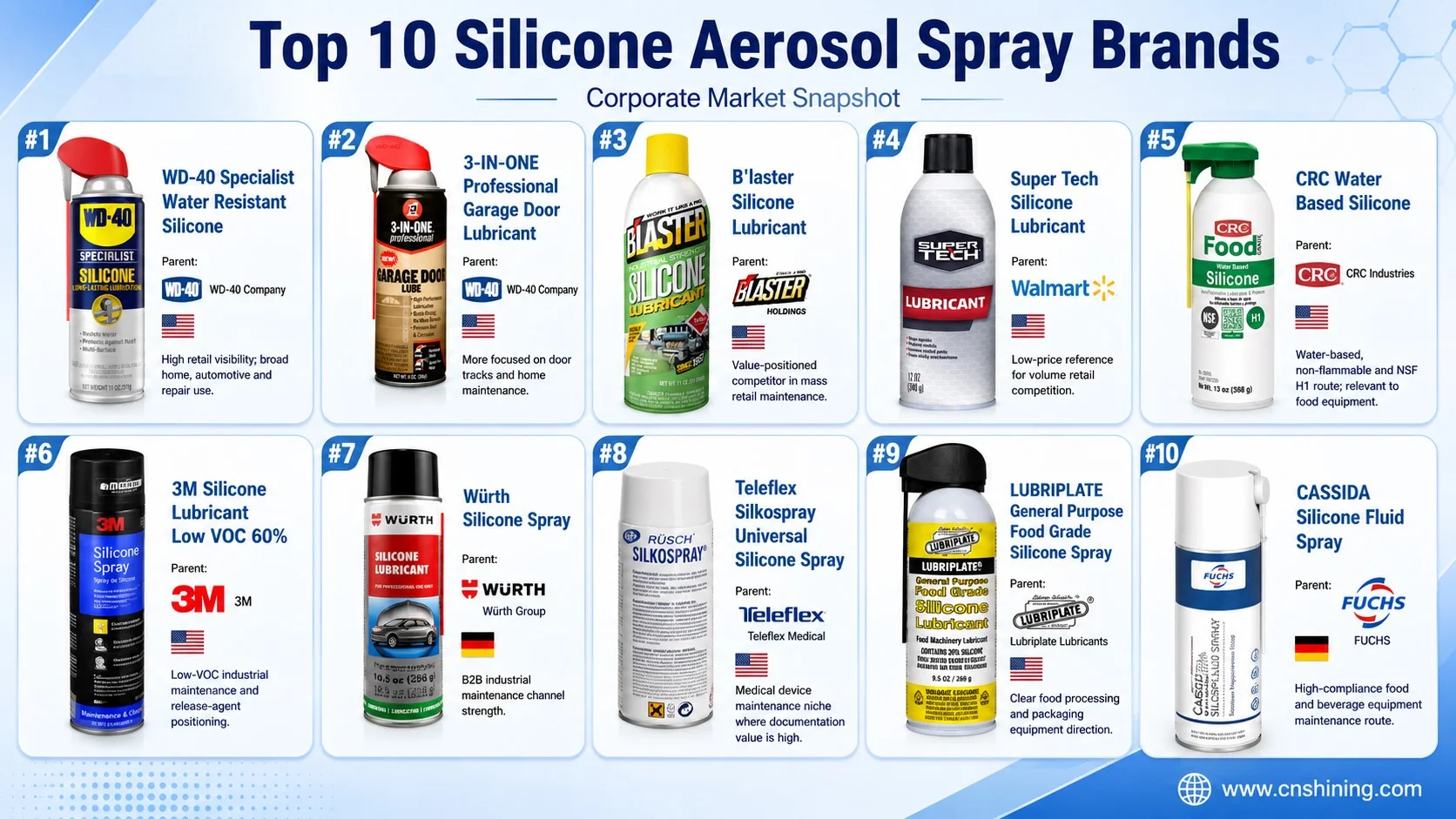
| Бренд / Продукт | Страна | Parent or Operator | Обычный размер | Диапазон цен для населения | Технический комментарий |
|---|---|---|---|---|---|
| WD-40 Specialist Water Resistant Silicone | США | Компания WD-40 | 11 унций | about $7.98–$8.78 | High retail visibility; broad home, automotive and repair use. |
| 3-IN-ONE Professional Garage Door Lubricant | США | WD-40 Company system | 11 унций | about $7.24–$7.49 | More focused on door tracks and home maintenance. |
| B’laster Silicone Lubricant | США | Blaster / Blaster Holdings | 11 унций | about $6.98–$7.98 | Value-positioned competitor in mass retail maintenance. |
| Super Tech Silicone Lubricant | США | собственная торговая марка Walmart | 12 унций | about $5.58 | Low-price reference for volume retail competition. |
| CRC Water Based Silicone | США | CRC Industries | 13 wt oz | about $11.92–$19.99 | Water-based, non-flammable and NSF H1 route; relevant to food equipment. |
| 3M Silicone Lubricant Low VOC 60% | США | 3М | 20–24 fl oz class | about $36.69 | Low-VOC industrial maintenance and release-agent positioning. |
| Würth Silicone Spray | Германия | Группа Вюрт | 300 g / 300 ml class | about $7.35 equivalent | B2B industrial maintenance channel strength. |
| Teleflex Silkospray Universal Silicone Spray | США | Teleflex Medical | Medical 500 ml class | about $87.70 each equivalent / about $876.99 case | Medical device maintenance niche where documentation value is high. |
| LUBRIPLATE General Purpose Food Grade Silicone Spray | США | Lubriplate Lubricants | 9.5 oz aerosol | about $11.70–$41.08 | Clear food processing and packaging equipment direction. |
| CASSIDA Silicone Fluid Spray | Германия | FUCHS | 400 ml aerosol format | about $15.48–$29.26 | High-compliance food and beverage equipment maintenance route. |
Visible mass-retail products cluster around roughly about $5.50–$8.00 per 11–12 oz can in North America. High-compliance food, industrial and medical versions move into distributor pricing. In those channels, the price is no longer only a cost-per-ounce story. Documentation, registration, traceability and channel support matter more.
7. User Pain Points and Packaging Engineering Advice
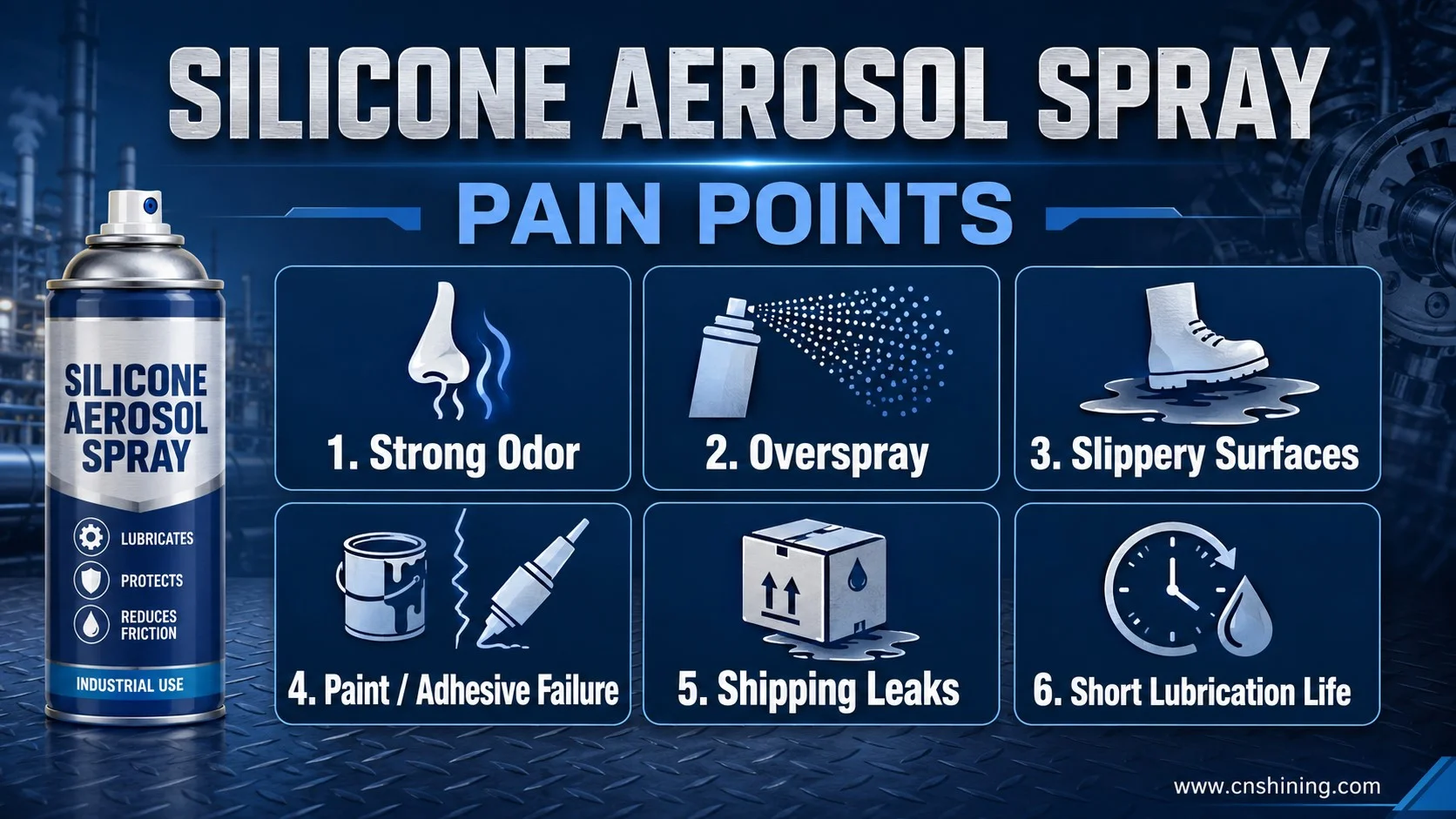
User complaints are consistent. The problem is rarely “not slippery enough.” It is usually odor, overspray, contamination, too much slip, short perceived life or poor spray control. That leads directly to packaging decisions.
| Болевая точка | Вероятная техническая причина | Packaging or Formula Response |
|---|---|---|
| Strong smell | Hydrocarbon solvent and propellant system | Low-VOC solvent, water-based emulsion, compressed gas valve route |
| Избыточное распыление | High flow, wide cone, poor nozzle control | Dual-mode actuator, lower narrow-stream flow, attachable straw or integrated flip straw |
| Slippery floor or grip area | Silicone film deposited outside target zone | Lockable actuator, warning icons, narrow spray mode, better instructions |
| Paint, adhesive or print failure | Silicone contamination on future bonding or coating surface | Front-label exclusions for unfinished wood, paint-prep areas, adhesive zones and print surfaces |
| Leaking during shipping | Actuator movement, valve leakage, cap loss | Twist-lock actuator, hidden orifice, e-commerce drop and leakage validation |
| Short lubrication life | Too thin film, low silicone viscosity, high carrier volatility | Higher-viscosity silicone fluid, more persistent carrier, application-specific SKU split |
The most practical improvement is not always a new active chemistry. For home and automotive users, a dual-spray actuator with a lock may solve more real complaints than a more expensive silicone fluid. For industrial users, documentation and repeatable spray rate often matter more than a premium-looking can.
8. Shining Packaging: Actuators, Aerosol Cans and Valves for Silicone Spray
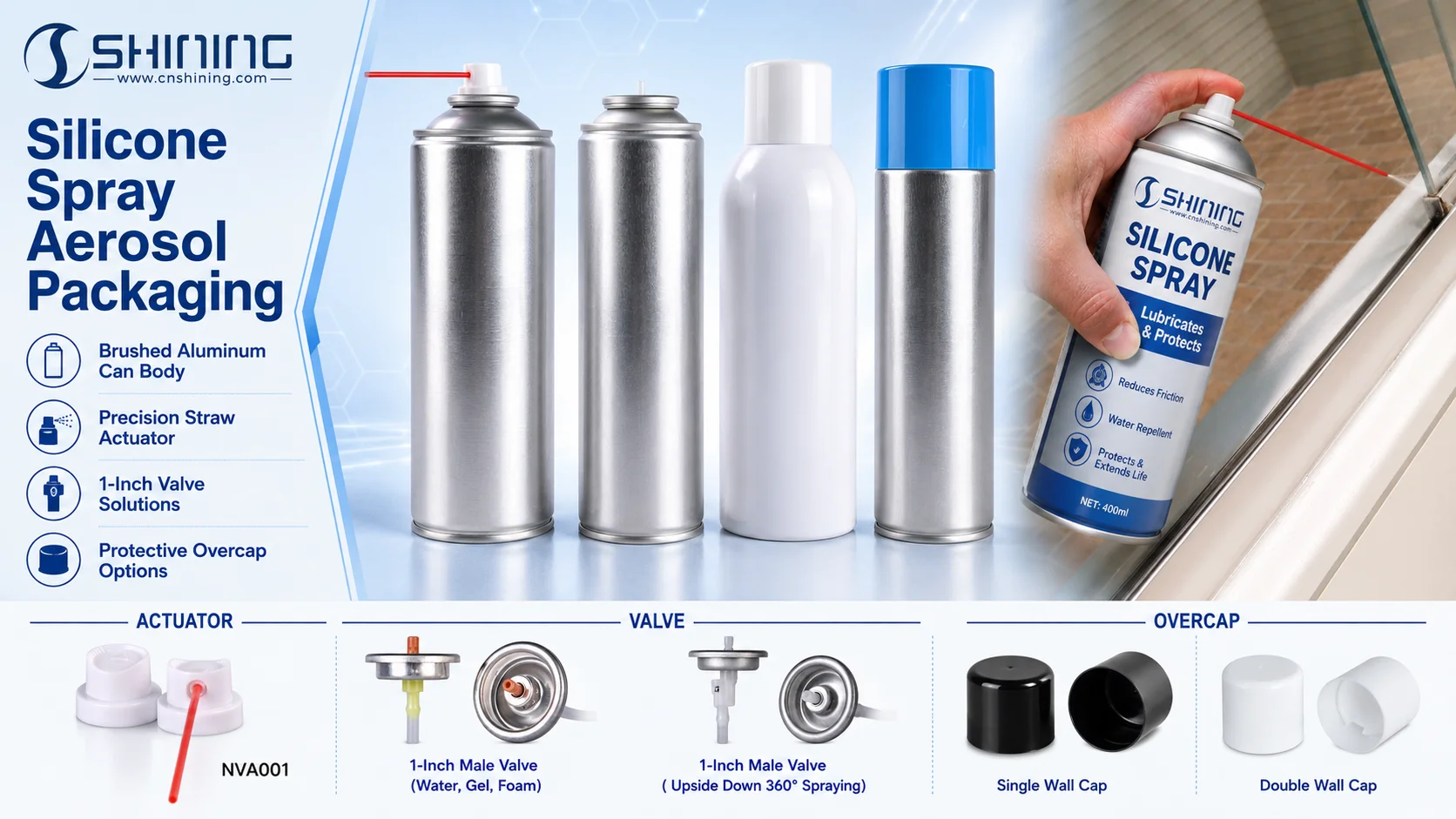
For silicone aerosol spray, packaging is part of the formulation system. A good valve and actuator do not fix a weak formula, but a poor spray package can make a good formula look uncontrolled. The key variables are spray rate, droplet size, leakage resistance, actuator force, cap or lock design, and compatibility with LPG, water-based emulsion, solvent-rich systems or compressed gas routes.
Shining Packaging fits this product category through three practical component groups: исполнительные механизмы, аэрозольные баллончики и клапаны. For silicone spray, the actuator should support controlled wide spray and accurate narrow application. The valve should match viscosity, propellant pressure and expected output rate. The can should be selected around pressure rating, internal corrosion risk, filling route, transport classification and shelf-life target.
A useful specification discussion should start with use case, not catalog diameter. Is the spray for garage doors, food equipment, rubber seals, mold release or electronics moisture protection? Is odor reduction more important than fast drying? Does the channel require e-commerce leakage control? These questions decide whether the packaging should prioritize a dual-mode actuator, a lockable head, a particular valve output, a lined can or a different propellant strategy.
9. Заключение
Silicone aerosol spray succeeds when the formula and packaging are designed as one system. PDMS gives the product its low-surface-energy film, but the user judges the result through odor, spray control, residue, safety and whether the product contaminates the wrong surface. The next product upgrades are likely to come from low-VOC or water-based chemistry, better actuator control, lockable anti-leak designs, clearer compatibility labels and recyclable or lighter can systems. That is the technical work worth doing.
10. FAQ: Silicone Aerosol Spray
Most maintenance-grade silicone aerosol sprays combine a silicone fluid such as PDMS, a volatile solvent or diluent, a propellant, and an aerosol valve system. Public SDS examples show that silicone fluid may be only a small percentage of the formulation. The carrier and propellant spread the silicone quickly, then evaporate to leave a thin boundary film.
No. Silicone spray usually relies on siloxane-based silicone fluids such as PDMS for lubrication, water repellency and surface slip. Silane products are more often used as coupling agents, primers or reactive hydrophobic treatments. The names are sometimes mixed in commercial language, so specifications should check CAS numbers, SDS content and intended application.
The smell usually comes from hydrocarbon solvents and propellants rather than the silicone oil itself. Fast-drying maintenance sprays often use petroleum solvents, heptane or LPG blends. Lower-odor designs usually require lower-VOC carrier choices, water-based silicone emulsions, compressed gas valve systems or a different evaporation profile. Fragrance masking rarely solves the root issue.
Silicone fluid spreads easily and forms a low-surface-energy film. That is useful for slip and release, but harmful on surfaces that must later be painted, printed, bonded or stained. Even light overspray can reduce wetting or adhesion. Unfinished wood, automotive trim, vinyl wrap zones and adhesive surfaces need strong warnings and controlled application.
Silicone spray is often better for rubber seals, plastic interfaces, water repellency, light anti-squeak work and electrical moisture protection. PTFE spray is stronger when a clean dry-film friction reducer is needed, especially in dust-sensitive sliding parts. The best choice depends on load, surface material, cleanliness requirement and future painting or bonding needs.
Usually not. Silicone aerosol spray creates a thin boundary film and works well in light-load sliding or anti-squeak applications. Grease is used where the contact needs thicker film retention, load support, anti-wear additives or longer service intervals. Using silicone spray on gears, heavy bearings or high-load mechanisms often gives short life and poor protection.
The actuator controls how much material leaves the can, where it lands and how much becomes overspray. For silicone spray, overspray is a safety and contamination issue because the film is slippery and difficult to remove from coating or bonding surfaces. Dual-mode actuators, integrated straws and lockable heads can reduce user error significantly.
Low VOC development means the solvent and propellant system must be redesigned, not just relabeled. A lower-VOC product may use a different carrier, a water-based silicone emulsion, compressed gas dispensing or a higher solids approach. The challenge is keeping spray quality, drying behavior, material compatibility and shelf stability while meeting regional VOC rules.
Yes, but they behave differently from solvent-rich products. Water-based silicone sprays can reduce odor and flammability and may support food-equipment positioning. They need stable emulsions, suitable corrosion control, compatible valve materials and acceptable drying time. The user may perceive them as less aggressive or slower drying, so the target application must be clear.
Start with propellant, solvent, silicone viscosity, target output rate, spray pattern, can compatibility, leakage risk and shipping classification. Then check the user scenario: broad surface coverage, narrow-track lubrication, food equipment, automotive rubber, or industrial release. The correct valve, actuator and can lining depend on those details, not just on can size.