
1. Введение
Canned food becomes shelf-stable only after the sealed container receives a validated heat treatment.
This treatment is known as canned food sterilization. The food is filled into a container, sealed, heated under controlled conditions, and then cooled. The goal is commercial sterility, not the destruction of every microorganism. Commercially sterile food contains no microorganisms capable of growing under normal storage conditions.
Sterilization is more severe than pasteurization. Pasteurization controls many vegetative microorganisms but may not destroy heat-resistant spores. Low-acid canned foods usually require pressure processing at temperatures above 100°C because spores can survive boiling-water temperatures.
The process protects consumers from foodborne illness, reduces spoilage, and allows the product to remain stable without refrigeration. It must also protect product quality. Excessive heating can damage texture, color, flavor, and nutrients.
A retort temperature alone does not define a safe process. Product pH, viscosity, particle size, container dimensions, initial temperature, heating time, pressure, and heat penetration all affect the result.
2. Main Steps in the Canned Food Sterilization Process
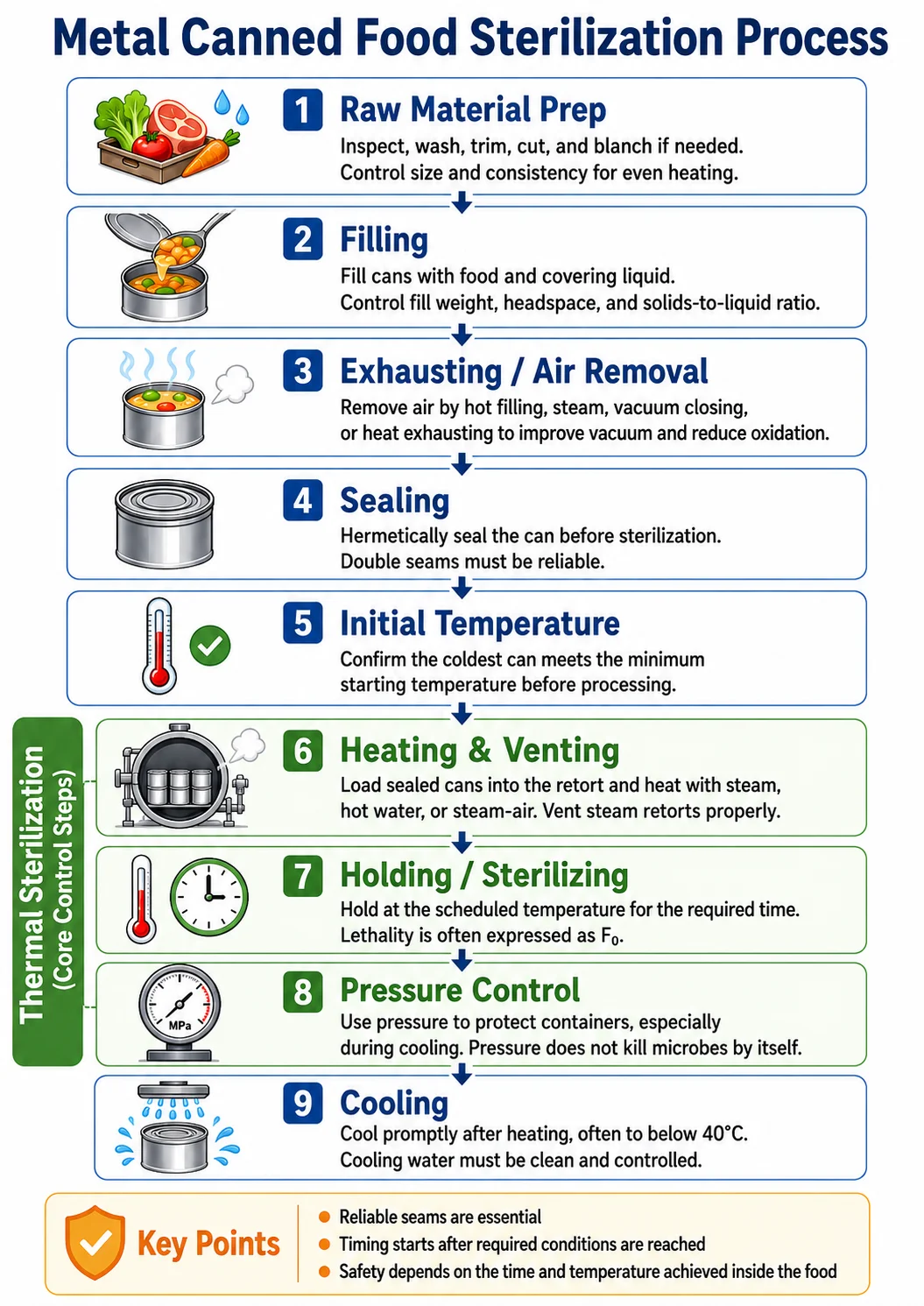
2.1 Raw Material Preparation
Raw materials are inspected, washed, trimmed, cut, and sometimes blanched before filling.
Piece size and product consistency should remain controlled. Large meat pieces, dense vegetables, or unexpected changes in viscosity can slow heat transfer.
2.2 Filling the Containers
The food and covering liquid are filled into metal cans or other suitable containers.
Fill weight, solids-to-liquid ratio, headspace, and product distribution must stay within the limits used to develop the thermal process. Overfilling can slow heating and increase internal pressure.
2.3 Exhausting and Air Removal
Air is removed by hot filling, steam injection, vacuum closing, or heat exhausting.
This step helps create a suitable vacuum after cooling. It also reduces oxidation and limits excessive pressure inside the container during heating.(источник)
2.4 Sealing
The container is hermetically sealed before sterilization.
Metal cans normally use a double seam. Seam dimensions must be checked regularly because a poor seam can allow microorganisms to enter after processing. This risk is especially high while the cans are wet and cooling.
2.5 Thermal Sterilization
Thermal sterilization is the main control step. Sealed containers are loaded into a retort and exposed to steam, hot water, or a steam-air mixture.
The process usually includes heating, holding, and cooling. The exact temperature and time depend on the food and package. A process used for soup in a small can cannot be applied directly to meat in a larger container.
Initial Product Temperature
The temperature of the coldest can before processing must meet the minimum specified in the scheduled process.
A colder product takes longer to heat. For this reason, hot-filled products should be retorted without unnecessary delay. Initial temperature is especially important for dense foods that heat mainly by conduction.
Heating and Venting
During the heating stage, steam or hot water raises the temperature of the retort and its load.
Steam retorts must be vented correctly. Air trapped inside the vessel can lower the temperature of the steam-air mixture and create cold zones. Processing time should not begin until the retort has reached the required conditions.
Holding Time
Once the process temperature is reached, the product is held for a defined period.
Many low-acid foods are processed near 121°C, but this is not a universal setting. Some products use lower temperatures for longer periods. Others use higher temperatures for shorter periods.
The process must deliver enough heat to the slowest-heating point inside the container. This point may be near the center, but its exact location depends on how the product transfers heat.
Thermal treatment is often expressed as an F₀ value. F₀ represents the equivalent processing time at 121.1°C. It is calculated from the complete product temperature history rather than the retort temperature alone.
Pressure Control
Pressure allows the retort to operate above the boiling point of water. It also protects the container from deformation.
Pressure itself does not provide microbial lethality. Safety comes from the time and temperature reached inside the food.
During cooling, pressure control becomes particularly important. Steam in the retort condenses quickly when cold water enters. External pressure can fall while pressure inside the hot container remains high. Without counterpressure, cans may buckle, panel, leak, or suffer seam damage.
Cooling
Containers are cooled after the required heat treatment has been delivered.
Cooling should be fast enough to stop further cooking and limit the growth of heat-tolerant organisms. Many products are cooled to below 40°C before leaving the retort.(источник)
Cooling water must be clean and controlled. A damaged container can draw water inward as its internal pressure falls.
3. Common Sterilization Methods for Canned Food
3.1 Steam Sterilization
Steam retorts use saturated steam as the heating medium.
They are widely used for rigid metal cans because steam transfers heat efficiently. The main operating concern is air removal. Poor venting can produce uneven temperatures inside the vessel.
3.2 Water Immersion Sterilization
Water immersion retorts process containers in circulating hot water.
The containers may be fully or partly submerged. Temperature and pressure can be controlled separately, making this method suitable for packages that require overpressure.
Water circulation and temperature uniformity must be checked throughout the load.
3.3 Water Spray Sterilization
Water spray retorts circulate heated water through nozzles or distribution plates.
The process water is normally heated and cooled through a heat exchanger. Compressed air is used to control pressure.
Spray coverage must remain consistent. Blocked nozzles or changes in basket loading can affect heat distribution.
3.4 Rotary Retort Sterilization
Rotary retorts move or rotate containers during processing.
Agitation can improve heat transfer in soups, sauces, dairy products, and some foods containing particles. Faster heating may reduce processing time and limit surface overcooking.
Rotation does not improve every product. Its effect depends on viscosity, headspace, container orientation, and rotational speed.
3.5 Continuous Sterilization
Continuous sterilizers move containers through heating, holding, and cooling sections without stopping the production flow.
They are commonly used for high-volume production with stable container sizes and recipes. Conveyor or reel speed becomes a process parameter because it determines how long each container remains in the heating zone.
4. Equipment Used in the Canned Food Sterilization Process
| Оборудование | Типичное использование | Main control point |
|---|---|---|
| Horizontal batch retort | Flexible production with different products and can sizes | Load pattern and circulation |
| Vertical retort | Smaller batches or plants with limited floor space | Load consistency |
| Steam retort | Rigid metal cans | Venting and steam distribution |
| Water immersion retort | Products requiring controlled overpressure | Water temperature and circulation |
| Water spray retort | Metal cans and pressure-sensitive packages | Spray coverage and flow |
| Rotary retort | Products that benefit from agitation | Rotation speed and headspace |
| Hydrostatic sterilizer | Large continuous production lines | Conveyor speed and zone temperature |
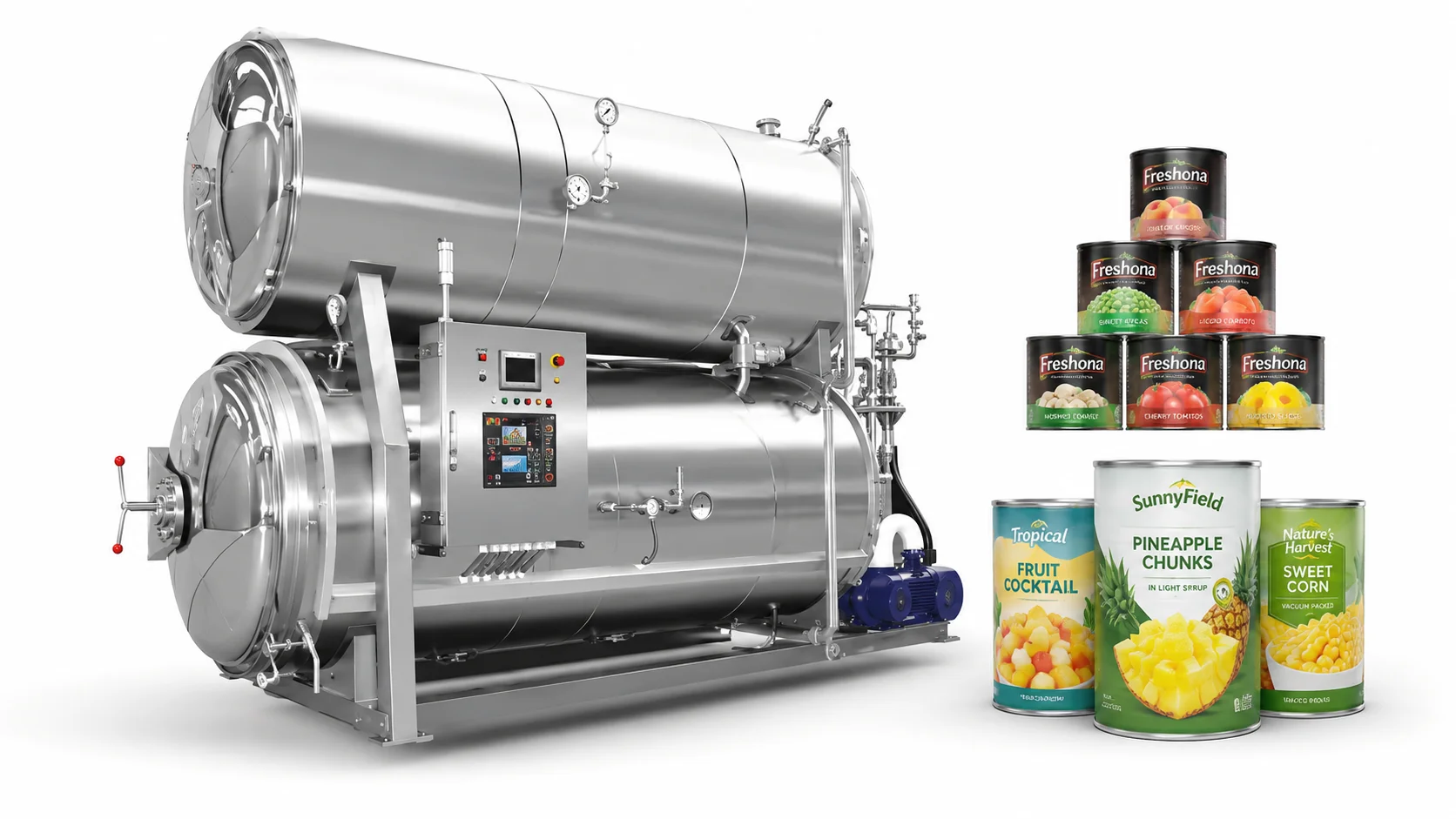
Retorts also require temperature sensors, recording instruments, pressure gauges, timers, controllers, and alarm systems. These instruments must be calibrated at defined intervals.
The control system should record what actually happened during the process. A programmed setpoint is not proof that the required conditions were achieved.
5. Key Factors That Affect Sterilization Effectiveness
5.1 Food Acidity
Food pH strongly affects the required sterilization conditions.
High-acid and acidified foods have an equilibrium pH of 4.6 or below. Their acidity limits the growth of Clostridium botulinum. These foods can often be processed at or below 100°C.
Low-acid foods have a pH above 4.6. They include many meat, seafood, dairy, and vegetable products. These foods normally require pressure processing above 100°C.
The pH category helps define the processing method, but it does not provide a complete time-temperature schedule.
5.2 Product Consistency
Liquids normally heat by convection. Movement inside the container carries heat from the wall toward the center.
Dense solids and thick products heat mainly by conduction. Heat moves slowly through the food, so longer processing may be required.
Recipes must remain controlled. Adding starch, changing particle size, reducing liquid, or packing solids more tightly can change heat penetration.
5.3 Container Size and Shape
Large cans usually heat more slowly than small cans because heat must travel farther to reach the cold point.
Can diameter, height, material, fill weight, and headspace also influence heating. A new container size normally requires a separate process review.
5.4 Initial Temperature
A low initial temperature increases the time needed for the product to reach an effective processing temperature.
Production should use the same minimum initial temperature applied during process development.
5.5 Retort Loading
Basket design, separator plates, container orientation, load density, water flow, and steam circulation affect temperature distribution.
A retort display may show the correct temperature while part of the load remains colder. This is why the equipment and loading arrangement must be tested together.
6. How Manufacturers Validate a Sterilization Process
6.1 Heat Distribution Tests
A heat distribution test measures temperatures at different positions inside the retort.
The purpose is to identify the coldest area and confirm that heating remains uniform under normal production conditions. The test should use the intended baskets, loading pattern, circulation system, and operating settings.
6.2 Heat Penetration Tests
A heat penetration test measures the product temperature inside selected containers.
Temperature sensors are placed near the expected cold point. The test records heating and cooling behavior and shows how much thermal treatment the product receives.
The result applies only to the tested product, formulation, container, fill weight, initial temperature, loading pattern, and retort conditions.

6.3 Scheduled Process Development
A scheduled process defines the minimum safe operating conditions for a specific canned product.
It normally includes process temperature, processing time, initial temperature, container size, product formulation, fill weight, headspace, and any required agitation settings.
Low-acid canned food processes should be developed or reviewed by a qualified thermal process authority.
6.4 Monitoring and Calibration
Operators must monitor the parameters named in the scheduled process.
This usually includes temperature, time, pressure, initial temperature, circulation, and rotation speed where applicable.
Temperature sensors, gauges, timers, and recording devices should be calibrated. Records should be reviewed before the product is released.
6.5 Incubation Testing
Incubation testing is used to detect spoilage caused by inadequate processing, container leakage, or post-process contamination.
For example, selected cans may be held at 37°C for 10 to 14 days to detect mesophilic spoilage, or at 55°C for five days to check for thermophilic spoilage. After incubation, the containers are examined for swelling, leakage, vacuum loss, pH changes, and other signs of spoilage.
Incubation testing supports routine process verification, but it does not replace a validated scheduled process, heat penetration studies, container integrity checks, or production-record review.
6.6 Process Deviations
A process deviation occurs when a required limit is not met.
Affected containers should be identified and held. They should not be released based only on appearance, incubation, or limited product testing. A qualified person must evaluate the deviation and decide whether the product can be reprocessed, released, or rejected.(источник)
7. How to Choose a Canned Food Sterilization System
The selection should begin with the product rather than the retort.
A thin liquid, a thick sauce, and a solid meat product do not heat in the same way. Product pH, viscosity, particle size, and heat-transfer behavior determine the type of process required. The container must also be considered. Metal cans can be processed in steam, immersion, spray, or rotary systems, while more pressure-sensitive packages usually need controlled overpressure.
Production volume also affects the decision. Batch retorts are easier to use when a factory handles several products, recipes, or can sizes. Continuous systems suit long production runs with limited changeovers. They offer higher throughput, but line speed and stoppages require close control.
The equipment must provide repeatable temperature distribution with the actual baskets and loading pattern used in production. Water use, steam consumption, heat recovery, maintenance access, automation, and record storage should also be reviewed. These operating details matter, but they come after process safety.
The selected system must be able to follow the validated scheduled process. A more complex retort does not make an unsuitable process safe.
8. Заключение
Canned food sterilization depends on the temperature reached inside the product, not only the temperature shown on the retort.
A safe process connects the formulation, container, initial temperature, loading method, heat penetration, pressure control, cooling, and seam integrity. Each parameter must remain within the limits used during validation.
The retort applies the process. It does not replace process development.
9. FAQ: Canned Food Sterilization
Commercial sterility is assessed through process validation, production records, container checks, incubation, and microbiological examination.
No single finished-product test can prove that every can is safe. The main control is the correct application of a validated scheduled process.
Heat penetration describes how quickly heat moves through food inside a sealed container.
A heat penetration test measures the product temperature near its cold point. The results are used to establish processing time and calculate thermal lethality.
HACCP is a food-safety system based on hazard analysis, control points, limits, monitoring, corrective actions, verification, and records.
In canned food production, it may cover formulation, filling, sealing, thermal processing, cooling, and container handling.
High-acid foods are often processed at or below 100°C.
Low-acid shelf-stable foods normally require pressure processing above 100°C. Many processes operate near 121°C, but the correct temperature and time depend on the product and container.
Pressure inside a hot can remains high when cooling begins.
If retort pressure falls too quickly, the container may deform or lose seam integrity. Controlled counterpressure protects the package while its internal temperature and pressure decrease.