
Metal food cans are not named at random. Codes like #1, #2, #10, 300, and 303 usually point to a known can size, capacity range, and use case.
For food manufacturers, can size affects more than fill weight. It also affects packaging cost, pallet efficiency, shelf layout, seaming setup, retort process, and line compatibility.
One point is easy to miss: the same can size does not always mean the same net weight. Peaches, beans, tomato paste, soup, and meat products do not pack the same way. Can volume is a reference point. The actual labeled weight depends on the product.
1. How to Read Metal Food Can Size Codes
Traditional food cans are often described in two ways.
1.1 Numbered Can Sizes: #1, #2, #2.5, #3, #5, #10
These names are older industry terms. They are still useful because they quickly describe the general capacity and application.
A #10 can, for example, usually means a large foodservice can. It is common in restaurants, cafeterias, hotels, and institutional kitchens.
1.2 Three-Digit Can Codes: 300, 303, 307 × 409
North American metal can dimensions often use three-digit codes. The code is based on inches and sixteenths of an inch.
The first group usually shows the can diameter. The second group shows the can height.
For example:
307 × 409 means:
- Diameter: 3 + 7/16 inches
- Height: 4 + 9/16 inches
So the can is about 3.4375 inches wide and 4.5625 inches tall.
2. Common Metal Food Can Size Chart
| Размер банки | Can Industry Code | Can Industry Code | Approx. Volume | Approx. Cups | Типичные области применения |
|---|---|---|---|---|---|
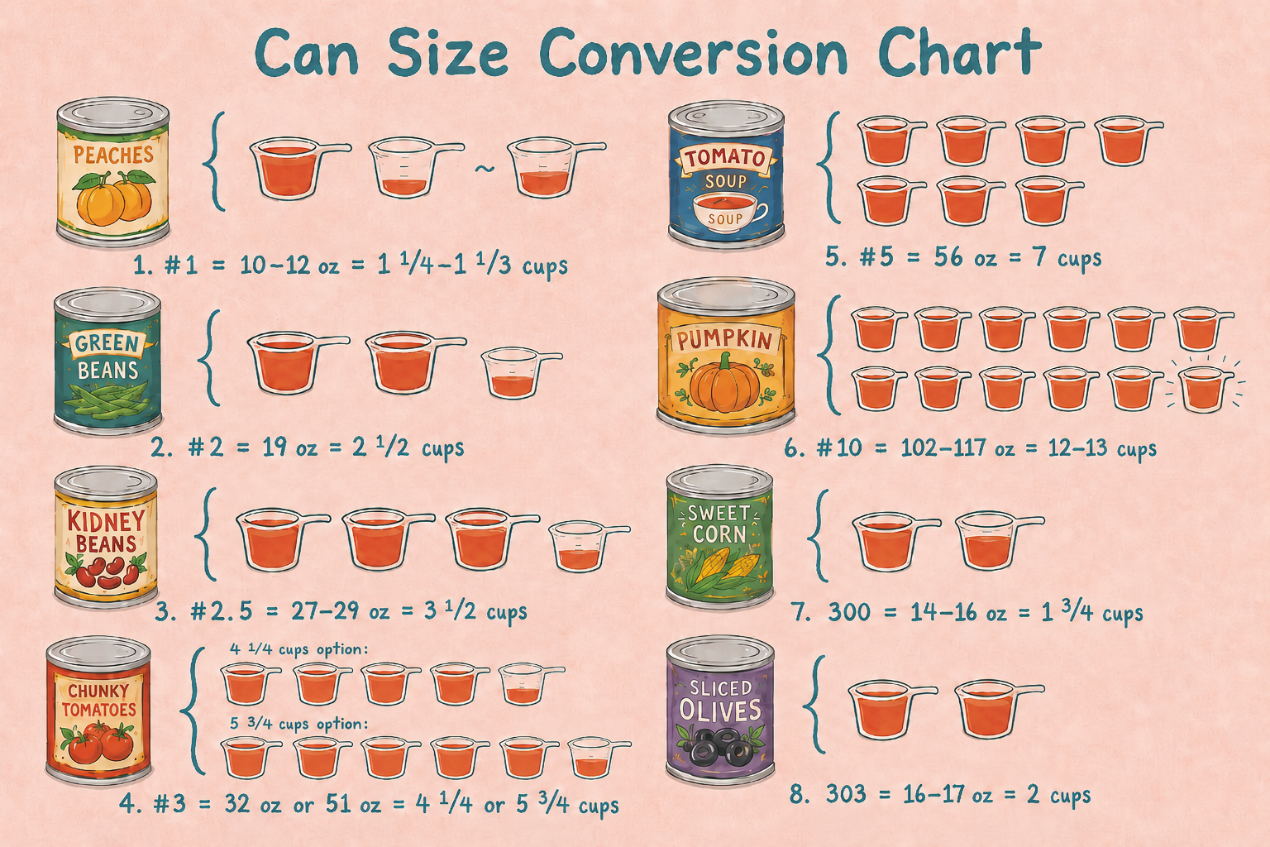
| #1 / Picnic Can | 211 × 400 | 2 + 11/16 × 4 inches | 10–12 oz | 1 1/4–1 1/3 cups | Fruit, soup, vegetables, small portions, meat, fish, specialty foods |
| #2 Can | 307 × 409 | 3 + 7/16 × 4 + 9/16 inches | 19 унций | 2 1/2 cups | Vegetables, fruit, tomato products, beans |
| #2.5 Can | 401 × 411 | 4 + 1/16 × 4 + 11/16 inches | 27–29 oz | 3 1/2 cups | Vegetables, fruit, tomato products, beans |
| #3 Can | 404 × 414 or 404 × 700 | 4 + 4/16 × 4 + 14/16 inches, or 4 + 4/16 × 7 inches | 32 oz or 51 oz | 4 1/4 cups or 5 3/4 cups | Juice, tomato juice, large-portion foods |
| #5 Can | 502 × 510 to 514 | 5 + 2/16 × 5 + 10/16 to 5 + 14/16 inches | 56 oz | 7 cups | Soup, chili, foodservice sauces, bulk food, large tuna packs |
| #10 Can | 603 × 700 | 6 + 3/16 × 7 inches | 102–117 oz | 12–13 cups | Foodservice packs, bulk vegetables, fruit, sauces |
| 300 Can | 300 × 407 | 3 × 4 + 7/16 inches | 14–16 oz | 1 3/4 cups | Soup, beans, vegetables, pork and beans, baked beans, meat products, cranberry sauce, blueberries, specialty foods |
| 303 Can | 303 × 406 | 3 + 3/16 × 4 + 6/16 inches | 16–17 oz | 2 cups | Tomatoes, beans, fruit, vegetables, some meat products, ready-to-eat soups, specialty foods |
3. Detailed Breakdown of Each Common Food Can Size
3.1 #1 Can: Small Retail and Picnic Size
The #1 can is often called a picnic can. It is a smaller retail size and works well for single-use or small-portion products.
It is commonly used for fruit, vegetables, soups, meat products, fish products, and specialty foods. For retail shelves, it can also work as a trial-size or low-commitment package.
3.2 #2 Can: Popular Household Food Can Size
The #2 can is one of the more familiar household food can sizes. It holds about 19 oz, or around 2.5 cups.
It is often used for fruit, vegetables, tomato products, and beans. For many products, it fits a 2–4 person household better than a small picnic can or a larger foodservice can.
3.3 #2.5 Can: Medium-Large Retail Can
The #2.5 can usually holds about 27–29 oz, or around 3.5 cups.
It is common for sliced fruit, stews, thick soups, sauces, and tomato products. It works when a #2 can is too small, but a #10 can is far too large for the end user.
For retail, this size often fits family-style or shareable products. For light foodservice use, it can also be practical when turnover is moderate.
3.4 #3 Can: Large Capacity Food Can
The #3 can is a large-capacity format. Depending on the version, it may hold about 32 oz or 51 oz.
It is often used for juice, tomato juice, and larger-portion food products. The size can be useful when the product is consumed in batches, not as a single household serving.
3.5 #5 Can: Foodservice and Semi-Bulk Packaging
The #5 can holds about 56 oz, or around 7 cups.
It is common for soup, chili, foodservice sauces, and other batch-use products. It is smaller than a #10 can, which makes it easier to handle in kitchens with lower daily volume.
For small restaurants or lower-turnover foodservice operations, this can be a practical middle ground. It reduces package count without forcing the kitchen to open a very large can.
3.6 #10 Can: Bulk Foodservice Can
The #10 can is a standard large foodservice can. It is common in restaurants, cafeterias, hotels, catering operations, and institutional kitchens.
It usually holds about 3 quarts, or roughly 102–117 oz. In weight terms, it may be around 6.5 lb to 7 lb 5 oz, depending on the product.
Typical products include tomato sauce, beans, fruit, vegetables, soup bases, and sauces.
The benefit is lower unit packaging cost. The tradeoff is handling after opening. Once opened, the product usually needs to be used quickly or transferred and refrigerated under proper food safety controls.
3.7 300 Can: Compact Standard Food Can
The 300 can is a compact standard size used for many shelf-stable foods.
Its typical size is about 3 inches in diameter and 4 + 7/16 inches tall. It is common for soups, beans, vegetables, pork and beans, baked beans, meat products, cranberry sauce, blueberries, and specialty foods.
For retail shelves, it is a practical size. It is easy to handle, easy to store, and close to the serving amount many households expect.
3.8 303 Can: Classic Vegetable and Fruit Can
The 303 can appears often in older recipes and traditional food packaging references.
It usually holds about 16–17 oz, or close to 2 cups. Common uses include beans, tomatoes, fruit, vegetables, some meat products, ready-to-eat soups, and specialty foods.
A 303 can is not always exactly the same as a 15 oz retail can. But in many recipe conversions, it is close enough to be treated as a nearby equivalent.
4. Numbered Can Sizes vs. Modern Ounce Labels
Older recipes may call for a “No. 303 can” or a “No. 2 can.” Modern retail products usually show net weight more clearly, such as 15 oz, 28 oz, or 102 oz.
That shift makes sense. Consumers care about how much food is inside. They are less interested in the can industry code.
For manufacturers, the old codes still matter. Empty-can purchasing depends on the actual body diameter, body height, end size, lid compatibility, and seaming setup.
So the label may say 15 oz. The production team still needs to know whether the package is closer to a 300 can, a 303 can, or another supplier-specific format.
5. How to Choose the Right Food Can Size
5.1 Based on Product Type
Soup, sauces, and tomato products need attention to flow behavior, hot filling, retort conditions, and headspace.
Fruit, vegetables, and beans need attention to drained weight, solids content, brine or syrup level, and finished net weight.
High-acid foods need the right internal coating. Corrosion resistance is not a detail to leave until the end.
5.2 Based on Target Market
For household retail, 300, 303, #2, and #2.5 cans are common choices.
For foodservice and institutional use, #5 and #10 cans usually make more sense.
For small portions, samples, or picnic-style products, the #1 can is often a better fit.
5.3 Based on Filling and Sealing Equipment
The can has to match the line. That means checking the can diameter, can height, lid size, seaming chuck, lifter plate, and filling setup.
A small dimensional difference can create real production issues. Poor seam compatibility is not a packaging detail. It is a product safety risk.
Also check whether the project needs a two-piece can or a three-piece can. The choice affects sourcing, coating, forming, decoration, and equipment compatibility.
6. Заключение
A can size code is a useful starting point, not the final specification.
Use the traditional size name to talk about general capacity. Use the three-digit code to understand the diameter and height. Then confirm the supplier’s actual specification sheet before ordering cans, designing labels, or setting up the filling line.
That simple check prevents many avoidable problems: wrong label height, wrong end size, poor seaming fit, inaccurate net weight assumptions, and packaging that does not match the intended use.
7. FAQ
A #10 can is a large foodservice can. It usually holds about 102–117 oz, or around 12–13 cups. It is commonly used for restaurants, cafeterias, institutions, and bulk food packaging.
A 300 can is usually about 3 inches in diameter. A 303 can is usually about 3 + 3/16 inches in diameter. The 303 can is slightly wider and often holds close to 2 cups.
Not exactly. A 303 can is often close to 15–17 oz, depending on the product. In many recipe substitutions, it can be treated as a nearby match, but it is not a fixed net-weight standard.
#5 and #10 cans are common foodservice choices. #10 cans work better for high-volume kitchens. #5 cans are easier to manage when turnover is lower.
Traditional can names can include variants. Suppliers may also adjust dimensions based on can type, end design, seam structure, coating, and production equipment requirements. The safest answer is to check the actual can specification sheet.