
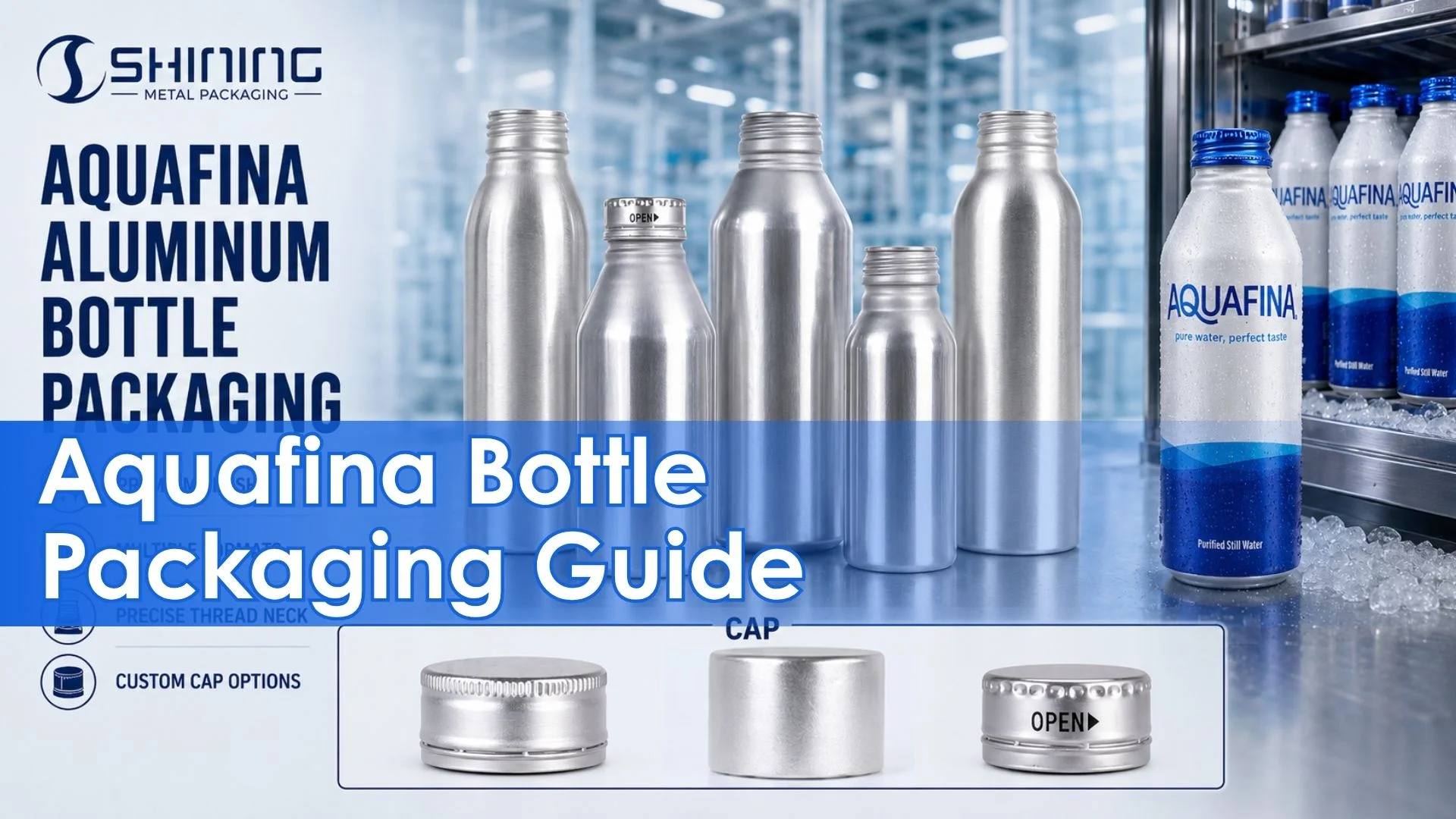
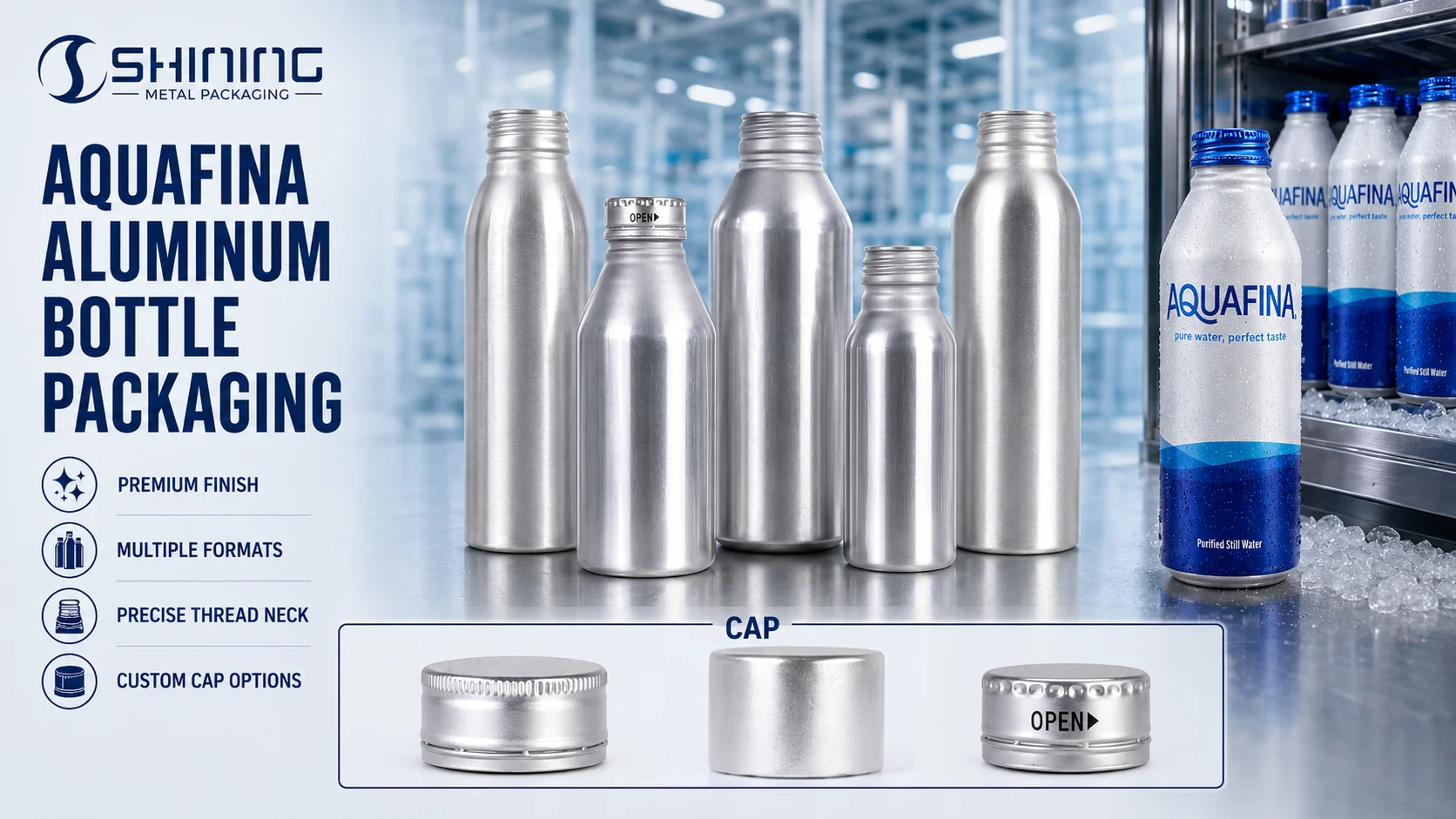
Aquafina’s public promise, “pure water, perfect taste,” gives its packaging a precise job: protect consistency without turning a familiar purified-water brand into a luxury spring-water story. The Aquafina aluminum bottle therefore makes the most sense not as a universal replacement for PET, but as a resealable 16 fl oz format for occasions where portability, cold presentation and stronger visual presence carry more value.
1. Purity Is the Brand Asset the Bottle Must Protect
Aquafina does not build its identity around a remote mountain, an ancient aquifer or a mineral-rich regional source. Its official purification explanation states that the water originates from public sources and passes through reverse osmosis and additional filtration and purification methods. That process supports a brand idea based on repeatable taste: consumers should receive the same clean profile wherever the bottle is purchased.
This distinction matters when aluminum is introduced. A silver metal package can easily suggest craft production, luxury positioning or an environmental campaign that dominates the water itself. Aquafina needs a narrower interpretation. Its recognizable blue wordmark, blue water graphics and clean silver field can make the package feel colder and more contemporary while preserving the visual familiarity of a mass-market purified-water brand.
The commercial product is also concrete rather than conceptual. PepsiCo Partners lists a 16 fl oz aluminum bottle packed 24 per case. The serving size remains close to Aquafina’s familiar single-serve water formats, while the case configuration points toward foodservice, hospitality, meetings, venues and other business channels. Aluminum changes the occasion and presentation more than it changes the underlying Aquafina product proposition.
2. Why the Aquafina Aluminum Bottle Works Best as a Channel-Specific Upgrade
The central packaging tension is accessibility versus added complexity. Aquafina has long operated as a high-volume water brand whose standard plastic multipacks establish a low price expectation. An garrafa de alumínio adds a formed metal body, internal food-contact coating, more sensitive decoration, a resealable closure system and additional line-control requirements. Those costs are difficult to justify when the purchase decision is based primarily on the lowest price per ounce.
The value equation changes in a stadium, hotel, conference, airport lounge, restaurant, catered event or premium convenience cooler. In these settings, the package is handled in public, often carried after opening and sometimes placed in a cup holder or bag. A tamper-evident bottle that can be closed again answers that action sequence more directly than a standard pull-tab can. The 16 fl oz capacity is also large enough for a normal hydration occasion without pushing the product toward the oversized, refillable-bottle behavior used by heavier aluminum formats.
This makes the Aquafina aluminum bottle a selective format extension. It should be evaluated as a cold single bottle, a venue package or a curated case product—not as a direct substitute for every family multipack. Where the priority is instead the lowest possible metal-packaging complexity, high-speed packing and dense pallet efficiency, an aluminum can may remain the more economical route. Where movement after opening matters, the bottle earns its additional components through resealability.
The brand language should follow the same discipline. Aquafina does not need to imitate the dark, disruptive visual codes of entertainment-led canned water or the nature photography of premium spring brands. Its opportunity is quieter: recognizable purified water in a cleaner, colder-looking and more occasion-appropriate container.
3. The Bottle Is a System: Coating, Neck, Closure and Surface
Still water has no carbonation pressure to manage, but that does not make its metal package technically simple. Because purified water has a restrained flavor profile, a minor organoleptic change, slow leak or inconsistent opening force can be more noticeable than it would be in a strongly flavored drink. The project therefore depends on the interaction between the bottle body, internal coating, neck finish, closure liner and filling process.
| Elemento de embalagem | Aquafina-Specific Decision | Development and Validation Focus |
|---|---|---|
| Bottle geometry | Retain a compact 473 mL / 16 fl oz proportion that reads as an immediate-consumption water bottle rather than a reusable flask. | Grip comfort, cup-holder fit, shoulder stability, base seating, conveyor contact, side-load sensitivity and visible dent tolerance. |
| Revestimento interno | Use a continuous beverage-grade food-contact barrier selected against the actual purified-water chemistry and filling conditions. | Water pH, conductivity, chloride and sulfate levels, ozone exposure, target shelf life, migration, corrosion and taste-panel performance. |
| Neck and closure | Prioritize tamper evidence and reliable resealing without making the first opening feel unusually difficult. | Neck tolerances, liner compatibility, application settings, removal torque, bridge break, reclosing behavior and transport leakage. |
| Decoration and varnish | Preserve the silver-and-blue Aquafina system with controlled contrast rather than adding heavy luxury textures or unrelated environmental graphics. | Blue color consistency, condensation resistance, abrasion, varnish adhesion, barcode readability and date-code visibility. |
| Pilot validation | Test the decorated bottle with production water, the intended closure and the proposed case configuration. | Leak and torque testing, drop and vibration exposure, thermal cycling, accelerated storage, flavor comparison and post-transport appearance. |
The regulatory basis for the internal barrier is functional rather than decorative: 21 CFR 175.300 describes qualifying resinous and polymeric coatings as continuous films that can separate food from a metal substrate. The actual coating chemistry should therefore be chosen only after the water specification, filling process and target markets are confirmed.
Consumer comments on comparable aluminum water bottles identify the same practical variables. Recent verified-purchase feedback for a 16 fl oz aluminum Dasani bottle praises the package for staying cold and limiting external sweating, while PATH buyers describe bottles that remained leak-free after drops but retained visible dents; price is also a recurring concern. These observations should be treated as category signals rather than Aquafina-specific findings, but they show why thermal feel, dent acceptance, closure integrity and price perception belong in the same development brief.
Shining Packaging can coordinate bottle geometry with inner-coating selection, neck and liner matching, and ROPP closure validation before pilot filling.
4. Competitor Landscape: Five Still Waters in Aluminum Bottles
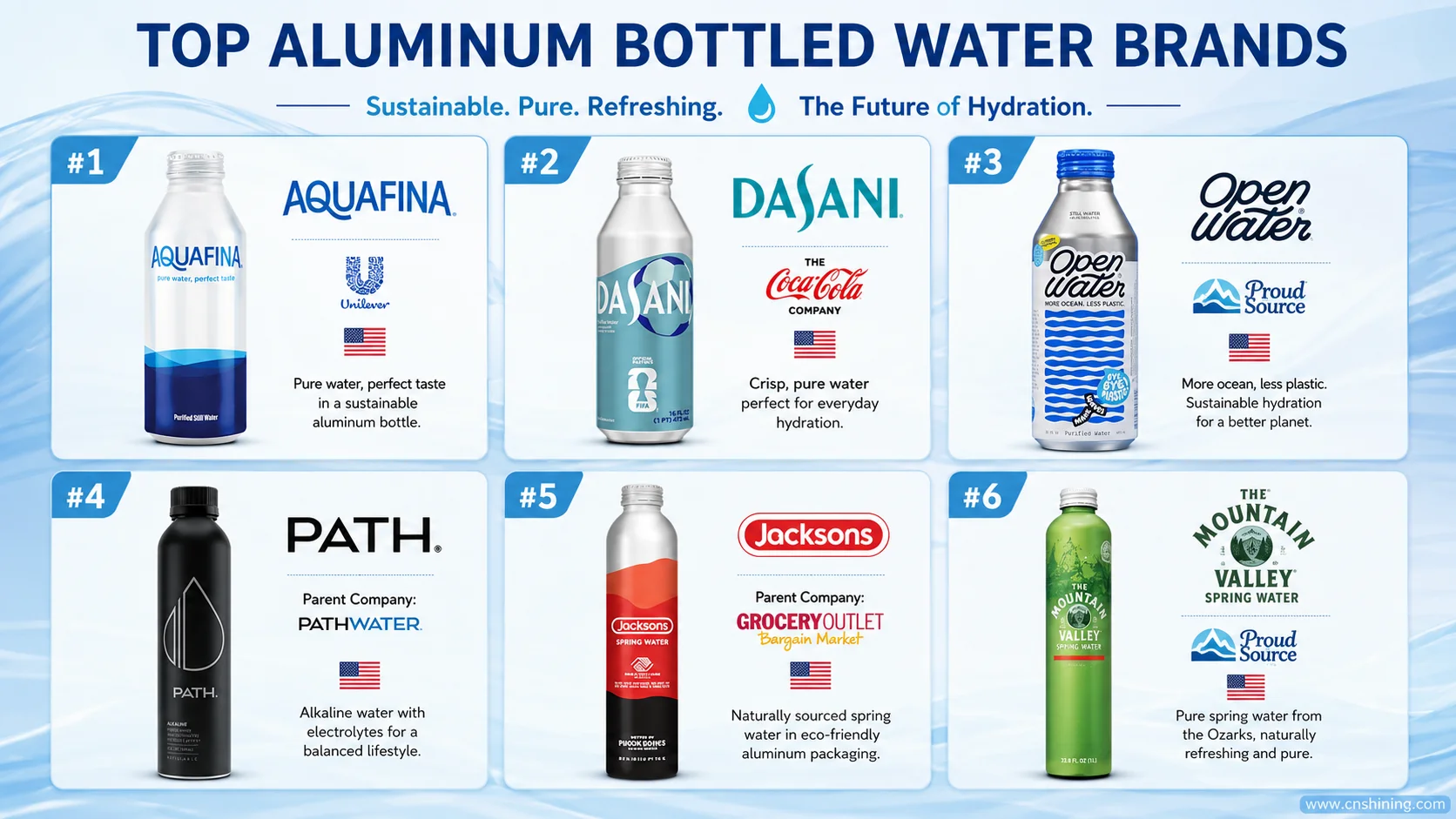
Aluminum-bottled water is not a single competitive category. Some brands use the bottle as a disposable but resealable alternative to plastic; others use thicker walls and wide mouths to encourage repeated refilling; premium spring brands use aluminum to extend an established source story into outdoor and travel occasions. The table compares finished still-water products that use aluminum bottles rather than packaging suppliers or material companies.
| Marca | País | Empresa Matriz | Capacidade | Retail Price per Bottle | Core Selling Point |
|---|---|---|---|---|---|
| Dasani | Estados Unidos | The Coca-Cola Company | 16 fl oz | Approx. $1.66 | Mainstream purified water in a familiar single-serve aluminum bottle, with minerals added for taste. |
| Águas abertas | Estados Unidos | Green Sheep, Inc. DBA Open Water | 16 fl oz | Approx. $2.00 | Purified water combined with ocean-conservation funding, local sourcing and an explicit recycled-aluminum narrative. |
| PATH | Estados Unidos | Pathwater, Inc. | 25 fl oz | $2.98 | A thicker, wide-mouth bottle designed to be refilled repeatedly, moving the product closer to an entry-level reusable vessel. |
| Fonte de água de origem orgulhosa | Estados Unidos | SOURCE Global, PBC | 25.3 fl oz | $3.79 | Naturally alkaline U.S. spring water, source identity and a plastic-reduction mission in a resealable aluminum bottle. |
| Mountain Valley | Estados Unidos | Primo Brands Corporation | 750 mL / 25.36 fl oz | $3.49 | Historic American spring-water provenance translated into a resealable format for hiking, beaches and other outdoor occasions. |
The comparison locates Aquafina in a specific middle position. Dasani is the closest mainstream reference because it combines purified water, a 16 fl oz capacity and a large beverage-company distribution model. Open Water and Proud Source give packaging and environmental purpose a larger share of the brand narrative. PATH asks consumers to retain and refill a larger, more durable bottle, while Mountain Valley uses aluminum to extend a long-established premium spring identity.
Aquafina does not need to outperform these products on every axis. Its differentiation is a familiar purified-water experience placed in a more presentable, resealable package for events, foodservice and travel. That position is credible only if the aluminum extension remains visually unmistakable as Aquafina and does not make environmental or reuse claims that the complete bottle, closure and distribution system cannot support.
5. Compliance, Claims and the Final Development Decision
For a U.S. launch, the water and the package must be reviewed as separate but connected compliance systems. The FDA bottled-water framework points manufacturers to 21 CFR 165.110 for bottled-water identity and quality and Part 129 for processing and bottling controls. Food-contact documentation must additionally cover the bottle coating, closure liner, inks and any labels or adhesives that could affect the finished package.
Environmental wording requires similar restraint. The FTC Green Guides caution against broad, unqualified claims such as “green” or “eco-friendly” and require recyclable claims to reflect consumers’ real access to appropriate collection systems. “Aluminum bottle,” “please recycle according to local guidance” and a verified recycled content percentage are more defensible than absolute statements such as “zero impact,” “100% sustainable” or “plastic-free” without a component-by-component assessment.
An export version needs an early coating review rather than a late label correction. The European Union’s current bisphenol regulation for food-contact materials covers varnishes, coatings, plastics, inks, adhesives and other relevant material groups. A project intended for both U.S. and EU markets should establish the coating chemistry, liner formulation, supporting declarations and migration-testing plan before commercial decoration is approved.
6.Conclusion
The strongest case for an Aquafina aluminum bottle is not a wholesale material conversion. It is a controlled 16 fl oz extension that preserves the brand’s purified-water clarity while improving resealability, public presentation and channel fit. Its success will depend less on the visibility of aluminum than on disciplined coating selection, closure performance, decoration durability and a price structure matched to venues where those differences are noticed.