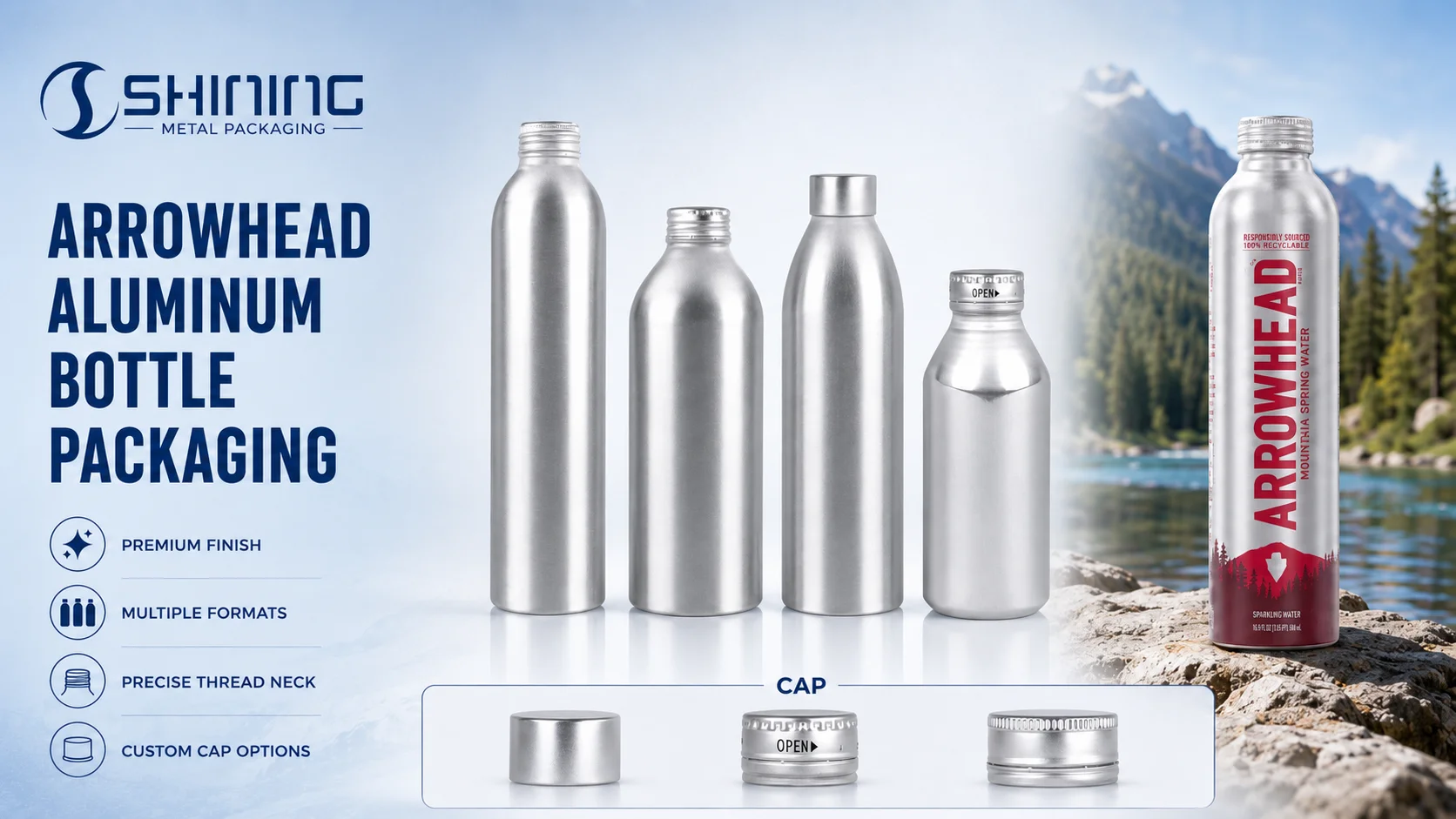
The Arrowhead aluminum bottle is not a low-cost replacement for the brand’s mainstream PET range. It is a 25 fl oz mountain spring water package designed for occasions in which resealability, portability, visual distinction and a higher acceptable unit price matter more than minimum container cost. Arrowhead already sells this format and has used aluminum bottles for limited-edition baseball artwork. The primary packaging logic is therefore channel and occasion fit. Premiumization is the supporting commercial effect, not the starting point.
Arrowhead is currently part of the Primo Brands portfolio. Its product page identifies the format as a 25 fl oz aluminum bottle containing mountain spring water, while the brand’s baseball partnership shows how the bottle can carry location-specific artwork and event-linked identity. These facts make the package a real commercial case rather than a speculative material concept. Primo Brands’ portfolio information, the 25 fl oz Arrowhead product listing e the limited-edition baseball bottle program establish the commercial context.
1. The Bottle Solves a Channel Problem, Not a Universal Packaging Problem
Arrowhead sells water across a broad market, but the economic role of its aluminum format is narrower than the role of a standard PET bottle. A low-priced family multipack is purchased largely on unit economics, availability and storage convenience. A single garrafa de alumínio is judged differently. It must earn its price through the drinking occasion, the package experience and the brand visibility delivered by one unit.
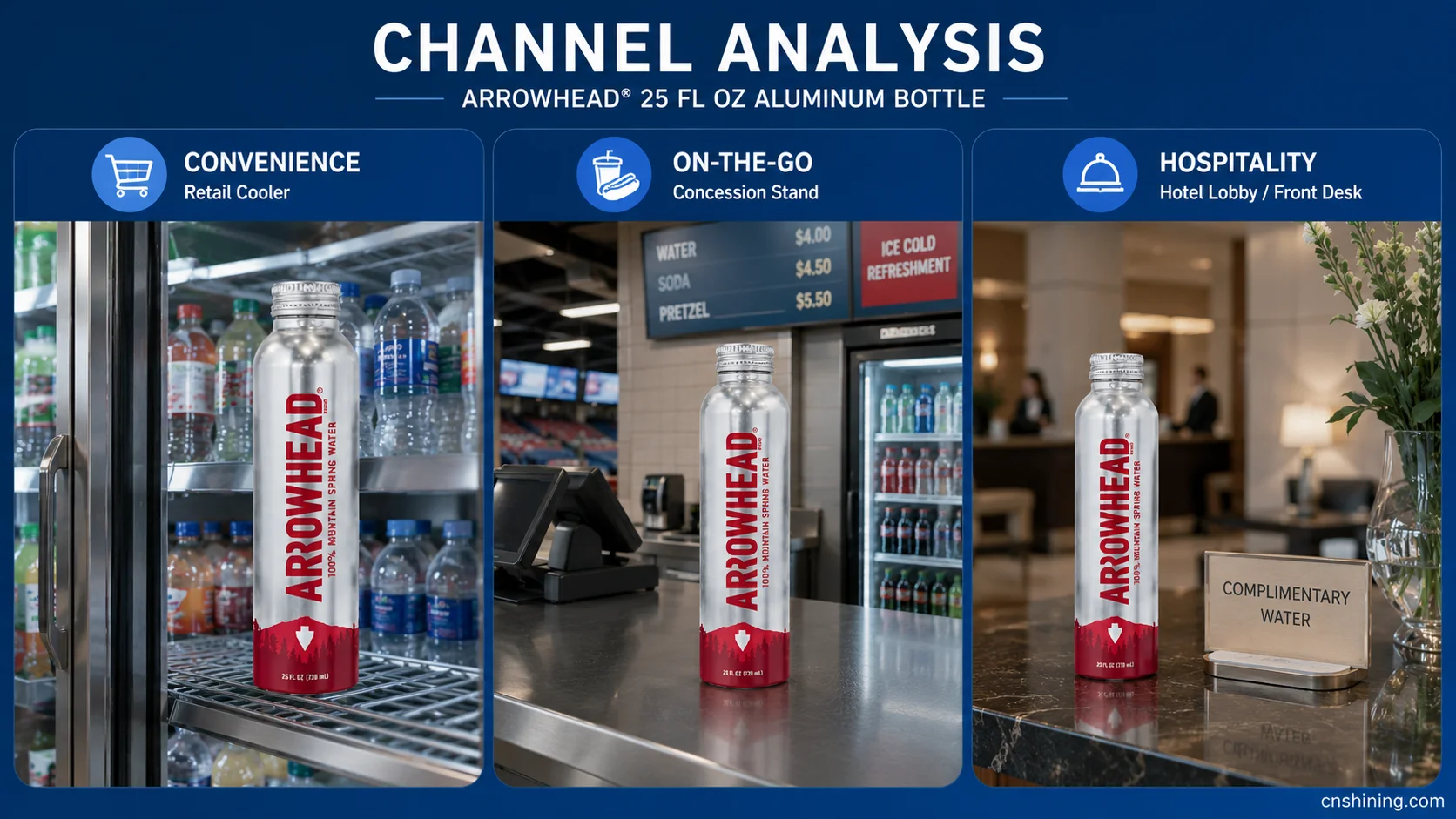
At the discounted direct-delivery price observed during this review, the 25 fl oz format was approximately US$2.17 per bottle. That price places it well above an ordinary single-use PET water bottle but inside the established range for premium aluminum-packaged water. It is therefore unsuitable as a silent material substitution in a price-led multipack. It is more defensible in convenience retail, airports, hotels, sports venues, entertainment locations, branded events and other channels where consumers already expect a higher single-unit price.
The 25 fl oz, or approximately 739 mL, capacity is also relevant. It is large enough to support an extended drinking occasion, so the closure must allow the consumer to drink, close the bottle and continue later. A standard beverage can would provide many of the same material and decoration attributes, but it would not provide the same resealing function. Glass could deliver a premium table presence, but it is less suitable where breakage controls or glass restrictions affect venue operations.
This gives the aluminum bottle a precise job: provide a premium-feeling, non-glass and resealable package for a single-unit water purchase. It does not need to outperform every alternative on every metric. It only needs to perform better in the channels selected for that SKU.
2. What the Arrowhead Aluminum Bottle Is Designed to Do
The packaging requirements become clearer when they are translated into functions rather than material claims. The bottle must protect still spring water, survive normal distribution, provide clear tamper evidence, reseal reliably and carry a recognizable brand design without hiding the metallic surface that helps justify the format.
| Commercial or user requirement | Bottle response | Engineering constraint |
|---|---|---|
| Longer single-person drinking occasion | Approximately 739 mL capacity with a resealable closure | Opening torque and reseal performance must remain consistent throughout shelf life |
| Venue and event use | Lightweight, non-glass container with visible tamper evidence | Venue acceptance is market-specific and must not be assumed solely from the material |
| Premium shelf identity | Metallic body, large decoration area and distinctive cold-touch perception | Artwork, base coat and varnish must tolerate filling-line and distribution abrasion |
| Portable consumption | Rigid bottle that can be closed between drinking occasions | Denting, condensation grip and cap usability require physical testing |
| Recyclability communication | Aluminum body with a familiar consumer recycling signal | Claims must reflect local collection systems and the full package, including coating and closure components |
| Limited or regional artwork | Broad cylindrical print area suitable for location or event graphics | Design variation must remain compatible with print registration, color control and inventory planning |
The supporting angle is premiumization, but the premium is functional rather than decorative alone. The bottle can be carried, resealed and used in locations where a breakable container is inconvenient. Its visual treatment then signals that the product belongs in a different purchasing occasion from a low-priced PET multipack.
That distinction matters because consumers do not pay more merely because a container contains aluminum. They pay more when the complete package produces a different experience: colder tactile perception, a firmer hand feel, a larger visible surface, controlled opening and a design that looks intentional at the point of sale.
3. Product Structure Breakdown: Body, Liner, Neck and Closure
The Arrowhead aluminum bottle should be evaluated as an integrated package rather than as an aluminum body purchased separately from the closure and decoration. A change in neck finish affects the cap, liner, capper settings and opening torque. A change in internal coating affects compatibility testing and the target-market documentation. A change in exterior varnish can affect both appearance and line scuffing.
| Structural element | Practical configuration | Por que isso importa |
|---|---|---|
| Bottle body | One-piece aluminum beverage bottle in the existing 25 fl oz capacity class | Provides the rigid metallic surface, light barrier and large decoration field that distinguish the SKU |
| Revestimento interno | Beverage-contact liner selected against the actual water chemistry, filling conditions, shelf life and destination market | Prevents direct content-to-metal interaction and protects flavor, corrosion resistance and migration performance |
| Neck finish | Wide-mouth threaded beverage finish, with a stock 38 mm class architecture as a practical development starting point | Controls closure availability, capper compatibility, drinking comfort and resealing performance |
| Encerramento | Tamper-evident, resealable screw or roll-on pilfer-proof closure matched to the final neck profile | Maintains seal integrity while showing first opening and allowing the consumer to close the bottle again |
| Closure liner or gasket | Compression sealing element selected for still water, fill temperature and required shelf life | Compensates for normal dimensional variation and is often the decisive component in leak prevention |
| Exterior decoration | Metallic silver field with controlled red and white brand graphics, preferably using direct decoration where feasible | Preserves the visible aluminum character and supports regional or event artwork |
| Protective varnish | Gloss, matte or selectively tactile over-varnish validated for abrasion and condensation exposure | Protects ink and controls surface feel without obscuring the metal appearance |
| Batch and date coding | Legible code zone on the shoulder, lower body or base, selected after line trials | Supports traceability without interfering with primary graphics or closure inspection |
| Use after opening | Resealable for the drinking occasion; not automatically presented as a validated long-term refill system | Prevents a functional resealing claim from being confused with a formal multi-use package claim |
The most influential structural decision is the neck-finish and closure system. The aluminum body creates visual and material differentiation, but resealability is what makes the bottle more suitable than a conventional can for a 25 fl oz still-water occasion. A poorly matched neck, cap or liner can turn a premium format into a leakage, opening-torque or consumer-comfort problem.
Development teams should therefore lock the closure architecture before finalizing bottle drawings or filling-line modifications. The differences among aluminum bottle thread systems e cap and sealing configurations affect more than appearance. They determine how the closure is applied, how tamper evidence is formed, which liner is required and how the finished bottle behaves after first opening.
4. Filling, Coating, Closure and Decoration Controls
4.1 Water is relatively forgiving, but it is not a reason to skip compatibility work
Still spring water generally presents a lower compatibility challenge than acidic juice, alcoholic beverages or highly salted formulations. That does not make uncoated aluminum acceptable, and it does not mean that every beverage liner will perform identically. Water chemistry can include dissolved minerals and ions that influence conductivity, corrosion behavior and sensory stability over time.
The coating specification should therefore be selected after reviewing pH, total dissolved solids, chloride and other relevant ions, fill temperature, treatment method, intended shelf life and storage conditions. A coating described commercially as BPA-free or BPA-NI still requires confirmation against the intended use and destination market. The useful engineering question is not simply which wording appears on a data sheet, but whether the applied and cured coating system remains continuous and suitable after forming, filling, capping and distribution. A practical overview of internal coating selection for aluminum beverage bottles explains why formulation choice and content compatibility have to be considered together.
4.2 The closure must be treated as a filling-line process
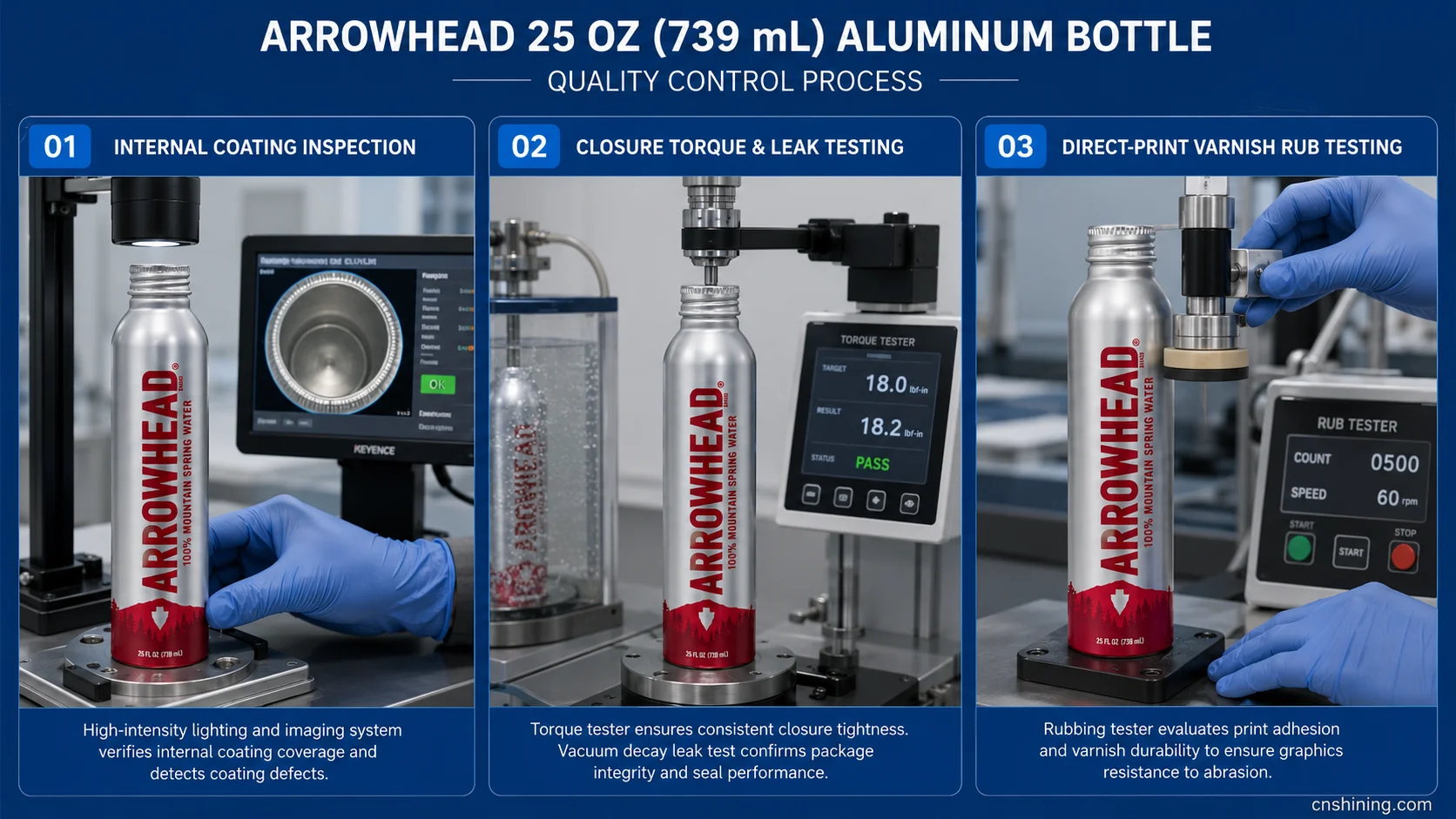
Where a roll-on pilfer-proof closure is used, the cap reaches its final threaded and tamper-evident form during capping. Top pressure, roller position, thread depth, pilfer-band tuck and container support all influence the result. The production control plan must therefore include applied-cap inspection, removal torque, bridge-break behavior and a defined leakage test rather than relying only on visual cap presence.
A technical ROPP capping workflow is relevant when that closure family is selected. For another screw-cap architecture, the specific application-torque and sealing-window controls will differ, but the same principle applies: the closure, neck and capping equipment are one system.
4.3 Decoration has to survive production, condensation and handling
Arrowhead’s red and white identity benefits from a metallic silver field because the unprinted or transparent-coated areas allow the material itself to remain visible. This is usually more coherent than covering the bottle with a large opaque sleeve that makes the metal body visually indistinguishable from another rigid container.
Cylindrical metal decoration has its own prepress restrictions. Artwork must account for print overlap, registration tolerance, tonal limits, base-coat behavior and areas affected by the shoulder and neck geometry. The aluminum bottle artwork and prepress guide describes the relationship among metal-specific printing, base coats and protective varnish. Selection among printing and finishing methods should then be based on order volume, graphic complexity, required tactile effect and abrasion performance rather than appearance alone.
4.4 Do not assume the body-forming route
Aluminum bottles can be manufactured through different supplier-specific forming routes. Impact extrusion is one common method for producing seamless aluminum bodies, but the actual process used for a selected stock bottle must be confirmed through drawings, samples and manufacturing documentation. The development team should specify functional outcomes—capacity, profile, wall performance, neck dimensions, internal coating continuity and external finish—rather than assigning a production method without evidence. An overview of the common aluminum bottle manufacturing sequence is useful for understanding where trimming, surface preparation, coating, forming and decoration controls enter the process.
5. Competitor Benchmark: Still Water in Aluminum Bottles
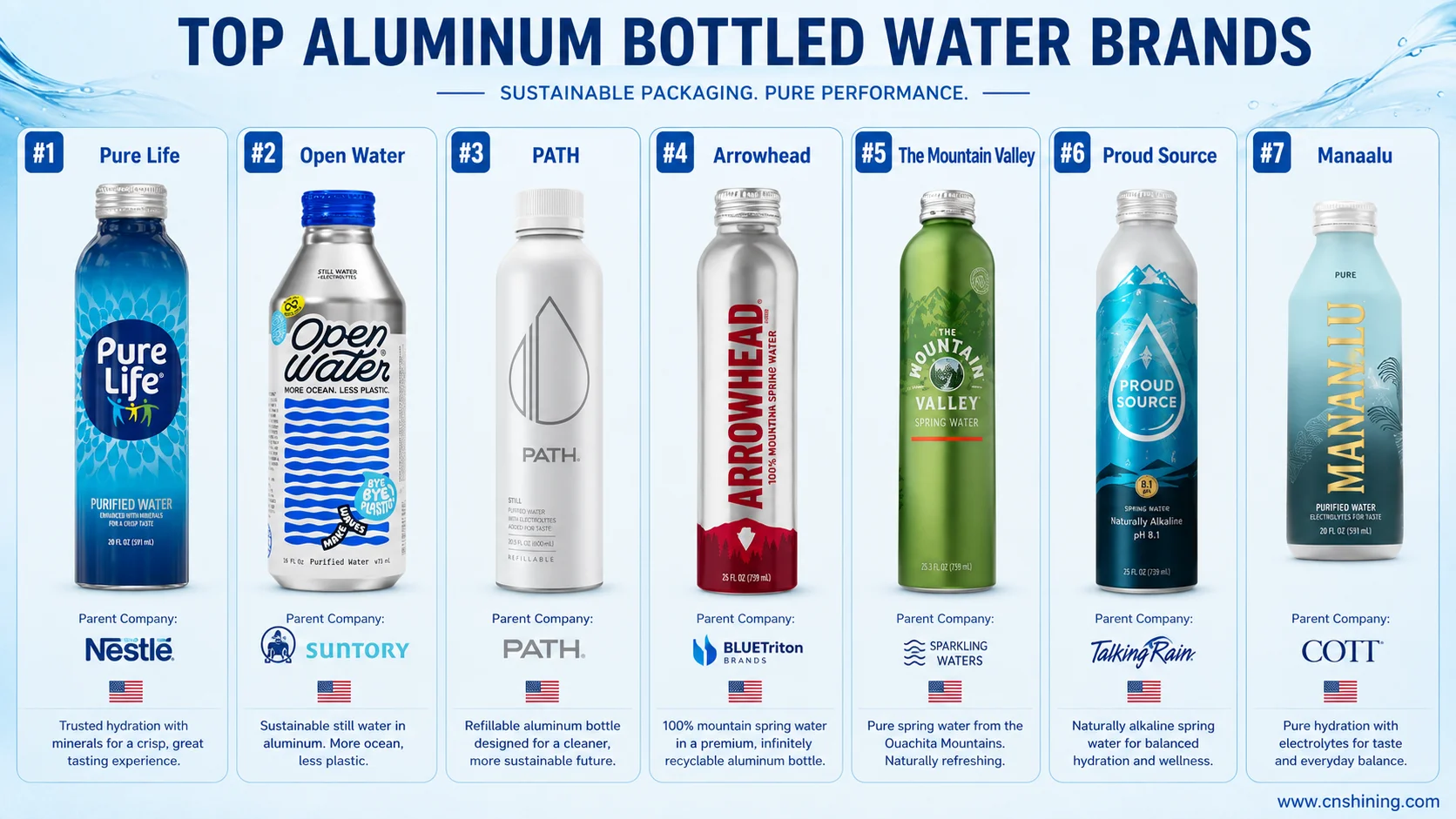
The relevant comparison set is not every premium water brand and not every product packaged in metal. A useful benchmark should include still water sold in a resealable aluminum bottle. This isolates the same core content and a comparable consumer opening experience.
| Marca | País | Empresa controladora | Capacidade | Observed retail price | Core selling point |
|---|---|---|---|---|---|
| Pure Life | Estados Unidos | Primo Brands | 20 fl oz / 591 mL | US$2.22 per bottle | Purified water with minerals for taste in a mass-premium, on-the-go format |
| Águas abertas | Estados Unidos | Open Water, privately held | 16 fl oz / 473 mL | US$2.25 per bottle | Purified still water with electrolytes and environmental positioning focused on reducing plastic-bottle use |
| PATH | Estados Unidos | PATHwater, Inc. | 25 fl oz / 739 mL | US$2.98 per bottle | Ultra-purified water in a bottle explicitly positioned for refilling and continued consumer use |
| Mountain Valley | Estados Unidos | Primo Brands | 16 fl oz / 473 mL | US$2.33 per bottle | Established American spring-water provenance translated into a portable aluminum format |
| Proud Source | Estados Unidos | SOURCE Global, PBC | 16 fl oz / 473 mL | US$1.99 per bottle | Naturally alkaline spring water, bottled at source, with mineral and community-origin messaging |
| Mananalu | Estados Unidos | Mananalu, Inc. | 22 fl oz / 651 mL | Starting at US$2.09 per bottle | Purified water linked to an ocean-plastic reduction mission and a larger resealable single unit |
The comparison shows a fairly consistent US mass-premium zone around US$2 to US$3 per bottle, although retailer and delivery markups can widen the range. Pure Life occupies the most mainstream position. Open Water and Mananalu put the environmental mission near the front of the brand. PATH makes reuse a central part of the package proposition. Mountain Valley and Proud Source rely more heavily on spring origin and mineral profile. The retailer observations and product specifications are supported by the linked listings.
Arrowhead’s point of difference is the combination of western mountain-spring heritage, a larger 25 fl oz drinking occasion and the demonstrated ability to carry local sports artwork. Its observed unit price is not outside the category. It sits close to the lower-middle portion of this aluminum-bottle set, which supports a mass-premium interpretation rather than an extreme luxury position.
The lesson for packaging managers is that an aluminum body alone does not create sufficient differentiation. Every brand in this table already has that material story. Arrowhead must use capacity, resealability, regional identity and channel-specific graphics to prevent the bottle from becoming a generic silver water container.
6. Sustainability Claims Need a Defined Boundary
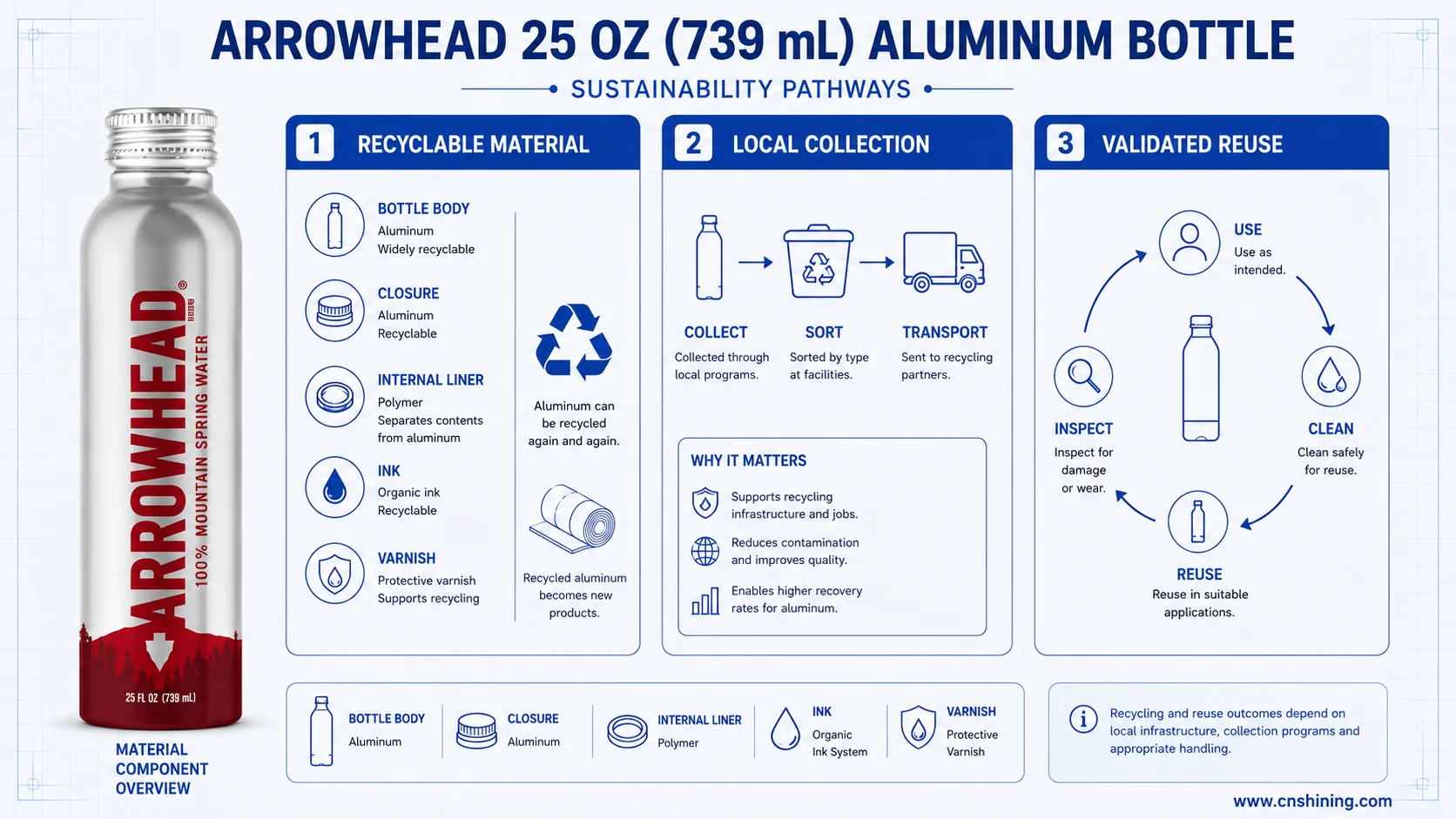
Aluminum gives Arrowhead a credible recyclability and circular-material story, but the safe claim is narrower than saying the bottle is automatically the most sustainable package. A container can be technically recyclable while still facing low local collection, poor consumer participation or incompatible sorting conditions. Actual recovery depends on the market in which the bottle is sold.
The full package also includes more than the visible body. The internal liner, closure liner, inks, varnish and any additional decorative components must be considered when preparing environmental claims or recyclability instructions. Direct printing can avoid a separate pressure-sensitive label or sleeve, but it does not turn the package into untreated aluminum.
For the United States, environmental language should be reviewed alongside the intended distribution footprint and state-level recycling conditions. Food-contact compliance is a separate question. FDA explains that food-contact substances requiring authorization must be suitable for their intended use, while the bottled-water standard is addressed separately under 21 CFR 165.110. See the FDA overview of food-contact substances e the US bottled-water standard. These sources define regulatory frameworks; they do not constitute approval of a particular bottle specification.
For the European Union, all food-contact materials, including metal packaging, are subject to the general safety and inertness principles of the EU food-contact framework. Packaging sustainability and labeling requirements also need to be reviewed under Regulation (EU) 2025/40, which begins applying from 12 August 2026, subject to its detailed provisions and transition arrangements. The European Commission’s food-contact materials guidance e the EU Packaging and Packaging Waste Regulation should be reviewed separately rather than combined with US requirements.
7. Packaging Decision Summary
The final decision should not be framed as aluminum versus plastic in the abstract. It should be framed as a selection among different commercial jobs.
Use the aluminum bottle when
The product is a higher-value single unit, resealing matters, glass is undesirable, the channel accepts premium pricing and the bottle’s metallic identity or limited artwork contributes to the purchase.
Keep PET when
The main requirement is a low-cost household multipack, transparent product visibility, mature high-volume distribution or minimum conversion cost.
7.3 Consider an aluminum can when
The product will normally be consumed in one sitting and high-speed filling, standardized supply or event throughput is more important than resealability.
The Arrowhead aluminum bottle makes engineering and commercial sense because it creates a distinct package for premium on-the-go spring water without requiring the brand to replace its mainstream packaging system. The 25 fl oz capacity supports a longer drinking occasion. The threaded closure separates it from a standard can. The metallic body provides a visible platform for regional and sports-linked artwork. The unit price can be justified in channels where those functions are noticed.
The package should proceed only as a complete system: bottle body, compatible internal coating, defined neck finish, closure and liner, controlled printing, protective varnish and validated filling conditions. Shining Packaging can be included in the technical RFQ as an aluminum-bottle manufacturing source, provided the project applies the same documented coating, closure, decoration and filled-package validation requirements expected from every qualified production source.