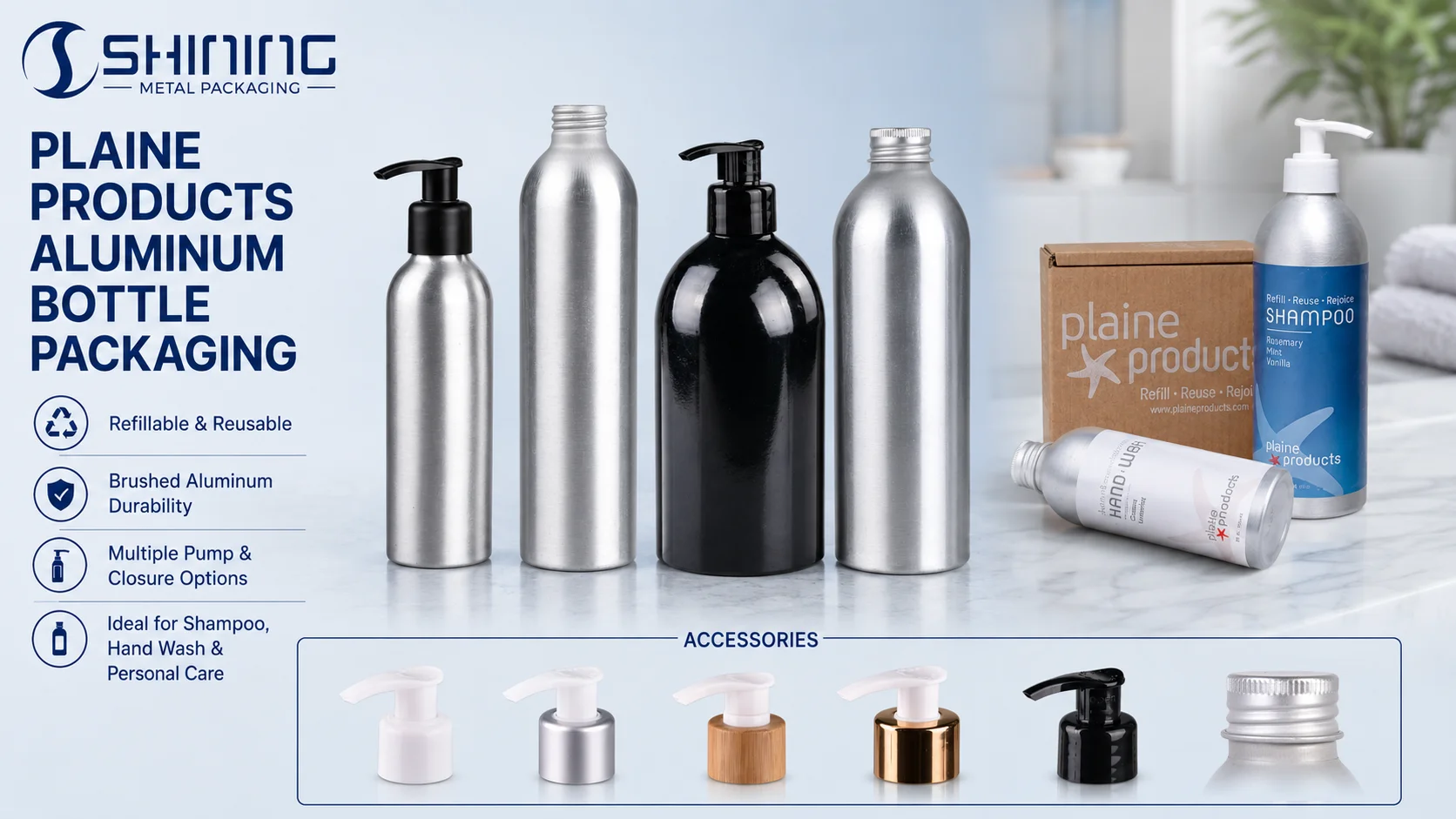
Plaine Products did not select an aluminum bottle merely to replace a plastic container with a different recyclable material. The package is the operating component of a return, wash and refill system for liquid shampoo and other personal care products. Its role is to preserve a familiar pump-dispensed experience while surviving repeated transport, wet-bathroom use, cleaning, inspection and recirculation.
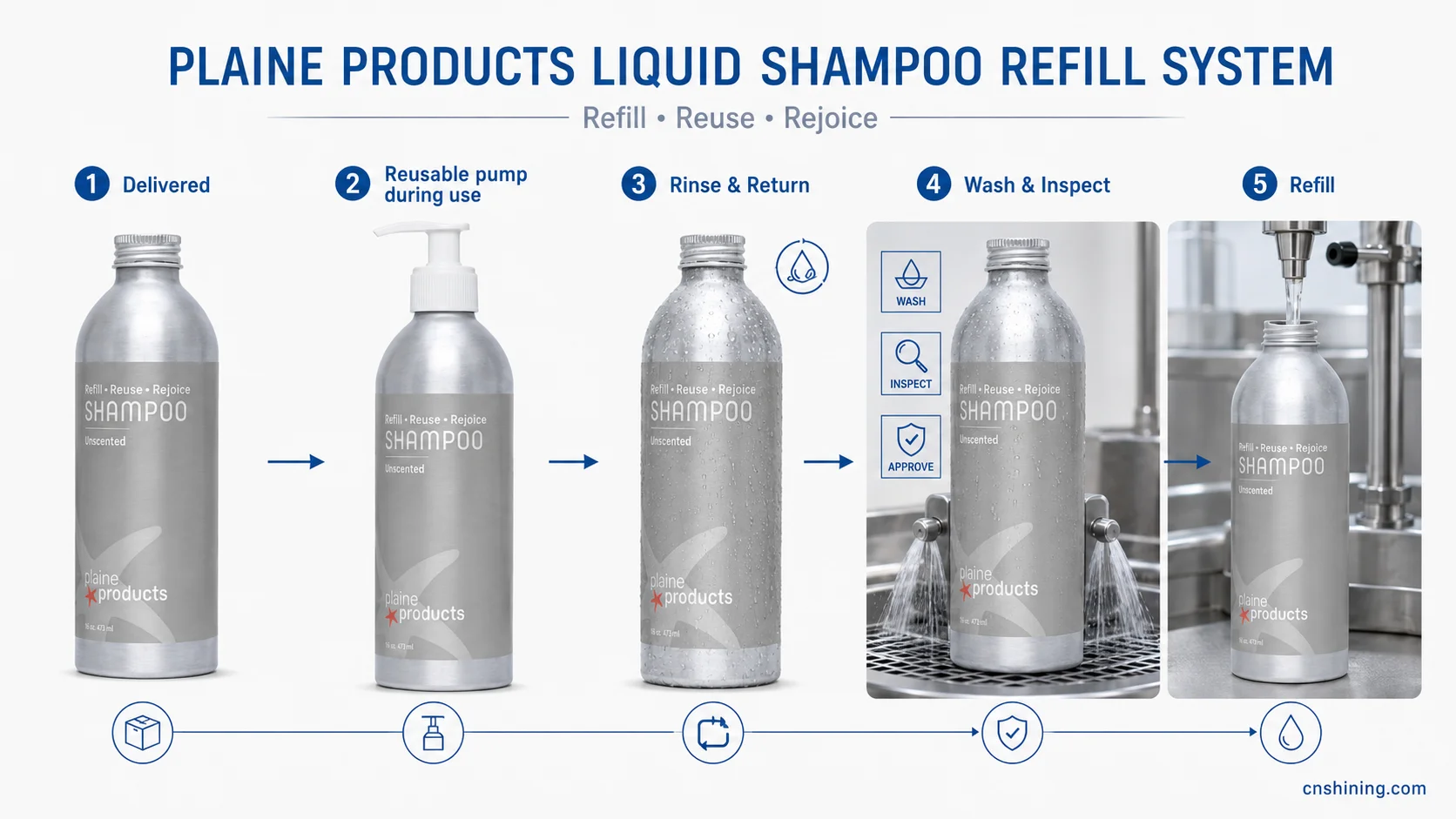
The brand’s core shampoo format is a 16 fl oz liquid product sold in a cylindrical aluminum container. The customer removes the shipping cap, installs a reusable pump and keeps that pump for subsequent refills. After the product is used, the empty bottle is rinsed, returned, cleaned, sanitized, inspected and prepared for another filling cycle. A smaller 2.5 fl oz format supports travel and product trial, while selected high-volume products are also offered in gallon containers.
That commercial model changes the packaging question. A one-way bottle only has to remain functional through filling, distribution, sale and one consumer-use period. A returnable bottle must do all of that repeatedly. Its internal coating, neck, closure seal, pump interface, decoration and inspection criteria become part of the business model rather than secondary technical details.
1. The Packaging Problem Plaine Products Was Actually Solving
Plaine Products entered a category dominated by disposable plastic bottles, pumps and closures. It could have reduced packaging by moving to shampoo bars or concentrated pastes, but those formats require consumers to change how they wash, dose and store the product. Instead, the brand retained an aqueous liquid formula and the familiar pump-bottle interaction.
This decision reduced behavioral friction but made the package more demanding. A liquid shampoo contains water, surfactants, preservatives, botanical extracts, oils, fragrance components and pH-adjusting materials. The container must maintain formula stability without corrosion, staining, odor transfer or unacceptable migration. It must also dispense a viscous product consistently and evacuate enough of the contents to avoid both product waste and consumer frustration.
The brand therefore needed a package that could address four connected requirements:
- Keep the product format familiar. Customers continue to use liquid shampoo rather than learning a solid or concentrated format.
- Separate the durable and consumable components. The pump is retained by the consumer while the bottle moves through the return system.
- Survive multiple handling environments. The bottle moves between filling, parcel distribution, bathrooms, reverse logistics and industrial reconditioning.
- Remain recoverable after rejection. A bottle that can no longer be refilled still has an established aluminum recycling route when properly separated from its closure and pump.
The resulting package is better understood as a serviceable asset than as a disposable container. Its economics depend on bottle turns: the number of useful circulation cycles achieved before the package is rejected, lost or recycled.
Plaine’s current 16 fl oz shampoo product is listed at US$33, with a reusable pump available separately for a small additional charge. The price therefore covers more than the formula. It also supports a comparatively expensive container, return handling, cleaning, inspection and inventory held within a circular system.
2. Why Aluminum Bottle Packaging Fits a Return-and-Reuse Model
Aluminum offers a useful combination of low mass, rigidity, corrosion resistance after appropriate internal protection, and recoverable material value. It does not shatter like glass, which matters when a wet bottle is handled in a shower or shipped back through a parcel network. It also provides an opaque barrier to light and a stable surface for direct printing, labeling and protective varnish.
None of those properties alone proves that a reusable garrafa de alumínio has a lower environmental impact than a single-use plastic bottle. Aluminum production is energy intensive, and reverse transport plus cleaning also consume energy and water. The technical case improves when one bottle replaces several one-way packages and when the return route is concentrated enough to avoid disproportionate transport.
Plaine’s model attempts to create those conditions through subscription refills, a standard bottle family, pump retention and return packaging that can be reused for sending empties back. Its public process asks the customer to order a refill before the current bottle is empty, transfer the existing pump, rinse the used bottle and return it in the same shipping system.
2.1 Why the pump is not attached to every refill
Pumps are mechanically complex, multi-material components. A typical lotion or shampoo pump may combine molded polymers, a metal spring, an elastomeric sealing component and a dip tube. Supplying a new pump with every bottle would reduce the packaging benefit of the return system and increase the number of components requiring separation at end of life.
Retaining the pump is therefore a rational design decision, but it transfers responsibility to the user. The consumer must keep the pump clean, move it to the new bottle and retain the original cap for travel or return. This creates a small inconvenience that a one-way pump bottle does not have.
2.2 Why aluminum is more than a recycling claim
The brand’s package is sometimes discussed primarily in terms of aluminum recyclability. For this case, reuse is the more important function. Recycling is the recovery route for bottles that cannot continue in service; it is not the first intended disposition.
The distinction matters. “Recyclable aluminum” describes a material property subject to collection and local infrastructure. “Returnable and reusable” describes an operating system that must include return instructions, collection, cleaning, inspection, rejection criteria, refilling and traceability. Plaine’s technical risk sits mainly in the second set of activities.
For this type of personal care container, a common manufacturing route is impact extrusion, in which an aluminum slug is formed into a seamless cylindrical body before trimming, neck formation, internal coating and decoration. The general sequence is outlined in this aluminum bottle manufacturing process guide. The exact forming route and alloy must be confirmed for each commercial specification rather than inferred from appearance alone.
3. Product Structure Teardown: The Bottle Is Only One Part of the System
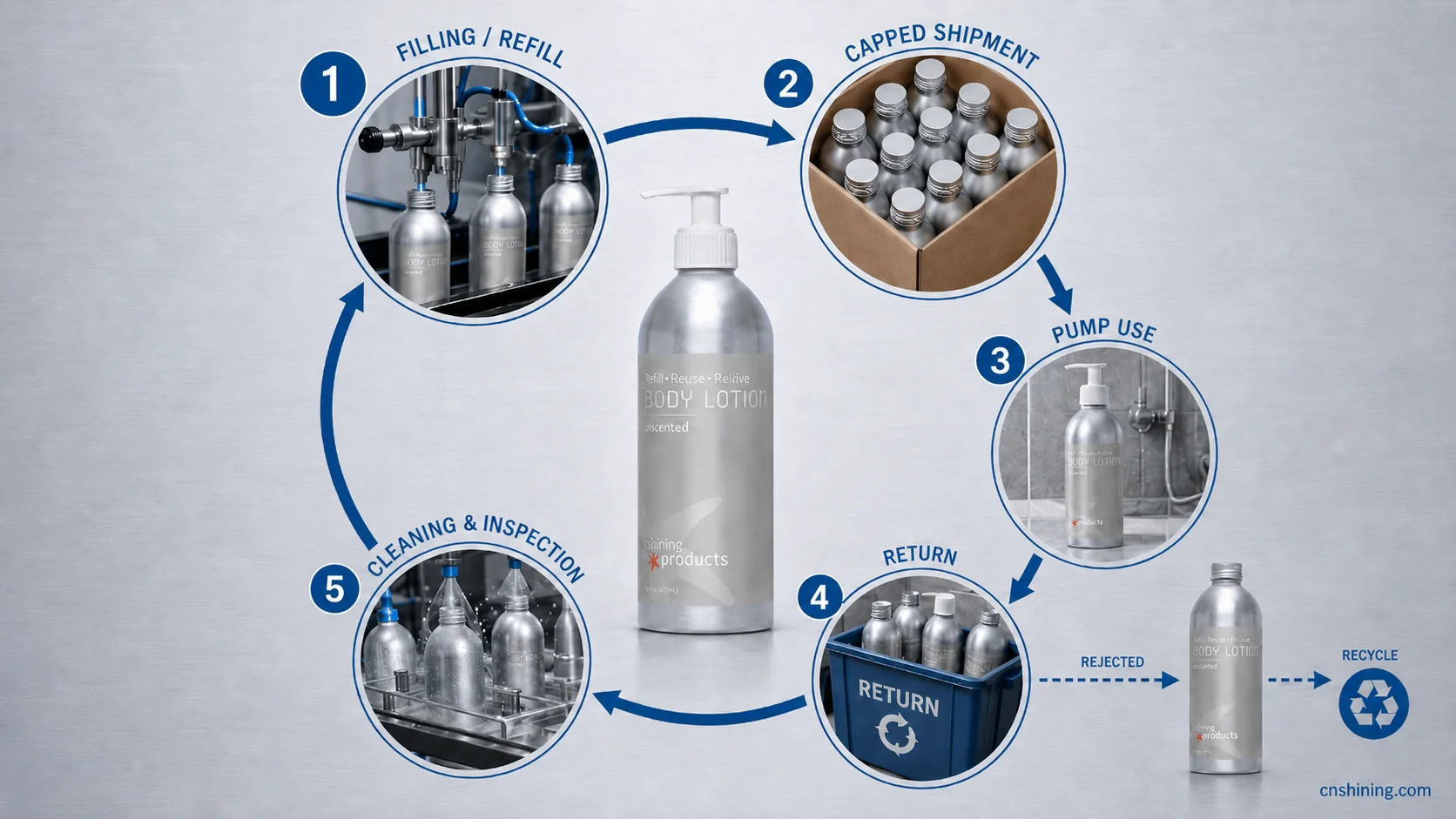
The package can be divided into seven functional layers. Some are visible to the consumer; others determine whether the bottle remains suitable after repeated exposure to formula, water, cleaning chemistry and mechanical handling.
| Structure item | Observed or confirmed function | Engineering requirement for reuse | Primary failure risk |
|---|---|---|---|
| Bottle body | Cylindrical aluminum primary container used for 16 fl oz and smaller liquid personal care formats. | Maintain base stability, shoulder geometry and neck alignment after filling, parcel handling, bathroom use, return transport and reconditioning. | Denting, rocking base, shoulder deformation, neck ovality or sharp damage that prevents safe reuse. |
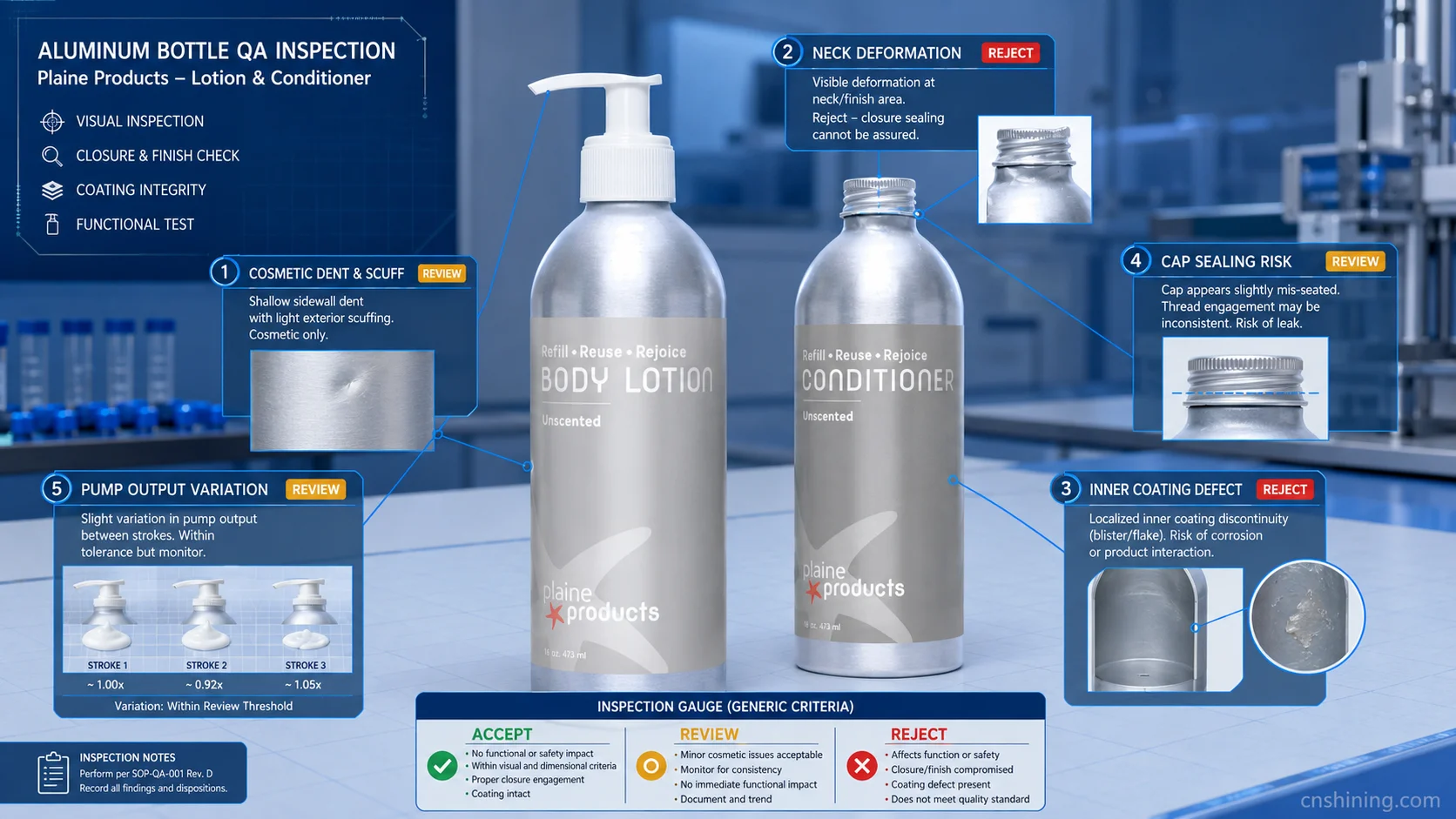
| Revestimento interno | A barrier separates the aqueous cosmetic formula from direct metal contact. Plaine describes a BPA-free cosmetic-grade epoxy phenolic lining. | Resist the complete formula over shelf life and remain continuous after forming, filling, washing and repeated exposure cycles. | Pinholes, under-cure, loss of adhesion, corrosion, discoloration, odor change or formula contamination. |
| Neck finish | Screw-compatible interface accepting both a shipping cap and a reusable dispensing pump. | Control thread geometry, sealing land, neck height and dimensional consistency across all bottle lots and reuse cycles. | Cross-threading, incomplete engagement, neck damage, pump mismatch or variable sealing compression. |
| Shipping and storage cap | Closes the filled bottle during parcel shipment and can be retained for travel. | Provide repeatable seal compression within a validated application-torque window and remain compatible with the formula. | Leakage, backing-off, liner swelling, stress cracking, overtightening or consumer difficulty reopening the bottle. |
| Reusable pump | Transferred by the customer from an empty bottle to the replacement bottle. | Match formula viscosity, dip-tube length, output per stroke, priming behavior and neck thread while tolerating repeated use. | Low output, clogging, poor evacuation, loss of prime, leakage around the collar or premature mechanical failure. |
| Decoration and identification | Product and brand information remain on a bottle intended for multiple rotations. | Retain legibility, product identification and acceptable appearance after wet handling, rubbing, return shipment and cleaning. | Ink removal, label lifting, adhesive residue, color loss, batch-identification loss or formula mix-up. |
| Surface protection | Clear or pigmented protection shields printed graphics and the exterior metal surface. | Balance abrasion resistance, wash resistance, tactile grip and recoat or rejection criteria. | Scuffing, gloss change, coating whitening, scratches, loss of grip or cosmetic inconsistency between rotations. |
| Return and reconditioning interface | The bottle is rinsed, returned, cleaned, sanitized, inspected and refilled. | Define incoming inspection, wash parameters, drying, contamination control, rejection limits and lot traceability. | Residual product, retained moisture, fragrance carryover, microbiological contamination or reuse of a structurally damaged bottle. |
The bottle body attracts the most attention, but the most influential structure item is the interface between the internal coating, neck finish and closure system. A dent on a sidewall may be cosmetic. A damaged sealing land, coating defect or incompatible gasket can make the package unsuitable for filling even when the bottle still looks acceptable.
Plaine’s consumer and packaging FAQ describes the liner as a cosmetic-grade epoxy phenolic resin that is BPA-free and suitable under referenced US and German requirements. That statement is useful but does not replace product-specific compatibility testing. A food-safe or cosmetic-grade coating still needs to be evaluated against the actual shampoo, conditioner, toner or lotion formula, including fragrance oils, preservatives, pH and expected storage temperature.
A structured coating program normally includes filled-product storage at ambient and elevated temperatures, control samples, visual corrosion inspection, adhesion testing and sensory or analytical checks where relevant. The practical issues behind those tests are discussed in this technical guide to aluminum bottle inner coatings and BPA considerations.
Neck compatibility should be treated with similar discipline. A pump that appears to screw onto a bottle may still have insufficient thread engagement, excessive collar clearance or the wrong sealing mechanism. This aluminum bottle thread and neck-finish guide explains why thread profile, finish dimensions and closure engagement must be specified together.
For exact items such as thread dimensions, gasket material, wash-cycle acceptance limits or torque windows, teams with an active project are welcome to discuss a validation plan.
4. Where Reuse Programs Fail: Liner, Closure, Pump and Surface Durability
A reusable bottle program usually fails through accumulated small variations rather than one dramatic material defect. Bottle dimensions vary across production lots. Closure torque changes with equipment condition. Formula viscosity shifts with temperature. Consumers handle pumps differently. Returned bottles arrive with different levels of residue, denting and abrasion.
The packaging specification therefore needs acceptance windows, not only nominal drawings. It also needs a reuse-cycle protocol that tests the complete package after cleaning, not just a new bottle.
4.1 Internal coating and formula compatibility
Bare aluminum naturally forms a protective oxide layer, but that does not make unlined metal suitable for every aqueous personal care formula. Surfactants, salts, organic acids, botanical extracts, essential oils, preservatives and colorants can create a more demanding environment. Purple shampoo adds another consideration because a strong colorant can make coating defects, staining and carryover more visible.
Compatibility work should use the final commercial formula, not a simplified base. At minimum, packaging teams should review:
- formula pH and expected pH drift;
- fragrance and essential-oil concentration;
- preservative system and ionic content;
- filled-product storage at intended and accelerated conditions;
- coating adhesion before and after wash exposure;
- metal pickup, discoloration, odor or viscosity change where technically relevant;
- the effect of repeated washing on coating continuity.
A bottle can pass a single shelf-life study and still fail as a reusable package if cleaning conditions reduce coating adhesion over subsequent cycles. Validation should therefore simulate the intended maximum number of rotations or establish a conservative inspection rule that removes suspect bottles earlier.
4.2 Cap, gasket and application torque
The shipping cap must prevent leakage during parcel movement while remaining easy for the consumer to remove. This requires a controlled relationship among neck dimensions, cap thread, sealing feature, liner or gasket compression and applied torque.
Too little torque can leave inadequate compression or allow the closure to loosen. Too much can deform the sealing element, damage the neck, make opening difficult or increase stress in the cap. Torque should be measured immediately after capping and after an agreed relaxation period because polymer closures and liners can lose apparent torque over time.
4.3 Pump dosage and product evacuation
Pump performance affects the consumer’s perception of both value and package quality. If each stroke delivers too little shampoo, users need repeated actuation and may believe the bottle is being consumed unusually quickly. If output is too high, dosing becomes wasteful. A dip tube that is too short, too stiff or poorly angled can also leave a meaningful quantity of product in the container.
Relevant tests include output per stroke, first-prime strokes, re-prime after standing, leakage at the collar, evacuation percentage, compatibility with fragrance and surfactants, and operation after repeated wet use. Pump tests should use aged product because viscosity and air entrainment can change during shelf life.
4.4 Printing, varnish and bottle identity
Plaine updated elements of its bottle graphics and labeling to improve performance through multiple uses. That is not simply a branding exercise. A returned bottle must still be identifiable by product type and must not carry ambiguous or damaged information into another filling cycle.
Direct printing can avoid label-edge lifting and residual adhesive, but inks and varnishes must tolerate abrasion and cleaning. Labels can support variable information and easier artwork changes, but their facestock, adhesive and overlaminate must be selected for water, surfactant contact and the intended reconditioning process.
Design teams can use this technical printing and artwork guide to account for cylindrical distortion, registration and printable areas. Surface appearance and abrasion resistance should then be reviewed against the options in this aluminum bottle printing-finishes and varnish guide.
4.5 Denting and return handling
Aluminum bottles can dent without losing containment. In a one-way package, a dent is normally treated as shelf damage. In a reuse program, the acceptance decision needs more nuance. A shallow sidewall dent may be cosmetic, while a distorted base, damaged neck, sharp crease or coating-compromising impact should trigger rejection.
The outbound box also functions as the return container, so it directly affects primary-package performance. Internal restraint should prevent bottles from striking one another, limit scuffing and keep loose pumps or caps from damaging bottle surfaces. This is the only reason the transport pack belongs in the engineering discussion: it protects the bottle’s ability to complete another rotation.
5. What Consumer Reviews Reveal About Package Performance
Public discussion of Plaine Products focuses heavily on formula performance and fragrance, but several recurring comments relate directly to the bottle system. These observations should be treated as qualitative signals rather than statistically controlled test data.
5.1 Positive packaging feedback
- Solid hand feel. Reviewers describe the bottle as sturdy and visually clean. One independent product review specifically noted that the container did not feel excessively slippery during use.
- Clear reduction in disposable plastic. Customers understand the practical action: retain the pump, return the bottle and receive another filled container.
- Acceptable bathroom appearance. The metallic bottle is perceived as more permanent than a typical disposable shampoo container and can support the brand’s higher price position.
- Visible evidence of circulation. Some returned bottles show small dents or wear. Certain customers accept these marks as evidence that the container is genuinely being reused rather than replaced after one cycle.
A long-term independent review of the shampoo and conditioner package described the aluminum bottles as sturdy, sleek and manageable in wet use. Another consumer account of the returnable bottle system noted that reused containers may arrive with dents while still remaining functional.
5.2 Negative feedback and friction points
Public comments do not establish a repeated pattern of systemic leakage, but they do identify several areas for packaging teams to monitor:
| Consumer observation | Likely packaging mechanism | Recommended validation or design response |
|---|---|---|
| Pump output feels small or requires many strokes. | Low nominal dose, viscous formula, restrictive pump pathway, incomplete priming or consumer expectation based on larger mass-market pumps. | Measure output per stroke across temperature and shelf-life conditions; compare dosage with recommended use; optimize actuator, engine and dip tube together. |
| The product appears to be consumed quickly. | Repeated pump strokes, high dose variability, poor evacuation visibility in an opaque bottle or actual formula-use rate. | Publish realistic dose guidance; validate pump repeatability; measure residual product and consider a controlled bottle-weight method for internal testing. |
| Returned bottles may show dents. | Parcel impacts, bottle-to-bottle contact, wet handling or accumulated circulation damage. | Separate cosmetic dent limits from functional rejection limits; protect neck and base zones; improve restraint where return damage clusters. |
| Surface wear can reduce the “new” appearance. | Wet abrasion, carton contact, washing, bottle-to-bottle rubbing or insufficient varnish resistance. | Run dry and wet rub tests before and after simulated cleaning cycles; define acceptable gloss, scratch and legibility limits. |
| Travel requires remembering the original cap and packing the pump separately. | The reusable pump is not necessarily intended to provide parcel- or luggage-grade sealing. | Make cap-retention instructions prominent; validate repeated cap application; consider a dedicated travel closure where the use case justifies it. |
| The package feels expensive. | Higher-cost aluminum body, small-scale filling, reverse logistics and reconditioning are reflected in the retail price. | Report verified average bottle turns, return rate and refill economics so the customer can connect price with actual system performance. |
Opening force, resealing and leakage remain relevant, they should be assessed using shampoo-specific storage, bathroom and parcel conditions.
The most useful consumer signal is not whether customers like aluminum in principle. It is whether the package makes the refill behavior easy enough to repeat. Every additional action—saving a cap, transferring a pump, rinsing a bottle, storing an empty and arranging a return—creates a point where the circular process can stop.
6. Liquid Shampoo in Aluminum Bottles: Competitor Comparison
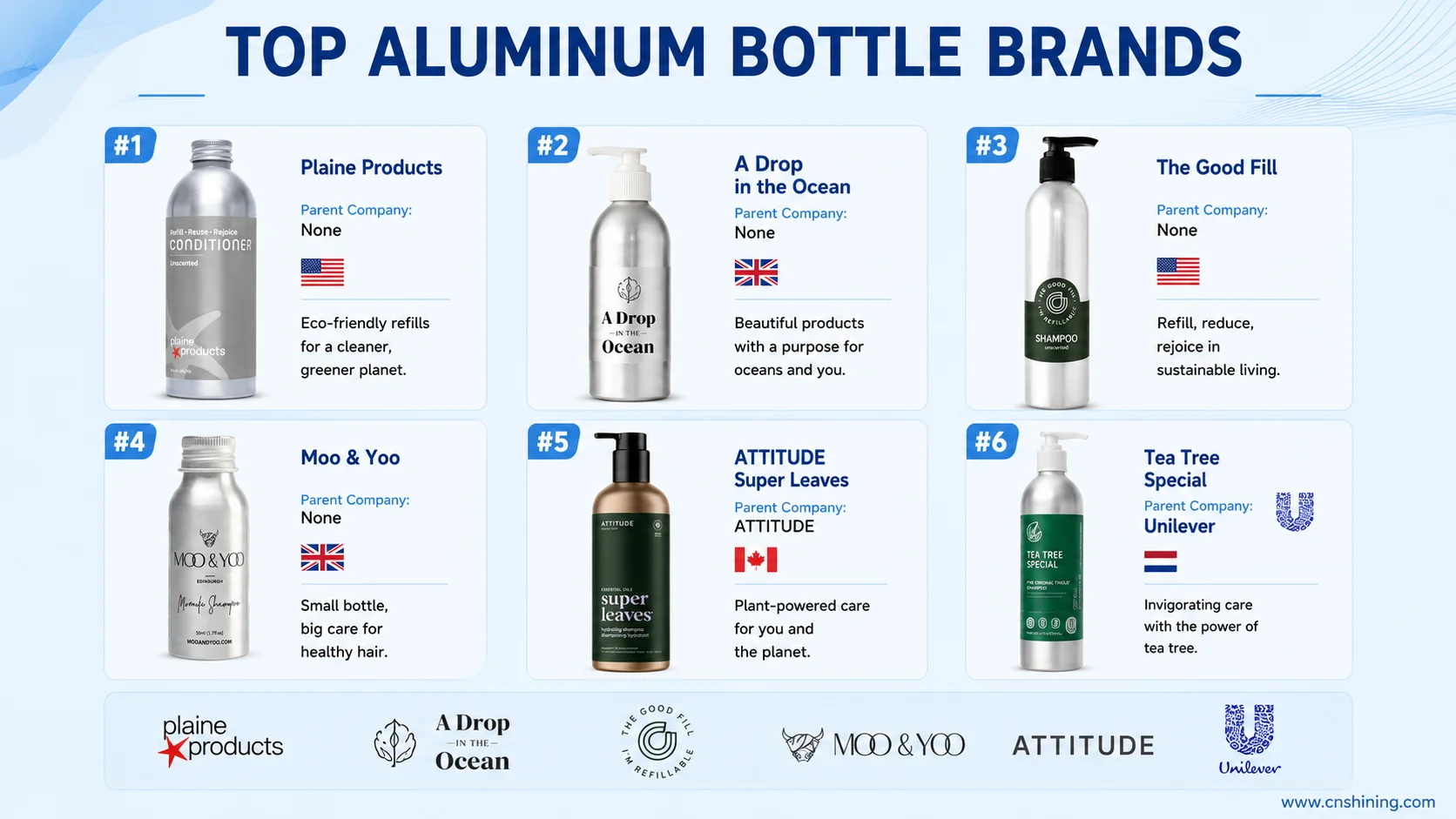
The closest comparisons are not shampoo bars, aluminum tubes or glass refill vessels. Those formats solve different packaging problems. The table below is limited to liquid shampoo sold in an aluminum bottle or a clearly identified aluminum dispensing container.
| Marca | País | Empresa controladora | Aluminum-bottle capacity | Single-unit retail price | Core proposition |
|---|---|---|---|---|---|
| Plaine Products | Estados Unidos | Plaine Products, privately held and family-owned | 16 fl oz / 473 mL | US$33.00 | Filled bottle is returned, professionally cleaned and placed back into circulation; consumer retains the pump. |
| Paul Mitchell Tea Tree Special Shampoo | Estados Unidos | Sistemas John Paul Mitchell | 500 mL | US$27.00 | Large established salon brand using a reusable aluminum retail bottle alongside refill formats. |
| A Drop in the Ocean Shampoo | Estados Unidos | A Drop in the Ocean, independent | 16 fl oz / 473 mL | US$38.00 for a new filled bottle | Regional circular refill model with aluminum containers and lower-waste replenishment options. |
| Moo & Yoo Miracle Shampoo | Reino Unido | Moo & Yoo, independent | 50 mL aluminum travel format | From £9.50 | Travel-size aluminum presentation for a vegan salon-positioned liquid shampoo. |
| The Good Fill Unscented Shampoo | Estados Unidos | The Good Fill, independent | 9 fl oz / 266 mL dispensing bottle | Approximately US$8.28 for the formula fill; bottle charged separately | In-store and mail-based refill model using a durable aluminum dispenser rather than returning every filled bottle to the brand. |
| ATTITUDE Hydrating Shampoo | Canadá | ATTITUDE, privately held | 16 fl oz / 473 mL | US$15.95 | Plant-derived formula positioned around ingredient verification, with an aluminum retail format and larger refill options. |
Plaine occupies the high end of this set. Its difference is not the presence of aluminum alone. Paul Mitchell and ATTITUDE can use an aluminum bottle as a durable consumer-owned package supported by larger refills. The Good Fill emphasizes repeated local filling. Plaine takes responsibility for recovering the empty bottle, reconditioning it and sending it into another use cycle.
That approach creates a stronger closed-loop narrative but also a more expensive operating model. It requires reverse freight, incoming inspection, washing, drying, storage, refill scheduling and management of rejected bottles. The US$33 price is easier to justify when the brand can demonstrate that bottles complete several successful turns. Without that evidence, the customer may perceive only a high-priced shampoo in a metal container.
The competitor set also shows that “refillable” can describe three technically different systems:
- Brand-returned bottle: the filled container goes back to the brand or its operator for cleaning and reuse.
- Consumer-owned bottle: the customer retains one bottle and replenishes it from a larger refill.
- Local refill bottle: the customer repeatedly fills the same container at a retail or mobile refill point.
These systems should not be treated as interchangeable in environmental comparisons. They have different transport patterns, wash responsibilities, contamination risks and achievable bottle-turn rates.
7. Sustainability Evidence, Regulatory Boundaries and Final Engineering View
7.1 What the sustainability evidence supports
Plaine has published more operational information than many small personal care brands. Its 2024 impact data reported that more than 128,500 disposable plastic bottles were avoided during that year and that the cumulative total since 2017 had exceeded 724,688. The same publication estimated 35,550 kg of avoided CO2e compared with its stated plastic-bottle baseline and reported offsets for transport and distribution emissions.
The brand’s current website displays a still higher cumulative bottle-avoidance count. These numbers show that the return program is operating at meaningful volume.
The brand’s 2024 impact publication is useful as an annual operational statement. For technical procurement or formal environmental claims, it would be stronger when paired with a documented life-cycle method, bottle-turn distribution and independent review of key assumptions.
This does not mean the reuse claim is invalid. It means the environmental result is conditional. A durable aluminum package generally needs repeated successful use to amortize its higher material and processing burden. Return rate and bottle survival are therefore environmental performance indicators as well as supply-chain metrics.
7.2 United States cosmetic-packaging obligations
Shampoo, conditioner and body wash are regulated as cosmetics in the United States unless therapeutic claims cause a product to be regulated as a drug. The FDA’s MoCRA requirements for cosmetic companies include facility registration, product listing, serious-adverse-event reporting, safety substantiation and expanded recall authority.
MoCRA does not create an “FDA-approved aluminum bottle” category for ordinary cosmetics. The responsible company must maintain evidence that the finished cosmetic is safe under labeled conditions of use. Packaging compatibility can form part of that evidence because corrosion, coating failure, contamination, closure leakage or microbial ingress may affect product safety.
7.3 European Union requirements
Products placed on the EU market must comply with Regulamento (CE) n.º 1223/2009 relativo aos produtos cosméticos. The Cosmetic Product Safety Report and Product Information File should account for relevant packaging characteristics, formula stability and foreseeable interactions between the product and its container. A Responsible Person, compliant labeling and notification through the Cosmetic Products Notification Portal are also required before placing the product on the market.
Packaging claims must also be reviewed against the EU Packaging and Packaging Waste Regulation, Regulation (EU) 2025/40, which begins applying on August 12, 2026. The regulation treats reusable packaging as part of a reuse system and introduces requirements covering reconditioning, technical documentation, labeling and broader packaging minimization and recyclability obligations.
A brand exporting a returnable bottle into the EU should not assume that a US mail-back model automatically satisfies every local reuse, waste, deposit, labeling or extended-producer-responsibility requirement. The operational route must be mapped country by country.
7.4 Global export and local-market checks
Outside the United States and European Union, the main packaging review should cover the local cosmetic definition, responsible importer, ingredient nomenclature, language, net-contents statement, batch coding, recycling marks, extended-producer-responsibility registration and any restrictions on environmental claims.
Brands should also confirm whether returned cosmetic containers may cross borders for cleaning or refilling. Residual contents, waste classification and reverse-logistics rules can make a national or regional loop more practical than a global return program.
7.5 Final packaging assessment
Plaine Products adopted the aluminum bottle because the material allows the brand to keep a conventional liquid shampoo experience while operating a visible return-and-reuse system. The bottle is lightweight relative to glass, resistant to breakage, opaque, suitable for durable decoration and recoverable when it reaches the end of its usable life.
The package also supports brand and price positioning. A metal bottle feels more permanent than an ordinary disposable shampoo pack, and the return process gives consumers a concrete action rather than an abstract recyclability message. Those benefits help explain why the company can sell a 16 fl oz shampoo at a price above many mass-market and refill-oriented alternatives.
The engineering limitation is equally clear: aluminum alone does not create a circular package. The internal coating must remain compatible with the formula and cleaning process. The neck must continue to seal with both the cap and reusable pump. Decoration must remain legible. Dents and scuffs must be classified consistently. Most importantly, customers must return enough bottles for repeated rotations.
The transferable lesson is that reusable aluminum bottle packaging should be designed as a controlled operating system. Material selection is only the first decision. Filling, sealing, dispensing, return behavior, cleaning, inspection and end-of-life recovery determine whether the format performs as intended.
Plaine Products provides a useful real-world case because its package does more than display a sustainability message: it circulates between the filler and the consumer. The model is technically credible when package compatibility and bottle-turn data are controlled with the same discipline as a conventional filling operation. For teams evaluating a similar format, Shining Packaging can support the bottle, coating, neck, closure, printing and scale-up validation work required to convert the reuse concept into a production specification.