
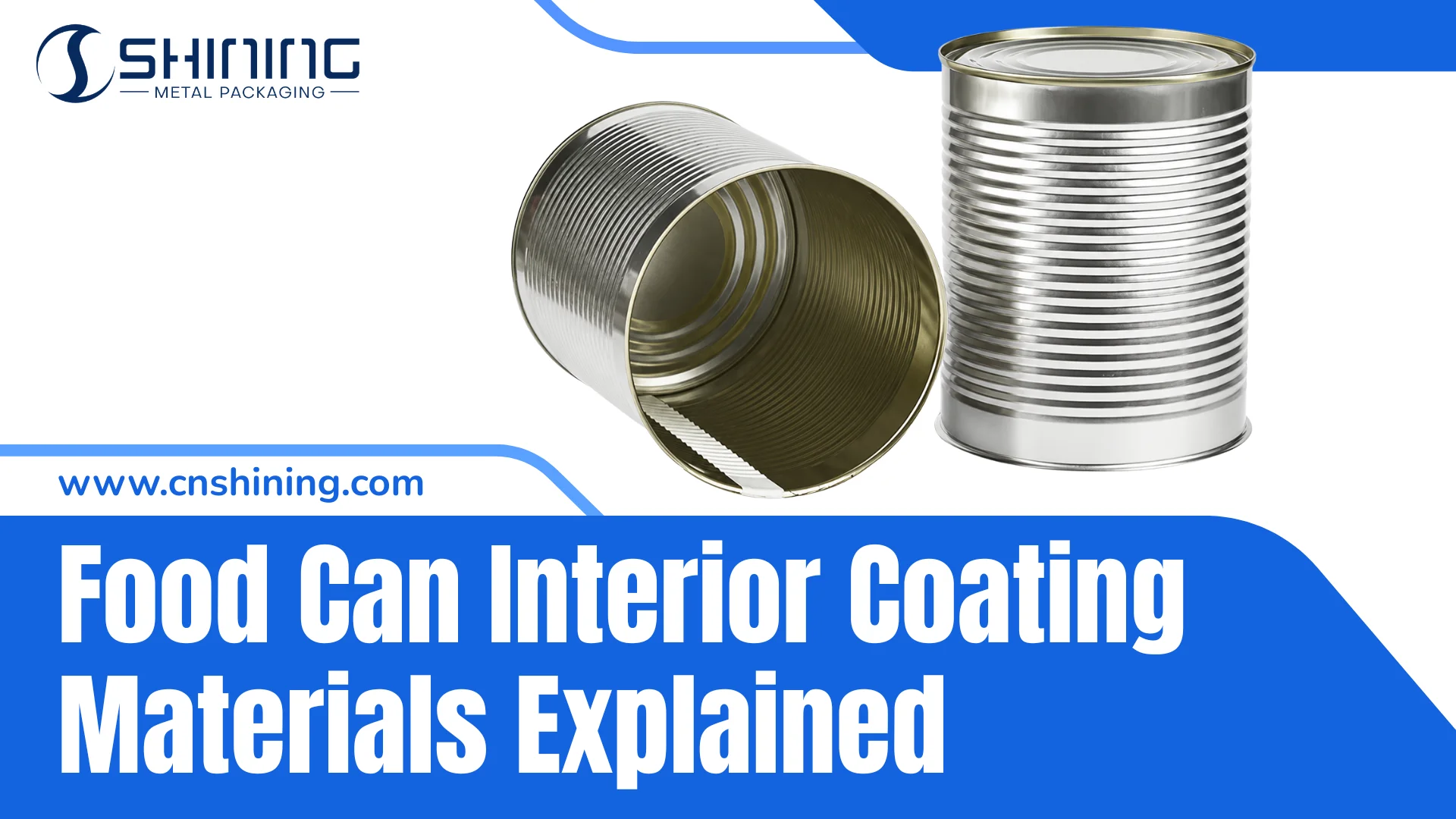
Maioria food cans are lined with an internal coating. It may be called a coating, lacquer, enamel, varnish, or liner. In many cases, it is a polymer-based film baked onto the inside of tinplate, steel, or aluminum cans. So yes, many food cans can be described as “plastic-lined,” but it is not a loose plastic sheet. It is a cured protective film bonded to the metal.
The reason is simple. Food and bare metal are not always compatible. Acidic foods, salty foods, sulfur-containing foods, oils, proteins, and heat-processed products can react with the metal surface during storage. That may cause corrosion, staining, off-flavors, color changes, gas formation, or metal migration.
The internal coating works as a barrier between the food and the can. It helps protect the metal, keep the food stable, and support the intended shelf life. But the coating cannot be chosen by a general label such as “food-grade.” It has to match the food, the can type, the heat treatment, the storage period, and the target market.
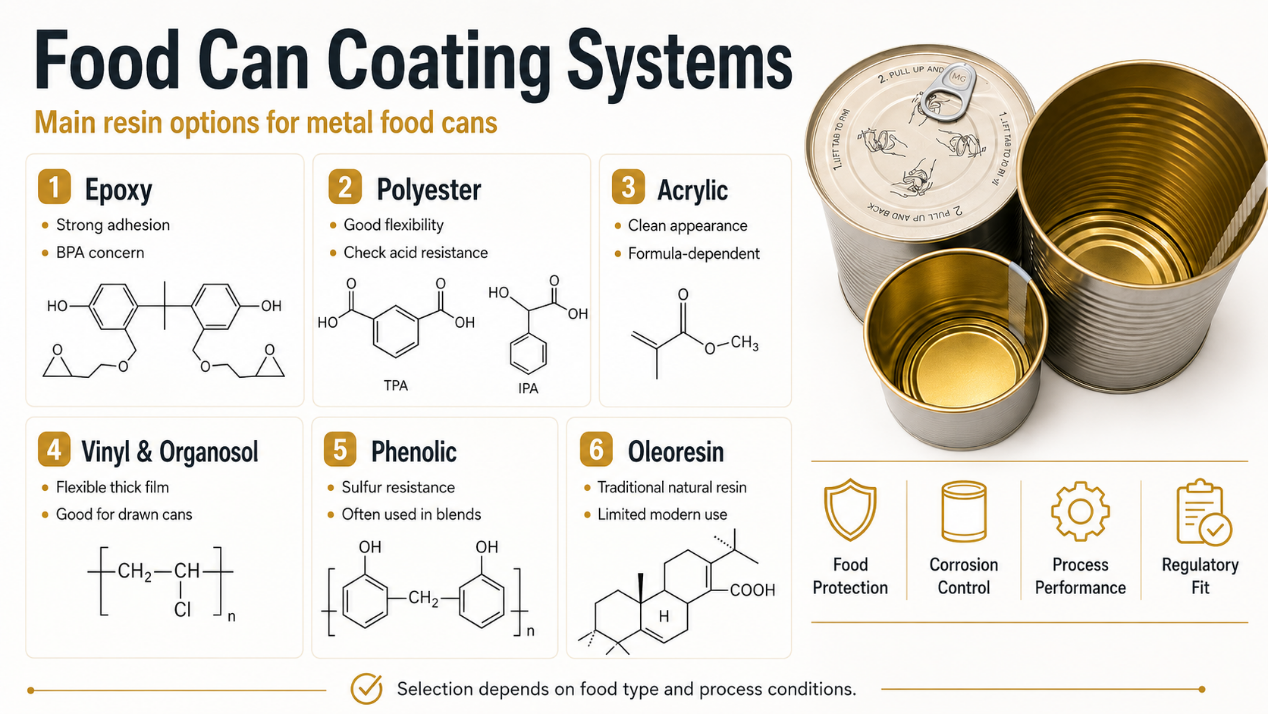
1. Common Types of Food Can Interior Coating Materials
Food cans do not all use the same lining. Different resin systems are selected according to the food and the process.
1.1 Epoxy-Based Coatings
Epoxy coatings have been widely used in food and beverage cans for many years. They offer strong adhesion, good chemical resistance, and stable processing performance. Common systems include epoxy-phenolic, epoxy-amino, epoxy-anhydride, and epoxy-acrylic coatings.
Epoxy-phenolic gold lacquers are often used in food cans because they provide good corrosion resistance and pack performance. They are common in three-piece cans and shallow drawn cans.
The main concern is BPA. Traditional epoxy coatings may be based on BPA-related chemistry. In many export markets, private-label projects, and retail supply chains, buyers now request BPA-NI or bisphenol-free systems. Epoxy still performs well from a technical point of view, but its use depends on regulatory and customer requirements.
1.2 Polyester-Based Coatings
Polyester coatings are widely used as alternatives to traditional epoxy systems. They offer good flexibility and can handle forming stress well. This makes them useful for can bodies, ends, and other parts that need to bend or stretch.
Their limitation is acid resistance. Some polyester systems may be sensitive to hydrolysis under low-pH conditions. Strong acidic foods, such as tomato products or vinegar-based foods, need careful testing before polyester is selected.(fonte)
Polyester is a useful BPA-NI direction, but it is not a universal replacement.
1.3 Acrylic-Based Coatings
Acrylic coatings are often used where a clean and light-colored internal appearance is preferred. They may be used in some food cans, beverage cans, and easy-open ends.
Their performance depends strongly on formulation. Some acrylic coatings may have limits in flexibility, corrosion resistance, or odor control. For sensitive foods, the coating should be tested for both technical performance and flavor impact.
1.4 Vinyl and Organosol Coatings
Vinyl coatings are usually blended with other resins to improve adhesion and resistance. Used alone, they may not bond well enough to metal.
Organosol coatings are thicker and more flexible. They are often used for drawn cans, fish cans, and easy-open ends. Their film coverage helps protect areas that experience forming stress.
For products such as canned fish, the coating may need to resist salt, oil, protein, sulfur compounds, and heat treatment at the same time. In these cases, organosol systems are often a practical option.
1.5 Phenolic-Based Coatings
Phenolic coatings are known for resistance to aggressive foods and sulfur staining. They are often used in blended systems, especially epoxy-phenolic coatings.
They are useful for meat, fish, beans, peas, corn, and other foods that may release sulfur compounds during sterilization. Without a suitable coating, these foods may cause black spots, gray stains, or dark areas on the can interior.
Phenolic systems can be less flexible and may affect flavor in some applications, so they are usually selected for specific performance needs.
1.6 Oleoresin Coatings
Oleoresin coatings are older systems made from natural gums, rosins, and drying oils. They were used before synthetic resin coatings became common.
Today, their use is limited. They have weaker adhesion, longer curing time, and lower corrosion resistance than many modern coatings. They may still be used for some mild or dry foods, but they are not suitable for acidic, salty, or aggressive retorted products.(fonte)
2. Which Coating Is Used for Which Food?
The coating should be selected from the food outward. The key questions are direct: Is the food acidic? Salty? Oily? Protein-rich? Does it release sulfur during retort? Is the can drawn or welded? How long will the product be stored?
2.1 Acidic Foods
Tomato products, fruit products, vinegar-based foods, pickled vegetables, and acidic sauces need coatings with acid resistance and stable adhesion.
These foods can slowly expose weak points in the coating during storage. Tomato paste is a typical case. It combines acidity, heat treatment, high solids, and long shelf life. If the coating is unsuitable, corrosion spots, darkening, off-odors, or vacuum loss may appear.
Common directions include acid-resistant epoxy-phenolic systems, selected BPA-NI systems, organosol coatings, and some polyester or acrylic systems after testing. For highly aggressive foods, a higher coating film weight may be needed.
2.2 Protein-Rich and Sulfur-Forming Foods
Meat, fish, seafood, beans, peas, and corn often need sulfur-resistant coatings. During high-temperature sterilization, these foods may release sulfur compounds. If those compounds reach exposed metal, black or gray staining may form.
Gold lacquers, epoxy-phenolic coatings, phenolic-modified systems, aluminum-pigmented coatings, and sulfur-resistant BPA-NI systems are common options.
Fish and seafood need extra attention because they may contain salt and oil. Meat products need stable adhesion after retort. Beans and corn may look mild, but sulfur staining can still appear after processing.
2.3 Neutral, Mixed, and Ready-to-Eat Foods
Neutral or mildly aggressive foods may use more general internal coatings, but that does not mean testing can be skipped. Vegetables in brine, soups, porridge, rice meals, and ready meals may contain salt, starch, protein, oil, spices, or sauce.
For these products, epoxy-phenolic, polyester, acrylic, organosol, or BPA-NI systems may be used depending on the recipe and process. The full formulation matters more than the food category name.
A “vegetable can” can mean many things. A brined vegetable, a tomato-based vegetable, and a seasoned mixed vegetable may need different coatings.
2.4 Oily, Spicy, and Seasoned Foods
Oil-rich and heavily seasoned foods can affect coating performance and flavor stability. Chili sauces, curry products, fish in oil, meat in oil, and seasoning pastes may contain oil, salt, pigments, spices, and acidic ingredients.
The coating needs oil resistance, corrosion resistance, and low flavor interaction. Organosol, epoxy-phenolic, and selected BPA-NI systems are often considered. Sensory testing is useful here. A coating may pass corrosion testing but still change the flavor profile.
2.5 Beverages, Nutrition Products, and Dry Foods
Beverage cans need thin, uniform, and flexible coatings that can survive high-speed forming. Polyester, acrylic, epoxy-acrylic, and BPA-NI beverage coatings are commonly used depending on the drink.
Nutrition powders, milk powder, coffee, tea, and dry foods are less corrosive, but odor, moisture, and compliance requirements still matter. For infant formula and nutritional products, BPA-NI status and migration documents should be checked early.
| Food Category | Risco principal | Common Coating Direction |
|---|---|---|
| Acidic foods | Acid corrosion, color change, storage risk | Acid-resistant epoxy-phenolic, BPA-NI systems, selected polyester/acrylic, organosol |
| Pickled and salty foods | Acid plus chloride attack | Acid- and salt-resistant coatings, high-resistance BPA-NI systems |
| Meat, fish, seafood | Sulfur staining, oil, salt, retort stress | Gold lacquer, epoxy-phenolic, phenolic-modified, organosol |
| Beans, peas, corn | Sulfur staining, black spots | Sulfur-resistant coatings, gold lacquer, anti-discoloration systems |
| Beans, peas, corn | Mixed ingredients, salt, oil, protein | Recipe-specific epoxy-phenolic, polyester, acrylic, BPA-NI systems |
| Oily or spicy foods | Oil interaction, flavor change, corrosion | Organosol, epoxy-phenolic, oil-resistant BPA-NI systems |
| Beverages | Forming stress, acidity, flavor stability | Polyester, acrylic, epoxy-acrylic, BPA-NI beverage coatings |
| Dry and nutrition products | Odor, moisture, compliance | Low-odor internal coatings, BPA-NI systems |
3. What About BPA in Food Can Linings?
BPA has not fully disappeared from food can coatings worldwide.
Traditional epoxy coatings often used BPA-related chemistry because it gave strong adhesion, chemical resistance, and reliable processing performance. That is why epoxy systems remained common for so long.
But the market has changed. Many buyers now ask for BPA-NI or bisphenol-free linings, especially for exports, baby food, nutrition products, and private-label retail projects.
BPA-NI means “BPA not intentionally added.” It is not the name of one coating material. A BPA-NI coating may be polyester-based, acrylic-based, organosol-based, or another epoxy-alternative system.
It also does not replace food-contact documentation. Buyers still need coating declarations, migration test reports, and compliance documents for the target market.
The practical point is clear: do not assume a can lining is acceptable just because it is commonly used. Confirm the BPA status, the coating type, and the required documents before production.
4. How to Choose the Right Food Can Interior Coating
Start with the application conditions, not the coating name.
A supplier cannot make a reliable recommendation if the only information is “canned food.” The basic information should include food category, pH, salt content, oil content, protein content, sugar content, heat treatment, can type, shelf life, and destination market.
For example, tomato sauce and fruit syrup are both acidic, but they do not behave the same. Fish in oil, fish in brine, and fish in tomato sauce may also need different coating systems. A vegetable in plain brine is different from a vegetable in vinegar or spicy sauce.
The can structure also matters. A two-piece drawn can needs a coating with better flexibility. A three-piece welded can has different seam and side-strip requirements. Easy-open ends need coating systems that can withstand scoring and opening stress.
Shelf life should be defined early. A coating that works in a short trial may not be safe for a two-year export product. Storage tests, retort tests, and sample observation are still necessary for aggressive foods.
Market requirements should also be checked at the beginning. The US, EU, Japan, Korea, and other markets may have different expectations for BPA, migration, and food-contact compliance.
A good coating choice is not the one with the most attractive label. It is the one that survives the real food, real process, and real storage conditions.
5. Future Trends in Food Can Coatings
Food can coatings are moving toward BPA-NI and bisphenol-free systems. This shift is driven by regulation, retailer standards, and brand requirements. BPA has not disappeared everywhere, but buyers can no longer assume traditional epoxy systems will be accepted in every market.
Polyester, acrylic, organosol, and other epoxy-alternative systems will continue to grow. The challenge is not simply replacing one resin with another. The new coating still has to survive food chemistry, retort conditions, forming stress, and long storage.
Another trend is clearer compliance documentation. Buyers are asking for coating declarations, migration test reports, BPA-NI statements, and destination-market compliance. This is especially important for exports, infant food, nutrition products, and private-label retail projects.
Food can internal coating is not a decorative detail. It is part of the packaging structure. The right coating depends on the food inside the can, not on a generic “food-grade” label.