
Canned ready-to-eat meals are complete or semi-complete meals packed in hermetically sealed latas de metal and thermally processed for commercial sterility and ambient storage. Typical products include stew, chili, curry, pasta, ravioli, rice meals, porridge, and congee.
“Ready to eat” does not mean the meal must be eaten cold. It means that cooking and commercial sterilization have already been completed. The consumer normally only needs to open the can or reheat the food.
Most meat-, bean-, rice-, and pasta-based meals are treated as low-acid foods unless the finished formulation has been properly acidified. Product names are not enough to determine the category. A tomato-heavy chili may behave differently from a meat-and-bean chili. Coconut curry and tomato curry can have very different pH, fat content, salt levels, and flow properties.
The packaging decision must therefore start with the actual formulation. Changes to the recipe, fill weight, can size, particle size, or solids-to-liquid ratio may affect heat penetration and invalidate an existing scheduled process.
1. Why Ready-to-Eat Meals Need Carefully Selected Cans
Ready meals expose the container to several stresses at the same time.
Acids and chlorides can increase corrosion risk. Meat, beans, seafood, and some spices may introduce sulfur compounds that contribute to staining or localized coating failure. Fat does not automatically protect the metal because water remains present in sauces, emulsions, and oil-water interfaces.
The product may also change during retorting. Pasta and rice absorb water. Starch gelatinizes. Proteins set. Sauces become thicker. A meal that initially heats by convection may move toward mixed or conduction heating as processing continues.
Mechanical pressure is another concern. The food, gas, and water vapor expand during heating. During cooling, pressure inside the can may remain high after external retort pressure begins to fall. Poor pressure control can result in end buckling, body paneling, seam distortion, or leakage.
This is why terms such as “low acid,” “high salt,” or “high fat” are not enough for can selection. The full food-can-process combination needs to be evaluated.
2. Matching the Can to Different Ready-Meal Formulations
These pack sizes are market examples rather than container recommendations. The final can diameter, height, brimful capacity, headspace and end specification should be confirmed with the can supplier and process authority.
| Tipo de produto | Main processing concern | Can and coating focus | Common net-content examples |
|---|---|---|---|
| Stew and beef stew | Large meat and vegetable pieces can complicate the cold-spot location. Thick gravy may slow heat transfer. | Check coating resistance to salt, fat, protein, and sulfur compounds. Inspect side-stripe coverage on three-piece cans. | 15 oz (425 g) and 20 oz (567 g) retail packs; 38 oz (1.08 kg) family packs |
| Chili | Beans continue absorbing water after filling. The sauce may become thicker during holding and retorting. | Test the combined effect of tomato acid, salt, spices, pigments, meat, and beans. | About 14.25–19 oz (404–539 g) for retail packs; 38 oz (1.08 kg) for larger packs |
| Curry | Emulsion stability, oil separation, viscosity, and particle distribution may change during processing. | Do not select the coating from pH alone. Test the actual curry, especially coconut-, dairy-, or tomato-based formulations. | Around 400 g (14 oz) |
| Pasta and spaghetti | Pasta absorbs free water and may form compact masses. Sauce viscosity can rise before and during retorting. | Keep pasta and sauce away from the flange. Check coating resistance to tomato acid, salt, and starch deposits. | About 14.5–15 oz (411–425 g); selected large packs around 40 oz (1.13 kg) |
| Ravioli | The filling and pasta shell form a large composite particle. Heating at the center of the largest piece must be verified. | Test the coating with the complete sauce, filling, and retort schedule. | About 15 oz (425 g); selected family packs around 40 oz (1.13 kg) |
| Macaroni meals | Cheese and high-starch sauces often behave as conduction-heated products. | Review compatibility with dairy fat, salt, phosphates, and any acid ingredients. | About 15 oz (425 g); selected large packs around 40 oz (1.13 kg) |
| Rice meals | Rice expansion reduces free liquid and may reduce the available headspace. | Control fill weight, expansion space, vacuum, and end pressure. | Around 15 oz (425 g) |
| Foodservice meals | Larger containers usually have longer heating paths and greater pressure loads. | Process validation must use the actual container size, fill weight, and retort loading pattern. | Often around 100–108 oz (2.8–3.1 kg), depending on product density and formulation |
A wider can may shorten the heating path but also changes the end area exposed to internal pressure. A taller can may fit the same nominal volume while producing different product movement and thermal behavior. Can size should therefore be selected together with the retort process, not after it.
3. Internal Coatings for Complex Meal Formulations
The internal coating must remain attached and continuous after can forming, seaming, retorting, cooling, and storage. Its job is not simply to stop visible rust. It must limit contact between the food and the metal so that corrosion, metal pickup, discoloration, and flavor changes remain under control.
Small defects matter. A scratch, pore, thin area, or incomplete weld repair can expose a very small area of metal to a conductive food. Corrosion may then remain concentrated at that point rather than spreading evenly across the can.
Coating selection should be based on the complete formulation. Equilibrium pH is only one input. The acid type, total acidity, chloride level, sulfur-containing ingredients, fat phase, spices, pigments, starch system, retort schedule, storage temperature, and expected shelf life can all change coating performance.
A useful test should reproduce the actual production conditions. Use the intended food, can, fill weight, headspace, closing process, and retort schedule. After processing, inspect the sidewall, bottom radius, score area, rivet, weld repair, and double-seam region. Storage testing is still needed because some failures develop gradually rather than immediately after retorting.
Food-contact compliance and product compatibility are separate checks. A coating may be legally suitable for food contact but still perform poorly with a specific chili, curry, or meat product under a severe thermal process.
4. Can Strength and Retort Performance
There is no standard retort schedule for all ready-meal cans. A statement such as “121°C for 30 minutes” ignores differences in formulation, viscosity, fill weight, particle size, initial temperature, container geometry, retort type, and agitation.
The scheduled process must be established for the specific product, container, and processing system by a qualified process authority. Changing the can diameter, can height, recipe, thickener level, maximum particle size, or fill weight may require a new evaluation.
Production control should focus on the variables used to establish that process. These may include minimum initial temperature, maximum fill weight, largest particle size, solids-to-liquid ratio, viscosity, headspace, retort loading pattern, and heating-medium circulation.
Headspace needs particular attention. Too little space increases pressure as the contents expand. Too much space may alter product movement in rotary or agitating systems. The filling operation must also keep food away from the flange. A sound thermal process cannot compensate for product trapped in the double seam.
Cooling pressure should not be released too quickly. At the start of cooling, the food and vapor inside the can remain hot. Controlled overpressure helps limit end buckling, paneling, and seam distortion until the internal pressure has fallen.
Easy-Open Ends for Ready Meals
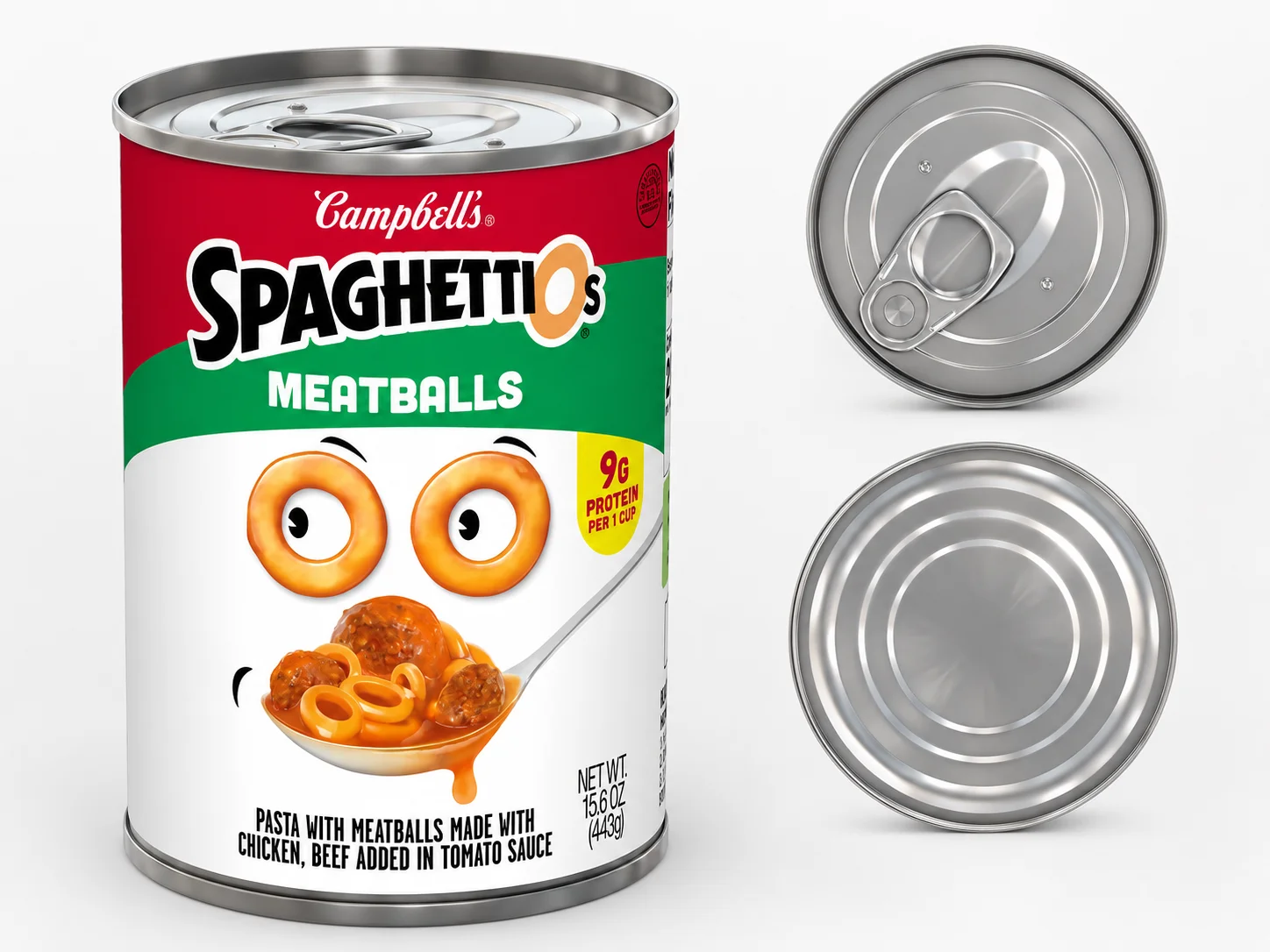
Full-aperture easy-open ends are commonly used for canned stew, ravioli, curry, rice meals, porridge, and congee. These products often contain large particles or thick sauces, so a wide opening makes the contents easier to remove with a spoon or pour into another container.
The end must remain stable during retorting, cooling, transport, and storage. The score area needs enough strength to resist internal pressure while still opening smoothly. The rivet, pull tab, and coating around the score should also remain intact after thermal processing.
Opening performance should be checked with the actual product after retorting and again after storage. The panel should tear along the designed score line, the tab should stay attached, and the opened edge should not create an unexpected sharp area.
5. Final Selection
A ready-meal can should be selected around the actual formulation and processing conditions.
Start with the food: pH, acid type, salt, sulfur compounds, fat, viscosity, particle size, and water absorption. Then evaluate the can construction, coating, dimensions, end design, seam, headspace, and retort pressure as one system.
The most useful evidence comes from the intended food packed in the intended can, processed on the intended retort system, and inspected again after storage.