1. A Midwest Bottle with a Selective Job to Do
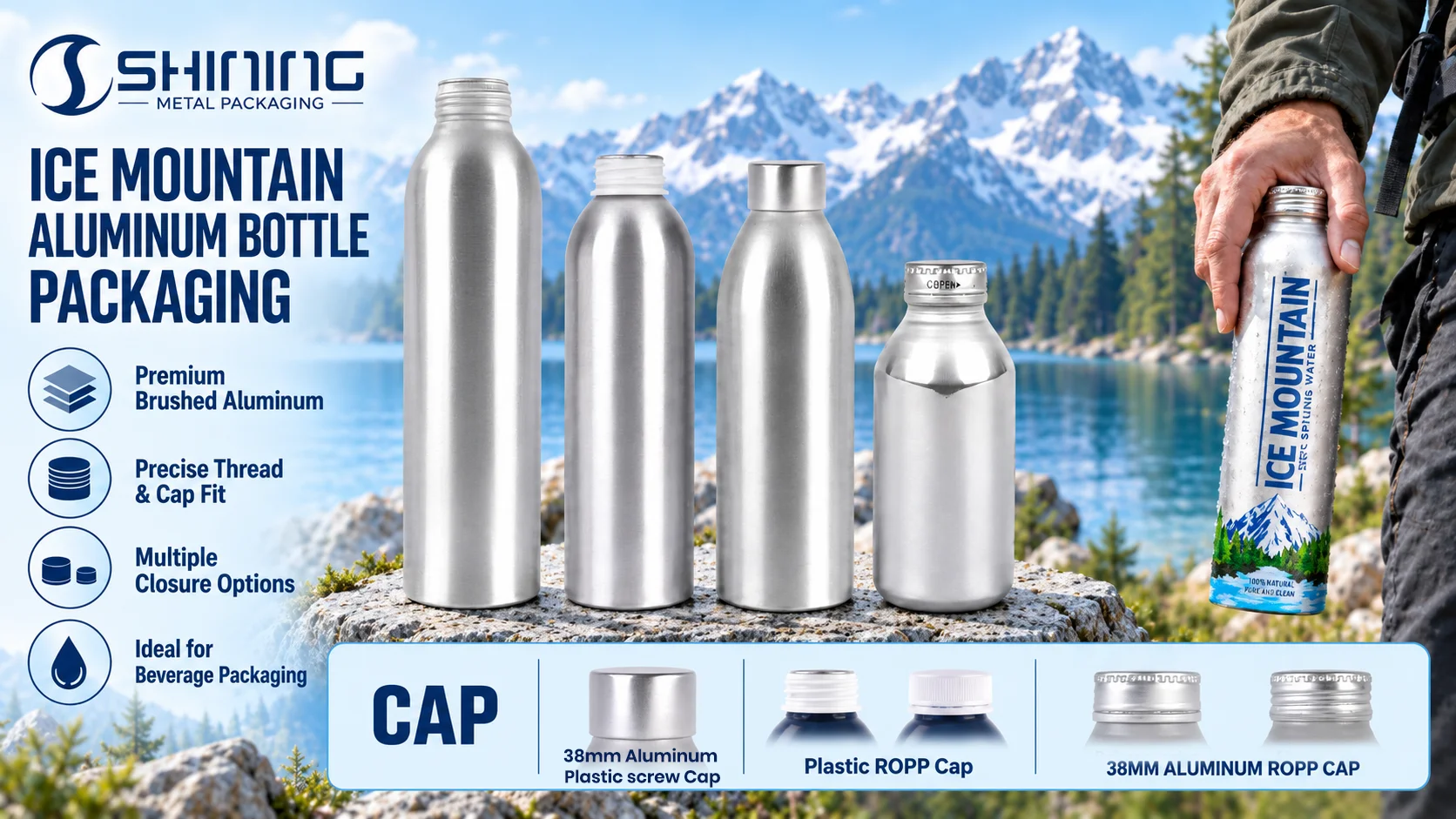
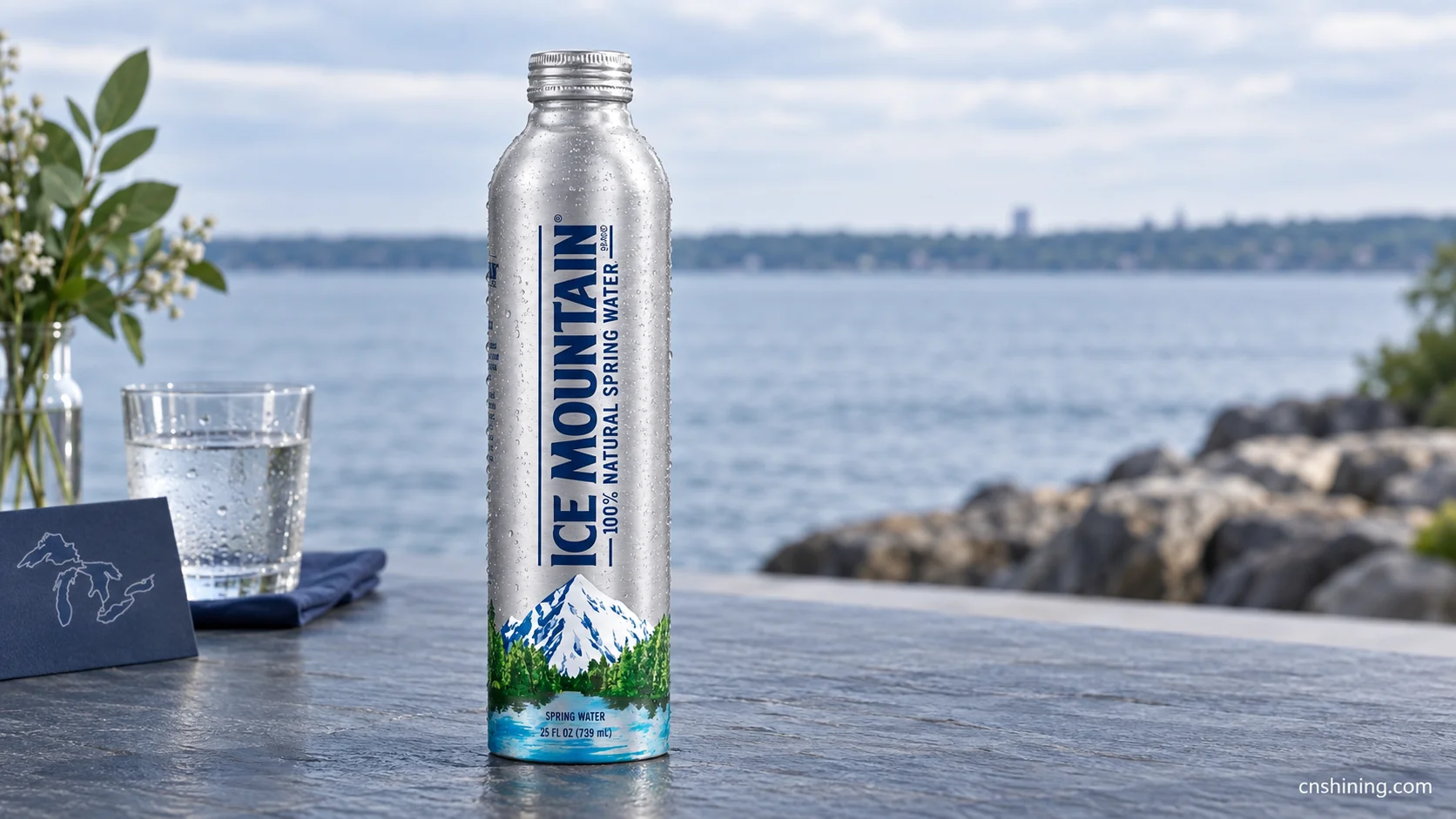
Ice Mountain describes its 25 fl oz алюминиевая бутылка through a regional promise rather than a generic material claim: the package is tied to preserving natural resources and communities in the Midwest, with 1% of sales directed to the Muskegon River Valley Watershed Assembly. That framing gives the Ice Mountain aluminum bottle a specific role. It is not simply spring water transferred from plastic into metal. It is a larger, resealable single-serve format that turns a familiar regional water brand into a more visible object for travel, events, hospitality, meetings, and other occasions where the package remains in the consumer’s hand. The official 25 fl oz product page makes the community connection part of the product itself.
The commercial tension is equally specific. Ice Mountain is a broad-access spring-water brand with a large PET portfolio, so the aluminum bottle should not pretend that every hydration occasion needs a premium metal package. A current retail snapshot lists the 25 oz bottle in a 12-pack at USD 26.09, or about USD 2.17 per bottle. The same channel lists conventional regional spring-water packs at much lower unit prices. The Ice Mountain aluminum bottle retail listing therefore supports a selective strategy: use aluminum where reclosure, a cold metal touch, a larger graphic canvas, and stronger table or cooler presence can earn the price difference.
This is also where ownership context matters without flattening the brand. Primo Brands identifies Ice Mountain as one of its regional water leaders, alongside national and other regional hydration brands. Ice Mountain’s advantage inside that portfolio is not exclusivity or luxury. It is a recognizable Great Lakes and Midwest identity that can support community programs, licensed sports graphics, and limited artwork without abandoning the direct, familiar tone of everyday spring water.
2. Engineering the Ice Mountain Aluminum Bottle as a Water-Contact System
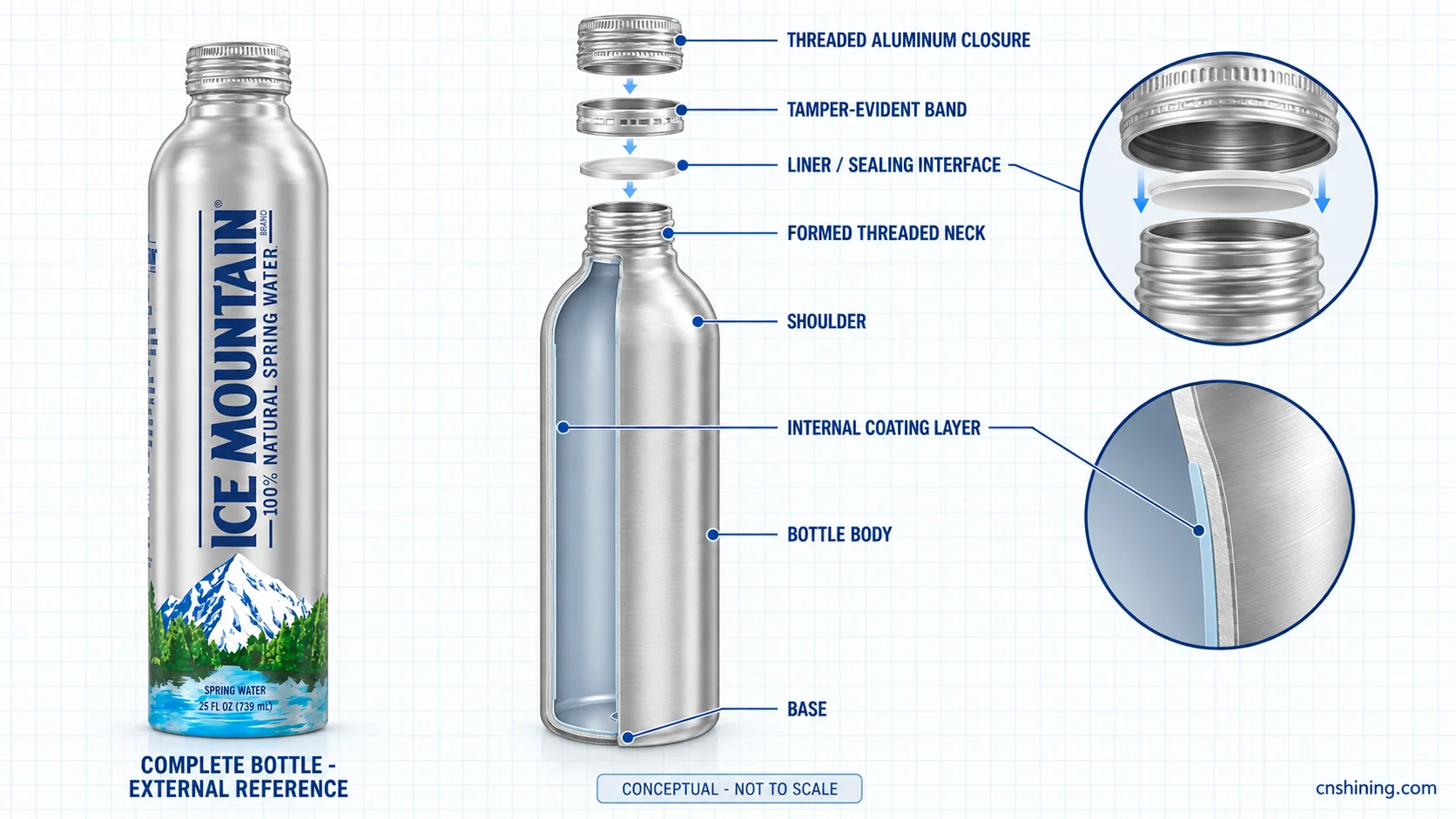
Spring water is less aggressive than many acidic, salty, alcoholic, or flavored beverages, but that does not make bare aluminum an acceptable assumption. Ice Mountain’s 2025 water quality report gives a spring-water pH range of 6.0 to 8.4 and total dissolved solids of 53 to 330 mg/L, with microfiltration, ultraviolet treatment and/or ozone used before filling. Those ranges describe a comparatively mild water system, yet mineral composition, ozone exposure, storage time, coating coverage, and cap-liner contact still have to be assessed together. The practical requirement is a food-contact coating qualified for the actual water, process, and intended shelf life, supported by migration, corrosion, sensory, and retained-sample testing.
| Package interface | Decision for the 25 oz format | Почему это важно | Validation focus |
|---|---|---|---|
| Bottle body | Tall 25 fl oz aluminum bottle with stable shoulder and base geometry | The format must remain easy to carry while resisting visible dents that would undermine its higher-value presentation. | Dimensional tolerance, top load, side impact, base stability, drop exposure, and filled-bottle handling. |
| Internal surface | Food-contact coating selected for the actual spring water and filling process | The coating separates water from the metal substrate and must preserve taste, odor, and package integrity through shelf life. | Coverage, cure, migration, corrosion, ozone compatibility, sensory transfer, and accelerated aging. |
| Neck and closure | Tamper-evident, resealable closure matched to the formed neck finish | Reclosure is the main behavioral advantage over a standard beverage can and supports the larger 25 oz serving. | Application window, removal torque, bridge break, leakage, reseal behavior, and neck deformation. |
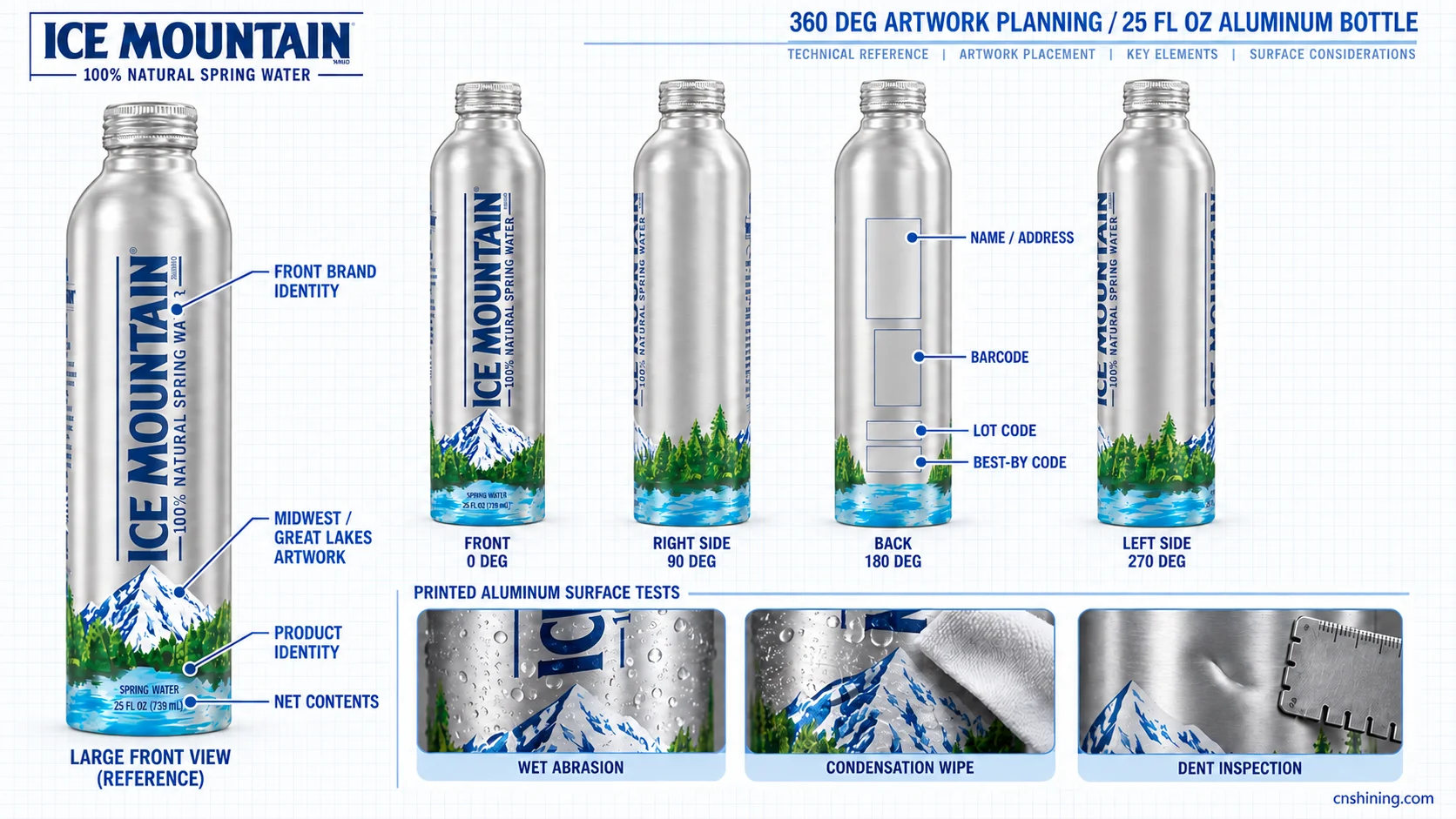
| Decoration | Direct print with protected legal and coding zones | The silver-and-blue bottle has to carry regional graphics without sacrificing traceability or mandatory information. | Color consistency, varnish adhesion, wet abrasion, condensation wiping, barcode readability, and code permanence. |
| Distribution | Case configuration that limits bottle-to-bottle rubbing and shoulder impacts | Aluminum avoids glass breakage but still needs protection from cosmetic denting and scuffing in parcel and retail handling. | Vibration, drop, compression, thermal cycling, pallet pattern, dividers, and e-commerce delivery simulation. |
The decisive interface is the resealable neck-and-closure system. The coating is a non-negotiable food-contact control, but reclosure is what allows the 25 oz bottle to behave differently from a can. If the cap opens inconsistently, leaks after first use, or damages the formed neck, the package loses the consumer benefit that helps justify its cost. FDA food-contact guidance also makes intended use and migration central to material authorization, so the liner, coating, ink, and other contact-relevant components must be documented rather than inferred from the base metal.
Блестящая упаковка can coordinate closure matching, coating compatibility, decorated samples, and filled-bottle validation so the package is assessed as one system.
3. The Graphic Surface Must Survive the Same Journey as the Water
Ice Mountain’s strongest visual assets already suit aluminum: a cool silver field, blue brand typography, mountain and water imagery, and enough uninterrupted height for a regional or licensed campaign to read from a distance. The opportunity is not to make the package look more technical. It is to let the metal surface intensify the existing associations of cold water, Great Lakes geography, and Midwest familiarity. A full-wrap limited design can carry baseball, city, watershed, or seasonal artwork, while the permanent brand architecture remains recognizable across the range.
The engineering constraint is that the Ice Mountain aluminum bottle will rarely stay dry and untouched. It may be handled from a refrigerated shelf, placed in ice, carried in a backpack, served at a meeting, or shipped through parcel networks. Direct print and varnish therefore need wet-abrasion, condensation-wipe, bottle-rub, and color-consistency checks on formed bottles. Legal text, the barcode, lot code, and best-by information should remain on relatively low-distortion areas rather than the shoulder or tight base radius. For U.S. distribution, the identity and labeling of bottled water are governed by 21 CFR 165.110; any move into flavored or sparkling extensions would change both the product specification and the packaging validation plan.
Consumer feedback on other aluminum-bottled water products points to the same practical risk: buyers often like the cold feel, reuse potential, and reduced reliance on plastic, but visible dents after delivery can overwhelm those benefits. That is not simply a logistics problem. It links body-wall design, shoulder geometry, varnish toughness, case partitioning, pallet stability, and channel choice. A bottle intended for hospitality cases may need a different cosmetic acceptance standard and secondary-pack design from one sold individually through a refrigerated convenience channel.
4. Competitive Set: Still Water in Aluminum Bottles
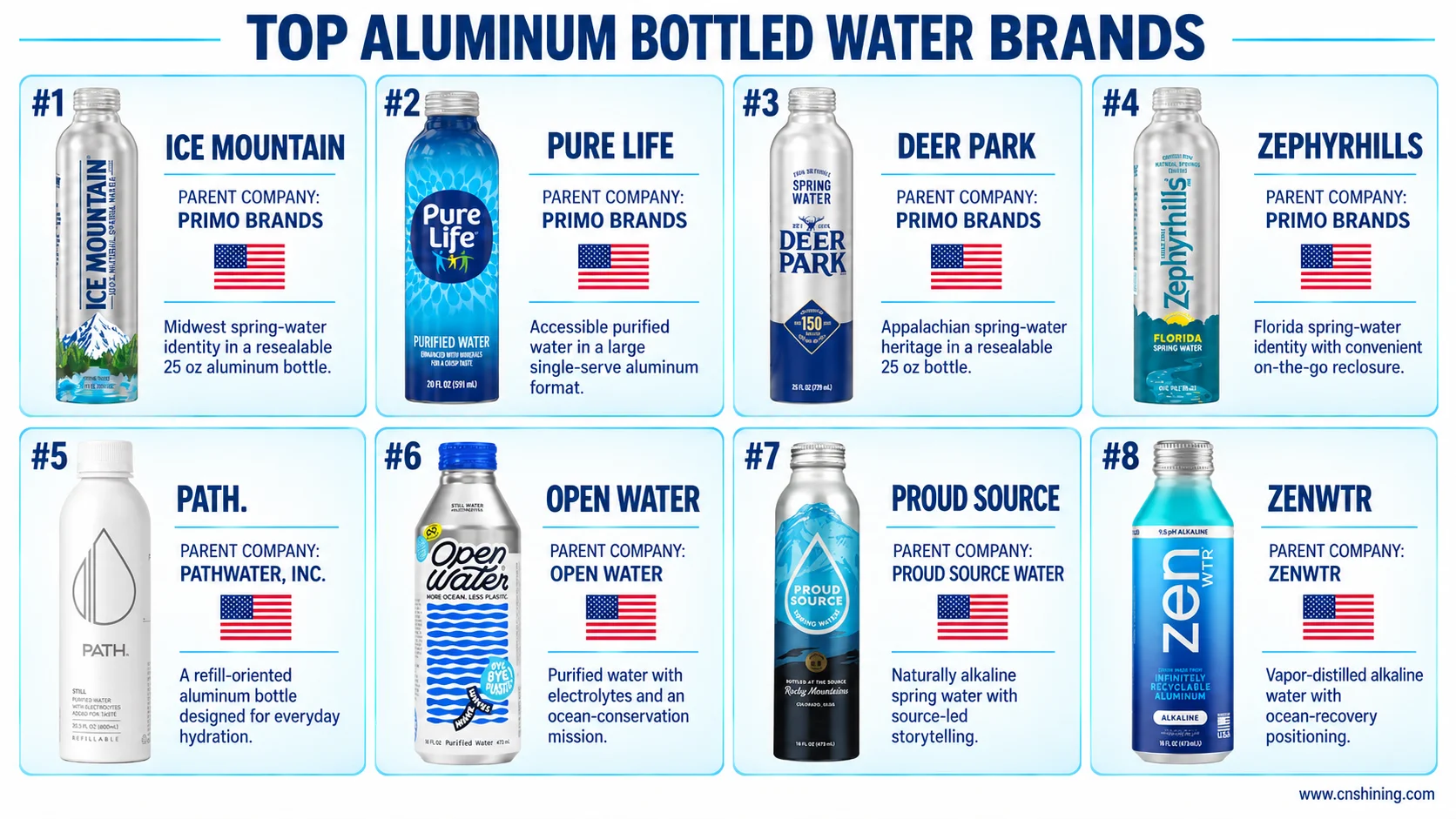
The useful comparison is not every premium water package. It is finished still water sold in a resealable aluminum bottle. That narrower set shows three distinct strategies: regional spring-water brands using aluminum as a campaign or community platform; mass purified-water brands using it as a recyclable single-serve extension; and specialist aluminum-first brands selling refillability, wide-mouth handling, or anti-plastic identity as the main proposition.
| Бренд | Страна | Материнская компания | Емкость | Retail price per bottle | Core selling point |
|---|---|---|---|---|---|
| Pure Life | Соединенные Штаты | Primo Brands | 20 fl oz | Approx. USD 1.75 | Accessible purified water in a large single-serve aluminum format, supported by a national family-hydration identity. |
| Олений парк | Соединенные Штаты | Primo Brands | 25 fl oz | Approx. USD 2.17 | Appalachian regional spring-water heritage translated into the same resealable 25 oz aluminum architecture. |
| Zephyrhills | Соединенные Штаты | Primo Brands | 25 fl oz | Approx. USD 2.17 | Florida spring-water identity, on-the-go reclosure, and local environmental-program support. |
| PATH | Соединенные Штаты | Pathwater, Inc. | 20 fl oz | Approx. USD 4.75 | A thicker refill-oriented aluminum bottle positioned as a durable daily hydration object rather than a one-occasion pack. |
| Открытая вода | Соединенные Штаты | Открытая вода | 16 жидких унций | Approx. USD 2.00 | Purified still water with electrolytes, aluminum-first packaging, and ocean-conservation positioning. |
| Proud Source | Соединенные Штаты | Источник воды Proud | 16 жидких унций | Approx. USD 1.85 | Naturally alkaline spring water with source-specific storytelling and a compact resealable aluminum bottle. |
| ZenWTR | Соединенные Штаты | ZenWTR | 16 жидких унций | Approx. USD 1.72 | Vapor-distilled alkaline water in a wide-mouth aluminum bottle with an ocean-bound-plastic recovery message. |
Prices are public U.S. online snapshots checked in September 2026 and converted to a single-bottle figure from the listed pack price where necessary. Taxes, subscriptions, promotions, location, and availability can change the effective price.
The table clarifies Ice Mountain’s position. It does not need to out-refill PATH, out-activate Open Water, or out-alkalize ZenWTR. Its closest structural comparisons are Deer Park and Zephyrhills, which use the same 25 oz regional-brand logic at the same sampled unit price. Ice Mountain therefore has to earn distinction through Midwest specificity: Great Lakes visual language, cold-water cues, community programs, and limited graphics that feel native to the region. Compared with Pure Life, it can be more place-led; compared with specialist aluminum-first brands, it can remain more familiar and accessible. The bottle is strongest when it converts regional trust into a package worth noticing, not when it tries to make aluminum the whole brand story.
5. Where the Aluminum Bottle Earns Its Extra Cost
For Ice Mountain, the aluminum bottle earns its place in channels where the package stays visible and handling behavior matters: a chilled convenience shelf, sports or cultural events, hotel rooms, conference tables, corporate programs, travel, and limited regional releases. The 25 oz capacity supports longer use than a small single-serve water, while reclosure makes it practical to carry between moments. Those benefits are diluted in price-led household stock-up occasions, where a lightweight multi-pack remains easier to justify.
Development should follow that commercial logic. First, confirm the target market, water specification, shelf life, filling temperature, ozone exposure, and existing line capability. Next, lock the bottle, coating, neck, liner, and closure as a single qualification set. Then validate graphics and legal copy on formed bottles before running filled stability, sensory, torque, leak, drop, vibration, thermal-cycle, and case-compression work. If a sparkling or flavored extension is considered later, it should receive its own pressure and compatibility program rather than inheriting assumptions from still spring water.
6. Заключение
Он Ice Mountain aluminum bottle is valuable because it gives a mainstream regional spring-water brand a selective package with more presence, a resealable 25 oz drinking rhythm, and enough surface to turn Midwest identity into limited or community-linked design. Its success should be judged by channel fit, closure reliability, sensory neutrality, artwork durability, and delivered appearance – not by whether aluminum can replace every plastic bottle in the portfolio. The disciplined strategy is a high-value regional hero SKU beside the volume formats that already make Ice Mountain widely accessible.