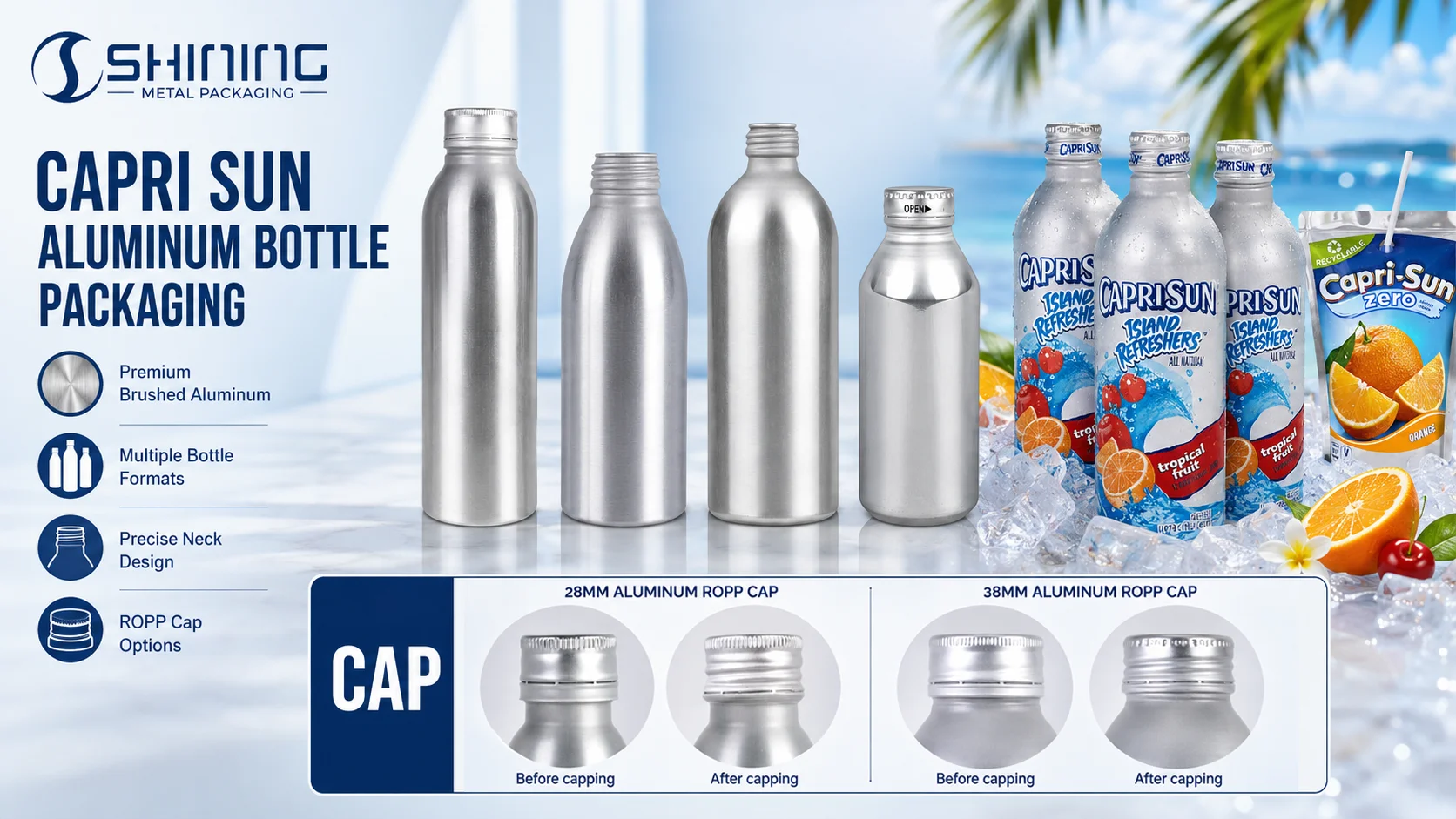
1. The Capri Sun Aluminum Bottle Should Create a New Drinking Moment, Not Replace the Pouch
When Capri Sun introduced its first U.S. single-serve bottle in more than two decades in 2025, the brand framed the move around a practical change in consumer behavior: fans wanted more drink, a package they could reseal and a format suited to convenience stores and drinking on the go. The 12 fl oz bottle holds roughly twice the volume of the familiar 6 fl oz pouch and was launched in Fruit Punch, Pacific Cooler and Strawberry Kiwi. That development provides a much stronger rationale for a Capri Sun Aluminiumflasche than simply replacing the iconic pouch with metal. Kraft Heinz’s 2025 bottle launch explicitly connects the new format with resealability, convenience stores and broader on-the-go use.
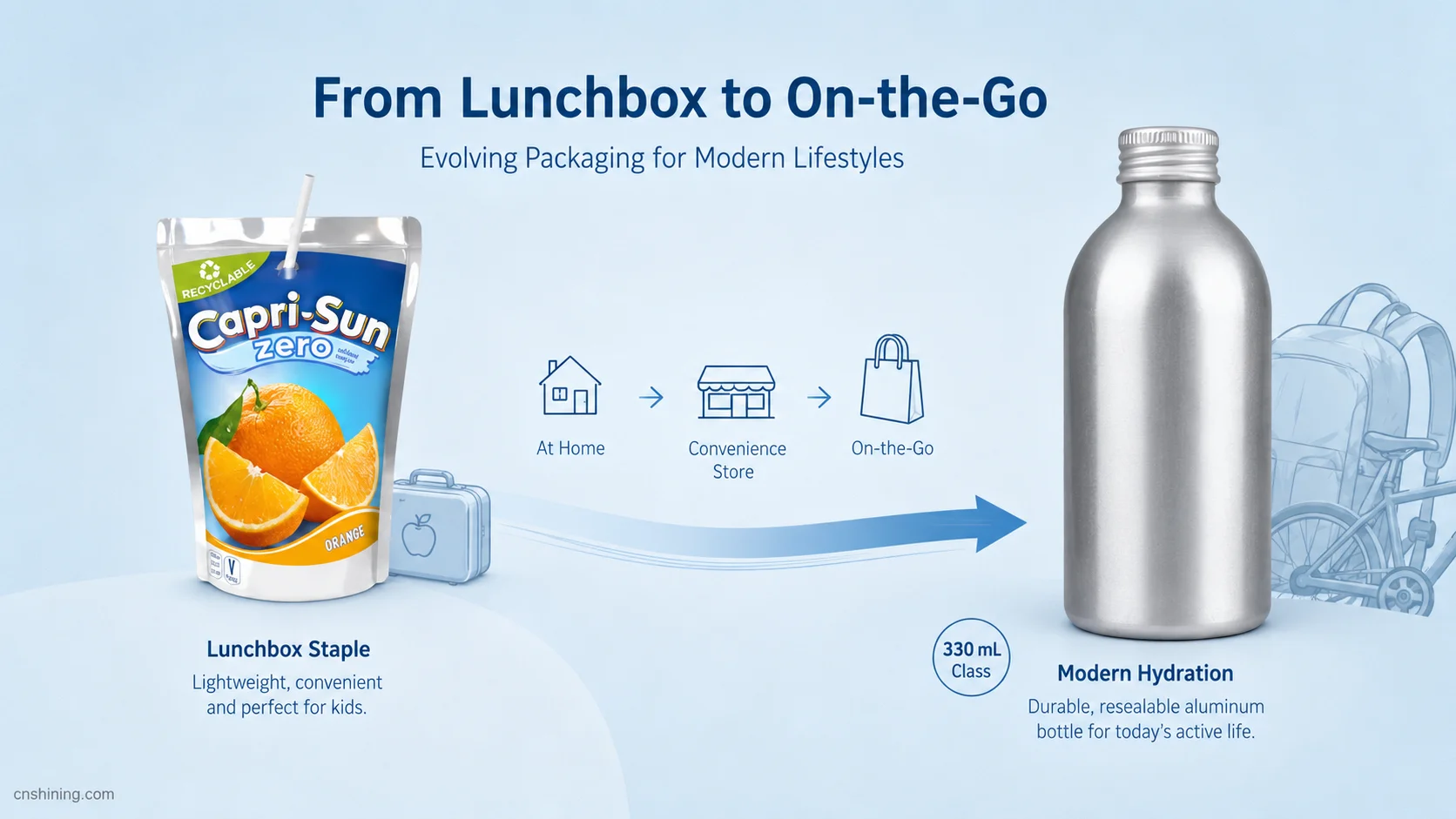
That distinction protects one of Capri Sun’s most valuable assets: the pouch is not an anonymous flexible package. It is part of the drinking ritual. Capri Sun still describes its core 200 ml format around lunchboxes, picnics, after-school activities and family days out, while its larger 330 ml European pouch adds a reclosable cap and is marketed for consumers who want more product while moving between occasions. The brand therefore already operates two different packaging behaviors—small, highly recognizable single-serve pouches and larger resealable formats. Capri Sun’s current international portfolio confirms that the 330 ml Big Pouch is sold in more than 20 countries and is explicitly positioned around “open, enjoy, close” consumption.
An aluminum bottle belongs on the second side of that architecture. A 250–355 ml metal format could serve convenience stores, vending, sports and outdoor occasions, teenage consumers and adults with nostalgic recognition of the brand without asking families to abandon the low-friction pouch format that built Capri Sun. There is also historical precedent: in 2003, Capri Sun introduced a 16.5 oz aluminum “bottle can” for Island Refreshers, with a resealable twist-off closure and a convenience-store focus aimed at 16–25-year-olds. Contemporary coverage reported that 86% of consumers in the cited research considered the package highly eye-catching. The original Capri Sun bottle-can launch shows that metal, resealability and an older on-the-go consumer are not foreign ideas for the brand.
2. For Capri Sun, the Inner Coating Is More Important Than the Aluminum Shell
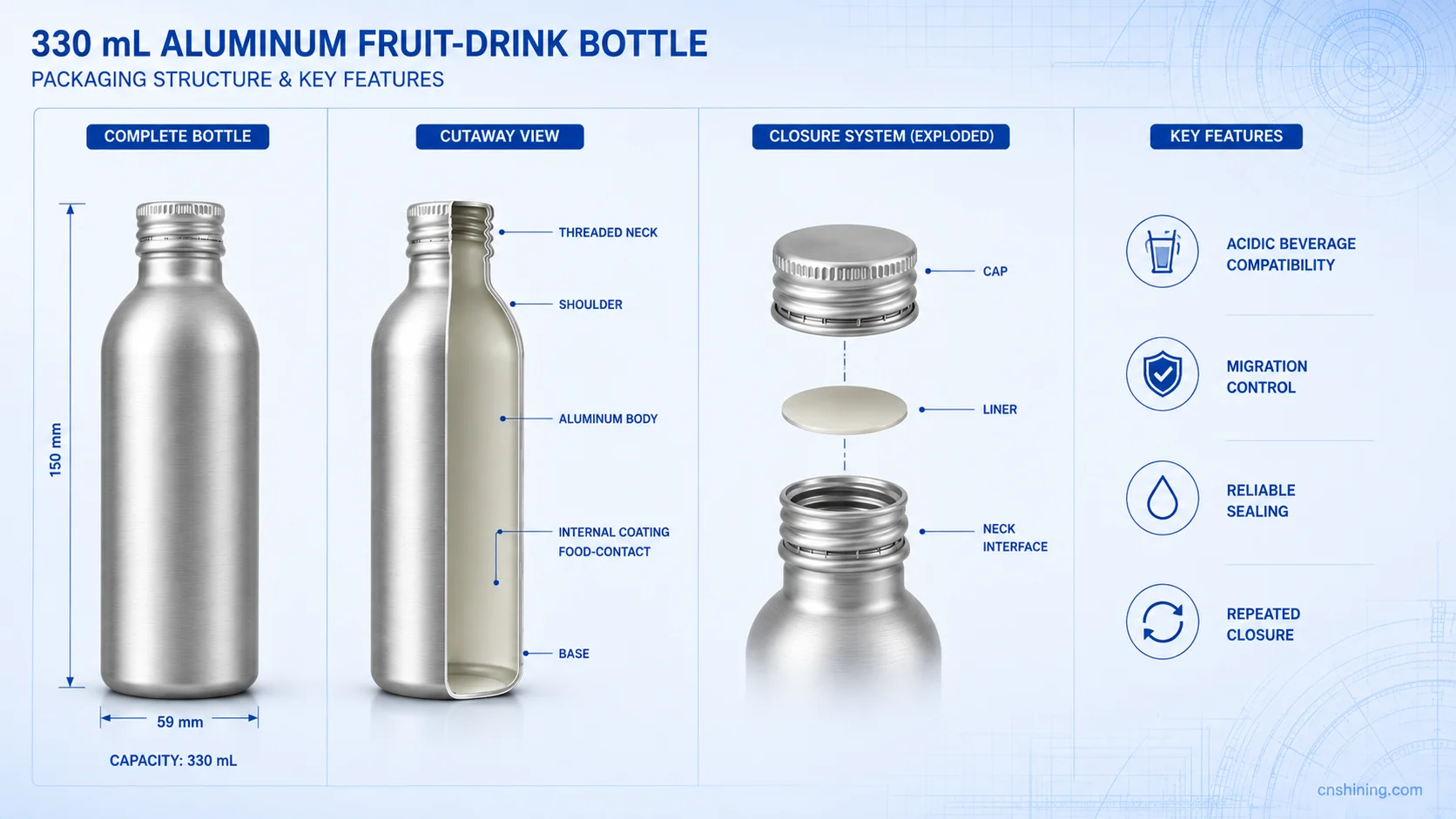
Capri Sun’s beverage chemistry creates the main engineering constraint. Current Capri Sun products are fruit-juice or fruit-flavored water-based drinks, and public ingredient information across the range includes fruit-juice concentrates and citric acid. That means an aluminum package cannot be specified on material reputation alone. The commercial formulation, acidity, dissolved salts, flavor system, processing temperature and target shelf life have to be matched to an appropriate food-contact coating before a bottle design can be considered production-ready.
| Packaging interface | Development direction | Why it matters for Capri Sun | Validation priority |
|---|---|---|---|
| Bottle format | Approximately 250–355 ml resealable aluminum bottle or bottle-can. | The size sits between the classic children’s pouch and larger multi-serve formats while supporting convenience-store single-unit consumption. | Filled weight, grip diameter, dent resistance, vending compatibility and cold-case handling. |
| Innenbeschichtung | Select against the exact Capri Sun SKU rather than using a universal “juice-compatible” coating assumption. | Citric acid, juice concentrates, flavor compounds and electrolyte variants can create different corrosion and migration conditions. | Migration, corrosion, flavor stability, color change, coating integrity and real-time shelf-life testing. |
| Neck and closure | Simple tamper-evident threaded closure with a qualified sealing interface. | Resealability is one of the strongest reasons to choose a bottle over a standard can for the larger Capri Sun occasion. | Opening torque, tamper-band break, leak resistance, repeated closure and post-distribution neck geometry. |
| Processing compatibility | Specify only after the target filling and preservation process is confirmed. | The package requirements change depending on whether the selected SKU and co-packer use hot filling, pasteurization, aseptic processing or another validated route. | Thermal exposure, coating stability, closure behavior, dimensional stability and post-process appearance. |
| Exterior decoration | Use metal as part of the visual system rather than covering every surface with an imitation pouch graphic. | Capri Sun already owns silver, fluid shapes and bright fruit-coded colors; exposed aluminum can modernize those cues without erasing recognition. | Color control, abrasion, condensation resistance, varnish durability and code readability. |
The coating specification is the project’s critical technical gate. A bottle can look structurally correct and still be wrong for the beverage if the coating, formulation and processing conditions are mismatched. Classic Fruit Punch and a future electrolyte-oriented SKU should not automatically inherit the same compatibility conclusion merely because both carry the Capri Sun name.
In the United States, food-contact coatings must have an appropriate regulatory basis for their intended use; FDA’s food-contact framework includes resinous and polymeric coatings used on metal substrates and ties compliance to specific food types and conditions of use. FDA food-contact guidance is therefore more useful than a generic “food-grade aluminum” claim. For an EU launch, all food-contact materials must comply with Regulation (EC) No 1935/2004 and GMP requirements, and the current EU rules on BPA and certain other bisphenols are directly relevant to metal-packaging coatings. European Commission food-contact guidance sets the general framework, while Regulation (EU) 2024/3190 establishes current restrictions on BPA and specified bisphenols in food-contact materials.
3. Metal Should Evolve Capri Sun’s Visual Language Instead of Turning It into a Generic Energy Drink
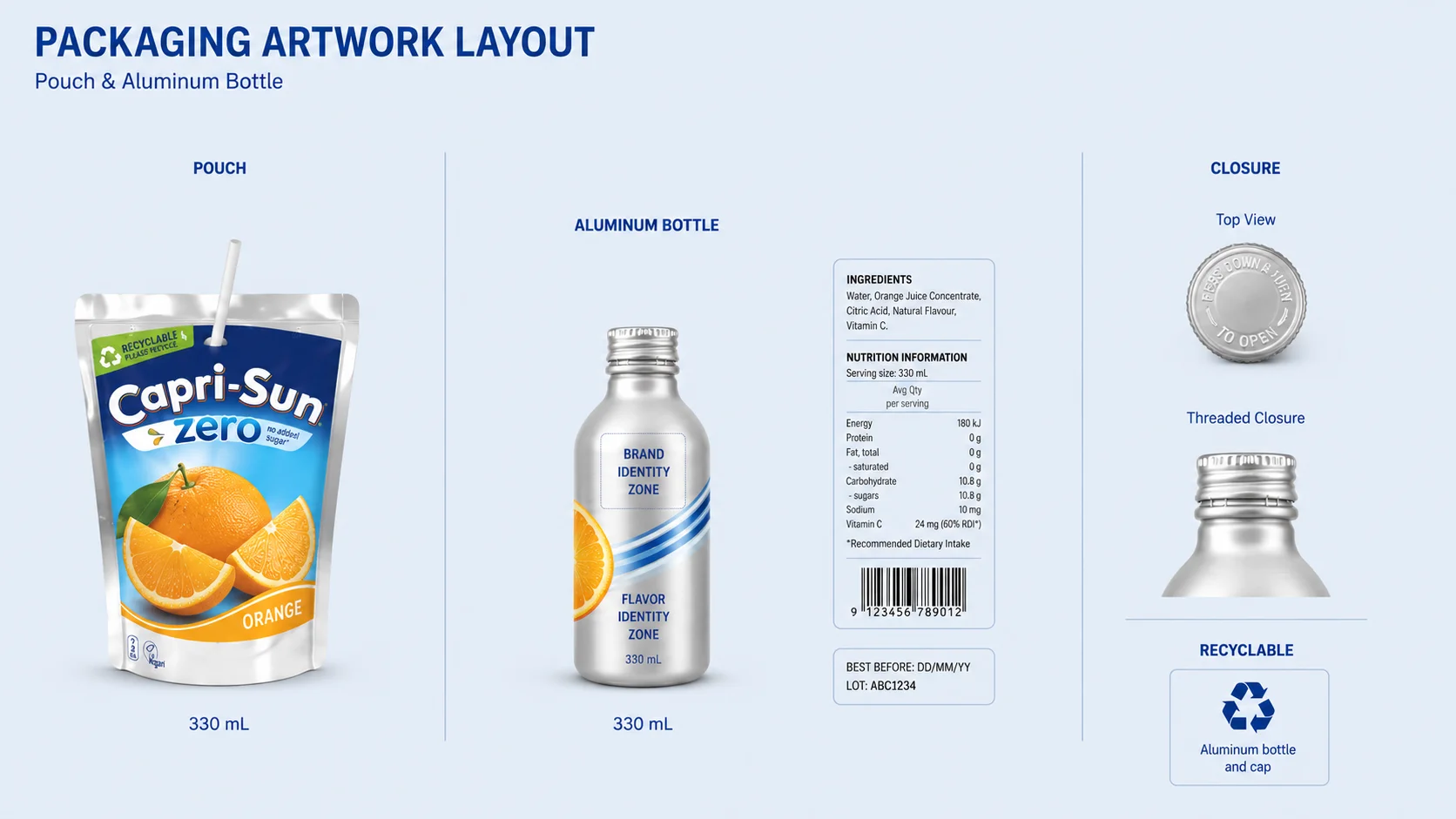
The design opportunity is unusually strong because Capri Sun already has a visual language that translates naturally to aluminum. Silver has long been part of the pouch identity, while fruit colors, fluid forms and an energetic wordmark provide recognition at a distance. A metal bottle can retain those assets while changing their hierarchy: exposed or lightly varnished aluminum can become the background material, fruit flavor can move into high-saturation color fields, and the central brand block can remain visually familiar without reproducing every detail of a flexible pouch on a rigid cylinder.
The drinking action needs the same degree of continuity. The classic pouch is opened by puncturing it with a straw; a larger 330 ml European pouch uses a reclosable tethered cap; the 2025 U.S. bottle uses a resealable closure. A future aluminum format therefore does not need to reproduce the straw ritual literally, but it should preserve the broader Capri Sun idea that opening is intuitive and playful rather than technical. A visible tamper-evident ring, moderate opening torque and a mouth designed for straightforward drinking would fit the brand better than an elaborate sports valve or aggressively engineered closure. Capri Sun’s own current FAQ explains the 330 ml pouch as a simple quarter-turn opening and closing experience, reinforcing the importance of uncomplicated reclosure.
A larger rigid package also creates more room for required information. In the U.S., fruit imagery and juice-related product naming can trigger percentage-juice declaration requirements, while ingredients, Nutrition Facts, net contents and responsible-party information still need disciplined space allocation. In Europe, the available cylinder provides more room for multilingual mandatory information than a small pouch, but that advantage disappears if the bottle is covered with decorative claims and secondary labels. The correct artwork process is therefore to reserve legal, coding and traceability zones first, then use the remaining 360-degree surface for flavor and brand storytelling.
Sustainability language should be equally restrained. An aluminum body may support a recyclability message, but a bottle can also contain coatings, inks, varnishes, a closure and liner that follow different material pathways. FTC guidance warns against broad environmental claims and says recyclability claims may need qualification depending on access to appropriate recycling facilities. The FTC Green Guides summary supports component-specific language rather than statements such as “100% eco-friendly.”
4. Competitor Landscape: Fruit Drinks Already Using Resealable Aluminum Bottle-Cans
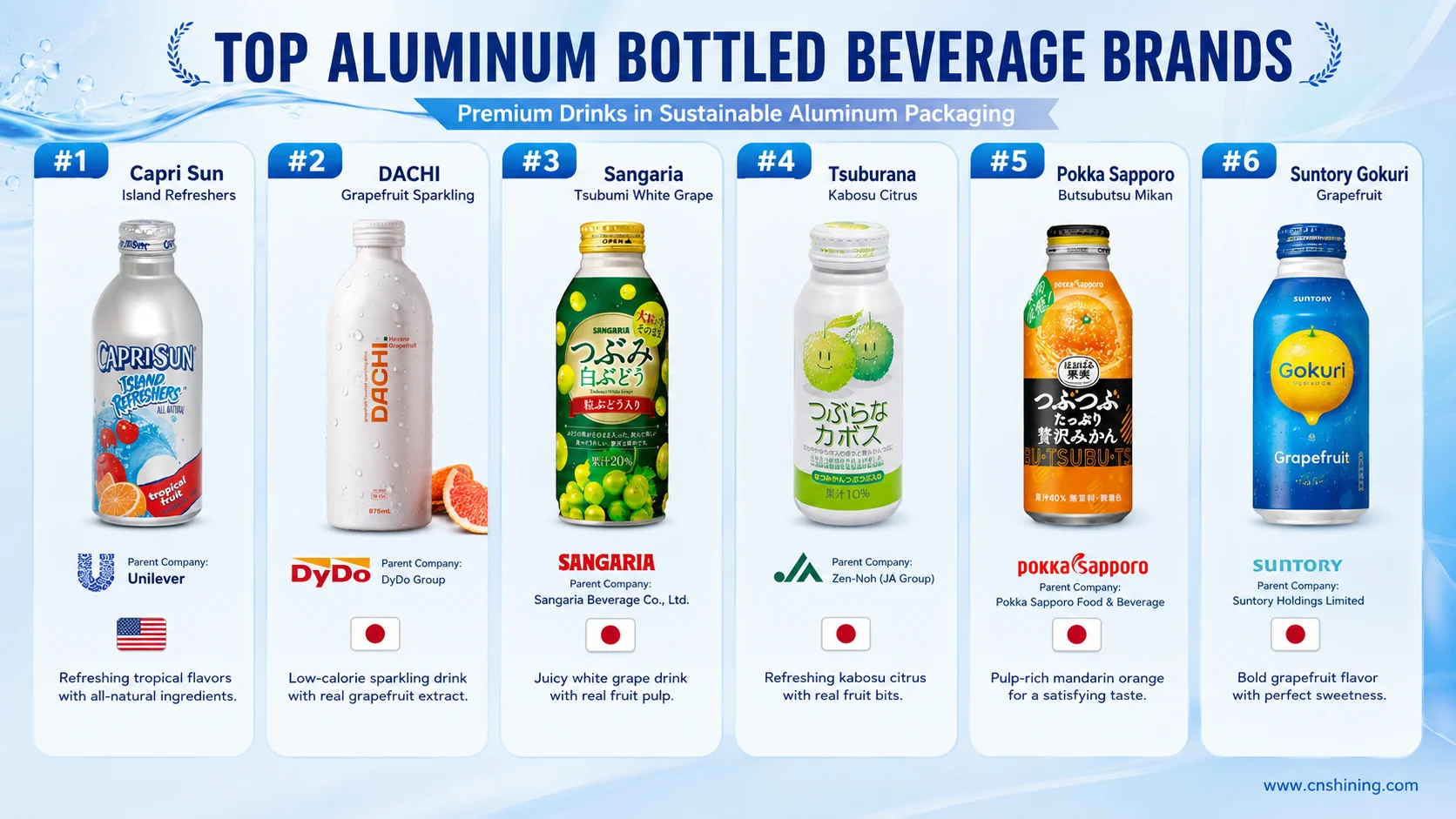
Direct competitors are less common than aluminum cans, which is itself informative. The most relevant finished-product references are concentrated in fruit drinks that need either reclosure, a wide drinking opening, room for pulp or a more distinctive cold-case format. Rather than padding the comparison with water, beer or energy drinks, the table below focuses on five verifiable fruit-based or fruit-forward beverages sold in aluminum bottle or bottle-can formats.
| Marke | Land | Muttergesellschaft | Kapazität | Retail Price | Core Selling Point |
|---|---|---|---|---|---|
| Suntory Gokuri Grapefruit | Japan | Suntory Beverage & Food Ltd. | 400 g bottle-can | JPY 150 suggested retail price | Grapefruit drink with fruit fiber, using a larger bottle-can to make texture and fruit intensity part of the drinking experience. |
| Pokka Sapporo Hoobaru Kajitsu Mikan | Japan | Sapporo Holdings Ltd. | 400 g bottle-can | Approx. JPY 207/bottle | 40% mandarin fruit drink with plentiful pulp, combining a resealable wide-mouth bottle-can with a deliberately substantial fruit texture. |
| JA Foods Oita Tsuburana Kabosu | Japan | JA Foods Oita Co., Ltd. | 190 g bottle-can | JPY 128/bottle | Compact single-serve kabosu drink with citrus juice and fruit pieces, using the bottle-can opening to accommodate texture while remaining easy to carry. |
| Sangaria Tsubumi White Grape | Japan | Nippon Sangaria Beverage Co., Ltd. | 380 g bottle-can | Approx. JPY 165/bottle | Fruit drink built around grape pieces and a resealable bottle-can, prioritizing texture and portable consumption over the conventions of a standard juice can. |
| Dachi Havana Grapefruit | Südafrika | Dachi | 875 mL aluminum bottle | ZAR 90/bottle | Low-calorie grapefruit and blood-orange refreshment in a large reusable aluminum bottle, positioning metal as part of a contemporary adult sharing and lifestyle format. |
The competitive lesson is not that Capri Sun should imitate Japanese pulp drinks. Their importance is structural. Gokuri, Hoobaru Kajitsu, Tsuburana and Tsubumi use bottle-cans where a standard pull-tab can would be less suitable for controlled drinking, reclosure or fruit pieces. Dachi uses a much larger metal bottle to make the container part of an adult lifestyle proposition. Capri Sun occupies a different cultural position: its opportunity is to combine the recognizable ease and brightness of a children’s drink with a larger, resealable package that feels credible in a convenience-store refrigerator.
That makes 250–355 ml a more coherent strategic range than either extreme in the table. A 190 ml bottle-can would move too close to the one-sitting logic already handled efficiently by the pouch; an 875 ml bottle would become a sharing product rather than an immediate-consumption extension. Around 330–355 ml, however, Capri Sun can connect directly to the direction already demonstrated by its 330 ml international pouch and 12 fl oz U.S. bottle while using metal to make the new format visually unmistakable.
5. The Best Aluminum Path Is a 330 mL-Class Brand Extension with Clear Technical Boundaries
A Capri Sun aluminum program should begin with one question: which consumption occasion is valuable enough to justify a package that is more complex than the pouch and more differentiated than a conventional can? The strongest answer is the larger, resealable, chilled single-serve occasion. A roughly 330 mL bottle can sit naturally in convenience-store coolers, vending machines, sports environments and outdoor retail while giving teenagers and adult nostalgia consumers a format that feels related to Capri Sun without being designed like children’s lunchbox packaging.
The development sequence should follow the beverage rather than the rendering. The first decision is the target formula—Fruit Punch, Pacific Cooler, Strawberry Kiwi, a 100% juice variant or a functional hydration extension—followed by actual pH, conductivity, sugar-acid balance, electrolyte level where relevant, preservation process and shelf-life target. Only then should the project freeze the internal coating, bottle geometry, cap liner and closure torque window. Filled-package trials should include compatibility and migration work, flavor stability, thermal exposure, opening and resealing, leakage, denting, transport simulation and wet-abrasion tests on the final decoration.
Shining Packaging can support inner-coating selection, closure matching, decorated sampling and package validation when an acidic fruit drink is developed in a resealable aluminum bottle.
Conclusion. The most convincing Capri Sun aluminum bottle is not a metal copy of the 6 oz pouch. It is a deliberately different Capri Sun for a different moment: larger, resealable, upright in the cold case and designed for consumers who have moved beyond the lunchbox without moving beyond the brand. Aluminum can strengthen that proposition through material feel and rigid-format visibility, but only if coating compatibility and the filling process are treated as primary engineering decisions. The pouch should remain the icon; the aluminum bottle can become the format that gives the brand somewhere new to go.