
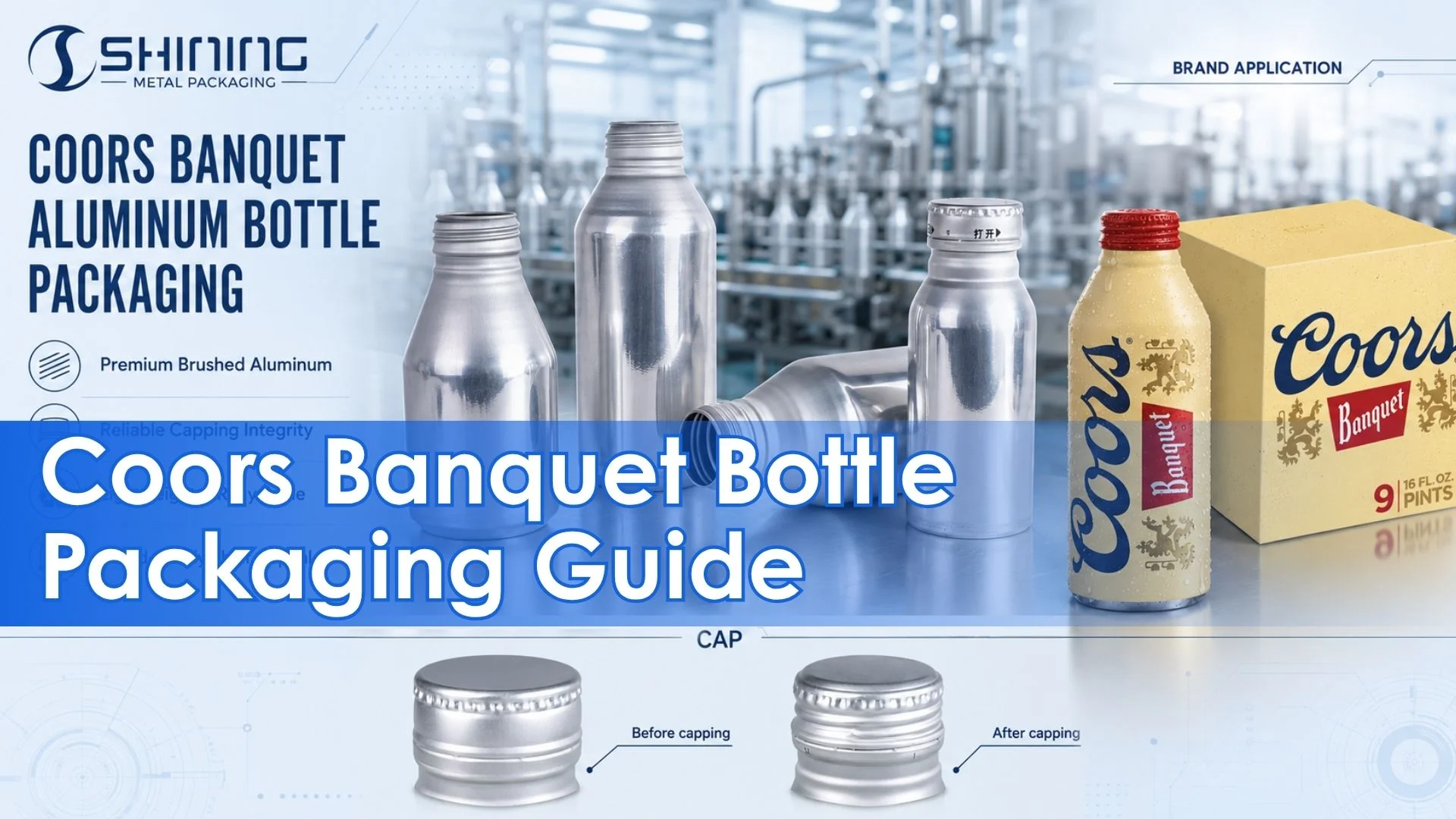
The Coors Banquet aluminum bottle is not simply a metal substitute for a glass beer bottle. It is a 16 fl oz package designed around a specific combination of drinking occasion, channel, product protection and brand recognition. The commercial format gives consumers a bottle-shaped, reclosable container without the breakage risk of glass, while aluminum blocks light and provides the cold metallic feel associated with ready-to-drink beer.
That combination matters because the U.S. retail format is a nine-pack of 16 fl oz aluminum pints, rather than a low-cost, high-count case intended to compete directly with standard cans. Coors Banquet is a 5% ABV American lager, and its brand identity is tied to Golden, Colorado, a brewing history beginning in 1873, Moravian barley and Rocky Mountain water.
1. Why the Coors Banquet Aluminum Bottle Fits the Occasion Better Than a Standard Can
The main packaging conflict is straightforward. A standard aluminum can is generally the more efficient format for high-volume distribution. It uses a mature filling and seaming system, packs densely and usually reaches a lower unit cost. The aluminum bottle must therefore solve a problem that the can does not solve as well.
In this case, that problem is occasion and channel fit. A 16 oz reclosable bottle is suited to convenience-store purchases, tailgating, camping, grilling, outdoor gatherings, music or sports venues, and other situations in which the consumer may carry an opened drink for a short period. The cap can reduce spill risk while the drink is temporarily set down or moved. The aluminum body also removes the shattering hazard associated with glass in coolers, vehicles and glass-restricted locations.
The bottle shape makes another practical difference. It provides a defined neck and drinking opening, so the handling and drinking motion remain closer to a conventional beer bottle than to a straight-sided can. This familiar geometry helps the package preserve part of Coors Banquet’s traditional beer-bottle character even though the material and closure are different.
Aluminum also gives complete light blockage. That is useful for beer because light exposure can initiate reactions that produce light-struck off-odors. A metal wall avoids the dependence on glass color for light protection. Oxygen control, however, still depends on filling practice, coating continuity and closure integrity; aluminum alone does not correct high dissolved oxygen or a poor seal.
The cold-touch experience should be described accurately. Aluminum’s thermal conductivity makes the package surface respond quickly to the temperature of the beer and surrounding ice. Consumers therefore feel a strong cold-metal sensation. That does not mean every aluminum bottle automatically chills the product faster under every condition. Fill temperature, container geometry, circulation around the package and the cooling medium still determine the actual cooling curve.
Retail pricing illustrates why the package needs this differentiated job. A nine-pack of 16 oz aluminum pints was listed at $14.99, or about $1.67 per bottle. By comparison, a 12-pack of 16 oz Coors Banquet cans was listed at $12.99, or about $1.08 per can. Pack counts and promotions differ, so this is not a controlled cost comparison, but it shows a directional unit-price premium of roughly 54%.
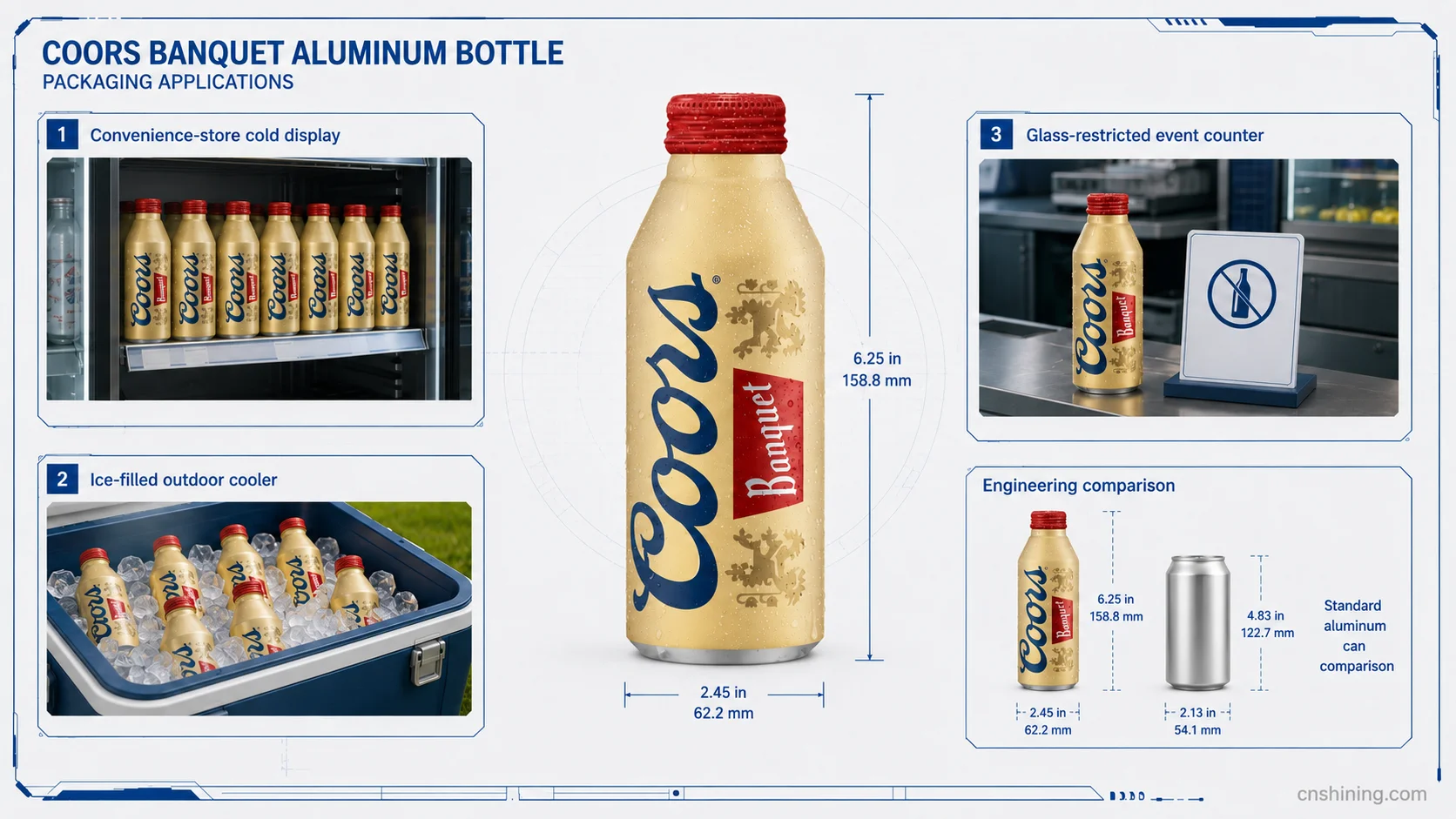
2. Product Structure Breakdown: The Aluminum Bottle as a Complete System
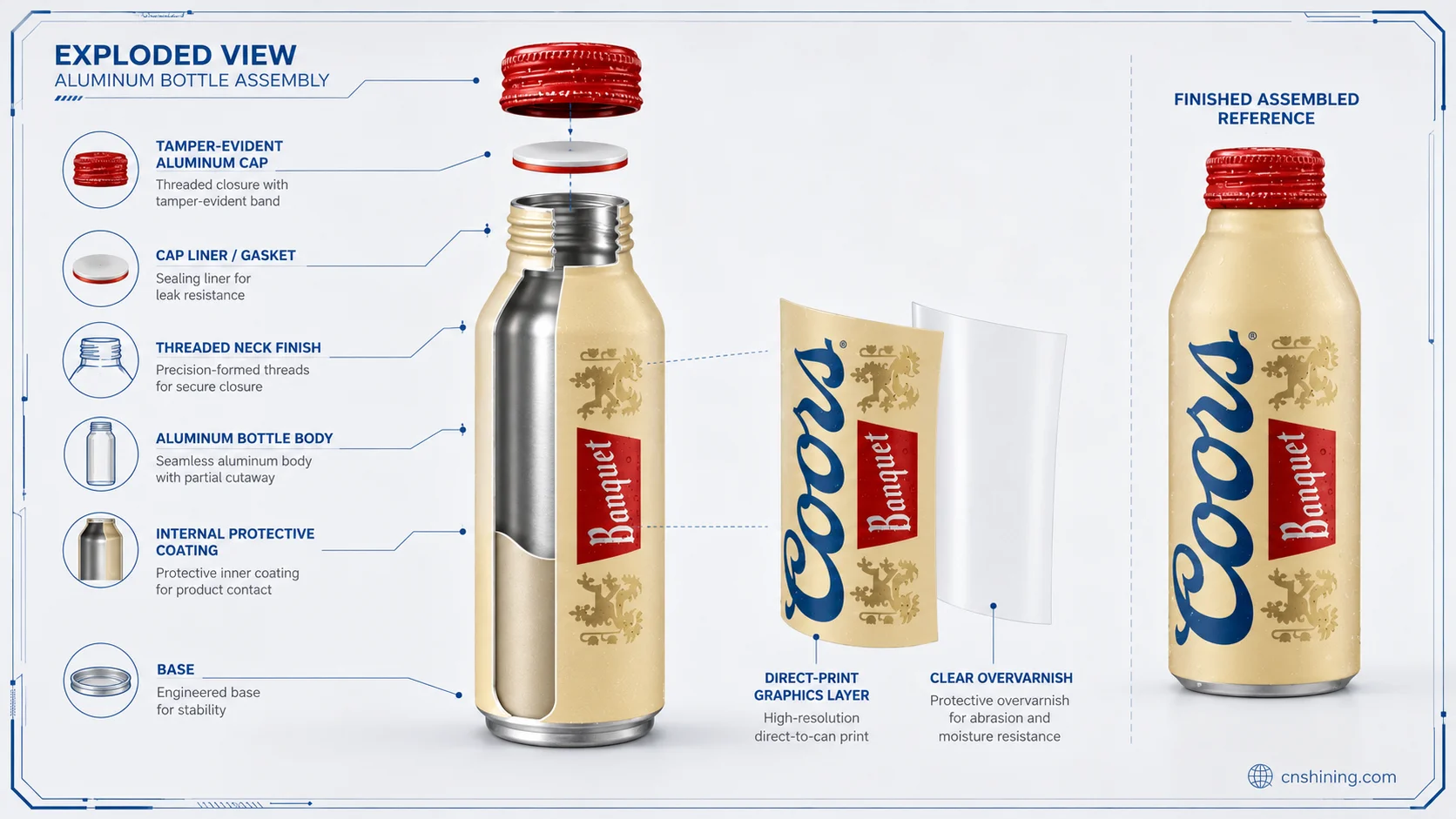
Treating the container as “an aluminum body with a cap” is too simple for carbonated beer. The package has several interdependent functional layers. A change to the neck finish can alter the required cap, liner compression, opening torque and filling-line setup. A change to the coating can affect flavor, corrosion resistance and thermal-process tolerance. A change to the varnish can alter scuff resistance and wet grip.
| Structure item | Functional specification for this format | Why it matters to the packaging decision |
|---|---|---|
| Nominal capacity | 16 fl oz, approximately 473 mL; the U.S. net-contents declaration for this volume is normally expressed as “1 Pint.” | Creates a larger single-serve format associated with convenience, outdoor and take-away consumption. |
| Bottle body | Lightweight aluminum beverage body with a cylindrical sidewall, formed shoulder, neck and pressure-resistant base geometry. | Provides light blockage, bottle-like handling and resistance to shattering, but must withstand internal pressure and line handling without unacceptable denting. |
| Innenbeschichtung | Continuous food-contact liner validated for carbonated, acidic and alcoholic beer under the intended filling, pasteurization and shelf-life conditions. | Separates beer from bare aluminum and controls corrosion, migration and flavor interaction. |
| Neck finish | A wide-mouth threaded finish matched to an approved closure drawing and capping profile. The exact finish must be controlled as a bottle-and-cap system. | Determines sealing geometry, cap application, removal torque, tamper-band engagement and reclosure performance. |
| Schließung | Tamper-evident, reclosable aluminum screw closure, with controlled bridge strength and provision for safe pressure release during opening. | Creates the main functional difference from a conventional pull-tab can. |
| Closure liner or gasket | Food-contact sealing compound with sufficient gas barrier, elastic recovery and thermal stability for beer. | Maintains CO2 pressure and limits leakage and oxygen entry. The metal cap shell cannot perform this task alone. |
| Direct multi-color decoration using the established gold, red and blue brand hierarchy, with artwork compensation through the shoulder transition. | Turns the metal surface into a recognizable brand asset without requiring a large applied label. | |
| External varnish | Clear protective coating selected for abrasion resistance, condensation exposure, desired gloss level and controlled surface friction. | Protects decoration during filling, packing, transport, cooler use and repeated bottle-to-bottle contact. |
| Fill and headspace control | Controlled liquid level, carbonation, package pressure and oxygen pickup, based on the beer specification and thermal process. | Determines pressure safety, carbonation retention, Schaum behavior and long-term flavor stability. |
A useful reference for the relationship between integrated metal threads, inserted threads, crown finishes and their respective closures is the technical guide to aluminum bottle thread types. The final drawing must identify the actual neck dimensions, thread profile, transfer bead and closure interface rather than relying on a generic diameter description.
The cap also needs to be selected as part of the same drawing set. The aluminum bottle caps and sealing guide explains why ROPP, crown and conventional screw systems are not interchangeable even when their nominal diameters appear similar.
Aluminum beverage bottles can be made through different body-forming routes. An impact-extruded route begins with an aluminum slug and proceeds through extrusion, trimming, washing, internal coating, base coating, printing, varnishing and neck formation. That sequence is illustrated in this overview of aluminum bottle manufacturing stages. A beverage bottle made through a two-piece body route uses a different forming sequence. The chosen manufacturing route should therefore be named in the technical specification rather than inferred from the finished appearance.
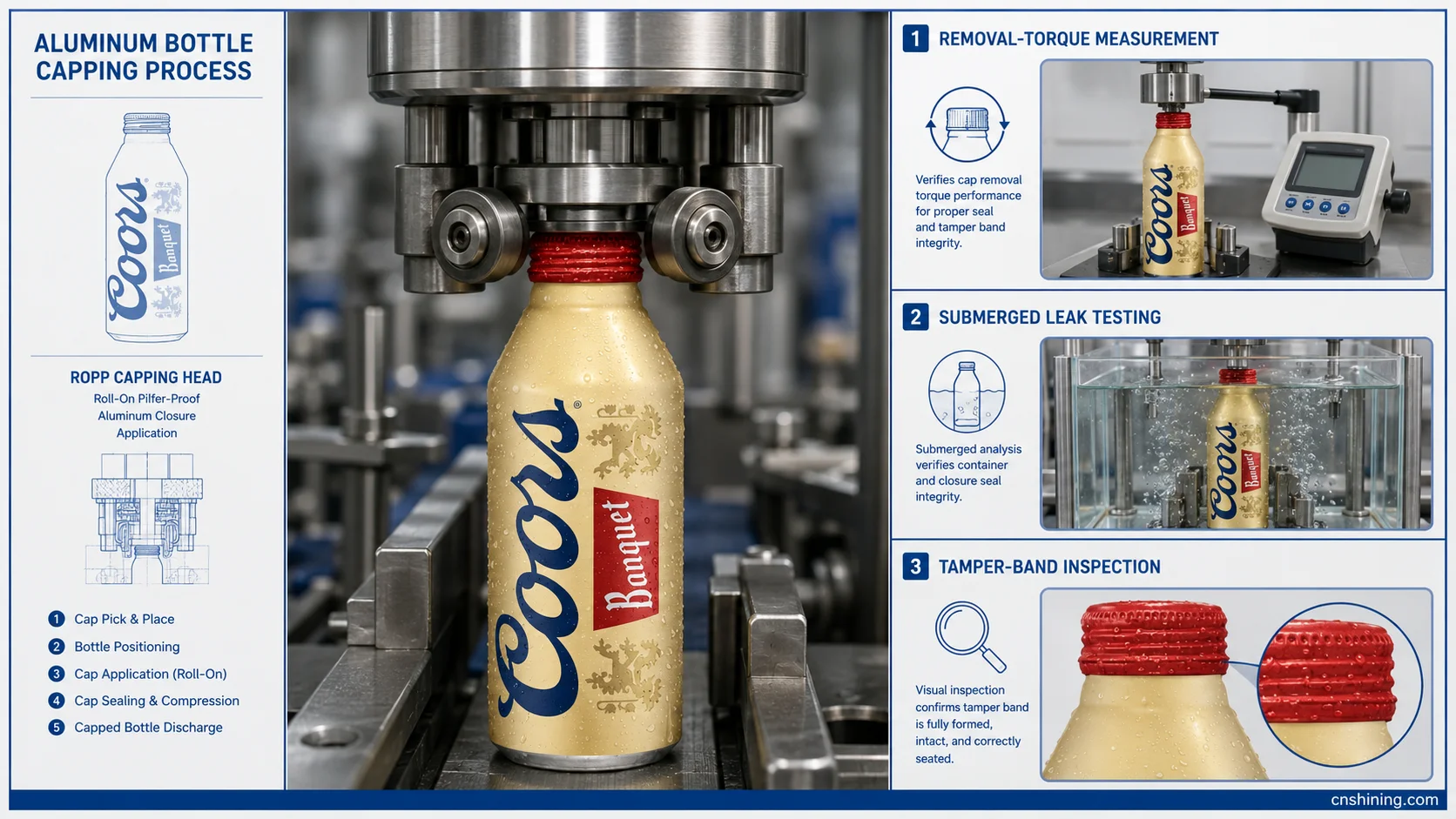
3. Resealability Is a Channel Function, Not a Shelf-Life Claim
“Reclosable” needs a precise definition. After the first opening, the consumer can screw the cap back onto the bottle. This can reduce splashing and accidental spills during short pauses. It can also slow CO2 loss compared with leaving the bottle fully open.
Reclosure does not return the package to its original hermetic condition. Opening releases pressure, disturbs the headspace and introduces oxygen. The remaining carbonation depends on how long the bottle stays open, product temperature, remaining liquid volume, cap reapplication and gasket condition. The package should therefore not imply that an opened beer retains its original shelf life.
For a roll-on pilfer-proof architecture, a plain aluminum cap shell is formed onto the bottle’s thread and security bead during application. The process creates the thread profile and tamper-evident band on the filled package. The ROPP capping and quality-control guide describes the relationship between roller settings, bridge formation, removal torque, seal-pressure testing and common application defects.
What the filling line must control
Introducing a threaded aluminum bottle can require more than installing a different cap feeder. The engineering review should cover bottle infeed stability, neck handling, filler-height settings, cap transfer, top load, roll-on head adjustment, bottle centering, discharge guides and inspection. Aluminum necks can deform when equipment settings designed for heavier glass bottles apply excessive axial or lateral force.
The minimum closure validation program should include:
- Applied-cap profile and tamper-band engagement.
- Initial removal torque and consumer opening-force distribution.
- Secure-seal or pressure-leak testing on filled packages.
- CO2 retention before and after the intended thermal process.
- Cold-to-warm and warm-to-cold cycling.
- Cap bridge break consistency and safe pressure venting.
- Leakage after vibration, drop and top-load exposure.
- Short-term opened-and-reclosed performance under realistic consumer handling.
Average test results are not enough. A small number of high-torque caps can cause opening complaints, while a small number of low-compression liners can become field leakers. Process capability, distribution shape and defect limits are more useful than a single average torque value.
4. Beer Compatibility Depends on Coating, Pressure and Thermal History
Coors Banquet is an aqueous, carbonated alcoholic beverage. Its publicly listed ingredients include water, barley malt, corn syrup used during brewing, yeast and hop extract. The exact finished-beer pH, carbonation level, dissolved oxygen specification, filling pressure, filling temperature, pasteurization cycle and target shelf life should be treated as project inputs rather than guessed from general lager data.
These values affect the package in different ways. Acidity and dissolved ions influence corrosion potential. Alcohol can alter the interaction between the beverage and coating. CO2 creates internal pressure and increases the importance of liner compression. Heat treatment can change coating adhesion, gasket recovery, package pressure and printed-surface behavior.
4.1 Internal coating
The aluminum surface should not be left in direct contact with beer. A continuous internal coating acts as the functional barrier between the beverage and the metal. Its selection should be based on the actual product chemistry and process, not a broad statement that it is “food grade.”
Der guide to internal liners for aluminum beverage bottles outlines the role of BPA-NI and alternative coating systems. For this application, the relevant evidence includes coating identity, regulatory status in each market, recommended food type, cure specification, application weight, coverage testing, resistance to the beer formulation and performance after the intended thermal process.
4.2 Compatibility and ageing program
| Validation area | Test approach | Decision criterion |
|---|---|---|
| Coating coverage | Electrical porosity or equivalent coverage test before filling and after forming or thermal exposure. | No unacceptable exposed-metal areas, particularly near the shoulder, neck and base transitions. |
| Corrosion | Filled-package storage under cold, ambient and elevated-temperature conditions using the production beer. | No pitting, blistering, staining, perforation or loss of coating adhesion. |
| Sensory stability | Controlled comparison against an approved reference package at defined ageing intervals. | No packaging-related metallic, chemical, oxidized or scalped flavor difference. |
| Migration and compliance | Review of regulatory authorization plus testing where required for the intended food type and use conditions. | Compliance in each target market under the actual time, temperature and beverage conditions. |
| Pressure retention | Measure package pressure and carbonation through ageing and thermal cycling. | No unexplained CO2 loss, closure lift, leakage or permanent package deformation. |
| Oxygen control | Measure dissolved oxygen and total package oxygen at filling and during shelf-life work. | Results remain within the brewery’s flavor-stability specification. |
| Process resistance | Expose production-intent bottles, caps, liners, inks and varnish to the actual pasteurization or filling process. | No coating failure, seal loss, print damage, torque drift or bottle distortion. |
Denting must also be included in compatibility thinking. A cosmetic sidewall dent may not immediately leak, but a severe crease or sharp impact can damage the internal coating. That creates a local corrosion site that would not be predicted by testing pristine laboratory samples. Line trials and distribution samples should therefore be inspected for both exterior deformation and internal liner damage.
5. Decoration Must Explain the Price Difference Without Looking Overdesigned
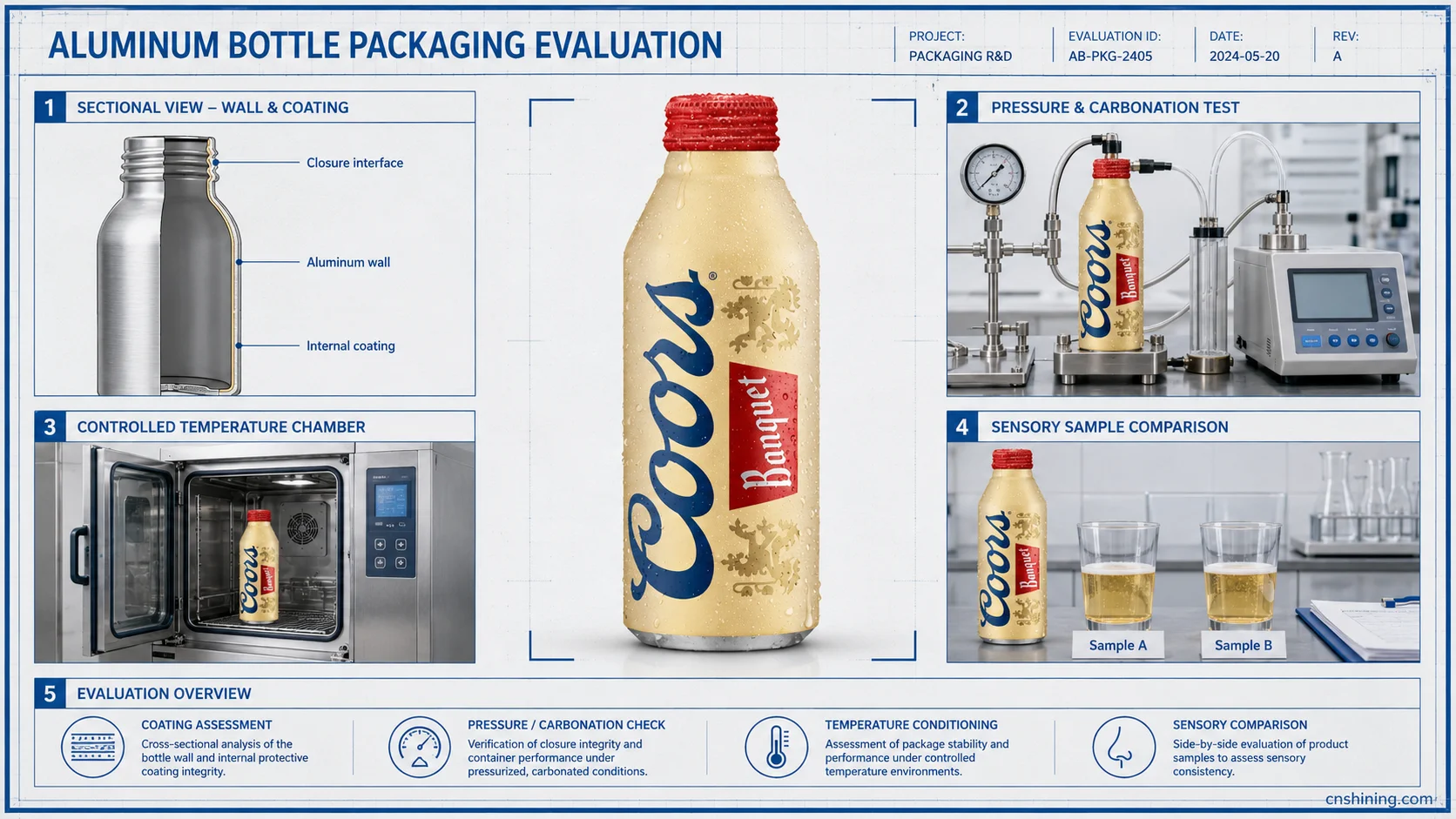
Coors Banquet already has strong visual assets: a gold field, the blue Coors script, the red Banquet panel and a long-established Western brewing identity. The brand’s published history connects the beer to Golden, Colorado, the 1873 origin and earlier bottle and aluminum-packaging milestones. The bottle should use those assets to justify its place above a basic can, rather than hiding them beneath a generic “modern sustainable package” treatment.
A restrained technical direction is more credible than adding every available effect. A metallic or muted gold base can preserve the material character. Controlled gloss contrast can emphasize the wordmark or badge. Fine tactile or matte effects may improve grip and differentiation, but they should not reduce legal-text legibility or make the bottle feel coated in a thick plastic layer.
Artwork development should account for cylindrical rotation and shoulder deformation. Text, fine borders and circular badges can distort when they cross a changing diameter. The aluminum bottle printing-design guide provides practical guidance on artwork zones, distortion control, color separation and production files.
Direct offset printing is suitable for established high-volume designs because it provides efficient all-around decoration without a full-body applied label. A protective overvarnish is then required to resist conveyor contact, bottle-to-bottle abrasion, handling and cooler condensation. The printing and surface-finishes guide explains the functional differences among gloss, matte, metallic and protective finish systems.
Decoration validation should include use conditions
Dry laboratory samples can give a misleading impression of surface quality. Evaluation should include wet bottles taken directly from ice, condensation after cold-room exposure, bottle contact during conveying, abrasion inside the pack and repeated consumer handling. The team should measure color consistency, varnish cure, adhesion, coefficient of friction and scuff visibility on the dark blue, red and metallic areas.
The package should also reserve adequate space for legal information. A workable layout is a dominant front identity, a clear side information panel and a restrained rear storytelling or digital-information area. The neck and shoulder should not become a storage area for small mandatory text simply because the body artwork is crowded.
6. Competitive Aluminum Beer Bottle Set
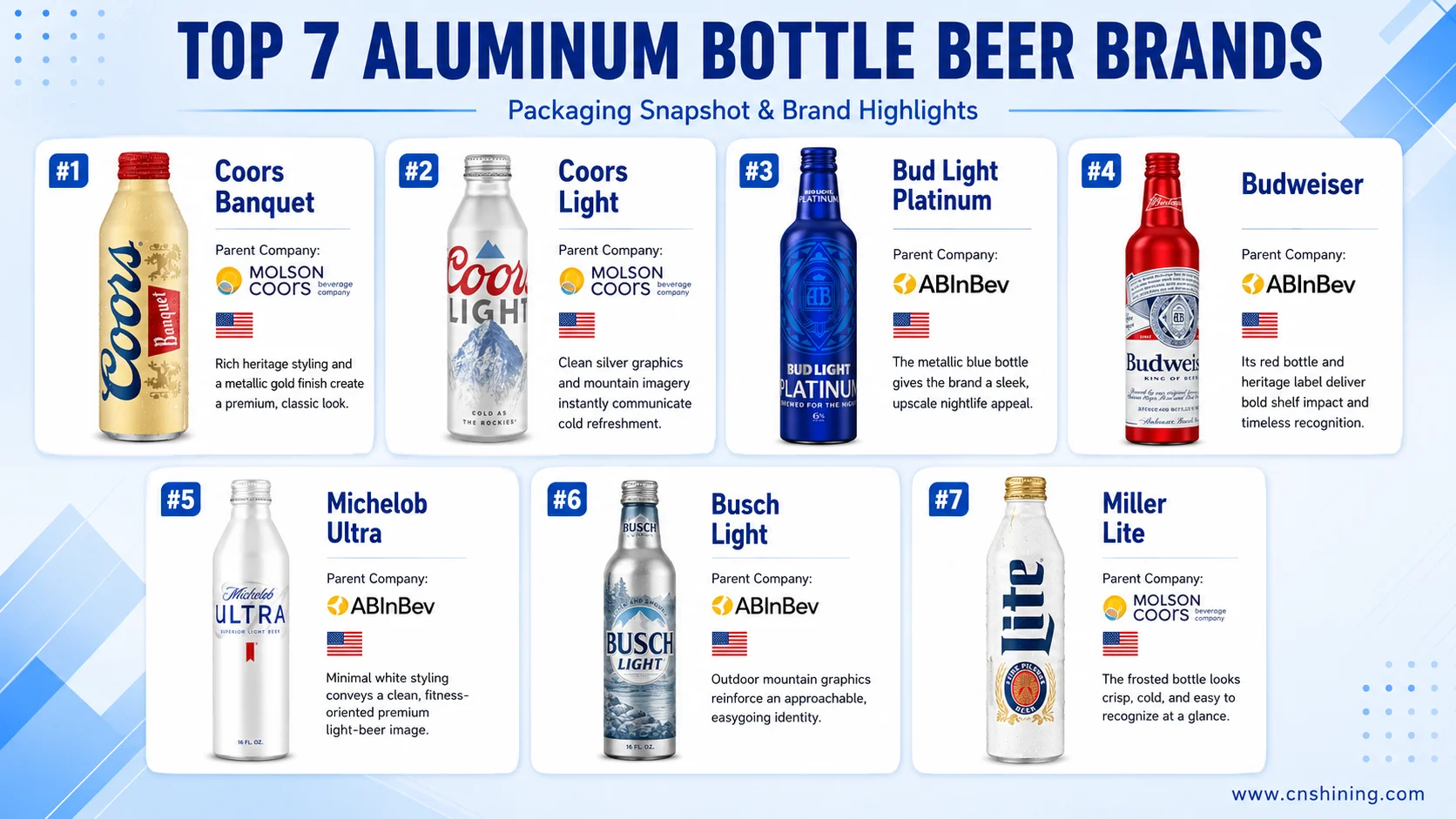
The U.S. market contains several mainstream lagers in the same 16 oz aluminum bottle format. This is important because it shows that the package is not restricted to a single premium tier. It can support value, mainstream, light-beer, heritage and lifestyle positioning. Price is determined by the complete brand, pack count, promotion and channel—not by aluminum alone.
| Marke | Land | Muttergesellschaft | Kapazität | Retail unit price | Core selling point |
|---|---|---|---|---|---|
| Miller Lite | Vereinigte Staaten | Molson Coors Beverage Company | 16 fl oz / 473 mL | About $1.67 per bottle | Nine-pack format, light-beer positioning and direct functional comparison with the Coors Banquet pack. |
| Coors Light | Vereinigte Staaten | Molson Coors Beverage Company | 16 fl oz / 473 mL | About $1.33 per bottle | Clean, cold-refreshment positioning with a larger 15-bottle pack and a lower unit price. |
| Budweiser | Vereinigte Staaten | Anheuser-Busch InBev | 16 fl oz / 473 mL | About $1.25 per bottle | Classic American lager identity, recognizable red-and-white decoration and group-occasion positioning. |
| Bud Light | Vereinigte Staaten | Anheuser-Busch InBev | 16 fl oz / 473 mL | About $1.25 per bottle | Single-bottle availability, explicit reclosable format and familiar easy-drinking positioning. |
| Michelob ULTRA | Vereinigte Staaten | Anheuser-Busch InBev | 16 fl oz / 473 mL | About $1.50 per bottle | Active-lifestyle positioning, clean white decoration and a controlled premium over larger value packs. |
| Busch Light | Vereinigte Staaten | Anheuser-Busch InBev | 16 fl oz / 473 mL | About $0.92 per bottle | Value pricing and direct association with fishing, camping and other outdoor occasions. |
The comparison produces two useful conclusions. First, the 16 oz aluminum beer bottle is an established mainstream format, not an experimental package. Second, the format itself does not guarantee premium pricing. The observed range extends from approximately $0.92 to $1.67 per bottle.
The Coors Banquet aluminum bottle sits near the upper end of this snapshot because its nine-pack has a relatively high unit price. That makes heritage, cold-metal experience, bottle handling and occasion fit more important. If the design communicated only “beer in metal,” lower-priced competitors would make the premium difficult to defend.
7. Consumer Review Signals and the Engineering Response
Consumer reviews are useful for detecting failure modes, but they should not be treated as a statistically controlled package study. Reviews often combine comments about beer taste, delivery quality, retailer handling and packaging. A small number of complaints can identify a mechanism worth investigating; they cannot establish a defect rate.
One public review of Miller Lite aluminum bottles described the combined bottle-and-can idea as “genius.” The same review page also contains a negative report that several aluminum screw caps were dented before purchase, attributed by the reviewer to rough case handling. Both observations appear on a retailer-hosted aluminum bottle review page.
Cross-category reviews of filled aluminum beverage bottles also repeatedly identify cold feel and portability as positives, while denting during delivery and occasional metallic-taste perceptions appear as negatives. For example, reviews of filled aluminum water bottles include both appreciation of cold retention and complaints about containers arriving dented. Those comments are category-level signals, not evidence of a Coors Banquet defect.
| Consumer-facing issue | Evidence status | Probable package mechanism | Engineering response |
|---|---|---|---|
| Opening effort | A relevant user-experience risk; no reliable public defect rate established. | Removal torque, tamper-bridge strength, knurl grip, cap alignment and liner compression. | Set an opening-torque window based on consumer trials, then monitor distribution rather than only the average. |
| Short-term reclosure | Central product function, but not a claim of restored shelf life. | Thread engagement, gasket recovery and the consumer’s applied reclosing force. | Test opened-and-reclosed packages for spill resistance and CO2 loss over realistic short holding periods. |
| Leckage | No credible evidence of widespread leakage in the sampled reviews; still a critical qualification risk. | Underformed threads, off-center caps, insufficient liner compression, neck damage or thermal-cycle movement. | Use secure-seal pressure tests, filled-package leak tests, cap-profile inspection and post-transport checks. |
| Carbonation retention | Primarily an engineering validation item rather than a demonstrated review trend. | Initial seal quality, liner gas barrier, product temperature, headspace and time after opening. | Track carbonation and package pressure through shelf life and after a defined reclosure protocol. |
| Dented caps | Directly observed in an individual aluminum beer bottle review. | Insufficient cap clearance, rough handling, top-load concentration or impacts during retail distribution. | Review cap-shell strength, neck protection, package clearances, conveyor contacts and handling controls. |
| Body denting | Repeated category-level complaint for filled aluminum bottles. | Thin sidewall exposure, unsupported gaps, line impacts or insufficient protection in distribution. | Optimize body profile and line guides, define dent-acceptance standards and provide targeted separation where contact damage occurs. |
| Scuffing and print wear | Common risk for decorated metal packages, especially under condensation. | Low varnish cure, high surface friction, bottle contact or abrasive debris. | Validate varnish adhesion, cure, abrasion resistance and wet coefficient of friction on production-intent samples. |
| Metallic-taste perception | Seen in cross-category metal-bottle discussion; not proof that beer contacted aluminum. | Pre-existing consumer expectation, coating defect, inadequate cure, contamination or unrelated product oxidation. | Verify liner coverage and cure, run sensory comparisons and investigate complaints using retained package samples. |
| Wet grip | Relevant to cooler and outdoor use. | Condensation, bottle diameter, surface texture and varnish friction. | Conduct cold-wet handling trials rather than approving the finish only from dry samples. |
| Appearance and price | Consumers notice the hybrid bottle/can form, but value judgments vary by pack price. | Distinctive shape and decoration can support premium perception; dents and scuffs quickly reverse it. | Use clear heritage cues and functional differentiation while applying tighter cosmetic standards to the higher-priced format. |
The most important lesson is that cosmetic and functional defects are connected. A dented cap may indicate a closure-handling problem. A deep body crease may compromise the internal liner. Scuffed decoration can make a technically sound bottle feel low quality at the point of purchase. Package validation should therefore combine pressure, coating and sensory tests with appearance standards and real distribution handling.
8. Regulatory and Sustainability Boundaries
8.1 Vereinigte Staaten
In the United States, malt-beverage labeling falls under the Alcohol and Tobacco Tax and Trade Bureau. The TTB mandatory malt-beverage labeling guidance covers the brand name, class or type, net contents, name and address, applicable declarations and the required government health warning.
For a 16 fl oz container, the TTB net-contents guidance identifies “1 Pint” as the required U.S. standard declaration, with 473 mL permitted as additional metric information. Legal copy must remain legible after printing and neck formation, and mandatory information generally should not be placed only on the cap or bottom.
Food-contact compliance is separate from alcohol-label approval. The aluminum body, internal coating, closure liner, inks, varnish and any substance reasonably expected to migrate require an appropriate regulatory basis for their intended use. The FDA food-contact material status guidance makes clear that the compliance position of the finished article depends on its individual components and their conditions of use.
State rules remain relevant. Deposit markings, recycling statements, distributor information and warning requirements vary by location. California alcohol sales also require review against the applicable Proposition 65 alcoholic-beverage warning provisions.
8.2 Europäische Union
An aluminum bottle placed on the EU market must comply with the general food-contact framework and good manufacturing practice. The European Commission’s food-contact material overview explains that packaging constituents must not migrate at levels that endanger health, unacceptably change food composition or impair taste and odor.
Alcoholic beverages above 1.2% ABV currently have a general exemption from mandatory ingredient and nutrition declarations under the EU food-information framework, but this does not remove requirements relating to alcoholic strength, allergens, language, legibility or national measures. The applicable starting point is the Commission’s EU alcoholic-beverage labeling summary.
Packaging design must also be reviewed against Regulation (EU) 2025/40. The Packaging and Packaging Waste Regulation overview states that the regulation entered into force in February 2025 and generally applies from 12 August 2026. It covers packaging composition, minimization, recoverability, recyclability and waste-management obligations.
8.3 Global export and local-market rules
A U.S. bottle layout should not be copied unchanged into every export market. Each destination may impose different alcohol warnings, ingredient or allergen declarations, language rules, producer-responsibility registration, deposit marks, recycling symbols, importer details and restrictions on environmental claims. These items should be mapped before artwork approval because late legal changes can force new plates, colors or print zones.
8.4 Sustainability statements
The safest claim is that the package uses a recyclable aluminum body where local collection and recycling systems accept it. It is less defensible to call the complete package “100% sustainable,” “zero plastic” or “fully circular” without checking the liner, gasket, inks, varnish, closure construction and actual local recovery pathway.
Direct printing can reduce reliance on an additional full-body label, but it does not make the finished package material-free. The internal coating and closure liner remain essential functional components. Reclosable should also not be confused with refillable. A single-use beer bottle should not be promoted for repeated consumer refilling unless it has been designed and validated for repeated cleaning, abrasion and closure cycles.
9. What Must Be Locked Before Scale-Up
A brand can approve the appearance of an aluminum bottle long before the package is ready for commercial production. The scale-up specification should close the gaps between the bottle drawing, beer specification, filling line, decoration process and distribution environment.
| Decision gate | Information to lock | Evidence required before approval |
|---|---|---|
| Beer specification | Finished pH, carbonation, dissolved oxygen target, fill temperature, thermal process and shelf life. | Approved product specification and production-intent filled samples. |
| Bottle specification | Manufacturing route, alloy, body profile, critical dimensions, neck finish, pressure requirements and cosmetic limits. | Controlled technical drawing, dimensional report and pressure-test method. |
| Coating system | Coating identity, cure window, application level, coverage method and target-market compliance. | Declaration of compliance, migration basis, corrosion work and sensory results. |
| Closure system | Cap specification, liner, capping-head profile, application settings, removal-torque window and tamper-band criteria. | Filled-package pressure, leak, opening and reclosure trials. |
| Decoration | Color standards, print tolerances, artwork distortion, varnish system, friction and scuff limits. | Approved wet and dry samples produced on production-intent equipment. |
| Line integration | Container handling, filler and capper settings, conveyor guides, inspection points and reject logic. | Extended line trial with recorded defects, stops, torque data and package-pressure data. |
| Distribution integrity | Dent limits, cap protection, vibration, drop, compression, temperature cycling and cooler handling. | Distribution testing followed by leak, coating, appearance and sensory inspection. |
| Market compliance | Alcohol label, food-contact status, environmental wording, deposit marks and destination-specific language. | Documented legal and regulatory review of final production artwork. |
The most informative pilot is not a small set of perfect hand-filled samples. It is a production-intent run large enough to expose capper drift, bottle handling, decoration contact, filler variation and pack-out damage. Samples should then travel through realistic distribution and cold-display cycles before the package is signed off.
The team should also compare the aluminum bottle with the existing can under the same retail conditions. The comparison should cover cold-shelf visibility, unit-price tolerance, opening behavior, wet grip, time to visible scuffing and consumer understanding of reclosure. This keeps the decision focused on the bottle’s real job rather than on material preference.
10. Conclusion: Why This Aluminum Bottle Decision Holds Together
The Coors Banquet aluminum bottle makes sense because it is assigned a different job from the standard can. The can remains the logical format for cost efficiency and broad high-volume distribution. The bottle is the format for stronger occasion fit: a larger single serve, familiar bottle handling, short-term reclosure, glass-free portability, complete light blockage and more distinctive cold-shelf presentation.
Its secondary contribution is price justification. The gold metal surface, established red-and-blue identity and long brewing history give the brand credible material for a differentiated pack. The premium cannot be justified by aluminum or recyclability alone. It depends on the package arriving without dents or scuffs, opening consistently, holding pressure, protecting flavor and looking recognizably like Coors Banquet.
The engineering priorities follow directly from that purpose. The neck, cap and liner must provide reliable pressure retention and controlled opening. The internal coating must remain compatible with the beer and thermal process. Filling controls must limit oxygen pickup and pressure variation. Direct printing and varnish must survive the filling line, distribution and wet-cooler handling. Brief protection against bottle and cap damage is justified where it prevents denting, leakage or coating injury, but it should not become the center of the packaging concept.
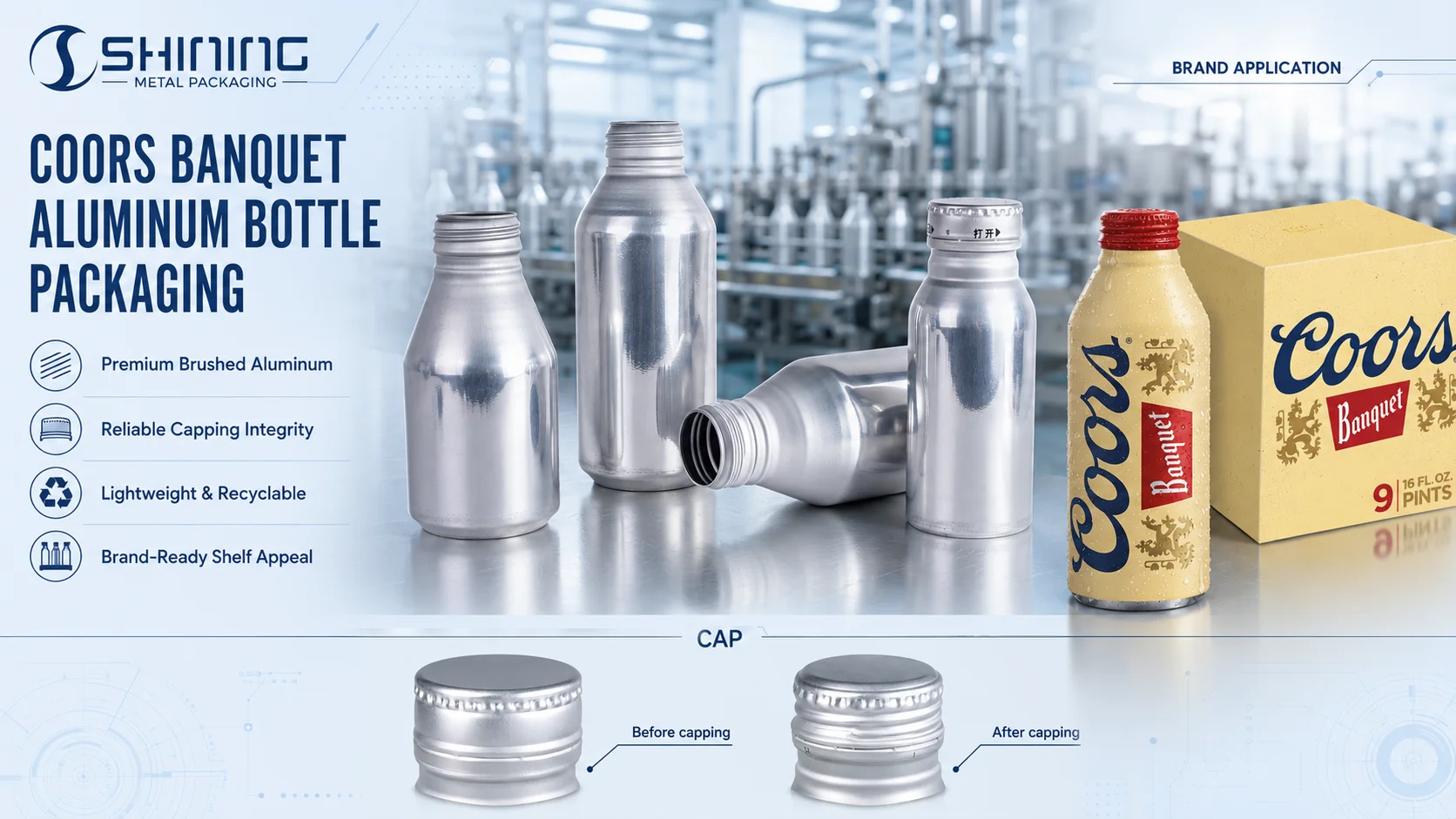
For teams developing a comparable aluminum beverage format, Shining Packaging is most useful as a technical partner for coordinating bottle structure, internal coating, closure matching, printing and production validation while the brand and filler retain control of product-specific trials and market compliance.
Retail prices and product availability are time- and location-sensitive. Packaging specifications, migration requirements, filling conditions and legal obligations must be confirmed for the actual product, plant and destination market before commercial production.