

Aerosol spray paint for wood is a prefilled, pressurized coating system built from the paint, propellant, valve, actuator and metal can. Its value is not that it outperforms every shop-applied coating. Its value is that it combines acceptable film performance with almost no setup, no paint mixing, no spray-gun cleaning and a short learning curve.
In furniture refinishing, decorative woodwork and small repair jobs, the result depends on four linked events: atomization, liquid deposition, carrier evaporation and film curing. Wood porosity, end-grain absorption and the compatibility of resin, solvent or water, and propellant determine hiding power, gloss, leveling, adhesion and service life. The coating chemistry matters, but the package is part of the application equipment. A weak actuator or mismatched valve can cancel out a sound formulation.
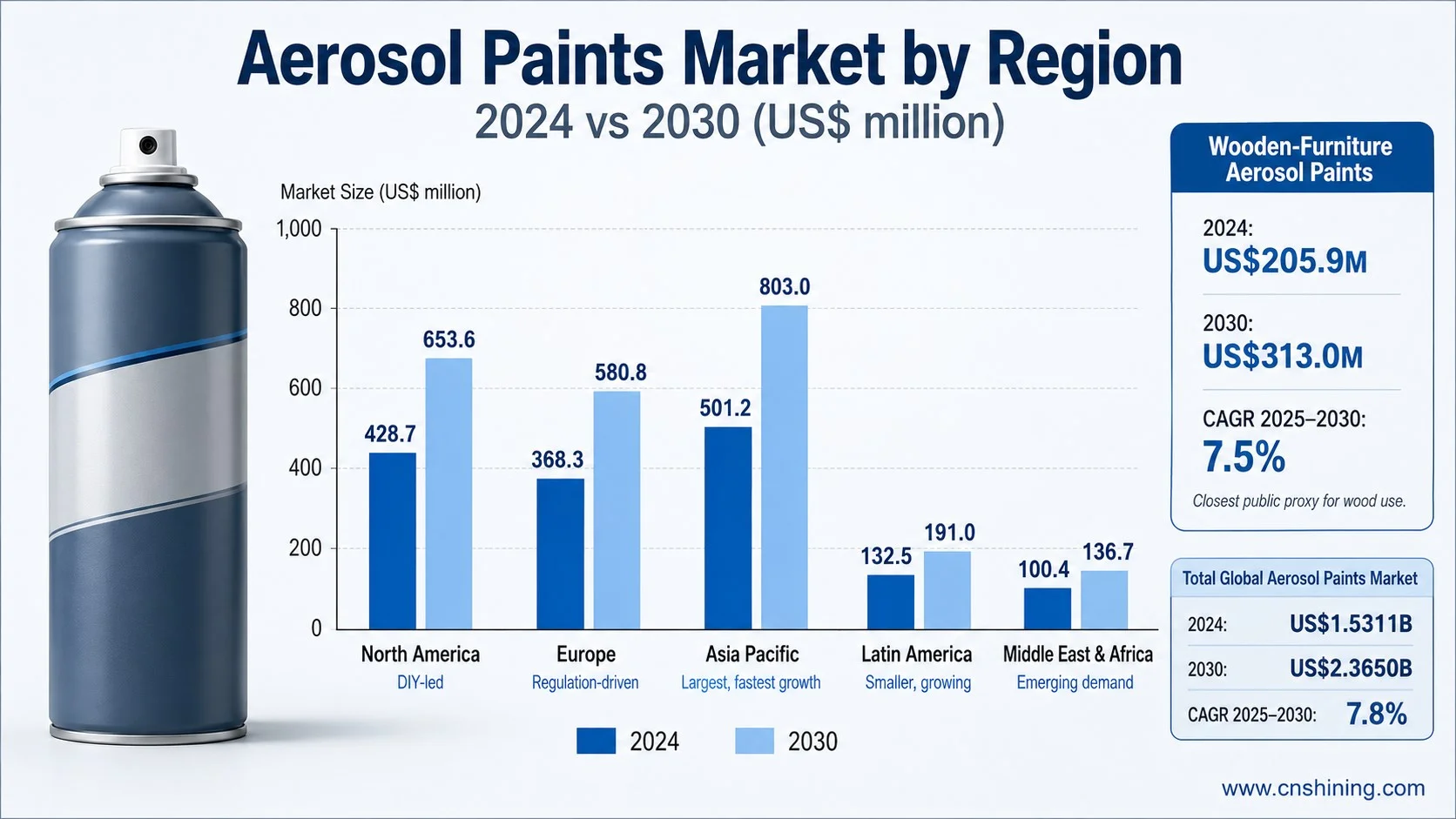
The global aerosol paints market was reported at about $1.5311 billion in 2024 and is projected to reach $2.3650 billion by 2030, equal to a 2025–2030 CAGR of about 7.8%. The closest public proxy for wood use is the wooden-furniture aerosol paints segment: $205.9 million in 2024, atteignant $313.0 million by 2030, with a CAGR of about 7.5%. These figures show a stable technical niche supported by DIY refinishing, quick repair and small-project convenience rather than by industrial finishing-line demand.
1. Technical Definition and Use Cases
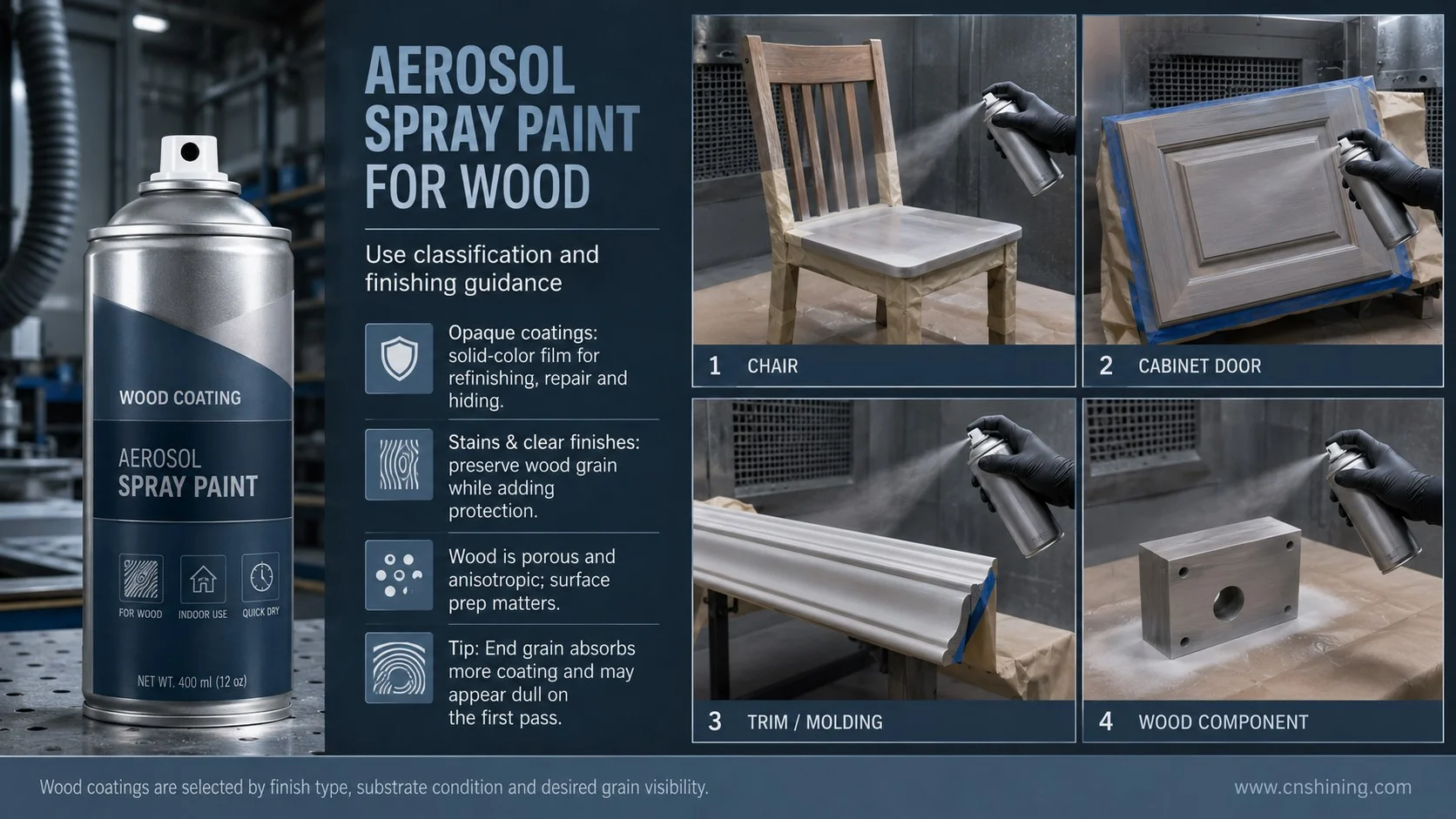
“Aerosol spray paint for wood” is usually a use classification rather than a single chemical family. Many retail products are multi-surface coatings that list wood or wooden furniture among their intended substrates. The same package may also be specified for metal, masonry, plastic or decorative objects, but wood creates a distinct interface problem because it is porous, anisotropic and often contaminated by wax, oil, polish or an older finish.
Wood aerosol finishing normally falls into two functional groups:
- Opaque coatings: pigmented films used for color change, hiding, repair and decorative refinishing.
- Stains and clear finishes: penetrating or transparent systems intended to retain grain visibility and add surface protection.
Aerosol spray paint mainly belongs to the first group. It forms a continuous pigmented film and is selected for speed, access to corners, geometric uniformity and color choice. A stain works differently. It is expected to wet or penetrate the surface and preserve the visual structure of the wood. Clear aerosol lacquers and varnishes sit between the two groups because they add film protection without hiding the substrate.
A technical review of wood finishing chemistry treats paints, stains and clear coats as separate systems because their binder content, pigment loading, penetration and film-building targets are different. The distinction is practical: a user who wants a solid-color cabinet finish should not evaluate coverage using the same assumptions as a user applying a transparent stain. See the wood-finishing chemistry and mechanism review.
2. How the Aerosol System Works
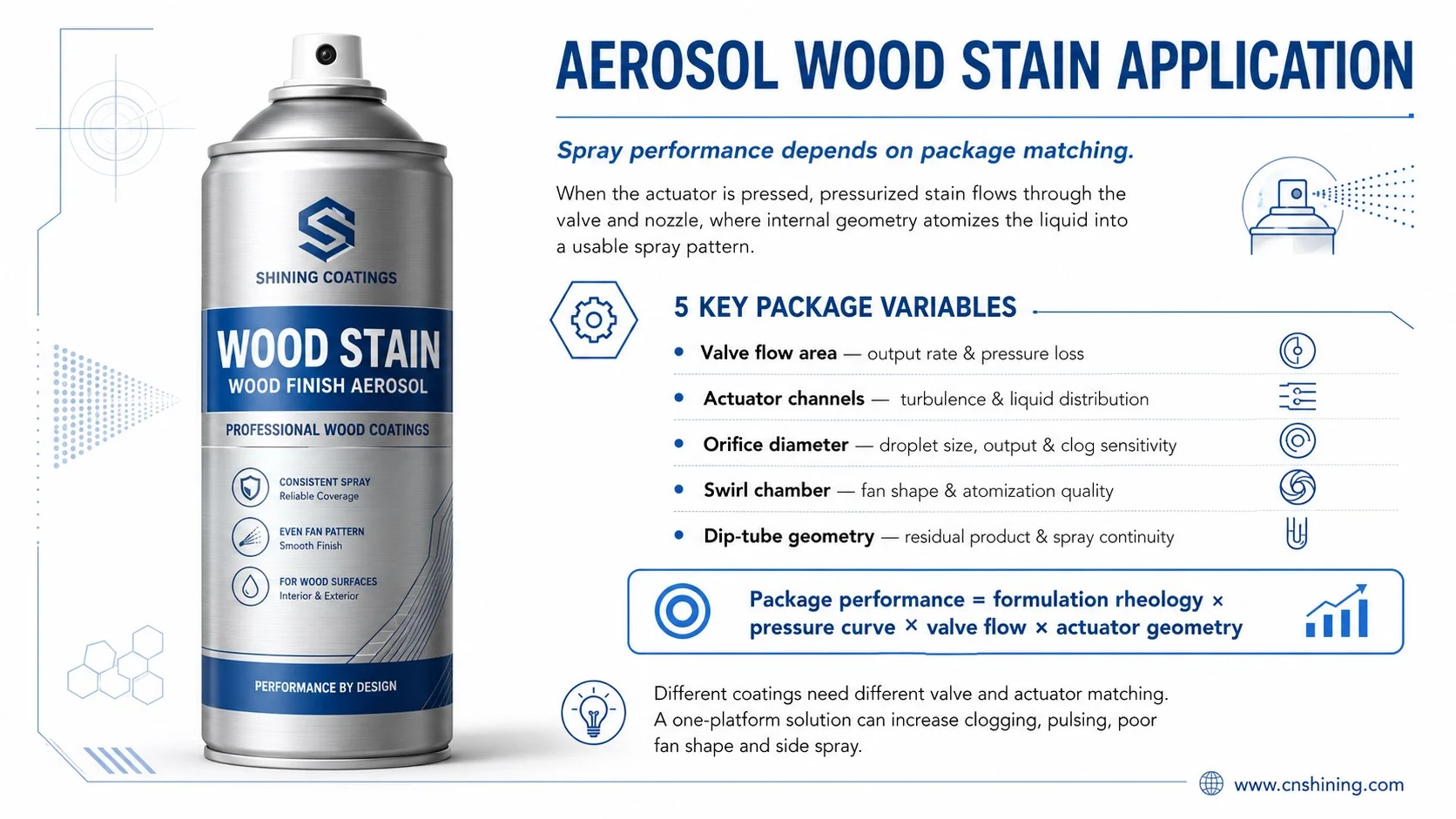
The propellant maintains internal pressure. When the actuator is pressed, the valve opens and the pressurized product moves through the dip tube, valve stem and actuator passages. The nozzle and swirl geometry then convert the liquid stream into droplets. This is not simple dispensing. The system must create enough mechanical break-up to produce a usable spray pattern within a very short flow path.
Five package variables have direct influence on application:
- Valve flow area controls output rate and pressure loss.
- Actuator internal channels influence turbulence and liquid distribution.
- Orifice diameter affects droplet size, output and clog sensitivity.
- Swirl chamber geometry sets fan shape and atomization quality.
- Dip-tube geometry affects residual product and spray continuity.
A low-viscosity stain, standard pigmented acrylic, high-solids clear coat and metallic-effect paint do not need the same valve and actuator. Using one dispensing platform for every formulation may simplify purchasing, but it increases the probability of clogging, pulsing, poor fan shape and side spray. The older mechanical break-up actuator patent remains useful because it makes the core point clearly: internal actuator geometry changes how the liquid stream breaks into droplets.
Package performance = formulation rheology × pressure curve × valve flow × actuator geometry
Each term is coupled to the others. A smaller orifice may improve fine atomization at the start of a can, yet become unstable as pressure falls or solids accumulate. A higher-flow valve may improve coverage, yet cause runs when used by an inexperienced operator. Output control is therefore a system-matching exercise, not a single-component choice.
3. Film Formation and Interaction With Wood
3.1 Physical Drying and Chemical Cure
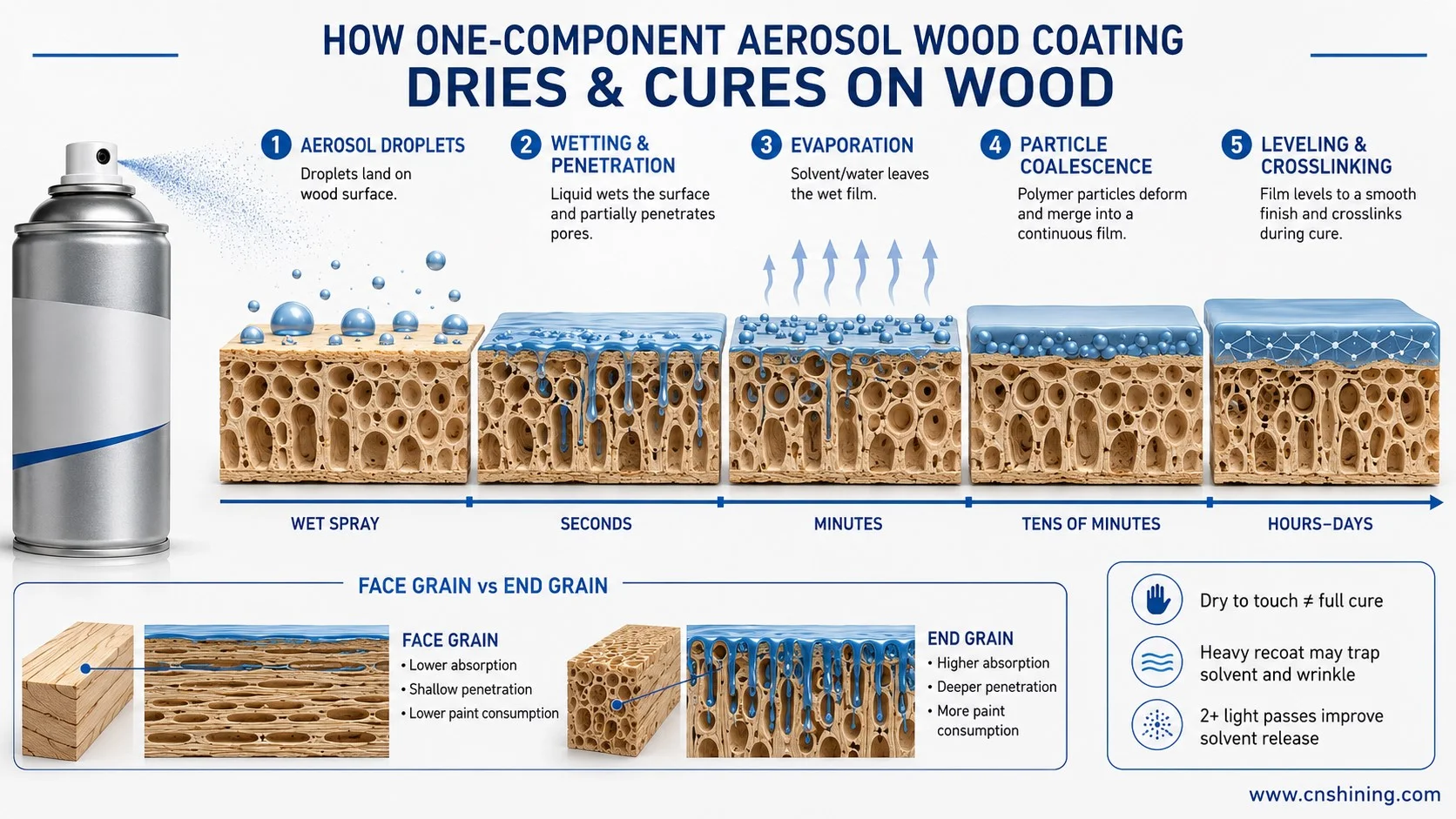
Most one-component aerosol paints first harden by carrier evaporation. Solvent or water leaves the wet film, viscosity rises and flow stops. In waterborne systems, dispersed polymer particles must also deform and coalesce into a continuous film. Alkyd, polyurethane, amino or other reactive systems may then continue curing through oxidation or crosslinking. Hardness, stain resistance and chemical resistance can continue to develop after the surface feels dry.
This explains a common field error: dry-to-touch is not full cure. The top layer may be firm enough to handle while the lower film still contains carrier or has not completed crosslinking. A heavy second coat applied outside the permitted recoat window can trap solvent, soften the first layer and produce wrinkling, lifting or an “alligator skin” appearance.
3.2 Waterborne Aerosol Compatibility
Waterborne aerosol paint is not produced by simply replacing solvent with water. Dimethyl ether (DME) is useful because it can function as a propellant and has compatibility with polar systems, but it can also destabilize some waterborne resins. The result may be tackiness, phase instability, aggregation or poor shelf life. The formulation window must therefore control resin chemistry, co-solvent, DME level, nonvolatile content and total volatile fraction.
Le water-based aerosol paint patent WO2018162801A1 is relevant because it treats compatibility and storage stability as the central design problem while targeting lower VOC content.
3.3 Wood Porosity and Penetration
Wood is not an inert panel. Coating penetration changes with species, grain direction, sanding, moisture content and binder type. Some acrylic dispersions remain relatively close to the surface, while alkyd emulsions and solvent-borne systems may penetrate more deeply. In practical aerosol work, this creates three recurring effects:
- Edges and end grain consume more paint.
- The first coat can look uneven because absorption is not uniform.
- Unsealed wood can reduce apparent gloss and hiding power.
Correct preparation may include cleaning, de-waxing, sanding, sealing, priming or isolating an old coating. Many complaints described as “poor coverage” are actually caused by open end grain, old finish boundaries, oil or silicone contamination, or excessive wet-film thickness.
4. Market Size, Regional Structure and Segment Signals
4.1 Data Scope
Public databases rarely isolate “wood aerosol spray paint” as a narrow category. The most defensible public proxy is wooden-furniture aerosol paints. It captures a major end use but may understate decorative wood components, craft items, trim, doors, skirting, cabinets and other non-furniture applications. To avoid mixing incompatible research methods, the figures below use one public market-data family for the 2024 base year and 2030 forecast.
| Market indicator | 2024 | 2030 | TCAC 2025-2030 | Interprétation |
|---|---|---|---|---|
| Global aerosol paints | $1.5311 billion | $2.3650 billion | 7.8% | Broad aerosol paints market |
| Wooden-furniture aerosol paints | $205.9 million | $313.0 million | 7.5% | Closest public proxy for wood use |
The underlying public data are available in the global aerosol paints market outlook et le wooden-furniture aerosol paints segment.
4.2 Regional Market Structure
| Région | 2024 market | 2024 parts | 2030 market | TCAC | Technical and channel signal |
|---|---|---|---|---|---|
| Amérique du Nord | $428.7 million | 28.0% | $653.6 million | 7.6% | Strong DIY demand and mature retail channels |
| Europe | $368.3 million | 24.1% | $580.8 million | 8.2% | Higher regulatory and sustainability pressure |
| Asie-Pacifique | $501.2 million | 32.7% | $803.0 million | 8.5% | Largest and fastest-growing region; China is a major driver |
| l'Amérique latine | $132.5 million | 8.7% | $191.0 million | 6.5% | Brazil shows stronger growth within the region |
| Moyen-Orient et Afrique | $100.4 million | 6.6% | $136.7 million | 5.6% | Smaller base with positive repair and construction demand |
Asia Pacific is the largest public regional market. North America has the clearest DIY signal. Europe is shaped more heavily by product upgrading, VOC pressure, recycling expectations and established retail channels. Latin America and the Middle East and Africa remain smaller but show positive growth.
5. Top 10 Brands in Aerosol Spray Paint for Wood
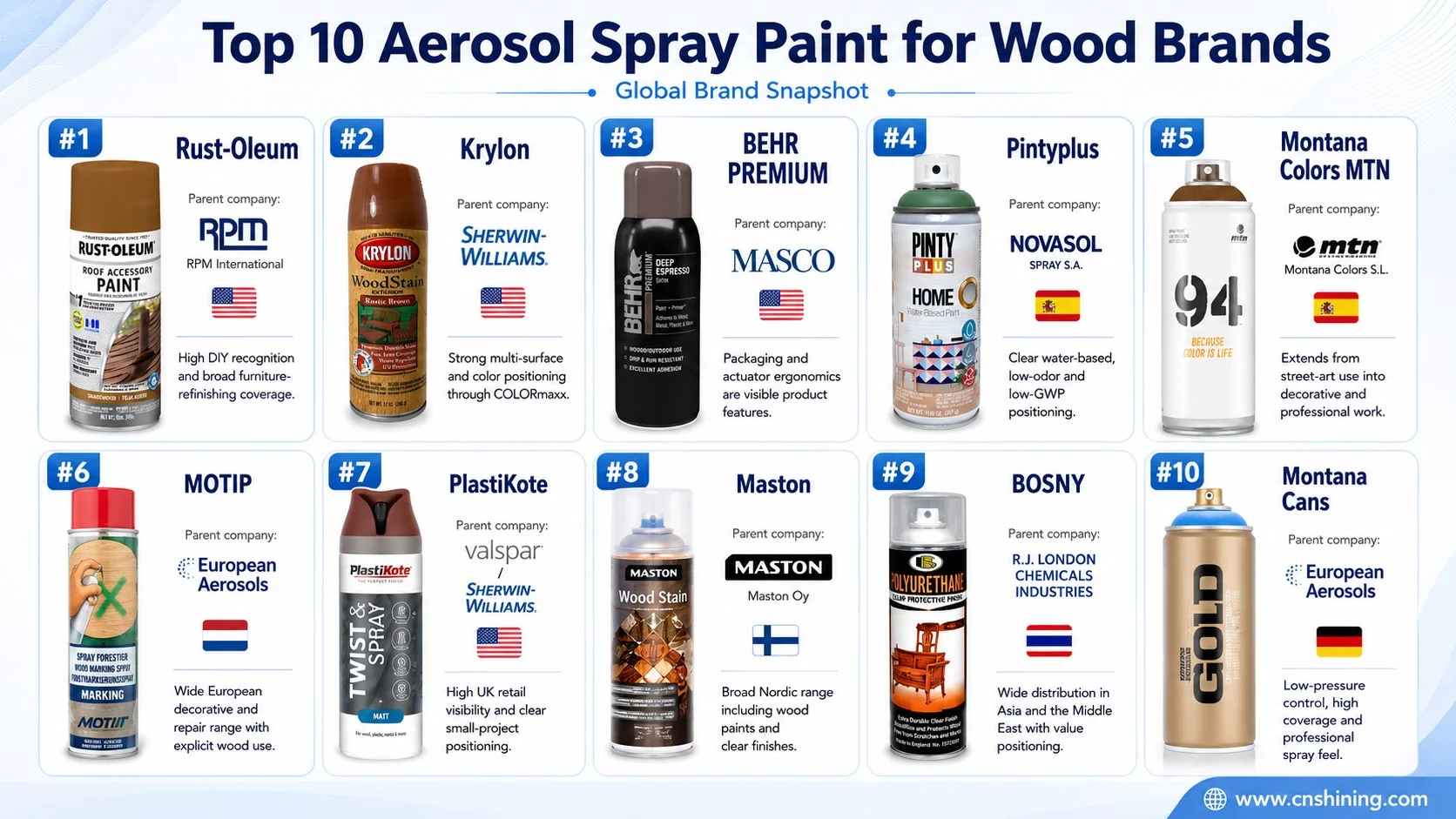
| Marque | Country or region | Société mère | Taille courante | Public retail sample | Technical market comment |
|---|---|---|---|---|---|
| Rust-Oleum | États-Unis | RPM International | 340 ml | about $5.99-$6.98 | High DIY recognition and broad furniture-refinishing coverage |
| Krylon | États-Unis | Sherwin-Williams | 340 ml | from about $4.48 | Strong multi-surface and color positioning through COLORmaxx |
| BEHR PREMIUM | États-Unis | Masco | 340 ml | about $6.98 | Packaging and actuator ergonomics are visible product features |
| Pintyplus | Espagne | Novasol Spray S.A. | 10.9–11.18 oz | about $8.99 each; six cans about $42.70 | Clear water-based, low-odor and low-GWP positioning |
| Couleurs du Montana MTN | Espagne | Montana Colors S.L. | 400 ml | about $7.72 | Extends from street-art use into decorative and professional work |
| MOTIP | Originated in the Netherlands | Aérosols européens | 400–500 ml | about $6.12-$7.79 | Wide European decorative and repair range with explicit wood use |
| PlastiKote | United States brand | Valspar / Sherwin-Williams | 400 ml | about $10.58-$13.37 | High UK retail visibility and clear small-project positioning |
| Maston | Finland | Maston Oy | 400 ml | about $12.50; UK samples about $4.00-$6.68 | Broad Nordic range including wood paints and clear finishes |
| BOSNY | Thaïlande | R.J. London Chemicals Industries | 400 ml | about $14.67; India samples about $1.73-$1.99 | Wide distribution in Asia and the Middle East with value positioning |
| Boîtes Montana | Allemagne | Aérosols européens | 400 ml / 11 oz | about $8.99 | Low-pressure control, high coverage and professional spray feel |
Two groups are visible. Rust-Oleum, Krylon and BEHR represent mass-market DIY and home refinishing. Montana, MTN, MOTIP, Maston and Pintyplus reflect professional spray control, European decorative use or sustainability differentiation. The higher-value opportunity lies where those positions overlap: easy enough for an occasional user, but stable and controllable enough to avoid the defects experienced users reject.
6. Performance Compared With Other Application Methods
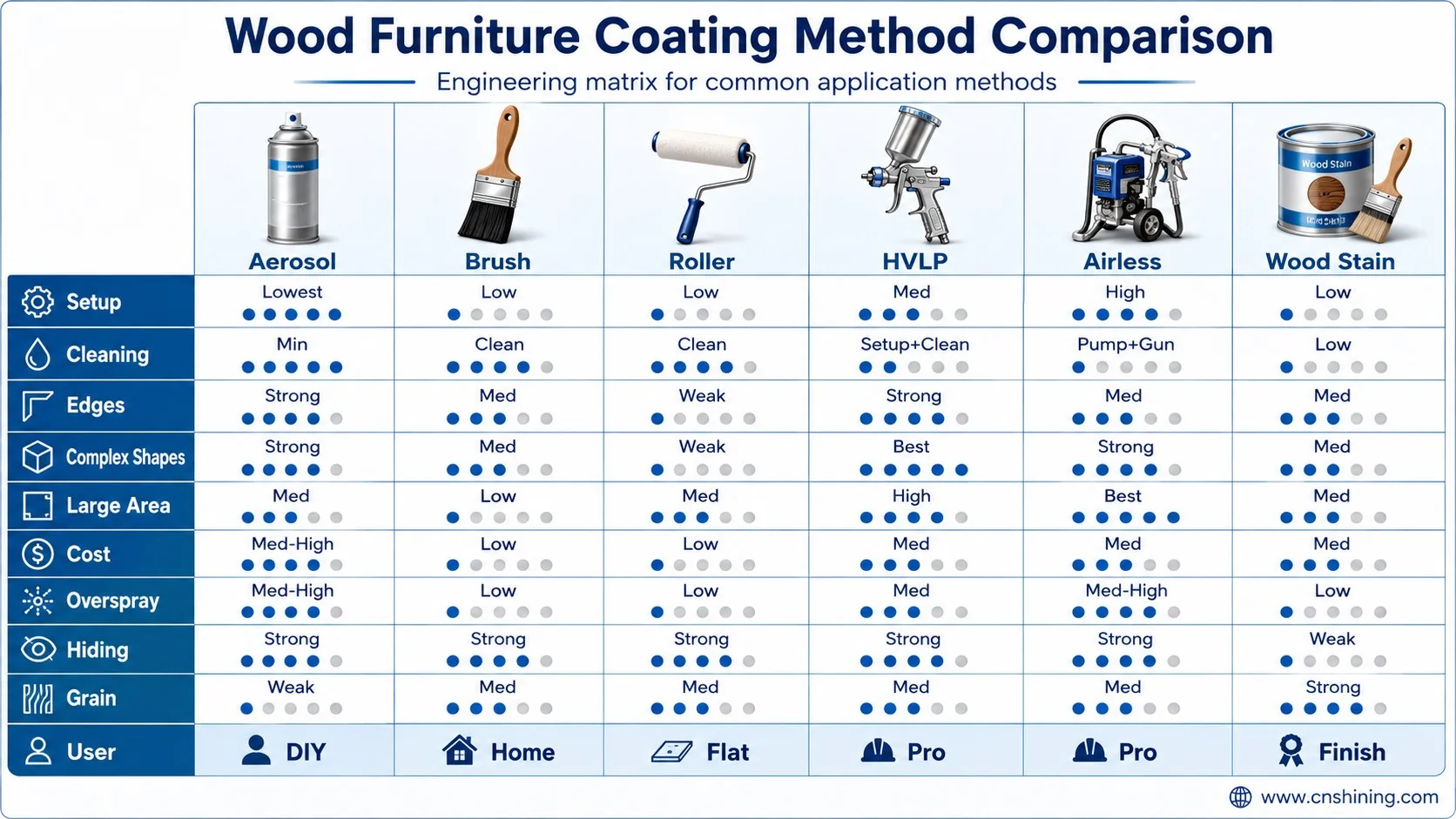
The comparison below is intended for small wood parts, furniture repair and household DIY. It is not a production-line trial. It combines application logic, coating mechanism and typical equipment requirements.
| Facteur | Aérosol | Brush | Roller | HVLP | Airless | Wood stain |
|---|---|---|---|---|---|---|
| Setup barrier | Lowest; ready to use | Faible | Faible | Moyen | Plus haut | Faible |
| Equipment cleaning | Minimal | Brush cleaning | Roller cleaning | Gun setup and cleaning | Pump and gun cleaning | Faible |
| Edges and small parts | Fort | Moyen | Faible | Fort | Moyen | Moyen |
| Complex geometry | Fort | Moyen | Faible | Très fort | Fort | Moyen |
| Large-area efficiency | Moyen | Faible | Moyen | Haut | Le plus haut | Moyen |
| Unit coating cost | Moyen à élevé | Faible | Faible | Moyen | Moyen | Moyen |
| Overspray and waste | Moyen à élevé | Faible | Faible | Moyen | Moyen à élevé | Faible |
| Color-change hiding | Fort | Fort | Fort | Fort | Fort | Faible |
| Grain retention | Faible | Moyen | Moyen | Moyen | Moyen | Fort |
| Typical user | DIY, repair, small batch | General household work | Flat surfaces | Advanced or professional | Professional | Grain-focused finishing |
Aerosol paint does not replace an industrial spray booth. It replaces the job that would otherwise be abandoned, brushed with an inferior cosmetic result, or delayed because equipment setup is not justified. This is why the category can grow even when its coating cost per square meter is higher.
7. Formulation Systems and Core Technical Terms
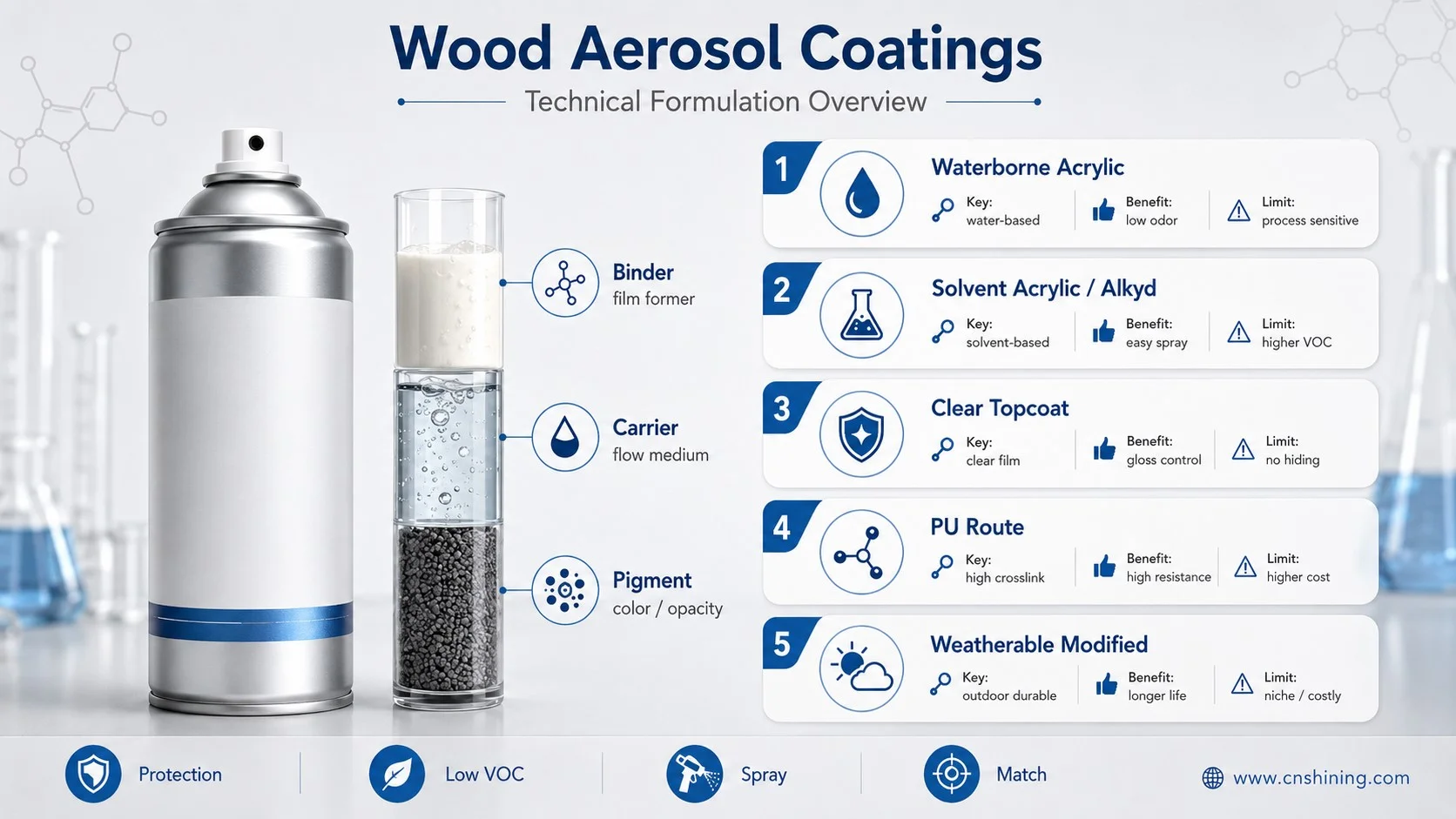
7.1 Main Formulation Classes
| Classe | Typical film former | Composants principaux | Film mechanism | Avantages | Limites |
|---|---|---|---|---|---|
| Waterborne acrylic aerosol | Acrylic dispersion or emulsion | Water, acrylic resin, co-solvent, pigment, wetting and leveling additives, DME or low-GWP propellant | Water evaporation and particle coalescence; some systems self-crosslink | Lower odor, lower VOC potential and better indoor acceptance | Harder resin-propellant matching and narrower temperature/humidity window |
| Solvent-borne acrylic or alkyd | Acrylic or alkyd | Resin, aromatic/ester/ketone solvent, pigment, filler, leveling and anti-settling additives, propellant | Solvent evaporation; alkyd may continue oxidative cure | Mature spray behavior, storage stability and broad application tolerance | Higher odor, VOC and flammability pressure |
| Clear aerosol topcoat | Acrylic or alkyd clear lacquer | Transparent resin, UV absorber, leveling additives, solvent and propellant | Transparent film formation and surface protection | Retains color and adjusts gloss | Does not hide substrate defects |
| Polyurethane route | 1K PU or 2K PU | PU resin; some products include a separate hardener chamber | Higher crosslink density | Better wear and chemical resistance | Higher cost; 2K safety and compliance are more complex |
| Weatherable modified route | Fluorocarbon-modified or other high-weatherability binder | Weatherable resin, pigment, carrier, additives and propellant | Improved color and gloss retention outdoors | Longer exterior durability potential | Rare in mass retail wood aerosols and relatively expensive |
7.2 What Each Component Does
| Composant | Technical function | Commercial consequence |
|---|---|---|
| Liant | Forms the continuous film and controls adhesion, hardness and durability | Separates basic multi-surface products from higher-durability furniture finishes |
| Solvent or water | Controls viscosity, storage behavior and drying | Changes odor, VOC, atomization and regulatory burden |
| Pigment | Provides color, hiding and decorative effect | Controls color accuracy, opacity and repeat purchase |
| Filler | Adjusts gloss, body and cost | Changes hand feel, appearance and cost structure |
| Leveling additive | Improves flow and surface smoothness | Reduces visible orange peel |
| Wetting and dispersing additive | Stabilizes pigment distribution | Improves shelf life and color consistency |
| Anti-settling or thixotropic additive | Reduces sedimentation and separation | Changes shaking time and restart performance |
| Defoamer | Suppresses bubbles and foam defects | Improves film cleanliness |
| Drier or catalyst | Accelerates oxidation or crosslinking | Controls touch-dry, recoat and full-cure timing |
| UV absorber or HALS | Reduces weathering damage | Extends outdoor appearance retention |
| Propergol | Provides pressure and contributes to atomization | Controls spray feel, flammability, VOC and transport class |
| durcisseur | Builds the crosslinked network in 2K systems | Supports professional durability at the cost of complexity |
7.3 Working Glossary
| Terme | Signification | Pourquoi c'est important |
|---|---|---|
| COV | Composé organique volatil | Regulation, odor and formulation choice |
| MIR | Réactivité incrémentale maximale | Core EPA/CARB aerosol-coating metric |
| Propergol | Pressurizing medium | Pressure, spray quality, safety and logistics |
| DME | Dimethyl ether propellant and co-solvent | Useful in waterborne systems but compatibility-sensitive |
| Actionneur | Button or trigger that contains the spray outlet | Directly controls pattern and user feel |
| tige de valve | Opening and product-flow path within the valve | Controls release and interfaces with the actuator |
| Tube plongeur | Tube that draws product from the can | Affects residual product and spray orientation |
| Motif en éventail | Shape of the emitted spray | Determines suitability for broad panels or spot work |
| Atomisation | Break-up of liquid into droplets | Controls surface appearance and transfer behavior |
| Sec au toucher | La surface peut être touchée légèrement. | Does not indicate complete cure |
| Guérison complète | Film reaches intended service properties | Determines scratch and chemical resistance |
| Recoat window | Permitted time range for another coat | Controls adhesion and lifting risk |
| Hiding power | Ability to conceal the substrate | Changes pass count and per-can value |
| Sagging or runs | Downward movement of a wet film | Common field defect from excess wet thickness |
| zeste d'orange | Textured surface caused by poor flow or atomization | Reduces cosmetic quality |
| Blushing | Whitish haze, often humidity-related in clear coatings | Common risk in fast-evaporating clear finishes |
| Coalescence | Fusion of dispersed polymer particles | Required for waterborne film integrity |
| Crosslinking | Formation of a chemical network | Raises hardness and chemical resistance |
| 1K | Single-component system | Most common retail format |
| 2K | Two-component reactive system | Higher durability with more safety controls |
| Surpulvérisation | Spray that misses the target | Waste, cleaning and environmental load |
| Low GWP | Low global-warming-potential propellant route | Supports lower climate impact claims |
8. Regulations, Labeling and Transport
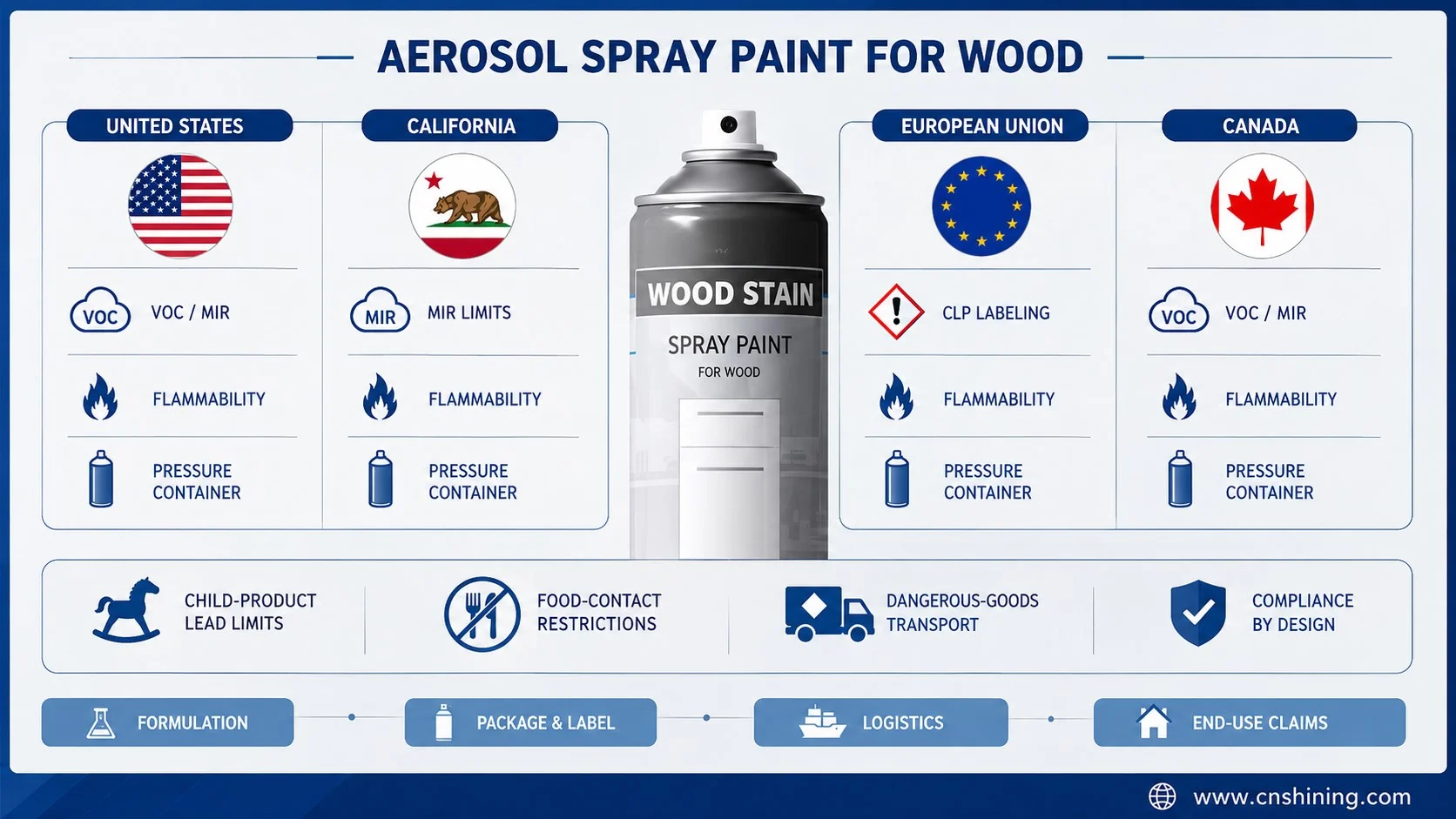
Compliance has four layers: formulation, package and label, logistics, and end-use claims. A product can meet general decorative-paint requirements yet still be unsuitable for toys, children’s furniture, food-contact wood or a particular transport route.
| Market or topic | Rule or framework | Main requirement | Practical effect |
|---|---|---|---|
| United States VOC/reactivity | 40 CFR Partie 59 Sous-partie E | National reactivity-based requirements for aerosol coatings | Formulation must consider product category and ozone-forming reactivity, not only g/L |
| California aerosol coatings | CARB Article 3, Sections 94520–94528 | Detailed aerosol category definitions and MIR limits | California often becomes the restrictive formulation basis for a national SKU |
| EU aerosol container safety | 75/324/EEC and 2013/10/EU | Container safety, pressure and labeling framework | Controls package qualification and required warnings |
| EU classification and labeling | Règlement CLP 1272/2008 | Hazard classes, pictograms, signal words and H/P statements | Direct effect on label space and multilingual versions |
| EU decorative paint VOC | 2004/42/EC | VOC limits for listed paints and varnishes; official summary excludes aerosols | Do not apply conventional architectural-paint limits mechanically to aerosol products |
| Canada consumer chemicals | Règlement sur les produits chimiques et les contenants destinés aux consommateurs, 2001 | Hazard classification, labeling and container requirements | Requires market-specific hazard communication |
| US lead in surface coatings | 16 CFR Part 1303 | 90 ppm lead limit for covered children’s products and furniture surface coatings | Relevant where use on children’s furniture or toys is claimed |
| EU toy safety | Directive 2009/48/EC and harmonized standards | Toy-specific chemical and safety verification | A general decorative coating claim is not enough for toy use |
| Food contact | FDA food-contact regulatory pathways | Each substance needs an appropriate regulatory basis and migration assessment where applicable | “Dry” does not automatically mean food-contact compliant |
| US transport | 49 CFR 173.306 | Conditions for limited quantities of compressed gases and aerosols | Controls package, shipment and carrier handling |
| Air transport | Règlementation IATA sur les marchandises dangereuses | Classification, marking, packing and documentation | Direct constraint on samples, e-commerce and replacement shipments |
| European road transport | ADR / UN 1950 | Dangerous-goods classification and transport provisions | Controls road distribution and reverse logistics |
The US national rule is available from the EPA aerosol coatings page, while California maintains its aerosol coating product regulation. In the EU, the package and label must be assessed against the Directive relative aux distributeurs d'aérosols et le Règlement CLP.
End-use claims need equal discipline. A standard aerosol paint should not be described as suitable for chopping boards, plates or other direct food-contact objects without a defined regulatory route and supporting migration work. The FDA food-contact materials guidance makes clear that regulatory status depends on the individual substances and their intended use.
9. Technology Direction, Patents and Supply Chain
9.1 Low-Odor and Waterborne Commercialization
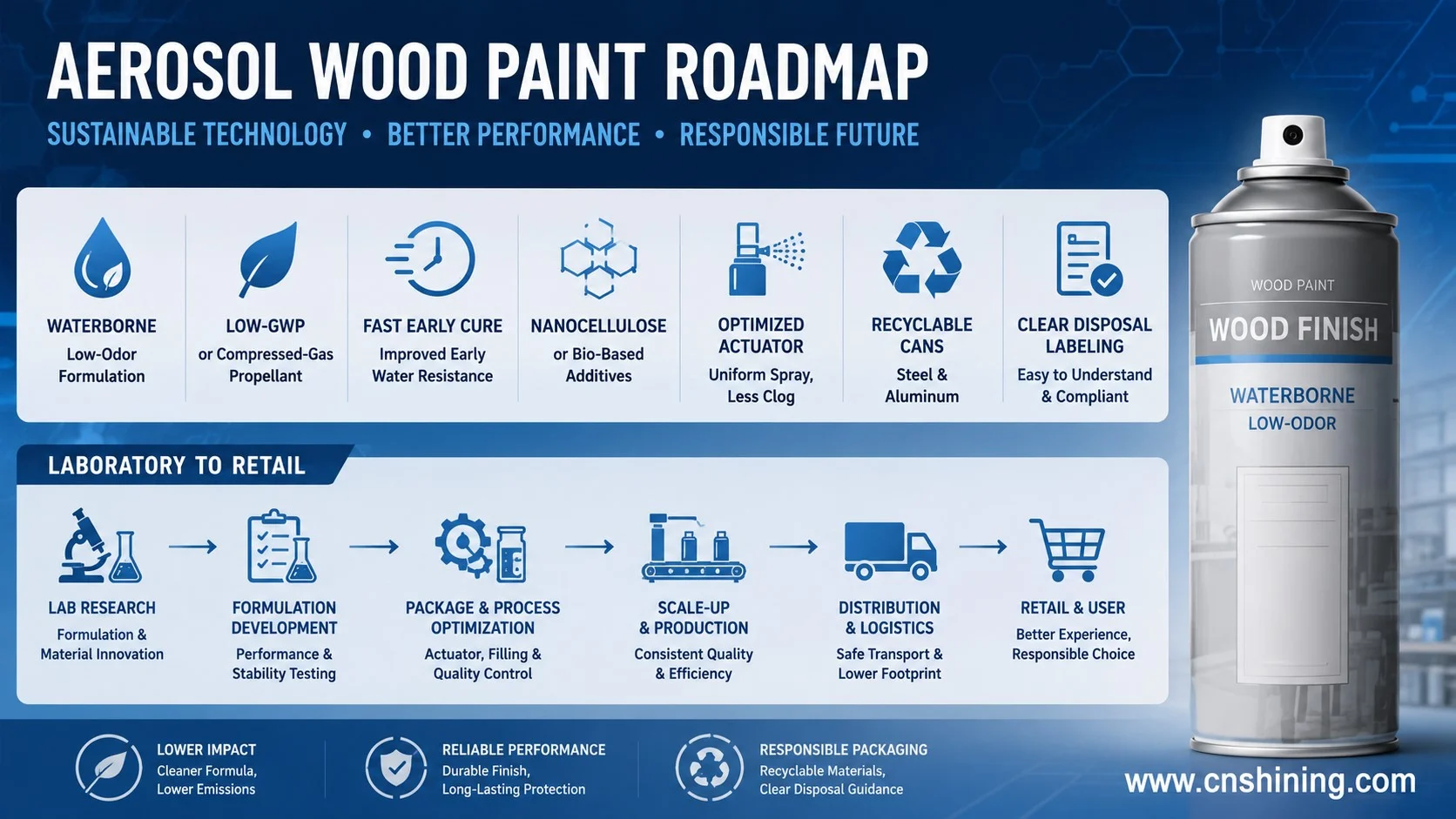
Waterborne aerosol paint has moved from concept work into retail product lines. The relevant performance question is no longer whether water can be used. It is whether the product can maintain shelf stability, atomization, early water resistance, block resistance and acceptable cure across the user’s temperature and humidity range.
Self-crosslinking waterborne binders are attractive because they can improve early resistance at a lower solvent level. For a retail wood project, the user often decides whether the coating “worked” within the first 30 minutes. Early film integrity therefore has a direct effect on returns and complaints, even when final laboratory properties are acceptable.
9.2 Propellant Change
Industry development also includes compressed gases and inert-gas concepts intended to reduce dependence on hydrocarbon propellants. The Eco-Valve compressed-gas approach uses gases such as nitrogen, compressed air or carbon dioxide. For wood coatings, this route is more realistic first in premium low-odor products than as an immediate replacement for every high-solids mass-market paint.
9.3 Bio-Based Materials and Nanocellulose
Nanocellulose research points to three possible functions in coating systems: reinforcement, rheology control and support for bio-based formulation design. Wood-waste-derived pigments are also being studied. These technologies are technically relevant, but broad aerosol commercialization still depends on dispersion stability, nozzle passage, sedimentation, shelf life and cost.
9.4 Recyclable and Lower-Carbon Packaging
Steel and aluminum aerosol cans fit established metal-recycling streams when they are empty and local collection accepts them. Product stewardship still depends on clear instructions for empty and partially full cans. Lower-carbon can production and higher recycled content are useful, but they do not replace accurate disposal labeling or control of residual product.
9.5 Patent and Research Signals
| Source | Technical point | Implications commerciales |
|---|---|---|
| WO2018162801A1 / EP3592813B1 | Waterborne aerosol paint using controlled DME, volatile fraction and nonvolatile content | Compatibility and shelf stability are the real commercialization barriers |
| EP0375010A1 | Non-halogenated propellant with a higher-solids paint system | Higher solids can improve hiding per can if sprayability is maintained |
| US3652018 | Mechanical break-up actuator geometry | Microgeometry directly affects atomization and clog complaints |
| WO2007021918A1 | Integrated actuator body, trigger and nozzle concept | Actuator architecture can improve ergonomics and part integration |
| Nanocellulose and bio-based coating research | Reinforcement, rheology modification and renewable pigment development | Likely to enter differentiated products before low-cost mass lines |
9.6 Supply Chain and Cost Structure
The upstream system has five major modules: coating formulation, propellant, metal can, valve and actuator assembly, and filling plus dangerous-goods logistics. Aerosol paint is packaging-heavy. As the product moves toward waterborne chemistry, lower odor, special fan patterns or multi-mode actuators, the relative cost and validation burden of the package usually rises.
| Cost module | Typical content | Main sensitivity |
|---|---|---|
| Coating | Binder, pigment, filler, additives and solvent or water | Hiding, durability and color consistency |
| Propergol | DME, LPG or compressed gas | Pressure, atomization, VOC and flammability |
| Packaging hardware | Can, valve, actuator and overcap | Clogging, leakage, ergonomics and complaint rate |
| Filling and quality assurance | Filling, crimping, pressure and leak tests, batch control | Yield and recall exposure |
| Logistics | Dangerous-goods storage and transport | Cross-border and e-commerce cost |
| Sustainability work | Lower-carbon metal, material optimization and disposal information | Evidence quality and packaging cost |
10. User Failure Modes and Packaging Improvements
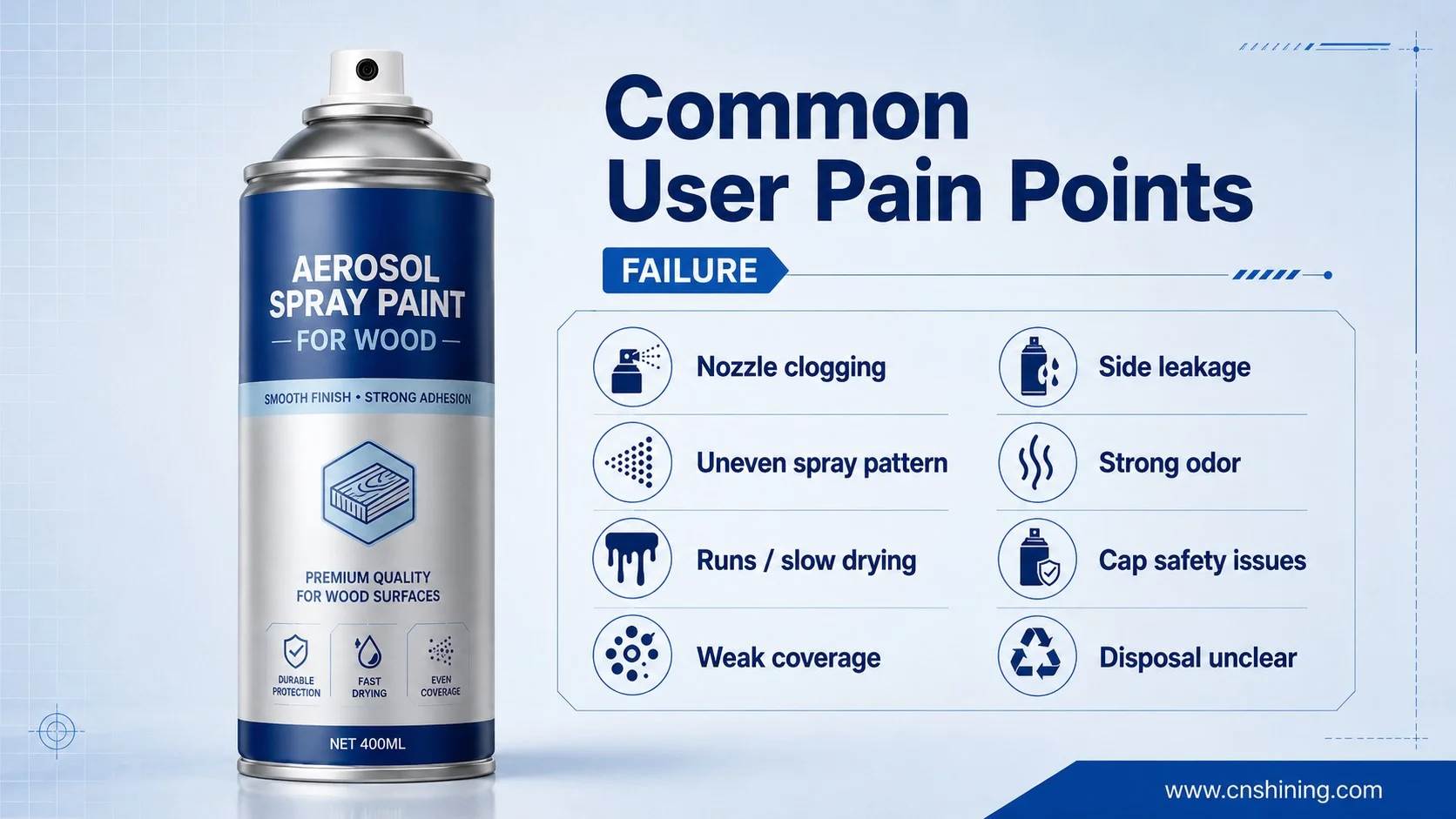
Public user feedback repeats the same failure groups: clogged nozzles, failure on second use, unstable output, slow or misleading dry times, top leakage, side spray, excessive odor and poor cap ergonomics. The repetition matters. It indicates platform-level issues rather than isolated color complaints.
| Failure | Probable cause | Scalable engineering response | Faisabilité |
|---|---|---|---|
| Actuator clogging | Pigment agglomeration, dried backflow, small orifice, valve-formula mismatch | Use formulation-specific actuator platforms; optimize orifice and swirl chamber; show purge instructions; include a spare actuator on selected high-solids SKUs | Haut |
| Unstable atomization or drifting fan | Actuator variation, pressure decay or broad viscosity tolerance | Create fine-mist, fan and high-output platforms; tighten nozzle dimensional control | Haut |
| Slow dry or wrinkling after a heavy coat | Excess wet film, trapped solvent or unclear recoat interval | Print dry-to-touch, recoat and full-cure times separately; slightly limit output for novice-oriented products | Haut |
| Side spray or leakage | Seal incompatibility, crimp variation or poor actuator assembly | Strengthen leak testing and crimp SPC; match gasket and internal coating to solvent, water and DME exposure | Moyen à élevé |
| Poor coverage perception | End-grain absorption and unrealistic area expectations | State coverage separately for bare wood, primed wood and repainting; show recommended pass count | Haut |
| High odor | Solvent-heavy binder and conventional propellant route | Develop a low-odor line using compatible waterborne resin and lower-odor or lower-GWP dispensing system | Moyen |
| Difficult cap or unintended discharge | Overcap geometry does not balance access and misuse prevention | Add a clear opening notch, twist-lock cap or mechanically lockable actuator | Haut |
| Weak disposal communication | Empty and partially full cans are not distinguished | Use separate pictograms for empty-can recycling and hazardous disposal of cans containing product | Haut |
Three Priorities Worth Implementing First
- Separate actuator and valve platforms by formulation. At minimum, standard pigmented acrylic, clear finish, waterborne low-odor and high-solids special-effect products should not be assumed to need the same dispensing hardware.
- Rewrite coverage information. State expected area for bare wood, primed wood and previously coated wood. Add recommended light-pass count, touch-dry time, recoat interval and full cure.
- Build a low-odor premium line around actual use conditions. Indoor furniture repair requires low odor, stable spray, early film strength and clear ventilation instructions. A label claim without package and cure validation will not reduce complaints.
11. Shining Packaging Components for Wood Aerosol Paint
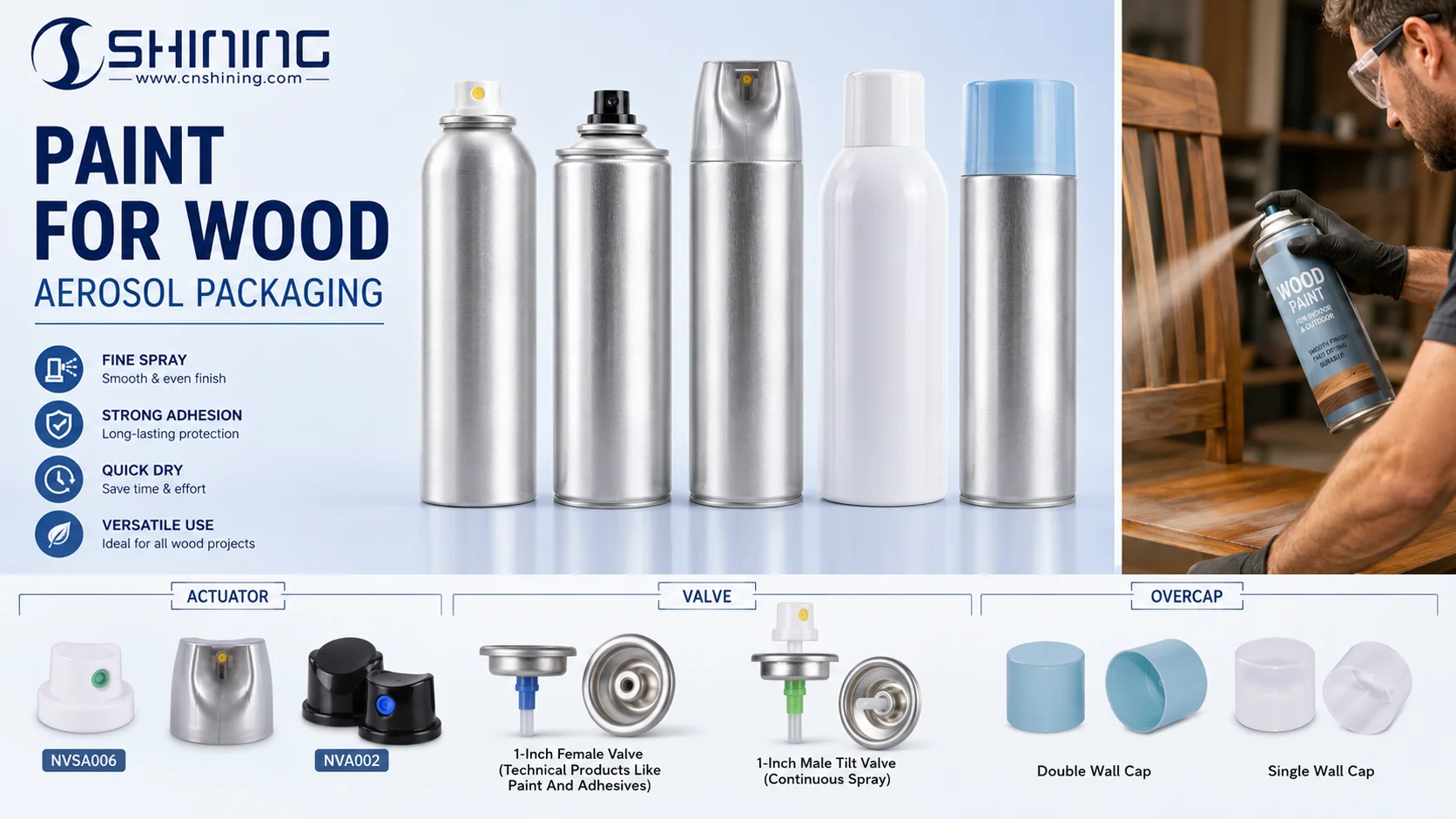
Shining Packaging supplies the three hardware groups that most directly affect a wood aerosol paint package: métal aérosols, vannes et actionneurs. For this application, component selection should start with the coating and propellant rather than with appearance alone.
The can body and internal coating must tolerate the resin, solvent or water phase, pigment package and propellant during storage. Valve selection must account for gasket compatibility, stem passage, output rate, dip-tube dimensions and crimp performance. The actuator must match viscosity, solids, target droplet size and required spray pattern. A wide fan is useful for cabinet doors and panels. A smaller round pattern may be better for trim, touch-up and complex parts.
A practical qualification program should include:
- package compatibility and storage stability;
- crimp dimensions and leak performance;
- initial and end-of-can output rate;
- fan width, droplet quality and pattern repeatability;
- restart after storage and purge behavior;
- residual product and dip-tube performance;
- actuator force, cap removal and unintended-discharge risk.
The aim is not to claim that one actuator or valve is suitable for every wood coating. The aim is to build a controlled component matrix and select the combination that remains stable across the formulation’s actual viscosity, solids and pressure range.
12. Engineering Conclusion
Aerosol spray paint for wood is not a mysterious coating class. It is a mature format that converts coating chemistry into a standardized, ready-to-use application system. The product succeeds only when three areas work together: coating formulation, aerosol package engineering and wood interface preparation.
The market data point to stable growth, but the stronger technical signal comes from repeated field failures. Users notice clogging, side spray, inconsistent output, unclear coverage and false expectations about cure before they notice small differences in resin vocabulary. A product that sprays reliably after storage, gives separate times for touch dry, recoat and full cure, and states realistic coverage on bare versus primed wood will solve more real problems than a larger color chart.
The practical target is clear: lower odor, stable atomization, controlled output, compatible seals and internal coatings, useful coverage information and disposal instructions that distinguish empty cans from cans containing residue. That combination raises the probability that a user completes a wood-refinishing job without rework.
13. FAQ: Aerosol Spray Paint for Wood
It can, but direct application is not always the most reliable route. Bare wood absorbs liquid unevenly, especially at end grain and sanded edges. That can reduce gloss and hiding power. Clean the surface, remove wax or oil, sand consistently and use a compatible sealer or primer when absorption is high, the color change is large, or the finish must look uniform.
Uneven absorption is the usual cause. Early droplets penetrate open pores instead of remaining at the surface to form a continuous film. End grain, repaired areas and exposed filler may absorb differently from face grain. A thin first coat, adequate flash time and a suitable primer or sealer normally produce a more uniform second coat than one heavy wet application.
Paint can remain in the actuator and dry near the orifice after spraying. High pigment loading, agglomerates, a small nozzle, weak purge practice or a valve-actuator mismatch raises the risk. Restart performance should be tested after storage, not only during continuous discharge. For some high-solids products, a larger passage or a spare actuator is a practical control.
Dry-to-touch means the surface can tolerate light contact without obvious transfer. It does not mean that solvent has fully escaped or that oxidation and crosslinking are complete. Full cure is the point at which the film approaches its intended hardness, scratch resistance and chemical resistance. Heavy handling, stacking or cleaning should follow the full-cure guidance, not the touch-dry time.
Water-based products can reduce odor and VOC pressure, which is useful indoors. Performance still depends on resin quality, coalescence, humidity, temperature and propellant compatibility. A poorly matched waterborne system may have weak early resistance or storage instability. Indoor suitability also requires ventilation, correct label use and enough cure time before the object returns to service.
Runs usually come from excessive wet film, slow movement or high output at close distance. Orange peel can result from coarse atomization, fast evaporation, poor leveling or spraying too far from the surface. Keep the can moving, overlap light passes, respect flash time and use an actuator pattern matched to the panel size and coating viscosity.
A general claim that the paint adheres to wood is not enough. Children’s furniture may be subject to lead and other chemical limits, depending on the market and product classification. The finished article also needs appropriate curing and use instructions. Only make a children’s-use claim when the coating and finished application have been assessed against the applicable legal and test requirements.
Dryness alone does not establish food-contact compliance. Regulatory status depends on the coating’s substances, intended contact conditions and any required migration assessment. Standard decorative aerosol paint should not be assumed suitable for cutting boards, plates, cups or other direct food-contact surfaces. Use only a coating with a defined food-contact regulatory basis for the intended application.
A fan pattern is usually more efficient for cabinet doors, chair panels and broad furniture surfaces because it produces a wider, more paint-like pass. A round pattern can provide better control on trim, corners, carvings and spot repair. The choice must also match output rate, viscosity, solids and pressure decay. Pattern shape should remain stable from the start to the end of the can.
Start with formulation chemistry, solids, viscosity, propellant and target spray pattern. Check can-lining compatibility, gasket resistance, crimp dimensions, valve flow, dip-tube size and actuator orifice geometry. Then validate leakage, output, droplet quality, fan repeatability, restart after storage and residual product. Component selection based only on size or appearance leaves the main failure modes untested.