
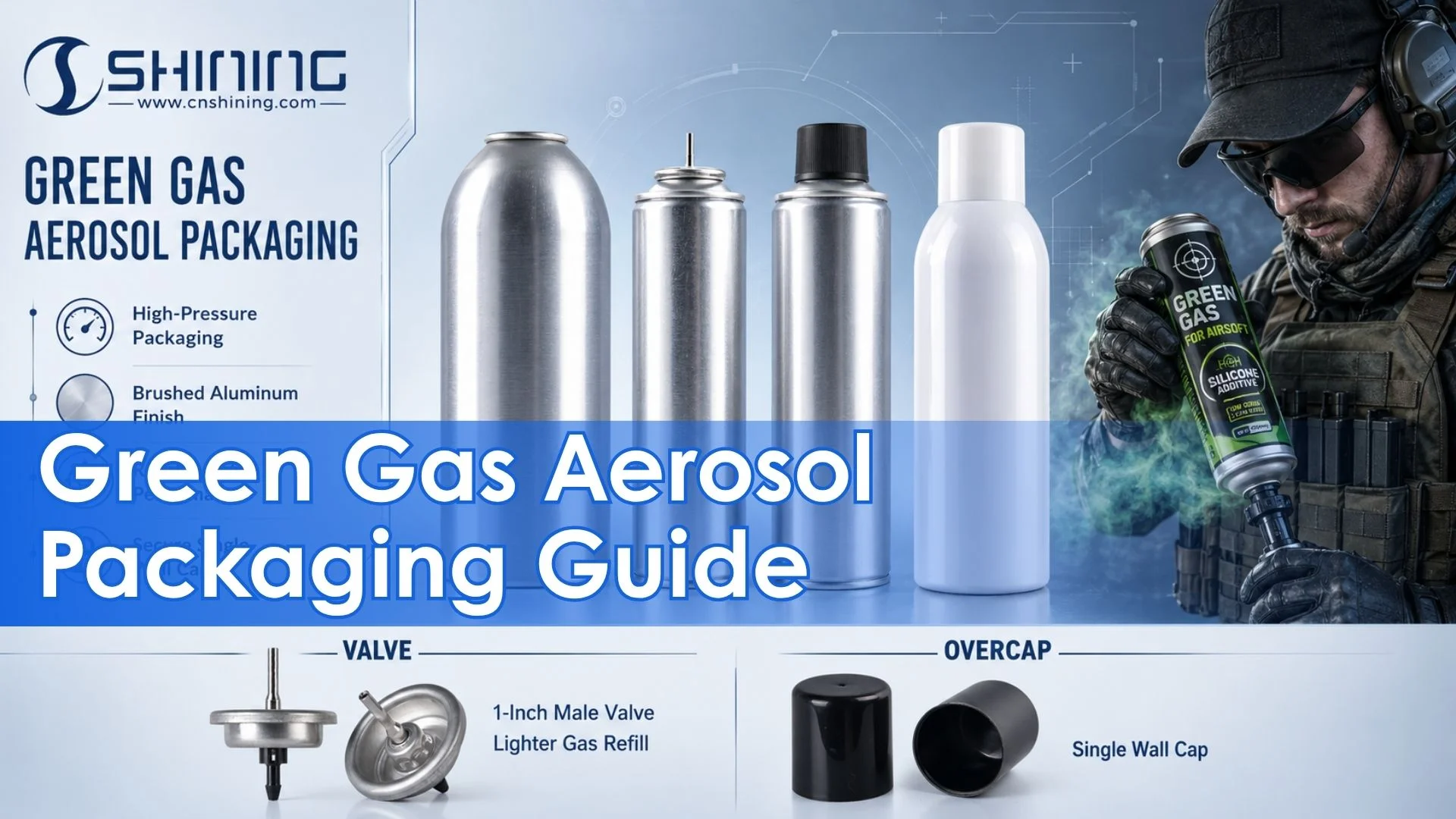
Green Gas is not one chemical name. In airsoft, it usually means a canned propane-based gas with silicone oil lubrication and small functional additives. In aerosol and industrial propellant work, terms such as green propellant, eco propellant, ou low-carbon propellant may refer to zero-ODP, lower-GWP, or renewable-origin systems such as hydrocarbons, DME, HFO-1234ze(E), renewable propane, renewable DME, or Bag-on-Valve with nitrogen or air.
The first engineering step is simple: define the use case. If purchasing, R&D, compliance, or market analysis treats airsoft retail gas, aerosol propellants, and low-GWP replacements as the same market, the result will be wrong.
1. Scope and Definition
Name boundary
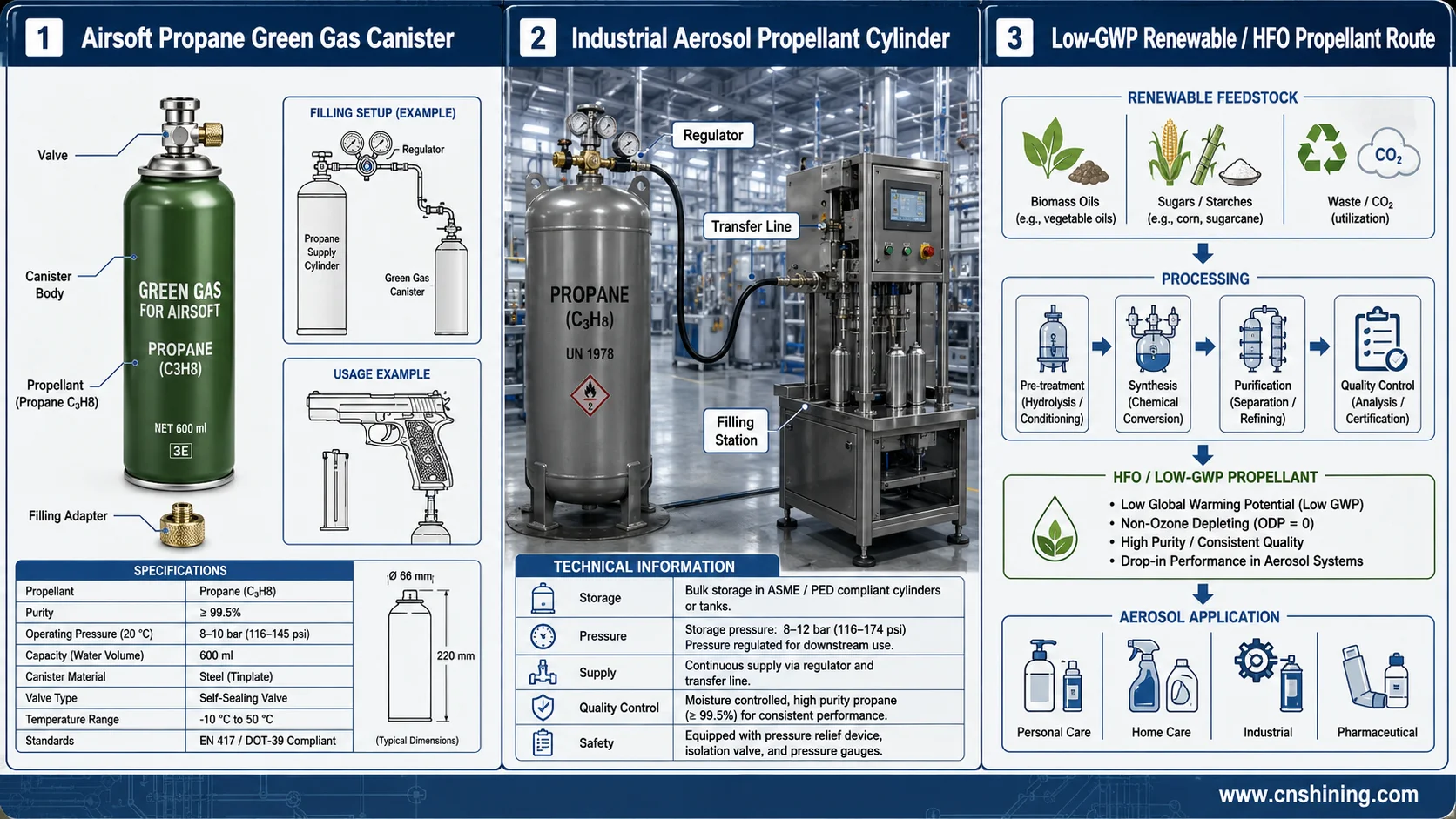
From a regulatory and SDS point of view, airsoft Green Gas is not a mysterious mixture. The Ballistol airsoft gas SDS describes the use as “propellant for airsoft weapons” and lists propane as a hazardous component. In the same market, silicone-lubricated and silicone-free gases exist because users need different maintenance and accuracy behavior.
In industrial aerosols, “green” is a relative term. It may mean lower impact than CFC/HCFC history, lower GWP than HFC-134a, or renewable sourcing. Honeywell’s HFO-1234ze(E) technical bulletin, for example, positions HFO-1234ze(E) as a non-flammable aerosol propellant with ultra-low GWP. That does not make every “green gas” natural or carbon-free. It means the environmental and regulatory profile has changed.
2. Working Principle: Vapor Pressure First
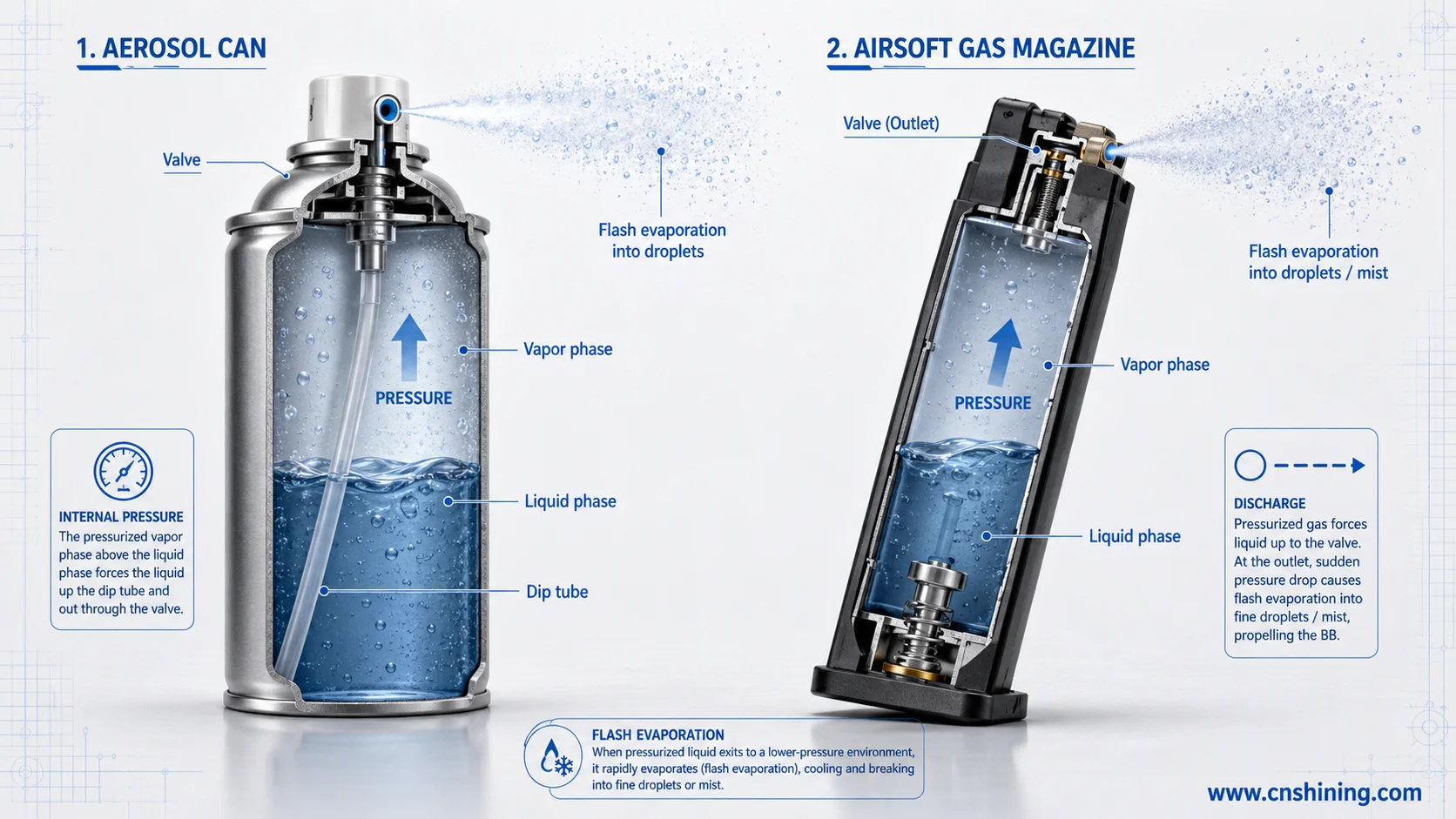
The core of Green Gas is not the word “green.” It is liquefied gas-vapor equilibrium and instant phase change after valve release. As long as liquid propellant remains inside the container, the system can hold relatively stable vapor pressure. When the valve opens, pressure difference pushes product out. The liquefied propellant then flash-evaporates under lower external pressure and helps form spray droplets.
Diversified CPC’s aerosol propellant material describes common aerosol propellant pressure ranges around 0.7-9.8 bar at 21.1°C. This pressure window explains both aerosol spraying and airsoft magazine gas supply.
Different gases feel different because vapor pressure curve, miscibility, solvency, flammability, and temperature response are different. Chemours HP DME technical data gives a vapor pressure of 63 psig at 70°F and DME solubility in water up to 35 wt%. HFO-1234ze(E) is around 64.2 psia / 4.4 bar at 70°F / 21°C and can be blended to tune pressure.
In airsoft, the same physics becomes the well-known cooldown problem. Continuous firing cools the magazine, pressure drops, recoil weakens, FPS falls, and cycling becomes less stable. A gas that works in summer can become weak in cold weather. A high-pressure winter gas can stress a platform that was not designed for it.
3. Formulation, Classification, and Compatibility
3.1 Classification by chemistry
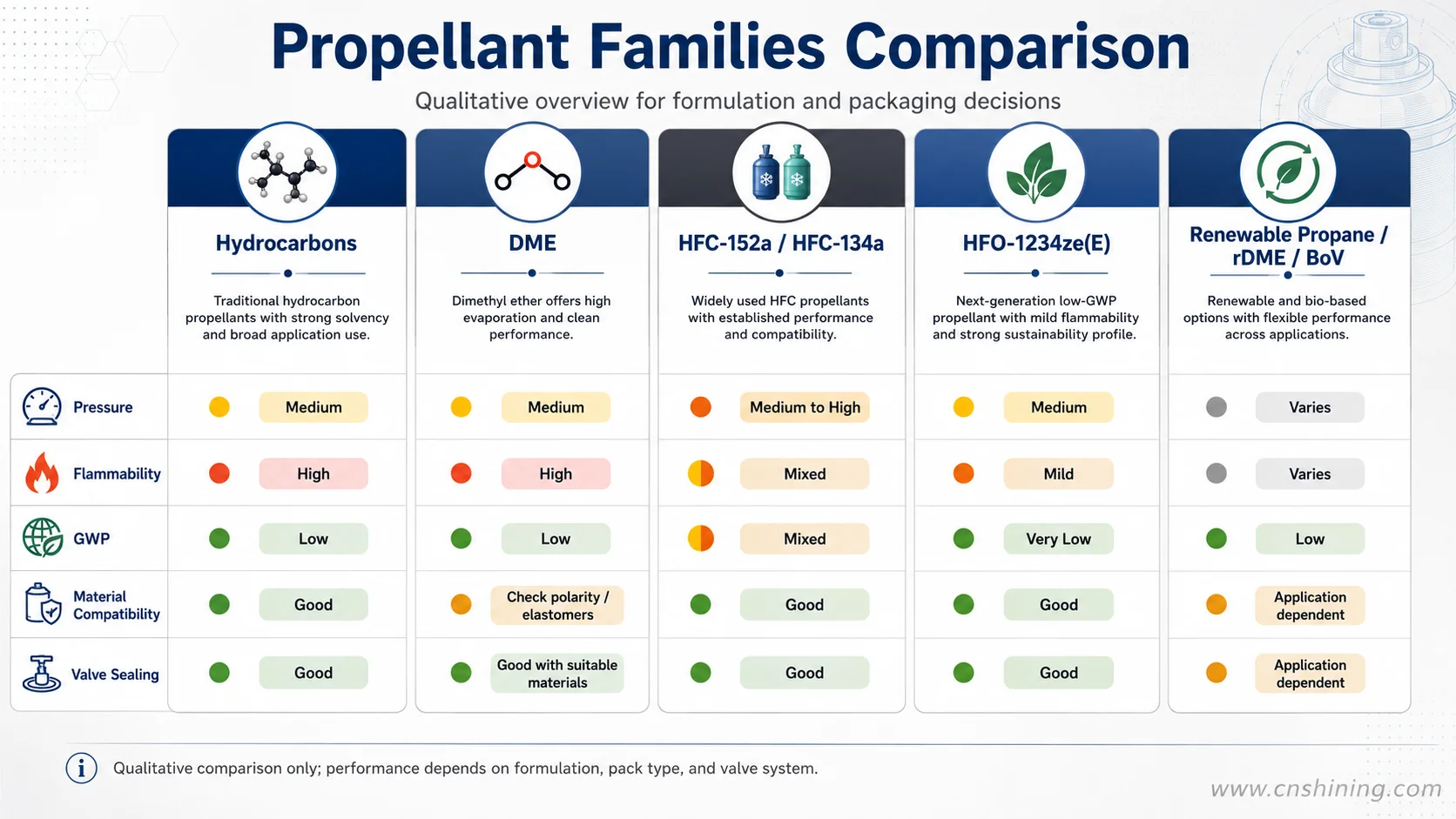
The table below classifies Green Gas-related propellants by chemistry, not by marketing label.
| Catégorie | Representative chemicals | Fonction principale | Typical public formula / ratio | Principaux avantages | Main risks / notes |
|---|---|---|---|---|---|
| Alkanes | Propane, isobutane, n-butane | Main pressure source; most common base in airsoft gas | Commercial grades include A-17 n-butane, A-31 isobutane, A-108 propane; one public blend example is A-46 = 15.2% propane / 84.8% isobutane. Hydrocarbon propellant reference | Low cost, wide pressure window, mature supply | Flammable; VOC; temperature and transport limits; seal wear depends on valve and elastomer system |
| Ethers | DME | Propellant plus solvent function for water-based or high-solvency systems | Public patent-type examples use 15-35% DME, 1-6% surfactant, balance water. Nouryon DME reference | Strong water miscibility, reduced need for extra solvent, available as Green DME | Pure DME is highly flammable; material compatibility must be tested |
| HFC | HFC-152a, HFC-134a | Stable pressure source; HFC-152a is a lower-GWP transitional option | HFA-152a GWP about 164; HFA-134a GWP about 1530; HFO/HFA blends can use 20/40/60/80 wt% HFO | Mature performance; HFC-152a has much lower climate burden than HFC-134a | Regulatory pressure under AIM and F-gas regimes; labeling and reporting may apply |
| HFO | HFO-1234ze(E) | Low-GWP, low photochemical reactivity propellant; can blend with HFA and common solvents | Can be used neat or blended with HFA-134a / HFA-152a at 20-80 wt% HFO to tune pressure | GWP <1 / table value 1.37; non-flammable under standard tests; VOC exempt in EPA context | Usually higher cost than hydrocarbons; regional and application availability must be checked |
| Renewable / low-carbon routes | Renewable propane, rDME, BoV + nitrogen / air | Reduce carbon intensity and support regulatory or ESG targets | Often positioned as drop-in or line-compatible routes; public blend ratios are not always disclosed. AeroNu renewable propellant route | Can lower footprint while keeping spray performance close to existing systems | Supply, certification, mass balance, and cost need separate review |
3.2 Typical formulation logic
For airsoft retail Green Gas, the common commercial structure is clear: propane base + silicone oil lubrication + trace functional additives. Silicone-free versions serve users who prefer manual lubrication and cleaner hop-up or barrel behavior. The market has moved from “gas with oil or not” to a more practical split: pre-lubricated convenience contre dry gas with controlled maintenance.
For industrial aerosols, formulation starts from target pressure, spray form, compatibility, and compliance boundary. Hydrocarbon blends tune pressure with propane, isobutane, and n-butane. DME adds solvency and water miscibility. HFO-1234ze(E) works as a higher-value pressure and low-GWP module. This is pressure engineering, not naming work.
3.3 Safety and compatibility
The key safety conclusion is direct: green does not mean non-flammable. Hydrocarbons are flammable. DME is highly flammable. HFO-1234ze(E) is one of the few options in this group that can be classified as non-flammable under standard aerosol propellant tests.
Compatibility is where many projects fail. DME’s water miscibility and solvency help formulation, but they can also attack weak material choices. For any migration from LPG to DME, HFO, water-containing formulations, or renewable drop-ins, the inner coating, valve gasket, O-ring, actuator plastic, stem, and cup gasket should be screened as a system.
4. Market Size and Trend Signals
Data boundary
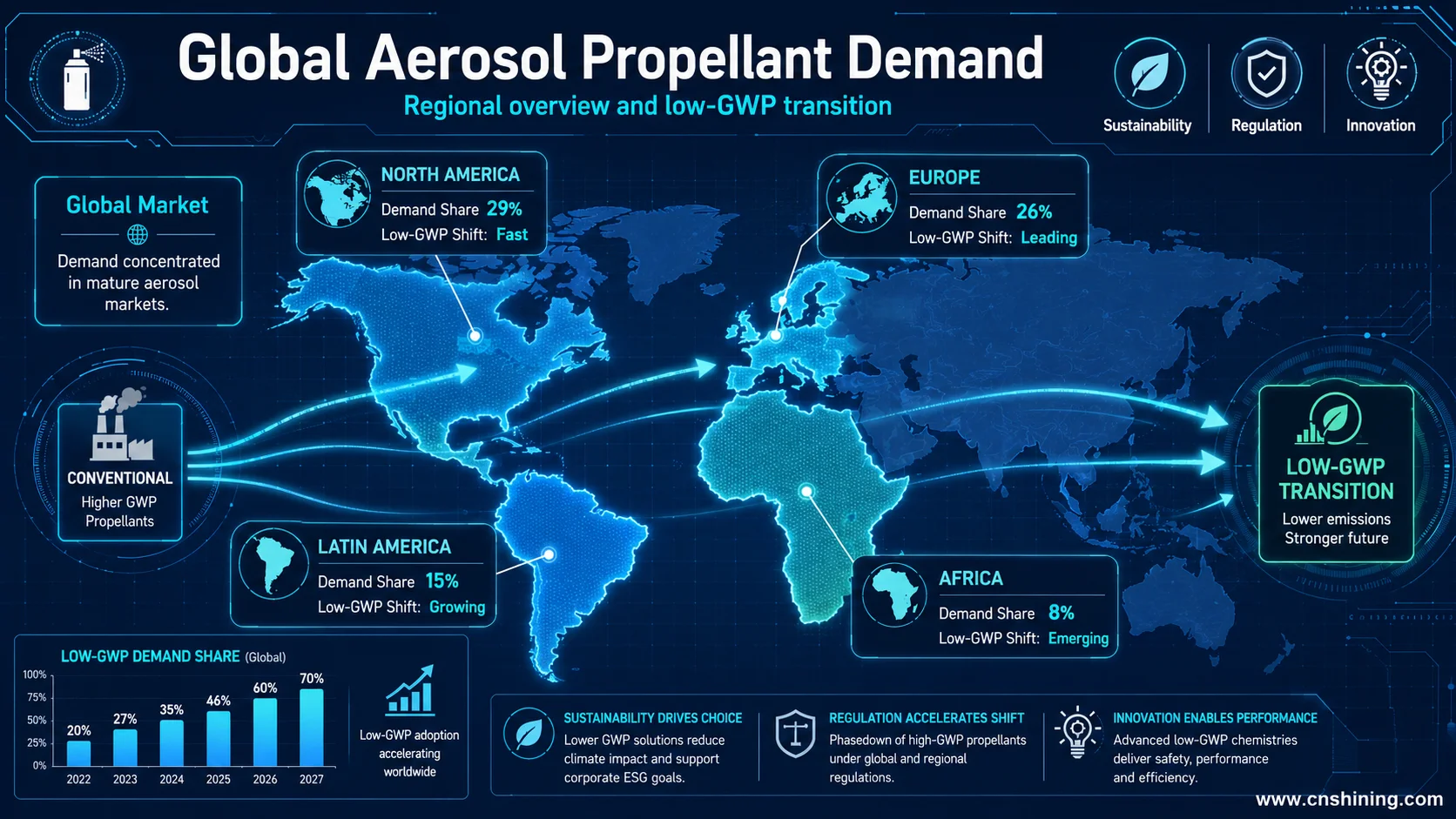
Green Gas is not a standard customs or market database category. A workable public view needs three layers: global and regional aerosol propellant revenue, regional aerosol filling volume, and airsoft retail brand evidence. These data points cannot be merged into one exact retail Green Gas market size.
Using the aerosol propellants market as the closest public proxy, Recherche et marchés reports around USD 10.62 billion in 2024, with a forecast of USD 19.19 billion by 2033 et 6.9% CAGR for 2025-2033. Airsoft retail Green Gas itself still lacks a unified, public, verifiable global market size.
| Région | Recent public indicator | Recent change | Outlook | Lecture technique |
|---|---|---|---|---|
| Mondial | Aerosol propellants market about USD 10.62 billion in 2024 | Demand driven by personal care, household, insecticide, medical, and industrial products | USD 19.19 billion by 2033; CAGR 6.9% | Best public total-market proxy, but not the airsoft retail Green Gas submarket |
| Amérique du Nord | Regional propellants market USD 2.22 billion in 2023; historical aerosol output 4.602 billion cans in 2015 and 4.558 billion in 2016. North America market reference | Public survey data showed U.S. production down 4.8% in 2019, then up 3.6% in 2020 | Regional outlook about USD 3.35 billion by 2033 | Mature market with strong regulatory pressure and better reporting than many regions |
| Europe | FEA: 5.288 billion cans in 2023; European propellants market about USD 3.8569 billion in 2024. Données de production d'aérosols FEA 2023 | 2013-2023 sequence: 5.428, 5.528, 5.672, 5.693, 5.766, 5.576, 5.492, 5.271, 5.319, 5.242, 5.288 billion cans | 2025-2033 CAGR around 7.2% in available public market view | High-regulation, mature region. Growth is more about formulation shift than volume explosion |
| Asie-Pacifique | Unified public regional revenue was not clearly obtained. Thailand has public association snapshots. Thailand aerosol data reference | Thailand data exists for 2019, 2022, 2023, and 2024; 2023 was about 244.3 million cans | Regional view should split Japan, Thailand, Australia, and other markets | It has some reference value in the context of open data. |
| l'Amérique latine | Brazil 1.30 billion cans in 2023 to 1.34 billion in 2024; Mexico 726.3 million in 2022 to 785.6 million in 2023 to 838 million in 2024. Latin America aerosol data reference | Brazil and Mexico are both growing | Brazil 2025 expected around plus/minus 5% | Regional bright spots are Brazil and Mexico, supported by consumer goods and manufacturing recovery |
| Africa | South Africa: 324.471 million locally filled cans in 2024; total sales 339.615 million units. South Africa aerosol data reference | South Africa was 329.1 million in 2021, 323.4 million in 2022, and basically recovered in 2024 | No unified public regional forecast used here | Africa open data is close to a South Africa representative sample. Transparency is limited |
Europe peaked around 2017, weakened after 2020, then stayed around 5.2-5.3 billion cans from 2021 to 2023. The market signal is not “volume grows everywhere.” It is more specific: demand still exists, but value shifts toward compliant formulations and better packaging systems.
5. Comparison, Terms, and Regulation
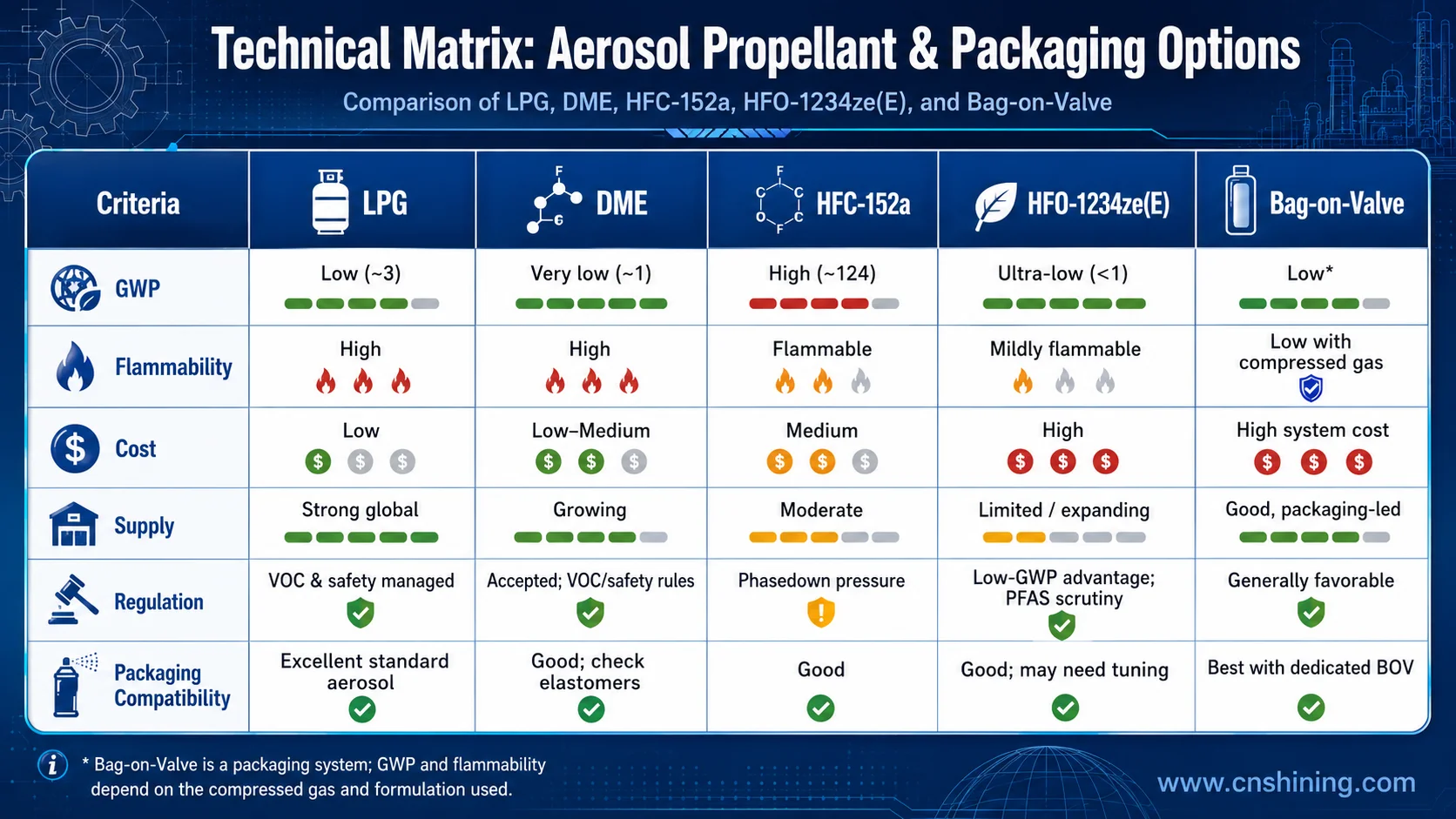
| Itinéraire | Performance | Environmental profile | Cost / supply | Sécurité | Practical use judgment |
|---|---|---|---|---|---|
| Hydrocarbon Green Gas / LPG | Wide pressure range, strong spray force, mature airsoft platform fit | Zero ODP; VOC; carbon footprint depends on fossil or renewable origin | Usually low cost and mature supply | Flammable; transport and storage restrictions | Main base route for many general-purpose products |
| DME | Medium-to-high pressure, strong solvency, useful in water-based systems | Fossil DME and Green DME differ strongly in carbon story | More specialized than normal LPG | Very flammable as pure material; compatibility testing must be stricter | Good fit when propellant and solvent roles are both needed |
| HFC-152a | Mature performance, transitional lower-GWP fluorinated propellant | GWP about 164, much lower than HFC-134a at about 1530, but still regulated | Usually higher than hydrocarbons and DME | Some uses face reporting, labeling, and restriction timelines | Useful where a buffer period exists and legacy pressure behavior must be preserved |
| HFO-1234ze(E) | Can be blended with HFA or solvents to tune pressure and spray | GWP <1 / table value 1.37; VOC exempt; low photochemical reactivity | Higher-value replacement route | Non-flammable under standard conditions | Fit for compliance-first and higher-value products |
| BoV + nitrogen / air | Separated from product; spray stability depends on valve and bag design | Non-flammable, low GWP, reduced product contact with propellant. Bag-on-Valve technical reference | Needs BoV supply chain and filling capability | Strong safety and product protection profile | Good fit for personal care, medical, and home care products that accept barrier packs |
| Terme | Signification simple | Business / engineering effect |
|---|---|---|
| Pression de vapeur | Equilibrium pressure generated by a propellant at a given temperature | Defines spray force, recoil feel, seasonal fit, and container design window |
| GWP | Global warming potential, compared as CO2 equivalent | Controls exposure to AIM, F-gas, and low-GWP replacement pressure |
| ODP | Ozone depletion potential | Most modern alternatives target ODP = 0, but ODP remains a base regulatory concept |
| COV | Composé organique volatil | Affects local air quality rules, especially consumer product limits |
| GBB | Gas blowback system in airsoft | Shows pressure, lubrication, temperature sensitivity, and cycling behavior clearly |
| Cooldown | Temperature and pressure drop after repeated gas release | Directly affects FPS, recoil, return rate, and seasonal SKU design |
| Silicone-lubricated | Gas contains silicone oil | Reduces dry wear on valves and seals, but may contaminate precision areas |
| Sans silicone | No silicone oil preloaded in the gas | Cleaner for hop-up and barrel setups, but requires active maintenance |
| BoV | Bag-on-Valve separated package | Allows air or nitrogen propellant and product isolation |
| ONU 1950 | Numéro de marchandises dangereuses pour les aérosols | Controls transport, storage, limited quantities, and cross-border logistics |
| SNAP | U.S. EPA Significant New Alternatives Policy program. SNAP propellant substitutes reference | Determines whether substitutes are acceptable for specific end uses |
| ADD | Directive européenne relative aux distributeurs d'aérosols | Controls aerosol container safety, filling, labeling, and dimensional rules |
| Marché | Main regulation / standard | Actual effect on Green Gas |
|---|---|---|
| Mondial | Montreal Protocol Kigali Amendment | HFCs are being phased down globally by 80-85%; high-GWP fluorinated propellants face long-term pressure |
| États-Unis fédéral | AIM Act and 40 CFR Part 84; SNAP | Aerosols are included in Technology Transitions. Most aerosol products cannot use controlled HFCs with GWP ≥150 from 2025-01-01, with later dates for some technical categories |
| Californie | CARB Consumer Products Program | VOC, toxic air contaminant, and greenhouse gas limits push formula reporting and early reformulation |
| Canada | Federal Halocarbon Regulations, 2022 | Controls emissions, records, permits, and handling logic for halocarbons and alternatives in covered federal contexts |
| Union européenne | Regulation (EU) 2024/573; Directive 75/324/CEE relative aux distributeurs d'aérosols; CLP; REACH | F-gas is the climate constraint layer. ADD controls aerosol container safety. CLP and REACH control classification, labeling, and chemical obligations |
| Japon | Act on Rational Use and Proper Management of Fluorocarbons | Lifecycle management of fluorocarbons is centered on refrigerants, but low-GWP replacement thinking affects propellant selection |
| Australie | HFC phase-down | Import quota-based phasedown started on 2018-01-01, increasing long-term pressure on high-GWP HFCs |
| Brazil / Mexico / Africa representative markets | Brazil Ibama IN 29/2023; Mexico HFC permits and quotas; South Africa Kigali roadmap | Regulatory maturity is lower than Europe or the U.S., but the direction is the same: permits, quotas, roadmaps, and project-based replacement |
6. Latest Development, Top Brands, and User Pain Points
6.1 Technology direction
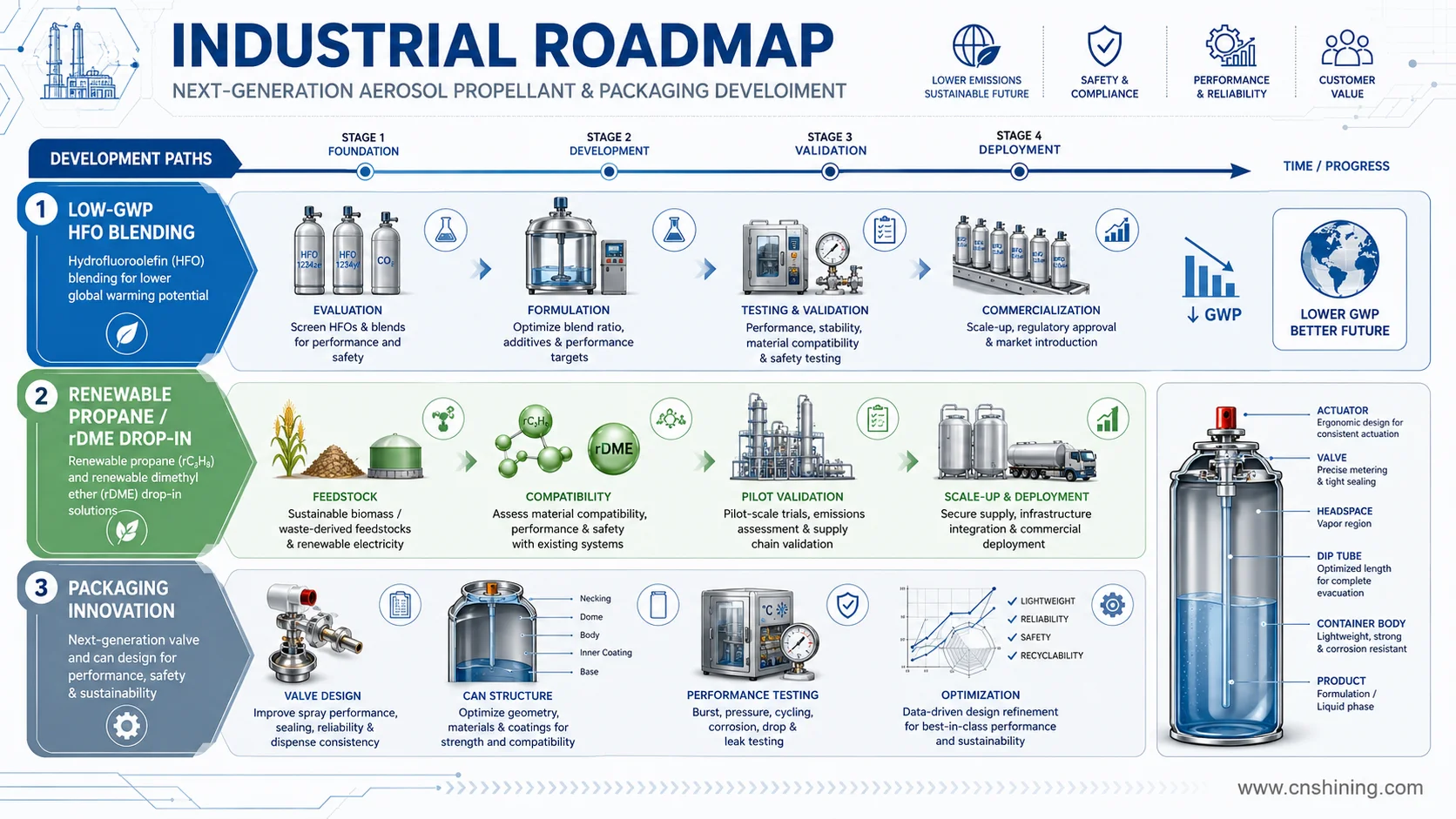
The technical direction is clear: low GWP with acceptable pressure behavior. HFO-1234ze(E) can function not only as a molecule replacement but also as a pressure-tuning module in more complex blends. Medical aerosol work has also shown that HFA-152a and HFO-1234ze can move beyond early laboratory discussion.
The second path is renewable drop-in propellant. Renewable propane and rDME are attractive because they can reduce carbon intensity without forcing every user to redesign the full spray system. The real question is not “which molecule is greener?” It is “which route can enter the existing filling and supply system with the least redesign risk?”
The third path is packaging structure. Low-GWP sprayable or extrudable composition patents already use CO2, N2, or low-GWP halogenated olefins. Recent patent work, such as US20240326074, shows that the market is looking at gas, valve, can, sealing cup, and dispensing behavior as one system.
6.2 Top 10 Green Gas Brand Table
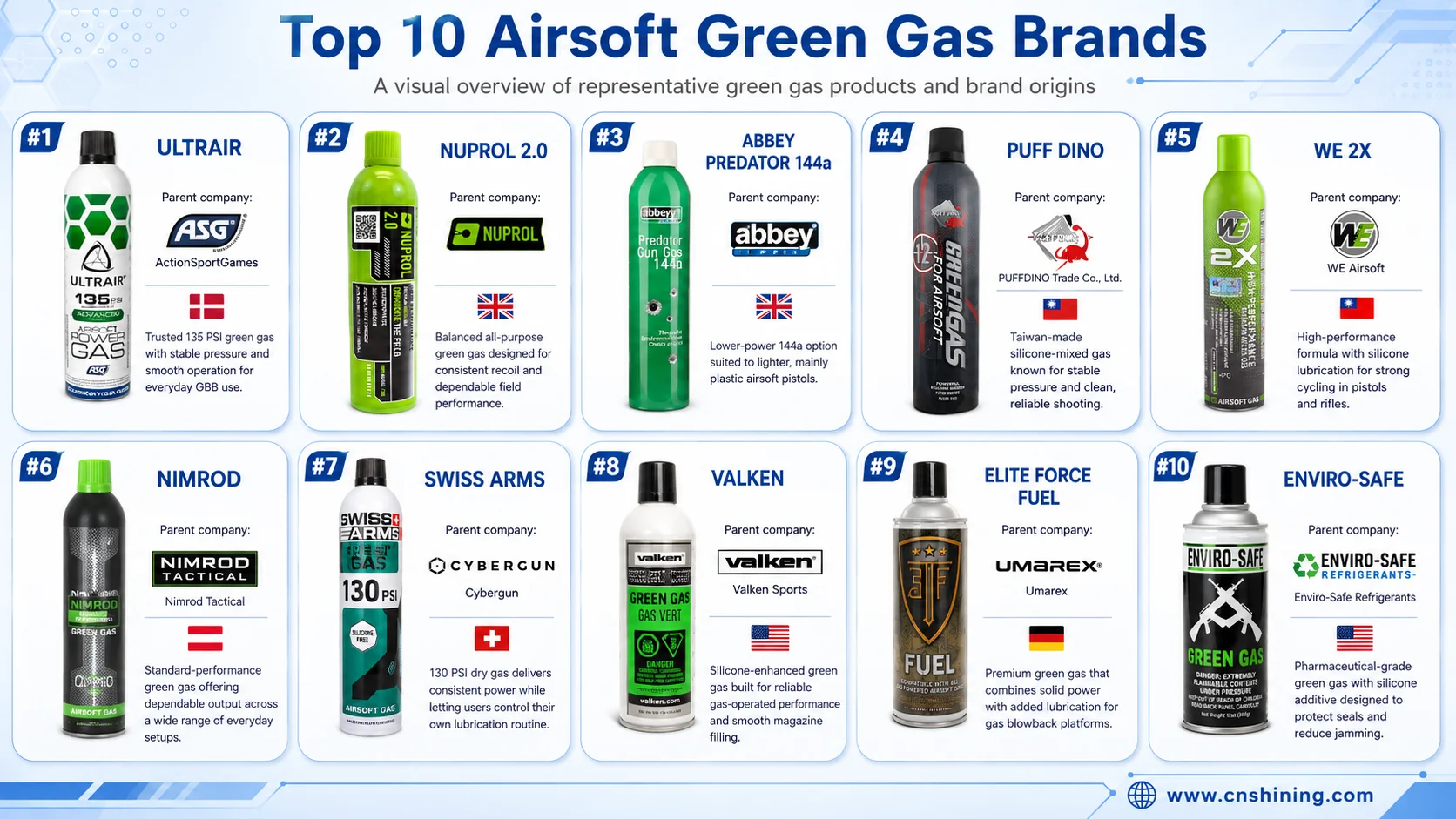
| Marque | Pays / région | Owner / brand holder | Representative product and capacity | Gamme de prix | Market positioning / comment |
|---|---|---|---|---|---|
| ASG Ultrair | Denmark | ActionSportGames A/S | Ultrair Power Gas with Silicone, 570 ml | environ 11$ | Established European airsoft consumable line; emphasizes silicone lubrication and use-case fit |
| NUPROL | Royaume-Uni | NUPROL LTD | Airsoft Gas 2.0, 300 g | about 14$-16$ | Mainstream UK gas system with 2.0 / 3.0 / 4.0 and ZERO silicone-free segmentation |
| Abbey | Royaume-Uni | Abbey Supply Company Limited | Predator Ultra Gas, 700 ml / 270 ml | about 13$ | Known for medium-pressure gas and O-ring-friendly filling logic |
| Puff Dino | Taiwan, China | PUFFDINO Trade Co., Ltd. | Standard Power 12KG, 600 ml | about 19$ | Taiwan aerosol and airsoft background; offers lubricated and non-lubricated variants |
| WE Airsoft | Taiwan, China | WE Model Co., Ltd. / WE Tactical Training International | Premium “2X” High Performance Green Gas | about 9$-18$ | Gas tied to a GBB platform ecosystem and training-oriented airsoft use |
| Nimrod | Autriche | Nimrod Tactical | Standard Performance Green Gas, 500 ml | about 14$ | Multiple pressure grades with European and colder-season positioning |
| Swiss Arms | Swiss brand license | Cybergun / EMG channels appear | Lubricated / Dry Gas, 600 ml | about 13$-14$ | Multi-pressure, multi-season, lubricated and dry product matrix |
| Valken | États-Unis | Valken | Green Gas, 8 oz / 226 g | environ 11$ | North American training and field-friendly positioning; public pages note DOT approval and 115 psi at 70°F |
| Elite Force Fuel | États-Unis | Umarex USA | Green Gas canister, 8 oz; also 600 ml / 130 PSI pages | about 12$-16$ | High recognition in North America and mainstream retail, with clear shipping limits |
| Enviro-Safe | États-Unis | Enviro-Safe Refrigerants, Inc. | Green Gas, 13.5 fl oz | about 15$ per can by 3-pack calculation | Focuses on medical-grade gas, no mercaptan, and training-use narrative |
| Lancer Tactical | États-Unis | Lancer Tactical | 12KG High PSI Green Gas, 600 ml | about 17$-21$ | High-PSI route for cold weather or high-demand platforms; platform tolerance matters |
6.3 User pain points and packaging improvement
Public reviews, repair notes, brand guides, and videos point to a stable pain-point order: leakage, temperature sensitivity, silicone-related accuracy side effects, and shipping friction. These are not just user complaints. They are packaging and specification problems.
| Improvement direction | Technical action | Bénéfice attendu | Supply chain / cost note |
|---|---|---|---|
| Valve and filling nozzle | Upgrade filling nozzle to aluminum, stainless steel, or low-temperature-friendly polymer tip; improve coaxiality and sealing face precision; life-test fill-valve gaskets | Reduces leakage, bent nozzle complaints, and O-ring damage returns | Material cost rises slightly, usually less than replacement cost |
| Formula segmentation | Offer at least lubricated general gas and silicone-free precision gas | Addresses both low-maintenance and clean-barrel users | Small formula change, higher SKU and channel-education cost |
| Temperature label | Print optimum temperature, typical PSI, and suitable platform on the front label; use bands for standard, high-pressure, and winter gas | Reduces bad reviews and platform damage caused by wrong temperature choice | Mostly label and instruction cost; high practical return |
| Remaining gas visibility | Print full-can gross weight, empty-can tare weight, batch number, and filling date | Helps users judge remaining gas and supports after-sales traceability | Small supply chain effect, but filling QC must be more disciplined |
| High-solvency formulation compatibility | Run coating, gasket, actuator plastic, and valve compatibility matrix for DME, HFO, and water-containing systems | Reduces valve swelling, precipitation, corrosion, odor, and leakage complaints | Medium front-end testing cost, lower long-term quality risk |
| Low-carbon route | For non-airsoft aerosols, evaluate renewable propane, rDME, or BoV + air / nitrogen depending on product protection needs | Creates regulatory buffer and lower-carbon pathway without automatically sacrificing spray performance | Renewable supply is still expanding; BoV may need valve and filling-line investment |
Airsoft Green Gas packaging should be managed as both an industrial pressure container et a consumer-use product. If it is treated only as a cheap consumable, leakage, misuse, wrong temperature selection, and logistics complaints will keep returning.
7. Shining Packaging Products for Green Gas and Aerosol Systems
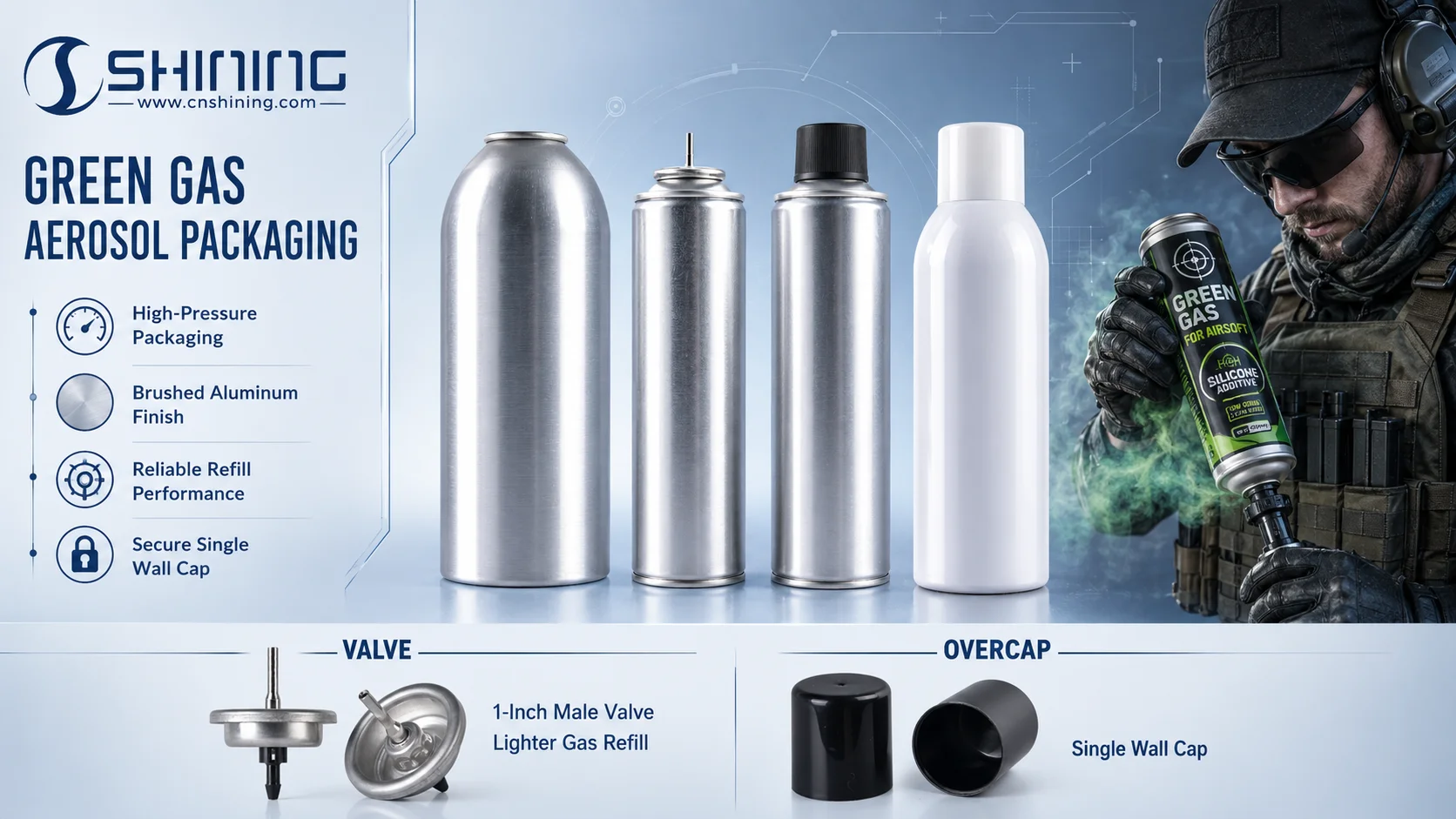
For Green Gas and low-GWP aerosol projects, Shining Packaging is usually involved at the package interface: actionneurs, aérosols, et vannes. These parts do not change the propellant chemistry, but they decide whether the selected gas can work reliably in production and storage.
The actuator controls spray feel, plume shape, user force, and residue behavior. The aerosol can must match pressure, coating, corrosion risk, filling process, and transport classification. The valve is the highest-risk part because the stem, gasket, cup, spring, dip tube, and filling path all see pressure, solvent, and repeated movement.
For hydrocarbon systems, the focus is pressure safety, flame labeling, valve seal integrity, and transport-ready packaging. For DME, HFO, or water-containing formulas, compatibility testing becomes more severe. For BoV systems, the valve and bag structure must keep product and propellant separated without sacrificing evacuation rate or spray stability.
8. Conclusion
Green Gas should be handled as a pressure, chemistry, packaging, and compliance problem. The market will not move to one single replacement. Mass products will keep using hydrocarbons and DME where they fit. Higher-compliance products will move toward HFO, renewable drop-ins, or BoV. Airsoft gas will keep splitting by pressure grade, silicone state, temperature range, and platform tolerance.
The practical conclusion is narrow but useful: define the gas, define the pressure window, test the valve package, and label the use condition clearly. Most failures start when one of those four steps is skipped.
9. FAQ: Green Gas Propellants, Compliance, and Packaging Risks
No. In airsoft, Green Gas usually means a propane-based liquefied gas with silicone oil and small additives. In aerosol and industrial propellant work, the same wording may point to low-GWP, zero-ODP, renewable, or lower-carbon systems. The correct definition depends on use case, SDS, pressure grade, and regulatory context.
Continuous firing releases gas quickly and causes evaporative cooling in the magazine. As the magazine temperature drops, vapor pressure drops as well. The result is weaker recoil, lower FPS, and less reliable cycling. This is called cooldown. It is a thermodynamic effect, not necessarily a purity defect in the gas.
Hydrocarbons such as propane, isobutane, and n-butane remain common because they are low cost, available at scale, and easy to blend across useful pressure windows. They also have zero ODP. The tradeoff is flammability, VOC classification, transport restriction, and the need for careful valve, can, and label design.
DME is not just a pressure source. It also works as a strong solvent and has high water miscibility, which makes it useful in some water-based aerosols and personal care formulas. That same solvency can create compatibility risks. Coatings, gaskets, O-rings, stems, actuators, and dip tubes should be tested before conversion.
HFO-1234ze(E) has a very low GWP and is classified as non-flammable under standard aerosol propellant conditions, which gives it a safety and compliance advantage in selected applications. It is usually more expensive than hydrocarbons and may have different supply and application limits. It still needs pressure, spray, and compatibility validation.
Silicone-lubricated gas helps reduce dry wear in valves and seals, which is useful for general users. The problem is that silicone oil can migrate into the hop-up or barrel area and affect accuracy. Silicone-free gas keeps those precision areas cleaner, but the user must maintain seals and moving parts separately.
Regulations such as the U.S. AIM Act and EU F-gas rules reduce the long-term room for high-GWP fluorinated propellants. This pushes formulators toward hydrocarbons, DME, HFO-1234ze(E), renewable propane, rDME, or separated systems such as Bag-on-Valve. The final choice depends on pressure, flammability, cost, and product compatibility.
Common weak points are filling valves, valve stems, O-rings, gaskets, crimp seals, and nozzle alignment. In airsoft, leakage often appears at the fill valve or magazine valve. In aerosols, leakage can also come from poor crimping, coating attack, gasket swelling, or actuator and stem mismatch after storage.
No. Bag-on-Valve is useful when product and propellant should stay separated, or when air or nitrogen is preferred over VOC propellants. It can improve product protection and reduce flammable propellant exposure. It also needs suitable valve supply, bag material, filling equipment, evacuation testing, and acceptance of its spray behavior.
Start with vapor pressure, flammability classification, GWP, ODP, VOC status, and transport rules. Then test the full package system: can coating, valve cup, gasket, stem, actuator resin, dip tube, filling path, crimp, and aged samples. A propellant change is not just a formula change. It is a packaging validation project.