
Tomato products expose latas de metal to acids, salts, heat and long storage periods. The product name alone does not tell you which can or internal coating will work.
Tomato paste, diced tomatoes and seasoned pasta sauce may all have a similar tomato base. Their packaging conditions are not similar. Viscosity changes heat transfer. Salt raises conductivity. Vinegar adds acetic acid. Onion and garlic introduce sulphur-containing compounds.
Can selection should start with the finished recipe, thermal process, container format and target shelf life.
1. Types of Canned Tomato Products
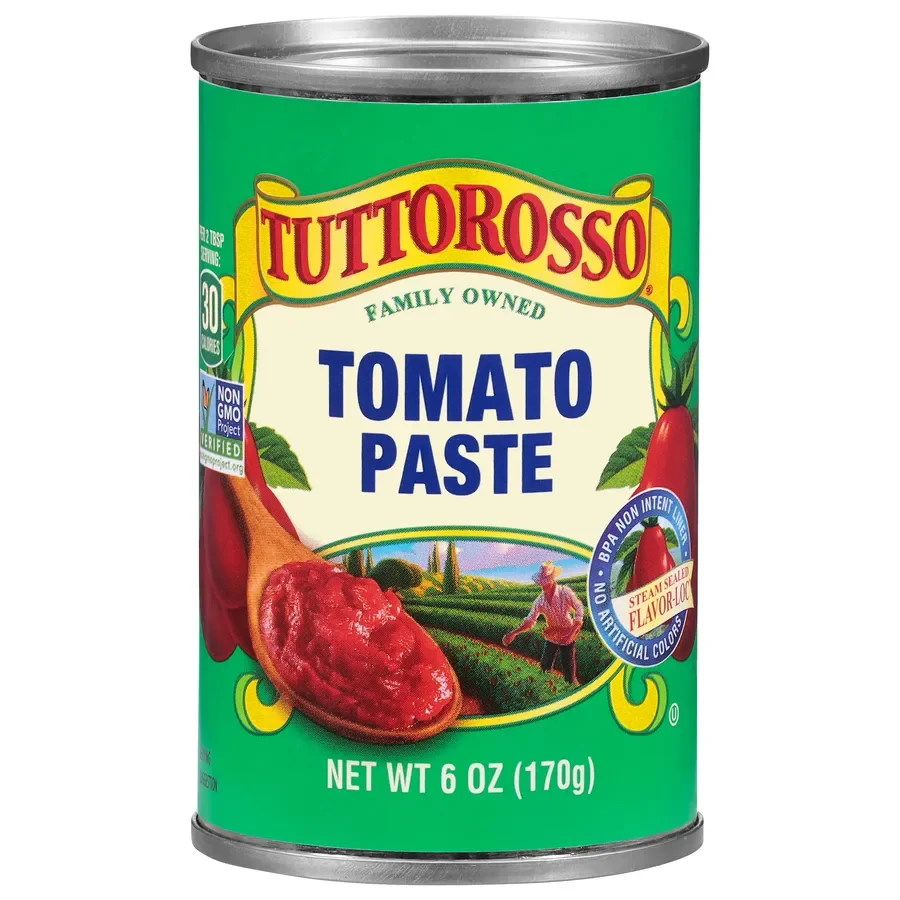
1.1 Tomato Paste
Tomato paste is a concentrated tomato product containing at least 24% natural tomato soluble solids under both Codex and US standards. Tomato puree falls below that level, although the minimum differs slightly by market: 7% under Codex and 8% under the US standard. (source1)(source2)
The high solids content of tomato paste creates a thick product with limited internal movement. Heat transfer is often dominated by conduction rather than convection. Air can also become trapped during filling.
The main concerns are slow heat penetration, headspace control, coating resistance and can-body deformation during heating and cooling. Large foodservice cans require separate validation from small retail cans because the thermal profile changes with container geometry.
1.2 Tomato Puree
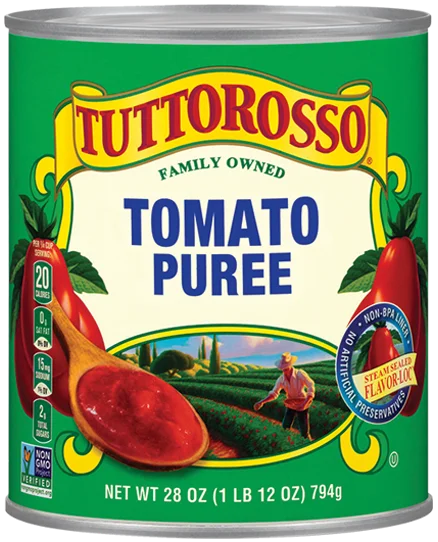
Tomato puree is less viscous than paste but thicker than tomato juice. Its heating behaviour may shift between convection and conduction depending on solids content, formulation and processing temperature.
The can needs a continuous internal barrier with stable adhesion after thermal processing. Coating porosity, oxygen in the headspace and storage temperature can affect long-term corrosion.
Puree should not be treated as diluted paste during testing. A change in viscosity can move the cold point and alter the required process.
1.3 Tomato Sauce
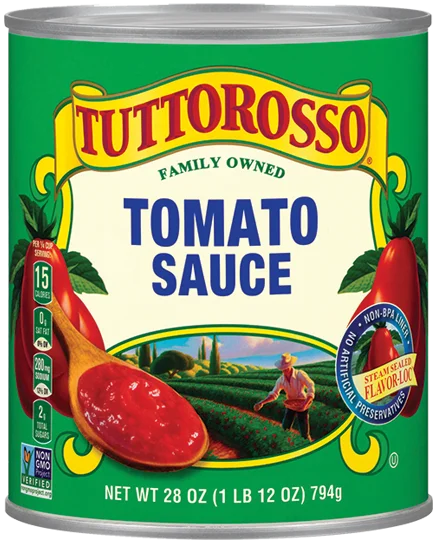
Tomato sauce is a formulation, not just a solids level.
The USDA standard effective June 12, 2026, allows tomato sauce to contain ingredients such as salt, spices, sweeteners, vinegar, onion and garlic. These ingredients affect both corrosion and heat transfer. (fonte)
Salt and vinegar can make the product more aggressive at coating defects. Sugar, starch and other thickeners affect viscosity. Oils and sulphur-containing seasonings may interact with the coating.
A coating tested only with plain tomato concentrate does not represent a commercial seasoned sauce.
1.4 Whole, Peeled, Diced, Sliced and Crushed Tomatoes
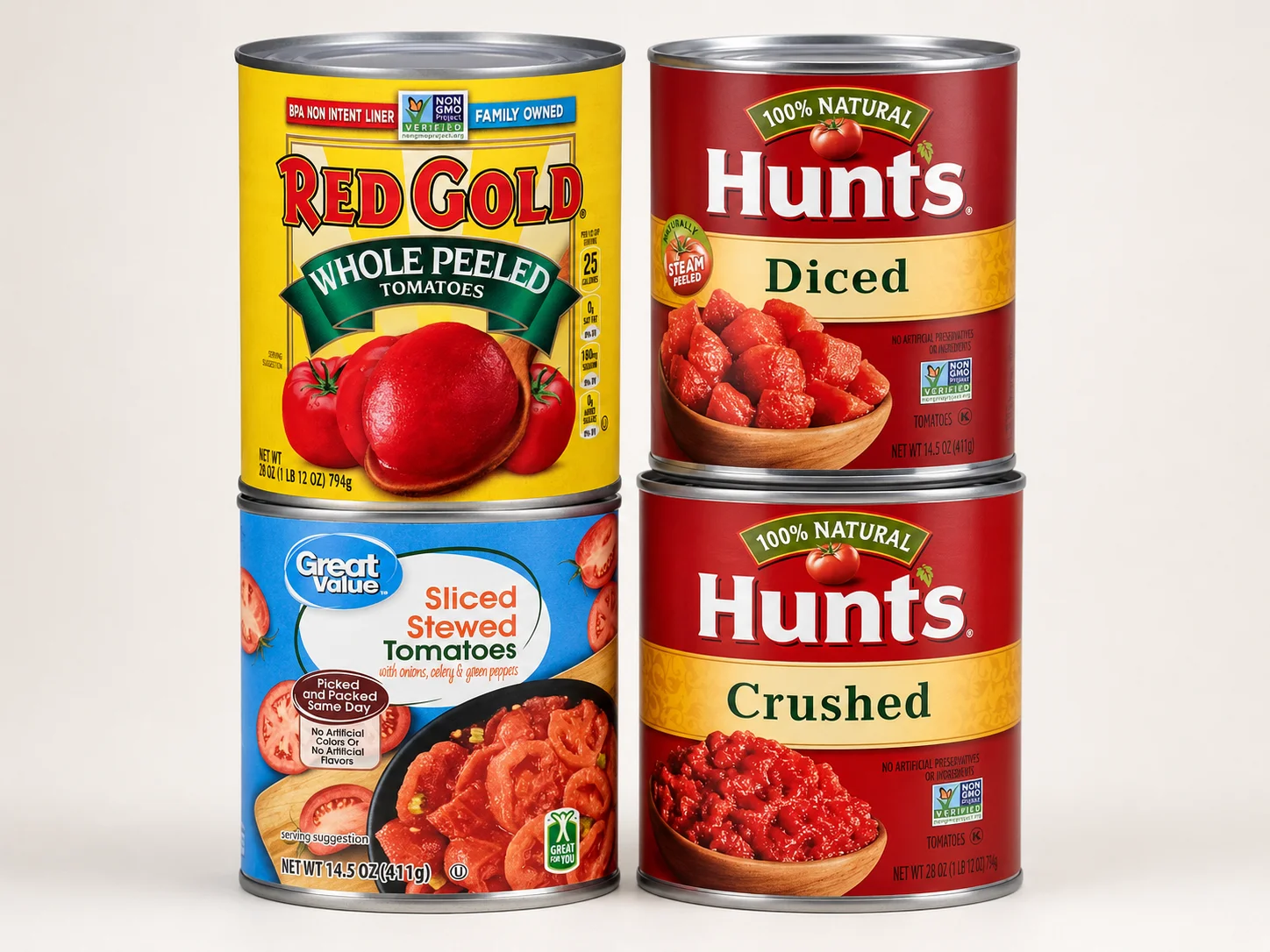
Preserved tomato classifications vary between standards and markets. Codex includes whole and processed styles and sets a maximum pH of 4.5 for preserved tomatoes. USDA grade standards separately identify styles such as whole, halves, wedges, sliced and diced. (fonte)
| Product style | Typical product behaviour | Main packaging concern |
|---|---|---|
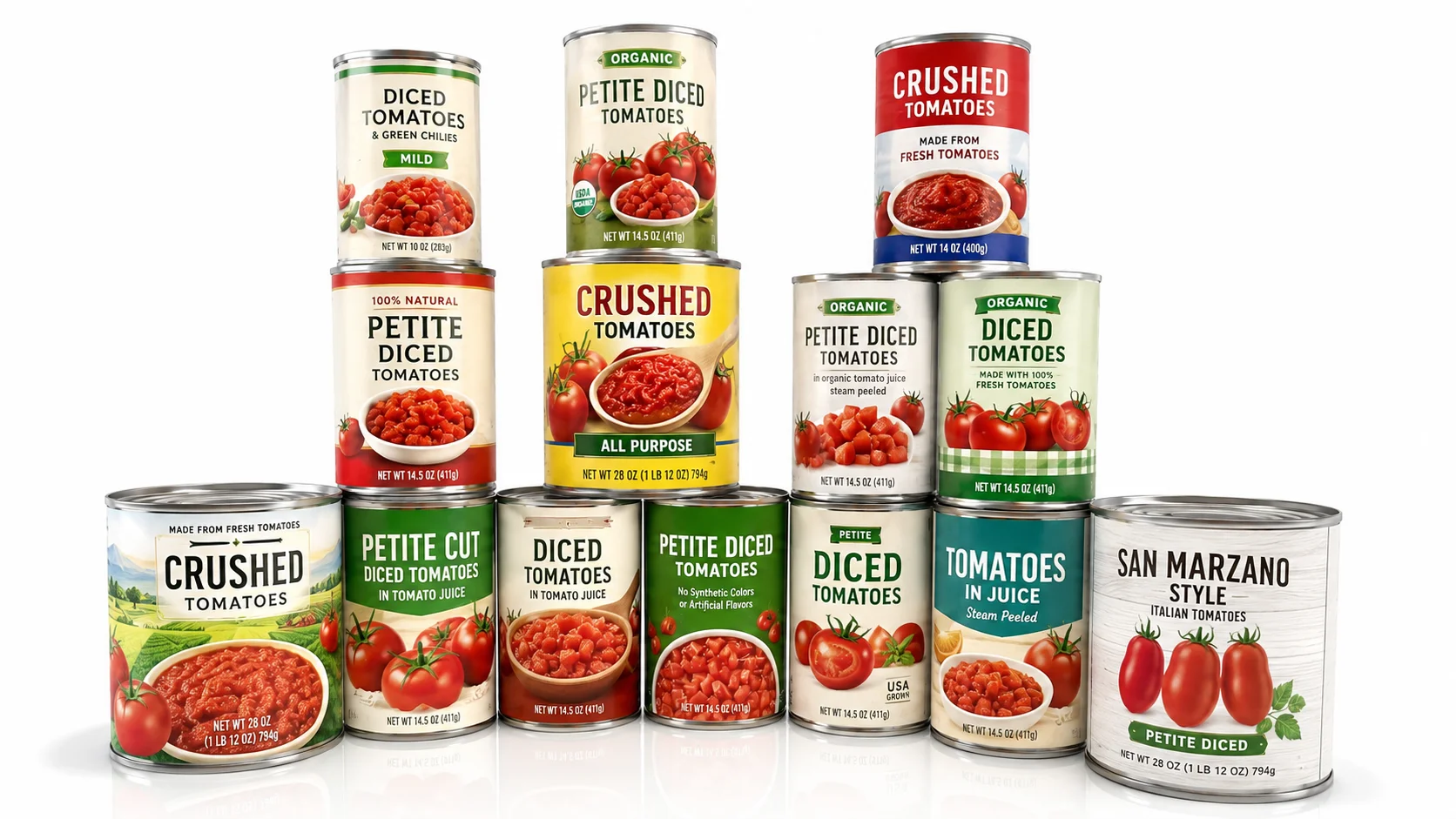
| Whole peeled tomatoes | Large particles packed in juice or puree | Mixed heat transfer, fruit damage and sufficient opening diameter |
| Diced tomatoes | Small particles with high exposed surface area | Salt or firming agents, coating contact and particle distribution |
| Sliced tomatoes | Thin pieces that may settle or overlap | Uneven packing, mechanical damage and variable heat paths |
| Crushed tomatoes | Fine particles suspended in a viscous phase | Filling splash, flange contamination, settling and slow heat penetration |
| Solid-pack tomatoes | Little or no added packing liquid | Air removal, headspace control and limited internal circulation |
| Peeled tomatoes | May be whole, diced or crushed | The actual cut style and packing medium determine the can requirements |
1.5 Pizza Sauce, Pasta Sauce, Ketchup and Chilli Sauce
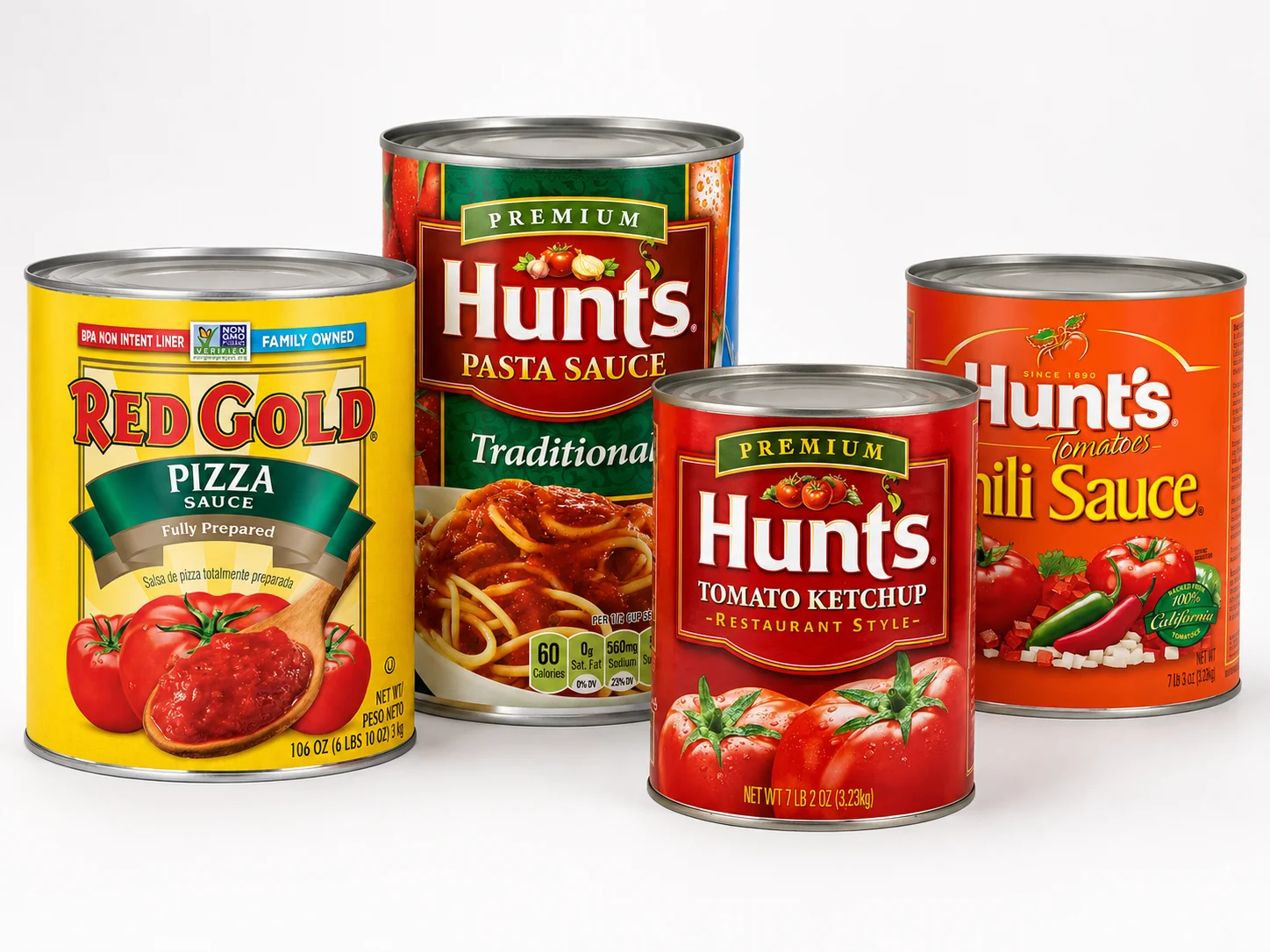
These products often contain vinegar, salt, sugar, spices, oils and thickeners. Some also include cheese ingredients or chilli extracts.
Codex excludes highly seasoned tomato sauces, ketchup, chilli sauce and pizza toppings from its processed tomato concentrate standard when added ingredients materially alter the tomato flavour. (fonte)
These products need recipe-specific testing. The finished pH still matters, but it does not describe chloride concentration, acetic acid exposure, sulphur compounds or coating absorption during storage.
Metal cans are used for some foodservice and industrial ketchup or chilli sauce packs. They should not be presented as the main retail format in every market.
2. Why Tomato Products Corrode Metal Cans
Tomato products are generally acidic, but pH is only one corrosion parameter.
Two products with the same pH may behave differently if one contains more salt, vinegar or residual oxygen. Coating damage also changes the result. A small scratch can expose tinplate or steel directly to an electrically conductive product.
| Fator | Possible effect |
|---|---|
| Ácidos orgânicos | Promote metal dissolution at coating defects |
| Salt and chloride | Increase conductivity and localised corrosion risk |
| Headspace oxygen | Supports oxidation and headspace corrosion |
| Sulphur compounds | May cause staining and affect the coating-metal interface |
| High viscosity | Changes heat penetration and cold-point location |
| Retort conditions | Increase coating water absorption and thermal stress |
| Warm storage | Accelerates product-coating-metal interactions |
| Scratches or coating holidays | Allow direct contact between the product and metal |
Possible failures include detinning, pitting, underfilm corrosion, coating delamination, sulphide staining and metal pickup. Severe corrosion may generate hydrogen, swell the can or eventually perforate the metal.
Research on retorted tomatoes has also shown that heat-generated sulphur compounds can be absorbed by polymer linings and may be associated with coating changes, delamination and substrate corrosion. The result depends on the specific product and coating system, but it confirms that pH alone is not enough. (fonte)
3. How to Select an Internal Coating
3.1 Epoxy-Phenolic and BPA-NI Systems
Epoxy-phenolic coatings have been widely used because they combine adhesion, chemical resistance and thermal stability. Their use now depends heavily on destination-market regulations, especially where BPA-based food-contact materials are restricted.
BPA-NI systems may use modified polyester, acrylic, polyolefin or other resin chemistry. “BPA-NI” means BPA is not intentionally used. It does not define corrosion performance and does not necessarily mean analytically zero BPA.
A supplier declaration should identify the exact coating system, intended food type, processing limits and applicable market regulations. A generic resin name is not an approval.
3.2 Acrylic Coatings
Acrylic coatings should not be presented as a normal first choice for retorted tomato cans.
Acrylic resins can provide a clean appearance and resistance to corrosion or sulphide staining. Their limitations are more relevant here: they can be brittle and may affect food taste or odour. For these reasons, acrylic coatings are more commonly associated with external can applications than demanding internal food contact. (fonte)
Modified acrylic or acrylic-hybrid systems may still be offered for specific internal applications. That does not make acrylic broadly suitable for tomato paste, salted diced tomatoes or vinegar-containing sauces.
3.3 Oleoresin Coatings
Oleoresin coatings are an older can-coating technology. They are flexible and relatively easy to apply, but their adhesion to metal and corrosion resistance are limited. They also need long curing times and may affect the sensory properties of food.
Some oleoresin systems have been used for low-acid foods such as beans. That experience should not be transferred to acidic tomato products.
Tomato paste, tomato sauce and vinegar-containing products place higher demands on the barrier. Oleoresin is therefore not a practical default choice for this category.
4. Retort and Thermal Processing Requirements
There is no standard retort temperature and time for every tomato can.
The scheduled process depends on the finished equilibrium pH, formulation, viscosity, particle size, fill weight, initial temperature, headspace, container dimensions and retort system. FDA guidance also treats pH and other controlled parameters as part of the scheduled process for acidified foods. (fonte)
Heat-transfer behaviour changes by product:
| Produto | Typical heating tendency |
|---|---|
| Tomato juice | Mainly convection |
| Thin tomato sauce | Strong convection component |
| Tomato puree | Mixed or viscosity-dependent |
| Tomato paste | Mainly conduction |
| Whole or diced tomatoes in juice | Mixed liquid-particle heating |
These descriptions are process assumptions, not scheduled processes.
A can filled with tomato paste cannot use the same heat-penetration assumptions as the same can filled with thin sauce. The container also needs to withstand pressure changes, cooling vacuum, end-panel movement and coating stress.
Seam integrity remains part of can selection even when it is not treated as a separate design topic. Thick paste or crushed tomatoes can contaminate the flange during filling. The chosen can body and end must run reliably on the actual seamer and remain sealed after processing and handling. FDA inspection guidance treats container and closure integrity as a production control rather than a single dimensional check. (fonte)
5. Choosing Can Sizes, Construction and Ends
Can construction and end type should follow the product rather than being selected as separate features.
| Produto | Principal risco | Practical packaging direction | Common market reference sizes |
|---|---|---|---|
| Tomato paste | High viscosity, trapped air and slow heating | Use small retail cans or larger three-piece foodservice cans. Control headspace and validate body strength under the actual thermal process. | Retail: 6 oz (170 g) and 12 oz (340 g). Foodservice: #10 can, typically about 111 oz (3.15 kg). |
| Tomato puree | Acidic, medium-viscosity product | Use a fully coated two-piece or three-piece can with a lining proven under the actual retort and storage conditions. | Retail: 10.75 oz (305 g) and 29 oz (822 g). Foodservice: #10 can, typically about 106 oz (3.01 kg). |
| Thin tomato sauce | Recipe-dependent corrosion and convection heating | A sanitary or easy-open end may be used. Confirm coating compatibility with salt, vinegar, spices and the scheduled process. | Retail: 8 oz (227 g), 15 oz (425 g) and 29 oz (822 g). Foodservice: #10 can, commonly about 106 oz (3.01 kg). |
| Crushed tomatoes | Filling splash, particles and variable viscosity | Three-piece cans are common for larger formats. Control flange cleanliness, weld-stripe coverage and particle distribution. | Retail: 15 oz (425 g) and 28 oz (794 g). Foodservice: #10 can, commonly 105–106 oz (2.98–3.01 kg), depending on consistency. |
| Diced tomatoes | High particle surface area and possible firming salts | Check coating continuity on the body, ends and weld-repair area. Avoid particle damage during filling and processing. | Retail: 14.5 oz (411 g) and 28 oz (794 g). Foodservice: #10 can, commonly about 102 oz (2.89 kg). |
| Whole peeled tomatoes | Large particles and mixed heat transfer | Use enough can diameter and opening area for filling and dispensing. A full-open end may be useful for foodservice packs. | Retail: 14.5 oz (411 g) and 28 oz (794 g). Foodservice: #10 can, commonly about 102 oz (2.89 kg). |
| Pizza or pasta sauce | Oil, salt, spices, sugar and thickeners | Use recipe-specific coating and process data. Do not apply test results from plain tomato sauce to a seasoned formulation. | 24 oz (680 g). Foodservice pizza, spaghetti and marinara sauces: #10 cans, commonly 105–106 oz (2.98–3.01 kg). |
| Ketchup or chilli sauce | Acetic acid, chloride and long storage | Focus on resistance to acetic acid and salt. Validate the package only where a metal-can format is commercially required. | Metal cans are mainly foodservice formats: approximately 114 oz (3.23 kg) for ketchup and 115 oz (3.26 kg) for chilli sauce in #10 cans. Retail products are more often packed in plastic or glass. |
Two-piece cans remove the welded side seam but place more forming strain on the coating. Three-piece cans offer more diameter and height options but require reliable weld-stripe protection. Neither design is automatically better.
Easy-open and full-open ends improve access, especially for whole tomatoes. Their score lines and formed areas still need to tolerate retort pressure and storage without coating damage. Standard sanitary ends may be simpler where easy opening is not required.
Common retail and foodservice formats can be used as starting references, but net weight and dimensions should come from the selected can supplier. USDA standards include formats ranging from smaller retail cans to No. 10 foodservice cans, which shows how widely the product-to-container ratio can vary.
6. A Practical Selection Rule
Start with the finished product, not the coating name.
Record the equilibrium pH, salt level, vinegar content, sulphur-bearing ingredients, viscosity, fill weight and required shelf life. Then define the can size, body construction, end and thermal process.
The final trial should use production cans, production ends and the real recipe. It should include retort exposure, seam checks, warm storage, coating adhesion, internal appearance and sensory evaluation.
Approve the complete product, coating, can and process as one system. A label such as “acrylic,” “BPA-NI” or “food grade” does not provide that answer.