
1. Introdução
Soup formulation affects how a metal can performs during filling, retorting, cooling, transport, and storage.
A thin broth does not behave like a cream soup. Tomato-based products create different corrosion risks from meat or bean soups. Noodles, starch, dairy solids, salt, fat, and large vegetable pieces can also change heat transfer, coating performance, and filling conditions.
For this reason, soup can selection should start with the product rather than the can size. The formulation, can structure, internal coating, end design, filling line, and scheduled process must work as one package system.
2. Why Soup Formulation Affects Can Selection
2.1 Broths and Stocks
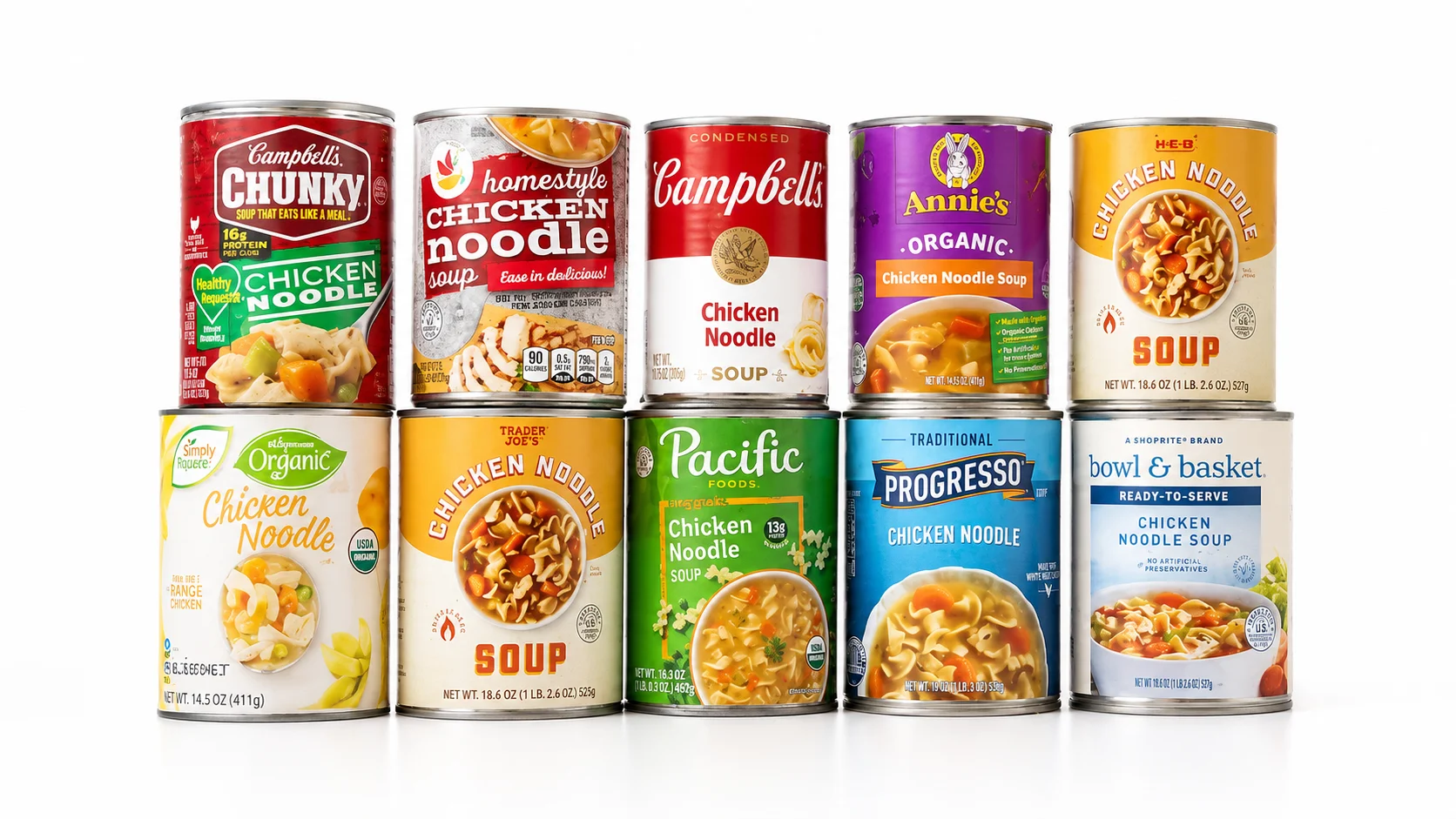
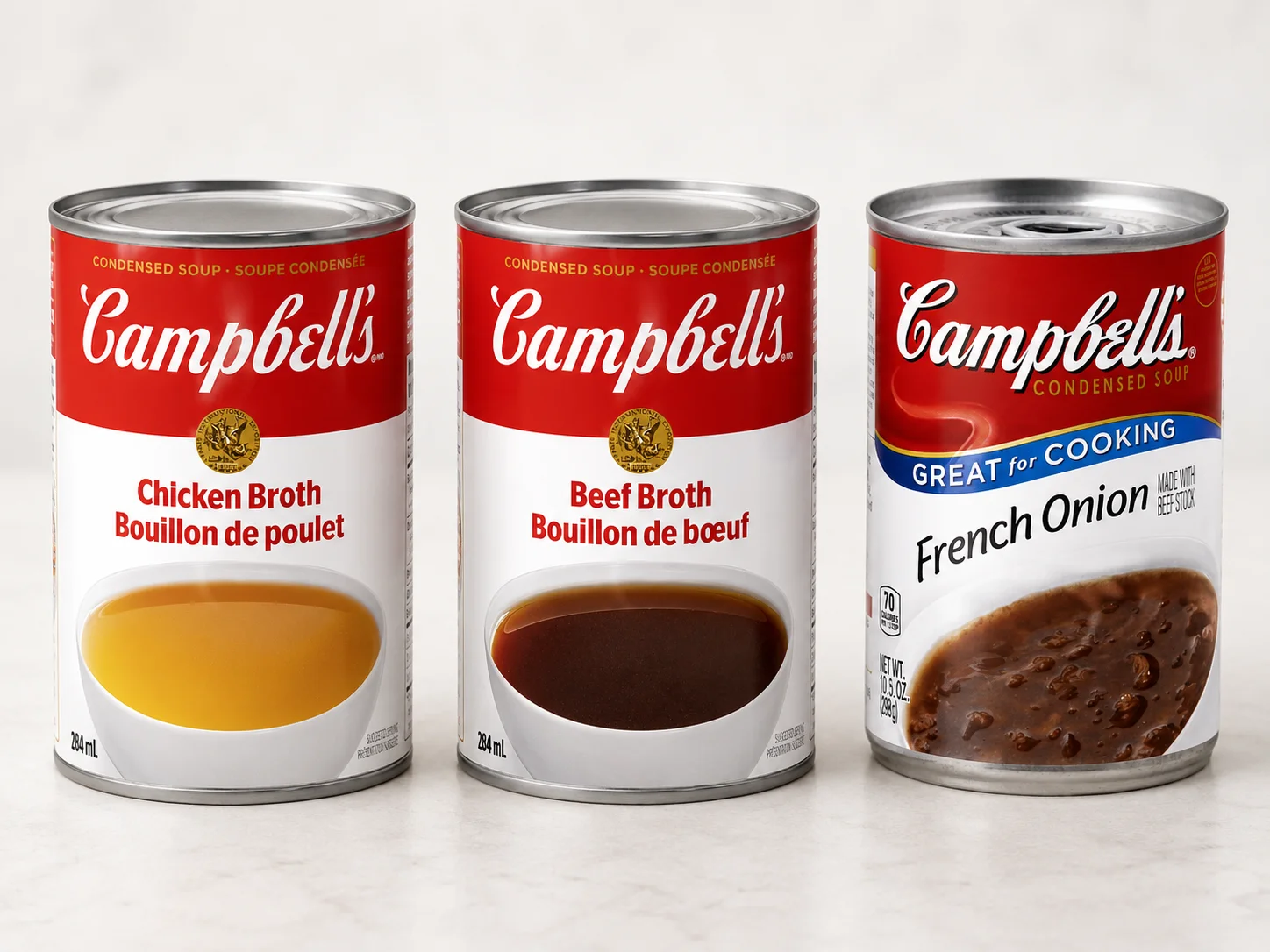
Broths and stocks are usually low-viscosity products with limited solid content. Common examples include:
- Chicken broth
- Beef broth
- Chicken stock
- Beef stock
- French onion soup
These products generally allow stronger internal convection than thick soups. Heat can move through the liquid more freely, but this does not mean all broth products can use the same thermal process.
Can diameter, fill temperature, fat content, sediment, suspended spices, and headspace can all affect processing conditions. Salt and meat proteins may also influence coating performance.
The can must withstand vacuum, stacking, and transport without paneling or permanent deformation. When an easy-open end is used, its opening performance should be checked after retorting and shelf-life storage.
2.2 Cream Soups and Chowders
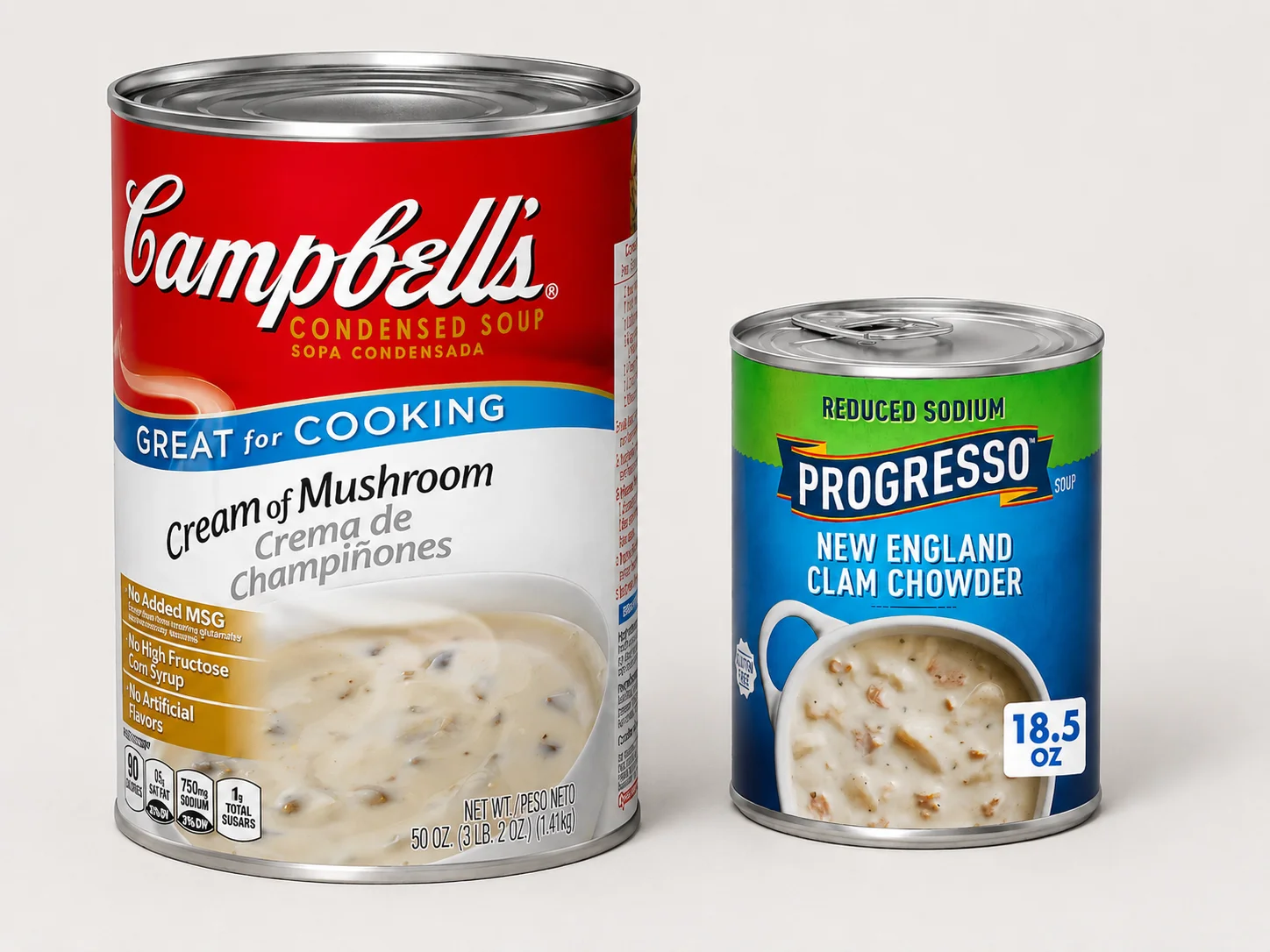
Cream soups and chowders may contain:
- Amido ou amido modificado
- Flour
- Cream, whey, or other dairy ingredients
- Vegetable oil
- Mushroom, potato, clam, or chicken pieces
These ingredients can reduce product movement inside the can. Starch may continue to thicken during heating, while dairy solids and fat can affect compatibility with the internal coating.
Viscosity, particle size, and particle distribution should be controlled during process development. A small formulation change can affect heat penetration. Increasing the starch level or changing the size of potato, mushroom, or meat pieces may require the scheduled process to be reviewed again. (fonte)
The coating should also be checked after retorting for blushing, blistering, loss of adhesion, staining, and corrosion.
2.3 Soups with Meat, Noodles, Beans, or Large Vegetables
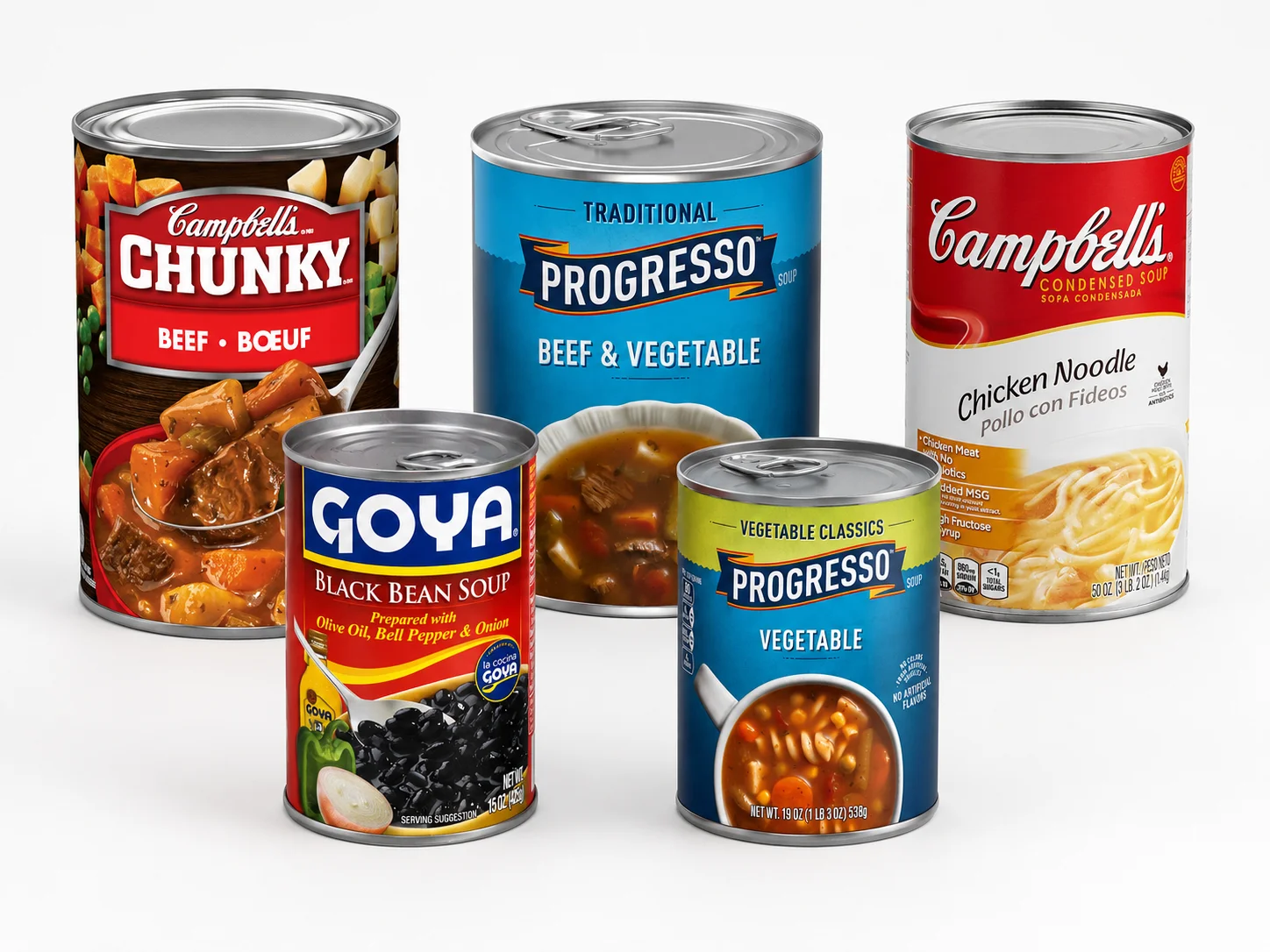
Chicken noodle soup, beef soup, bean soup, and chunky vegetable soup contain both liquid and solid components.
Typical solids include:
- Chicken or beef pieces
- Noodles, macaroni, barley, or rice
- Beans
- Potatoes, carrots, and celery
- Mushrooms
- Meatballs
For these soups, the maximum particle size and the liquid-to-solid ratio can strongly affect heat penetration. Filling sequence also matters because solids may not be distributed evenly between cans.
Noodles, rice, and beans absorb water during processing. This can change the viscosity, fill level, and available headspace. Large pieces can also make product discharge more difficult, especially when the can opening is narrow.
Meat, poultry, beans, and some vegetables may produce sulfur-containing compounds during retorting. These compounds can react with the internal surface and cause dark staining. Coating selection should therefore consider sulfur resistance as well as general corrosion resistance. (fonte)
2.4 Tomato-Based Soups
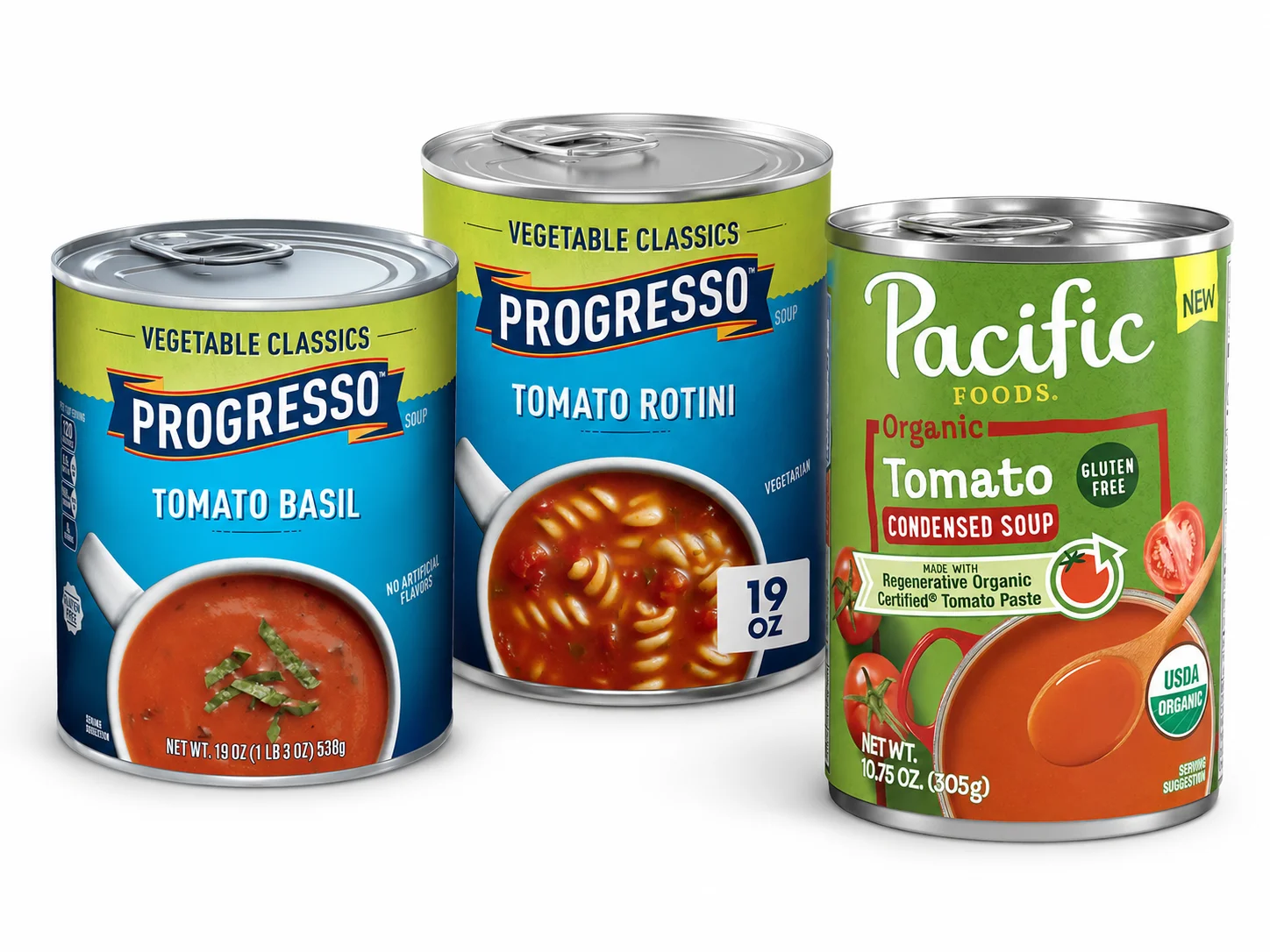
The corrosion risk of tomato soup cannot be determined from the product name alone.
Tomato variety, maturity, acid type, salt level, spices, dairy ingredients, and finished equilibrium pH can all affect package performance. A tomato soup may be classified as acid, acidified, or low acid depending on its complete formulation.
Important product variables include:
- Finished equilibrium pH
- Total acidity and acid type
- Salt and chloride content
- Added cream or starch
- Spices and seasonings
- Storage temperature and expected shelf life
The internal coating should resist acid attack throughout processing and storage. Attention is also needed around the body weld, easy-open score, rivet area, and other locations where coating coverage may be more difficult to maintain.
3. Hot Filling vs. Retort Processing
Many shelf-stable broths, meat soups, cream soups, bean soups, noodle soups, and vegetable soups fall within the low-acid canned food category. Final classification depends on the actual finished equilibrium pH and product formulation.
Hot filling can raise the initial product temperature, support exhausting, and reduce temperature variation before retorting. It does not replace a validated retort process for shelf-stable low-acid soup.
The scheduled process must deliver the required heat treatment to the slowest-heating area of the product. It also depends on correct fill weight, particle size, headspace, initial temperature, container dimensions, and retort conditions.
The can manufacturer can provide information about materials, dimensions, coatings, ends, pressure resistance, and seaming compatibility. The food processor and its process authority are responsible for product classification, heat penetration studies, critical factors, and the scheduled process.
A retort time should not be selected from the can size or a general soup description alone.
4. Two-Piece vs. Three-Piece Soup Cans
Two-piece cans have a formed body and bottom with one separate top end. Three-piece cans use a welded body with separate top and bottom ends. Both formats can be used for shelf-stable soup when the material, coating, seams, and dimensions match the product and processing conditions.
Two-piece cans are often used when the product has a stable specification, high annual volume, and a limited number of sizes. The absence of a side weld gives the body a continuous appearance and removes one coated weld area. They can be suitable for broths, condensed soups, sauces, and other products produced in standardized retail formats. Shallow cans and specially drawn shapes are also more commonly made as two-piece containers.
The main production constraint is tooling. Changes in diameter, height, or capacity may require different forming equipment or dedicated tools. This makes the format less flexible for small-volume projects with many SKUs.
Three-piece cans are widely used for traditional retail soup cans, family-size containers, and foodservice formats. Because the body height can be adjusted more easily, they are practical for product lines that use one diameter across several fill volumes. They also suit new products where annual demand is not yet clear.
For meat soups, bean soups, noodle soups, and chunky products, the choice between two-piece and three-piece construction is usually less important than the opening diameter, coating system, fill conditions, and retort performance. A three-piece can may provide more size flexibility, while a two-piece can may suit a mature, high-volume retail product.
Neither structure is automatically better. The decision should reflect annual volume, required capacities, existing seaming equipment, coating needs, retort conditions, and tooling cost.
5. Choosing the Right Internal Coating
The internal coating separates the soup from the metal surface. It must remain stable during filling, seaming, retorting, cooling, transport, and storage.
A coating that works with one soup may not work with another. Testing should use the actual formulation rather than a general product category.
5.1 General Wet-Food Coatings
These coatings may be suitable for products with relatively mild corrosion conditions, such as some broths and vegetable soups.
Performance still depends on salt, protein, fat, oxygen, processing temperature, and shelf life. A pack test is needed before commercial use.
5.2 Acid-Resistant Coatings
Acid-resistant systems may be needed for:
- Tomato soup
- Vegetable soup containing tomato
- Acidified soup
- Products containing organic acids
- Soups with acidic seasonings
Testing should check the can body, bottom profile, weld area, score line, rivet area, and any location where the coating may have been stretched or damaged.
5.3 Sulfur-Resistant and Stain-Resistant Coatings
These coatings may be considered for:
- Chicken soup
- Beef soup
- Meat broth
- Bean soup
- Products containing egg
- Soups containing sulfur-active vegetables
Dark staining does not always mean that the can has lost its barrier function, but it can still create an appearance problem. The coating should be evaluated for both corrosion protection and stain resistance.
5.4 High-Flexibility Coatings
Flexible coating systems are often used on:
- Deep-drawn two-piece cans
- Easy-open ends
- Highly formed components
- Areas exposed to movement during retorting
The coating must tolerate forming without cracking. It must then remain attached during thermal processing and cooling.
Three-piece cans also require protection over the welded side seam. The side-stripe coating must fully cover the affected area and remain properly cured after application.
6. Common Soup Can Sizes
Soup cans are available in small retail, standard retail, ready-to-eat, family-size, and foodservice formats. Can tables normally describe nominal container capacity in milliliters or US fluid ounces. Retail labels, however, often declare the actual soup content by weight in ounces and grams.
6.1 Small Cans for Condensed Soup
| Tamanho da lata | Approximate nominal capacity |
|---|---|
| 211 × 300 | 234 mL / 7.9 US fl oz |
| 211 × 304 | 254 mL / 8.6 US fl oz |
| 211 × 308 | 273 mL / 9.2 US fl oz |
| 211 × 315 | 307 mL / 10.4 US fl oz |
These formats may be considered for concentrated broth, cooking soup, condensed products, and smaller serving sizes.
In the US retail market, condensed soups are commonly sold at around 10.5 oz (298 g). This size is widely used for products such as condensed cream of mushroom soup and other cooking soups. (fonte)
6.2 Standard Retail Soup Cans
| Tamanho da lata | Approximate nominal capacity |
|---|---|
| 300 × 400 | 400 mL / 13.5 US fl oz |
| 300 × 402 | 412 mL / 13.9 US fl oz |
| 300 × 407 | 434 mL / 14.7 US fl oz |
These cans may be used for standard retail soup, broth, stock, condensed soup, and vegetable soup. The labeled net weight varies with the formulation. A broth with limited solids and a thick soup with meat or vegetables will not produce the same net weight at the same fill level.
6.3 Ready-to-Eat and Chunky Soup Cans
| Tamanho da lata | Approximate nominal capacity |
|---|---|
| 307 × 400 | 517 mL / 17.5 US fl oz |
| 307 × 407 | 583 mL / 19.7 US fl oz |
| 307 × 409 | 596 mL / 20.2 US fl oz |
| 307 × 415 | 645 mL / 21.8 US fl oz |
These larger retail formats provide more room for ready-to-eat soup, chicken noodle soup, bean soup, chowder, and chunky meat or vegetable products.
Common US retail net weights in this category include:
- 18.5 oz (about 524 g) for some creamy ready-to-eat soups
- 18.8 oz (about 533 g) for chunky meat and vegetable soups
- 19 oz (about 539 g) for ready-to-serve chicken noodle, rice, vegetable, and similar soups
Current market examples include 18.5 oz creamy chicken noodle soup, 18.8 oz chunky steak and potato soup, and 19 oz ready-to-serve chicken noodle soup. (fonte)
Family-size and foodservice cans may use 401, 404, 502, or 603 series formats. Large foodservice condensed soups are also commonly supplied in 50 oz cans, equal to about 1.42 kg, for institutional kitchens, restaurants, catering, and recipe preparation. (fonte)
Nominal can capacity is not the same as labeled net content. The mL and US fl oz figures describe the approximate internal volume of the container. The oz and g figures on a retail label describe the actual product weight. Final net weight depends on soup density, solid content, headspace, thermal expansion, filling accuracy, and processing conditions.
For example, a can with a nominal capacity of 434 mL has a volume of about 14.7 US fl oz, but this does not mean that it must contain 14.7 oz or 434 g of soup. The final declaration must be established from the actual filled product.
Soup cans may use either a standard end or an easy-open end. Standard ends remain common in foodservice and cost-sensitive applications. Easy-open ends are more common on retail products where opening convenience matters.
A full-aperture easy-open end can improve the discharge of noodles, meat, beans, and large vegetable pieces. Its score, tab, rivet, coating, sealing compound, and double seam must remain functional after retorting, cooling, transport, and storage. The end should be selected as part of the complete retort package.
7. Soup Can Seaming and Quality Control
The double seam is the primary seal between the can body and the end, so the can size, end specification, seamer tooling, and line setup must match. Flange cleanliness is also critical. Oil, starch, noodles, or solid pieces trapped in the seam can cause poor overlap, wrinkles, false seams, or leakage. Routine checks should cover seam dimensions and visible defects, with extra attention to the score and rivet areas of easy-open ends.
Retorting, cooling, and handling can place additional stress on the can and seam. Quality control should therefore cover both the can plant and the filling line, including container dimensions, coating and weld protection, fill conditions, headspace, seam integrity, retort records, and post-process inspection. Pack testing and shelf-life testing are still needed because some defects only appear after processing or storage.
8. Conclusão
Start with the finished soup formulation.
Confirm its pH, viscosity, solids ratio, maximum particle size, salt level, fat content, sulfur risk, and expected shelf life. Then select the can construction, coating, size, end, and seaming setup around those conditions.
Broth, cream soup, tomato soup, and chunky meat soup do not place the same demands on a metal package. Similar products can provide a useful reference, but the final package should be tested with the actual soup and the actual thermal process.