
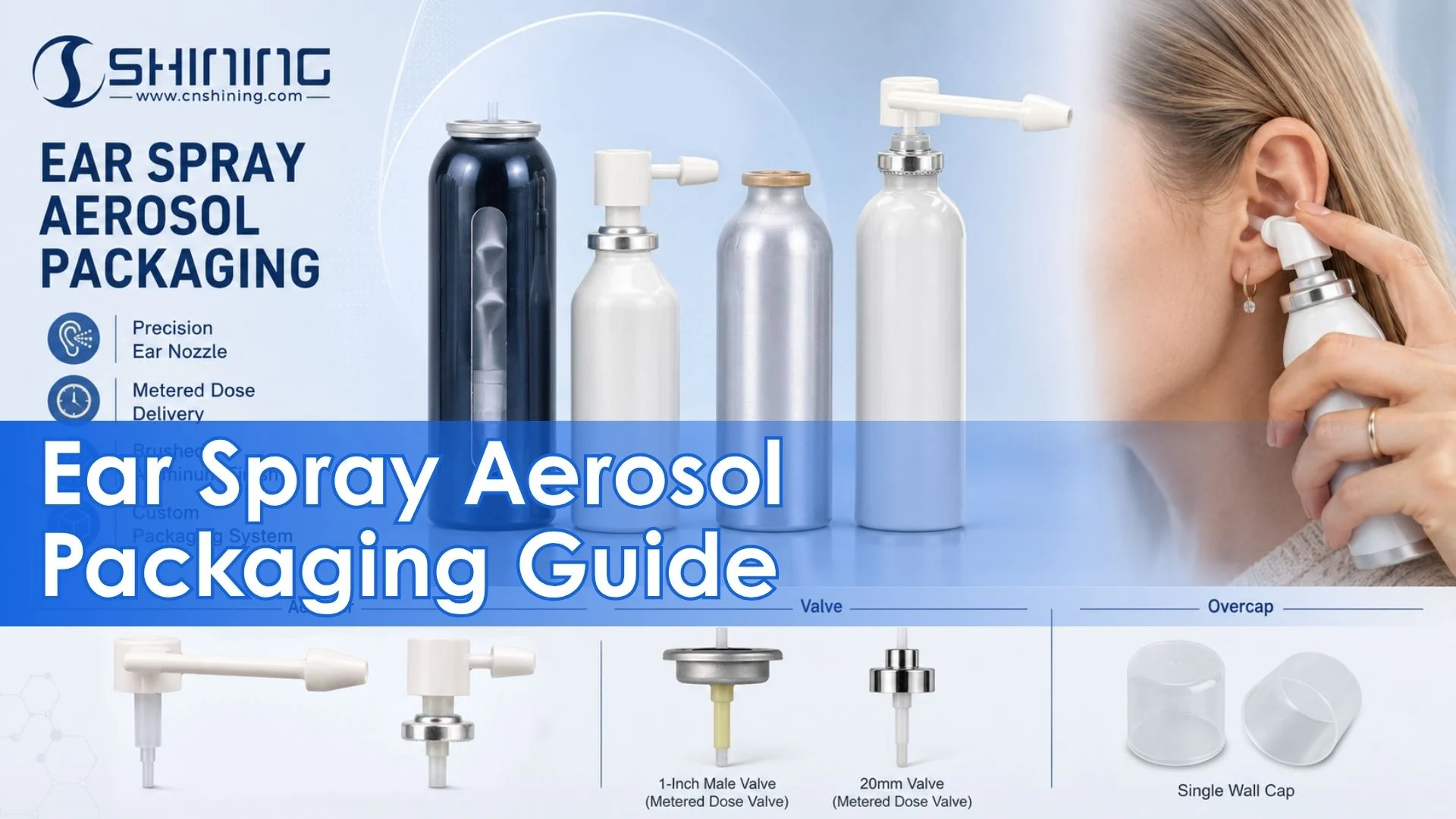
Ear aerosol spray sits at the edge of otic spray, earwax removal spray, ear drying spray, auricular care spray, pump spray and bag-on-valve aerosol packaging. The term sounds simple, but the market is not dominated by classic propellant aerosol cans. Most visible products are mechanical pump sprays, non-propellant ecological sprays, small metered sprays, or spray-like delivery systems used for ear hygiene and outer ear canal care.
A useful way to read this category is to treat it as both a product concept and a packaging concept. The product side covers outer ear canal cleaning, cerumen softening, drying after water exposure, and itch relief around or near the ear. The packaging side covers the actuator, pump or valve, dose volume, spray pressure, nozzle geometry, container compatibility and contamination control. If any one of these parts is weak, the user notices it quickly.
1. Product Definition and Operating Principle
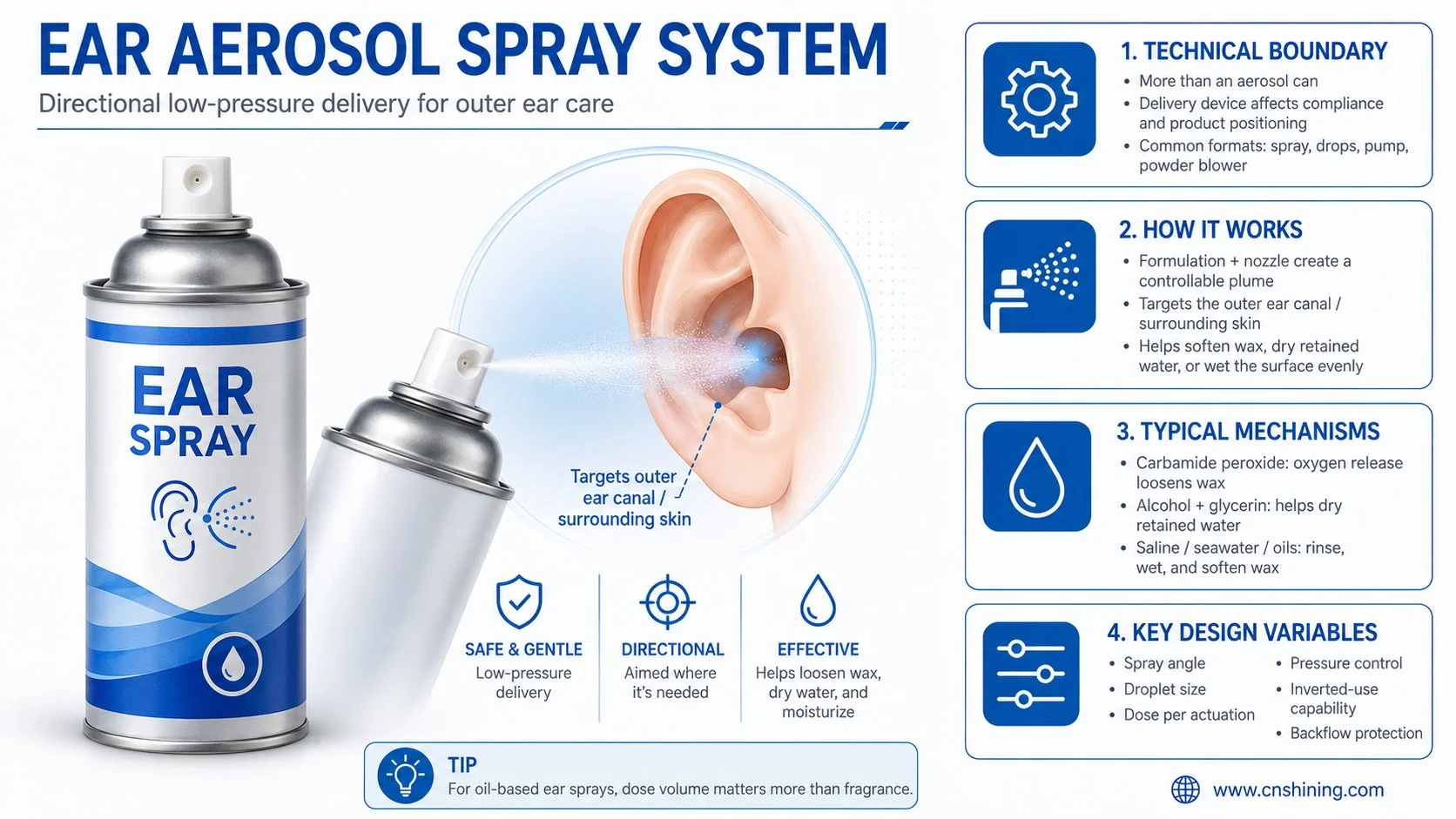
1.1 Definition and Technical Boundary
From a regulatory and commercial view, an ear spray should not be reduced to “aerosol can.” The U.S. device classification for ear, nose and throat drug administration devices includes powder blowers, droppers, ear wicks, manual nebulizer pumps and nasal inhalers under 21 CFR 874.5220. That matters. Once the product is designed to deliver a substance to the ear, the delivery mechanism itself becomes part of the compliance discussion.
Current market examples include seawater or saline cleaning sprays, surfactant-lipid earwax disintegration sprays, olive oil or mineral oil softening sprays, hydrocortisone anti-itch sprays, and competing formats such as drops, irrigation kits and powder blowers. The market uses “spray” mostly to mean directional, low-pressure and controllable delivery, not necessarily a classic propellant aerosol.
1.2 How Ear Sprays Work
The mechanism has four layers. First is the formulation. For example, carbamide peroxide 6.5% is used as an earwax removal aid, and official labels describe oxygen release and foaming when the product contacts wax through DailyMed carbamide peroxide labeling. Second is spray dynamics: the nozzle converts liquid into droplets or a directed plume. Third is the target area: most public products limit use to the outer ear canal or skin around the ear. Fourth is the result: softening wax, drying retained water, forming a wetting layer, or covering an irritated area evenly.
Several mechanisms are already clear in public product and regulatory information: carbamide peroxide loosens wax by oxygen release, isopropyl alcohol 95% with glycerin helps dry retained water, seawater or isotonic saline cleans by wetting and physical rinsing, DOSS plus ethoxydiglycol separates wax structure and dissolves lipids, and olive oil or mineral oil reduces wax adhesion through wetting and softening.
1.3 Design Variables Behind the Mechanism
The real design units are spray angle, droplet size, dose per actuation, spray pressure, inverted-use capability and microbial backflow control. A product may look like a small bottle, but the user feels all these variables during one press. This is why some products stress a pressure-limiting nozzle, a discrete unit dose, or even coverage.
2. Advantages, Competing Formats and Formulation Map
2.1 Comparison With Similar Products
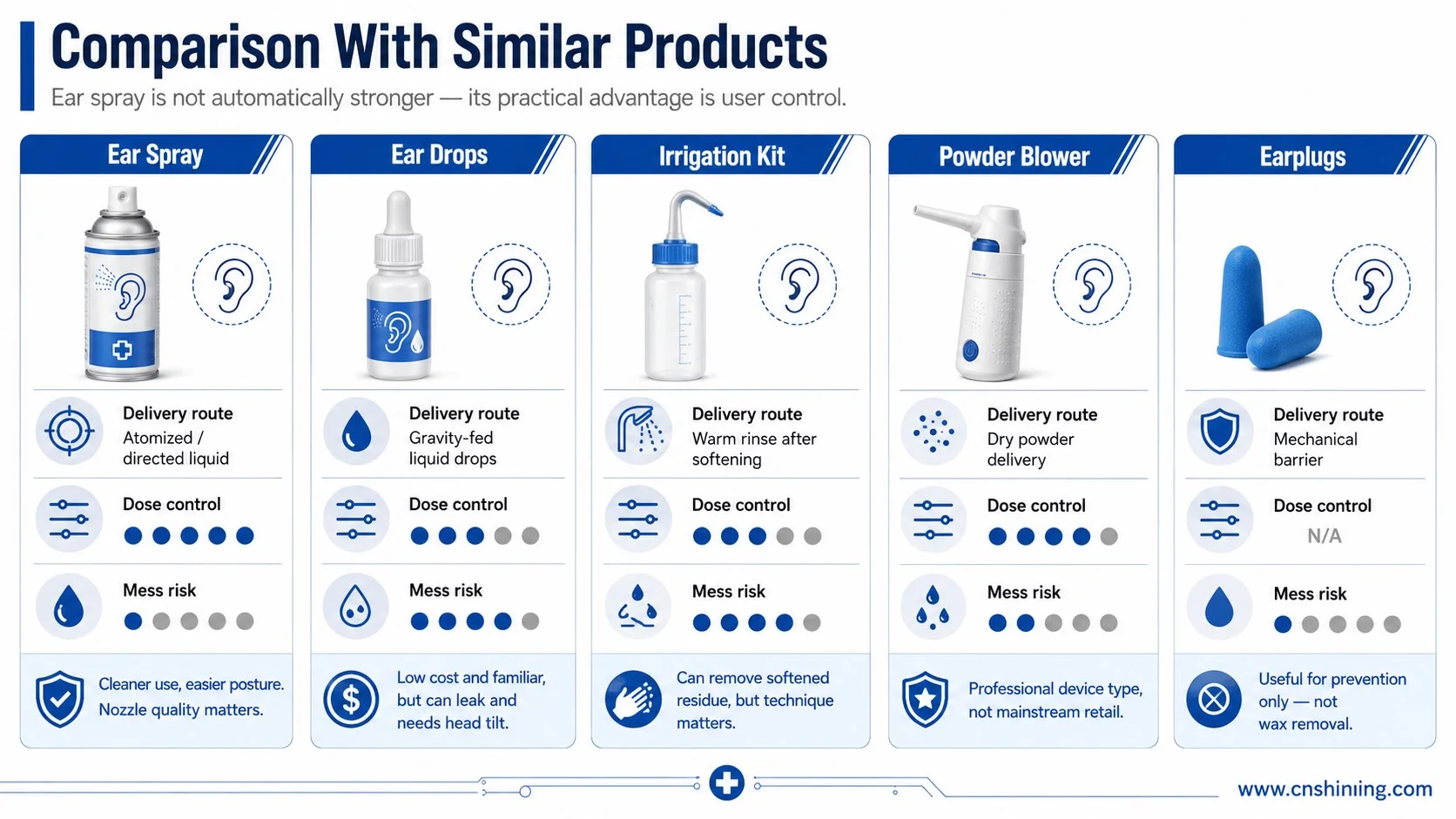
Ear spray does not automatically mean stronger clinical effect. Its practical advantage is user control. Drops are mature and low cost, but they often leak out and require the user to keep the head tilted. Irrigation kits can remove softened residue, but technique matters. Powder blowers are recognized device types, yet they are not mainstream retail products. Earplugs only compete in prevention scenarios such as swimming or noise protection.
| Categoria | Mecanismo principal | Principal vantagem | Limitação principal | Packaging Lesson |
|---|---|---|---|---|
| Ear spray | Atomized or directed liquid delivery to the outer ear canal or ear area | Metered dose, less mess, easier posture, semi-professional feel | Poor nozzle design can feel sharp, leaky or misdirected | Nozzle and dose quality decide user acceptance |
| Ear drops | Gravity-fed liquid drops | Low cost, mature regulation, familiar OTC format | Leakage, head tilt, waiting time | Useful low-price benchmark for spray claims |
| Irrigation kit | Warm water or rinse flow after wax softening | Visible removal of remaining wax | Higher technique burden and misuse risk | Works well as a secondary step after softening |
| Ear powder blower | Powder delivery to ear, nose or throat sites | Avoids liquid retention in selected professional uses | Low consumer familiarity | Better for professional channels than mass OTC |
| Earplugs | Mechanical barrier | Prevents water or noise exposure | No wax removal or itch-relief function | Can pair with swimmer-care spray as a kit |
2.2 Formulation Classes
The clearest U.S. OTC anchor is FDA OTC Monograph M014 for topical otic drug products. It supports two clear outer-ear OTC pathways: carbamide peroxide 6.5% for earwax removal aid, and isopropyl alcohol 95% in anhydrous glycerin 5% base for ear drying aid. These are useful starting points when the U.S. market is involved.
| Use / Format | Ingredientes comuns | Mecanismo | Example Product Type | Nota de Desenvolvimento |
|---|---|---|---|---|
| Medicated wax softening | Carbamide peroxide 6.5% | Oxygen-release foaming softens and loosens cerumen | Debrox-type OTC systems | Clear monograph anchor in the U.S. |
| Medicated ear drying | Isopropyl alcohol 95% + glycerin 5% | Promotes water evaporation while glycerin reduces harshness | Swimmer’s ear drying aid | Useful after swimming or water retention |
| Medicated itch relief | Hydrocortisone 1% with soothing ingredients | Anti-itch and anti-inflammatory action for external use | eosera Ear Itch MD +Plus | Not positioned as infection treatment |
| Seawater cleaning | Controlled seawater or mineral-rich saline | Physical wetting and cleaning | Audispray Adult; Similasan SeaRinse | Easy to understand for daily hygiene |
| Surfactant wax disintegration | DOSS + ethoxydiglycol | Separates wax plug structure and dissolves lipids | Audispray Ultra | Better for formed wax plugs than light daily cleaning |
| Oil softening spray | Olive oil, mineral oil, peppermint oil in some products | Wets and softens wax, lowering adhesion | Earol, Boots, Ear Clear-type products | Low education burden in pharmacy channels |
| Botanical cleaning and comfort | Isotonic saline with tea tree, aloe, chamomile or similar ingredients | Cleaning plus comfort positioning | Otosan Ear Spray | Often positioned through medical device or borderline logic |
2.3 Technical Term List
| Prazo | Significado literal | Significado comercial |
|---|---|---|
| Otic / Auricular | Ear-use or ear-area use | Defines labeling, registration and intended-use language |
| Cerumen | Earwax | Base term for cleaning and wax-removal claims |
| Cerumenolytic | Wax softening or dissolving agent | Can shift the product toward drug or device review |
| dose medida | Controlled output per actuation | Improves dose control and user confidence |
| Overpressure | Spray pressure that feels too strong or unsafe | A key fear point in ear spray use |
| Vented nozzle | Nozzle with pressure relief or flow guidance | Turns comfort and safety perception into a physical feature |
| Preservative-free multidose | Multidose system using mechanical contamination barriers | Fits sensitive-use and clean-formulation positioning |
| BOV | Bag-on-valve aerosol system | Separa o produto do propelente e permite o uso em 360 graus. |
| Forro | Internal coating of a can or container | Controls compatibility with oils, alcohols and surfactants |
| UDI | Unique Device Identification | Affects traceability and channel access for medical devices |
| Borderline product | Product between drug, device and cosmetic rules | Determines evidence, label and registration burden |
| Ototoxicity | Ear toxicity risk | Limits ingredients and use claims, especially when the eardrum is damaged |
3. Notas sobre regulamentação e conformidade
3.1 United States
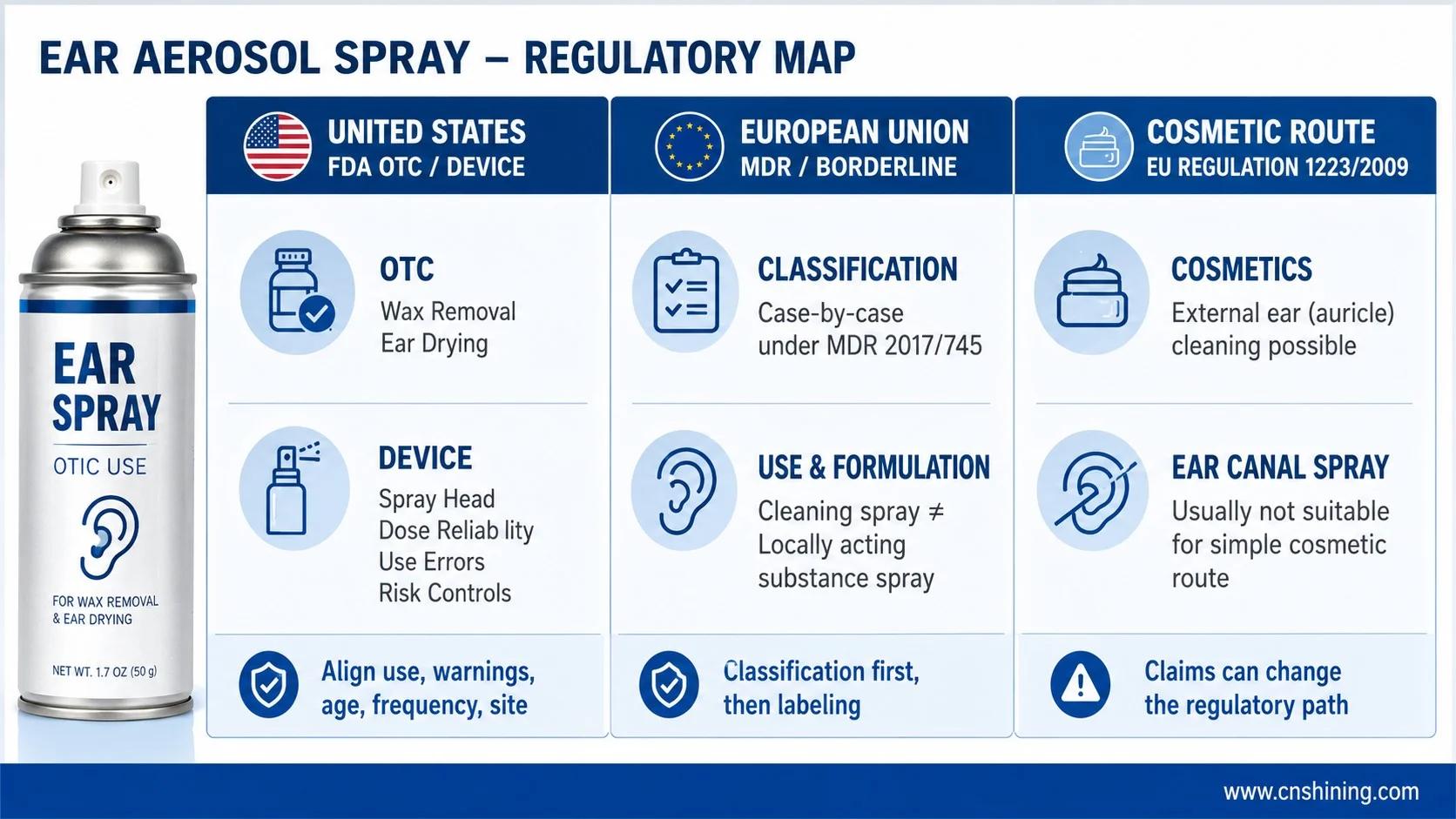
The U.S. pathway is relatively clear for two OTC outer-ear uses: wax removal and ear drying. The challenge is not only whether the ingredient is listed. The use, warning, age direction, frequency limit and body site must align. For carbamide peroxide labels, warnings commonly address ear drainage, ear pain, irritation, rash, dizziness, perforated eardrum, ear surgery history, eye contact and limited duration of use.
The device side should not be ignored. Since manual nebulizer pumps and related ENT drug administration devices are recognized under the eCFR section noted above, a spray head used with an otic formulation may need device-style thinking: dose reliability, use errors, complaints, cleaning instructions and risk controls.
3.2 European Union
In the EU, the first question is product classification. The Medical Device Regulation 2017/745 requires case-by-case attention for borderline products. A body-orifice device used in the ear canal may fall into a lower class under the right conditions, but a substance-based product introduced into a body orifice may trigger a different rule logic. A cleaning spray and a locally acting substance spray should not be treated as the same file.
Cosmetic logic is narrower. The EU Cosmetic Regulation 1223/2009 defines cosmetics around external body parts and certain oral applications. A spray intended to go into the ear canal is usually a poor fit for a simple cosmetic route. Ear auricle surface cleaning is a different case.
4. Top 10 Ear Spray Brands: Reference Sample, Not a Sales Ranking
The following Top 10 table is retained as a separate brand reference section. It is not a verified sales ranking. It is a practical sample set selected by visibility, category representation and available public information. For packaging teams, this table is more useful as a benchmark map than as a market-share table.
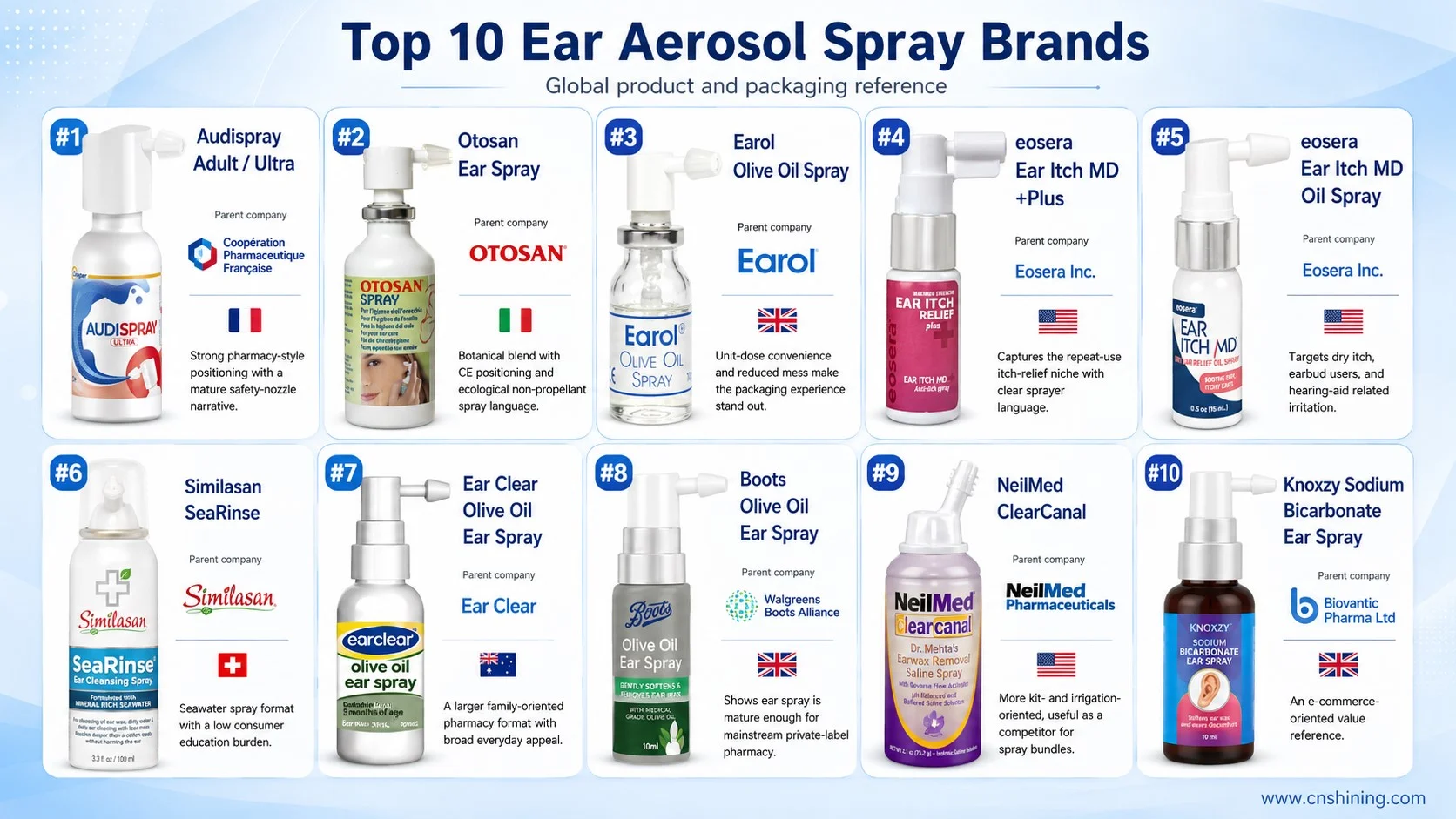
| Marca/Linha | País | Operating Body | Capacidade comum | Faixa de preço pública | Comentário técnico |
|---|---|---|---|---|---|
| Audispray Adult / Ultra | França | Coopération Pharmaceutique Française / Audispray system | 50 mL; Ultra about 120 sprays | aproximadamente $18,99 | Strong pharmacy-style positioning; mature safety-nozzle narrative |
| Otosan Ear Spray | Itália | Otosan | 50 mL | about $10.26–$15.90 | Botanical blend, CE positioning and non-propellant ecological spray language |
| Earol Olive Oil Spray | Reino Unido | Earol brand operation; public retail ownership not unified | 10 mL | about $6.62–$13 | Unit dose and reduced mess are strong packaging-experience references |
| eosera Ear Itch MD +Plus | Estados Unidos | Eosera Inc. | 10 mL | about $16.99 | Captures the repeat-use itch-relief niche and uses clear sprayer language |
| eosera Ear Itch MD Oil Spray | Estados Unidos | Eosera Inc. | 15–17 mL | about $15.99 | Targets dry itch, earbud users and hearing-aid related irritation |
| Similasan SeaRinse | Suíça | Similasan | 3.3 fl oz | aproximadamente $9,99 | Seawater spray format with low consumer education burden |
| Ear Clear Olive Oil Ear Spray | Austrália | Ear Clear brand system | 30 mL | about $7.97–$9.81 | Larger family-oriented pharmacy format |
| Boots Olive Oil Ear Spray | Reino Unido | Walgreens Boots Alliance | 10 mL | about $7.68 | Shows that ear spray is mature enough for mainstream private-label pharmacy |
| NeilMed ClearCanal | Estados Unidos | NeilMed Pharmaceuticals | 75 mL kit; 15 mL drops | about $7.46–$12.95 | More kit and irrigation oriented; useful competitor for spray bundles |
| Knoxzy Sodium Bicarbonate Ear Spray | Reino Unido | Biovantic Pharma Ltd | 10 mL | about $8.47 | E-commerce-oriented value reference |
5. Packaging Design: Solving the User Pain Points
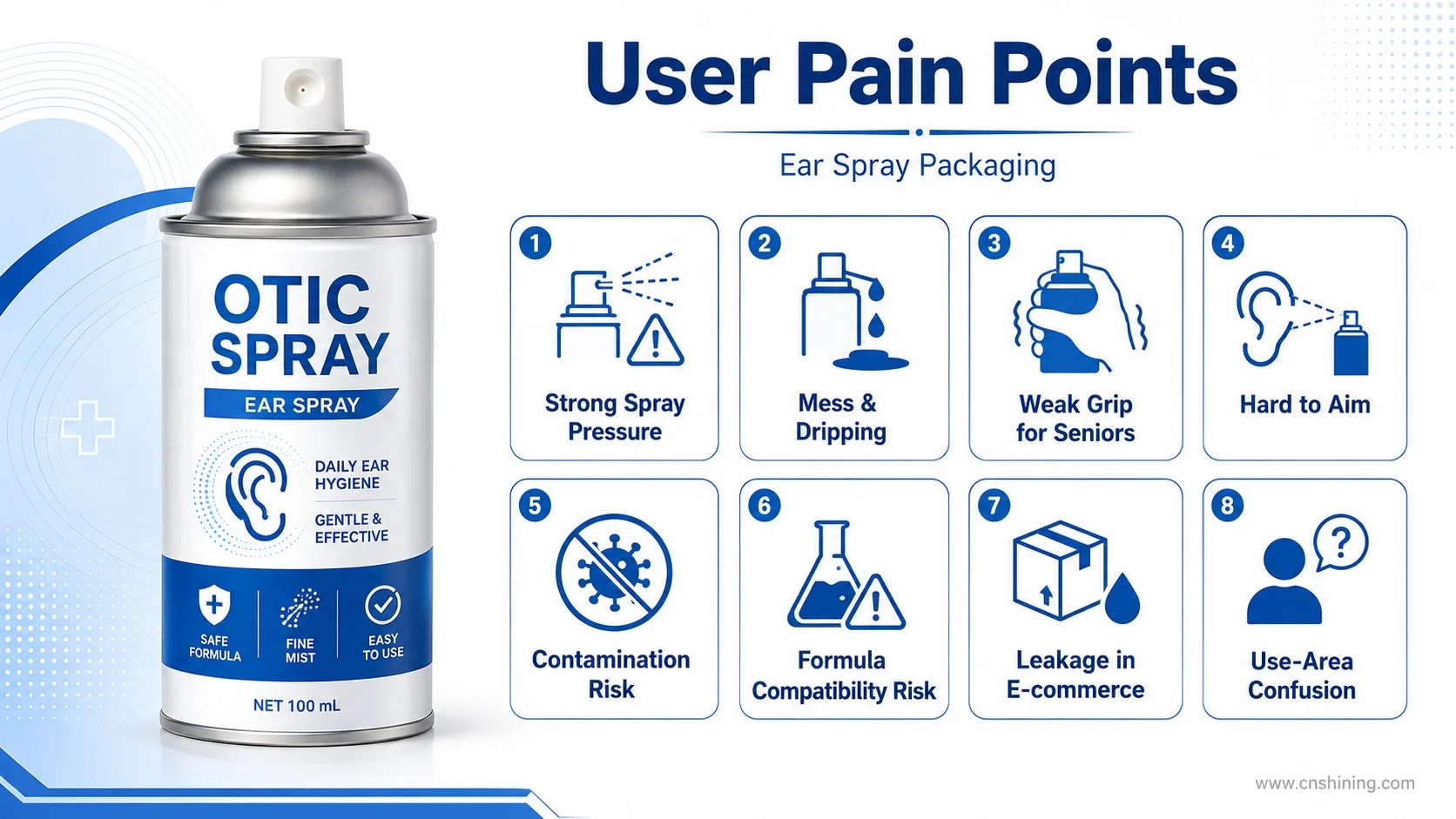
5.1 User Pain Points From Market Language
User pain points do not only appear in negative reviews. They are also visible in what product pages repeatedly promise: less mess, precise spray, no harsh chemicals, easier use than hard-to-squeeze tubes, and suitability for hearing-aid or earbud users. Social media trends add another problem: people want fast results, but high-pressure or tool-based DIY cleaning can harm the ear. A news warning about viral ear-cleaning behavior appeared in The Independent.
| Ponto problemático do usuário | Packaging Solution | Por que funciona | Trade-Off |
|---|---|---|---|
| Fear of strong spray or eardrum pressure | Vented or flow-guided ear actuator, side-directed or controlled-angle plume | Makes safety perception physical and lowers first-use fear | More complex tooling and tighter spray validation |
| Mess and dripping | Metered pump with slender ear actuator | Controls single output and reduces oil or saline overflow | High-viscosity oils may clog if the viscosity window is not managed |
| Weak hand strength in elderly users | Low actuation force and anti-slip grip zone | Easier than hard squeeze tubes or awkward droppers | Too low a force can raise transport misfire risk |
| Awkward aiming | Inverted or multi-angle spray structure; 360-degree uptake option | Improves self-use success when the head position is not ideal | More parts and higher cost |
| Contamination concern | Preservative-free multidose pump or BOV system | Supports sensitive-use and reduced-preservative positioning | Higher bill of materials and filling complexity |
| Oil, alcohol or surfactant compatibility risk | Formula-specific liner or pouch material selection | Controls odor, color change, extractables and shelf-life risk | Os testes de compatibilidade levam tempo. |
| E-commerce leakage | Lock cap, tamper band and secondary seal pouch | Reduces return rate and leakage complaints | More packaging layers and possible opening frustration |
| Confusion between ear canal and ear-area use | Front-label zone diagram and icon-based warnings | Reduces misuse and customer-service burden | Front panel becomes crowded |
5.2 Practical Packaging Route
For a mass pharmacy product, a non-propellant mechanical pump is usually the most practical starting point. A narrow-waist or oval-shoulder bottle improves grip. A short-stroke, low-force actuator improves use comfort. A slender directional nozzle with an external stop helps prevent over-insertion. A clear cap and tamper band protect transport. This approach matches already familiar products while avoiding the added filling and shipping burden of a propellant aerosol.
Container compatibility needs early testing. Oil phases, alcohol, surfactants and essential oils can interact with plastic, aluminum liners, valves and gaskets. Aluminum aerosol containers can be supplied with internal liner options, as described by Shining Packaging’s aluminum aerosol can information. “It holds liquid today” is not the same as “it stays stable for shelf life.”
6. Shining Packaging Fit: Actuators, Aerosol Cans and Valves for Ear Spray Projects
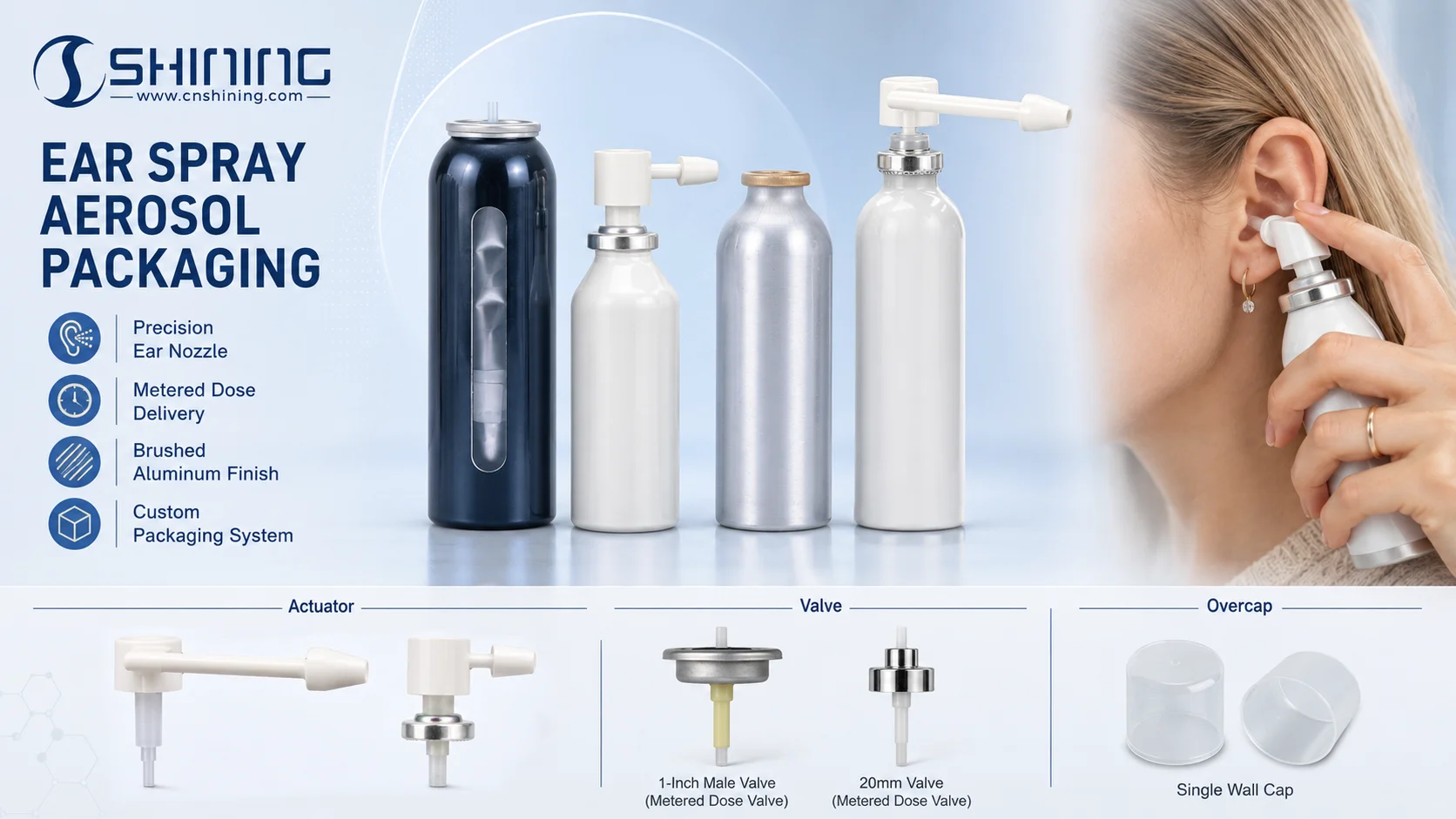
For ear aerosol spray, the packaging work should start at the interface between the actuator, valve or pump, and container. Shining Packaging’s relevant product scope fits that interface: atuadores for spray direction and actuation feel, latas de aerossol for metal-container options, and válvulas for aerosol or bag-on-valve projects where product-propellant separation, controlled discharge or multi-angle use is needed.
This does not mean every ear spray should use a metal aerosol can. Many ear care products work better as pump sprays. The point is more practical: when a brand chooses an aerosol or BOV architecture, the can, valve, actuator, inner compatibility and leakage control must be selected together. A good ear actuator cannot compensate for a valve that gives harsh output. A good can does not solve a formula-liner mismatch.
7. Final Technical Note
The useful conclusion is direct: ear aerosol spray is not won by formula alone. The winning product has to connect the formula, dose, nozzle, actuator feel, container compatibility, warnings and shipping performance. The user’s question is simple: will it reach the right place, gently, without mess? If the package cannot answer that question physically, the label cannot fix it.
8. FAQ: Technical Questions About Ear Aerosol Spray
No. In this category, “ear aerosol spray” is often used loosely. Many visible products are mechanical pump sprays, non-propellant sprays or small metered spray systems. True propellant aerosol cans and bag-on-valve systems exist, but they are not the dominant retail format for ear care. The delivery performance matters more than the naming.
Spray gives better directional control and can reduce the mess associated with drops. It also allows a metered output, which helps users feel that the dose is controlled. Drops remain low cost and familiar, but they often require head tilting, waiting time and cleanup. Spray wins when the nozzle and dose are well designed.
Common formulation routes include saline or seawater cleaning sprays, olive oil or mineral oil softening sprays, surfactant and solvent systems for wax structure breakdown, alcohol-glycerin drying aids, and hydrocortisone anti-itch products. The product claim determines the regulatory route. A simple hygiene spray and a medicated otic product are not the same.
The ear canal is narrow and users are nervous about the eardrum. A spray that feels too sharp can create immediate rejection, even if the formula is acceptable. Pressure control depends on actuator geometry, orifice design, pump output, plume angle and dose volume. This is why vented or guided ear nozzles are technically valuable.
Bag-on-valve is worth evaluating when the product needs 360-degree use, clean separation between product and propellant, continuous spray behavior, strong evacuation, or a more pharmaceutical packaging profile. It is not automatically needed for every ear care product. The cost, filling process and component compatibility must justify the user benefit.
Oil phases, alcohol, surfactants and essential oils can interact with bottles, can liners, pouches, valves, gaskets and actuators. Risks include odor change, color shift, swelling, clogging, leakage and extractables. Early compatibility screening should use the real formula, accelerated aging and the intended closure system, not only water-filled appearance samples.
Public market summaries usually report earwax removal products or broader ear care, not spray-only revenue. These categories mix drops, sprays, cotton swabs, irrigation kits, smart tools and other products. Spray is better read as a growth and packaging-differentiation format inside the larger self-care category, rather than a fully isolated public market.
Risky labels often overreach into infection treatment, ear pain relief or middle-ear language without the right regulatory path. Another common problem is unclear use site. “In the ear canal” and “around the ear” can carry different implications. Warnings for perforated eardrum, discharge, pain, surgery history and age limits should be considered during development.
It can be useful when the product targets sensitive users or wants reduced-preservative positioning. Preservative-free multidose systems rely on mechanical barriers that reduce contamination during repeated use. The benefit is meaningful only if microbial challenge testing, backflow control and user handling are validated. It also increases component cost and development work.
They should check dose output, spray pressure, plume angle, nozzle insertion stop, actuator force, leakage, low-fill performance, formula compatibility, microbial backflow and e-commerce transport behavior. These tests map directly to user complaints: too strong, hard to aim, messy, clogged, leaking, or unclear. Ear spray is a small package with little tolerance for weak details.