
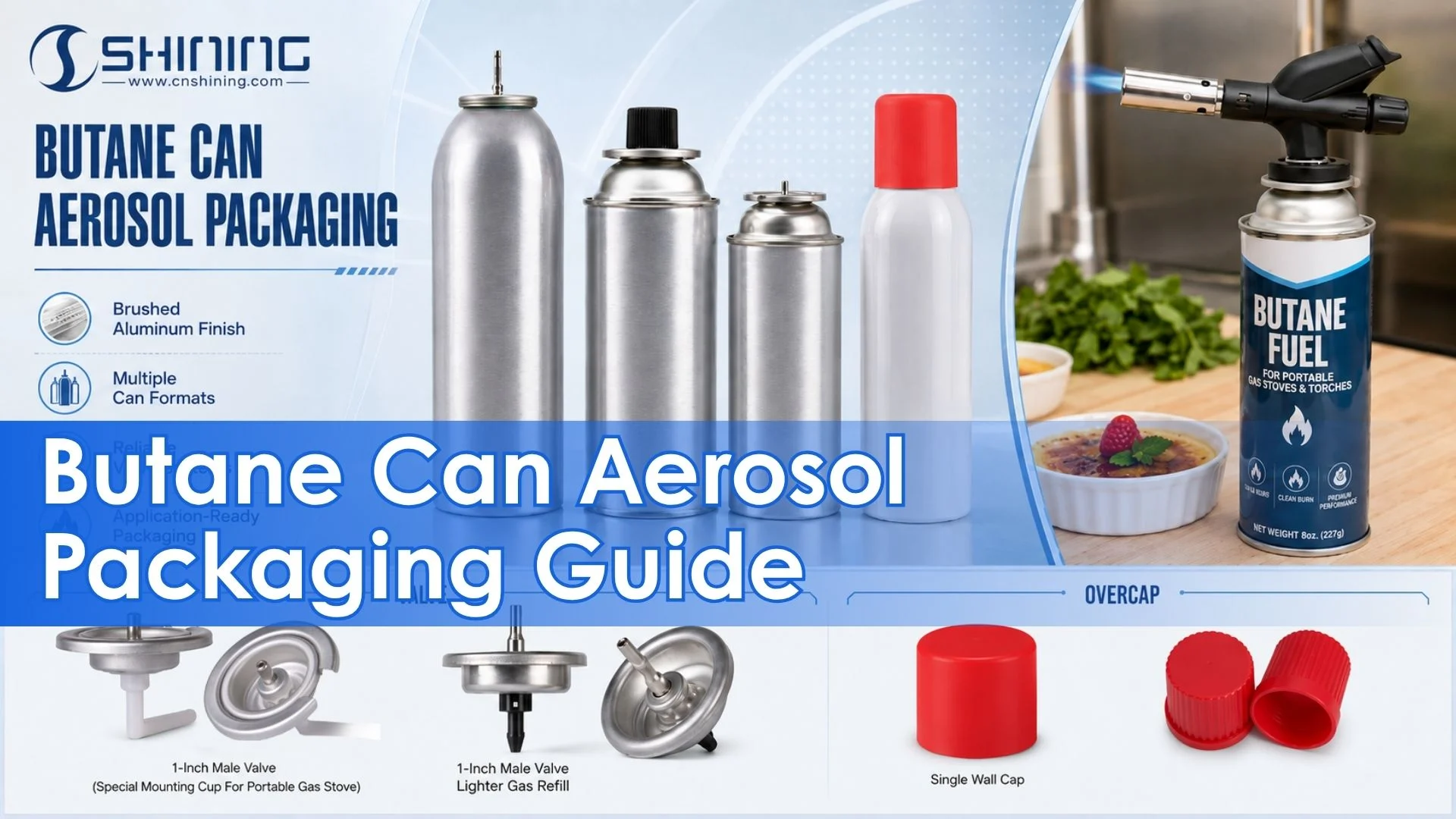
A butane can is a pressure package before it is a fuel SKU. It may also be called a butane cartridge, butane gas canister, cassette gas cartridge, EN417 fuel canister, lighter refill gas, or small LPG cartridge. The names change by channel. The engineering problem stays the same.
This product is not only “fuel in a metal container.” It is a controlled system made of fuel blend, metal can body, valve, sealing interface, actuator or trigger path, warning label, and dangerous-goods transport classification. Most field complaints do not start with heat value. They start with leakage, poor alignment, weak flame in cold weather, overheating from oversized cookware, SKU confusion, and unclear empty-can disposal.
1. Visão Técnica Executiva
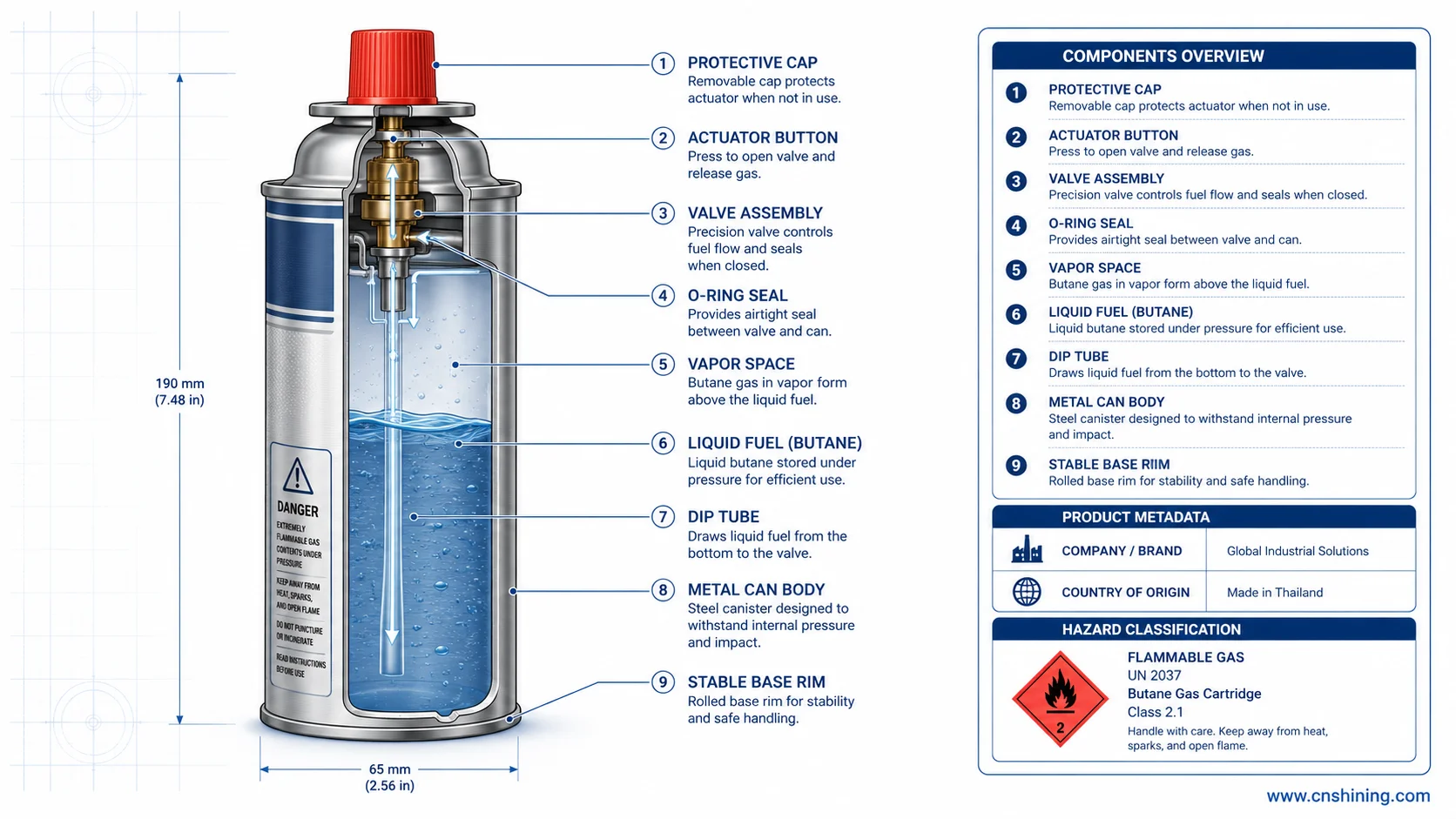
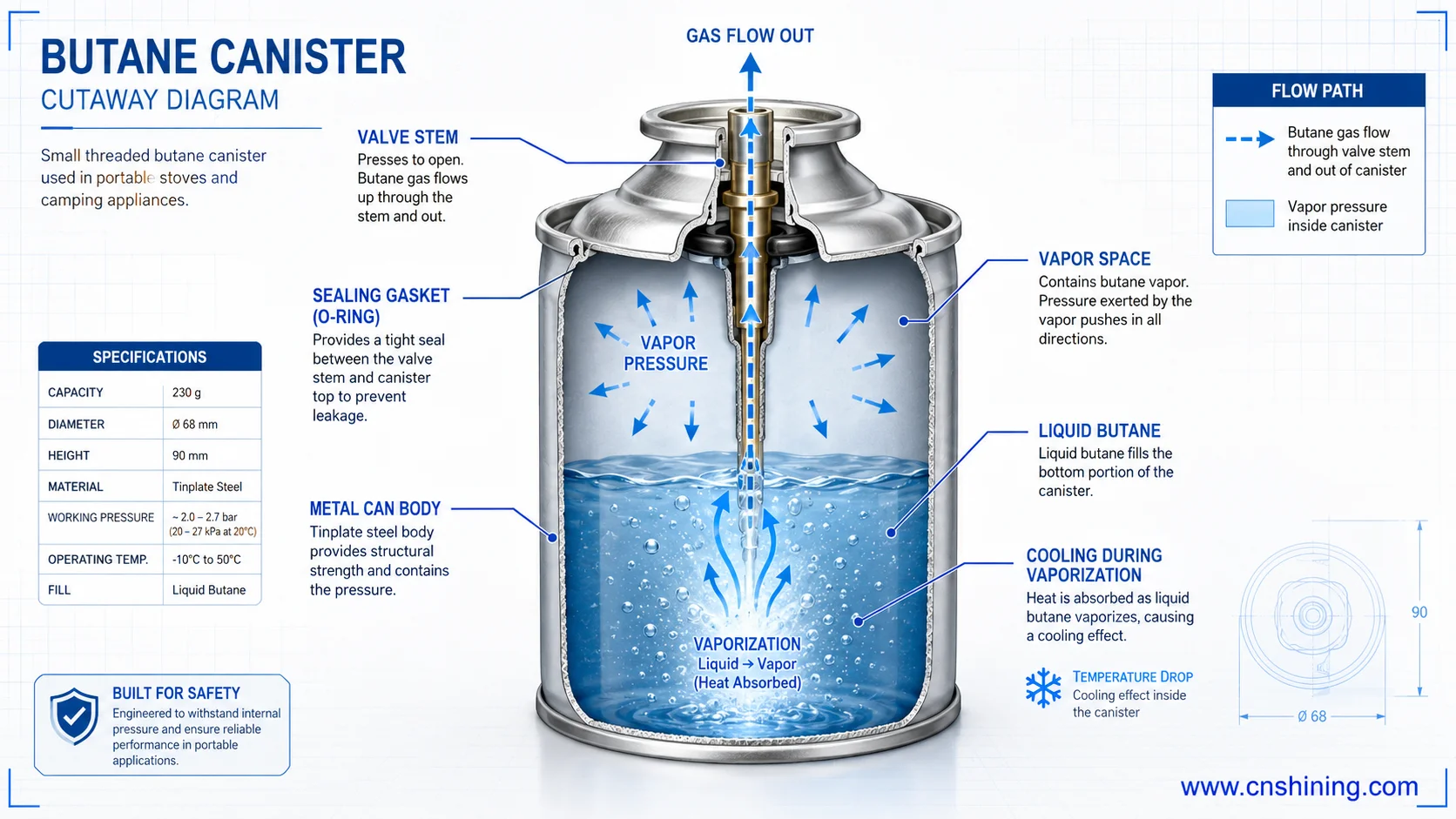
The core mechanism is liquid-vapor equilibrium. At room temperature, liquefied butane generates its own vapor pressure. When the user opens the valve, vapor leaves first. Internal pressure drops. Liquid fuel then vaporizes to restore pressure. That vaporization absorbs heat, so the can gets colder during use. The common field symptom is simple: the longer it runs, the colder it gets, and the weaker the flame becomes.
n-butane has a normal boiling point around -0.5°C, while isobutane is around -11.7°C. Blending isobutane and propane improves low-temperature usability, but it also changes internal pressure and regulatory handling. For n-butane property data, see the NIST Chemistry WebBook record for butane. For transport behavior, NOAA notes that butane is shipped as a liquefied gas under its own vapor pressure and that vapors are heavier than air; the NOAA CAMEO butane datasheet is a practical starting point.
2. Scope, Definition, and Working Principle
2.1 Definition and Boundary
This article treats a butane can as a non-refillable consumer metal pressure container, generally below the 1 L class, used for portable stoves, torches, lamps, heaters, and refill applications. Three product layers matter:
- Main scope: small metal pressure cans for portable stoves, torches, heaters, lamps, and refill use.
- Adjacent products: EN417 threaded cartridges, cassette stove cans, and lighter refill cans.
- Comparison products: large LPG cylinders and aerosol packages using butane, isobutane, or propane as propellants.
O GSO EN 417:2025 scope page describes non-refillable metallic LPG cartridges with or without a valve, used with portable appliances, in the 50 ml to 1,000 ml capacity range. It also notes the 50°C pressure condition and odorization exceptions for small capacities.
2.2 Physical and Chemical Mechanism
The supply path starts from saturated vapor pressure. Inside the can, liquid fuel sits below a vapor space. Opening the valve releases vapor. The pressure drop forces more liquid to evaporate. That evaporation removes latent heat from the can wall and lowers vapor pressure. Low ambient temperature makes this worse.
That is why a pure butane solution is weaker in winter or at high altitude than a blend using more isobutane or propane. A stable flame is not only a burner issue. It is also a fuel formulation, valve flow, pressure envelope, and heat-transfer issue.
2.3 Valve, Trigger, and Release Control
In a typical cassette stove, the fuel can nozzle enters the regulator and seals through an O-ring. A mechanical or magnetic structure holds the can in position. The front knob meters gas flow. The locking lever pushes the fuel can into the regulator. Gas then moves through the regulator and main nozzle, mixes with primary air, and ignites at the burner ports.
The U.S. CPSC report on tabletop butane appliances recorded over-pressure protection activation at about 65-79 psig, ou 0.45-0.54 MPa, in the test samples. The same report describes the risk created when a large griddle extends over the fuel compartment; see the CPSC tabletop butane cooking appliance report.
Common interface families are:
- Bayonet / cassette interface: depends on alignment slot, lock lever, and can position feedback.
- EN417 threaded self-sealing valve: common in backpacking stove canisters.
- Lighter refill nozzle and adapter system: relies on a narrow refill stem or adapter to open the receiving valve.
- Liquid butane or blended fuel establishes vapor pressure inside the can.
- The user presses the valve stem, locks the cassette can, or opens a connected appliance valve.
- The valve opens and gas passes through the O-ring interface, regulator, or nozzle.
- Gas mixes with primary air and is ignited.
- Internal pressure falls, liquid fuel vaporizes, and the can cools.
- At low temperature, vapor pressure drops and flame output decays.
3. Fuel Formulation, Classification, and Product Comparison
3.1 Common Formulation Paths
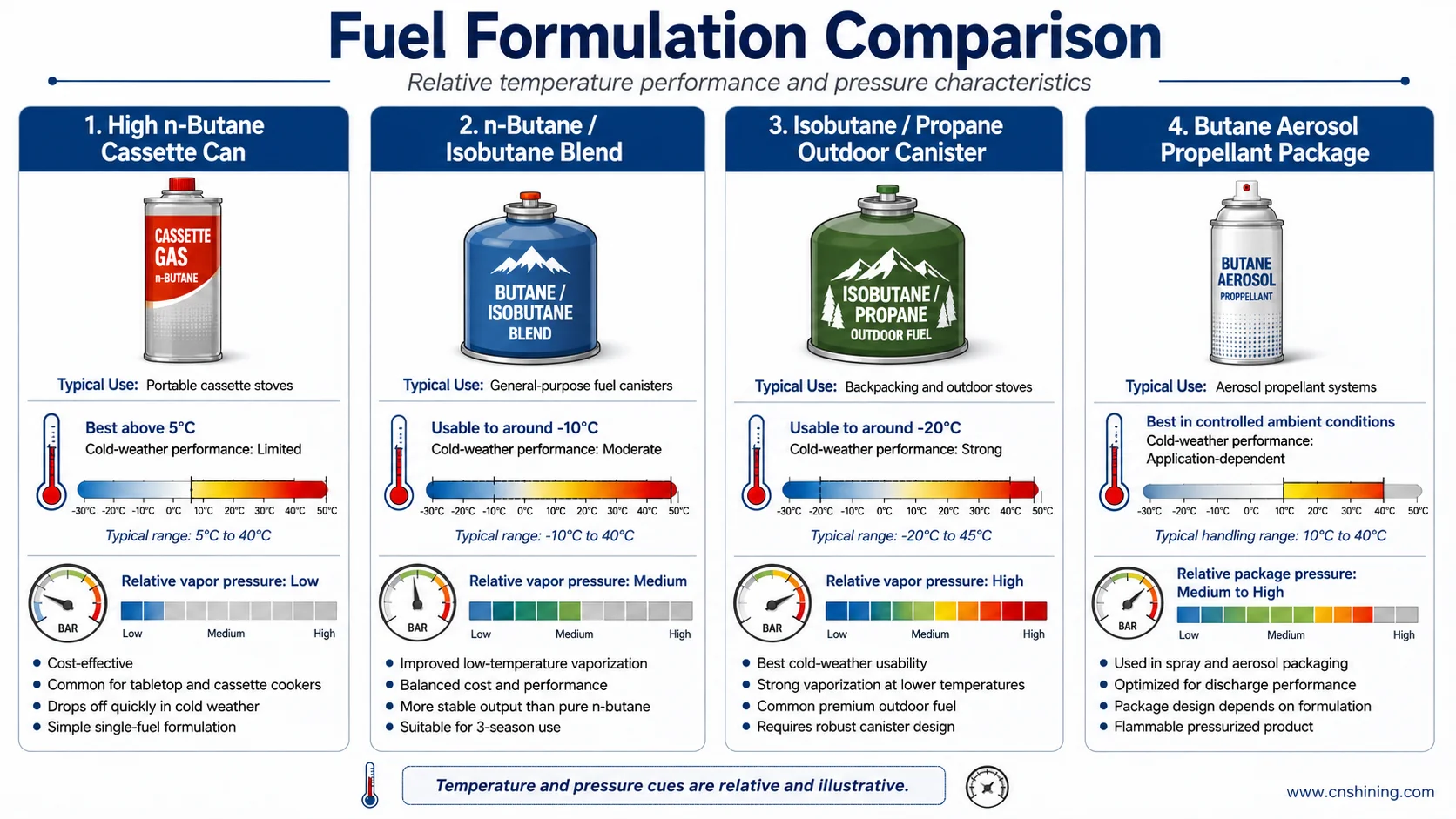
Consumer-facing butane cans generally follow four formulation ideas:
| Formulation Path | Uso típico | Significado técnico |
|---|---|---|
| High n-butane | Cassette stove cans and some lighter refill products | Cost-friendly and stable at normal temperature, but weaker in cold conditions. |
| n-butane / isobutane | Improved cold-start consumer fuel | Higher isobutane content improves vapor pressure at lower temperature. |
| Isobutane / propane | Outdoor threaded canisters | Better for cold weather and high altitude, with a higher pressure design burden. |
| Butane / isobutane / propane propellant | Aerosol, technical spray, personal care, cleaning products | The gas may act as a propellant rather than the product being burned as fuel. |
Odor strategy also changes by product type. Fuel cans may use odorized gas to help users detect leakage. High-purity lighter refill gas may avoid strong odor because users associate smell with dirty fuel or nozzle clogging. Capacity and local regulation affect the decision.
3.2 Safety Focus
The safety question is not “is it flammable?” It is already highly flammable. The real question is whether the fuel remains predictable across temperature, posture, accessory fit, interface tolerance, and user behavior. Oversized cookware, poorly locked cans, and leaking interfaces are recurring hazard patterns.
3.3 Comparison with Related Products
Compared with large LPG cylinders, a butane can is portable, simple, and suitable for small distributed heat demand. Its disadvantages are higher packaging cost per unit of energy, more disposable packaging, weaker cold-weather performance in pure-butane systems, and tighter retail transport constraints.
Compared with lighter refill gas, a stove fuel can emphasizes continuous gas supply and appliance compatibility. Lighter gas emphasizes refill convenience and small-nozzle adaptation. Compared with aerosol propellant packaging, the purpose changes: a butane fuel can supplies heat; an aerosol package atomizes or dispenses another material. That difference changes valve design, actuator geometry, labeling, and compliance language.
4. Regulation, Standards, Transport, and Recycling
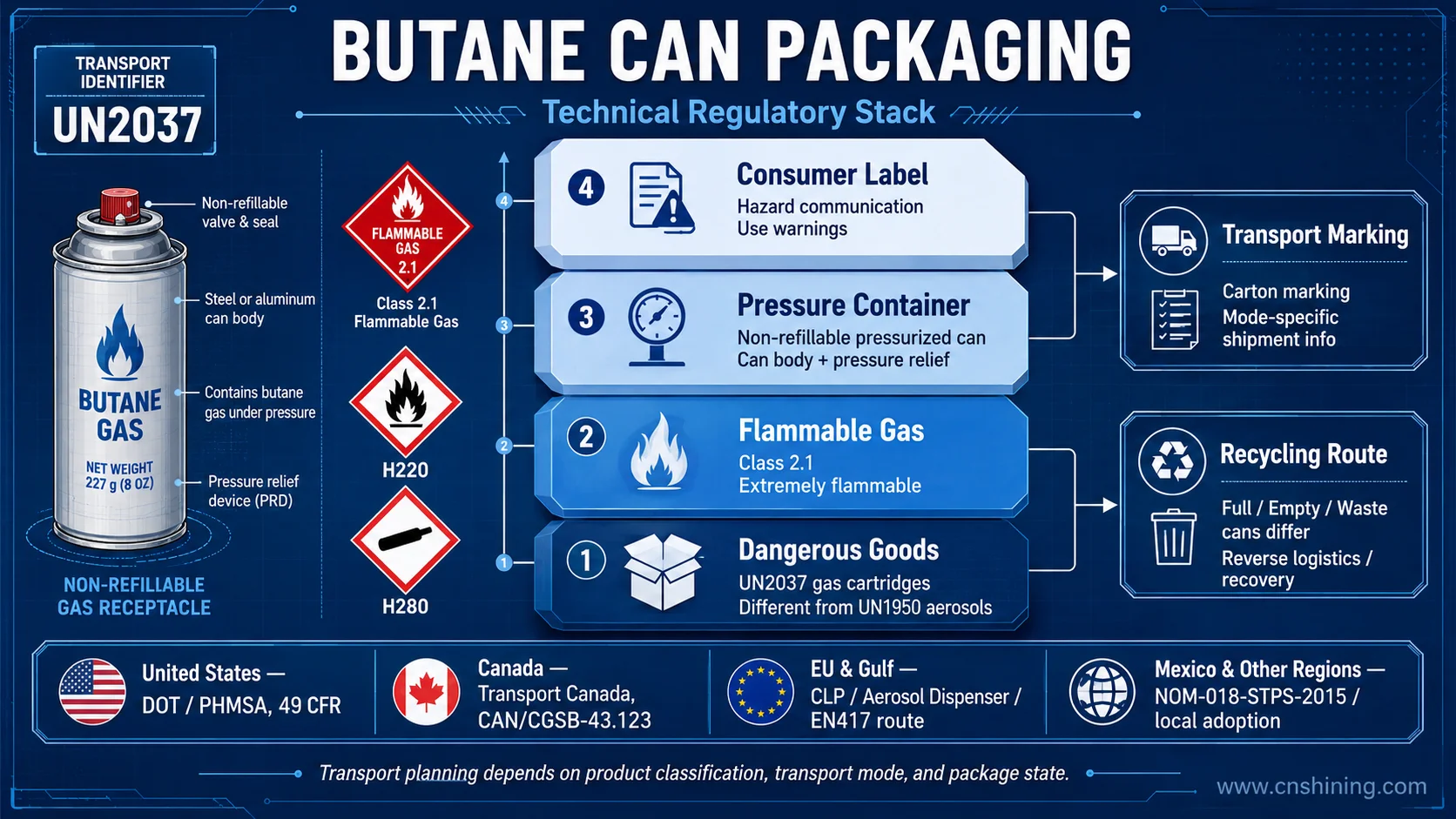
The regulatory base is a four-layer stack: dangerous goods, flammable gas, pressure container, and consumer chemical labeling. Small non-refillable gas receptacles fall into the UN dangerous goods logic. A UNECE working document discusses differentiation between UN1950 aerosols and UN2037 gas cartridges; see the UNECE document on UN1950 and UN2037 differentiation.
For U.S. transport classification, 49 CFR is the working baseline. The eCFR hazardous materials table section is one reference point. For chemical classification in Europe, the ECHA butane classification page supports the common GHS/CLP hazard statements: H220 for extremely flammable gas and H280 for gas under pressure.
4.1 Estados Unidos
The U.S. framework combines DOT/PHMSA transport rules, pressure-container specifications, and consumer product safety learning from portable stove incidents. In practice, product developers need to consider can body specification, over-pressure release behavior, labeling, carton marking, and use-case warnings together.
4.2 Canada
Transport Canada states that aerosol containers and gas cartridges for Class 2 dangerous goods must follow applicable CAN/CGSB-43.123 requirements. The Transport Canada aerosol containers and gas cartridges requirements page separates design, manufacture, selection, use, marking, and registration logic. The CAN/CGSB-43.123 document is useful for transport of aerosol containers and gas cartridges.
4.3 European Union and Gulf Markets
EU aerosol products must consider flammability and pressure hazards under the aerosol dispenser framework. The European Commission aerosol dispenser directive page is relevant for aerosol dispenser logic. EN417-type cartridge products sit in a separate technical standard route for non-refillable metallic LPG cartridges used with portable appliances.
4.4 Mexico, and Other Regions
For Mexico, NOM-018-STPS-2015 follows GHS hazard communication logic; see the NOM-018-STPS-2015 source PDF. Latin America, Gulf countries, and South Africa are not “low-rule” markets. They often adopt international frameworks with local execution details.
4.5 Transport and Recycling
Transport planning must distinguish product classification, transport mode, and package state. New full cans, empty consumer cans, and waste cans for recovery are not the same logistics problem. The U.S. EPA has added aerosol cans to the universal waste system; see the EPA aerosol cans universal waste rule page. This matters for reverse logistics and empty-can handling instructions.
5. User Pain Points and Packaging Improvement Opportunities
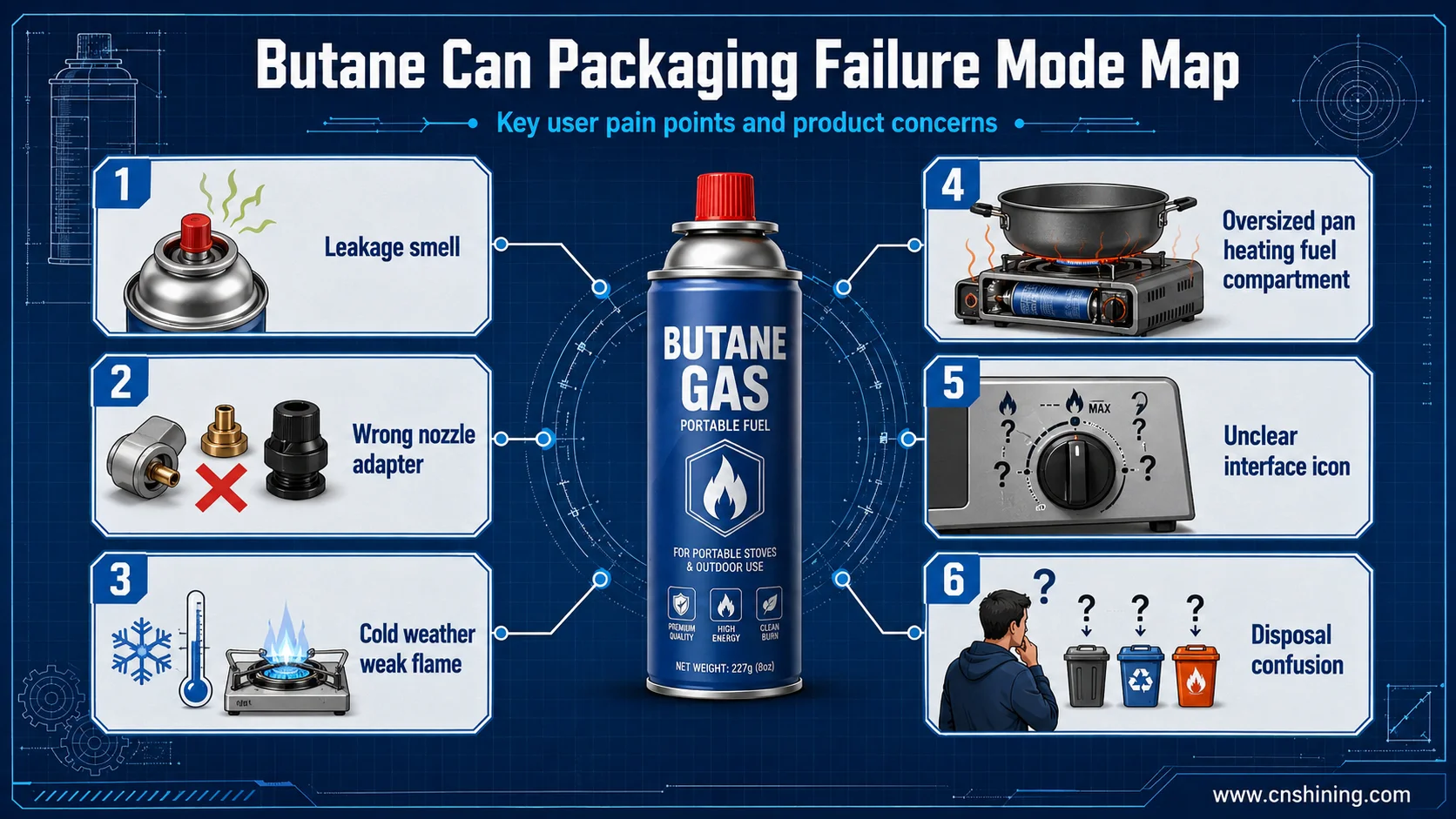
| User Complaint | Provável raiz técnica | Resposta de embalagem |
|---|---|---|
| “I smell gas.” | Valve return issue, O-ring mismatch, dirt in valve seat, or poor interface tolerance. | Improve self-sealing valve consistency, dust cap, leak-check instruction, and interface tolerance control. |
| “Fuel sprays everywhere during refill.” | Adapter geometry mismatch or pressure difference not managed. | Use coded adapters, clearer refill direction diagrams, and anti-blowback seat design. |
| “The flame is weak in cold weather.” | Low vapor pressure after evaporative cooling. | Use correct blend guidance and avoid unsafe external heating advice. |
| “It fits but no gas comes out.” | Valve stem not fully depressed, lock not engaged, or wrong interface family. | Make interface icons larger and add tactile or visual lock feedback. |
| “I bought the wrong version and already filled it.” | SKU and interface confusion in e-commerce. | Put interface type, adapter count, and non-return-after-filling notice on the main image and front label. |
Packaging Improvement Direction
The strongest commercial opportunity is not just thicker metal. It is a mistake-resistant packaging system. For cassette cans, the alignment slot, lock lever, and O-ring should create forced guidance and clear “locked” feedback. For threaded canisters, valve core return and gasket durability deserve close validation. For refill cans, adapter coding and anti-blowback geometry reduce the “gas around the nozzle” failure mode.
Label design should promote compatibility from fine print to main visual. A front panel should tell the user whether the package is bayonet cassette, EN417 threaded, or lighter refill only. For side-mounted cassette stove systems, maximum cookware diameter and fuel-compartment heating warnings should be high contrast. Heat-sensitive ink or a simple thermal warning band can help, but it cannot replace appliance-level interlock.
Internal coating and material compatibility also matter. Public pages rarely disclose coating chemistry, so it is not safe to name one resin as universal. The right process is to test the fuel blend, odorant, trace water, valve gasket, coating, and metal substrate as one system.
6. Where Shining Packaging Fits: Actuators, Aerosol Cans, and Valves
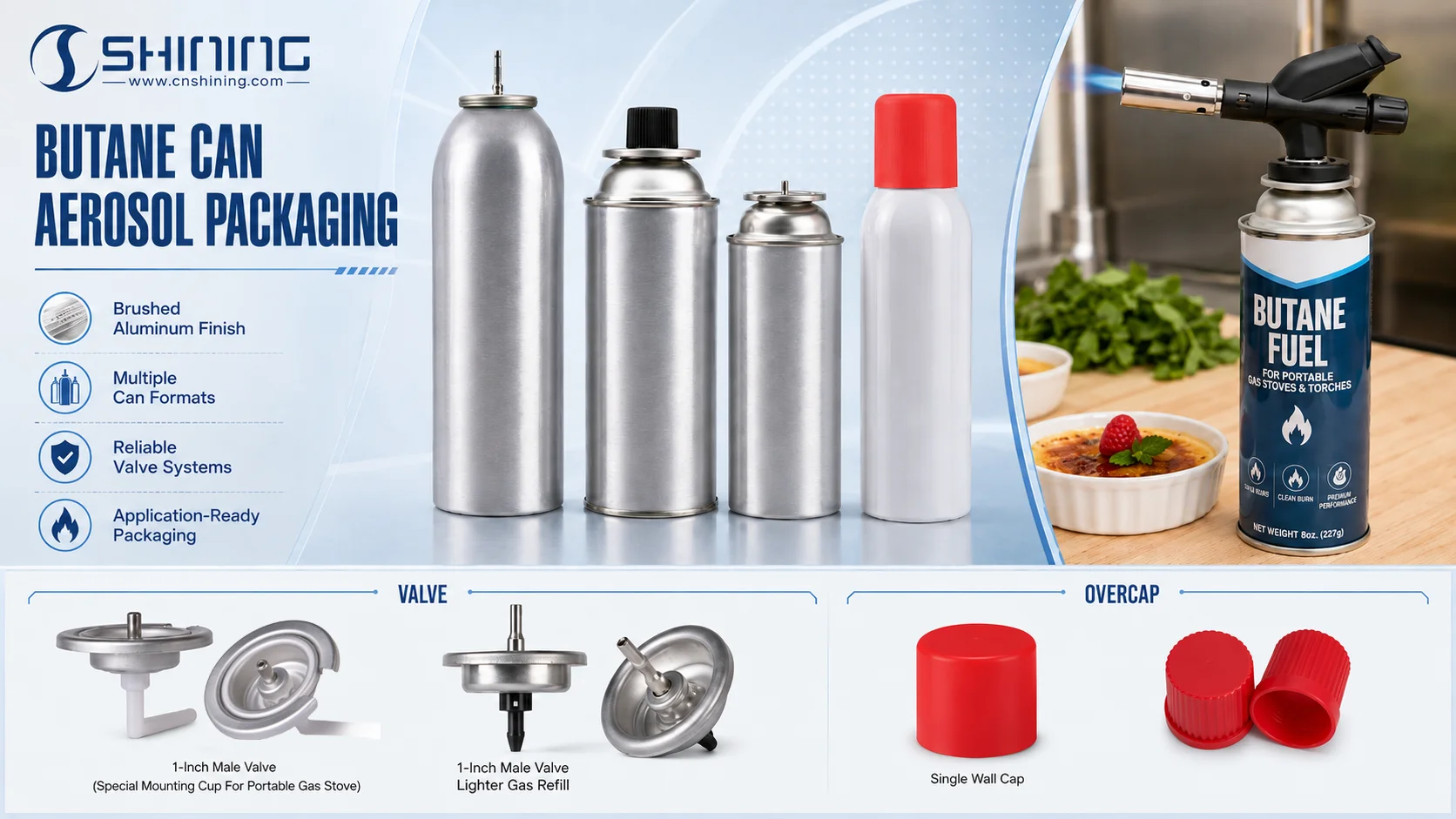
For butane-related packaging, the can body is only one part of the risk chain. The actuator, valve, stem, gasket, cup, and can-to-device interface decide whether users feel a clean engagement or a leak-prone product. Shining Packaging’s relevant work sits in these interface components: atuadores, latas de aerossol, e válvulas used in pressure packaging systems where controlled release and sealing reliability are central.
This is not a claim that every butane fuel can uses the same actuator as a spray aerosol. It does not. The useful link is engineering practice: valve-seat control, gasket compatibility, crimp consistency, actuator travel, and user feedback all affect complaint rates. In fuel cans, the interface must control gas release. In aerosol cans, the actuator and valve must control spray or discharge. The design discipline is similar: reduce unintended release, make correct use obvious, and keep the package stable through transport and storage.
For teams developing butane cans, torches, technical sprays, or gas-driven products, the practical question is direct: does the package make the correct action easier than the wrong one? If not, leakage complaints will eventually find the weak point.
7. Top 10 Butane Can Brands
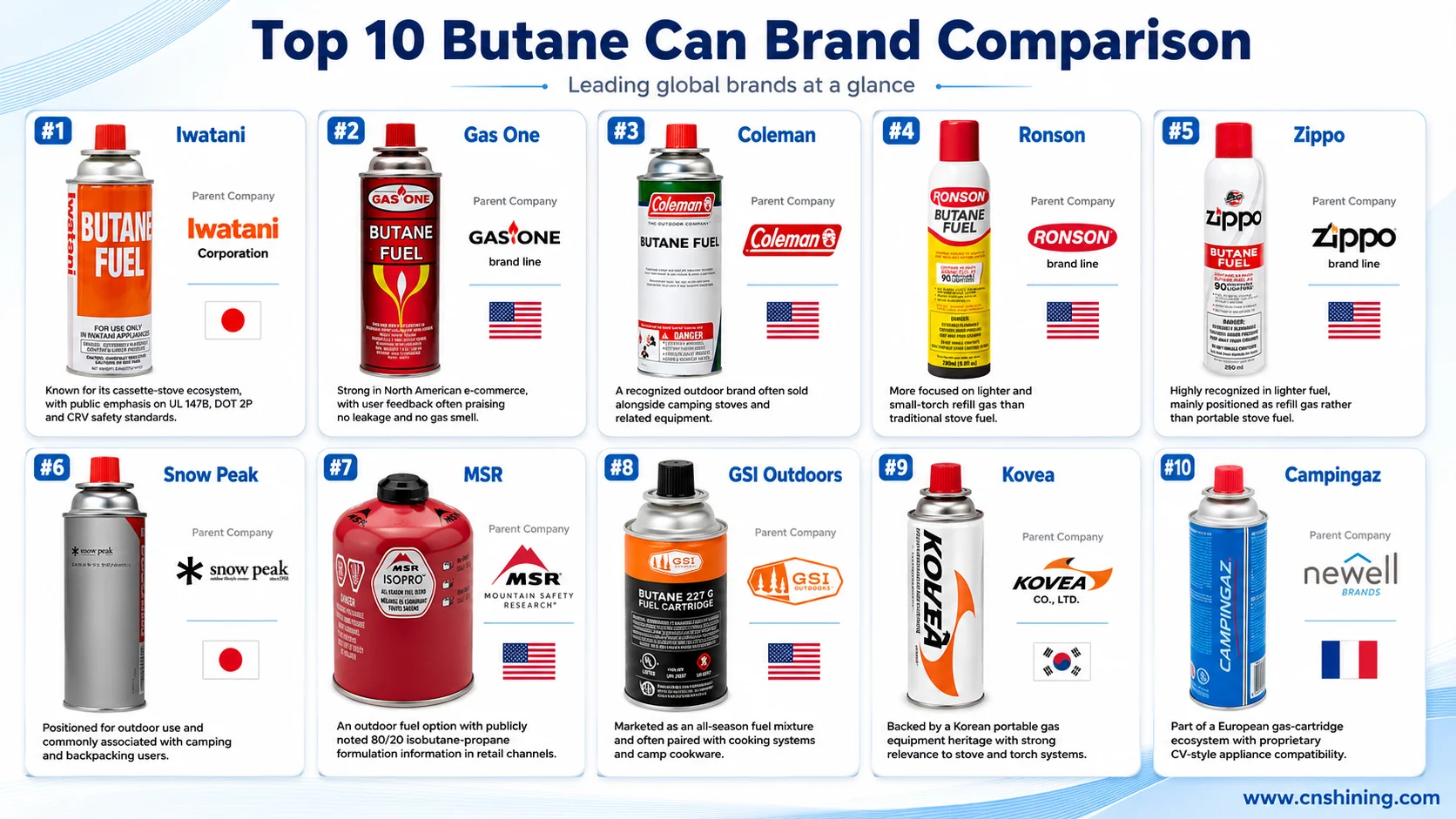
| Marca | País/Região | Empresa/Operadora | Capacidade comum | Typical Visible Price | Comentário técnico |
|---|---|---|---|---|---|
| Iwatani | Japão | Iwatani Corporation | 227 g / 8 oz | about $1.93-3.49 per can | Known cassette stove ecosystem. Public materials emphasize UL 147B, DOT 2P, and CRV. |
| Gás Um | Estados Unidos | Gas One brand line | 8 oz / 227 g | about $8.88 single; $15.95-15.96 for 4 cans | Strong North American e-commerce presence. User feedback often focuses on no leakage and no gas smell. |
| Coleman | Estados Unidos | Coleman | 8.8 oz; also 7.75 oz mixed fuel | about $10.99 for 2 cans | Outdoor channel recognition. Often sold with camping stoves and related equipment. |
| Ronson | Estados Unidos | Ronson brand line | 135 ml, 290 ml | about $4.96 for 290 ml; $12.95 for 135 ml x 3 | More focused on lighter and small torch refill gas than stove fuel. |
| Zippo | Estados Unidos | Zippo brand line | 75 ml, 5.82 oz | about $7.99 for 75 ml | High lighter-fuel recognition. Mainly refill gas rather than portable stove fuel. |
| Pico Nevado | Japão | Snow Peak brand entity | 220 g | about $6.95 | Outdoor fuel positioning. Commonly associated with camping and backpacking users. |
| MSR | Estados Unidos | Mountain Safety Research | 110 g and larger sizes | about $5.95 for 110 g | Outdoor fuel example with public 80/20 isobutane/propane formulation information in retail channels. |
| GSI Outdoors | Estados Unidos | GSI Outdoors | 230 g | about $6.95 | All-season fuel mixture positioning. Often paired with cooking systems and camp cookware. |
| Kovea | Coréia do Sul | Kovea Co., Ltd. | 220 g / 230 g | about $39.94 per set | Korean portable gas equipment background. Strong relevance to stove and torch systems. |
| Campingaz | França | Newell Brands brand line | CV300 Plus, CV470 Plus | about $10.08-16.13 per cartridge | European gas cartridge ecosystem with proprietary CV-style appliance compatibility. |
Common Technical Terms
| Prazo | Breve explicação | Significado comercial |
|---|---|---|
| n-butane | Normal butane; normal boiling point about -0.5°C. | Cost-friendly, but cold-weather output is limited. |
| isobutane | Butane isomer with lower boiling point, around -11.7°C. See the PubChem isobutane record. | Better low-temperature usability; common in upgraded outdoor blends. |
| GLP | Liquefied petroleum gas, commonly propane and butane mixtures. | The product is not always pure butane. Label and classification language should match the mixture. |
| EN 417 | Standard route for non-refillable portable LPG metal cartridges. | Important compatibility language for European and Gulf portable appliance markets. |
| Lindal / EN417 valve | Threaded self-sealing valve family used on many outdoor canisters. | Compatibility point, but also a potential complaint point if seal or valve return is poor. |
| Bayonet / cassette / MSF-1A | Long cassette stove can interface family. | Needs clear e-commerce photos and front-label interface icons. |
| CRV / RVR | Pressure relief structure such as countersink or rim vent release. | Safety structure that can be made visible in technical packaging language. |
| ONU 2037 | Dangerous goods number for small receptacles containing gas, commonly gas cartridges. | Directly affects transport documents, carton marks, and customs communication. |
| H220 / H280 | GHS/CLP hazard statements for extremely flammable gas and gas under pressure. | Drives label, SDS, pictogram, and multilingual compliance wording. |
| DOT 2P | Common North American small gas container specification language. | Useful in export and retail approval discussions. |
| Universal Waste | U.S. simplified management route for selected hazardous wastes. | Relevant to empty aerosol can handling and reverse logistics planning. |
8. Pontos técnicos principais
The stable conclusion is clear: competition in butane cans is moving away from simply filling another low-cost metal can. The useful work is in controlling interfaces, pressure, valve sealing, misuse, labeling, and regional compliance. A better can is not only safer in the laboratory. It gives the user fewer chances to install it wrong, heat it wrong, refill it wrong, or dispose of it wrong.
9. FAQ: Butane Can Design, Safety, and Packaging
A butane can supplies gas through liquid-vapor equilibrium. When vapor leaves through the valve, more liquid butane evaporates to restore pressure. That evaporation absorbs heat from the can body. As the can becomes colder, vapor pressure falls, and the burner receives less gas. Low ambient temperature makes this pressure drop more visible.
n-butane boils at about -0.5°C, so its vapor pressure becomes weak near freezing conditions. The can may still contain liquid fuel, but it cannot generate enough vapor flow for a strong flame. Isobutane and propane blends improve low-temperature performance because they produce more usable pressure at lower temperatures.
A cassette butane can normally uses a bayonet-style interface with an alignment notch and stove locking lever. An EN417 canister uses a threaded self-sealing valve common in backpacking stoves. They are not interchangeable unless the appliance is specifically designed for both systems. The label should show the interface clearly.
Gas smell usually points to a sealing or valve problem. Common causes include an O-ring that is not fully engaged, a damaged valve seat, dirt in the valve, poor thread or adapter tolerance, or a can that is not locked into the regulator. A small smell should not be treated as normal during storage or use.
Oversized pans or griddles can extend over the fuel compartment and send heat back toward the can, regulator, and valve area. This changes the thermal path from normal cooking to fuel-can heating. If pressure rises enough, the protection system may activate, venting fuel. Appliance warnings should state maximum cookware size clearly.
UN 2037 is used for small receptacles containing gas, often described as gas cartridges. It affects transport description, outer carton marking, documentation, and carrier acceptance. It does not replace local container rules, consumer labeling, or chemical hazard statements. Export teams should treat it as one part of the compliance stack.
H220 identifies an extremely flammable gas. H280 identifies gas under pressure that may explode if heated. Butane products often need both because the material is flammable and held as a liquefied gas in a pressure container. The exact label must follow the market’s GHS or CLP implementation and the product mixture.
The interface type should be visible before purchase and before installation. Front labels and e-commerce images should show whether the product is cassette bayonet, EN417 threaded, or lighter-refill only. Adapter count, fill direction, lock position, and appliance compatibility should not be hidden in small manual text.
No. Both may use butane, isobutane, or propane, but the product function is different. A fuel can supplies combustible gas to a burner. An aerosol package uses gas pressure to dispense another material. That difference changes valve design, actuator movement, labeling language, discharge behavior, and applicable product standards.
Test the fuel blend, odorant, trace moisture, valve gasket, valve seat, coating, and metal substrate together. A change that looks safe in isolation can create swelling, odor, corrosion, leakage, or slow valve return over storage time. Compatibility testing should cover temperature cycling, transport vibration, and long-term filled-can aging.