

Metal food cans provide strong protection against oxygen, light, moisture, and physical damage. They also allow food to be stored for long periods without refrigeration.
These properties continue to support demand across ready meals, vegetables, seafood, meat, and wet pet food.
According to Mordor Intelligence, the global food cans market is valued at USD 28.47 billion in 2026 and is expected to reach USD 35.86 billion by 2031, growing at a CAGR of 4.72%.(источник)
Growth is steady, but manufacturers still face pressure from raw material costs, flexible packaging, and changes in food-contact coating regulations.
1. Metal Food Cans Market Snapshot
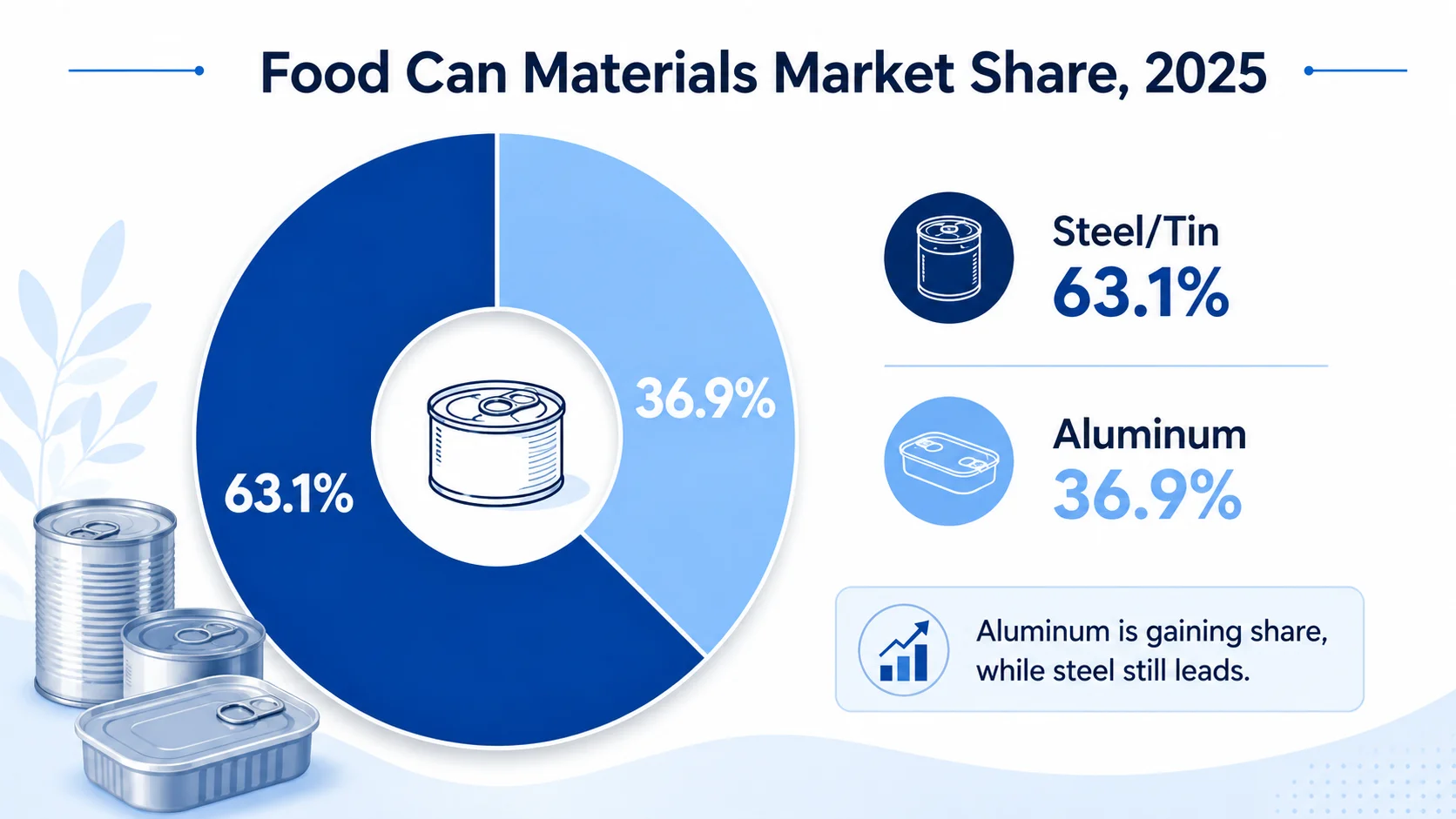
Steel and tinplate cans accounted for 63.06% of market revenue in 2025. Aluminum holds a smaller share but is expected to grow faster, at a 5.43% CAGR through 2031.
Three-piece welded cans generated 58.63% of revenue in 2025. Two-piece cans are projected to grow at a 5.32% CAGR.
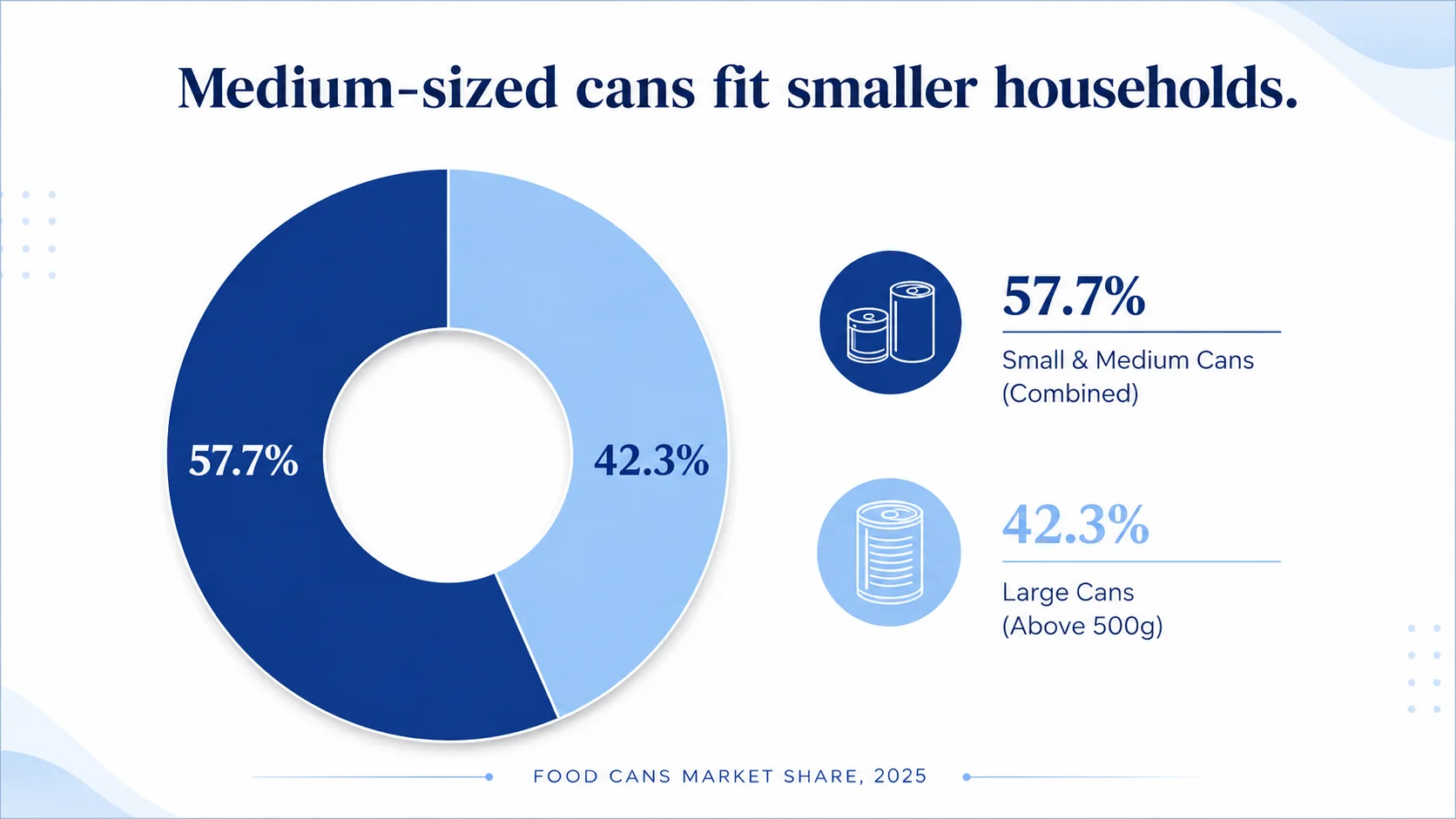
Large cans above 500 grams remain the largest size category. Medium cans between 201 and 500 grams are growing faster, driven by smaller households and portion-controlled products.
Ready meals remain the largest application, while wet pet food is the fastest-growing segment.
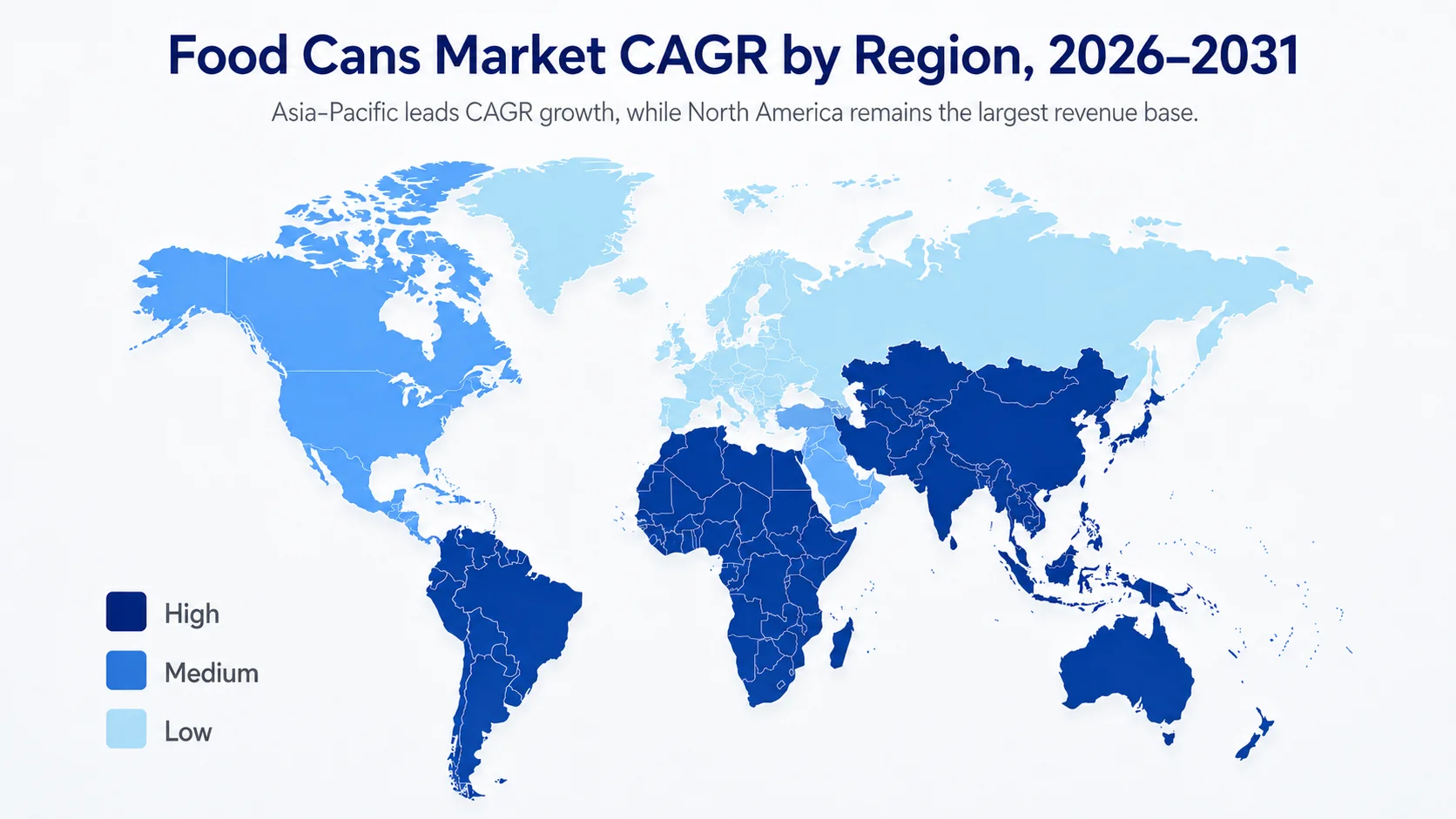
North America is the largest regional market. Asia-Pacific is expected to record the highest growth rate.
2. Major Metal Food Can Market Trends
2.1 Aluminum Is Gaining Share
Steel remains the main material for canned vegetables, soups, meat, and institutional food products. It is widely available, easy to process, and cost-effective for high-volume production.
Aluminum is gaining share where weight, corrosion resistance, and recycling performance matter more.
Its lower weight can reduce freight costs. It also works well with seamless two-piece can designs used for pet food, seafood, and ready meals.
Recycled aluminum requires far less energy than primary aluminum production. This makes it attractive to companies working toward packaging and emissions targets.
Steel is unlikely to be replaced across the market. It remains competitive in larger formats and can be separated easily in recycling facilities using magnetic sorting.
Many food processors will continue to use both materials to manage costs and supply risks.
2.2 Two-Piece Cans Are Expanding
Three-piece cans consist of a welded body, a top end, and a bottom end. They remain common because manufacturers can produce different can heights with relatively flexible equipment.
Two-piece cans use a formed body and one separate end. They have no side weld, which reduces coating use and removes one possible failure point.
The main limitation is tooling cost. Two-piece production becomes more economical when volumes are high.
New high-speed lines can produce more than 100,000 cans per hour. This allows manufacturers to spread tooling costs across larger production runs.
As a result, many new plants in Asia-Pacific are installing two-piece lines instead of older welded-can systems.
2.3 Medium-Sized Cans Fit Smaller Households
Large cans above 500 grams accounted for 42.32% of market revenue in 2025. They remain common in foodservice and family-size products.
Medium cans between 201 and 500 grams are expected to grow at a 5.87% CAGR through 2031.
Smaller households often prefer products that can be used in one meal. Medium cans reduce leftovers and the need to store opened food.
They also work well in e-commerce grocery orders because they are easier to pack and create less parcel weight than larger formats.
Small cans below 200 grams will remain common in premium seafood, infant nutrition, sauces, and single-serve pet food.(источник)
2.4 Wet Pet Food Is Growing Faster
Ready meals represented 34.32% of food can revenue in 2025. Wet pet food, however, is projected to grow at a 6.21% CAGR through 2031.
Pet owners are buying more portion-controlled wet food. Metal cans provide reliable sealing, long shelf life, and strong protection during transport.
Formats around 200 and 400 grams are especially common because they help control serving size and reduce waste after opening.
Premium pet food also supports greater use of aluminum, printed can bodies, and smaller production runs.
Traditional categories such as canned vegetables and fruit will continue to generate large volumes, but their growth will be slower.
3. What Is Driving Market Growth?
3.1 Urbanization Supports Shelf-Stable Food Demand
Urban households often have less time and space for food preparation. Shelf-stable vegetables, proteins, soups, and ready meals offer simple storage and preparation.
This pattern is especially relevant in India, Indonesia, Brazil, and parts of the Middle East.
Metal cans also work well in regions where refrigerated storage and transport remain limited. Food can be distributed and stored without depending on a continuous cold chain.
3.2 Modern Retail Is Expanding Distribution
Supermarkets, discount stores, convenience shops, and grocery platforms are increasing the availability of canned food.
Retailers also use canned beans, tomatoes, seafood, soups, and pet food in private-label ranges because these products have long shelf lives and low spoilage risk.
Metal cans can withstand repeated handling during delivery. They are less fragile than glass and do not require refrigerated transport.
3.3 Barrier Performance Remains a Technical Advantage
Metal cans block light, oxygen, and moisture. Properly processed products can remain stable for several years without refrigeration.
Flexible pouches and cartons can provide similar protection, but they often rely on bonded layers of plastic, paper, and aluminum.
These multilayer structures can be more difficult to separate during recycling.
Metal cans remain useful for products that require long storage, high-temperature processing, strong stacking performance, and resistance to punctures.
4. Main Constraints on the Market
4.1 Flexible Packaging Is Lighter
Flexible pouches use less material and take up less space during transport. They are common in baby food, sauces, fruit products, ready meals, and pet food toppers.
For products with shorter shelf-life requirements, a pouch may cost less than a metal can.
Metal remains stronger where the package must tolerate retort processing, warehouse stacking, long storage, or rough distribution conditions.
The right format depends on the food product and its supply chain.
4.2 Raw Material Prices Affect Margins
Aluminum and steel prices can change faster than packaging contracts.
This creates problems for can manufacturers working under fixed-price agreements. Higher metal, coating, or energy costs can reduce margins before prices are adjusted.
Lightweighting can reduce material use, but wall thickness cannot be reduced without testing pressure resistance, seam quality, stacking strength, and retort performance.
4.3 BPA Rules Are Changing Internal Coatings
The European Union banned BPA in food-contact materials in December 2024. Can manufacturers are moving toward polyester, acrylic, and other alternative coatings.
A new coating must remain stable when exposed to acidic foods, fatty foods, proteins, heat treatment, and long storage periods.
Manufacturers need migration tests, corrosion tests, production trials, and shelf-life validation before changing coating systems.
This adds cost and development time, but it is becoming a standard part of can design.
4.4 Recycling Depends on Local Collection
Metal cans are recyclable, but actual recovery depends on local collection and sorting systems.
Steel cans can be separated using magnets. Aluminum has high scrap value but may still be lost where collection systems are weak.
The environmental result depends on whether the can is collected and returned to metal production, not only on whether the material is technically recyclable.
5. Regional Market Outlook
5.1 North America
North America accounted for 39.87% of global food can revenue in 2025.
The region has mature canning infrastructure and stable demand for soups, vegetables, seafood, meat, and pet food.
Growth is expected to remain moderate. Most investment will focus on lightweighting, production efficiency, BPA-free coatings, and premium pet food formats.
5.2 Asia-Pacific
Asia-Pacific is projected to grow at a 6.42% CAGR through 2031.
Urbanization, rising incomes, food-processing investment, and limited cold-chain coverage are supporting demand.
Manufacturers are also adding local two-piece can capacity. Producing cans closer to filling plants reduces the cost of transporting empty containers.
India, China, and Southeast Asia will remain key markets for production and consumption.(источник)
5.3 Europe
European growth will be shaped mainly by regulation and packaging changes.
BPA restrictions, recycling targets, and producer responsibility rules are pushing manufacturers to update coatings and reduce material use.
Private-label canned food will remain an important part of the market, particularly in discount retail.
5.4 South America, the Middle East, and Africa
Brazil has established demand for affordable canned staples and a large retail market.
In the Middle East and Africa, long shelf life is a practical advantage because refrigerated transport and storage are not available in every area.
Growth will depend on food prices, local filling capacity, metal supply, and waste collection systems.
6. Future Outlook
Steel will remain the main material for high-volume and price-sensitive food products. Aluminum will gain share in lightweight, two-piece, and premium applications.
Medium-sized cans will grow faster than large family formats. Wet pet food will continue to outperform many traditional food categories.
Asia-Pacific will provide much of the new market growth and production capacity.
Manufacturers will need to focus on practical improvements: lower material use, stable BPA-free coatings, efficient production lines, and better recovery of used cans.