
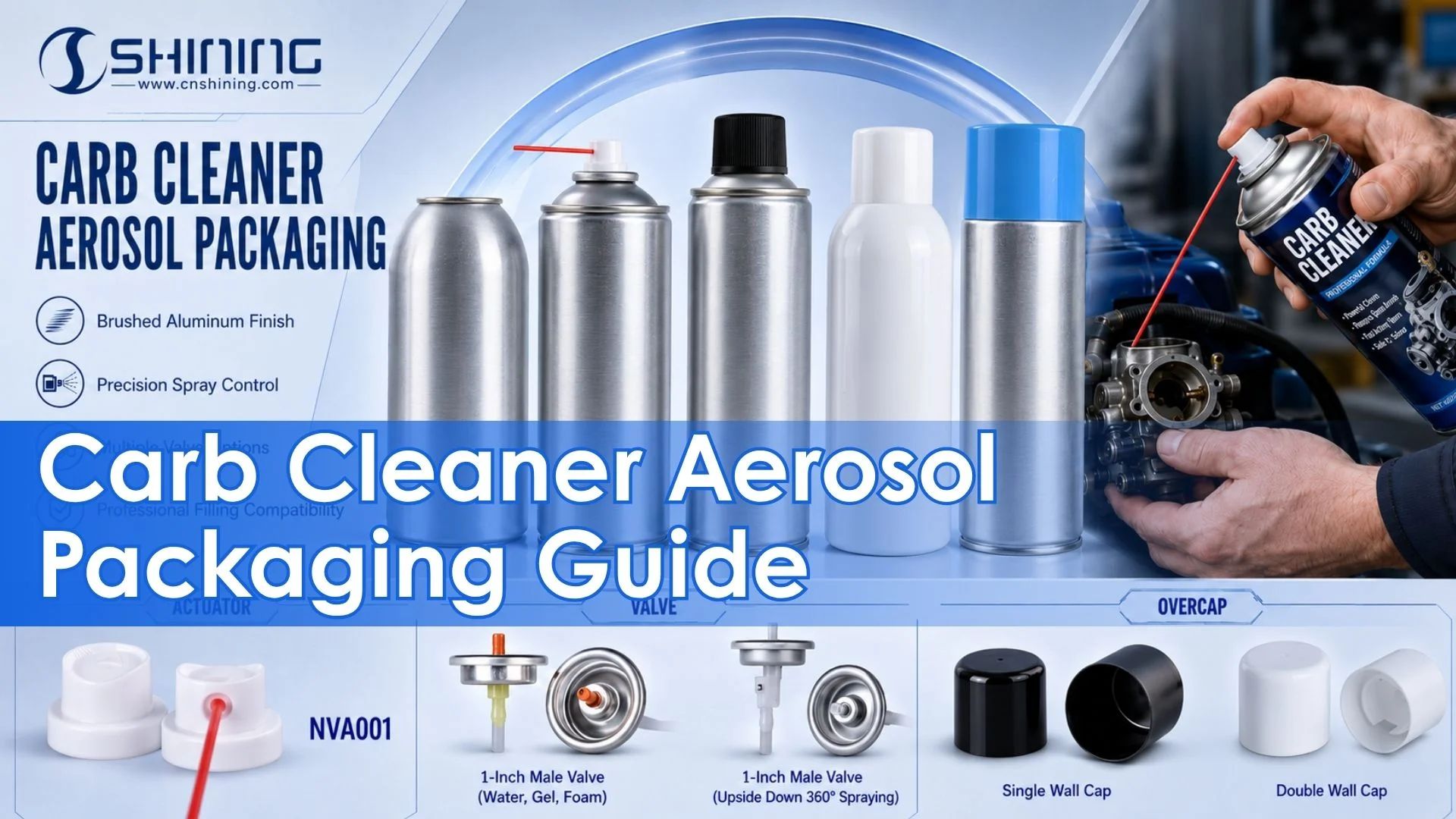
Aerosol carb cleaner, also called carburetor and choke cleaner or carb/throttle body cleaner, is built around one practical requirement: deliver a fast solvent jet into a dirty fuel-air passage and leave very little residue behind. The dirt is not simple dust. It is usually a mix of gasoline gum, varnish-like deposits, carbon, oily sludge, fine particles, and light corrosion.
The product sits between chemistry and packaging engineering. The solvent system dissolves and swells deposits. The aerosol valve, actuator, dip tube, can coating, and propellant decide whether that solvent reaches the right place with enough force. In this category, a poor straw or unstable valve can damage the user experience as much as a weak formulation.
1. Définition du produit et mécanisme de nettoyage
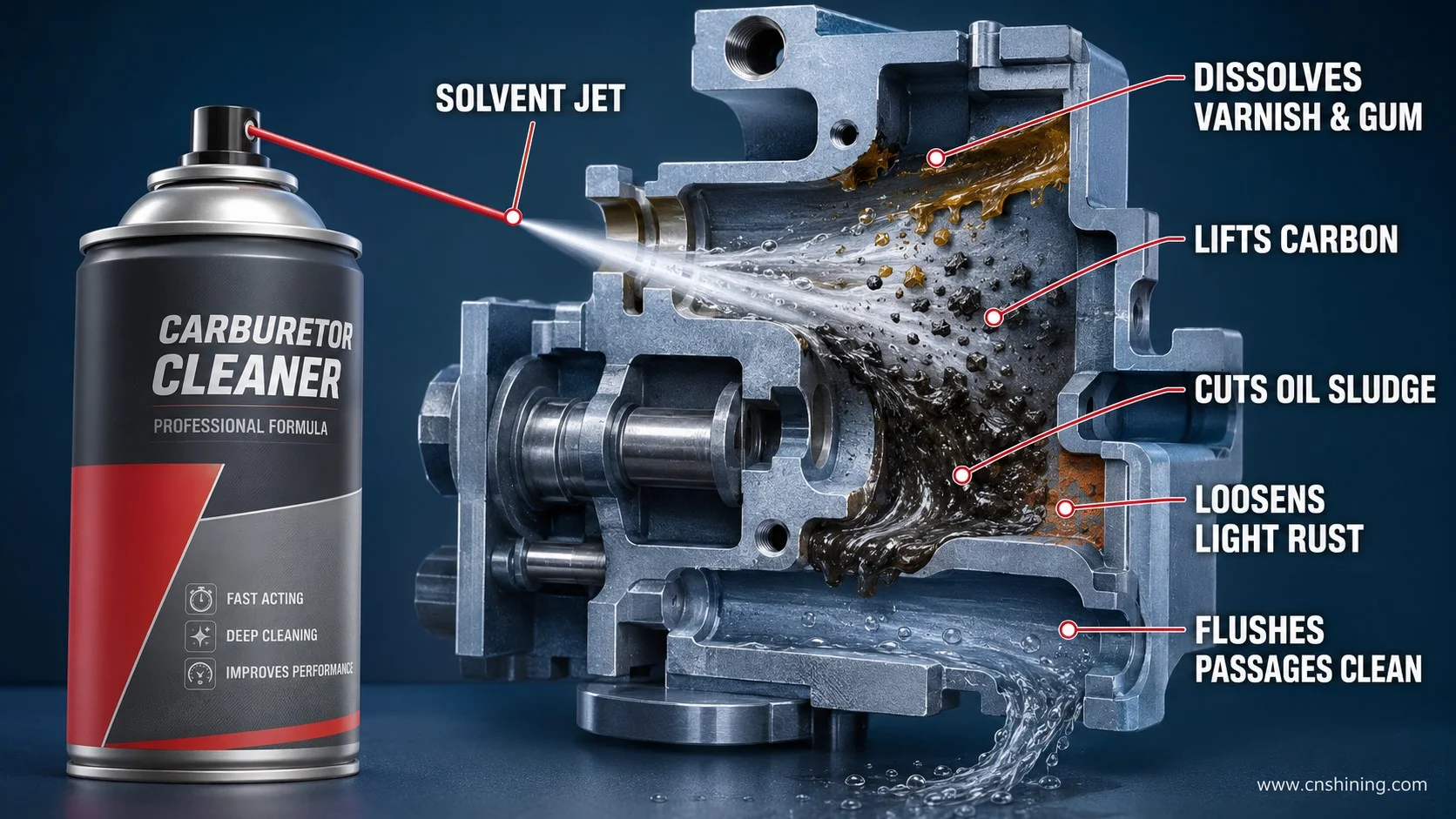
1.1 Definition and Use Boundary
In U.S. federal regulation, carburetor and choke cleaner is treated as a defined consumer product category. The regulatory boundary matters because it separates a spray cleaner from a fuel additive poured into a tank or fuel line. The eCFR definition under 40 CFR Partie 59 Sous-partie C is therefore not just legal wording. It affects VOC limits, label language, product claims, and testing logic.
Brand education materials follow the same line. Berryman, for example, distinguishes aerosol carb and choke cleaner from pour-in fuel additives, and its technical answer notes that spraying into the carburetor is useful, but narrow passageways or metering blocks may still need removal and direct cleaning. This is a good reality check. Aerosol carb cleaner is a fast first-line tool, not a final process for every blocked carburetor. See the Berryman usage answer.
1.2 Chemical and Mechanical Action
Carburetor deposits are difficult because they are mixed deposits. Acetone helps with fast drying, rapid degreasing, and low residue. Aromatic hydrocarbons such as toluene or xylene improve swelling and dissolution of hydrophobic varnish and gum. Alcohols such as methanol or isopropanol help attack more polar resin-like residues. Aliphatic hydrocarbons and LVP hydrocarbon solvents tune solvency and evaporation behavior.
The spray format adds a mechanical advantage. A propellant-driven jet acts like a small flushing tool. It does not only wet the surface; it knocks loose softened contamination and carries it away. That is why actuator geometry and pressure stability matter.
2. Common Solvents, Active Ingredients, and Propellants
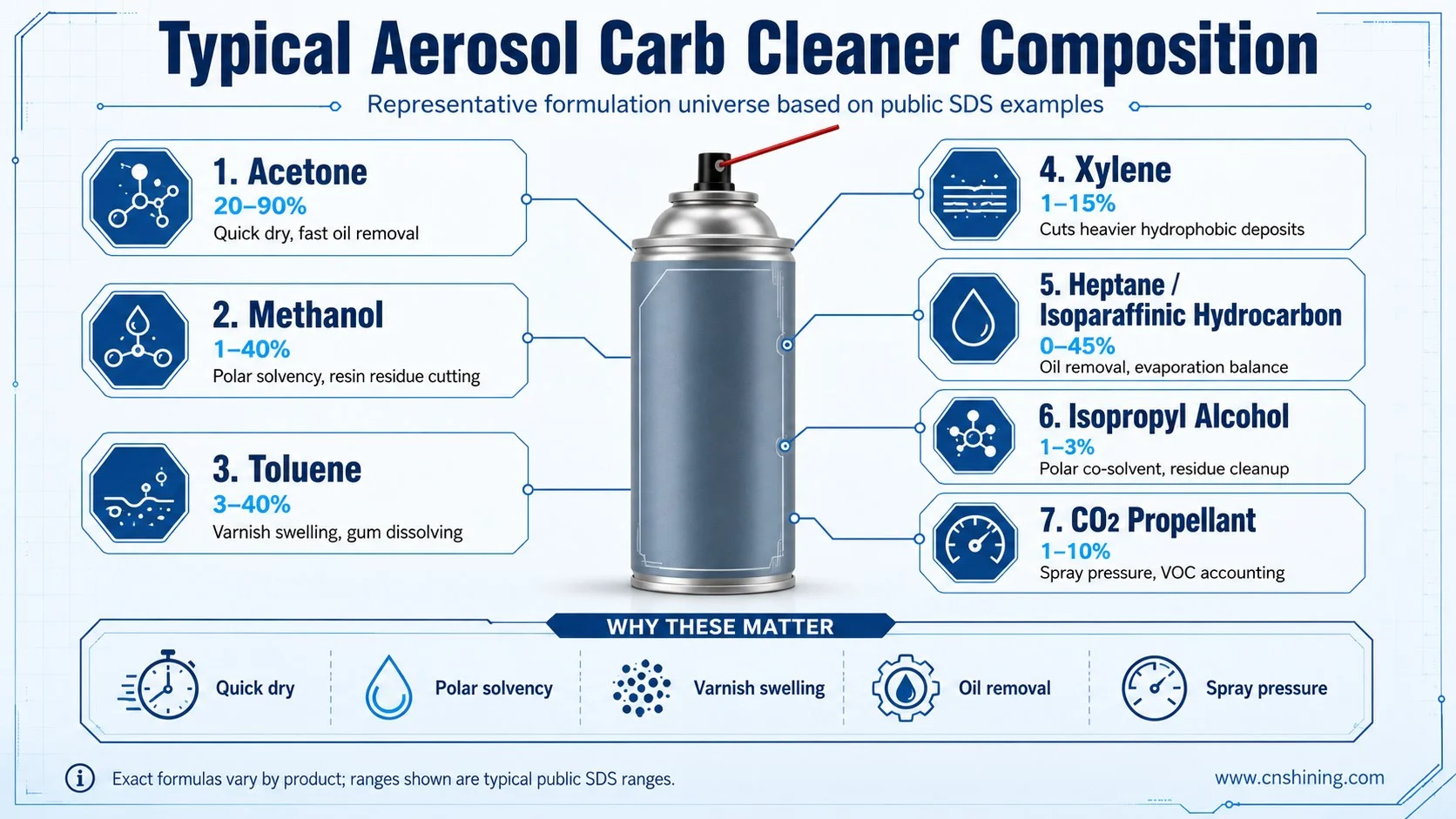
Public SDS documents show a clear formulation universe. CRC Clean-R-Carb 05079 uses a strong traditional solvent structure: methanol 30–40%, toluene 30–40%, acetone 20–30%, and CO2 5–10%. WD-40 Specialist Carb/Throttle Body & Parts Cleaner is more acetone-led: acetone 80–90%, CO2 1–10%, heptane under 10%, and isopropyl alcohol 1–3%. Gumout Jet Spray lists acetone 65–85%, toluene 5–10%, and CO2 5–10%. GUNK Small Engine Carb & Choke Cleaner uses acetone as the main solvent with isomeric petroleum distillates, CO2, xylene, and ethylbenzene.
The pattern is direct: acetone has become the backbone of many low-VOC, fast-drying routes. Stronger traditional routes still rely on aromatics, but aromatics carry heavier odor, toxicology, and regulatory burdens. CO2 and other compressed gases also matter because propellants can count into total VOC calculations for spray products. Public SDS examples include CRC Clean-R-Carb SDS, WD-40 Specialist SDS, Gumout Jet Spray SDS, et GUNK Small Engine SDS.
| Classe d'ingrédients | Matériaux typiques | Fonction principale | Publicly Visible Range | Signification commerciale |
|---|---|---|---|---|
| High-volatility ketone | Acetone | Quick drying, fast oil removal, lower surface tension, low-VOC design space | 20–90% | Backbone of fast-drying and low-VOC routes |
| Alcools | Methanol, isopropyl alcohol | Polar solvency and resin residue cutting | 1–40% | Strong cleaning effect, heavier health and labeling burden |
| Aromatics | Toluene, xylene, ethylbenzene | Swelling and dissolving gum, varnish, and hydrophobic deposits | 3–40% | Powerful solvency, higher regulatory pressure |
| Aliphatic / LVP hydrocarbon solvents | Heptane, isoparaffinic distillates, LVP hydrocarbon | Oil and hydrophobic deposit removal, evaporation curve adjustment | 0–45% | Useful in 50-state or low-VOC formulation balancing |
| Ether co-solvents | PTB and related materials | Solvency window adjustment, odor or flash point control | Patent example around 10% | Interesting for alternative routes, not dominant in mainstream retail products |
| Propergols | CO2, nitrogen, compressed air | Spray pressure, VOC accounting, manufacturability, transport classification | 1–10% common | Low-VOC routes increasingly favor compressed gas concepts |
3. Performance Comparison and Formulation Routes
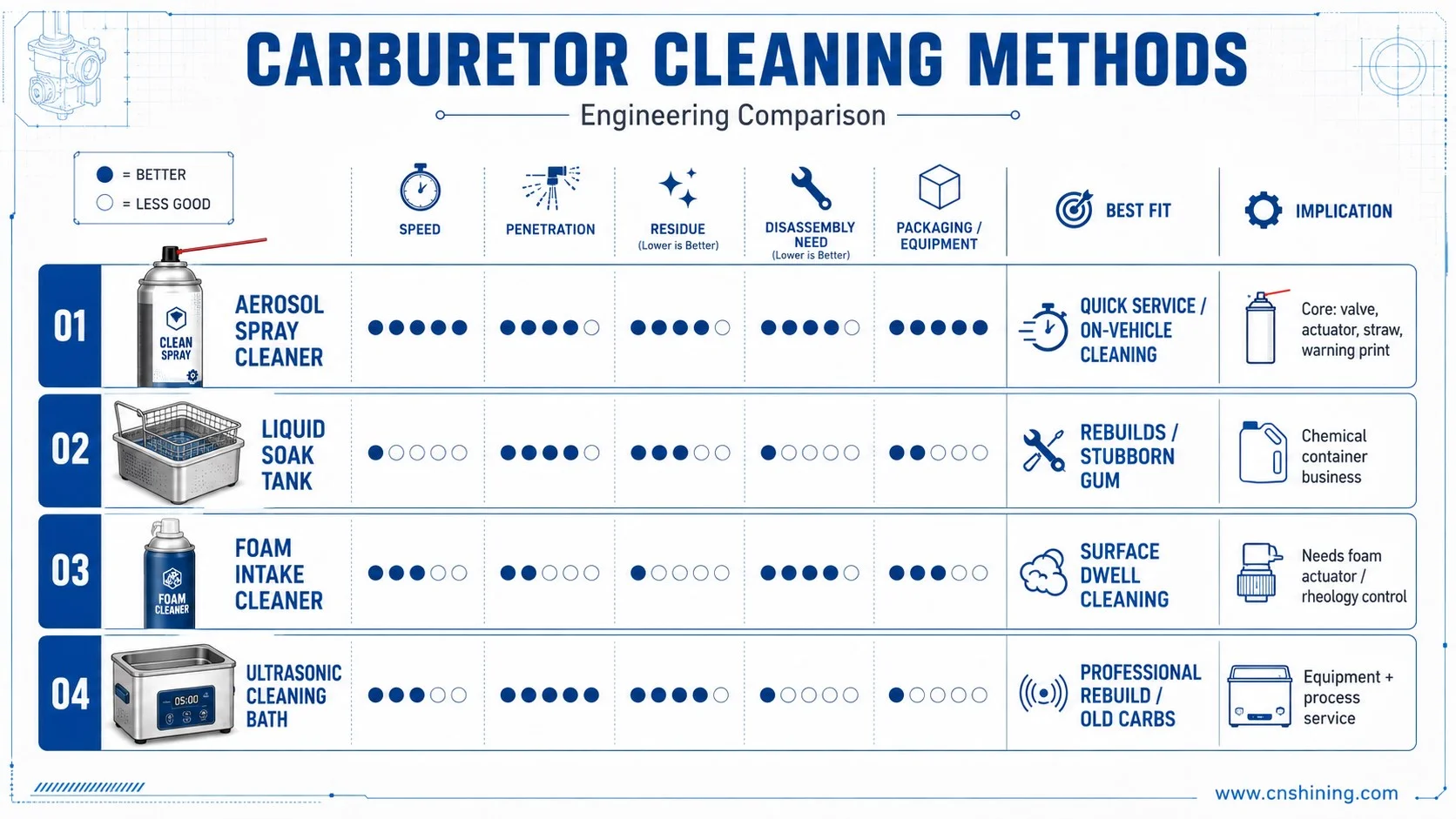
| Méthode | Medium / Delivery | Avantages | Limites principales | Meilleure adaptation | Packaging / Equipment Meaning |
|---|---|---|---|---|---|
| Aerosol carb cleaner | High-volatility solvent plus aerosol propellant | Fast, strong penetration, ready-to-use, flushes while spraying, low residue | High vapor exposure, not enough for severe blockage, can be misused on plastics or sensors | Quick service, on-vehicle cleaning, throttle linkage, intake mouth cleaning | Valve, actuator, extension straw, and warning print are core differentiators |
| Liquid soak cleaner | Solvent bath or basket soak | Better for stubborn gum and hidden passages, longer contact time | Slower, requires disassembly, creates more waste-liquid management | Rebuilds, restoration, badly aged carburetors | More like chemical container business than aerosol packaging |
| Foam intake / throttle cleaner | Foam clinging to surface | Longer surface dwell time | Less flushing force in deep passages, higher residue risk | Intake and throttle surface cleaning where dwell time matters | Needs foam actuator or formula rheology control |
| Nettoyage par ultrasons | Water-based or solvent bath plus cavitation | Effective on complex internal cavities, small holes, and aged residues | Requires disassembly, equipment CAPEX, labor, and material compatibility control | Professional bench work, batch rebuilds, old carburetor restoration | Equipment and process service, not a single-can user experience |
A simple judgment works well in the field: if the user needs “no disassembly, immediate effect, quick drying,” aerosol is usually the practical route. If the carburetor is decades old, varnished internally, and the idle or main jet will not pass fluid, soaking or ultrasonic cleaning is more reliable.
| Itinéraire | Exemple public | Typical Ratio | Engineering View |
|---|---|---|---|
| Traditional strong-solvent route | CRC Clean-R-Carb 05079 | Methanol 30–40 / toluene 30–40 / acetone 20–30 / CO2 5–10 | Strong cleaning force, but heavier toxicology, odor, and regulatory load |
| Acetone-led quick-dry route | Spécialiste WD-40 | Acetone 80–90 / CO2 1–10 / heptane <10 / IPA 1–3 | Typical low-VOC-friendly, quick-dry, precision-spray direction |
| Acetone plus limited aromatic route | Gumout Jet Spray | Acetone 65–85 / toluene 5–10 / CO2 5–10 | Balanced route for retail: solvency retained while VOC pressure is reduced |
| 50-state / low-VOC practical route | GUNK Small Engine Carb & Choke Cleaner | Acetone 70–<80 / isomeric petroleum distillates 10–<20 / CO2 5–<10 / xylene 5–<10 / ethylbenzene 3–<5 | Acetone is the main carrier; limited aromatics preserve cleaning strength |
| Low-VOC patent route | US20140349916A1 | LVP hydrocarbon 20–45 / acetone 50–80 / heptane 0–10 / CO2 3–10 | Regulation-driven formulation design suitable for 50-state thinking |
| Low-odor alternative concept | EP0857778A2 | Alkyl aromatic 86 / PTB 10 / CO2 4 | Lower vapor pressure, lower odor, higher flash point concept route |
The patent direction is worth watching. US20140349916A1 shows a low-VOC cleaner framework using LVP hydrocarbon, acetone, limited heptane, and CO2 or nitrogen. EP0857778A2 gives a different low-odor cleaner concept. Neither should be treated as a universal formula, but both explain why modern products are moving away from “more aggressive solvent at any cost.”
4. Termes techniques courants
| Terme | Signification technique simple | Commercial / Engineering Meaning |
|---|---|---|
| COV | Volatile organic compound, often controlled by weight percentage | Decides regional sales eligibility and SKU design |
| LVP-VOC | Low vapor pressure VOC, treated differently in some rules | Useful buffer in low-VOC formulation |
| HAP | Hazardous air pollutant | Affects occupational health review, SDS, and EHS acceptance |
| Produit en aérosol | Product dispensed from a self-pressurized container by propellant | Triggers aerosol packaging, transport, and valve design rules |
| Propergol | CO2, nitrogen, hydrocarbon gas, or similar pressure source | Controls spray feel, VOC count, GWP, and transport classification |
| Actionneur | Le bouton ou la tête de pulvérisation actionnée par l'utilisateur | Controls pattern, hand feel, mis-spray risk, and precision |
| Soupape | Aerosol valve assembly | Controls sealing, solvent resistance, and output consistency |
| Sensor-safe | Lower risk to sensors, usually linked with low residue and reduced material attack | Reduces misuse complaints and supports higher-positioned products |
| Sans résidus | Leaves little visible residue after drying | Core expectation for carb cleaner |
| 50-state compliant | Formula positioned for all U.S. state sales requirements | Reduces SKU fragmentation and channel complexity |
| ATTEINDRE | EU chemical registration, evaluation, authorization, and restriction system | Affects raw material selection and EU launch |
| CLP | EU classification, labeling, and packaging system | Controls pictograms, warning words, and hazard statements |
| ONU1950 | Transport number for aerosols | Controls land, sea, air shipping declarations |
| GHS | Globally harmonized chemical classification and labeling system | Common language for SDS and labels |
| BOV | Bag-on-valve aerosol system | Attractive for some sprays, but strong solvent compatibility must be proven |
5. Regulatory and Transport Requirements
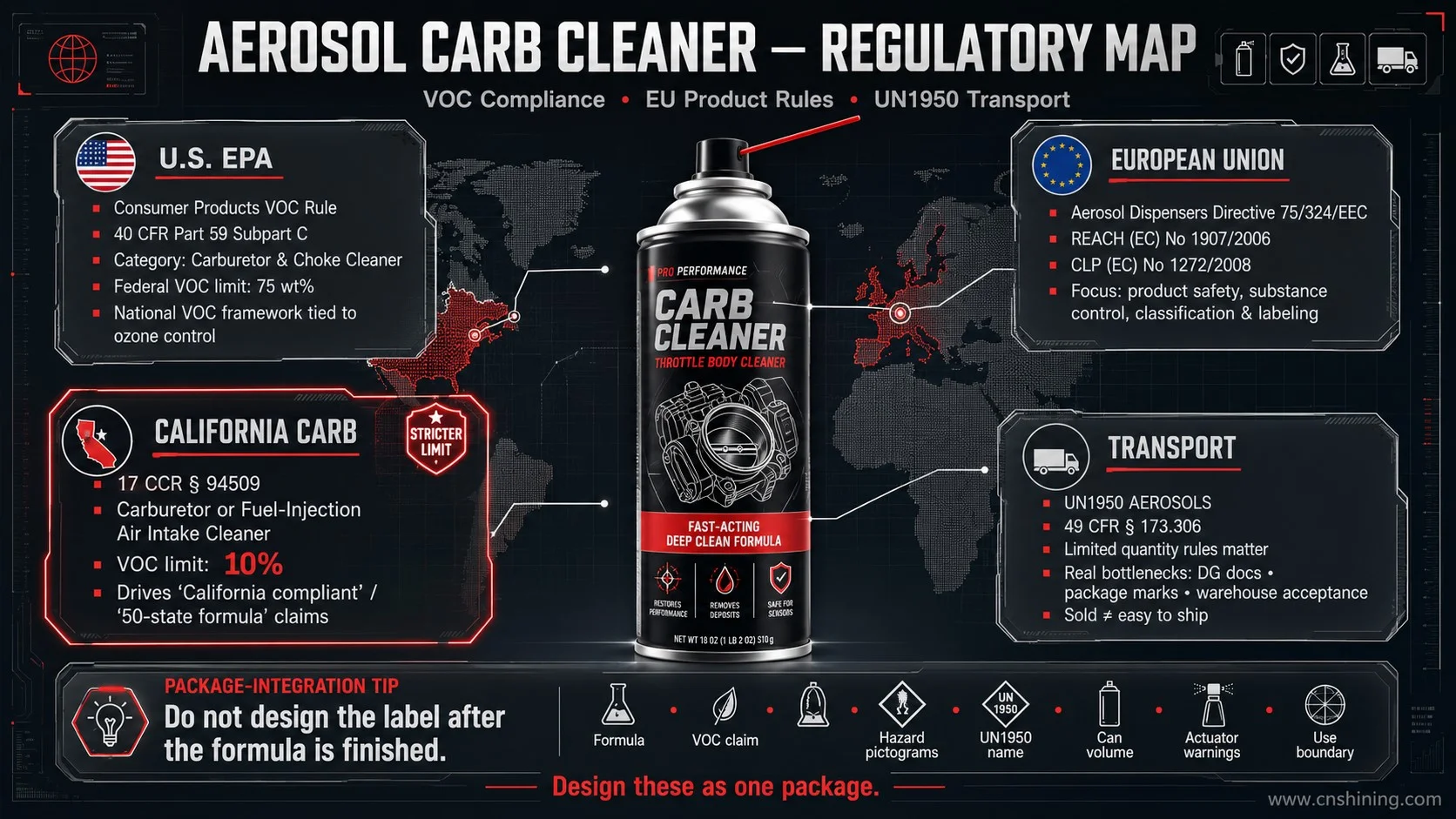
In the United States, EPA consumer product VOC rules set the federal framework. The EPA rule page notes national VOC standards for consumer products and the rule’s link to ozone control. For carburetor and choke cleaners, federal content limits and definitions sit within Part 59. EPA’s public overview is available at Consumer Products: National VOC Emission Standards.
California is tighter. The CARB/OTC-style pressure is why many brands use phrases such as VOC compliant, California compliant, or 50-state formula. California’s standard for “Carburetor or Fuel-Injection Air Intake Cleaner” is listed with a 10% VOC limit in 17 CCR § 94509.
Europe works less like a single VOC number and more like a combined control system: aerosol dispenser safety, REACH raw material governance, and CLP classification and labeling.
Transport is a separate problem. Most aerosol carb cleaners speak the language of AÉROSOLS UN1950. U.S. transport rules for limited quantities and aerosol containers are reflected in 49 CFR §173.306. For cross-border e-commerce, “the product can be sold” does not mean “the product can be shipped easily.” DG documentation, packaging marks, and warehouse acceptance often become the real bottleneck.
6. Development Trends: Low VOC, Material Safety, Recyclable Cans, Smart Actuators
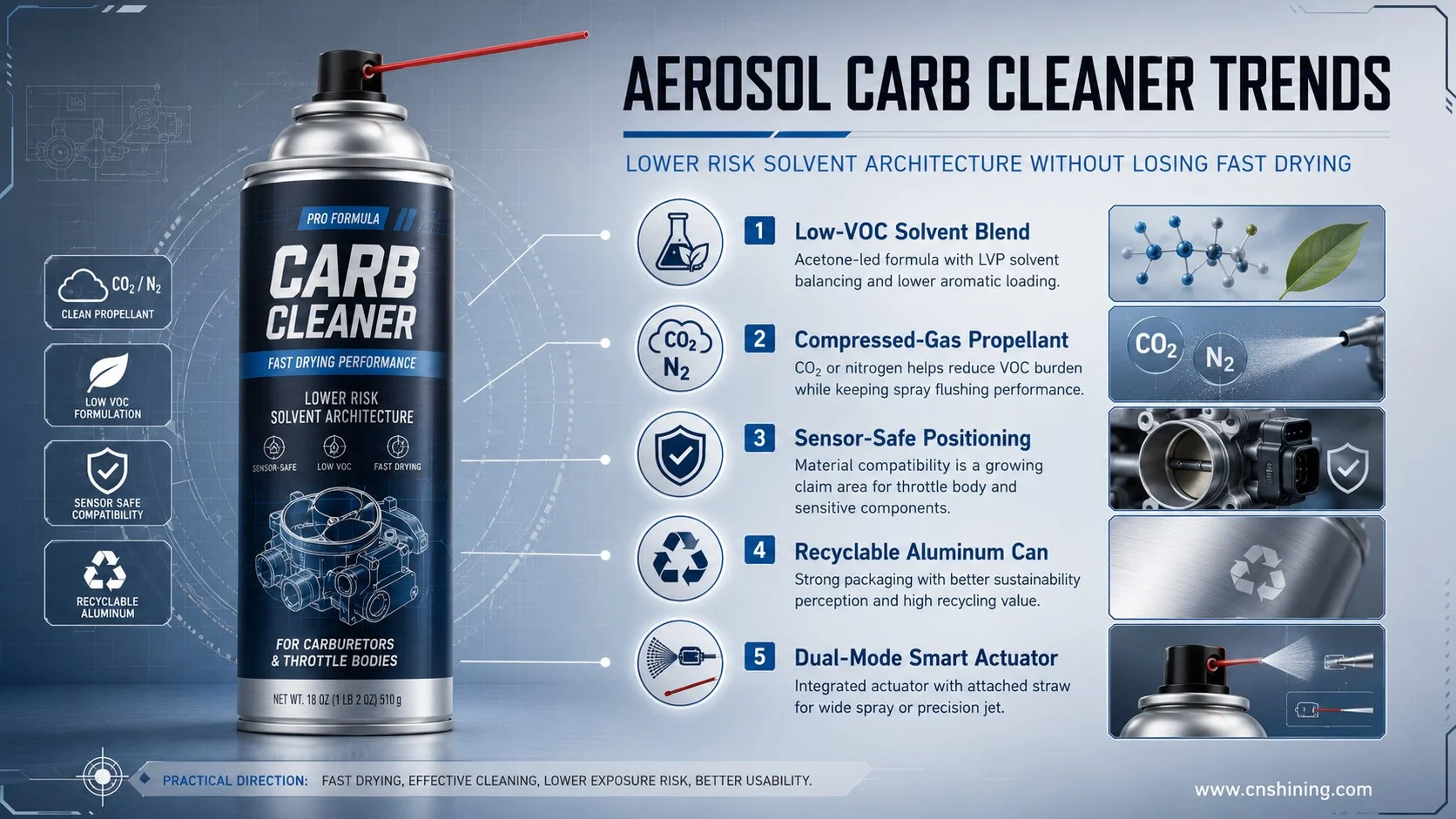
The clearest trend is not full water-based replacement. It is lower risk solvent architecture without losing quick drying and spray flushing. Acetone-led systems, LVP hydrocarbon balancing, compressed-gas propellants, and lower aromatic loading are the practical direction.
Material compatibility is becoming a stronger claim area. Users often confuse carb cleaner, MAF cleaner, contact cleaner, throttle body cleaner, and brake cleaner. That is why “sensor-safe” or “plastic-safe” claims appear more often, including newer performance-market products such as Holley’s 18 oz carburetor and throttle body cleaner page, which highlights sensor and electronics safety. The reference product page is Holley 120-HLYCC-18.
Packaging sustainability is also moving into purchasing conversations. Shining Packaging states that aluminum aerosol cans are recyclable and that recycling aluminum can save large amounts of energy compared with primary aluminum production. This is relevant because strong solvent products still need robust packaging.
The actuator is another active area. Integrated, lightweight, capless, or dual-mode actuators directly attack old customer complaints: lost straws, poor precision, accidental discharge, and too many loose parts.
Exposure science is pushing the same direction. A peer-reviewed paper in Aerosol and Air Quality Research reported high total VOC contents in spray consumer products and noted that propellants can contribute to VOC emissions. That does not make every carb cleaner the same, but it confirms that spray cleaner exposure is a real technical issue, not just a consumer perception problem. See the AAQR paper on VOC emissions from consumer products.
7. Top 10 Brands: Visibility, Capacity, and Positioning
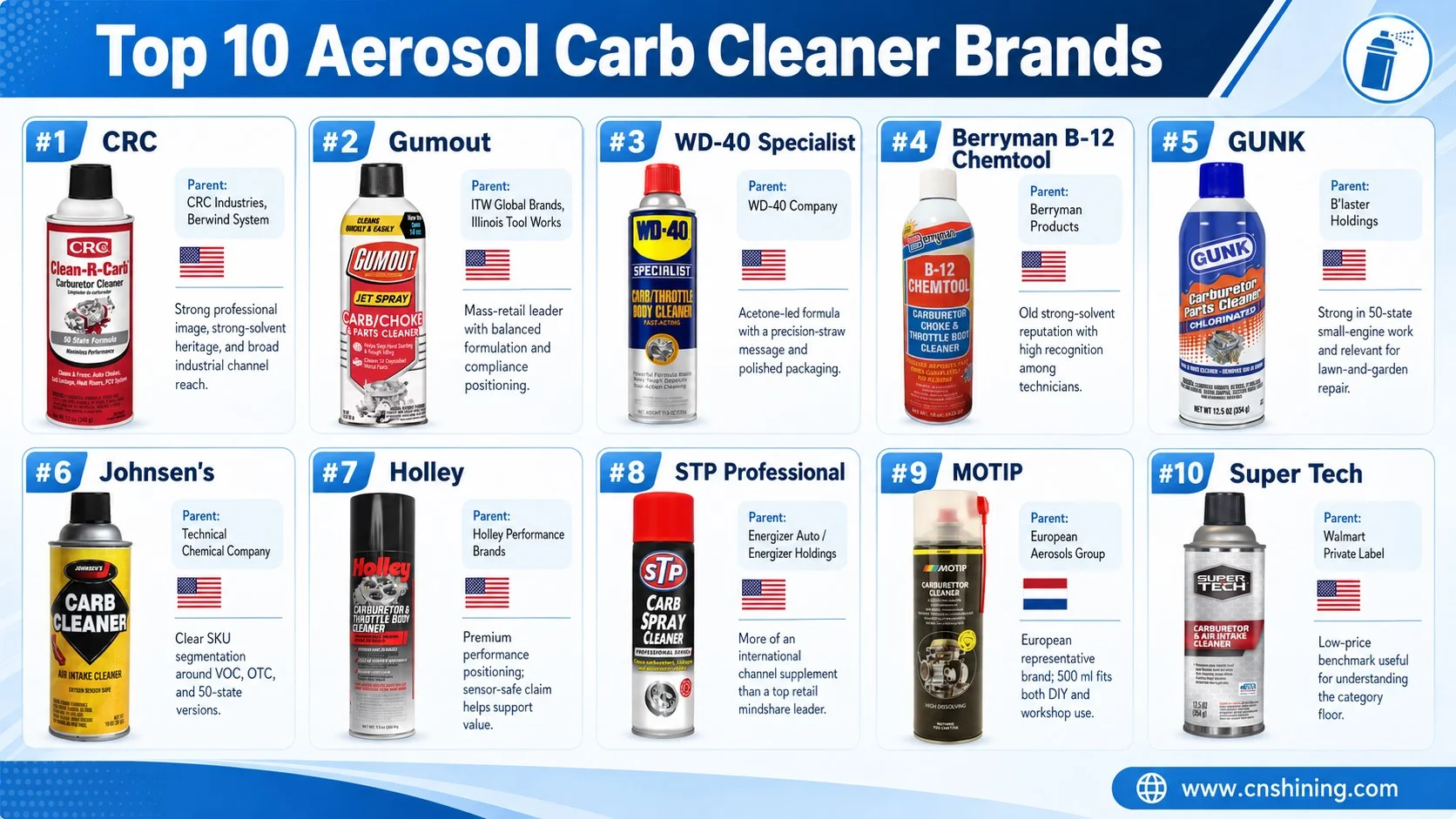
| Marque | Pays / Région | Parent / Operating Entity | Taille courante | Commentaire technique direct |
|---|---|---|---|---|
| CRC | États-Unis | CRC Industries, Berwind system | 340 ml | Strong professional image, strong-solvent history, wide industrial channel access |
| Gumout | États-Unis | ITW Global Brands, Illinois Tool Works | 14 oz | Mass retail representative with balanced formulation and compliance positioning |
| Spécialiste WD-40 | États-Unis | Société WD-40 | 13.5 oz | Acetone-led formula, precision straw message, strong packaging experience |
| Berryman B-12 Chemtool | États-Unis | Produits Berryman | 10 oz, 16 oz, 20 oz | Old strong-solvent reputation; high recognition among technicians |
| GUNK | États-Unis | B'laster Holdings | 354 g | Strong in 50-state small-engine context, with lawn and garden repair relevance |
| Johnsen’s | États-Unis | Technical Chemical Company | 10 oz, 16.25 oz | Clear SKU segmentation around VOC, OTC, and 50-state versions |
| Holley | États-Unis | Holley Performance Brands | 500 g | Higher price, clear performance-market positioning, sensor-safe claim supports value |
| STP Professional | États-Unis | Energizer Auto / Energizer Holdings | 500 ml | More of an international channel supplement than a top retail mindshare leader |
| MOTIP | Pays-Bas | European Aerosols Group | 500 ml | European representative brand; 500 ml size fits both DIY and workshop use |
| Super Tech | États-Unis | Marque privée Walmart | 12.5 oz; also 10% VOC 10 oz version | Sets the low retail price reference; useful for understanding the category floor |
8. Platform Pain Points and Packaging Design Suggestions
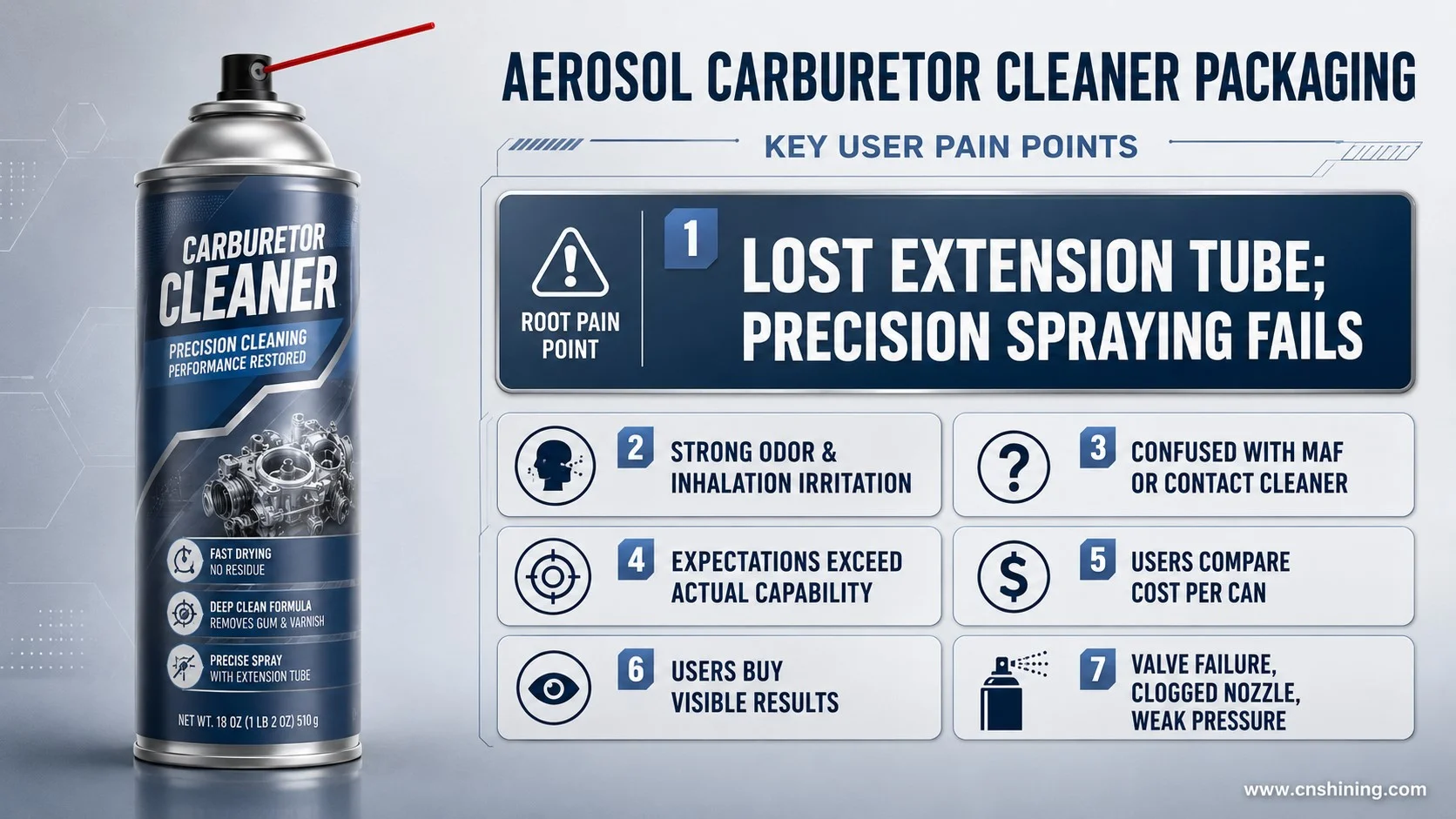
Customer pain points are stable across retail and repair communities: extension straws pop out or disappear, spray precision is poor, odor and inhalation irritation are strong, the can will not spray, half a can loses pressure, users worry about plastic or sensor damage, and severe blockage does not clear with spray alone.
| Signal de quai | Representative Theme | Root Pain Point | Packaging Solution |
|---|---|---|---|
| Avis sur le commerce de détail | Straws popping out | Lost extension tube; precision spraying fails | Use hinged integrated straw, secondary snap lock, or tethered straw design |
| Repair forums | “Do not want to kill my lungs” | Odor and inhalation irritation | Front-panel ventilation/PPE icons, lower-splash actuator, lower-aromatic SKU |
| Repair forums | Carb cleaner is not plastic-safe | User confuses carb cleaner with MAF cleaner or contact cleaner | Add “Not for MAF / O2 sensors / painted plastics” icons and QR compatibility table |
| Repair discussion | Aerosol alone will not clear every passage | User expectation exceeds product capability | Print three use scenarios: maintenance, moderate deposit, severe blockage requiring disassembly |
| Value retail | Price sensitivity | Users compare cost per can | Basic actuator for economy line; integrated precision actuator for higher line |
| Short-video commerce | Smoother idle, less vibration | User buys perceptible outcome | Front label should speak to hard starts, rough idle, hesitation, and sticking linkage |
| Brand support topics | Can will not spray | Valve failure, clogged nozzle, low pressure | Improve valve cleanliness, tail filter, particle control, and spray/leak testing |
If I had no budget constraint, I would start from the valve and actuator. For valve design, use seal materials proven against acetone, methanol, toluene, xylene, and hydrocarbon mixtures. The valve stem, gasket, cup, and dip tube should be immersed in the full formulation, not only in individual solvents. Strong solvent compatibility matters more than cosmetic details.
For the actuator, a dual-mode concept is practical: a broad spray nozzle for open surfaces and a flip-up or tethered straw for idle passages, linkages, and narrow gaps. The extension straw should not be a separate loose part. That failure mode is too common and too avoidable.
Can size should match channel. A 10–14 oz can works for high-volume DIY retail. A 16–18 oz can fits professional workstations where one repair should not require a second can. Grip matters because users often wear gloves or have oil on their hands. Can coating is not a place for risky cost-cutting when the formula contains high acetone, methanol, toluene, or xylene.
Label design should be layered. First layer: where to use and where not to use. Second layer: ventilation, PPE, ignition warning, and storage temperature. Third layer: full regulatory text. A QR tutorial can reduce misuse, especially for people who assume carb cleaner, throttle cleaner, MAF cleaner, and brake cleaner are interchangeable. CRC’s own instructional material shows that users still search for step-by-step carburetor cleaning help; one example is CRC’s carburetor cleaning article.
9. Compatibilité produit : Actionneurs, boîtiers et vannes Shining Packaging
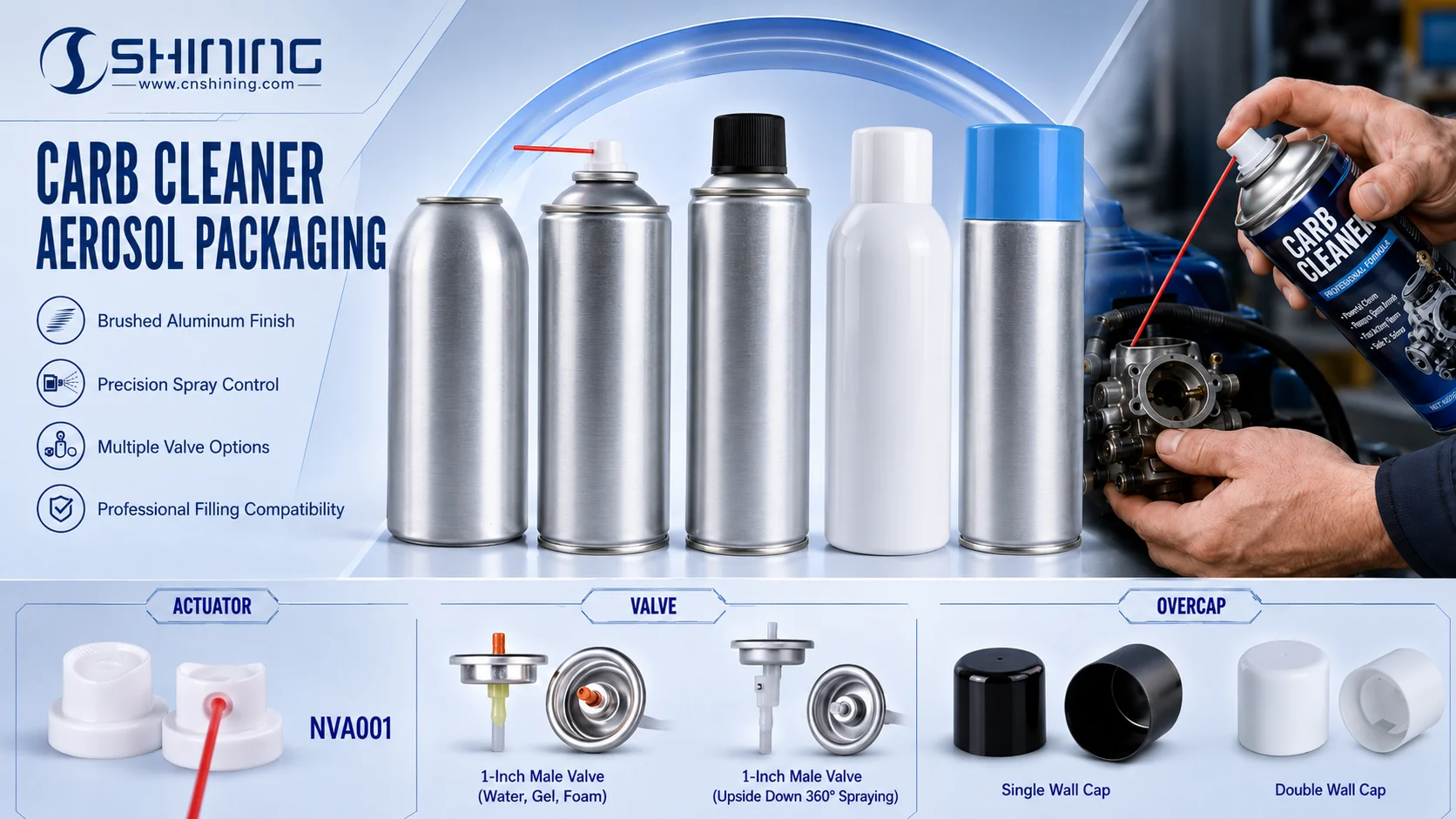
For aerosol carb cleaner, packaging hardware is not a secondary accessory. It is part of the cleaning system. Shining Packaging’s relevant scope in this application is the actionneur, aérosol, et soupape. The practical questions are simple: can the valve seal survive the solvent blend, does the actuator place the spray accurately, does the extension tube stay with the can, and does the can coating remain stable during storage?
A carb cleaner package should be specified from the formula outward. High-acetone and aromatic-containing systems need careful material selection for valve gaskets, stems, dip tubes, actuator resin, can coating, and printed label resistance. A visually similar aerosol package used for a mild water-based spray may fail quickly in this solvent class.
The useful packaging target is not “more parts.” It is fewer failure points: stable pressure, clean valve output, accurate spray, retained straw, readable hazard hierarchy, and predictable shelf life. That is the part of aerosol carb cleaner where packaging engineering can still create real differentiation in a mature category.
10. Final Technical Take
Aerosol carb cleaner is a mature product, but the engineering problem is not finished. The formula must clean gum, varnish, carbon, and oil quickly. The product must also fit VOC rules, reduce exposure complaints, avoid material damage, and spray accurately through a small actuator and valve system.
The category has moved from “who has the strongest solvent smell” to “who can balance cleaning force, low residue, low-VOC strategy, sensor and plastic risk, and packaging reliability.” For manufacturers, the smart work is not only in the solvent drum. It is in the complete system: formula, propellant, can coating, valve, actuator, straw retention, label hierarchy, and transport documents.
11. FAQ: Aerosol Carb Cleaner Technical Questions
Aerosol carb cleaner is designed to remove gum, varnish-like fuel oxidation deposits, carbon, oil film, dirt, and light corrosion from carburetors, chokes, throttle linkages, and related intake areas. Its value comes from a high-volatility solvent blend plus a pressurized spray jet that dissolves and physically flushes loosened contamination.
No. Aerosol carb cleaner is sprayed onto or into carburetor and intake components. A fuel additive is poured into the fuel tank or fuel line. This distinction changes the regulatory category, delivery method, exposure route, and product claims. Treating the two as interchangeable creates both technical and compliance problems.
Acetone is common because it evaporates quickly, cuts oil effectively, lowers surface tension, and helps formulas dry with little residue. It also gives formulators more room under certain VOC compliance approaches. It does not solve every deposit alone, so aromatics, alcohols, or hydrocarbon solvents are often added for broader solvency.
Toluene, xylene, and similar aromatics are effective at swelling and dissolving hydrophobic gum, varnish, and aged fuel residues. Their drawback is heavier odor, health concern, labeling burden, and regulatory pressure. Modern formulas often reduce aromatic loading rather than remove it completely when strong cleaning performance is still required.
No. Aerosol spray is useful for quick cleaning and moderate deposits, but severe blockage in idle jets, metering blocks, and hidden passages often requires disassembly. Soaking, compressed air, cleaning needles, or ultrasonic cleaning may be needed. A spray can is a fast service tool, not a guaranteed rebuild method.
The actuator controls spray pattern, direction, user force, and precision. Carb cleaner often needs to enter small passages or linkages, so a lost straw or poor nozzle immediately reduces product usefulness. A dual-mode actuator with a retained straw can improve both broad surface cleaning and narrow passage targeting.
“50-state compliant” usually means the formula is positioned to meet sales requirements across all U.S. states, including stricter regions such as California. It helps reduce SKU fragmentation and channel confusion. The claim should be supported by formula VOC calculation, category classification, label review, and up-to-date regulatory checking.
Many carb cleaners contain strong solvents such as acetone, aromatics, alcohols, or hydrocarbon blends. These can attack some plastics, coatings, elastomers, and sensitive electronic sensors. A product labeled for carburetors should not automatically be used on MAF sensors, oxygen sensors, painted surfaces, connectors, or unknown plastics.
Spray failure can come from valve clogging, particle contamination, actuator blockage, dip tube problems, seal swelling, pressure loss, or poor compatibility between formula and packaging materials. Strong solvent systems require careful testing of valve gaskets, stems, dip tubes, can coating, and actuator resin under full-formula storage conditions.
The most useful upgrades solve known field failures: solvent-resistant valve materials, stable can coating, retained or flip-up extension straw, controlled spray actuator, anti-slip can surface, clear use-boundary icons, and strong warning hierarchy. These changes address real user complaints without pretending that chemistry alone can fix every application problem.