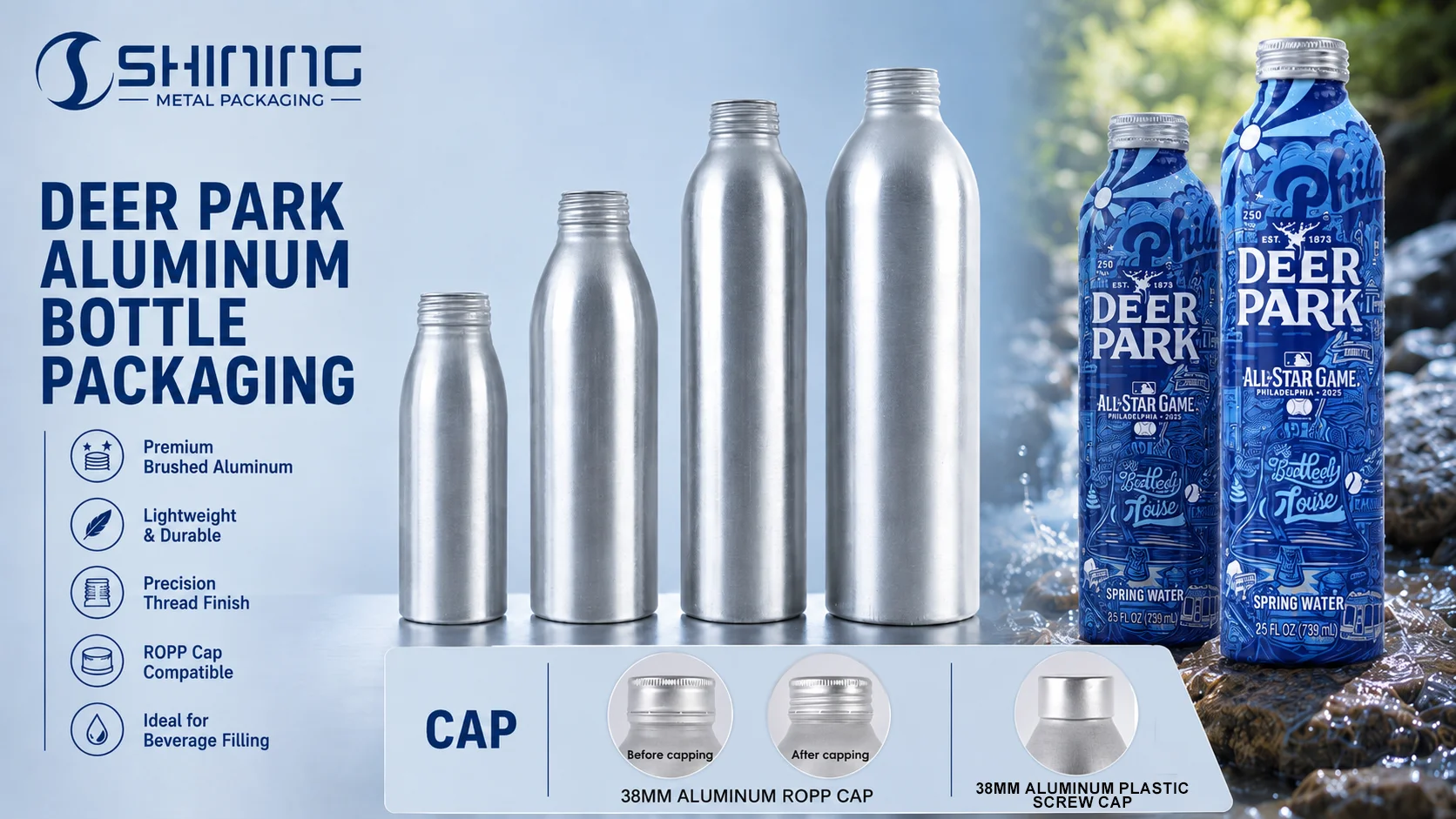
1. A Regional Spring-Water Brand Turns Aluminum into a Local Media Surface
Deer Park reduces a large part of its brand position to four unusually concrete words: “Never Shipped From Overseas.” The brand dates to 1873 and currently describes spring sources across Pennsylvania, New Jersey, Maryland, South Carolina and Florida. That regional logic matters to the Parc aux cerfs bouteille en aluminium, because the package is more convincing as an extension of an East Coast spring-water identity than as a generic statement that metal is preferable to plastic.
The specific product makes the strategy easier to read. Deer Park officially lists a 25 fl oz aluminum bottle containing spring water, and links purchases of that bottle to a commitment to donate 1% of sales to local environmental causes. The size is large enough to behave differently from a conventional small single-serve water bottle: finishing the contents in one uninterrupted drinking occasion is less certain, so portability and closure performance have more value.
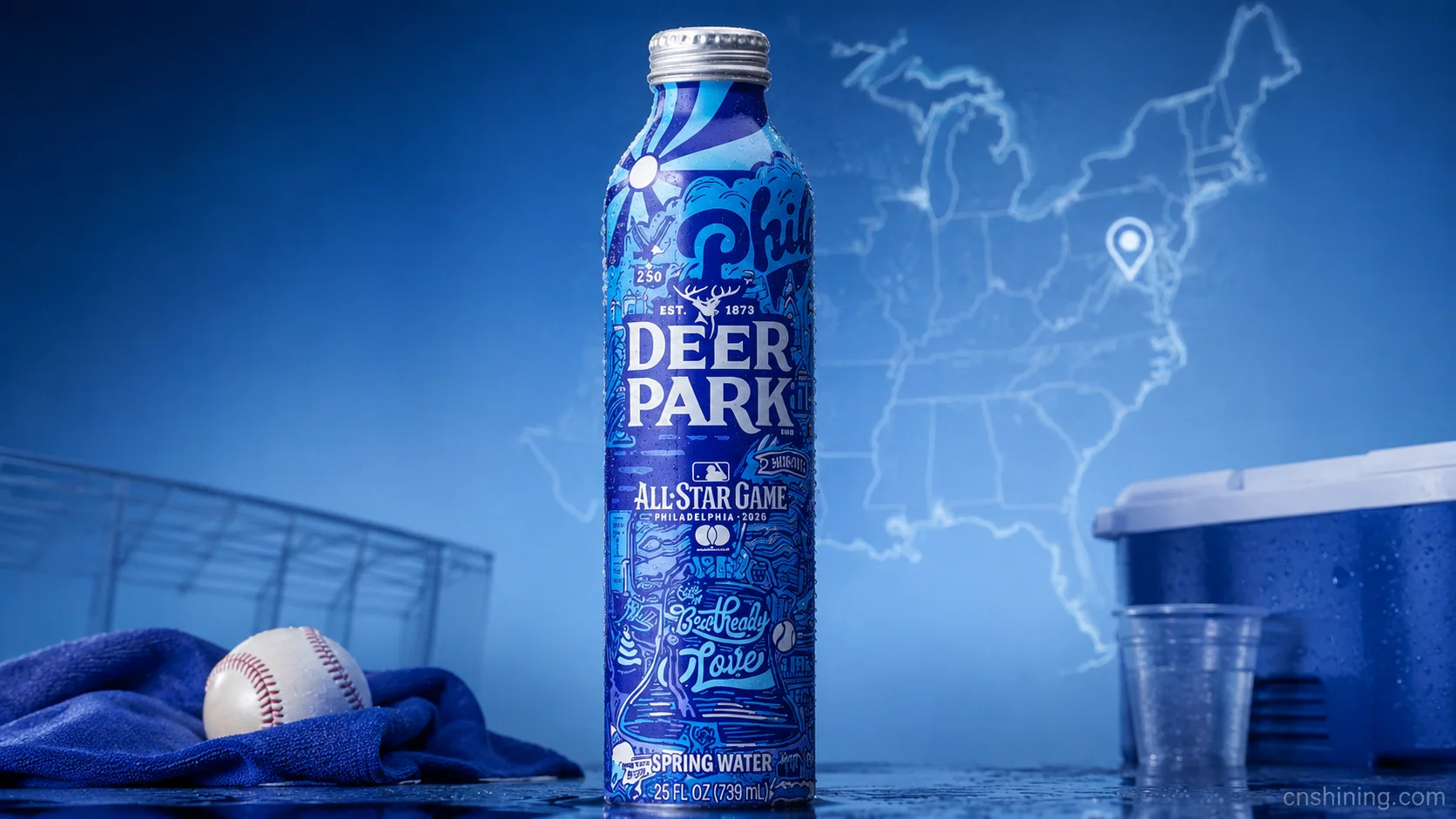
More revealing is what Deer Park is doing with the metal surface in 2026. Its Major League Baseball partnership currently includes limited-time aluminum bottles carrying locally oriented artwork by Philadelphia artist Paul Carpenter. The bottle therefore has a second function beyond containment: it becomes a durable, highly visible canvas for regional campaigns and event-linked editions. That is a more brand-specific use of aluminum than simply giving a standard water SKU a metallic finish.
The resulting packaging tension is clear. Deer Park is a familiar, broadly distributed spring-water name, not a niche luxury-water label. The aluminum format has to create enough distinction for convenience retail, cold cabinets and event occasions without pushing the product so far toward collectible packaging that the basic promise of accessible regional hydration disappears. The 25 fl oz bottle works because it can carry both ideas at once: familiar spring water inside, a more deliberate single-bottle experience outside.
2. Engineering the Deer Park Aluminum Bottle Around Water Chemistry
For this product, the most important engineering question is not whether aluminum provides enough barrier performance. Spring water places relatively modest demands on oxygen and light barrier compared with many beer or flavor-sensitive beverage systems. The harder question is whether the product-contact system remains neutral across Deer Park’s actual water chemistry.
The brand’s 2025 water analysis is especially useful here. Across the reported spring-water samples, pH ranges from 4.8 to 8.3, chloride from 1.2 to 17 mg/L, and total dissolved solids from non-detect to 240 mg/L. Deer Park’s sparkling water is reported at pH 4.8. Those ranges make it inappropriate to treat the brand simply as one chemically constant “neutral water.” The target SKU, source and storage conditions should instead define the compatibility window used for package validation.
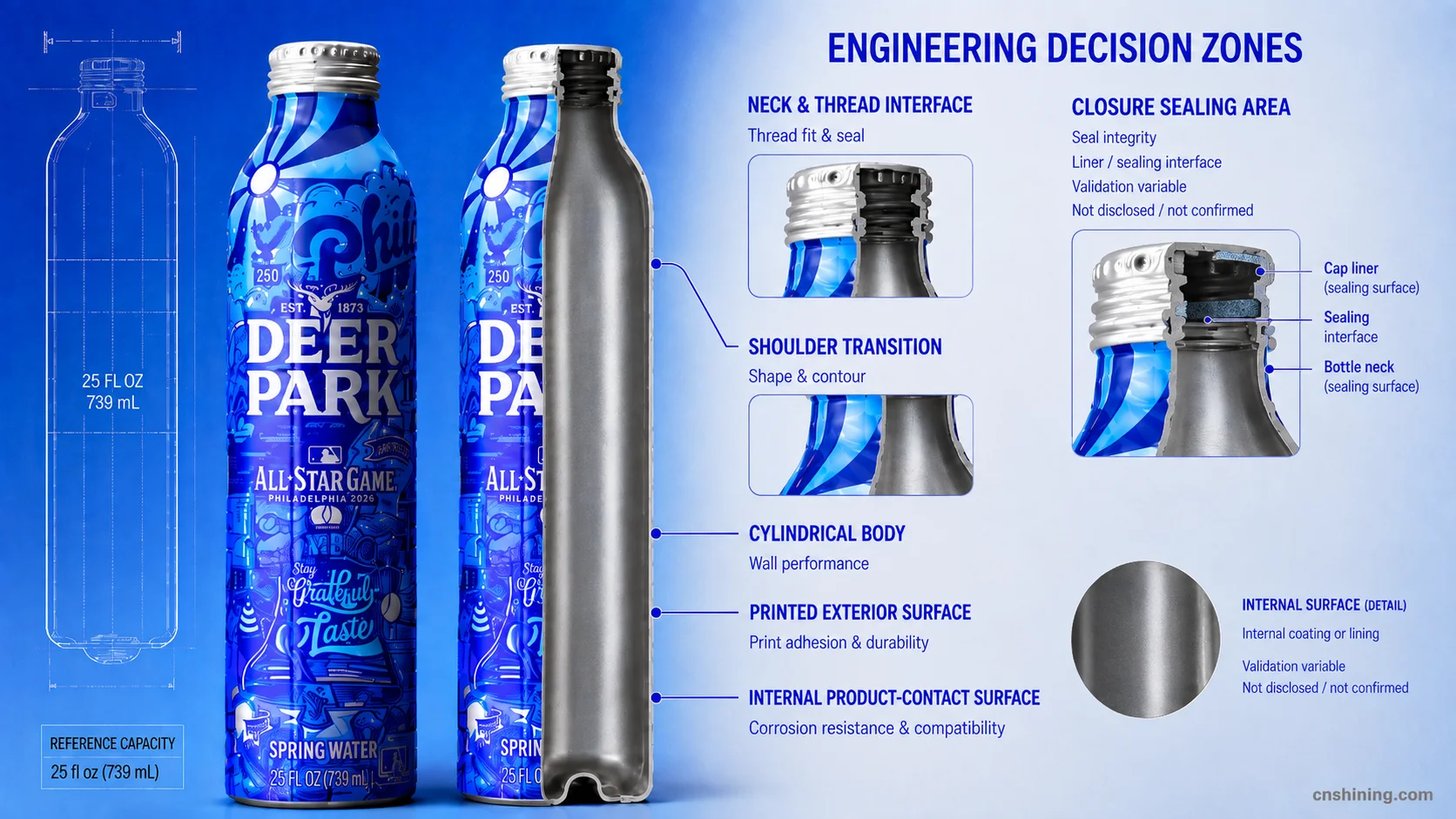
An aluminum beverage bottle normally relies on an internal food-contact coating to separate the beverage from bare metal. The specific coating chemistry used on Deer Park’s commercial bottle is not established by the public information reviewed here, so it should not be guessed. In development, the relevant requirement is more practical: test the intended coating against the actual finished water, including the lower-pH and higher-ion ends of the qualified composition window, and evaluate corrosion, migration, odor and taste through the required shelf life.
| Packaging Variable | What Is Established | What Matters in Engineering Validation |
|---|---|---|
| Content and capacity | 25 fl oz spring water | Validate the exact production water rather than a generic laboratory water. |
| Water chemistry | Meaningful pH and mineral variation occurs across Deer Park sources. | Use qualified pH, chloride, TDS and other relevant ion limits when defining coating tests. |
| Closure behavior | The commercial product is presented with a resealable cap. | Exact neck finish, liner, application torque, removal torque and leak limits must be matched as a system. |
| Revêtement intérieur | A precise commercial coating specification is not confirmed by public brand information. | Confirm food-contact compliance, compatibility, sensory neutrality and shelf-life performance. |
| Decoration | Deer Park is already using aluminum bottles for limited-edition local artwork. | Color control, varnish durability and scuff resistance become relevant when graphics carry campaign value. |
| Sparkling extension | Deer Park also has a sparkling-water range. | Do not transfer still-water bottle assumptions to a carbonated SKU without pressure, closure and CO2-retention validation. |
The engineering priority is therefore the product-contact and closure system, not a decorative specification in isolation. A useful development program should connect closure and ROPP matching principles with inner-coating compatibility, while keeping the exact closure type and liner specification dependent on the validated commercial design.
3. The Use Case Is “Drink Now, Close Later” — and That Changes the Failure Modes
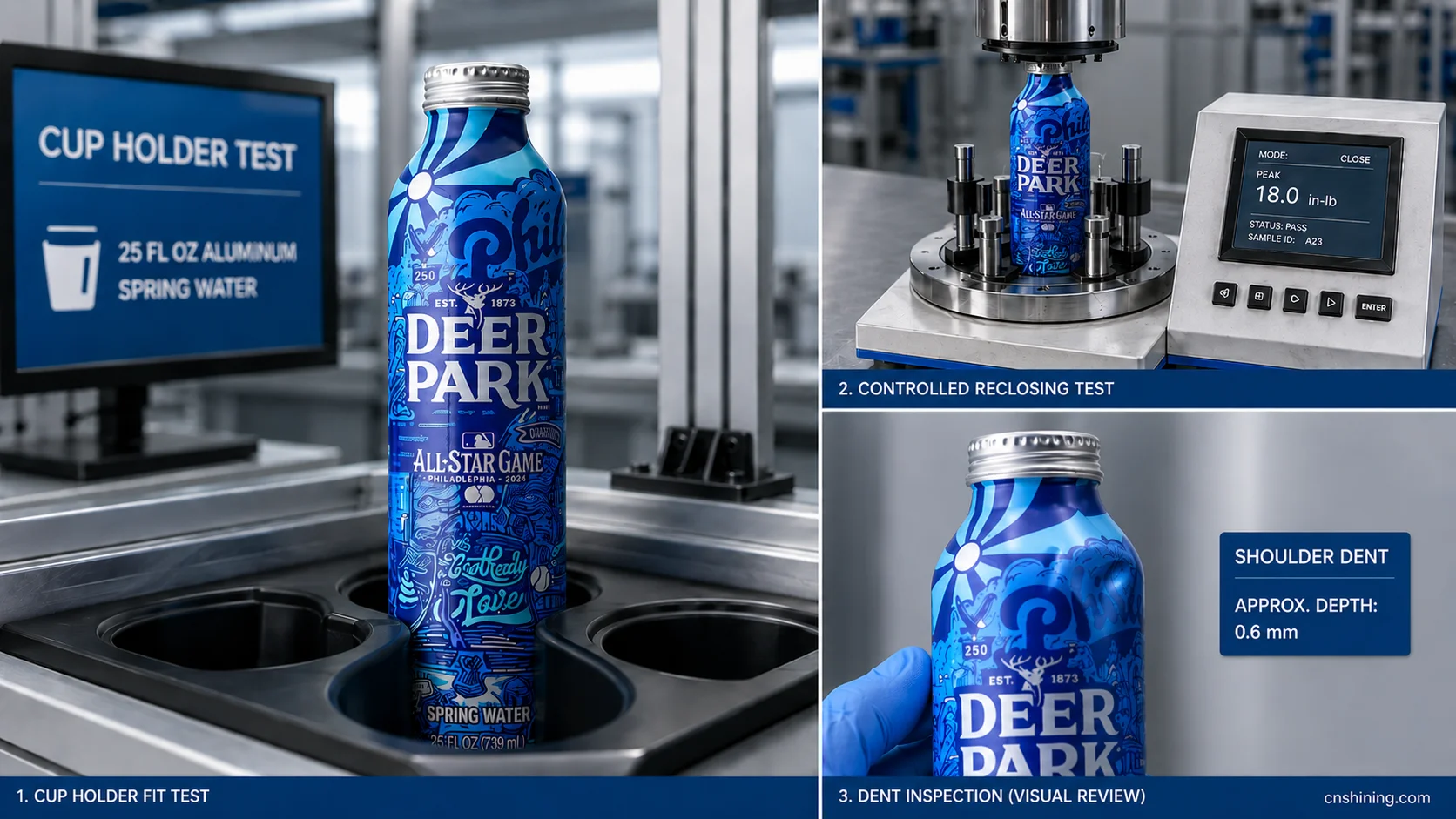
A public retail description of the 25 fl oz product identifies a resealable cap for on-the-go hydration. That detail is more consequential than it looks. A relatively large single bottle may move between a store refrigerator, cup holder, desk, backpack and event seat before it is empty. For the Deer Park aluminum bottle, opening torque, reclosing feel and leak resistance therefore belong to the consumer experience rather than being invisible factory specifications.
This also changes how damage should be judged. Aluminum avoids the breakage mode associated with glass, but a premium-looking metal bottle can acquire visible dents or scuffs without losing containment. Public feedback on comparable aluminum-water products illustrates the distinction: a PATH customer reported dents after drops while noting that the bottle did not leak, while an Open Water buyer complained that bottles arrived bent and therefore looked unattractive. Pure Life reviews similarly include reports of dented arrivals. Those are not Deer Park defect reports, but they point to a relevant engineering lesson for this package class: cosmetic acceptance and leak performance should be controlled as separate quality criteria.
For high-visibility cold-cabinet or event SKUs, that distinction can affect secondary packaging even though the shipping case is not the product story. A bottle that still seals perfectly but reaches the shelf with a shoulder dent can undermine the very premium signal that justified the metal format. Carton fit, bottle-to-bottle contact, vibration exposure and handling therefore deserve enough validation to protect the decorated surface, particularly when limited-edition artwork is part of the commercial value.
The consumer trade-off is equally specific. Comparable 25 fl oz aluminum spring-water products currently sell around the mid-single-bottle two-dollar range at several U.S. retailers, which means the package is being asked to support noticeably more perceived value than ordinary commodity multipack water. Deer Park does not need to make the bottle feel luxurious in a restaurant sense; it needs to make the additional value visible in the moments where portability, closure, cold handling and regional design are actually noticed.
4. Competitor and Portfolio Benchmark: Five Aluminum-Bottled Spring Waters
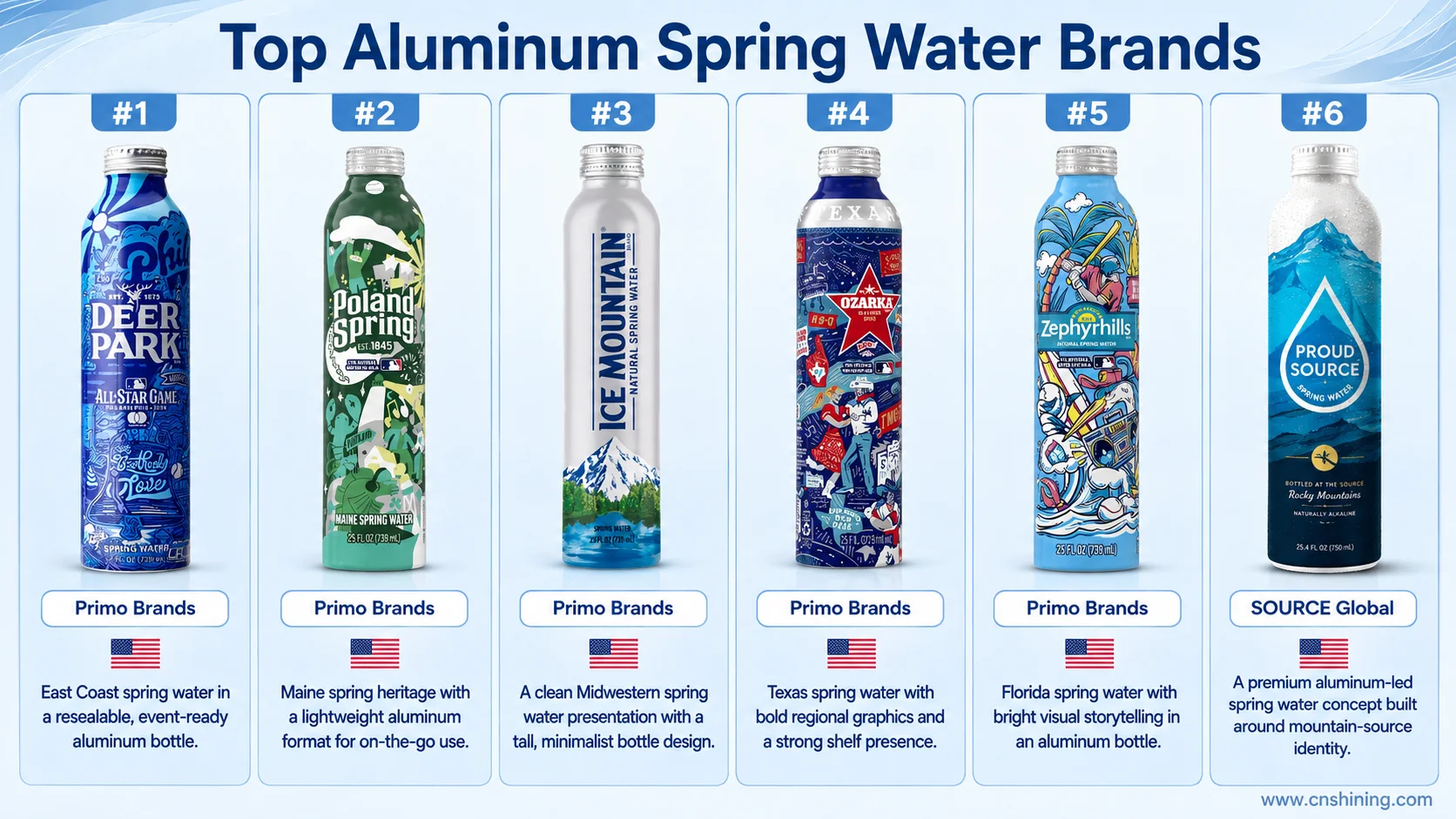
The most useful comparison is not with glass prestige water or canned flavored beverages, but with finished spring-water brands already selling aluminum bottles. Four of the five benchmarks below — Poland Spring, Ice Mountain, Ozarka and Zephyrhills — are currently listed alongside Deer Park in the Primo Brands portfolio. They are therefore portfolio peers as much as retail comparables, and their similarity helps reveal which parts of Deer Park’s execution are truly distinctive.
| Marque | Pays | Société mère | Capacité | Retail Price | Core Selling Point |
|---|---|---|---|---|---|
| Poland Spring | États-Unis | Primo Brands Corporation | 25 fl oz | USD 2.69 per bottle | Maine spring heritage, resealable portable format and locally directed conservation narrative. |
| Ice Mountain | États-Unis | Primo Brands Corporation | 25 fl oz | USD 2.69 per bottle | Midwestern spring identity with a region-specific watershed contribution attached to the aluminum SKU. |
| Ozarka | États-Unis | Primo Brands Corporation | 25 fl oz | USD 2.59 per bottle | Explicit Texas spring-water identity, with the aluminum bottle tied to regional water stewardship. |
| Zephyrhills | États-Unis | Primo Brands Corporation | 25 fl oz | USD 2.69 per bottle | Florida spring provenance, resealable on-the-go use and locally framed environmental support. |
| Source d'eau fière | États-Unis | SOURCE Global PBC | 25.3 fl oz | USD 2.99 per bottle | Naturally alkaline spring water, domestic source story and aluminum positioned as a central part of the brand proposition. |
The table makes one point particularly clear: aluminum itself does not differentiate Deer Park. Several regional spring-water brands now use almost the same 25 fl oz packaging proposition, and four sit inside the same corporate portfolio. The Deer Park aluminum bottle therefore needs differentiation above the material level.
Its stronger territory is the combination of an East Coast spring history dating to 1873, a familiar regional identity and an aluminum surface that is already being used for localized MLB artwork. Poland Spring emphasizes Maine; Ice Mountain emphasizes the Midwest; Ozarka speaks explicitly to Texas; Zephyrhills is distinctly Floridian. Deer Park can occupy the Mid-Atlantic and broader East Coast position in the same regional logic, but the 2026 artist collaboration shows a way to make that geography more visually active rather than leaving provenance as back-label copy.
Proud Source represents a different competitive model. Its aluminum bottle and alkaline spring-water proposition are central to the brand identity itself. Deer Park does not need to imitate that approach. Its advantage is that the metal package can be selective — a recognizable flagship or event-ready format inside a much broader spring-water portfolio — rather than requiring every consumer interaction to revolve around the container material.
5. Regulatory Boundaries and the Packaging Decision Worth Protecting
For U.S. commercialization, packaging development sits behind a product that is already regulated as bottled water. FDA identifies 21 CFR Part 129 and 21 CFR 165.110 as core bottled-water provisions, and the definition of spring water is tied to the underground formation and the way the source is collected. That matters to Deer Park because “spring water” is not decorative brand language; it is part of the regulated product identity around which the package is built.
If the product or a future aluminum-bottle program is intended for the European Union, the coating specification deserves a separate compliance review rather than an assumption that a U.S. food-contact declaration automatically covers the export SKU. The current consolidated text of Commission Regulation (EU) 2024/3190 prohibits BPA use in specified food-contact materials, including varnishes and coatings, subject to the regulation’s defined exceptions and transitional provisions. That makes the chemical identity and documentation of the internal coating an actual sourcing variable, not merely a marketing question about whether a bottle can carry a “BPA-free” phrase.
Sustainability language deserves similar precision. Deer Park already has a comparatively concrete claim available: the official aluminum-bottle page states that 1% of sales from the bottle will support local environmental causes. That is more useful than trying to make an absolute claim that the package is universally “green.” Recycling availability, the cap and liner system, decoration, local collection infrastructure and the actual manufacturing route all affect the environmental outcome. Keeping the claim specific also fits Deer Park’s broader brand style better than turning a spring-water bottle into an environmental manifesto.
The final packaging judgment is therefore narrower — and more useful — than saying that aluminum is simply a better material. The Deer Park aluminum bottle works when it performs three jobs simultaneously: it carries an established East Coast spring-water identity, makes a 25 fl oz drinking occasion practical through dependable resealing, and provides a durable visual surface that can support regional and event-specific editions. Its principal technical risks sit at the less visible interfaces: coating compatibility across variable water chemistry, closure consistency, and cosmetic protection through distribution.
That combination gives Deer Park a credible route to premiumize selected occasions without trying to turn a mainstream regional water into a luxury product. The most defensible next improvements would therefore be better validation rather than more claims: qualify the extreme water-chemistry window, lock the closure and liner specification, define cosmetic AQL separately from leak performance, and verify decoration durability under the distribution environments where the bottle is expected to earn its higher perceived value.