
Fruit acidity, packing medium, and thermal processing determine how a metal can performs during storage.
Most canned fruits contain natural organic acids. Added citric acid, fruit juice, juice concentrate, sugar, dissolved oxygen, and processing temperature can make the final pack more or less aggressive toward the container. An unsuitable can specification may lead to internal staining, localized corrosion, color changes, flavor changes, or a shorter shelf life.
The fruit name is not enough to select the can. Variety, maturity, recipe, and packing medium can change the finished equilibrium pH. FDA also notes that products such as pears and pineapples, or their juices, may have an equilibrium pH above 4.6 under some conditions. The final formulation and measured data should therefore be used for both process classification and packaging evaluation.(source)
The internal surface also matters. Tinplate is not fully inert when it contacts acidic fruit products or fruit juice. Most food cans therefore use a cured polymer coating to separate the food from the metal and reduce corrosion during processing and storage.
Can selection should start with four questions:
What is the finished product pH? Is the fruit packed in syrup, juice, or water? What thermal process will the filled can receive? How long and under what conditions will it be stored?
Those answers are more useful than a general request for a “fruit can.”
1. Syrup, Fruit Juice, or Water: How the Packing Medium Affects Can Selection
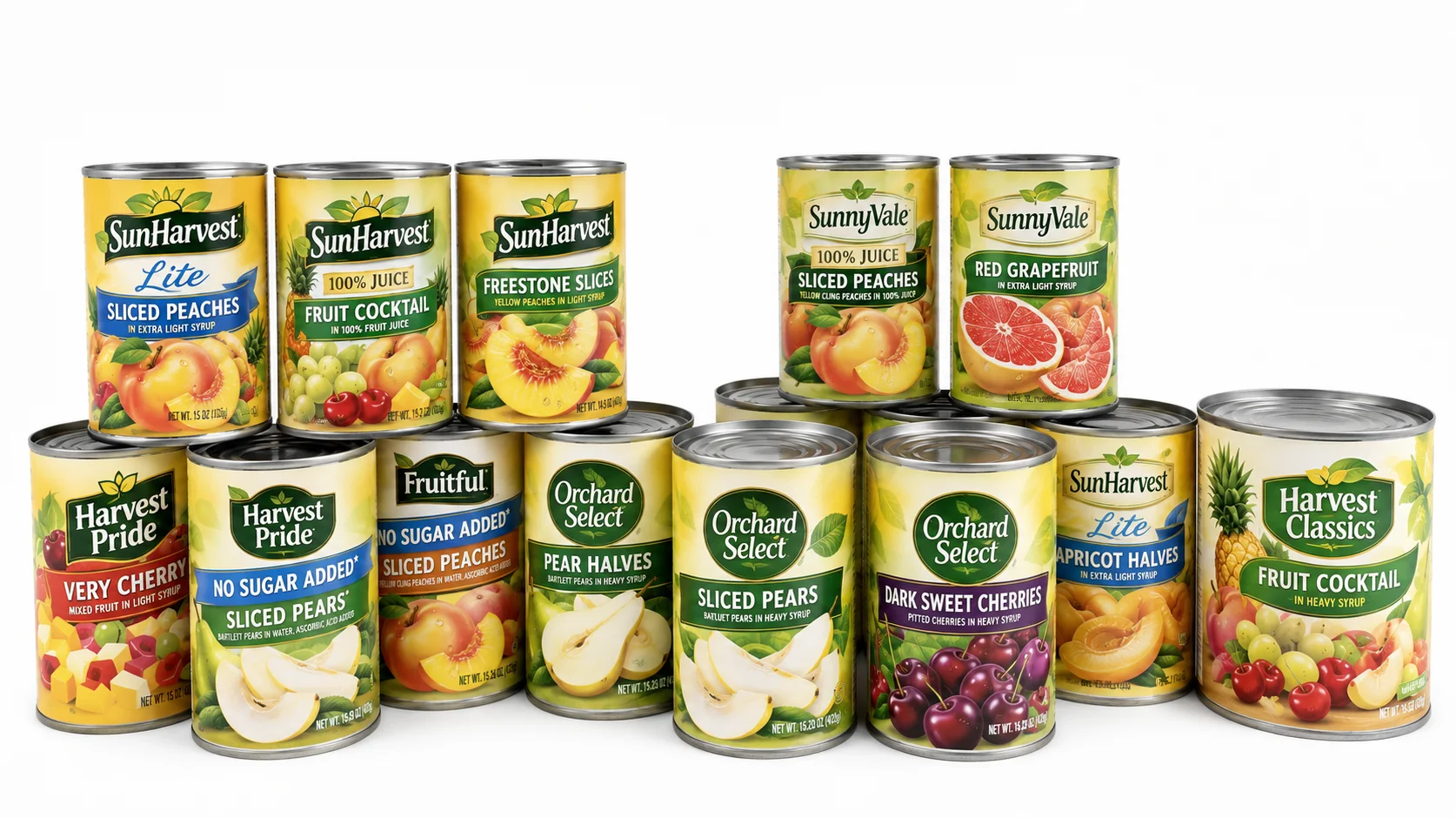
Codex standards recognize several packing media for canned fruit, including water, fruit juice, mixtures of water and juice, sweetened juice, and syrup. The permitted descriptions and Brix ranges depend on the fruit category and the applicable product standard. (source)
The medium is not just a labeling detail. It changes the environment inside the can.
1.1 Fruit Packed in Syrup
Light syrup and heavy syrup are common for peaches, pears, lychees, longans, apricots, cherries, and fruit cocktail.
Sugar concentration affects viscosity and heat transfer, but Brix alone does not predict can compatibility. A syrup may also contain added acid, fruit juice, flavor ingredients, or antioxidants. These components can change the corrosion behavior of the pack.
A peach in light syrup and a peach in heavy syrup may use the same can size but still require separate testing if the acid level, processing schedule, or shelf-life target is different.
Syrup-packed products with pale fruit need particular attention to internal staining. A minor coating defect that is difficult to notice in a dark product may become obvious next to pear, lychee, or longan.
1.2 Fruit Packed in Juice
Juice-packed fruit often creates a more demanding can environment than a basic syrup formulation.
Pineapple juice, citrus juice, grape juice, pear juice, and mixed fruit juice contain natural acids, minerals, pigments, aroma compounds, and suspended solids. Concentrated juice may increase both acidity and solids content.
The coating must resist the liquid phase as well as direct contact with fruit pieces. Product color, cloud stability, and flavor should also be observed during storage. A can may show no obvious corrosion and still produce an unwanted metallic note or coating-related odor.
Pineapple and citrus products deserve closer evaluation around the welded side seam, easy-open score, rivet area, and double seams. These areas may experience greater coating stress than the main body panel.
1.3 Fruit Packed in Water or Lightly Sweetened Liquid
Lower sugar does not mean lower packaging risk.
Fruit packed in water still contains natural acids. Added citric or ascorbic acid may also be used to control pH or product color. Because the liquid has less sugar and flavor intensity, small changes in taste, color, or metal interaction may be easier to detect.
No-added-sugar fruit, fruit in water, and fruit in light juice should therefore be assessed as separate formulations. They should not automatically receive the same internal specification as the syrup-packed version.
2. How to Select the Can Type for Fruit Cans
2.1 Two-Piece vs. Three-Piece Cans for Canned Fruit
Two-piece cans offer a seamless body and a clean internal surface. They are a practical choice for selected small and medium retail packs, such as lychee, longan, cherries, diced peaches, and smaller portions of mixed fruit. The body coating must have enough flexibility to withstand drawing without cracking or becoming too thin.
Three-piece cans provide more flexibility in diameter, height, and filling capacity. They are often used for peach halves, pear halves, pineapple slices, mango pieces, fruit cocktail, family packs, and foodservice products. Larger capacities can usually be developed without creating a new drawn-can format.
Neither structure is automatically better for acidic fruit. The decision depends on can size, available production equipment, fruit-piece dimensions, processing conditions, and the performance of the applied coating. Metal-packaging research also notes that two-piece forming and three-piece welding create different mechanical demands on coatings and seams.
2.2 Ends for Canned Fruit
Conventional non-easy-open ends are economical and widely used for foodservice packs, industrial applications, and products intended to be opened with a can opener. They are suitable for fruit pieces, fruit puree, and larger cans where consumer convenience is not the main requirement.
Full-aperture easy-open ends are generally preferred for retail canned fruit. They are suitable for diced fruit, cherries, lychees, longans, peach halves, pear halves, pineapple slices, mango pieces, and other solid fruit products. The full opening provides convenient access and helps larger or more delicate fruit pieces to be removed without damage.
Partial-aperture easy-open ends are generally not the first choice for canned solid fruit. They may be considered for pourable or semi-liquid products where controlled dispensing is required.
The end type should be selected according to the fruit format, can diameter, processing conditions, can-opening requirements, and sales channel. Particular attention should be given to the score area, rivet, and internal coating, which must withstand forming, heat processing, and storage without loss of integrity.
3. How to Select the Internal Coating for Fruit Cans
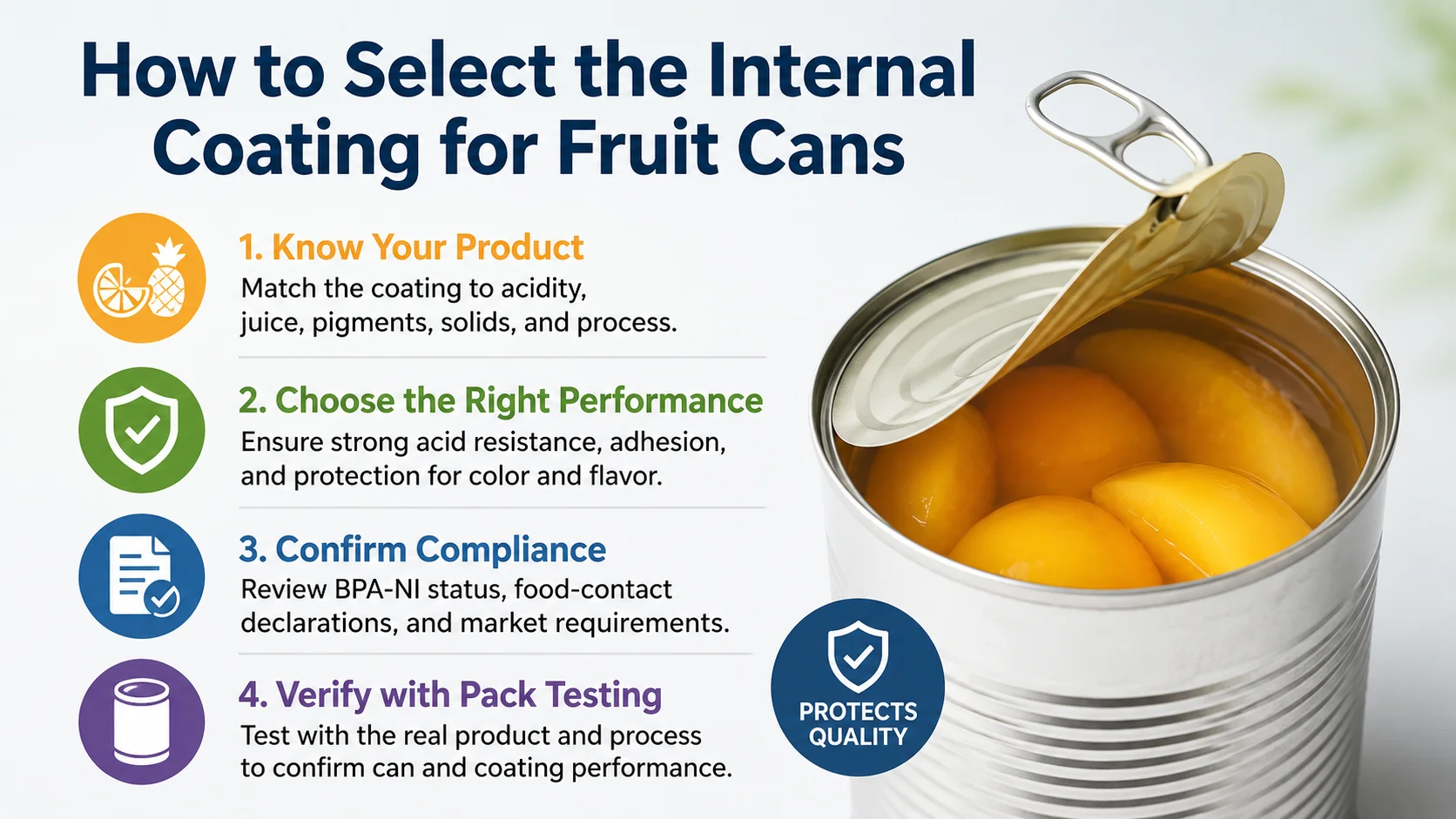
The internal coating separates the fruit product from the metal and helps control corrosion, staining, and flavor changes during processing and storage.
Selection should start with the product, not the resin name. The key factors are acidity, juice content, pigments, flavor sensitivity, solids level, heat treatment, and expected shelf life.
3.1 High-Acid and Juice-Rich Fruits
Pineapple, mandarin orange, grapefruit, canned orange, and products packed in citrus or pineapple juice usually need strong acid resistance and stable adhesion after heat processing.
Possible options include acid-resistant epoxy-phenolic coatings, qualified polyester systems, and BPA-NI alternatives. Performance around easy-open scores, welded seams, and double seams should be checked carefully.
3.2 Pale or Color-Sensitive Fruits
Pear, lychee, longan, white peach, cherries, and other color-sensitive fruits can make staining or coating defects easy to see.
The coating should resist corrosion without affecting the fruit’s color, aroma, or flavor. Clear or light-gold finishes may be suitable, but the final choice should be confirmed with the actual recipe and process.
3.3 Dense, Pureed, and Mixed Fruit Products
Mango, papaya, banana puree, palm fruit, fruit cocktail, and mixed fruit products may contain high solids, concentrated juice, several acids, or different pigments.
For mixed products, select the coating according to the most aggressive ingredient. Pineapple juice, citrus components, added acid, or strongly colored fruit may control the requirement even when they are not the main ingredient.
3.4 BPA-NI and Market Requirements
BPA-NI means BPA was not intentionally added. It does not identify a specific resin or guarantee performance. Polyester, acrylic, organosol, and other systems may all be supplied as BPA-NI.
Food-contact declarations, migration documents, and destination-market requirements should be checked before production.
3.5 Pack Testing
Final approval should be based on filled-can testing with the actual fruit, liquid medium, filling conditions, end type, and thermal process.
During storage, check for corrosion, coating damage, staining, color or flavor changes, vacuum loss, and seam-area defects. Laboratory screening is useful, but it cannot fully reproduce the conditions inside a finished can.
4. Common Fruits Used in Metal Food Cans
Fruits with similar packaging behavior can be evaluated as groups. The table below gives starting directions rather than fixed specifications.
| Fruit group | Typical products | Main packaging concerns | Common can formats and size examples | Internal coating direction |
|---|---|---|---|---|
| Pale, syrup-packed fruits | Pear, lychee, longan | Staining, delicate flavor, syrup acidity | 425–850 mL retail cans; 2.65–4.25 L for larger pear packs | Acid-resistant coating with low discoloration and flavor interaction |
| High-acid, juice-rich fruits | Pineapple, mandarin orange, grapefruit | Acid corrosion, juice color, seam protection | 314–850 mL retail cans; 2.65 L foodservice cans; wider cans for pineapple slices | Strong acid resistance and reliable coverage around seams and scores |
| Soft stone fruits | Peach, apricot, cherry | Soft pieces, acidity, color changes | 425–850 mL cans; wide-opening formats for fruit halves; 2.65–4.25 L foodservice packs | Acid-resistant, low-odor coating with good staining resistance |
| Dense tropical fruits and purees | Mango, papaya, banana, palm fruit | High solids, viscosity, heat transfer | 425–850 mL retail cans; 2.65–3 L cans for catering or industrial use | Heat-stable coating matched to the full recipe |
| Mixed fruit products | Fruit cocktail, mixed fruit, tropical fruit salad | Mixed acids, juices, pigments, and textures | 850 mL family packs; 2.65–4.25 L foodservice cans; 307 × 512 as a common medium format | Select for the most aggressive fruit or liquid component |
These categories are useful during early specification work. They do not replace product testing. Fruit variety, maturity, juice source, acid adjustment, Brix, and retort conditions can move a product from a mild application to a more aggressive one.
5. Conclusion
Measure the finished equilibrium pH first. Then review the packing medium, fruit format, thermal process, can capacity, and expected storage conditions.
Use two-piece cans where a seamless small or medium retail body offers a practical advantage. Use three-piece cans where size flexibility, larger volume, or wide fruit pieces make them more suitable.
Select the internal coating by the product’s actual acid, juice, pigment, flavor, and processing behavior. The coating name is only a starting point. The final decision should come from production-representative pack tests.