
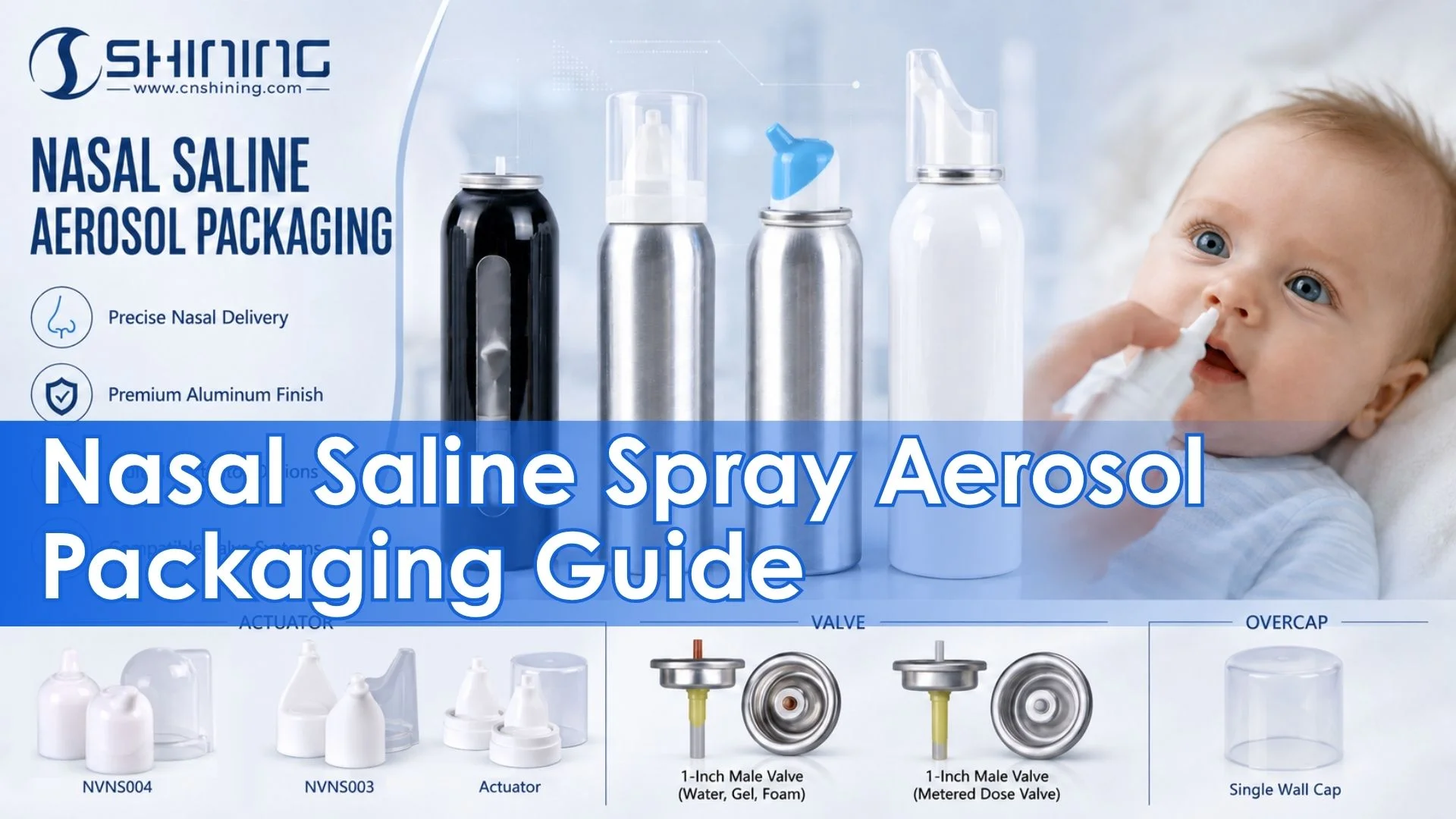
Nasal saline mist, seawater nasal spray, saline nasal irrigation aerosol, and non-medicated nasal spray all describe the same working idea: deliver a sodium chloride solution into the nasal cavity as a controlled fine mist. The product does not rely on vasoconstriction or pharmacological anti-inflammatory action. It works mainly by moistening nasal mucosa, loosening secretions, rinsing dust, pollen, and pollutant particles, and, in hypertonic formulas, using osmotic pressure to reduce mucosal swelling.
The technical question is not whether salt water is new. It is not. The real question is whether the formula, valve, actuator, can, and user instructions produce a spray that feels gentle, clean, repeatable, and suitable for daily use.
1. Definition, Working Principle, and Adjacent Formats
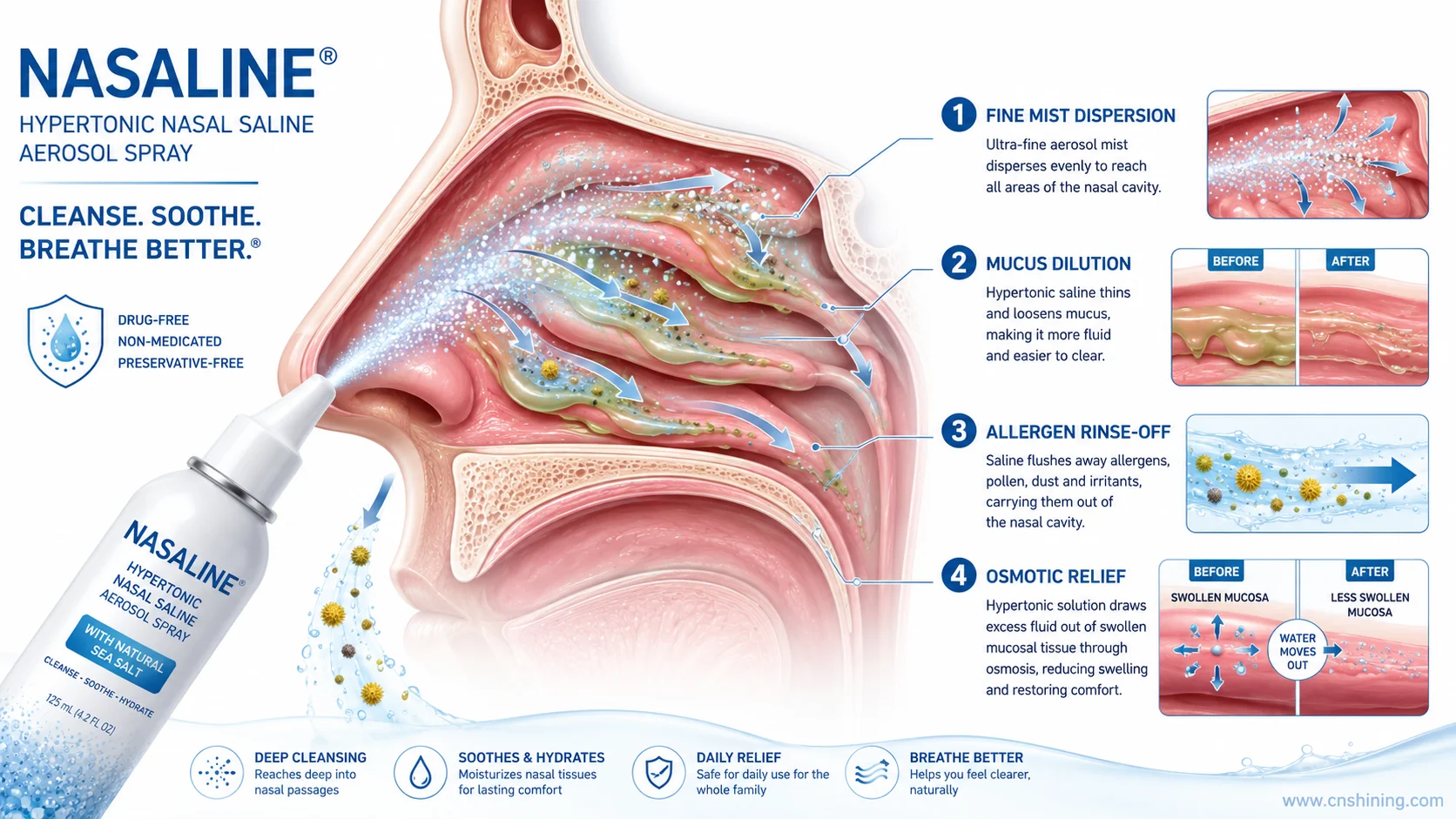
A nasal saline aerosol spray is usually a sodium chloride solution delivered through a pressurized aerosol can, continuous valve, or Bolsa sobre válvula (BOV) system. Public U.S. labels show both 0.65% sodium chloride products described as nasal moisturizers and 0.9% aerosol sprays containing purified water and saline. A useful reference point is the DailyMed saline nasal 0.65% spray label.
The working principle can be split into three layers:
- Moistening and dilution: saline softens dry crusts and makes viscous secretions easier to remove.
- Mechanical rinsing: mist can help remove pollen, dust, pollutants, and some allergens from the nasal surface.
- Osmotic action: hypertonic saline above 0.9% can draw water from swollen mucosa, which may give faster congestion relief but may also increase stinging.
O Cochrane review on nasal saline for allergic rhinitis notes that saline irrigation is probably linked to mucus thinning and allergen removal, while adverse effects are usually mild, including irritation, discomfort, or nosebleeds in some users.
| Categoria | Typical Delivery | Principal força | Limitação principal | Caso de uso ideal |
|---|---|---|---|---|
| Saline aerosol spray | Pressurized can, BOV, fine mist output | Fast actuation, gentle mist, possible 360° use, preservative-free multi-dose potential | Small dose per actuation; less effective than high-volume rinse for heavy mucus | Daily moisture, mild to moderate congestion, allergy-season carry use, children and elderly users |
| Saline drops or pump spray | Squeeze bottle, pump, dropper | Low cost, simple structure, drops suitable for infants | Multi-dose bottles often need preservatives; spray consistency may be weaker | Infants, low-cost OTC care, short-term family use |
| Nasal irrigation device | Squeeze bottle, neti pot, powered irrigator | High volume, stronger clearing of thick mucus and crusts | Higher learning cost, less portable, lower compliance for some users | Sinusitis, post-operative care, heavy secretion load |
| Medicated nasal spray | Metered pump, prescription or OTC drug spray | Anti-inflammatory, antiallergic, or decongestant effect | Drug limits, side effects, rebound congestion risk with decongestants | Moderate to severe allergic rhinitis or defined inflammation control |
2. Formulation Design and Technical Terms
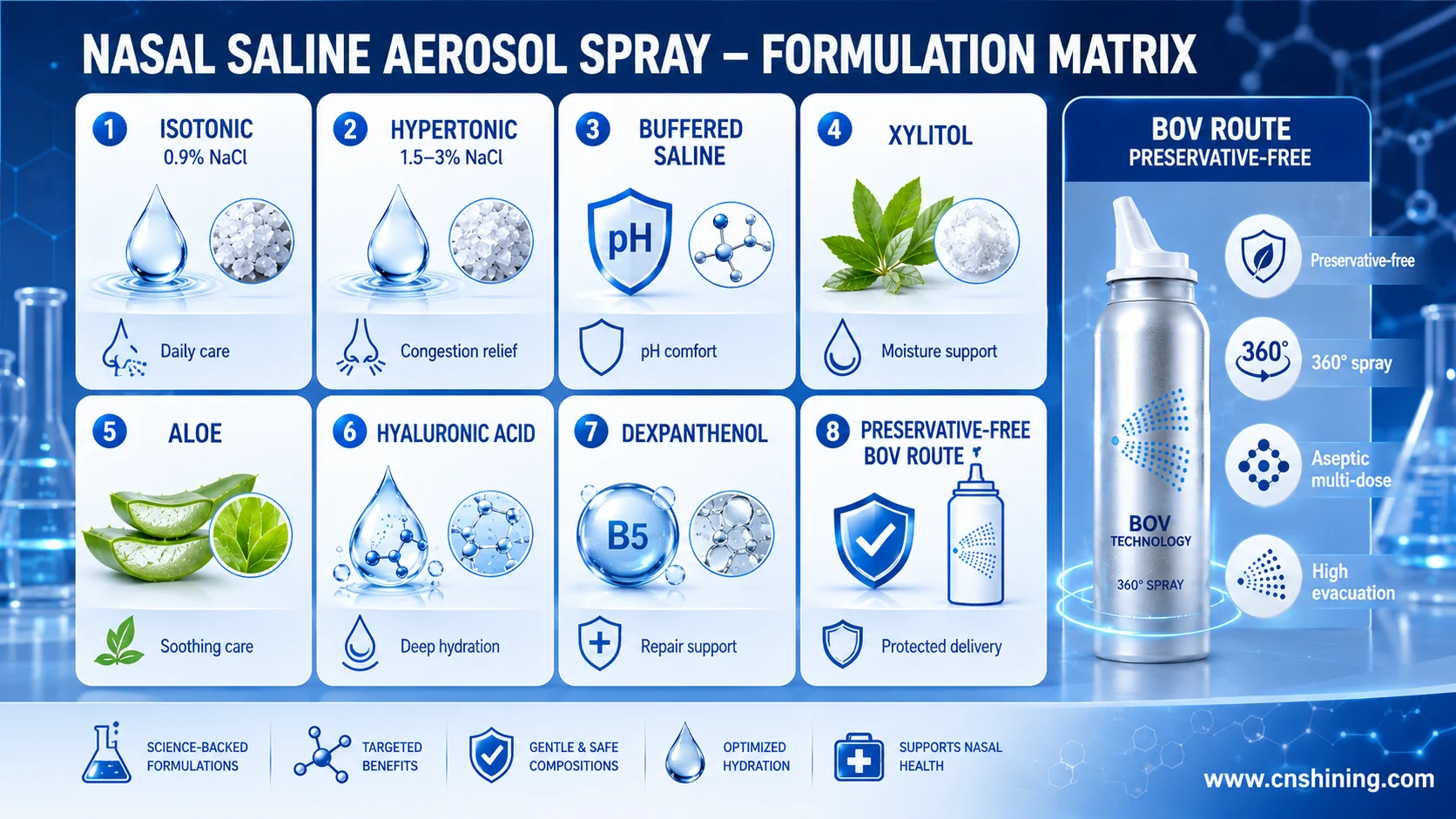
Saline spray looks simple, but the commercial difference often comes from tonicity, preservative strategy, buffer system, added humectants, and delivery hardware. Formulation and package are not separate decisions.
| Tipo de fórmula | Componentes típicos | Função principal | Common Example Logic |
|---|---|---|---|
| Preservative-free / isotonic | Purified water + sodium chloride around 0.9% ± sodium bicarbonate or buffer salts | Daily moisture, mild cleansing, lower irritation profile | Often used for family daily-care positioning and frequent use. |
| Preservative-free / hypertonic | Seawater or NaCl above 0.9%, often around 1.5%–3% | Stronger osmotic effect for congestion relief | Fits “strong congestion” products but can increase stinging complaints. |
| Preserved / buffered isotonic | 0.65% NaCl + benzalkonium chloride + alcohol or phenylcarbinol + phosphate buffer | Lower-cost multi-dose pump format | Useful for shelf-life control but less attractive for sensitive-nose claims. |
| Seawater + trace mineral salts | Seawater + copper, manganese, or magnesium salts + water | Cleaning plus mineral-source differentiation | Used in sea-water nasal spray portfolios. |
| Xylitol-added | Purified water + xylitol + NaCl + grapefruit seed extract | Moisture and particle-adhesion positioning | Creates a different user story, but heavy congestion claims still need caution. |
| Aloe / hyaluronic acid / dexpanthenol | NaCl plus aloe, hyaluronic acid, or dexpanthenol | Dry mucosa comfort and repair-oriented positioning | Useful for dry air, post-care, or irritation-sensitive users. |
| Hypotonic | NaCl below 0.9% | Theoretical gentle moisture route | The source report did not identify a strong verified commercial example. |
The link between preservative-free claims and packaging is direct. Bag-on-Valve technology separates the product from compressed gas and supports continuous dispensing, 360° use, and high evacuation efficiency. This is why BOV is widely used in nasal saline aerosol systems.
| Prazo | Simple Meaning | Product Development Meaning |
|---|---|---|
| Isotônico | Salt concentration close to body fluid, usually around 0.9% NaCl | Better suited to frequent daily care and children’s lines. |
| Hypertonic | Salt concentration above 0.9% | Better for stronger congestion relief, but comfort risk is higher. |
| Preservative-free | No common antimicrobial preservative system | Useful for sensitive users and long-term use claims, but package barrier design must be stronger. |
| Buffered | pH adjusted with phosphate or bicarbonate salts | Can reduce irritation and improve consistency. |
| Bolsa na válvula | Internal pouch separates formula from propellant | Supports 360° spray, high evacuation, and preservative-free multi-dose systems. |
| Geometria da pluma | Spray angle, shape, and velocity | Controls whether the spray feels soft, harsh, shallow, or throat-directed. |
| Distribuição do tamanho das gotículas | Range of mist droplet sizes | Too large may drip; too fine or too fast may reach the throat. |
| Aseptic multi-dose | Repeated use without back-contamination | The key condition for preservative-free multi-use nasal spray. |
| OTC monograph final | U.S. OTC drug listing status in some labels | Relevant when the product is sold through an OTC drug route. |
| UDI | Unique device identification | Important for device traceability, recall, and cross-border registration. |
3. Regulatory Pathways and Compliance Logic
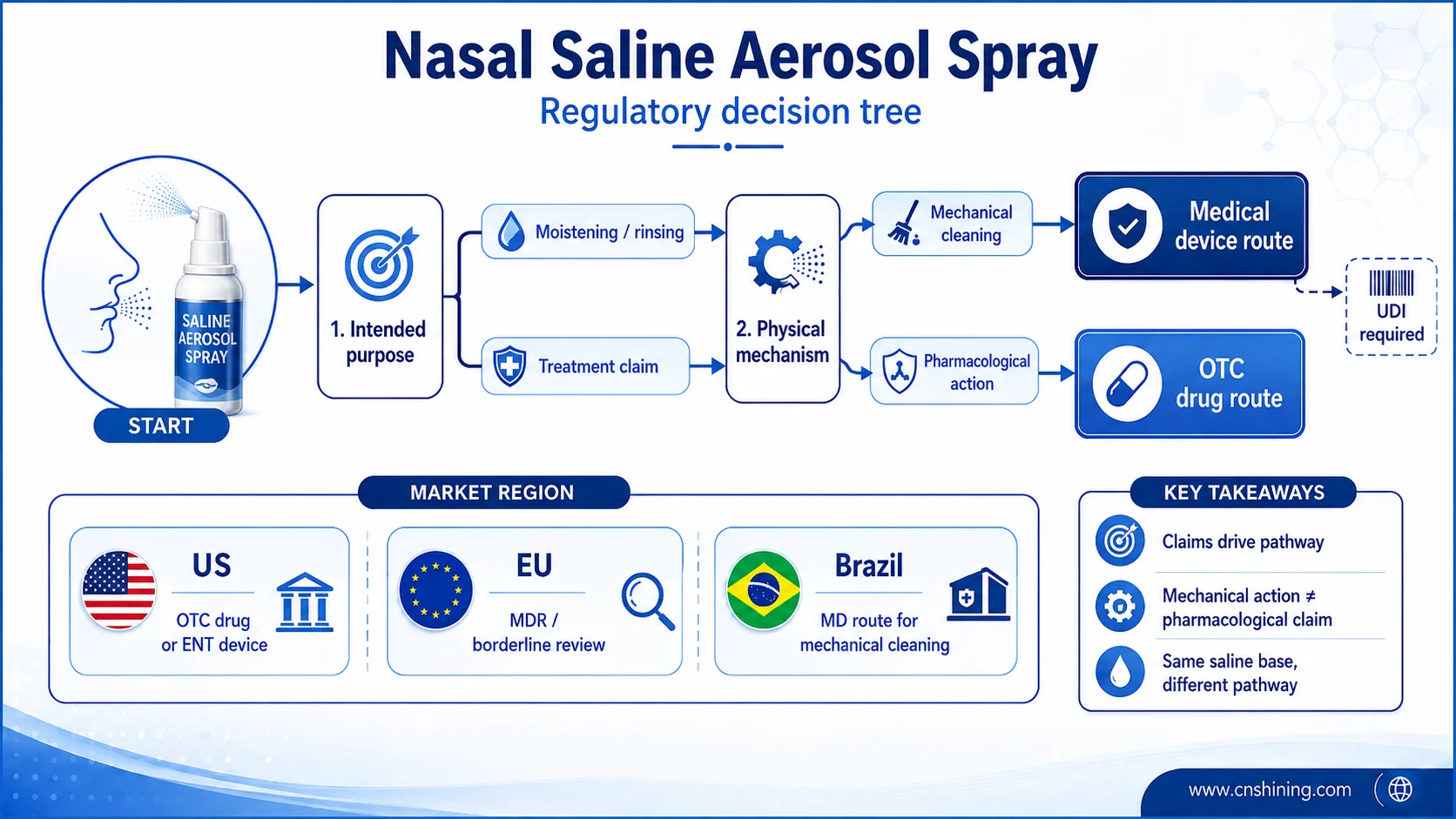
The common regulatory logic is clear: classification depends on intended purpose e main mode of action. A product framed as physical cleaning and moistening may follow a different path from one claiming pharmacological treatment.
| Mercado | Typical Path | Key Requirement | Significado prático |
|---|---|---|---|
| Estados Unidos | OTC drug label or ENT delivery device route | Some sodium chloride nasal sprays appear as OTC drug labels; the FDA Product Code KCO covers certain ENT delivery devices. | Decide early whether the project is built around the solution, the delivery device, or a combined product logic. |
| União Europeia | MDR device route or medicinal product boundary review | O MDCG 2022-5 Rev.1 guidance addresses borderlines between medical devices and medicinal products. | Physical rinsing and moistening must not be mixed casually with pharmacological treatment claims. |
| Brasil | Medical device route for certain saline irrigation products | Anvisa’s 2025 rule treats certain sodium chloride nasal irrigation solutions and powders as medical devices when they act mainly by mechanical cleaning. | Same saline base, different claims, different pathway. This matters for Latin America planning. |
| Middle East / Africa | Country-by-country registration | Local agent, local label language, and supporting CE/FDA-style technical files are often needed. | No single regional rule should be assumed without checking the target country. |
4. User Pain Points and Packaging Improvements
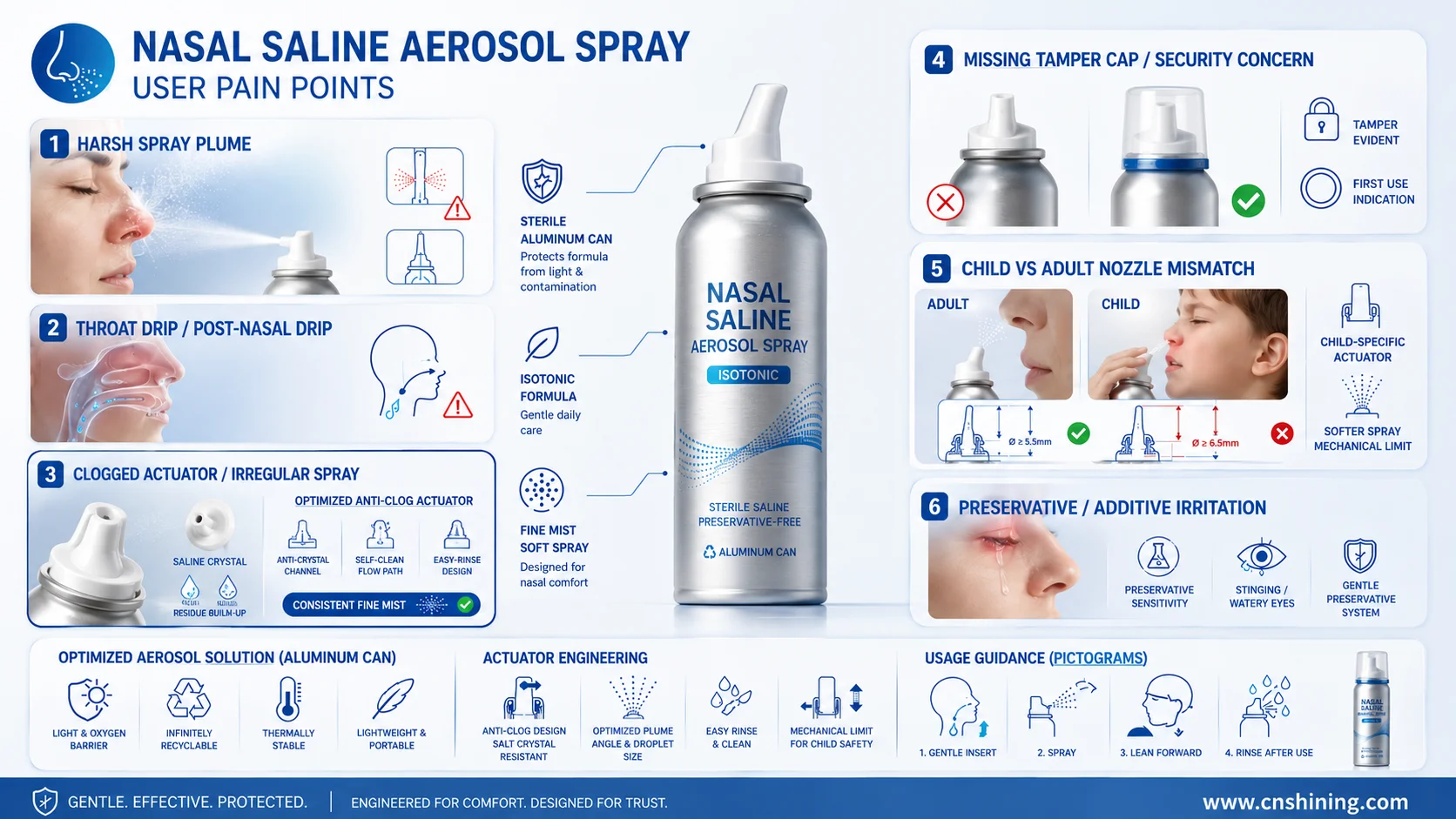
User complaints do not usually say “the chemistry is wrong.” They say the spray is too strong, too irritating, too hard to aim, missing a security cap, clogged, or not suitable for a child’s nose. That makes this category closer to a delivery-system product than a simple salt-water SKU.
| Sinal do usuário | Interpretação Técnica | Resposta de embalagem |
|---|---|---|
| Mild congestion relief feels acceptable, but severe blockage relief may disappoint | Gentle formulas and strong decongestion expectations are not the same use case | Separate daily isotonic SKUs from hypertonic congestion SKUs. |
| High-strength or eucalyptus-style products may sting or trigger watery eyes | Hypertonicity, sensory additives, and spray velocity interact | Use clear age and sensitivity warnings; reduce plume impact where possible. |
| Concern about missing security caps or possible contamination | Nasal products contact mucosa, so users have low tolerance for poor tamper evidence | Add visible tamper ring, secure overcap, and clear first-use indication. |
| Liquid runs back out or reaches the throat | Head position, droplet size, plume angle, and nasal blockage all matter | Improve instructions and tune actuator plume geometry. |
| Neti pot or rinse cannot pass through a blocked nose | High-volume irrigation is not easy for every anatomy or blockage condition | Offer gentle mist as low-learning-care format, not as a replacement for every rinse case. |
| Clogging or irregular spray | Salt crystallization, actuator residue, or poor cleaning instruction | Design anti-clog or easy-rinse actuators and add cleaning icons. |
| Children resist the nozzle | Nozzle diameter, insertion depth, spray force, and sound can cause rejection | Use a child-specific actuator with softer output and mechanical limit features. |
Valve choice should start with the user experience target. For higher-end preservative-free lines, BOV is often the practical direction. The value is not decorative: product and propellant remain separated, spray pressure is more stable, inverted use is possible, and users have fewer concerns about back-contamination.
Actuator design should not be treated as a shared commodity part. Adult and child versions need different force, stroke, nozzle geometry, and output. About the new nasal actuators, such as the Shining actuator, shows that adult/child nasal spray formats, sterilization support, and mechanical break-up spray systems are becoming normal design points.
5. Packaging Components for Nasal Saline Aerosol Spray: Shining Packaging
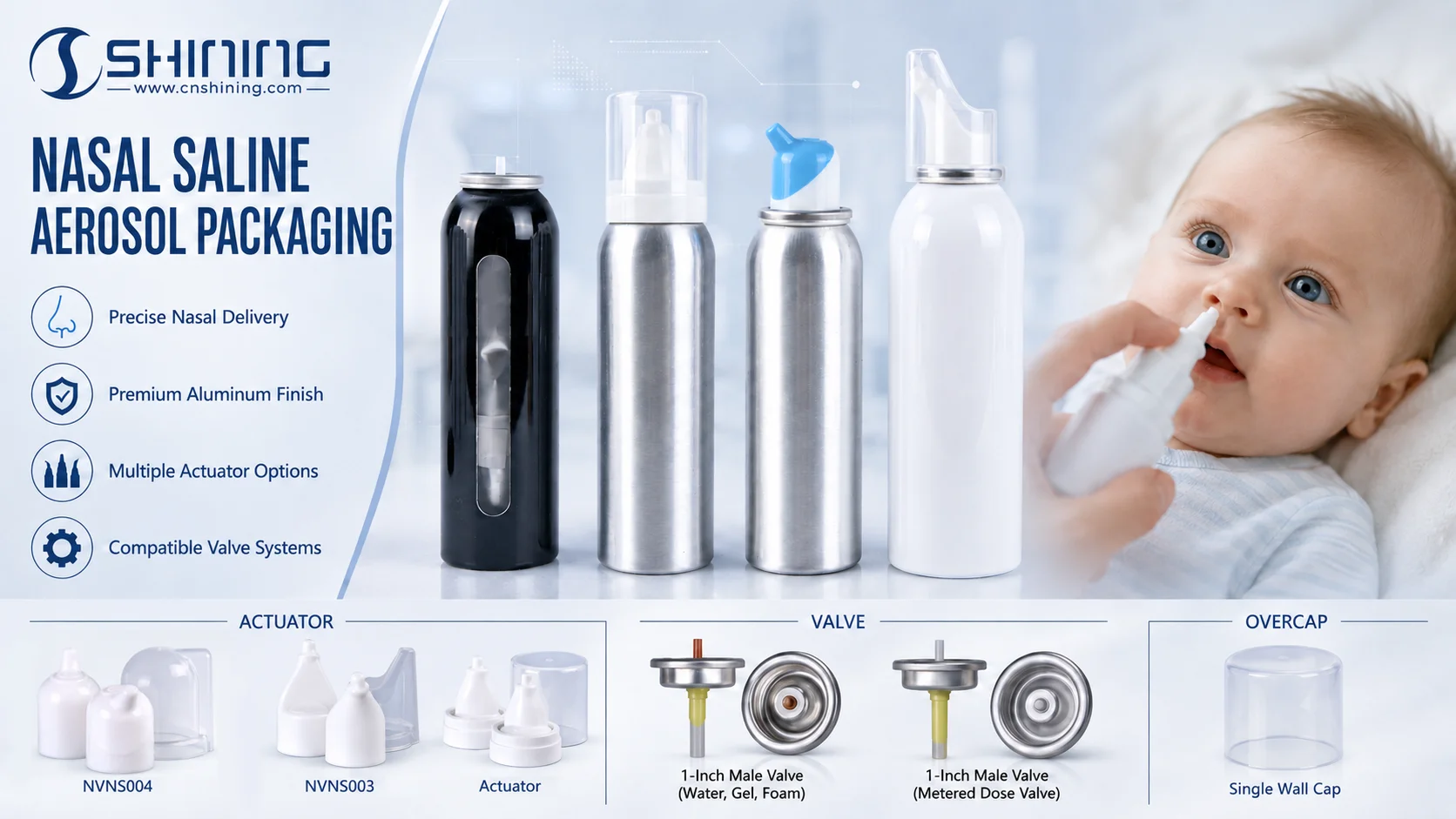
For Shining Packaging, this application sits in a practical engineering zone: atuador + lata de aerossol + válvula must be selected around saline chemistry and nasal-use comfort. The aerosol can has to handle chloride-containing media with proper internal coating. The valve has to keep output stable across the product life. The actuator has to turn that pressure into a fine mist that does not feel like a jet unless the product is intentionally designed for rinse strength.
| Componente | Key Design Question | Technical Direction |
|---|---|---|
| Nasal actuator | How soft should the mist feel, and for which age group? | Use low hand force, controlled stroke, defined plume angle, and separate adult / child options where needed. |
| Válvula de aerossol | Is the product isotonic daily care, hypertonic congestion relief, or rinse-style output? | Select valve output and continuous spray behavior based on dose, spray duration, and formula viscosity. |
| BOV system | Is preservative-free multi-dose use part of the product claim? | Use bag separation to reduce propellant contact and support 360° dispensing. |
| Lata de aerossol | How will the chloride formula interact with metal and coating over shelf life? | Use suitable aluminum or internally coated steel systems and validate coating integrity. |
| Overcap and tamper feature | Will users trust the product on arrival? | Add visible tamper evidence, secure cap retention, and clear open / close indication. |
6. Top 10 Nasal Saline Aerosol Spray Brands
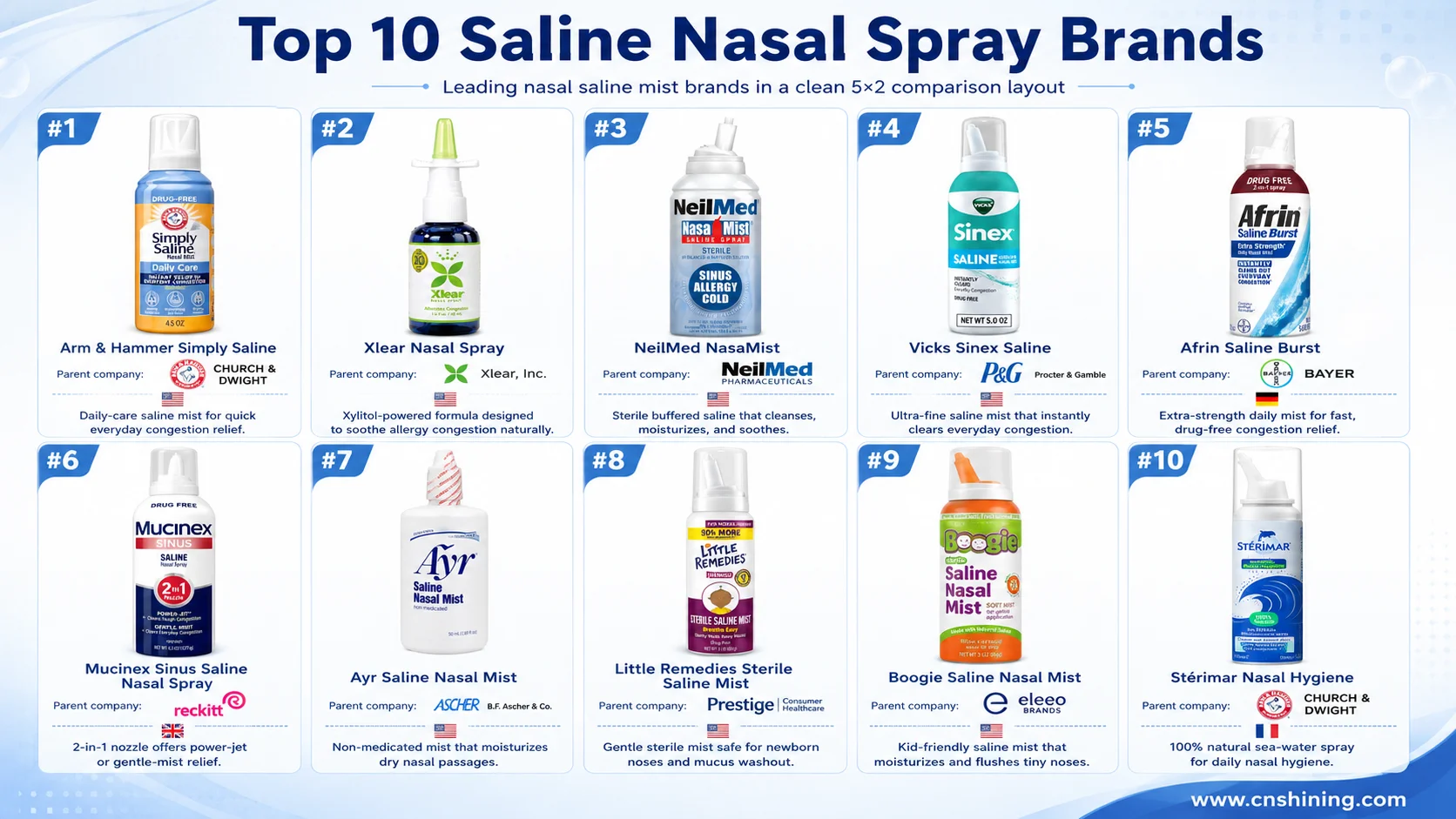
| Marca | País | Empresa Matriz | Tamanho comum | Faixa de preço visível | Comentário técnico |
|---|---|---|---|---|---|
| ARM & HAMMER Simply Saline | Estados Unidos | Igreja e Dwight | 4.5–4.6 oz | about $7.89–$7.99 per bottle | One of the most visible North American saline aerosol brands; isotonic and hypertonic lines are clear. |
| Xlear | Estados Unidos | Xlear, Inc. | 1,5 oz | about $12.49–$13.49 | Typical xylitol-added route; stronger differentiation, but heavy-congestion performance can be user-dependent. |
| NeilMed NasaMist | Estados Unidos | NeilMed Pharmaceuticals | 75 mL / 4.5 oz / 177 mL | about $6.98–$8.99 | Strong link between mist products and high-volume rinse systems. |
| Vicks Sinex Saline | Estados Unidos | Procter & Gamble | 5 onças | about $17.94 per two-pack | Ultra-fine mist positioning is clear and connected to cold / congestion shelf recognition. |
| Afrin Saline Burst | Estados Unidos | Bayer Consumer Health | 5 onças | aproximadamente $10.99 | Hypertonic seawater and dual-nozzle concept support stronger congestion positioning. |
| Mucinex Sinus Saline Nasal Spray | Estados Unidos | Reckitt | 4.5 oz | about $8.97 | Recent 2-in-1 Jet + Mist system is one of the clearer hardware-led upgrades. |
| Ayr Saline Nasal Mist | Estados Unidos | B.F. Ascher & Co. | 50 mL / 1.69 fl oz | about $3.13–$5.99 | Classic low-price pharmacy product with preserved isotonic formula examples. |
| Little Remedies Sterile Saline Mist | Estados Unidos | Prestige Consumer Healthcare | 3 oz / 1 oz | about $3.99–$4.99 | Infant and child positioning is direct; nozzle softness and labeling matter more than large capacity. |
| Boogie Mist | Estados Unidos | Eleeo Brands | 3.1 oz | aproximadamente $5.97 | Child-focused positioning; acceptance depends heavily on sensory and actuator experience. |
| Stérimar | França | Laboratoires Fumouze | 50 mL / 100 mL | about $9.14 for 50 mL | Representative seawater nasal spray brand with strong mineral-salt and pharmacy positioning. |
7. Closing Note
Nasal saline aerosol spray is a small product with many failure points. The formula may be simple, but the user judges the whole system: mist softness, spray direction, cap security, preservative strategy, clogging behavior, and comfort after repeated use. For product development, the practical route is clear. Define the claim first. Match isotonic or hypertonic formula to the use case. Then design the valve, actuator, can coating, and label as one system. That is where this category is won or lost.
8. FAQ: Nasal Saline Aerosol Spray
A nasal saline aerosol spray is a nasal-care product that delivers sodium chloride solution as a fine mist through a pressurized can, continuous valve, or Bag-on-Valve system. It is usually non-medicated. Its main role is physical: moistening the nasal lining, loosening mucus, helping remove particles, and supporting daily nasal hygiene.
Isotonic saline is close to body-fluid salt concentration, usually around 0.9% sodium chloride. It is often used for frequent moisture and gentle cleaning. Hypertonic saline has a higher salt concentration. It may reduce mucosal swelling by osmotic effect, but users may feel more stinging, dryness, or discomfort.
Bag-on-Valve separates the saline formula from the compressed gas. This supports more stable continuous spray, 360° use, high evacuation, and preservative-free multi-dose product design. It also helps reduce user concern about propellant contact and back-contamination. For nasal saline, these points affect comfort and trust more than appearance.
Preservative-free saline is often preferred for sensitive noses, children, and frequent-use products because it avoids common preservative irritation concerns. It is not automatically easier to make. The package must provide a stronger contamination barrier. Valve design, BOV separation, filling hygiene, and use instructions become more demanding.
Throat drip can come from droplet size, spray velocity, plume angle, head position, or nasal blockage. If droplets are too fine or the jet is too strong, liquid may travel deeper than intended. A better actuator, clearer use instructions, and age-specific nozzle geometry can reduce this problem.
Hypertonic saline contains more salt than body fluid. That osmotic difference can help draw water from swollen mucosa, but it can also irritate sensitive tissue. Added sensory components such as eucalyptus-style cooling agents may increase discomfort. Spray force and droplet impact can make the same formula feel harsher.
The main defects are harsh spray, irregular output, actuator clogging, weak tamper evidence, cap loss, formula leakage, and poor can compatibility with chloride-containing solution. These are not minor cosmetic issues. Nasal products contact mucosa, so users judge hygiene, safety, and comfort quickly from the package behavior.
Adult actuators can use a broader nasal tip and slightly stronger output if the product needs rinse performance. Child actuators should usually use softer mist, lower impact, smaller geometry, and clear insertion limits. The goal is not only dose delivery. It is reducing fear, discomfort, and misuse.
Sodium chloride solutions can be corrosive to metal packaging if the internal coating is unsuitable or damaged. For aerosol cans, coating integrity testing, long-term compatibility, pressure testing, and migration checks should be part of development. A failed coating can affect shelf life, formula stability, and package safety.
It depends on the market, claim, and main mode of action. A product claiming moisture or mucus loosening may follow one path, while a device emphasizing physical rinsing may follow another. U.S., EU, China, and Brazil all look closely at intended purpose and whether the action is physical or pharmacological.