
Paint can size affects filling volume, lid compatibility, storage, shipping, and production equipment.
Для metal paint cans, nominal capacity is only part of the specification. Two cans with the same stated volume may have different diameters, heights, or lid profiles depending on the manufacturer.
When selecting a can, check both capacity and actual dimensions.
1. What Are the Standard Paint Can Sizes?
Common U.S. paint can sizes range from 1/4 pint to 5 gallons.
Smaller formats are typically used for samples, touch-ups, stains, and specialty coatings. Quart and gallon cans are common for consumer and professional paints. At 2 gallons and above, pail-style construction becomes more common.
| Paint Can Size | Nominal Volume | Approx. Metric Volume | Typical Dimensions (H × D) | Estimated Paint Coverage (Square Feet) | Типичное использование |
|---|---|---|---|---|---|
| 1/4 Pint | 4 fl oz | 118 mL | 2 1/16” x 2 ½” | 12.5 sq. ft. | Samples, color testing |
| 1/2 Pint | 8 жидких унций | 237 mL | 3” x 2 7/8” | 25 sq. ft. | Touch-ups, small repairs |
| 1 Pint | 16 жидких унций | 473 mL | 3 15/16” x 3 7/16” | 50 sq. ft. | Trim, furniture, repair work |
| 1 Quart | 32 fl oz | 946 mL | About 5″ × 5″ | 100 sq. ft. | Small painting jobs |
| 1/2 Gallon | 64 fl oz | 1.89 L | 5 7/8” x 5 3/8” | 180/200 sq. ft. | Medium projects |
| 1 Gallon | 128 fl oz | 3.79 L | 7 5/8” x 6 5/8” | 400 sq. ft. | Walls, coatings, general use |
| 2 Gallon | 256 fl oz | 7.57 L | 10″ x 9.25″ | 800 sq. ft. | Larger projects |
| 3 Gallon | 384 fl oz | 11.36 L | Supplier-specific | 1,200 sq. ft. | Commercial and industrial use |
| 5 Gallon | 640 fl oz | 18.93 L | 14 ½” x 11 ¾” | 1800 sq. ft. | Bulk coatings and large jobs |
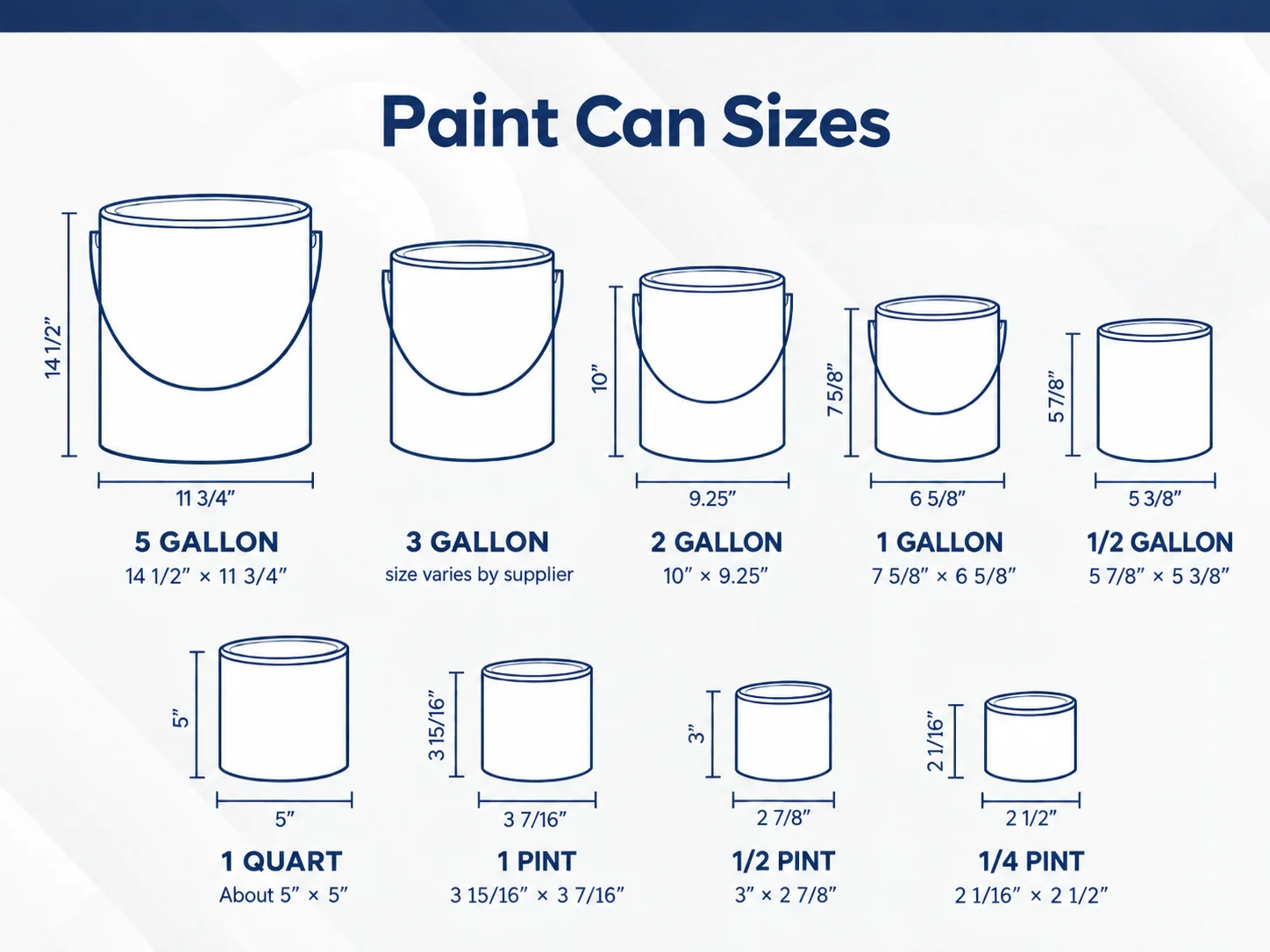
These dimensions are typical references, not fixed standards. Actual dimensions depend on tooling, wall construction, lid design, and supplier.
The main differences are straightforward.
1/4 pint to 1 pint cans are compact formats for samples, repair products, touch-up coatings, and small-volume specialty products.
1 quart and 1/2 gallon cans sit between sample packaging and full-gallon containers. They are useful when a gallon would leave too much unused material.
1 галлон is one of the most common round metal paint can formats in the U.S. It is widely used for architectural paints, primers, coatings, stains, and similar products.
2-, 3-, and 5-gallon containers are intended for higher fill volumes. At these sizes, handle strength, lid retention, filled weight, pallet layout, and pouring become more important. The container may also shift from a traditional paint can design to a steel pail.
This is why larger capacities should be specified by both volume and actual container dimensions.
2. Metric Paint Can Sizes: 1 Liter, 2 Liter, 3 Liter and 5 Liter
In metric markets, common metal paint can capacities include 1 L, 2 L, 3 L, and 5 L.
| Metric Size | Approx. U.S. Volume | Relative Size |
|---|---|---|
| 1 Liter | 33.8 fl oz / 1.06 qt | Slightly larger than 1 quart |
| 2 Liter | 67.6 fl oz / 0.53 gal | Slightly larger than 1/2 gallon |
| 3 Liter | 101.4 fl oz / 0.79 gal | Between 1/2 gallon and 1 gallon |
| 5 Liter | 169.1 fl oz / 1.32 gal | Larger than 1 gallon |
Metric cans do not directly match U.S. customary sizes.
For example, a 1-liter can is close to a quart, but it holds about 5.7% more product. A 5-liter can is also noticeably larger than a U.S. gallon.
There is no universal outside dimension for a 1 L, 2 L, 3 L, or 5 L metal paint can. Manufacturers may use different diameter-to-height ratios for the same nominal capacity.
For production planning, use the supplier’s technical drawing rather than relying only on the volume label.
3. Imperial vs Metric Paint Can Sizes
In North American paint packaging, pint, quart, and gallon normally refer to U.S. customary units, not British Imperial units.
A U.S. gallon equals about 3.785 liters, while a British Imperial gallon is about 4.546 liters.
Common U.S. conversions are:
| U.S. Size | Metric Equivalent |
|---|---|
| 1 Pint | 0.473 L |
| 1 Quart | 0.946 L |
| 1/2 Gallon | 1.893 L |
| 1 Gallon | 3.785 L |
| 2 Gallons | 7.571 L |
| 3 Gallons | 11.356 L |
| 5 Gallons | 18.927 L |
The practical difference is not just the number printed on the container.
Changing from a quart to a 1-liter can, or from a gallon to a 4-liter can, can also change can dimensions, lid diameter, filling settings, carton size, and pallet configuration.
For products sold in several markets, metric and U.S. packages should therefore be treated as separate packaging formats.
4. Paint Can Lids and Closure Options
The lid needs to match the can ring, product, filling process, and expected opening and resealing cycles.
4.1 Standard Paint Can Lids
Most traditional round metal paint cans use a lever-type lid. The lid is pressed into the can ring to create the seal and can later be lifted with a paint can opener or another suitable flat tool.
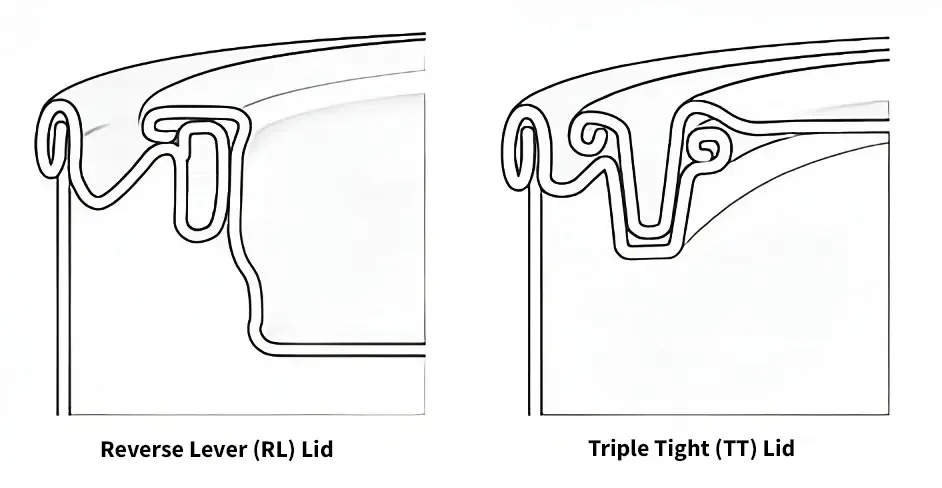
Within this general lever-lid design, different ring and sealing structures are available. Two common examples are Reverse Lever (RL) и Triple Tight (TT).
Reverse Lever (RL) refers to a closure structure in which the lid engages with the inner profile of the can ring. It is commonly used on cylindrical metal cans in a range of smaller and medium capacities.
Triple Tight (TT) uses multiple sealing contact points between the lid and ring. This design is often selected when a tighter seal or repeated opening and resealing is required.
RL and TT should therefore not be treated as completely separate from lever lids. They are different closure constructions within the broader lever-lid paint can system.
The exact lid and ring profile must match. Two cans with the same nominal capacity do not necessarily use interchangeable lids.
For normal use, the lid is opened gradually around the rim rather than being forced upward from a single point. When resealing, the rim should be clean and the lid should be pressed or tapped down evenly so the mating surfaces are not distorted.
4.2 Paint Can Pour Spouts and Pour Lids
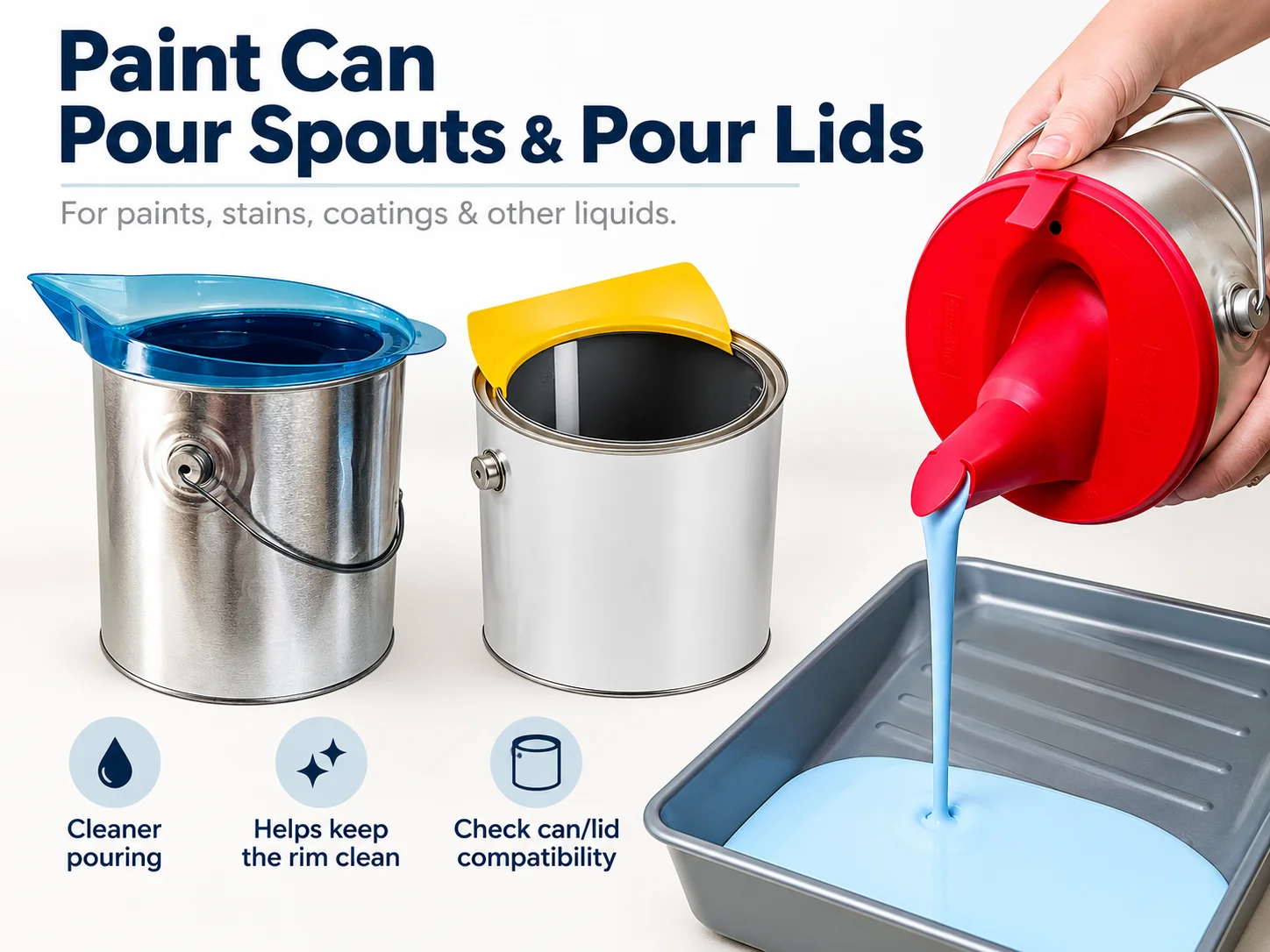
Pouring directly from a conventional paint can can leave paint in the rim, which may interfere with resealing.
Pour spouts and pour lids provide a cleaner flow path and can be useful for paints, stains, coatings, and other liquids that are dispensed repeatedly.
Compatibility still depends on the can diameter, ring profile, closure design, and product viscosity. A spout designed for one lid system may not fit another even if both containers have the same nominal capacity.
5. How to Choose the Right Paint Can Size for Your Product
Start with the required fill volume.
Do not assume that similar-looking U.S. and metric sizes are interchangeable. A quart is not a liter, and a U.S. gallon is not 4 liters.
Then check the outside dimensions. Diameter and height affect filling equipment, lid presses, labeling or printing, case packing, pallet layout, and paint shaker compatibility.
Product chemistry also matters. Metal cans may be supplied unlined or with an internal coating. The appropriate lining depends on the formulation and should be confirmed through compatibility testing.
Next, confirm the closure system. Check the lid profile, ring construction, sealing requirements, and whether the end user will repeatedly open and reseal the container.
For larger sizes, also consider filled weight, handle strength, pouring control, and whether a traditional paint can or pail-style container is more practical.
A useful paint can specification should therefore include:
- Nominal capacity
- Actual container dimensions
- Lid and ring type
- Internal lining, if required
- Handle configuration
- Filling and closing requirements
- Packing and equipment compatibility
6. Заключение
Paint can sizes may look standardized, but capacity alone does not define the package.
Small cans mainly differ by fill volume. As capacity increases, differences in diameter, height, lid construction, handle design, and pail configuration become more significant.
For production use, specify the volume, dimensions, closure system, and lining together. A supplier drawing should be the final reference before setting up filling, closing, packing, or mixing equipment.