
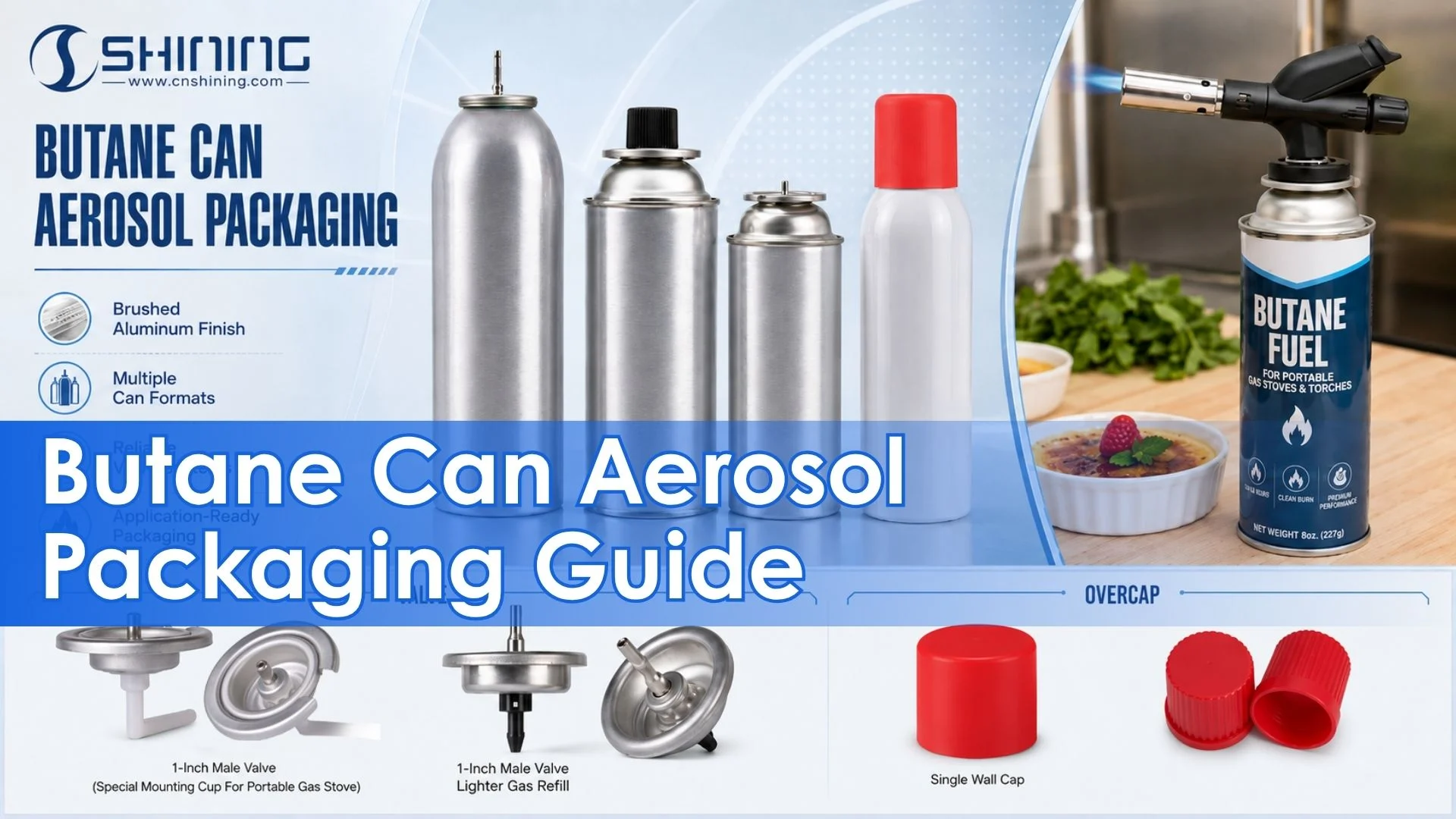
A butano puede Se trata de un paquete a presión antes de ser un producto de combustible. También puede denominarse cartucho de butano, bombona de gas butano, cartucho de gas tipo cassette, bombona de combustible EN417, gas de recarga para encendedores o cartucho pequeño de GLP. La denominación varía según el canal de distribución. El problema técnico, sin embargo, persiste.
Este producto no es solo “combustible en un recipiente de metal”. Es un sistema controlado hecho de mezcla de combustible, cuerpo de la lata metálica, válvula, interfaz de sellado, trayectoria del actuador o gatillo, etiqueta de advertencia y clasificación para el transporte de mercancías peligrosas. La mayoría de las quejas de los usuarios no comienzan con el poder calorífico. Comienzan con fugas, mala alineación, llama débil en climas fríos, sobrecalentamiento por utensilios de cocina demasiado grandes, confusión de códigos de producto y eliminación poco clara de latas vacías.
1. Perspectiva técnica ejecutiva
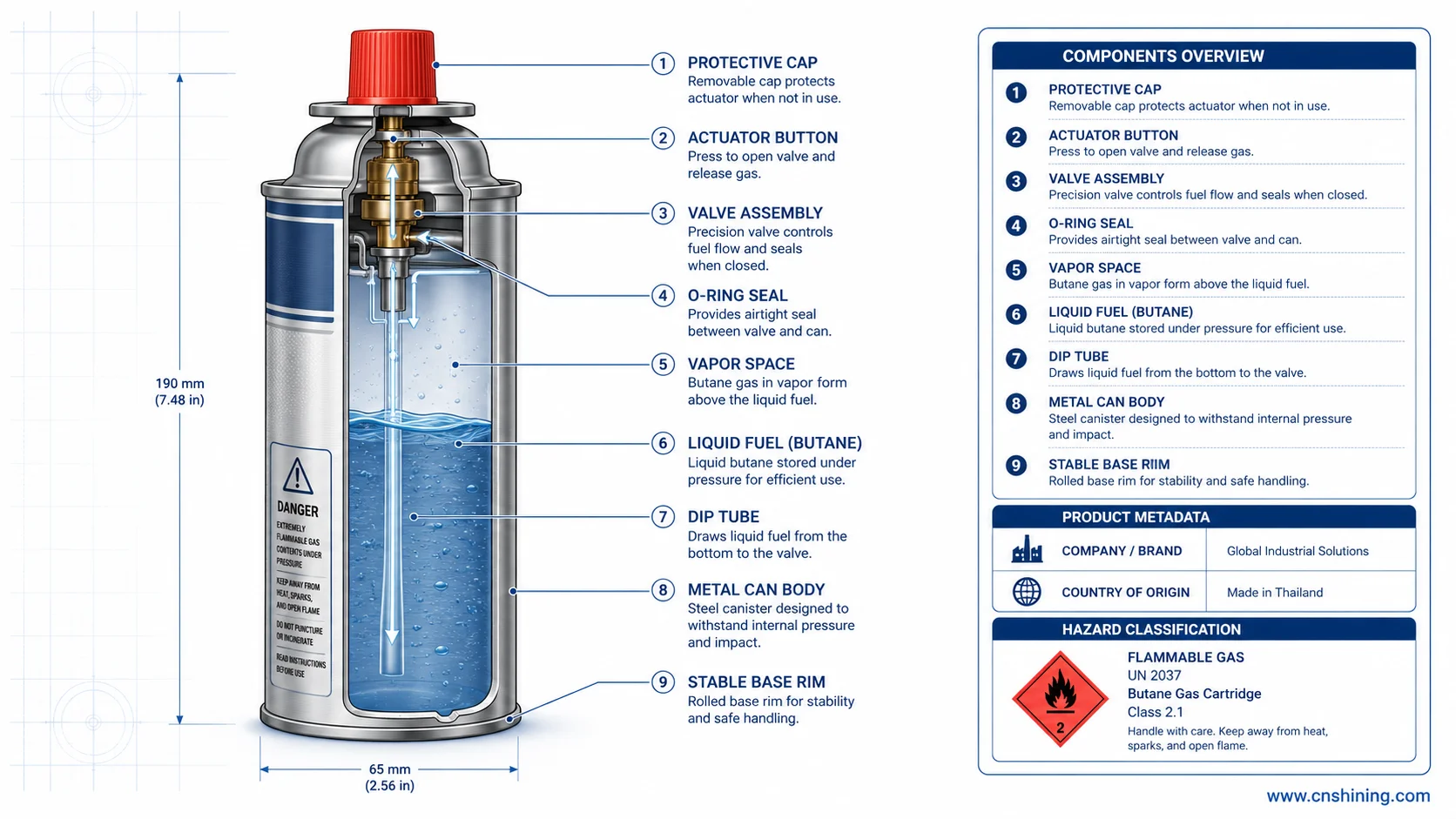
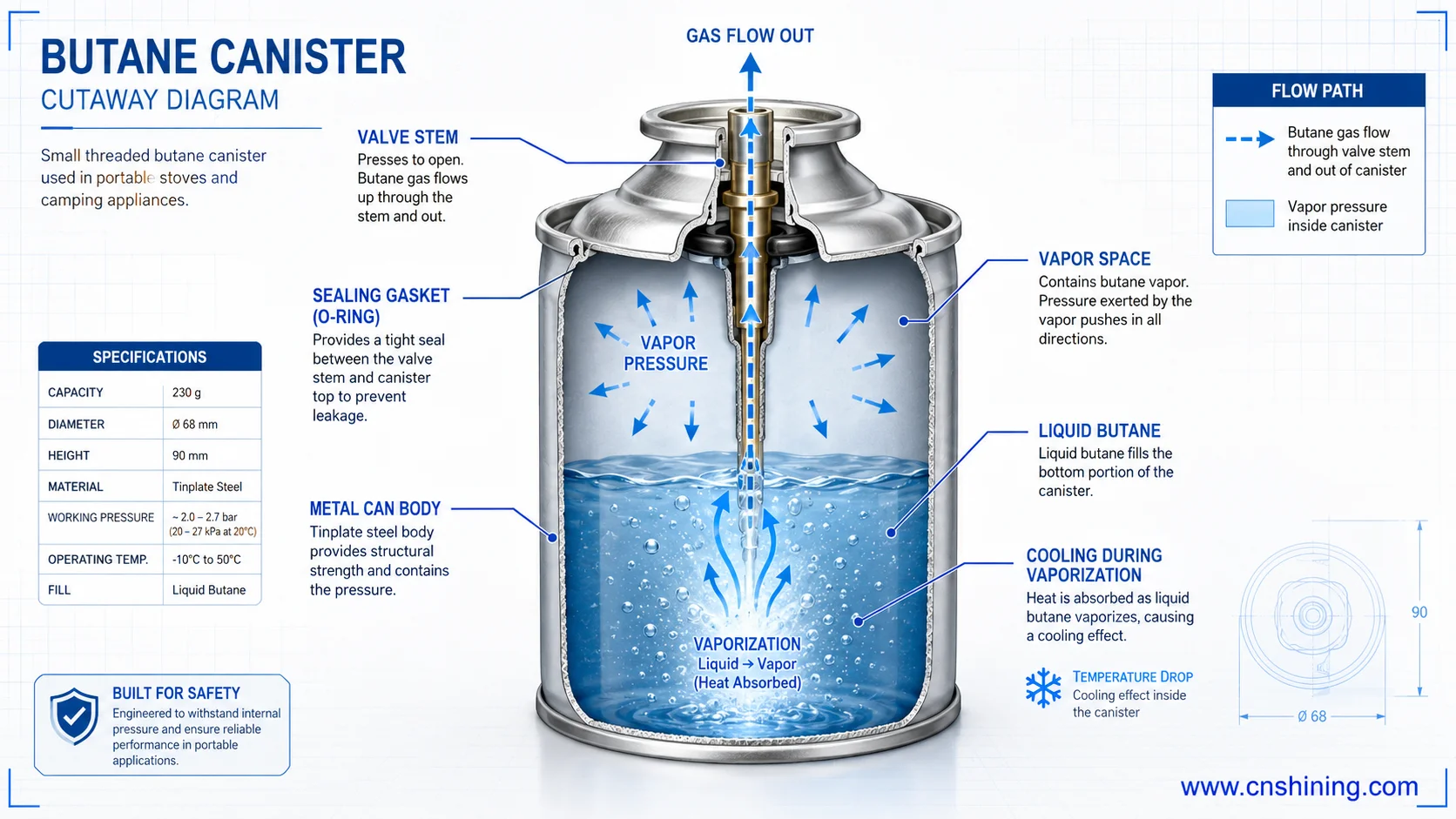
El mecanismo principal es el equilibrio líquido-vapor. A temperatura ambiente, el butano licuado genera su propia presión de vapor. Cuando el usuario abre la válvula, el vapor sale primero. La presión interna disminuye. El combustible líquido se vaporiza entonces para restablecer la presión. Esa vaporización absorbe calor, por lo que el envase se enfría durante su uso. El síntoma común en el campo es simple: Cuanto más tiempo esté funcionando, más frío se vuelve y más débil se vuelve la llama..
El n-butano tiene un punto de ebullición normal alrededor de -0,5 °C, mientras que el isobutano está alrededor -11,7 °C. La mezcla de isobutano y propano mejora la usabilidad a bajas temperaturas, pero también cambia la presión interna y el manejo regulatorio. Para obtener datos sobre las propiedades del n-butano, consulte la Registro del NIST Chemistry WebBook para el butano. En cuanto al comportamiento durante el transporte, la NOAA señala que el butano se transporta como un gas licuado bajo su propia presión de vapor y que los vapores son más pesados que el aire; Hoja de datos del butano NOAA CAMEO es un punto de partida práctico.
2. Alcance, definición y principio de funcionamiento
2.1 Definición y límites
Este artículo trata una lata de butano como un recipiente metálico a presión de consumo, no recargable, generalmente de menos de 1 litro, utilizado para estufas portátiles, antorchas, lámparas, calentadores y aplicaciones de recarga. Tres capas del producto son importantes:
- Alcance principal: Pequeñas latas metálicas a presión para hornillos portátiles, antorchas, calentadores, lámparas y para recarga.
- Productos adyacentes: Cartuchos roscados EN417, cartuchos para hornillos de cassette y recambios para encendedores.
- Productos de comparación: Cilindros de GLP de gran tamaño y envases de aerosol que utilizan butano, isobutano o propano como propelentes.
El Página de alcance de GSO EN 417:2025 Describe cartuchos metálicos de GLP no recargables, con o sin válvula, para uso con aparatos portátiles, con capacidades de entre 50 ml y 1000 ml. Asimismo, se mencionan las excepciones relativas a la condición de presión de 50 °C y la odorización en los cartuchos de menor capacidad.
2.2 Mecanismo físico y químico
El proceso de suministro comienza con la presión de vapor saturado. Dentro del bidón, el combustible líquido se encuentra debajo de un espacio de vapor. Al abrir la válvula, se libera el vapor. La caída de presión fuerza la evaporación de más líquido. Esta evaporación elimina el calor latente de la pared del bidón y reduce la presión de vapor. Las bajas temperaturas ambiente empeoran esta situación.
Por eso, una solución de butano puro es menos potente en invierno o a gran altitud que una mezcla con mayor proporción de isobutano o propano. Una llama estable no depende únicamente del quemador, sino también de la formulación del combustible, el caudal de la válvula, el rango de presión y la transferencia de calor.
2.3 Control de válvula, gatillo y liberación
En una estufa de cassette típica, la boquilla del cartucho de combustible entra en el regulador y se sella mediante una junta tórica. Una estructura mecánica o magnética mantiene el cartucho en su posición. La perilla frontal regula el flujo de gas. La palanca de bloqueo empuja el cartucho de combustible hacia el regulador. El gas entonces pasa a través del regulador y la boquilla principal, se mezcla con el aire primario y se enciende en los orificios del quemador.
El informe de la CPSC de EE. UU. sobre aparatos de butano de sobremesa registró la activación de la protección contra sobrepresión en aproximadamente 65-79 psig, o 0,45-0,54 MPa, en las muestras de prueba. El mismo informe describe el riesgo que se crea cuando una plancha grande se extiende sobre el compartimento de combustible; véase el Informe de la CPSC sobre aparatos de cocina de butano de sobremesa.
Las familias de interfaces más comunes son:
- Interfaz de bayoneta/cassette: Depende de la ranura de alineación, la palanca de bloqueo y la retroalimentación de posición.
- Válvula autosellante roscada EN417: común en los cartuchos de hornillos para mochileros.
- Sistema de boquilla y adaptador para recarga de encendedores: Se basa en un vástago de llenado estrecho o un adaptador para abrir la válvula receptora.
- El butano líquido o la mezcla de combustible generan presión de vapor dentro del envase.
- El usuario presiona el vástago de la válvula, bloquea el cartucho o abre la válvula de un aparato conectado.
- La válvula se abre y el gas pasa a través de la interfaz de la junta tórica, el regulador o la boquilla.
- El gas se mezcla con el aire primario y se enciende.
- La presión interna disminuye, el combustible líquido se vaporiza y el recipiente se enfría.
- A bajas temperaturas, la presión de vapor disminuye y la intensidad de la llama se atenúa.
3. Formulación, clasificación y comparación de combustibles
3.1 Rutas de formulación comunes
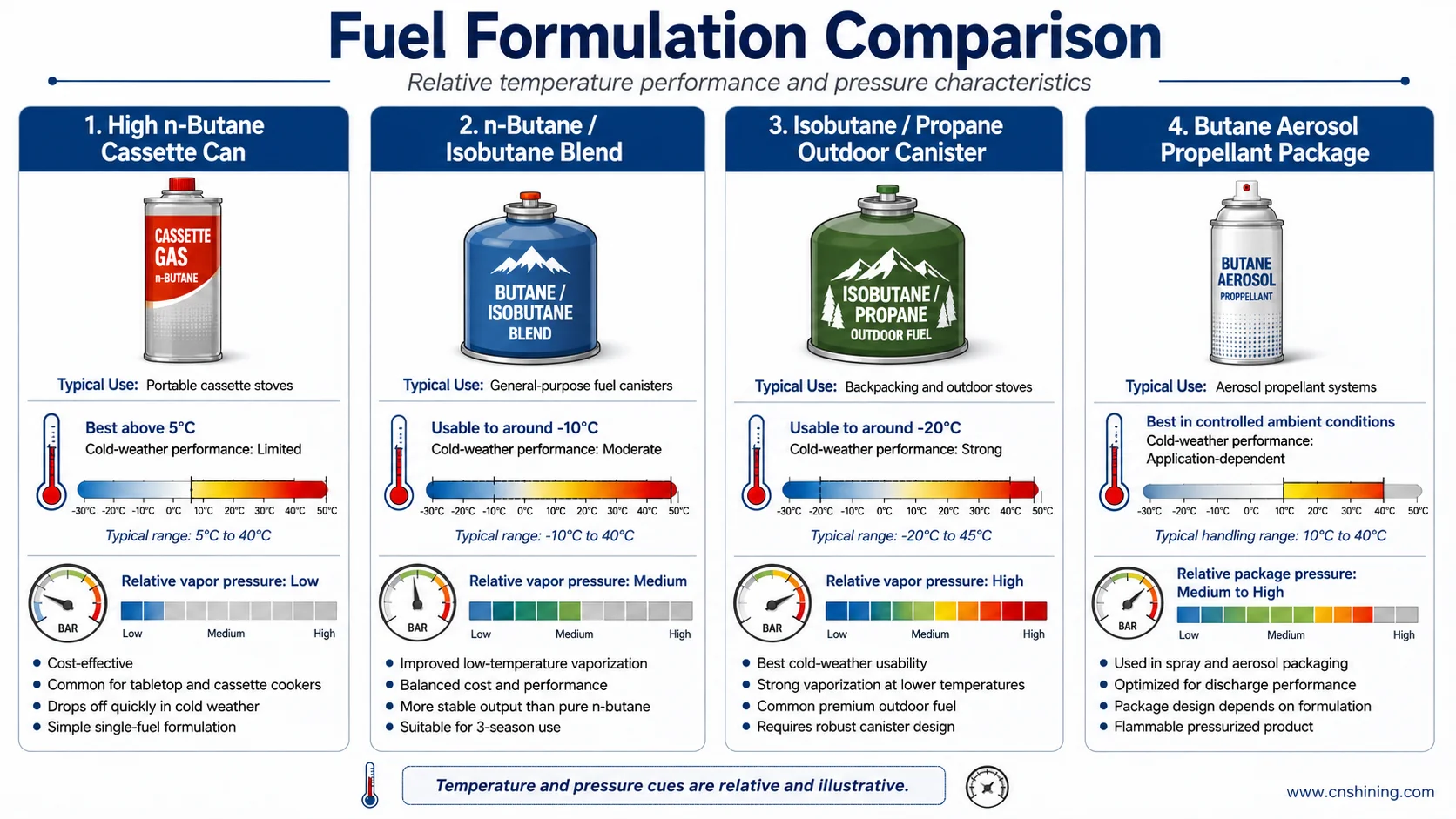
Las latas de butano destinadas al consumidor generalmente siguen cuatro ideas de formulación:
| Ruta de formulación | Uso típico | Significado técnico |
|---|---|---|
| Alto contenido de n-butano | Latas para hornillos de cassette y algunos productos de recarga para encendedores. | Económico y estable a temperatura normal, pero menos eficaz en condiciones de frío. |
| n-butano / isobutano | Combustible para el consumidor mejorado para el arranque en frío | Un mayor contenido de isobutano mejora la presión de vapor a temperaturas más bajas. |
| Isobutano / propano | Recipientes roscados para exteriores | Más adecuado para climas fríos y grandes altitudes, con una mayor presión de diseño. |
| Propelente de butano/isobutano/propano | Aerosol, spray técnico, cuidado personal, productos de limpieza | El gas puede actuar como propulsor en lugar de que el producto se queme como combustible. |
La estrategia de olores también varía según el tipo de producto. Los bidones de combustible pueden usar gas odorizado para ayudar a los usuarios a detectar fugas. El gas de recarga para encendedores de alta pureza puede evitar olores fuertes, ya que los usuarios asocian el olor con combustible sucio o con la obstrucción de la boquilla. La capacidad y la normativa local influyen en la decisión.
3.2 Enfoque en la seguridad
La cuestión de seguridad no es si es inflamable, ya que es altamente inflamable. La verdadera pregunta es si el combustible se comporta de forma predecible en función de la temperatura, la postura, el ajuste de los accesorios, la tolerancia de la interfaz y el comportamiento del usuario. Los utensilios de cocina de gran tamaño, las latas mal cerradas y las interfaces con fugas son patrones de riesgo recurrentes.
3.3 Comparación con productos relacionados
En comparación con las grandes bombonas de GLP, una lata de butano es portátil, sencilla y adecuada para pequeñas necesidades de calefacción distribuida. Sus desventajas son un mayor coste de envasado por unidad de energía, un mayor número de envases desechables, un rendimiento inferior en climas fríos en sistemas de butano puro y mayores restricciones en el transporte para la venta al por menor.
En comparación con el gas de recarga para encendedores, una lata de combustible para estufas prioriza el suministro continuo de gas y la compatibilidad con electrodomésticos. El gas para encendedores prioriza la comodidad de recarga y la adaptación a boquillas pequeñas. En comparación con los envases de propelente en aerosol, el propósito cambia: una lata de butano proporciona calor; un envase de aerosol atomiza o dispensa otro material. Esta diferencia modifica el diseño de la válvula, la geometría del actuador, el etiquetado y la terminología de cumplimiento.
4. Regulación, normas, transporte y reciclaje
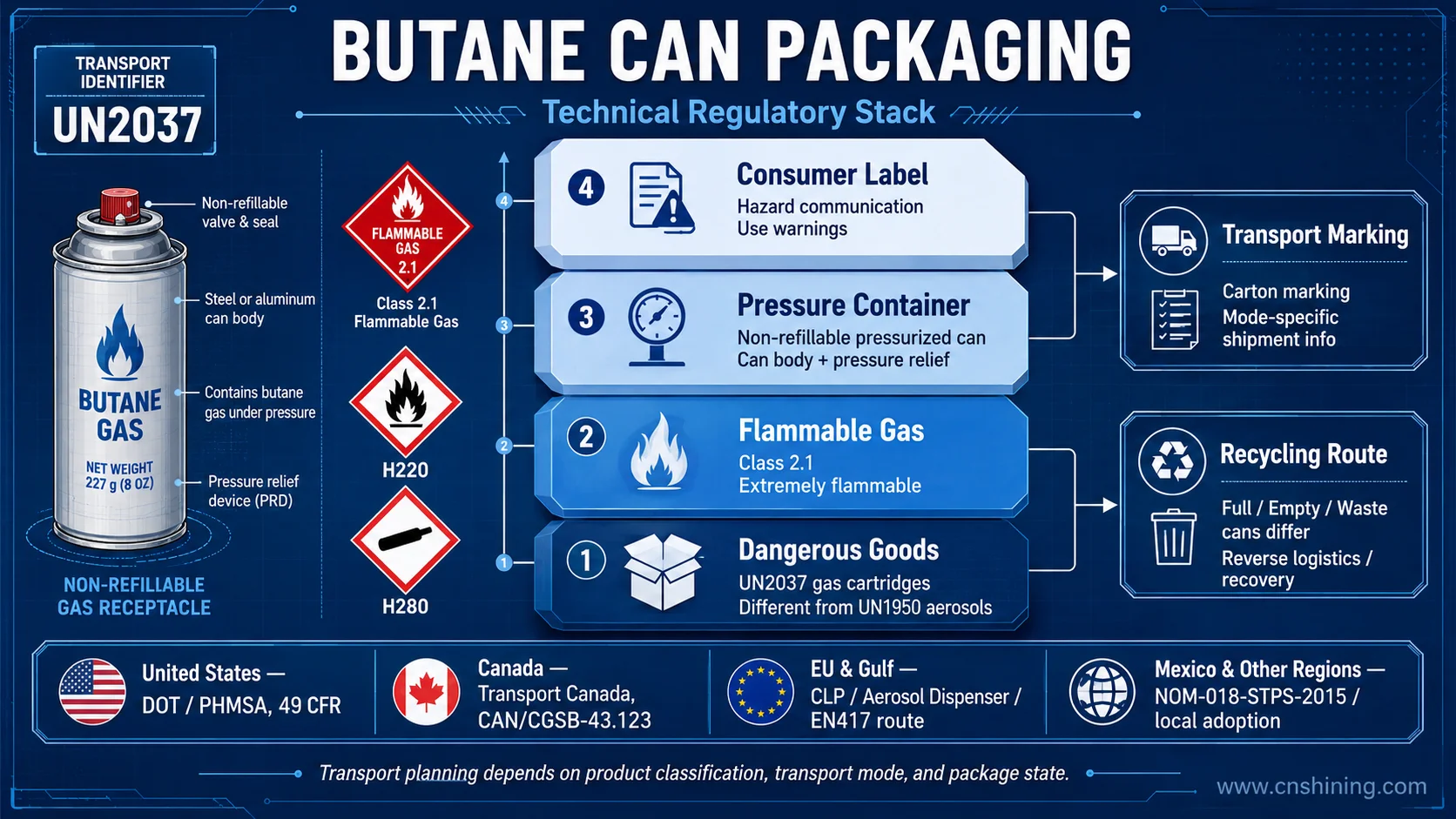
La base regulatoria es una estructura de cuatro capas: Etiquetado de mercancías peligrosas, gases inflamables, recipientes a presión y productos químicos de consumo.. Los pequeños recipientes de gas no recargables entran dentro de la lógica de mercancías peligrosas de la ONU. Un documento de trabajo de la UNECE analiza la diferenciación entre los aerosoles UN1950 y los cartuchos de gas UN2037; véase el Documento de la CEPE sobre la diferenciación entre la ONU de 1950 y la ONU de 2037..
Para la clasificación del transporte en EE. UU., 49 CFR es la base de trabajo. Sección de la tabla de materiales peligrosos del eCFR es un punto de referencia. Para la clasificación química en Europa, el Página de clasificación de butano de la ECHA Admite las declaraciones de peligro comunes del GHS/CLP: H220 para gases extremadamente inflamables y H280 para gas a presión.
4.1 Estados Unidos
El marco normativo estadounidense combina las normas de transporte del DOT/PHMSA, las especificaciones de los recipientes a presión y las lecciones aprendidas sobre la seguridad de los productos de consumo a partir de incidentes con hornillos portátiles. En la práctica, los desarrolladores de productos deben considerar conjuntamente las especificaciones del cuerpo del envase, el comportamiento ante la liberación de sobrepresión, el etiquetado, el marcado de la caja y las advertencias sobre su uso.
4.2 Canadá
Transport Canada establece que los envases de aerosol y los cartuchos de gas para mercancías peligrosas de Clase 2 deben cumplir con los requisitos aplicables de CAN/CGSB-43.123. Página de requisitos de Transport Canada para envases de aerosol y cartuchos de gas Separa la lógica de diseño, fabricación, selección, uso, marcado y registro. Documento CAN/CGSB-43.123 Es útil para el transporte de envases de aerosol y cartuchos de gas.
4.3 Mercados de la Unión Europea y del Golfo Pérsico
Los productos en aerosol de la UE deben tener en cuenta los riesgos de inflamabilidad y presión en el marco de la normativa sobre dispensadores de aerosol. Página de la directiva de la Comisión Europea sobre dispensadores de aerosoles Es relevante para la lógica de los dispensadores de aerosoles. Los cartuchos tipo EN417 se rigen por una norma técnica independiente para los cartuchos metálicos de GLP no recargables utilizados con aparatos portátiles.
4.4 México y otras regiones
Para México, NOM-018-STPS-2015 sigue la lógica de comunicación de peligros del SGA; véase el PDF fuente NOM-018-STPS-2015. Latinoamérica, los países del Golfo y Sudáfrica no son mercados con regulaciones flexibles. Suelen adoptar marcos internacionales con detalles de ejecución locales.
4.5 Transporte y reciclaje
La planificación del transporte debe distinguir la clasificación del producto, el modo de transporte y el estado del embalaje. Las latas nuevas llenas, las latas vacías de consumo y las latas de desecho para su recuperación no representan el mismo problema logístico. La EPA de EE. UU. ha añadido las latas de aerosol al sistema de residuos universales; véase el Página de la normativa de residuos universales de la EPA sobre latas de aerosol. Esto es importante para la logística inversa y las instrucciones de manejo de latas vacías.
5. Problemas que experimentan los usuarios y oportunidades de mejora del empaquetado
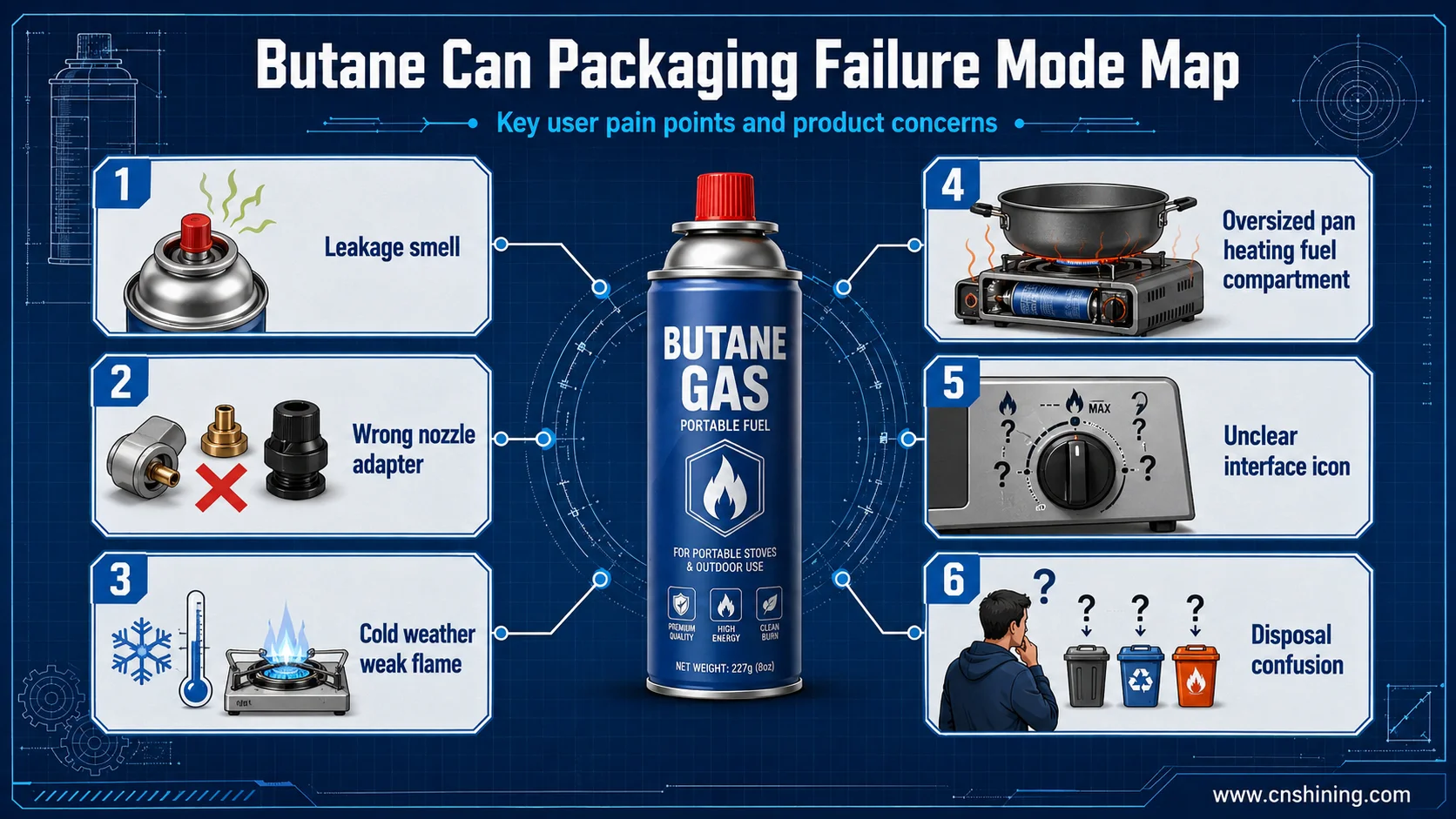
| Queja del usuario | Posible origen técnico | Respuesta del embalaje |
|---|---|---|
| “Huelo a gas.” | Problema de retorno de la válvula, desajuste de la junta tórica, suciedad en el asiento de la válvula o tolerancia de interfaz deficiente. | Mejorar la consistencia de la válvula autosellante, la tapa antipolvo, las instrucciones de comprobación de fugas y el control de tolerancia de la interfaz. |
| “Durante el repostaje, el combustible sale disparado por todas partes.” | Desajuste en la geometría del adaptador o diferencia de presión no controlada. | Utilice adaptadores codificados, diagramas de instrucciones de recarga más claros y un diseño de asiento anti-retroceso. |
| “La llama se debilita con el frío.” | Baja presión de vapor tras el enfriamiento por evaporación. | Utilice la mezcla adecuada según las instrucciones y evite los consejos sobre calefacción externa que puedan resultar inseguros. |
| “Encaja, pero no sale gas.” | El vástago de la válvula no está completamente presionado, el seguro no está activado o la interfaz es incorrecta. | Aumenta el tamaño de los iconos de la interfaz y añade una señal táctil o visual que indique si se está bloqueando la interfaz. |
| “Compré la versión equivocada y ya la rellené.” | Confusión en cuanto a SKU e interfaz en el comercio electrónico. | Indique el tipo de interfaz, la cantidad de adaptadores y el aviso de no devolución después del llenado en la imagen principal y en la etiqueta frontal. |
Dirección de mejora del embalaje
La oportunidad comercial más fuerte no es solo un metal más grueso. Es una sistema de embalaje a prueba de errores. Para los cartuchos tipo cassette, la ranura de alineación, la palanca de bloqueo y la junta tórica deben proporcionar una guía forzada y una clara indicación de bloqueo. Para los cartuchos roscados, el retorno del núcleo de la válvula y la durabilidad de la junta requieren una validación exhaustiva. Para los cartuchos de recarga, la codificación del adaptador y la geometría anti-retroceso reducen el modo de fallo por acumulación de gas alrededor de la boquilla.
El diseño de la etiqueta debe promover la compatibilidad, desde la letra pequeña hasta el elemento visual principal. Un panel frontal debe indicar al usuario si el paquete es de cartucho de bayoneta, rosca EN417 o solo para recarga de encendedor. En los sistemas de cocina de cartucho de montaje lateral, las advertencias sobre el diámetro máximo de los utensilios de cocina y el calentamiento del compartimento de combustible deben tener un alto contraste. La tinta termosensible o una simple banda de advertencia térmica pueden ser útiles, pero no sustituyen el sistema de bloqueo del aparato.
La compatibilidad del recubrimiento interno y del material también es importante. Las páginas públicas rara vez divulgan la composición química del recubrimiento, por lo que no es seguro considerar una resina como universal. El procedimiento correcto consiste en analizar la mezcla de combustible, el odorizante, el agua residual, la junta de la válvula, el recubrimiento y el sustrato metálico como un sistema integral.
6. Aplicaciones de Shining Packaging: Actuadores, latas de aerosol y válvulas
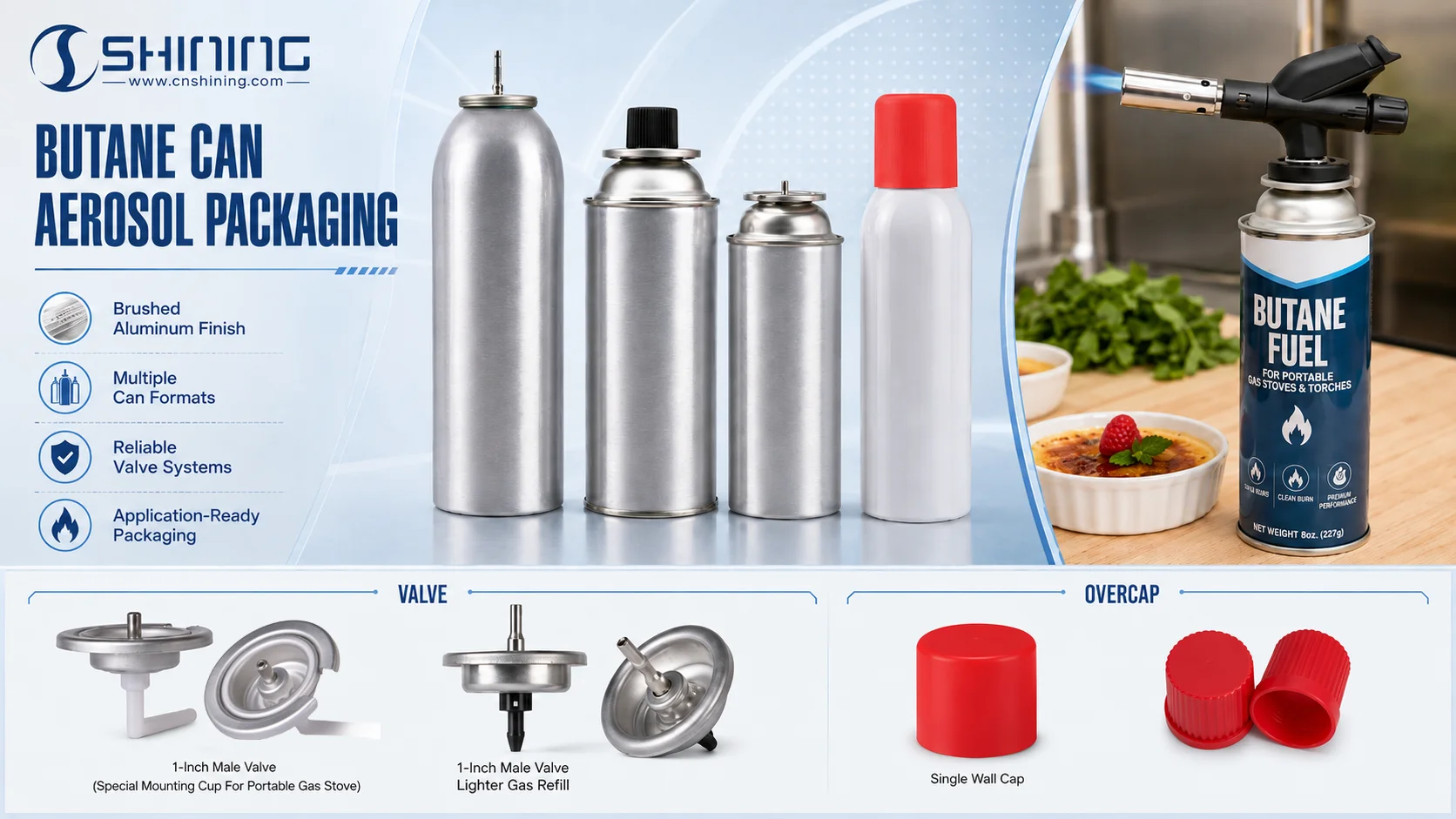
En el caso de los envases de butano, el cuerpo del envase es solo una parte de la cadena de riesgo. El actuador, la válvula, el vástago, la junta, la copa y la interfaz entre el envase y el dispositivo determinan si los usuarios perciben una interacción segura o un producto propenso a fugas. El trabajo relevante de Shining Packaging se centra en estos componentes de la interfaz: actuadores, latas de aerosol, y válvulas Se utiliza en sistemas de envasado a presión donde la liberación controlada y la fiabilidad del sellado son fundamentales.
Esto no significa que todos los bidones de butano utilicen el mismo actuador que los aerosoles. No es así. La clave reside en la práctica de ingeniería: el control del asiento de la válvula, la compatibilidad de la junta, la consistencia del engaste, el recorrido del actuador y la retroalimentación del usuario influyen en la tasa de reclamaciones. En los bidones de combustible, la interfaz debe controlar la liberación del gas. En los aerosoles, el actuador y la válvula deben controlar la pulverización o descarga. La disciplina de diseño es similar: reducir las liberaciones involuntarias, facilitar el uso correcto y mantener el envase estable durante el transporte y el almacenamiento.
Para los equipos que desarrollan cartuchos de butano, sopletes, aerosoles técnicos o productos que funcionan con gas, la pregunta práctica es directa: ¿el envase facilita la acción correcta en lugar de la incorrecta? De no ser así, las quejas por fugas acabarán encontrando el punto débil.
7. Las 10 mejores marcas de bombonas de butano
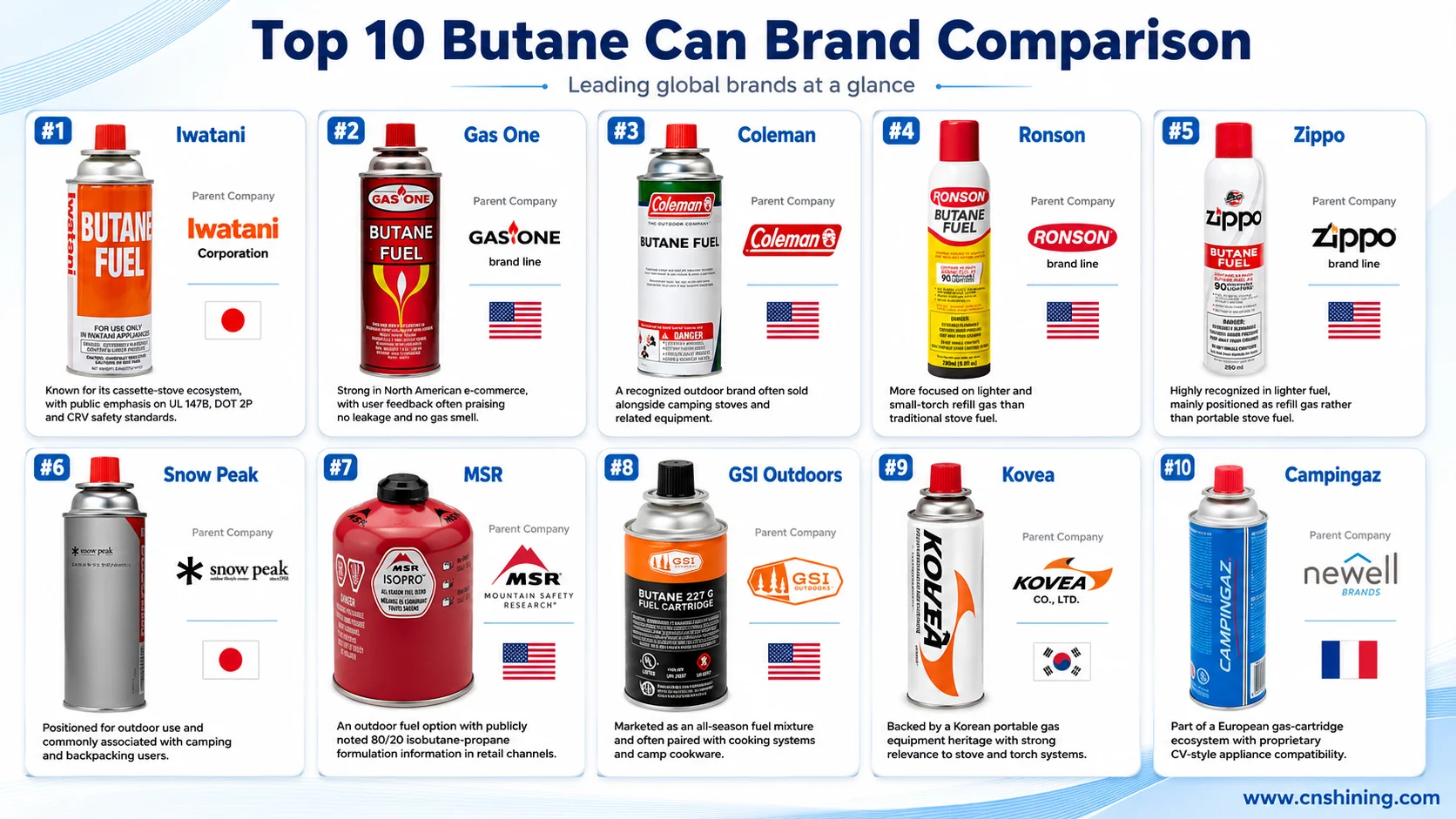
| Marca | País/Región | Empresa / Operador | Capacidad común | Precio típico visible | Comentario técnico |
|---|---|---|---|---|---|
| Iwatani | Japón | Corporación Iwatani | 227 g / 8 oz | aproximadamente $1.93-3.49 por lata | Ecosistema conocido de estufas de cassette. Los materiales públicos hacen hincapié en UL 147B, DOT 2P y CRV. |
| Gas Uno | Estados Unidos | Línea de productos de la marca Gas One | 8 oz / 227 g | aproximadamente $8.88 individual; $15.95-15.96 por 4 latas | Fuerte presencia en el comercio electrónico en Norteamérica. Los comentarios de los usuarios suelen destacar la ausencia de fugas y de olor a gas. |
| Coleman | Estados Unidos | Coleman | 8.8 onzas; también 7.75 onzas de combustible mezclado | aproximadamente $10.99 por 2 latas | Reconocimiento de canales exteriores. A menudo se vende con hornillos de camping y equipos relacionados. |
| Ronson | Estados Unidos | Línea de productos de la marca Ronson | 135 ml, 290 ml | aproximadamente $4.96 para 290 ml; $12.95 para 135 ml x 3 | Más enfocado en el gas de recarga para encendedores y antorchas pequeñas que en el combustible para estufas. |
| Zippo | Estados Unidos | Línea de productos de la marca Zippo | 75 ml, 5,82 oz | aproximadamente $7.99 por 75 ml | Alta capacidad de reconocimiento de combustible para encendedores. Principalmente gas de recarga, no combustible para hornillos portátiles. |
| Pico nevado | Japón | entidad de marca Snow Peak | 220 g | aproximadamente $6.95 | Posicionamiento de combustible en exteriores. Comúnmente asociado con usuarios de campamentos y excursionismo. |
| MSR | Estados Unidos | Investigación sobre seguridad en montaña | Tamaños de 110 g y superiores | aproximadamente $5.95 por 110 g | Ejemplo de combustible para exteriores con información pública sobre la formulación de isobutano/propano 80/20 en canales minoristas. |
| GSI Outdoors | Estados Unidos | GSI Outdoors | 230 g | aproximadamente $6.95 | Sistema de mezcla de combustible para todas las estaciones. Suele combinarse con sistemas de cocina y utensilios de cocina para acampar. |
| Kovea | Corea del Sur | Compañía Kovea, Ltd. | 220 g / 230 g | aproximadamente $39.94 por juego | Experiencia en equipos de gas portátiles coreanos. Gran relevancia para sistemas de estufas y sopletes. |
| Campingaz | Francia | Línea de productos de Newell Brands | CV300 Plus, CV470 Plus | aproximadamente $10.08-16.13 por cartucho | Sistema europeo de cartuchos de gas con compatibilidad patentada para aparatos de estilo CV. |
Términos técnicos comunes
| Término | Breve explicación | Significado empresarial |
|---|---|---|
| n-butano | Butano normal; punto de ebullición normal aproximado de -0,5 °C. | Económico, pero su rendimiento en climas fríos es limitado. |
| isobutano | Isómero del butano con un punto de ebullición más bajo, alrededor de -11,7 °C. Ver el Registro de isobutano en PubChem. | Mayor durabilidad a bajas temperaturas; característica común en mezclas mejoradas para exteriores. |
| GLP | Gas licuado de petróleo, comúnmente mezclas de propano y butano. | El producto no siempre es butano puro. La etiqueta y la clasificación deben coincidir con la composición de la mezcla. |
| EN 417 | Ruta estándar para cartuchos metálicos portátiles de GLP no recargables. | Lenguaje de compatibilidad importante para los mercados de electrodomésticos portátiles de Europa y el Golfo Pérsico. |
| Válvula Lindal / EN417 | Válvula roscada autosellante, utilizada en muchos recipientes para exteriores. | Es un punto de compatibilidad, pero también un posible motivo de queja si el sellado o el retorno de la válvula son deficientes. |
| Bayoneta / casete / MSF-1A | La estufa de cassette larga puede conectarse con la familia. | Necesita fotos claras para el comercio electrónico e iconos de interfaz en la etiqueta frontal. |
| CRV / RVR | Estructura de alivio de presión, como por ejemplo un avellanado o una válvula de ventilación en el borde. | Estructura de seguridad que puede hacerse visible en el lenguaje técnico del embalaje. |
| ONU 2037 | Número de mercancías peligrosas para pequeños recipientes que contienen gas, comúnmente cartuchos de gas. | Afecta directamente a los documentos de transporte, las marcas de las cajas y la comunicación aduanera. |
| H220 / H280 | Indicaciones de peligro GHS/CLP para gases extremadamente inflamables y gases a presión. | Incluye etiquetas, hojas de datos de seguridad (SDS), pictogramas y texto de cumplimiento multilingüe. |
| DOT 2P | Lenguaje común de especificación de contenedores pequeños de gas en Norteamérica. | Útil en las conversaciones sobre aprobación de exportaciones y ventas minoristas. |
| Residuos universales | Ruta de gestión simplificada de EE. UU. para determinados residuos peligrosos. | Relevante para la gestión de latas de aerosol vacías y la planificación de la logística inversa. |
8. Conclusiones técnicas
La conclusión estable es clara: la competencia en las latas de butano se está alejando de simplemente llenar otra lata de metal de bajo costo. El trabajo útil está en controlar interfaces, presión, sellado de válvulas, mal uso, etiquetado y cumplimiento regional. Un mejor recipiente no solo es más seguro en el laboratorio, sino que también reduce las posibilidades de que el usuario lo instale incorrectamente, lo caliente de forma incorrecta, lo rellene incorrectamente o lo deseche incorrectamente.
9. Preguntas frecuentes: Diseño, seguridad y embalaje de las latas de butano.
Un cartucho de butano suministra gas mediante el equilibrio líquido-vapor. Cuando el vapor sale por la válvula, se evapora más butano líquido para restablecer la presión. Esta evaporación absorbe calor del cuerpo del cartucho. A medida que el cartucho se enfría, la presión de vapor disminuye y el quemador recibe menos gas. Las bajas temperaturas ambiente hacen que esta caída de presión sea más evidente.
El n-butano hierve a unos -0,5 °C, por lo que su presión de vapor disminuye cerca del punto de congelación. Aunque el recipiente aún contenga combustible líquido, no genera suficiente flujo de vapor para producir una llama fuerte. Las mezclas de isobutano y propano mejoran el rendimiento a bajas temperaturas, ya que generan una mayor presión útil a temperaturas más bajas.
Un cartucho de butano tipo cassette suele utilizar una conexión de bayoneta con una muesca de alineación y una palanca de bloqueo. Un cartucho EN417 utiliza una válvula roscada autosellante, común en hornillos de camping. No son intercambiables a menos que el aparato esté diseñado específicamente para ambos sistemas. La etiqueta debe indicar claramente la conexión.
El olor a gas suele indicar un problema de sellado o de válvula. Las causas comunes incluyen una junta tórica mal ajustada, un asiento de válvula dañado, suciedad en la válvula, una rosca o tolerancia del adaptador deficientes, o un recipiente que no está bien sujeto al regulador. Un ligero olor no debe considerarse normal durante el almacenamiento o el uso.
Las sartenes o planchas de gran tamaño pueden sobresalir del compartimento del combustible y dirigir el calor hacia el depósito, el regulador y la válvula. Esto modifica la trayectoria térmica, pasando de la cocción normal al calentamiento del depósito de combustible. Si la presión aumenta lo suficiente, el sistema de protección puede activarse y liberar el combustible. Las advertencias del aparato deben indicar claramente el tamaño máximo de los utensilios de cocina.
La norma UN 2037 se utiliza para recipientes pequeños que contienen gas, a menudo denominados cartuchos de gas. Afecta a la descripción del transporte, el marcado del embalaje exterior, la documentación y la aceptación por parte del transportista. No sustituye las normas locales sobre envases, el etiquetado para el consumidor ni las declaraciones de peligro químico. Los equipos de exportación deben considerarla como parte del conjunto de requisitos de cumplimiento.
H220 identifica un gas extremadamente inflamable. H280 identifica un gas a presión que puede explotar si se calienta. Los productos de butano suelen requerir ambas etiquetas, ya que el material es inflamable y se almacena como gas licuado en un recipiente a presión. La etiqueta debe ajustarse a la implementación del GHS o CLP del mercado y a la composición del producto.
El tipo de interfaz debe ser visible antes de la compra y la instalación. Las etiquetas frontales y las imágenes de comercio electrónico deben indicar si el producto tiene conexión de bayoneta de casete, rosca EN417 o si solo se puede recargar con encendedores. La cantidad de adaptadores, la dirección de llenado, la posición de bloqueo y la compatibilidad con el aparato no deben ocultarse en texto pequeño del manual.
No. Ambos pueden usar butano, isobutano o propano, pero su funcionamiento es diferente. Un bidón de combustible suministra gas combustible a un quemador. Un envase de aerosol utiliza la presión del gas para dispensar otro material. Esta diferencia modifica el diseño de la válvula, el movimiento del actuador, el etiquetado, el comportamiento de la descarga y las normas aplicables al producto.
Pruebe conjuntamente la mezcla de combustible, el odorizante, la humedad residual, la junta de la válvula, el asiento de la válvula, el recubrimiento y el sustrato metálico. Un cambio que parezca seguro de forma aislada puede provocar hinchazón, mal olor, corrosión, fugas o un retorno lento de la válvula con el tiempo de almacenamiento. Las pruebas de compatibilidad deben abarcar los ciclos de temperatura, las vibraciones durante el transporte y el envejecimiento prolongado del envase lleno.