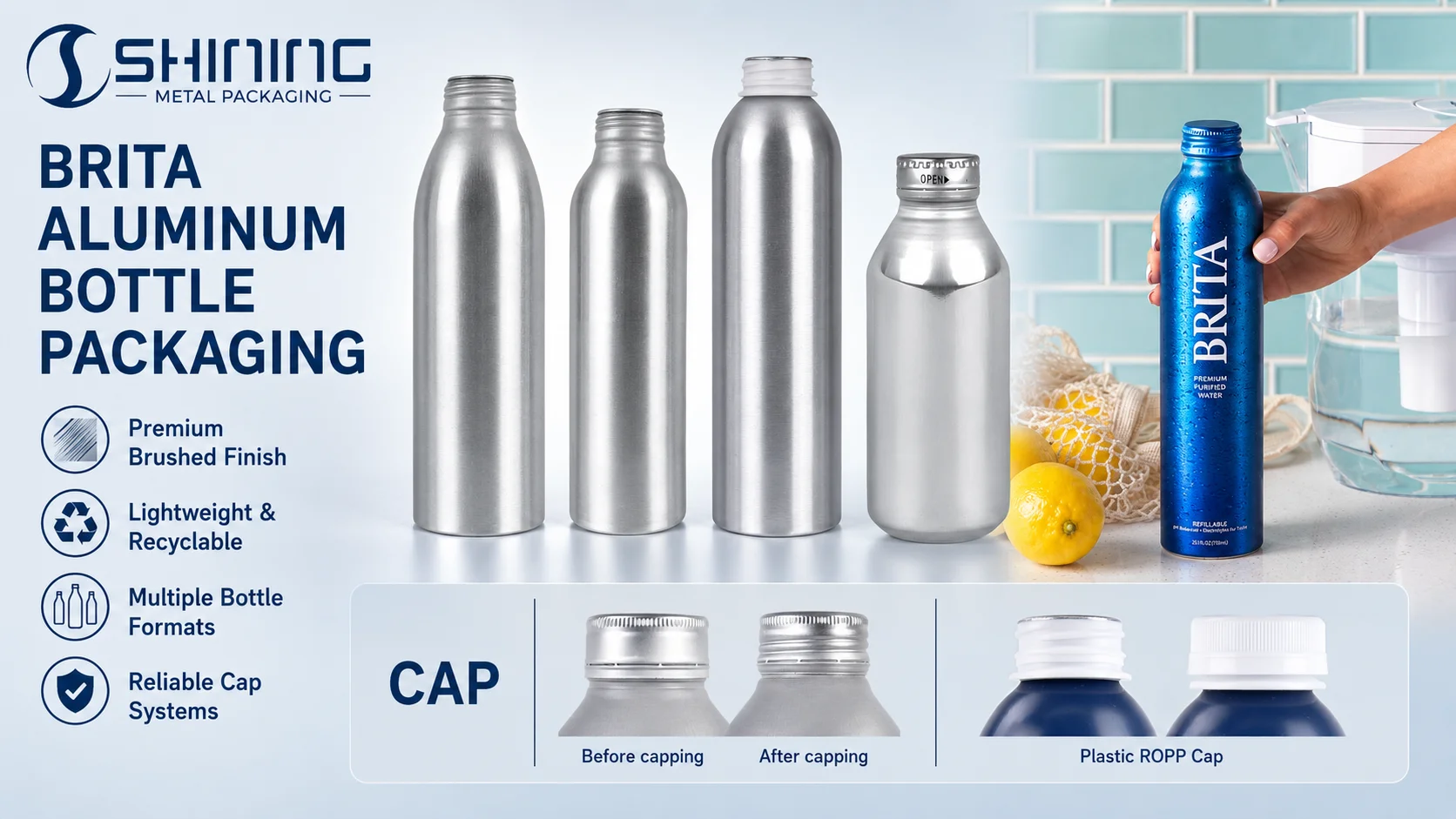
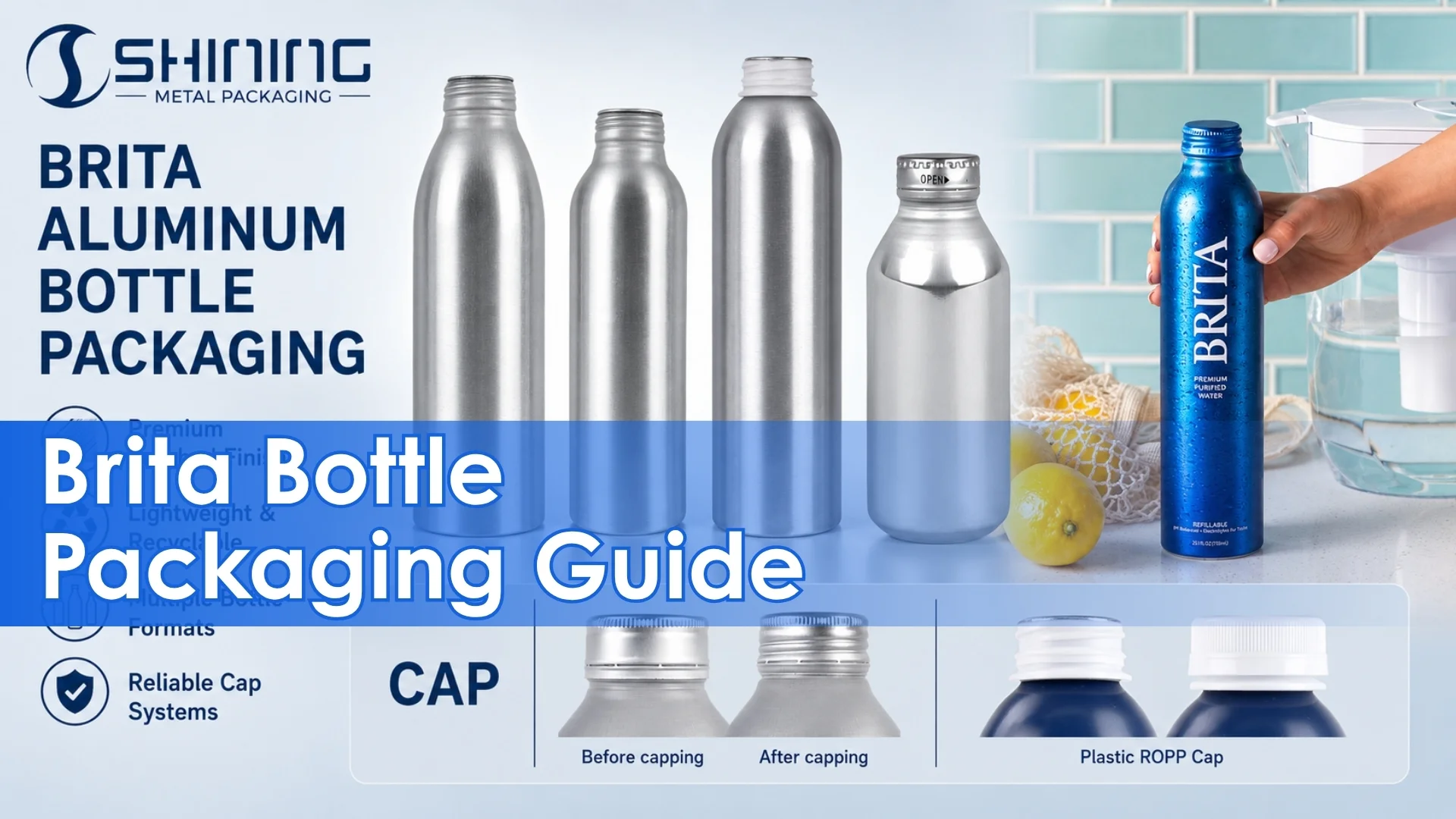
The Brita aluminum water bottle is unusual because it comes from a brand whose strongest long-term argument is that people should depend less on packaged water. Brita Premium Purified Water does not try to hide that tension. Its 18 oz and 25 oz formats are sold as ready-to-drink water, yet the bottle is designed and described as refillable, with the next refill expected to come from a Brita filtration product rather than another disposable purchase.
1. “Great Taste. Less Waste.” Is a Packaging Instruction, Not Just a Slogan
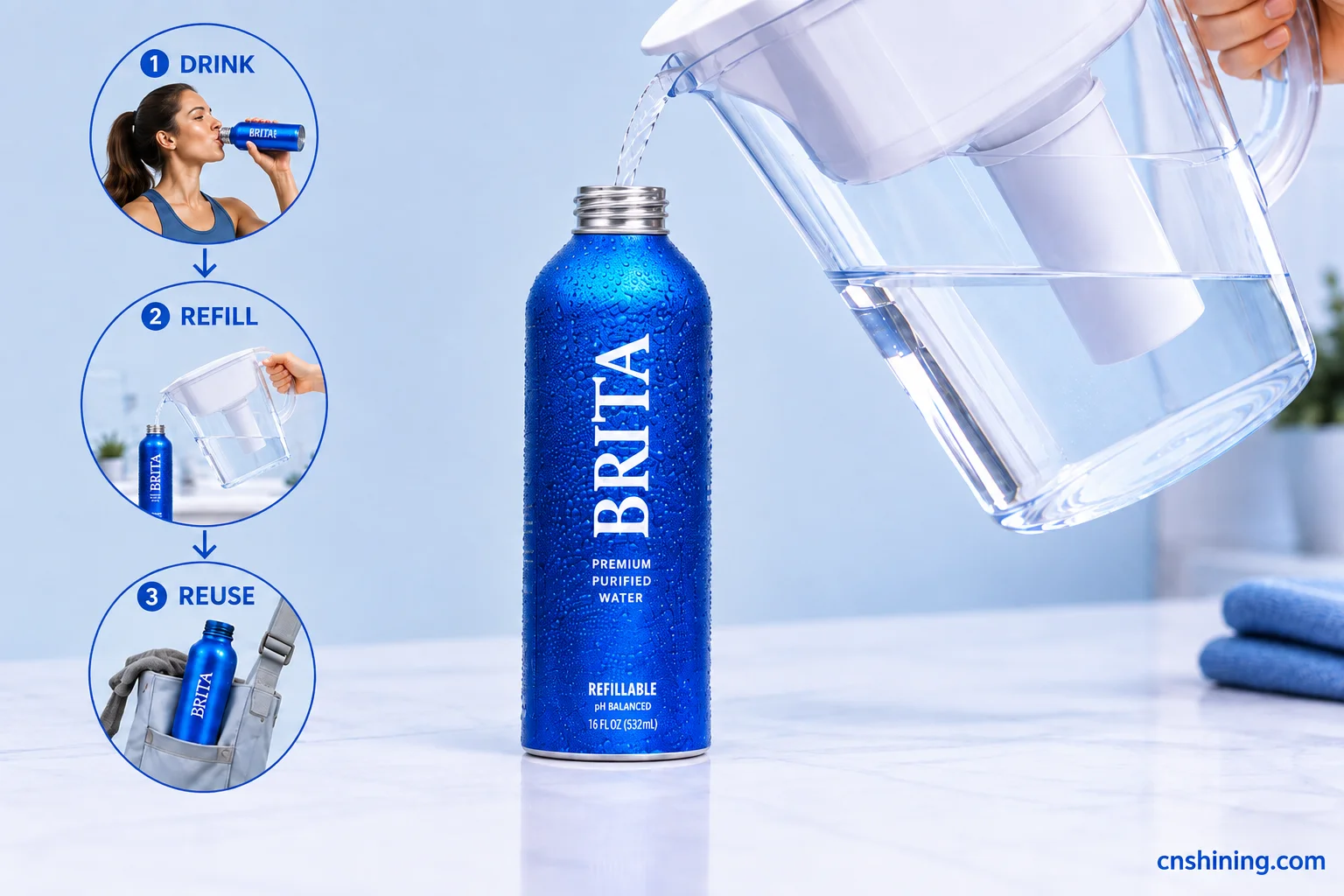
Brita Premium Purified Water is presented in refillable aluminum bottles and offered in 18 oz and 25 oz sizes, with 12- and 24-bottle pack options. The water is described as the result of a 10-step process, while the brand’s product story asks consumers to drink the original fill and then reuse the same bottle with water from a Brita pitcher, dispenser or faucet system. That creates a specific packaging job: the container must work first as a retail beverage package and then remain credible as a short-cycle reusable object.
The line “Great Taste. Less Waste.” therefore carries more technical weight than a typical sustainability headline. Brita’s wider brand system is built around improving municipal water and reducing dependence on disposable bottles. Its bottled-water extension uses aluminum to make a packaged purchase feel less final: the closure can be replaced, the bottle can re-enter daily use, and the package becomes a visible reminder of the brand’s filtration ecosystem. The related Brita Water sustainability and filtration page reinforces this logic with a process that includes municipal water supply, carbon and micron filtration, reverse osmosis, UV treatment and ozonation, rather than a spring-source narrative.
This is the product’s distinctive position. Many aluminum water brands sell origin, mineral profile, celebrity culture or ocean activism. Brita sells a transition from a purchased fill to a home-filtered refill. The bottle is not merely an alternative material for still water; it is the physical handoff between retail hydration and the brand’s installed base of filtration products.
2. How the Brita Aluminum Water Bottle Converts Brand Trust into Physical Use
The package works because several design decisions support the same behavior. The straight, portable single-serve format is familiar at retail, while the threaded, resealable closure allows the consumer to put the bottle into a bag or return it to a refrigerator after opening. The white-and-blue visual language carries Brita’s clean-water identity without borrowing the scenic imagery used by premium spring-water brands. Two capacities also cover different occasions: 18 oz remains close to conventional single-serve hydration, while 25 oz gives the bottle a stronger reason to be carried and refilled.
| Observed product decision | Brand and user function | Engineering implication |
|---|---|---|
| 18 oz and 25 oz aluminum bottle formats | Separates quick retail hydration from longer on-the-go use | Larger volume increases dent sensitivity, hand-feel requirements and the importance of base and shoulder stiffness |
| Resealable threaded closure | Makes the refill message physically possible rather than rhetorical | Closure torque, liner compression, thread repeatability and leak performance must remain stable after multiple opening cycles |
| Opaque, light-colored decorated body | Expresses filtration, cleanliness and technical restraint | Scuff resistance, varnish durability, color consistency and dent visibility matter more than decorative complexity |
| Purified still water | Keeps the product close to Brita’s core promise of controlled taste | Pressure demand is modest, but sensory neutrality, hygiene, lining integrity and closure cleanliness become primary |
| Refill-oriented use after purchase | Extends the package from FMCG container to temporary reusable bottle | The bottle must tolerate repeated handling without implying unlimited service life or compatibility with every beverage |
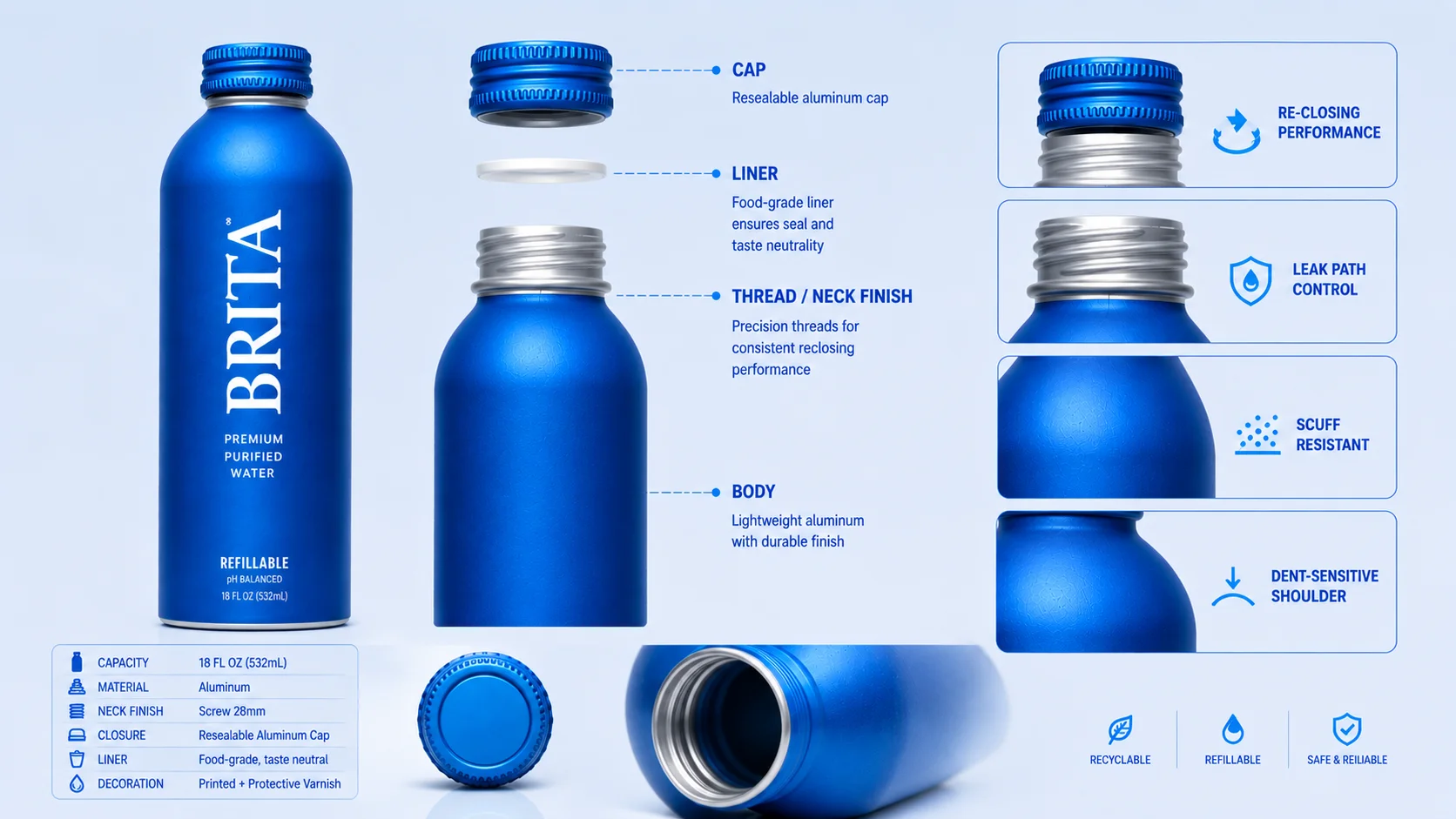
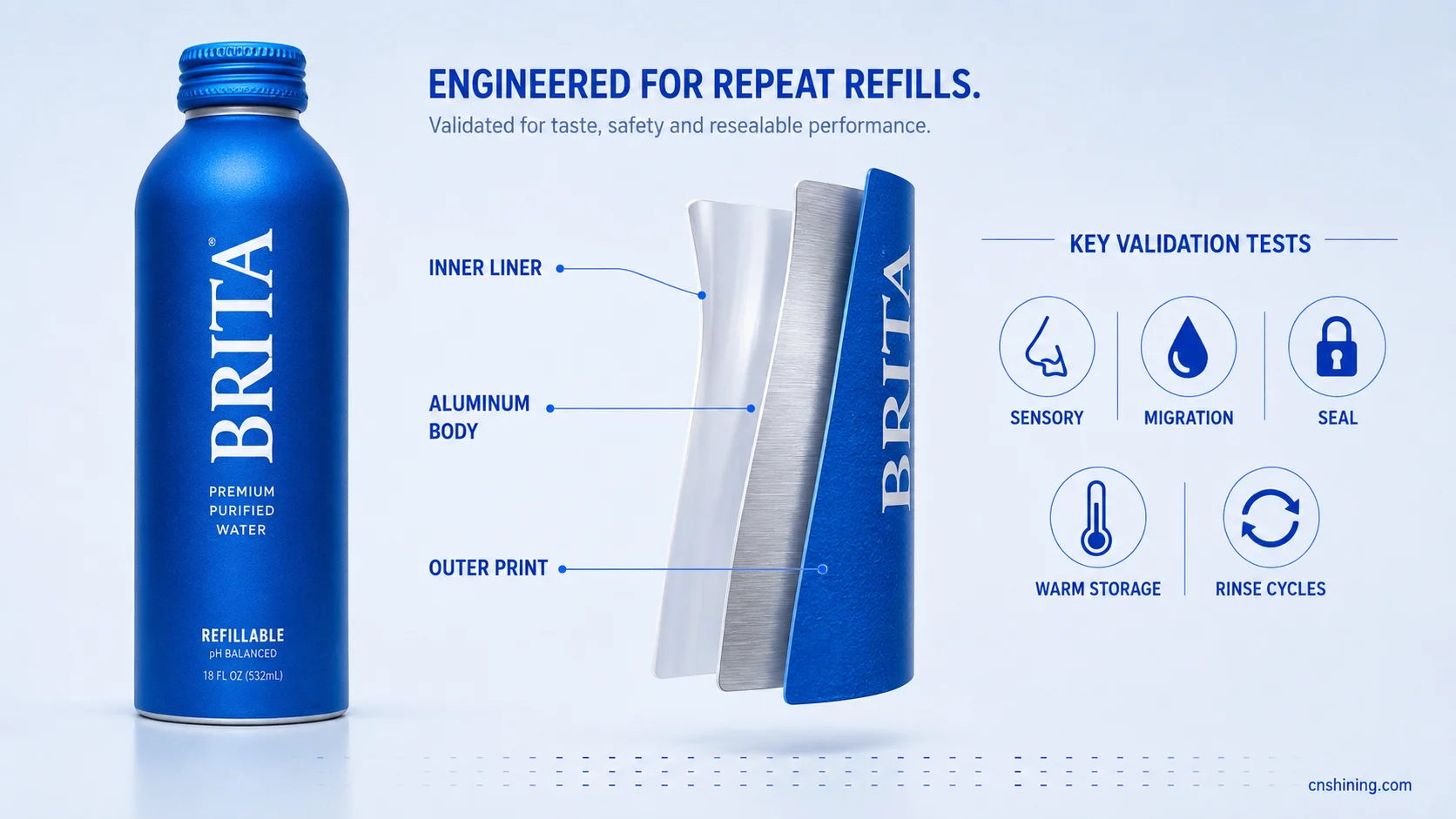
The key structural item is the closure-to-neck system. An botella de aluminio can be light, printable and recyclable, but the refill proposition fails immediately if reclosing torque becomes inconsistent, the cap liner picks up odor, or the neck deforms after impact. For Brita, a reliable second, fifth and tenth closure cycle matters more than adding another decorative finish.
Public consumer feedback points in the same direction. Walmart reviews include praise for the bottle staying cold and being reused for a week or two, but one purchaser also reported that the water tasted different after the bottle had warmed for several hours. A single review does not establish a general defect, yet it identifies the right validation question: sensory testing should include warm distribution exposure, opened-bottle hold time and repeated refill cycles, not only chilled first-use tasting.
3. Food-Contact Control Must Match the Refill Claim
The original fill is controlled purified water, but consumer refilling introduces a wider and less predictable contact environment. Brita directs users toward filtered water and specifies hand washing, while warning against dishwashers, microwaves, abrasive cleaning and combustible liquids. Those instructions help preserve the package, yet they do not remove the need to define a realistic use boundary.
The public product information confirms the aluminum cap and its thin silicone insert. It does not provide a basis for naming a specific bottle-lining chemistry, so epoxy, polyester, polyolefin or BPA-NI claims should not be inferred from the bottle’s appearance. In an actual specification, the internal food-contact system should be supported by a declaration of compliance, intended-use conditions, migration evidence, cure controls and sensory testing for the packaged water.
The refill cycle expands that test plan. Relevant challenges include repeated exposure to filtered and municipal drinking water, differences in mineral content, residual disinfectants, warm storage, hand-washing chemicals and periods in which a partially filled bottle remains closed. Acidic drinks, electrolyte mixtures, juice and carbonated beverages should not be treated as permitted uses unless compatibility has been separately established.
In the United States, the filled water must fit the FDA framework for bottled-water processing and quality , including 21 CFR Part 129 and 21 CFR 165.110. A resinous or polymeric coating used as a food-contact barrier may also need to comply through an applicable route such as 21 CFR 175.300 . For EU distribution, metal packaging and its coatings remain subject to the safety, inertness and GMP principles summarized in the European Commission’s food-contact-material framework .
The practical priority for a Brita aluminum water bottle is sensory stability. Migration compliance is essential, but a technically compliant package can still weaken the product if the cap, liner or interior creates an odor or taste that conflicts with Brita’s filtration reputation. Warm-hold tasting, repeated-opening trials and refill-water variation should therefore accompany conventional migration, leakage and transport testing.
4. Competitive Set: Five Aluminum Bottled-Water Brands and Five Different Packaging Jobs
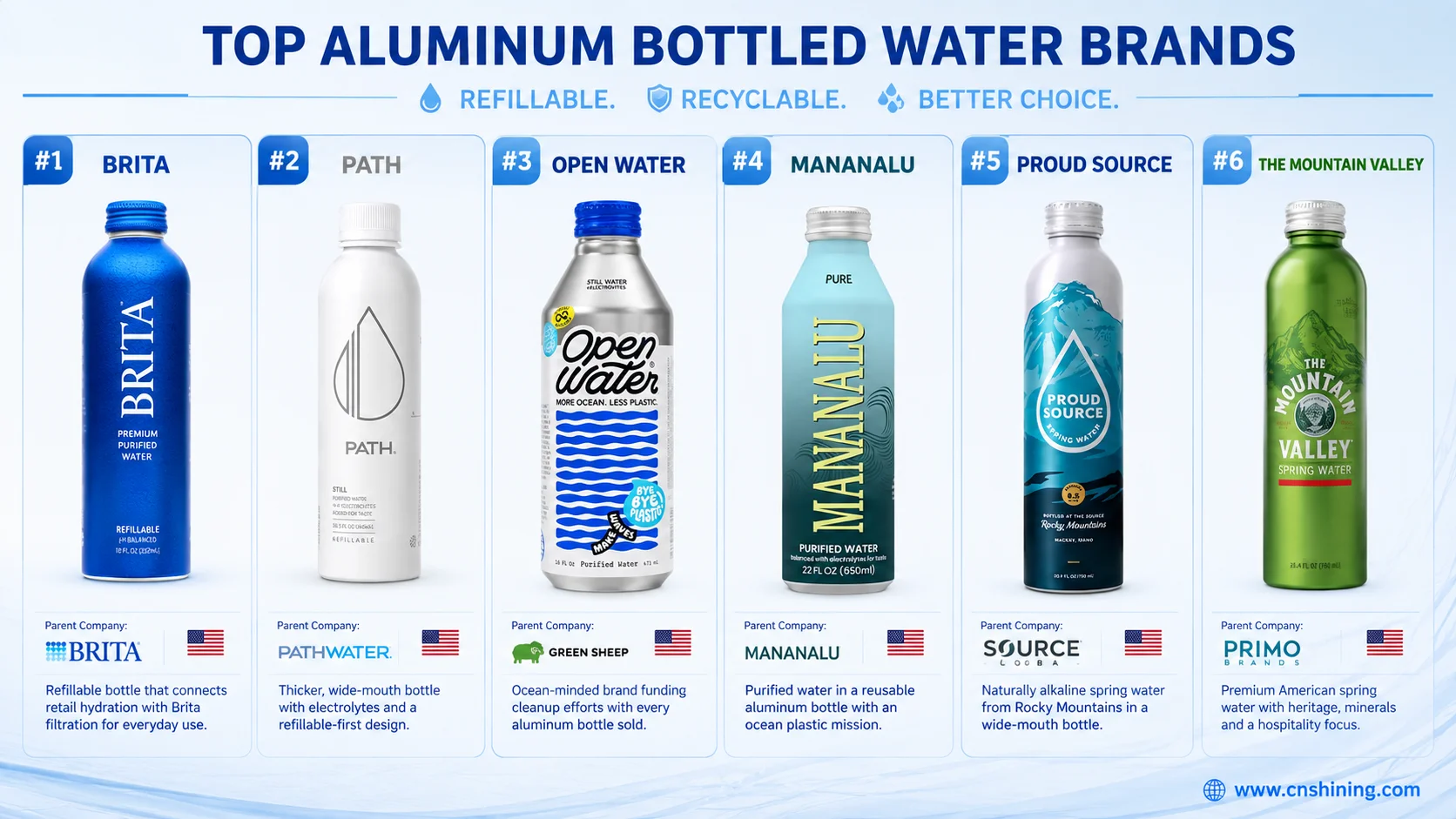
Comparable products show that aluminum bottled water is not a single positioning category. The material can support a refill-first utility proposition, an ocean-plastic mission, a premium spring-source story or an alkaline-mineral claim. The table uses still water in resealable aluminum bottles and excludes aluminum cans, reusable empty bottles and packaging suppliers.
| Marca | País | Empresa matriz | Capacidad | Indicative single-unit retail price | Core selling point |
|---|---|---|---|---|---|
| PATH Still | Estados Unidos | Pathwater, Inc. | 20.3 fl oz / 600 mL | USD 4.69 | Thicker refillable bottle, wide-mouth reuse and purified water with electrolytes |
| Open Water Still | Estados Unidos | Green Sheep, Inc. | 16 fl oz / 473 mL | USD 2.00 | Compact resealable format, neutral-pH purified water and ocean-conservation funding |
| Mananalu Pure | Estados Unidos | Mananalu | 22 fl oz / 651 mL | USD 2.69 | Ocean-plastic mission, reusable bottle and lifestyle-led brand identity |
| Orgullosa fuente de agua | Estados Unidos | SOURCE Global | 750 mL / 25.4 fl oz | USD 2.49 | Naturally alkaline spring water, place-based sourcing and a wide-mouth bottle |
| The Mountain Valley | Estados Unidos | Primo Brands Corporation | 750 mL / 25.4 fl oz | USD 3.00 | Premium American spring-water heritage, mineral profile and hospitality-ready scale |
Brita’s position is different from every row. It does not need an exotic source because filtration competence is already the brand asset. It also does not need the bottle to become a permanent piece of drinkware. Its most defensible middle ground is a recognizable, resealable aluminum bottle that earns several refills and directs the consumer back to Brita-filtered water. The 18 oz format supports impulse purchase; the 25 oz format approaches the larger refillable bottles used by PATH, Proud Source and Mountain Valley without adopting their source-water narratives.
The trade-off is equally clear. PATH can justify a high unit price with a more overt durability proposition. Open Water can win on compact affordability. Proud Source and Mountain Valley can anchor value in landscape and mineral origin. Brita must instead prove that its first fill tastes controlled, its closure survives reuse and its refill instruction is easy enough to become behavior rather than copy.
5. What Brita’s Aluminum Bottle Choice Means for Development and Procurement
The strongest version of this project is not “water in a more recyclable package.” It is a tightly defined hybrid between a filled beverage and a reusable brand object. That definition changes the specification. A conventional single-use still-water bottle might be released after fill-line, leakage, migration and distribution testing. A refill-oriented Brita bottle also needs repeated closure cycling, warm-hold sensory work, refill-water variation, cleaning guidance, scuff and dent assessment, and a clear statement of which liquids and temperatures the bottle is intended to handle.
Procurement should therefore compare complete systems rather than bottle-body quotations. The practical RFQ needs bottle geometry, neck finish, closure and liner specification, inner-coating compliance basis, decoration method, cure and varnish controls, filling compatibility, pallet and case protection, defect limits and retained-sample protocols. Because the product’s value depends on trust, a minor metallic note, cap odor or visible coating defect carries more brand risk here than it would for an anonymous event-water package.
Shining Packaging can support bottle geometry, closure fit , inner-coating compatibility , decoration trials, and pilot validation for aluminum water programs that must protect sensory quality and repeat-use performance.