
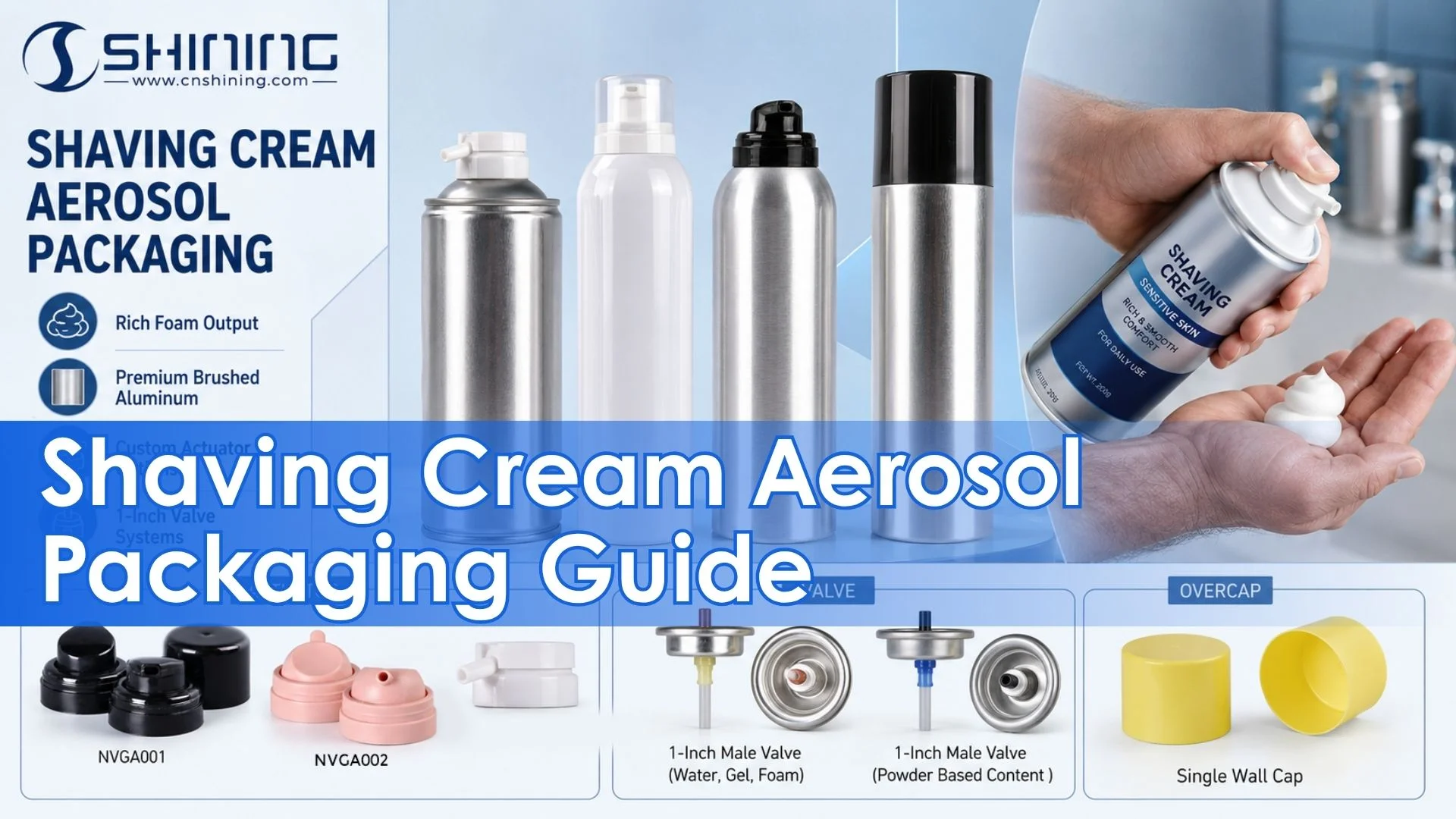
Aerosol shaving cream is a pressurized foam delivery system. It is not just a soap formula in a metal can. The working result depends on propellant selection, valve flow, actuator geometry, concentrate rheology, foam stabilization, can coating and corrosion control.
In regulatory and retail language, the category overlaps with shaving foam, shave foam, pressurized shaving cream, canned shaving cream and instant lather. It should not be treated as the same product as post-foaming shaving gel. That distinction affects VOC compliance, formulation design, actuator choice and user expectations.
The practical conclusion is simple: aerosol shaving cream remains a mature but technically active category. The pressure now comes from low-VOC rules, recycled aluminum, sensitive-skin claims, e-commerce transport, valve failures and rust complaints. Packaging engineers need to solve the basic dispensing problems before any sustainability story can carry real weight.
1. Definition and Working Principle
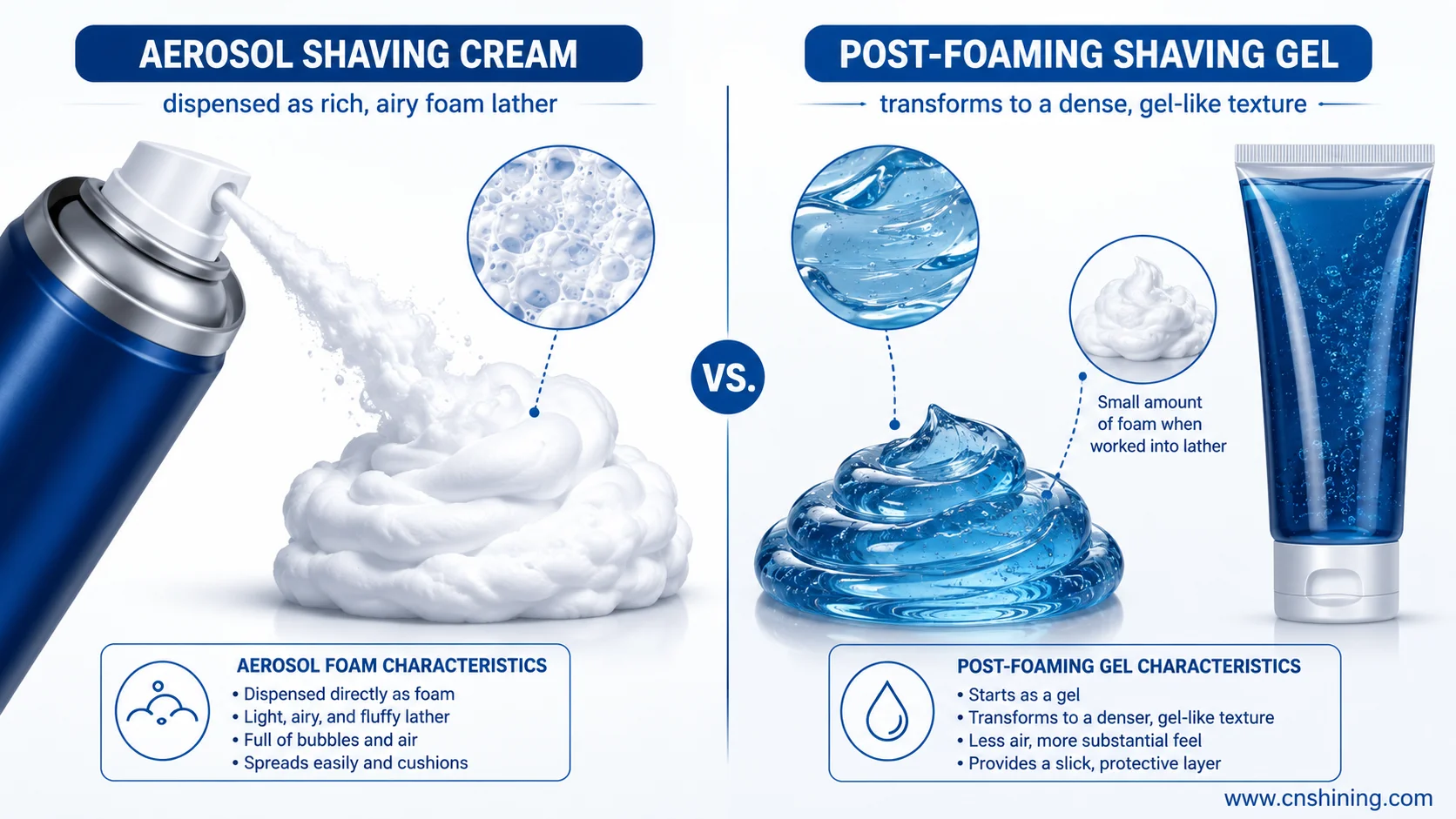
For this article, aerosol shaving cream means a shaving preparation packed in a pressurized container and released through a valve and actuator to form foam or near-foam directly before wet shaving. The U.S. EPA defines shaving cream as an aerosol product that dispenses a foam lather for use with a blade, cartridge razor or other wet-shaving system.
California CARB uses the same basic boundary and states that shaving cream does not include shaving gel. CARB also defines shaving gel as a post-foaming semi-solid. That distinction matters because the VOC limits are different: the public CARB regulation lists 5% for shaving cream and 4% for shaving gel in the relevant table.
The EU Aerosol Dispenser Directive looks at the package rather than the cosmetic category. It defines an aerosol dispenser as a non-reusable container made of metal, glass or plastic, containing compressed, liquefied or dissolved gas under pressure and fitted with a release device. It can eject contents as particles, foam, paste, powder or liquid.
The mechanism can be described as a short chain: pressurized storage → valve opening → shear through the valve and nozzle → sudden pressure drop → propellant flash-off → bubble formation → surfactant film stabilization → shaving foam layer on skin.
- Inside the can: water phase, soap/surfactant system, humectants, lubricants and propellant.
- User presses the actuator.
- The stem moves and opens the valve.
- Internal pressure pushes concentrate through the valve and orifice.
- Liquefied hydrocarbon propellant flashes as pressure drops.
- Microbubbles form inside the discharged product.
- Surfactants and fatty acid soaps stabilize the gas-liquid interface.
- The foam softens beard hair and reduces blade friction.
2. Product Forms and Formulation System
Aerosol shaving foam wins mainly on speed, convenience and repeatable foam density. It is not always the theoretical maximum in lubrication. Brush shaving soap can perform very well, but it needs technique, water control and cleaning. Post-foaming gel may give stronger visibility on the shaving path, but it is less tolerant of valve and nozzle mismatch.
| Format | Foam method | Speed | Lubrication / protection | Visibility | Portability | Environmental pressure | Typical advantage | Typical weakness |
|---|---|---|---|---|---|---|---|---|
| Aerosol shaving foam | Pressurized can, instant foam | Very fast | Medium to high, stable | Medium | High | Medium to high | No learning curve, consistent foam | VOC, recycling, valve and actuator issues |
| Post-foaming shaving gel | Gel exits first, then foams by rubbing | Fast | High, often thicker | High | High | Medium to high | Better shaving-path visibility | Can fail if valve/nozzle is mismatched |
| Brushless cream | Hand-applied film or light foam | Fast | Medium to high | High | High | Low | Easy to build glide and transparent film | Less rich foam feel |
| Shaving soap | Brush lather | Slow | Can be high with correct technique | Medium | Low | Low | Low packaging and low unit cost | Higher learning and preparation time |
| Brush shaving cream | Brush lather | Medium | Medium-high to high | Medium | Medium | Low to medium | Traditional experience with easier lather | Still needs brush and cleaning |
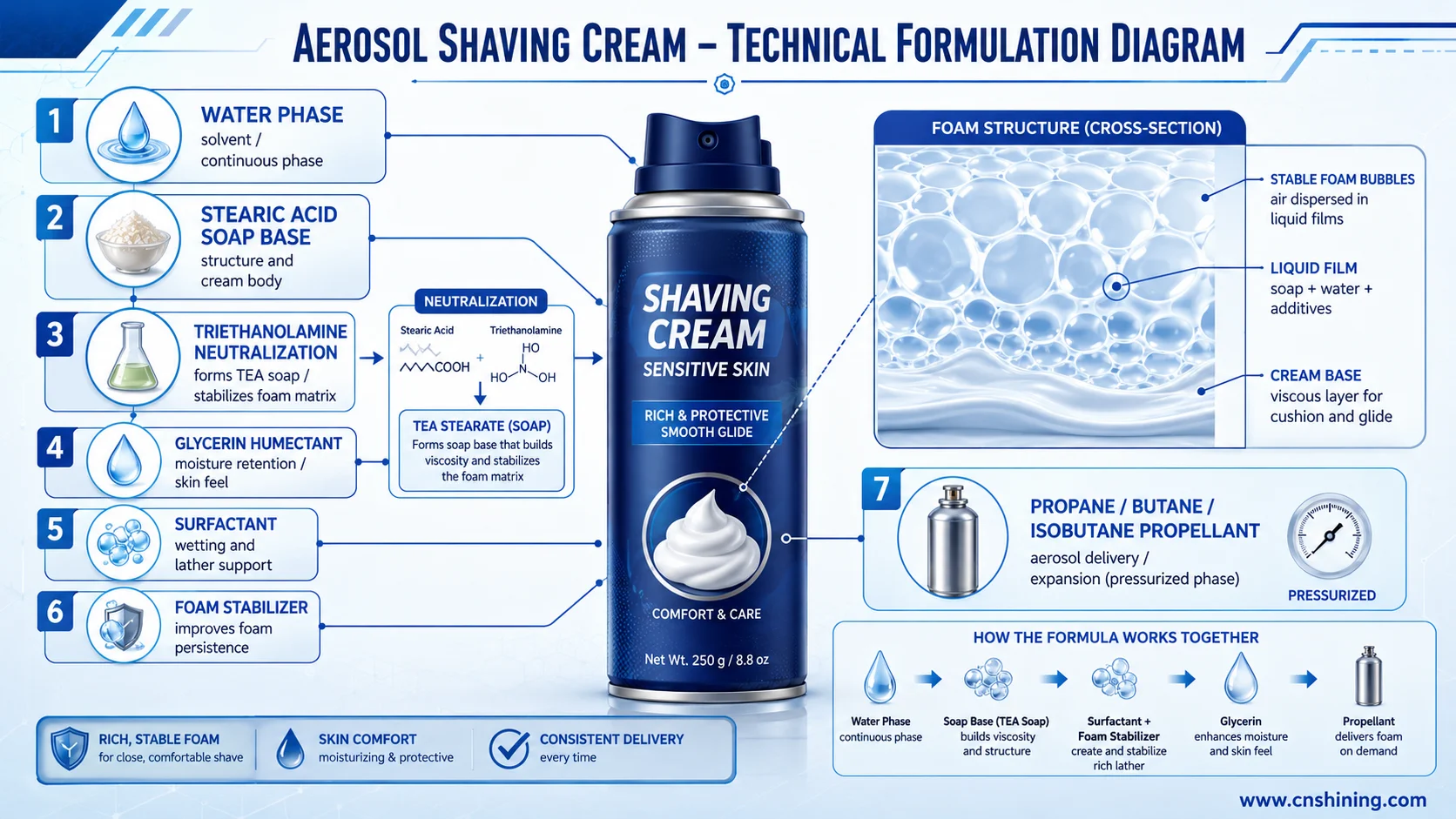
Traditional instant aerosol shaving foam usually follows a stable structure: high water phase + soap/surfactant base + humectant and lubricant + small propellant fraction + fragrance, preservative and pH control. A representative patent window gives water at 70–90%, anionic foaming agent at 5–15%, foam stabilizer at 0.5–3%, triglycerides at 1–5% and propellant at 1–10%. See US4035477A pressurized foaming shaving composition.
Another representative shaving composition patent describes volatile post-foaming agents such as n-butane, isobutane and propane blends, typically in a lower percentage window for post-foaming behavior. See WO1992016188A1 shaving compositions.
Foam physics explains why mixed surfactants and film elasticity matter. Foams are gas dispersed in a liquid phase, and the lifetime of a pure liquid foam is short unless surface-active agents stabilize the interface. A cosmetic foam review discusses aerosol foam, propellant-free foam and the role of surfactants in foam formation. See Foams as carrier systems for pharmaceuticals and cosmetics.
| Formulation type | Typical structure | Key components | Common industry window | Commercial meaning |
|---|---|---|---|---|
| Instant aerosol shaving foam | Pressurized in can, exits as foam | Water, fatty acid soap, TEA/KOH, surfactant, glycerin/sorbitol, propellant | Water 70–90%; foaming agent 5–15%; stabilizer 0.5–3%; lubricant 1–5%; propellant 1–10% | Mainstream shelf format with mature filling process |
| Post-foaming shaving gel | Semi-solid gel in can, foams after rubbing | Water, surfactant, volatile post-foaming agent, polymer, humectant | Water often 60–93%; surfactant 2–25%; post-foaming agent about 2–5%; pH often 7–10 | Good visibility and thicker feel, but narrower valve tolerance |
| BOV separated-propellant system | Product isolated from compressed gas by bag | Foam concentrate plus compressed air, nitrogen or separated drive system | No single concentration template; viscosity and actuator matching dominate | Useful for high evacuation, 360° use and lower contact with propellant |
| Non-aerosol foamer | Mechanical pump or foamer head | Water-phase surfactant, viscosity control, humectant, film former | Controlled mainly by foamer mesh and liquid rheology | Avoids some VOC and pressure issues but rarely duplicates aerosol richness |
| Function module | Typical INCI / chemical class | Role in aerosol shaving cream |
|---|---|---|
| Main water phase | Aqua | Continuous phase, cost base and flowability control |
| Soap base / main foamer | Stearic Acid + TEA/KOH; SLS; Sarcosinate; Laureth-23 | Reduces surface tension, creates fine foam and supports body |
| Humectant and lubricant | Glycerin, Sorbitol, Propylene Glycol | Softens beard hair, slows foam drying and improves razor glide |
| Foam stabilizer | Fatty acid balance, fatty amides, HPMC, PEG-7M | Improves film strength and slows collapse or drainage |
| Soothing claim ingredients | Aloe, Panthenol, Vitamin E, Oat, Green Tea | Supports sensitive-skin, moisturization and comfort claims |
| Propellant | Propane, Butane, Isobutane; compressed air or nitrogen in separated systems | Drives discharge and, in some systems, contributes directly to foam cell formation |
Stability failures usually come from five areas: high-temperature phase separation, fatty acid neutralization imbalance, post-foaming residue at the nozzle, propellant/formula incompatibility, and corrosion risk from high-water, alkaline or fragrance-containing formulas in metal packaging.
3. Terms, Regulations and Patent Direction
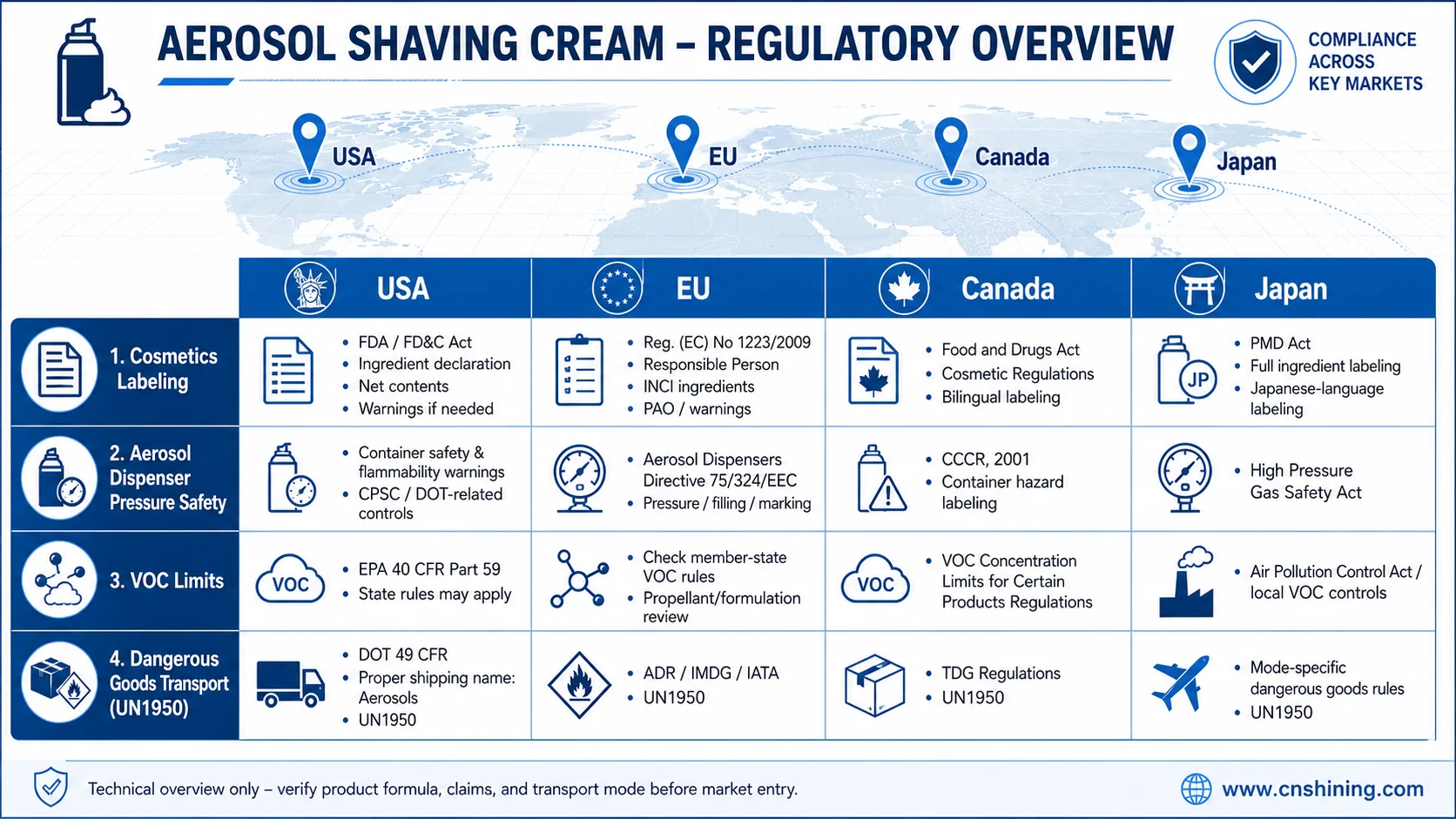
A shaving foam aerosol must meet cosmetic requirements, aerosol dispenser safety requirements, VOC or environmental rules, and dangerous goods transport logic.
| Term | Plain definition | Business consequence |
|---|---|---|
| Propellant | Compressed or liquefied gas that expels the product | Controls pressure, VOC profile, foam feel and cost |
| Concentrate | Main product excluding propellant | Controls formula claims, glide and stability |
| Valve | Opening and sealing mechanism between can and outside | Controls leakage, discharge rate and residual product |
| Stem | Moving valve shaft | Poor fit creates bad press feel or unstable dispensing |
| Gasket | Sealing elastomer | Compatibility failure can create leakage and pressure drift |
| Actuator | Button or spray head pressed by the user | Controls ergonomics, ribbon shape, foam shape and mess |
| Overcap | External cap | Reduces accidental activation and improves shelf hygiene |
| Dip tube | Tube drawing product from the can base to valve | Controls evacuation and use orientation |
| BOV | Bag-on-valve system | Separates product from propellant and improves evacuation in some systems |
| Post-foaming gel | Gel that foams after rubbing | Not the same regulatory category as shaving cream in CARB wording |
| Evacuation rate | How much product can be dispensed before failure | Low residual product reduces “can still feels full” complaints |
| VOC | Volatile organic compound | Directly affects U.S., Canadian and state-level compliance |
| Internal pressure | Pressure inside the filled can | Affects safety, filling, logistics and actuator output |
| Compatibility | Ability of formula, propellant, gasket, valve and coating to coexist | Controls corrosion, leakage, odor transfer and shelf stability |
| Region | Main rules or standards | Practical requirement for aerosol shaving cream |
|---|---|---|
| United States, federal | FDA cosmetics labeling; 21 CFR Part 740; 21 CFR 700.23; 40 CFR Part 59 Subpart C | Cosmetic labeling and warnings, CFC restriction, consumer product VOC management. See the FDA Cosmetics Labeling Guide and FDA prohibited and restricted ingredients page. |
| California | CARB Consumer Products Regulation | Separate definitions for shaving cream and shaving gel, with different VOC limits. |
| European Union | Regulation (EC) No 1223/2009, ADD 75/324/EEC, CLP links, ISO 22716 | Cosmetic safety, PIF, labeling, GMP and aerosol pressure or flammability hazard analysis. |
| Canada | VOC Concentration Limits for Certain Products Regulations | VOC is controlled by net weight percentage, affecting manufacture and import. See Justice Canada VOC concentration limits. |
| Japan | Japan Standards for Cosmetics; UN Model Regulations / UN1950 | Ingredient restrictions apply to cosmetics, and aerosol products generally require dangerous goods transport handling. See the Japan Standards for Cosmetics translation. |
The patent direction has moved in four phases. First, patents focused on foam body, foam volume, heat stability and shaving feel. Second, post-foaming gels introduced gel-to-foam behavior. Third, formula carriers moved toward skin comfort, low irritation and active ingredients. Fourth, packaging patents and actuator designs targeted residue, clean cut-off, press feel and texture control.
The current center of work is not “can it foam?” It is “can it dispense cleanly, empty well, resist corrosion, meet VOC pressure and still feel consistent at the finger?” That is where valve and actuator engineering has more value than another small change in perfume.
4. Technical Trends in Aerosol Shaving Cream
4.1 Sustainable metal packaging
Recycled aluminum, lightweighting and corrosion-resistant bottoms are no longer side claims. They are tied to real use conditions. Shaving foam cans sit in bathrooms, showers and wet sinks. If the bottom rusts or leaves a ring, the consumer sees a hygiene failure before they think about carbon footprint.
4.2 Propellant adjustment
CFC propellants are already prohibited in U.S. cosmetic aerosol products for domestic consumption. Current commercial systems still often use hydrocarbons such as propane, butane and isobutane. The pressure is shifting toward lower VOC, lower odor, lower carbon and better separated-propellant systems.
4.3 BOV and separated systems
Bag-on-valve is useful when product-propellant separation, high evacuation, 360° use or high-viscosity discharge matters. It is not a universal replacement for classic aerosol shaving foam. The foam structure must still be built by formula rheology and actuator design.
4.4 Actuator ergonomics
Modern foam and gel actuators are being designed around wider finger pads, ribbon or rich foam output, overcap protection and e-commerce transport resistance.
5. Top 10 Aerosol Shaving Cream Brands
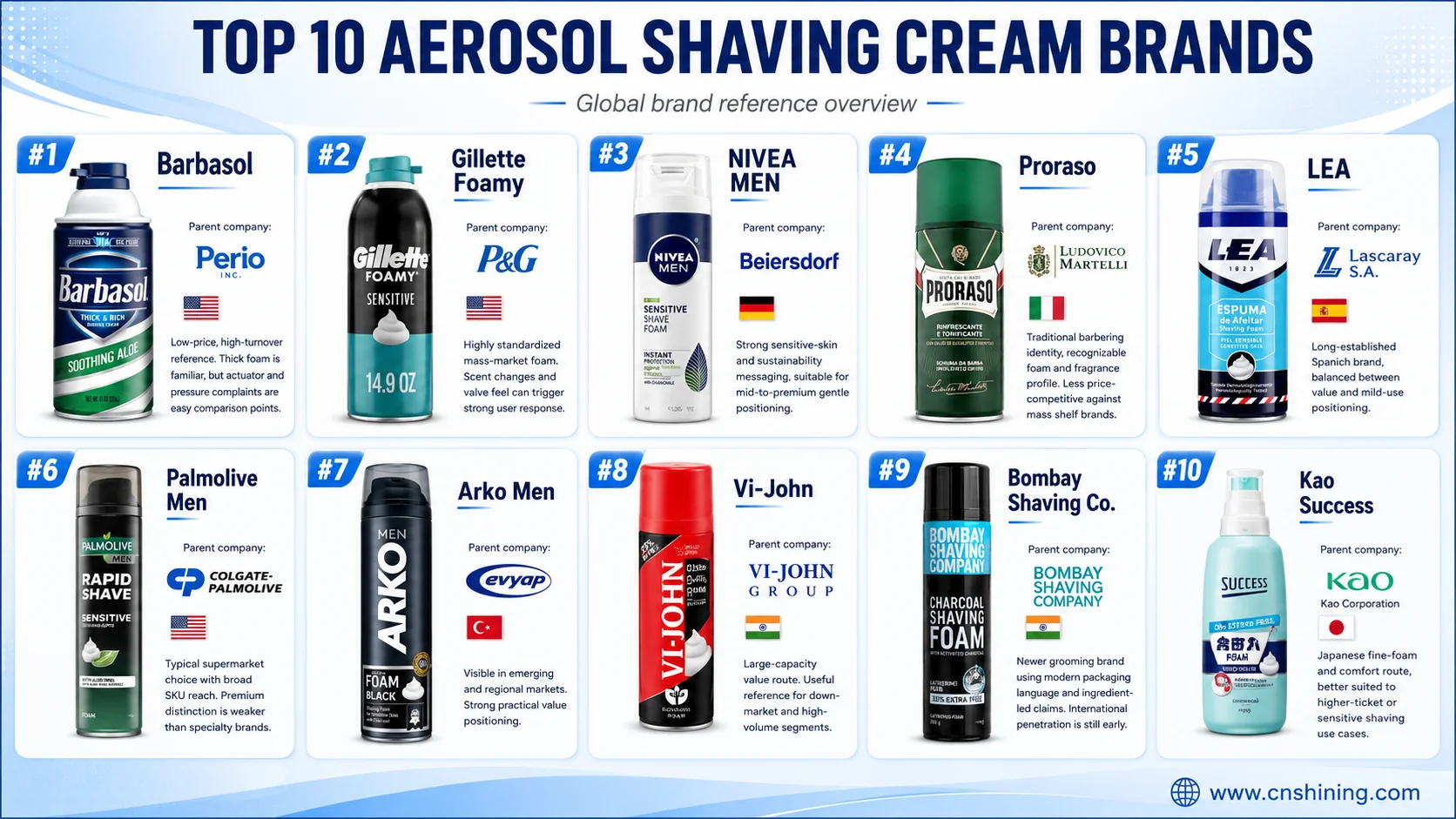
| Brand | Country / region | Parent company | Typical size | Public retail price band | Technical / market comment |
|---|---|---|---|---|---|
| Barbasol | United States | Perio Inc. | 10 oz / 295 ml | about 2.47$ | Low-price, high-turnover reference. Thick foam is familiar, but actuator and pressure complaints are easy comparison points. |
| Gillette Foamy | United States | Procter & Gamble | 11 oz | about 2.97$–3.12$ | Highly standardized mass-market foam. Scent changes and valve feel can trigger strong user response. |
| NIVEA MEN | Germany | Beiersdorf | 200 ml / 198 g | about 5.60$–9.88$ | Strong sensitive-skin and sustainability messaging, suitable for mid-to-premium gentle positioning. |
| Proraso | Italy | Ludovico Martelli | 300 ml | about 9.30$ | Traditional barbering identity, recognizable foam and fragrance profile. Less price-competitive against mass shelf brands. |
| LEA | Spain | Lascaray S.A. | 250 ml | about 7.02$ | Long-established Spanish brand, balanced between value and mild-use positioning. |
| Palmolive Men | United States | Colgate-Palmolive | 200 ml | about 1.61$–5.84$ | Typical supermarket choice with broad SKU reach. Premium distinction is weaker than specialty brands. |
| Arko Men | Turkey | Evyap | 200 ml | about 5.18$–6.10$ | Visible in emerging and regional markets. Strong practical value positioning. |
| Vi-John | India | Vi-John Group | 400 ml | about 2.04$–2.60$ | Large-capacity value route. Useful reference for down-market and high-volume segments. |
| Bombay Shaving Company | India | Bombay Shaving Company | 264 g / 425 g | about 0.61$–3.11$ | Newer grooming brand using modern packaging language and ingredient-led claims. International penetration is still early. |
| Kao Success | Japan | Kao Corporation | 250 g | about 6.00$–13.90$ | Japanese fine-foam and comfort route, better suited to higher-ticket or sensitive shaving use cases. |
6. Packaging Pain Points and Engineering Improvements
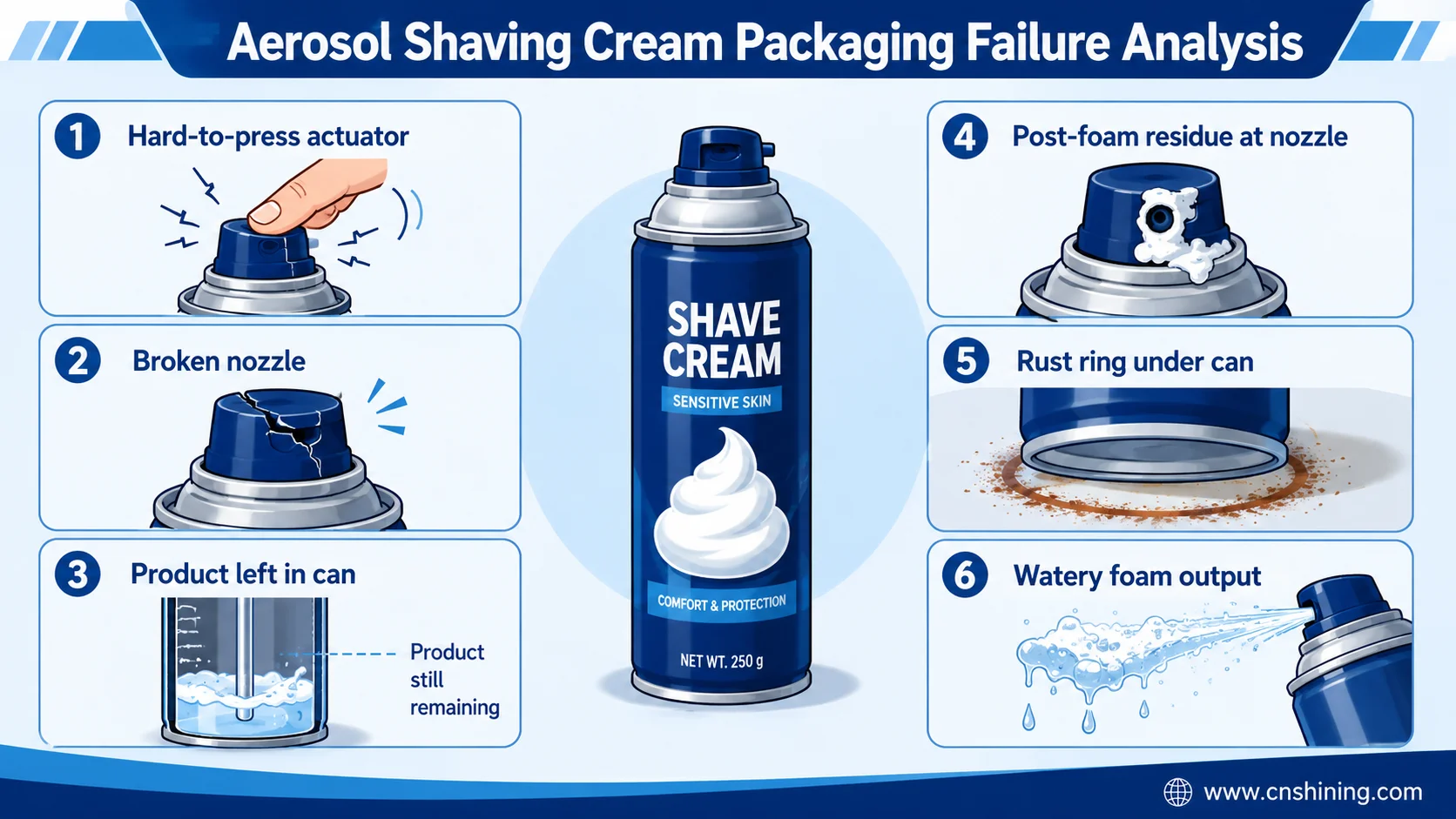
User complaints are not random. They map cleanly to packaging engineering: actuator force, overcap protection, valve retention, dip tube evacuation, nozzle residue, can bottom corrosion and formula-package compatibility.
| Pain point theme | Repeated sample signal | Engineering interpretation |
|---|---|---|
| Actuator is hard to press or difficult to control | Repeated comments about poor control and wobbly buttons | Actuation force, actuator skirt retention and stem fit need review |
| Nozzle or actuator missing, loose or broken | Complaints about new cans that cannot dispense | Transport vibration, overcap design and actuator retention are weak points |
| Can still feels full but product does not come out | Users interpret this as insufficient gas | Evacuation rate, dip tube length, valve restriction and viscosity drift need testing |
| Fragrance changed or became too strong | Long-term users react strongly to scent changes | Fragrance reformulation should be treated as a package compatibility event, not only a sensory change |
| Foam is runny, watery or hard to spread | Complaints mention thin texture or poor spread | Formula rheology, propellant ratio and actuator orifice need to be matched again |
| Nozzle area becomes messy after dispensing | Residue and post-foaming at the mouth reduce hygiene perception | Cut-off cleanliness and anti-residue channel design matter |
| Can bottom rusts or leaves a ring | Bathroom and shower use exposes the base to standing water | Aluminum can, rust-proof base, coating and bottom geometry are category basics |
7. Shining Packaging Components for Aerosol Shaving Cream
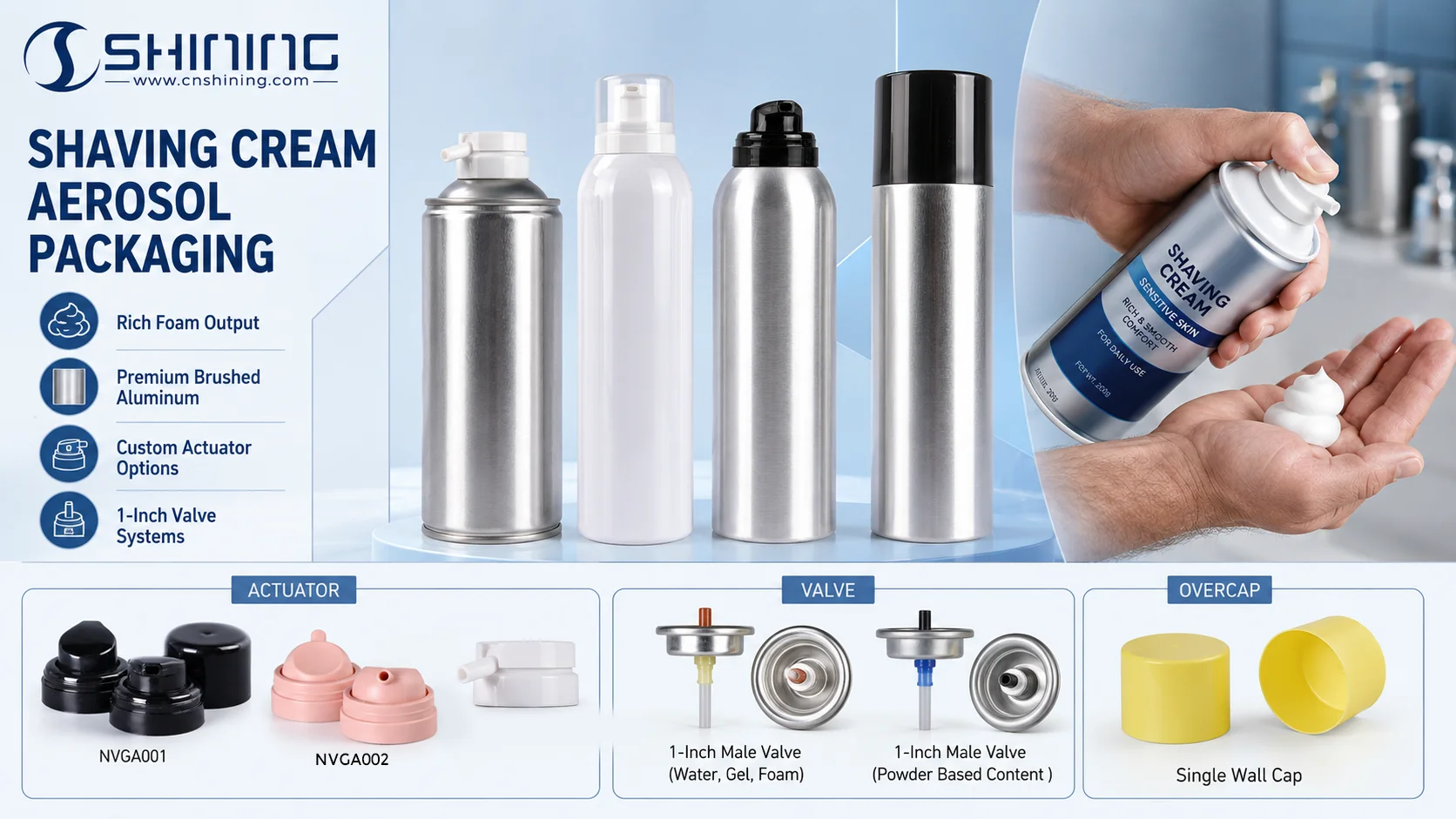
For aerosol shaving cream, Shining Packaging’s relevant work sits around three package interfaces: actuator, aerosol can and valve. The point is not to make the package look more complicated. The point is to match dispensing hardware to foam behavior.
The actuator should fit the formula type: rich foam, light foam or gel-like output. Finger pad width, press force, stem fit and outlet geometry decide whether the user feels control or frustration. The valve should be selected with discharge rate, viscosity, propellant plan, evacuation target and gasket compatibility in mind. The aerosol can then has to survive high-water, alkaline and fragrance-containing systems under bathroom humidity.
For shaving foam projects, the practical checklist is usually short: clean cut-off, stable foam ribbon, low residual product, no cap contamination, corrosion-resistant base, inner coating compatibility and enough overcap protection for e-commerce shipment. Shining Packaging can position its actuator, aerosol can and valve work around these engineering checks rather than around broad claims.
8. Conclusion
Aerosol shaving cream is a stable category with active engineering pressure. The most useful work is not adding another general claim. It is making the package dispense correctly for the whole use cycle.
The engineering priorities are clear: define the product as foam, not post-foaming gel; separate narrow shaving foam market data from broad shaving cream market data; match formula, propellant, valve and actuator as one system; treat VOC and aerosol rules early; test lining and gasket compatibility before scale-up; and do not ignore rust, residue or evacuation. These are small details on a drawing, but they are large details in a bathroom.
9. FAQ: Aerosol Shaving Cream Technical Questions
No. Aerosol shaving cream is normally defined as a product that dispenses foam lather directly from a pressurized container. Shaving gel is a post-foaming semi-solid that turns into foam after rubbing on skin. This distinction affects VOC limits, actuator design, valve flow and consumer expectations. Treating them as the same category can create both compliance and dispensing problems.
The foam forms because the pressurized system releases product through a valve and actuator into normal atmospheric pressure. Liquefied propellant can flash rapidly during the pressure drop, creating small bubbles. Surfactants, fatty acid soaps and stabilizers then form films around those bubbles. Without enough interfacial stability, the foam drains, coalesces and collapses too quickly for wet shaving.
A typical structure is high water content, a fatty acid soap or surfactant system, humectants such as glycerin or sorbitol, foam stabilizers, lubricant or emollient components, fragrance, preservative and a small propellant fraction. Representative patent windows show water around 70–90%, foaming agent around 5–15%, stabilizer around 0.5–3% and propellant around 1–10%.
This usually points to poor evacuation, pressure loss, dip tube mismatch, valve restriction, actuator blockage or viscosity drift. The user reads it as “not enough gas,” but the root cause can be mechanical or formulation-related. High-viscosity systems need careful valve flow and dip tube design. Testing should measure residual product after repeated real-use cycles, not only initial output.
The actuator controls the user’s direct touch point. Finger pad size, actuation force, stem fit, outlet geometry and overcap protection influence dose control, foam ribbon shape, residue and accidental discharge. A good formula can still receive poor reviews if the button is hard to press, wobbly, breaks during shipping or leaves post-foaming residue around the nozzle.
Useful tests include actuation force, discharge rate, foam density, foam drainage, cut-off cleanliness, nozzle residue, evacuation rate, internal pressure stability, hot and cold storage, valve leakage, gasket swelling, lining compatibility and bathroom humidity resistance. The test plan should include repeated dispensing and aging because many real failures appear after several uses or after transport vibration.
Shaving cream cans often sit in wet bathrooms, showers or around sinks. If the base rusts or leaves a ring, users see it as dirty and unreliable. Corrosion also raises deeper questions about coating, metal selection and formula compatibility. Aluminum cans, resistant bottom design, wet-resistant lacquer and better drainage geometry can reduce this visible failure mode.
Bag-on-valve can help when product-propellant separation, high evacuation, cleaner discharge or 360° use is needed. It is not automatically better for every shaving foam formula. Since the propellant is separated from the product, foam formation depends more heavily on the formulation and actuator. Viscosity, spray path, foam texture and cost must be checked together.
VOC rules influence propellant selection, fragrance solvent choices, formula structure and regional sell-in strategy. California separates shaving cream from shaving gel and uses different VOC limits. Canada also manages VOC concentration for certain products. Development teams should confirm the exact product category first, then design propellant and concentrate around the target markets instead of adjusting late.
Start with dispensing reliability. Users notice hard pressing, broken actuators, messy nozzles, poor evacuation, watery foam and rust before they consider broader packaging claims. After actuator control, valve flow, evacuation and corrosion are stable, sustainability upgrades such as recycled aluminum, light-weighting or separated-propellant systems become more credible. Basic function has to be solved first.