
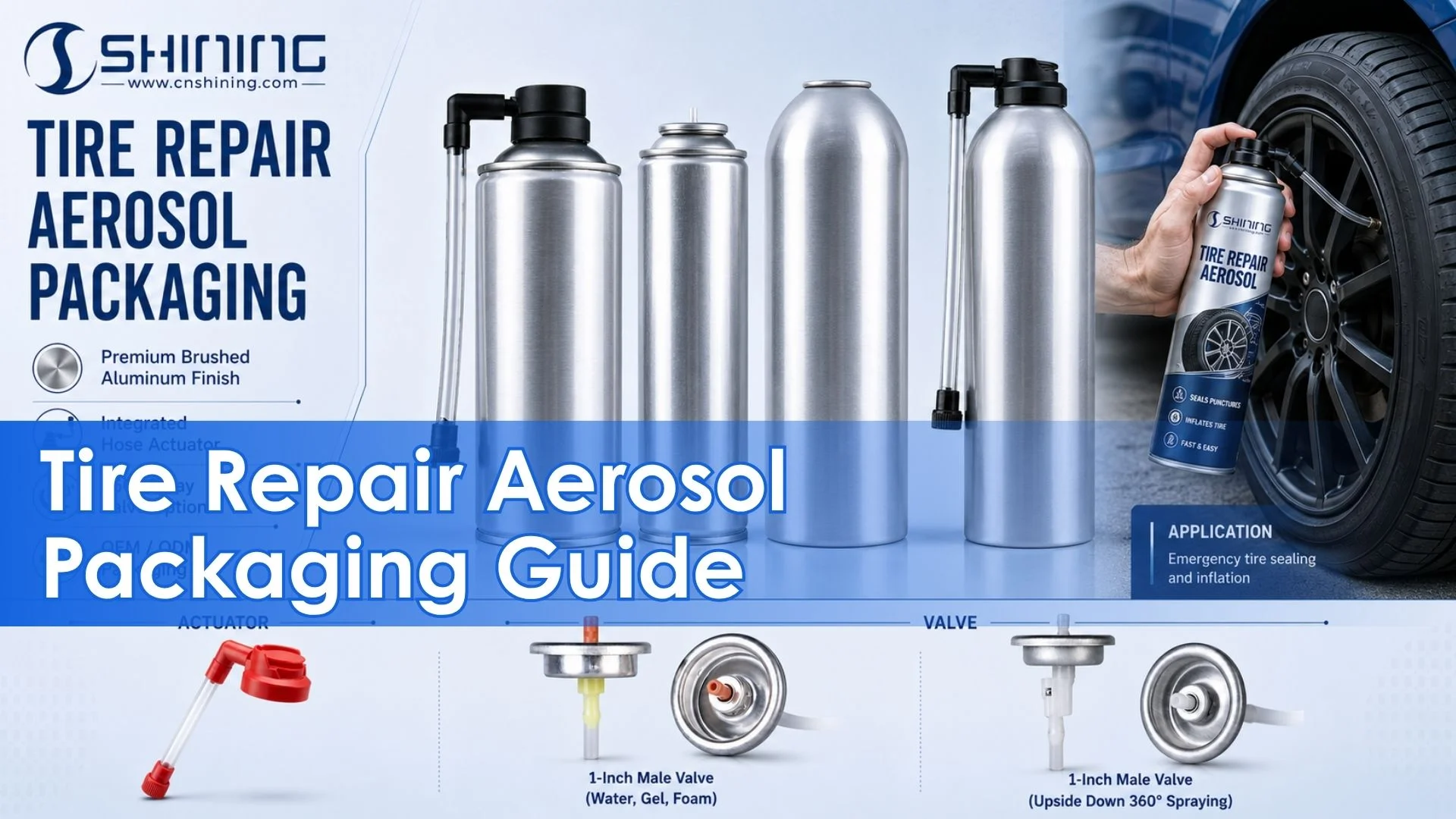
Tire repair aerosol, also sold as flat tire repair and inflator, tyre weld, puncture repair spray, or emergency tire sealant spray, is not a permanent tire repair system. It is a temporary roadside mobility product. The package injects a pressurized sealing formula through the tire valve. Escaping air carries the sealing phase toward the puncture, while the propellant or a paired compressor restores enough pressure for limited driving.
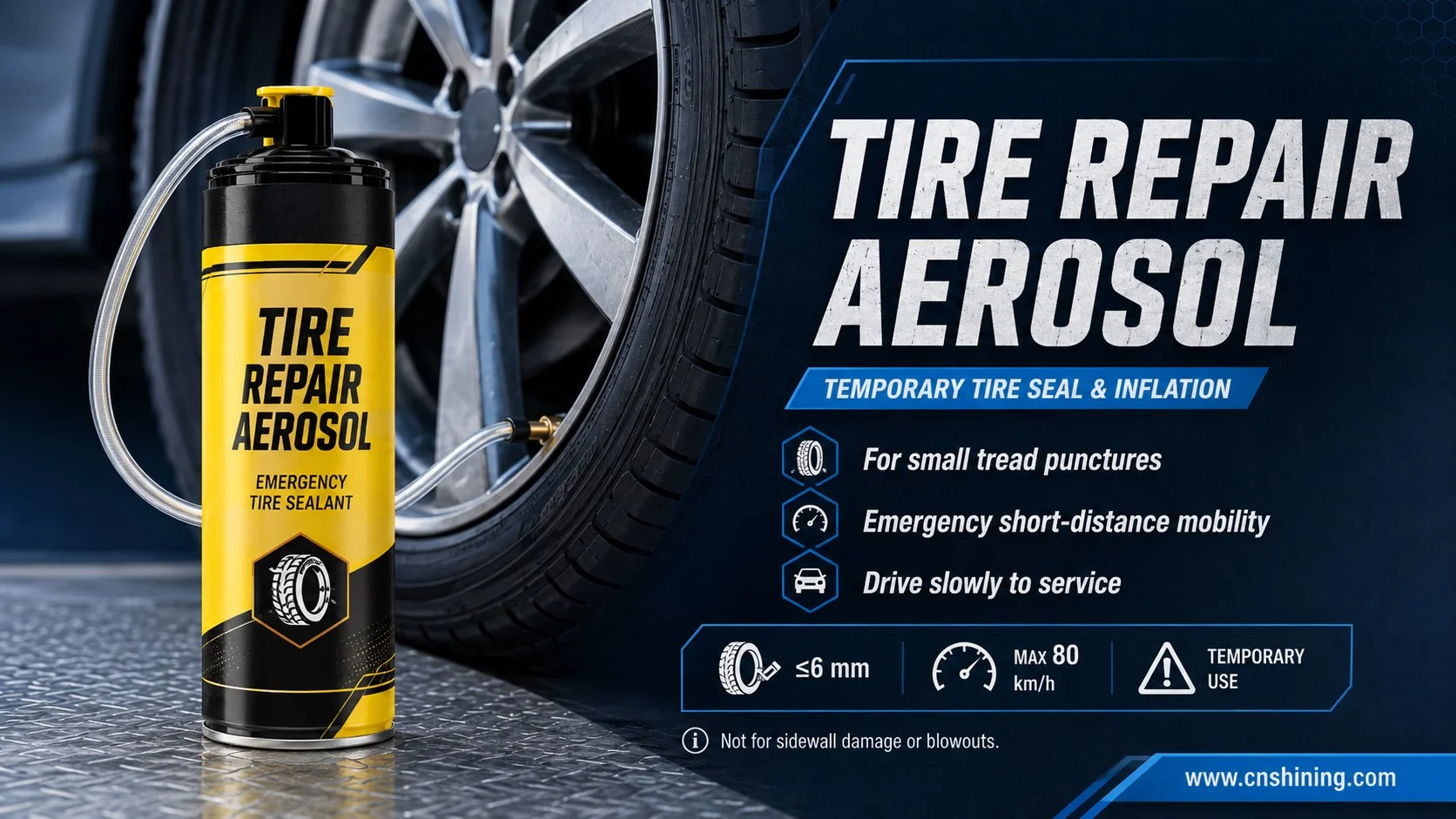
The working boundary is narrow. Most public instructions limit use to small tread-area punctures, commonly up to about 6 mm or 1/4 inch. These products are not intended for sidewall cuts, cracked tires, bead separation, blowouts, or structural tire damage. After use, typical guidance is to drive slowly and visit a tire service point, with common limits around 80 km/h and 100-125 miles or 200 km.
1. Product Definition, Mechanism and Formulation
1.1 Definition and Working Principle
The basic operating sequence is consistent across the category. The user connects the can or sealant bottle to the tire valve. The formula enters the tire cavity. Rotation and internal pressure distribute the sealant along the tread area. At the puncture, air loss creates localized flow, and the formula accumulates, bridges, coagulates, or forms a flexible film. A propellant or compressor then raises pressure to a level suitable for slow driving.
Michelin describes tire sealant as an emergency method injected through the valve so the driver can keep moving after the material hardens. AirMan defines the system as a combination of high-performance inflator and repair sealant. Its public FAQ states that AirMan can repair tread punctures up to 6 mm or 1/4 inch, asks the driver to run the vehicle around 8 km / 5 miles after filling, and gives a maximum speed of 80 km/h and distance up to 200 km / 125 miles. See AirMan tire repair kit FAQ.
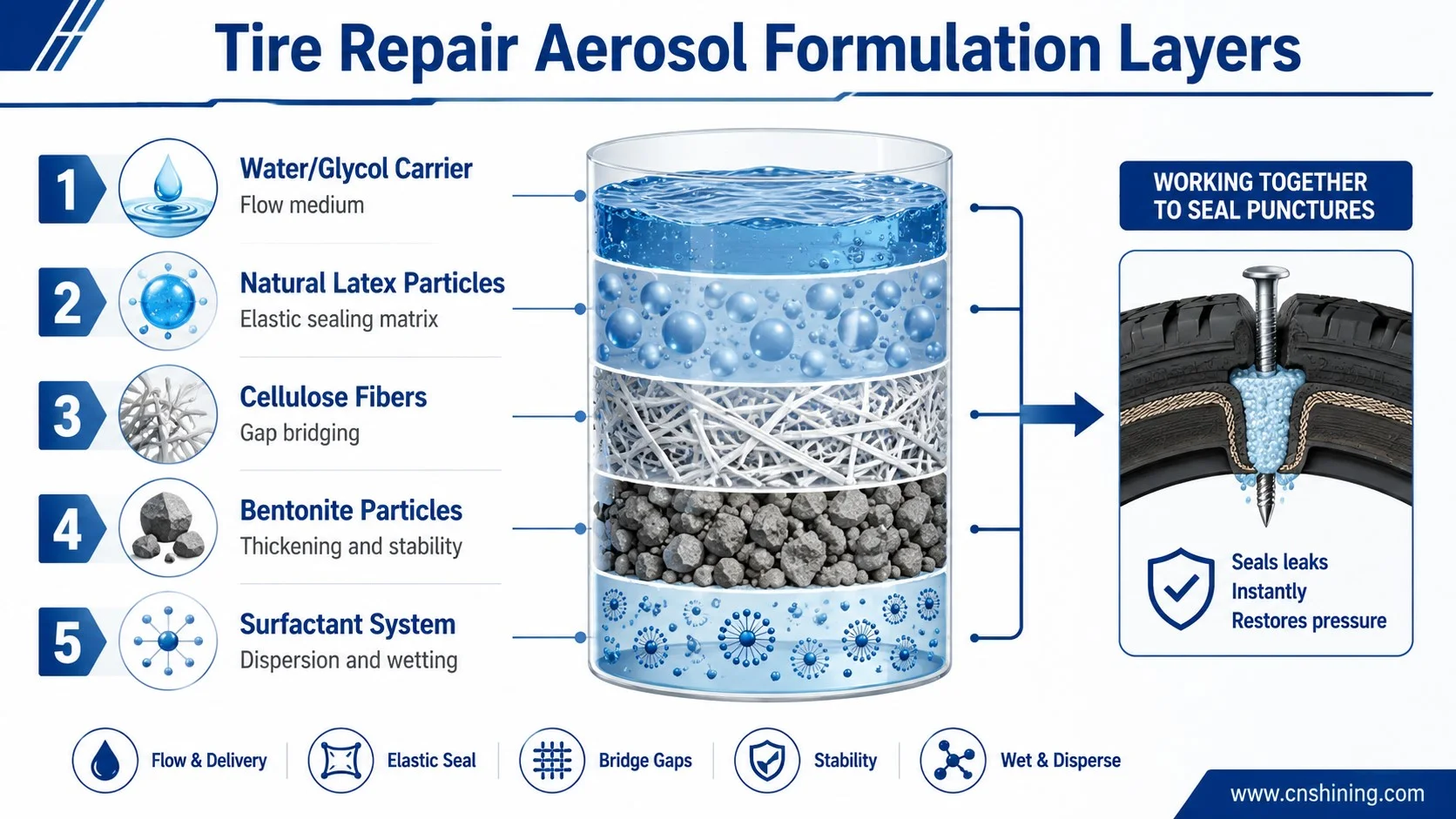
Old systems behaved more like foam plus solvent or propellant. Newer systems behave more like water-based elastic particles plus bridging fillers plus controlled rheology. Natural rubber latex can undergo in-situ phase change under air-leak disturbance. Micro/nano cellulose can build a capture-and-bridge network with latex particles. Controlled prevulcanization increases crosslink density and helps the plug retain pressure after sealing.
The limit still matters. Fix-a-Flat asks users to seek professional repair within 3 days or 100 miles. OSRAM positions TYREseal as an emergency solution for continuing to a service point, not as a permanent repair. See Fix-a-Flat emergency tire repair instructions and OSRAM TYREseal 450 product information.
1.2 Common Formulation Components
| Component category | Common public ingredients | Main function | Mechanism | Safety and storage notes | Representative sources |
|---|---|---|---|---|---|
| Carrier / antifreeze phase | Water, propylene glycol, ethylene glycol, glycerin | Moves the sealing phase, adjusts viscosity, improves low-temperature flow | Keeps latex and particles fluid enough to pass through the valve and concentrate near the puncture | More antifreeze usually improves cold flow, but toxicology and labeling must be checked | AirMan MSDS, Holts SDS, EP0798140A2, US20160311183A1 |
| Elastic sealing phase | Natural latex, SBR latex, synthetic emulsion | Forms a flexible plug that follows tire deformation | Coagulates or forms a film under air loss, shear and drying | Mechanical stability must be controlled to avoid storage coagulation | US20160311183A1, US9115270B2, AirMan FAQ |
| Bridging fillers / fibers | Cellulose, bentonite, quartz, carbon, crumb rubber, PE powder, mica | Improves plugging speed and success rate | Fibers bridge the hole; flakes and particles wedge into irregular interfaces | Oversized particles increase valve-blocking risk; overly fine particles may not bridge effectively | Fix-a-Flat SDS, AirMan MSDS, EP0798140A2, WO2017075673A1 |
| Surfactant / suspension system | Potassium oleate, soaps, thickeners, dispersants, suspension aids | Maintains dispersion and valve passage | Balances storage stability against fast coagulation at the damaged area | Poor balance causes separation, valve clogging or uneven discharge | Holts SDS, WO2017075673A1 |
| Preservative / corrosion control | Magnesium oxide, preservatives, corrosion inhibitors | Protects formula and metal surfaces during storage | Reduces spoilage, corrosion and long-term instability | Regional SDS and label rules apply, especially for sensitizing preservatives | Fix-a-Flat SDS, EP0798140A2 |
| Propellant system | Butane, propane, isobutane, dimethyl ether, or external compressor | Provides discharge force and partial inflation | Controls can pressure, spray behavior, flammability and transport classification | Flammable aerosols require stricter CLP, FHSA, DOT, ADR and IATA handling | Holts SDS, Liqui Moly SDS, 49 CFR 173.306 |
1.3 Formula Types and Typical Examples
| Formula type | Main ingredients | Main function | Safety and storage notes | Typical public example | Source type |
|---|---|---|---|---|---|
| Traditional flammable-propellant aerosol | Butane, propane, isobutane, propylene glycol, minor soaps | Self-dispensing and partial inflation | Extremely flammable pressurized container; keep away from heat and ignition sources | Holts Tyreweld SDS lists butane, propane, isobutane and propylene glycol ranges | SDS |
| Solvent / ether strong-foam route | Dimethyl ether, ketones, butyl acetate and related solvents | Fast discharge and foam formation | Higher flammability, inhalation and environmental burden | Liqui Moly tire repair spray SDS lists dimethyl ether in the 20-50% range | SDS |
| Water-based latex route | Water, natural latex, glycerin | Lower odor, washable residue, repair compatibility | Cold-flow and storage stability are central | US9862156B2 describes water-based concentrate, glycerin antifreeze and natural latex | Patent |
| Latex plus ethylene glycol composite | Natural latex, synthetic latex, ethylene glycol | Improves low-temperature behavior and particle structure control | Particle size, viscosity and valve passage need balancing | US9115270B2 / EP3245050B1 emphasizes filtered natural latex and synthetic latex particle distribution | Patent |
| Water-based particle gel / valve-through system | Water, propylene glycol, bentonite, polysaccharide or chitosan-type materials, carbon | Valve-through filling, TPMS compatibility and later washing | Particle size and rheology must avoid small-passage blockage | AirMan Proactive Seal MSDS discloses water, propylene glycol, bentonite, poliglusam and carbon ranges | MSDS and FAQ |
| Fiber / particle reinforced formula | Cellulose, quartz, MgO, flakes, particles, glycerin | Improves bridging and immediate air-loss control | Poor powder design increases sedimentation, valve clogging and separation | Fix-a-Flat SDS lists glycerin, quartz, MgO and cellulose ranges | SDS |
| Academic green reinforcement route | Natural latex plus micro/nano cellulose or prevulcanized latex | Raises plugging efficiency and pressure retention | Industrial stability, cost and filling compatibility still need validation | Recent papers report shorter repair driving distance and pressure retention above 90% after prevulcanization | Academic papers |
The practical direction is clear: water-based latex plus particles or fibers is becoming the high-value route. It matches the need for fast sealing, washability, repair-shop acceptance, TPMS-safe claims and a cleaner regulatory profile. The hard part is not simply sealing a hole. The hard part is keeping the product stable in storage, passing through the valve during use, sealing quickly, and still allowing a tire technician to perform a proper repair later.
2. Market Size, Regional Trends and Outlook
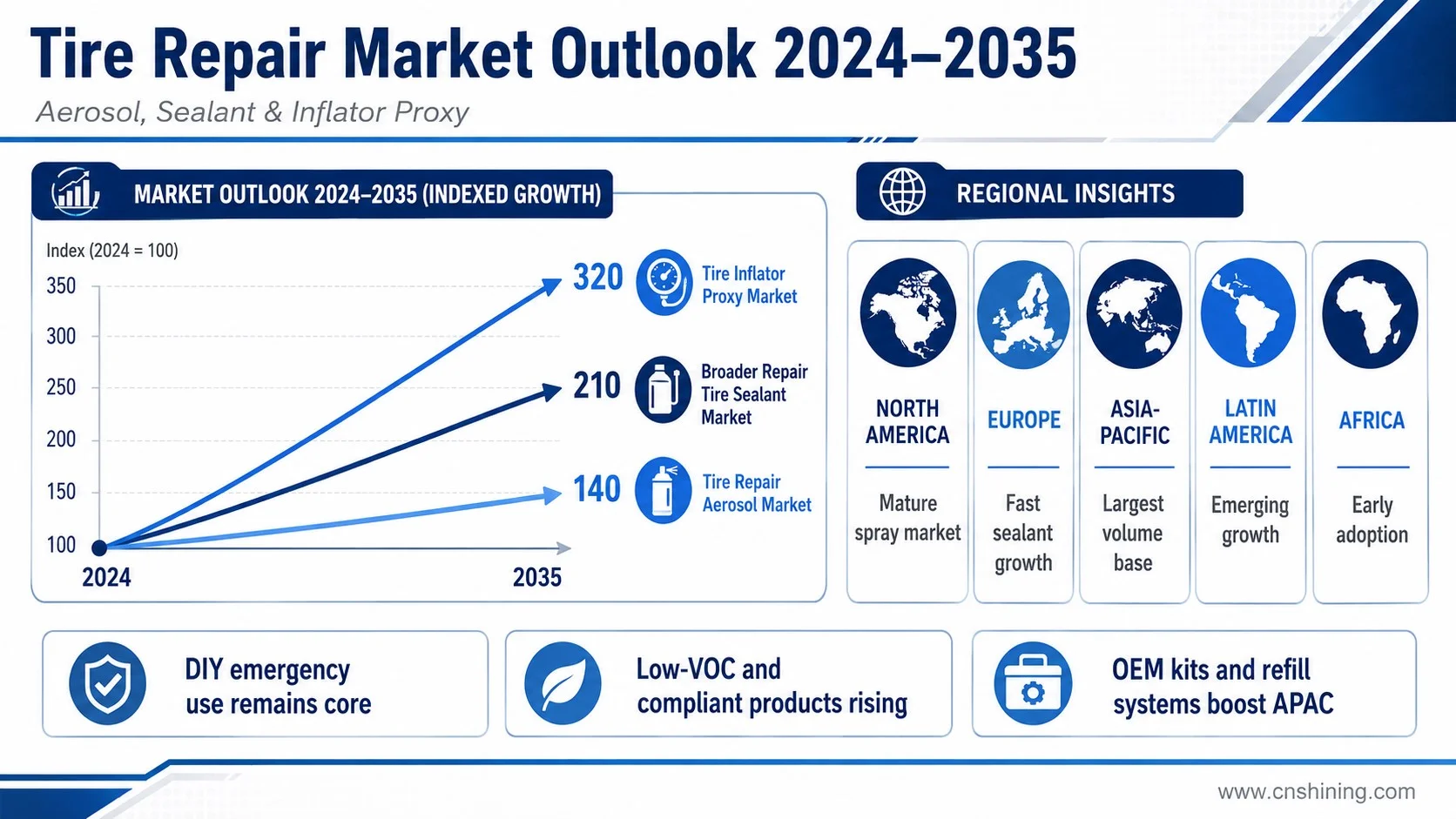
| Region | Public signal | Key data point | Technical reading |
|---|---|---|---|
| North America | Narrow spray market is visibly mature | Public reports describe North America as a leading region for tyre sealant spray | DIY emergency aerosol has strong retail awareness and dense user review volume |
| Europe | Broad sealant market shows fast growth | European chemical labeling, SDS and aerosol container rules are detailed | Low-VOC, washable, repairable and clearly labeled products fit the direction |
| Asia-Pacific | Largest broad sealant and inflator proxy base | Inflator proxy data gives Asia-Pacific a large share | When OEM kits, refill bottles and compressors are included, APAC is likely the volume center |
| Latin America | Smaller base with growth potential | Brazil EV sales growth supports future mobility-kit demand | Online, value-oriented products may grow first before high-spec TPMS-safe versions |
| Africa | Smaller but gradually adopting | South African channels show stable tire-fix SKU availability | Basic emergency products remain more relevant than premium green claims in early adoption |
3. Competing Solutions, Terms and Compliance
| Solution | Seals puncture? | Adds pressure? | Near permanent? | User difficulty | Typical advantage | Typical weakness | Best-fit use |
|---|---|---|---|---|---|---|---|
| Tire repair aerosol | Yes, small tread punctures | Usually yes, or partly | No | Low | Fastest and easiest to understand | Mess, valve clogging, TPMS concern, narrow damage limit | Roadside emergency |
| Preventive sealant | Yes, before or after puncture | Usually no | No | Medium | Useful in frequent puncture environments | Needs filling, maintenance and eventual cleanup | Bicycle, off-road, preventive maintenance |
| Tire plug / patch | Yes | No | Closer to permanent repair | High | Low cost and accepted by repair shops | Needs tools and skill | Workshop or trained user |
| Portable inflator | No | Yes | No | Low | Clean and reusable | Cannot stop air loss alone | Pressure maintenance, paired with plug or sealant |
| TPMS | No | No | No | Very low | Warns of pressure loss | Only monitors; does not repair | Vehicle warning and compliance |
The short engineering answer is this: if the target is to let an untrained driver recover basic mobility quickly, aerosol still makes sense. If the target is less mess and better permanent repair probability, a transparent sealant refill bottle plus compressor is catching up fast.
| Term | Plain technical meaning | Commercial meaning |
|---|---|---|
| Tire mobility kit | Sealant plus inflator supplied as an emergency kit | Important for OEM and refill-bottle replacement business |
| Valve-through | Sealant can pass through the valve without removing the valve core | Reduces user steps and error risk |
| TPMS-safe | Designed not to block pressure sensor passages under intended use | Directly affects consumer trust and after-service complaints |
| Particle gel technology | Uses gelled particles to plug holes and remain washable | Common in higher-spec or OE replacement positioning |
| Tread-area puncture | Puncture in the tire tread zone | The only damage area most products claim |
| Temporary repair | Short-term mobility restoration | Must be stated clearly on labels and instructions |
| UN1950 AEROSOLS | Common dangerous goods identification for aerosols | Controls transport, storage and export documentation |
| Limited Quantity | Transport exception or simplified regime for small quantities | Affects logistics cost and shipping route availability |
| SDS | Safety Data Sheet | Basic document for market access and B2B sales |
| UFI | Unique Formula Identifier in the EU | Relevant to mixture labels and poison-center notification |
| VOC | Volatile organic compound | Relevant to EPA, CARB and low-VOC formula positioning |
| BOV | Bag-on-Valve packaging | Useful for low-VOC, high evacuation and 360-degree discharge routes |
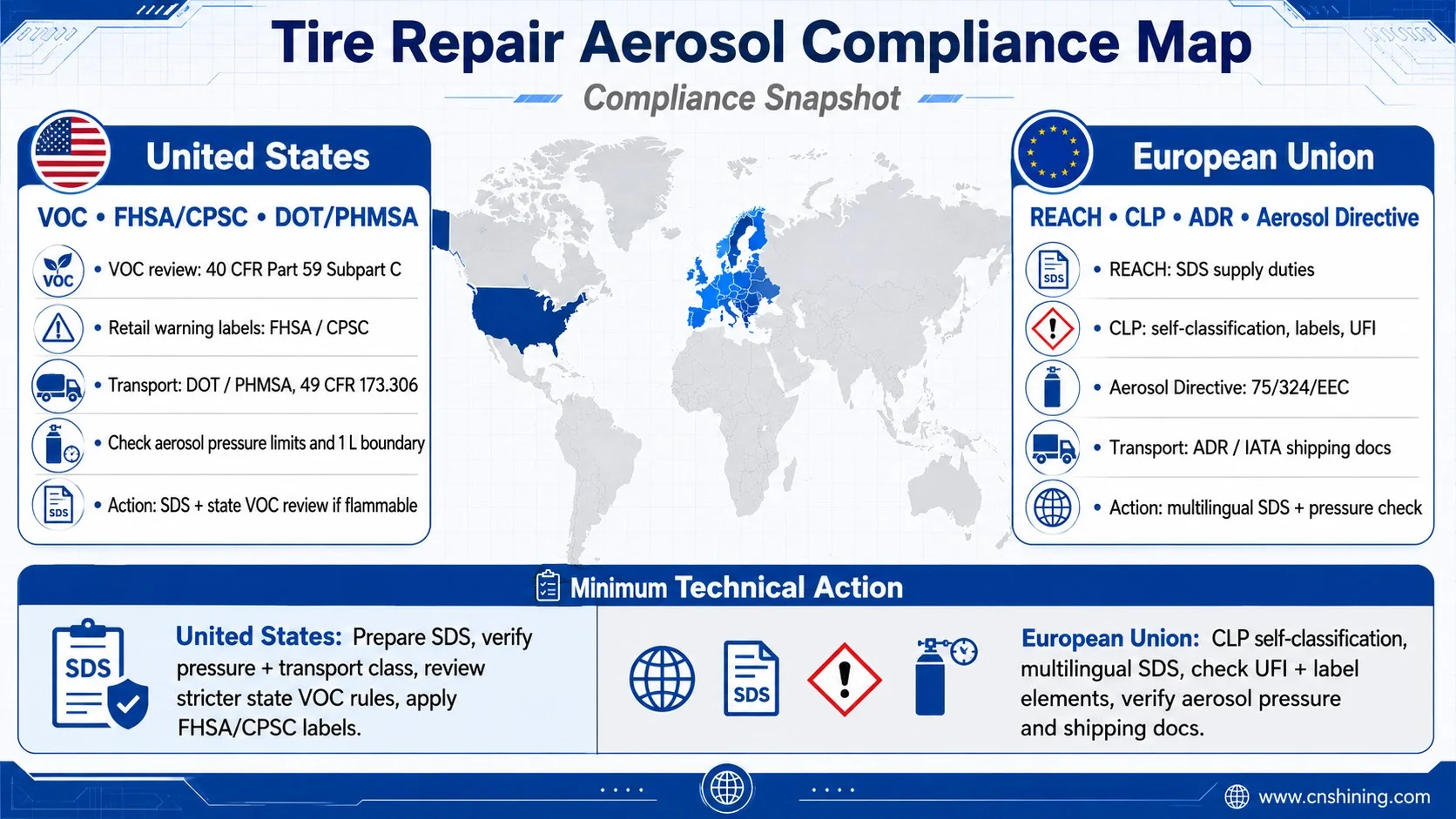
Compliance Snapshot
In the United States, the main checks are VOC rules for consumer products, FHSA/CPSC warning labels, and DOT/PHMSA transport classification. For metal aerosol containers, 49 CFR 173.306 includes limits such as a 1 L capacity boundary for certain metal aerosol containers and pressure limits tied to 54.4°C test conditions. VOC review should also refer to 40 CFR Part 59 Subpart C. Household hazardous warning requirements should be checked against CPSC FHSA guidance.
In the European Union, REACH, CLP, the Aerosol Dispensers Directive and ADR are the core framework. SDS supply duties can be checked through REACH safety data sheet guidance. Aerosol container design should be checked against Directive 75/324/EEC on aerosol dispensers.
| Market | Minimum technical action |
|---|---|
| United States | Prepare SDS, verify pressure and transport classification, review VOC rules under stricter state requirements if flammable propellants are used, and apply FHSA/CPSC warning labels for retail packs. |
| European Union | Perform CLP self-classification, prepare multilingual SDS, check UFI, label elements, aerosol container pressure requirements and ADR/IATA shipping documents. |
4. Top 10 Visible Tire Repair Aerosol Brands
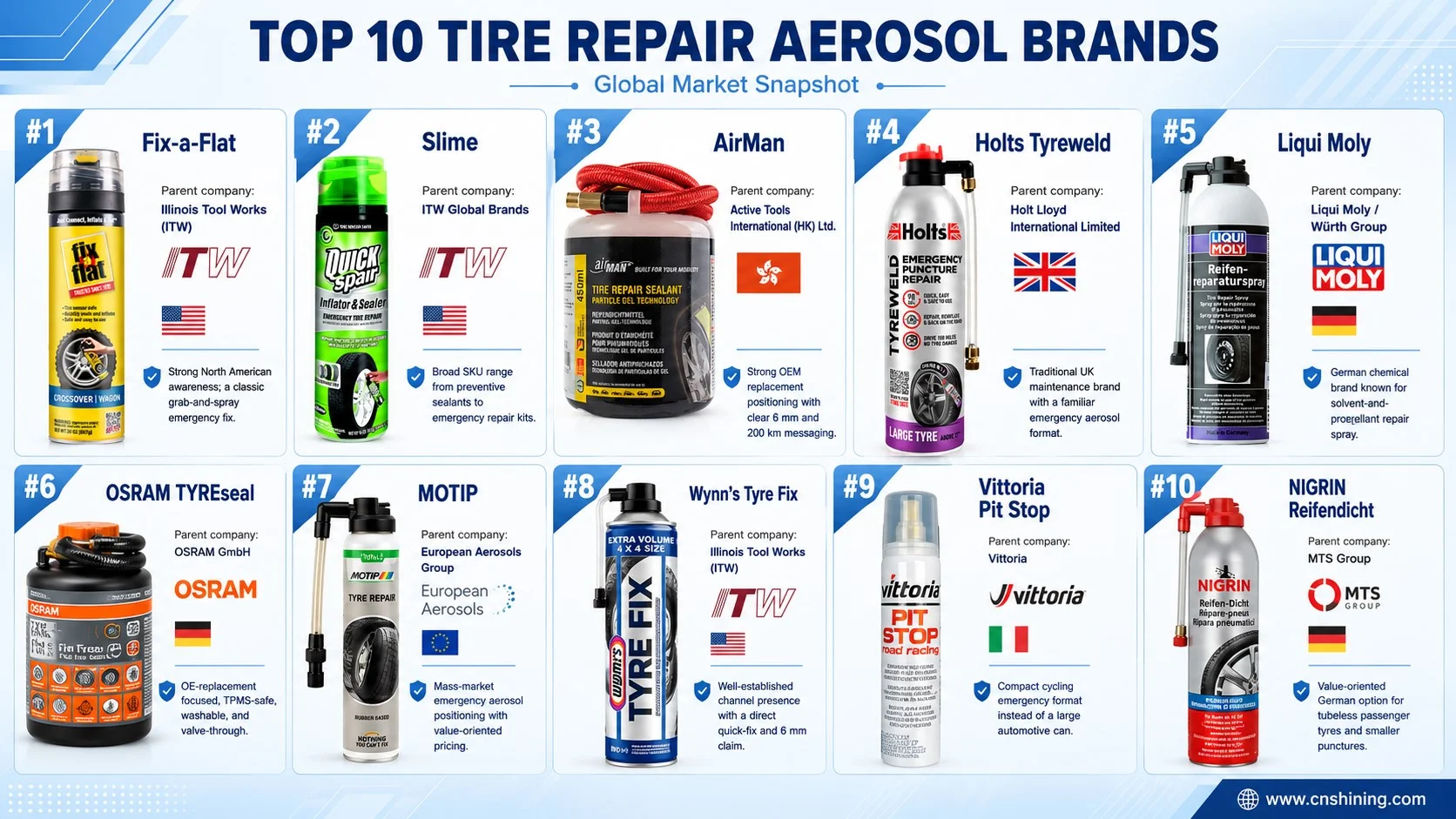
| Brand | Country / Region | Public operator or parent | Common capacity | Public price range | Direct technical comment | Main channels |
|---|---|---|---|---|---|---|
| Fix-a-Flat | United States | Illinois Tool Works (ITW) | 12 / 16 / 20 / 24 oz | About US$8.49-17.99 in public retail references | Strong North American awareness; typical grab-and-spray emergency product | Mass retail, auto parts, online, official site |
| Slime | United States | ITW Global Brands | 16 oz, 32 oz, emergency kits | About US$15.99-21.99 for common retail SKUs; kits higher | Broad SKU spread from preventive liquid to emergency kits | Auto parts, online, home-improvement retail, official site |
| AirMan | Hong Kong | Active Tools International (HK) Ltd. | 440 / 450 mL, repair kits | About US$31.50 for 440 mL; kits higher | Strong OEM replacement logic; transparent bottle, 6 mm, 200 km messaging is clear | OEM channels, online, official site |
| Holts Tyreweld | United Kingdom | Holt Lloyd International Limited | Capacity varies by local listing | Public price varies by market | Traditional UK maintenance brand; standard flammable aerosol route | UK auto parts, ecommerce, official site |
| Liqui Moly | Germany | Liqui Moly under Würth Group | 500 mL | Public price varies by market | German chemical brand; SDS indicates solvent/ether-propellant style in known product data | European auto parts, ecommerce, official site |
| OSRAM TYREseal | Germany | OSRAM GmbH | 450 mL, kit versions | Official page routes users to online distributors | Clear OE-replacement orientation: particle gel, TPMS-safe, washable, valve-through | Official distributors, auto parts, online |
| MOTIP | Europe | European Aerosols Group | 500 mL | Public European listings vary strongly | Lower price band; mass-market emergency aerosol positioning | Motorcycle/auto ecommerce, official site |
| Wynn’s Tyre Fix | United States | Illinois Tool Works (ITW) | 340 / 500 mL, plus gram-based listings | About US$6.20-9.70 in public South African references | Mature South African channel presence; direct quick-fix message and 6 mm claim | South African auto parts, ecommerce, official site |
| Vittoria Pit Stop | Italy | Vittoria brand | 75 mL | About US$17.99-19.98; official EU references lower | Small, portable cycling emergency format rather than automotive large can | Bicycle retail, online, official site |
| NIGRIN Reifendicht | Germany | MTS Group | 500 mL | About US$8.70-10.00 in common public references | German-language value product; often claims tubeless passenger tire use and smaller puncture limits | German ecommerce, price-comparison sites, official site |
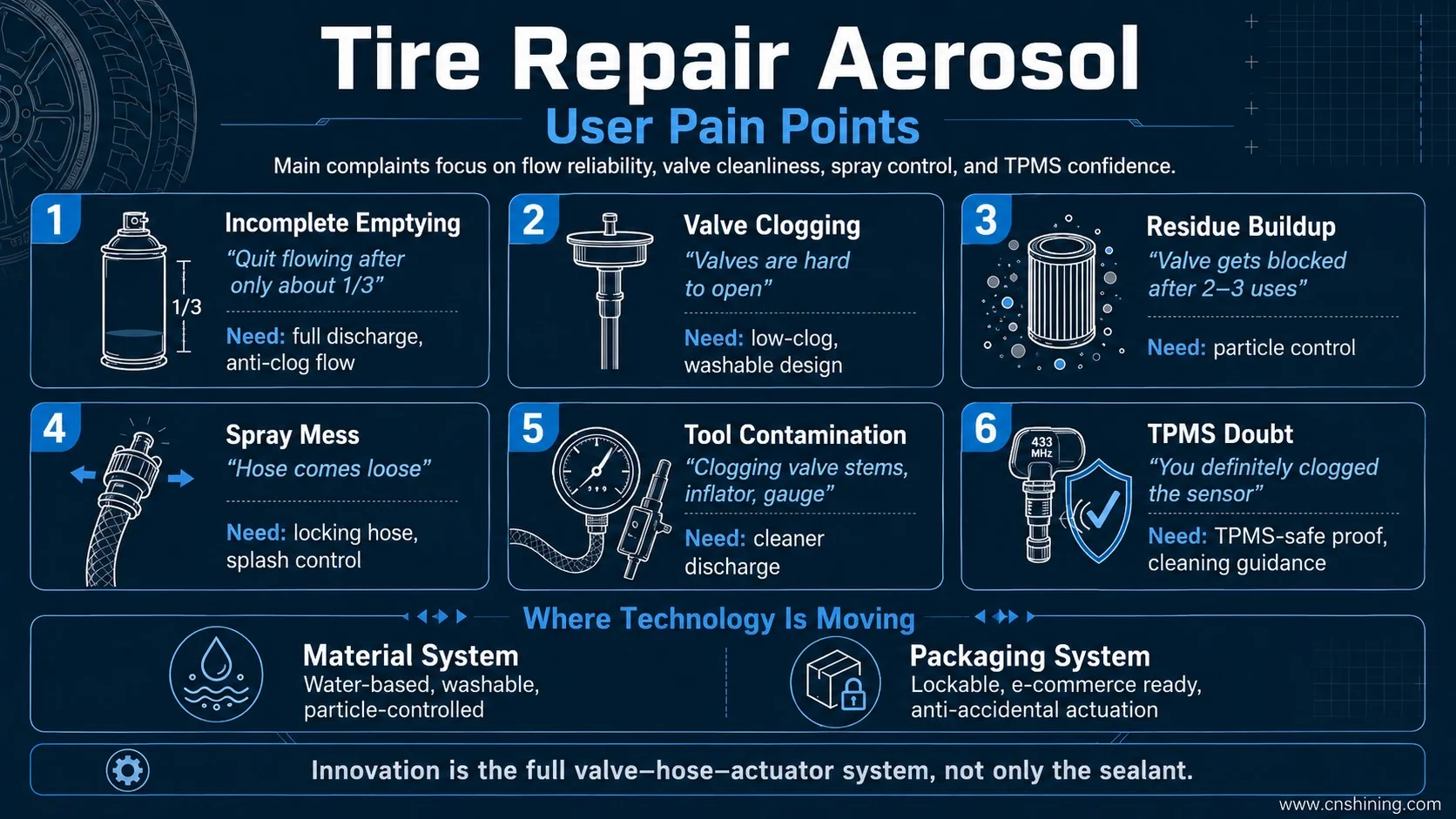
5. User Pain Points and Current Technical Direction
User complaints are highly concentrated. They do not mainly ask for a stronger chemical story. They ask for a product that empties properly, does not clog the valve, does not spray sealant over the wheel arch, and does not create doubt around TPMS sensors.
| Platform signal | Short original excerpt | Technical interpretation | Need reflected |
|---|---|---|---|
| Retail review | “The product quit flowing after only about 1/3” | Can, valve or formula stopped before full discharge | More reliable evacuation and anti-clog flow path |
| Forum | “valves are very hard to open due to sealant clogging them” | Dried sealant blocks valve-core movement | Lower-clog formula, washable residues, cleanable valve-end design |
| Forum | “2-3 times before the valve gets completely blocked” | Repeated inflation worsens residue buildup | Better particle filtration and valve-tip rheology |
| Retail review | “Plastic hose … comes loose … shooting sealer all over the place” | Hose retention failed under pressure | Locking connector, anti-kink hose and check valve |
| Forum | “clogging my valve stems … inflator … gauge” | Sealant contaminates not only the tire valve but also service tools | Cleaner discharge, lower residue transfer and service-friendly instructions |
| Forum | “You definitely clogged the sensor” | TPMS risk perception remains strong | Clear TPMS-safe evidence and practical cleaning guidance |
| Forum | “spray sealant on clothes” | Back-spray and uncontrolled discharge damage user experience | Backflow control, lockable actuator and splash reduction |
| Forum | “the valve stem is plugged” | Traditional aerosol reputation still affects the category | Better user education and repair-shop acceptance |
Current technology is moving in two tracks. Material systems are becoming more water-based, washable and particle-controlled. Packaging systems are becoming more e-commerce ready, more lockable, and more resistant to accidental actuation. The visible innovation is not only “better sealant”; it is the full valve-hose-actuator-instruction system.
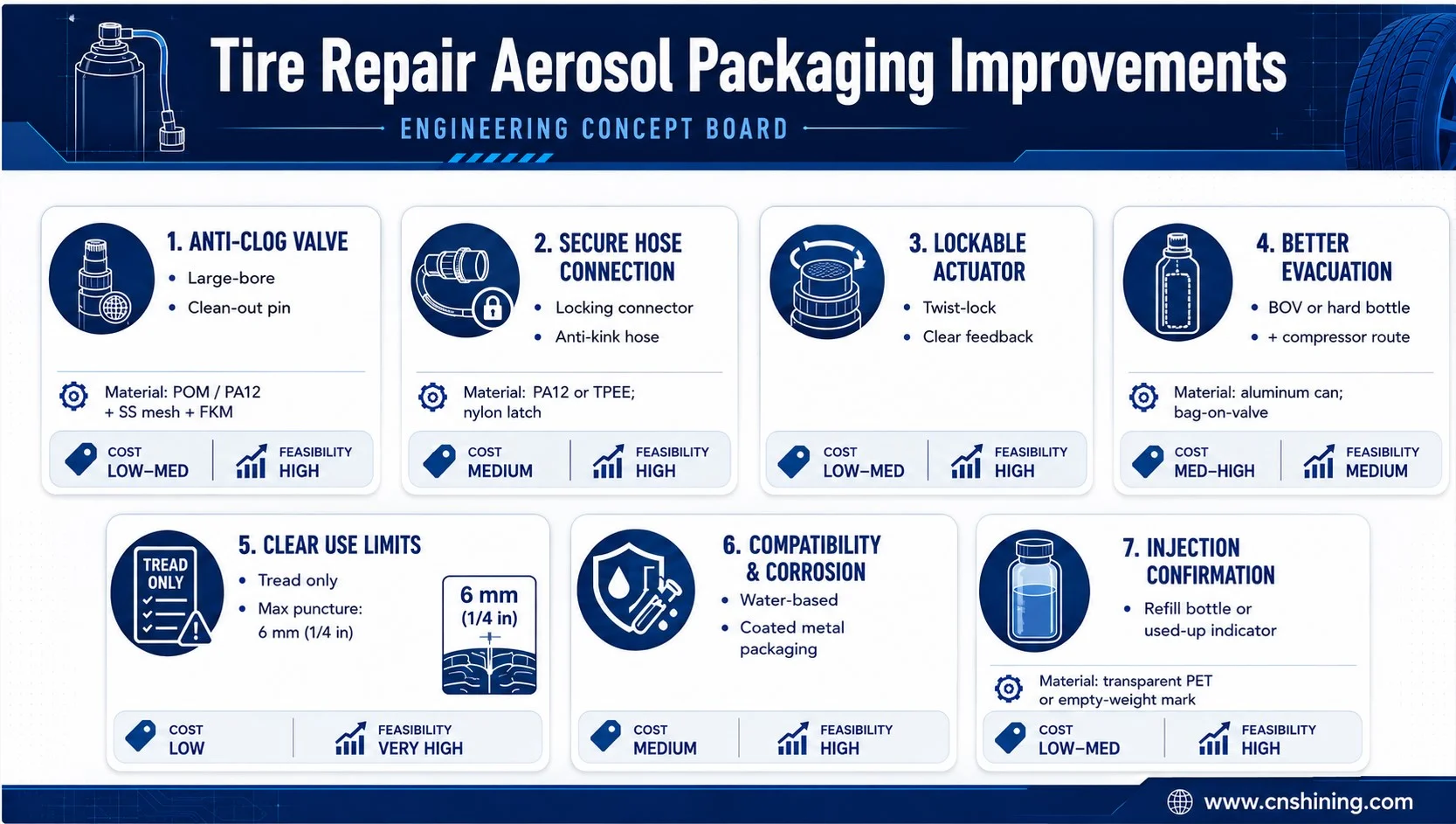
6. Packaging Improvement Ideas for Tire Repair Aerosol
Packaging changes can solve complaints faster than another small change in formula solids. The most useful improvements are mechanical, visible and easy to explain. The following actions map directly to common user complaints.
| Pain point | Suggested improvement | Recommended material / structure | Cost impact | Feasibility | Why it helps |
|---|---|---|---|---|---|
| Valve clogging and dried valve tip | Use a large-bore valve-end assembly with disposable micro-screen and clean-out pin | POM or PA12 valve body, 304 stainless 80-120 mesh screen, FKM seal | Low to medium | High | Large bore reduces sensitivity. Screen blocks oversized particles. A clean-out pin helps service or second use. |
| Hose detaches and sprays sealant | Use locking or quarter-turn bayonet connector plus anti-kink hose | PA12 or TPEE hose, glass-fiber reinforced nylon latch, dual barb plus overmold | Medium | High | Mechanical lock is more reliable than friction fit under pressure. |
| Accidental actuation or shipping leakage | Use capless lockable actuator with clear click feedback | Twist-to-lock or double-click style actuator, larger thumb pad | Low to medium | High | Fits e-commerce handling and reduces accidental discharge. |
| Incomplete evacuation | For premium formats, consider BOV or hard-bottle plus compressor route | Aluminum can plus bag-on-valve; air or nitrogen; transparent refill bottle for compressor kits | Medium to high | Medium | BOV can improve evacuation and 360-degree use, but tire inflation still often needs compressor support. |
| User misunderstands repair boundary | Print large front-label limits: tread only, maximum puncture size, maximum speed, maximum distance | Multilingual label, QR video, 6 mm / 1/4 inch gauge graphic | Low | Very high | Many negative reviews come from wrong expectations, not only product failure. |
| Can compatibility and corrosion concern | Develop dedicated internal coating validation for water-based latex formulas | Metal packaging coating, 40°C / 50°C aging, salt spray, adhesion and migration tests | Medium | High | Latex, glycol, surfactant and corrosion inhibitor chemistry must remain compatible through shelf life. |
| User cannot confirm injection | Use transparent refill bottle or printed weight / used-up indicator for aerosol can | Transparent PET or multilayer bottle; aerosol can with empty-weight reference mark | Low to medium | High | Reduces anxiety about whether sealant actually entered the tire. |
If only three changes can be made, start with the locking connector, lockable actuator and front-label boundary instructions. These items are low-risk, visible to the user, and directly address the most common failure comments.
Bag-on-Valve technology is technically relevant where a brand wants propellant separation, high evacuation, 360-degree discharge and lower VOC exposure. Aptar states that its BOV system separates product and propellant and can reach up to 99% evacuation.
Actuator design also matters. Large-can actuators with lock functions are relevant for e-commerce and storage safety. For internal coatings, metal packaging suppliers usually need long-term compatibility tests with the actual latex-glycol-surfactant system; coating technology references can be checked through ACTEGA packaging coatings.
7. Shining Packaging Components for Tire Repair Aerosol
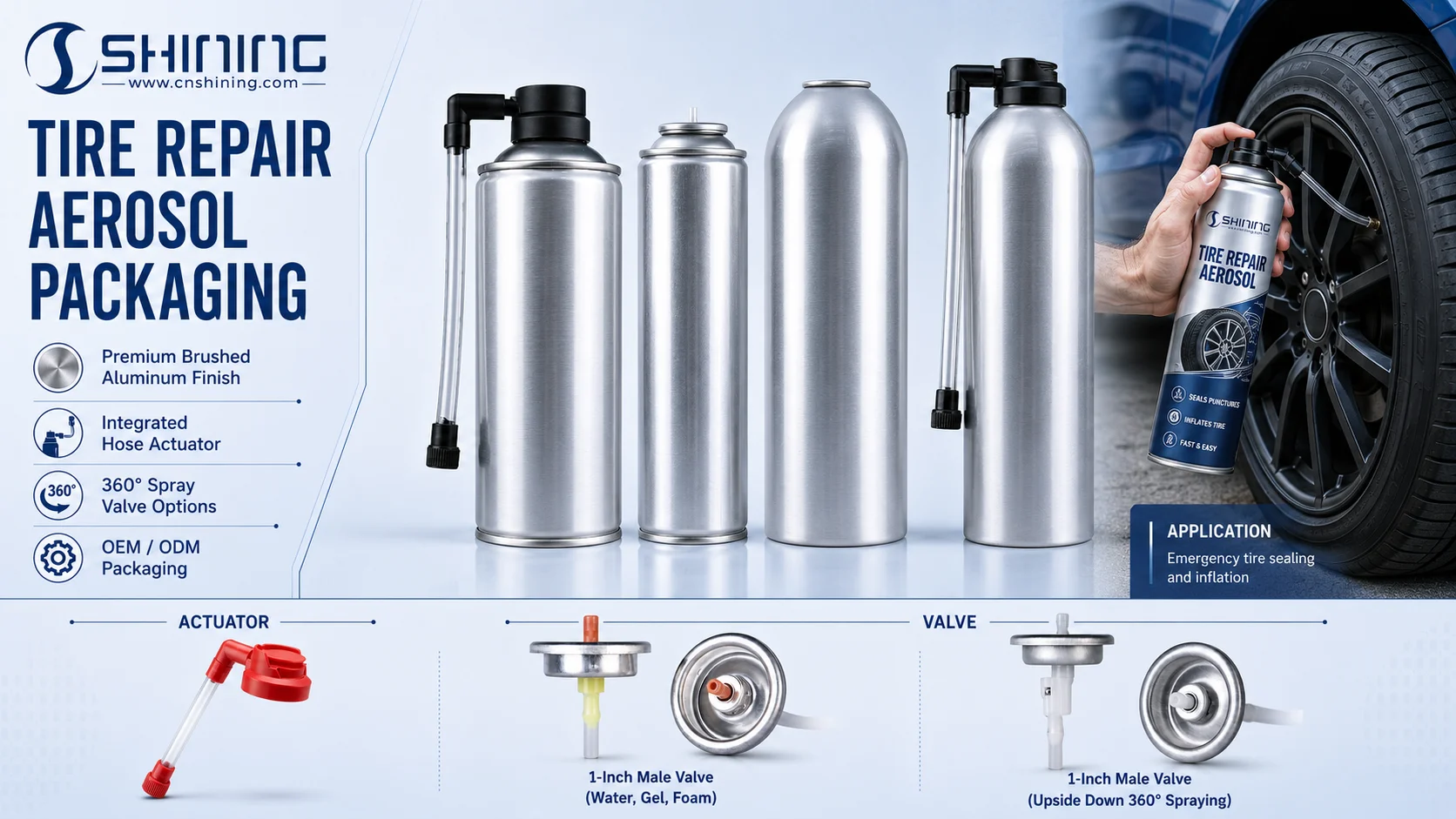
In tire repair aerosol, the package is part of the functional system. The sealant formula may be sound, but a weak actuator, narrow valve path or loose hose interface can still create a failed roadside experience. This is where component selection needs the same attention as formulation.
For this application, Shining Packaging can be positioned around three practical components: aerosol cans, valves and actuators. The aerosol can must tolerate internal pressure, formula contact and transport handling. The valve must pass a particle-containing sealant without creating a premature clog point. The actuator should give controlled discharge and resist accidental triggering during storage or e-commerce shipment.
The most relevant engineering checks are simple but strict: valve path diameter, gasket compatibility with glycol and latex systems, actuator locking force, discharge rate repeatability, can internal coating compatibility, hot-water bath pressure behavior, and long-term storage stability. For high-solid or fiber-reinforced formulas, early testing should use the real production formula, not a clean water substitute.
8. Technical Closing Note
Tire repair aerosol will remain useful because it solves a real roadside problem with low user skill. The next improvement cycle is less about stronger claims and more about reliability: stable water-based sealant, controlled particle size, valve-through flow, lockable actuator, secure hose connector, clear repair limits and packaging compatibility testing. The winning design is the one that still works after storage, shipping, cold weather and user error.
9. FAQ: Tire Repair Aerosol
It injects a pressurized sealant through the tire valve. Air escaping from the puncture pulls the sealant toward the leak path. As the tire rotates, latex, fillers or gel particles collect at the puncture and form a temporary plug. The propellant or paired compressor then restores enough pressure for limited driving to a repair point.
The sealant usually addresses only small tread punctures and does not restore tire structure. It cannot repair sidewall cuts, bead damage, cracks, blowouts or large tears. The driver should limit speed and distance after use, then ask a tire shop to inspect, clean and repair or replace the tire according to normal safety practice.
Public product instructions often use about 6 mm or 1/4 inch as the upper limit for tread-area punctures. This is not a universal guarantee. Plugging success depends on tire pressure, puncture shape, remaining object, formula solids, valve passage, tire rotation and how fast the driver follows the usage steps.
Clogging usually comes from particle size, dried latex residue, fiber buildup, sedimentation or narrow flow paths at the valve and hose adapter. A formula needs enough solids to bridge the puncture, but those same solids can block small passages. Good design controls particle distribution, suspension stability and valve-end geometry together.
TPMS-safe means the product is designed to be compatible under intended use. It does not remove every risk. Sensor passage size, formula residue, overuse, wrong orientation and delayed cleaning can still create concern. A credible TPMS-safe claim should be supported by valve-through testing, sensor exposure tests and clear repair-shop cleaning instructions.
Water-based latex systems can reduce odor, improve washability and support repair-shop acceptance. Natural latex can form a flexible sealing phase, while fillers or fibers help bridge the hole. The challenge is storage stability. The formula must stay fluid in the can, pass through the valve, and only build a plug at the leak.
Glycols and glycerin act as carrier and antifreeze components. They help keep the formula fluid at lower temperatures and adjust viscosity for valve passage. The trade-off is safety and labeling. Ethylene glycol, propylene glycol and glycerin do not carry the same toxicology profile, so SDS and regional label requirements must be reviewed.
The user operates the product under roadside pressure, often in poor light and bad weather. A loose hose can detach and spray sealant. A weak actuator can misfire in shipment or be hard to control. Locking connectors, anti-kink hoses, lockable actuators and clear flow direction reduce failure without changing the formula.
Bag-on-Valve separates product from propellant and can improve evacuation, 360-degree dispensing and VOC profile. It is more suitable when the package mainly dispenses sealant, not when the can must also provide meaningful tire inflation. For many tire repair systems, BOV works better as part of a sealant bottle plus compressor kit.
Test the complete formula and package as one system. Key checks include valve passage, actuator force, discharge rate, full evacuation, hose retention, can pressure, coating compatibility, gasket swelling, sedimentation, cold flow, hot storage and TPMS exposure. Water-only testing is not enough for latex, glycol, fiber or particle-loaded tire sealants.