
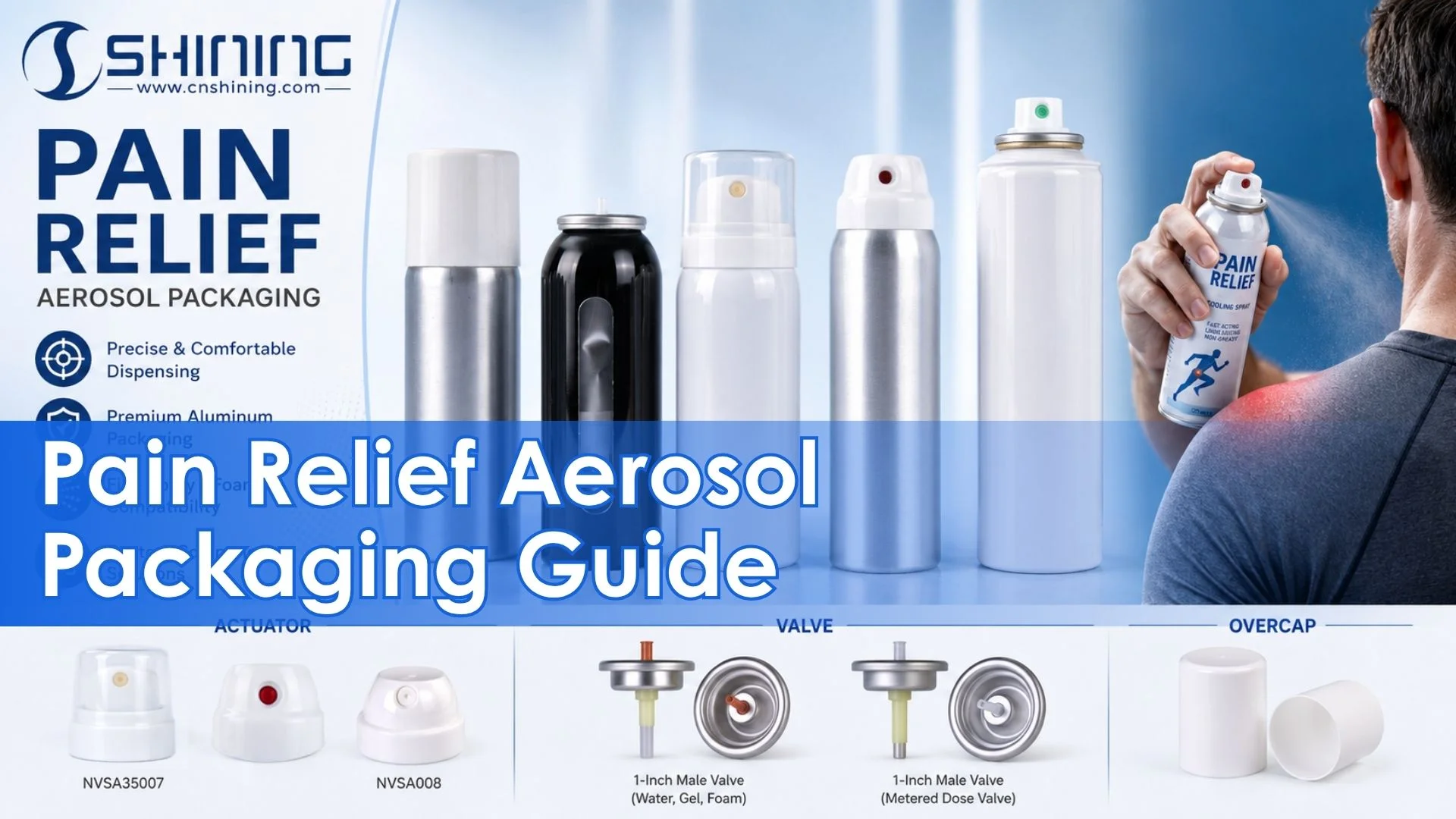
A pain relief aerosol spray works only when the formula, spray hardware and user instruction meet at the skin. The product is not just “a liquid in a can.” It is a topical delivery system for analgesic, anesthetic, anti-inflammatory or counterirritant ingredients. The real value is practical: reaching the back, shoulder and neck; drying fast; reducing hand contact; and making repeated use easier.
The category covers products searched as pain relief spray, muscle pain spray, joint pain spray, topical analgesic spray, menthol pain relief spray, lidocaine spray, and diclofenac spray. Those search terms point to different formula logics. Packaging engineers should not treat them as the same product.
1. What the Product Is and Why the Package Matters
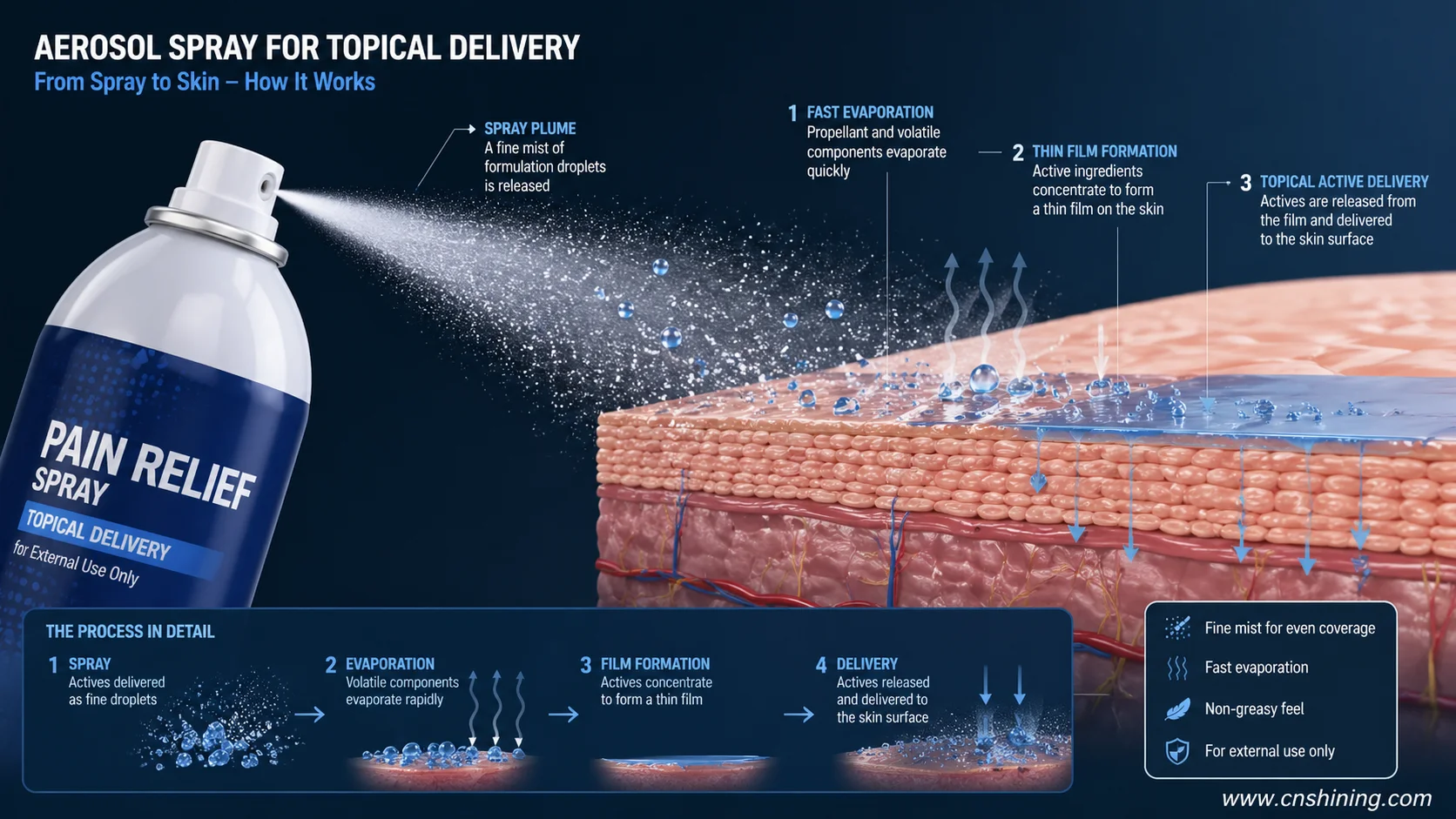
From a formulation and regulatory view, pain relief aerosol spray is a topical external analgesic product. Its function normally follows three routes:
- Pharmacological route: menthol activates cold-sensing TRPM8 receptors; lidocaine blocks voltage-gated sodium channels; diclofenac reduces prostaglandin formation through COX inhibition; capsaicin works through TRPV1-related desensitization.
- Physical route: alcohol and propellant evaporation give a quick cooling feeling and fast dry-down.
- Delivery route: droplets wet the stratum corneum, then ingredients may move through intercellular, transcellular or appendageal pathways.
The key point is not “deeper penetration at any cost.” The practical target is local effect, controlled skin residence, acceptable odor, safe use and repeatable spray output.
2. Mechanism and Dosage-Form Comparison
2.1 Onset and user sensation
| Active Class | Typical Ingredients | Main Mechanism | Common User Sensation | Technical Note |
|---|---|---|---|---|
| Cooling counterirritants | Menthol, camphor | TRPM8 and sensory modulation | Seconds to minutes | Fast sensation does not always mean fast anti-inflammatory action. |
| Local anesthetics | Lidocaine, benzocaine | Sodium-channel blockade | Several minutes | More suited to local nerve-like pain, burning or irritation. Metered delivery becomes more relevant. |
| NSAIDs | Diclofenac | COX pathway inhibition | Less immediate than menthol | More treatment-oriented; full benefit usually depends on repeated use. |
| Heat or sting desensitizers | Capsaicin | TRPV1 stimulation and desensitization | Initial heat, sting or burn | User education is not optional. Tolerance drives repeat use. |
2.2 Spray versus gel, patch, cream and oral products
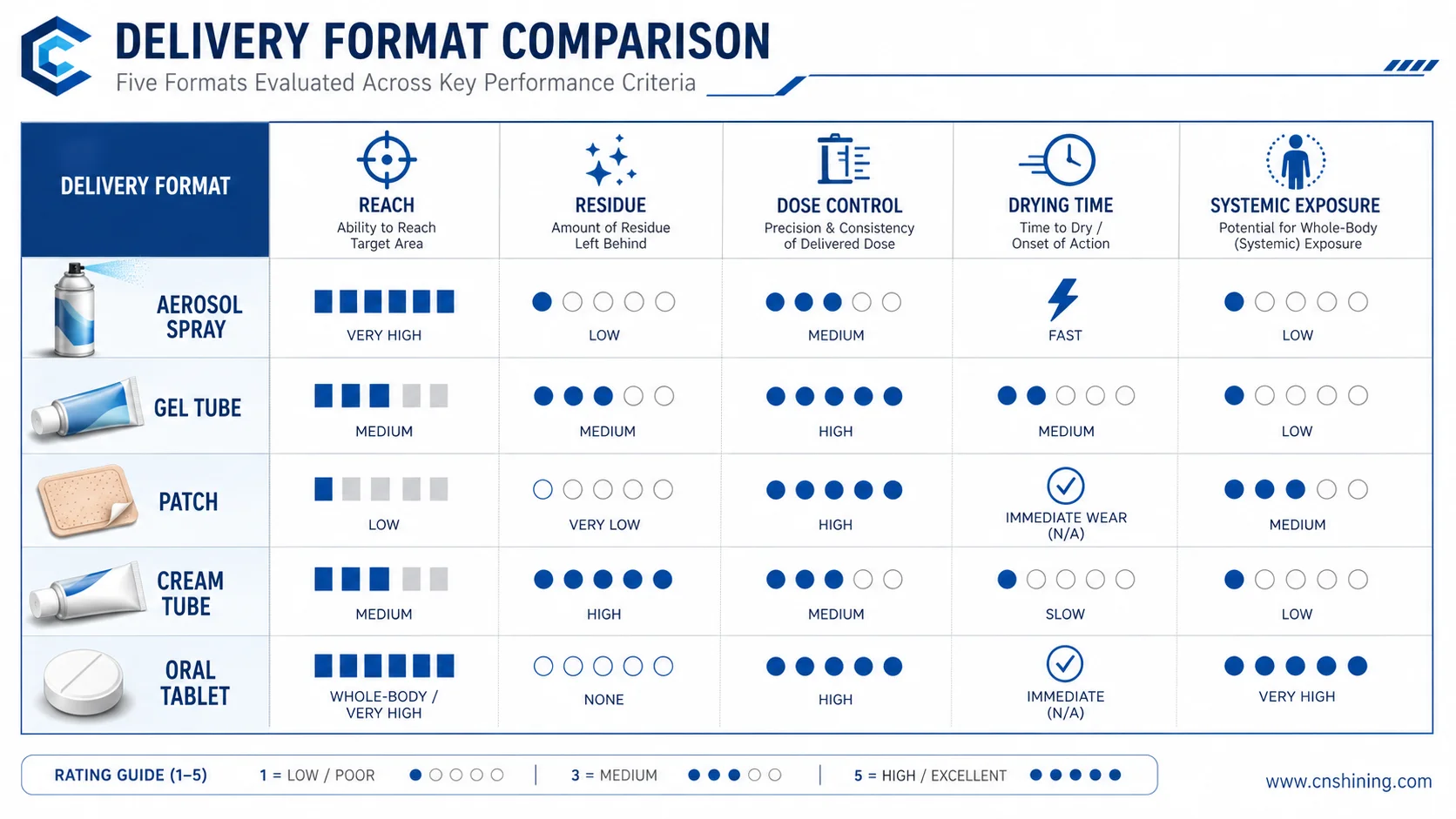
| Dosage Form | Main Strength | Main Weakness | Best-Fit Scenario | Packaging Requirement |
|---|---|---|---|---|
| Aerosol spray | Reaches back, shoulder and neck; low hand contact; quick drying; portable; can support 360° use. | Overspray, inhalation risk, odor, direction confusion, output inconsistency if the valve is weak. | Sports injuries, neck/shoulder/back pain, travel use, self-application. | Valve, actuator, plume geometry, can shape and label design decide the user experience. |
| Gel | Accurate application and good local residence. | Hand contact, tackiness, clothing transfer. | Knee, elbow, wrist and other easy-to-reach areas. | Pump or tube evacuation, viscosity control and residue management. |
| Patch | Longer wear time and visible reminder that treatment is still applied. | Adhesion failure, sweat lift, hair pull, skin irritation. | Chronic local pain or night use. | Adhesive layer, breathability and skin compatibility. |
| Cream | Massage feel and better fit for dry skin. | Greasy feel, slow spread, hand contact. | Home massage and winter use. | Controlled extrusion and contamination reduction. |
| Oral product | Standardized systemic dosing for broader pain coverage. | Higher systemic exposure and mismatch with “spray and go” use. | Multi-site pain or systemic treatment need. | Not an aerosol packaging issue. |
The conclusion here is simple. Aerosol spray should not try to replace every topical form. Its natural role is quick sensation + hard-to-reach areas + portability + non-contact use.
3. Market Size, Regional Split and Demand Logic
Public “spray-only” market data is thinner than broader topical pain relief data. The spray segment should be treated as a high-convenience, high-experience subcategory, not the largest part of topical pain relief.
| Scope | Current Size | Forecast Size | Growth Reading | Use in Planning |
|---|---|---|---|---|
| Global pain relief sprays | About USD 1.5 billion in 2024 | About USD 2.5 billion by 2033 | Source states 6.5% CAGR; endpoint math suggests about 5.8%. | Good for directional planning, not audit-grade financial modeling. |
| Global topical pain relief market | About USD 11.6 billion in 2025 | About USD 18.1 billion by 2034 | About 4.89% CAGR. | More stable scope; includes gels, creams, patches and sprays. |
| U.S. topical pain relief market | USD 2,612 million in 2019 | USD 3,272 million by 2027 | About 3.7% CAGR. | Shows a large but mature market base. |
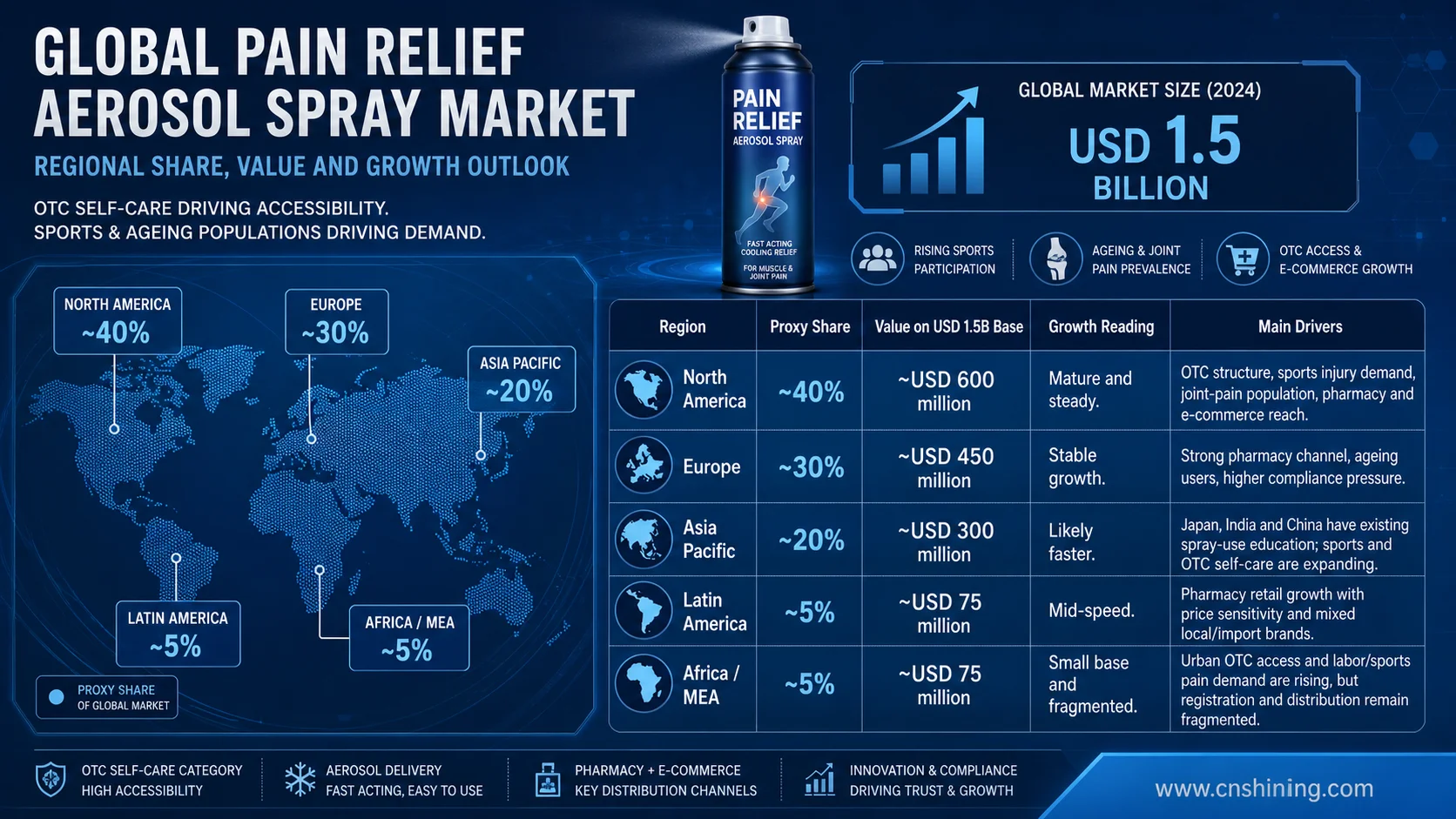
| Region | Proxy Share | Value on USD 1.5B Base | Growth Reading | Main Drivers |
|---|---|---|---|---|
| North America | ~40% | ~USD 600 million | Mature and steady. | OTC structure, sports injury demand, joint-pain population, pharmacy and e-commerce reach. |
| Europe | ~30% | ~USD 450 million | Stable growth. | Strong pharmacy channel, ageing users, higher compliance pressure. |
| Asia Pacific | ~20% | ~USD 300 million | Likely faster. | Japan, India and China have existing spray-use education; sports and OTC self-care are expanding. |
| Latin America | ~5% | ~USD 75 million | Mid-speed. | Pharmacy retail growth with price sensitivity and mixed local/import brands. |
| Africa / MEA | ~5% | ~USD 75 million | Small base and fragmented. | Urban OTC access and labor/sports pain demand are rising, but registration and distribution remain fragmented. |
The real demand driver is not only chronic pain prevalence. Purchase behavior is triggered by clearer use cases: ageing joint pain, gym and sports injury, concern about oral systemic exposure, home self-care, and the simple user wish to spray the back without touching the formula.
4. Formula Map and Key Technical Terms
Commercial products usually cluster into four formula families: NSAID systems, local anesthetic systems, counterirritant systems and herbal or compound-positioned systems. The core actives seen repeatedly are menthol, camphor, methyl salicylate, lidocaine, diclofenac and capsaicin.
| Category | Typical Actives | Typical Range / Pattern | Mechanism | Development Note |
|---|---|---|---|---|
| NSAIDs | Diclofenac diethylamine or sodium | Often paired with ethanol and penetration enhancers in spray or solution systems. | COX inhibition and reduced prostaglandin formation. | Less sensory drama; repeat use depends more on perceived therapeutic effect. |
| Local anesthetics | Lidocaine, benzocaine | U.S. OTC M017 lists lidocaine 0.5–4% and benzocaine 5–20% for relevant external analgesic uses. | Reduces nerve impulse conduction. | Metered valve and clear dose language matter more than in simple cooling sprays. |
| Counterirritants | Menthol, camphor, methyl salicylate, capsaicin | U.S. OTC M017 includes menthol 1.25–16%, camphor >3–11%, methyl salicylate 10–60%, capsaicin 0.025–0.25% as counterirritant ranges. | Cold, heat, redness or sensory modulation. | Sensation is part of value. Odor, staining and dry-down decide repeat use. |
| Herbal / compound-positioned | Arnica, eucalyptus, Hypericum, peppermint, cannabis seed oil, MSM, glucosamine | Varies strongly by market and claim route. | Evidence strength varies by ingredient and jurisdiction. | Useful for positioning, but claim language must stay within the evidence and local rules. |
A practical aerosol formula is rarely just active ingredient plus alcohol. It may include volatile solvent, humectant or slip phase, film-forming polymer, rheology modifier, fragrance or essential oil, propellant or compressed gas, valve lubricant strategy and can-lining compatibility.
| Term | Plain Meaning | Packaging Meaning |
|---|---|---|
| Counterirritant | An active that shifts pain perception through cooling, heat or mild irritation. | Drives first impression and user comments. |
| TRPM8 | Cold receptor strongly linked to menthol sensation. | Explains “ice” positioning differences. |
| TRPV1 | Capsaicin-related receptor with initial stimulation and later desensitization. | Needs clear tolerance instructions. |
| Transappendageal | Entry through follicles or sweat glands. | Related to droplet size, wetting time and penetration enhancers. |
| Film-forming spray | Solvent evaporates and leaves a film on skin. | Supports uniform coverage, dry feel and possible sustained local release. |
| 360° valve | Sprays at any orientation. | Directly solves back and shoulder self-application. |
| Metered valve | Fixed output per actuation. | Needed for stronger dose language and higher-potency systems. |
| BOV | Bag-on-Valve system separating product from propellant gas. | Supports all-angle use, better emptying and compressed air or nitrogen routes. |
| Plume geometry | Spray cone shape, angle and deposition area. | Controls overspray, inhalation complaint and eye/face mis-spray risk. |
| Internal lacquer | Can lining in contact with formula. | Key for alcohol, essential oil, camphor and methyl salicylate compatibility. |
5. Regulatory Requirements by Region
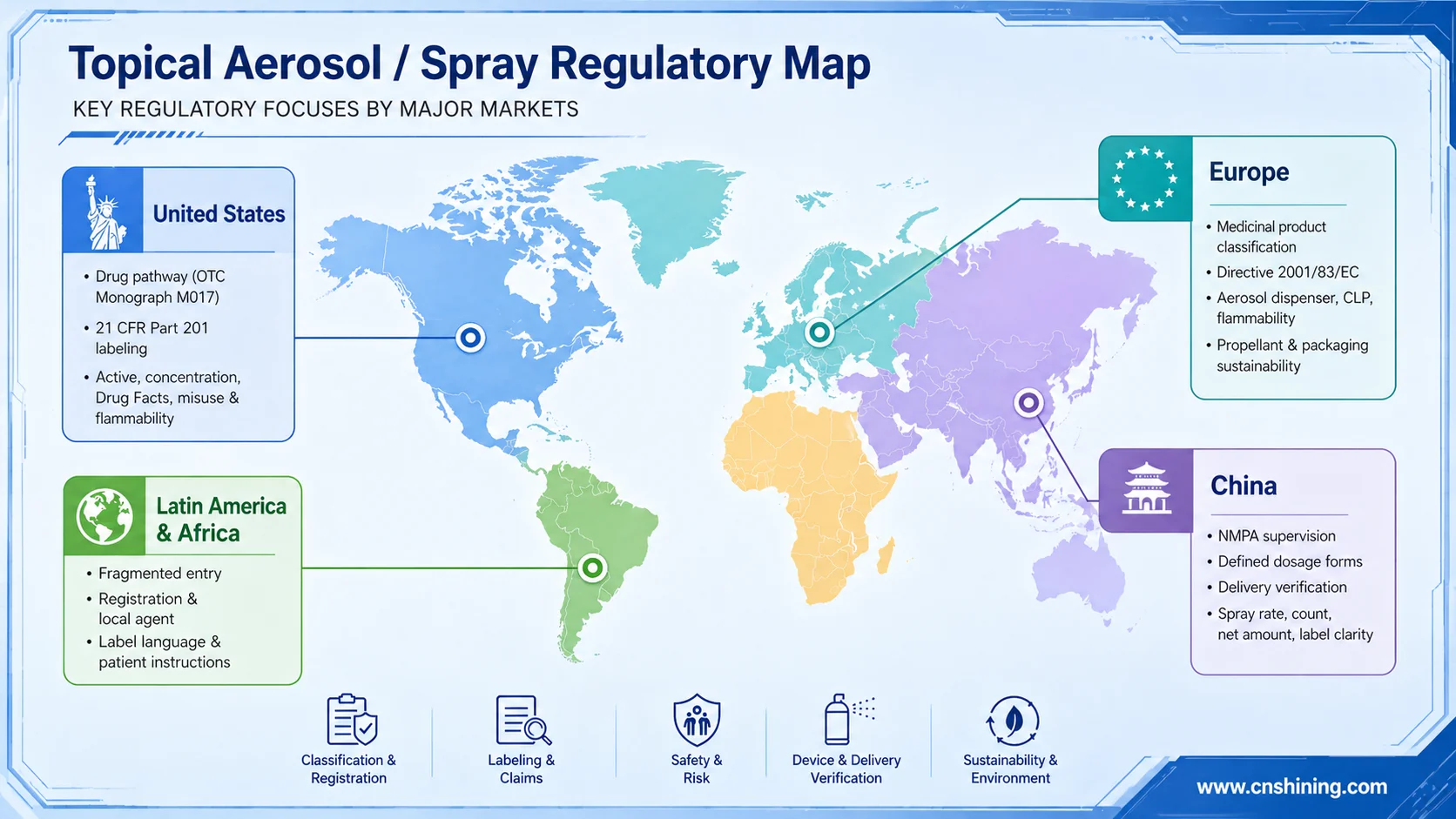
5.1 United States
In the U.S., a topical product making analgesic, anesthetic or counterirritant claims normally follows a drug pathway, not a cosmetic pathway. The FDA OTC Monograph M017 for External Analgesic Drug Products lists relevant active ingredients and concentration ranges. OTC label format links back to 21 CFR Part 201 labeling requirements.
For aerosol products, the practical issues are active legality, concentration boundary, Drug Facts wording, child-risk language, frequency of use, flammability, eye/face mis-spray and inhalation of mist. If a product claims a fixed amount per spray, the evidence burden moves into human factors and functional verification.
5.2 Europe
In the EU, pain treatment or symptom relief claims typically point first to medicinal product classification. Directive 2001/83/EC sets the broad medicinal product framework, while aerosol packages also need attention to aerosol dispenser, CLP and flammability labeling logic.
Europe is also where propellant and packaging sustainability pressure shows up earlier. BOV, compressed air, nitrogen, low-GWP propellant thinking, lighter aluminum cans and recyclability are no longer side topics for long-range planning.
5.3 Latin America and Africa
Brazil and South Africa show a more fragmented entry pattern. ANVISA medicine information and SAHPRA patient information expectations point to the same practical issue: registration route, label language, local agent responsibility and patient-readable instructions can be harder than basic demand creation.
6. Technology Trends, Patents and Development Signals
The development direction is clear: not “make it colder” forever. Better products will be more stable, more accurate, safer to use, easier to explain and easier to justify environmentally.
6.1 Trend 1: from simple spray to controlled local depot
Patent and formulation work shows interest in high-volatility alcohol systems, menthol/camphor stability, no-drip dry-down and film-forming sprays that leave a controlled layer on skin. Some designs aim for a fast initial sensation followed by longer local release.
6.2 Trend 2: from continuous output to metered output
Metered aerosol valves can deliver a more consistent dose per actuation. This matters for lidocaine systems, NSAID solutions and any product that wants clearer “per spray” language.
6.3 Trend 3: BOV and compressed gas routes
Bag-on-Valve technical highlights air or nitrogen use, up to 100% product emptying, even spray pattern and all-angle use. For pain relief aerosol spray, that directly maps to back application, residue reduction and formula/propellant separation.
6.4 Representative patents and literature
| Type | Source | Technical Point |
|---|---|---|
| Patent | WO2020223092A1 Topical analgesic spray compositions | Menthol/camphor in high-volatility alcohol systems, with fast dry-down and uniform spray behavior. |
| Patent | WO2017091739A1 Topical film-forming spray | Film formation after spraying, with a 1–24 hour release concept. |
| Patent | US20170296484A1 Topical Film-Forming Spray | Fast plus sustained release logic for topical spray systems. |
| Patent | US6299900B1 Dermal penetration enhancers and delivery systems | Metered aerosol plus nozzle shield concepts for spray distance and deposition control. |
| Patent | US5453445A Lidocaine-phenylephrine aerosol preparation | Shows that solvent system, valve lubrication and package engineering must be considered together. |
7. Top 10 Pain Relief Aerosol Spray Brands
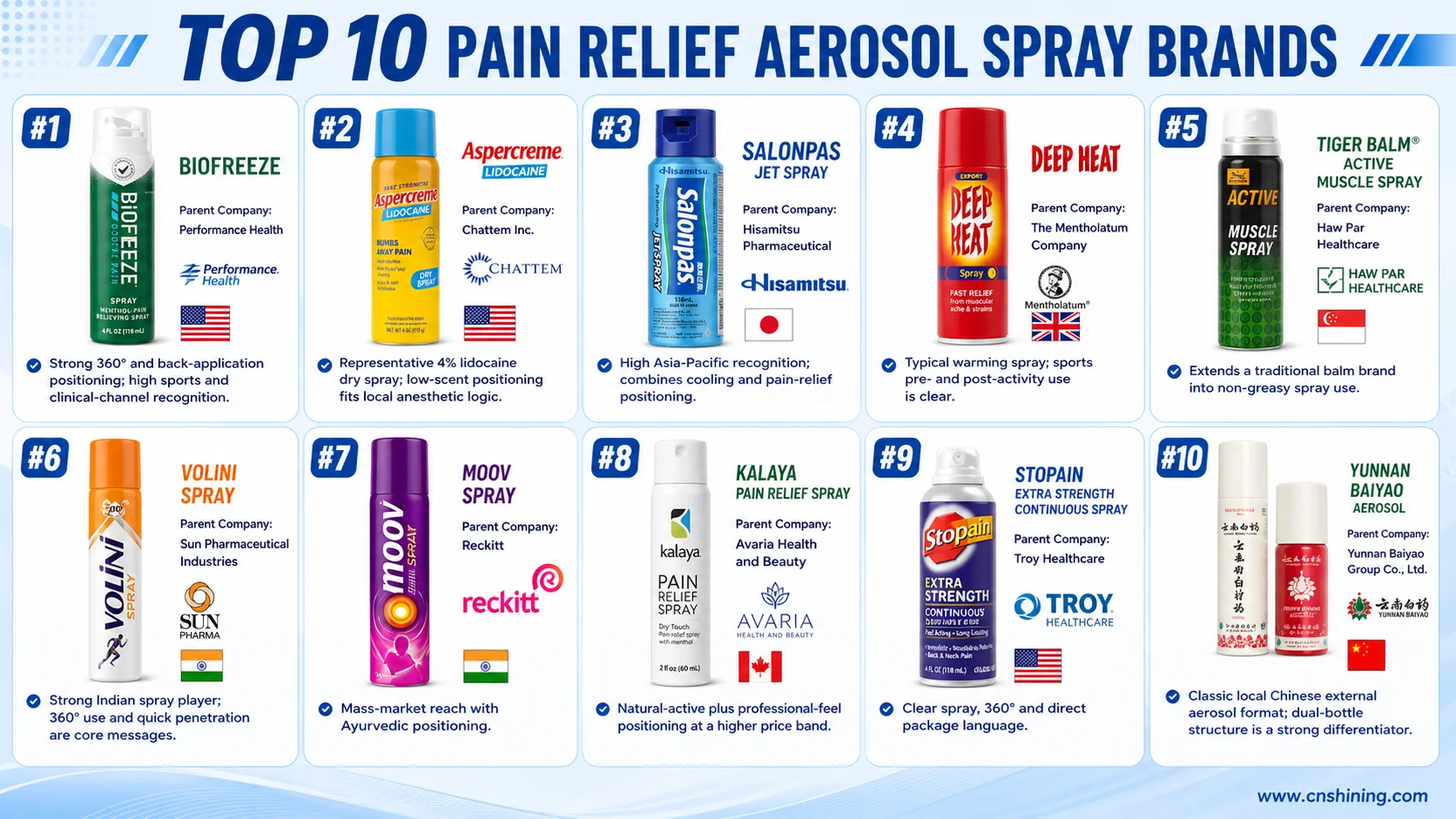
This Top 10 list is a representative brand map, not a strict global sales ranking. The selection logic is retail visibility, regional recognition, dosage-form relevance and available public information.
| Brand | Country / Region | Parent Company | Common Size | Visible Price Range | Technical Comment |
|---|---|---|---|---|---|
| Biofreeze | United States | Performance Health | 3 fl oz, 4 fl oz, 16 fl oz | About US$12.99–20.67 for visible 4 oz retail listings | Strong 360° and back-application positioning; high sports and clinical-channel recognition. |
| Aspercreme Lidocaine Dry Spray | United States | Chattem Inc. | 4 oz | About US$10.98 | Representative 4% lidocaine dry spray; low-scent positioning fits local anesthetic logic. |
| Air / Jet Salonpas | Japan | Hisamitsu Pharmaceutical | 80 mL, 4 oz | About R$48.79–69.00 in visible Brazil retail listings | High Asia-Pacific recognition; combines cooling and pain-relief positioning. |
| Deep Heat Spray | United Kingdom | The Mentholatum Company | 72.5 mL, 150 mL | About £4.99–5.29 | Typical warming spray; sports pre- and post-activity use is clear. |
| Tiger Balm Active Muscle Spray | Singapore | Haw Par Healthcare | 2.53 fl oz / 75 mL | About US$9.37–11.99 | Extends a traditional balm brand into non-greasy spray use. |
| Volini Spray | India | Sun Pharmaceutical Industries | 15 g, 42 g, 62 g, 100 g | About ₹77–279 | Strong Indian spray player; 360° use and quick penetration are core messages. |
| Moov Spray | UK | Reckitt | 35 g, 50 g, 80 g | About ₹182–339 | Mass-market reach with Ayurvedic positioning. |
| KaLaya Pain Relief Spray | Canada | Avaria Health and Beauty | 2 fl oz / 60 mL | About US$12.86–16.99 | Natural-active plus professional-feel positioning at a higher price band. |
| Stopain Extra Strength Continuous Spray | United States | Troy Healthcare | 4 fl oz / 118 mL | About US$11.69–12.99 | Clear spray, 360° and direct package language. |
| Yunnan Baiyao Aerosol | China | Yunnan Baiyao Group Co., Ltd. | Commonly 85 g aerosol + 30 g safeguard liquid | About $7.99–9.66 | Classic local Chinese external aerosol format; dual-bottle structure is a strong differentiator. |
8. User Pain Points and Packaging Design Priorities
Public reviews and forum comments repeatedly point to the same problems: the user cannot see the spray direction, the mist spreads too far, odor is too strong, the product cannot spray upside down, colored residue is embarrassing, and the valve or actuator feels heavy. These are not formula problems alone. They sit at the boundary between valve, actuator, plume, can shape, label instruction and material compatibility.
| Packaging Element | Design Direction | Expected Effect |
|---|---|---|
| Valve system | Use 360° continuous spray for mass OTC sports products; consider metered valves for higher-potency lidocaine or NSAID formats; evaluate BOV if all-angle use, low residue and formula isolation are priorities. | Solves back-use failure, output variation and poor evacuation. |
| Actuator and nozzle | Larger press surface, lower actuation force, tactile direction marker, visible arrow, lock status, and spray shield for high-mist systems. | Reduces eye/face mis-spray and helps older users or users with weaker grip. |
| Spray pattern | Move away from “finer is always better.” Use controlled deposition, narrow fan or hollow cone based on target body area. | Less inhalation and fewer “sprays everywhere” complaints. |
| Can shape and grip | Use slim or waisted aluminum cans, anti-slip texture on cap or shoulder, and align nozzle direction with front artwork. | Better one-hand self-application. |
| Printing and label | State 360° use, colorless or colored output, odor intensity, quick-dry behavior, “do not inhale,” “avoid face and eyes,” and exact spray duration or spray count. | Reduces misuse, complaints and wrong expectations. |
| Internal lacquer and materials | Run compatibility tests for high-alcohol, menthol, camphor, methyl salicylate and essential oil systems. Check corrosion, valve swelling, odor shift and extractables/leachables risk. | Reduces valve sticking, can corrosion, smell change and unstable spray output. |
| Transport lock | Use twist-to-lock or firm overcap with clear open/closed feedback. | Reduces bag leakage and warehouse transport loss. |
9. Shining Packaging Components for Pain Relief Aerosol Spray
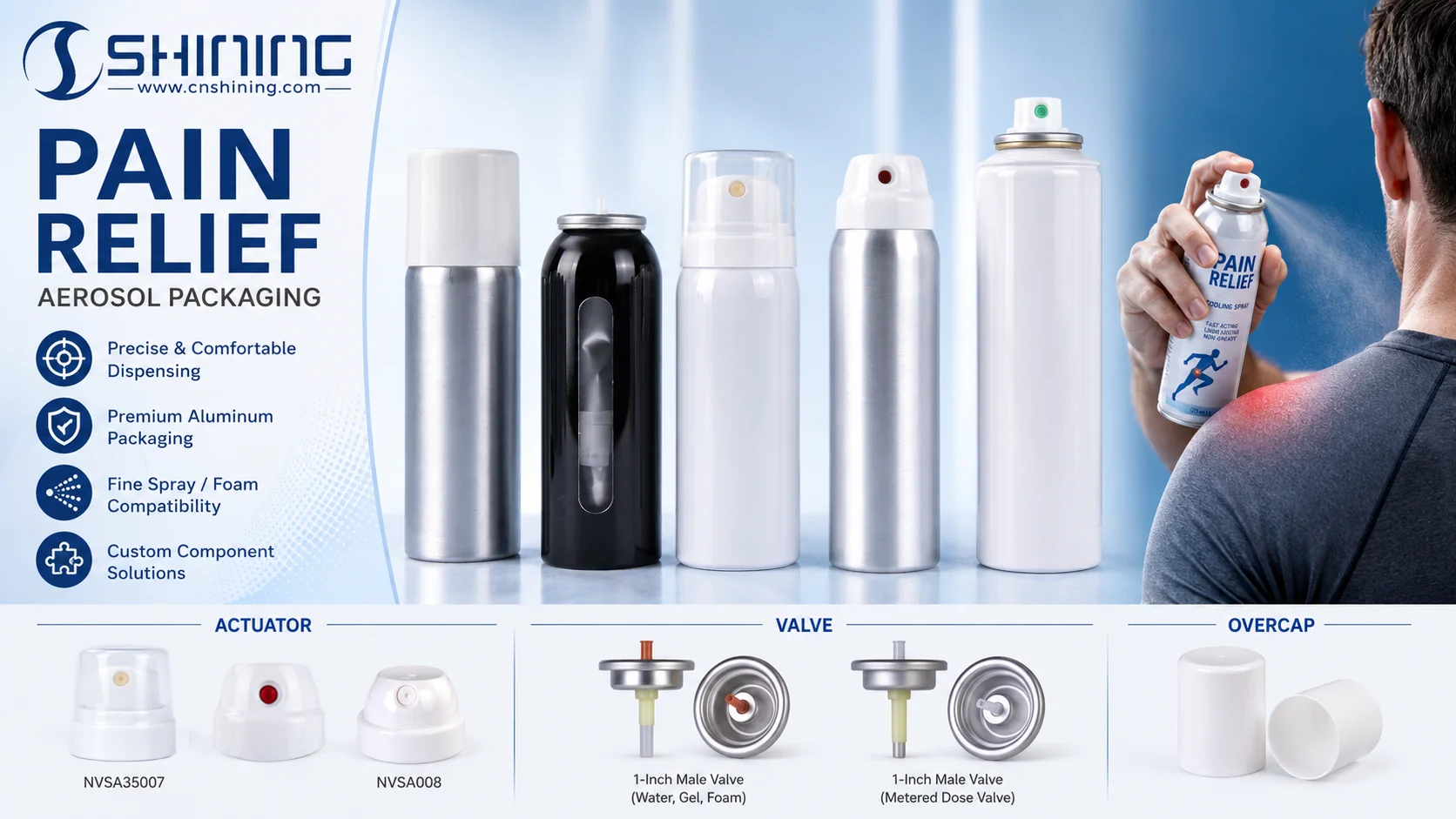
For Shining Packaging, the useful discussion is not “one can fits all.” A pain relief aerosol spray package must be matched to the formula type and use scenario. A menthol/camphor cooling spray, a lidocaine dry spray and a diclofenac solution put different stress on the actuator, valve gasket, dip tube, internal lacquer and aluminum can.
The main component decisions are:
- Actuator: low press force, clear spray direction, controlled plume, optional guard structure for face/eye mis-spray reduction.
- Aerosol can: aluminum can body with suitable diameter, grip feel, shoulder profile, print readability and internal coating matched to alcohol, essential oil and salicylate systems.
- Valve: continuous 360° valve for back-use convenience, metered valve for dose-consistency language, or BOV route when all-angle evacuation and product/propellant separation are required.
The engineering sequence should be simple: first define formula aggressiveness, target spray area and dosing language; then screen valve output, spray pattern, actuator force, can lining and storage stability. This avoids the common mistake of choosing the can before understanding the plume.
10. Final Engineering Note
Pain relief aerosol spray is valuable because it solves real use problems: hard-to-reach application, quick sensory feedback, low hand contact and portability. The failure points are just as clear: overspray, inhalation, odor, wrong spray direction, poor upside-down performance and material incompatibility.
The next useful upgrade is not simply stronger cooling or stronger heat. It is a package that sprays more predictably, empties better, explains itself faster and stays compatible with aggressive topical analgesic formulas. That is where actuator, valve and aerosol can engineering decide whether the product works in real hands.
11. FAQ: Pain Relief Aerosol Spray
A pain relief aerosol spray is a topical external product that deposits analgesic, anesthetic, anti-inflammatory or counterirritant ingredients onto the skin. Its value is not only fast spraying. It also helps users reach the back, shoulder and neck, reduces hand contact, dries quickly and improves repeated use when the package works correctly.
Menthol mainly creates a cooling sensation by activating TRPM8 cold receptors. Alcohol and propellant evaporation can add an immediate cooling effect. This fast feeling can happen before deeper pharmacological benefit is fully established, so sensory onset and therapeutic onset should not be treated as the same measurement.
Lidocaine is a local anesthetic. It blocks voltage-gated sodium channels and reduces nerve impulse transmission. Menthol works more through cooling and sensory modulation. Because lidocaine is more dose-sensitive, metered valves, clear directions and repeatable output are more relevant than in many simple cooling sprays.
Many users buy aerosol spray because they need to apply it to areas they cannot easily reach, especially the back and shoulder. A 360° valve allows spraying at different angles, including inverted positions. This directly solves a common user complaint: the product works only when held upright.
A metered valve is useful when the product needs more consistent output per actuation. This becomes more relevant for lidocaine sprays, NSAID solutions or products that want to state a clearer dose per spray. It also supports better user instructions, such as number of sprays per use area.
Overspray is usually caused by plume geometry, spray angle, droplet size, actuator design and user distance. A very fine mist may look refined but can spread indoors and be inhaled. For pain relief sprays, controlled deposition is often better than maximum atomization, especially for neck and shoulder use.
Pain relief formulas may contain alcohol, menthol, camphor, methyl salicylate or essential oils. These materials can stress can linings, valve seals and plastic parts. Internal lacquer selection and long-term compatibility testing help reduce corrosion, odor change, valve sticking and unstable spray performance during storage.
BOV can be suitable when the product needs all-angle use, high evacuation, reduced propellant contact and a compressed air or nitrogen route. It is not automatically better for every formula. The decision should be based on viscosity, active stability, cost target, filling line capability and required spray pattern.
Useful labels state whether the spray works upside down, whether it is colorless, how strong the odor may be, how long or how many times to spray, and where not to use it. Eye, face, mucosa, broken skin and inhalation warnings should be visible before the user starts spraying.
Core tests should include valve output, plume pattern, actuation force, spray direction usability, can-lining compatibility, gasket compatibility, storage stability, residual content, flammability labeling logic and human-factor checks. For stronger dose claims, metered output verification and clearer use instructions become part of the technical package.