
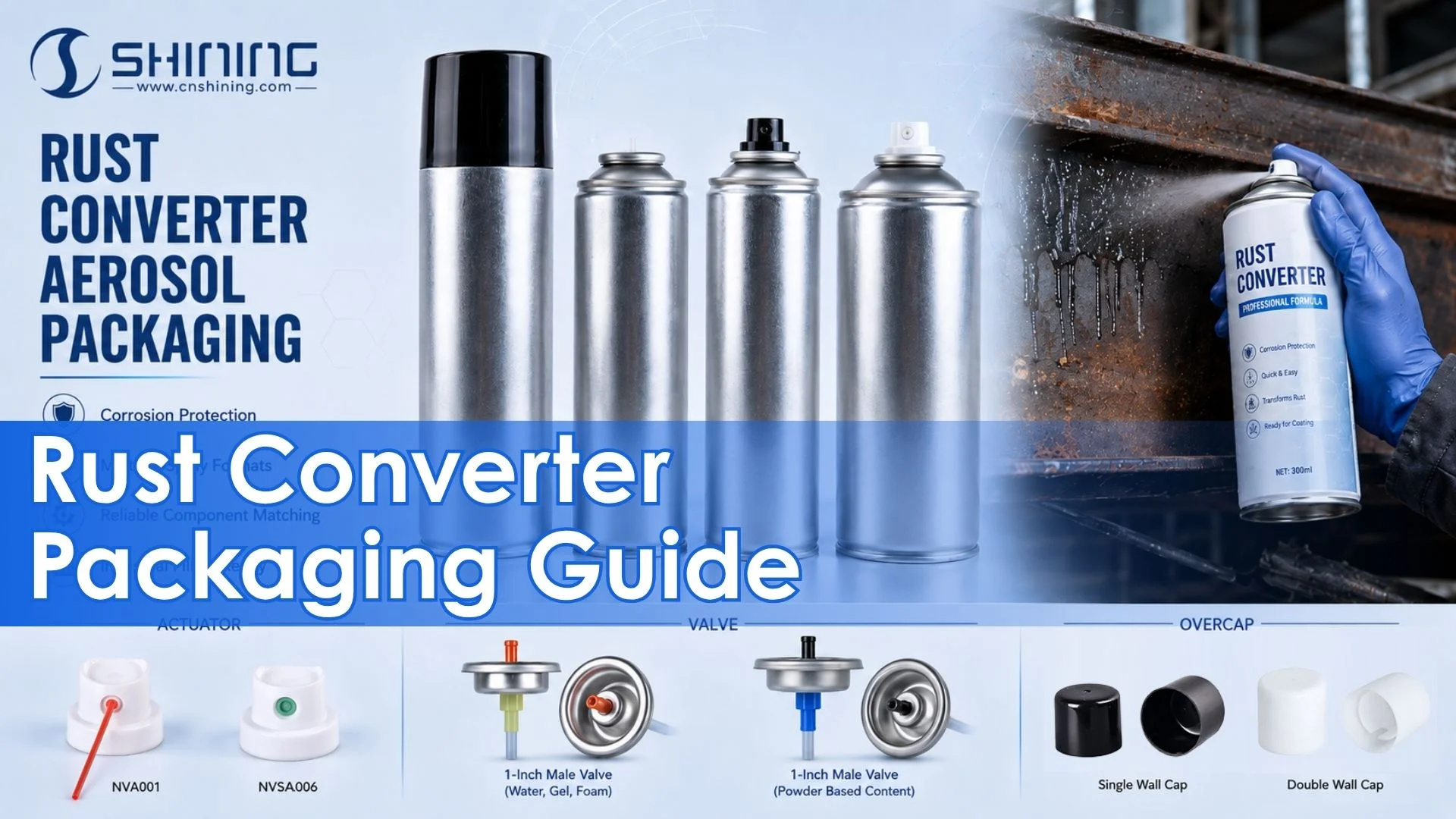
A rust converter aerosol spray is not just rust remover in a pressurized can. It is a chemical conversion system delivered through an aerosol package. The formula wets rust, reacts with iron oxides or hydroxides, forms a more stable layer, and leaves a surface that can often be recoated.
In practical work, the product succeeds or fails on four points: conversion depth, coating compatibility, spray system stability, and regulatory labeling. Users usually do not complain about coordination chemistry. They complain about blocked nozzles, poor upside-down spraying, unclear instructions, difficult disposal, and confusion between rust converter, rust remover, etch primer, and anti-rust primer.
1. Definition and Conversion Mechanism
A rust converter aerosol spray can be defined as a pressurized aerosol delivery system for a chemical rust-conversion formula. It uses a non-refillable container, valve, actuator, propellant, and active formulation to atomize the product onto corroded metal. The European Commission defines an aerosol dispenser as a non-reusable container containing compressed, liquefied, or dissolved gas under pressure and fitted with a release device that ejects the contents.
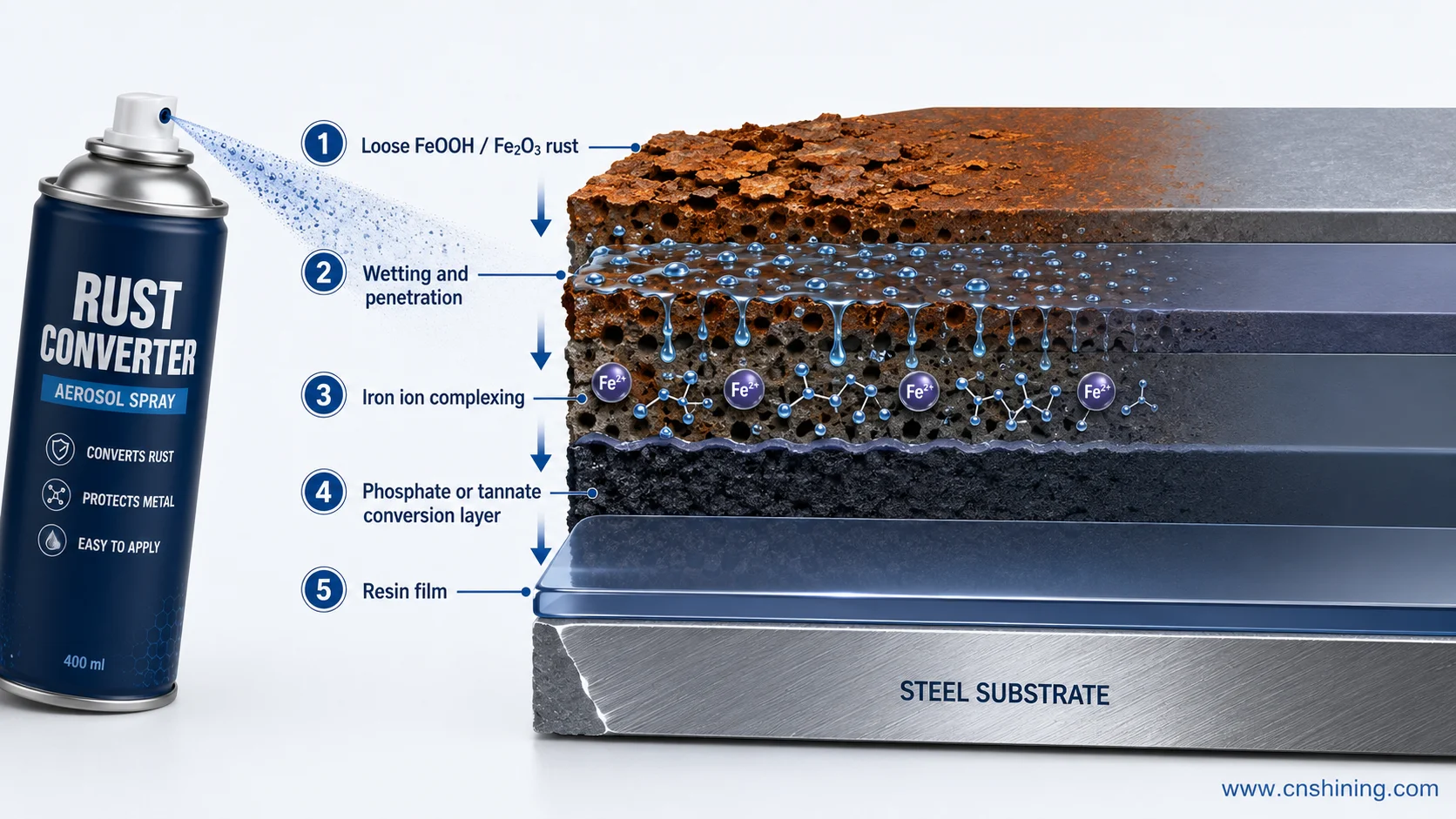
The conversion process normally has four stages:
| Stage | What Happens | Why It Matters |
|---|---|---|
| Wetting and penetration | Water, alcohols, ethers, wetting agents, and propellant help active materials enter loose rust. | Poor wetting leaves unconverted rust under the film. |
| Activation and partial dissolution | Phosphoric acid, polyphosphoric acid, acetic acid, or other acidic components loosen or rearrange iron oxide surfaces. | Too little activation slows conversion. Too much acid can leave residual acidity. |
| Complexing, deposition, or conversion | Tannic acid, polyphenols, gallic acid, phytic acid, or phosphate systems react with Fe(III)/Fe(II). | This forms ferric tannate, iron phosphate, or related stable conversion layers. |
| Film formation and sealing | Acrylic, vinyl acetate, polyvinyl acetate, epoxy, or hybrid resin closes the converted layer. | The film slows oxygen and water ingress and supports later painting. |
In simplified chemical language, tannic acid or polyphenol systems coordinate with ferric ions from FeOOH and Fe2O3, often producing a dark iron tannate layer. Phosphoric acid systems generate iron phosphate deposits. Phytic acid systems chelate Fe3+ through multiple phosphate groups. Silane hybrid systems hydrolyze into silanols and form M–O–Si or Si–O–Si networks. Epoxy systems do not convert rust by themselves, but they improve sealing, water resistance, and overcoat durability when used with conversion chemistry.
A review on progress in rust converters shows why field results vary so much. Different rust phases do not respond equally. Non-stoichiometric spinel phases such as γ-Fe2O3/Fe3O4 may convert far better than goethite, while chloride-rich akaganeite is much harder to stabilize.
2. Comparison with Adjacent Product Types
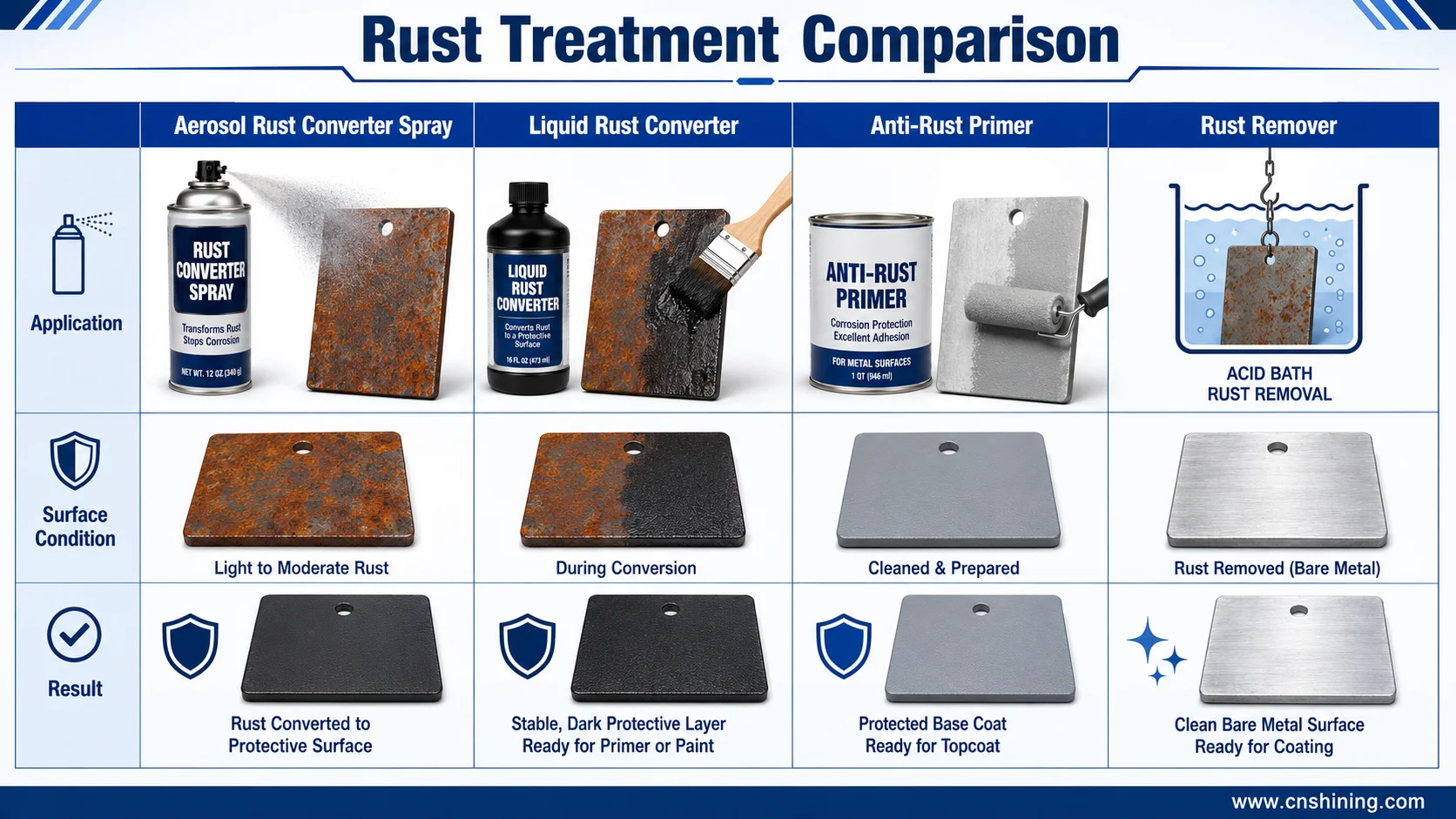
A rust converter aerosol spray is efficient for spot repair, but it is not a universal shortcut. It can reduce the need to sand all the way to bright bare metal. It cannot remove oil, loose rust, soluble salts, or poor film thickness control.
| Dimension | Rust Converter Aerosol Spray | Liquid Rust Converter | Primer | Rust Remover |
|---|---|---|---|---|
| Core action | Conversion + spray film formation | Mainly conversion | Sealing, adhesion, anti-rust protection | Dissolves or removes rust |
| Best work area | Spot repair, edges, vertical surfaces, chassis, field maintenance | Large brushed, dipped, or pumped areas | Cleaned or converted surfaces | Heavy restoration and bare-metal preparation |
| Application speed | High | Medium | Medium | Low to medium |
| Film thickness control | Moderate | Better | High | Not applicable |
| Deep penetration | Moderate, limited by spray volume | Better, especially by brushing or soaking | Poor | Depends on acid or chelating system |
| Main drawback | Nozzle clogging, spray loss, dangerous-goods handling, higher unit cost | Runs, slower work, tool cleaning | Does not convert rust | May attack substrate and leaves short flash-rust window |
Aerosolization gives this product type three commercial advantages: higher shelf visibility, lower user threshold, and better SKU storytelling. Terms such as “any-angle spray,” “comfort tip,” “epoxy-based,” and “converter + primer” are not random claims. They describe real application problems users face under vehicles, around welds, and inside corners.
3. Formulation Systems and Technical Terms
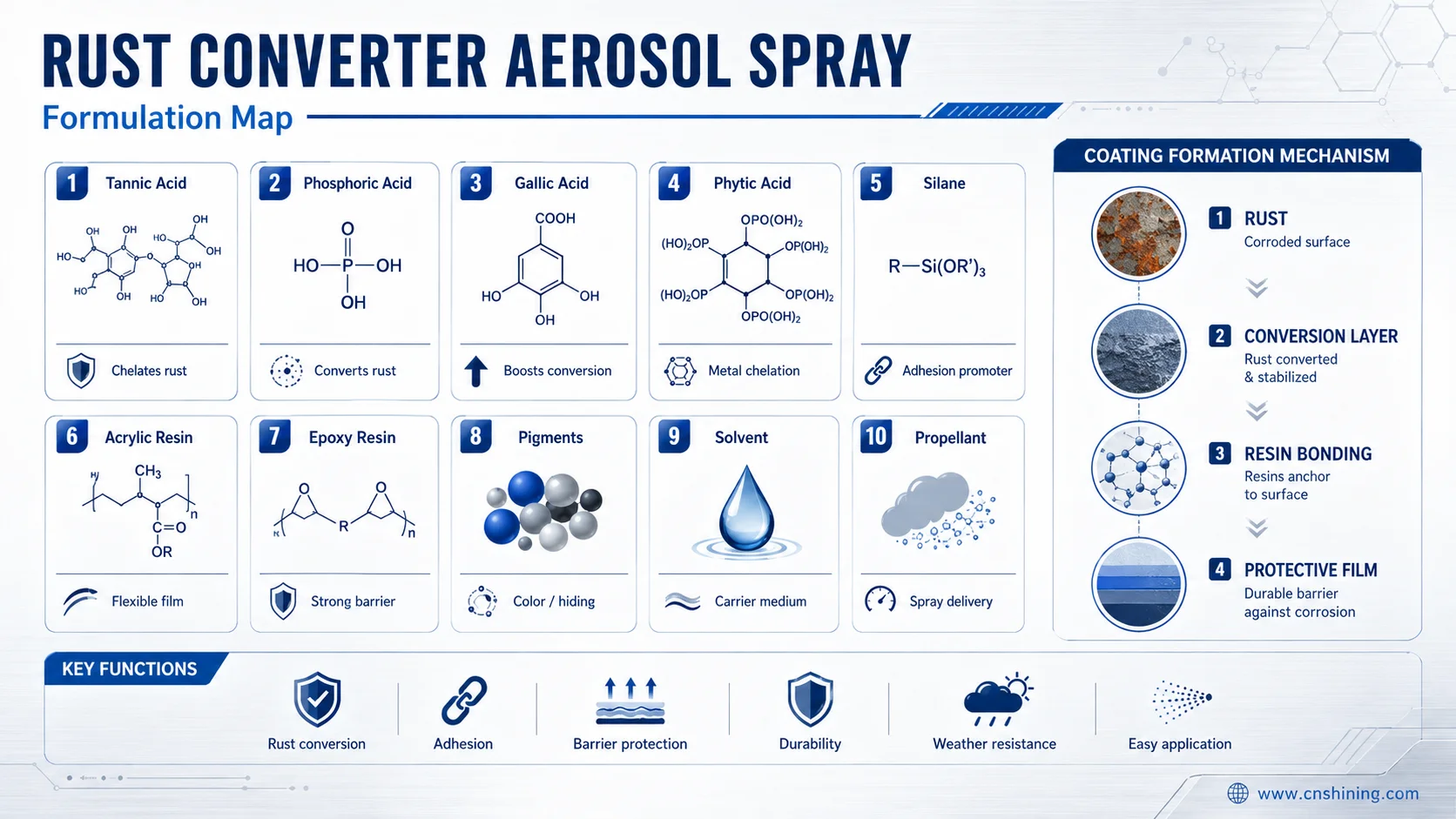
The classic system is still tannic acid + phosphoric acid + resin film former. Recent development moves toward polyphenol systems, gallic acid chemistry, phytic acid, silane hybrid layers, low-VOC systems, and converter-primer epoxy routes.
3.1 Key Components
| Component | Function | Common Range | Packaging Note |
|---|---|---|---|
| Tannic acid | Complexes iron ions and forms dark stable layers | About 3–9% | Color-deepening and metal-ion interaction must be controlled. |
| Phosphoric/polyphosphoric acid | Activates rust and forms iron phosphate | About 4–30%; some two-liquid examples higher | Excess acid can attack can lining, springs, and substrates. |
| Gallic acid / pyrogallol / polyphenols | Reduction, complexing, blackening, milder conversion | About 2–6% active level in some ready-to-use formulas | pH, oxidation, and color drift need testing. |
| Phytic acid | Multidentate chelation and denser conversion layer | Low to medium single-digit additive level | Works better with resin, silane, or inhibitor support. |
| Acrylic or vinyl dispersion | Film formation and recoatable base | Wide range; some compositions show high resin share | Controls nozzle shear, atomization, hanging, and flash rust. |
| Epoxy resin | Stronger sealing and primer-like film | Used mainly in 2-in-1 systems | Coexistence with acidic actives is difficult. |
| Anti-rust pigments | Secondary barrier and corrosion protection | Low to medium single-digit levels | Sedimentation and nozzle clogging risk increase. |
| Solvent / coalescent | Viscosity reduction, penetration, film formation | Often 5–30% | Affects VOC, odor, flammability, and drying. |
| Propellant | Atomization and product discharge | Often about 10–35% in finished aerosol | Controls pressure, spray pattern, flammability, and transport class. |
3.2 Terminology Used in This Category
| Term | Plain Meaning | Commercial Meaning |
|---|---|---|
| Rust converter | Product that stabilizes existing rust into a more paintable layer | Saves some surface-preparation work |
| Rust reformer | Consumer-market name for a converter | Usually emphasizes black paintable finish |
| Ferric tannate | Dark iron-tannin complex | Explains visible blackening |
| Iron phosphate | Phosphate conversion layer | Supports adhesion and later coating |
| Flash rust | Fast rust return during water-based drying | Key problem in low-VOC aerosol systems |
| Overcoat window | Time range for applying later paint | Major cause of user success or failure |
| 360° valve / up-down valve | Valve that sprays upright or inverted | Important for chassis and hard-to-reach areas |
| Actuator | Spray button or spray head | Controls fan shape, fatigue, clogging, and accuracy |
| VOC | Volatile organic compound | Drives formulation, labeling, and compliance work |
| UN1950 | Dangerous-goods number for aerosols | Affects storage, shipping, and cross-border selling |
4. Regulations, Standards, and Transport Marking
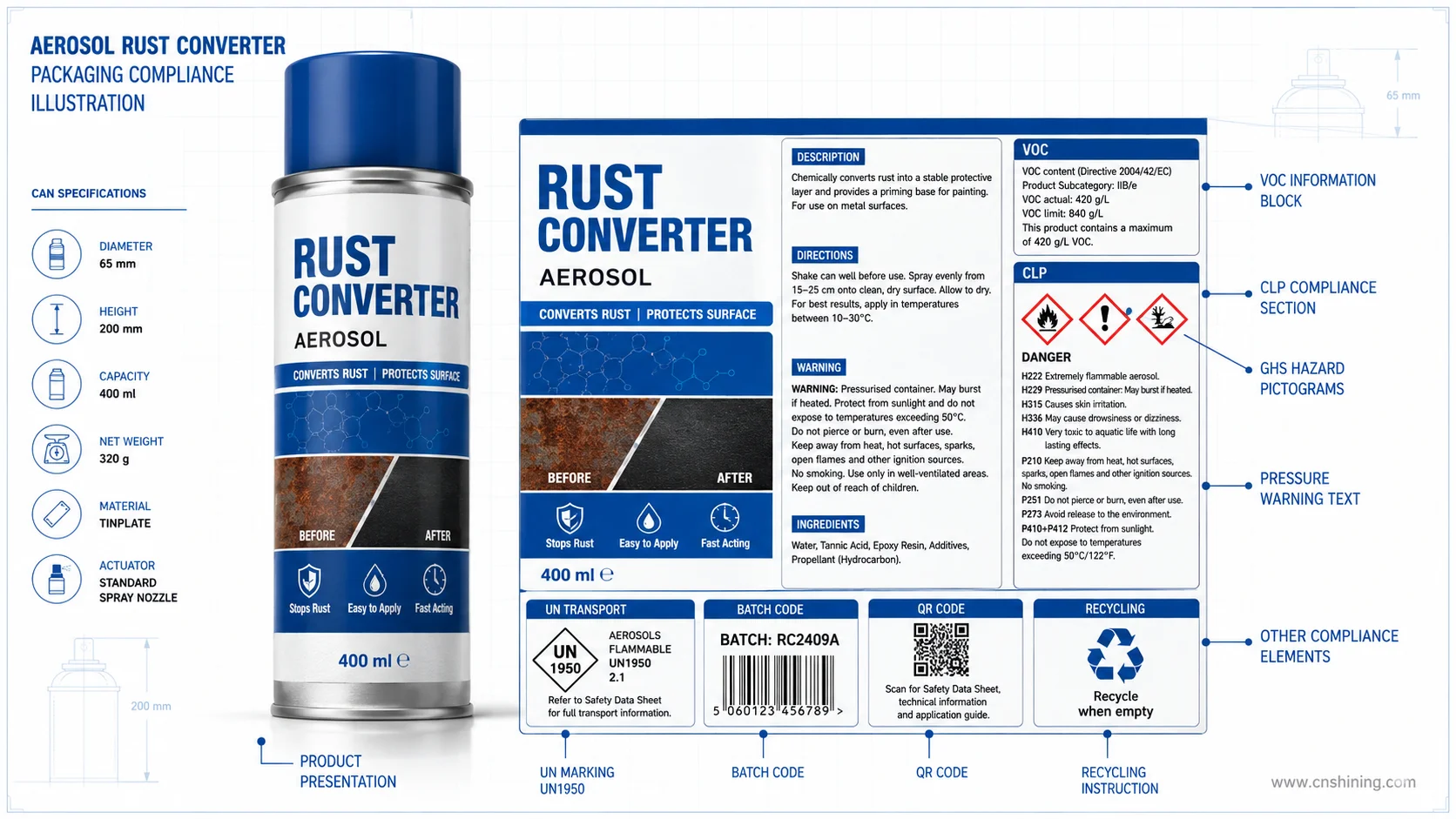
Rust converter aerosol spray is regulated in two ways. It is a chemical coating product, and it is also a pressurized aerosol package. Compliance cannot be checked only by formula or only by container. VOC, hazardous substances, classification, labeling, SDS, pressure, flammability, transport, and storage all matter.
| Region | Main Rules or Standards | Practical Effect |
|---|---|---|
| United States | EPA aerosol coatings VOC rule, OSHA HazCom, DOT aerosol transport, California aerosol coating rules | Aerosol coatings must consider national VOC/reactivity rules and California MIR/PWMIR logic. The EPA 2025 amendments are relevant to formulation data and reporting. See the EPA aerosol coatings final rule. |
| California | Aerosol Coating Products Regulation and MIR tables | Product category, date code, and reactivity data must be managed carefully. See the California consumer products regulation order. |
| European Union | Aerosol Dispensers Directive, CLP, REACH, VOC rules, ADR | Pressure safety, flammability, inhalation hazard analysis, SDS, classification, and road transport must align. |
| Canada | Transport Canada TDG and CAN/CGSB-43.123 | UN1950 aerosol container selection, manufacture, and dangerous-goods transport are central. See the Transport Canada aerosol container standard page. |
| Japan | Product safety and household harmful-substance frameworks | Retail entry requires local safety files, Japanese labeling, and attention to household aerosol product requirements. See the Japanese Product Safety Pledge product list. |
One practical issue is often missed: the chemical hazard and transport hazard may not look the same. A formula change in solvent or propellant can move the product into a different flammable aerosol or shipping profile. That affects carton marks, warehouse controls, e-commerce eligibility, and SDS wording.
5. Technology Trends and Brand Structure
The clear trend is not simply “faster blackening.” The next product generation has to balance conversion efficiency, VOC footprint, packaging compatibility, and transport risk. This is why formulation and packaging now need to be developed together.
Bag-on-Valve technology is being reconsidered for sensitive formulas because it separates product from propellant and can reduce long-term contact between active chemistry and the pressure chamber. For acidic, polyphenol, phytic-acid, or pigment-rich rust converter systems, that separation can reduce compatibility problems. The tradeoff is cost and filling complexity.
The 360° valve is not a cosmetic feature here. Rust converter sprays are used under wheel arches, around chassis members, inside frames, and near weld backsides. If the can fails upside down, the user may never wet the rust that actually needs conversion.
Digital packaging is also more useful than it first appears. A small can has limited label area, but rust converter aerosol spray needs instructions, SDS access, batch code, recycling guidance, overcoat window, and regional warnings. A GS1 Digital Link or QR structure can connect the can to batch-specific data, use videos, SDS, and disposal guidance.
6. Top 10 Rust Converter Aerosol Spray Brands
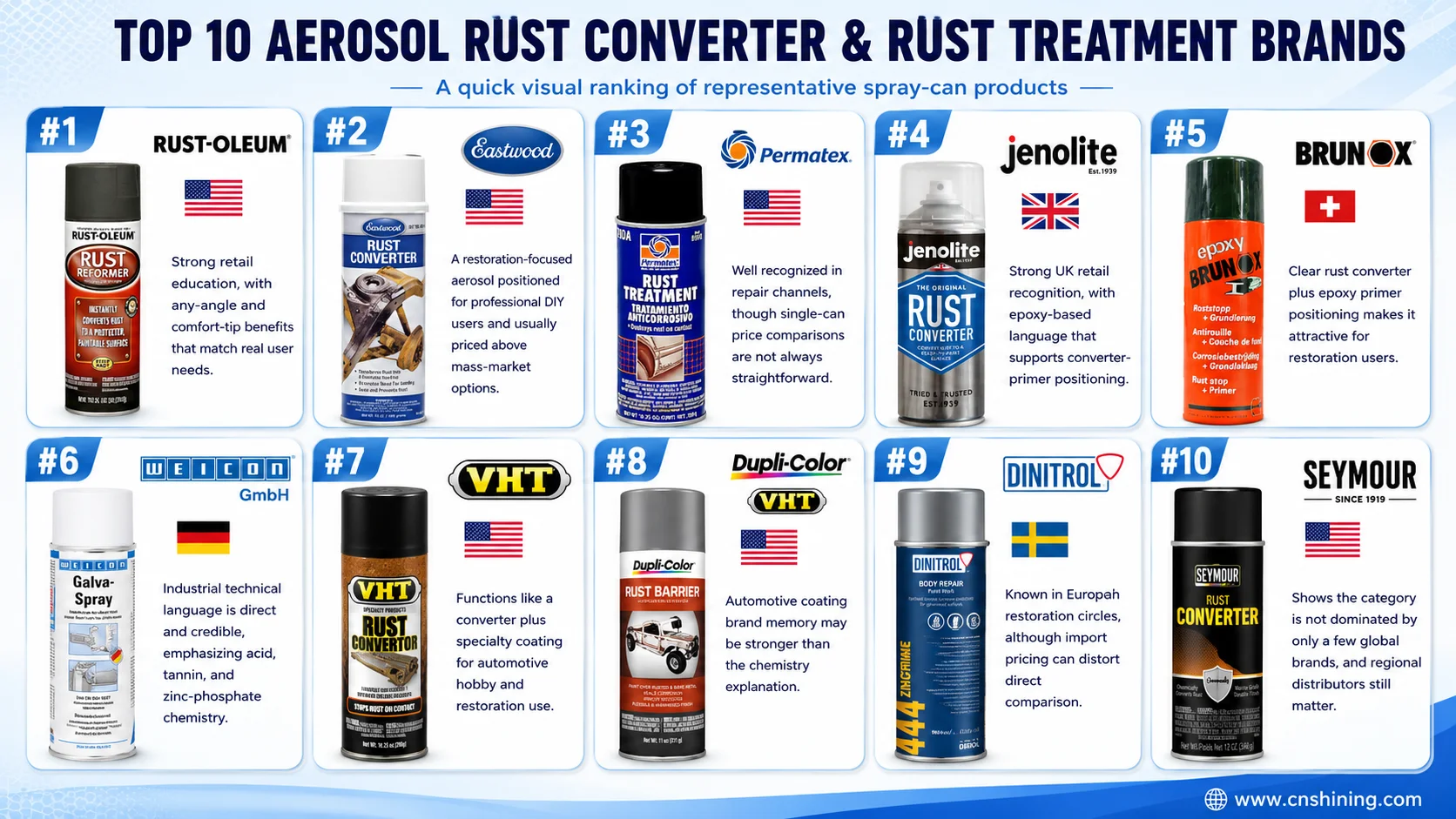
| Brand / Product Cluster | Visible Brand Body | Representative Capacity | Technical Comment |
|---|---|---|---|
| Rust-Oleum Rust Reformer | Rust-Oleum | 10.25 oz | Strong channel education; any-angle and comfort-tip claims match real use problems. |
| Eastwood Rust Converter Aerosol | Eastwood | Aerosol SKU | Targets restoration and professional DIY; usually priced above mass-market spray products. |
| Permatex Rust Treatment | Permatex | 10.25 oz class | Repair-channel recognition is strong, but single-can price comparison is less clean. |
| Jenolite Rust Converter Aerosol | Jenolite | 400 ml | UK retail recognition; epoxy-based language positions it closer to converter-primer use. |
| BRUNOX Epoxy Spray | Brunox AG | 400 ml | Clear converter + epoxy primer positioning for restoration users. |
| WEICON Rust Converter Spray | WEICON GmbH | 400 ml | Industrial wording is strong; acid, tannin, and zinc phosphate language is technically direct. |
| VHT Rust Convertor | VHT / Dupli-Color | 10.25 oz | More like converter plus specialty coating for automotive hobby users. |
| Dupli-Color VHT Rust Converter | Dupli-Color / VHT | 10.25 oz aerosol | Automotive coating channel memory may be stronger than chemistry explanation. |
| Dinitrol RC900 | Dinitrol | 400 ml aerosol | Known in European restoration circles; import pricing can distort comparison. |
| Seymour | Seymour | 12–13 oz common | Shows the category is not locked by a few global brands; regional distributors still matter. |
Most visible capacities sit around 10.25–14 oz or 400 ml. That is not accidental. It balances shelf space, dangerous-goods handling, user comfort, spray coverage, and one-project repair logic.
7. User Pain Points and Packaging Design Suggestions
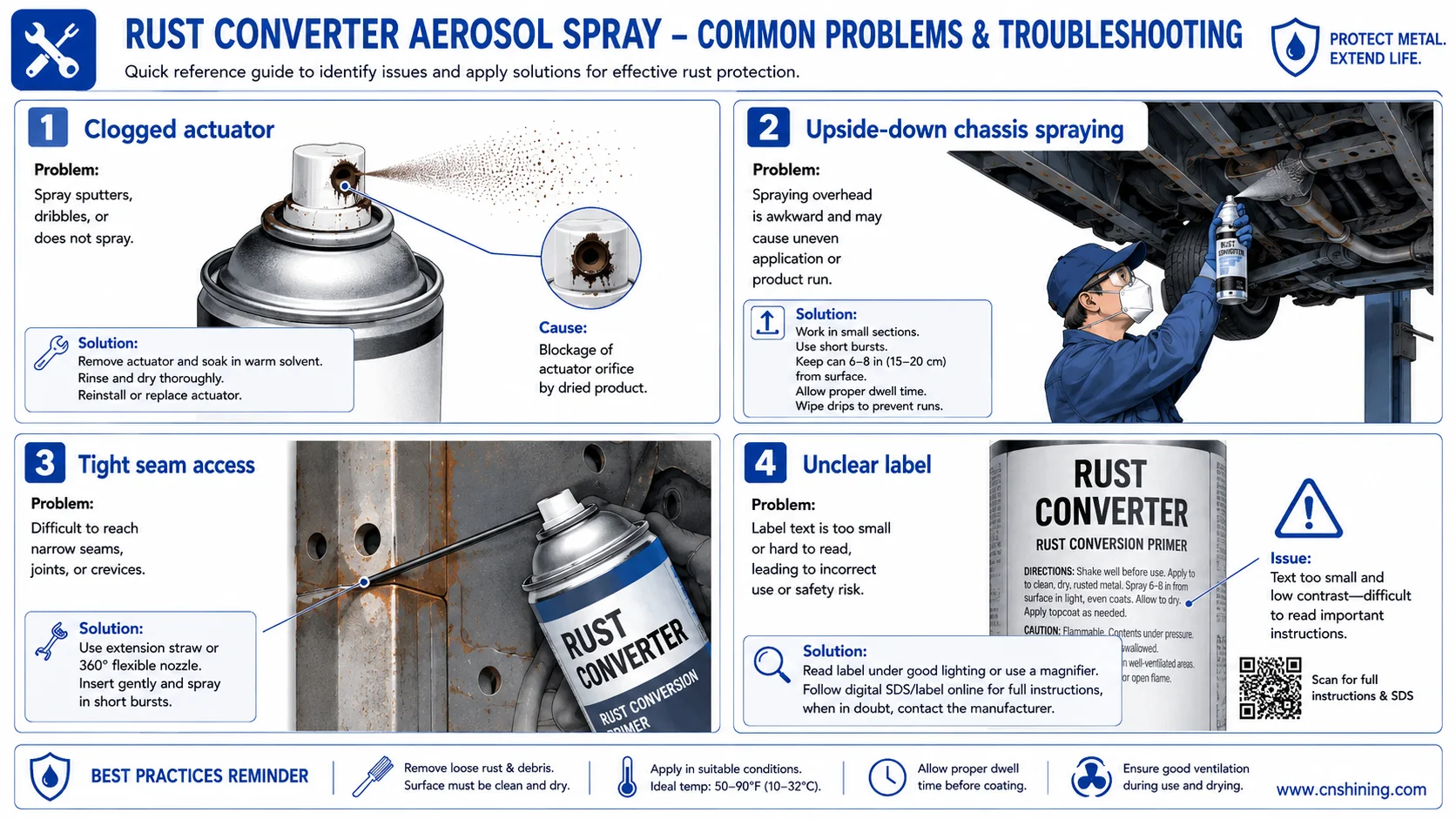
| Pain Point | Technical Cause | Packaging Response |
|---|---|---|
| Nozzle clogging | Acid/polyphenol/pigment/resin systems can form deposits or sediment. | Larger flow path, better actuator cleaning design, stronger suspension stability. |
| Poor upside-down spraying | Standard dip-tube systems lose feed orientation under chassis or wheel-arch work. | 360° valve, BOV option, or dedicated up/down valve design. |
| Tight spaces not reached | Fan spray cannot enter seams, boxed sections, or deep holes. | Dual-pattern actuator and fixed extension tube. |
| Misuse as rust remover | Consumer language mixes converter, remover, primer, and cleaner. | Front-label wording: “Converts rust, does not dissolve all rust.” |
| Disposal confusion | Aerosol cans may contain pressure, acid, resin, pigment, and residual liquid. | Clear empty-can instruction, QR recycling guidance, visible warning icons. |
Packaging Engineering Suggestions
The practical brief is simple: do not start with a more decorative can. Start with the parts that affect failure.
| Module | Recommended Direction | Problem Solved |
|---|---|---|
| Valve | 360° large-channel anti-clog valve; evaluate BOV for higher-grade versions | Upside-down spraying, clogging, long-term stability |
| Actuator | Dual fan/stream actuator with fixed extension tube | Flat panels and seams both covered; less accessory loss |
| Can body | 400 ml tall slim can with anti-roll shoulder and glove-friendly grip area | Better access under vehicles and in frame gaps |
| Internal coating | Acid- and polyphenol-resistant lining | Shelf life, color drift, corrosion control |
| Printing | Four-step pictorial instructions, overcoat window, empty-can disposal diagram | Lower misuse and clearer user expectation |
| Digital layer | GS1 Digital Link or QR to SDS, application video, recycling page, batch traceability | More information without overloading a small label |
8. Packaging Components for Rust Converter Aerosol Spray: Actuators, Aerosol Cans, and Valves
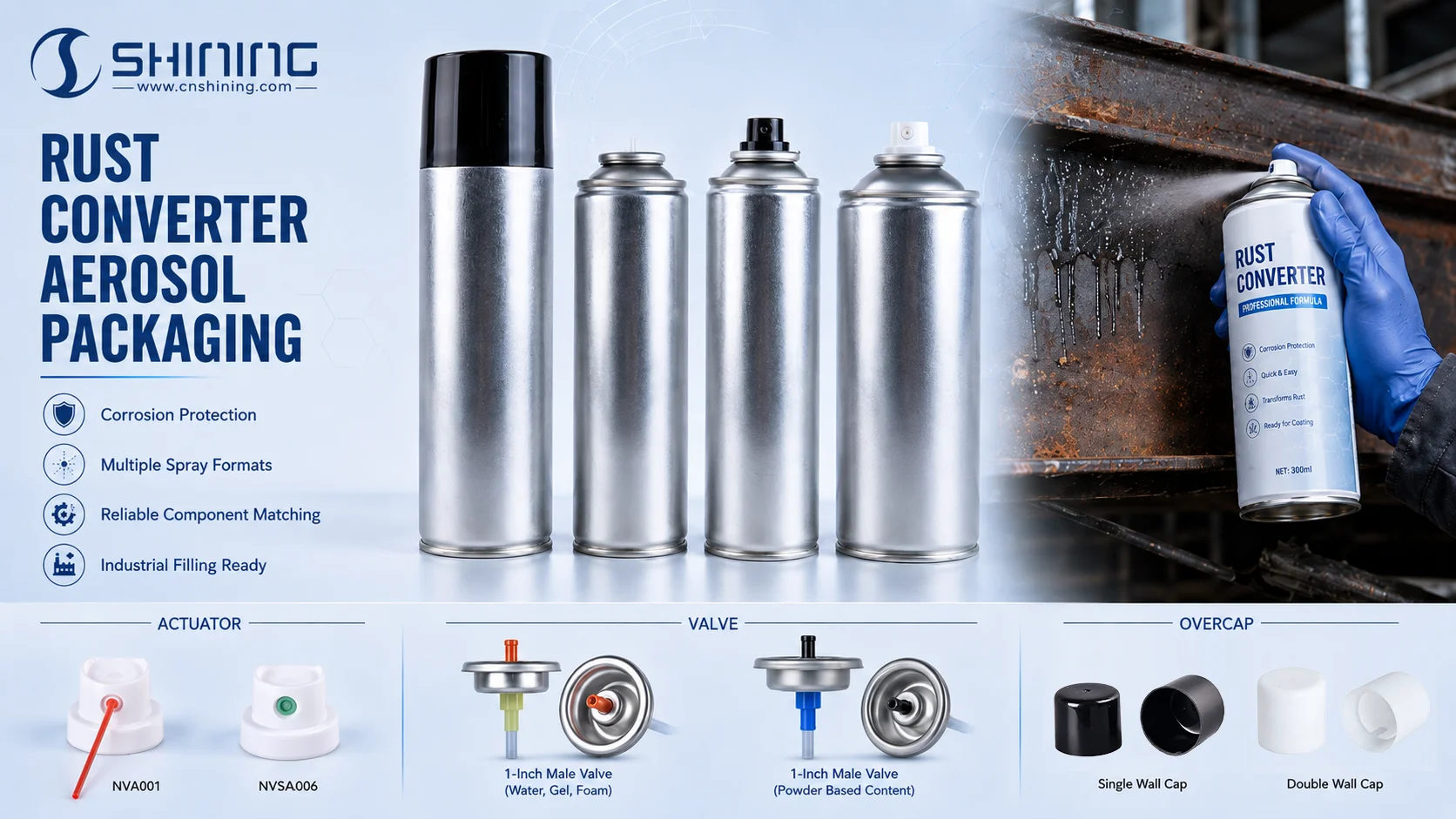
For a rust converter aerosol spray, packaging is part of the technical system. The valve, actuator, dip tube, internal coating, and can geometry decide whether the formula reaches the rusted area in the right amount and at the right angle.
Shining Packaging’s relevant work is mainly around actuators, aerosol cans, and valves. In this application, the useful discussion is not about a generic spray package. It is about compatibility: acidic or polyphenol formulas, pigment loading, sediment control, upside-down use, glove operation, and clear printing space for safety instructions.
A reasonable component selection for this product type would start with:
| Component | Technical Focus | Why It Matters in Rust Converter Spray |
|---|---|---|
| Actuator | Fan/stream pattern, clog resistance, finger comfort, extension tube fit | Controls coating coverage, seam access, overspray, and user fatigue. |
| Aerosol can | Steel or aluminum body, pressure rating, inner coating, print area | Must tolerate active chemistry and carry clear hazard/use instructions. |
| Valve | Flow path, gasket material, spring compatibility, 360° or BOV option | Directly affects clogging, first spray after storage, and inverted application. |
The engineering question should be blunt: can this package still spray a pigment-rich converter after months on the shelf, and can it spray under a vehicle without starving the feed? If not, the formula may be good, but the product will still fail in the field.
9. Final Notes
Rust converter aerosol spray is a useful product when the job is localized rust stabilization, not full rust removal. The chemistry must convert enough of the rust layer, but the package must also deliver the chemistry into seams, corners, and inverted positions. A strong product in this category is not only darker or faster. It sprays consistently, stores safely, explains itself clearly, and leaves a surface that can actually be recoated.
10. FAQ: Rust Converter Aerosol Spray
It changes unstable iron oxides and hydroxides into a more stable conversion layer, then seals that layer with resin. Common routes use tannic acid, phosphoric acid, polyphenols, phytic acid, or hybrid systems. The goal is not to wash rust away. The goal is to stabilize the remaining rust and create a surface that can often be painted.
No. Rust remover dissolves or removes rust, often through acid or chelating action. Rust converter reacts with rust and stabilizes it into a darker, more paintable layer. Confusing the two causes many field problems. A converter may save sanding to bright metal, but it cannot replace cleaning, degreasing, salt removal, or loose-scale removal.
Blackening usually comes from iron complexes or conversion products. In tannic acid and polyphenol systems, ferric ions from rust coordinate with phenolic groups and form dark iron tannate-like layers. Phosphate systems can form iron phosphate deposits. Black color is a useful sign, but it does not prove full penetration through heavy rust scale.
Heavy rust is not one uniform material. It can include loose scale, goethite, magnetite, hematite, chloride-rich akaganeite, oils, and salts. Some phases convert more readily than others. If the spray cannot penetrate the layer, only the surface reacts. Loose scale should be removed first so the active chemistry can reach bonded rust.
Rust converter sprays often contain acid, polyphenols, resin, pigments, fillers, and corrosion inhibitors. These materials can settle, react, or dry at the actuator or valve outlet. Pigment-rich black formulas are especially sensitive. Valve channel size, actuator geometry, shaking behavior, storage time, and formula dispersion stability all affect clogging risk.
Real rust repair often happens under wheel arches, chassis sections, brackets, weld backsides, and frame corners. A normal upright-only spray system may lose feed when inverted. A 360° valve or suitable BOV system helps maintain discharge at awkward angles. This matters more for rust conversion than decorative spraying because missed rust remains active.
Usually not. Some products combine converter and primer functions, especially epoxy-based systems, but conversion and priming are still different tasks. A converter stabilizes rust. A primer mainly provides adhesion, sealing, and corrosion protection for the coating system. For demanding work, check the overcoat window and whether the product is designed as a true converter-primer.
The common routes include tannic acid/phosphoric acid systems, polyphenol or gallic acid systems, phytic acid systems, silane hybrid layers, and epoxy integrated routes. Tannic and phosphoric systems are easy to understand and cost-effective. Newer systems try to reduce VOC, improve adhesion, reduce residual acidity, or improve compatibility with later coatings.
The product is both a chemical coating and a pressurized aerosol package. VOC rules, GHS or CLP classification, SDS, flammability, pressure safety, UN1950 transport classification, and recycling instructions all matter. A change in solvent or propellant can change hazard labels and shipping requirements, even when the visible product function looks unchanged.
Useful tests include conversion on different rust phases, salt-contaminated panels, overcoat adhesion, first-spray after aging, inverted spray continuity, repeated clog cycles, can-lining compatibility, valve material compatibility, discharge rate, residue level, and storage color drift. These tests reflect real field complaints better than a simple blackening demonstration on a clean rust coupon.