
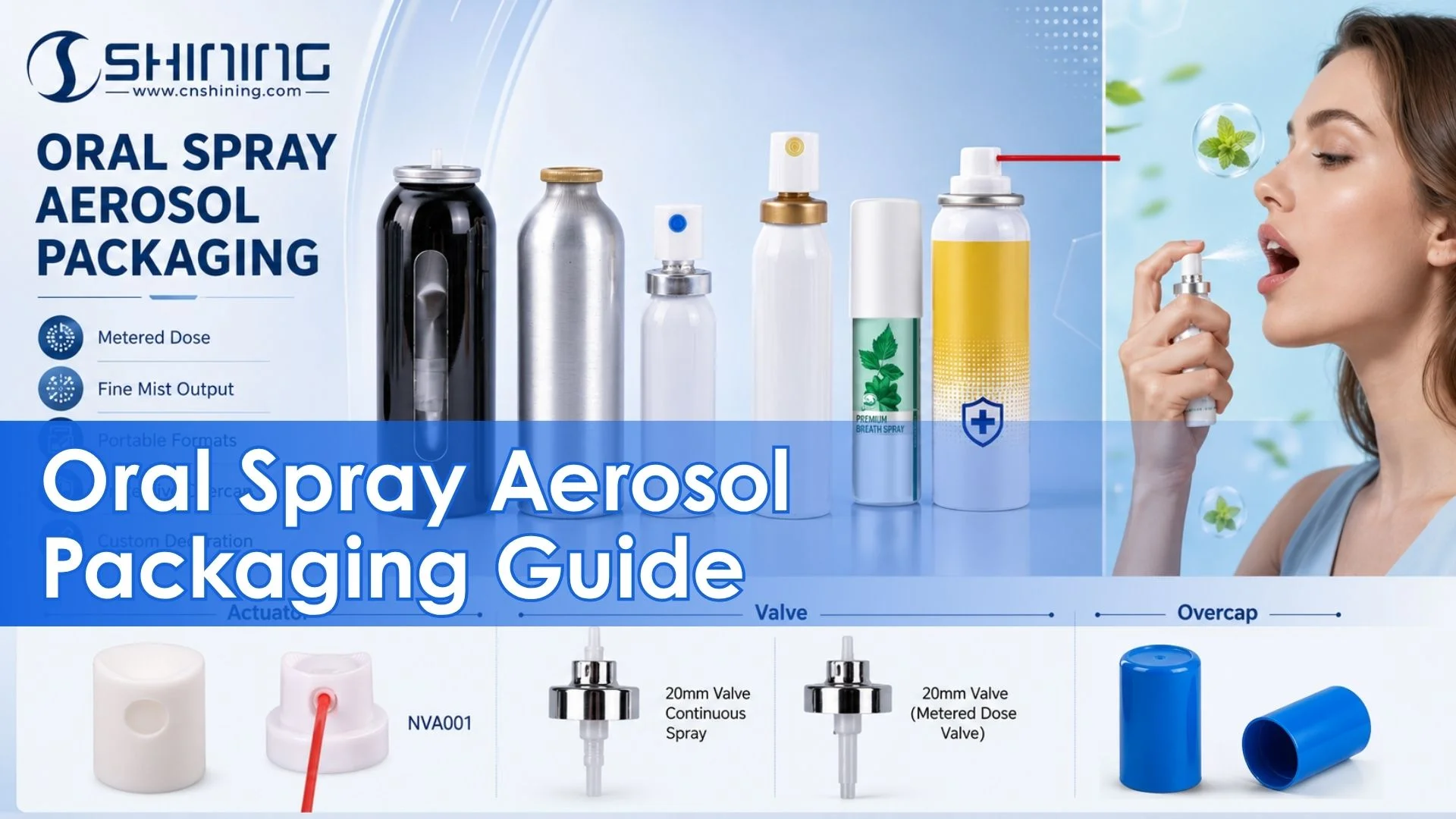
An oral aerosol spray is not just a small container that sprays liquid into the mouth. In true aerosol form, it is a pressurized delivery system where the formulation, valve, actuator, orifice, propellant, inner coating and seal materials work together to control dose, plume shape, spray angle, droplet distribution and local deposition.
This distinction matters. Many products sold as oral spray, mouth spray, dry mouth spray or breath freshener spray are now mechanical pump sprays or non-pressurized atomizers. A true oral aerosol spray is only one technical subset of the wider oral spray shelf. That is why market data, regulatory review and packaging decisions should not be mixed without checking the packaging format.
1. Definition: What Counts as an Oral Aerosol Spray?
A practical definition is direct: an oral aerosol spray is an oral care or local treatment formulation packed in a pressurized container. When the user presses the actuator, the valve opens and the propellant or compressed gas drives the formulation through the stem and nozzle to form a liquid droplet plume. The target site may be the tongue, buccal mucosa, gum line, front throat, or local oropharyngeal area.
The EU Aerosol Dispensers Directive defines aerosol dispensers as non-reusable containers containing compressed, liquefied or dissolved gas and fitted with a release device. FDA packaging guidance also recognizes aerosol dosage forms used on the oral surface under the “lingual aerosol” concept.
In business terms, this product is better understood as a packaging-driven local oral delivery system. The package is not passive. It forms the spray, meters or semi-meters the dose, affects taste perception, and often decides whether the consumer feels a mist, a jet, or a leaking bottle.
This article includes breath freshener sprays, oral and throat analgesic sprays, antibacterial or antiplaque sprays, dry mouth moisturizing sprays, fluoride sprays, and some herbal or essential oil sprays. It does not treat conventional mouthwash, gels, lozenges, oral patches, or pulmonary metered dose inhalers as oral aerosol spray.
2. Working Principle: Valve, Actuator, Propellant and Deposition
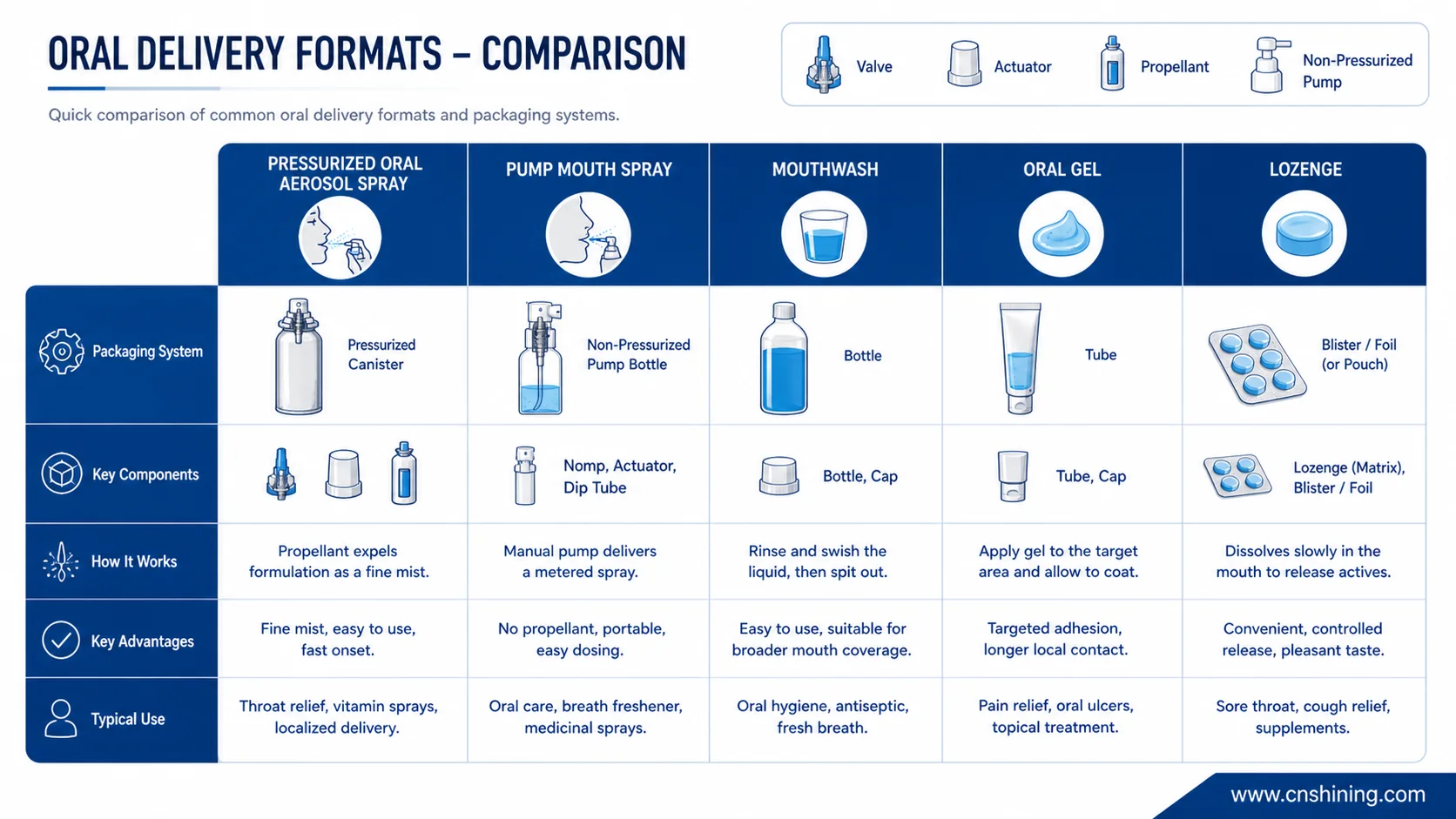
The core mechanism is the valve assembly. A classical aerosol valve includes stem, stem gasket, spring, mounting cup, housing and dip tube. When the actuator is pressed, the stem moves down, the gasket seal is opened, and internal pressure pushes the product through the valve and actuator channel. When the finger is released, the spring returns the stem and the gasket reseals the system.
The actuator and nozzle decide the first user impression. The same formulation can feel completely different when the orifice diameter, swirl chamber, fan insert, extension tube or mouth-directed actuator is changed. Our Spray actuator can be tuned for fan spray, fine mist, vertical spray, extension nozzles or inverted use. For oral spray, that tuning affects whether the spray covers the tongue and cheek, or hits the back of the throat and causes bitterness or coughing.
Liquefied propellants such as butane, isobutane, propane, DME, HFA-152a and HFA-134a lose pressure as the product is used and usually give a wetter, coarser output.
Bag-on-Valve is a useful variant. The product is sealed inside a bag, while the driving gas stays outside the bag. For oral products, this reduces direct contact between propellant and formulation. It can help taste, purity, corrosion control and chemical compatibility, especially when hydrocarbons are not desirable.
3. Market Scope
Demand has three technical roots. First, the oral disease base is large. The WHO Global Oral Health Status Report indicates that oral diseases affect billions of people. Second, dry mouth is common in older and multi-medication users. Third, e-commerce and pocket-use behavior make “after meals, before meetings, in the car, before social contact” a real use case.
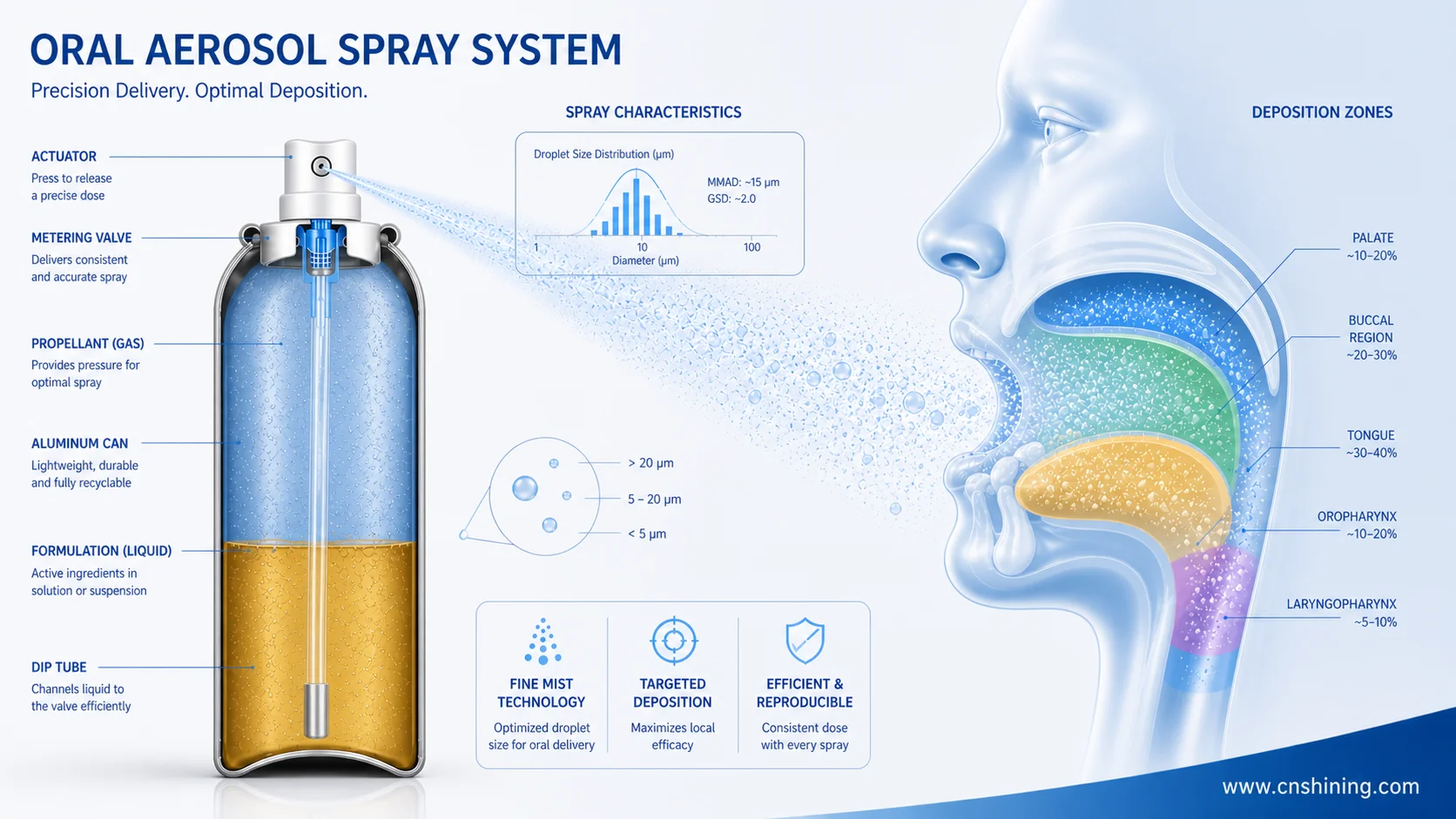
| Region | Public / Derived Scope | Current Size Judgment | Growth Judgment | Packaging Meaning |
|---|---|---|---|---|
| North America | Alcohol-free mouth-spray proxy | 2024 around USD 496 million | Mid-speed growth; likely remains one of the largest single regions. | OTC acceptance and convenience consumption are strong, but sustainability and pump replacement pressure are also strong. |
| Europe | Derived from global proxy | 2024 around USD 388 million | Steady growth with higher compliance sensitivity. | Alcohol, CHX, propellant and sustainable packaging choices need more careful review. |
| China | Derived within Asia-Pacific | One of the major Asia-Pacific oral care markets. | Faster than mature Western markets, but true aerosol public data is limited. | Pump spray and light oral freshener formats are more visible; drug packaging review becomes stricter when therapeutic claims appear. |
| India | Asia-Pacific oral care base | Oral care market around USD 3.182 billion in 2024. | High growth; throat and oral spray acceptance is visible. | Regulatory route for oral and throat sprays is established, including povidone iodine throat spray examples. |
| Latin America | Proxy split | Smaller share of the global proxy pool. | Often faster than mature markets. | Brazil and Mexico pharmacy and e-commerce channels need country-level sell-out data. |
| Southeast Asia | Asia-Pacific derived view | Smaller than China and India, but SKU variety is high. | Tourism retail, convenience stores and pharmacy chains support growth. | Small portable sprays move quickly, but first-spray experience is heavily judged. |
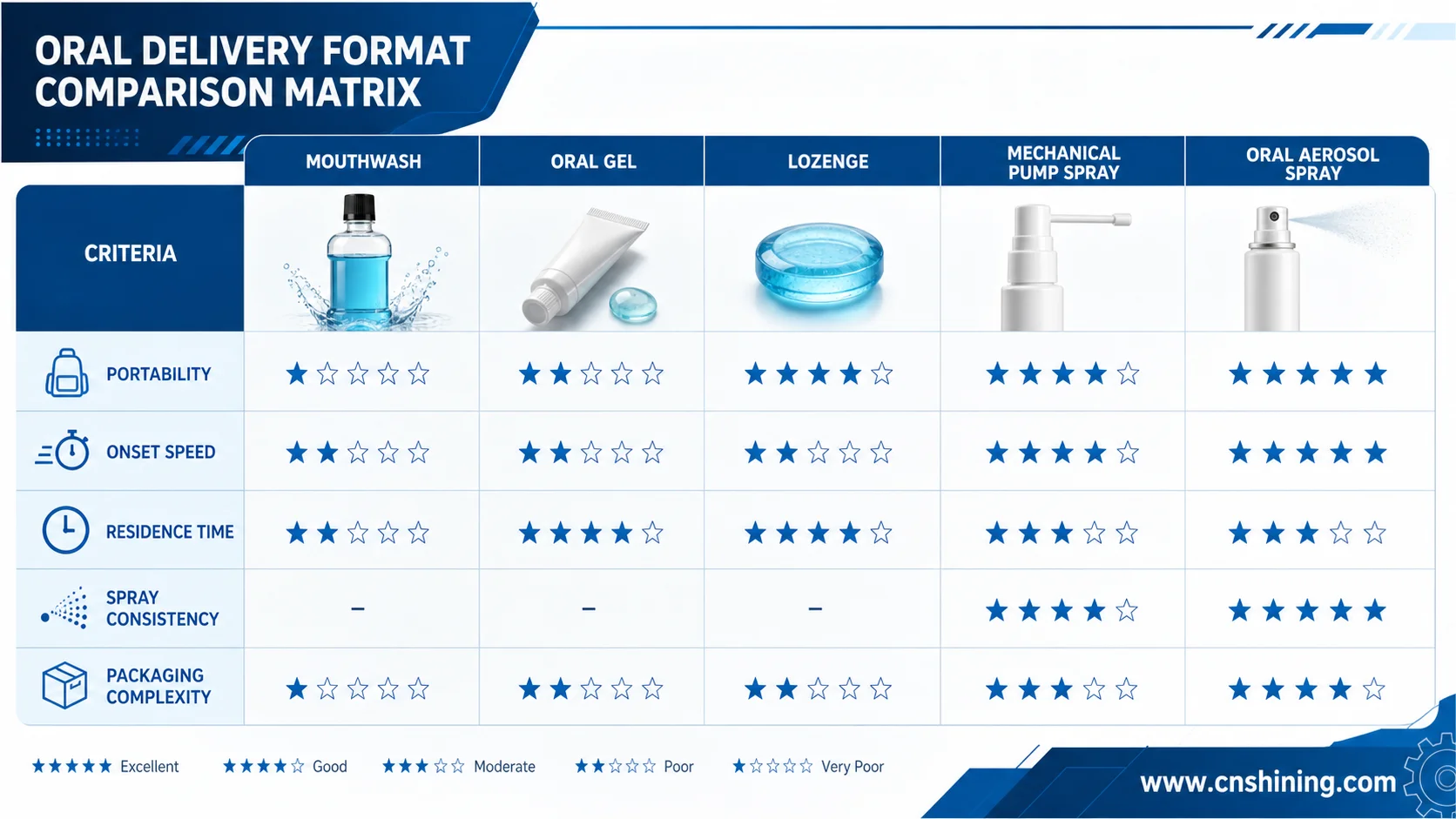
4. Comparison with Adjacent Oral Dosage Formats
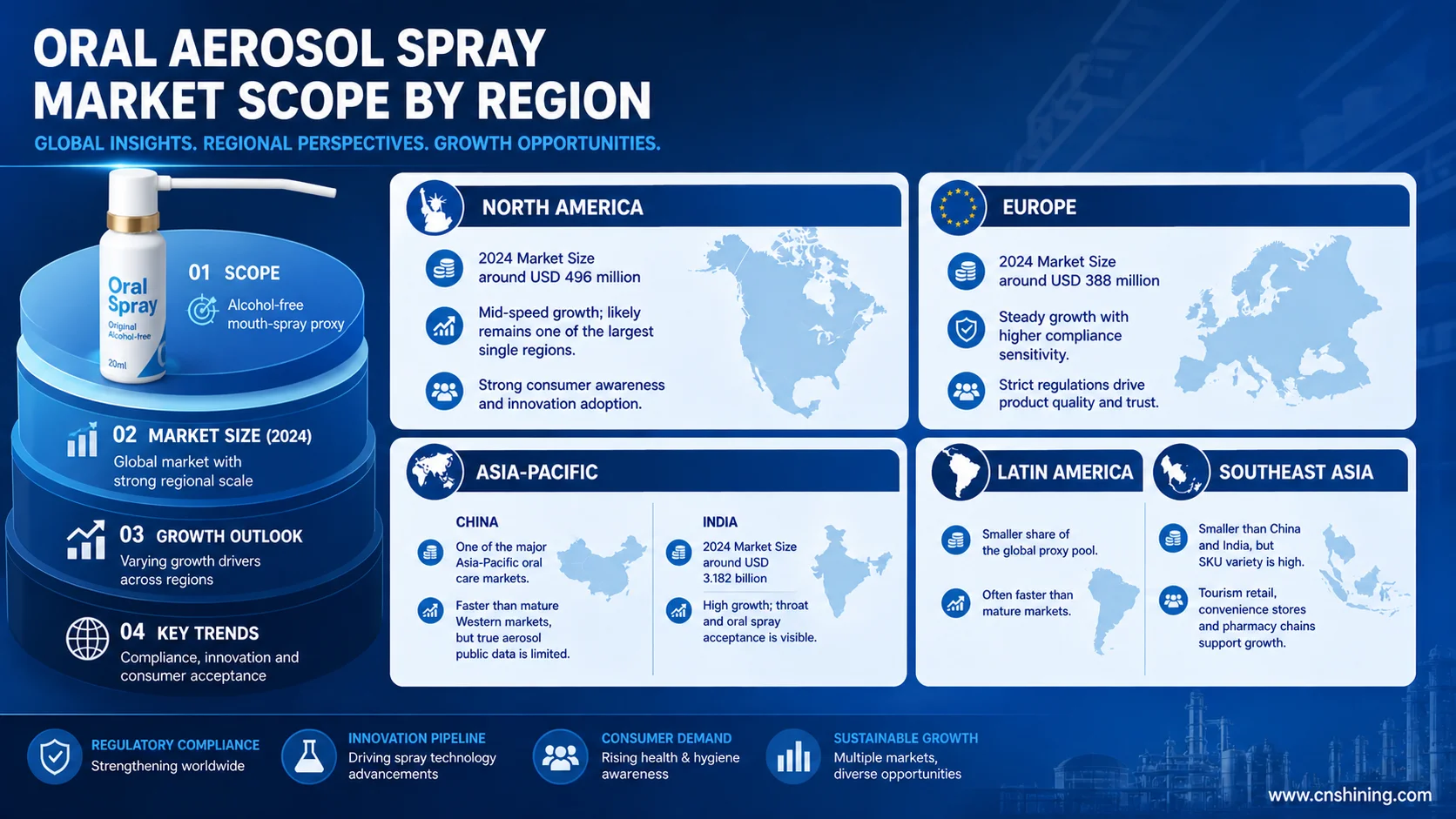
Oral aerosol spray does not win because it replaces every oral care format. It wins only when immediate use, portability, spray feel and local deposition matter more than full-mouth rinse coverage or long mucosal residence.
| Format | Typical Advantage | Typical Weakness | Use Case | Meaning for Oral Aerosol Spray |
|---|---|---|---|---|
| Mouthwash | Wide whole-mouth coverage; accepted in pharmacy and daily care. | Not discreet; needs larger bottle or cup. | Home use, post-operation support, full-mouth cleaning. | Aerosol should focus on immediate portable use, not full-mouth rinsing. |
| Oral gel | Better adhesion and longer residence. | Application feel can be sticky or polarizing. | Bedtime dry mouth, ulcers, friction points. | Spray can borrow film-forming logic without becoming unpleasantly sticky. |
| Lozenge | Longer contact time and salivary stimulation. | Slower onset; less discreet while speaking. | Dry mouth management, mild bad breath. | Spray owns seconds-level onset; lozenge owns minutes-level duration. |
| Mechanical pump spray | No propellant; easier transport and often more flavor control. | Can clog, backflow, leak or feel like a stream. | Daily oral spray, OTC oral care, small pocket packs. | True aerosol must beat pump spray on mist quality and leak resistance. |
| Oral aerosol spray | Immediate, portable, high-frequency use; stable plume is possible. | More complex package; propellant, flammability and compatibility issues. | Classic breath spray, local throat analgesic, professional topical anesthetic. | The best position is reliable spray feel, controlled deposition and pocket safety. |
5. Formulation, Stability and Manufacturing Control
Oral spray formulation cannot be separated from packaging selection. Ethanol, essential oils, oxidizing deodorant systems, fluoride salts, anesthetics, polymers and surfactants can all interact with valves, gaskets, inner coatings, bag materials and actuator channels.
| Category | Typical Actives | Public Concentration / Example | Common Excipients | Function | Stability Risk | Scale-up Point |
|---|---|---|---|---|---|---|
| Antibacterial / antiplaque | CPC, CHX, povidone iodine, stabilized chlorine dioxide | CPC 0.05%; CHX spray literature often 0.2%; povidone iodine throat spray 0.45% w/v. | Water, glycerin, PEG-40/60 hydrogenated castor oil, citrate buffer, sweetener, preservative. | Bad breath control, plaque control, oral cleaning, local throat or oral antibacterial action. | Oxidizing systems challenge valve parts, gaskets and flavors; CHX is not friendly with some anionic systems. | Screen formulation, valve, inner coating and gasket together; then run accelerated and real-time storage. |
| Local anesthetic / analgesic | Phenol, benzocaine, menthol | Phenol 1.4%; benzocaine non-solid OTC dosage forms commonly allow 5–20%, with 20% products visible. | Ethanol, water, flavor, glycerin, sweetener. | Mouth ulcer, sore throat and local oral pain relief. | Benzocaine carries safety warnings; ethanol and flavor systems can increase sting and bitter aftertaste. | Prioritize metered dose, child misuse control, clear label design and anti-accidental actuation. |
| Breath freshening | Zinc salts, chlorine dioxide, CPC, menthol, ethanol, essential oils | CB12 contains zinc acetate, chlorhexidine diacetate and sodium fluoride; classic aerosol breath sprays may use ethanol and isobutane. | Water, glycerin, solubilizer, sweetener, pH adjuster. | Immediate odor masking and volatile sulfur compound control. | Flavor volatility, bitter tail, over-strong sensation and oxidizer loss. | The commercial problem is often mist quality and aftertaste, not only active strength. |
| Fluoride / anticaries | NaF, MFP, APF | Professional APF foam may use NaF 1.81%, equivalent to 1.23% fluoride ion; some sprays mark around 230 ppm fluoride. | Water, xylitol, surfactant, preservative, sweetener. | Caries prevention and remineralization support. | Fluoride compatibility with flavor and metal contact; child swallowing risk. | Separate professional and OTC products clearly; metering and instructions matter. |
| Dry mouth / moisturizing | Xylitol, glycerin, PVP/VA, mucoadhesive polymers, sometimes CPC | Biotène-type formulas commonly use glycerin, xylitol and film-forming polymers. | Glycerin, PVP/VA, xanthan gum, solubilizer, preservative. | Lubrication, moisture relief and dry mouth comfort. | Sticky, oily or artificial slip; nozzle clogging; short residence time. | Use film-forming polymers, actuator tuning and low-backflow spray heads to improve experience. |
| Herbal / essential oil | Clove oil, clove CO2 extract, lavender oil, grapefruit oil, propolis, aloe | Recent studies include clove oil microemulsion and plant-derived oromucosal spray prototypes; retail concentrations are often undisclosed. | Ethanol, co-solvent, surfactant, cyclodextrin, sweetener, pH adjuster. | Antibacterial, soothing effect, natural flavor positioning. | Oxidation, volatilization, phase separation, haze and gasket or coating attack. | Microemulsion, nanoemulsion, encapsulation, light barrier and oxygen barrier should be evaluated early. |
Practical Terms Used in Development
| Term | Technical Meaning | Why It Matters Commercially |
|---|---|---|
| Valve assembly | The opening, sealing and flow-control unit: stem, spring, gasket, housing, mounting cup and related parts. | It decides leakage, press feel, shut-off and long-term reliability. |
| Actuator | The user-pressed external part, often containing orifice, insert or extension path. | Many “formula” complaints are actually actuator complaints. |
| Orifice / swirl chamber | The geometry that breaks the liquid into droplets. | It decides mist versus stream. |
| Spray plume | The spatial mist pattern, angle, velocity and concentration after discharge. | It decides coverage and throat irritation. |
| D50 / D90 | Particle size points where 50% or 90% of volume is below the stated diameter. | Needed for development, comparison and regulatory discussion. |
| Shot weight / delivered dose | Mass or active dose delivered per actuation. | Important for anesthetic, fluoride and pediatric-related products. |
| Priming | Empty actuations needed before stable spray after first use or storage. | Too much priming makes users think the pack is defective. |
| Compatibility | Interaction between formulation and valve, can, coating, gasket, bag and actuator materials. | This often decides shelf life and complaint rate. |
| Extractables / leachables | Substances that can be extracted from or migrate out of packaging materials. | Directly tied to safety review, odor and long-term stability. |
| BOV | Bag-on-Valve system separating product from driving gas. | Useful when taste, oxidation, corrosion or propellant contact is a concern. |
Manufacturing control should include fill weight, can pressure, crimp consistency, valve leakage, delivered dose or shot weight, residual propellant, drop and transport behavior, microbial limits and spray pattern drift over shelf life. Lab samples can look acceptable while the commercial pack fails after storage or transport.
6. Regulations, Standards and Innovation Routes
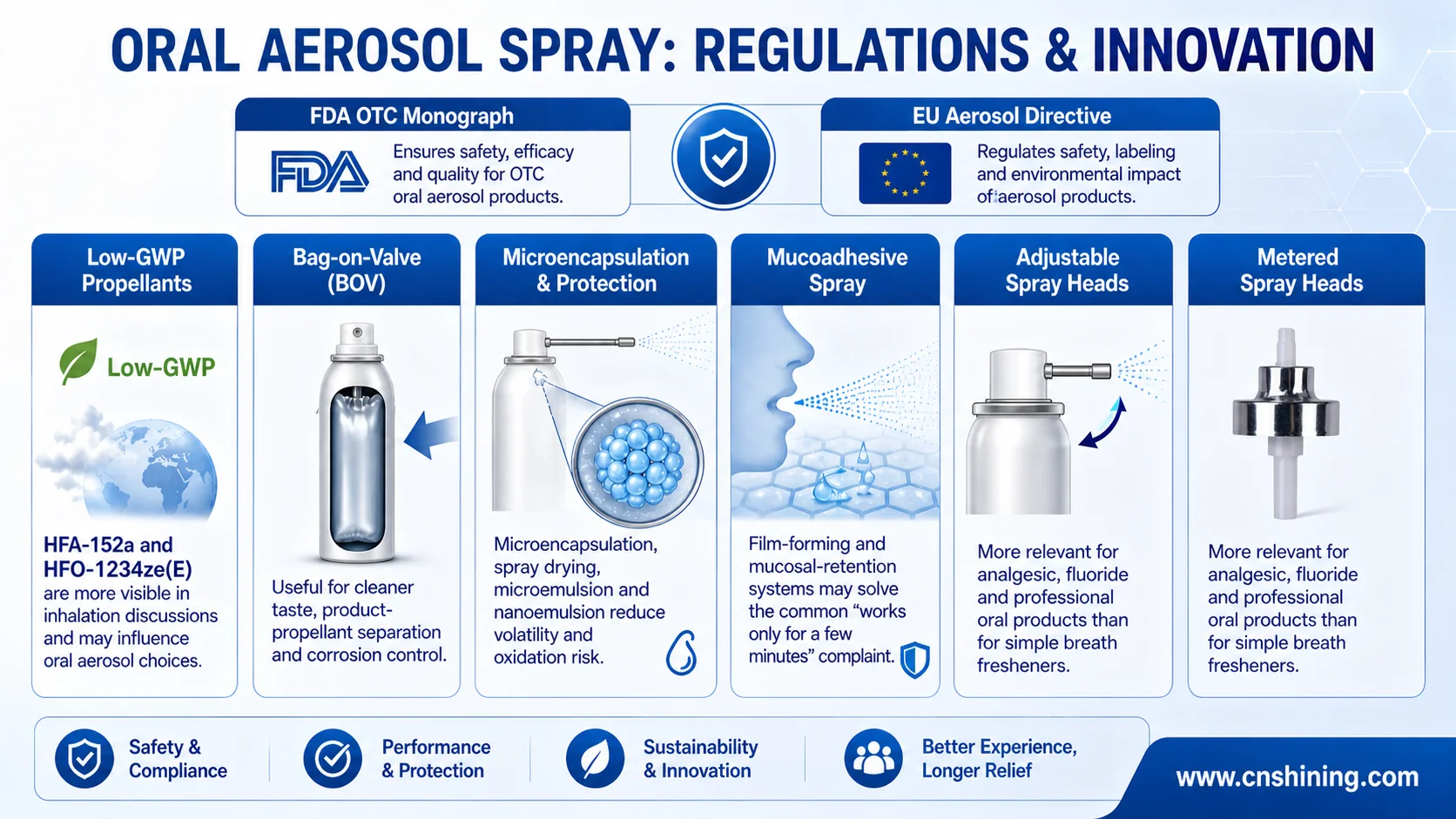
In the United States, claims such as analgesic, anticaries, antiplaque or oral disease treatment generally move the product toward drug regulation. FDA OTC Monograph M022 defines active ingredients, labels, warnings and use directions for oral healthcare drug products. FDA container closure guidance also expects the packaging system to be suitable for its dosage form and route.
Europe adds pressure-container requirements through aerosol dispenser rules. For medicinal products, device performance, dose uniformity, CMC consistency and packaging safety are not optional topics. The climate impact of propellants is also under closer review. EMA has already noted a lower-GWP propellant reformulation case in inhaled medicine, and the same technical direction can influence oral aerosol thinking.
Innovation routes worth watching
- Low-GWP propellants: HFA-152a and HFO-1234ze(E) are more visible in inhalation discussions and may influence oral aerosol choices.
- Bag-on-Valve: Useful for cleaner taste, product-propellant separation and corrosion control.
- Essential oil protection: Microencapsulation, spray drying, microemulsion and nanoemulsion reduce volatility and oxidation risk.
- Mucoadhesive spray: Film-forming and mucosal-retention systems may solve the common “works only for a few minutes” complaint.
- Adjustable or metered spray heads: More relevant for analgesic, fluoride and professional oral products than for simple breath fresheners.
7. Shining Packaging: Actuators, Aerosol Cans and Valves for Oral Spray Projects
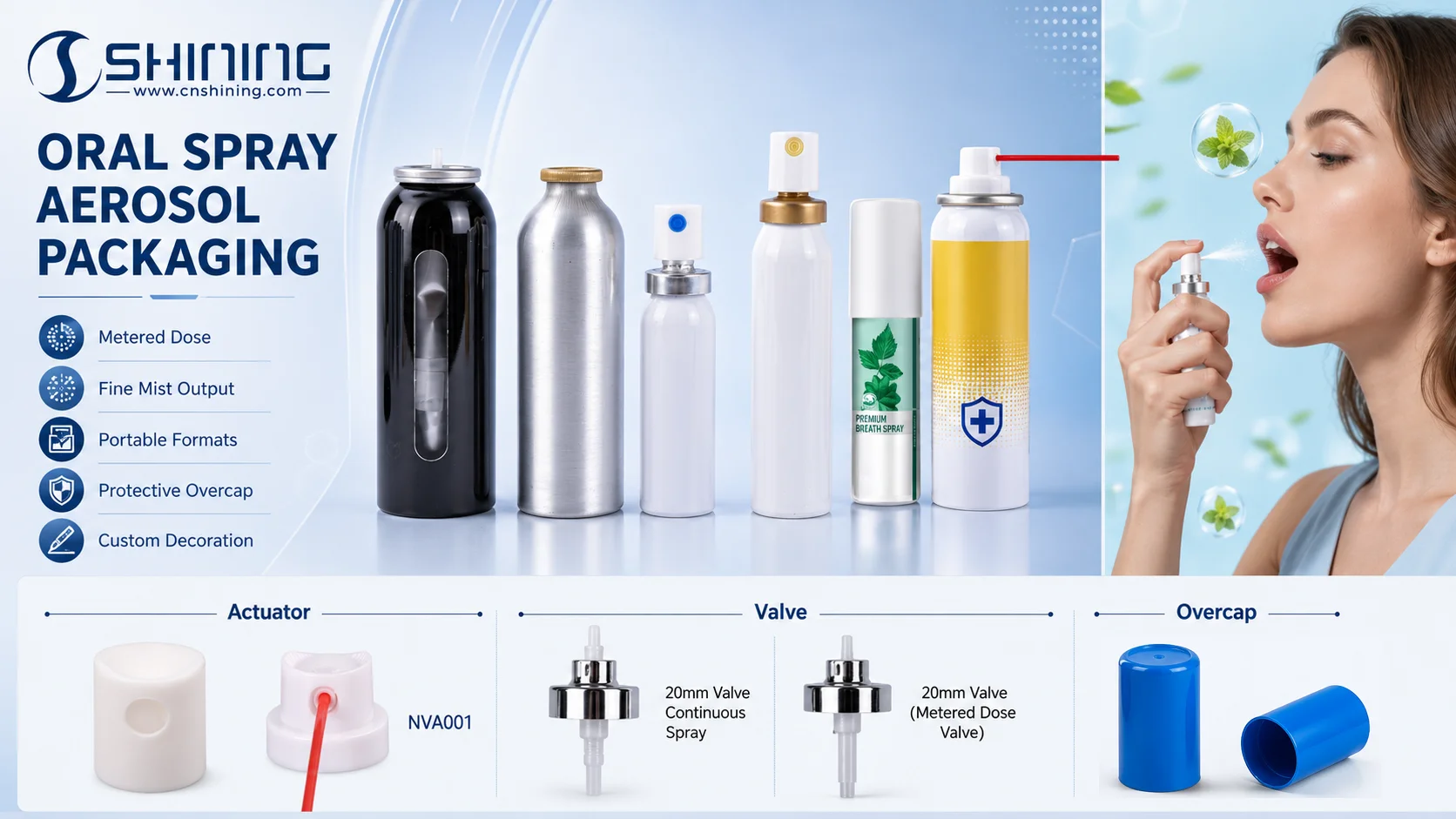
For oral aerosol spray, Shining Packaging’s relevant work is not only the metal can. The practical package set usually includes actuator, aerosol can and valve. These three parts should be selected together because the user judges the product through spray feel, leakage behavior, pocket safety and taste stability.
A mouth-directed actuator can reduce throat hit by guiding the spray toward the tongue or cheek. A suitable valve and gasket system helps control leakage, shot weight and alcohol or essential oil compatibility. The aerosol can and inner coating need to match ethanol, flavor oil, oxidizing systems, fluoride salts or mucoadhesive polymers. For BOV projects, the bag material and valve path become part of the formulation protection strategy.
The practical question is simple: does the package deliver a repeatable coarse mist without leaking in a pocket? If not, the active ingredient cannot save the user experience.
8. Top 10 Brand Samples and Consumer Signals
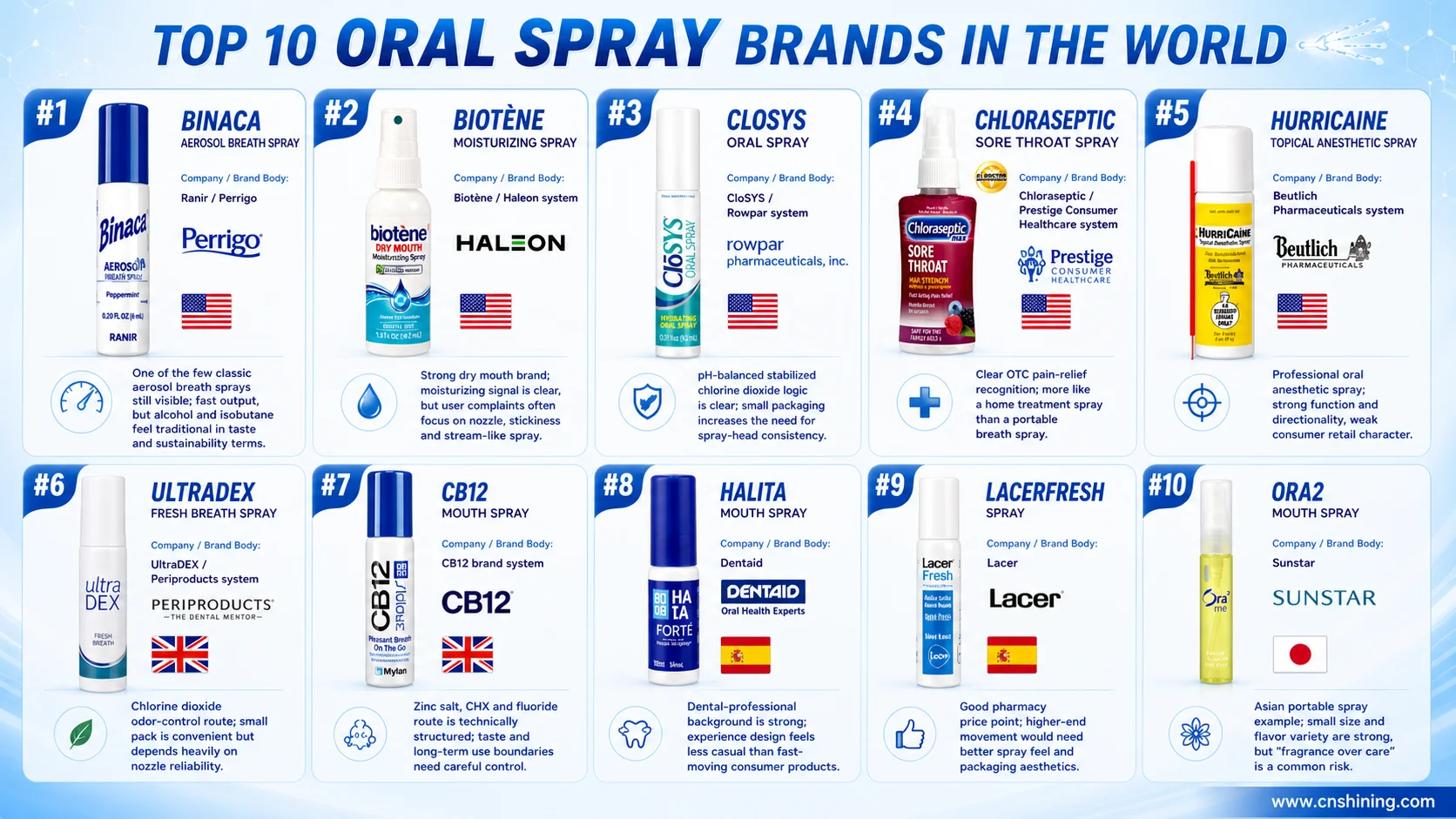
The following table is not a strict global market-share top ten. It is a representative sample based on cross-region search visibility, category representation, packaging format difference and retail availability. It intentionally includes true aerosols and strong pump-spray substitutes because that is how the shelf actually competes.
| Brand / Product | Country | Company / Brand Body | Packaging Form | Typical Size | Observed Price | Technical Comment |
|---|---|---|---|---|---|---|
| Binaca Aerosol Breath Spray | United States | Ranir / Perrigo | True aerosol | 0.20–0.214 fl oz | From US$1.09 | One of the few classic aerosol breath sprays still visible; fast output, but alcohol and isobutane feel traditional in taste and sustainability terms. |
| Biotène Moisturizing Spray | United States | Biotène / Haleon system | Pump spray | 44 mL | CAD12.47 | Strong dry mouth brand; moisturizing signal is clear, but user complaints often focus on nozzle, stickiness and stream-like spray. |
| CloSYS Oral Spray | United States | CloSYS / Rowpar system | Pump spray | 9.2 mL, often three-pack | US$9.99 (3 Count) | pH-balanced stabilized chlorine dioxide logic is clear; small packaging increases the need for spray-head consistency. |
| Chloraseptic Sore Throat Spray | United States | Chloraseptic / Prestige Consumer Healthcare system | Throat spray, not typical pocket aerosol | 4–6 fl oz | US$6.38–6.39 | Clear OTC pain-relief recognition; more like a home treatment spray than a portable breath spray. |
| HurriCaine Topical Anesthetic Spray | United States | Beutlich Pharmaceuticals system | Aerosol / professional spray | 2 oz | US$42.54 in professional dental channel | Professional oral anesthetic spray; strong function and directionality, weak consumer retail character. |
| UltraDEX Fresh Breath Spray | United Kingdom | UltraDEX / Periproducts system | Pump spray | 9 mL | £2.37 | Chlorine dioxide odor-control route; small pack is convenient but depends heavily on nozzle reliability. |
| CB12 Mouth Spray | United Kingdom / Nordic markets | CB12 brand system | Pump spray | 15 mL | €4.19–US$11.87 | Zinc salt, CHX and fluoride route is technically structured; taste and long-term use boundaries need careful control. |
| HALITA Mouth Spray | Spain | Dentaid | Pump spray | 15 mL | €5.26–€6.66 | Dental-professional background is strong; experience design feels less casual than fast-moving consumer products. |
| LacerFresh Spray | Spain | Lacer | Pump spray | 15 mL | €3.39–€3.40 | Good pharmacy price point; higher-end movement would need better spray feel and packaging aesthetics. |
| Ora2 Mouth Spray | Japan | Sunstar | Pump spray | 6 mL | Around SGD3.04 | Asian portable spray example; small size and flavor variety are strong, but “fragrance over care” is a common risk. |
Observed user pain points
| Pain Point | Packaging or Structure Response | Focused Part | Expected Business Effect |
|---|---|---|---|
| Leakage in bag, pocket or shipping carton | Use a more stable metered valve, stronger reseal path, better overcap fit or twist-lock structure; screen gasket compatibility with ethanol and essential oils. | Valve, gasket, cap | Lower return rate, fewer logistics complaints and fewer negative social posts. |
| “Stream, not mist” feeling | Optimize orifice diameter, swirl chamber and fan insert; match actuator to high-viscosity formulas separately. | Actuator, nozzle | Better first-spray satisfaction and higher repeat use. |
| Bitter, throat-hitting or too strong | Use a 20–30° downward mouth-directed actuator and avoid direct back-throat targeting; consider BOV or lower-odor propellant route. | Actuator, propellant system | Lower irritation and flavor-overload complaints. |
| Short action time | Use film-forming or mucoadhesive spray logic; communicate the difference between instant freshening and sustained care. | Formula and spray head together | Moves the product from emergency use toward daily-use oral care. |
| No remaining-volume signal | Add spray-count information, net-weight cue, QR instruction or transparent window for pump packs. | Can, label, print | Reduces surprise empty-pack experience. |
| Poor compatibility with ethanol, essential oil or oxidizing systems | Upgrade inner coating, evaluate BOV, and run full compatibility plus extractables and leachables review. | Inner coating, valve, bag material | Improves shelf life and reduces odor, discoloration or activity loss. |
9. Conclusion
Oral aerosol spray should be evaluated as a device-package-formulation system. The market is real, but the true aerosol subset is narrower than broad mouth spray figures suggest. The technical problems are also practical: leakage, stream-like spray, bitter throat hit, short action time, propellant compatibility and coating stability. The best development route is not to force every oral spray into a classic hydrocarbon aerosol can. It is to choose the package format that gives reliable mist, local deposition, stable taste and low complaint risk.
10. FAQ: Oral Aerosol Spray Technical Questions
Oral aerosol spray uses a pressurized container, valve and propellant or compressed gas to discharge the formulation. Pump mouth spray uses mechanical finger force and is usually non-pressurized. The difference affects spray consistency, leakage behavior, regulatory handling, transport classification, formulation compatibility and how the user feels the plume in the mouth.
A jet-like feel usually comes from poor matching between formulation viscosity, surface tension, orifice size, swirl geometry and actuator channel design. High-viscosity dry mouth formulas are especially sensitive. Changing only the formula rarely solves it. The spray head and actuator need to be tested with the real filled product.
Common technical options include liquefied propellants such as butane, isobutane, propane, DME, HFA-152a and HFA-134a, plus compressed gases such as CO2, N2 and N2O. Compressed gases Liquefied propellants usually maintain steadier pressure, while liquefied propellants may produce wetter and coarser output as pressure drops during use.
Bag-on-Valve can be useful when taste purity, propellant separation, corrosion control or oxidative stability matters. The product stays inside a bag while gas remains outside. This reduces direct propellant contact and can help formulas containing water, essential oils, polymers or sensitive active ingredients, but bag and valve compatibility still need testing.
There is no universal droplet size. A fine mist spreads well, but very small particles may travel deeper with airflow. Coarser droplets often improve local oral deposition and reduce inhalation concern, but they can feel harsh if velocity is too high. Target size should follow the intended site: tongue, cheek, gum or throat.
Breath sprays often contain ethanol, menthol, essential oils, oxidizing deodorant systems or flavor solubilizers. These materials can swell gaskets, extract materials from plastics, attack can coatings or change flavor over storage. Compatibility testing should cover valve parts, inner coating, actuator, cap and the complete filled package under real storage conditions.
Leakage can come from weak valve resealing, poor gasket selection, loose overcap fit, transport vibration, high internal pressure, formula attack on elastomers or actuator contamination after spraying. For oral products, even small leakage is visible because the pack is often carried in pockets or bags. Leak testing should include shipping simulation.
The route depends on claims and ingredients. Breath freshening or simple cosmetic oral care may follow consumer product or cosmetic logic in some markets. Pain relief, anticaries, antiplaque, antiseptic or disease-treatment claims usually move the product toward drug rules. Packaging materials may also need drug packaging review when therapeutic claims are used.
Saliva flow, swallowing and tongue movement quickly remove low-viscosity sprays from the mucosa. Glycerin and xylitol can give immediate comfort, but residence time is limited. Film-forming polymers, mucoadhesive systems and better spray targeting can extend comfort, but they must avoid sticky or artificial mouthfeel that users dislike.
Key tests include valve leakage, shot weight, spray angle, droplet distribution, actuator dripping, can pressure, crimp quality, coating compatibility, gasket compatibility, microbial limits, accelerated stability and real-time storage. For active oral products, delivered dose and label-related safety controls should be confirmed before commercial tooling and decoration are locked.