
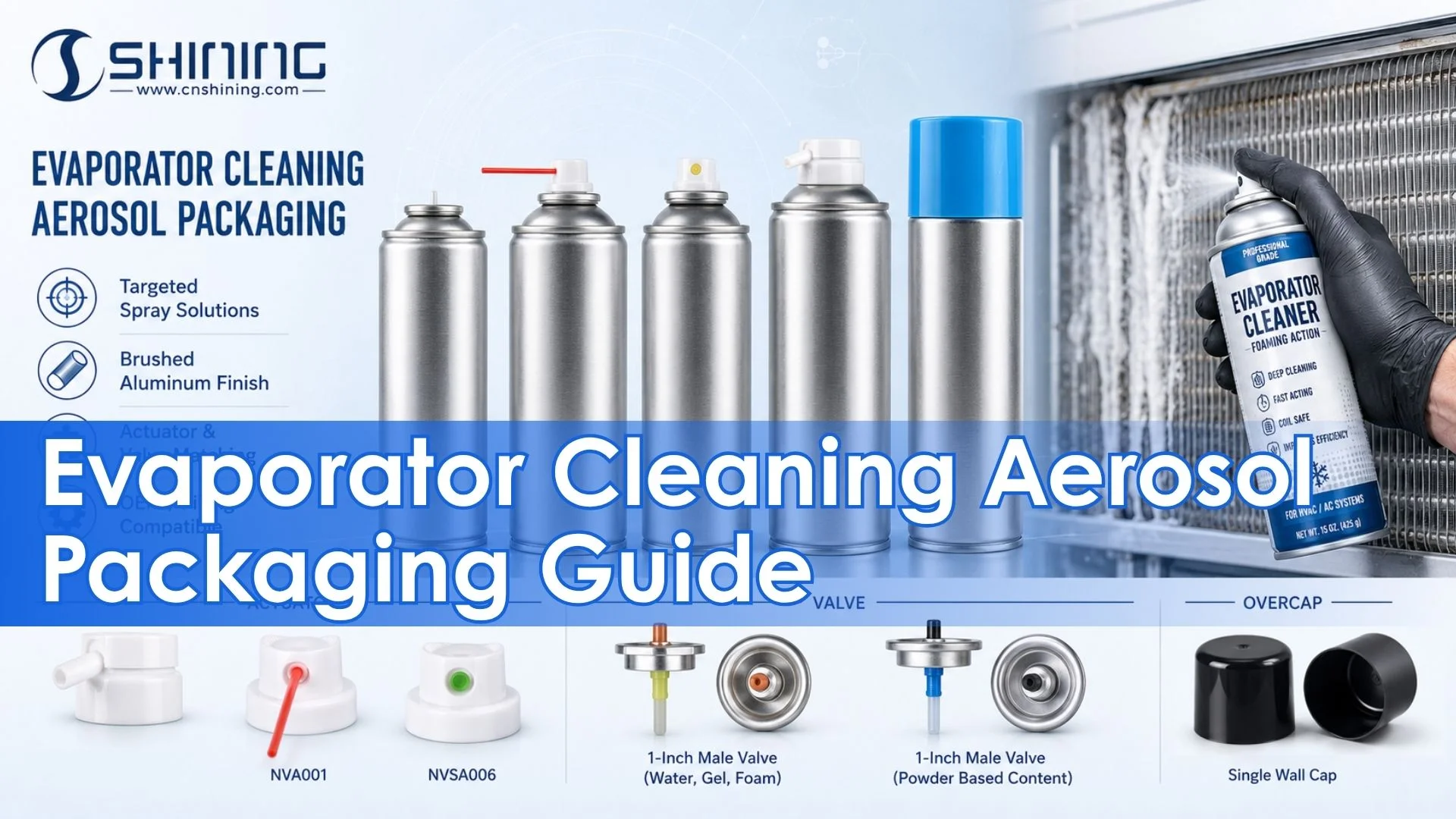
Evaporator cleaning aerosol spray, also called evaporator coil cleaner, HVAC coil foam cleaner, automotive A/C evaporator cleaner or no-rinse coil spray, is a pressurized delivery system for placing a cleaning liquid into coil fins, evaporator boxes and air passages. The real work is done by wetting, soil loosening, emulsification, foam dwell and drainage. The aerosol format only decides whether that chemistry reaches the right surface.
1. Product Definition and Competitive Position
1.1 Definition and Uses
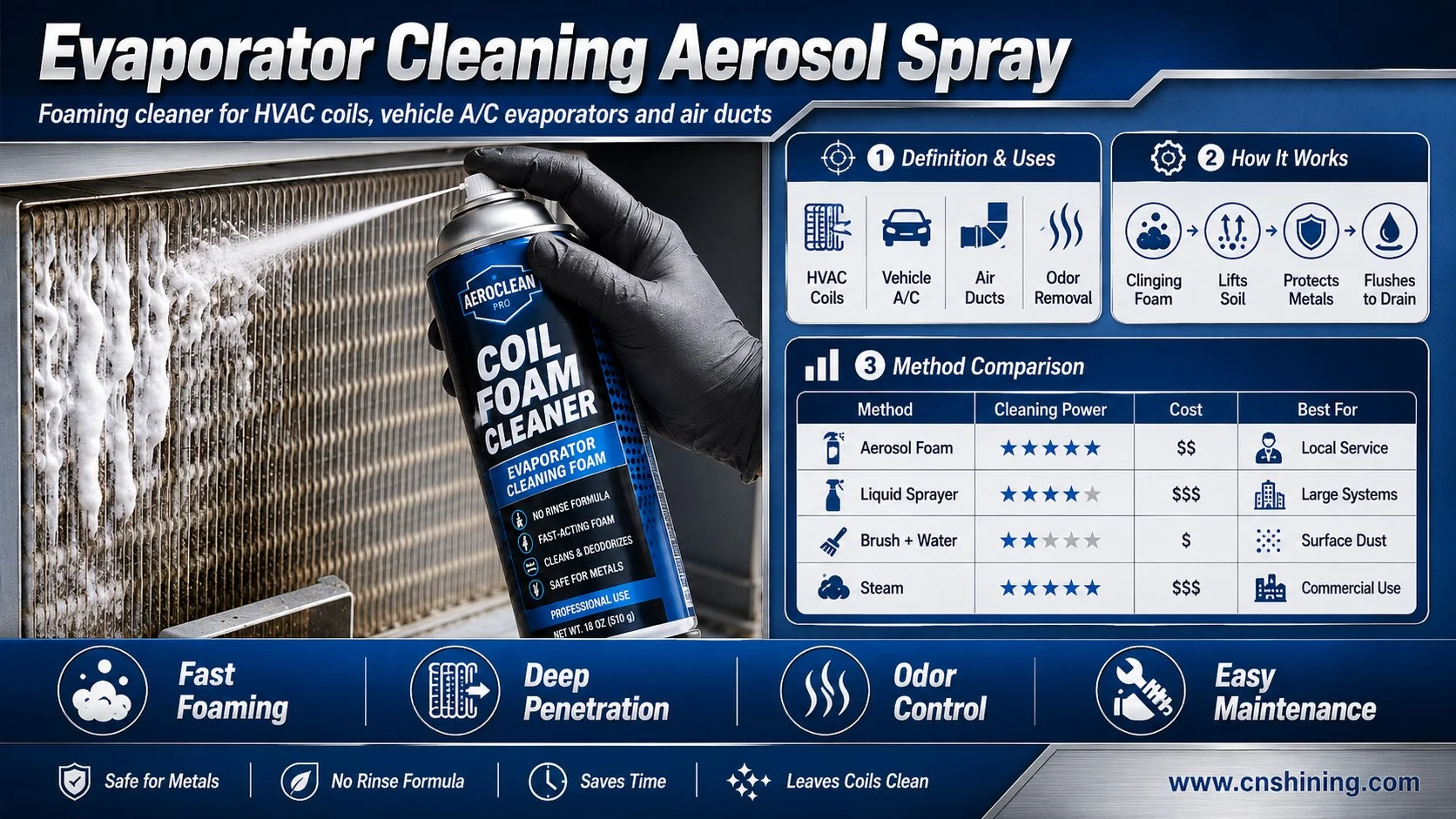
Evaporator cleaning aerosol spray is a pressurized spray cleaner designed for air-conditioner evaporators, evaporator coils, cooling coils, vehicle HVAC evaporator boxes and air ducts. It is sold as home HVAC coil cleaner, commercial coil aerosol, automotive evaporator foam cleaner and deodorizing A/C cleaner.
The main use cases are clear. First, seasonal maintenance before heavy cooling operation. Second, odor treatment for moldy, damp, smoky or microbial smells. Third, small evaporators in refrigeration or food-area equipment. Fourth, deep access into automotive evaporator boxes without removing the dashboard.
1.2 Working Principle and Mechanism
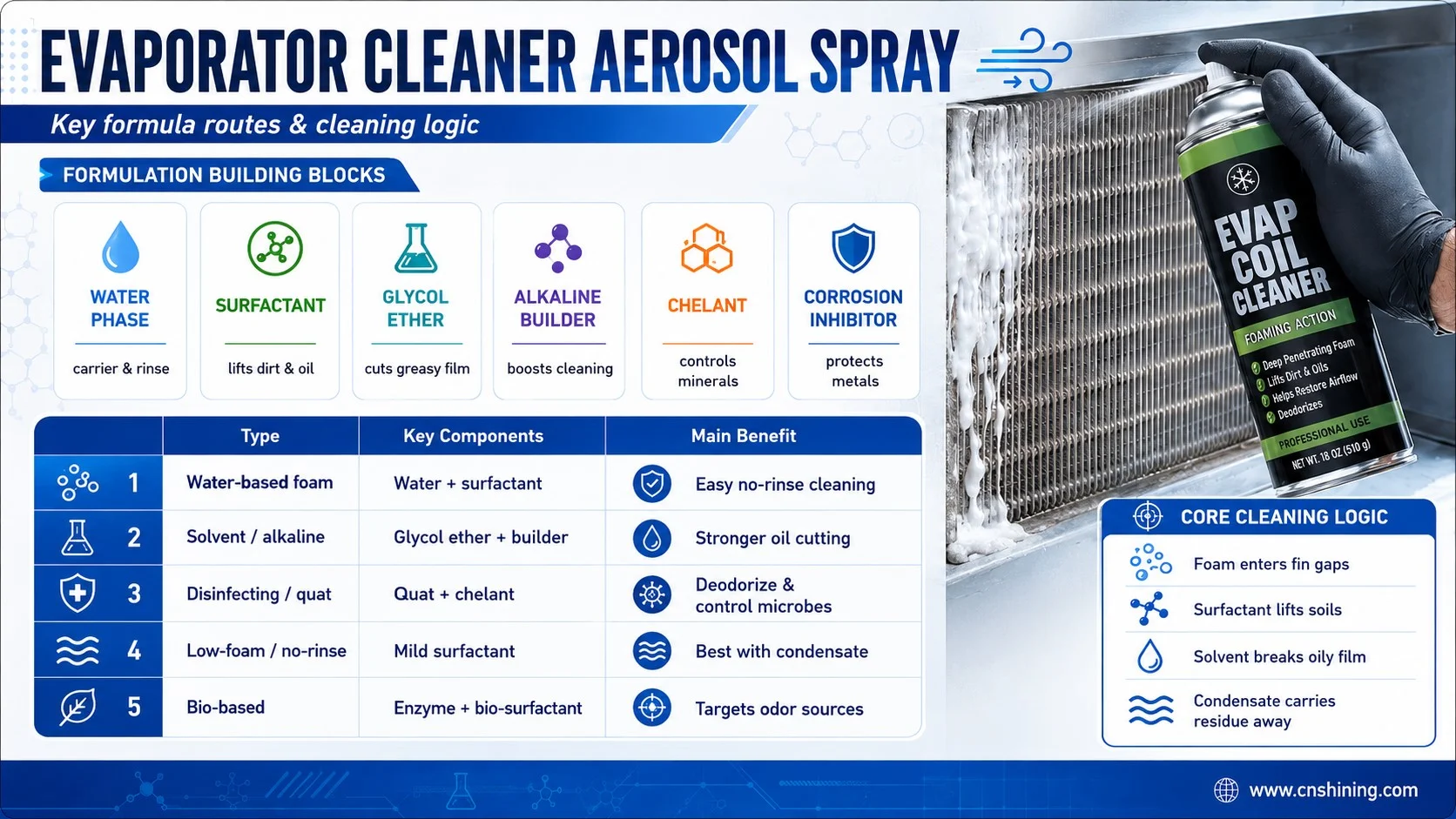
The mechanism is simple but often misunderstood. Foam gives the formula time to stay between fins. Surfactants wet the metal surface and lift soil. Solvents and alkaline builders cut oily films. Chelants reduce redeposition. Corrosion inhibitors and pH control keep aluminum fins, copper tubes and nearby metal parts within a safe range. Condensate then carries loosened residue toward the drain path.
The reason this matters is measurable. The U.S. Department of Energy maintenance guidance states that airflow obstruction allows dirt to bypass filters and settle on evaporator coils, reducing heat absorption. LBNL/ACEEE research on coil fouling connects coil dirt with pressure-drop increase. Purdue research on evaporator fouling also links airflow loss with reduced capacity and COP; see the Purdue evaporator fouling paper. A 2025 field study in Building and Environment reported supply airflow recovery and fan energy reduction after HVAC cleaning; see the HVAC cleaning and energy consumption study.
1.3 Comparison with Alternative Cleaning Methods
The table below reflects light-to-medium evaporator fouling and odor cases. “Cleaning efficiency” here means field suitability, not laboratory maximum soil removal. Large oily industrial coils remain a different job.
| Method | Cleaning Efficiency | Ease of Use | Safety | Cost | Environmental Impact | Typical Scenario | Field Judgment |
|---|---|---|---|---|---|---|---|
| Aerosol spray / foam | 3.5/5 | 5/5 | 3/5 | 3/5 | 2.5/5 | Light-to-medium fouling, vehicle evaporators, local maintenance | Not the strongest method, but “good enough and easy” often wins. |
| Liquid cleaner with sprayer | 4/5 | 3/5 | 3.5/5 | 4/5 | 3.5/5 | Medium and large HVAC systems, scheduled service | Better unit-area cost, higher operating threshold. |
| Mechanical brushing and water | 2.5/5 | 2/5 | 4/5 | 4/5 | 3/5 | Accessible surfaces and loose dust | Cheap, but may miss deep fin spaces and can damage fins. |
| Steam cleaning | 4/5 | 2/5 | 3.5/5 | 2/5 | 4/5 | Commercial AHU, hygiene-driven work | Lower chemical load, higher equipment and process demand. |
| Ultrasonic cleaning | 4.5/5 | 1/5 | 4/5 | 1.5/5 | 3.5/5 | Removable parts, offline cleaning | Strong effect, but rarely realistic for installed evaporators. |
Aerosol spray scores high on convenience because of 360° valves, inverted spraying, extension tubes and single-can dosing. It does not score higher on safety or environment because pressurized containers, flammable or irritating ingredients, VOC rules and transport classification remain hard constraints. Maintenance planning is also broader than one product; ANSI/ASHRAE/ACCA Standard 180-2018 frames HVAC inspection and maintenance as a documented program, not a one-time spray event.
2. Formulation Systems and Professional Terms
2.1 Classification by Chemical System
| Type | Typical Components | Mechanism | Public Example | Safety and Storage Point |
|---|---|---|---|---|
| Water-based foam | Water, surfactant, small glycol ether solvent, chelant, corrosion inhibitor, LPG or hydrocarbon propellant | Wets fins, emulsifies dust and oil film, drains with condensate after foam break | KOOL-IT SDS: water >75%, LPG 5–10%, 2-butoxyethanol 0.5–3%, ammonia <0.1% | Pressurized container; heat, flame and ventilation controls are still required. |
| Solvent-surfactant-alkaline builder | Glycol ethers, 2-butoxyethanol, SLS, EDTA, sodium metasilicate, sodium nitrite, propane/butane | Better oil cutting and film breaking for no-rinse evaporator maintenance | Evap Foam SDS | Eye irritation, inhalation exposure and flammable aerosol classification must be managed. |
| Disinfecting / quat system | Benzalkonium chloride-type quats, EDTA, glycol ether co-solvent, LPG propellant | Adds microbial-control and mildewstat claims to cleaning and deodorizing | Evap-Fresh SDS | Label contact time, approved surface and food-contact rinse rules become part of performance. |
| Low-foam / no-rinse evaporator system | Low-foam surfactant, neutral or mildly alkaline builder, corrosion inhibitor, deodorizer | Designed for condensing evaporators where condensate can carry residue away | No-rinse evaporator coil cleaners in HVAC service channels | Best suited to coils that actually generate condensate during operation. |
| Enzyme or bio-based system | Plant enzyme, bio-surfactant, mild solvent, water-based carrier | Targets organic odor sources with lower odor and softer hazard positioning | Public plant-enzyme A/C evaporator cleaner claims in automotive aftermarket | Lower irritation claims do not remove the need for SDS, transport and label review. |
| Foam-enhanced patent route | Water 50–60%, solvent 20–50%, surfactant 0.5–2.5%, pH/corrosion control about 1.25–1.75% | Improves foam adherence and fin coverage time | Foaming evaporator coil cleaner patent family | Stronger foam does not automatically mean safer foam. Metal compatibility still decides. |
| Polymer-assisted household A/C aerosol | Surfactant, acrylic copolymer, corrosion inhibitor, biocide, solvent, water, LPG | Improves hanging behavior on fins and vertical surfaces | Household air-conditioner aerosol cleaning composition patent | Added cling means residue and re-deposition checks become more important. |
2.2 Commercial Logic of Key Ingredients
Surfactants are the main force for pulling soil away from metal. Glycol ether solvents and alkaline builders open oily film, smoke deposit and kitchen-type organic residue. EDTA and similar chelants help with metal ions and redeposition. Corrosion inhibitors and pH control decide whether a product can safely approach aluminum fins, copper tubes and valve areas. Quats and fragrance systems decide whether the product can support odor or disinfection claims.
2.3 Technical Glossary
| Term | Plain Meaning | Commercial Meaning |
|---|---|---|
| Evaporator coil | Heat exchanger where refrigerant absorbs heat and evaporates | The core component the cleaner is trying to recover |
| Coil fouling | Accumulated dirt, oil film, biofilm or particulate on coil surfaces | Drives cleaning frequency and user complaints |
| No-rinse | No extra manual rinse under defined conditions | Strong claim, but usually depends on condensate |
| Self-rinsing | Residue leaves with condensate water | Useful only on condensing evaporators |
| Dwell time | Time the formula stays on the surface | Affects cleaning and disinfection performance |
| Surfactant | Wetting and emulsifying chemical | Controls foam, wetting and soil release |
| Solvent | Chemical that cuts oily or organic residue | Often linked to VOC and odor strength |
| Corrosion inhibitor | Protects aluminum, copper and steel from attack | Decides material compatibility credibility |
| Quat | Quaternary ammonium disinfectant component | Supports disinfecting claims but adds regulatory burden |
| VOC | Volatile organic compound | Directly affects U.S., China and regional market access |
| Propellant | Gas phase that expels product from the can | Affects spray feel, flammability, GWP and transport |
| 360° valve | Valve that sprays in upright or inverted positions | Useful for window units, roof units and vehicle access |
| Extension tube | Flexible tube mounted to the actuator | Determines whether foam reaches the coil face |
| BOV | Bag-on-Valve system | Separates formula from propellant and supports non-flammable options |
| CLP / GHS | Chemical classification and labeling framework | Controls pictograms, hazard text and SDS structure |
| UN1950 | Transport entry for aerosols | Affects warehousing, e-commerce and cross-border shipping |
| NSF C1 / K5 | Food-area cleaning classifications | Useful for food-service refrigeration claims |
| IAQ | Indoor air quality | Connects coil cleaning with odor, hygiene and occupant complaints |
3. Regulatory and Compliance Framework
| Market | Key Framework | Direct Effect on Evaporator Cleaning Aerosol Spray |
|---|---|---|
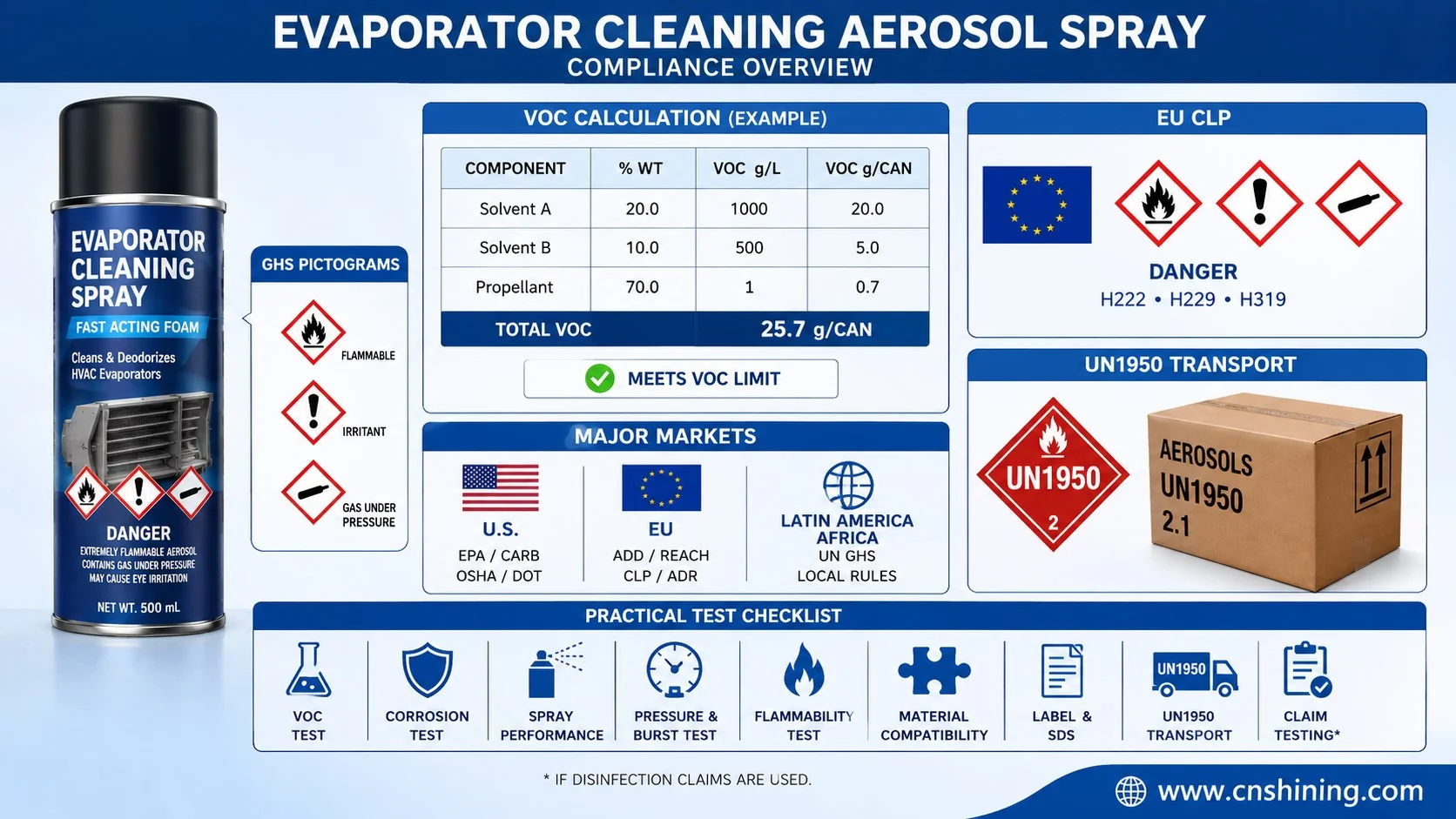
| United States | EPA 40 CFR Part 59, CARB Consumer Products, OSHA HazCom, CPSC/FHSA, DOT 49 CFR, EPA registration if disinfecting claims apply | VOC calculation, hazard labels, SDS, flammability, pressurized container safety, UN1950 transport and disinfectant claim control. |
| European Union | Aerosol Dispensers Directive, REACH, CLP, ADR, F-gases III | Container safety, substance compliance, pictograms, transport rules and pressure against high-GWP propellants. |
| Latin America / Africa | UN GHS and transport frameworks with local adoption | Country-by-country SDS, label language, import and storage requirements need local confirmation. |
3.2 Compliance Points That Usually Block Launch
In the U.S., the bottleneck is often VOC and labeling rather than cleaning performance. The EPA consumer product VOC rule and the California Air Resources Board Consumer Products Program set formulation boundaries. Occupational use also requires alignment with OSHA Hazard Communication. If the label says disinfect, sanitize, kill bacteria or control mildew, the claim moves into pesticide/disinfectant registration territory.
In the EU, the working frame is ADD + REACH + CLP. The Aerosol Dispensers Directive focuses on aerosol container safety. REACH handles substance obligations. CLP controls classification, labeling and packaging. F-gas pressure also makes compressed air, nitrogen, Bag-on-Valve and low-GWP propellants more relevant.
3.3 Practical Test Checklist
Before launch, the minimum file should cover VOC calculation or testing, corrosion compatibility, foam stability, spray rate, inverted spray performance, can pressure, burst safety, flammability testing, material compatibility, label review, SDS, UN1950 transport classification and claim-specific testing. If disinfection claims are used, the AOAC or EPA route must be planned at the beginning, not after the label is printed.
4. Top 10 Brands: Publicly Visible Product Families
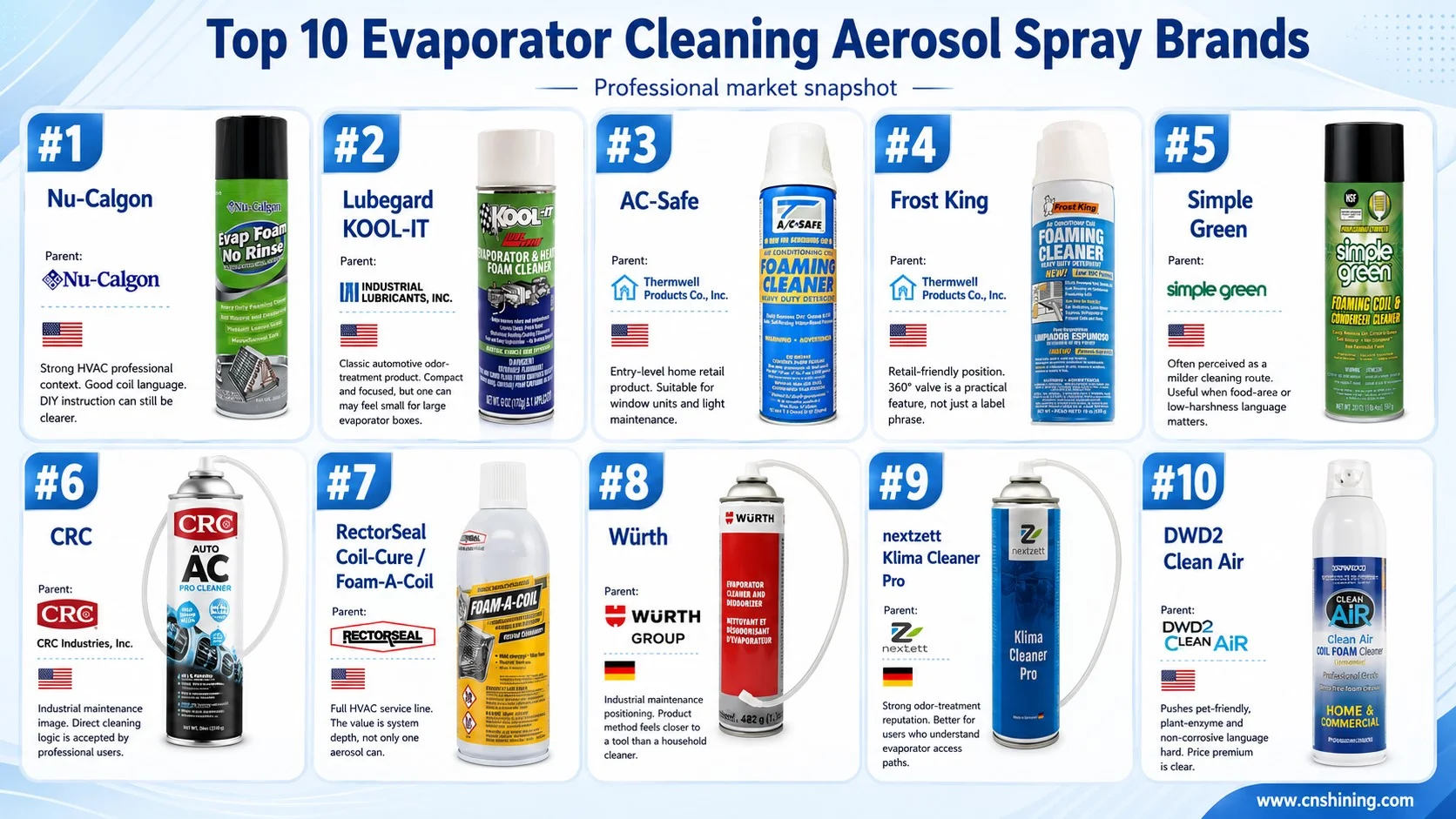
The following “Top 10” is not a confidential global sales ranking. It is a representative list based on public brand visibility, channel presence, review volume and available technical material.
| Brand | Country / Region | Parent or Public Operator | Common Size | Public Price Range | Direct Technical Comment |
|---|---|---|---|---|---|
| Nu-Calgon | United States | Nu-Calgon | 18 oz | about $17.95–$21.64/can; 2-pack about $39.97–$40.87 | Strong HVAC professional context. Good coil language. DIY instruction can still be clearer. |
| Lubegard KOOL-IT | United States | Industrial Lubricants, Inc. | 6 oz | about $14.99 | Classic automotive odor-treatment product. Compact and focused, but one can may feel small for large evaporator boxes. |
| AC-Safe | United States | Thermwell Products Co., Inc. | 19 oz | about $9.98 | Entry-level home retail product. Suitable for window units and light maintenance. |
| Frost King | United States | Thermwell Products Co., Inc. | 19 oz | about $10.99 | Retail-friendly position. 360° valve is a practical feature, not just a label phrase. |
| Simple Green | United States | Simple Green brand | 20 oz / 32 oz | about $9.98–$13.98 | Often perceived as a milder cleaning route. Useful when food-area or low-harshness language matters. |
| CRC | United States | CRC Industries, Inc. | 18 oz | about $18.53 | Industrial maintenance image. Direct cleaning logic is accepted by professional users. |
| RectorSeal Coil-Cure / Foam-A-Coil | United States | RectorSeal | 12 oz / 18 oz / gallon | about $18.98 for Coil-Cure 18 oz; about $37.21 for Foam-A-Coil 1 gallon sample | Full HVAC service line. The value is system depth, not only one aerosol can. |
| Würth | Germany | Würth Group | 18 oz / kits | about $19.99 for selected kit SKUs | Industrial maintenance positioning. Product method feels closer to a tool than a household cleaner. |
| nextzett Klima Cleaner Pro | Germany | nextzett | 10 fl oz | about $16.96–$19.95 | Strong odor-treatment reputation. Better for users who understand evaporator access paths. |
| DWD2 Clean Air | United States | DWD2 Clean Air | 8 oz / green version | about $27.95–$28.52; green version about $39.61 | Pushes pet-friendly, plant-enzyme and non-corrosive language hard. Price premium is clear. |
5. User Feedback and Failure Points
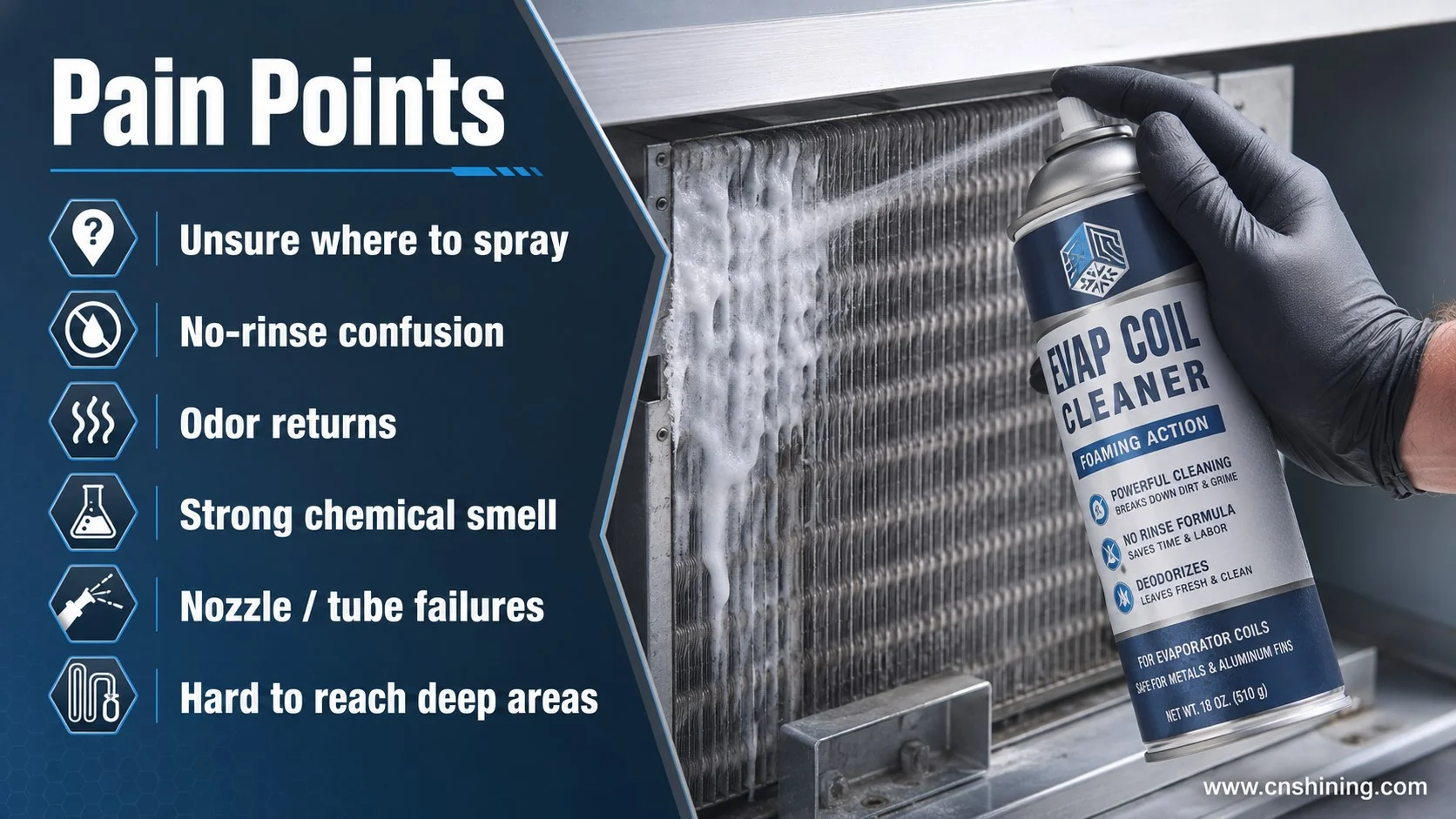
User feedback is consistent. Buyers do not want to become chemists. They want to spray in the right place, avoid dismantling too much, stop the smell, and not be hit by heavy fragrance. When complaints appear, the product is not always the root cause. The delivery path, drain condition, filter status and packaging reliability often decide the result.
| Pain Point | Typical Signal | Technical Reading |
|---|---|---|
| Users do not know where to spray | Questions about vent, filter slot, coil face or drain hole access | The cleaner may work, but wrong delivery path leaves the evaporator face untreated. |
| No-rinse confusion | Users assume no-rinse means no water removal in any condition | Self-rinsing depends on condensate. Dry surfaces need wiping or flushing. |
| Odor returns | Smell improves for days or weeks, then comes back | Drain restriction, wet filter, persistent moisture or thick biofilm can remain. |
| Fragrance or chemical odor is too strong | Some users want fresh scent; others want no scent | Fragrance intensity should be segmented, not treated as one universal preference. |
| Nozzle, tube or packaging failure | Missing spray nozzle, half-empty cans, broken cap or hose loss | Aerosol packaging failure becomes product failure, even when the formula is acceptable. |
| Cannot reach deep areas | Foam stays near vents or entry points | Extension tube length, stiffness and actuator connection matter directly. |
6. Packaging and Use Experience Upgrade Advice
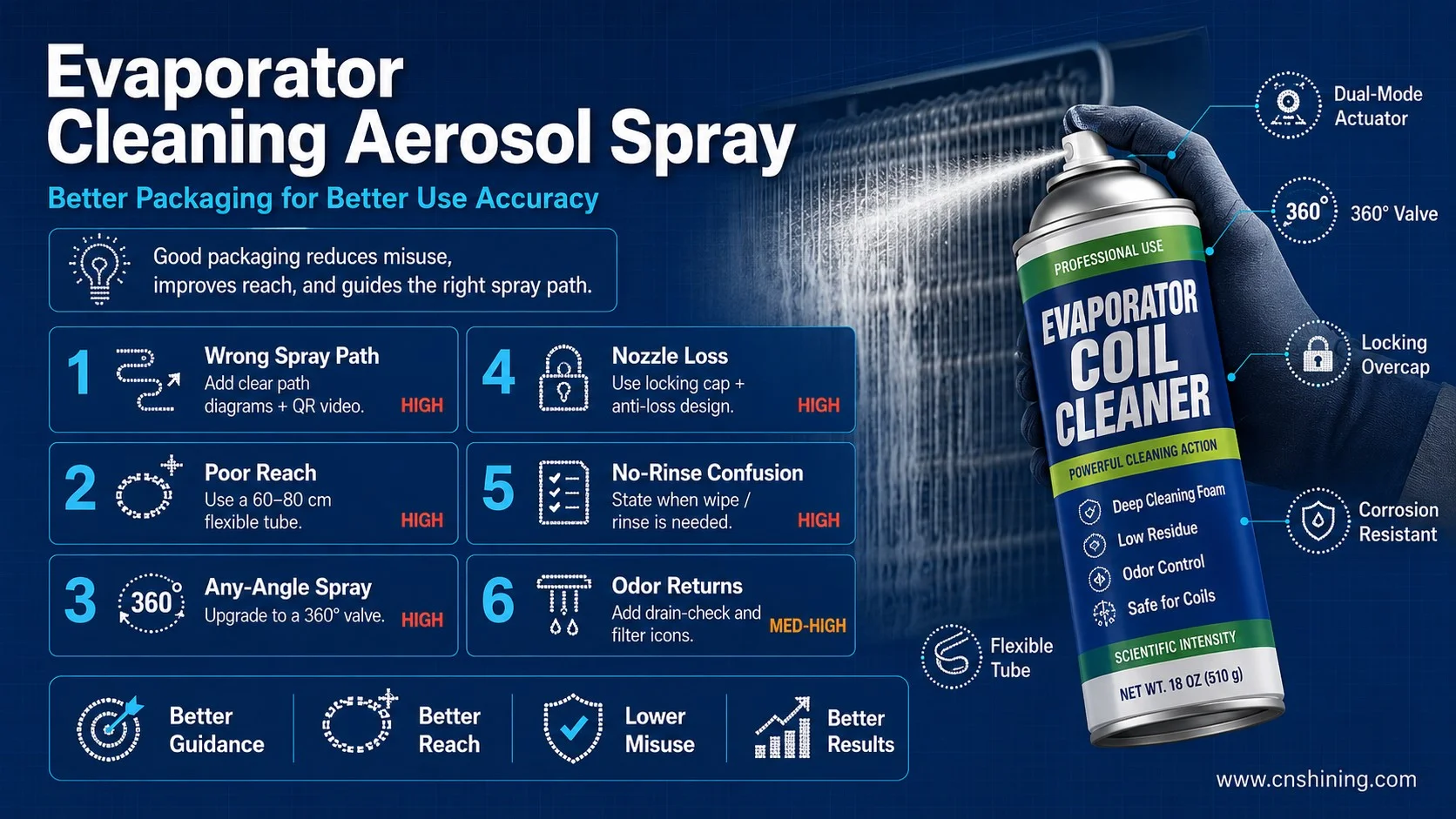
From Valve, Actuator, Can Shape, Printing and Label to Better Use Accuracy
The best packaging improvement is not a brighter can. It is a lower error rate. Users fail when they spray through the wrong path, misunderstand dwell time, treat no-rinse as no-think, or expect fragrance to remove root-cause moisture. The most useful upgrades are 360° valves, storable extension tubes, dual-mode actuators, equipment-path diagrams, QR videos, corrosion-resistant internal coatings, stronger overcaps and anti-loss nozzle structures.
| User Pain Point | Packaging / Instruction Improvement | Priority | Why It Should Be Done |
|---|---|---|---|
| Wrong spray path | Front label path split for home coil and vehicle evaporator; cap-inside diagram for drain hole, filter slot and coil face; QR video | High | This is a common failure source and can be solved by information design. |
| Deep area not reached | Standard 60–80 cm flexible tube; dual-mode actuator for wide foam and directed tube | High | Depth coverage decides whether users feel the result. |
| Inverted or upward spraying is difficult | Upgrade to 360° valve and clearly mark upside-down usability | High | Window units, rooftop units and vehicle drains often require non-upright spraying. |
| Nozzle missing or can arrives damaged | Locking overcap, anti-loss actuator structure, transport protection ring, e-commerce secondary pack | High | This avoids preventable negative reviews. |
| No-rinse is overread | Label phrase: “self-rinsing only on condensing evaporators”; red box for wipe/rinse cases | High | Over-simplified language creates trust problems. |
| Odor returns | Add icons for drain check and cabin filter replacement; state heavy biofilm may need repeat or service work | Medium-high | It manages expectations and reduces false failure claims. |
| Fragrance is polarizing | Offer fragrance-free, low-scent and citrus versions; mark scent intensity on front label | Medium-high | Scent tolerance is split. One fragrance cannot serve all users. |
| Poor hand control | Larger textured actuator and stable grip can profile | Medium | Better control improves spray placement. |
| Can corrosion or formula incompatibility | Match internal coating, valve cup and gasket materials to alkaline, quat or glycol ether systems | Medium | Storage stability is part of product reliability. |
7. Shining Packaging: Actuator, Aerosol Can and Valve Choices for Evaporator Cleaner Projects
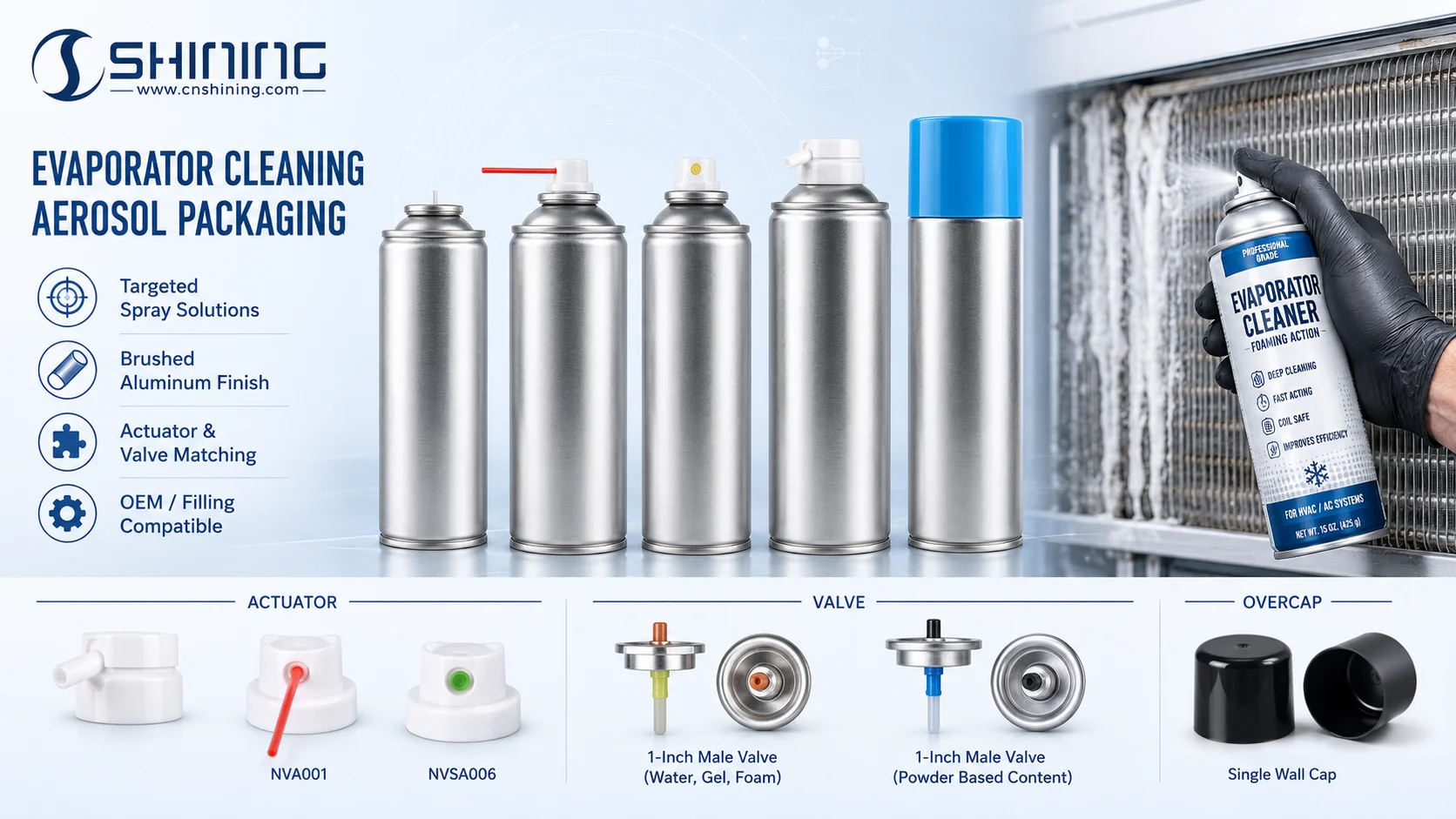
For evaporator cleaning aerosol spray, the packaging set should be selected from the formula outward. Shining Packaging can fit this type of project through aerosol cans, valves and actuators, but the engineering question comes first: What is the propellant? What is the internal pressure? Is the formula alkaline, solvent-rich or quat-based? Does the user need inverted spraying? How long should the extension tube be?
The actuator decides how accurately foam enters the coil area. A wide button may be comfortable for open coil faces, while a tube-compatible actuator is usually better for vehicle evaporator boxes. The valve decides spray angle, leakage risk, foam stability and transport robustness. The can and internal coating decide storage stability with alkaline builders, glycol ethers, quats and corrosion inhibitors. It is a system decision, not three separate parts.
8. Technical Closing Note
Evaporator cleaning aerosol spray is a practical maintenance format for narrow, low-access coil spaces. It should not be treated as a universal coil restoration method. The best product work happens where formula, valve, actuator, can coating, extension tube and label instructions are developed together. If foam reaches the wrong surface, a stronger formula will not fix the job. If the valve leaks or the tube is lost, the chemistry never gets a fair chance.
9. FAQ: Evaporator Cleaning Aerosol Spray
Evaporator cleaning aerosol spray is a pressurized cleaner used on HVAC evaporator coils, cooling coils, vehicle evaporator boxes and related air passages. It delivers a liquid formula as spray or foam. The formula usually combines surfactants, solvents, alkaline builders, corrosion inhibitors, odor-control or disinfecting actives and a propellant. The goal is to loosen soil, support foam dwell and let residue drain away.
Fouling blocks airflow and adds thermal resistance on the coil surface. Dirt can bypass filters and settle on the evaporator, reducing heat absorption and increasing pressure drop. Field and laboratory studies connect dirty coils with lower airflow, weaker cooling capacity and poorer system efficiency. Cleaning is useful when it restores airflow, heat transfer and condensate drainage rather than only masking odor.
No-rinse cleaners work best on evaporators that generate condensate during normal cooling operation. The condensate helps carry loosened dirt and broken foam into the drain path. On dry coils, non-condensing surfaces or equipment without a working drain path, “no-rinse” can be misunderstood. Those conditions may still need wiping, controlled water flushing or service cleaning.
Foam improves contact time and coverage inside coil fins. A thin liquid can run off too quickly, especially on vertical fins or hard-to-reach evaporator faces. Foam helps the surfactant and solvent system stay in place long enough to wet, loosen and emulsify soil. Foam quality still needs balance. Too much residue can create drainage or re-soiling concerns.
Common ingredients include water, surfactants, glycol ether solvents, alkaline builders, EDTA or similar chelants, corrosion inhibitors, fragrance, quaternary ammonium compounds in disinfecting products and LPG or other propellants. Water-based foam systems are common for automotive and HVAC maintenance. Stronger solvent-alkaline systems cut oil better but usually raise odor, VOC, flammability and label-control issues.
Aerosol spray is weak for heavy grease, thick biological film, severe fin blockage, large commercial coil banks or equipment with poor access to the actual coil face. In those cases, liquid concentrates, mechanical washing, steam cleaning or professional service can be more reliable. Aerosol spray is best seen as a light-to-medium maintenance tool, not as a full restoration method.
Many evaporator surfaces are not reachable from a straight upright spray angle. Vehicle evaporator boxes may require entry through a drain tube or filter slot. Window units and rooftop units may need inverted or sideways spraying. A 360° valve and a secure extension tube improve delivery accuracy. Without them, foam may stay near the opening instead of reaching the coil.
The launch file should cover VOC limits, GHS or CLP classification, SDS, aerosol pressure and burst testing, flammability, corrosion compatibility, material compatibility, label wording and UN1950 transport classification. U.S. products also need EPA and CARB attention. EU products need ADD, REACH and CLP review. China projects should include GB 38508 and GB/T 14449 checks.
Odor can return when the root cause remains. A cleaner may reduce surface odor, but moisture, blocked drains, dirty cabin filters, recirculation habits or persistent biofilm can rebuild the smell. Automotive systems are especially sensitive because the evaporator box stays damp. A better method checks the drain path and filter condition instead of relying on fragrance alone.
Packaging can reduce complaints by making correct use harder to miss. A secure actuator, anti-loss extension tube, 360° valve, corrosion-resistant can, locked overcap and clear path diagram all matter. The label should explain where to spray, when condensate is needed, how long to wait and when professional cleaning is required. Better packaging raises correct-use probability.