
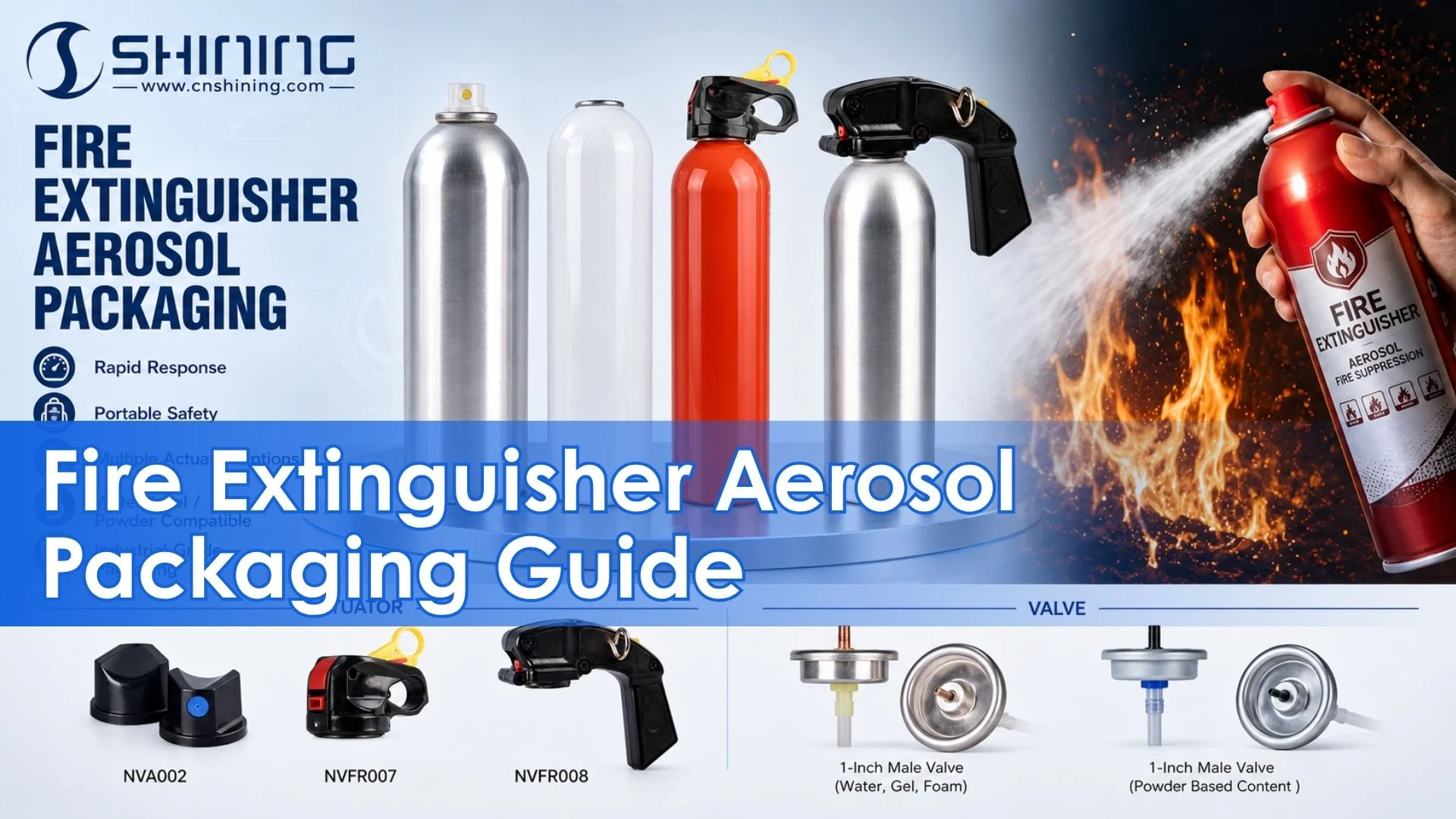
A fire extinguisher can is not a small traditional extinguisher in a different shape. It is a portable aerosol fire suppression system, commonly described in retail and technical searches as an aerosol fire extinguisher. The container, valve, actuator, propellant, nozzle and extinguishing agent work as one package. If one part fails, the product may still look fine on the shelf but fail when the user needs it.
1. Definition and Product Boundary
In retail language, “fire extinguisher can” usually refers to a portable fire extinguishing spray, aerosol fire extinguisher, spray can fire extinguisher, or mini fire extinguisher can. It is normally disposable, light, easy to place in a kitchen, camper, car, workshop or outdoor gear box, and designed for users with little training.
It should not be confused with three nearby categories. A traditional stored-pressure portable extinguisher follows a different service and rating logic. A fire blanket is a physical smothering product. A fixed condensed aerosol fire suppression unit is a different system used for enclosed spaces and electrical cabinets, not a hand-held consumer spray can.
2. Working Mechanism: Release, Spray and Fire Suppression
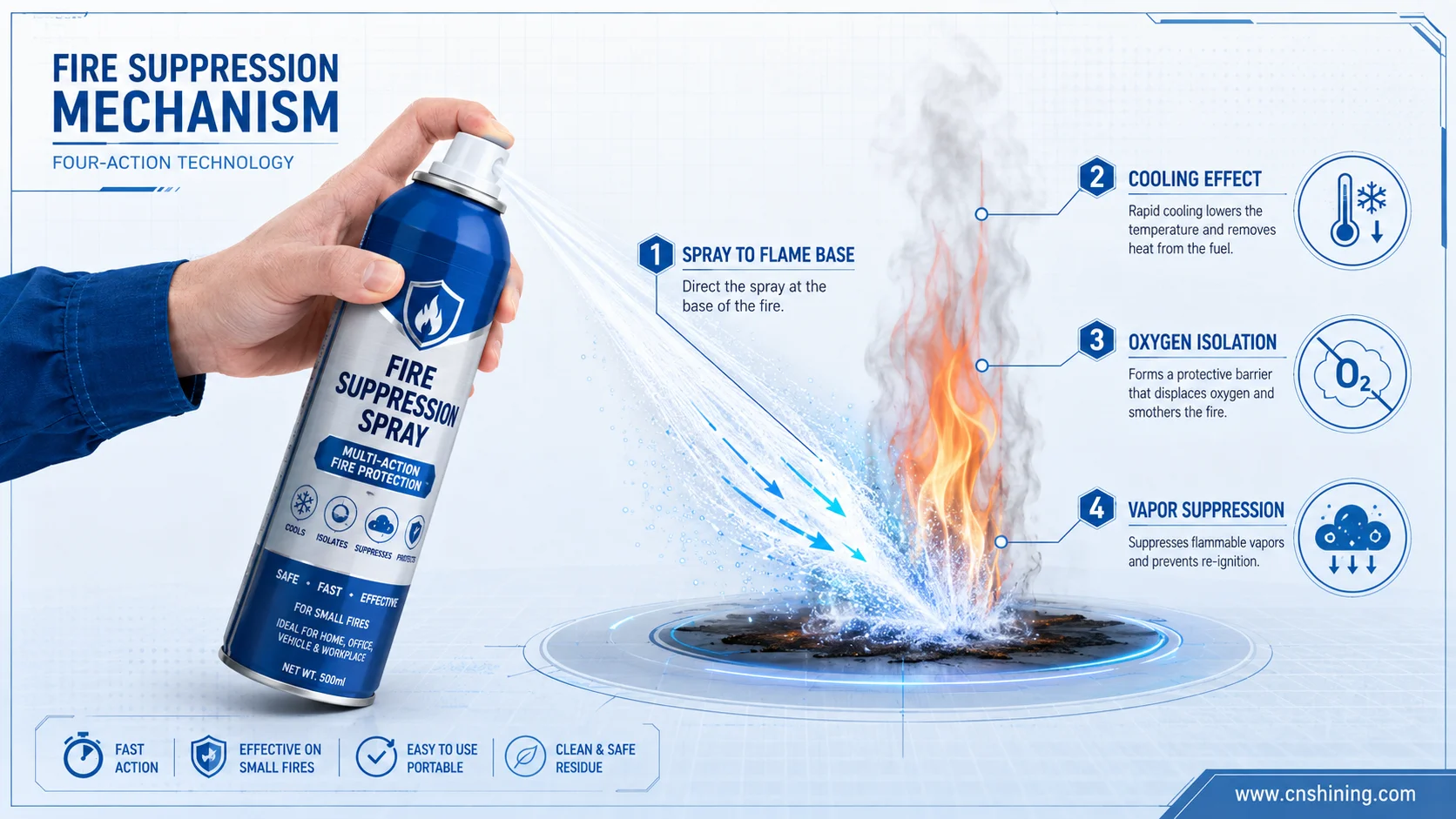
A fire extinguisher spray works by moving the right extinguishing medium to the flame base and fuel surface fast enough. The performance is controlled by the agent chemistry and the package. Valve seal, pressure platform, dip tube or inner bag, nozzle geometry, droplet size, foam structure, spray cone angle and discharge time all change the result.
- Step 1: The user removes the cap or safety device, then presses the actuator or trigger.
- Step 2: The valve opens. Propellant or stored gas drives the extinguishing medium through the dip tube or bag outlet.
- Step 3: The nozzle turns liquid, foam or powder-bearing medium into a spray, stream or cone.
- Step 4: The agent reaches the flame base and fuel surface, then cools, blankets, dilutes oxygen, suppresses vapor or interrupts flame chemistry.
The main suppression routes are clear. Water-based spray cools and wets. Foam covers the surface and reduces vapor release. Dry chemical powder interrupts free-radical chain reactions. CO2 reduces local oxygen concentration and cools during expansion. Wet chemical systems form a saponified layer on hot cooking oil. Condensed aerosol systems use potassium-bearing particles to capture H, O and OH radicals in enclosed spaces.
Bag-on-Valve, or BOV, deserves separate attention. In BOV, the extinguishing liquid is held inside an inner bag while compressed gas outside the bag provides force. This helps 360-degree use, reduces direct contact between propellant and liquid, and can improve storage stability. It also changes the package validation work. The bag, valve, crimp and can must be tested as one pressure system.
3. Extinguishing Agents, Formulation Windows and Terms
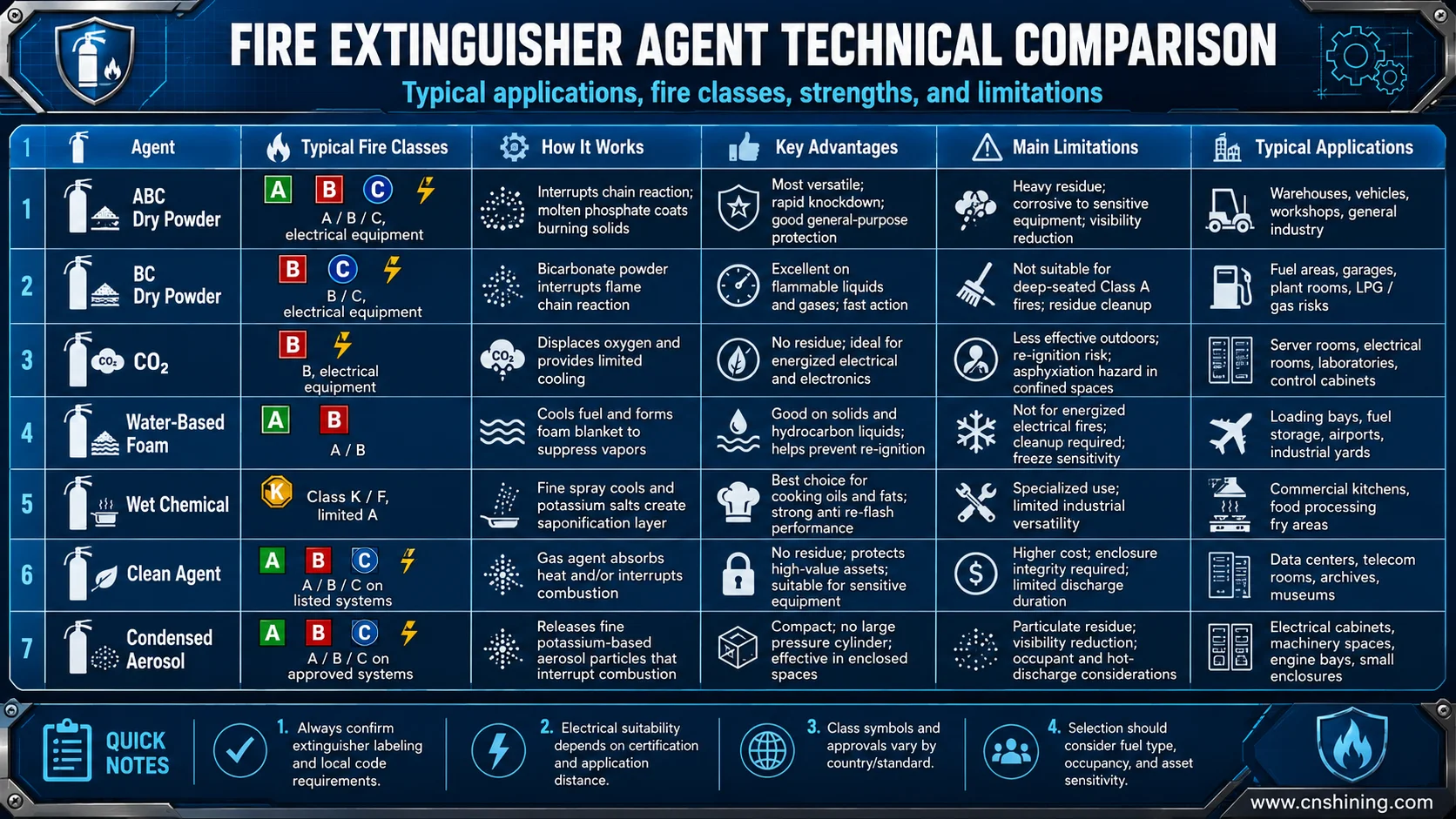
A fire extinguisher can is not one chemical formula. An aerosol can fire extinguisher must be engineered as a complete container-agent system. The same principle applies to a fire extinguisher spray can, where formulation and package performance are inseparable.
| Agent Type | Representative Public Composition | Main Mechanism | Safety / Limitation | Storage Observation |
|---|---|---|---|---|
| ABC dry powder | Monoammonium phosphate 80-100%, calcium carbonate 1-5%, clay or mica about 0.5-1.5% | Surface isolation and flame-chain inhibition for A/B/C fires | Heavy residue; avoid long-term dust inhalation | Mature system; moisture and caking must be controlled |
| BC dry powder | Sodium bicarbonate 80-100% with fillers and anti-caking agents | Strong chain inhibition for B/C fires | Not friendly to precision electronics; residue remains visible | Moisture and compaction affect discharge |
| Purple-K powder | Potassium bicarbonate 75-85%, calcium carbonate 5-15%, mica, clay, silica and dye | Strong liquid-fire suppression | Dust residue and exposure remain the main drawbacks | Avoid high humidity and strong acid environments |
| CO2 | Carbon dioxide 99.8-100% | Oxygen dilution and expansion cooling | Asphyxiation risk in confined areas; cold discharge can injure skin | Pressure cylinder route is mature but needs strict heat management |
| Water-based foam / spray | Example from a public SDS: water 73.4%, propylene glycol monobutyl ether 7%, several anionic surfactants 1-5%, nitrogen 1.1% | Cooling, wetting, foam cover and vapor suppression | Eye and skin irritation possible; fluorine-free status must be checked by formulation | Needs good compatibility with lining, gasket and valve materials |
| Wet chemical | Potassium acetate 30-60%, usually nitrogen or compressed air as expellant | Saponification and cooling on hot cooking oil | Best suited to F/K fires; electrical use needs label confirmation | Corrosion resistance and material compatibility are key |
| Clean agent | Example: Halotron-I with HCFC-123 85-95%, proprietary gas blend 1-10%, argon expellant | Heat absorption and gas-phase inhibition with low residue | Higher cost; confined-space exposure and environmental pressure remain concerns | Pressure system is stable, but regulatory substitution pressure continues |
| Consumer water-based spray | Some products disclose only partial ingredients and trade-secret components, nitrogen pressurization | Cooling and surface coverage for small fire areas | Actual fire class and use boundary must follow the label | Users need clear shelf-life and usability signals |
| Condensed aerosol | Typical patents show oxidizer 58-78%, reducer 8-28%, modifier 2-12%, binder 2-11% | Potassium-containing particles capture flame radicals in enclosed volumes | Not the same as hand-held consumer spray; residue and activation safety must be reviewed | Closer to fixed fire suppression device engineering |
For water-based fire extinguishing spray, public SDS evidence is useful because it shows the package is not “just water” .
| Term | Engineering Meaning | Commercial Meaning |
|---|---|---|
| Portable aerosol dispenser | Small non-refillable pressurized device that discharges an extinguishing medium | Retail-friendly, low-training fire response format |
| Incipient fire | A small fire still controllable by one person using a portable device | The real use boundary of most fire extinguisher cans |
| Fire class A/B/C/F/K | Solid combustibles, flammable liquids, electrical, cooking oil and related categories | Labels must state what the product can and cannot address |
| Discharge time | Continuous spray duration before the package empties | Defines user correction time during panic use |
| Spray pattern | Cone angle, stream shape and coverage pattern | Wide coverage is not automatically better if reach becomes too short |
| Bag-on-Valve | Inner bag separates liquid product from compressed gas | Supports 360-degree use and cleaner formulation control |
| Saponification | Wet chemical reaction forming a soap-like layer on hot oil | Key mechanism for cooking oil fire products |
| PFAS-free / fluorine-free | No PFAS or fluorinated surfactant system | Growing claim area in water-based foam products |
| Limited Quantity | Transport simplification route for certain dangerous goods conditions | Directly affects ecommerce and cross-border logistics |
| Shelf life | Marked service life under defined storage conditions | A trust point because many cans lack pressure gauges |
4. Performance Comparison and Use Scenarios
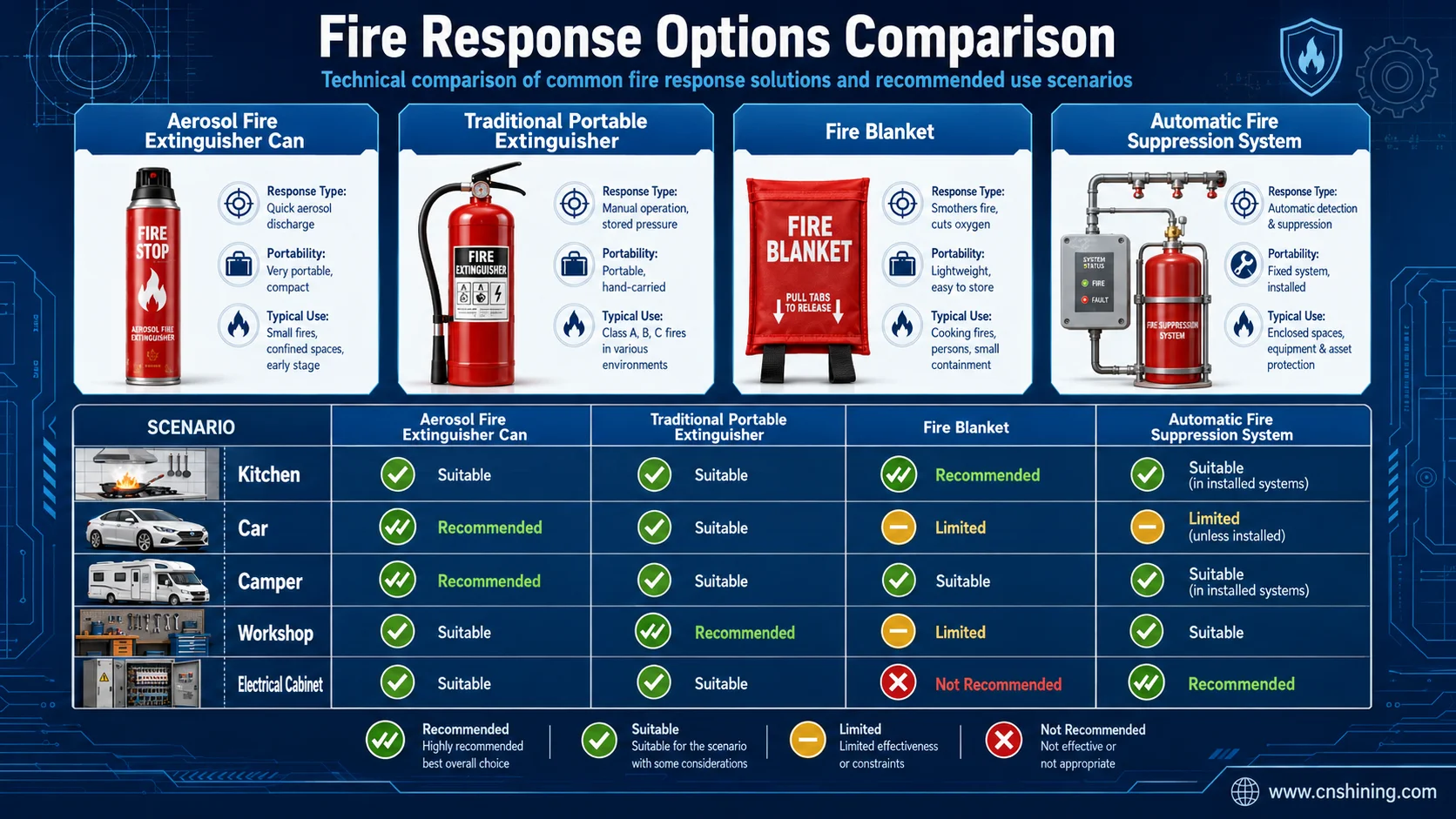
The closest competitor to a fire extinguisher in a can is not an industrial suppression system. It is the small home ABC extinguisher and the fire blanket. Each product has a different job. The can wins on reach speed and placement flexibility. The traditional portable fire extinguisher wins on capacity, rating maturity and status visibility.
| Dimension | Fire Extinguisher Can | Traditional Portable Extinguisher | Fire Blanket | Automatic System |
|---|---|---|---|---|
| Core role | Fast first response for small fires and distributed placement | Main home and commercial fire protection device | Kitchen pan fire, clothing fire, smothering use | Building or equipment-level protection |
| User skill | Low; similar to spray-can operation | Moderate; pull, aim, squeeze and sweep training helps | Low to moderate; needs close approach | Low during operation, but installation is technical |
| Capacity | Small; limited fire size | Medium to high | Depends on blanket size | Depends on system design |
| Residue | A water-based fire extinguishing aerosol spray can leave less residue, as can clean-agent versions; dry powder versions are still messy | Dry powder residue can be heavy; CO2 and clean agents are cleaner | Almost no chemical residue | Depends on agent type |
| Status visibility | Usually no pressure gauge | Most common units include a gauge | Packaging integrity only | Inspection and monitoring route |
| Maintenance | Usually disposable; replace at expiry | Inspectable, serviceable and sometimes refillable | Replace if damaged or used | Professional maintenance |
| Main weakness | Small capacity, unclear boundary and user trust gap | Larger size and more training burden | Narrow use range | Higher installation and maintenance cost |
The safer deployment logic is simple: use a traditional extinguisher for the main protection point and use fire extinguisher cans as close-access supplements. Typical locations are under the kitchen counter, beside a grill, in a camper, near a tool bench, in a car door compartment, or close to a small charging area. Should a consumer be told to use a small fire extinguisher or aerosol can on every fire? No. That is exactly where credibility is lost.
5. Market Size and Demand Signals
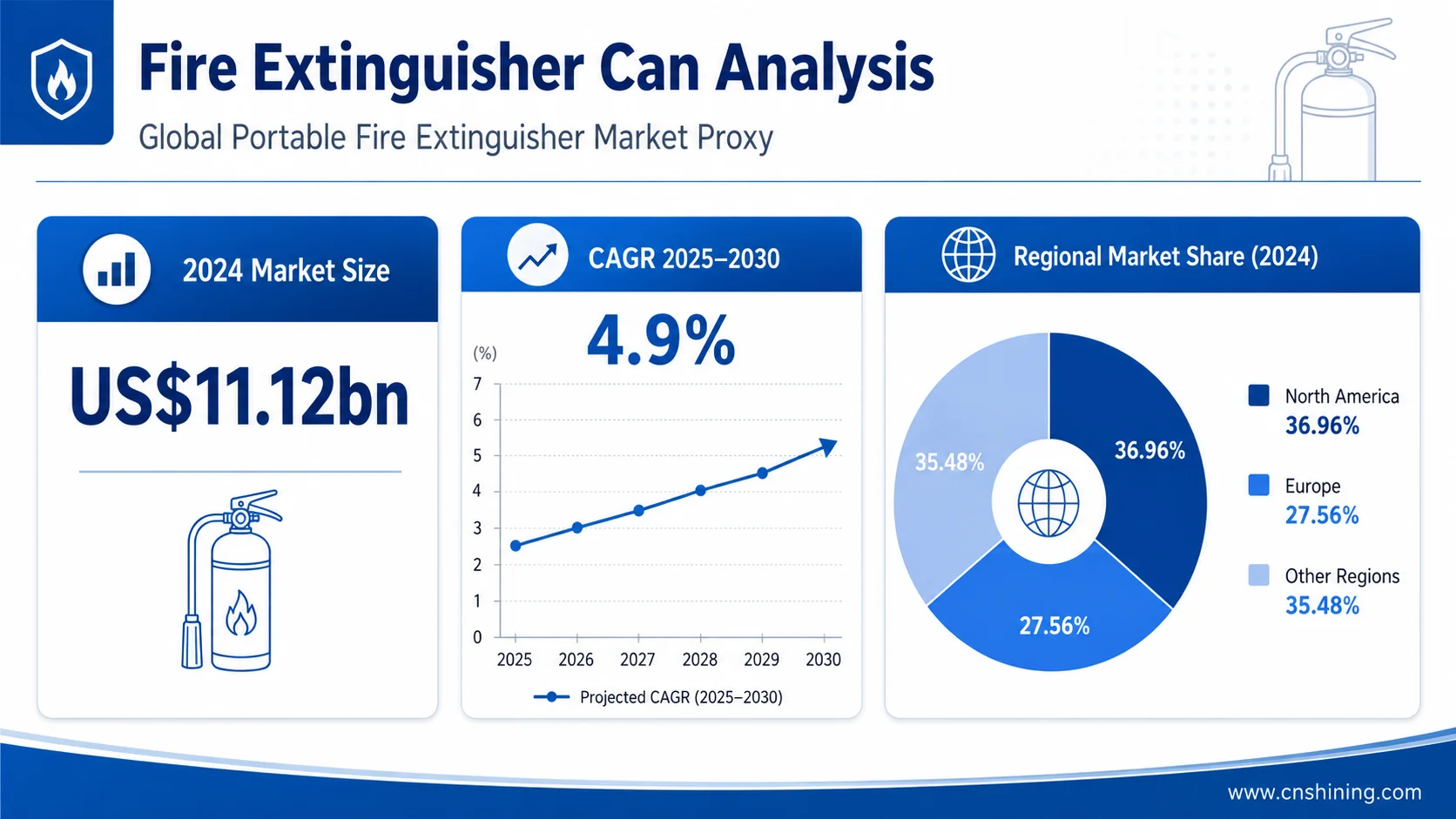
The source report uses the Grand View Research portable fire extinguisher market data tree as the closest public reference. The global portable fire extinguisher market is stated in the report at $11.12 billion in 2024, with 2025-2030 CAGR of 4.9%. North America accounts for 36.96% and Europe for 27.56% in the same proxy structure.
North America: 36.96%
Europe: 27.56%
Other regions: 35.48%
| Market Scope | Time Point | Scale / Growth | Region Signal |
|---|---|---|---|
| Global fire extinguisher market, broad scope | 2019 | $4.32bn | No separate aerosol can split |
| Global fire extinguisher market, broad scope | 2027E | $5.95bn; CAGR 4.1% | No separate aerosol can split |
| Global portable fire extinguisher market | 2024 | $11.12bn | North America 36.96%; Europe 27.56% |
| Global portable fire extinguisher market | 2025-2030 | CAGR 4.9% | North America and Europe remain high-share regions |
| European portable fire extinguisher market | 2024 | $3.06bn | Europe |
| North America portable fire extinguisher market | 2024 | about $4.11bn by share calculation | North America |
Growth is driven less by “more fires” and more by fragmented use points: open kitchens, campers, outdoor cooking, charging equipment, micromobility batteries, small workshops and rental apartments. Users want something close at hand. That favors smaller disposable aerosol fire extinguisher cans, provided the label is honest about fire size and use limits. An aerosol spray fire extinguisher fits this close-access role because its compact format supports distributed placement.
6. Standards, Ratings and Transport Compliance
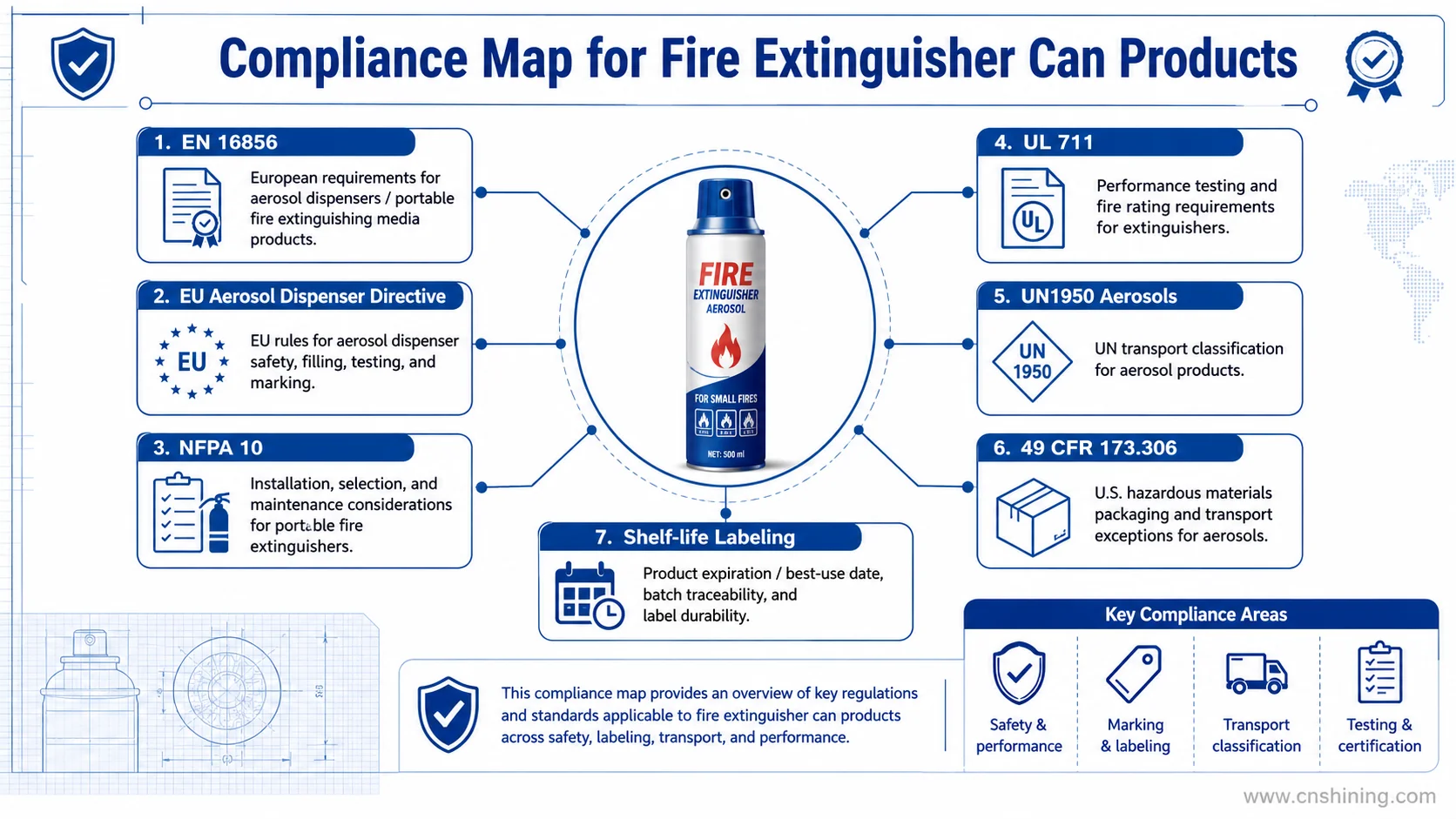
The biggest compliance mistake is to treat a consumer aerosol fire spray as automatically equivalent to a traditional code-required extinguisher. It may suppress a small fire. That does not mean it can replace a rated extinguisher in every jurisdiction or building use case.
In the United States, UL fire extinguisher testing and certification separates testing routes by agent and product type. UL 711 covers rating and fire tests; other standards cover dry chemical, CO2 and halogenated clean-agent extinguishers. The certification path is not one generic “spray can” route.
Transport is a separate layer. A fire extinguisher aerosol can commonly falls under UN1950 Aerosols for transport purposes, while some traditional extinguishers may follow other dangerous goods routes. The 49 CFR 173.306 limited quantities of compressed gases text sets specific preparation and packaging conditions for compressed gases and aerosol-related shipments. This affects ecommerce, cross-border logistics and warehouse handling.
| Region / Layer | Main Standard or Rule | Product Scope | Practical Meaning for Fire Extinguisher Can |
|---|---|---|---|
| United States | NFPA 10 | Portable fire extinguishers | Placement and maintenance logic; aerosol cans may not replace code-required units |
| United States | UL 711 / UL 299 / UL 154 / UL 2129 | Rating, dry chemical, CO2 and clean-agent routes | Certification depends on agent and product architecture |
| European Union | Aerosol Dispenser Directive | Aerosol containers | Pressure, flammability and container safety framework |
| European Union | EN 16856:2020 | Portable aerosol dispensers for fire extinguishing | Closest European standard for consumer fire extinguishing aerosol products |
| United Kingdom | BS 6165 | Small disposable aerosol fire extinguishers | Relevant for miniature disposable aerosol products |
| Transport | UN1950 / 49 CFR / ADR | Aerosol cans and compressed gas packages | Direct effect on shipment, storage, ecommerce and export routes |
7. Top 10 Fire Extinguisher Can Brands
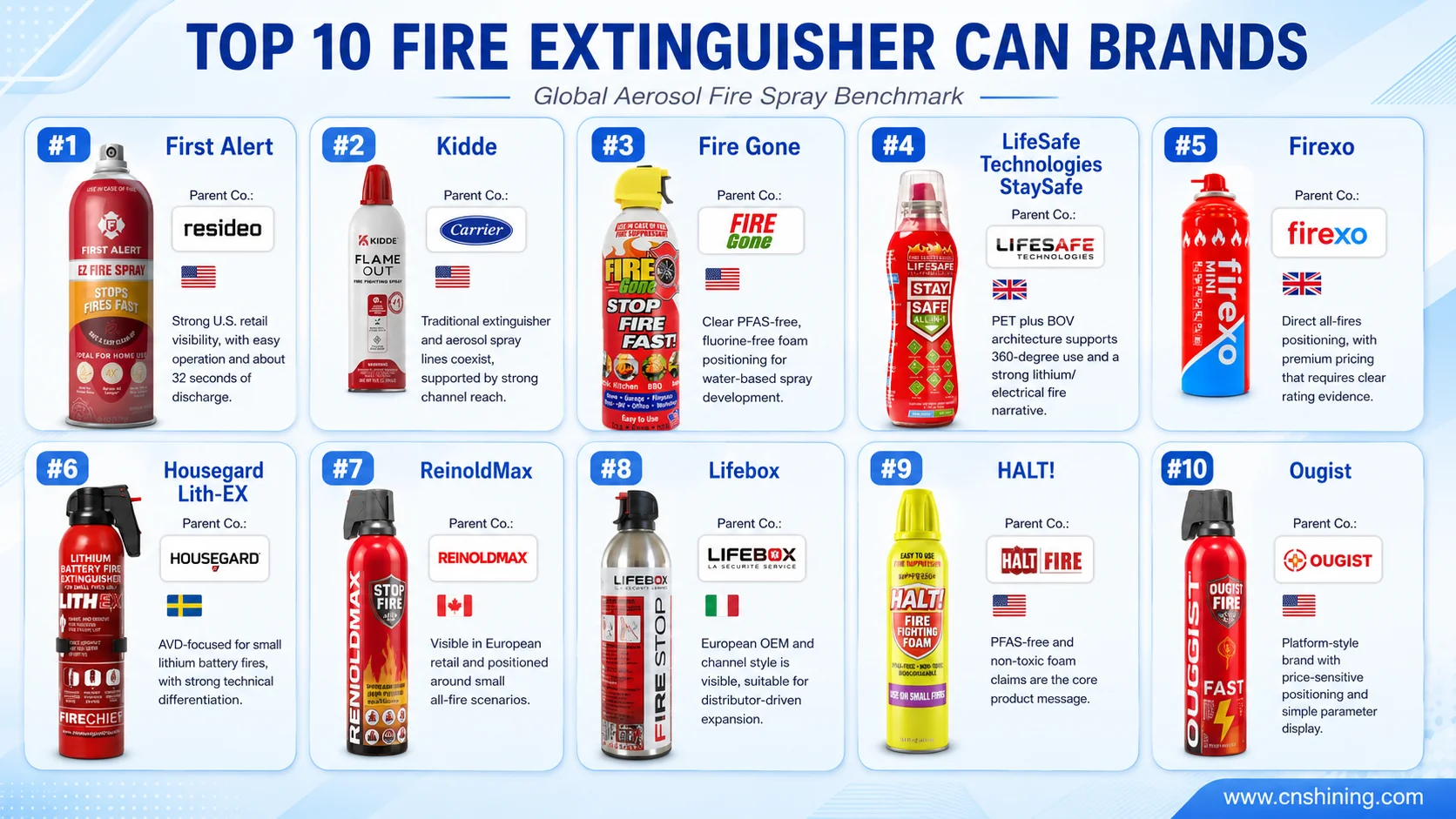
The following matrix is not an official sales ranking. It should also not be read as a definitive guide to the best aerosol fire extinguisher products. It is organized from public visibility, retail presence and product information available during the source research. Retail and brand-store links are intentionally omitted here. Prices move quickly and are used only as channel-position signals.
| Brand | Country / Region | Typical Size | Public Price Range | Technical Comment |
|---|---|---|---|---|
| First Alert | United States | 18 oz | about $13.98 single unit | Strong U.S. retail visibility. The product message centers on easy operation and about 32 seconds of discharge. |
| Kidde | United States | 17.6 oz | about $9.29-11.47 | Traditional extinguisher and spray fire extinguisher lines coexist. Channel strength is high. |
| Fire Gone | United States | 16 oz | about $16.99-17.99 | Clear PFAS-free and fluorine-free foam positioning. Relevant for water-based spray can development. |
| LifeSafe Technologies StaySafe | United Kingdom | 335 ml | about $19.99 and up | PET plus BOV architecture. Strong 360-degree use and lithium/electrical fire narrative. |
| Firexo | United Kingdom | 150 ml Mini | about $29.99-33.09 | All-fires positioning is direct, and the compact format is representative of the mini fire extinguisher spray segment. Pricing is relatively high, so rating evidence must be clear. |
| Housegard Lith-EX | Sweden | 500 ml | about $58.15-77.91 | AVD focus for small lithium battery fires. Strong technical differentiation. |
| ReinoldMax | Canada | 500-750 ml | about $7.63-28.54 | Visible in European retail. Positioned around small all-fire scenarios. |
| Lifebox | Italy | 600 cc | about $20.00-22.84 | European OEM and channel style is visible. Suitable reference for distributor-driven expansion. |
| HALT! | United States | 10 oz | about $12.97 | PFAS-free and non-toxic foam claims are the main message. |
| Ougist | United States | 620 ml twin pack | about $18.99 | Platform-style brand. Price-sensitive positioning with simple parameter display. |
8. User Pain Points and Packaging Improvements
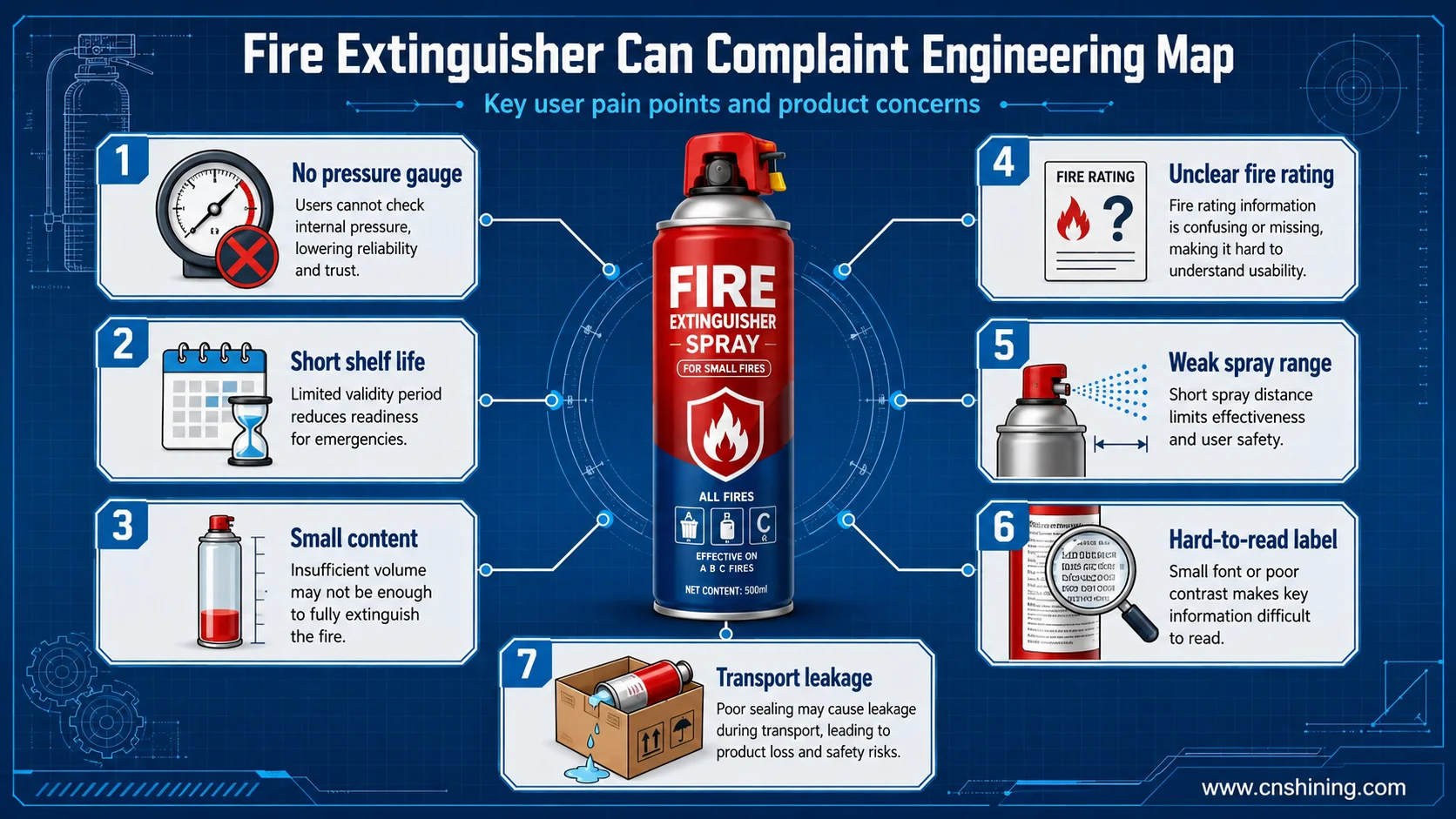
User feedback is consistent. People like the size, storage convenience and low operating burden. The complaints are more useful: limited contents, no pressure gauge, unclear rating, uncertainty around expiry, concern about spray range, and distrust when brands imply the can replaces a regular extinguisher.
Reddit discussions are not laboratory data, but they show the trust problem well. In one discussion about fire spray cans, users describe them as useful for very small incipient fires while warning that they have limited contents and should be paired with a regular extinguisher. That is a reasonable field view.
| User Pain Point | Packaging Area | Practical Improvement | Why It Helps |
|---|---|---|---|
| No way to know if it is still usable | Printing, indicator, BOV structure | Large expiry date, production date, storage temperature range, optional simple status indicator | Builds confidence in shelf-life without a traditional pressure gauge |
| Small content and short discharge time | Can size, valve rate, user instructions | State discharge time and maximum use scenario clearly; avoid oversized claims | Prevents misuse on fires beyond the product boundary |
| Spray too wide or reach too short | Nozzle and actuator | Use controlled spray geometry; consider stream-to-cone staged design for water-based products | Improves stand-off distance and coverage balance |
| Panic operation errors | Trigger, actuator and direction marking | Use trigger-style actuator with clear arrow and grip cue | Reduces wrong-direction spraying under stress |
| Hard to store at the real risk point | Can shape and accessories | Add anti-roll base, wall clip, magnetic holder, car bracket or flat-sided sleeve | Improves actual placement near kitchen, camper and workshop risks |
| Leakage or weak output after storage | Valve, gasket, crimp, inner coating | Run long-term leakage, thermal cycling, crimp quality and gasket compatibility tests | Slow leakage is a failure mode, not a minor packaging defect |
| Unclear claims | Front label and back label | Show fire class, operation distance, “not a replacement where code requires rated extinguisher,” and one-time use warning | Improves trust with professional users and cautious buyers |
The packaging answer is not only “make a stronger formula.” In this category, packaging must create certainty: can it spray, how long does it spray, how far does it spray, what fire class is it for, and when should it be replaced?
9. Shining Packaging Components for Fire Extinguisher Can Systems
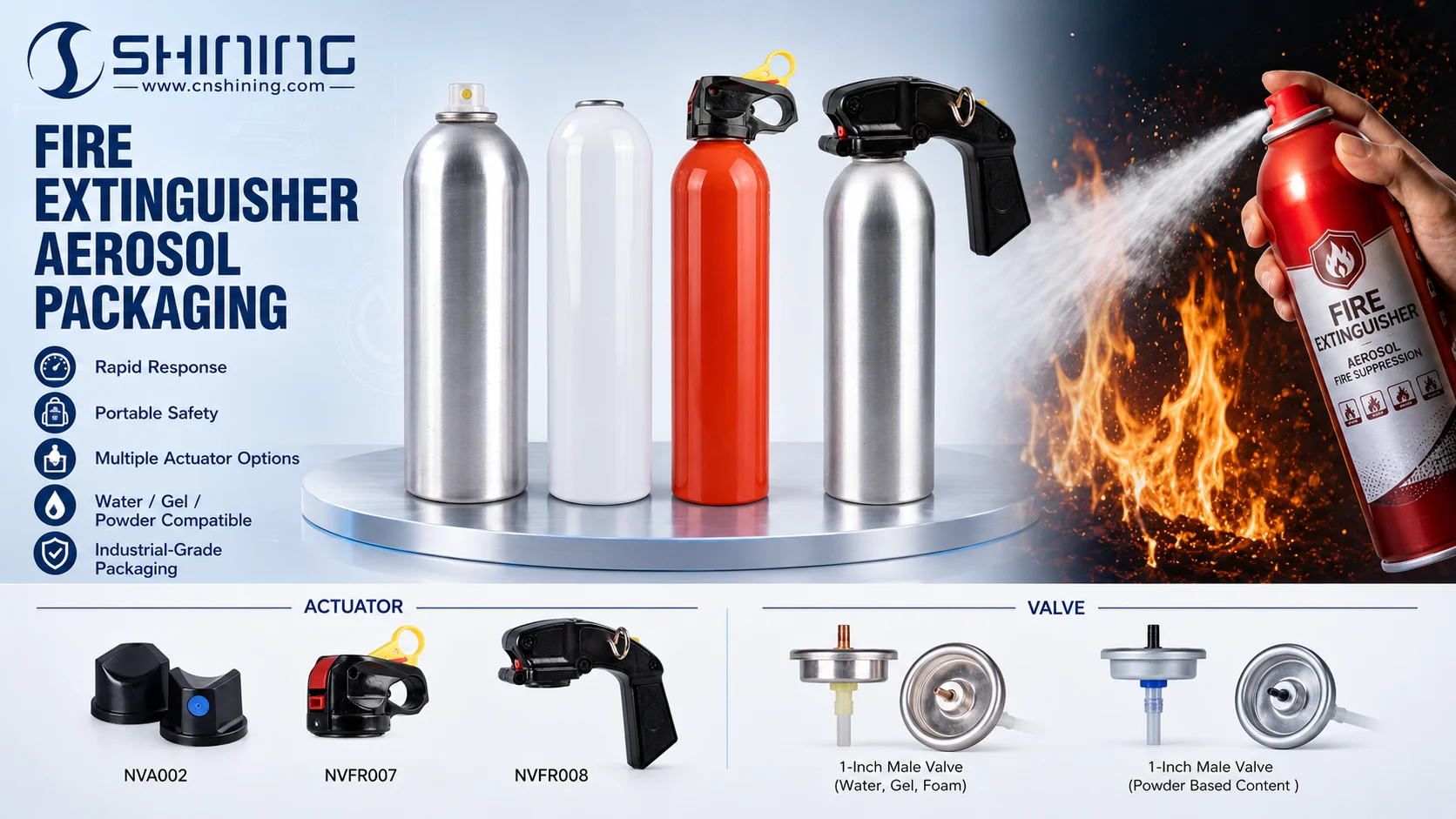
For Shining Packaging, the relevant product interface is clear: actuators, aerosol cans and valves. In a fire extinguisher can, these components define more than appearance. They control actuation force, spray direction, discharge consistency, leakage risk, can pressure performance, crimp reliability and compatibility with water-based foam or other suppressant liquids.
A sensible packaging brief should start with the fire scenario. Kitchen foam spray, camper safety spray, lithium battery adjacent products and a general household fire extinguisher aerosol spray do not need the same nozzle or label hierarchy. The actuator and valve should be selected with agent viscosity, foam generation, spray distance, storage angle and user stress behavior in mind.
| Component | Engineering Question | Recommended Check |
|---|---|---|
| Actuator | Can the user aim correctly under panic? | Evaluate trigger feel, top-button force, direction arrow, spray cone and anti-accidental-discharge design. |
| Valve | Can the system hold pressure and meter liquid consistently? | Test gasket compatibility, discharge rate drift, clogging, foam behavior and repeated short-burst performance. |
| Aerosol can | Can the can meet pressure, corrosion and shelf-life demands? | Validate pressure resistance, lining compatibility, crimp quality, leakage, drop performance and heat exposure. |
| BOV option | Does the liquid need separation from compressed gas? | Check 360-degree discharge, bag integrity, evacuation rate and long-term interaction with suppressant liquid. |
| Printing and coding | Can the user understand the product in three seconds? | Use large fire-class icons, operation distance, expiry date, storage limits, QR video and batch traceability. |
10. Conclusion
The fire extinguisher can has a real use case. It gives ordinary users a small, familiar and easy-to-place fire response tool for the first seconds of a small fire. The risk starts when it is sold as an all-purpose replacement for rated portable extinguishers.
The better product direction is practical: clear fire-class labeling, visible shelf-life information, reliable valve and crimp quality, controlled spray geometry, compatible can lining, honest lithium battery claims, PFAS-free foam evidence where relevant, and recycling instructions that users can understand. In this category, trust comes from technical certainty, not loud claims.
11. FAQ: Fire Extinguisher Can
No. A fire extinguisher can is usually a small disposable aerosol product for incipient fires. A traditional portable extinguisher normally has a larger agent load, clearer rating system, service route and often a pressure gauge. The can is useful as a close-access supplement, but it should not be assumed to replace a rated extinguisher required by code.
That depends on the agent, test standard and label. Some water-based sprays target small A, B, electrical or cooking risks, while dry chemical products may cover broader A/B/C classes. Lithium battery claims need extra caution because cooling and re-ignition control are difficult. Buyers should read the stated fire class, test basis, use distance and maximum scenario.
Most consumer aerosol cans use sealed disposable packaging rather than the serviceable cylinder architecture used by many traditional extinguishers. This makes them lighter and cheaper, but removes a familiar status signal. Good packaging should compensate with clear production date, expiry date, storage limits, batch traceability and, where possible, a simple usability or pressure-status indicator.
EN 16856:2020 is a European standard for portable aerosol dispensers used for fire extinguishing purposes. It covers non-refillable metal aerosol products below 1 kg or 1 L for limited domestic fires and untrained users. It is closer to the fire extinguisher can category than traditional EN 3 portable extinguisher standards.
Spray pattern decides how far the user can stand, how much agent reaches the flame base, and whether the product covers the fuel surface evenly. A very wide cone may look reassuring but can reduce throw distance and concentration. A narrow stream may reach farther but cover less area. The nozzle must match the agent and target fire.
Bag-on-Valve separates the liquid suppressant from the compressed gas. This can support 360-degree spraying, reduce direct propellant contact, improve evacuation, and help storage stability for water-based or foam liquids. It also adds validation work. The inner bag, valve, crimp and can must resist pressure, aging, heat exposure and leakage over the marked shelf life.
PFAS-free or fluorine-free claims usually relate to the foam or surfactant system. The formula must still wet, cool, spread and suppress vapor without fluorinated surfactants. That can increase the need for careful surfactant selection, corrosion testing and label clarity. The claim is useful only when supported by SDS, test evidence and realistic fire-class statements.
Only within a narrow and clearly tested use case. Lithium battery events can involve thermal runaway, re-ignition and long cooling demand. Some AVD, vermiculite dispersion or gel systems are aimed at battery risks, but a small consumer can has limited content and discharge time. The label should state battery size, fire condition and test basis.
The key tests are pressure resistance, valve leakage, crimp integrity, gasket compatibility, inner coating compatibility, drop resistance, thermal cycling, corrosion, discharge rate stability and spray pattern consistency after storage. A fire extinguisher can may sit unused for years, so long-term seal reliability is not a secondary packaging detail. It is part of the safety function.
Rules vary by region and by whether the can is empty. Aerosol cans should not be punctured or burned. Labels should tell users whether the can must be fully discharged before recycling and whether local household hazardous waste handling is required. For brands, “recyclable metal can” should be paired with clear empty-can and local-recycling instructions.