
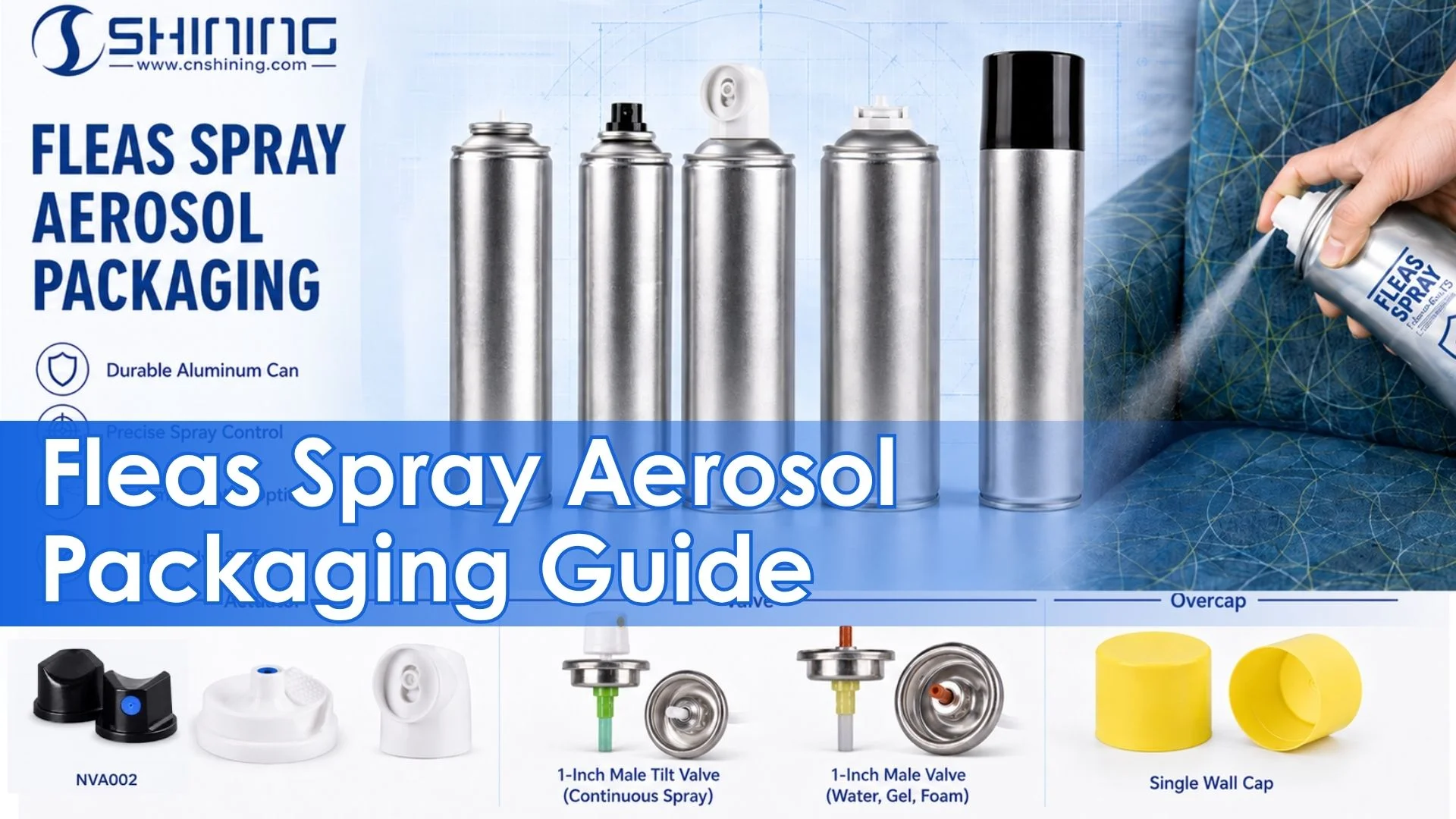
Aerosol spray for fleas is mainly an environmental control product. It is often searched as flea aerosol, household flea spray, premise spray, carpet flea spray, upholstery flea aerosol or flea and tick home spray. The names overlap in retail search, but the technical boundary matters. Some products are made for carpets, bedding and room surfaces. Some are made for direct use on animals. These two routes should not be mixed.
The working logic of mainstream products is stable: fast adult flea kill plus lifecycle interruption. Fast kill is usually provided by pyrethrins, pyrethroids, etofenprox, prallethrin or dinotefuran. Lifecycle control usually comes from insect growth regulators, mainly S-methoprene or pyriproxyfen. The aim is not a single spray event that makes every flea disappear instantly. The aim is to reduce repeated emergence from eggs, larvae and pupae in the pet’s living environment.
1. Definition, Use Boundary and Working Principle
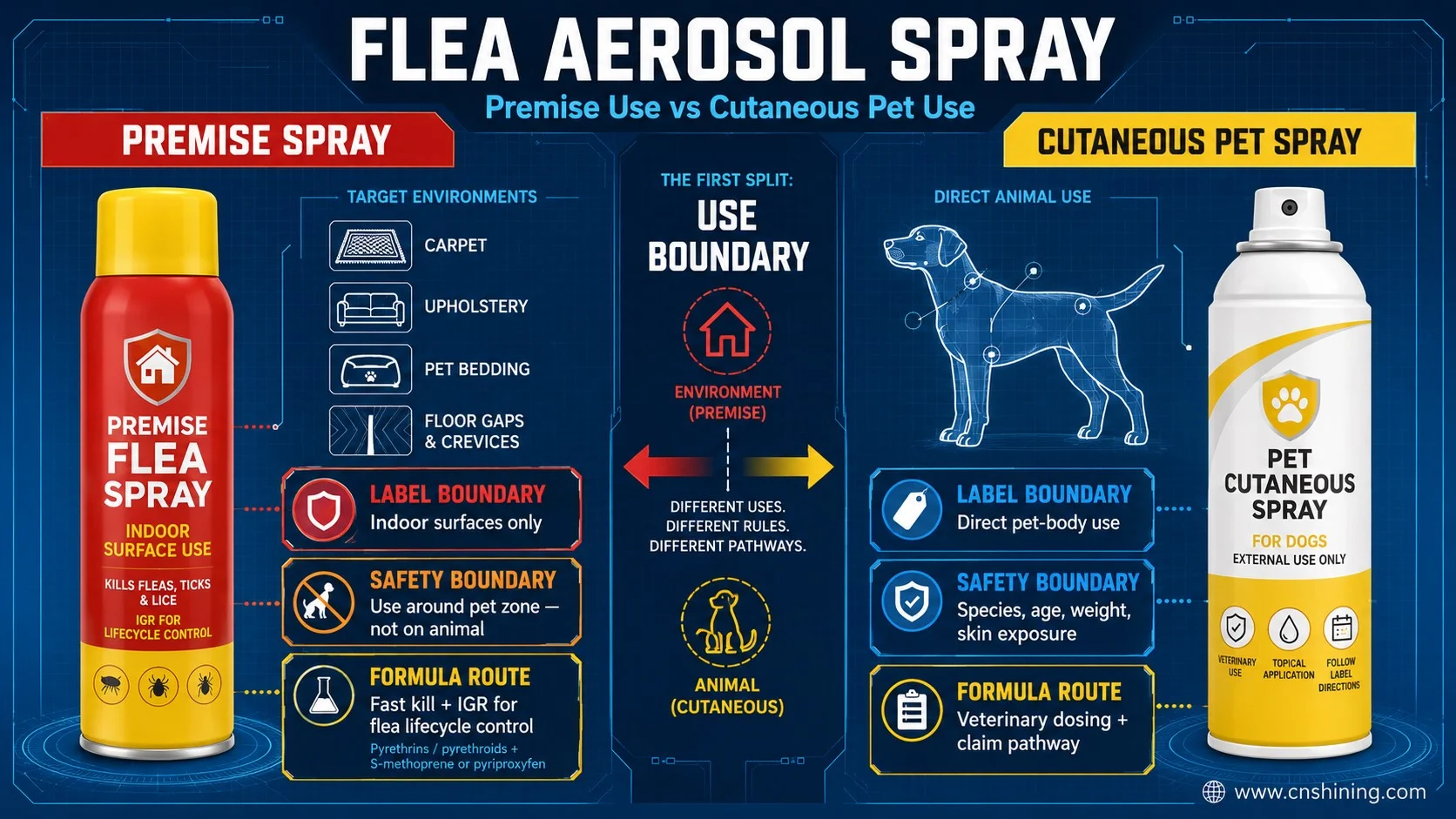
In practical product development, “aerosol spray for fleas” should be split by use boundary first. The formulation, valve choice, label, warning language and legal route all change with the intended use site.
Premise sprays are designed for the environment. They may be applied to carpets, curtains, upholstery, floor gaps, pet bedding and room surfaces. The product is used around the pet’s living zone, not on the animal unless specifically permitted.
Direct animal sprays require a different safety and dosing logic. Species, age, body weight, skin exposure and veterinary claims matter. A household aerosol can with an insecticide active should not be repositioned as a pet-body product without changing the regulatory and safety framework.
The technical reason premise sprays matter is simple. A visible flea on the animal is only part of the issue. Eggs and immature stages may sit in soft furnishing and floor gaps. A product that looks like “just a carpet spray” is often trying to reset the flea lifecycle inside the home.
Pyrethrins and pyrethroids act mainly through insect nerve sodium channels and give fast knockdown. Insect growth regulators do not create the same immediate visual effect. They suppress the development of eggs and larvae, helping reduce later adult emergence. This is why many commercial labels pair fast-kill ingredients with S-methoprene or pyriproxyfen.
2. Main Active Ingredients and Formula Framework
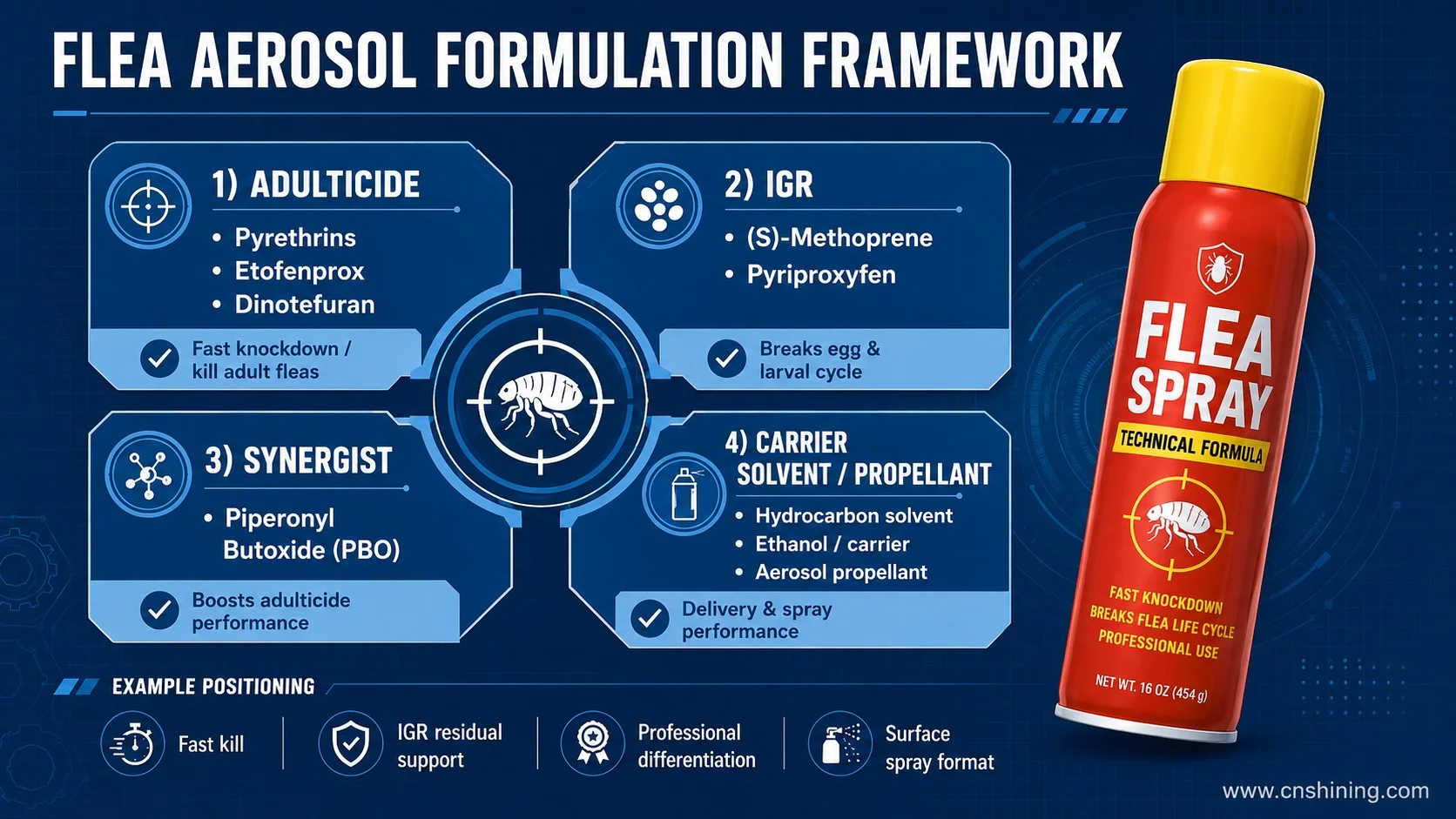
Most public commercial examples follow a combined structure:
Fast-kill active such as pyrethrins, etofenprox, prallethrin or dinotefuran + IGR such as S-methoprene or pyriproxyfen + synergist such as piperonyl butoxide + carrier or solvent + propellant system + valve and actuator fit.
Pyrethrins and pyrethroids are commercially attractive because they are fast. They can create a knockdown effect that users can see. The limitation is clear: if there is no lifecycle control, eggs and larvae remain a problem.
S-methoprene and pyriproxyfen are added for residual lifecycle management. They are not used to create a dramatic “dead flea in seconds” effect. Their value is in suppressing egg hatch, larval development and later adult emergence.
Newer professional products also show a different route. PT Alpine Flea & Bed Bug Pressurized Insecticide uses dinotefuran 0.25%, pyriproxyfen 0.10% and prallethrin 0.05%. This combination sits closer to professional pest control, where low repellency, fast drying and residual performance are easier to explain than in low-cost retail products. A public label-style reference is available at PT Alpine Flea & Bed Bug Pressurized Insecticide label information.
Cat sensitivity deserves a hard line. Permethrin can be risky for cats. “Can be used around dogs” does not mean “safe for cats.” Direct animal use, wet surface contact and re-entry timing must be treated carefully. The MSD Veterinary Manual on ectoparasiticides used in small animals is a useful technical reference for understanding animal ectoparasiticide categories.
| Active Category | Typical Function | Public Example Level | Public Product Example | Commercial Meaning |
|---|---|---|---|---|
| Pyrethrins | Fast knockdown, adult flea kill | 0.15% | ADAMS Flea & Tick Carpet & Home Spray | Fast visible effect, limited residual value alone |
| Tetramethrin | Supports fast knockdown | 0.25% | ADAMS Flea & Tick Carpet & Home Spray | Often used with PBO and IGR |
| Etofenprox | Synthetic fast-kill active for surface treatment | 0.50%–1.00% | ADAMS Home Spray; ADAMS Carpet & Home Spray | Common in household flea sprays |
| Piperonyl butoxide | Synergist for pyrethrin or pyrethroid systems | 1.50%–2.00% | ADAMS Home Spray; ADAMS Carpet & Home Spray | Improves visible fast-kill performance |
| (S)-Methoprene | IGR, inhibits egg and larval development | 0.01%–0.09% | ADAMS Home Spray; ADAMS Carpet & Home Spray; Precor series | Core support for “months of protection” language |
| Pyriproxyfen | IGR, suppresses emergence and reinfestation | 0.10% | PT Alpine; Indorex Defence | Common in professional or long-residual positioning |
| Dinotefuran | Newer non-repellent fast-kill active | 0.25% | PT Alpine Flea & Bed Bug | Professional-channel differentiation point |
| Prallethrin | Fast knockdown | 0.05% | PT Alpine Flea & Bed Bug | Works with dinotefuran and IGR in a combination formula |
| Permethrin | Adulticide, but cat warning is essential | Not always disclosed on public product pages | Indorex Defence | Useful in premise spray, but cat safety language must be visible |
| Fipronil | Veterinary skin spray active | 0.25% w/v | FRONTLINE Spray for Dogs & Cats | More aligned with veterinary cutaneous spray than household aerosol |
| Macrolides | Animal ectoparasite control | Rare in public household aerosol brands | Ivermectin, selamectin, moxidectin in veterinary formats | Not the mainstream household flea aerosol route |
Public labels do not always disclose full solvent, surfactant, stabilizer and propellant systems. These are often grouped under “other ingredients.” What can be seen from public material is that the market includes both water-based aerosol routes and formulas containing petroleum distillates. For example, Precor 2625 is publicly described as a water-based aerosol in its technical material. The Zoëcon Precor 2625 Premise Spray fact sheet is a useful example.
3. Common Technical Terms Used in Flea Aerosol Products
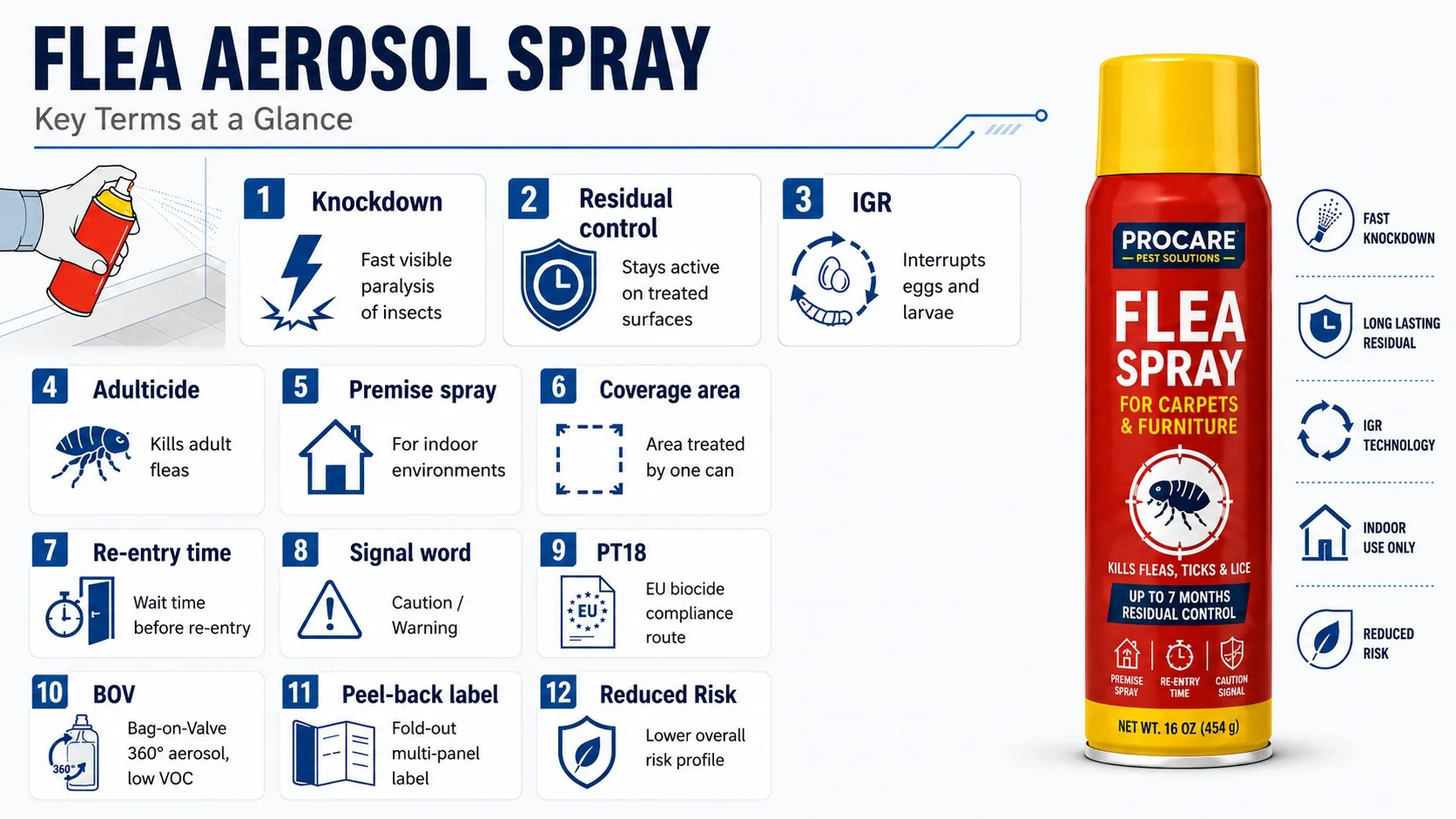
| Term | Plain Technical Meaning | Business Meaning |
|---|---|---|
| Knockdown | Rapid paralysis or fast visible collapse of insects | Shapes the first user impression |
| Residual control | Activity maintained on treated surfaces for a period of time | Determines whether users expect frequent respraying |
| IGR | Insect Growth Regulator | Key for interrupting eggs and larvae |
| Adulticide | Active ingredient that kills adult fleas | Solves the insects users can see immediately |
| Premise spray | Environmental spray, not direct pet application | Core product type for home and professional indoor treatment |
| Coverage area | Area treated by one can | Directly affects cost per treatment and satisfaction |
| Re-entry time | Time before people or pets can enter the treated room again | Strongly affects safety perception and complaints |
| Signal word | Label warning term such as Caution, Warning or Danger | Connects hazard classification with user behavior |
| PT18 | EU BPR product type for insecticides, acaricides and arthropod control | Basic EU route for household flea biocides |
| BOV | Bag-on-Valve aerosol packaging | Supports low VOC, 360° use and product-propellant separation |
| Accordion / peel-back label | Folded or peel-open multi-panel label | Useful for warnings, multilingual text and e-commerce packaging |
| Reduced Risk | EPA positioning for lower overall risk active ingredients | Can help differentiate professional products |
4. Top 10 Retail-Visible Brands and Product Lines
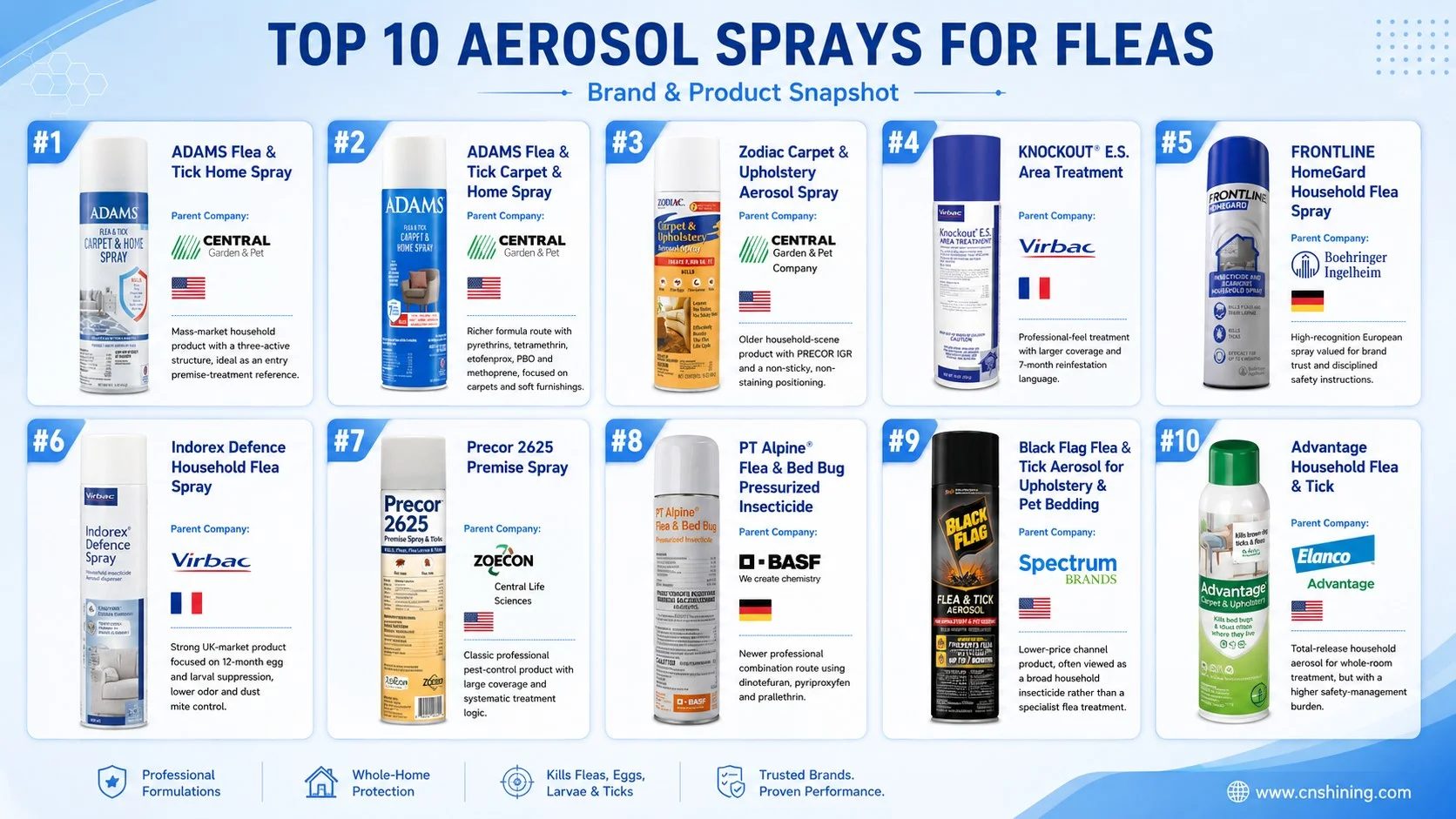
| Brand / Product Line | Country | Parent / Operator | Common Size | Captured Price Range | Short Technical Comment |
|---|---|---|---|---|---|
| ADAMS Flea & Tick Home Spray | United States | Central Garden & Pet | 24 fl oz | about $14.46 | Mass-market household product. Three-active structure. Suitable as an entry premise treatment reference. |
| ADAMS Flea & Tick Carpet & Home Spray | United States | Central Garden & Pet | 16 oz | about $27.02 | Richer formula route, containing pyrethrins, tetramethrin, etofenprox, PBO and methoprene. More focused on carpet and soft furnishings. |
| Zodiac Carpet & Upholstery Aerosol Spray | United States | Central Garden & Pet Company | 16 oz | about $19.99; Amazon about $14.44 | Older household-scene product. PRECOR IGR and non-sticky / non-staining positioning are key user-facing points. |
| KNOCKOUT E.S. Area Treatment | France | Virbac | 16 oz | about $37.99 | More professional feel, larger coverage and 7-month reinfestation language. Higher price than mass retail aerosols. |
| FRONTLINE HomeGard Household Flea Spray | Germany | Boehringer Ingelheim | 500 ml | about $15.59–$16.07 | High-recognition European household spray. Brand trust and disciplined safety instructions are part of the product value. |
| Indorex Defence Household Flea Spray | France | Virbac | 500 ml | about $16.01–$20.09 | Strong UK product. Focuses on 12-month egg and larval suppression, lower odor and dust mite control. |
| Precor 2625 Premise Spray | United States | Central Life Sciences / Zoëcon / Central Garden & Pet system | 21 oz | about $24.84–$26.37 | Classic professional pest control product. Large coverage and systematic treatment logic make it useful for PMP/PCO work. |
| PT Alpine Flea & Bed Bug Pressurized Insecticide | Germany | BASF | 20 oz | about $22.55–$27.95 | Newer professional combination route: dinotefuran, pyriproxyfen and prallethrin. Reduced-risk active positioning is visible. |
| Black Flag Flea & Tick Aerosol for Upholstery & Pet Bedding | United States | Spectrum Brands | 16 oz | about $8.29–$9.99 | Lower price channel product. Often perceived as broad household insecticide rather than specialist flea treatment. |
| Advantage Household Flea & Tick Fogger | United States | Elanco Advantage | 3 × 2 oz foggers | about $19.79–$21.99 | Total-release household aerosol, not a directional spray. Useful for whole-room treatment but higher safety-management burden. |
Three points stand out. First, household OTC and quasi-professional products coexist. Second, professional aerosols are more expensive per can, but compete on coverage, residual effect and job efficiency. Third, in Europe, trust and compliant label design are not soft decoration. They are part of the product’s technical competitiveness.
5. Comparison with Powder, Liquid Spray, Spot-On and Collar Products
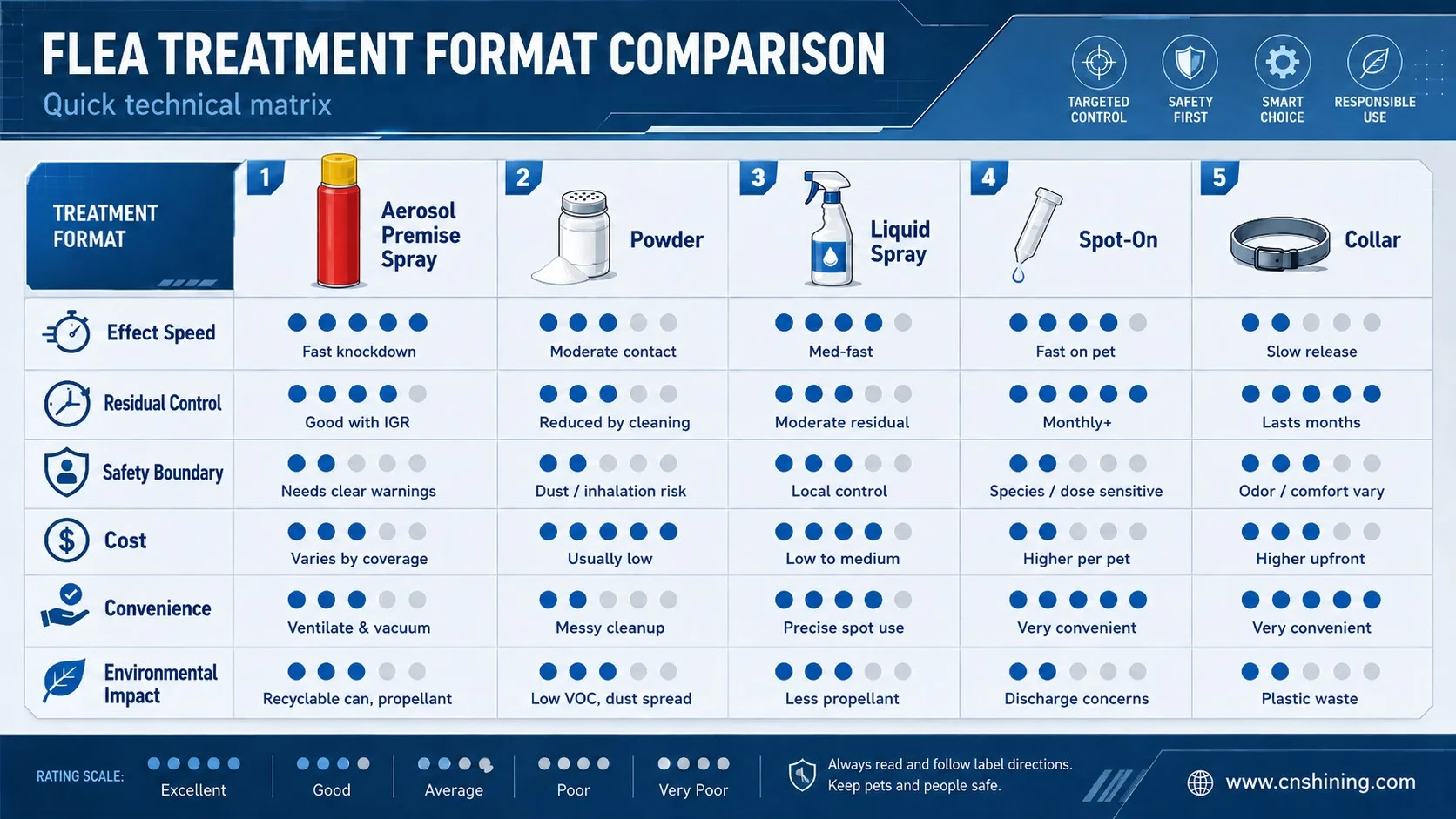
The useful comparison is not “which is the best.” The useful question is where the infestation sits. If the home has become a flea reservoir, aerosol premise spray is hard to replace. If the aim is routine protection on the pet body, spot-on, oral or collar formats are usually easier for the user.
| Dimension | Aerosol Flea Spray | Powder | Liquid Spray | Spot-On | Collar |
|---|---|---|---|---|---|
| Effect Speed | Fast. Adult knockdown is often visible. | Medium. Contact effect exists, but visible effect is weaker. | Medium to fast, depending on active and atomization. | Often fast on pet body, but does not treat the home reservoir. | Slow to medium. Usually continuous release. |
| Residual Effect | Medium to high when IGR is included. | Medium, affected by cleaning and vacuuming. | Medium. | High. Usually monthly or longer. | High. Can last several months. |
| Safety | Depends on active ingredient. Cats, children, fish tanks and ignition sources need clear warnings. | Higher inhalation and dust-spread concern. | Easier to control locally, still active-dependent. | Direct pet exposure. Misuse risk is mainly species, weight and combination treatment. | Long-term body contact. Odor and comfort vary by product. |
| Cost | Low to medium-high per can. Coverage varies widely. | Usually low. | Low to medium. | Often higher when calculated per pet per month. | Higher upfront, moderate when monthlyized. |
| Convenience | Good for large surfaces, but requires leaving the room, ventilation and vacuuming. | Messy and cleanup-heavy. | Good for precise spot treatment. | Very convenient, especially for single-pet homes. | Very convenient, but comfort differs. |
| Environmental Aspect | Metal can is recyclable, but propellant, pressure container and waste-can management matter. | Low VOC, but particulate spread and inhalation are issues. | Less propellant, more plastic packaging. | Environmental discharge debate is increasing. | Plastic waste and long-term active release need attention. |
The conclusion is narrow: when the problem is in the environment, spray has a role. When the problem is only routine pet-body protection, spray is not the lowest-effort option.
6. Regulatory and Compliance Routes
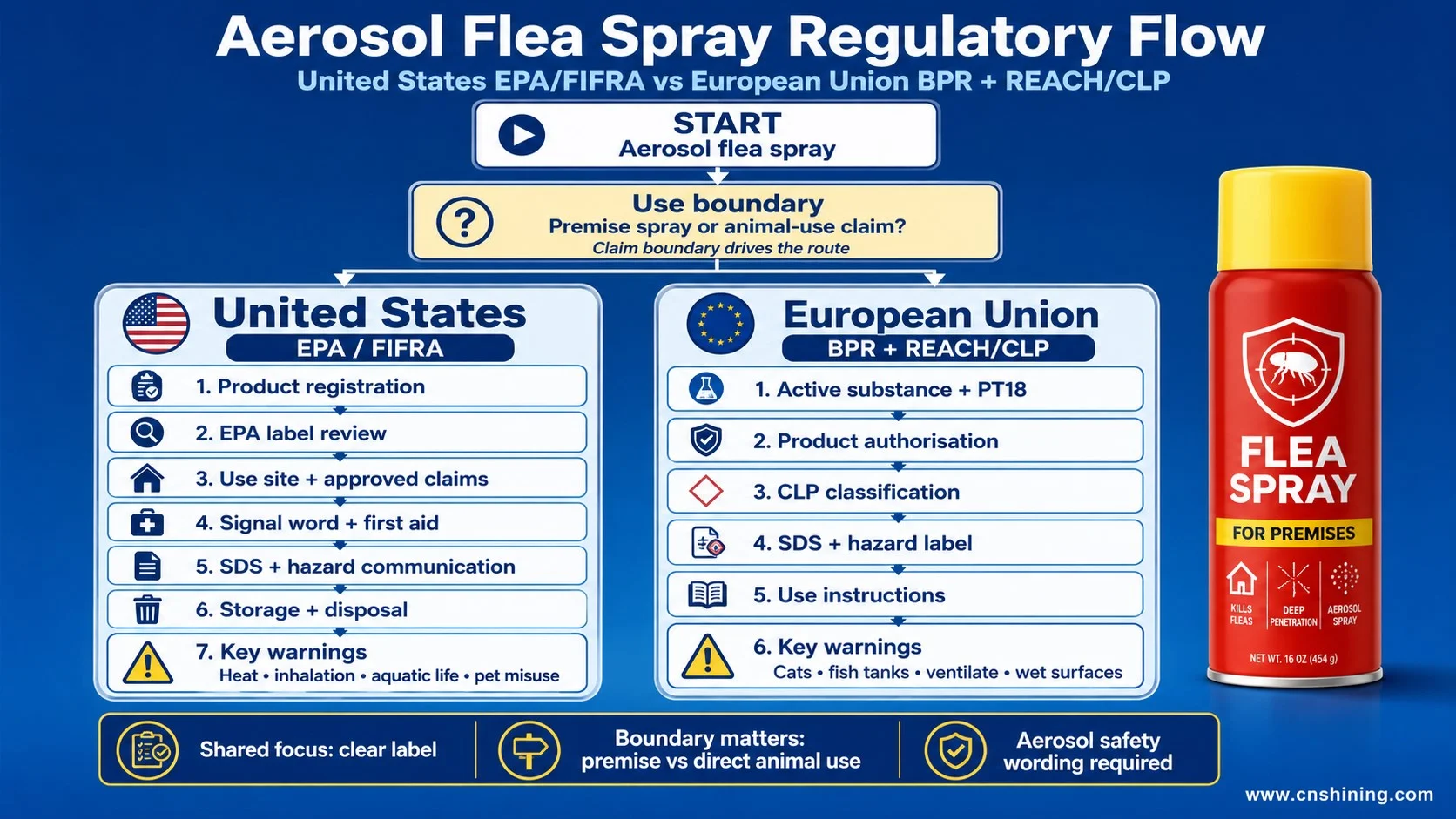
6.1 United States
In the United States, many external flea and tick sprays, carpet sprays, premise sprays and some pet-use pesticidal products are regulated by the EPA under FIFRA. Product registration and label review are entry requirements, not final-stage formalities. The EPA explains its approach on its regulation of flea and tick products page.
The practical compliance points are clear:
- define whether the product is a premise spray or direct animal-use product;
- register the product and align the label with approved claims;
- match signal word, first-aid text and precautionary statements to the hazard profile;
- address pressurized aerosol storage and disposal;
- make aquatic, inhalation, heat and pet-misuse warnings readable.
The EPA Label Review Manual remains a core reference for pesticide label structure. EPA pyrethrins materials also highlight aquatic organism sensitivity, which explains why fish tank and water warnings are common. See the EPA Pyrethrins Reregistration Eligibility Decision.
6.2 European Union
In the EU, household flea aerosols are usually read through the Biocidal Products Regulation route. The relevant product type is generally PT18, covering insecticides, acaricides and products to control other arthropods. The European Commission explains this framework on its biocidal products page.
REACH and CLP then shape chemical registration, classification, safety data sheets and hazard labeling. The EUR-Lex REACH Regulation text is relevant for the chemical substance side. For household flea product restrictions and wording examples, the source report also referenced EUR-Lex Regulation reference CELEX 32020R0704.
EU and UK market labels often provide more visible household instructions: remove pets, cover fish tanks, keep cats away from wet treated surfaces, leave the room after spraying, ventilate and vacuum. This is not just legal text. It reduces misuse.
| Market | Main Regulatory Framework | Key Company Action | Label Focus | Typical Limitation |
|---|---|---|---|---|
| United States | EPA / FIFRA | Product registration, label review, SDS and hazard communication | Signal word, use site, first aid, storage and disposal | Aquatic organisms, ignition sources, children and pet misuse |
| European Union | BPR + REACH/CLP | Active approval, product authorization, classification and label consistency | PT18, CLP hazards, non-target organisms and ventilation instructions | Cat safety, fish tanks, aquatic environment and aerosol classification |
7. User Feedback, Pain Points and Real-Use Problems
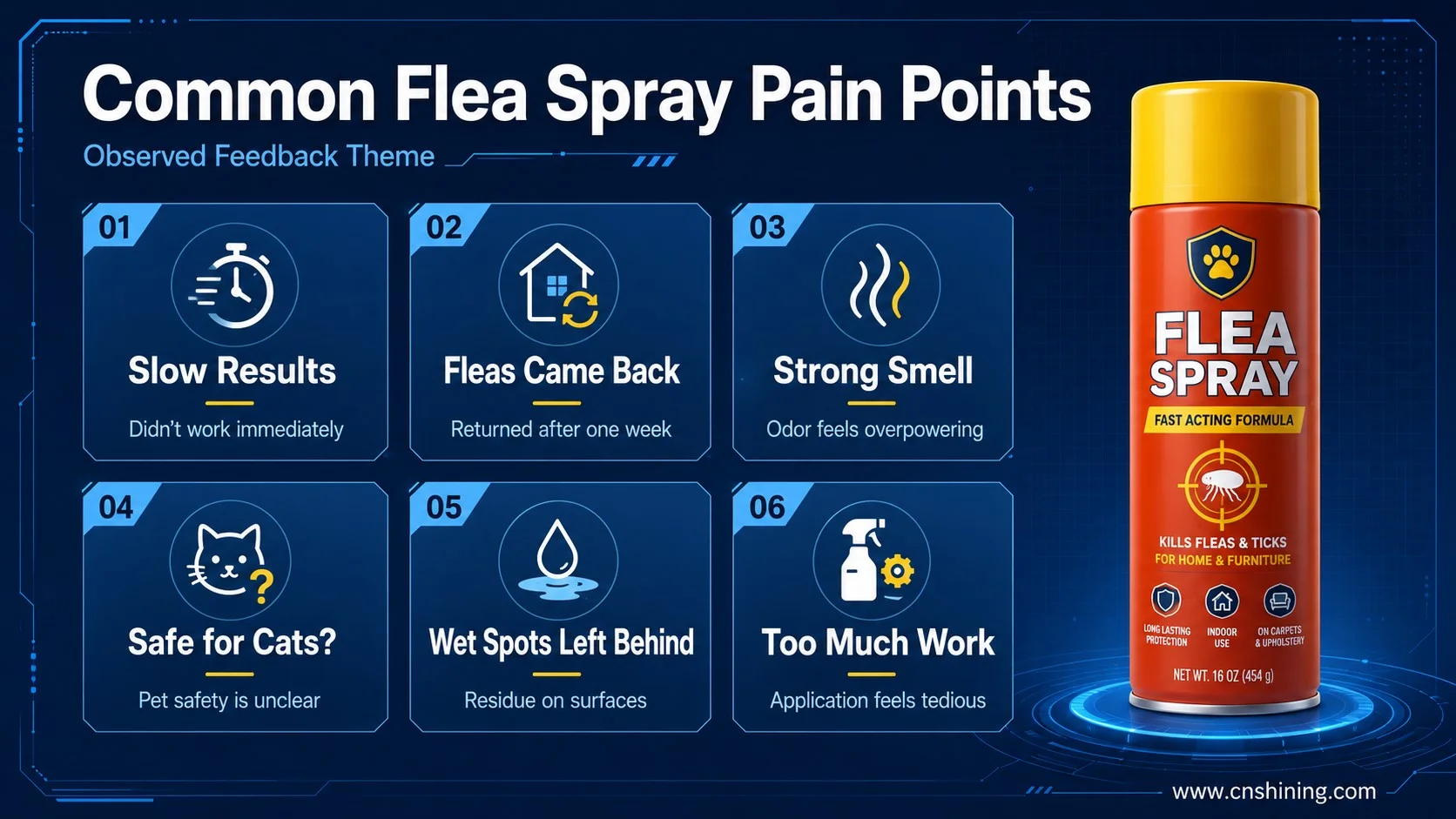
Retail and social feedback in the source report clusters around five issues:
- effect does not feel immediate enough;
- fleas appear again after several days;
- odor and irritation are hard to tolerate;
- users worry about cats, children and fish tanks;
- vacuuming, bedding treatment and repeat work feel too labor-intensive.
Many negative reviews are not simply “the product did nothing.” They often show a mismatch between consumer expectations and flea biology. If pupae continue to emerge, the user sees new fleas and thinks the aerosol has failed. If the label does not explain IGR timing, vacuuming and repeat treatment, the product takes the blame.
| Observed Feedback Theme | Technical Reading | Packaging / Label Implication |
|---|---|---|
| “It did not work immediately.” | User expects instant total elimination, while IGR lifecycle control takes time. | Explain adult kill and lifecycle interruption separately. |
| “Fleas came back after one week.” | Later emergence from pupae or untreated areas may be occurring. | Add a treatment calendar and vacuuming instruction. |
| “The smell is too strong.” | Solvent, propellant and fragrance profile affect acceptance. | Consider low-odor system, BOV route or spray-pattern adjustment. |
| “Is this safe for cats?” | Cat sensitivity, especially with some pyrethroids, is a real safety boundary. | Make cat wet-surface warning and re-entry timing visible. |
| “It left wet spots.” | Spray pattern, droplet size, distance and valve output may be mismatched. | Test actuator insert, spray rate and recommended distance. |
| “Too much work.” | Environmental flea treatment requires vacuuming, bedding washing and repeat management. | Use a clear step-by-step treatment flow on the label. |
The high-confidence reading is this: consumers often suffer more from poor process understanding than from the active ingredient itself. A technically sound product can still receive weak reviews if the user does not understand room exit, ventilation, vacuuming, re-entry and repeat treatment timing.
8. Packaging Improvements: What Actually Reduces Complaints
The best packaging improvement is not decoration. It is reducing misuse cost. For flea aerosol sprays, this means safer actuation, better flow control, clearer label instructions, less transport leakage and fewer surface wetness problems.
| Pain Point | Packaging / Structure Suggestion | Feasibility | Cost Impact | Supply Chain Attention |
|---|---|---|---|---|
| Strong odor; user avoids spraying long enough | Use BOV or lower-VOC propellant system where compatible; support water-based / low-odor formula | Medium | Medium | Check BOV filling line, bag material and valve cup compatibility |
| Accidental spray or child handling | Use twist-to-lock actuator or visible safety lock | High | Low to medium | Match actuator, valve stem and spray insert |
| Finger fatigue and uneven discharge | Use larger finger pad and ergonomic actuator; adjust insert for carpet and crack treatment | High | Low to medium | Test valve flow rate, spray width and droplet size together |
| E-commerce leakage or accidental trigger | Add valve protection cap and strong outer packaging with cushioning | High | Low | Coordinate hazardous goods shipping and carton testing |
| Label is hard to understand | Use peel-back or accordion label with “leave room – ventilate – return – vacuum – repeat” flow | High | Low | Reserve label space for warnings and multilingual text |
| Concern about can corrosion or migration | Use BPA-NI internal coating and avoid PFAS routes where technically possible | Medium | Medium | Run formula-coating compatibility, shelf-life and migration checks |
| Sustainability concern | Use lightweight steel or aluminum can, PCR where feasible, and clear recycling instruction | High | Low to medium | Separate empty-can and partly filled-can disposal language |
| Wet spots, stains or sticky surface feel | Optimize nozzle insert, spray width and droplet profile; consider 360° capability | Medium-high | Medium | Co-test with formula viscosity and can pressure curve |
For BOV, the technical logic is product-propellant separation. Air or nitrogen can be used behind the bag, while the formulation remains inside the bag. This can support cleaner emptying, lower VOC positioning and 360° use when the full system is designed correctly.
Transport and waste handling should be designed early. DOT aerosol shipping guidance highlights strong outer packaging, cushioning and valve protection. See the DOT Check the Box for Aerosols fact sheet. EPA has also added hazardous waste aerosol cans to universal waste regulations, which affects retail returns, service operators and warehouse SOPs. See EPA aerosol cans universal waste rule.
9. Shining Packaging: Aerosol Cans, Valves and Actuators for This Application
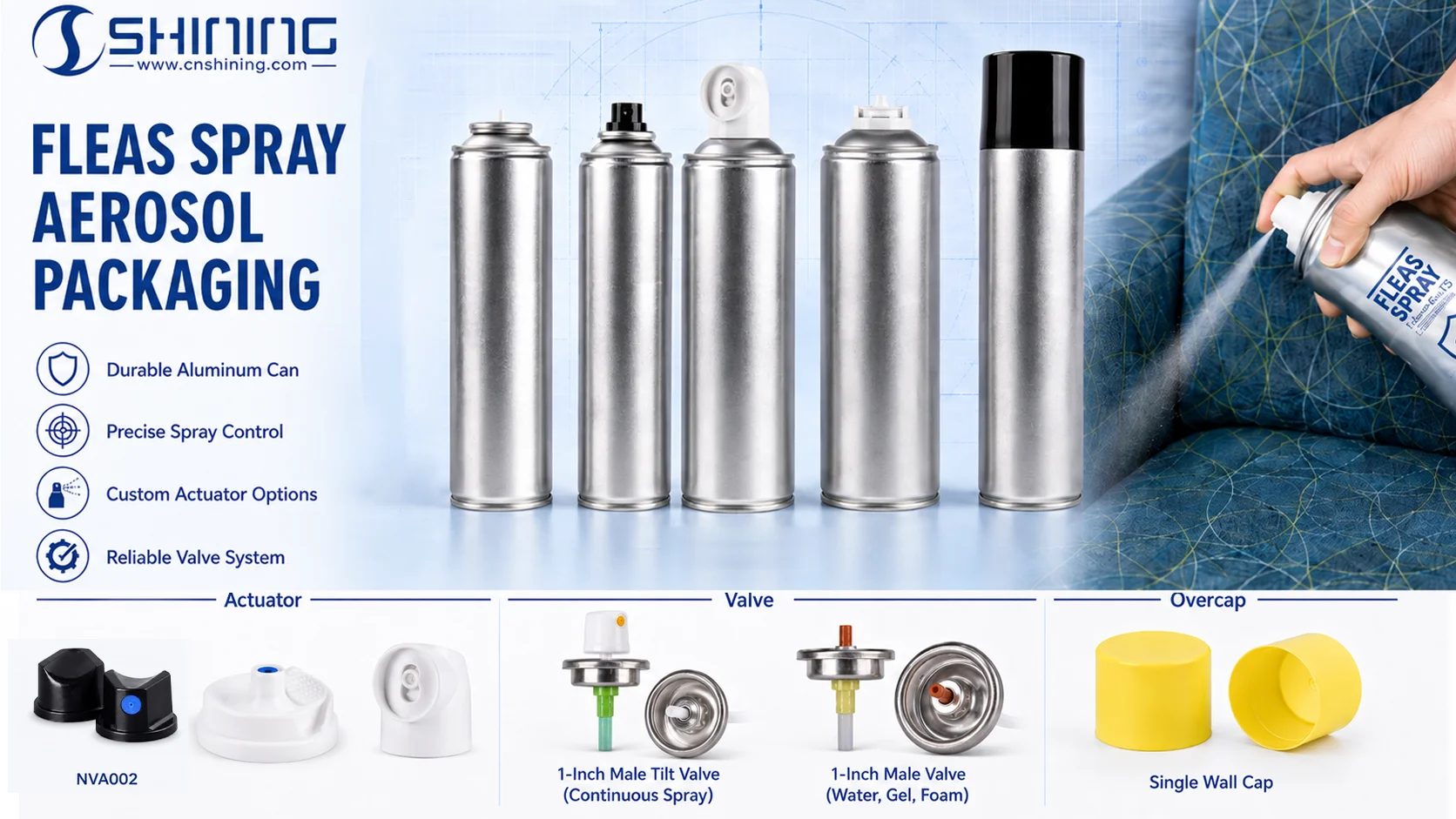
For flea premise aerosol products, packaging hardware needs to solve a few practical problems: stable spray rate, suitable spray width, controlled wetting, reliable sealing, safe actuation and transport protection. The can, valve, actuator, cap and label area should be specified as one working system.
Shining Packaging’s relevant product scope fits the hardware side of this category: aerosol cans, valves, actuators and matching caps for household aerosol applications. For flea spray, the actuator and valve are not minor accessories. They influence coverage, surface wetness, odor perception and user fatigue.
A narrow spray may over-wet a small spot and leave visible marks. A very wide spray may waste product and increase inhalation exposure. A valve with unsuitable flow can make a good formula feel weak or messy. This is why spray angle, discharge rate, droplet size, emptying behavior and leakage resistance should be checked before production release.
For conventional pressurized products, a lockable actuator and robust overcap may be the fastest way to reduce misfire and leakage. For lower-VOC or cleaner-dispensing product concepts, BOV can be evaluated if formula compatibility and filling equipment allow it.
10. Technical Trends: Actives, Low-Odor Systems, BOV and Controlled Release
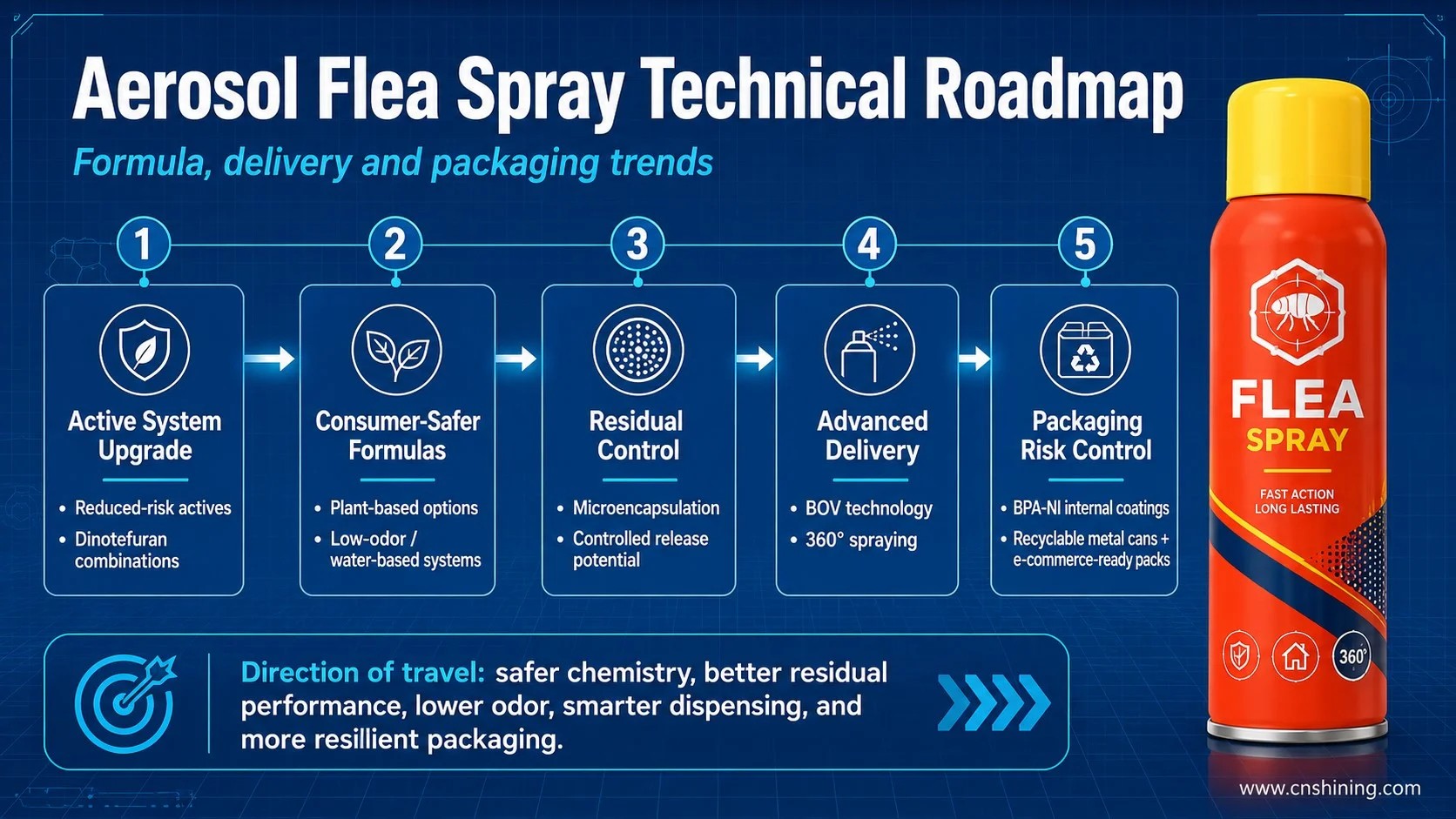
Several trends are visible from public material.
First, professional formulas are trying to differentiate beyond older pyrethrin or permethrin routes. BASF’s PT line shows professional-channel positioning around pressurized insecticides and specific active combinations. See BASF PT Brands professional pest control reference.
Second, lower-toxicity and plant-based positioning has entered larger brand systems. Central Garden & Pet announced ADAMS Botanicals Flea & Tick Pet & Home Spray in 2025, describing EPA approval, plant-based actives, water-based formulation, alcohol-free language and a softer odor direction. See the Central Garden & Pet ADAMS Botanicals release.
Third, controlled release remains technically interesting. A patent reference on microencapsulated insecticide for pet ectoparasite treatment shows one route for longer residual effect and potentially lower surface impact. See WO2003051116A1 microencapsulated insecticide patent. Patent existence does not mean broad commercial adoption, but it shows the direction.
Fourth, packaging has moved from a cost item to a risk-control system. BOV, 360° dispensing, BPA-NI internal coating, recyclable metal cans and e-commerce-safe cap structures are all more relevant when regulation, logistics and household safety expectations move in the same direction.
11. Conclusion
Aerosol spray for fleas should be understood as a premise-control tool. It is strongest when the infestation has moved into carpets, bedding, upholstery and floor gaps. It is weaker as a routine animal-only protection format because spot-on, oral and collar products are easier for many pet owners.
The product is not defined only by the insecticide active. Performance depends on a system: adulticide, IGR, solvent route, propellant or BOV choice, valve, actuator, can coating, cap protection, label clarity and disposal instructions. If any part is weak, users may experience odor, wet spots, recurrence, safety anxiety or poor spray control.
For packaging development, the practical priority is clear: reduce misuse first. A stable actuator, matched valve, readable treatment flow, good cap protection and verified transport packaging can solve many complaints before a company makes expensive platform changes.
12. FAQ: Aerosol Spray for Fleas
Most traditional flea aerosols are premise products for household surfaces. They are used on carpets, upholstery, pet bedding, cracks and room areas where eggs and larvae may remain. Direct pet sprays exist, but they follow a different veterinary or cutaneous-use logic. The label must clearly state the allowed use site.
Adulticides give fast visible knockdown against adult fleas. IGRs such as S-methoprene or pyriproxyfen suppress egg and larval development. The combination matters because a home infestation is rarely only adult fleas. Without lifecycle control, new adults may continue to emerge from untreated or immature stages.
Reappearance can come from pupae that continue to emerge after treatment, untreated zones, or weak process control. IGRs need time to interrupt development. Vacuuming, bedding washing, pet treatment and repeat environmental treatment may all be needed. A good label should explain this sequence instead of promising instant clearance.
S-methoprene is an insect growth regulator. It does not work like a fast adulticide. Its role is to interfere with immature flea development so eggs and larvae fail to progress normally. In household aerosols, it supports residual control and helps reduce reinfestation pressure after adult fleas are knocked down.
Cats can be more sensitive to certain pyrethroid exposures, especially permethrin. A household surface spray or dog-safe product should not be assumed safe for cats. Labels need clear wet-surface warnings, re-entry timing, ventilation instructions and species boundaries. This is a safety issue, not just cautious wording.
No. Public market data usually shows spot-on or oral products as larger delivery formats in flea and tick control. Aerosol spray remains a support format for environmental treatment. It is most useful when carpets, bedding, cracks and soft furnishings act as a reservoir for eggs, larvae and pupae.
Lockable actuators, strong caps, readable treatment diagrams and peel-back labels can reduce misuse. Users need to understand when to leave the room, when to ventilate, when pets can return, and when to vacuum. These packaging changes can reduce complaints without changing the active formula itself.
BOV can be suitable when the product needs lower VOC positioning, cleaner dispensing, formula-propellant separation or 360° spraying. It is not automatically suitable for every insecticide formula. The bag material, valve, filling line, pressure profile, storage stability and chemical compatibility all need to be tested.
Wet spots can result from high discharge rate, narrow spray pattern, large droplets, short spray distance or mismatch between formula viscosity and actuator insert. The issue is not always the formula alone. Valve flow, can pressure, nozzle geometry and user instructions should be tested as one system.
The main risk is treating chemistry, packaging and label design as separate tasks. A good active system can still fail in real use if the actuator sprays poorly, the label is confusing, odor is too strong, or transport protection is weak. This category needs product-system engineering.