
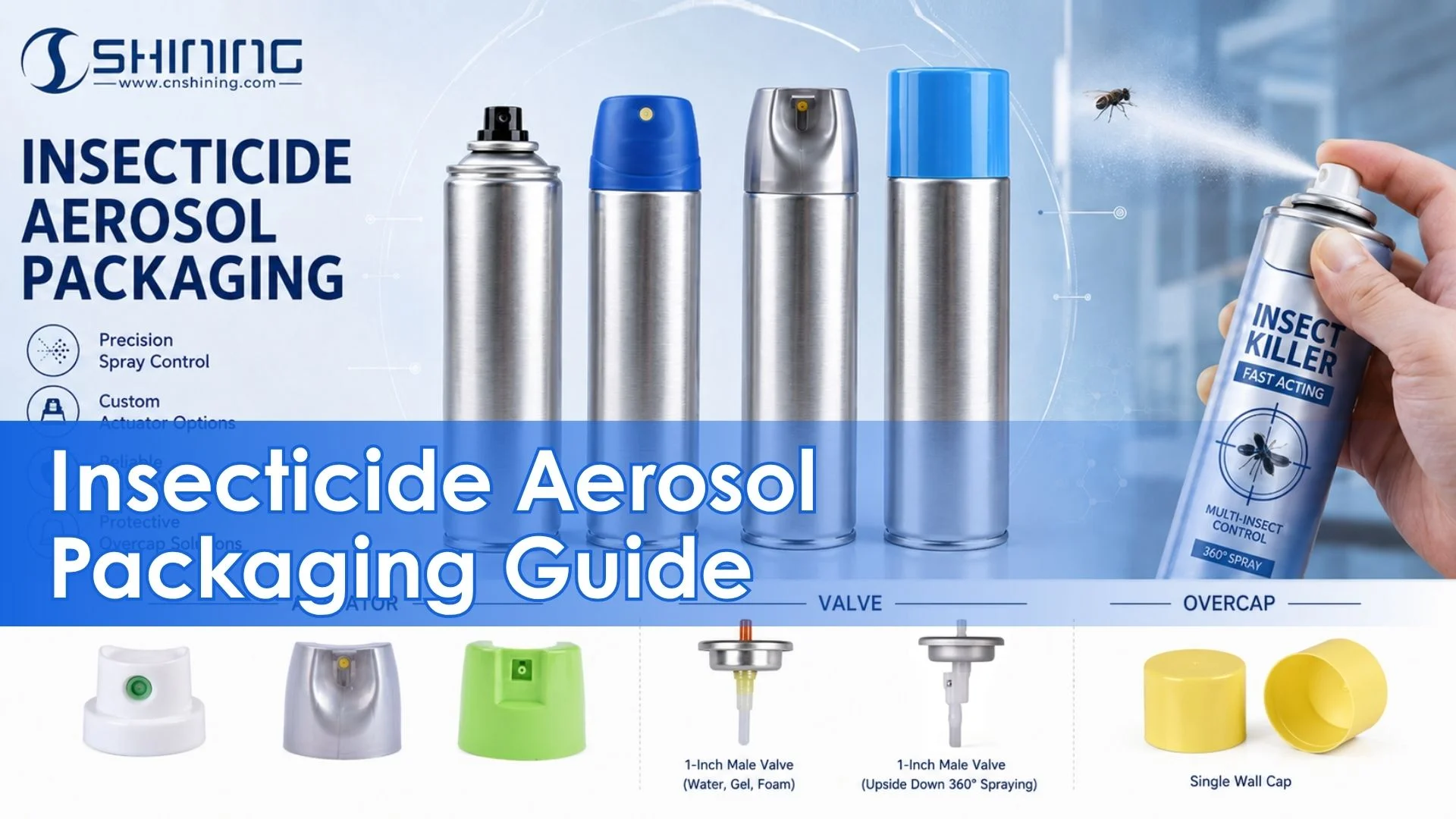
Aerosol insecticide is a pressurized delivery system, not just an active ingredient in a can. Its field performance depends on the active compound, solvent system, propellant pressure, valve flow, actuator geometry, droplet size, can coating, and label compliance working as one package.
1. What Aerosol Insecticide Really Is
A household aerosol insecticide normally packs insecticidal active ingredients, solvents or co-solvents, functional additives, and propellant inside a pressure-resistant aerosol can. When the user presses the actuator, the valve opens and the formulation exits as droplets into air or onto a target surface. The practical promise is simple: fast knockdown plus some residual control.
The commercial split is already clear. One side of the shelf is built around high-efficiency neurotoxic routes such as pyrethrins and synthetic pyrethroids. The other side leans into plant-derived actives, low odor and lower psychological toxicity burden. Both are aerosol bug spray. They are not the same engineering product.

2. Definition, Mechanism, and Atomization Physics
2.1 Mode of action on insects
Consumer aerosol insecticides still rely heavily on natural pyrethrins and synthetic pyrethroids. These compounds disturb the insect nervous system and create overexcitation, paralysis and death. That is why the user expects an immediate visual result: the insect should drop soon after contact.
IGRs, or insect growth regulators, work differently. They are not mainly built for instant adult kill. Their role is to interrupt molting, development or reproduction. In a practical formulation strategy, IGRs are delayed-return components, while pyrethrins, pyrethroids and synergists such as PBO carry the visible knockdown.
2.2 How the can turns liquid into droplets
The aerosol can is a pressurized two-phase system. The propellant supplies internal pressure. Liquid travels through the dip tube, valve body, valve stem and actuator. During this path, pressure falls and part of the propellant flashes. The formulation breaks into droplets. Valve orifice, stem flow, actuator swirl chamber, formulation viscosity, surface tension and propellant vapor pressure decide whether the user gets fine mist, a strong jet, or a half-empty can that starts spitting liquid.
| Spray route | Engineering target | Best fit |
|---|---|---|
| Fine cone mist | Smaller droplets, wider air coverage, faster contact with flying insects | Flying insect killer, mosquito spray, room-space treatment |
| Directional jet or fan spray | More momentum, crack entry, surface wetting and residual deposition | Cockroach killer aerosol, ant spray, crawling insect aerosol |
| Total-release fogger | Broad enclosed-room discharge with strict safety and re-entry rules | Whole-room stage treatment, not casual spot use |
This is why a single “universal nozzle” often fails in use. The flying insect SKU wants plume coverage. The crawling insect SKU wants aim, crack reach and controlled surface deposition. One actuator cannot do both well without compromise.
3. Formulation Roles and Technical Terms
Concentrations below are not universal legal limits. They are common ranges or representative values derived from public labels, procurement samples, patent texts and official technical materials in the source document.

| Ingredient class | Main role | Public concentration / example | Technical safety profile |
|---|---|---|---|
| Natural pyrethrins | Fast knockdown and flying insect perception | Representative public value: 0.10% | Targets insect nervous system. Household use should follow label ventilation and re-entry rules. |
| Synthetic pyrethroids: permethrin, cypermethrin, imiprothrin, tetramethrin | Knockdown plus residual effect, especially crawling insects and cracks | Public examples around 0.025%-0.20%+, often dual or triple blends | Still the main workhorse route. Strong efficacy, but odor, residue, resistance and regulatory pressure are sensitive. |
| Organophosphate / carbamate routes | Older high-kill-strength route | Example in source material: propoxur 0.75% + cyfluthrin 0.025% | Safety margin is usually less favorable than pyrethroid routes. Consumer share is generally under pressure. |
| Neonicotinoids | Less visible in household aerosol public samples | Unspecified | More common in other formats. Not a main public aerosol route in the reviewed samples. |
| IGR: methoprene, pyriproxyfen | Interrupt molting, egg development and reproduction | Unspecified | Not designed for instant adult knockdown. Works better as part of a lifecycle-control story. |
| Plant-derived actives: geraniol, lemongrass, cornmint, rosemary | Low odor, natural-positioning and family-use perception | Often not shown as stable public concentration on retail pages | Commercial value lies in lower odor load and user confidence, not automatically stronger kill. |
| PBO | Synergist for pyrethrins and pyrethroids | Representative public value: 0.50% | Not sold as the main insecticidal active. It improves knockdown efficiency and timing. |
| Solvent / carrier | Dissolve active, adjust evaporation, spray feel and residue | Usually a large part of the total formula | Controls odor, VOC load, surface residue, corrosion and can stability. Patent reference: aerosol insecticide composition patent |
| Propellant: LPG, propane-butane, DME, compressed gas, HFC-134a | Generate pressure, atomization and evacuation | System-dependent, often a major share | Drives flammability, VOC status, carbon footprint, spray pressure and cold-temperature performance. |
Terms that matter in packaging discussions
| Term | Meaning | Why it matters commercially |
|---|---|---|
| Knockdown | Short-time loss of insect activity after spraying | Defines whether the user feels the spray worked. |
| Residual effect | Continued control after deposition on a surface | Supports “keeps working” claims and repeat-use timing. |
| Space spray | Airborne droplets mainly contacting flying insects | Works for flying insect killer and mosquito room spray. |
| Crack-and-crevice | Directed application into gaps, baseboards and hidden zones | Needs a more directional actuator and enough spray momentum. |
| Total-release fogger | One-time discharge into a closed space | High coverage, but overuse, flammability and re-entry control are serious issues. |
| Actuator | The pressed nozzle assembly | Controls spray pattern, droplet spectrum, comfort and clogging risk. |
| Valve | Can-top flow control part | Controls leakage, flow rate, evacuation and production consistency. |
| BOV | Bag-on-valve, where product and propellant side are separated | Useful for 360° spray, low residual volume and sensitive formulas. |
| VOC | Volatile organic compound | Controls saleability, odor perception and formulation choices. |
| Compatibility | Formula interaction with gasket, coating and metal can | Decides leakage, rust, delamination, phase separation and shelf life. |
4. Aerosol Versus Liquid Sprays, Baits, and Foggers
Aerosol insecticide keeps a strong household position because it combines easy operation and visible immediate effect. No dilution. No extra device. See the insect, press the actuator. That advantage is real.
The limits are just as real. Aerosol is easier to over-apply than bait. It is harder than water-based ready-to-use trigger spray to make truly low-VOC and low-odor. It does not solve colony-level cockroach or ant problems as well as bait. It is safer for spot treatment than a fogger, but it cannot replace a controlled whole-room treatment when that is the defined job.

| Format | Main advantages | Main drawbacks | Best use | Commercial conclusion |
|---|---|---|---|---|
| Aerosol insecticide | Fast effect, strong perception, easy spot kill, space spray possible | Odor, VOC, flammability, mis-spray, nozzle complaints | Flying insects, sudden household pests, crack treatment | Still the most visible retail format. |
| Liquid RTU spray | Directional, can support low volatility and stronger residual control | Less spray impact and weaker fine mist coverage | Baseboards, door frames, fixed pest routes | Better for perimeter control than instant knockdown theater. |
| Bait / gel | Low exposure area, strong colony effect for ants and cockroaches | Slow, less visible, not useful for flying insects | Cockroach and ant root-cause control | Best used with aerosol, not simply against it. |
| Total-release fogger | Broad room coverage and low manual effort | Over-spray risk, long vacancy time, flammability and food/pet concerns | Closed-space stage treatment | More polarized because safety and misuse risk are higher. |
5. Regional Regulations and Standards

Regulation is not a final label task. It shapes the platform from the start. The hard constraints fall into three groups: pesticide or biocidal registration and labeling, VOC and propellant flammability, and packaging or child-resistant requirements.
| Region | Core framework | Label and packaging focus | VOC / propellant focus | Registration timing signal |
|---|---|---|---|---|
| United States | EPA under FIFRA; 40 CFR Part 156 for labeling; Part 157 for child-resistant packaging | Brand, ingredients, hazard statements and Directions for Use must be clear. Source: 40 CFR 156.10 labeling requirements | ODS/CFC/HCFC aerosol propellant restrictions apply federally. Source: EPA ozone-depleting aerosol restrictions | PRIA 5 categories define statutory decision time; A461 shows 6 months for a listed new end-use public-health product category. Source: EPA PRIA A461 category |
| California | CARB Consumer Products Regulation | Product category definition matters. Crawling bug, flying bug and fogger are treated separately. | Crawling bug aerosol moves to 8% VOC by 2030; bed bug aerosol 15%; flying bug aerosol 20%; fogger 45%. Source: CARB Consumer Products Regulation Article 2 | Sell-through timing and category classification must be designed before launch. |
| European Union | BPR for biocidal products, PT18; CLP; REACH; Aerosol Dispensers Directive | Active substance approval comes before product authorization. Hazard classification and container safety must align. Source: European Commission biocides regulation | No single pan-EU VOC cap for insecticide aerosols was identified in the source review, but ODS/HFC, flammable aerosol and chemical hazard controls remain strong. | National authorization is commonly treated as a 365-day procedure. Source: ECHA national authorization page |
| Brazil | Anvisa saneantes / desinfestantes framework | Registration, notification and labeling are central. Source: Anvisa 2025 saneantes rules update | Public technical material states CFCs for household hygiene aerosol propellants have been banned since 1988. A national insecticide aerosol VOC cap was not identified in the source review. | Product registration can carry a 10-year validity; post-registration changes have defined timelines. Source: Brazil saneantes registration renewal |
| India | Insecticides Act, 1968 and Insecticides Rules, 1971; CIBRC and CROP portal | Rules Chapter V covers packaging and labeling requirements. Source: India Insecticides Rules, 1971 | ODS/CFC controls apply. A national household insecticide aerosol VOC cap was not identified in the source review. | Online submission is handled through the CROP portal. Source: CIBRC CROP registration portal |
6. R&D Trends, Patents, and Material Direction
The next 3-5 years are not about making the product simply “more toxic.” The useful direction is more stable spray, lower odor, fewer complaints, and no loss of knockdown perception. Traditional high-efficiency pyrethroid aerosols will stay. Plant-based, water-based and BOV systems will carry more of the high-experience positioning.
| Trend | Public evidence | Engineering meaning |
|---|---|---|
| Plant-derived and natural-positioning growth | Natural formulations held 51.35% share of household insecticides in 2025 and expanded at 8.42% CAGR in one public dataset. | Lower odor and lower psychological toxicity burden are now mainstream purchase variables. |
| Low VOC pressure | CARB drives crawling bug aerosol toward 8% VOC in 2030; | Water-based, low-aromatic and compressed-gas platforms need earlier valve and coating validation. |
| BOV and separated delivery | Recent BOV and valve patents remain active. Source: bag-on-valve technology patent | BOV can improve 360° spray, low residual liquid, formula isolation and odor perception. |
| Compound active systems | EP2708126A1 combines alpha-cypermethrin, permethrin, tetramethrin and PBO. Source: insecticidal aerosol patent EP2708126A1 | Fewer SKUs can cover more insects, but compatibility and label claims become more complex. |
| Water-based and low-irritation direction | CN104186464A discloses a household water-based insect aerosol route. Source: household water-based insect aerosol patent | Better low-odor story, but higher demand on corrosion, microbial control and valve material selection. |
| Can corrosion and compatibility | US4668507A points to corrosion-resistant insecticidal aerosol composition concerns. Source: corrosion-resistant insecticidal composition patent | Internal coating and gasket material are part of formulation design, not post-processing. |
| Refill and recycling concepts | Refillable aerosol bombs were discussed decades ago. Source: refillable aerosol insecticide bomb patent | Consumer open refill remains hard for pesticide products due to contamination, liability and registration consistency. |
| Low VOC formulation history | US6969521B1 shows a low-VOC aerosol insect repellent route. Source: low VOC aerosol insect repellent patent | VOC reduction is not new. The hard part is doing it without poor spray feel or unstable packaging. |
7. Top 10 Aerosol Insecticide Brands

| Brand | Main market / country | Parent company | Typical size | Public retail price range | Technical market reading |
|---|---|---|---|---|---|
| Raid | United States | SC Johnson | 15-18 oz | US$3-6 | Deep channel coverage and broad SKU structure. The hard balance is strength, odor and mist volume. |
| Hot Shot | United States | Spectrum Brands | 15 oz | US$4-6 | Value-oriented and widely distributed. Spray consistency complaints show why nozzle quality matters. |
| Black Flag | United States | Spectrum Brands | 14-18 oz | US$10-15 | Older, more tool-like pest control voice. Less focused on soft household fragrance cues. |
| Bengal | United States | Bengal Products | 9-16 oz | US$9-12 | Strong professional feel, especially for cockroach and crack-oriented applications. |
| Zevo | United States | Procter & Gamble | 10 oz | US$9-10 | Plant-derived, low-odor and pet-household acceptance are built into the brand language. |
| STEM | United States | SC Johnson | 10-12 oz | US$7-8 | Positions plant-derived actives in a more mainstream household format. |
| Baygon | United States | SC Johnson | 200-400 mL | About US$2.4-2.7 | Very familiar in Asia and Latin America. Strong in value and kill perception, weaker in modern low-odor positioning. |
| HIT | India | Godrej Consumer Products | 200-625 mL | About US$1.2-2.7 | High-frequency South Asian household brand with detailed capacity segmentation and kitchen/drain-use awareness. |
| Mortein | United Kingdom | Reckitt | 200-400 mL | From about US$1.4; full range unspecified | Strong global mosquito and insect-control memory, with larger price variation by region and channel. |
| Fumakilla | Japan | Fumakilla | 450 mL | About US$3.2-3.9 | Japanese engineering style is visible: particle size, spray form and safety instructions become part of the product language. |
8. User Pain Points and Packaging Design Response

Consumer complaints are very consistent: unstable nozzle, spray that becomes a liquid line, strong odor that lingers, sticky residue, over-spray, and anxiety around pets, kitchens, bedding and HVAC. These are not soft branding issues. Most are packaging and formulation-interface problems.
| Pain point | Technical reading | Packaging response |
|---|---|---|
| Nozzle instability and wrong spray pattern | Often caused by mismatched actuator, valve flow, particle load, viscosity or partial blockage. | Separate flying-insect and crawling-insect valve/actuator platforms. Add pre-valve filtration where needed. |
| Strong odor and long dissipation | Usually driven by solvent system, fragrance choice, droplet size and over-application. | Low-aromatic carrier, BOV or compressed gas route, controlled spray output and clearer ventilation icon design. |
| Residue or sticky film | Often not an active ingredient issue. It is deposition load, solvent evaporation rate and over-spray. | Tune droplet spectrum and output per second. Avoid “too wet” spray for space-spray SKUs. |
| Too much product per press | Users do not know how long to press for a small room or surface line. | Metered or quasi-metered valve for sensitive rooms. Add dose icons such as “10 m² / 2 shots”. |
| Pet, food-surface and bedding concerns | Users need quick visual instructions, not only dense warning text. | High-contrast hazard band, front-panel icons, QR video for re-entry and ventilation. |
| Effective kill but recurring pests | Point-kill aerosol is being used to solve colony or sanitation problems. | Print “instant kill” and “long-term control” as separate use cases. Pair with bait/gel guidance where allowed. |
| Target issue | Design suggestion | Suggested material / structure | Why it works |
|---|---|---|---|
| Solid-line output, clogging, spray drift | Use two valve/actuator platforms: fine cone mist for flying insects, directional jet or fan for crawling insects. Add fine filter before valve. | POM/acetal actuator; butyl or nitrile gasket matched to formula; 100-150 mesh stainless filter at dip tube inlet where needed. | A single actuator across all SKUs is a common complaint source. |
| Overuse in small rooms | Use quasi-metered valve for child/pet-sensitive scenes. For large cans, keep continuous valve but create two-stage press feel. | Two resistance steps or short-stroke limiter. | It gives the user tactile feedback before over-application. |
| Heavy odor, residual liquid, no upside-down spray | Create a higher-experience BOV line using compressed air or nitrogen on the propellant side. | BOV can, bag, compatible valve and actuator. | Product and propellant separation improves evacuation, 360° spray and formula stability. |
| Water-based or plant-derived corrosion risk | Do not use one internal coating for all formulas. Validate coating by pH, solvent polarity and active package. | BPA-NI epoxy-phenolic for many hydrocarbon/pyrethroid lines; modified polyester or high-barrier coating for water-based or plant-source systems. | Corrosion, delamination and gasket swelling can destroy shelf life before the user sees the product. |
| Safety anxiety after mis-spray | Use direct metal printing for warning hierarchy. Add solvent-resistant varnish where labels face handling and chemical exposure. | High-contrast bands, re-entry icons, food-surface warning icons, pet and bedding prohibition icons. | Users respond faster to icons than long paragraphs. |
| Poor grip and one-hand control | Use slimmer shoulder geometry for 300 mL cans and stronger waist or wider base for 400-450 mL cans. | 57-65 mm diameter can families; textured actuator finger pad. | Grip geometry directly affects over-spray and aim accuracy. |
| Low-price SKU misuse | Print “suitable for” and “not suitable for” pest types on front label. | Two-color front strip and back-label bait/gel combination note. | Reduces unrealistic expectations about recurrence control. |
| Sustainability without compliance loss | Avoid open consumer refill for pesticide aerosol. If refill is pursued, use B2B closed-loop collection and refilling. | Batch traceability, controlled refill line, re-registration consistency. | Pesticide contamination and liability risks are higher than normal cleaning aerosols. |
9. Shining Packaging Components for Aerosol Insecticide
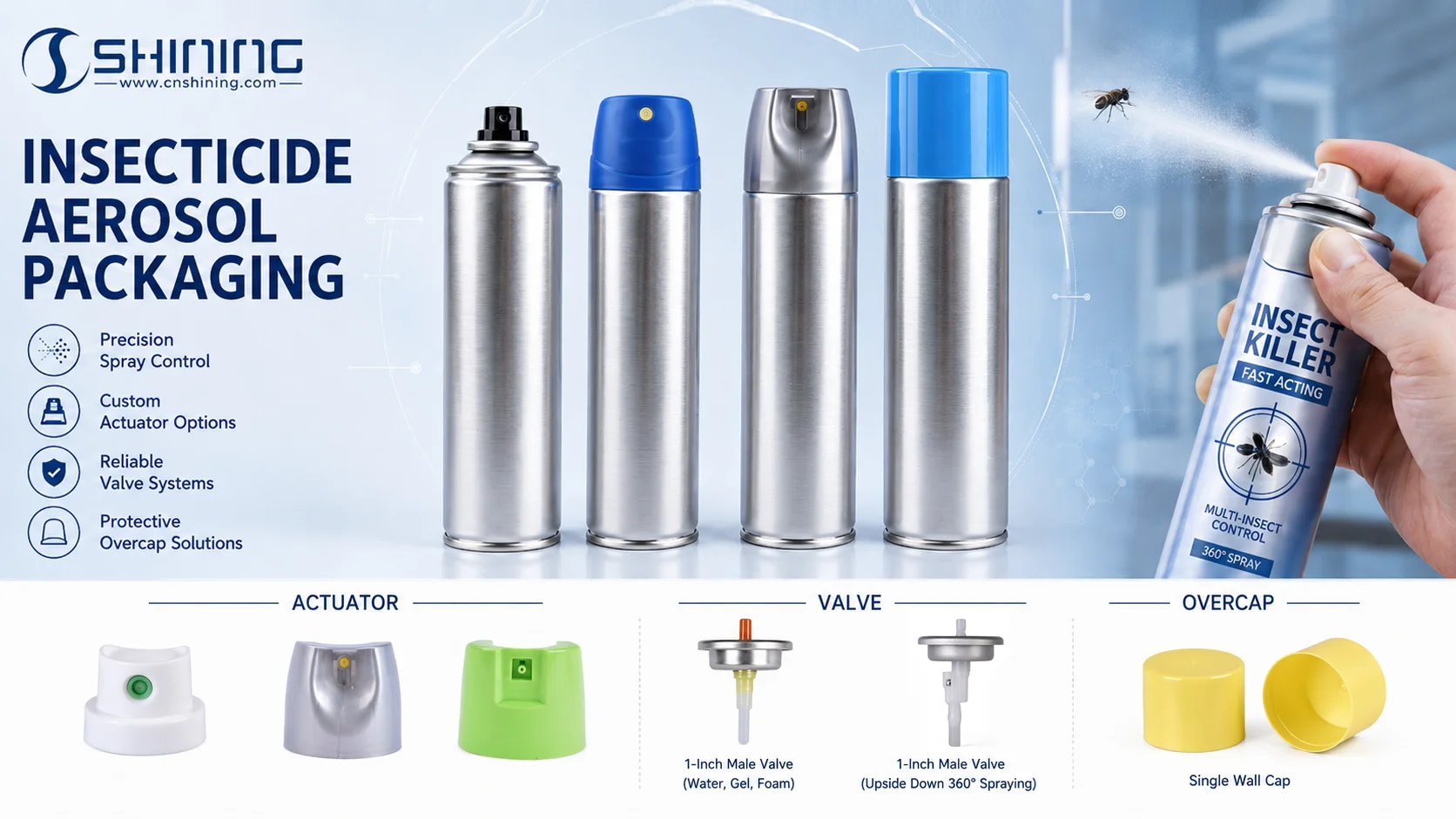
For aerosol insecticide, packaging components should be selected around the spray task. Shining Packaging’s relevant parts are mainly actuators, aerosol cans and valves. The useful question is not “which component looks better?” It is “which component keeps the spray stable with this formula, propellant and target insect?”
For flying insect aerosol, actuator design should support fine mist coverage and comfortable repeated pressing. For cockroach killer aerosol or crawling insect spray, the actuator and valve should support a more directional plume and reliable crack entry. For low-odor, water-based or plant-derived formulas, the can coating, gasket material and valve compatibility need earlier testing because corrosion and swelling risks rise.
A practical component package usually includes a pressure-rated tinplate or aluminum aerosol can, formula-matched internal coating, compatible valve gasket, dip tube length matched to fill volume, actuator orifice designed for the required plume, and print layout that leaves enough space for hazard and re-entry instructions. That is not a sales decoration. It is part of the product’s technical reliability.
10. Practical Platform Recommendations
If a new global aerosol insecticide platform were built today, I would not force one line to cover all scenes. Three lines are more realistic.
10.1 Classic Power line
This line fits high-efficiency traditional markets similar to Raid, Hot Shot or Baygon positioning. It can keep hydrocarbon or LPG propulsion, but flying insect and crawling insect SKUs should not share the same valve/actuator set. Flying insect spray needs fine mist coverage. Crawling insect aerosol needs crack reach, directional control and residual deposition. The first engineering target is fewer complaints about liquid lines, clogged heads and unstable spray near the end of can life.
10.2 Low-Odor Family line
This line fits dense urban homes, pet households, e-commerce channels and stricter regulatory markets. BOV is a good structure to evaluate because it separates product from propellant side and can support 360° use and lower residual liquid. The formula may be water-based or low-aromatic. The user should not feel that the room has been chemically overloaded after use.
10.3 Metered Room-Control line
This line fits small rooms, student apartments, hotel housekeeping and sensitive households. Each spray should be controlled. The label can state simple room-dose logic such as “10 m² / 2 shots” or “20 m² / 4 shots,” subject to local label approval. It may not be the highest-volume line, but it can reduce misuse and complaint rate.
11. Conclusion
Aerosol insecticide is an old category with active engineering changes. The active ingredient still matters, but the competitive weak points are now easier to see: unstable spray, odor, residue, VOC limits, compatibility failures and unclear use instructions. The next useful step is not a greener-looking label. It is a packaging platform that matches the insect target, the formula, the propellant and the regulation before the first production batch is filled.
The winning product will not simply be the strongest-smelling can on the shelf. It will be the can that sprays consistently, leaves fewer doubts in the room, survives the formula, and can still pass the next VOC and labeling review.
12. FAQ: Aerosol Insecticide Technical Questions
Aerosol insecticide is a pressurized system. The propellant, valve and actuator help convert the formulation into droplets immediately after pressing. A trigger liquid spray depends more on mechanical pumping and usually gives stronger direction but less fine space coverage. Aerosol is better for instant knockdown perception, while liquid spray can be better for controlled surface treatment.
Pyrethrins and synthetic pyrethroids act quickly on insect nervous systems, so they match the user expectation of fast knockdown. They are also compatible with many household aerosol formats when the solvent, propellant and valve system are correctly selected. The trade-offs are odor perception, residue, regulatory pressure and resistance concerns in some pest populations.
PBO, or piperonyl butoxide, is a synergist. It is normally not presented as the main killing ingredient. Its job is to improve the effect of pyrethrins or pyrethroids by reducing insect detoxification pathways. In practical aerosol design, PBO helps increase knockdown efficiency and shorten the time between spray contact and visible insect collapse.
Spray form comes from the full delivery system. Valve flow, stem size, actuator orifice, swirl chamber, propellant pressure, formulation viscosity and surface tension all matter. A clogged filter, wrong actuator or poor formula compatibility can turn a designed mist into a solid liquid line. This is why flying-insect and crawling-insect SKUs should not blindly share nozzles.
VOC limits restrict how much volatile organic material can be present in certain product categories. This affects solvent and propellant choice directly. Low VOC design may require more water, compressed gas, low-aromatic carriers or BOV structures. It also raises new compatibility questions because water-based or polar systems can increase corrosion, gasket swelling and valve instability.
BOV separates the product from the propellant side by using a bag inside the can. For aerosol insecticide, this can improve 360° spraying, reduce residual liquid, support compressed gas systems and protect sensitive formulas from direct propellant contact. It is useful for low-odor or higher-experience lines, but the valve, bag and formulation still need compatibility testing.
Sticky residue is usually a deposition and carrier issue, not simply an active-ingredient issue. Large droplets, slow-evaporating solvents, high output per second or user over-spray can leave wet film on surfaces. Actuator geometry, valve flow and formula volatility need to be tuned together. A fine space spray and a residual surface spray should be treated as different products.
Many aerosol insecticides are point-kill products. They can knock down visible insects quickly, but they may not remove eggs, hidden colonies, food sources or entry points. Recurrence often means the job needs bait, IGR, sanitation or crack treatment. Packaging should make this distinction clear so users do not expect one quick spray to solve a structural infestation.
Water-based aerosol insecticide needs more than a formula stability check. The can coating, valve gasket, dip tube, actuator, corrosion behavior, microbial control and spray quality should all be tested. Accelerated storage should include upright and inverted positions where relevant. A formula that looks stable in glass can still fail inside a metal aerosol can.
Flying insect aerosol usually needs fine mist, broader plume coverage and fast airborne contact. Crawling insect aerosol needs aim, crack entry, surface wetting and some residual deposition. That difference should drive actuator, valve and label design. Using the same actuator for both may reduce tooling complexity, but it often creates poor spray feel or weak application accuracy.