
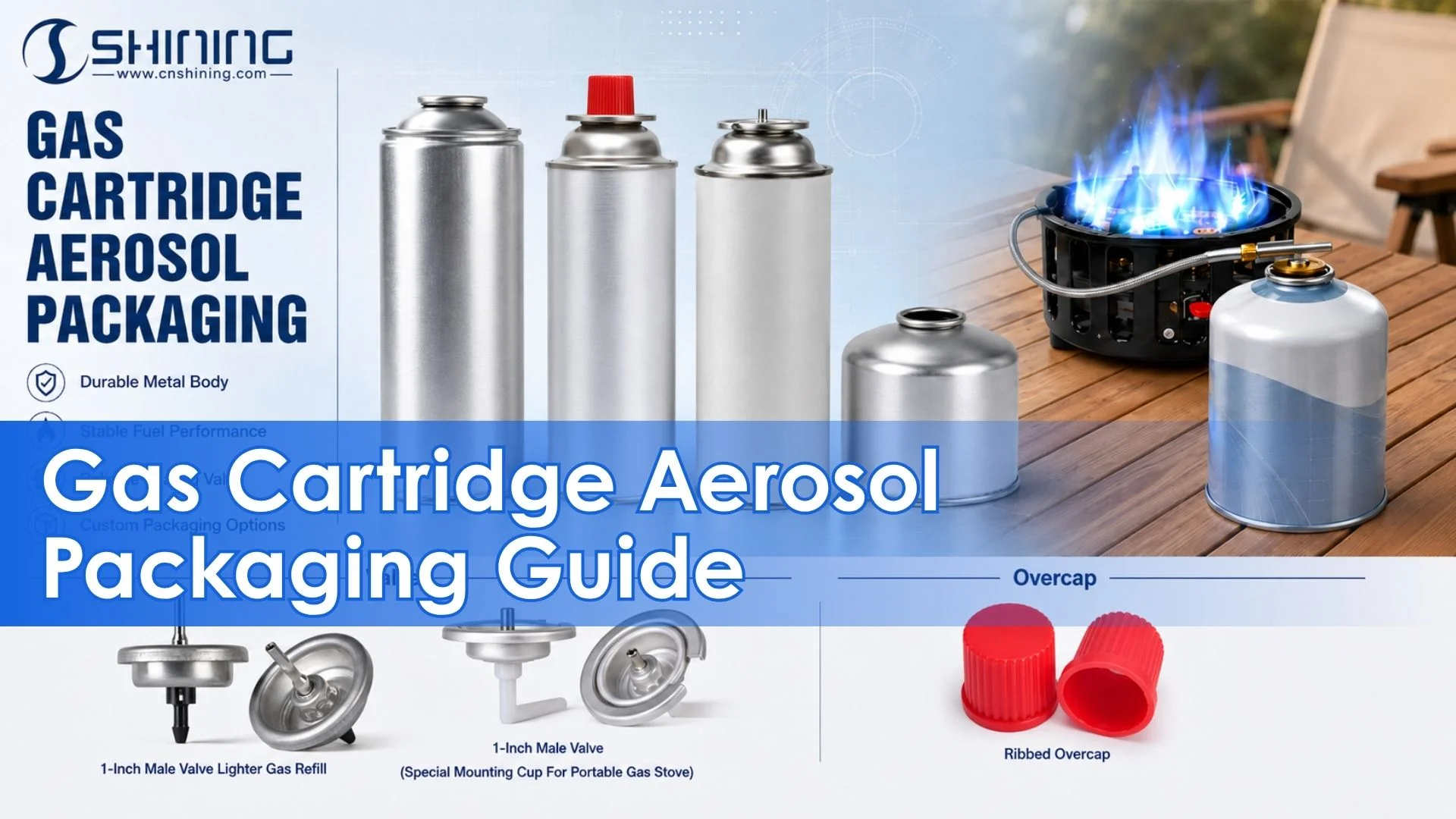
A gas cartridge, also called a gas canister, butane cartridge, fuel canister or cassette gas cylinder, is not just a small container filled with gas. It is a pressure packaging system where thermodynamics, valve design, metal forming, transport rules and user behavior meet in one compact product.
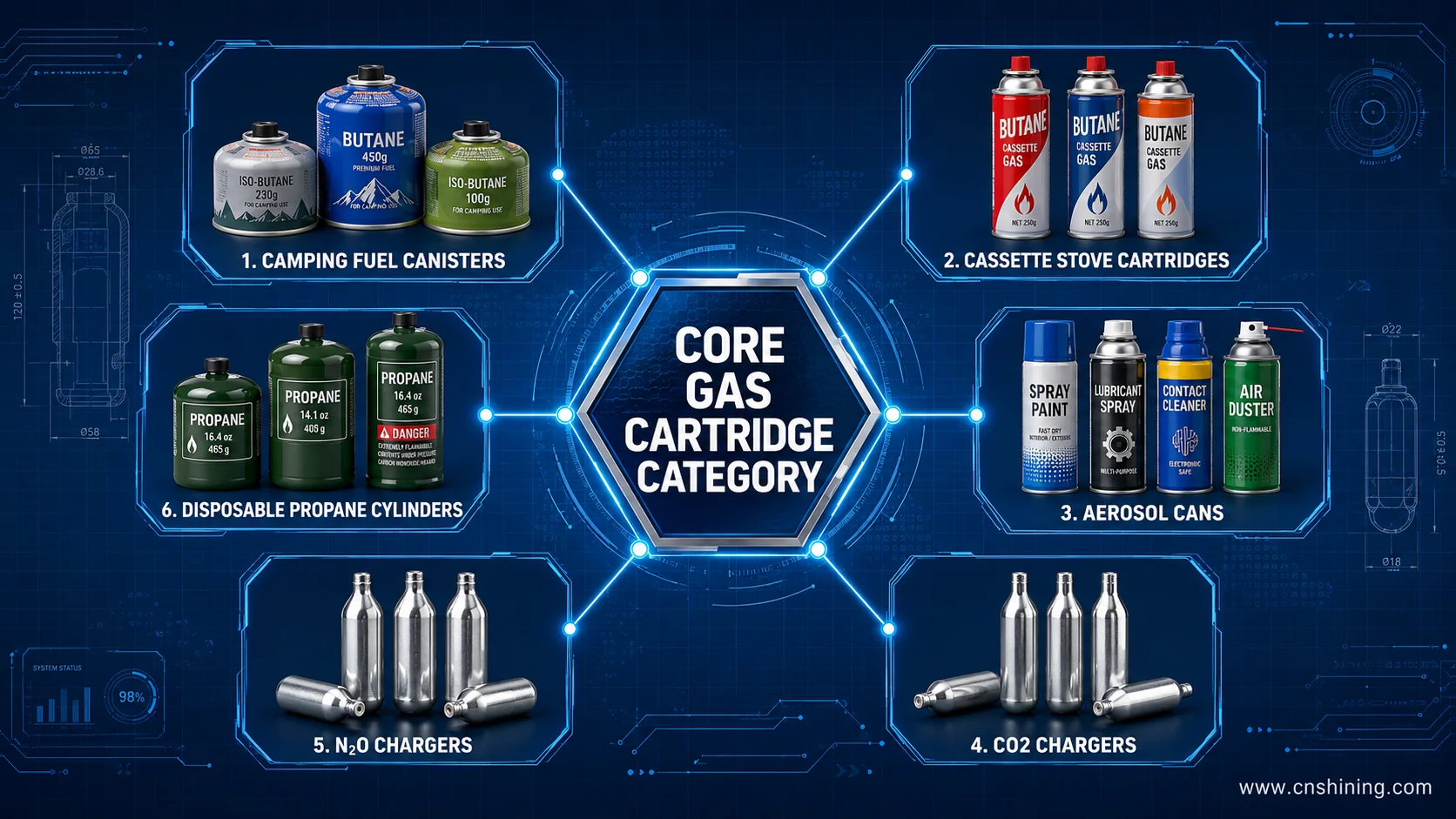
For this article, gas cartridge means a small, pre-filled, non-refillable or limited-connection metallic gas container. The main scope covers camping fuel canisters, cassette stove cartridges, threaded fuel cans, and disposable metal gas receptacles with or without valves. Aerosol cans, CO2 chargers, N2O food chargers and disposable propane cylinders are discussed as adjacent products, not as the same market.
1. Product Scope and Working Assumptions
The core product scope follows the logic behind EN 417 for non-refillable metallic LPG cartridges and ISO 11118 for non-refillable metallic gas cylinders. EN 417 applies to metallic LPG cartridges for portable appliances, with or without a valve, and covers a total capacity range of 50 mL to 1,000 mL. That range is important. It separates this category from large refillable industrial cylinders.
The adjacent layer includes aerosol dispensers, CO2 cylinders, N2O food chargers and 1 lb propane cylinders. These products share pressure packaging knowledge, but they do not share the same use logic. An aerosol dispenser, as defined under the EU Aerosol Dispenser Directive, includes a release device and is designed to discharge liquid, foam, paste, powder or gas. A fuel cartridge is mainly a gas source for another appliance.
Market data needs the same discipline. Public reports use different boundaries. A narrow “butane gas canisters” market is closer to camping, cassette stove and portable fuel. A wider “butane gas cartridges” market may include kitchen, torch, lighter refill and other portable butane channels. Mixing both into one number creates false precision.
2. Definition, Structure and Working Principle
2.1 Definition and typical structure
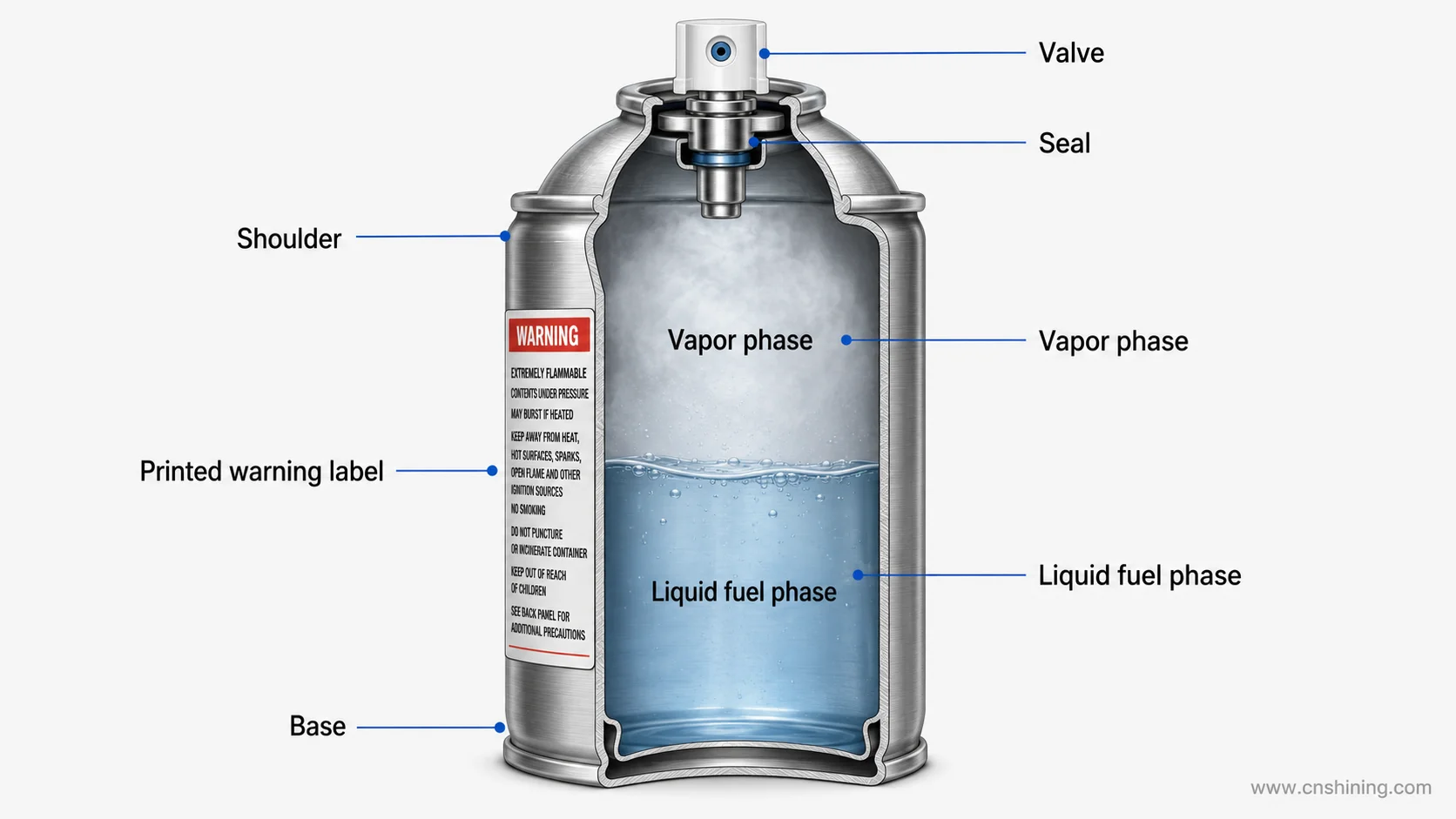
A gas cartridge is normally a non-refillable metallic container filled with compressed or liquefied gas. A common cartridge contains a metal body, shoulder or top cover, valve or closure, sealing parts, base structure and printed label. The connection system is one of the main design decisions.
Four connection groups are common:
- EN 417 threaded self-sealing valve, widely used for mountaineering and camping fuel canisters.
- Campingaz CV / Easy Clic type bayonet systems, easier to connect but more brand-ecosystem dependent.
- Bayonet or cassette cartridges, widely used in portable cassette stoves and many Asian kitchen and outdoor applications.
- Pierceable cartridges, still present in some markets but less favored in higher-end outdoor use because they cannot be safely removed once pierced.
2.2 Liquid-vapor equilibrium
Most fuel gas cartridges work as liquid-vapor equilibrium containers. Inside the can, liquefied fuel and vapor exist together. When the valve opens, vapor exits first. Pressure drops. Liquid fuel then evaporates to rebuild vapor pressure. This keeps output relatively stable for a period.
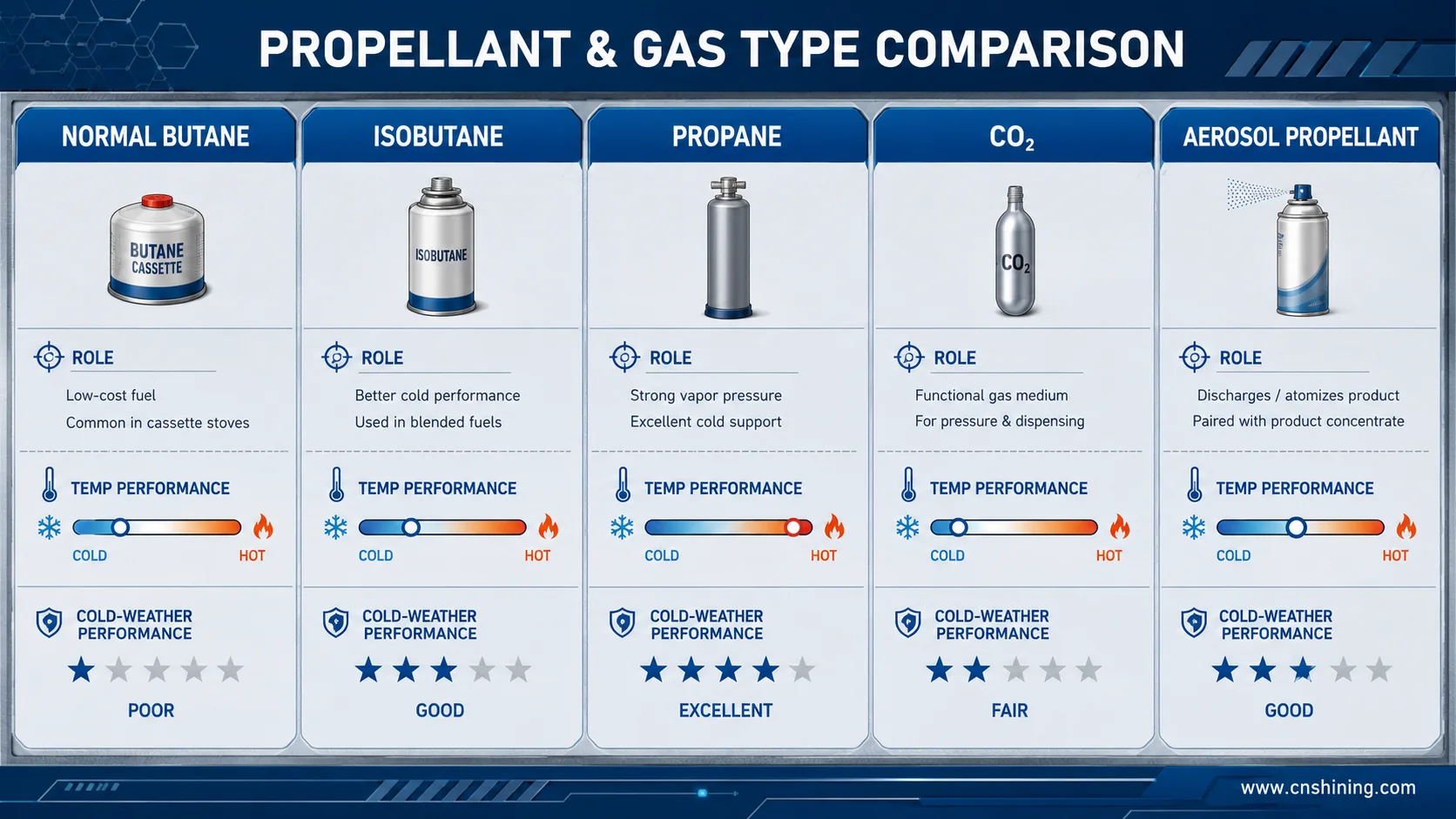
Fuel performance depends on vapor pressure and temperature. Propane lifts usable pressure at low temperature. Isobutane performs better than normal butane in cold conditions. Normal butane is cost-effective, but it loses pressure more quickly in cold weather. This is why many outdoor brands use isobutane / propane or butane / propane blends instead of pure normal butane.
The second effect is evaporative cooling. Evaporation consumes heat. During high output, the cartridge body cools down. The colder the ambient air, the lower the remaining liquid level, and the higher the burner demand, the more obvious the pressure drop becomes. Technical discussions in outdoor testing communities have long pointed to this behavior, including the higher cold-weather vapor pressure of isobutane compared with normal butane under similar propane content.
2.3 Valve reliability is user-visible quality
Users rarely judge a cartridge by vapor-pressure curves. They judge it by simple experiences: Does it connect smoothly? Does it hiss briefly or keep leaking? Does it spray fuel onto the hand? Does the valve close after removal? This is where valve tolerance, seal material, spring alignment, self-sealing behavior and locking feedback become more important than nominal capacity.
Aerosol cans follow a related but different logic. Their purpose is to discharge a product. With Bag-on-Valve technology, the product phase and propellant phase can be physically separated. That is not the normal structure of a fuel gas cartridge, where the gas or fuel itself is the functional content.
3. Classification and Typical Formulations
The key point is simple: in core fuel gas cartridges, the “active ingredient” is usually the gas itself. Only when aerosol products are included does the formula split into active product and propellant.
| Category | Typical Propellant / Content | Typical Range or Example | Role of Components | Commercial Note |
|---|---|---|---|---|
| Cassette stove bayonet cartridge | Mainly normal butane | Chinese consumer guidance defines cassette cooker cylinders as disposable cylinders with butane content not lower than 95%; some mixed products also exist. | Butane gives low cost and wide availability at room temperature; cold vapor pressure is weak. | Good for mass circulation. Winter, altitude and continuous high-fire use expose the limit quickly. |
| EN 417 threaded camping fuel canister | Isobutane / propane or butane / propane | Common public examples include 80/20, 85/15, 75/25 and three-component blends. | Isobutane improves cold performance. Propane raises vapor pressure. Normal butane controls cost. | Mainstream in mid to higher outdoor channels. Cold-use products normally move toward higher isobutane and propane performance. |
| Campingaz CV system | Butane / propane | CV300 Plus is publicly described as a 240 g 80/20 butane-propane cartridge. | The blend balances output and pressure. Easy Clic improves connection experience. | Good user experience, but the ecosystem is more closed than EN 417 threaded products. |
| Special small gas cylinder | CO2, N2O or inert gases | Capacity varies by application. Purity and valve precision matter more than camping compatibility. | The gas itself is the functional medium. | Closer to a gas device than a camping fuel product. Channels include food service, beverage, industrial and sport uses. |
| Aerosol can comparison item | Product concentrate + propellant | Formulas are category-specific and often proprietary. BOV can separate product and propellant. | Active product provides function. Propellant provides discharge or atomization. | More complex in formula IP, VOC control, labeling and product responsibility. |
4. Market Size and Regional Growth
4.1 Two valid market boundaries
Public market data splits into two useful lines. The narrow line is portable butane gas canisters. The wider line is butane gas cartridges. The difference is not a data error. It is a boundary difference.
| Market Boundary | 2025 Global Size | Forecast Endpoint | CAGR | Best Use |
|---|---|---|---|---|
| Narrow: portable butane gas canisters | USD 1.3 billion | About USD 2.03 billion by 2034 | About 5.04% | Closer to camping, cassette stove and portable fuel canisters, based on Precedence Research market data. |
| Wider: butane gas cartridges | USD 4.2 billion | About USD 7.1 billion by 2034 | About 6.0% | More likely to include broader portable butane applications, based on DataIntelo market data. |
A useful adjacent check comes from the aerosol packaging industry. The FEA 2025 Annual Report states that EU aerosol production reached over 3.4 billion units in 2024, and Germany, France and Italy accounted for more than 60% of annual EU aerosol production. This is not the gas cartridge market. It does show the maturity of Europe’s pressure packaging, valve, filling and regulatory infrastructure.
4.2 Regional working view
| Region | Public Share Signal | 2025 Working Size Range | Recent Judgment |
|---|---|---|---|
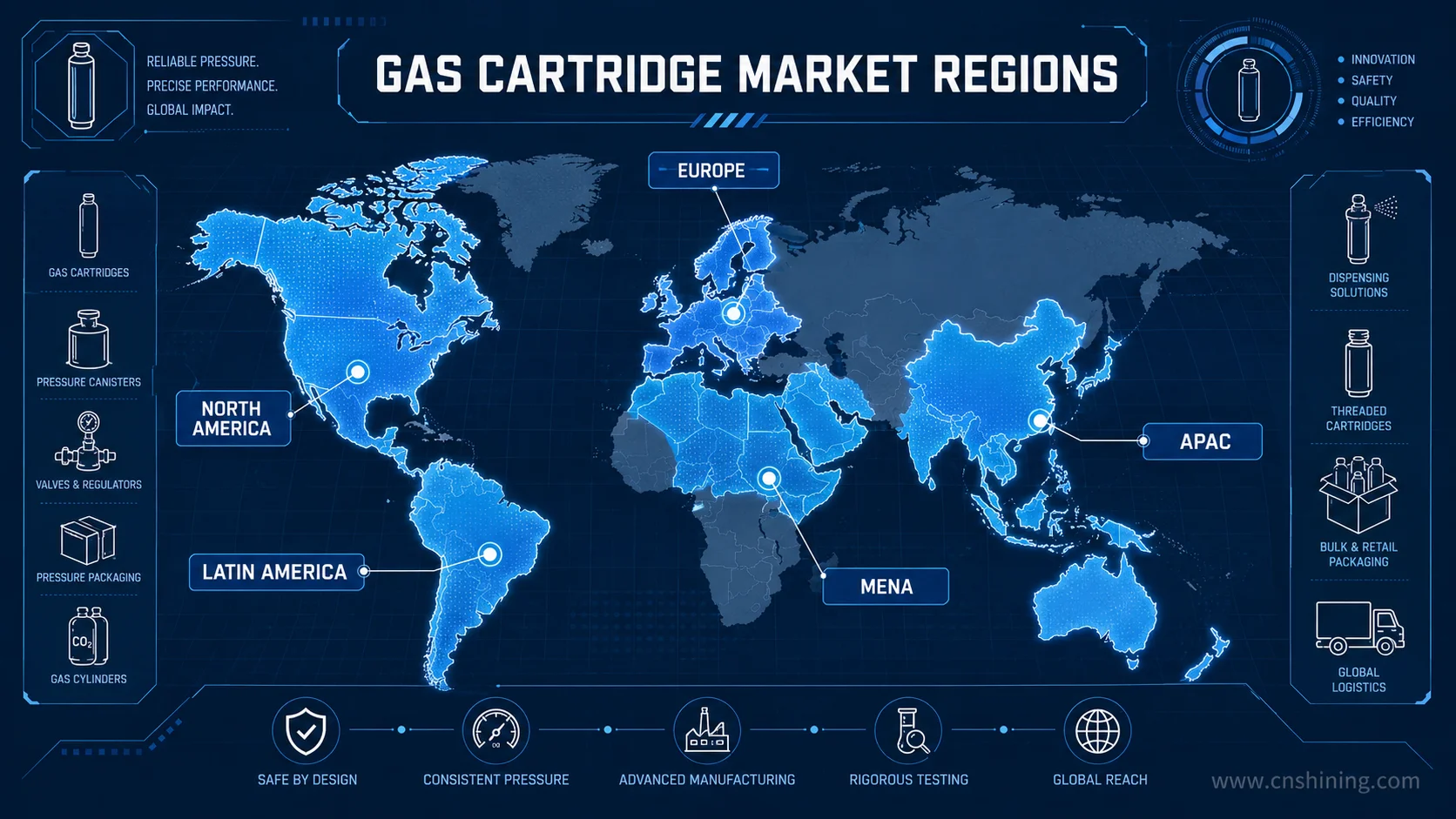
| North America | About 21%–26.4%; narrow canister reports identify North America as a dominant outdoor-oriented region. | About USD 270 million–1.11 billion | Strong in outdoor, RV, emergency preparedness and mobile food-service use. Adapter and accessory ecosystems are active. |
| Europe | Wide-scope share around 21.8%; aerosol infrastructure is mature. | About USD 280 million–920 million | Camping culture, product liability, recycling and labeling expectations are relatively strict. |
| APAC | Wide reports often place APAC as the largest or fastest-growing region. | About USD 500 million–1.60 billion | China, Japan, Korea and Southeast Asia drive volume. Japan and Korea are strong in high-quality cassette appliances and valve detail. |
| Latin America | About 9% in some public reports. | About USD 120 million–380 million | Home cooking, street food and non-piped-gas use matter, but channels are fragmented. |
| MENA | MEA references are often used as a proxy. GCC standardization is moving closer to EN 417 through GSO EN 417:2025. | About USD 90 million–290 million | Desert tourism, outdoor use, North African cooking and import channels all matter. Country differences are large. |
If a company serves backpacking stove fuel, North America, Europe, Japan, Korea and higher-end China outdoor channels deserve more attention. If it serves cassette stove fast-moving fuel for kitchen or mobile catering, Southeast Asia, Latin America and parts of MENA become more important.
5. Shining Packaging Product Relevance: Actuators, Aerosol Cans and Valves
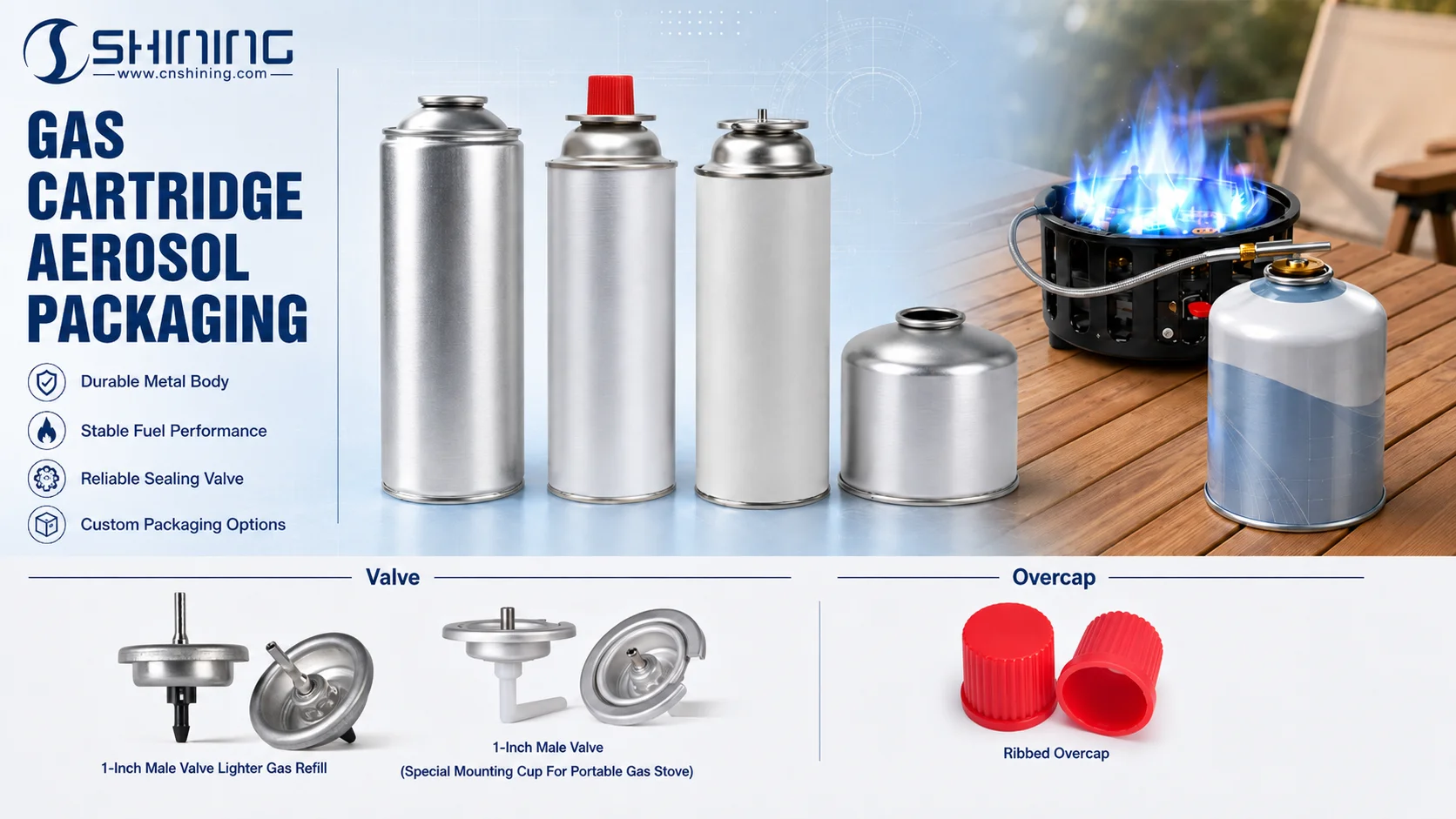
Gas cartridge projects often touch nearby aerosol packaging work. The overlap is not the fuel formula. It is the pressure-packaging hardware: metal cans, valve sealing behavior, actuator usability, crimp quality, leak control and label design. These are areas where packaging experience transfers well.
Shining Packaging works with aerosol cans, valves and actuators for pressure-packaging applications. In a gas cartridge context, the practical value is not to treat every cartridge as an aerosol can. The value is to use aerosol packaging discipline where it fits: valve tolerance thinking, actuator ergonomics, corrosion-resistant can materials, compatible coatings, safety labeling and production leak-check logic.
For adjacent products such as spray cans, technical fluids, kitchen-related aerosol products or special gas packaging, actuator and valve selection should be decided together with the can body, contents, pressure level and end-use motion. A smooth button or actuator is not a cosmetic detail. It controls discharge behavior and reduces misuse.
6. Advantages, Limitations and Adjacent Product Comparison
The main advantage of gas cartridges is high energy density with immediate use. Users do not need a pump, separate pressure device or on-site mixing. For camping, hotel backup, mobile catering and emergency kits, this is cleaner than liquid fuel and more portable than large cylinders.
The limitations are also clear. Cold weather reduces output. Interface fragmentation creates misuse. Dangerous-goods transport raises storage and return costs. One dented can, one unclear adapter, or one repeated refill of a disposable cartridge can turn a simple product into a safety problem.
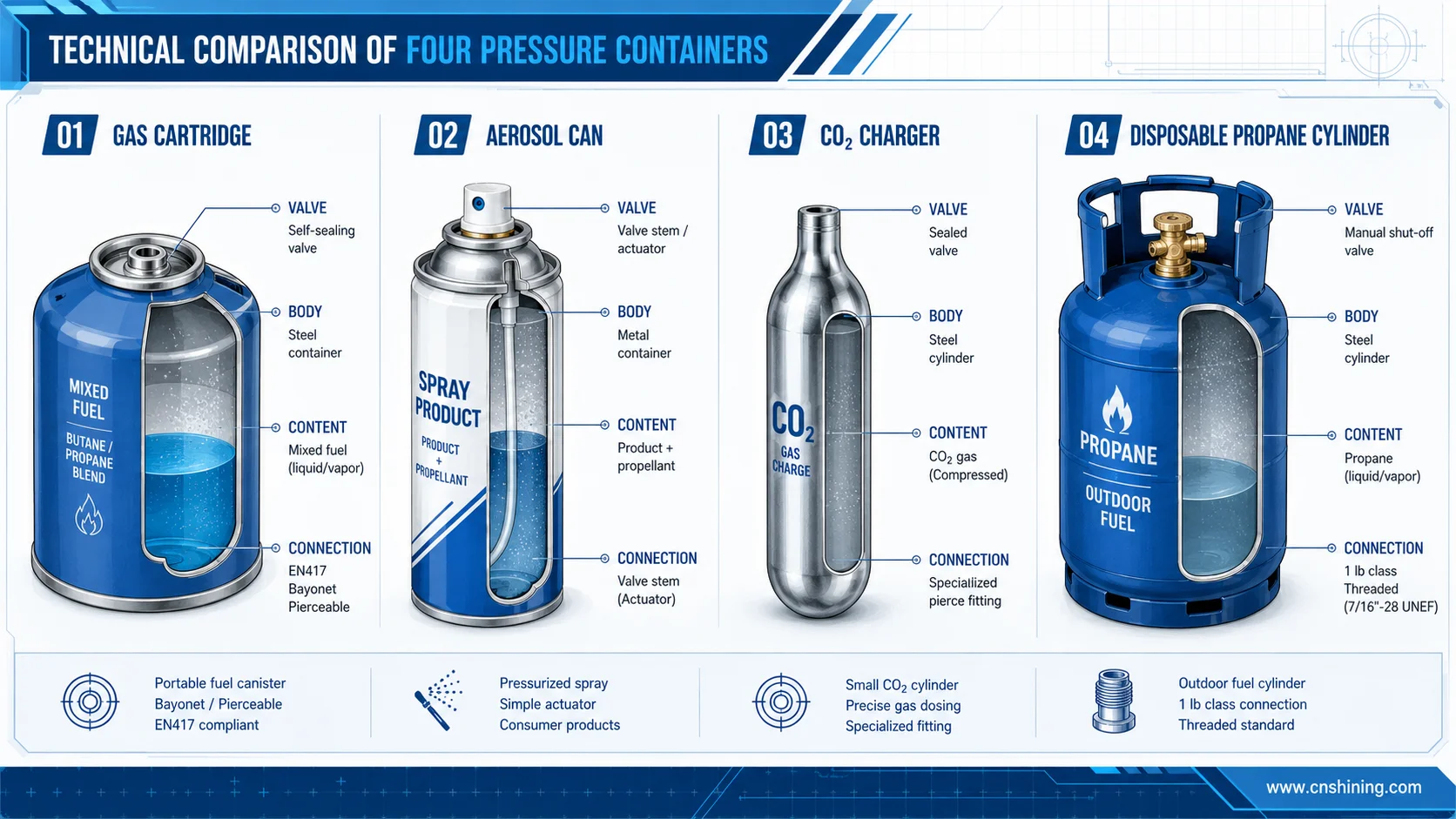
| Item | Core Gas Cartridge | Aerosol Can | CO2 Small Cylinder / Charger | Disposable Propane Cylinder |
|---|---|---|---|---|
| Core use | Supplies gas to stoves, torches and portable devices. | Discharges or atomizes a product. | Pressurization, carbonation, inflation or dedicated equipment use. | Higher-pressure fuel for camping and heating equipment. |
| Structure logic | Single chamber storing liquid/vapor fuel; connection system is central. | Container + product + propellant; discharge behavior is central. | Gas function and purity are often central. | Larger, heavier and higher-pressure outdoor hardware logic. |
| Typical connection | EN 417, CV, bayonet or pierceable. | Valve stem + actuator or button. | Depends on application. | 1 lb / 16.4 oz class dedicated connection. |
| Typical contents | Butane, isobutane and propane blends. | Product concentrate plus LPG or compressed gas propellant. | Mainly CO2 in many consumer applications. | Propane or related blends. |
| Temperature sensitivity | High; directly affects vapor pressure and flame output. | Medium; affects spray pattern and discharge. | Medium; depends on device. | Better low-temperature behavior, but heavier system. |
| Regulatory focus | EN 417, ISO 11118 and UN 2037 context. | Aerosol Directive and UN 1950 context. | ISO 11118 may apply for non-refillable small cylinders, with application-specific rules. | Retail pages often highlight DOT / UL compliance. |
| Main weakness | Cold output drop, interface fragmentation and refill misuse. | Formula, VOC, spray and labeling complexity. | Not suitable for general camping stoves. | Heavier, larger and more demanding in transport and storage. |
The commercial difference between a gas cartridge and an aerosol can is not “both contain gas.” The difference is this: one sells gas as the functional medium; the other uses gas to deliver a product.
7. Professional Terms Used in Gas Cartridge Work
| Term | Plain Technical Meaning | Business Meaning |
|---|---|---|
| EN 417 | European standard for non-refillable metallic LPG cartridges. | A common technical language for European and many international outdoor channels. |
| ISO 11118 | International standard for non-refillable metallic gas cylinders. | Useful for small gas cylinders and special disposable gas containers. |
| Lindal valve | Common name for threaded self-sealing outdoor fuel canister valve type. | Compatibility affects repeat purchase and cross-brand appliance use. |
| Easy Clic | Campingaz click-on connection system. | Easy to use, but more tied to one brand ecosystem. |
| Bayonet / cassette | Cartridge connection common in cassette stoves. | Strong in Asian kitchen and portable cooking channels. |
| CRV | Countersink Release Vent, an overpressure release design. | Reduces risk under abnormal heat or pressure exposure. |
| Self-sealing | Valve closes automatically after appliance removal. | Reduces residual leakage and storage risk. |
| BOV | Bag-on-Valve packaging. | More relevant to aerosol systems than fuel cartridges. |
| Vapor pressure | Pressure generated by vapor above liquid fuel. | Defines cold-weather output and flame stability. |
| Tare weight | Empty can weight. | Helps users estimate remaining fuel by weighing. |
| UN 2037 | Transport context for small receptacles containing gas. | Directly affects road, sea, warehouse and e-commerce handling. |
| UN 1950 | Transport number commonly used for aerosols. | Separates aerosol logistics from ordinary fuel cartridge logic. |
| BPA-NI | BPA non-intent internal coating system. | Relevant for food, personal care and sensitive markets. |
8. Regulations, Standards and Safety Labels
Regulation is not a paperwork layer added after design. For gas cartridges, it shapes capacity, pressure testing, valve closure, transport marking, warning language and return handling.
| Region / Layer | Key Rule or Standard | Core Content | Commercial Impact |
|---|---|---|---|
| Global transport | UN / ADR 2025; UN 2037 and UN 1950 context | Dangerous-goods classification, quantity limits, special provisions and packaging rules. UN 2037 applies to small receptacles containing gas in many contexts. | Controls sea, road, warehouse and e-commerce fulfillment. See the practical ADR 2025 UN 2037 card and UN 1950 aerosol reference. |
| International standard | ISO 11118:2025 | Materials, design, manufacture, inspection and testing for non-refillable metallic gas cylinders and closures. | Important for design consistency in special gas and small-cylinder applications. |
| Europe | EN 417:2012; Aerosol Directive; REACH / CLP | Construction, inspection, testing, marking, aerosol packaging and chemical labeling logic. | High expectations for valve safety, marking, warnings, recycling and chemical compliance. |
| United States | EPA aerosol waste and recycling rules; retail DOT / UL practice | The EPA aerosol cans universal waste rule affects disposal and recycling narratives for adjacent aerosol containers. | Regulation affects production, retail acceptability and post-use handling. |
| China | GB 16691 and related cooker / cylinder rules | GB 16691 addresses portable butane cookers and gas cylinders. Consumer warnings often focus on oversized pans, heat shielding and parallel stove use. | China is both a production base and a high-sensitivity user safety market. |
| GCC / MENA | GSO EN 417:2025 | GCC standardization is aligning with the EN 417 language for metallic gas cartridges. | Export labeling and certification should expect more European-style requirements. |
Safety label logic
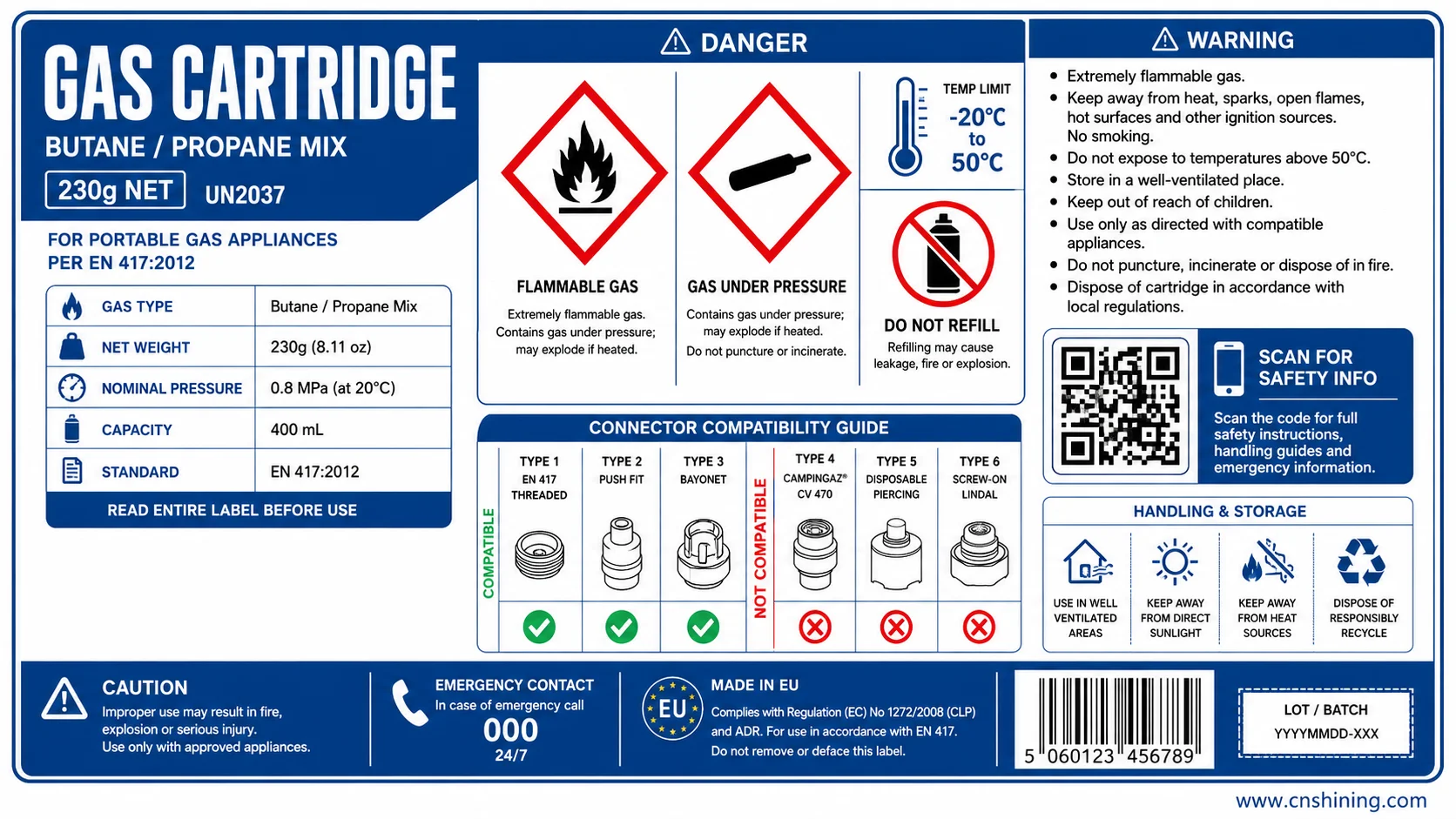
For butane fuel products, common GHS elements include flame pictogram, gas cylinder pictogram, signal word Danger, H220 for extremely flammable gas and H280 for gas under pressure. Technical chemical references such as Sigma-Aldrich butane safety data show the same direction.
The label should not stop at codes. It should tell users what not to do: do not heat, puncture or burn the cartridge; do not expose it to sun or high temperature; do not place the face or hand in front of the outlet during connection; do not use mismatched adapters; do not refill disposable cartridges; do not let oversized cookware cover the cartridge compartment; do not heat multiple cassette stoves side by side. The Macau consumer warning PDF gives practical misuse examples for cassette stove risk; see the consumer safety notice.
9. Competitive Landscape and Top 10 Gas Cartridge Brands
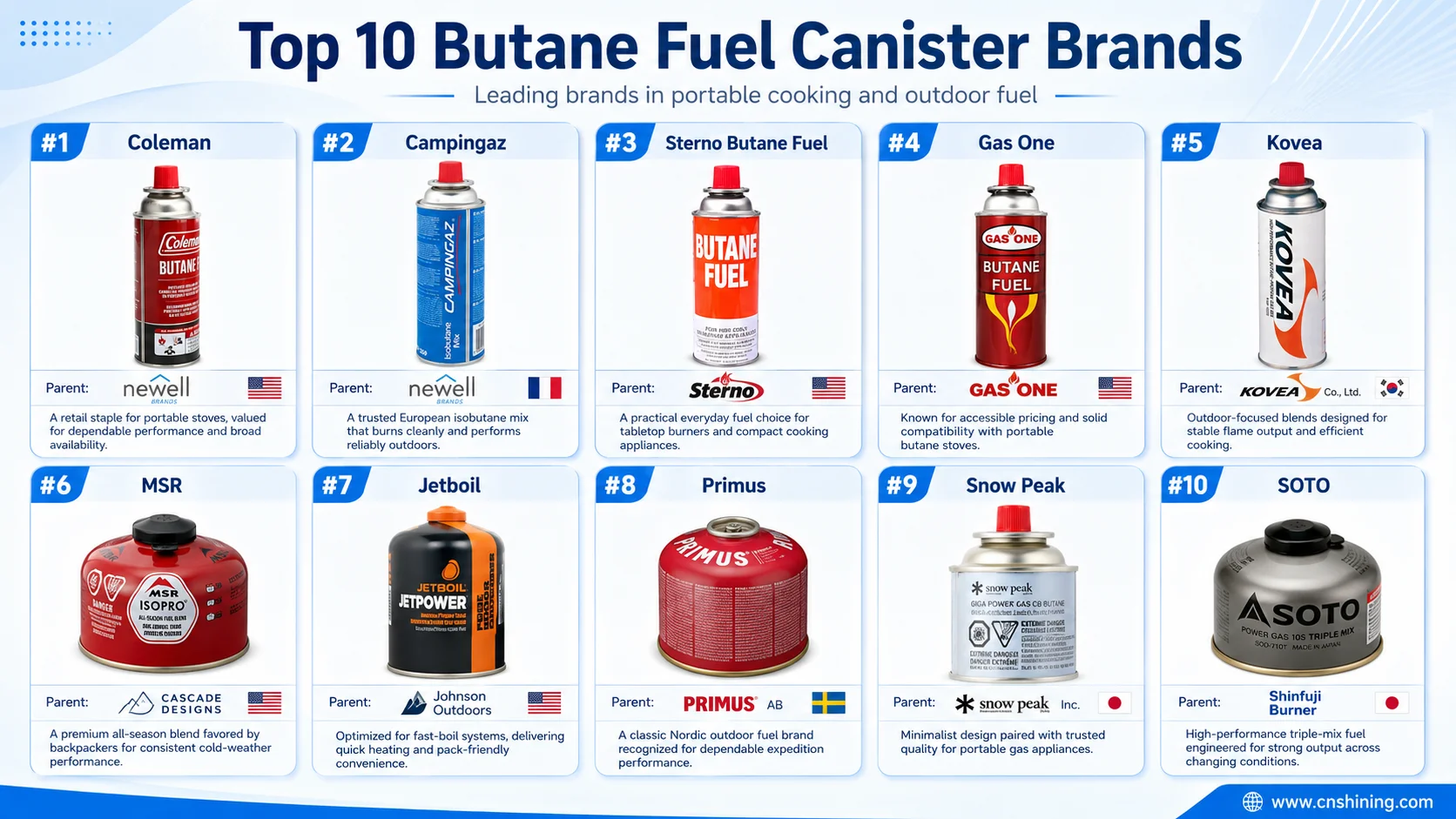
| Brand | Country / Origin | Parent Company / Brand Entity | Typical Capacity | Common Retail Price Band | Technical Comment |
|---|---|---|---|---|---|
| Coleman | United States | Coleman / Newell Brands | 250 g / 8.8 oz bayonet; 220 g / 440 g threaded | 8.8 oz single can about $2.68 in mass retail; European C250 / C500 also exists. | Very strong channel reach and low price, but global specification systems are not fully unified. |
| Campingaz | France | Campingaz / Newell Brands | CV300 240 g; CV470 450 g | CV300 about $9.8; CV470 about $13.3. | Easy Clic improves handling, but the ecosystem is more closed. |
| Iwatani | Japan | Iwatani | 250 g cassette; 227 g / 8 oz | About $3.49–6.99 per can. | Strong cassette stove ecosystem and safety design culture. |
| Gas One | United States | Gas One | 8 oz butane; 100 g isobutane | 12-pack about $27.70; small 100 g can about $10.99 in some mass retail. | Wide price coverage and strong e-commerce visibility. SKU compatibility needs clear explanation. |
| Kovea | Korea | KOVEA | 227 g bayonet; 230 g threaded | 230 g can about $5.8 in some outdoor retail. | Solid formulation and OEM-style technical discipline. Regional naming can be confusing. |
| MSR | United States | MSR / Cascade Designs | 110 g / 227 g / 450 g | 110 g about $5.95; 227 g about $6.95. | Strong technical reputation among outdoor users, especially for cold-use trust. |
| Jetboil | United States | Jetboil / Johnson Outdoors | 100 g / 230 g / 450 g | 100 g about $5.95. | Fuel is closely tied to integrated cooking systems. Efficiency story is strong. |
| Primus | Sweden | Primus / Silva system | 100 g / 230 g / 450 g | 100 g about $8.4. | Balanced outdoor brand. Some markets may need renewed positioning after ownership changes. |
| Snow Peak | Japan | Snow Peak | 110 g / 250 g | 110 g about $5.95. | Strong design and storage experience. Premium positioning is clear. |
| SOTO | Japan | SOTO | 105 g / 230 g / 460 g; ST-700 Regular Gas | Power Gas 105 about $4.1; ST-700 Regular Gas about $3.1. | Three-component blends and cold-use capability stand out. International retail coverage is narrower than major US brands. |
10. User Pain Points and Packaging Improvements
Public feedback from e-commerce, forums and social platforms is not a statistically controlled sample. It is still useful for engineering. Users repeatedly complain about the same things: leakage during connection, damaged delivery, incompatible size or interface, weak cold output, short runtime, unsafe heating and refill misuse.
| Pain Point | Engineering / Packaging Response | Part Affected | Reasoning |
|---|---|---|---|
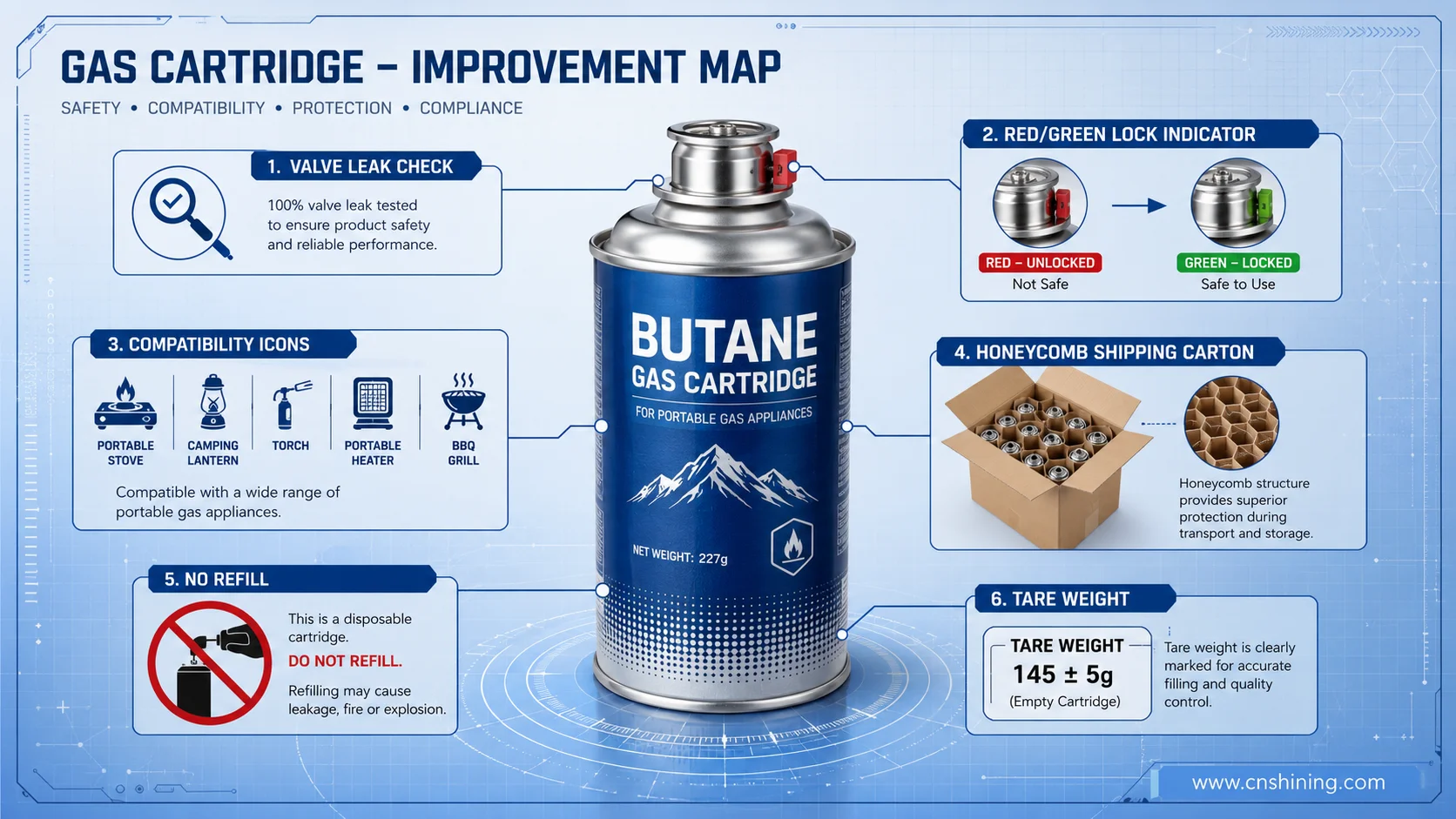
| Short gas burst or continued leakage during connection | Improve valve core and spring coaxiality, add double sealing, use auto-close or self-locking structure, and conduct 100% leak checks on critical faces. | Valve | Self-sealing and auto-closing functions directly affect user trust. |
| User cannot tell whether the cartridge is locked | Add red / green lock window, click sound, force feedback and stronger guide keying. | Actuator or connection mechanism | Hissing during lock-in is often a human-interface problem, not only a gas problem. |
| E-commerce dents and damaged cases | Use honeycomb partitions, molded pulp separation, reinforced case corners and stronger shoulder/base dent resistance. | Outer carton, box, can shape | Pressure containers should not rely on ordinary light-duty e-commerce packaging. |
| Wrong size or incompatible interface | Print large front-facing icons for EN 417, CV, bayonet or pierceable systems. Use a clear compatible / not-compatible matrix. | Printing and instruction design | “Universal” wording creates misuse when interfaces differ. |
| Cold output drop judged as poor quality | Print recommended temperature range and divide SKUs into Regular, Power and Winter-type blends. | Printing and SKU strategy | Users need to know why formulation matters. BTU claims alone do not explain cold behavior. |
| Disposable cartridges are refilled | Use stronger non-refillable sealing logic and clear no-refill warnings. Consider anti-refill structural design where suitable. | Valve and instruction system | Repeated refill can damage valves not engineered for reuse. |
| User cannot estimate remaining fuel | Print net weight, tare weight and weighing method. Add QR video for remaining-fuel estimation. | Label | Runtime anxiety is common in outdoor use. |
| Internal corrosion, odor or sensitive product contact | Select BPA-NI or other compatible internal coatings based on contents and market sensitivity. | Internal coating | Adjacent aerosol and food-contact markets increasingly expect coating discipline. |
The practical direction is direct: put safety into the valve and can body, put correct use into diagrams and printing, and put transport protection into the outer package.
11. Recent Technology and Material Trends
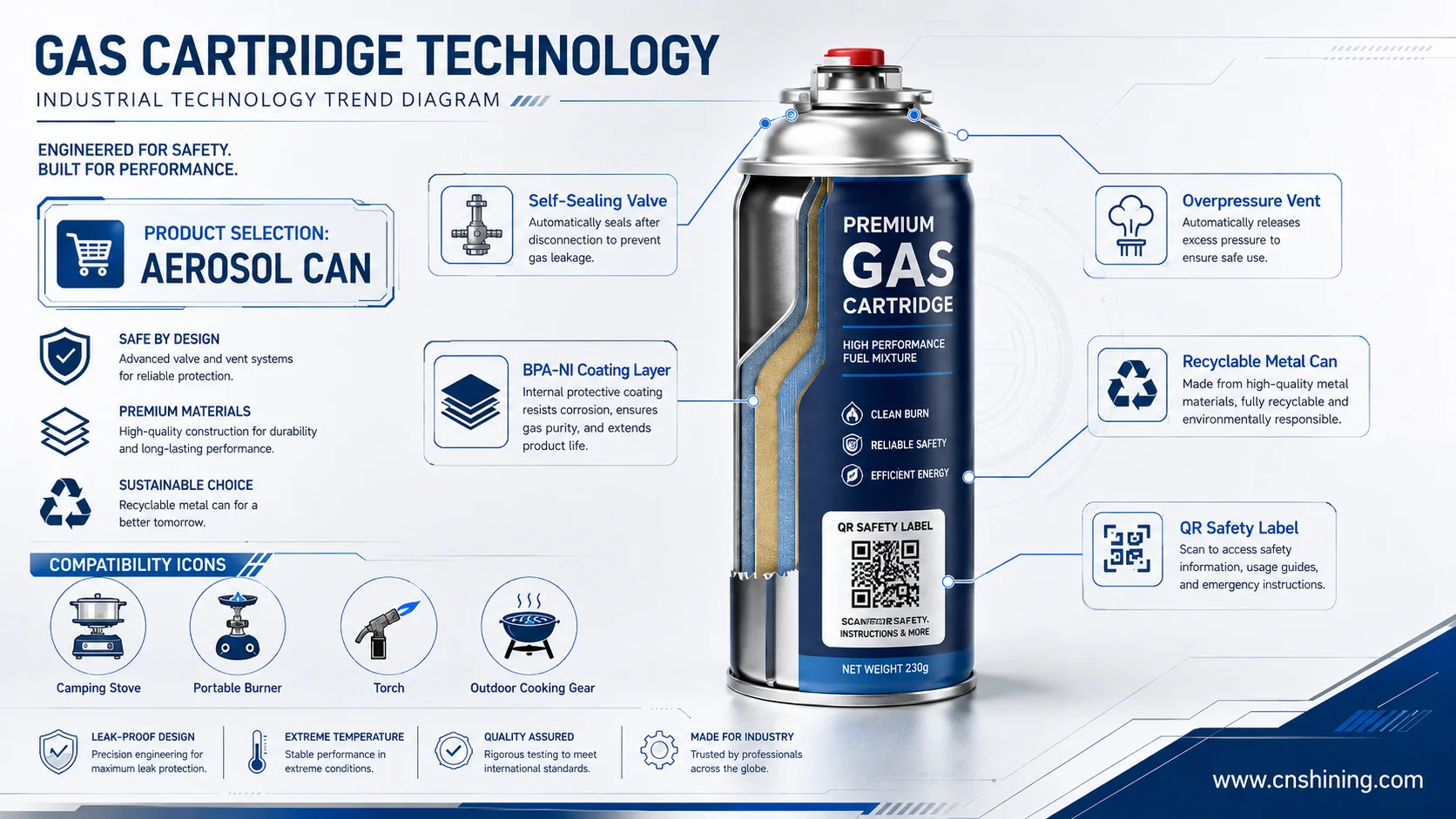
The recent shift is not one magic gas blend. The shift is the combined upgrade of materials, valves, recycling systems and information design.
Recycling pressure is moving from aerosol packaging into the wider pressure-container discussion. The Aerosol Recycling Initiative sets targets such as 85% recycling access and 90% aerosol can recyclability labeling coverage by 2030. Gas cartridges are not identical to aerosol cans, but the same public pressure affects metal can design, labeling and collection discussions.
Valve and connection design is moving from “usable” to “harder to misuse.” That means better self-sealing valves, clearer locking feedback, automatic closing, overpressure release and more visible compatibility language. Older and current pressure-container patents, including small CO2 cylinder filling and valve-related designs, also show how much engineering attention sits around closure reliability.
In coatings, BPA-NI has moved from a bonus feature toward a basic expectation in sensitive markets. ArcelorMittal’s BPA-NI aerosol packaging material is one example of how metal packaging suppliers position non-intent BPA systems for pressure packaging components.
The next useful difference may come from information design. Compatibility icons, temperature range, runtime estimate, QR video, abnormal-state diagrams, recycling steps and visible no-refill warnings can reduce real misuse. A user cannot follow a warning that was never designed to be read.
12. FAQ: Gas Cartridge Technical Questions
A gas cartridge is a small metallic container filled with compressed or liquefied gas for portable equipment. In this article, the core scope is non-refillable or limited-connection containers used for camping stoves, cassette cookers, torches and similar devices. Large refillable industrial cylinders are outside this scope.
The main reason is boundary definition. Some reports count only portable butane canisters for camping or cassette cookers. Others include wider butane cartridge channels such as kitchen fuel, torches and lighter refill products. The numbers are not directly comparable unless the application scope is defined first.
Most fuel cartridges rely on vapor pressure above liquid fuel. As temperature falls, vapor pressure drops. When the burner consumes gas, evaporation cools the cartridge further. Normal butane is more sensitive to this than isobutane or propane blends, so cold-use products often use higher-performance gas mixtures.
EN 417 is closely tied to non-refillable metallic LPG cartridges for portable appliances, including valve and marking requirements. ISO 11118 is broader and covers non-refillable metallic gas cylinders and their closure systems. Both matter, but EN 417 is more directly linked to consumer fuel cartridges.
The valve controls connection, sealing, removal and leakage behavior. Users judge safety by what happens during attachment: hissing, fuel spray, lock feedback and shutoff after removal. Small tolerance problems in the valve core, spring, seal or interface can become visible safety concerns during ordinary use.
They are related pressure packaging types, but their function differs. A fuel gas cartridge supplies gas to another appliance. An aerosol can uses propellant to discharge or atomize a product. Aerosol designs may separate product and propellant, especially in Bag-on-Valve systems. Fuel cartridges usually do not.
Compatibility problems come from different connection systems: EN 417 threaded valves, CV click systems, bayonet cassette cartridges and pierceable cartridges are not interchangeable. Adapter markets exist, but adapters also increase misuse risk. Clear front-label icons and compatibility matrices reduce wrong purchases and unsafe connections.
A useful label should show flammability, pressure, temperature limits, no-puncture and no-refill warnings, compatible connector type, basic connection steps and misuse scenarios. Codes alone are not enough. Users need diagrams for oversized cookware risk, heat exposure, adapter mismatch and abnormal leaking or hissing.
Gas cartridges are pressure containers, so dents, punctures and damaged cases are not just cosmetic. E-commerce shipping needs stronger separation, corner protection, impact resistance and movement control. Weak outer cartons can create product returns, user anxiety and potential safety inspection problems before the cartridge is even used.
The most practical improvements are better leak detection, stronger self-sealing valves, clear lock feedback, low-temperature blend segmentation, visible compatibility labeling, recyclable metal packaging, BPA-NI or compatible coatings where needed, and safer e-commerce cartons. These improvements address real user complaints rather than cosmetic differentiation.