
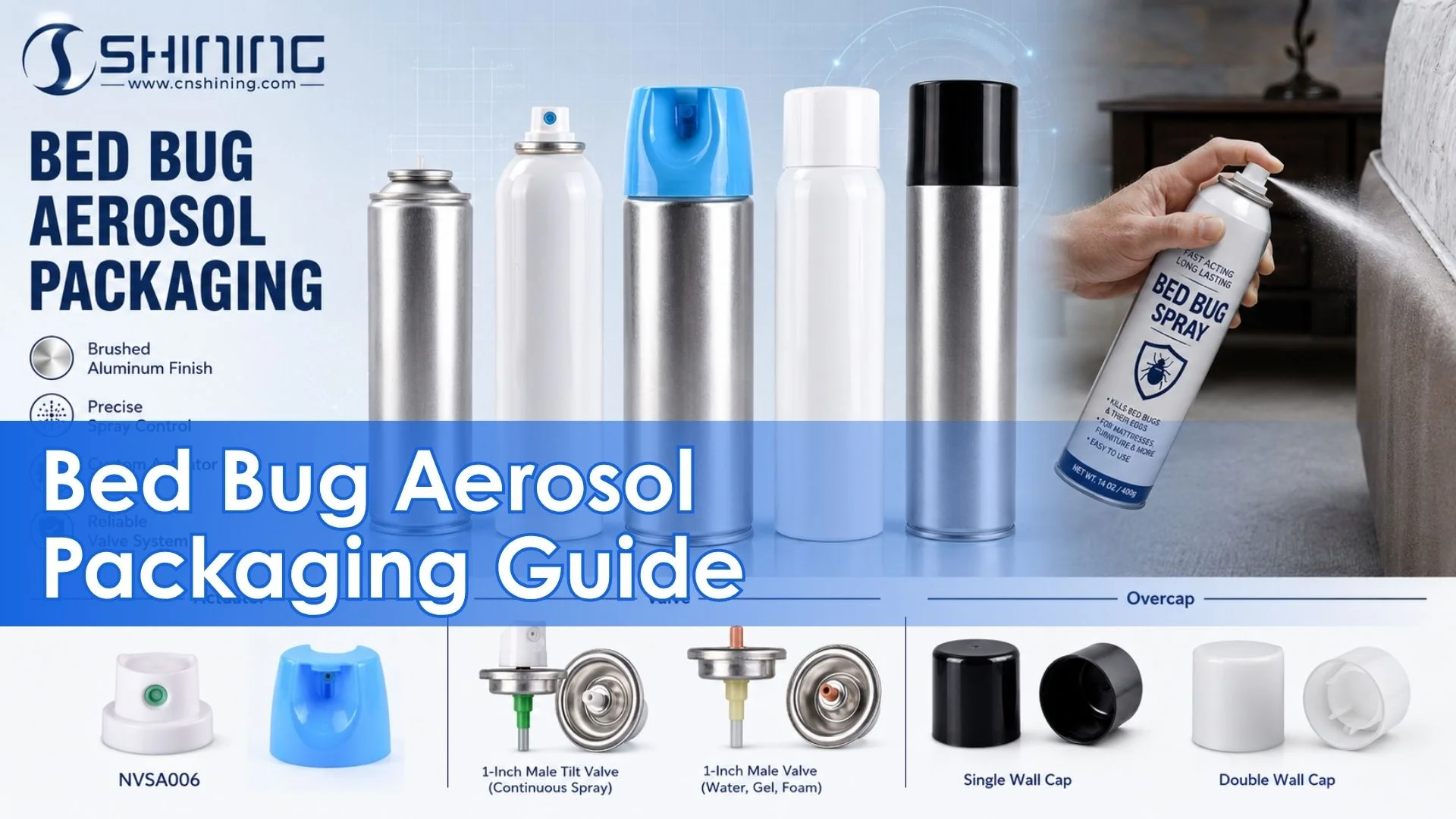
Bed bug aerosol spray works only when the active system, surface, resistance level and application pattern line up. In field use, it is better understood as a ready-to-use aerosol insecticide, crack-and-crevice spray, bed bug killer foam or residual contact spray. Its value is not “one can and the infestation is gone.” Its value is the balance between fast knockdown, access to narrow harborages, simple use and compatibility with integrated pest management (IPM).
The U.S. EPA lists more than 300 registered products for bed bug control and groups them into several classes, including pyrethrins, pyrethroids, desiccants, biochemicals, pyrroles, neonicotinoids and insect growth regulators. That already tells us the main point: “Does a spray work?” is not a single answer. It is a product of formulation × surface × resistance × application discipline. EPA bed bug pesticide classes and product search
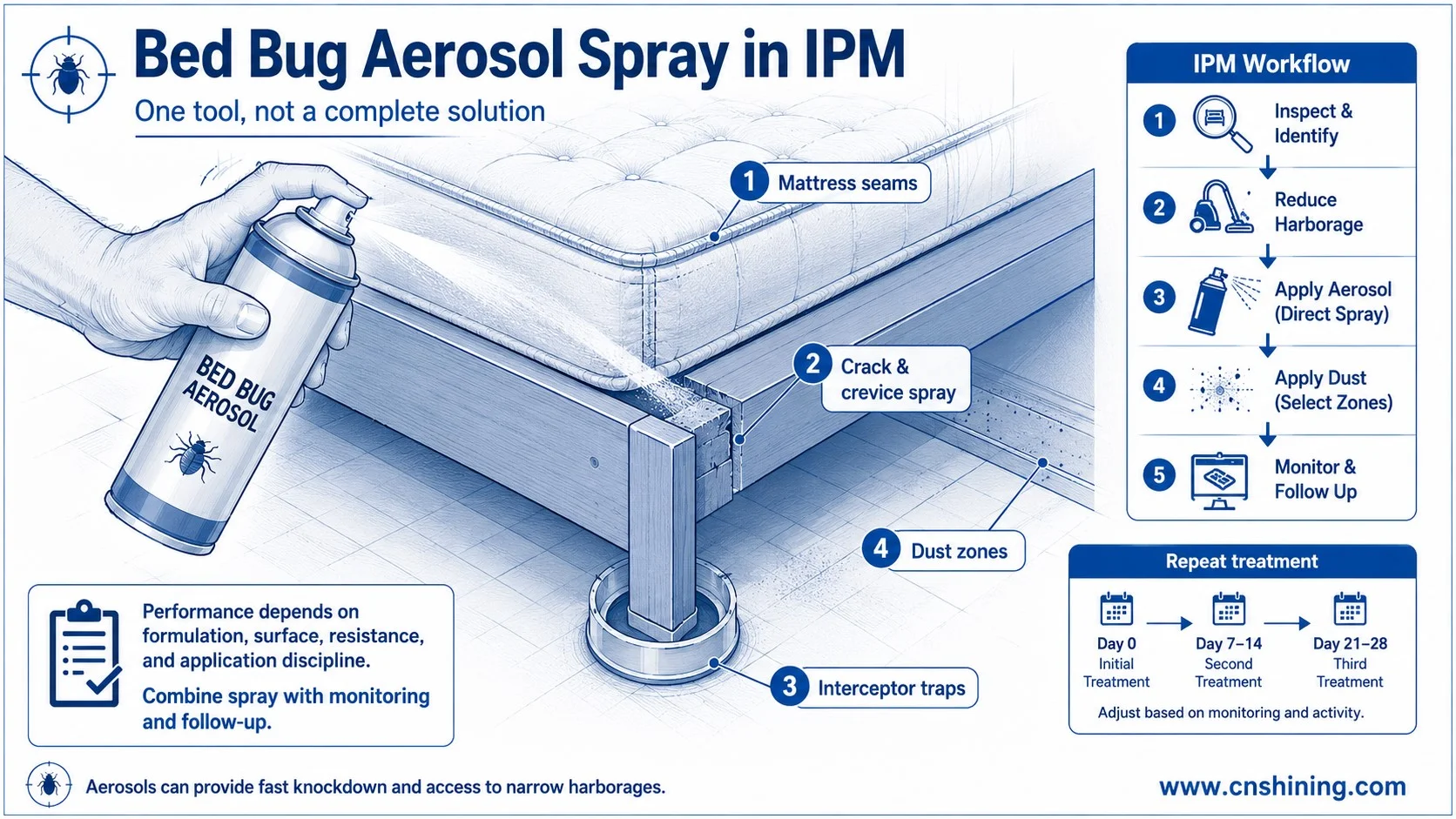
1. Product Definition and Working Principle
In this article, Bed Bug Aerosol Spray means a pressurized aerosol can that releases mist, foam or directed spray through a valve and actuator. The product is used for contact kill, residual control or support treatment against bed bug adults, nymphs and eggs. It is usually a ready-to-use product, so the packaging system is part of the formulation performance.
Three label concepts should not be mixed. Kill means direct mortality, often shown as “contact kill,” “kills eggs,” or “kills nymphs and adults.” Repellency means bed bugs avoid or leave treated areas; some pyrethrin or pyrethroid products can flush resistant bed bugs from one hiding site to another. Suppression means population pressure is reduced, for example by IGR effects on development or by long residual deposits after treatment.
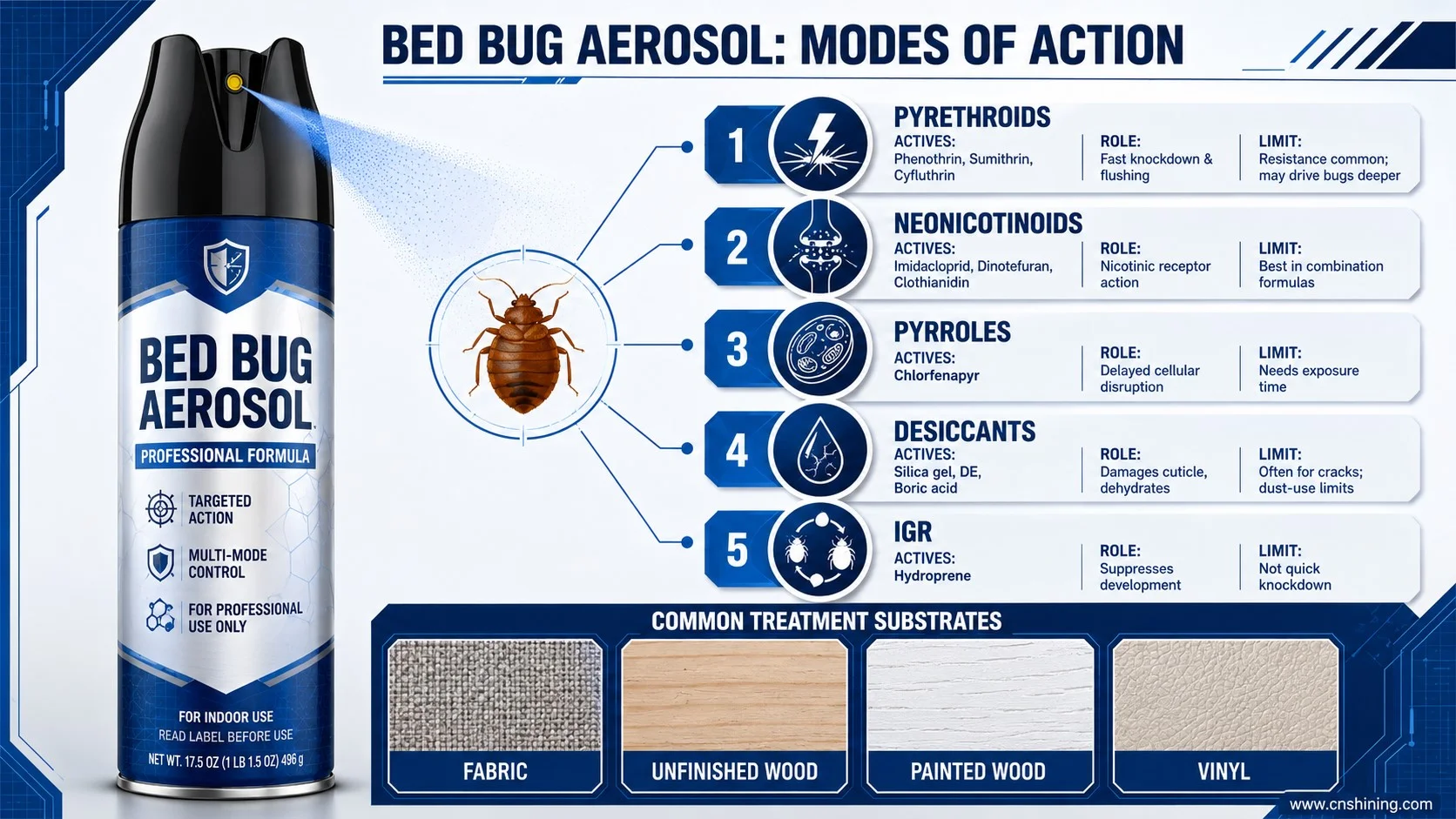
| Class | Typical Active Ingredients | Technical Role | Practical Limitation |
|---|---|---|---|
| Pyrethrins / pyrethroids | Phenothrin, sumithrin, cyfluthrin, lambda-cyhalothrin | Fast neurotoxic knockdown and flushing effect. | Resistance is common. Flushing can move bugs into new harborages. |
| Neonicotinoids | Imidacloprid, dinotefuran, clothianidin | Act on nicotinic receptors; often used to improve resistance performance. | Usually works best as part of a multi-site formulation or treatment plan. |
| Pyrroles | Chlorfenapyr | Pro-insecticide that disrupts cell function after activation. | Knockdown is not always immediate; placement and exposure time matter. |
| Desiccants | Diatomaceous earth, boric acid, silica gel | Destroy the waxy cuticle and dehydrate the insect. | Often used as dust in cracks. Inhalation risk limits where it can be applied. |
| IGR | Hydroprene | Interferes with development and later population recovery. | Not a quick knockdown route. |
Lab data also shows why “natural” or “synthetic” is not enough to judge performance. A Rutgers / Journal of Economic Entomology study compared 11 non-synthetic products and found that most direct-spray results were weak, while EcoRaider and Temprid SC reached 100% direct-spray mortality in the tested setup. The same paper reported 87% egg mortality for EcoRaider. The point is not that one essential oil name is magic. The point is that solvents, surfactants, wetting agents and hidden formulation work can decide whether the active reaches the insect. Rutgers study on non-synthetic bed bug products
1.2 Time to effect and surface dependence
The time dimension has two parts: direct contact effect and residual effect. CrossFire Aerosol label information in the source report states up to 1 month residual control on unfinished wood and control within 5 minutes under direct spraying conditions. Bedlam Plus public technical material positions the product around resistant bed bugs and eggs with two-week residual language. Harris retail language describes 16 oz aerosol performance as 16-week effective. These are not the same engineering specification. Surface, test method and label wording change the claim.
A 2016 study in Insects compared four liquid sprays and four ready-to-use aerosols on fabric, unfinished wood, painted wood and vinyl against moderately pyrethroid-resistant bed bugs. Bedlam, Demand CS and Temprid SC did not exceed 70% mortality across all tested substrates, while Transport GHP showed more stable residual performance. Longer exposure also helped: four hours of exposure performed better than five minutes. For product managers, that means “can the spray reach the crack?” and “will the insect stay on the deposit?” are both real questions. Selected insecticide sprays and aerosols efficacy study
2. Formulation Routes and Alternative Methods
The formulation trend is moving away from single-site neurotoxic claims and toward three parallel routes: multi-site combinations for resistance management, lower-odor or plant-derived narratives for household channels, and better packaging engineering to reduce complaints about actuator failure, odor, residue and unclear use instructions.
| Category | Common Actives | Mode of Action | Public Example from Source Report | Engineering Note |
|---|---|---|---|---|
| Pyrethroid / pyrethrin | Phenothrin, sumithrin, cyfluthrin, lambda-cyhalothrin | Nervous system action; fast knockdown. | Bedlam Plus: phenothrin 0.4% + MGK 264 1% + imidacloprid 0.05%. | Often used for fast kill and crack/foam positioning. |
| Neonicotinoid | Imidacloprid, dinotefuran, clothianidin | Continuous firing at nicotinic receptors. | PT Alpine Flea & Bed Bug label includes dinotefuran 0.25%. | Useful in resistance-oriented combinations. EPA TC 303 / PT Alpine label PDF |
| Pyrrole | Chlorfenapyr | Activated pro-insecticide affecting cell function. | Phantom aerosol included in academic comparison. | Residual profile can matter more than instant knockdown. |
| Organophosphate narrow-use route | Dichlorvos / DDVP | Cholinesterase inhibition or vapor action. | Nuvan Directed Spray aerosol listed with dichlorvos 0.5% in source report. | Regulatory sensitivity is high; market availability differs by region. |
| IGR | Hydroprene | Interferes with nymph development or adult formation. | Alaska DEC notes IGR bed bug labels mainly use hydroprene in liquid or aerosol forms. Alaska DEC insecticide selection note | Population suppression, not visible quick kill. |
| Biochemical / plant-derived | Cold pressed neem oil, geraniol, cedar oil, lemongrass oil, cornmint oil | Multiple contact and behavioral effects. | EcoRaider: geraniol 1% + cedar oil 1% + sodium lauryl sulfate 2%. | Strong retail narrative, but performance depends on full formulation. |
| Desiccant / physical | Diatomaceous earth, boric acid, silica gel | Cuticle wax disruption and dehydration. | Usually a crack-and-crevice dust, not the standard bed bug aerosol route. | Long residual and low resistance risk, slower action. |
A good bed bug aerosol usually has four layers: a fast-kill layer, a residual layer, a surface-adaptation layer and a release-system layer. The first two are chemistry. The third is solvent, surfactant and stabilizer work. The fourth is the valve, actuator, dip tube, foam or droplet spectrum. A product can fail in reviews even when the active chemistry is reasonable, simply because the actuator clogs or the spray pattern cannot reach the seam.
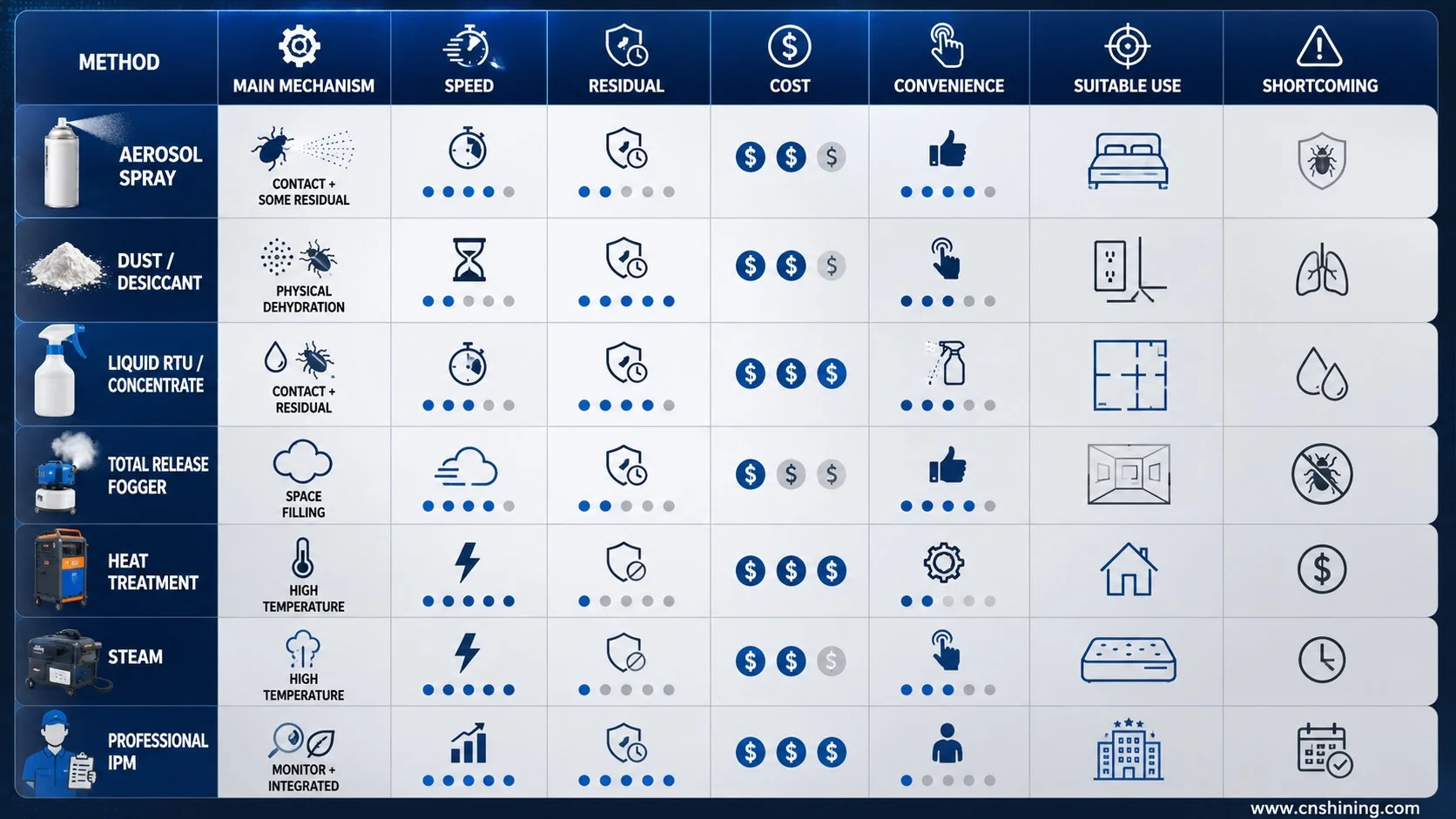
| Method | Main Mechanism | Duration | Convenience | Suitable Use | Shortcoming |
|---|---|---|---|---|---|
| Aerosol spray | Contact kill plus some residual | Minutes to weeks depending on label and surface | High | DIY, cracks, bed frames, transport tools, localized treatment | Higher unit coverage cost; resistance and surface dependence. |
| Dust / desiccant | Physical dehydration | Long | Medium | Cracks, voids, bed frames, outlet edges where label allows | Slow action and inhalation-control limits. |
| Liquid RTU / concentrate | Contact plus residual | Medium to high | Medium | Larger treatment boundaries and professional repeat treatment | Mixing, equipment, overwetting and higher user skill. |
| Total release fogger | Space filling | Product-dependent | High | More common for non-bed-bug space pests | Bed bug fit is often poor; some labels state no bed bug control. |
| Heat treatment | High-temperature mortality | Immediate, no chemical residual | Low to medium | Whole-room or professional clear-out treatment | Cost, equipment and no residual barrier. |
| Steam | High-temperature contact | Immediate, no residual | Medium | Mattress seams and soft furniture details | Slow, labor-heavy, limited coverage. |
| Professional IPM | Monitoring plus chemical and non-chemical control | Most stable | Low for user, high execution need | Moderate to heavy infestations, multi-unit buildings, hotels | Depends on discipline, follow-up and budget. |
The last line is the working reality. Field literature on multi-unit housing shows that IPM programs can reduce bed bug incidence and density better than insecticide-only approaches. Aerosol is a fast interface inside that system, not the whole system. Bed bug IPM field-study literature review PDF
3. Regulatory and Compliance Notes
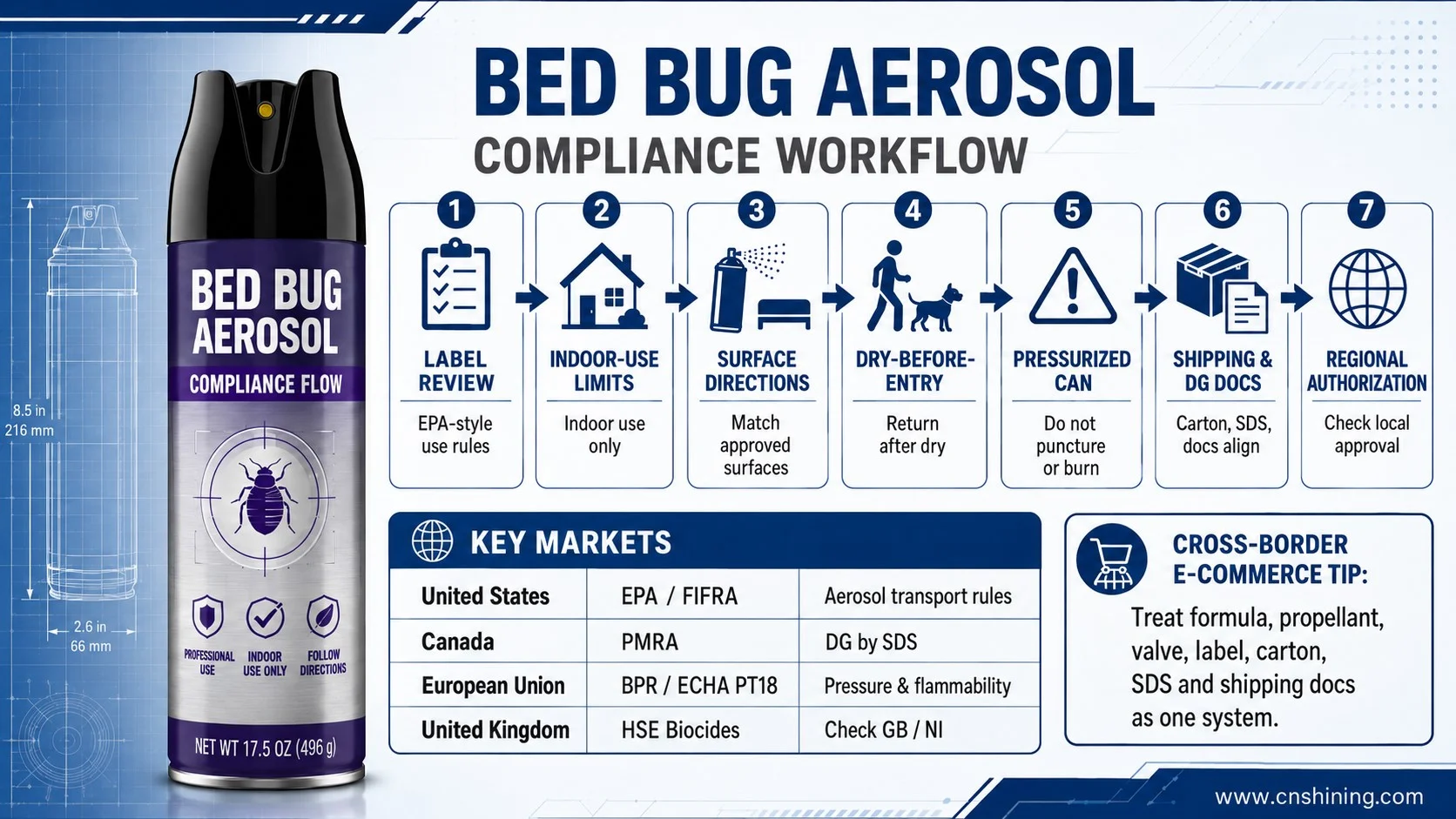
For aerosol pesticides, compliance is not just active ingredient approval. It connects product registration, label wording, allowed surfaces, re-entry conditions, packaging pressure, propellant flammability, storage, transport and regional authorization. The label is the boundary of use.
| Market | Regulatory Framework | Practical Label / Launch Requirement | Aerosol Packaging Note |
|---|---|---|---|
| United States | EPA / FIFRA | Bed bug products require EPA registration; labels commonly define indoor use, dry-before-entry rules and food-area limits. | 49 CFR 173.306 covers limited quantities of compressed gases, including container capacity and pressure limits. 49 CFR 173.306 aerosol transport requirements |
| Canada | Health Canada PMRA | Registration and official labels apply; online text is not a substitute for official labels. | Dangerous goods classification follows product SDS and transport rules. |
| European Union | BPR 528/2012; ECHA; PT18 | Active substance approval and product authorization are required; label claims must match authorized use. | Aerosol Dispensers Directive requires assessment of flammability and pressure hazards. |
| United Kingdom | HSE Biocides; Aerosol Dispensers Regulations 2009 | Great Britain and Northern Ireland authorization lists must be checked separately. | 2009 aerosol regulations form the safety basis for aerosol cans. |
| Brazil | ANVISA saneantes / desinfestantes | Household, institutional and professional desinfestantes need registration and label compliance. | Aerosol products still depend on SDS and dangerous-goods logistics. |
| Japan | Pesticide quasi-drug / quasi-drug route for some household pest products | Local product category and active allowability must be checked. | Propellant and flammability rules apply under Japanese safety systems. |
In the U.S., CrossFire label content cited in the source document includes indoor-only use, no use on humans or animals, no space-spray use, dry-surface re-entry for people and pets, and food-area restrictions. The label also states that the aerosol can is pressurized, must not be punctured or burned, and may burst above 130°F. EPA MGK Formula 30642 registration label PDF
Residue discussion also needs precision. Indoor bed bug aerosols for mattresses, bed frames, baseboards and luggage are not handled like agricultural maximum residue limits. The practical control points are registration, exposure assessment, re-entry rules and exact surface wording. A better consumer label tells users where to spray, where not to spray, when contact is allowed again and whether bedding should be washed.
4. Top 10 Bed Bug Aerosol Spray Brands
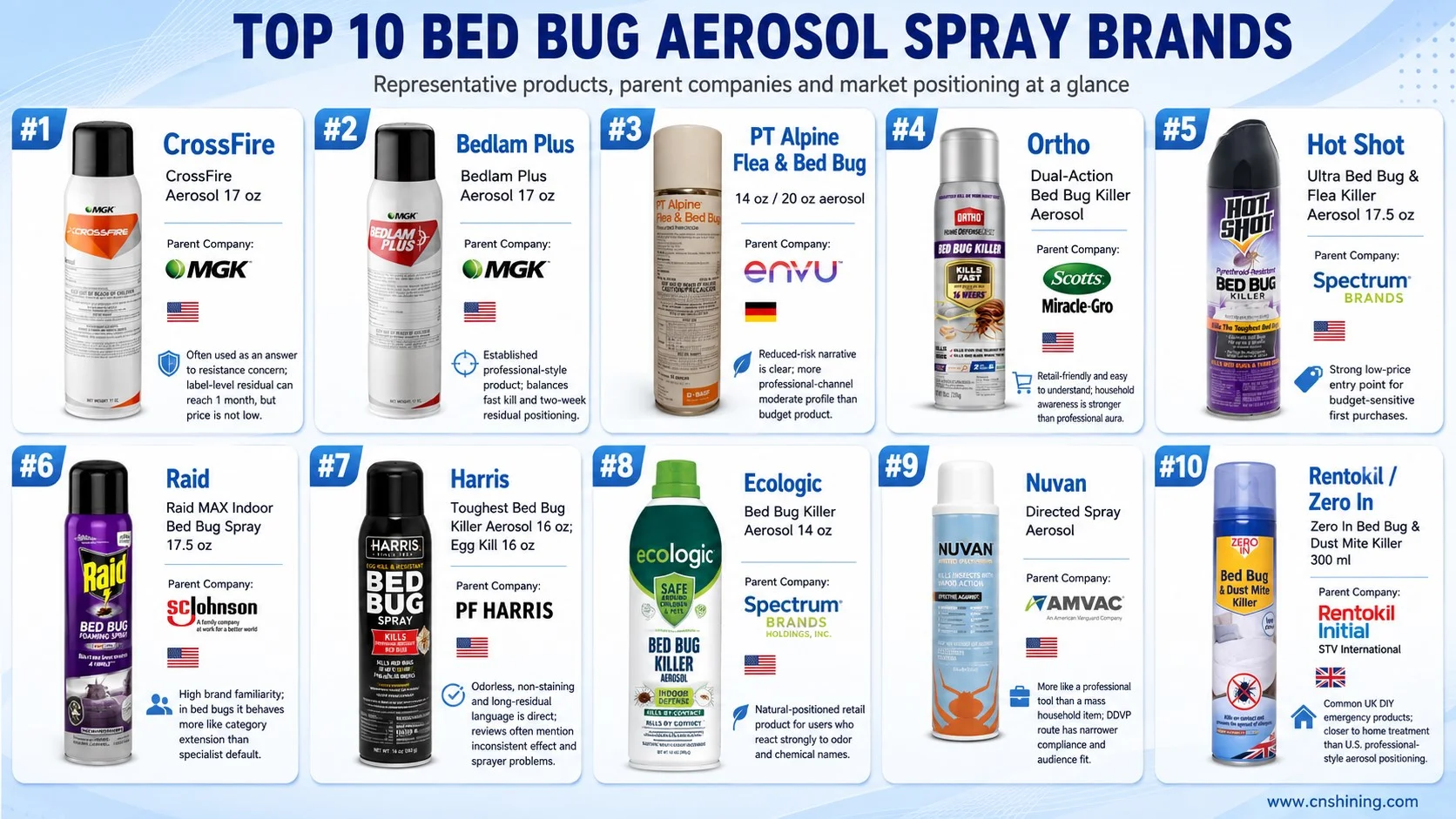
| Brand | Country | Parent Company | Representative Product and Capacity | Public Price Range | One-Line Technical Read |
|---|---|---|---|---|---|
| CrossFire | United States | MGK | CrossFire Aerosol 17 oz | about $27.71–$36.95 | Often used as an answer to resistance concern; label-level residual can reach 1 month, but price is not low. |
| Bedlam Plus | United States | MGK | Bedlam Plus Aerosol 17 oz | about $21.93–$29.47 | Established professional-style product; balances fast kill and two-week residual positioning. |
| PT Alpine Flea & Bed Bug | Germany | Envu | 14 oz / 20 oz aerosol | about $16.99–$38.99 | Reduced-risk narrative is clear; more professional-channel moderate profile than budget product. |
| Ortho | United States | Scotts Miracle-Gro | Dual-Action Bed Bug Killer Aerosol | about $13.49 | Retail-friendly and easy to understand; household awareness is stronger than professional aura. |
| Hot Shot | United States | Spectrum Brands | Ultra Bed Bug & Flea Killer Aerosol 17.5 oz | about $10.48 | Strong low-price entry point for budget-sensitive first purchases. |
| Raid | United States | SC Johnson | Raid MAX Indoor Bed Bug Spray 17.5 oz | from about $13.97 | High brand familiarity; in bed bugs it behaves more like category extension than specialist default. |
| Harris | United States | PF Harris | Toughest Bed Bug Killer Aerosol 16 oz; Egg Kill 16 oz | about $11.08–$21.75 | Odorless, non-staining and long-residual language is direct; reviews often mention inconsistent effect and sprayer problems. |
| Ecologic | United States | Spectrum Brands Holdings, Inc. | Bed Bug Killer Aerosol 14 oz | about $10.98 | Natural-positioned retail product for users who react strongly to odor and chemical names. |
| Nuvan Directed Spray | United States | AMVAC / American Vanguard | Directed Spray Aerosol | about $52.52 | More like a professional tool than a mass household item; DDVP route has narrower compliance and audience fit. |
| Rentokil / Zero In | United Kingdom | Rentokil Initial / STV International | Rentokil Insectrol 300 ml; Zero In Bed Bug & Dust Mite Killer 300 ml | about $11.17–$25.27 | Common UK DIY emergency products; closer to home treatment than U.S. professional-style aerosol positioning. |
The brand structure is split. MGK, Envu and AMVAC speak more to professional use, while Ortho, Raid, Hot Shot and Harris fit retail shelf logic and platform search behavior. The UK examples lean toward household emergency treatment.
User complaints repeat across platforms: not one-and-done, bites still appearing two weeks later, actuator or valve failure, odor and residue uncertainty, unclear retreatment rhythm, and in social commerce, delivery and authenticity problems. These complaints match the technical literature. A spray may work in a lab and still disappoint users if the label does not explain preparation, crack placement, repeat timing and what to combine with the aerosol.
5. Packaging Engineering
The latest direction is not one single breakthrough. It is five lines moving at once: new active ingredients, lower-toxicity narratives, controlled release or microencapsulation, smart or timed dispensing expectations, and online review pressure. A 2025 public study described isocycloseram as promising against multiple resistant bed bug strains, and Japanese household products have already shown that newer mechanisms such as broflanilide can move into quasi-drug aerosol or one-push formats. 2025 Insects article on isocycloseram challenge validation
Green or plant-derived routes will not remove the need for hard evidence. They shift the work toward formulation engineering: penetration, wetting, deposit behavior, odor, fabric compatibility and claim discipline. The package becomes the user interface for all of that.
| Component | Improvement Direction | Material / Process Note | User Pain Point Addressed |
|---|---|---|---|
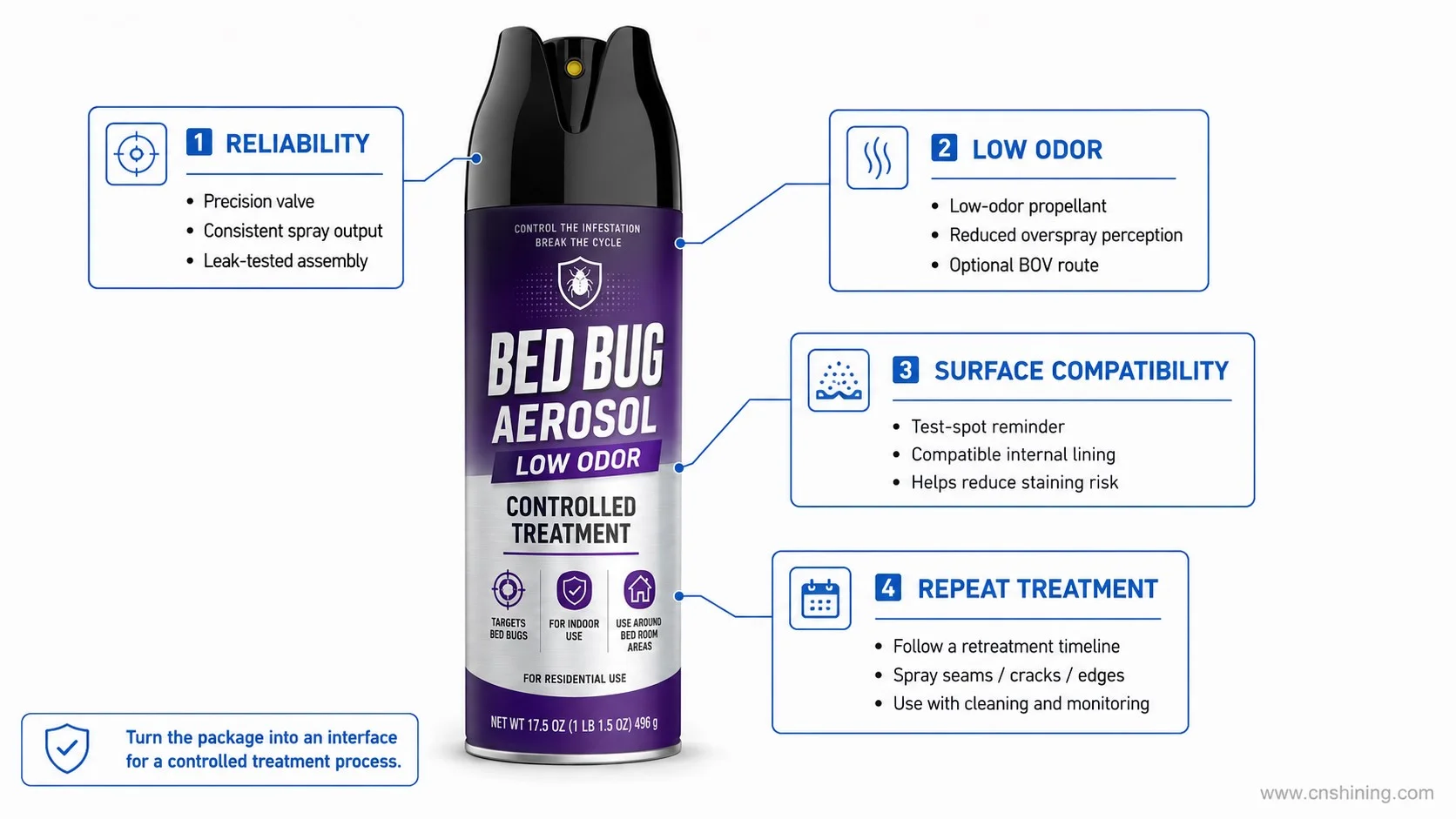
| Valve system | Higher consistency metered or precision valve; stable inverted spray. | Precision stem, tighter assembly tolerance, 100% leak test. | No spray, uneven spray rate, loss of trust. |
| Actuator / nozzle | Dual mode: fan spray plus straw-directed crack spray. | Integrated molded actuator, tethered red straw, child-resistant lock if required. | Hard switching between mattress seams and baseboard zones; lost straw. |
| Can shape | Waisted grip or anti-slip zone for gloved users. | Aluminum or tinplate can with embossing or matte localized coating. | Hand fatigue and slipping during longer treatment. |
| Internal coating | Compatibility with alcohols, essential oils, synergists and solvents. | BPA-NI epoxy-phenolic or compatible polyester lining after testing. | Odor migration, corrosion, formulation instability, precipitate. |
| Propellant system | Lower-odor route; BOV for selected premium or sensitive formulas. | Low-odor propellant blend; bag-on-valve to separate product from propellant. | Odor, overspray and fabric perception problems. |
| Label printing | Separate kill, repellency and suppression language; add spray map and retreatment timeline. | Alcohol-resistant ink, icon layout, QR code to treatment video. | Users expect one spray to solve the full infestation. |
| Coverage cue | Show approximate square feet or bed-equivalent treatment capacity. | Front label plus side-panel application diagram. | Overuse, underuse and purchase uncertainty. |
| Surface compatibility | High-visibility test-spot reminder for water-safe fabrics. | High-contrast warning box and fabric icon. | Staining, residue and textile complaints. |
The short version for engineering teams: change the package from “a can of insecticide” into “an interface for a controlled treatment process.” The product must tell the user what to clean first, where to spray, how long to wait, when to repeat, and when dust, interceptors, encasements or a professional service are the better next step.
6. Where Shining Packaging Fits: Actuators, Aerosol Cans and Valves
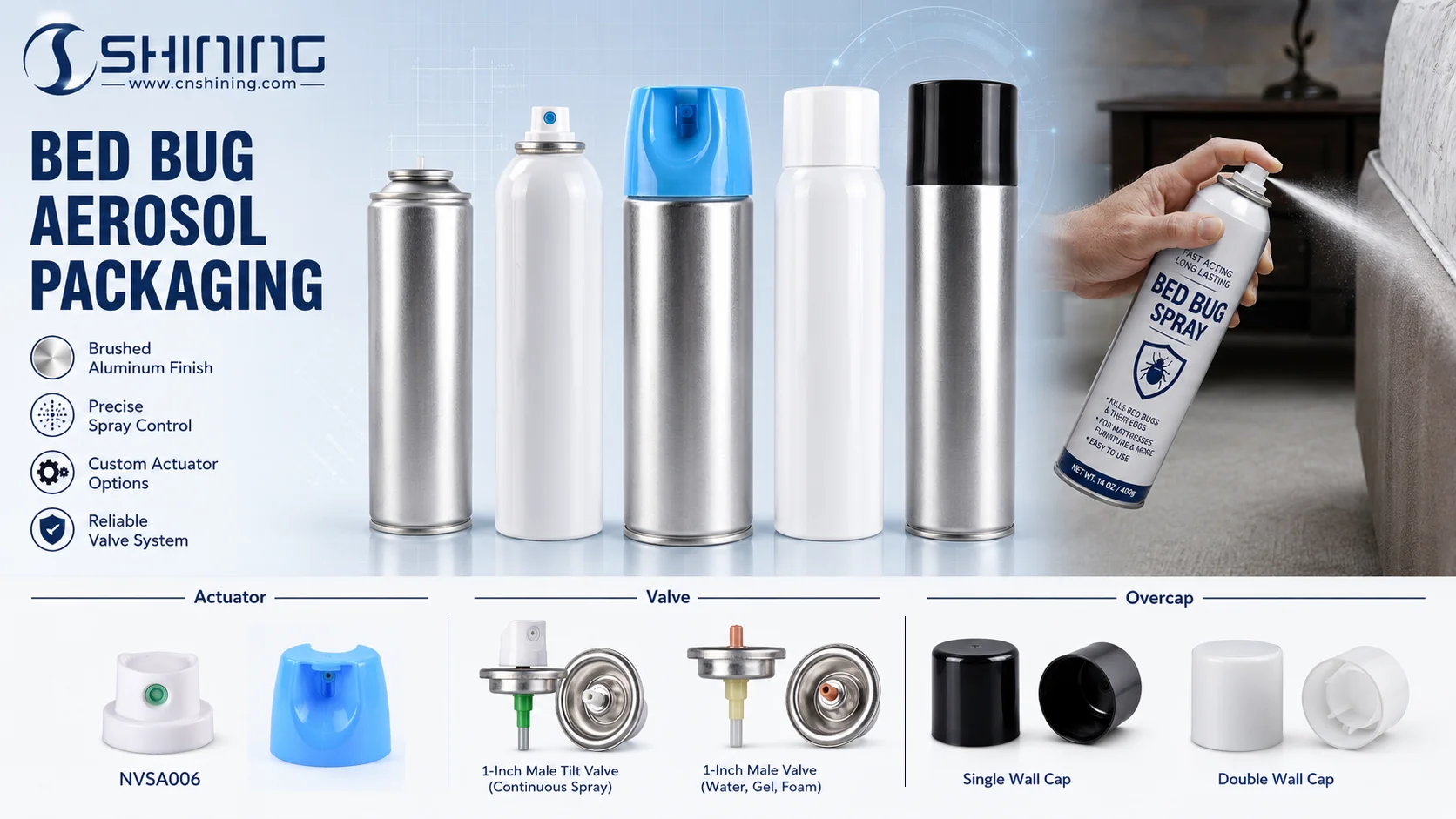
For bed bug aerosol spray, the metal package is not just a container. It decides whether the product can reach mattress seams, bed-frame joints, baseboard cracks and luggage folds without clogging, leaking or spraying too wide. That is where packaging engineering affects field performance.
Shining Packaging can be positioned around the mechanical release system: aerosol cans, valves and actuators. For this product type, the useful discussion is not a broad promise. It is practical specification work: can material and internal coating compatibility, pressure tolerance, valve output consistency, actuator ergonomics, spray-straw retention, leak testing and label area for clear treatment instructions.
Bed bug aerosol formulas may contain water, alcohol, oils, synergists, surfactants or solvent packages. Each route can stress the can lining, gasket, valve and actuator differently. Before scale-up, packaging tests should include formulation compatibility, storage stability, spray pattern, output rate, valve clogging risk, inversion behavior and transport pressure safety. The user will not separate chemistry from packaging. If the actuator fails, the whole product fails.
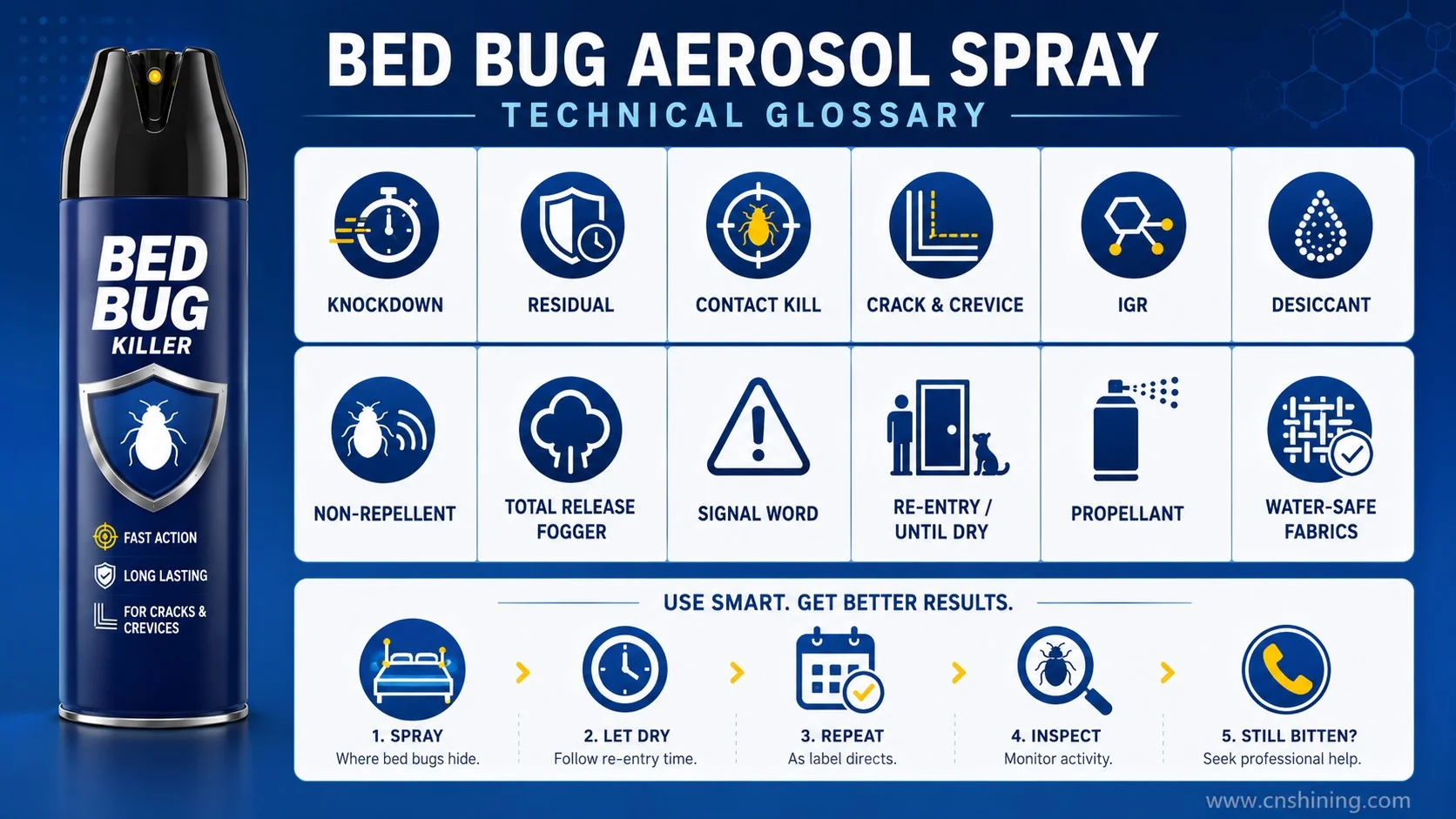
7. Bed Bug Aerosol Spray Glossary
| Term | Plain Technical Meaning | Commercial Meaning |
|---|---|---|
| Knockdown | Fast immobilization; not always final mortality. | Creates the first impression of visible effect. |
| Residual control | Surface deposit remains active after drying. | Controls retreatment interval and user expectations. |
| Contact kill | Strongest effect when spray directly hits the insect. | Users often overextend this into whole-room control. |
| Crack & crevice | Treatment into narrow hiding zones. | Important for bed bug aerosol value. |
| Pyrethroid-resistant | Bed bugs survive or move after pyrethroid exposure. | Shapes formula claims and rotation education. |
| Mode of action | How the active kills or suppresses the insect. | Important for resistance management. |
| IGR | Insect growth regulator affecting development. | Useful for suppression, not instant kill messaging. |
| Desiccant | Physical dehydration route. | Long residual, lower resistance risk, slower effect. |
| Non-repellent | Does not strongly drive insects away. | Helps avoid spreading insects to untreated zones. |
| Total release fogger | Full-room release device. | Often overestimated for bed bug control. |
| Signal word | Label hazard word. | Controls user risk perception. |
| Re-entry / until dry | When people and pets may return or touch surfaces. | One of the most important household-use boundaries. |
| Propellant | Gas system that releases product from the can. | Affects spray feel, flammability, odor and transport. |
| Water-safe fabrics | Textiles suitable for water-based treatment after testing. | Not a universal no-stain guarantee. |
Terms above come from EPA class descriptions, pesticide labels and common professional-market language. For e-commerce and social content, the terms should be translated into action language: where to spray, when to sleep on the surface again, whether to repeat treatment, and what a user should do when bites continue.
8. Final Technical Takeaway
Bed bug aerosol spray is a necessary product type, but not a complete treatment strategy. It is the forward tool in the IPM toolbox: quick, directed and convenient, yet limited by resistance, surface behavior, user technique and packaging reliability. The stronger long-term products will not be the ones with the loudest “kills fast” claim. They will be the ones that define the claim boundary, deliver the formula through a reliable valve and actuator, reduce odor and surface risk, and teach the user how to repeat and combine treatment correctly.
9. FAQ: Bed Bug Aerosol Spray
No. Aerosol spray is useful for contact kill, crack-and-crevice placement and localized residual control, but bed bugs hide in seams, frames, voids and nearby furniture. Eggs and missed harborages can restart the problem. In practice, aerosol works better inside an IPM plan that also uses inspection, cleaning, encasements, interceptors, dust or professional follow-up.
Bites after spraying do not automatically prove the product failed. Bed bugs may have avoided the treated surface, stayed hidden during the first exposure, or hatched after treatment. Skin reactions can also appear late. The technical question is whether the product reached harborages, whether residual deposits remain active on that surface, and whether retreatment timing matches the egg cycle.
Contact kill is strongest when droplets hit the insect directly. Residual control depends on the dry deposit left on a surface after application. These are separate performance claims. A product can kill quickly on direct spray but have weak residual effect on fabric, or show better residual on unfinished wood than on vinyl. Labels and test surfaces matter.
Surface type changes how droplets spread, absorb, dry and remain available to the insect. Fabric, unfinished wood, painted wood and vinyl do not hold residues the same way. A porous surface may absorb solvent and active differently from a smooth surface. This is why residual claims should be read together with the tested substrate, not only the active ingredient name.
They can still be useful, especially for quick knockdown or flushing, but resistance limits reliability. EPA notes that resistant bed bug populations may move to new hiding places after exposure to pyrethrins or pyrethroids. Many modern products combine different modes of action or are used with non-chemical tools to reduce dependence on one active route.
Desiccants kill by damaging the bed bug’s waxy cuticle so the insect dehydrates. This is a physical route, so resistance risk is lower than with conventional neurotoxic insecticides. They are usually applied as dust in cracks and voids, not as the main aerosol format. Their effect is slower, but residual value can be strong when placement is correct.
For aerosol insecticides, the delivery system is part of the product. A clogged actuator, weak valve or lost straw can prevent the formula from reaching bed-frame joints and seams. From the user’s view, a good active ingredient means little if the can will not spray. Engineering controls should include output rate, leak testing, inversion behavior and clogging checks.
Labels should separate kill, repellency, suppression, residual duration and surface compatibility. They should also show a simple spray map: mattress seams, bed frame cracks, baseboards, luggage folds and restricted surfaces. Retreatment rhythm matters. Users need to know when to reapply, when the surface can be touched, and when the case is beyond DIY treatment.
No. Plant-derived actives can support low-odor or lower-toxicity positioning, but performance still depends on the whole formulation. Rutgers work showed large differences among non-synthetic products. Solvents, surfactants, wetting agents and deposit behavior can decide whether the active reaches the insect or egg. “Natural” is not a substitute for tested efficacy and clear labeling.
Useful tests include formula-to-lining compatibility, storage stability, corrosion checks, valve leakage, actuator clogging, spray pattern, output rate, inversion performance and pressure safety. Bed bug products often need both wider surface coverage and narrow crack delivery. The package should also leave enough label area for surface warnings, re-entry rules and repeat-treatment instructions.