
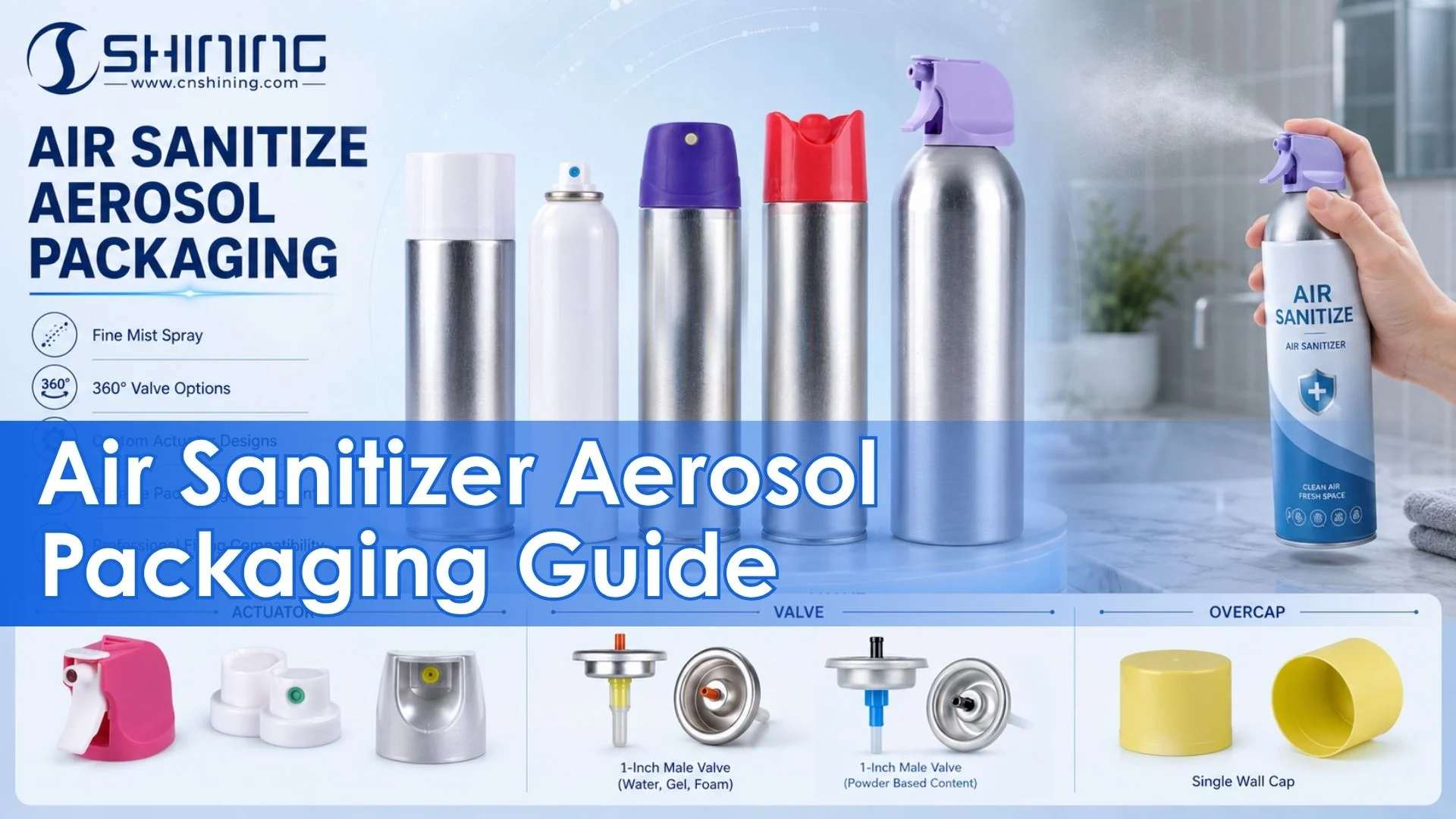
Aerosol air sanitizer, air disinfectant spray, room sanitizing mist, airborne microorganism reduction spray — these names often get mixed on the shelf. Technically, they do not mean the same thing. The narrow regulatory meaning is a product that makes a supported claim for reducing microorganisms in the air itself. The broader commercial meaning includes aerosol room sprays, surface disinfectants, fabric sprays, odor control products, and air-treatment aerosols sold into the same consumer habit.
The working conclusion is direct: an aerosol air sanitizer is not magic in a can. It is a controlled result of formulation chemistry, aerosol engineering, and label-defined use conditions. If one of those three parts is weak, the product may still spray, smell clean, and look convenient, but the technical claim becomes fragile.
1. Scope and Regulatory Meaning
From a regulatory angle, air sanitizer is not a synonym for air freshener. The strict meaning applies to products that claim to treat the air and temporarily reduce airborne microorganisms. In the U.S. EPA logic, an air sanitizer may not claim to sterilize air, disinfect air in the disease-prevention sense, or prevent or treat disease. The acceptable language is closer to “temporarily reduces the number of airborne bacteria,” provided the data and label conditions support that claim.
From a market angle, the boundary is wider. Retail shelves and market reports often group three product types together:
- Air-only products: mainly positioned for room air microorganism reduction and odor control.
- Air + surface products: sprays used on air, hard surfaces, soft furnishings, or fabrics depending on the label.
- Aerosol-adjacent products: continuous mist, reusable sprayer, or non-traditional aerosol formats that compete with aerosol disinfectants in consumer perception.
2. Mechanism and Aerosol Engineering
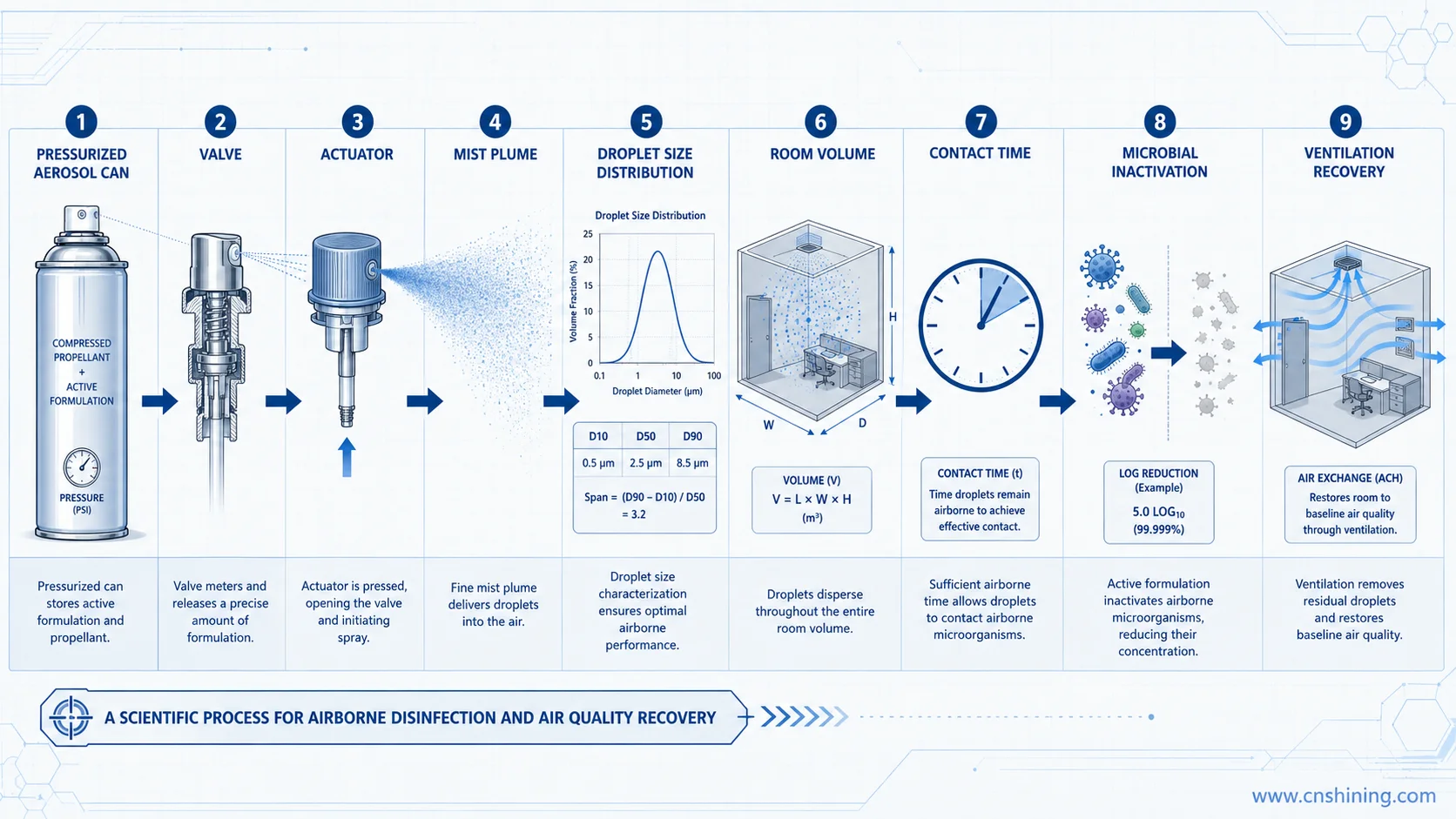
The operating chain is simple on paper: pressurization ‚Üí atomization ‚Üí diffusion ‚Üí contact ‚Üí inactivation ‚Üí decay. The propellant pushes the formulation out of the container. The valve and actuator break the liquid into droplets or mist. The mist disperses, deposits, or releases vapor-phase active molecules. The active chemistry then interacts with microbial structures.
Typical aerosol propellant systems can generate about 0.7–9.8 bar at 21.1°C, with droplet sizes ranging from below 1 µm to 125 µm and higher for streaming aerosols. That range is wide. A fine air-treatment mist and a wet surface spray are not the same engineering target.
Use conditions decide whether the product works as tested. A well-known air sanitizer label pattern requires a defined room size, closed doors and windows, a fixed spray time, an empty room during contact time, and ventilation after the waiting period. For one EPA label example, the use direction is based on an 800 cubic ft room, a 30-second continuous spray, 4 minutes for bacteria, and 12 minutes for airborne virus surrogate claims. That is not casual air freshener behavior.
3. Active Ingredients and Formulation Options
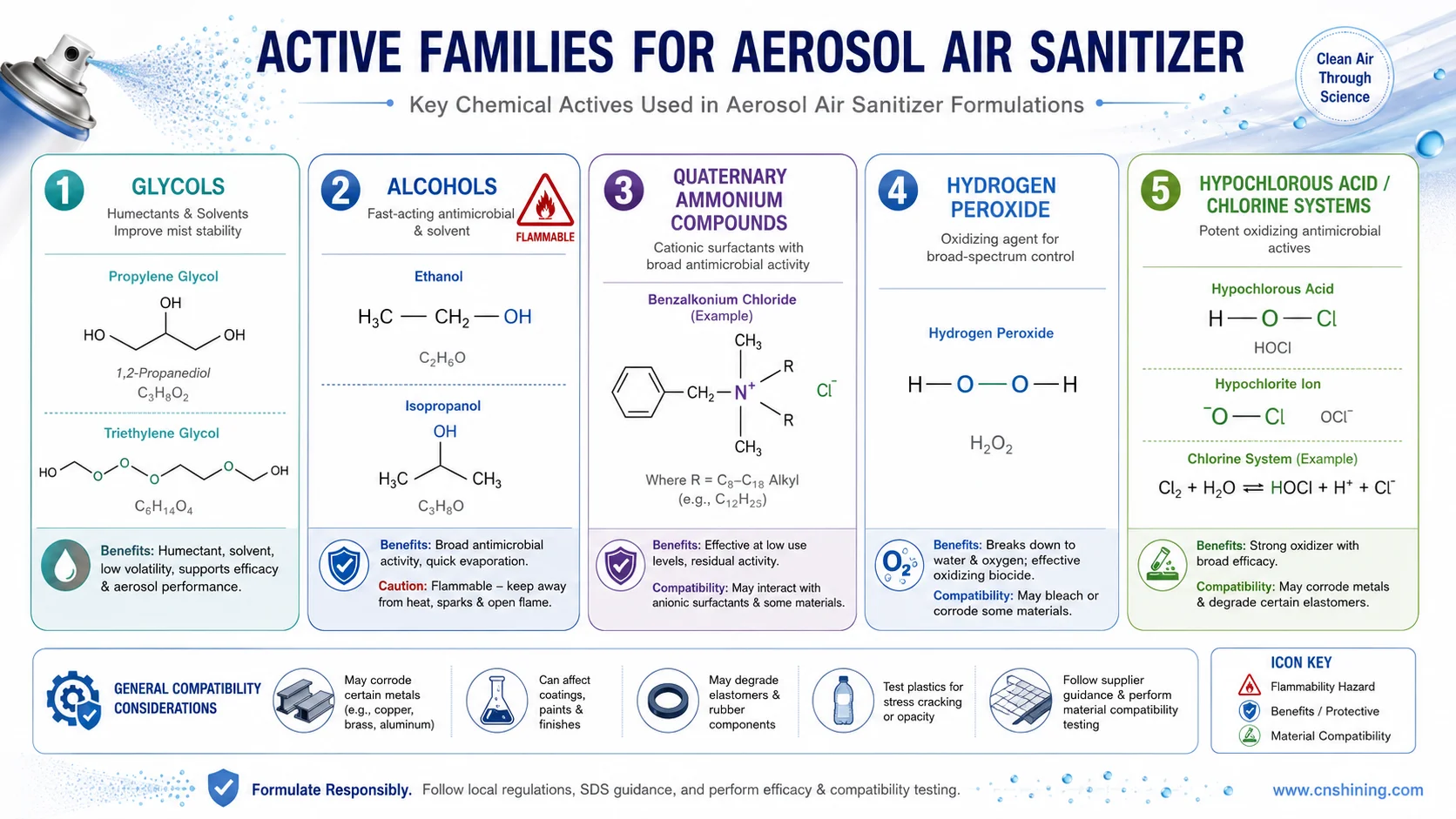
Different active systems work through different mechanisms. Alcohols mainly denature proteins and disrupt lipid membranes. Quaternary ammonium compounds damage microbial membranes and may leave some surface residual activity depending on the formulation. Hydrogen peroxide and peracetic acid are oxidation systems. Hypochlorous acid and chlorine systems rely on active chlorine chemistry and are strongly affected by pH and material compatibility. Glycols are a special air-treatment branch, where vapor or aerosol concentration in an enclosed space supports temporary airborne microbial reduction.
| Active family | Main mechanism | Representative public concentration window | Typical release design | Technical concern |
|---|---|---|---|---|
| Glycols: DPG, TEG, PG | Vapor-phase or mist-phase reduction of viable airborne microorganisms | EPA air sanitizer logic usually starts at at least 5% glycols; one public air sanitizer label shows 14.00% dipropylene glycol | Liquefied propellant, solvent, fragrance, stabilizer; target is enough vapor or mist concentration in a closed room | Inhalation perception, fragrance load, waiting time, closed-room label requirement |
| Alcohols: ethanol, isopropanol | Protein denaturation and lipid membrane disruption | Public examples include high ethanol content; Sagrotan aerosol lists 60 g ethanol per 100 g | Often single-phase alcohol aerosol with propellant, fragrance, denaturant, and co-solvent | Flammability, fast evaporation, strong odor impact, material sensitivity |
| Quaternary ammonium compounds | Membrane disruption; some surface residual behavior | Low-percent active levels are common in ready-to-use surface products; public examples include DDAC or ADBAS/BAC systems | Surfactant, solvent, fragrance, propellant; often surface or fabric compatible | Residue, pet concerns, surface wetting, label-specific rinse requirements |
| Hydrogen peroxide | Oxidative damage through reactive species | Common ready-use liquid disinfectant references often discuss 3% solutions; consumer aerosol examples are less common | More common in trigger sprays, liquid systems, vapor systems, or professional equipment | Metal compatibility, valve compatibility, liner selection, heat and light stability |
| HOCl / hypochlorite systems | Active chlorine oxidation; HOCl is the more efficient form | Often discussed in ppm-level use solutions or superoxidized water systems | More common in freshly prepared liquid or sprayer systems than long-shelf-life metal aerosols | Chlorine odor, corrosion, pH control, incompatibility with acids or ammonia |
| Peracetic acid / mixed oxidants | Strong oxidation, suited to institutional disinfection | Appears in market segmentation, but is not a common household aerosol route | Professional or industrial fogging systems | Irritation, odor, storage stability, packaging compatibility |
3.1 Option A: Glycol Air-Only System
A glycol air-only product may use roughly 10–20% DPG or TEG, combined with DME, HFC, HFO, hydrocarbon propellant, fragrance, and stabilizer. The target is not simply “more active.” The target is a stable system that can build enough vapor or fine mist concentration in a defined enclosed space.
3.2 Option B: Alcohol + Low-Level Quat Dual-Use System
This route is common in European household aerosol disinfectants. It dries fast and gives users the expected “disinfection feel.” The trade-off is clear: flammability, strong front-note odor, and a higher chance of sensitivity complaints.
3.3 Option C: Quat Surface and Odor-Control System
This approach leans toward surface cleaning, deodorization, and residual surface hygiene. It may be useful for hard surfaces and soft furnishings, but it should not be treated as a strict air-only sanitizer unless the label and data support that claim.
3.4 Option D: Air + Fabric + Surface Multi-Use System
Multi-use products are easy for consumers to understand, but they increase label complexity. The same SKU may be sprayed into air, onto fabric, and onto surfaces. That makes dose control and warning language more difficult.
3.5 Technical Glossary
| Term | Technical meaning | Commercial implication |
|---|---|---|
| Aerosol | Product released as a mist through propellant or mechanical force from a pressurized container. | Different from a pump spray; affects flammability, transport, valve design, and VOC review. |
| Propellant | Gas or liquefied gas that pushes formulation out and influences atomization. | Controls spray feel, pressure, VOC/GWP profile, flammability, and transport class. |
| Actuator | The finger-pressed spray head that shapes the spray plume. | A poor actuator can turn a valid formulation into a bad user experience. |
| Valve | Assembly that controls sealing, flow, opening, and closing. | Leakage, clogging, spray bias, and dose drift often start here. |
| BOV | Bag-on-valve structure separating formulation from compressed gas. | Useful when direct propellant-formula contact is undesirable. |
| Contact time | Required time for the active system to remain in contact with the target. | Many complaints come from users not waiting long enough. |
| Log reduction | Microbial reduction scale; 3-log equals about 99.9% reduction. | More precise than vague “kills germs” language. |
| Residual effect | Effect remaining after application and drying or reopening the room. | Many air-only products do not provide residual air protection. |
| GUV / UVGI | Germicidal ultraviolet air treatment. | A strong alternative route for continuous occupied-space air treatment. |
4. Regional Structure
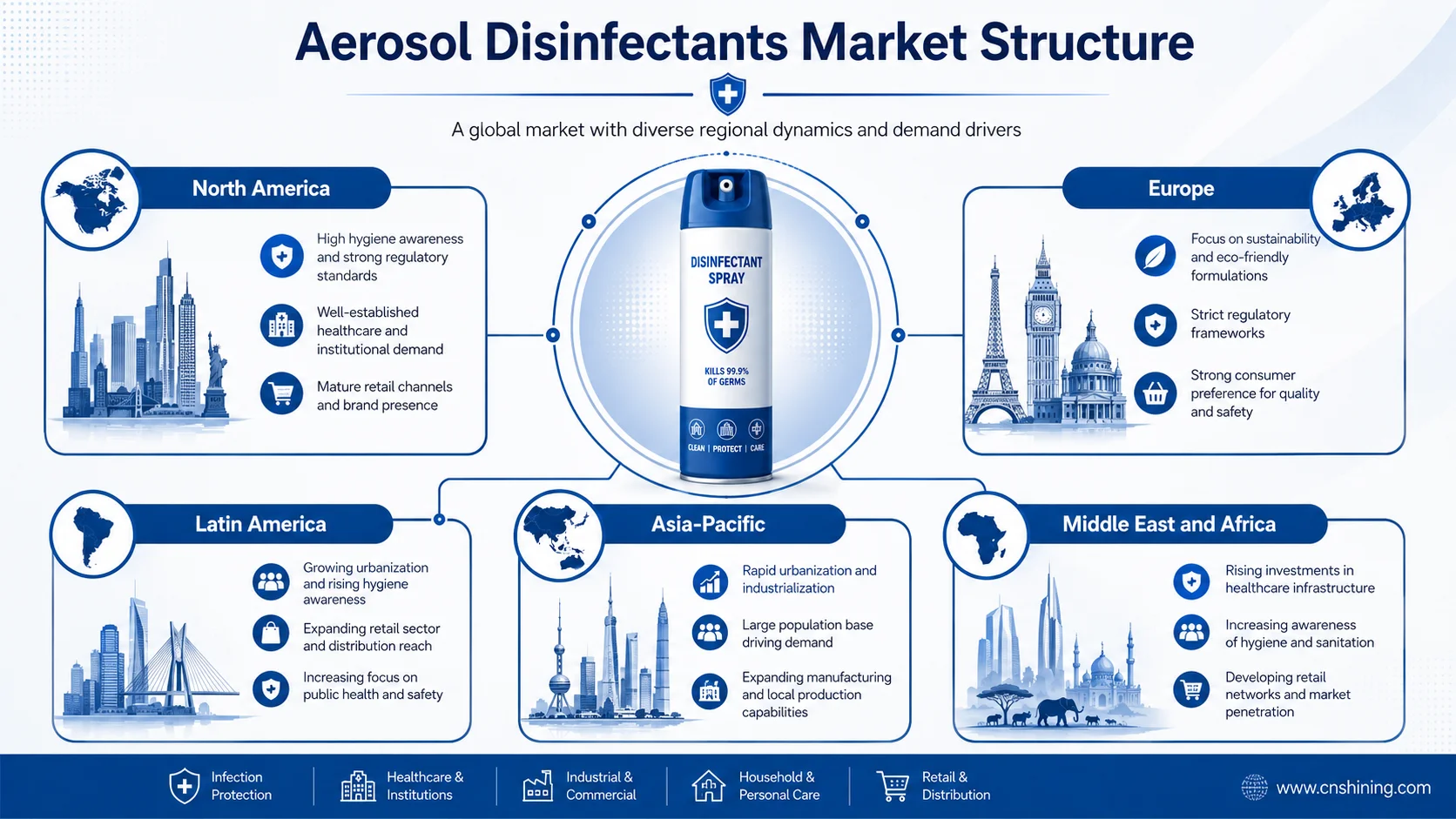
| Region | Publicly visible size or trend | Main driver | Main obstacle |
|---|---|---|---|
| North America | 2023 value around USD 0.97 billion in one public dataset; current leading regional base | High retail penetration, institutional hygiene rules, EPA framework maturity | VOC limits, fragrance fatigue, occupational safety controls |
| Europe | 2023 value around USD 0.76 billion in the same dataset | BPR and CLP create a structured high-barrier market | Label complexity, flammability presentation, strict claim control |
| Asia-Pacific | 2023 value around USD 0.55 billion; often identified as fastest-growing | Urbanization, online retail, household hygiene upgrades, China/India/Southeast Asia penetration | Fragmented regulation, wide price bands, user education cost |
| Latin America | Smaller base, visible growth potential | Modern retail and post-pandemic hygiene habits | Price sensitivity, import dependence, currency and regulation variation |
| Middle East and Africa | Early-stage base in public datasets | Hotel, healthcare, and urban commercial demand | Distribution, warehouse conditions, and cost constraints |
5. Top 10 Aerosol Air Sanitizer Brand
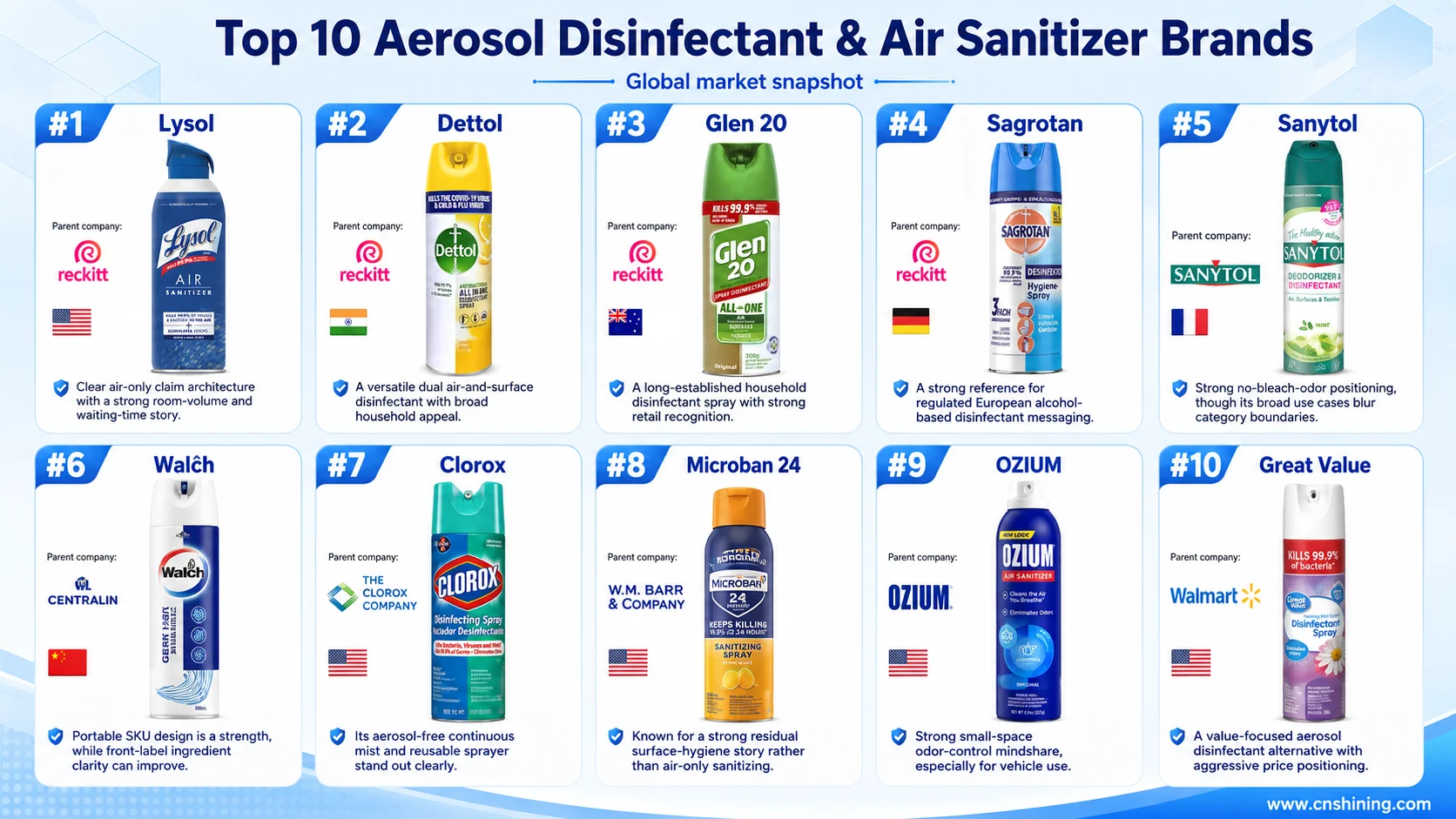
| Brand | Main market | Parent / operator visible in source | Common size | Public price window | Technical reading |
|---|---|---|---|---|---|
| Lysol | U.S. | Reckitt | 10 oz air sanitizer; 12.5 / 19 oz disinfectant spray | about 6.97$–7.29$ / 10 oz | Strongest air-only claim architecture; the room-volume and waiting-time narrative is clear. |
| Dettol | India | Reckitt | 225 mL disinfectant spray | about 1.65$ / 225 mL | More like a dual air/surface household disinfectant than a narrow EPA-style air sanitizer. |
| Glen 20 | Australia / New Zealand | Reckitt | 300 g | about 3.41$–4.12$ | Long-established household disinfectant spray with strong channel recognition. |
| Sagrotan | Germany | Reckitt | 100 mL, 250 mL, 400 mL aerosol | about 2.27$ / 100 mL; about 5.77$ / 250 mL; about 5.81$ / 500 mL | Good reference for regulated European alcohol-based disinfectant language. |
| Sanytol | France | Sanytol | 150 mL / 300 mL air purifier; 500 mL multipurpose | about 5.07$–5.58$ | “No bleach odor” positioning is strong, but multi-scenario use can blur boundaries. |
| Walch | China | WL Centralin | 12 mL, 450 mL | about 3.82$ / 12 mL; about 7.65$ / 450 mL | Good at portable SKU design; pet and ingredient concerns need clearer front-label handling. |
| Clorox | U.S. | The Clorox Company | 16 fl oz disinfecting mist | about 6.89$ / 16 fl oz | Aerosol-free continuous mist and reusable sprayer create clear format differentiation. |
| Microban 24 | U.S. | W.M. Barr | 15 fl oz sanitizing spray | about 8.49$ / 15 fl oz | Strong surface residual hygiene story; not a typical air-only sanitizer. |
| OZIUM | U.S. | OZIUM | 8 oz | about 6.48$ / 8 oz | Strong small-space and odor-control mindshare, especially in vehicles. |
| Great Value | U.S. | Walmart | 19 oz disinfectant spray | about 4.77$–5.00$ / 19 oz | Not air-only, but aggressive as a value aerosol disinfectant alternative. |
6. Alternatives and Use-Case Boundaries
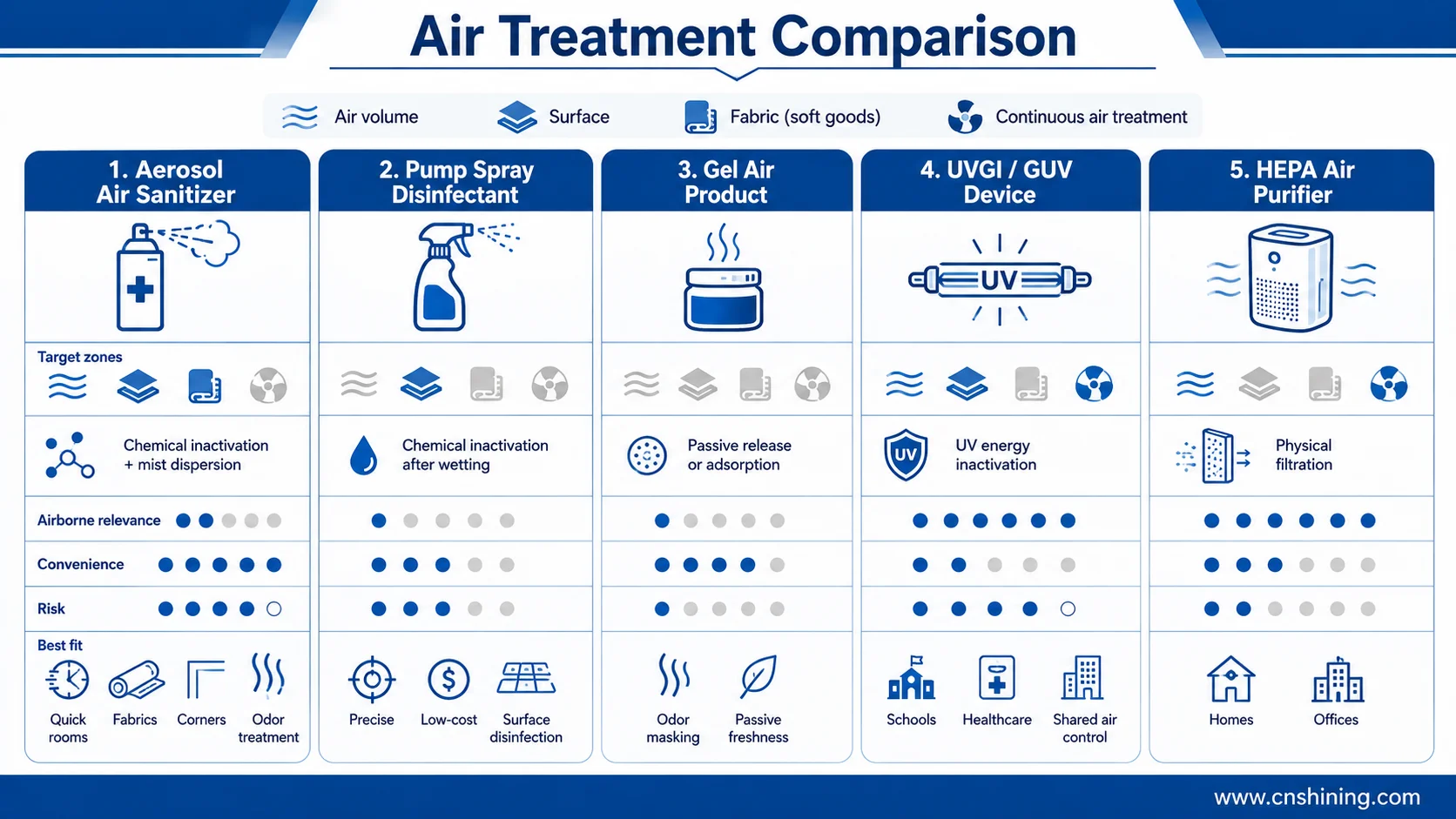
The real competitor to aerosol air sanitizer is not only another aerosol can. It is every practical method that can reduce risk or improve perceived hygiene in indoor air and room environments: pump sprays, wipes, gels, HEPA filtration, and UVGI/GUV systems.
| Dimension | Aerosol Air Sanitizer | Pump / liquid disinfectant | Solid / gel air product | UVGI / GUV | HEPA air purifier |
|---|---|---|---|---|---|
| Main target | Air volume, soft goods, surfaces depending on label | Mainly surfaces | Mainly odor or fragrance release | Air and some exposed surfaces | Airborne particles and aerosols |
| Action route | Chemical inactivation plus mist dispersion | Chemical inactivation after wetting | Passive release or adsorption | UV energy inactivation | Physical filtration |
| Airborne pathogen relevance | Possible only with registered and supported air claims | Usually not an air-body claim | Usually not a disinfection route | Strong for continuous air treatment when designed correctly | Strong for removing particles carrying microbes |
| Convenience | High; one press covers a broad zone | Moderate; targeted operation | High but weak disinfection relevance | Requires equipment and design control | Requires power and filter maintenance |
| Main risk | Inhalation exposure, fragrance/VOC, flammability, over-spray | Skin and surface exposure, wet residue | Limited efficacy | Unsafe UV exposure if poorly designed | Filter replacement and airflow limitations |
| Best fit | Fast, event-driven treatment of rooms, fabric, corners, odor sources | Low-cost precise surface disinfection | Odor masking or passive freshness | Schools, healthcare, offices, shared air control | Homes and offices needing continuous particle removal |
If the goal is continuous shared-air risk reduction, HEPA and UVGI often make more technical sense than a one-time spray. If the goal is quick treatment of a bathroom, closet, fabric surface, trash area, vehicle interior, or odor source, aerosol remains efficient. The product is a fast hygiene tool, not a building ventilation system.
7. Regulation and Compliance
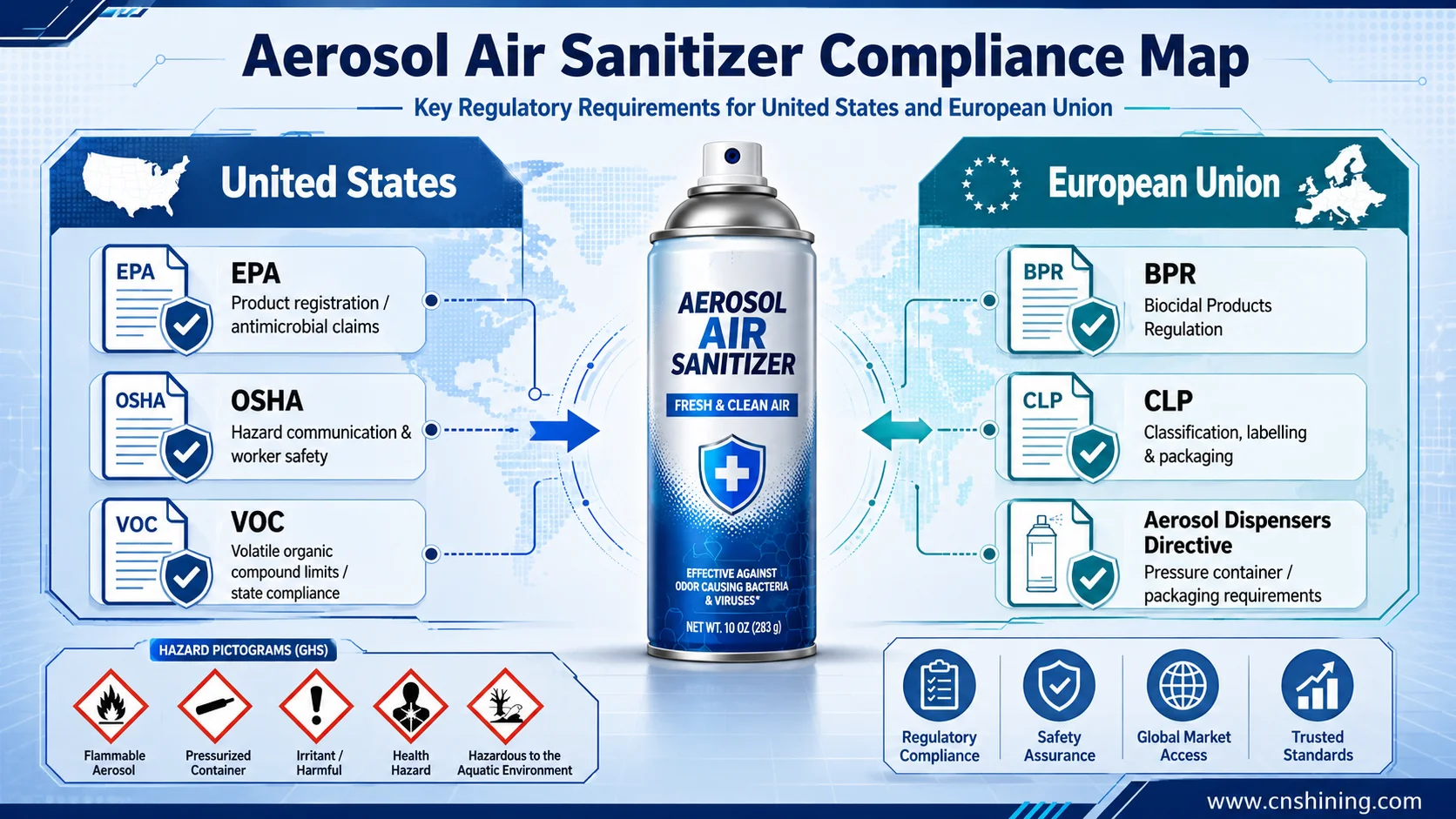
7.1 United States
In the U.S., environmental surface and environmental air antimicrobial claims are generally handled through the EPA antimicrobial pesticide framework. FDA relevance becomes stronger for critical and semi-critical medical-device disinfection or sterilization routes, not ordinary household air-treatment aerosols.
For air sanitizers, the EPA position is strict. Glycol products need enough glycol content and suitable vapor concentration logic. Non-glycol products need air sampling and microbiological data showing at least 99.9% reduction of viable airborne microorganisms compared with untreated control. Labels must describe closed-space use, spray duration, spray method, humidity conditions where relevant, and contact time.
OSHA and SDS requirements then enter through workplace use, storage, and flammable aerosol classification. VOC rules also matter at federal and state levels. For a U.S. launch, the practical sequence is: EPA claim route, OSHA/SDS hazard communication, VOC/CARB review, then packaging and logistics controls.
7.2 European Union
The EU is shaped by three layers: BPR 528/2012 for biocidal product status and active substances, CLP 1272/2008 for classification and label presentation, and the Aerosol Dispensers Directive 75/324/EEC for aerosol container safety. Alcohol-based aerosols carry visible hazard communication. That affects e-commerce, transport, warehouse handling, and consumer trust.
| Compliance module | United States | European Union |
|---|---|---|
| Efficacy proof | EPA air sanitizer or disinfectant data | BPR product type and active substance framework |
| Label | EPA registration number, directions for use, warnings, limitations | CLP + BPR + aerosol container requirements |
| Safety files | SDS, OSHA HCS, flammable aerosol classification | SDS, CLP classification, packaging information |
| Packaging | Transport, flammability, VOC, leakage, pressure | Aerosol container directive and hazard presentation |
8. Shining Packaging Components for Aerosol Air Sanitizer
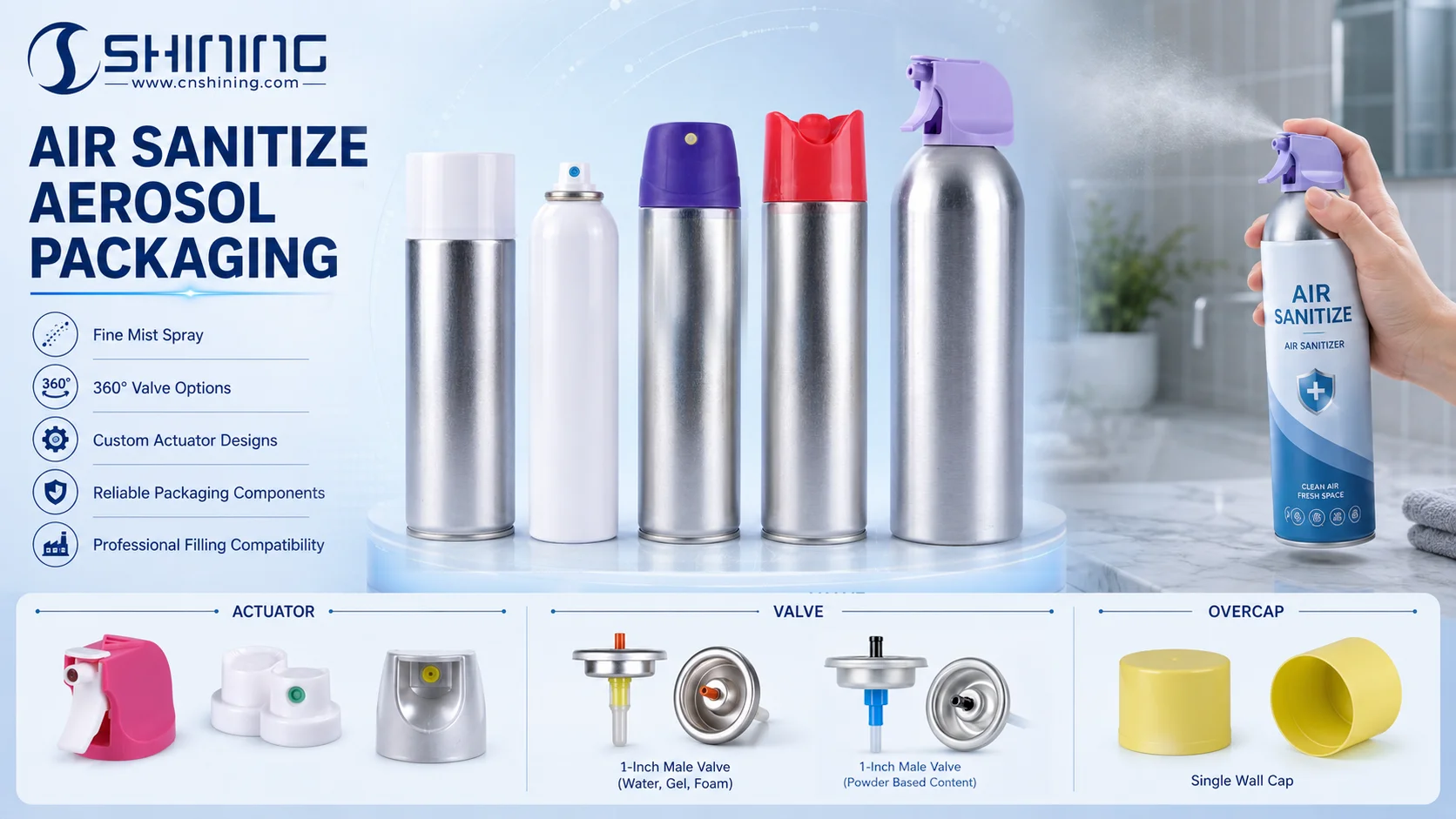
For Shining Packaging, the relevant work is not the disinfectant formula itself. It is the hardware envelope around the formula: actuators, aerosol cans, and valves. These parts decide how the formula leaves the pack, how stable the dose feels, whether the product leaks, whether the spray plume is too wet, and whether the container survives the formulation through shelf life.
Air sanitizer packaging should be specified from the use condition backward. Start with room volume, spray time, active chemistry, propellant, target plume, contact time, flammability class, and user group. Then select the valve, actuator, can material, internal coating, cap, and secondary warnings. A chemically valid product can still fail if the actuator over-delivers fragrance, the valve drips, or the liner is incompatible with alcohol or oxidizing systems.
| Component | Packaging decision | Why it matters for aerosol air sanitizer |
|---|---|---|
| Actuator | Spray angle, plume width, output rate, button force, lock design | Controls over-spray, user dose, room distribution, and complaint rate. |
| Valve | Flow rate, sealing material, stem design, compatibility with solvent and active system | Leaks, clogging, sputter, and dose drift usually appear as user-facing defects. |
| Aerosol can | Steel or aluminum selection, pressure rating, shape, internal coating, recycling message | Must handle pressure, corrosion risk, storage temperature, and transport classification. |
| Cap and lock | Child resistance, travel lock, tactile open/close feedback | Important for household, school, vehicle, and institutional storage scenarios. |
| Label space | Room-volume icons, spray duration, wait time, ventilation instruction | Users rarely read dense directions. A good label prevents misuse. |
9. Technical Frontiers, Patents, and Product Direction
The technical direction is becoming clear. The industry is moving from “spray harder” to spray less, spray more consistently, lower exposure, and reduce environmental load. That changes packaging priorities.
| Patent or public text | Core idea | Commercial meaning |
|---|---|---|
| High-concentration single-phase glycol aerosol air sanitizer | TEG plus DME to carry higher glycol loading in an aerosol format | Shows that air-only sanitizer is an old technical route repackaged for modern consumer use. |
| Biodegradable core-shell microcapsules | Controlled release of active or fragrance systems through biodegradable microcapsules | Relevant to long-lasting odor control, lower exposure perception, and fabric deposition. |
| HFO-1234ze sprayable compositions | Lower GWP propellant route for sprayable products | Supports lower environmental burden and reformulation for regulated markets. |
| Bag-on-valve technology | Separation of formula and gas, with gas pressure acting on the bag | Useful for formulas that should not directly contact propellant or need 360° spray performance. |
| Aerosol actuator structures | Geometry improvements in spray head and flow path | The actuator itself remains a real innovation field, not a commodity afterthought. |
| Sensor-based sanitizing methods | Glycol-containing space treatment with steady aerosol concentration and possible sensor control | Points to equipment + consumable + algorithm models rather than a single disposable can. |
Four R&D hotspots deserve attention: low VOC / low GWP propulsion, BOV or compressed-gas systems, controlled release systems, and sensor-based dosing. None of these removes the need for claim support. They make dose control and exposure control more realistic.
10. User Pain Points and Packaging Improvements
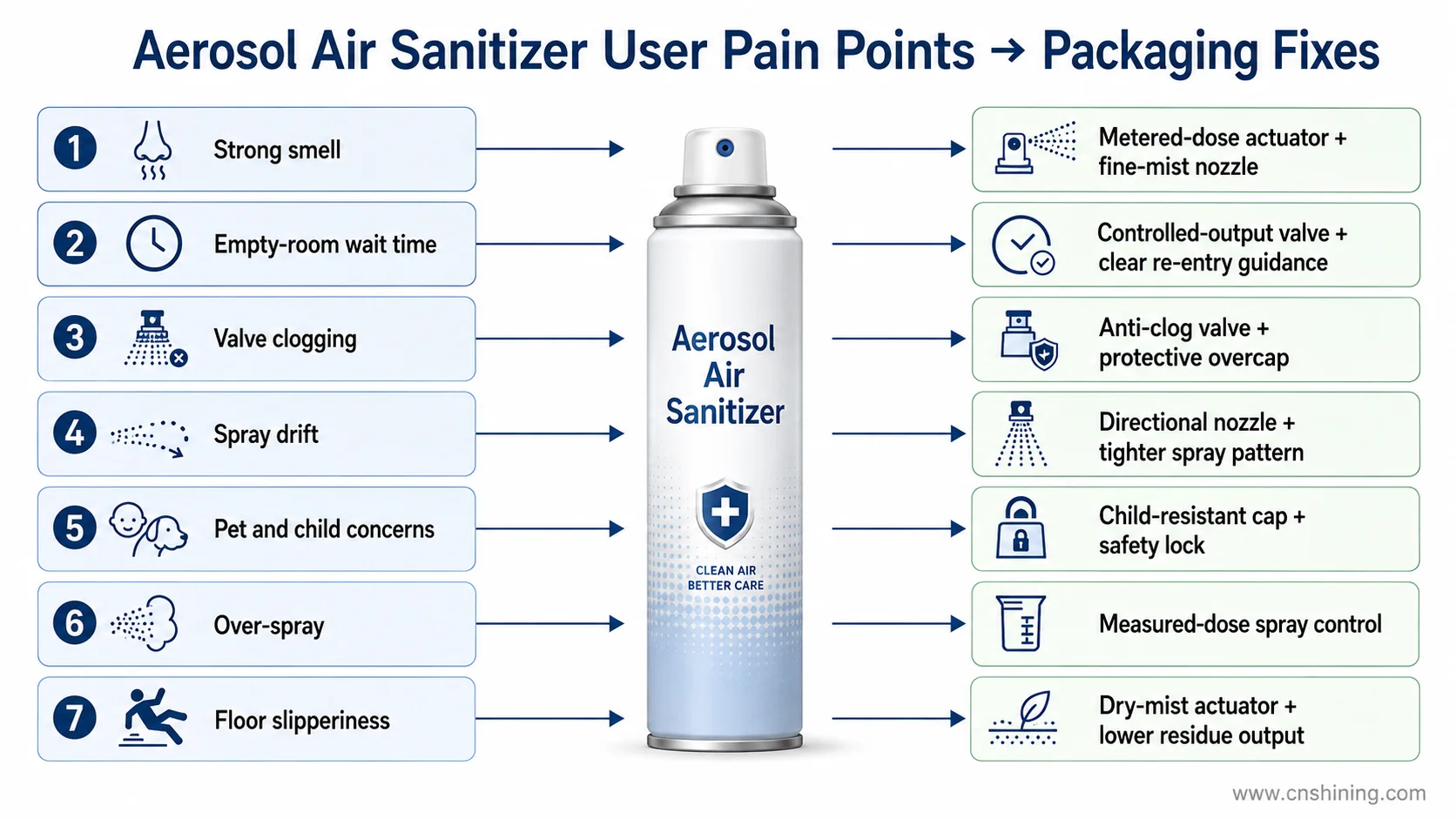
User complaints are not mysterious. They usually concentrate around five issues: strong smell, need to leave the room, actuator or valve experience, unstable performance on heavy odor, and concern around pets, children, or sensitive users. These are packaging and instruction problems as much as formulation problems.
| Observed pain point | Likely technical cause | Packaging response |
|---|---|---|
| Smell is too strong | Over-spray, high fragrance load, alcohol flash, room too small | Lower-output actuator, dose cue, room-volume icon, softer spray pattern |
| Waiting time feels inconvenient | Air-only claims require defined contact time | Clear label icons: spray time, leave room, wait time, ventilate |
| Spray head clogs or spits | Residue, crystallization, incompatible insert geometry | Anti-clog insert, compatible valve gasket, aging test under real use cycles |
| Heavy odor returns | Odor source remains; sanitizer treats air but may not remove source | Label separates odor-source cleaning from air treatment |
| Pet or child concern | Ingredient anxiety, inhalation exposure, unclear warning hierarchy | Front-label sensitive-use icons, QR page for detailed safety and room use rules |
| Floor gets slippery | Droplet size too large or spray directed downward | Upward plume actuator, “spray to room center and ceiling” icon, controlled output |
The best packaging improvement is not a larger button. It is a more controlled spray. A dual-mode actuator, dose-limited valve, reliable lock, compatible internal coating, and clear volume-based label can solve more real-world problems than another claim line on the front panel.
11. Practical Conclusion
Aerosol air sanitizer is a compound category shaped by microbiology, chemistry, aerosol packaging, user behavior, and regulatory wording. The hard part is not only killing microorganisms under test conditions. The hard part is making a product that users can dose correctly, tolerate in real rooms, store safely, and understand without reading a legal document.
The most useful engineering mindset is this: effectiveness has to be translated into controllable use. For this category, “controllable use” means the right formulation, the right propellant, the right valve, the right actuator, the right can coating, and a label that tells the user exactly when to spray, how long to wait, and when to ventilate.
12. FAQ: Aerosol Air Sanitizer
An aerosol air sanitizer makes a supported claim about reducing microorganisms in air under defined use conditions. An air freshener mainly changes odor perception through fragrance, adsorption, or masking. The difference is not the spray format; it is the claim, test data, active system, label directions, and regulatory treatment. A scented disinfectant spray can still be outside the narrow air sanitizer category.
Air sanitizer efficacy depends on concentration and contact time. In a closed room, the mist or vapor can reach the tested concentration and remain long enough to act on airborne microorganisms. If doors, vents, or windows are open, the active concentration may dilute quickly. Waiting time is not a formality; it is part of the tested use condition.
No. Glycol systems such as dipropylene glycol or triethylene glycol are linked to vapor or mist-phase reduction of airborne microorganisms in enclosed spaces. Alcohol systems mainly act through protein denaturation and lipid membrane disruption after wetting. Alcohol sprays can dry fast, which is useful for surfaces but can reduce contact time if the use condition is not controlled.
The actuator controls spray angle, output, plume shape, droplet size tendency, and user feel. For air sanitizer use, this affects how the product distributes through room air and whether it falls wet onto hard floors. A high-output actuator may feel powerful but can create odor overload, slippery surfaces, and inconsistent dosing. Hardware is part of the efficacy system.
No. Aerosol air sanitizer is better understood as a fast, event-driven hygiene tool. HEPA filtration continuously removes airborne particles and aerosols, while UVGI can continuously inactivate microorganisms when properly designed. For shared indoor air control, filtration and UVGI usually fit long-duration operation better. Aerosol sprays are more suitable for defined short-term treatment tasks.
Alcohol-based aerosols bring flammability, fast evaporation, strong odor, and compatibility demands. The valve gasket, actuator insert, dip tube, liner, and can coating must tolerate the solvent system. Leakage, spray drift, and clogging can appear after aging even when early samples look acceptable. Heat storage and repeated-use spray testing are needed before packaging approval.
Propellants affect pressure, spray quality, flammability, VOC profile, GWP, and transport classification. Hydrocarbon and DME systems are common but can raise flammability and VOC concerns. HFO, compressed gas, nitrogen, air, and BOV formats are being explored to lower environmental or exposure burden. The choice also changes valve design and spray feel.
The label must convert laboratory use conditions into clear user behavior. Room size, spray time, spray direction, whether the room should be empty, waiting period, ventilation, food-contact surface warnings, and residual-effect limitations all matter. If this information is buried in dense text, users will misuse the product. Icons and QR-based calculators can reduce errors.
Bag-on-valve separates the formulation from the compressed gas. This can help when the formula should not directly contact propellant, when 360-degree spray is desired, or when compressed air or nitrogen is preferred. BOV is not automatically better for every sanitizer. It must be checked against output rate, bag compatibility, fill process, cost, and label use.
Test pressure stability, spray rate, plume pattern, valve leakage, actuator clogging, gasket compatibility, internal corrosion, liner stability, heat aging, cold storage, repeated short bursts, and continuous spray. For air sanitizer claims, also check that packaging output matches the label dose. A technically sound formula can fail commercially if the package cannot deliver it consistently.