
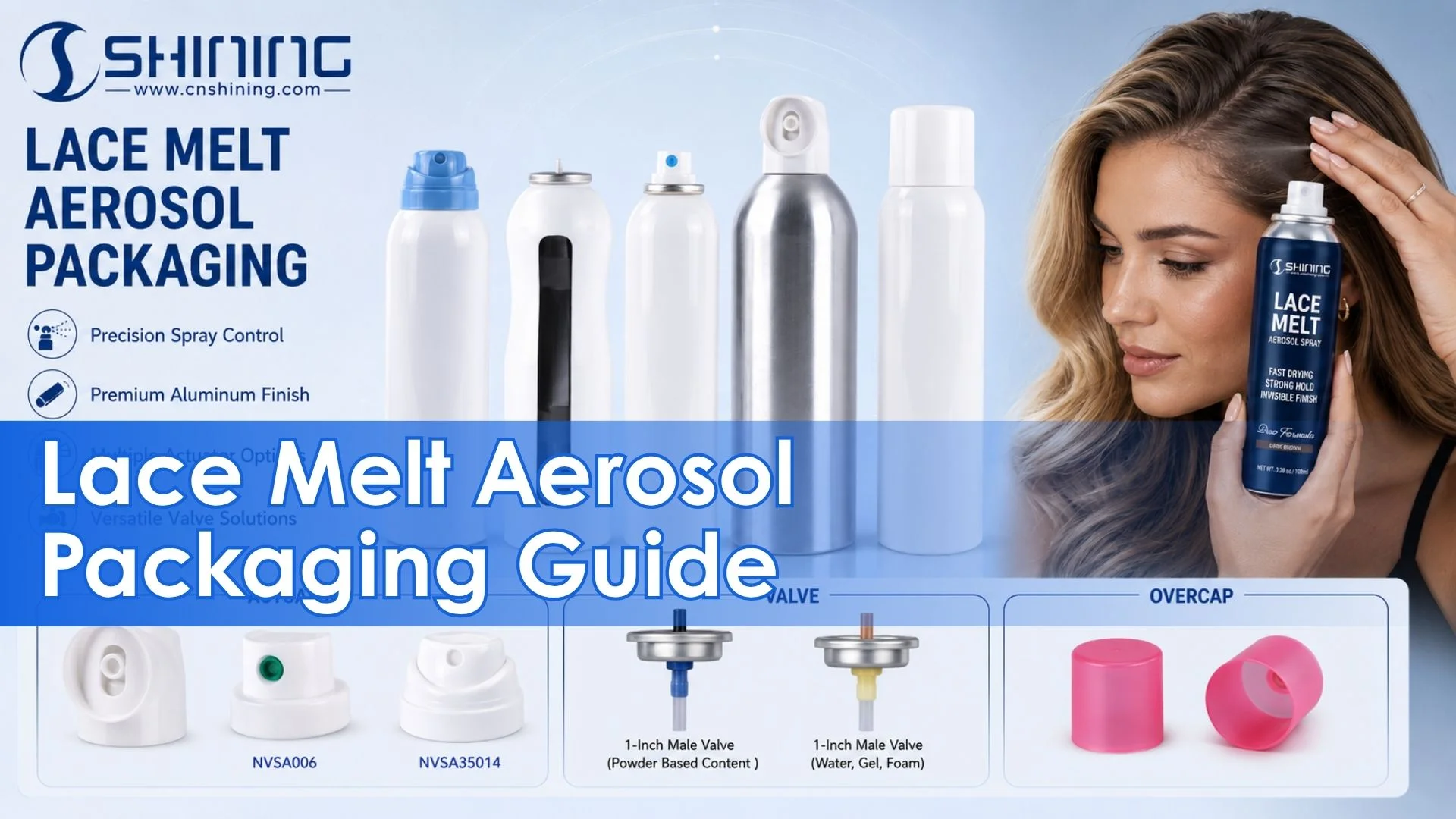
Lace melt aerosol spray works by depositing a thin film-forming layer at the boundary between skin, hairline and lace. The spray carries resin, volatile solvent, propellant and minor conditioning ingredients through an aerosol valve system. After spraying, solvent and propellant evaporate quickly. The remaining polymer film helps press the lace down, reduce visible edges and give the “what lace” visual effect.
In retail and salon language, the same product may be called lace melt spray, lace melting spray, lace melt aerosol spray, wig adhesive spray, lace bond spray, wig bonding spray or holding spray for wigs. That wording looks harmless to users. It is less harmless for VOC classification, transport labeling, SDS wording and claims control.
Technically, this category sits between a strong aerosol hair spray and a short-to-medium wear wig adhesive. It is not the same as lace tinting spray or lace tinting powder. Tint products correct color mismatch and grey cast. They do not provide the same mechanical hold.
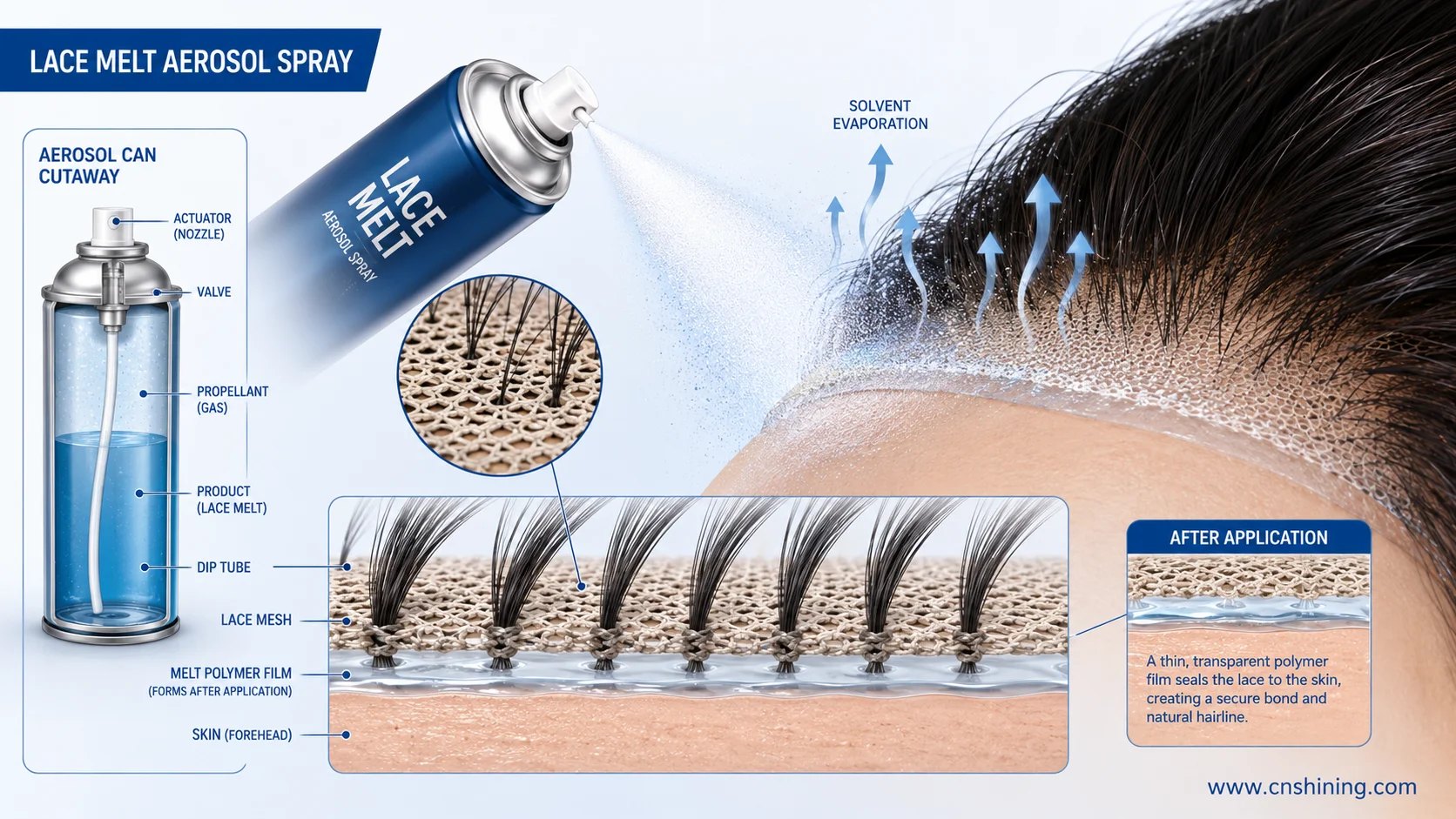
1. Definition and Working Mechanism
The working mechanism is simple: spray a fast-drying adhesive or styling resin system onto the lace-to-skin zone, wait until the layer becomes tacky, then press the lace into place. The aerosol package is part of the performance. The aerosol is a system made of container, valve, actuator, propellant and product concentrate; the pressurized system releases the contents as droplets, foam, paste or powder through the actuator. For lace melt spray, the target is a fine, controlled mist rather than a wet patch or heavy stream. .
After spraying, alcohol and propellant leave the film first. The concentration of polymer rises fast. A thin continuous layer forms across lace holes, baby hairs and skin texture. If the layer is thin and continuous, the lace edge looks flatter and less white. If the layer is too thick, or if powder, oil or makeup interferes with the resin, white cast and flakes appear.
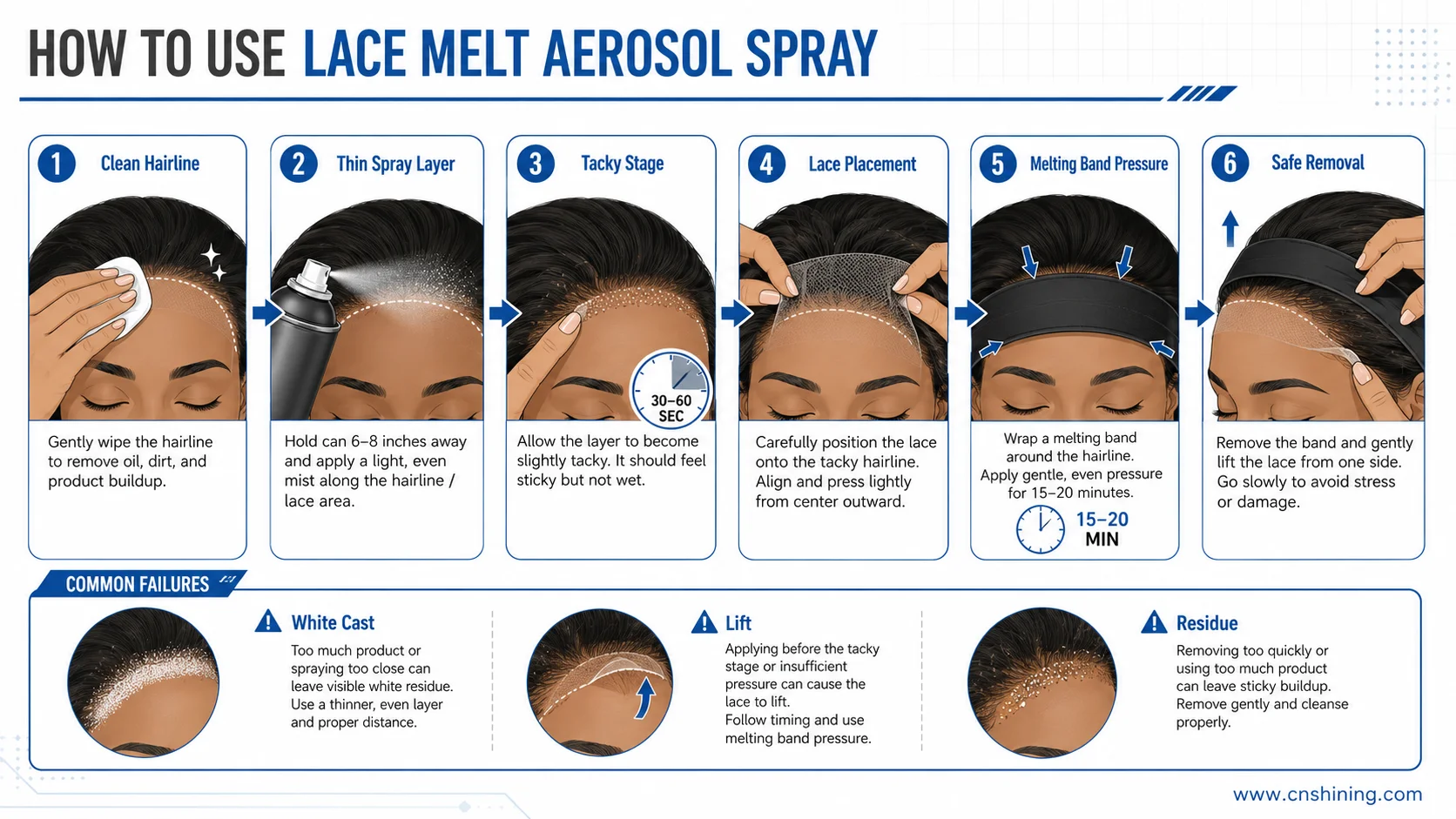
2. Typical Use Path and Failure Points
The user process is stable across most products. Clean the hairline. Spray from a short distance. Use thin layers. Wait for the tacky stage. Apply lace. Press with a melting band or scarf. Add small reinforcement layers only where the edge lifts. Remove with alcohol or remover rather than pulling the lace off.
| Step | Correct Technical Purpose | Common Failure |
|---|---|---|
| Clean skin and hairline | Remove sweat, oil and makeup residue | Film cannot wet the surface evenly |
| Spray thin layers | Build controlled film thickness | One heavy layer turns cloudy or brittle |
| Wait until tacky | Let solvent level drop before bonding | Lace shifts, lifts or looks wet |
| Press with band | Improve contact between lace and skin | Raised edges and visible shadow remain |
| Remove properly | Reduce edge stress and residue build-up | Hairline damage, residue and tangling |
Many user complaints are not pure formula problems. Spray pattern, output rate, valve consistency and actuator design affect the final film. A product can have a good resin system and still fail if the actuator lays down too much liquid at once.
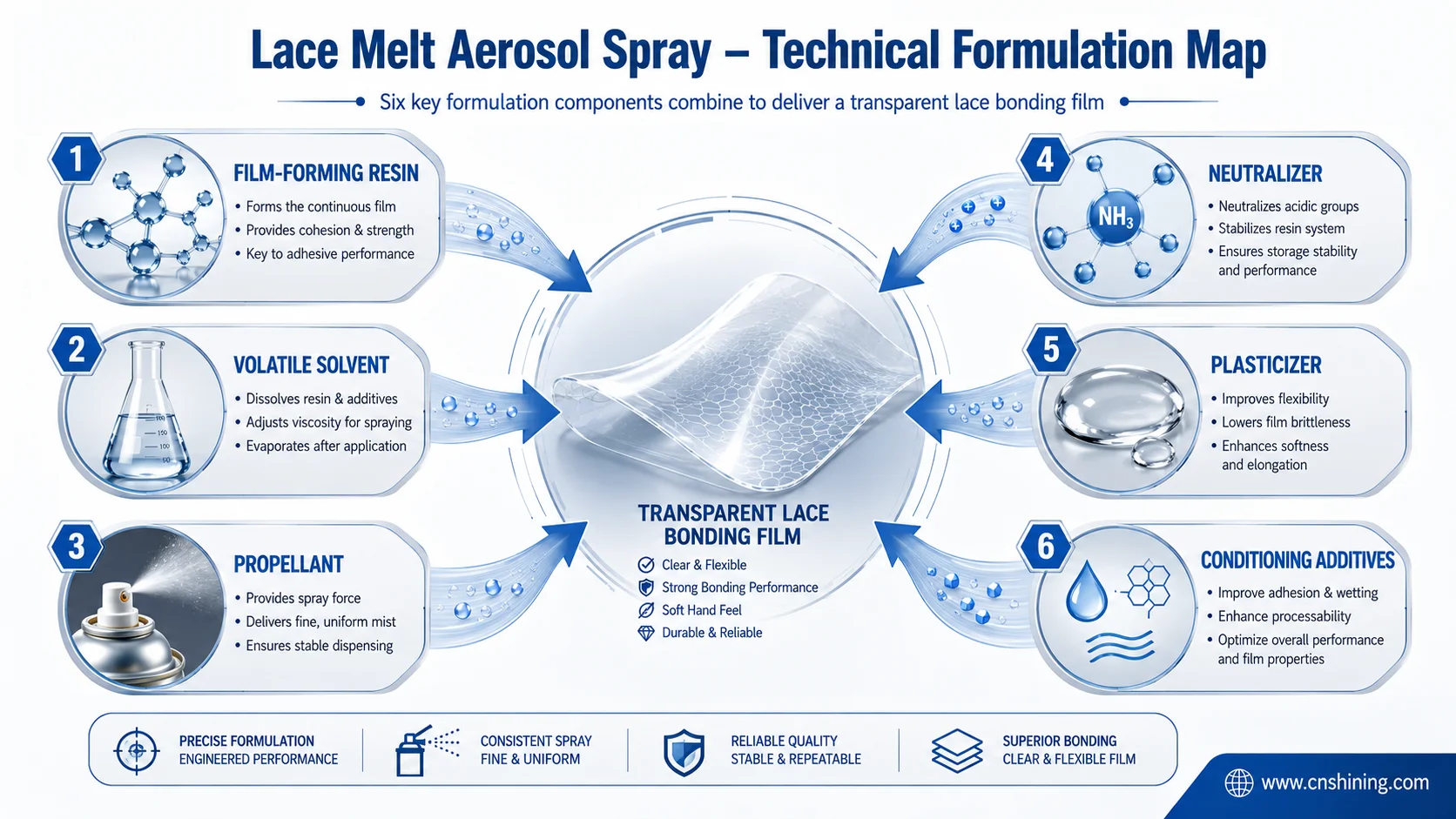
3. Formulation, INCI Terms and Performance Logic
Public ingredient lists and hair spray patents show a familiar structure: film-forming resin, alcohol or water carrier, propellant, neutralizer and small conditioning additives. Classic hair aerosol patents may allow resin levels up to about 20 wt%, while retail lace melt systems are usually closer to low single-digit to low double-digit film-former ranges.
| Function | Common Ingredients | Role in Lace Melt Spray | Typical Reading |
|---|---|---|---|
| Film forming and hold | Octylacrylamide/Acrylates/Butylaminoethyl Methacrylate Copolymer, AMP-Acrylates Copolymer, VA/Crotonates/Vinyl Neodecanoate Copolymer, PVP/VA | Transparent film, hold strength, humidity resistance and stiffness control | Core performance driver |
| Volatile carrier | Alcohol Denat., water | Fast dry, wetting and resin distribution | Alcohol-rich systems dry fast but increase odor and flammability concerns |
| Propellant | HFC-152a, butane, isobutane, propane, dimethyl ether, compressed gas | Atomization, spray force and dry-down behavior | Propellant route affects VOC, flammability and transport |
| Neutralizer / pH control | Aminomethyl propanol | Solubilizes or disperses acidic resins and affects washability | Usually low dosage |
| Plasticizing and feel | Triethyl citrate, dimethicone, PEG/PPG silicones | Reduces brittleness and helps film flexibility | Important for reducing crunchy texture |
| Conditioning claims | Panthenol, hydrolyzed protein, keratin, biotin, silk protein, vitamin E | Supports edge-care and scalp-comfort positioning | Usually minor additions, not the main hold mechanism |
| Cooling and fragrance | Fragrance, tea tree, peppermint, rosemary mint | Controls sensory profile and brand identity | Can also trigger odor or irritation complaints |
Three formulation families show up most often. The first is the high-alcohol transparent aerosol: fast, simple, clear and familiar to strong hair spray manufacturers. The second is a conditioning-enhanced lace bond aerosol with biotin, silk, keratin or botanical cues. The third is a lower-VOC or compressed-gas route, including water-rich or bag-on-valve concepts. The last route is harder to tune because droplet size, spray rate and film hold must be rebuilt together.
4. Product Types and Adjacent Alternatives
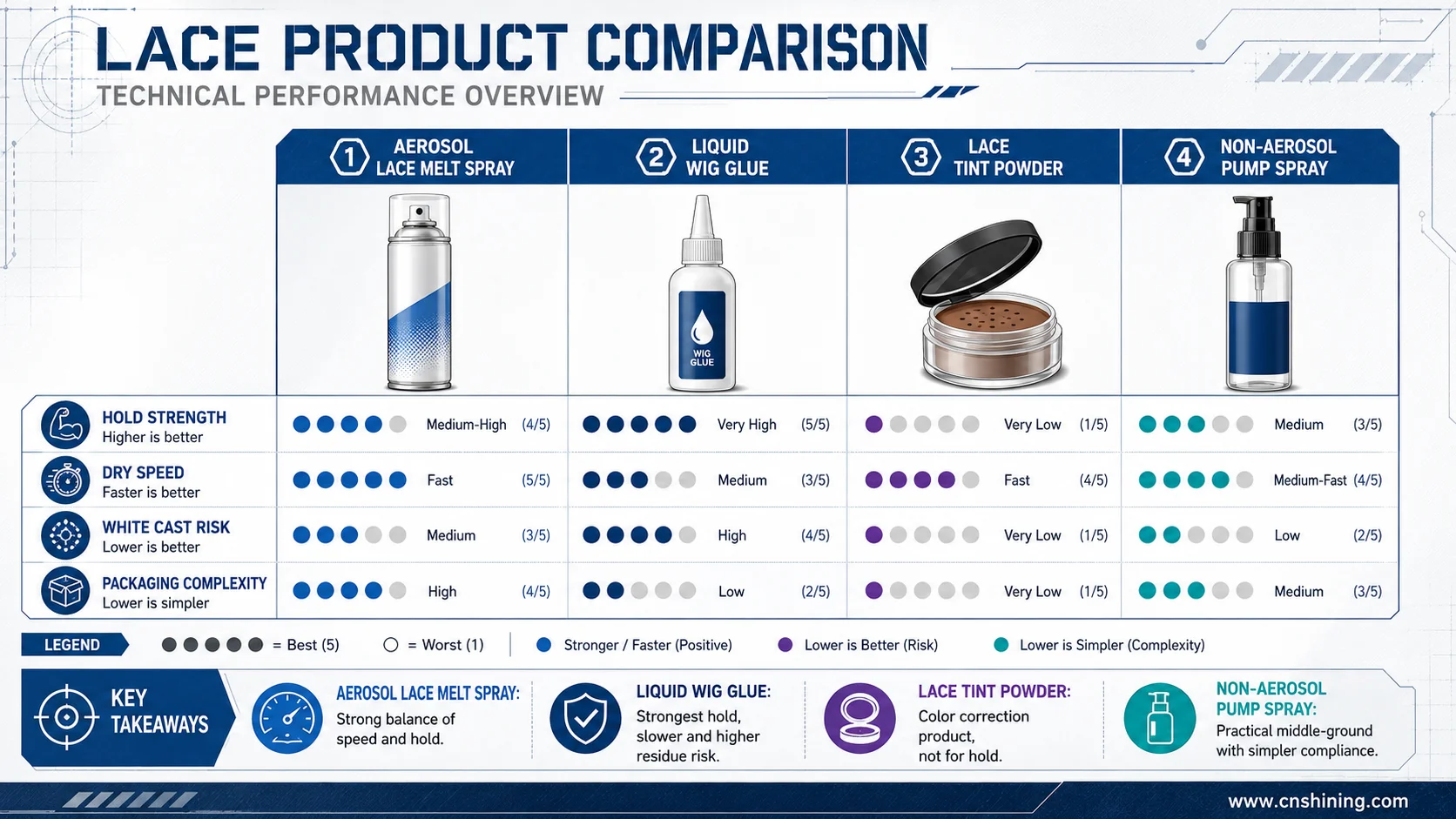
Lace melt aerosol spray is not the strongest adhesive option. It is the fastest and easiest to spread evenly. That makes it attractive for daily wig installation, short-term wear and touch-up work. Liquid glue still wins in long wear and high-sweat use. Powder wins in color correction but has almost no hold. Non-aerosol pump sprays avoid propellant issues, but they often produce larger droplets and slower dry-down.
| Dimension | Aerosol Lace Melt Spray | Liquid Glue | Lace Tint Powder | Non-Aerosol Spray |
|---|---|---|---|---|
| Main function | Bonding, hold and visual melt | Strong adhesion | Color correction and matte finish | Bonding or styling, depending on formula |
| Hold strength | Medium to strong | Highest | Very low | Medium |
| Drying speed | Fast | Medium | Immediate | Medium |
| Clean application | Good, but overspray exists | Messier, requires skill | Clean | Good local control |
| White edge control | Good if thin; poor if over-sprayed | Skill-dependent | Strong for tinting only | Depends on droplet size and resin |
| Regulatory and packaging load | High: aerosol, pressure, flammability, VOC | Medium | Low | Medium |
5. Compliance, VOC and Patent Direction
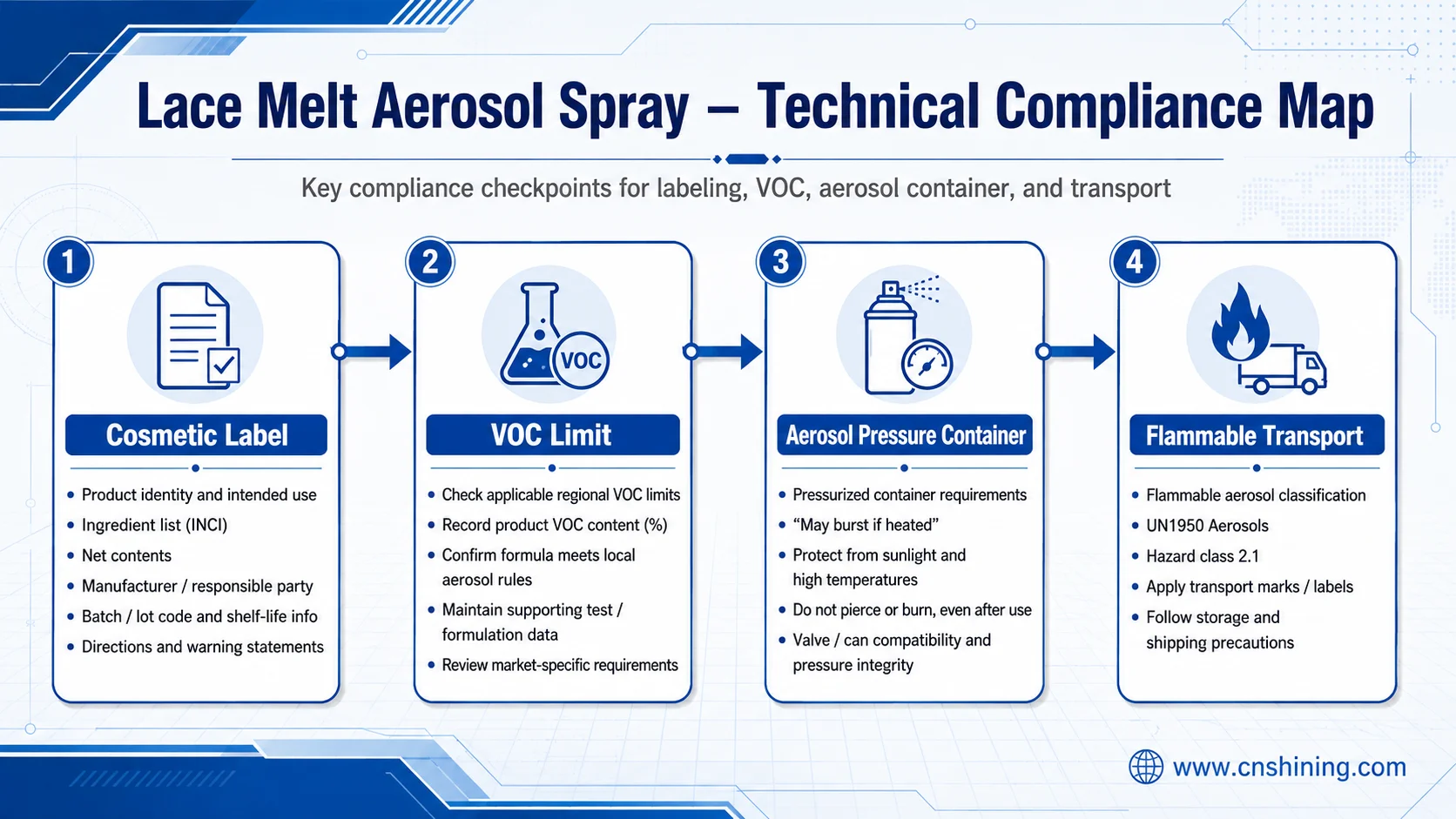
The compliance problem is not only whether the product is a cosmetic. The harder part is that it is also an aerosol, a pressure package, often flammable, and possibly a VOC-controlled consumer product. The wording on the label, SDS, marketplace page and claims should point to the same product category.
| Market | Technical Compliance Focus | Practical Issue |
|---|---|---|
| United States | FDA cosmetic labeling, warnings and truthful claims | Identity, net quantity, ingredient declaration and warning language must match actual function. |
| California | CARB consumer product VOC limits | Hair Finishing Spray shows a 50% VOC limit from 2023; adhesive categories may follow different limits. |
| European Union | Regulation (EC) No 1223/2009 and aerosol dispenser rules | Cosmetic safety and pressure/flammability requirements must be handled together. |
| Great Britain | GB cosmetic enforcement guidance | EU assumptions should not be copied without checking GB and NI routes. |
| Canada | Canadian Cosmetic Regulations and Health Canada cosmetic guidance | Labelling, ingredient list, pressurized container rules, safety evidence and notification should be checked together. |
| Brazil | ANVISA cosmetics and personal hygiene regulation | Portuguese labeling and local regularization need early planning. |
6. Top 10 Brands Lace Melt Aerosol
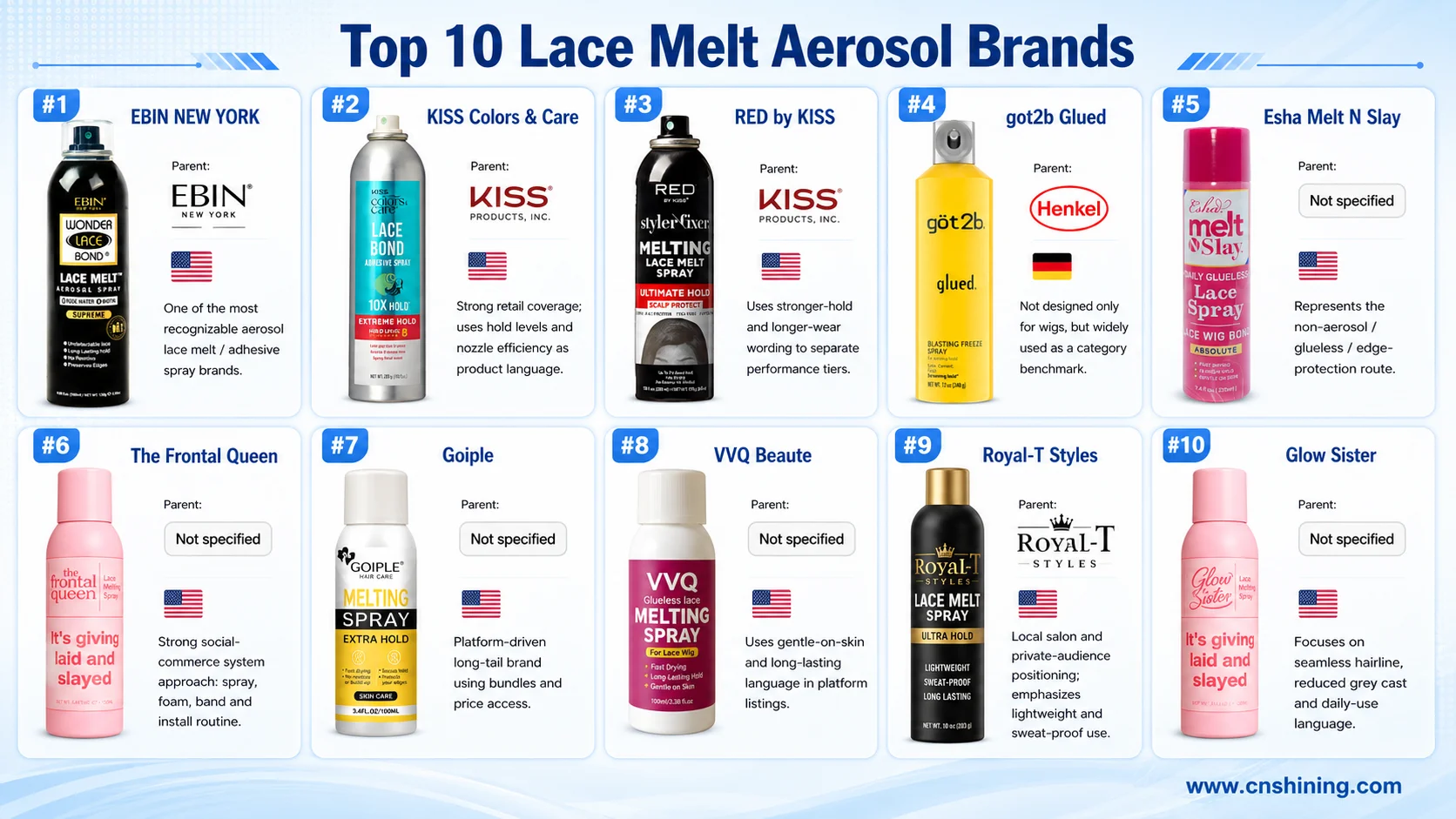
| Brand | Country | Parent | Size | Price Range | Technical Reading |
|---|---|---|---|---|---|
| EBIN NEW YORK | United States | EBIN NEW YORK | 2.7 oz, 6.08 oz | about $7.60-$12.98 | One of the most recognizable aerosol lace melt / adhesive spray brands. |
| KISS Colors & Care | United States | KISS Products Inc. | 6 oz, 11.1 oz | about $8.99-$11.99 | Strong retail coverage; uses hold levels and nozzle efficiency as product language. |
| RED by KISS | United States | KISS Products Inc. | 2.7 oz, 7.8 oz | about $3.99-$9.99 | Uses stronger-hold and longer-wear wording to separate performance tiers. |
| got2b Glued | Germany | Henkel | 2 oz, 12 oz | about $3.99-$10.50 | Not designed only for wigs, but widely used as a category benchmark. |
| Esha Melt N Slay | United States | Esha Girl | 2.7 oz, 7.4 oz, 12 oz | about $8.99-$15.99 | Represents the non-aerosol / glueless / edge-protection route. |
| The Frontal Queen | United States | The Frontal Queen | 4.2 oz, duo kits | about $20.99-$35.00 | Strong social-commerce system approach: spray, foam, band and install routine. |
| Goiple | United States | Goiple Care | 3.4 fl oz; bundle sets | about $6.99-$18.99 | Platform-driven long-tail brand using bundles and price access. |
| VVQ Beaute | United States | VVQ Beaute | 100ml | about $6.99-$12.99 | Uses gentle-on-skin and long-lasting language in platform listings. |
| Royal-T Styles | United States | Royal-T Styles | 120ml | about $25.00 | Local salon and private-audience positioning; emphasizes lightweight and sweat-proof use. |
| Glow Sister | United States | Glow Sister | 4.2 fl oz | about $34.99-$39.99 | Focuses on seamless hairline, reduced grey cast and daily-use language. |
Four routes are worth watching separately: EBIN for category naming, KISS for channel scale, got2b for substitute-product behavior, and The Frontal Queen for system-style social commerce. The lesson is not that every new product must copy them. The lesson is that the user buys an install result, not only a can of spray.
7. User Pain Points and Packaging Fixes
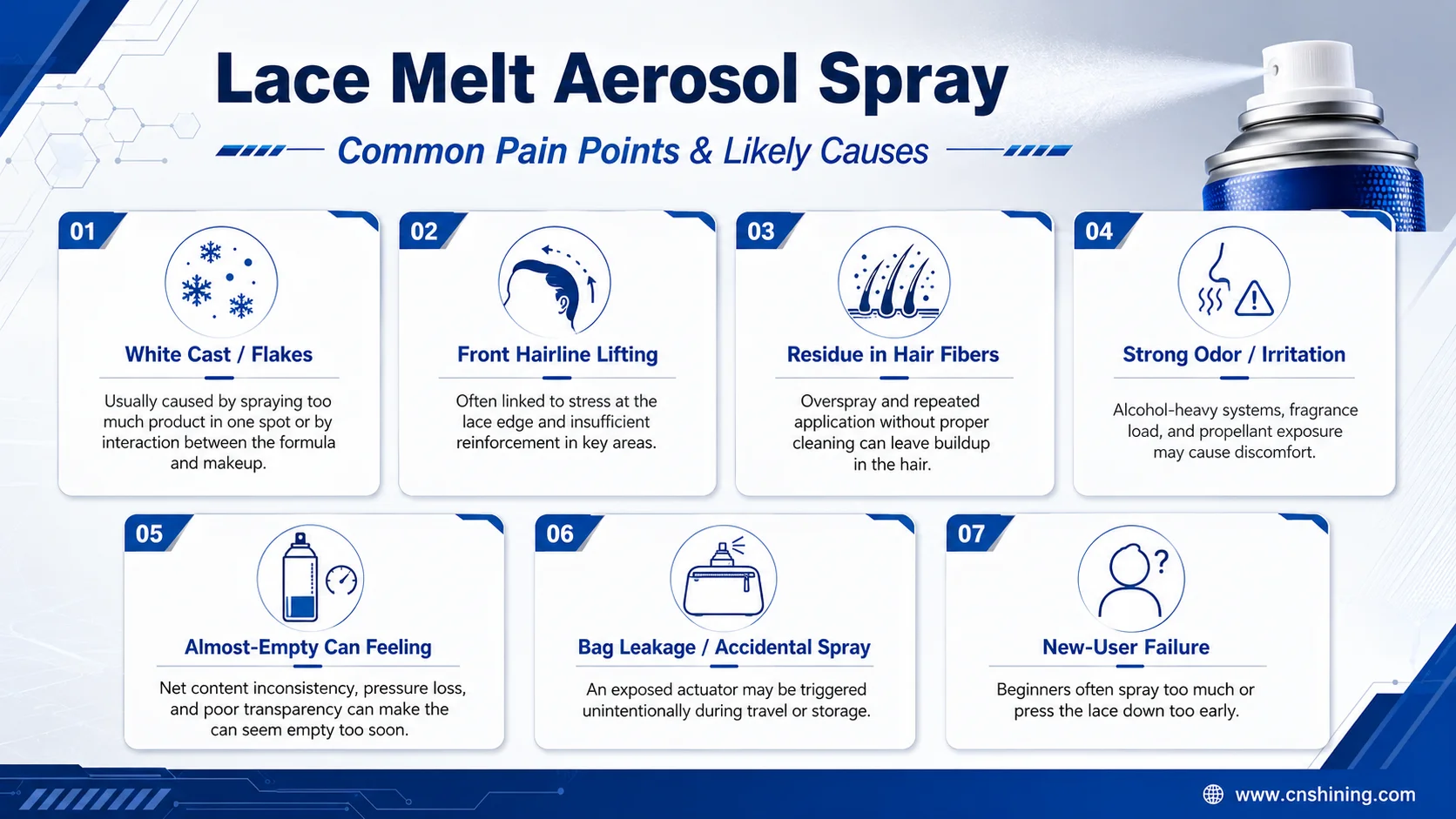
The highest-frequency user problems are not hard to understand: white cast, sweat-off, oil-skin instability, strong odor, residue build-up, almost-empty-can complaints and poor spray control. These are packaging problems as much as formula problems.
| Pain Point | Likely Technical Cause | Packaging Fix | Why It Helps |
|---|---|---|---|
| White cast / white flakes | Too much wet film in one spot, poor droplet breakup, resin-makeup interaction | Finer actuator, lower output rate, narrower spray option | Reduces local film thickness and polymer pooling. |
| Front hairline lifting | Local stress at lace edge and poor targeted reinforcement | Dual spray strategy: wide mist plus narrow touch-up actuator | Fixes the real failure zone instead of spraying the full hairline again. |
| Residue entering hair fibers | Overspray into hair, repeated application without cleaning | Directional actuator and controlled valve output | Keeps more product on skin-lace boundary, less on hair. |
| Strong odor or irritation | Alcohol-rich system, fragrance load, propellant exposure | Evaluate BOV, compressed gas, compatible internal coating | Supports lower solvent exposure and better formula separation. |
| Almost-empty-can perception | Net content inconsistency, pressure loss, poor consumer transparency | Inline net-content, pressure and leak checks; clearer usage notes | Improves trust and reduces avoidable complaints. |
| Bag leakage or accidental spray | Actuator exposed in travel bag | Lockable actuator, deeper overcap, travel-safe cap | Prevents discharge during storage and shipping. |
| New-user failure | User sprays too much or presses lace too early | Three-step can graphics: clean, thin spray, tacky press | Instruction design reduces formula misuse. |
| Corrosion or compatibility risk | High alcohol, neutralized resin, water-rich low-VOC variants | Internal coating tests, aluminum can or BOV evaluation | Low-VOC routes often need stricter pack compatibility checks. |
A realistic upgrade sequence is: first tune actuator and valve output, then improve the usage graphics, then test BOV or compressed-gas routes. The first two actions are lower cost and often visible in user experience. BOV is a structural move for lower-VOC and water-rich systems.
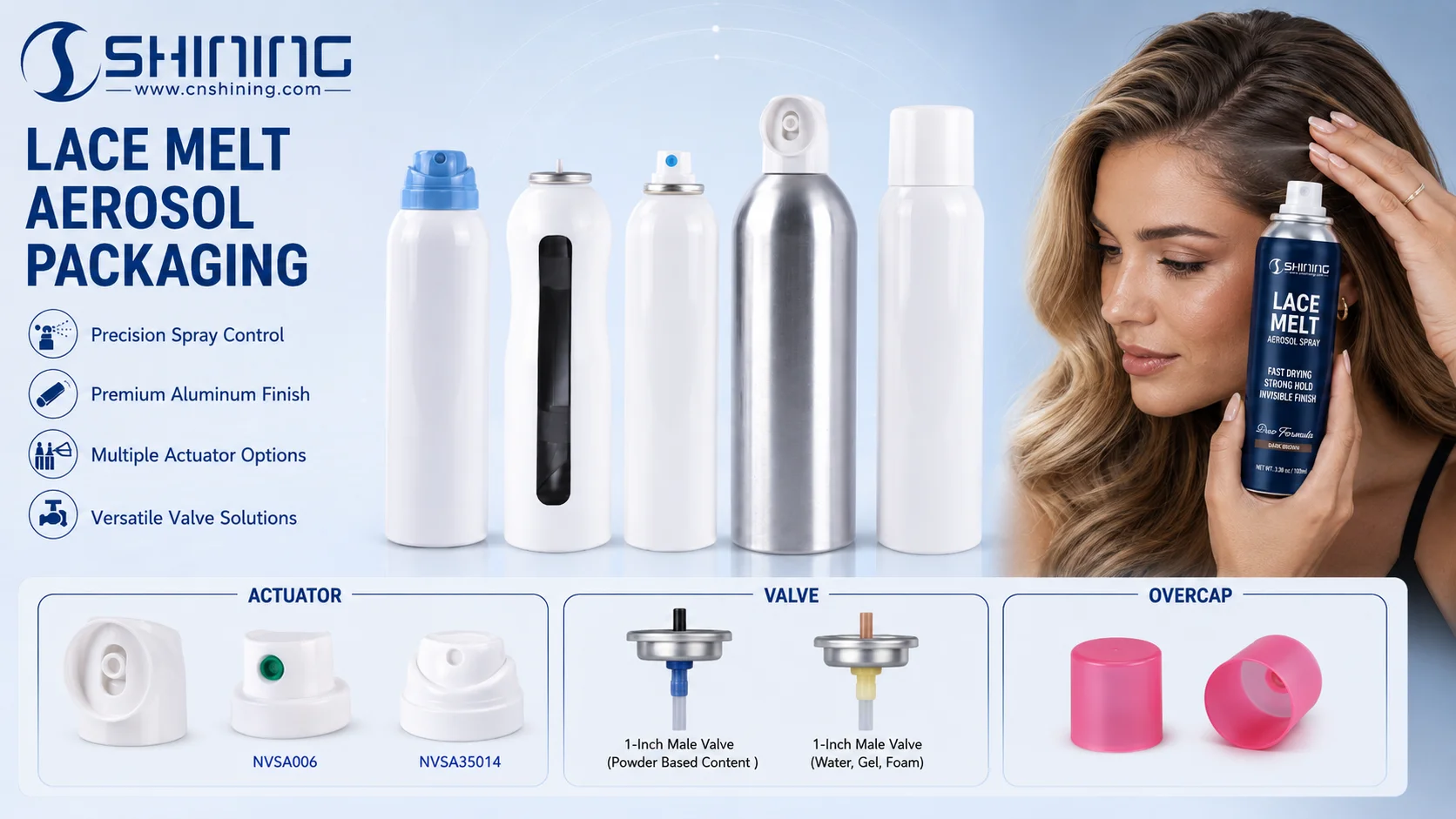
8. Shining Packaging: Actuators, Aerosol Cans and Valves for Lace Melt Spray
For this product type, the package is not decoration. The spray system decides whether the film lands as a fine mist or a wet band. Shining Packaging’s relevant work sits around three parts: aerosol cans, valves and actuators. For lace melt aerosol spray, these parts should be selected around alcohol/water compatibility, target output rate, spray angle, droplet size, leakage control and cap safety.
A narrow technical target is better than a broad promise. For example: reduce one-press output, keep the mist fine enough for HD lace, avoid liquid spitting near the end of can life, and make the actuator easy to aim at the hairline. If a brand is moving toward low-VOC or semi-water systems, internal coating and BOV feasibility should be checked before scale-up.
9. Final Technical Takeaway
Lace melt aerosol spray is not a novelty item. It is a small but technically dense point in the industrialization of wig installation. The main competition will not stay at “who makes it stick harder.” The better question is sharper: who can control the film, the mist, the VOC route, the residue profile and the user instruction well enough that the lace still looks clean outside a short video?
10. FAQ: Lace Melt Aerosol Spray
Lace melt aerosol spray is a pressurized wig installation spray that deposits a fast-drying film across the lace edge and hairline. Its purpose is not only adhesion. It also helps flatten the lace, reduce visible whiteness and make the edge look closer to skin. The effect comes from film-forming polymers, volatile solvent, propellant and controlled atomization.
Not exactly. Wig glue is usually a stronger liquid adhesive for longer wear. Lace melt spray behaves more like a strong styling spray crossed with a short-to-medium wear lace adhesive. It is faster and cleaner to apply, but it may not hold as long under sweat, oil or extended wear. The correct choice depends on use time and skin condition.
White cast usually appears when too much product lands in one area or the film dries unevenly. Oil, makeup powder, lace tint, sweat and incomplete drying can make the film turn cloudy or flaky. Spray quality matters too. A heavy actuator output can create local polymer build-up even when the formula itself is transparent.
Hold normally comes from film-forming polymers used in strong hair sprays. Common examples include acrylates copolymers, octylacrylamide/acrylates/butylaminoethyl methacrylate copolymer, AMP-acrylates copolymer, VA/crotonates/vinyl neodecanoate copolymer and PVP/VA. These materials form a thin film after solvent and propellant evaporate, creating mechanical grip on lace and skin.
The actuator controls spray angle, droplet breakup, local output and aiming accuracy. For lace melt use, too much product in one press increases white cast and residue. A fine, controlled actuator can lay down a thinner film at the lace edge. This is why packaging design directly affects user results, not only shelf appearance.
Bag-on-valve can help when a brand wants lower-VOC, water-rich or formulation-separated aerosol systems. It keeps product concentrate inside a bag while propellant pressure stays outside. That can improve product separation and reduce some compatibility issues. It still needs testing because spray rate, droplet size and end-of-can performance can change with BOV structure.
Lace melt aerosol spray may be treated as a hair finishing spray, hair styling product or adhesive-type product depending on claims, label wording and use. These categories can carry different VOC limits. In markets such as California, classification affects the allowable volatile organic content. Claims, SDS language and product identity should be aligned before launch.
Lace tinting spray or powder mainly adjusts color. It helps reduce grey, ashy or white-looking lace by matching the lace closer to skin tone. Lace melt spray mainly forms a film to press and hold lace against the hairline. Tint can improve appearance, but it does not replace adhesive film performance when edge lifting is the problem.
Useful tests include spray pattern on lace mesh, output per press, droplet feel on skin-like substrate, valve leakage, net content control, pressure retention, actuator clogging and internal coating compatibility. Testing only on paper is not enough. Lace mesh reveals pooling, white cast, overspray into hair fibers and poor edge targeting more clearly.
The main direction is not simply higher adhesion. Better products will control white cast, residue, edge comfort, dry speed, VOC compliance and spray accuracy at the same time. That pushes development toward finer actuators, tuned valve output, clearer usage graphics, low-VOC systems, compressed gas or BOV options, and full wig installation systems.