

Standard Overview
FEA 405 is an industry standard issued by the European Aerosol Federation (FEA) that defines parallelism and establishes uniform measurement methods for aerosol containers with 25.4 mm openings.
Parallelism between the container opening and the container base is a critical geometric condition for faultless valve clinching. Even small angular deviations can cause uneven gasket compression and unstable sealing.
Purpose and Position in the Standards System
The acceptable limits for parallelism are defined in EN 15010 (Aluminium aerosol containers – clinch-related tolerances).
FEA 405 does not define tolerance values. Its sole purpose is to ensure that parallelism is measured in a consistent and reproducible way across different factories, laboratories, and inspection systems.
Definition of Parallelism
Parallelism describes whether two surfaces are oriented at a constant distance from each other. In aerosol containers, this refers to:
- The plane of the container base, and
- The plane of the container opening
If the two planes were extended infinitely, they would never intersect. Any deviation represents a loss of parallelism.
Scope of Application
FEA 405 applies to:
- Aerosol containers with 25.4 mm openings
- Both tinplate and aluminium containers
- Routine quality control and laboratory inspection
Method 1 – Mechanical Gauge Measurement
The primary method defined in FEA 405 uses a mechanical dial gauge equipped with a rigid measuring bar.
The measuring bar:
- Has a diameter of 8 mm
- Has a length of 30 mm
- Is fixed parallel to a reference flat surface
The bar is positioned at a height equal to the nominal container height.
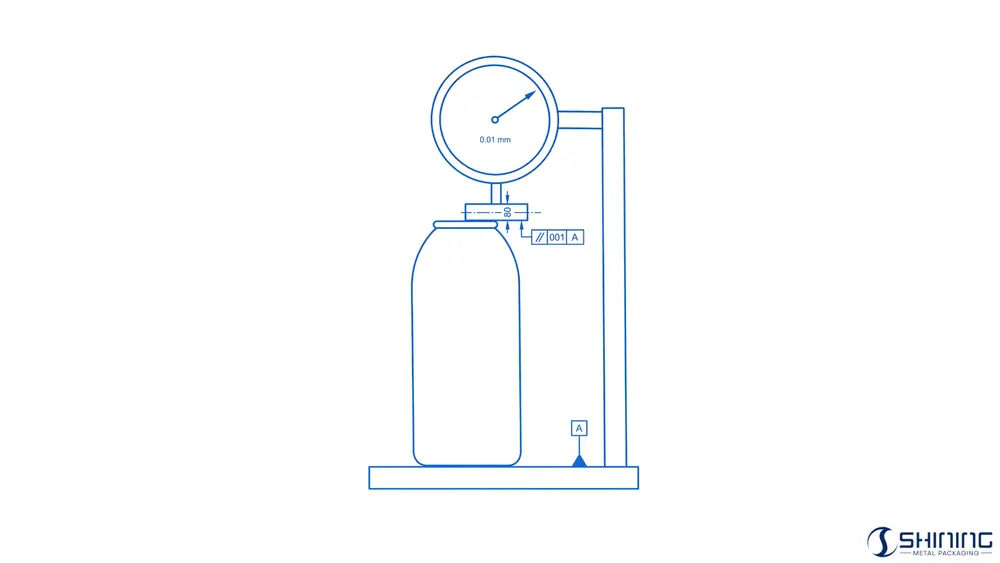
The container is placed on the reference surface and rotated once about its vertical axis. The maximum deviation observed on the gauge represents the parallelism deviation.
Method 2 – 2D or 3D Control Device
As an alternative to the mechanical gauge, FEA 405 allows the use of 2D or 3D measuring systems, such as optical or coordinate measuring devices.
This method evaluates parallelism by:
- Constructing a virtual plane A representing the container base
- Constructing a virtual plane B representing the container opening
- Calculating the maximum height difference between the two planes
Interpretation of Results
Parallelism deviation is expressed as the maximum difference in height measured between the opening plane and the base plane during rotation or scanning.
The measured value must then be compared with the allowable tolerance defined in EN 15010.
Why Parallelism Matters
Poor parallelism can lead to:
- Tilted valve cups after clinching
- Uneven gasket compression
- Increased risk of leakage and cosmetic defects
Relationship with Other Standards
- EN 15010 – Defines allowable parallelism tolerances
- EN 14850 – Defines contact height measurement
- FEA 216 – Defines clinching jaw geometry
Together, these standards control orientation, position, and deformation in the clinching system.
Download the Standard PDF
This document provides FEA 405, defining parallelism and standardized measurement methods for aerosol containers with 25.4 mm openings. It describes mechanical gauge and 2D or 3D control procedures to ensure consistent geometric alignment for reliable clinching performance.
FAQ – Engineering & Quality
No. FEA 405 defines how parallelism is measured. Tolerance limits are specified separately in EN 15010.
No. 2D or 3D control devices are permitted if they reproduce the same datum principles. Consistency is more important than the measuring technology.
Rotation ensures that the maximum deviation around the full circumference is captured. Single-point checks may miss critical angular errors.
No. Clinching cannot compensate for geometric misalignment. Parallelism must be controlled at the container manufacturing stage.
During initial qualification, periodic quality audits, and whenever sealing issues appear. It is a foundational geometric control parameter.