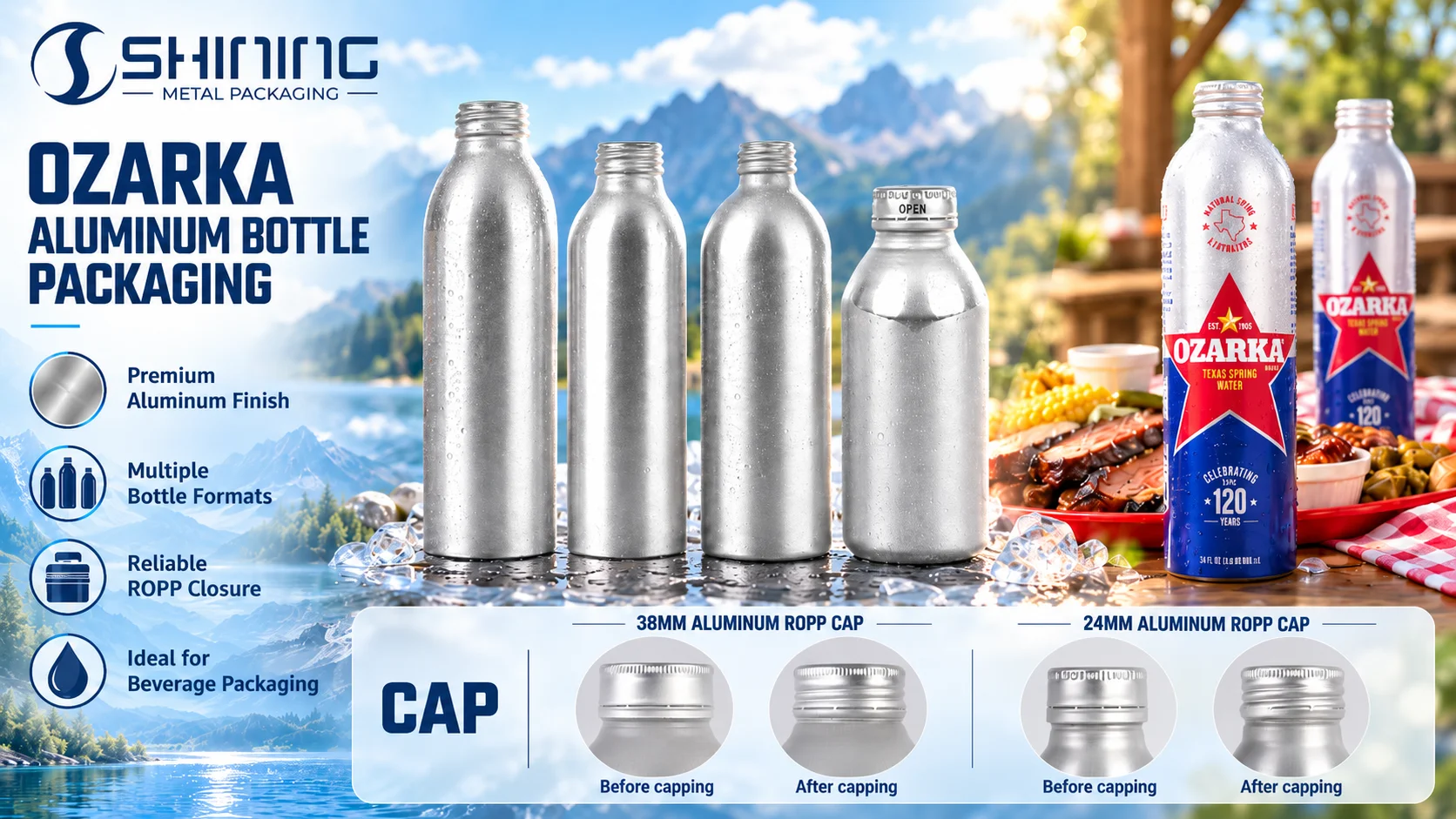
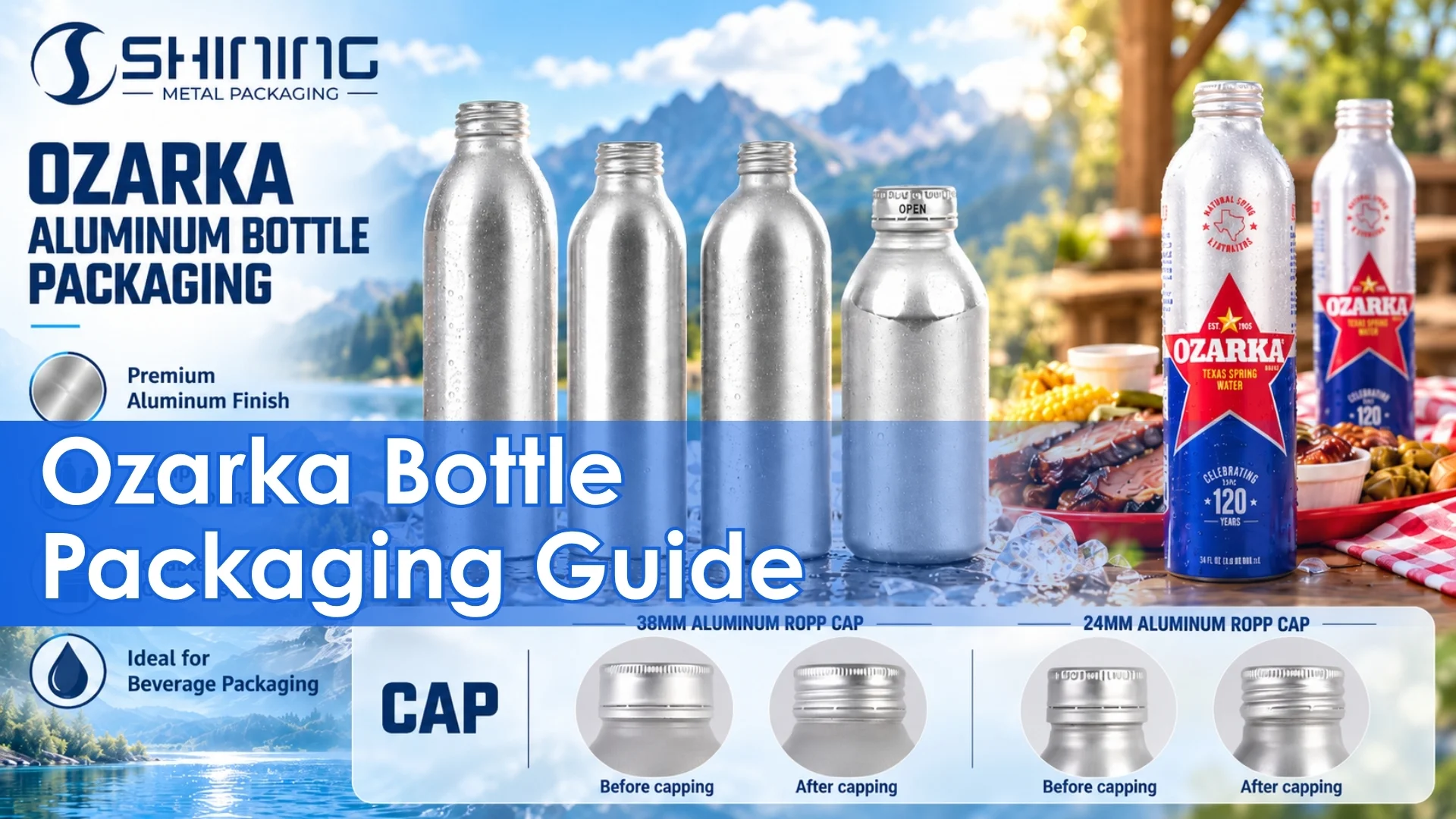
Ozarka describes its connection to the state in unusually direct language: “Texas isn’t just where you’re from, it’s what you’re made of.” The Ozarka aluminum bottle gives that statement a physical format. Instead of treating aluminum as a generic sustainability cue, the 25 fl oz spring-water bottle can carry Texas identity, limited-edition artwork and an on-the-go drinking format in the same object. That makes the packaging question more specific than “aluminum versus plastic”: can a relatively large, resealable metal bottle become recognizable brand media while its coating, closure, decoration and handling performance remain dependable in everyday use?
1. Texas Is the Product Context, Not Just the Artwork
Ozarka’s current product architecture makes the regional idea concrete. Its spring water is sourced from Texas, and the brand now lists a single 25 fl oz aluminum bottled-water format. The product page also ties purchases of the aluminum bottle to a donation of 1% of sales to The Meadows Center for Water and the Environment. At H-E-B, the 25 oz bottle is currently listed at US$2.98 each, positioning it as a deliberate single-bottle purchase rather than the economics of a conventional household water multipack.
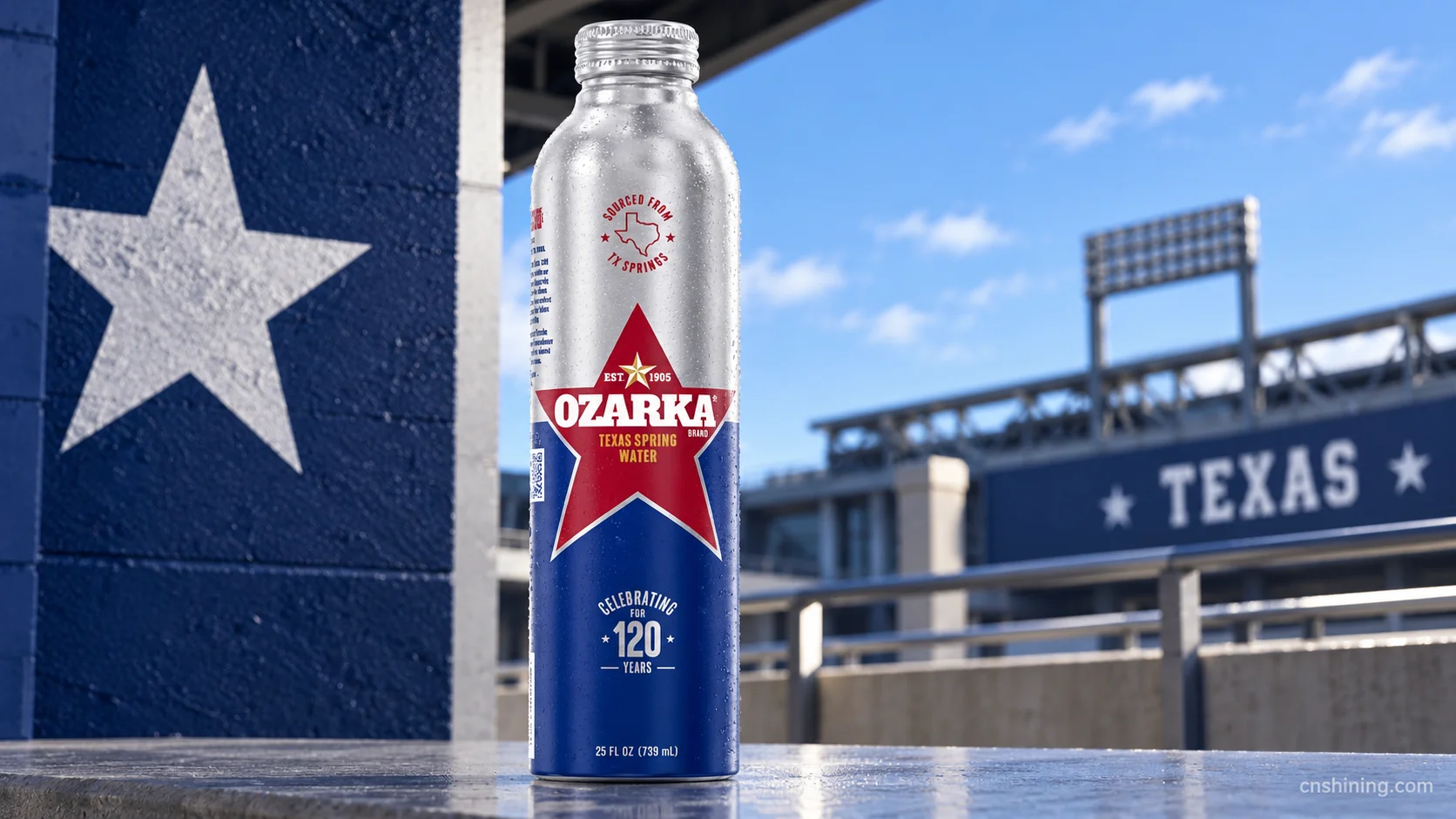
The more distinctive move is what Ozarka puts on that metal surface. Its MLB relationship turns the bottle into a seasonal communication platform, while a 2026 limited-edition version designed by Texas artist Curtis Jinkins draws on small-town community, Texas night skies, local landscape and flora. That is materially different from placing a recycling message on an otherwise anonymous metal container: the aluminum bottle becomes a tall, portable canvas for regional culture. The underlying research also identifies the 25 oz aluminum SKU and MLB bottle art as evidence that Ozarka is using aluminum for recognition and storytelling, not simply for material substitution.
This distinction matters because the bottle shape itself is not enough to make Ozarka unique. Several spring-water brands now use closely related aluminum formats. Ozarka therefore has to earn differentiation through what happens on and around the bottle: the silver-and-blue metal language, the red Texas cues, artwork that can change without weakening recognition, and occasions where carrying one bottle makes sense. Aluminum is useful here because it can be both container and graphic object; its strategic value falls if the package is reduced to a generic “green bottle.”
2. Why the Ozarka Aluminum Bottle Is an Engineering Choice, Not a Material Swap
Spring water is comparatively uncomplicated as a beverage, but that does not make its package chemically irrelevant. Ozarka’s 2025 water analysis reports pH values of 5.5–6.9 and total dissolved solids of 38–150 mg/L for its spring water. Its FAQ gives an 18-month “Best By” period for still water. Those numbers point to a relatively low-reactivity beverage compared with acidic juice or an alcoholic RTD, yet an aluminum package still has to preserve taste, odor and container integrity through the intended shelf life. The product-contact coating, cap liner and sealing interface therefore belong in the product specification, not in an afterthought after artwork approval. Ozarka’s annual water-quality data provides the content-side starting point for that compatibility work.
| Decision variable | Grounded Ozarka case | Engineering implication |
|---|---|---|
| Contents and shelf life | Still Texas spring water; 2025 pH 5.5–6.9; TDS 38–150 mg/L; 18-month Best By period | Validate water–coating–liner compatibility, sensory stability and seal integrity over the intended life of the filled package. |
| Pack size | 25 fl oz single aluminum bottle | The capacity encourages multi-sip use, making opening force, resealing and post-opening leak resistance more consequential than on a small one-session package. |
| Closure interface | The format is presented for portable use and retail copy describes the bottle as reusable/refillable. | Neck finish, closure shell, liner, application torque and tamper evidence should be treated as one system and confirmed against the actual filling line. |
| Decoration | Permanent Texas branding plus limited-edition MLB artwork | The print system must support recognizable core graphics while allowing seasonal versions without unacceptable color shift, shoulder distortion or artwork abrasion. |
| Metal-body handling | A tall single-serve package intended to be handled individually | Dent visibility, bottle-to-bottle contact, condensation and varnish scuffing deserve finished-product testing rather than empty-bottle inspection alone. |
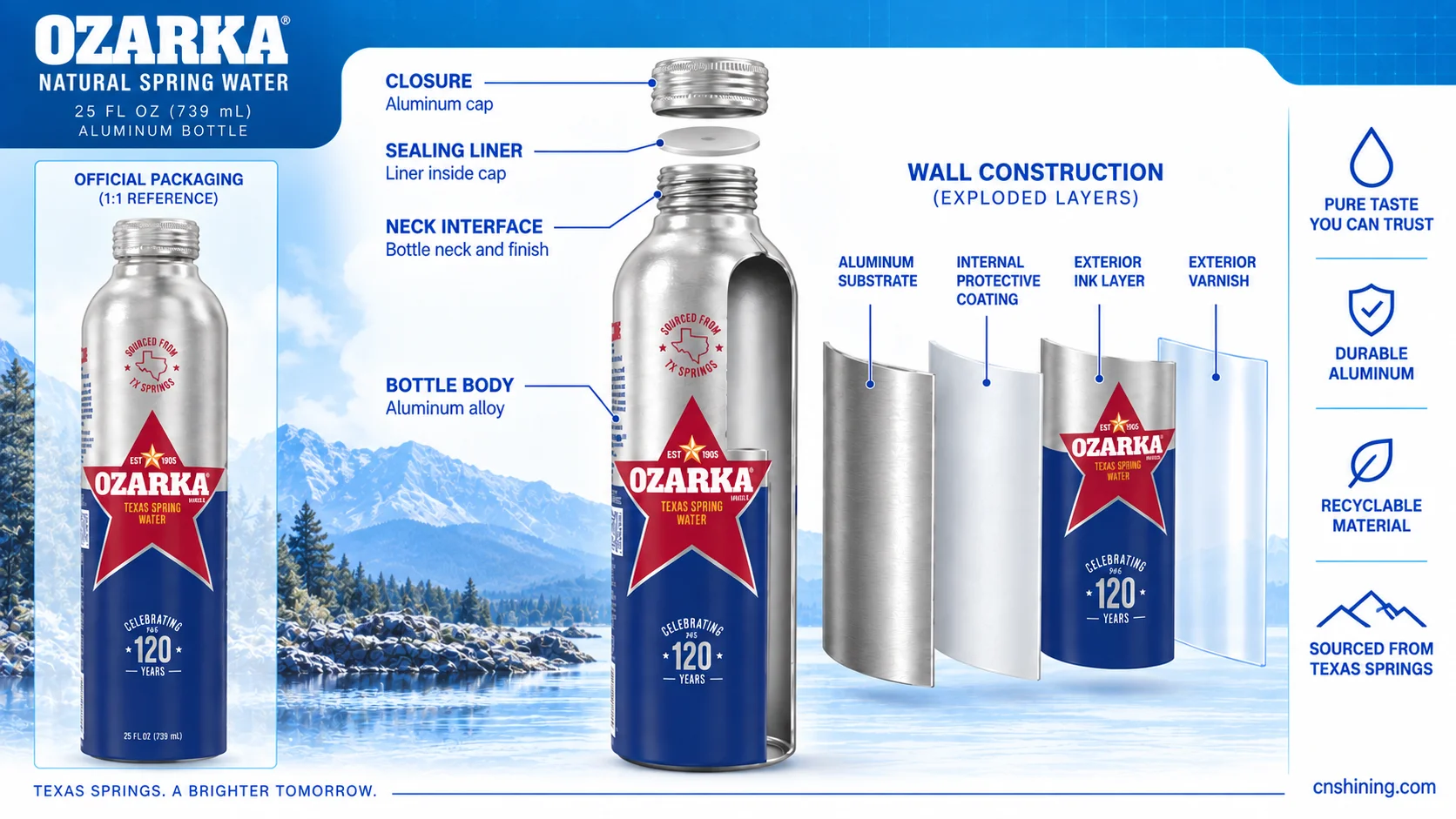
The highest-leverage structural issue is the closure–liner–coating relationship. A graphic defect is visible, but a poor opening-torque window, imperfect reseal or sensory interaction changes the drinking experience itself. Because the exact production neck, liner and coating specification must be confirmed against the real package, a ROPP closure system should be treated as an engineering option rather than an assumed Ozarka specification. Where ROPP is appropriate, torque control, bridge behavior and secure-seal testing become measurable development variables.
Decoration has a similar specification problem. A Texas-themed bottle benefits from uninterrupted metal graphics, but printing method, printable body area and protective varnish affect what artwork can survive production and distribution. Complex art should therefore be designed around the real cylindrical and shoulder geometry rather than adapted at the last minute; the aluminum bottle printing and finish trade-offs illustrate why offset, transfer and screen processes lead to different artwork constraints.
For projects where closure behavior, coating compatibility and decoration must be proved together, Shining Packaging can support neck/closure matching, coating review, print trials and production validation.
3. The Experience to Validate: Cold, Portable, Reclosable—and Not Annoying to Open
Packaging-specific public feedback is most useful here as a diagnostic tool. Reviews of closely comparable 25 oz aluminum spring-water bottles show both sides of the format. Poland Spring reviewers describe the bottle as convenient to carry and particularly satisfying when chilled, while one reviewer reports a metallic smell and taste. Arrowhead reviews similarly include positive comments about cold drinking and reuse alongside isolated concern about metallic taste, including one review that associated it with a dented bottle. A Zephyrhills reviewer, meanwhile, describes a cap that was extremely difficult to unscrew. These comments do not establish failure rates—and many peer reviews were collected through promotional sampling—but they identify exactly which package variables consumers notice.
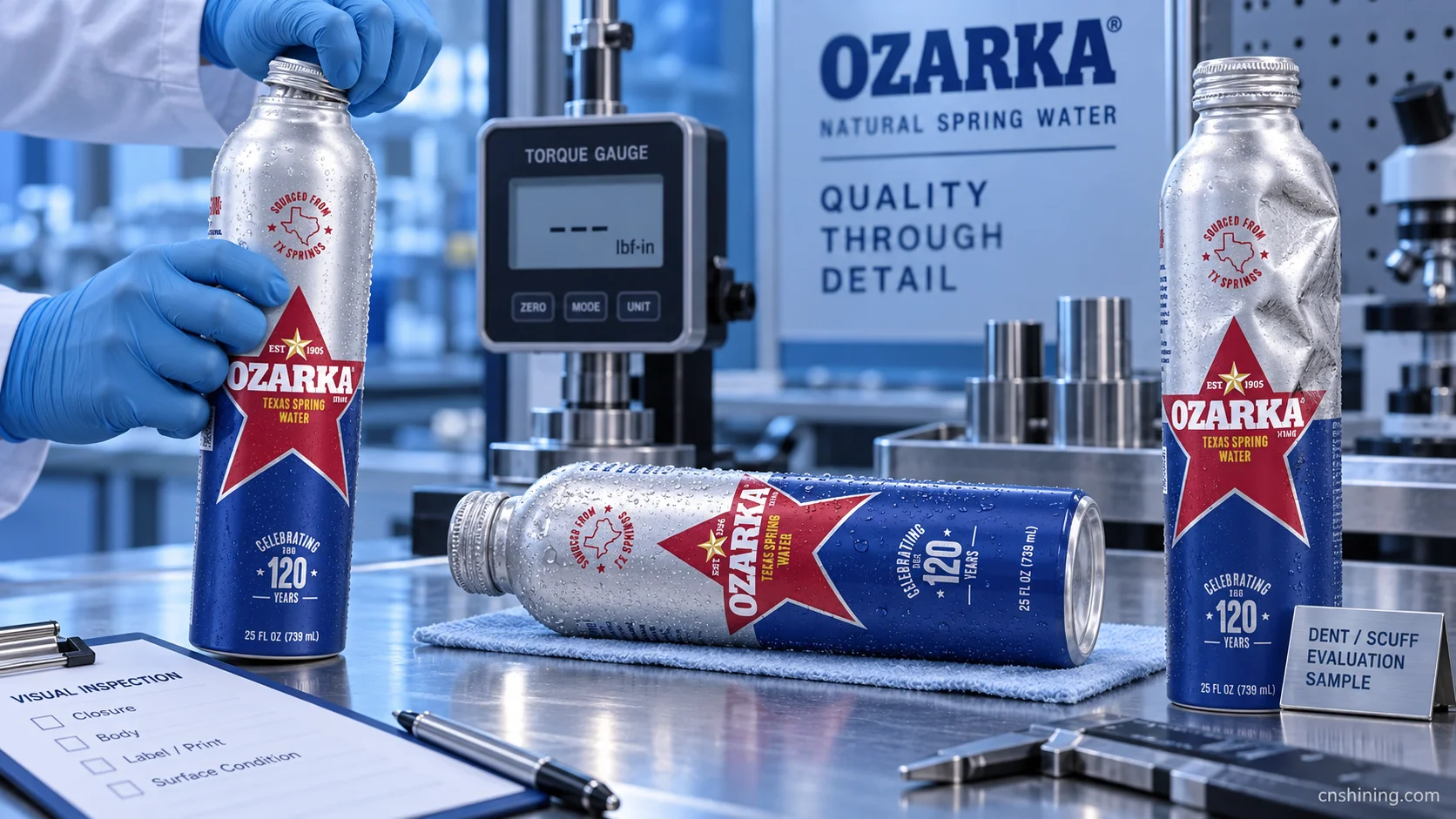
For Ozarka, those signals translate into a practical validation sequence. First-opening torque should be measured across production variation, cold storage and aging, not judged from one hand-applied sample. Resealed bottles should undergo upright, inverted and carried-in-a-bag leakage checks. Sensory testing should compare control water with filled-package samples after aging so that coating or liner concerns can be separated from the psychological expectation of a “metal taste.” Finished bottles also need dent and surface-abrasion review after realistic distribution, because an intact seal does not guarantee that a visibly battered bottle will still communicate the intended value.
Condensation adds another layer. The metal surface is part of the chilled drinking experience, but moisture, handling friction and repeated contact can expose weaknesses in varnish, fine text and high-contrast graphics. For a bottle that may carry collectible or limited artwork, decoration durability is not cosmetic trivia: damaged graphics directly reduce the value of the packaging idea. Transport pack-out therefore matters only insofar as it controls denting, cap damage and printed-surface contact; it does not need to become a separate packaging story.
The resulting channel logic is fairly clear. A 25 fl oz resealable metal bottle makes the strongest sense where consumers buy one visible bottle, chill it, carry it and potentially keep drinking after leaving the point of purchase: convenience retail, travel, campus or workplace environments, stadium and event occasions, and premium cold-box merchandising. Ozarka’s continuing MLB activity strengthens that interpretation. It is a less compelling format when the buying decision is dominated almost entirely by the lowest cost per ounce for household stock-up.
4. Aluminum Spring Water Competitors: Similar Bottles, Different Brand Jobs
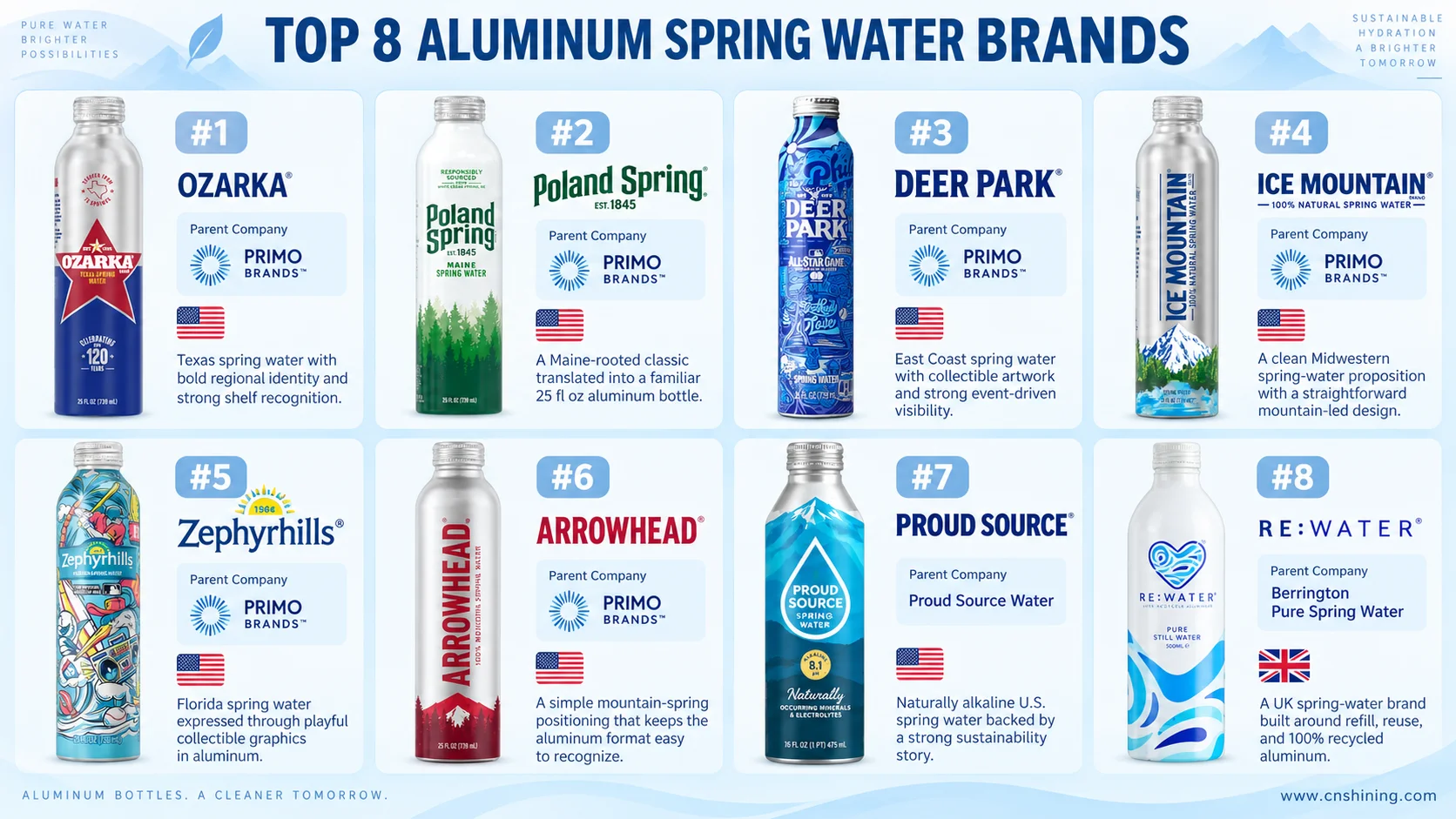
The most revealing comparison is not aluminum against glass or PET; it is aluminum spring water against aluminum spring water. The table below uses finished consumer brands with still spring water sold in aluminum bottles. Current online listings checked in September 2026 are used for price signals. Prices vary by retailer and location, so they should be read as shelf-position evidence rather than margin or packaging-cost data.
| Brand | Country | Parent company | Capacity | Retail price per bottle | Core selling point |
|---|---|---|---|---|---|
| Poland Spring | United States | Primo Brands Corporation | 25 fl oz | US$2.69 | Maine/Northeast spring-water identity translated into a 25 fl oz aluminum format. |
| Deer Park | United States | Primo Brands Corporation | 25 fl oz | US$2.79 | Mid-Atlantic spring provenance, portable aluminum format and a local environmental-support message. |
| Ice Mountain | United States | Primo Brands Corporation | 25 fl oz | US$2.69 | Midwestern spring-water identity with environmental support tied to the Great Lakes region. |
| Zephyrhills | United States | Primo Brands Corporation | 25 fl oz | From US$2.69 | Florida spring provenance and a strongly localized regional water identity in aluminum. |
| Arrowhead | United States | Primo Brands Corporation | 25 fl oz | US$2.69 | Western mountain-spring identity, resealable single-bottle use and California environmental support. |
| Proud Source Water | United States | SOURCE Global, PBC | 16 fl oz | US$1.99 | Naturally alkaline U.S. spring water with a materials-first aluminum and recycled-content narrative. |
| Re:Water | United Kingdom | Independent | 500 mL | £1.90 per unit | British spring water built around a 100% recycled-aluminum, refill/reuse/reseal proposition. |
The table exposes an unusual competitive fact. Poland Spring, Deer Park, Ice Mountain, Zephyrhills, Arrowhead and Ozarka now sit within the same Primo Brands portfolio, and several use a closely aligned 25 fl oz regional spring-water aluminum format. The physical bottle platform can therefore become relatively standardized while each brand changes the geography, graphics and community story around it. Primo Brands’ current corporate materials identify all six as regional spring-water brands in the same portfolio.
That makes the Ozarka aluminum bottle more interesting, not less. Its defensible position is not “we also sell spring water in aluminum.” It is the combination of Texas provenance, the red-star/silver-blue recognition system, baseball activation, artist editions and a local water-stewardship connection. Proud Source and Re:Water occupy a different territory: their aluminum itself carries much more of the brand argument through recycled-material and reuse language. Copying that minimalist sustainability grammar would weaken what Ozarka already owns culturally.
Price reinforces the same conclusion cautiously. Ozarka’s current H-E-B listing is US$2.98 for 25 oz, compared with several regional 25 oz aluminum peers around US$2.69 in other retail environments. Because these are different retailers and regions, the gap should not be interpreted as a controlled pricing premium. It does show, however, why the package needs a reason to exist beyond material choice: at single-bottle prices, distinctive artwork, regional familiarity and occasion fit have to do visible work.
5. What Makes the Format Credible: Food-Contact Discipline, Claim Discipline and Repeatable Production
For Ozarka’s U.S. business, regulatory relevance starts with the product rather than the material trend. 21 CFR 165.110 governs bottled-water identity and quality and directs bottled-water processing and bottling to the applicable requirements of Part 129. In package development, that means the immediate container and all product-contact interfaces have to preserve the water’s sanitary and sensory condition; compliance cannot be reduced to asking whether “aluminum is food safe.”
The marketing language deserves equally careful treatment. Ozarka’s product page calls the format an “all aluminum bottle,” while retail copy also uses reusable/refillable language. Those statements should not be expanded into claims about every liner, coating, ink or closure component without a verified bill of materials. The FTC Green Guides framework cautions against broad, unqualified environmental-benefit claims and places conditions around recyclable and refillable representations. Specific statements about the bottle body, local recycling instructions, verified recycled content or an actual reuse mechanism are more defensible than phrases such as “zero impact” or “the most sustainable bottle.”
A sensible production-release plan would therefore combine four evidence streams rather than approve the project from appearance alone: accelerated and real-time water–coating–liner sensory compatibility; initial and aged opening torque plus reseal leakage; filled-bottle drop, vibration, dent and cap-integrity checks; and condensation/abrasion testing on the final print and varnish system. Ozarka’s 18-month still-water Best By period provides a useful boundary for the shelf-life program. If the same visual platform is later extended to sparkling water, pressure resistance and closure behavior should be qualified as a separate package system rather than inferred from the still-water bottle.
The commercial opportunity is equally specific. Rather than proliferating bottle shapes, Ozarka can use a stable aluminum architecture as a repeatable canvas: permanent Texas recognition on the core SKU, controlled artwork changes for baseball, cities or local collaborators, and surface finishes proven to survive the channels where those designs matter. This approach moves customization into decoration while keeping the critical neck, liner, coating and filling interfaces disciplined—a more scalable proposition than treating every limited edition as a new packaging platform.
Conclusion
The Ozarka aluminum bottle is convincing when aluminum is treated as a system rather than a headline material. The bottle gives a regional spring-water brand enough physical presence to turn Texas culture and limited artwork into recognizable single-serve packaging, but the competitive set shows that aluminum alone is no longer distinctive. Ozarka’s stronger position is the combination of place, occasion and graphic storytelling, supported quietly by reliable sealing, product-contact compatibility and decoration durability. In that sense, the most valuable engineering outcome is almost invisible: standardize the parts consumers should never have to think about, then let the metal surface carry the part of the brand they will remember.