
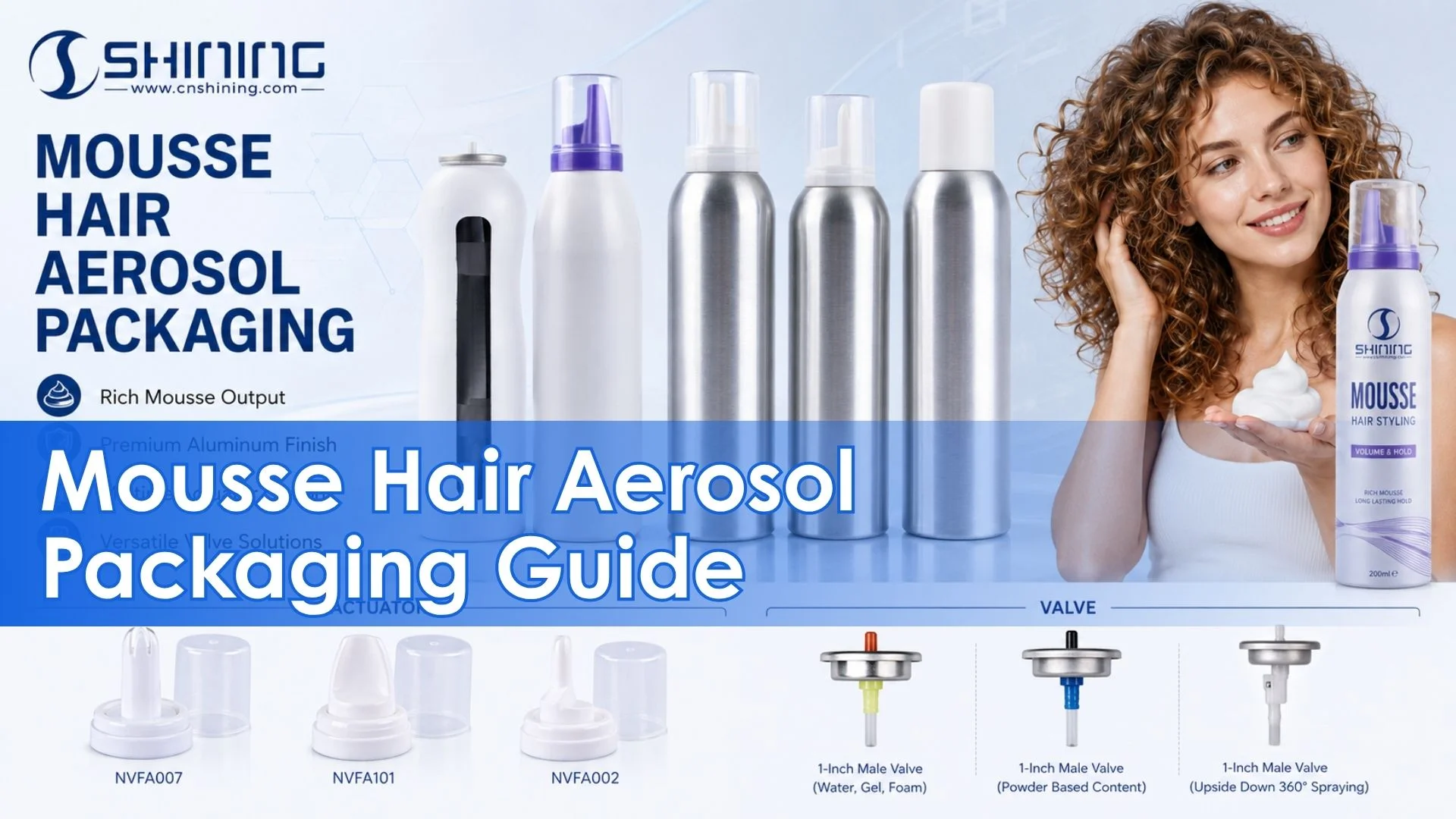
A mousse hair aerosol spray is not just a hair styling formula in a metal can. In technical terms, it is a hair mousse formulation combined with an aerosol dispenser. The formula, propellant, valve, actuator, internal lacquer and regulatory limit all work as one system. If one part is mismatched, the user sees it quickly: clogged nozzle, weak foam, hard hair feel, leakage after drop impact, or poor discharge near the end of pack life.
For packaging engineers, this category is useful because the failure modes are visible. Foam quality tells you something about pressure balance. Nozzle clogging tells you something about polymer deposition and actuator geometry. Corrosion risk tells you something about lacquer compatibility. The product looks simple on shelf, but the development window is narrow.
1. Definition, Naming and Working Principle
Under the California CARB wording, Hair Mousse means a hairstyling foam designed to help form a coiffure and provide limited holding power. Under the EU aerosol framework, an aerosol dispenser is a non-refillable pressurized container able to discharge contents as particles, foam, paste, powder, liquid or gas. Put together, the practical definition is clear: a pressurized hair styling product that exits through a valve and actuator as foam or mousse, used for volume, curl definition, frizz control and light-to-medium hold.
The operating principle has two layers. Physically, the can pressure pushes product through the valve and actuator. As the product leaves the container, the pressure drops, volatile propellant expands or flashes, and bubbles form inside the liquid phase. Chemically, surfactants stabilize the foam film, styling polymers form a film on hair fibers, and conditioning agents reduce roughness or frizz.
The actuator is not a decorative part. Orifice size, mixing chamber geometry, inverted-use behavior and dead volume change foam density, discharge rate and creaminess.
2. Advantages, Formulation Windows and Technical Terms
The main benefit of aerosol hair mousse is not maximum hold. It is fast foam expansion, wide distribution, root lift, curl definition and an airier hand feel. Hairspray is better for final hold. Mousse is better as a styling base, especially before blow-drying or curl shaping.
| Dimension | Aerosol hair mousse | Non-aerosol mousse | Foam pump | Hair spray | Engineering judgment |
|---|---|---|---|---|---|
| Texture and spread | Fine foam, fast expansion | Depends mainly on formula | Light and wetter foam | Atomized mist, not foam | Aerosol mousse gives the strongest instant foam feel. |
| Use position | Pre-blow-dry, volume, curl definition | Light-to-medium styling | Light care and soft hold | Final hold and finish | Hairspray is a finishing product; mousse is a forming product. |
| Hold level | Light to medium | Light to medium | Light | Medium to high | The regulatory definition already points to limited holding power. |
| VOC and flammability | Sensitive | Lower | Lower | Often higher | Low-VOC reformulation is a real constraint for aerosol mousse. |
| Transport | UN1950 aerosol management | Simpler | Simpler | Also aerosol if pressurized | Aerosol systems carry more logistics control points. |
| Packaging risk | Nozzle clogging, actuator breakage, lacquer compatibility | Lower | Pump failure or foam collapse | Nozzle clogging | Aerosol mousse has the highest packaging engineering load. |
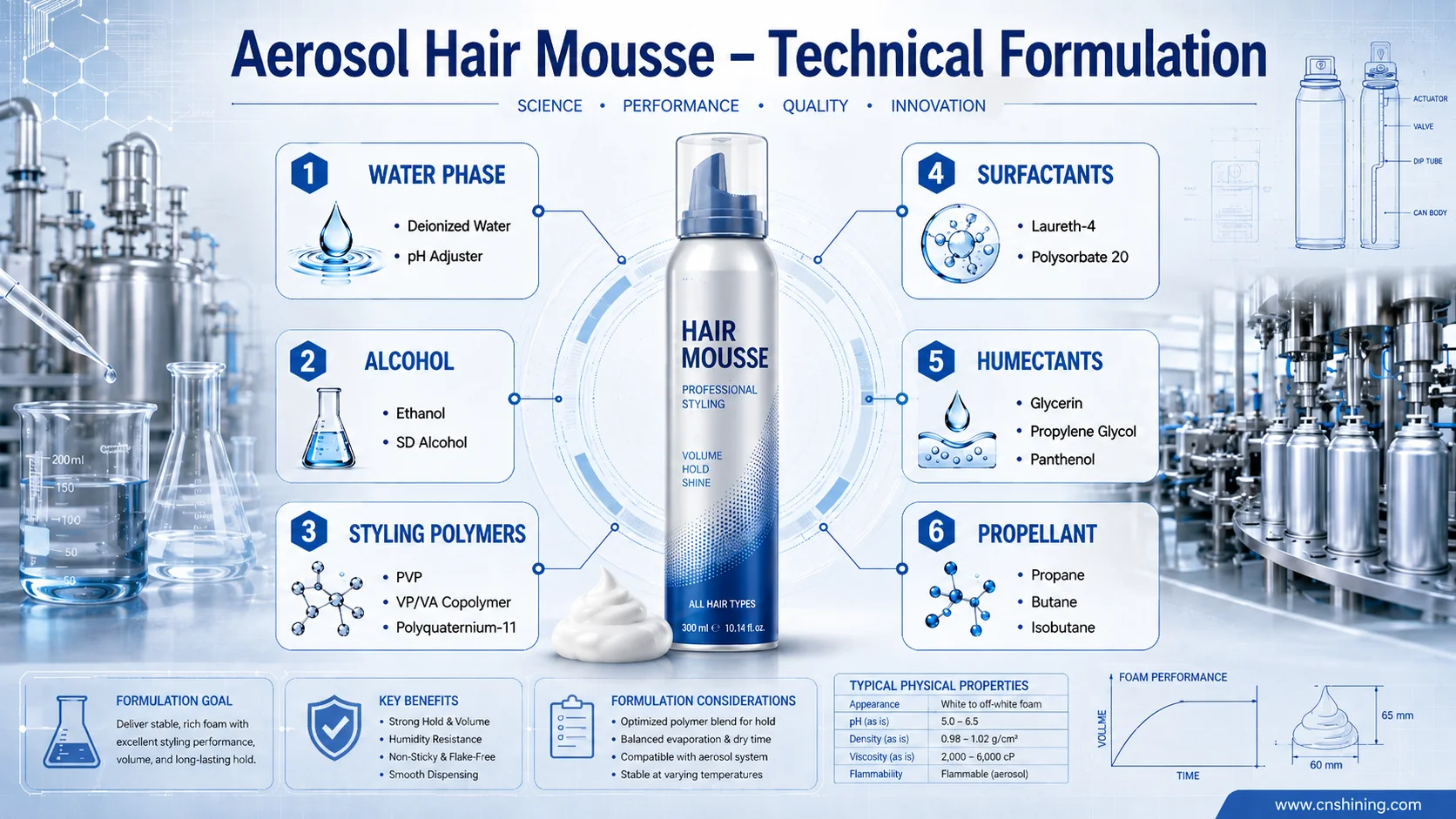
Patent disclosures show wide formula ranges.Water can sit around 30% to 90%, alcohol from 0% to 30%, styling resin from 2% to 40%, and aerosol propellant from 5% to 50%. This is not a universal formula standard. It is a development window. See WO2001070179A1, US6589518B2 and US20110311463A1.
| Formula category | Common examples | Function | Typical working window |
|---|---|---|---|
| Carrier | Water, ethanol | Solvent, drying speed, polymer delivery | Water 40%-90%; ethanol 0%-30% |
| Styling polymer | PVP, VP/VA Copolymer, Acrylates Copolymer, Polyquaternium, polyurethane resin | Film formation, volume support, curl memory | 0.5%-8% common; patent ranges can be wider |
| Surfactant and foam aid | Cocamidopropyl Betaine, amine oxides, nonionic surfactants | Lower interfacial tension, foam generation, foam stability | 0.1%-5%; cleansing-type mousse may be higher |
| Conditioning agent | Silicone emulsion, cationic polymer, quats | Smoothness, frizz reduction, combability | 0.1%-3% |
| Humectant / plasticizer | Glycerin, panthenol, propylene glycol | Softness, lower brittleness | 0.5%-5% |
| Preservative | Phenoxyethanol, organic acid salts | Microbial stability | 0.2%-1% |
| Fragrance | Fragrance / parfum | Odor profile | 0.05%-0.5% |
| pH adjuster / neutralizer | AMP, TEA, citric acid | Polymer neutralization and system stability | 0.1%-1% |
| Propellant | DME, propane, butane, isobutane; air or nitrogen in BOV | Pressure, discharge, foam structure | 3%-20% common; patent windows can reach 50% |
| Archetype | Use case | Formula logic |
|---|---|---|
| Classic volumizing mousse | Root lift and pre-blow-dry support | Water + moderate alcohol + PVP/VP/VA or acrylate resin + AMP neutralization + panthenol or light conditioner + DME or hydrocarbon propellant. |
| Curl moisturizing mousse | Curl definition with less brittle feel | Water + low or no alcohol + flexible resin or polyquaternium + glycerin or panthenol + plant oil, protein or extract + mild propellant system. |
| Low-VOC premium mousse | Regulated markets and higher sustainability pressure | High-water phase + low propellant or BOV compressed gas + flexible resin + light silicone or conditioning emulsion + tighter packaging compatibility control. |
| Term | Plain explanation | Why it matters |
|---|---|---|
| Aerosol dispenser | Pressurized non-refillable package for foam or liquid discharge. | Defines pressure and transport obligations. |
| Propellant | Gas or liquefied gas that creates pressure. | Controls VOC, flammability, foam density and cost. |
| BOV | Bag-on-Valve system separating product from propellant. | Supports lower VOC, better evacuation and 360° discharge. |
| Actuator | The press button and dispensing head. | Controls foam density, user feel and clogging risk. |
| Stem orifice | Flow opening in the valve stem. | Affects flow rate, shear and foam formation. |
| Overcap | Protective cap over actuator. | Supports dust protection and drop resistance. |
| LVP-VOC | Low vapor pressure VOC. | Useful in CARB-oriented formula design. |
| Internal lacquer | Can internal coating. | Controls corrosion, odor migration and shelf life. |
| Flashing | Rapid propellant expansion after pressure drop. | Drives foam nucleation and creaminess. |
3. Regulatory and Transport Controls
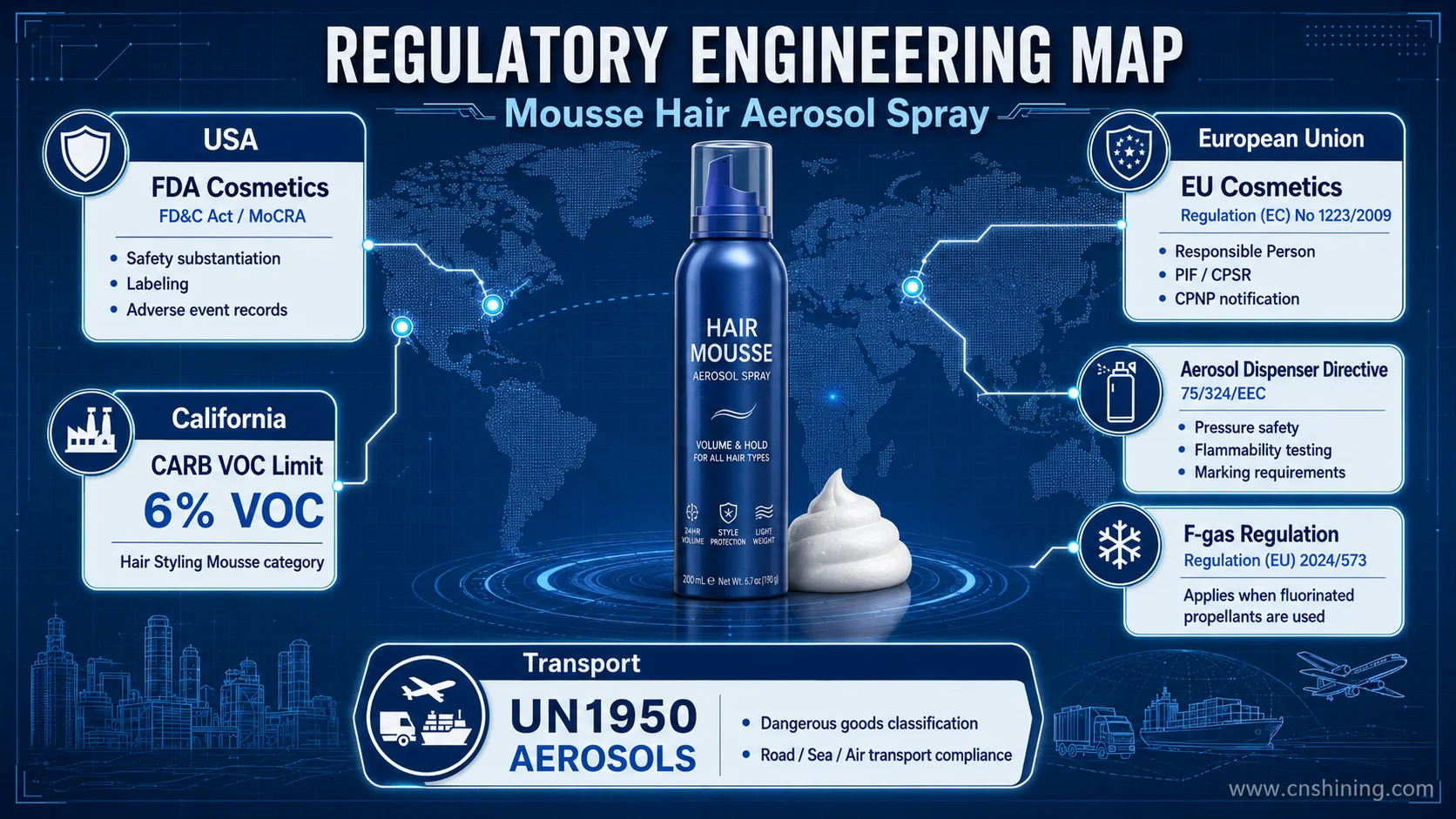
In the United States, hair mousse normally sits in cosmetics if claims stay around styling, beautifying, curl definition, frizz control, volume or conditioning. Claims such as dandruff treatment, hair loss treatment or scalp disease treatment may move the product toward drug or cosmetic-drug logic. The FDA MoCRA page makes facility registration, product listing, serious adverse event reporting and safety substantiation front-line compliance work.
Labeling is not a minor afterthought for aerosol mousse. Self-pressurized containers need suitable warnings, and ingredient, identity, net content and responsible party information need to be controlled under the FDA Cosmetics Labeling Guide. CFC propellants are prohibited in cosmetic aerosol products for domestic consumption under FDA rules listed on the FDA prohibited and restricted ingredients page.
California VOC control is the hard practical constraint. CARB separates Hair Mousse from Hair Styling Product and sets Hair Mousse at 6% VOC after the relevant effective date. This is why low-VOC mousse is not just a label story. It changes resin choice, propellant percentage, solvent level and actuator design.
In the EU, two tracks apply at the same time: cosmetics law and aerosol dispenser law. The EU cosmetics legislation page covers Regulation (EC) No 1223/2009, responsible person, safety assessment and notification framework. The aerosol dispenser rules cover the pressurized package itself. Recent F-gas pressure also matters. The EU F-gas legislation page states that Regulation (EU) 2024/573 started to apply on 11 March 2024 and covers products and equipment containing fluorinated greenhouse gases or relying on them.
For transport, aerosol mousse is normally handled as UN1950, AEROSOLS. The Canadian TDG regulation gives a clear classification example: dangerous goods in aerosol containers are transported under UN1950, with flammable gas class logic based on flammable component mass and heat of combustion. See the Transportation of Dangerous Goods Regulations.
4. Technology Trends and Patent Hotspots
The direction is clear: lower VOC, more precise foam control, better package compatibility and stronger sustainability claims backed by actual packaging changes. Reduced-VOC patent work is visible in WO2022013362A1. Natural or softer film-forming systems are also visible in patent literature. The reason is practical: users want hold, but they do not want crunchy or dry hair.
There are three low-VOC routes. The first is lowering propellant level and shifting foam performance to actuator geometry and resin design. The second is compressed gas with Bag-on-Valve technology, where product and propellant are separated. The third is softer water-based film formation, using flexible polymers, plasticizers and humectants to reduce alcohol dependency.
Metal packaging is also changing. Low-carbon aluminum, PCR content, wall-weight reduction and lower lacquer load are packaging-side answers to the same pressure.
5. Top 10 Mousse Hair Aerosol Spray Brands
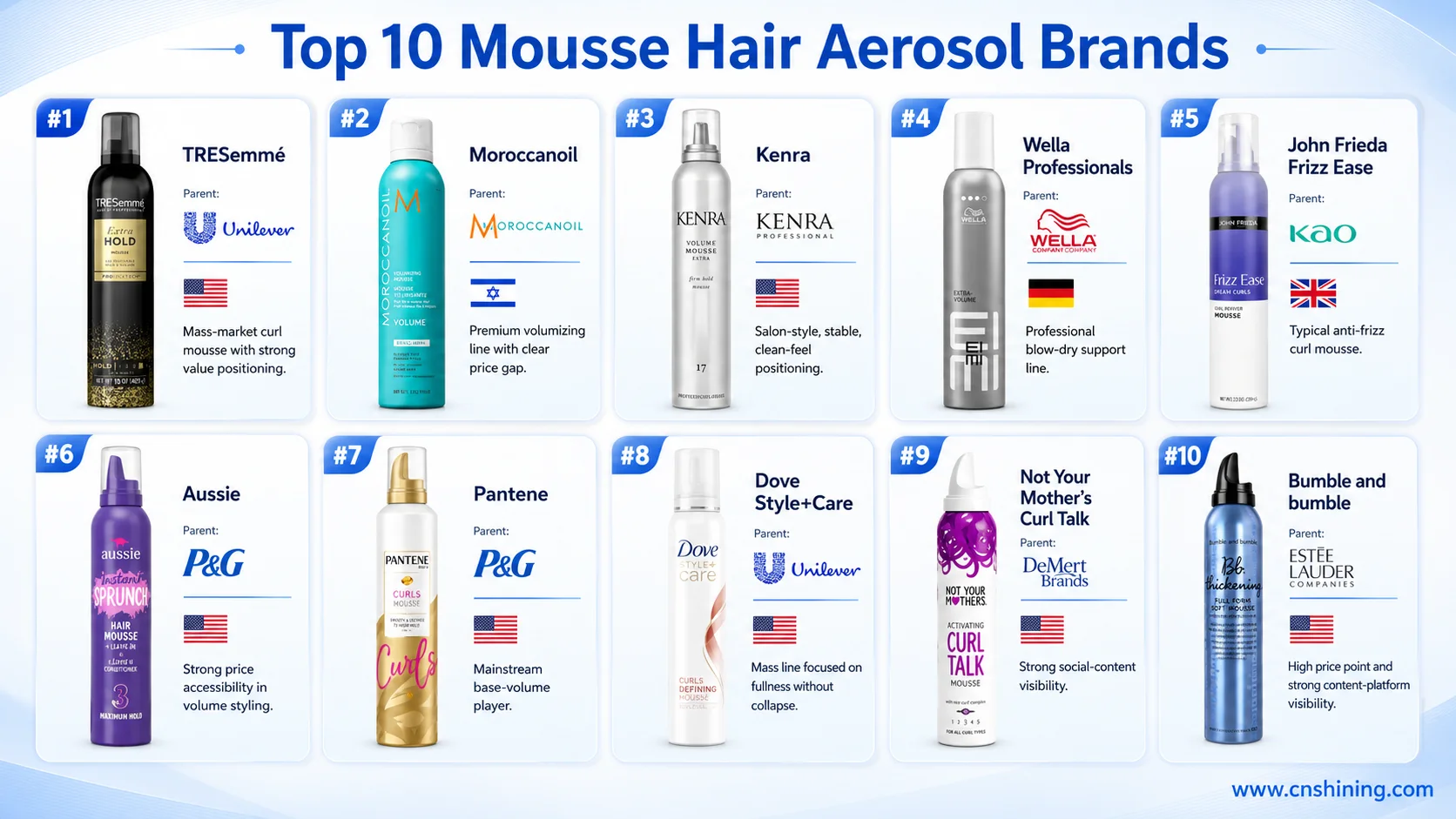
| Brand | Country | Parent | Common size | Price | Direct observation |
|---|---|---|---|---|---|
| TRESemmé | United States | Unilever | 10.5 oz | about 14.90-16.91$ | Mass-market curl mousse with strong value positioning. |
| Moroccanoil | Israel | Moroccanoil | 8.5 oz / 250 mL | about 30.40-40.00$ | Premium volumizing line with clear price gap. |
| Kenra | United States | Kenra Professional | 8 oz | about 20-21$ | Salon-style, stable, clean-feel positioning. |
| Wella Professionals | Germany | Wella Company | 10.1 oz | about 19-20$ | Professional blow-dry support line. |
| John Frieda Frizz Ease | United Kingdom | Kao | 7.2 oz | about 8.97-9.99$ | Typical anti-frizz curl mousse. |
| Aussie | United States | Procter & Gamble | 6 oz | about 4.97-14.91$ | Strong price accessibility in volume styling. |
| Pantene | United States | Procter & Gamble | 6.6 oz | about 10.44-11.50$ | Mainstream base-volume player. |
| Dove Style+Care | United States | Unilever | 7 oz | about 6.98$ | Mass line focused on fullness without collapse. |
| Not Your Mother’s Curl Talk | United States | DeMert Brands | 7 oz | about 8.74$ | Strong social-content visibility. |
| Bumble and bumble | United States | Estée Lauder Companies | 5 oz / 146 mL | about 35.15-37.00$ | High price point and strong content-platform visibility. |
6. Packaging Pain Points and Practical Improvements
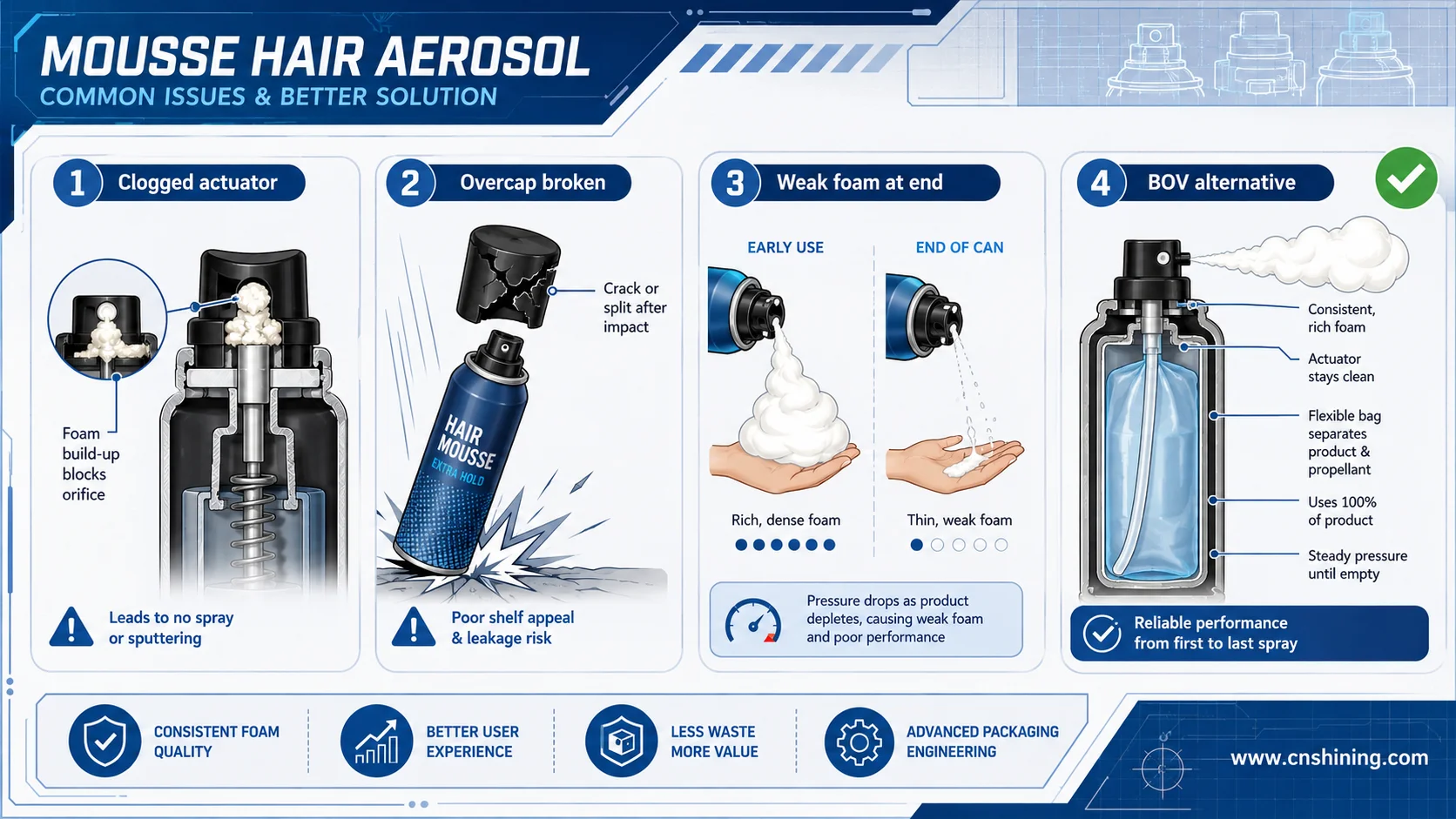
| Pain point | Likely technical root | Useful correction |
|---|---|---|
| Nozzle clogging | Polymer or surfactant drying at stem / orifice; dead zones inside actuator. | Anti-clog foam actuator, removable head, lower-residue resin system. |
| Actuator breakage or leakage concern | Weak overcap, brittle actuator resin, poor lock geometry, valve cup damage after impact. | Tougher PP copolymer, stronger skirt and lock design, higher drop-test standard. |
| Weak foam near end of pack | Propellant phase imbalance, pressure decay, improper inverted use. | Clear inverted-use graphics, optimized propellant ratio, BOV option for premium SKUs. |
| Crunchy, dry or hard hair | High-Tg resin, high alcohol, localized deposition from aggressive discharge. | Flexible resin, humectant, controlled-dose actuator, usage education. |
| Frizz returns quickly | Poor balance between resin and conditioner; weak humidity resistance. | Cationic conditioning polymer, humidity testing, protein / protein-free SKU logic. |
Internal corrosion should not be treated as a rare event. Water, alcohol, DME, surfactant, fragrance and electrolytes can stress can coatings. The practical answer is not guessing; it is accelerated compatibility testing with the final formula, valve and propellant.
7. Shining Packaging Components for Mousse Hair Aerosol Spray
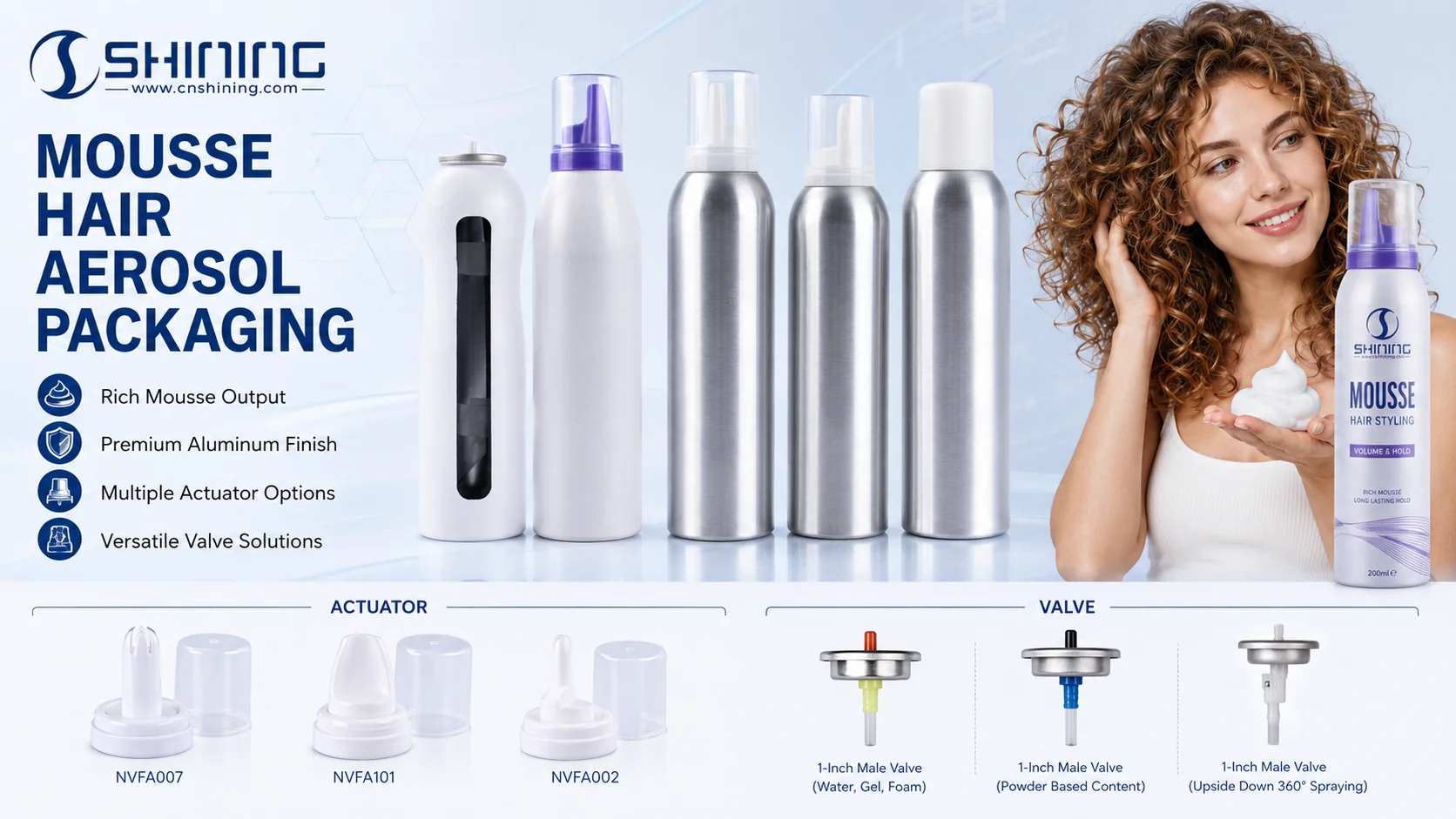
For mousse hair aerosol spray, the package should be specified as a system. The actuator, valve, can body, internal coating and propellant route must match the formula. A good-looking can cannot compensate for a poor foam actuator. A strong resin formula cannot compensate for an incompatible gasket or lacquer.
Shining Packaging can be positioned naturally in this system through three component areas: aerosol cans, foam actuators and aerosol valves. For standard hydrocarbon or DME mousse, the key check points are pressure rating, valve flow, stem orifice, actuator foam chamber, gasket compatibility and internal lacquer. For low-VOC or premium mousse, BOV-compatible can and valve options should be evaluated early because the filling process and cost model are different.
One useful engineering rule: do not approve the can, valve and actuator separately. Run packed-unit tests. The same formula can behave differently after propellant filling, storage at elevated temperature, repeated actuation and drop exposure.
8. Final Technical Notes
Mousse hair aerosol spray is best judged as a combined formula and packaging system. The strongest development path is practical: flexible film-forming polymers, controlled humectant or plasticizer use, low-residue surfactant design, anti-clog foam actuator, compatible valve gasket, tested internal lacquer and a propellant route that can meet VOC and transport requirements. BOV is useful for premium and low-VOC lines, but it needs the right price point and filling setup. For mass SKUs, actuator geometry and compatibility testing often deliver faster gains.
9. FAQ: Mousse Hair Aerosol Spray
It is a hair mousse formula packed in a pressurized aerosol dispenser. The product exits through a valve and foam actuator as mousse. It is used for volume, curl definition, frizz control and light-to-medium hold, not for hard final fixation like many hairsprays.
The can stores formula and propellant under pressure. When the actuator opens the valve, product flows out and pressure drops quickly. The propellant expands or flashes, creating bubbles inside the liquid phase. Surfactants stabilize the bubbles, while polymers later form a styling film on hair.
The actuator controls flow path, mixing, foam expansion and discharge feel. Small changes in orifice, chamber shape or dead volume can change foam density and clogging risk. For mousse, the actuator is part of the product experience, not only a press button.
Clogging usually comes from dried polymer, surfactant residue or formula deposits around the stem and actuator outlet. High-resin systems and poor actuator geometry increase the risk. Anti-clog actuator design, lower-residue polymers and removable heads can reduce the failure rate.
Crunch usually comes from a stiff film-forming polymer, high alcohol level, high local product deposition or too much product applied in one area. Softer polymers, plasticizers, humectants and controlled-dose actuators can reduce brittleness while keeping useful hold.
Propellant and volatile solvents help pressure, discharge and foam formation, but they also affect VOC limits. California sets a tight VOC standard for Hair Mousse. Low-VOC design must shift performance toward water-based resin systems, actuator foam control or compressed gas technologies.
BOV is useful when low VOC, reduced flammability, high evacuation, 360° dispensing or better product-propellant separation is needed. It is more expensive than a standard aerosol system, so it fits premium, sensitive or regulation-driven SKUs better than low-cost mass products.
Check pressure rating, internal lacquer compatibility, valve crimp quality, gasket behavior, propellant route, formula pH, alcohol level, surfactant system and fragrance interaction. Packed-unit testing is safer than testing each component alone because propellant changes compatibility behavior.
It is usually a cosmetic when claims stay around styling, appearance, volume, curl definition, conditioning or frizz control. If claims move to treating dandruff, hair loss, scalp disease or body function, the product may enter drug or cosmetic-drug regulatory territory.
The fastest practical upgrade is often the foam actuator. A better actuator can improve foam texture, reduce clogging and improve user control without changing the whole formula. Internal lacquer and gasket compatibility testing should run in parallel to reduce leakage, odor and corrosion risk.