
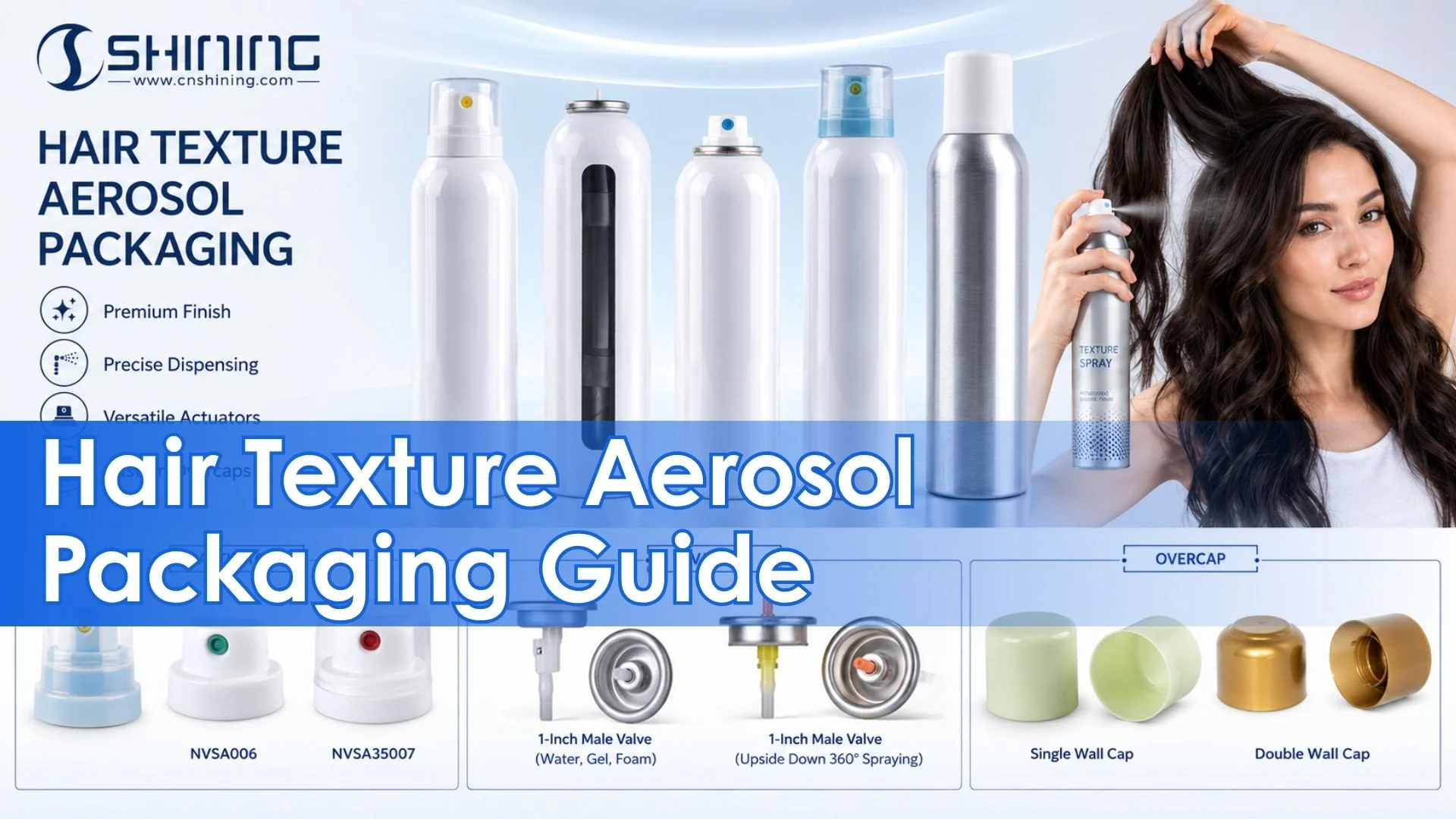
Hair texture aerosol spray is not just a lighter hairspray. It is a propellant-driven styling system that deposits a low-tack film and powder-like grip on hair fibers. The target is dry volume, matte or semi-matte separation, re-workable hold, and low visible residue. When the spray feels sticky, wet, gritty in the wrong way, or hard to aim, the root cause is usually technical.
1. What Is a Hair Texture Aerosol Spray
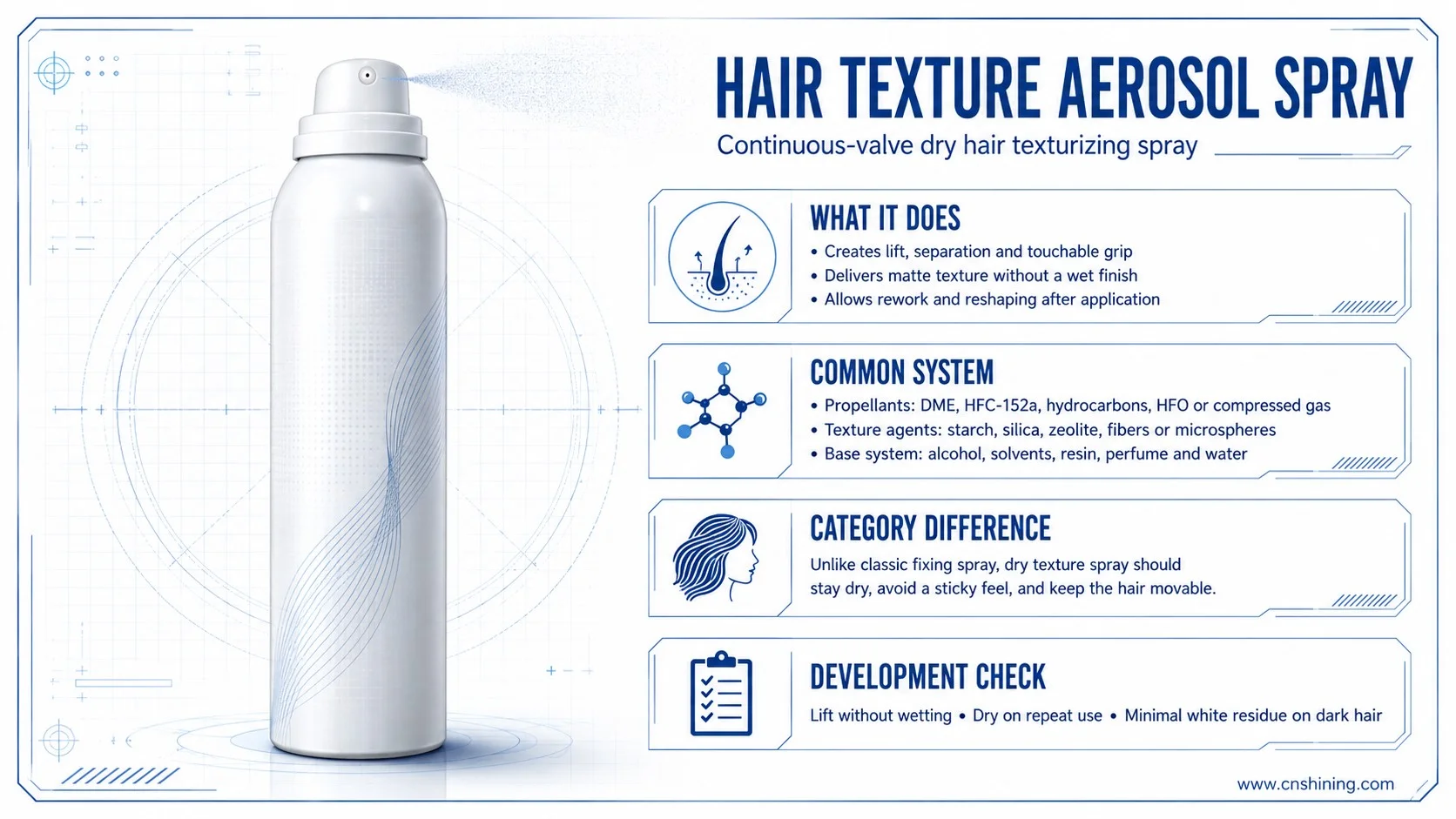
Hair texture aerosol spray means a continuous-valve aerosol product used mainly on dry hair. It is powered by DME, HFC-152a, hydrocarbons, HFO propellant, or compressed gas. It uses film-forming polymers and particles such as starch, silica, zeolite, fibers or microspheres to create lift, separation, matte finish and touchable grip.
The UK official Hair spray – aerosol frame formulation gives a useful boundary for this product family. It lists alcohol or isopropanol, propellants, volatile silicones or related solvents, humectants, resins, plasticisers, preservatives, perfume and water as typical modules. That matches the working structure of most dry texture spray and aerosol texturizing spray products.
The product boundary is different from classic fixing spray. A fixing spray is designed to lock hair into a set shape. A dry texture spray should avoid a strong sticky phase and allow the user to rub, lift and reshape the hair after application. This is why the same polymer chemistry can produce either a rigid hairspray feel or a softer invisible dry grip, depending on the powder load, solvent path, actuator, valve and spray rate.
2. Working Mechanism: Atomization, Flash-Off and Deposit Formation
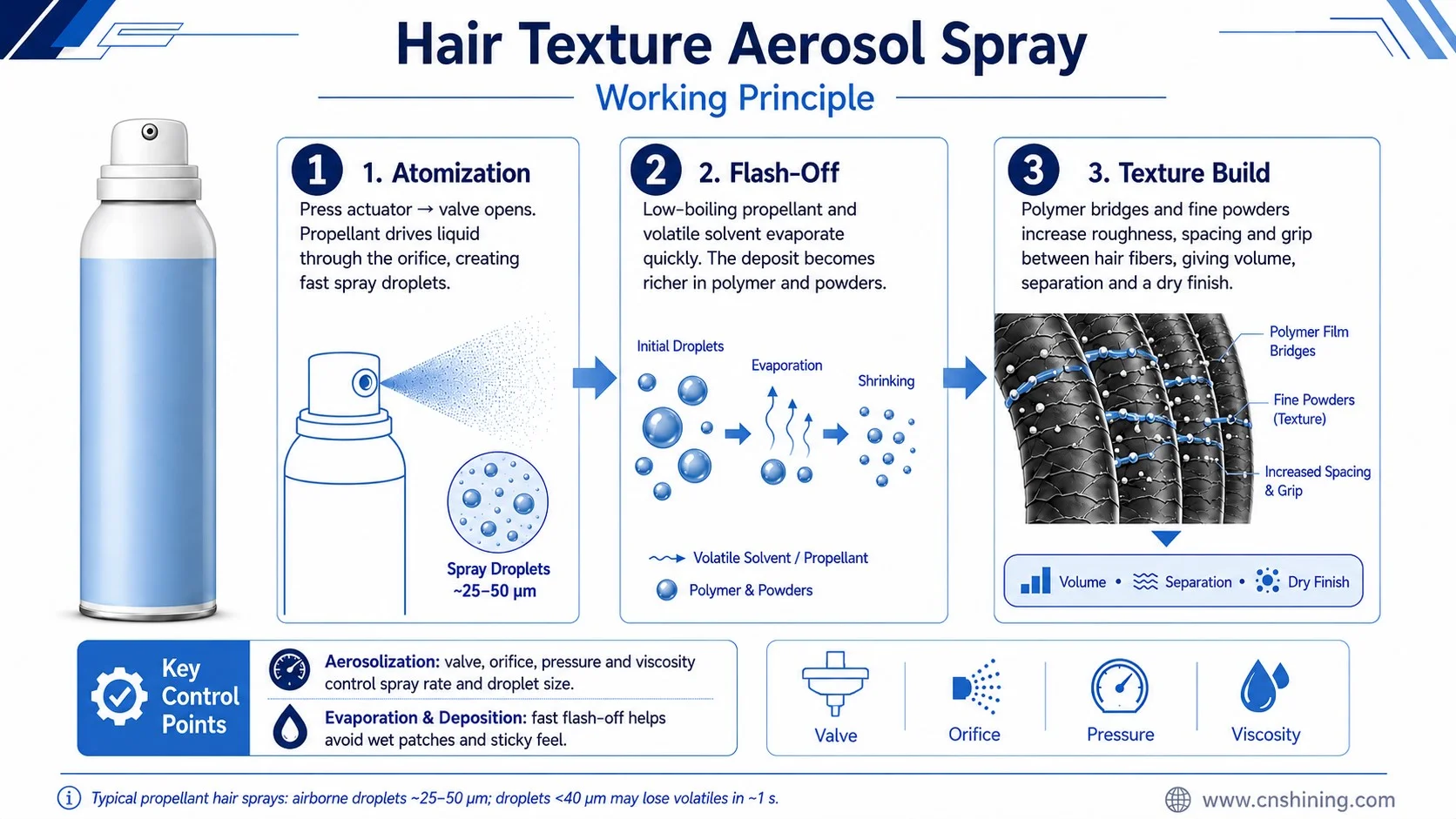
The physical chemistry is simple enough to map in three steps.
Step 1: Pressing the actuator opens the valve. Propellant carries the liquid phase through the stem and actuator orifice at high velocity, forming droplets.
Step 2: Low-boiling propellant and volatile solvent flash off quickly. The remaining deposit becomes richer in polymer, silicone, starch, silica, zeolite or other non-volatile materials.
Step 3: Polymer bridges or films form between hair fibers. Powders increase roughness, fiber spacing and tactile grip. The result is volume, separation and a dry finish.
Aerosolization is the first control point. Valve design, stem orifice, actuator insert, vapor pressure and formulation viscosity decide spray rate, particle size distribution and whether the product lands as a fine mist or as a wet patch.
Evaporation and deposition are the second control point. The CIR respiratory exposure resource reports that propellant hair sprays commonly have airborne droplet median aerodynamic diameters around 25-50 μm, while pump hair sprays are closer to 60-80 μm. In propellant hair sprays, the respirable fraction below 10 μm is usually 1-2.5% and not more than 5%. Droplets below 40 μm may lose volatile components within about one second after release.
This explains a common user complaint. A formula can be correct on paper but still feel sticky on hair if the spray pattern is too narrow, the discharge rate is too high, or the droplets wet the same spot before flash-off is complete.
3. Formulation Architecture and Common Use Windows
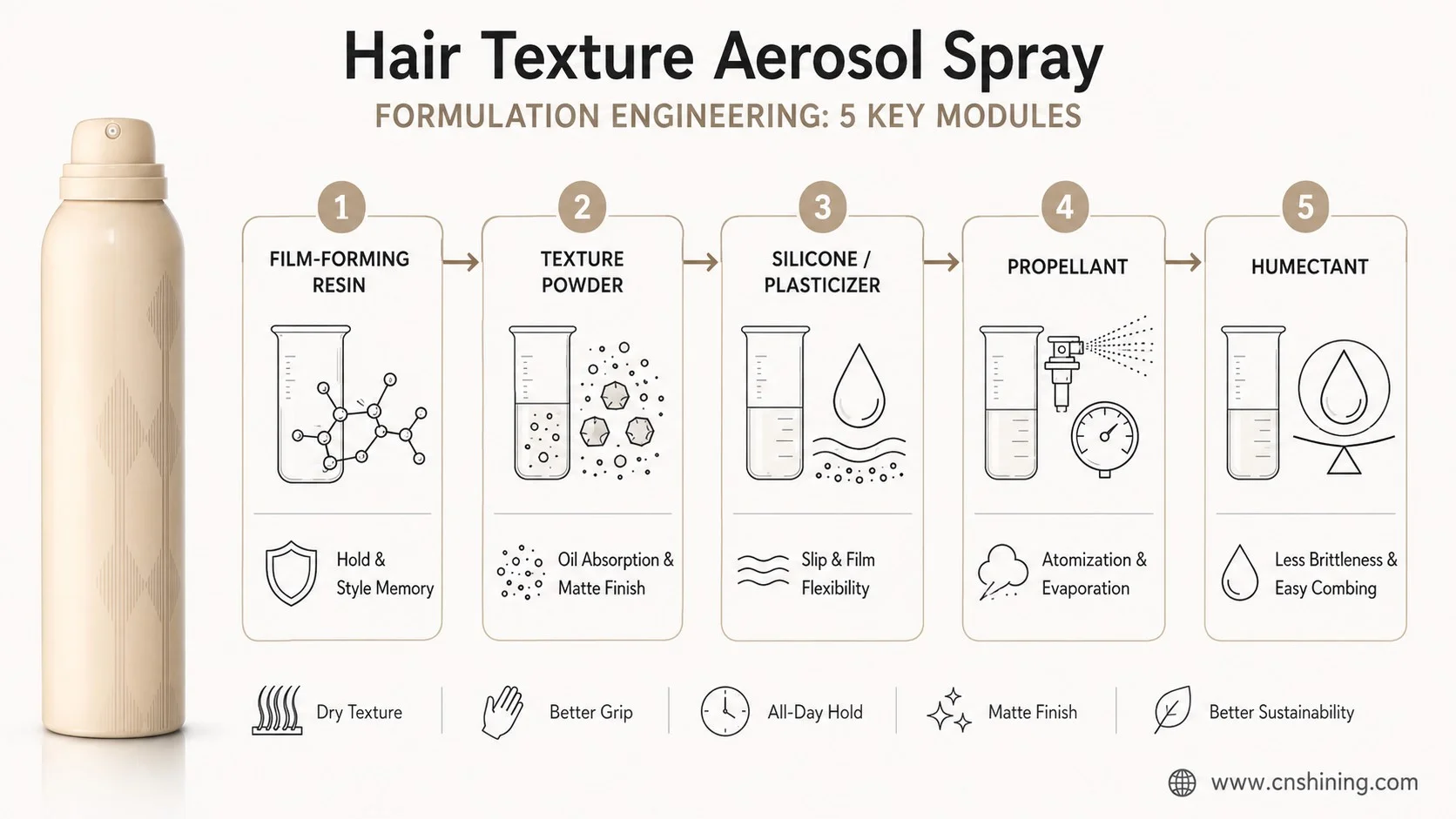
The performance axis is the balance of resin, powder and propellant. Too much resin gives tack, matting and build-up. Too much powder gives grey cast, dirty feel and valve clogging risk. Too aggressive a volatile phase can amplify fragrance and create a harsh spray cloud.
Public dry texture spray patents such as GB2583576A Dry Texture Spray describe the category as different from classic fixing spray because the texture system should avoid obvious stickiness and allow reworking. A related aerosol hair composition patent, WO2016112320A1, gives useful windows for low-resin, high-propellant volume systems using lightweight particles.
| Module | Representative INCI / Material | Main Function | Public Window | Practical Note |
|---|---|---|---|---|
| Film-forming resin | VP/VA Copolymer, Acrylates Copolymer, Polyurethane-14, PVM/MA ester | Hold, style memory, humidity resistance and fiber bridging | 0.1-10 wt%; often 0.5-5 wt%; dry texture patents may reach 0.5-15 wt% | Higher levels increase hold but can drive stiffness, tack and build-up. |
| Texture powder | Rice starch phosphate, tapioca starch, zeolite, silica dimethyl silylate, talc | Oil absorption, roughness, spacing and matte finish | Starch ester 0.1-10 wt%; silica dimethyl silylate 0.1-1 wt%; talc up to 0.5 wt% | This is the main source of “dirty texture” and second-day hair feel. |
| Microspheres | Hollow fluid-filled microspheres | Low-density spacing between fibers | 0.01-5 wt%; often 0.1-0.5 wt% | Useful when a formula needs volume without heavy resin. |
| Conditioning polymer | Polyquaternium-11 and related systems | Slip, combing and less rough after-feel | Often up to 2 wt% | Too much conditioning reduces dry grip. |
| Humectant | Glycerin, propylene glycol | Less brittle feel and reduced pull during combing | Official frame formulation allows humectants up to 30%; dry texture spray often uses much less | High humectant is risky for a dry-finish product. |
| Plasticiser | Acetyl triethyl citrate, polyglycol ethers | Film flexibility and lower flaking | Frame formulation lists plasticisers up to 2% | Small changes can reduce “crunch” without removing hold. |
| Silicone / volatile carrier | Cyclopentasiloxane, dimethicone, PEG/PPG silicones | Slip, anti-static effect and smoother finish | Volatile silicones and related solvents may reach 40% in the UK frame formulation | Usually an auxiliary system in dry texture spray, not the core. |
| Solvent carrier | Ethanol, isopropanol, water | Polymer solubility, dispersion and dry speed | Alcohol can reach 95% in the official frame formulation; liquid carrier in patents may be 0.2-50% | High alcohol improves dry speed but may increase dry feel. |
| Propellant | DME, HFC-152a, propane, isobutane, butane, HFO-1234ze(E) | Atomization, pressure, evaporation speed and carbon profile | 40-90 wt%; often 65-85 wt%; official frame allows up to 90% | It affects spray feel, logistics classification and sustainability claims. |
| Fragrance / preservative | Fragrance, preservatives | Odor identity and microbial control | Frame formulation lists perfume up to 1% and preservatives up to 1% | Strong fragrance is a frequent complaint in texture sprays. |
Three conclusions matter in real development. No visible residue does not mean no particles. It means particle size, color, refractive index, total loading and spray uniformity are controlled. No tack is not only a low-resin question. It also depends on film glass transition, plasticiser choice and evaporation path. A premium feel often comes from the combined behavior of silicone, plasticiser, fragrance and mist quality, not from one hero ingredient.
Functional Modules and User Perception
| Functional Module | Representative Structure | Direct Physical Effect | User Perception | Commercial Meaning |
|---|---|---|---|---|
| Film-forming resin | VP/VA, acrylates, polyurethane, polyester | Dry bridge and thin film between fibers | Hold, style memory, anti-frizz | Decides whether the style can stay up. |
| Powder / particle | Zeolite, silica, starch, fiber, microsphere | Oil absorption, roughening, spacing and light scattering | Volume, grit, matte finish, thicker hair illusion | Drives the perceived “texture” effect. |
| Silicone / plasticiser | Dimethicone, PEG/PPG silicone, ATC | Less brittle film and better slip | Less clumping, fewer flakes | Reduces negative reviews about harsh touch. |
| Propellant | DME, HFC-152a, hydrocarbons, HFO | Atomization, spray rate, dry speed and particle size | Easy or hard spray, wetness, throat feel | Affects regulation, transport and spray experience. |
| Conditioning / humectant | Glycerin, polyquaternium, protein | Less over-drying and pull | Less rough, easier combing | Reduces “my hair feels worse” feedback. |
4. Market Size, Regional Split and Category Comparison
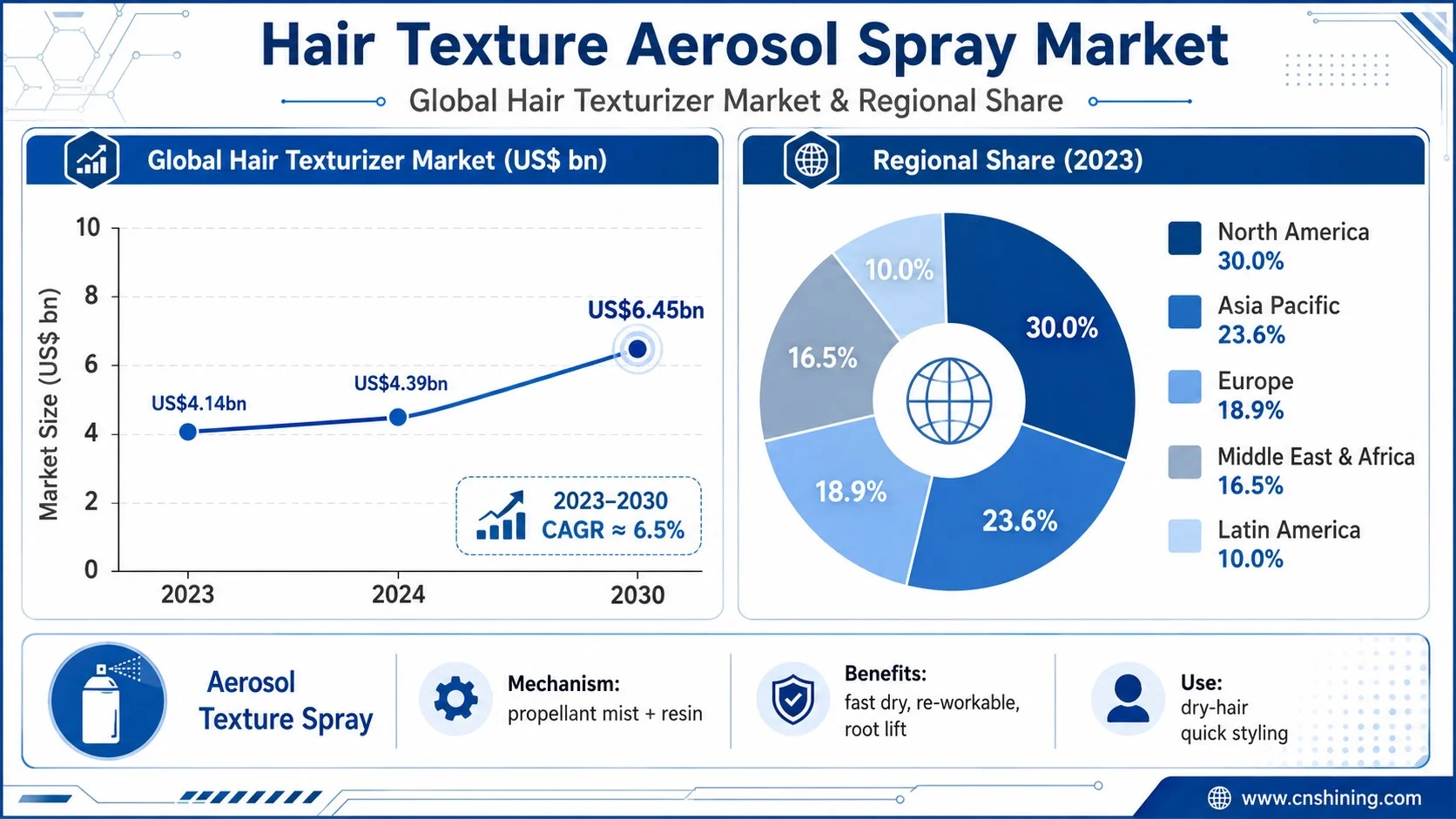
| Region | 2023 Share / Size | 2030 Size | CAGR | Main Drivers | Main Barriers |
|---|---|---|---|---|---|
| North America | About 30%; about US$1.24bn by global share | About US$1.92bn by directional residual estimate | About 6.4% estimated; U.S. about 5.3% | High-performance styling, textured-hair demand, natural and premium packaging preference | Mature market, price sensitivity, stronger VOC and propellant pressure |
| Europe | US$781.1m | US$1,279.7m | 7.3% | Salon channel, sustainability claims, natural-origin positioning | REACH, microplastic limits, packaging and label cost |
| Asia Pacific | US$980.0m; 23.6% share | US$1,423.6m | 5.5% | Online beauty, social media styling, young consumers, India and other growth markets | Price segmentation, mixed national rules, hot and humid climates |
| Latin America | US$416.0m; 10.0% share | US$650.5m | 6.6% | Brazil, strong styling culture, more online beauty buying | Currency pressure, import cost, channel authenticity issues |
| Middle East & Africa | US$684.9m; 16.5% share | US$1,181.0m | 8.1% | Textured-hair demand, cultural styling needs, early expansion stage | Dangerous goods logistics, extreme climate, import dependence |
Category Position
| Category | Main Mechanism | Strength | Weakness | Best Use Case |
|---|---|---|---|---|
| Aerosol texture spray | Propellant mist + resin + powder / oil-absorbing particles | Fast volume, fast dry, re-workable, photo-friendly, good for second-day hair | Inhalation feel, scent, residue and dose-control risk; dangerous goods logistics | Dry-hair quick styling, root lift, separation, shoots and fast routines |
| Non-aerosol texture spray | Pump spray with larger wet droplets; polymer, sugar, protein or salt | Lower inhalation concern, more targeted placement | Wetter, slower dry, higher risk of collapse or product feel | Sectioned use, damp-hair prep, fragrance-sensitive users |
| Sea salt spray | Salt crystallization with minor resin or humectant | Clear beach-wave identity and low education cost | Can feel dry or hard, not friendly to fragile or color-treated hair | Light waves, beach texture, air-drying |
| Dry shampoo | Starch or zeolite oil absorption; volume as side effect | Fast oil control and second-day refresh | White residue and grey cast are more common | Oily roots and emergency refresh |
| Wax / paste | Semi-solid wax, oil and polymer coating | Strong separation and control | Heavy, oily, poor fit for fine hair, less airy appearance | Short hair, fringe control, local strand definition |
5. Top 10 Hair Texture Aerosol Spray Brands
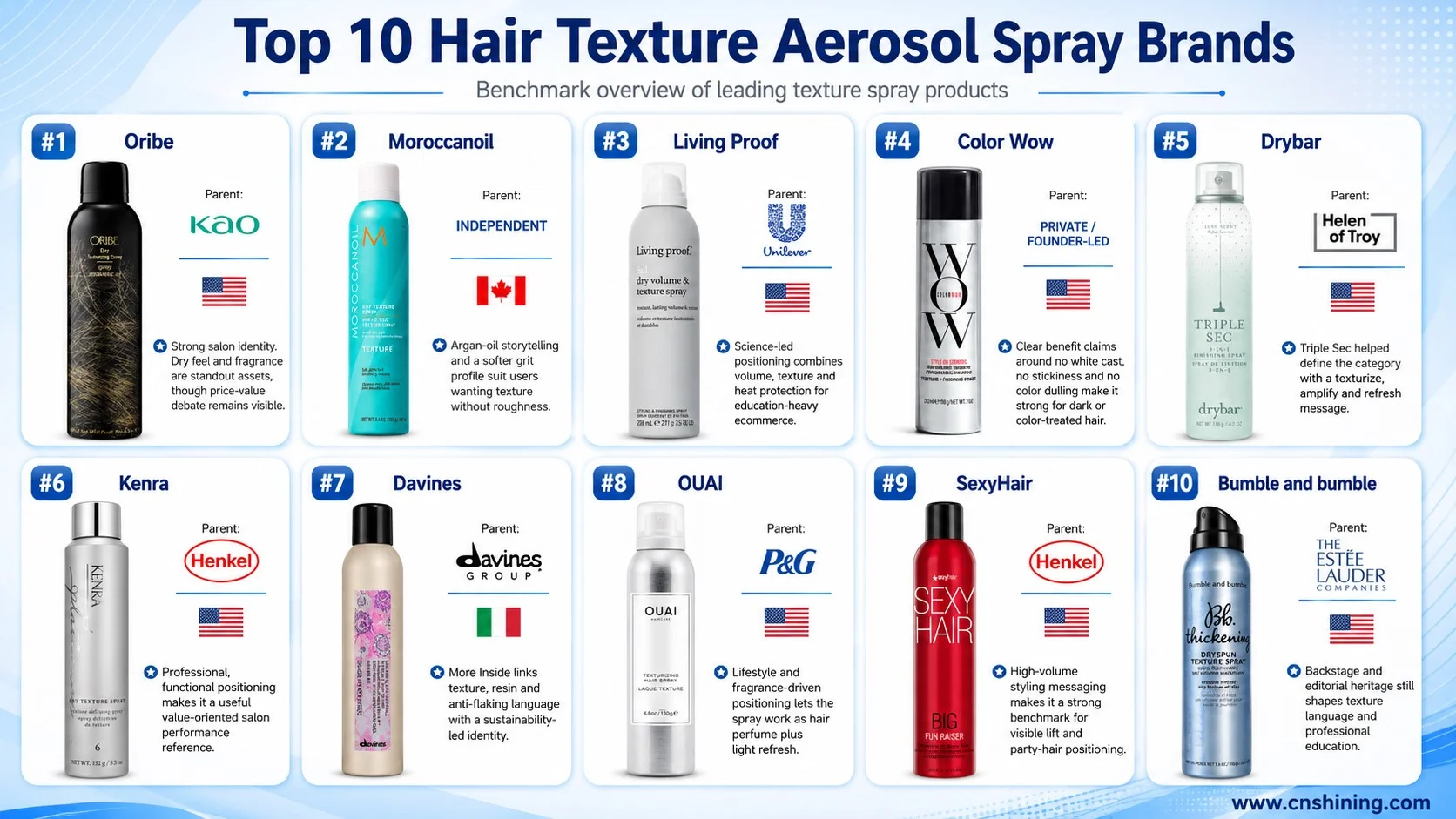
| Brand | Origin | Parent / Ownership | Common Size | Retail Range | Technical Comment |
|---|---|---|---|---|---|
| Oribe | United States | Kao | 79 mL / 300 mL | about $49-52 standard size | Strong salon identity. Dry spray feel and fragrance are core assets, but price-value debate is visible. |
| Moroccanoil | Canada / North America | Independent operating brand | 60 mL / 205 mL | about $15-32 | Uses argan-oil narrative with a softer grit profile for users who want texture without roughness. |
| Living Proof | United States | Unilever | 95 / 238 / 335 mL | about $34-36 standard size | Science-led language, volume plus texture plus heat protection. Strong fit for education-heavy ecommerce. |
| Color Wow | United States | Founder-led / private ownership history | 1.5 oz / 7 oz | about $15-32 | Clear claim structure around no white cast, no stickiness and no color dulling. Strong for dark and color-treated hair. |
| Drybar | United States | Helen of Troy | 47 g / 118 g | about $22-31 | Triple Sec built a category template around texturize, amplify and refresh. |
| Kenra | United States | Henkel | 5.3 oz | about $20-25 | Professional and functional positioning. Useful reference for value-oriented salon performance. |
| Davines | Italy | Davines Group | 250 mL | about $25-37 | More Inside line links texture, resin and anti-flaking language with sustainability identity. |
| OUAI | United States | Procter & Gamble | 40 g / 130 g | about $31-42 | More lifestyle and fragrance-driven. Texture spray works as hair perfume plus light refresh. |
| SexyHair | United States | Henkel | 6.8 oz / 8.5 oz | about $20-23 | High-volume styling message. Suitable benchmark for visible lift and party-hair positioning. |
| Bumble and bumble | United States | The Estée Lauder Companies | Multiple formats | about $16-53 | Backstage and editorial styling heritage. Still influential in texture language and professional education. |
6. Regulatory, Transport and Compliance Checklist
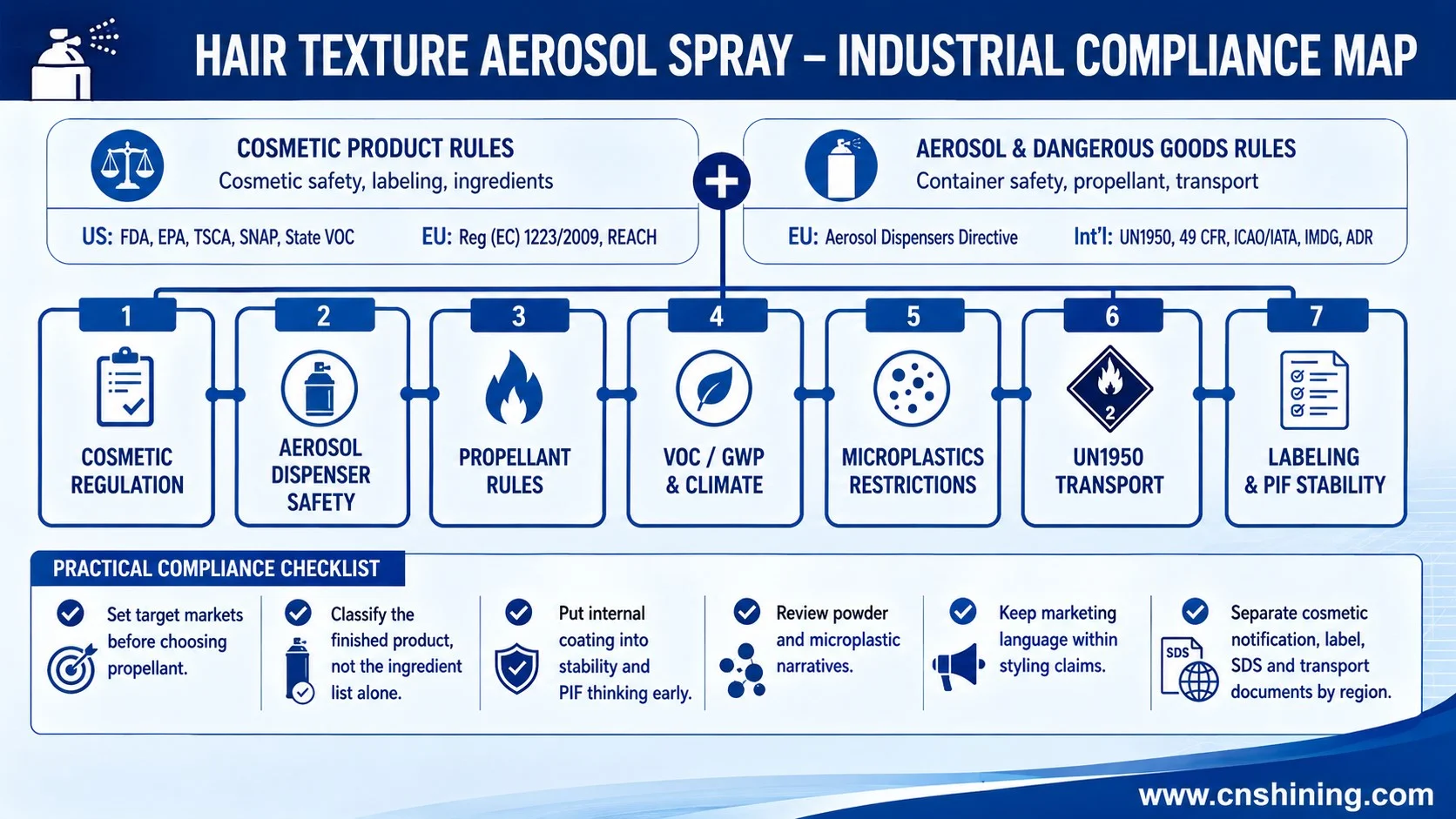
Hair texture aerosol spray sits under two rule sets at the same time: cosmetic product rules and aerosol packaging / dangerous goods rules. In the United States, the FDA cosmetics framework applies to cosmetic safety and labeling. Propellant and chemical management questions may also involve EPA, TSCA, SNAP and state VOC controls.
In the EU, Regulation (EC) No 1223/2009 on cosmetic products, REACH and the Aerosol Dispensers Directive have to be read together. The EU restriction on intentionally added microplastics increases pressure on texture systems that use polymeric particles.
Transport classification is not decided by the word “cosmetic.” It depends on the filled pressure vessel and its hazard profile. The PHMSA interpretation for UN1950 Aerosols shows that aerosol classification can involve different primary and subsidiary hazard combinations. A hair spray commonly follows a flammable aerosol route, but the final decision should come from finished-product testing and the applicable transport code.
| Market / Area | Main Rule or Institution | Effect on Hair Texture Aerosol Spray |
|---|---|---|
| United States | FDA, EPA, TSCA, SNAP, state VOC rules | Cosmetic safety, labeling, prohibited ingredients, propellant substitution and VOC strategy must be aligned. |
| European Union | Cosmetics Regulation 1223/2009, REACH, Aerosol Dispensers Directive | Finished cosmetic compliance, aerosol container safety, labeling and microplastic restrictions all matter. |
| United Kingdom | GB retained cosmetics regulation and SCPN notification system | Responsible Person, PIF, safety assessment and market notification need UK-specific handling. |
| International transport | UN1950 Aerosols, 49 CFR, ICAO/IATA, IMDG, ADR | Finished aerosol pressure, flammability and spray behavior drive shipment classification. |
| Item | Why It Matters |
|---|---|
| Set target markets before choosing propellant. | Propellant affects GWP, VOC, flammability, transport class and label language. |
| Classify the finished product, not the ingredient list alone. | Aerosol pressure and flammability are package-level properties. |
| Put internal coating into stability and PIF thinking early. | DME, alcohol, fragrance oils and extracts can challenge can linings. |
| Review powder and microplastic narratives. | Texture sprays rely on particles, so EU restriction pressure is real. |
| Keep marketing language within styling claims. | A texture spray should not be positioned as a treatment or drug-like product. |
| Separate cosmetic notification, label language, SDS and transport documents by region. | One global document set rarely fits every market without adjustment. |
7. User Complaints Translated into Packaging Engineering
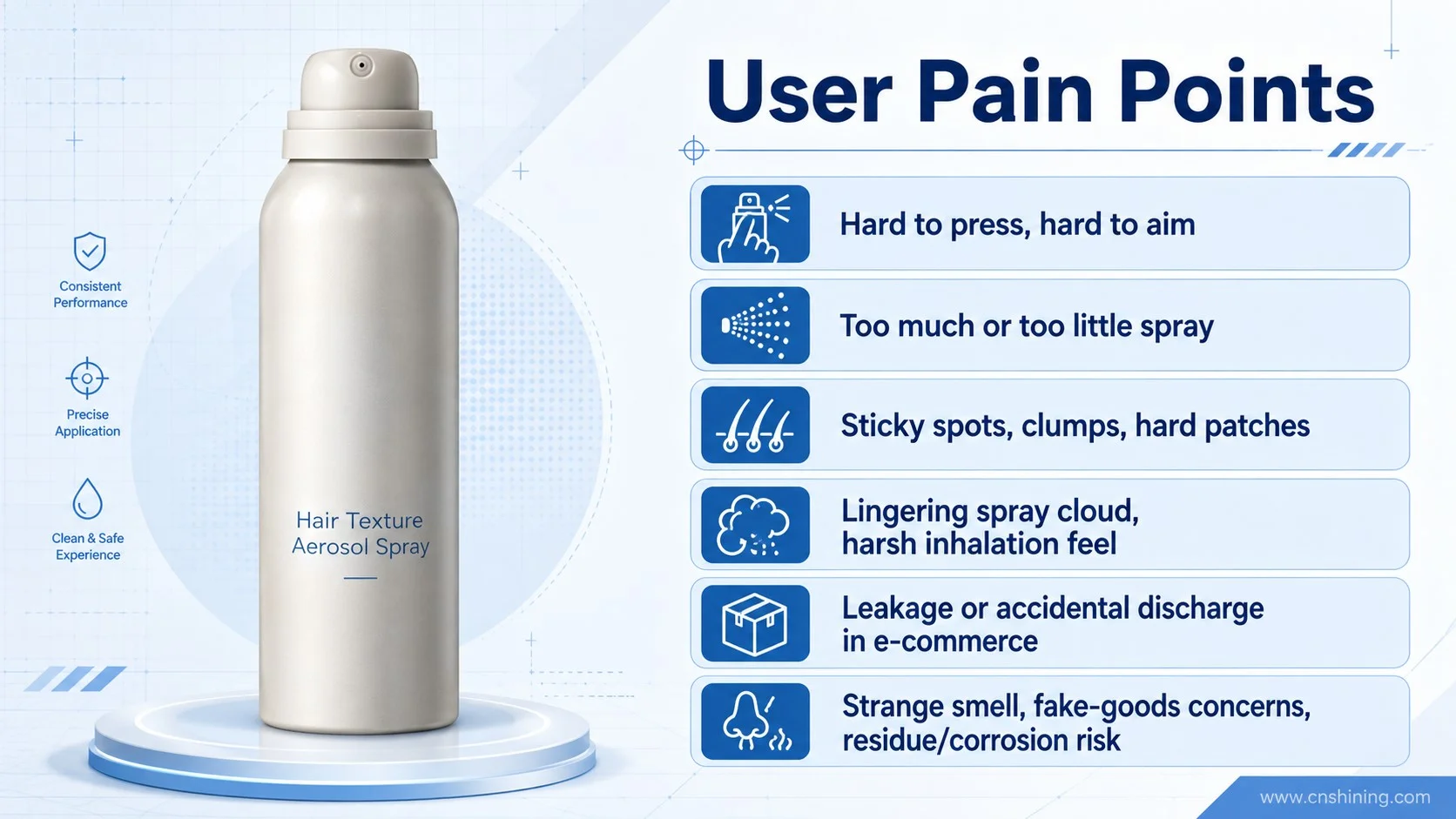
Public reviews cluster around the same problems: sticky feel, oily appearance after several hours, hard-to-press actuators, poor aim, strong scent, gritty residue, spray cloud in the mouth, fast emptying and suspected counterfeit goods. These are not vague consumer moods. They point to measurable packaging and formulation variables.
| User Pain Point | Priority Packaging Area | Actionable Direction | Why It Works |
|---|---|---|---|
| Hard to press, hard to aim | Actuator, shoulder, ergonomics | Use a wider finger pad actuator; consider hoodless or twist-to-lock design; evaluate ogival or ergonomic shoulder shape. | A wider and more stable pressing surface improves directional control and reduces two-hand use. |
| Too much or too little product | Valve spray rate, stem orifice, actuator insert | Develop a low-spray-rate micromist version and split daily use from high-volume SKU by discharge rate. | Spray rate and particle size are mechanical outputs, not only formula outputs. |
| Local stickiness, hard patches, clumps | Valve, insert, resin and powder balance | Use powder-compatible actuator geometry and tune wetting. Do not simply reduce resin if deposition is uneven. | Uniform mist and fast flash-off reduce local over-application. |
| Heavy inhalation feel or lingering spray cloud | Valve type, spray direction, packaging system | For premium lines, evaluate Bag-on-Valve and compressed air or nitrogen; add 360-degree sprayability for root and back-head use. | More controlled direction reduces face-level cloud exposure during real use. |
| Leakage or accidental discharge in ecommerce | Actuator and cap | Use twist-to-lock or hidden-orifice logic; separate ecommerce SKU from shelf SKU if needed. | Shipping loads differ from shelf handling. Locking logic reduces nuisance discharge. |
| Suspicious smell or possible fake goods | Printing, coding, tamper evidence | Add visible batch code, serialization, QR verification and tamper-evident band for risky channels. | Packaging can reduce authenticity anxiety and improve complaint tracing. |
| Long-term residue, off-note, corrosion risk | Internal coating and valve material compatibility | Match lining to DME, alcohol, fragrance oil and extract profile; run 50°C accelerated storage plus corrosion and extraction checks. | Compatibility is a filled-product question, not a generic can question. |
8. Product Fit: Shining Packaging Actuators, Cans and Valves
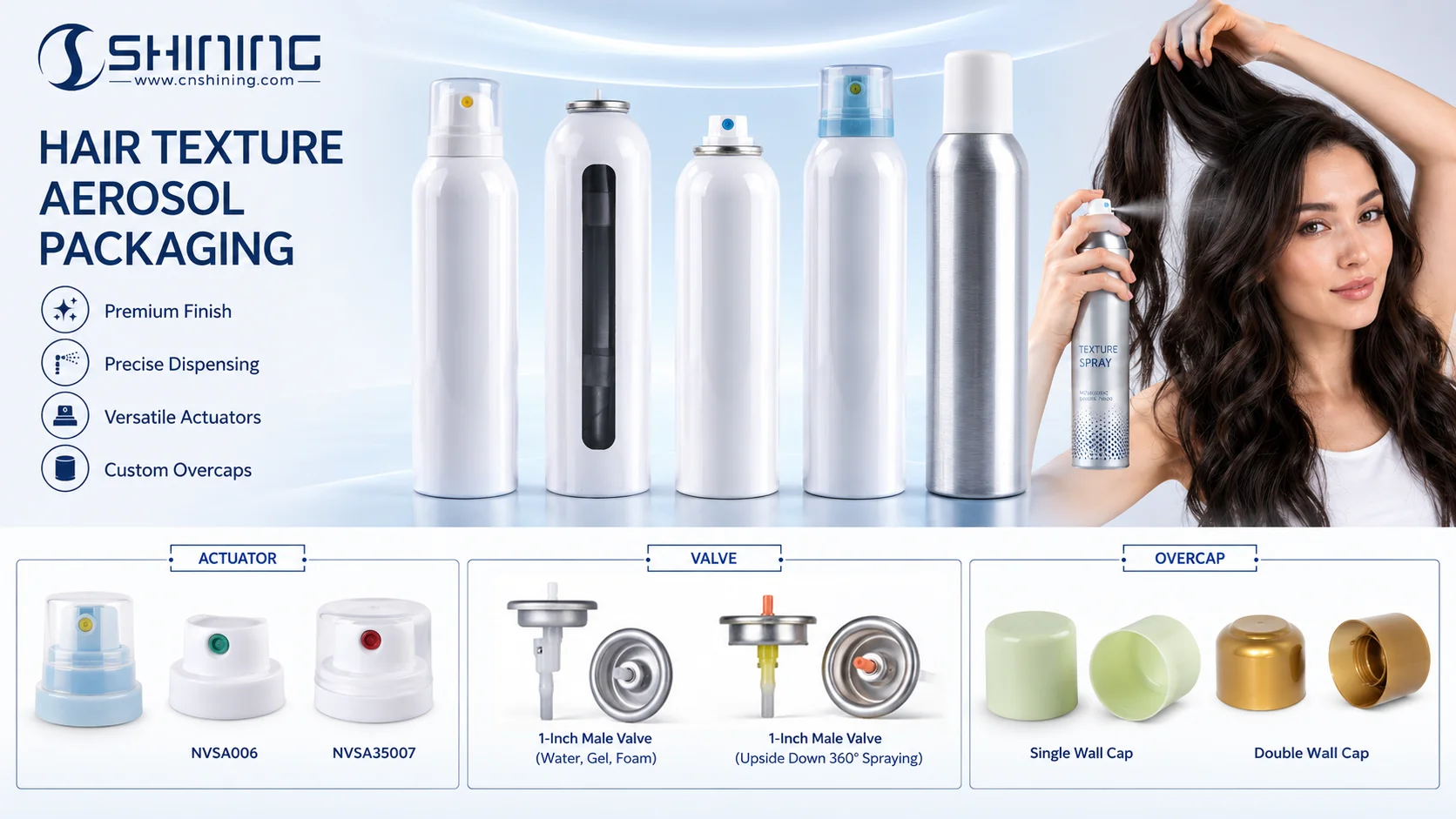
For Shining Packaging, the natural position in this product category is the component interface: actuators, aerosol cans and valves. In hair texture aerosol spray, these parts are not secondary. They decide spray rate, finger load, mist geometry, powder compatibility, leakage resistance, use-angle tolerance and internal coating risk.
A practical development brief for this category should specify the target spray rate, actuator finger feel, orifice insert, spray cone angle, powder loading risk, 360-degree use requirement, valve gasket compatibility, can pressure rating and inner coating. The formula team should not finish the resin and powder system before packaging tests begin. That sequence often causes late-stage clogging, wet patches or unstable spray output.
| Component | Engineering Question | Recommended Check for Texture Spray |
|---|---|---|
| Actuator | Can the user press and aim without over-dosing? | Test wide finger pad, low-spray-rate insert, anti-clog geometry and ecommerce lock option. |
| Valve | Can the valve meter powder-bearing formula evenly? | Check stem orifice, gasket compatibility, spray rate drift, clogging after repeated use and upside-down performance. |
| Aerosol can | Can the can support propellant pressure and lining compatibility? | Validate pressure, shoulder shape, inner lacquer, alcohol/DME resistance, corrosion and long-storage odor stability. |
| Printing and coding | Can the user understand use distance and verify authenticity? | Add 8-10 inch use-distance icon, root/mid-length spray graphic, batch code and QR verification when channel risk is high. |
9. Conclusion
Hair texture aerosol spray will not win by becoming a stronger hairspray. The better direction is dry grip with fewer user mistakes. That means lower visible residue, less tack, controlled fragrance release, stable powder suspension, low-GWP propellant options, compatible internal coatings and an actuator-valve system that meters product predictably.
For packaging teams, the work is clear. Do not treat the actuator, valve and can as final sourcing items. They are part of the formula performance. When spray rate, mist pattern, coating compatibility and user instructions are specified early, the product has a better chance of delivering the texture users expect: volume, separation, matte finish and re-workable hold without the heavy product feel.
10. FAQ: Hair Texture Aerosol Spray
Classic hairspray mainly fixes hair into a defined shape through polymer film formation. Hair texture aerosol spray uses a similar aerosol base but shifts the target toward dry grip, volume, matte finish and re-workable separation. It usually adds powders or oil-absorbing particles, so the user feels lift and texture instead of a hard locked shell.
Stickiness usually comes from local over-application, slow evaporation, high resin concentration, plasticized film behavior or a narrow wet spray pattern. The formula may not be the only cause. A high spray rate, unsuitable actuator insert or poor valve match can place too much liquid on one area before propellant and solvent have flashed off.
Powders such as starch, silica, zeolite, fibers or microspheres increase friction, absorb oil, create spacing between hair fibers and reduce shine by light scattering. They are not just fillers. They are central to the dry grip and thicker-hair illusion. The risk is visible residue, grey cast, dirty touch or valve clogging if loading and dispersion are not controlled.
Propellant controls pressure, spray rate, droplet size, evaporation speed, flammability, logistics classification and carbon profile. DME offers useful solvency and water compatibility. Hydrocarbons and HFC-152a support fast dry spray behavior. HFO-1234ze(E) offers a low-GWP route. Each option changes formula stability, valve compatibility, labeling and transport obligations.
Propellant sprays use internal pressure and rapid expansion through the valve and actuator orifice, so they generally form smaller airborne droplets than pump sprays. Public respiratory exposure data shows propellant hair sprays often around 25-50 μm median aerodynamic diameter, while pump hair sprays are closer to 60-80 μm. Smaller droplets help dry feel but need exposure control.
White residue is a system issue. Formula teams control particle type, refractive index, color and total powder loading. Packaging teams control spray uniformity, discharge rate and droplet distribution. A fine, even mist deposits less material per spot. Clear use-distance icons also help because spraying too close to the scalp concentrates powder and makes residue visible.
The actuator should support controlled finger pressure, stable aim and a mist pattern that avoids local wetting. A wider finger pad can improve use comfort. A low-spray-rate insert helps dosing. Powder-compatible geometry reduces clogging. Twist-to-lock or hidden-orifice designs can reduce leakage and accidental discharge during ecommerce shipping or travel.
Hair texture aerosol spray often contains alcohol, DME, fragrance oils, powders and sometimes botanical components. These can interact with metal can linings, valve springs and gaskets. Early testing should include corrosion, adhesion, extraction, odor shift and accelerated storage. Treating lining choice as a late purchasing item increases the risk of stability failure.
The underestimated point is that the product is both a cosmetic and a pressurized aerosol package. Cosmetic safety, labeling and notification are only one side. The filled can must also satisfy aerosol dispenser safety, flammability classification, transport rules and local VOC or propellant restrictions. Finished-product testing is needed because the hazard profile comes from the complete package.
The next useful direction is not simply stronger hold. It is lower-residue dry grip with lower failure rate. That means powder systems with less grey cast, propellants with better carbon profiles, recyclable metal packaging with suitable linings, and actuator-valve sets that deliver predictable micromist output. User education on spray distance remains part of the technical solution.