
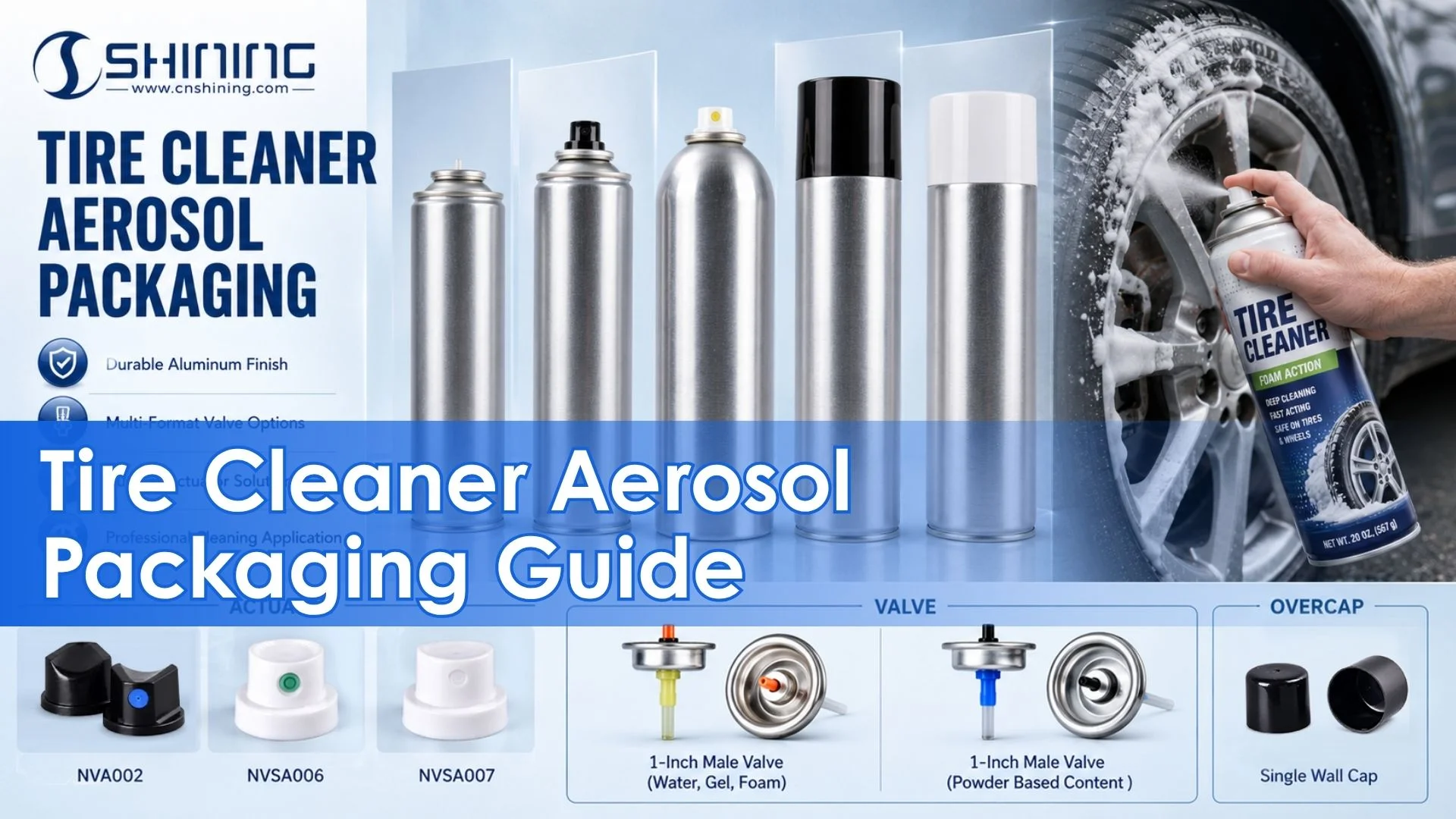
A tire cleaner aerosol is a pressurized delivery system for tire foam, wheel and tire cleaner aerosol, tire sidewall cleaner, or clean-and-shine spray. It is not just cleaning liquid in a can. The product combines a cleaning formulation, propellant, aerosol container, valve, actuator, and internal compatibility design.
1. Definition and Working Principle
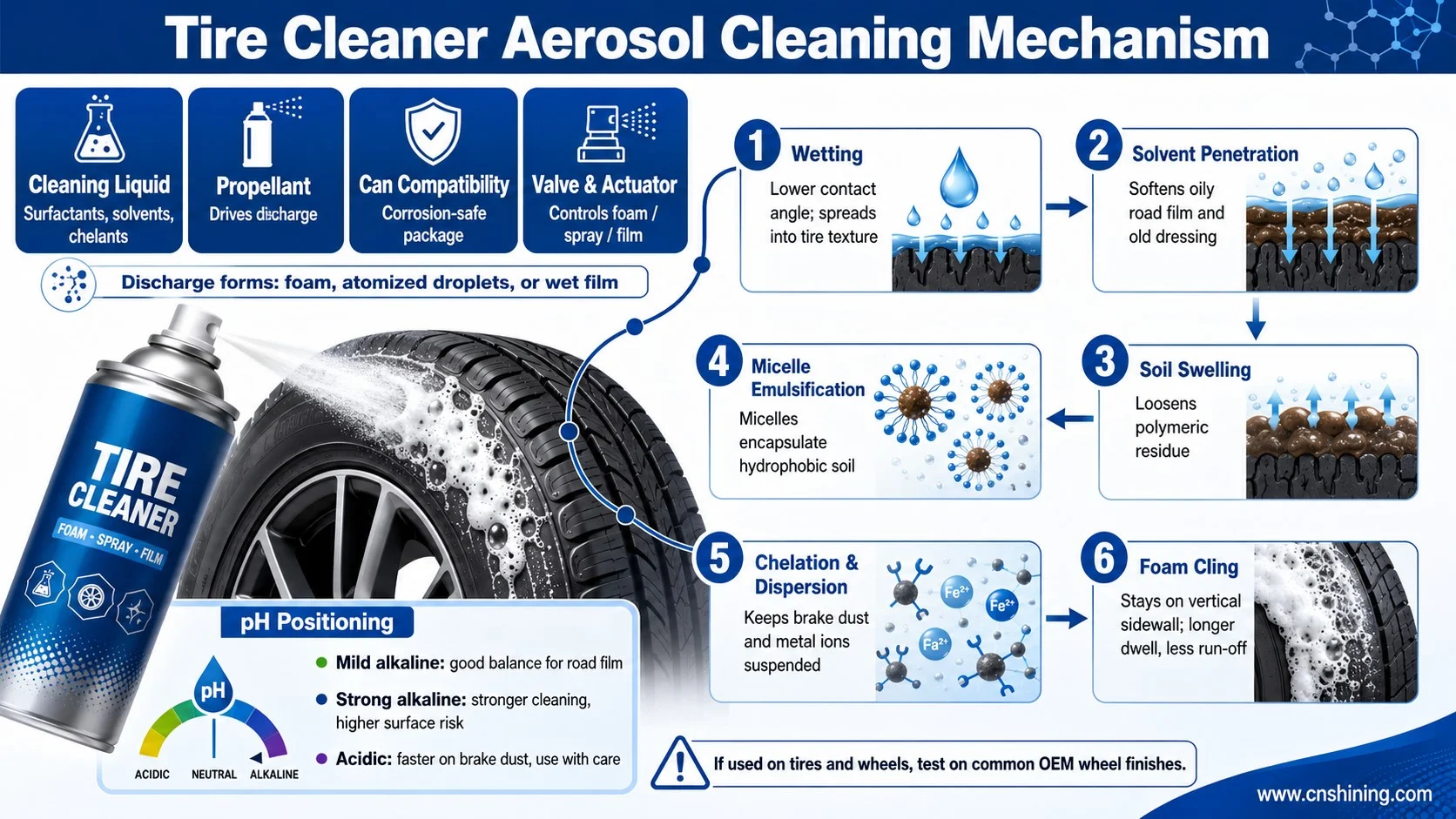
A tire cleaner aerosol has at least four technical blocks: the cleaning liquid, the propellant, the internal can compatibility system, and the valve-actuator system that controls the discharge form. In use, the product may exit as foam, atomized droplets, or a wet film.
The first cleaning step is wetting. Surfactants reduce the contact angle on rubber and allow the liquid to spread into tire texture, sidewall lettering, tread edges, and the soil layer. Next, solvents or co-solvents soften oily road film, old tire dressing, and polymeric residues. Neutral or mildly alkaline systems may use ethanolamines, phosphate esters, dioctyl sulfosuccinate, glycols, or glycol-type co-solvents to balance cleaning power with surface tolerance.
Once the soil is swollen, surfactant micelles encapsulate hydrophobic residue. Chelants and dispersants keep mineral particles, metal ions, and brake dust in the liquid phase. Public wheel and tire cleaner patents describe combinations of nonionic, cationic, and anionic surfactants, EDTA salts, phosphates, pyrophosphates, citrates, and silicates. See one example in wheel and tire cleaner composition patent literature.
User experience is often decided by foam and spray form, not by theoretical cleaning chemistry. Foam-type products stay longer on the vertical tire sidewall, reduce run-off, and give a visible signal that the product is still working. Public foam cleaning patents show water as the dominant phase, surfactant levels around 0.05–10 wt.%, and a foam-boosting solvent. A related example is the foam cleaning composition patent.
pH is commercially important. Mild alkaline products work well on organic soil, road film, and yellowing layers while keeping a safer positioning for factory wheels. Strong alkaline products clean harder but raise risk for aluminum, coatings, plated surfaces, and long-term rubber compatibility. Acidic products work faster on brake dust and mineral residue, but misuse risk increases on bare metal and polished finishes.
2. Market Size and Trends
| Public scope | Base size | Forecast size | CAGR | Comment |
|---|---|---|---|---|
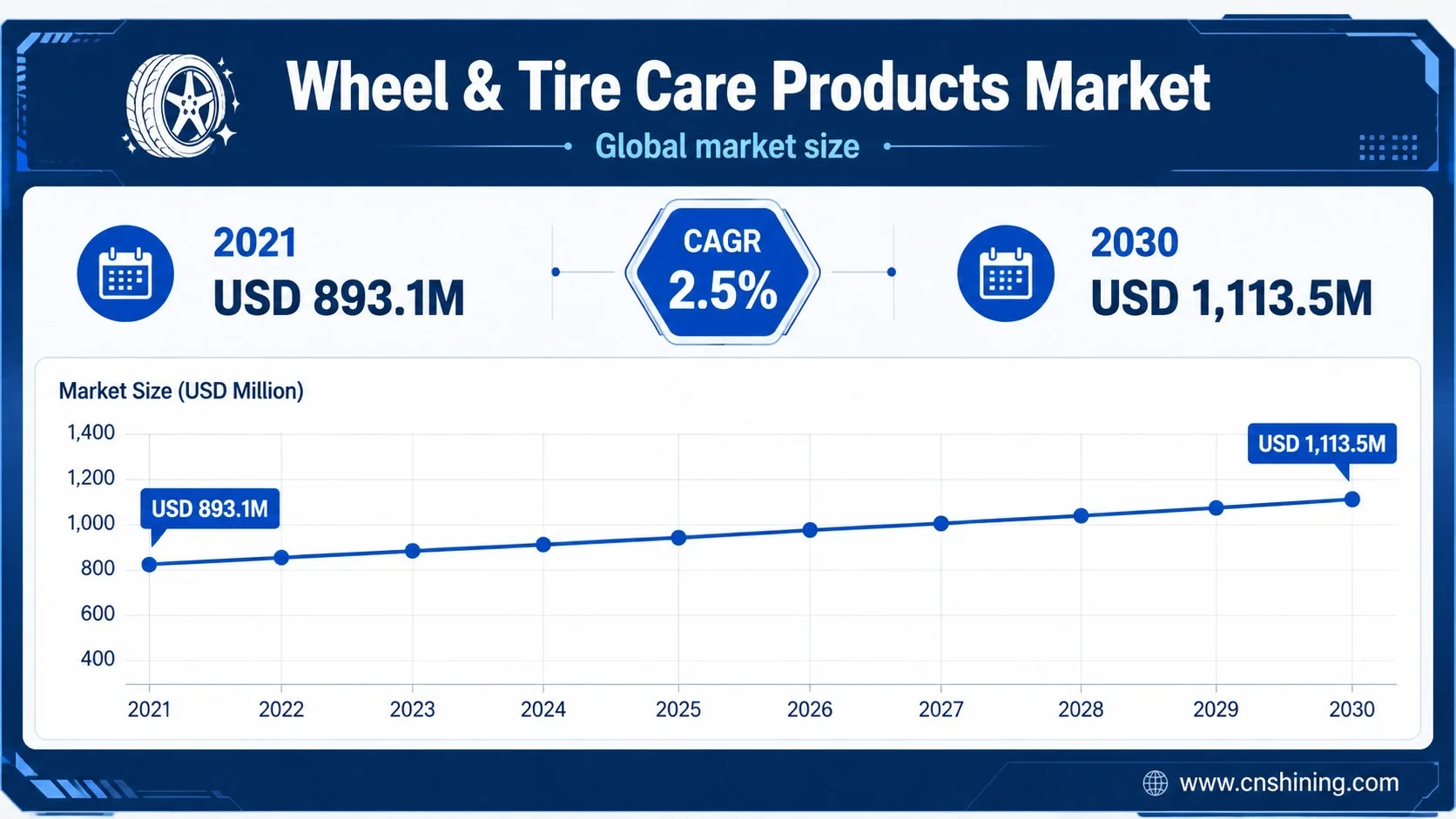
| Global wheel & tire care products | USD 893.1 million in 2021 | USD 1,113.5 million in 2030 | 2.5% | Closest public scope for the tire/wheel care subcategory; based on Grand View Research wheel and tire care data. |
| Global tire & wheel cleaners | USD 2.4456 billion in 2022 | USD 2.9875 billion in 2030 | 2.54% | Wider scope, visibly larger estimate. |
| Global tire & wheel cleaners | USD 1.30 billion in 2023 | USD 2.32 billion in 2033 | 5.96% | Likely includes or excludes different channels and product types. |
| Global tire & wheel cleaners | USD 2.0 billion in 2025 | USD 2.5 billion in 2035 | 2.5% | Not fully comparable with the other two wider scopes. |
Demand drivers are consistent: global vehicle sales remained large, the vehicle parc is aging, and DIY retail still dominates car care. ACEA reported 74.6 million global vehicle sales in 2024. The average U.S. vehicle age reached 12.8 years in 2025, and the EU passenger car average age was around 12.3 years. Older vehicles usually bring more aftermarket cleaning and appearance care demand. See the ACEA full-year 2024 auto industry report.
3. Product Comparison, Formulation Segments and Terms
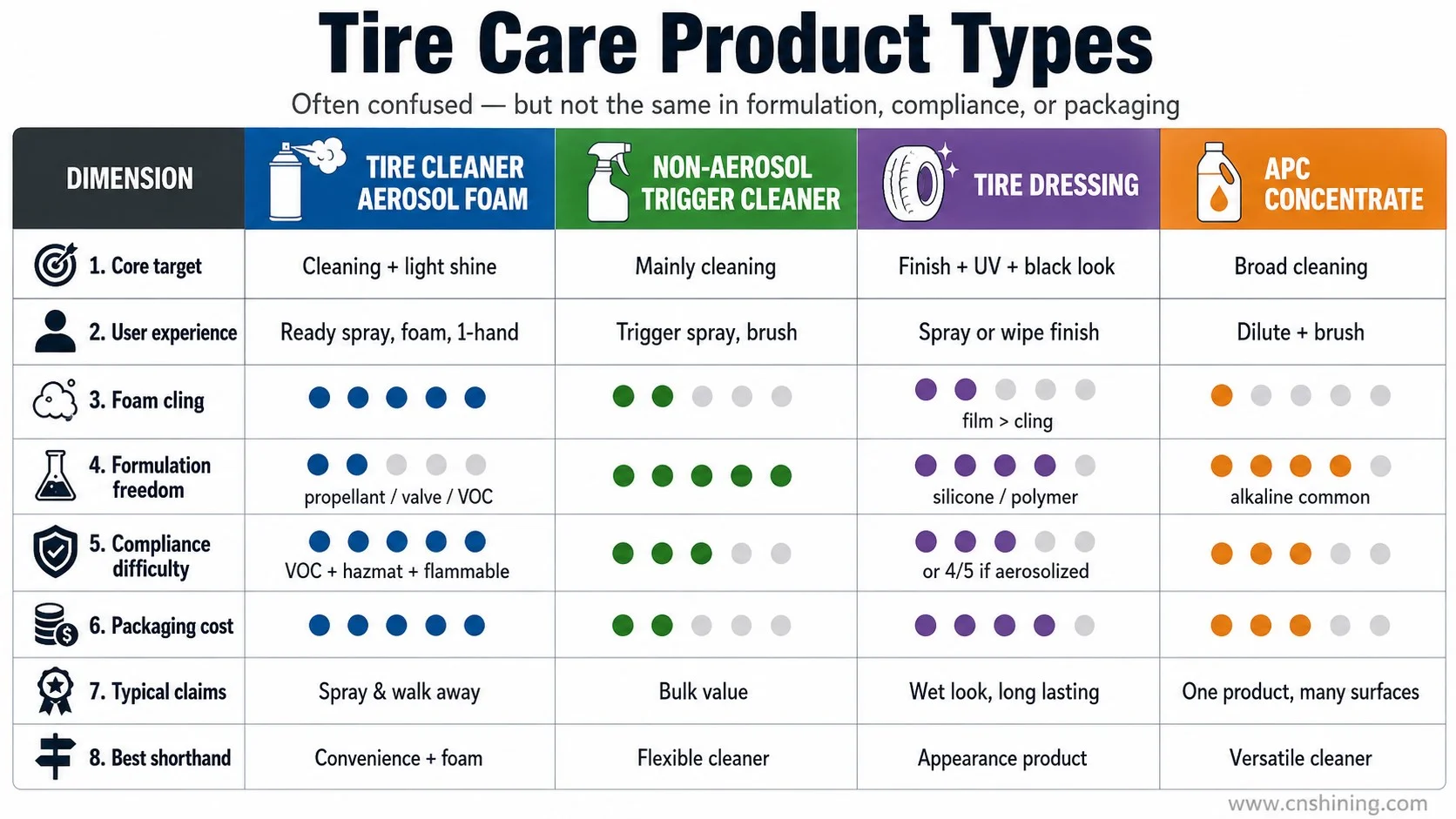
Tire cleaner aerosol is often confused with non-aerosol tire cleaner, tire dressing, and all-purpose cleaner. They may all be used around tires, but they are not the same product from a formulation, compliance, or packaging view.
| Dimension | Tire cleaner aerosol | Non-aerosol tire cleaner | Tire dressing / protectant | APC |
|---|---|---|---|---|
| Core target | Cleaning, sometimes with slight shine/protection | Mainly cleaning | Appearance, black finish, UV protection, feel | Broad cleaning |
| User experience | Ready to spray, foam or mist, one-hand use | Often needs trigger sprayer, brushing, or dilution | Spray or wipe, more like surface finishing | Usually diluted and brushed |
| Surface dwell | Foam type gives stronger cling | Depends on trigger and viscosity | Film formation is more important than cling | Usually limited cling |
| Formulation freedom | Constrained by propellant, valve, VOC, and can stability | Higher freedom | Often higher silicone/polymer content | Alkaline systems are common |
| Compliance difficulty | High: VOC, hazardous transport, flammable labeling | Medium | Medium to high if aerosolized | Medium |
| Unit packaging cost | High | Low | Medium to high | Low to medium |
| Typical claims | Spray and walk away, thick foam, no wipe | Bulk pack, value, professional concentrate | Wet look, long lasting, UV protection | One product for many surfaces |
Aerosol and non-aerosol formats also diverge under VOC rules. CARB’s Tire or Wheel Cleaner limit is 8% VOC for aerosol and 2% VOC for nonaerosol. This is one reason a pump-spray cleaner cannot simply be moved into a can without reworking solvent, propellant, and co-solvent choices. The current CARB regulatory text is available in the California Consumer Products Regulations.
The line between cleaning and shine is becoming less clean in retail. Many SKUs claim to clean, shine, and protect in one can. Tire shine patents may use silicone resins, polymers, tackifiers, and organic solvent routes. One published tire polishing and protective composition describes 2–25 wt.% silicone resin, 0.1–4 wt.% rubber-type polymer, and 0.1–10 wt.% tackifier in organic solvent. See the tire polishing and protective composition patent.
| Type | Typical functional ingredients | Main role | Indicative range |
|---|---|---|---|
| Acidic heavy-duty wheel/tire cleaner | Citric, oxalic, or phosphoric acid; surfactants; corrosion inhibitors; chelants | Faster removal of brake dust, minerals, and metal oxides | Acid 1–10%; surfactant 0.2–5%; chelant/inhibitor 0.1–3%; water 50–90%; propellant 3–15% |
| Neutral or mildly alkaline foam | Dioctyl sulfosuccinate, ethanolamine, phosphate ester, nonionic surfactant, glycols | Balances cleaning and surface safety for most OEM wheels | Surfactant 0.1–5%; amine/phosphate ester 0.1–5%; co-solvent 1–10%; water 60–95%; propellant 3–15% |
| Alkaline APC-style cleaner | NaOH/KOH, silicates, phosphates, surfactants | Stronger removal of organic dirt, road film, and old dressing | Alkali/builders 1–15%; surfactant 0.5–8%; water 50–90%; solvent 0–10% |
| Solvent-based clean-and-shine | Organic solvent, silicone oil/resin, polymers, tackifiers | Cleans while forming black gloss and rain-resistant film | Solvent 20–60%; silicone 2–25%; polymer/tackifier 0.1–10%; propellant 3–15% |
| Foam-enhanced format | Water, surfactants, foam-boosting solvent, propellant | Increases cling time and visible cleaning feedback | Water usually >80%; surfactant 0.05–10%; small foam booster; propellant adjusted to valve system |
| Low-VOC / environment-oriented route | Water, low-VOC co-solvents, biodegradable surfactants, compressed gas or optimized propellant | Meets VOC and internal sustainability targets | Water 70–95%; green surfactant 0.2–5%; low-VOC co-solvent 1–10%; propellant 3–10% |
| Bio-based route | APG, rhamnolipids, cardanol-derived surfactants | Improves biodegradation profile and reduces petrochemical dependence | Bio-based surfactant 0.1–5%; usually blended with conventional surfactants or co-solvents |
| Term | Plain explanation | Commercial meaning |
|---|---|---|
| Aerosol | Pressurized discharge system | Controls VOC, transport, storage, and can cost |
| Propellant | Gas or liquefied gas that drives discharge | Controls spray force, atomization, flammability, and compliance |
| Actuator | Button or spray head | Controls hand feel, spray pattern, and accidental discharge risk |
| Cling foam | Foam that stays on a vertical surface | Directly affects visible cleaning and run-off |
| HLB | Hydrophilic-lipophilic balance | Helps select surfactants and emulsion systems |
| CMC | Critical micelle concentration | Affects detergent efficiency and cost |
| Chelant | Agent that binds metal ions | Useful for brake dust, hard water, and mineral contamination |
| Builder | Alkalinity and cleaning booster | Supports pH, water softening, dispersion, and cleaning |
| LVP-VOC | Low vapor pressure VOC | Often used in low-VOC design spaces |
| Sling | Product thrown off a rotating tire | A common complaint for tire dressing products |
| PFAS-free | No intentionally added PFAS | Increasingly used as a procurement threshold |
| BOV | Bag-on-valve system | Separates formula and propellant, but adds cost |
| UFI | Unique Formula Identifier in the EU | Connected to poison center notification and labeling |
| Hoodless | Actuator without a separate overcap | Can reduce plastic and parts, but needs reliable locking |
4. Regulations and Compliance
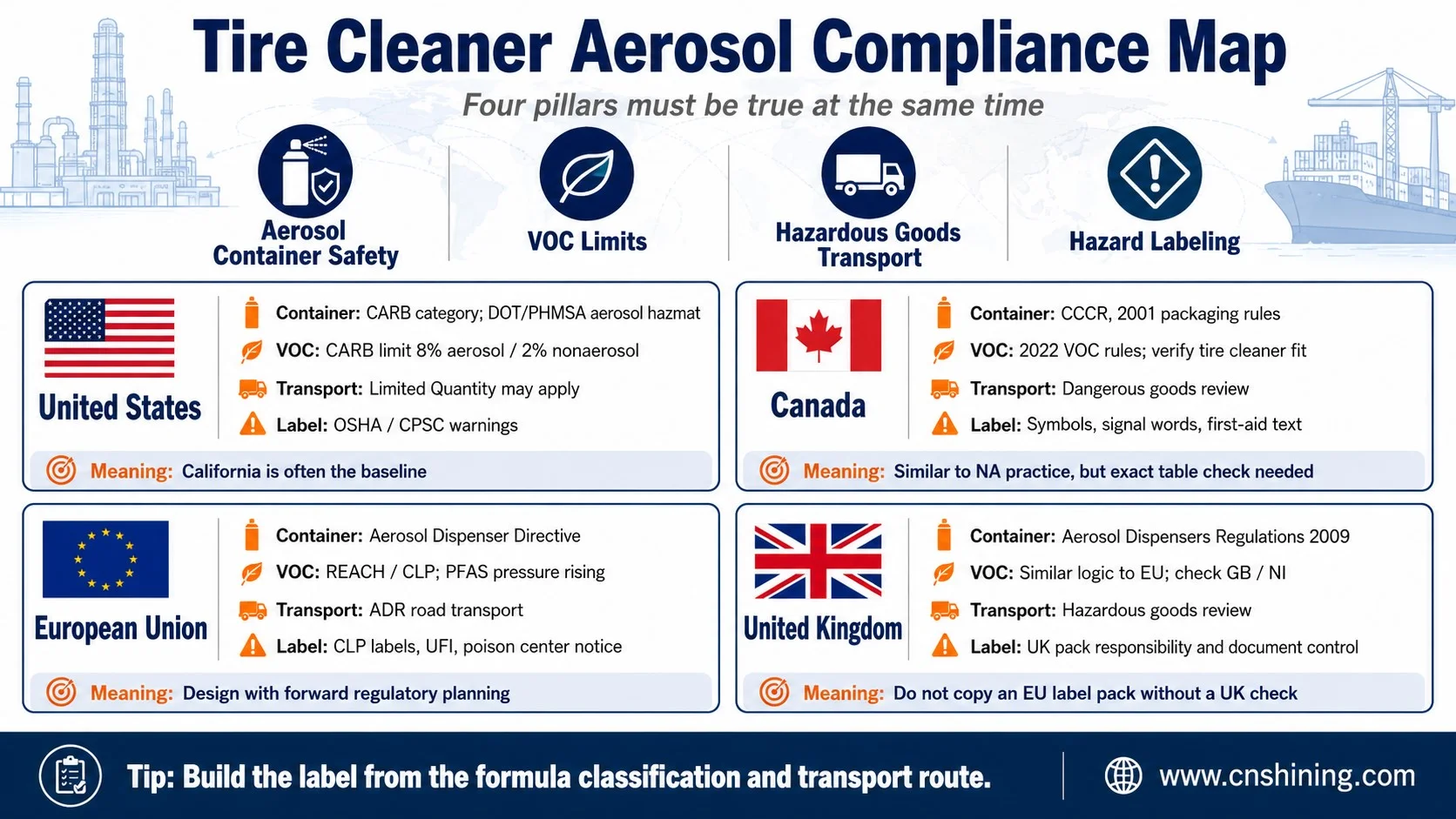
For tire cleaner aerosol, the regulatory problem is not only whether the formula works. Four things must be true at the same time: the can must be a safe aerosol container, the product must meet local VOC rules, the package must be transportable as a hazardous good, and the retail label must use the correct warnings and language.
| Market | Aerosol / container rules | VOC / ingredient focus | Transport and label focus | Direct meaning |
|---|---|---|---|---|
| United States | CARB defines Tire or Wheel Cleaner; DOT/PHMSA treats aerosols as hazardous materials. | CARB VOC limit: aerosol 8%, nonaerosol 2%; EPA restrictions affect methylene chloride, TCE, and PCE. | Limited quantity ground transport may apply; OSHA/CPSC warning language matters. | The U.S. should not be treated as one simple market. California is often the baseline. |
| Canada | CCCR, 2001 covers consumer chemical classification, labeling, and packaging. | 2022 VOC regulations cover many product categories; the source did not confirm a specific tire cleaner sublimit. | Clear hazard symbols, signal words, safety statements, and first-aid language. | Close to North American practice, but the exact table must still be checked. |
| European Union | Aerosol Dispenser Directive controls container safety; CLP/REACH control chemicals and labels. | PFAS restriction work is moving; dangerous substance management keeps tightening. | ADR road transport, CLP labels, UFI, and poison center notification must align. | Design with regulatory forward planning, not only current shelf claims. |
| United Kingdom | Aerosol Dispensers Regulations 2009 remain the key framework. | Similar chemical logic to Europe, with GB/NI route differences. | Placed-on-market responsibility and document control are important. | Do not copy an EU label pack without a UK check. |
| Japan | High Pressure Gas Safety Act controls high-pressure gas and container aspects. | No dedicated tire cleaner aerosol VOC text was confirmed in the source. | Import documents and aerosol pressure/capacity conditions are practical checkpoints. | Start with high-pressure gas and import documentation before retail claims. |
| Mexico | Specific official tire cleaner aerosol VOC rules were not confirmed in the source. | General consumer product labeling paths may apply where no product-specific NOM exists. | Spanish retail label review is a common entry requirement. | Formula is not the only gate; local labeling is also a gate. See a general Mexico product compliance overview. |
| South Africa | Dangerous goods classification follows UN-style pathways. | No dedicated aerosol tire cleaner VOC rule was confirmed in the source. | Dangerous goods labels and transport controls are practical requirements. | Implementation usually follows hazardous goods and chemical import frameworks. See South Africa’s Dangerous Goods Regulations page. |
Ingredient restrictions are moving faster than many legacy formulas. The U.S. EPA has taken risk management action on chlorinated solvents such as methylene chloride, and this direction affects old “strong cleaning” solvent strategies. See EPA’s risk management page for methylene chloride. The EU PFAS process also changes procurement behavior even before every final rule is settled; see the ECHA PFAS restriction progress update.
Labeling is an engineering issue, not a late artwork issue. OSHA guidance explains that hazardous chemical shipments need required label elements, and flammable aerosols need correct hazard language. Health Canada’s CCCR reference material also shows the level of detail expected for consumer chemical packaging. OSHA’s labeling guidance is available as Hazard Communication Standard labels guidance.
5. Technology Development and Brand Landscape
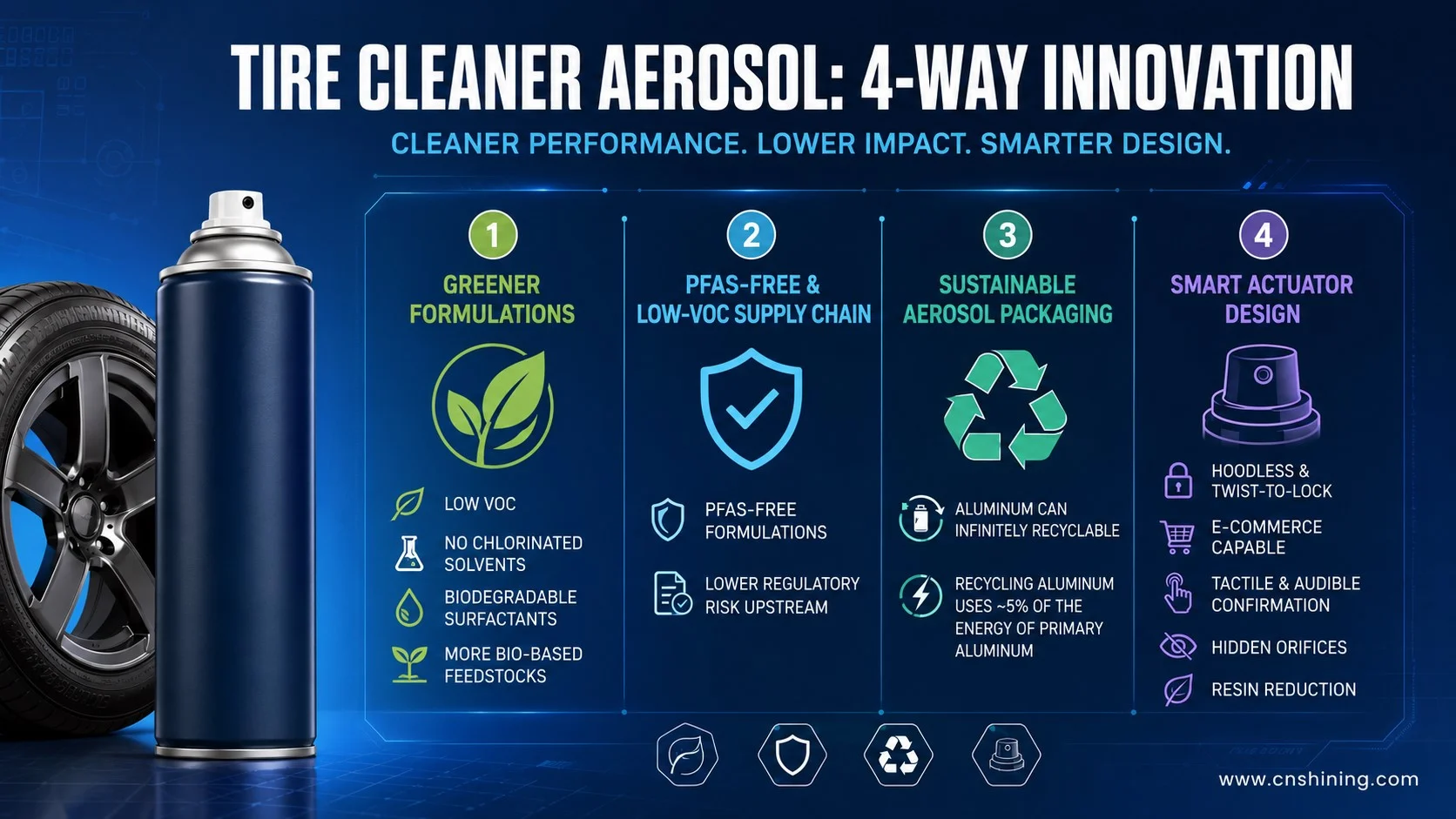
Recent product development is not only about stronger cleaning. Four lines are moving together.
First, formulation is shifting toward lower VOC, no chlorinated solvents, biodegradable surfactants, and more bio-based feedstocks where cost and supply allow it. Green surfactants such as biosurfactants and cardanol-derived surfactants are discussed in public literature for lower toxicity, biodegradation, and renewable raw material potential. See this green surfactants review.
Second, PFAS-free and low-VOC language is moving upstream into procurement. Many tire cleaner formulas may not need PFAS for performance, but supply chains increasingly want lower regulatory risk before final bans force the issue.
Third, aerosol packaging is being pulled into carbon and material reduction work. AEROBAL states that aluminum aerosol cans can be recycled repeatedly without loss of performance and that recycling aluminum needs about 5% of the energy required for primary aluminum. See AEROBAL sustainability information.
Fourth, actuator design is becoming a real performance variable. Hoodless structures, twist-to-lock mechanisms, e-commerce-capable designs, tactile confirmation, audible confirmation, hidden orifices, and resin reduction can reduce leakage and accidental discharge.
6. Top 10 Tire Cleaner Aerosol Brands
| Brand | Country / region | Parent company | Representative public SKU | Common size | Market price range | Technical reading |
|---|---|---|---|---|---|---|
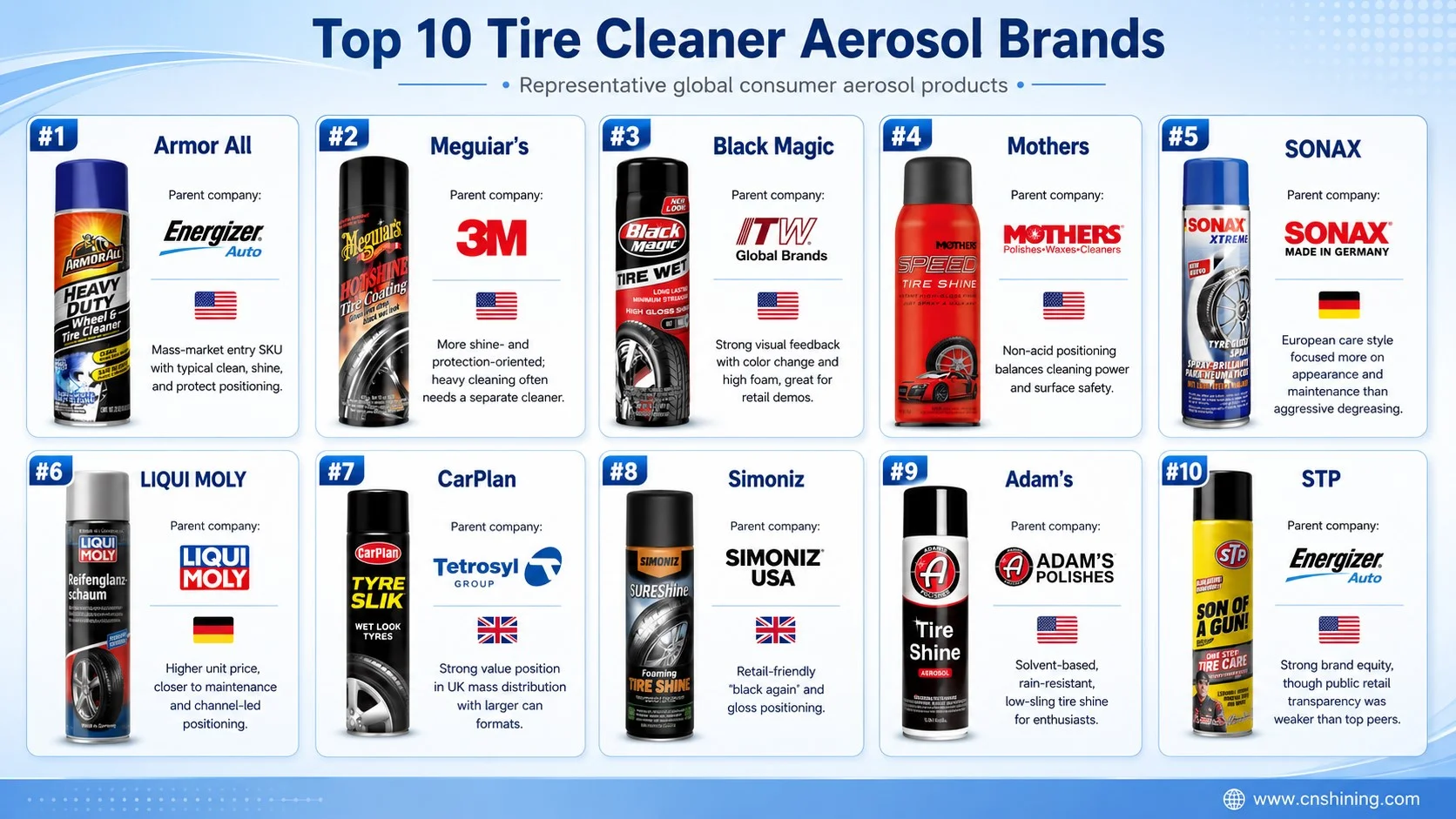
| Armor All | United States | Energizer Auto | Tire Foam Protectant | 20 oz | about $9–$11 per can | Mass-market entry SKU; typical clean, shine, and protect positioning. |
| Meguiar’s | United States | 3M | Hot Shine Tire Foam | 19 oz | about $4–$6 per can | More shine and protection oriented; heavy cleaning often needs a separate cleaner. |
| Black Magic | United States | ITW Global Brands | Intense Foam Wheel & Tire Cleaner | 22 fl oz | about $8–$9 per can | Strong visual feedback with color change and high foam; attractive in retail demonstration. |
| Mothers | United States | Mothers Polish | Foaming Wheel & Tire Cleaner | 24 oz | about $10–$12 per can | Non-acid positioning balances cleaning power and surface safety. |
| SONAX | Germany | SONAX GmbH | XTREME Tyre Gloss Spray Wet Look | 400 ml | about $4–$15 per can | European care style; more appearance and maintenance than aggressive degreasing. |
| LIQUI MOLY | Germany | LIQUI MOLY GmbH | Tire Shine / Tire Bright Foam | 400 ml | about $16–$23 per can | Higher unit price; closer to maintenance and channel-led product positioning. |
| CarPlan | United Kingdom | Tetrosyl Group | Tyre Shine Foam Cleaner | 500 ml | about $9–$11 per can | Strong value position in UK mass distribution and larger can formats. |
| Simoniz | Common in UK retail | Simoniz USA, Inc | Back to Black Tyre & Trim Aerosol | 500 ml | about $6–$11 per can | Retail-friendly “black again” and gloss positioning. |
| Adam’s | United States | Adam’s Polishes | Aerosol Tire Shine | 12 oz | about $10 per can | Clearly described as solvent-based, rain-resistant, low-sling enthusiast product. |
| STP | United States | Energizer Auto | Son Of A Gun One Step Tire Care | 21 oz | about $17 per can | Strong group brand equity, but public retail transparency was weaker than top peers in the source. |
The competitive pattern is clear enough. North American brands often compress clean, shine, and protect into one high-volume retail SKU. European brands more often lean toward safety, controlled appearance, and care language. UK retail is active in 500–600 ml high-value aerosol formats. This explains why the same phrase “tire foam” can mean a mass retail consumable in North America, a care product in Europe, and a channel-volume SKU in the UK.
7. User Pain Points and Packaging Improvements
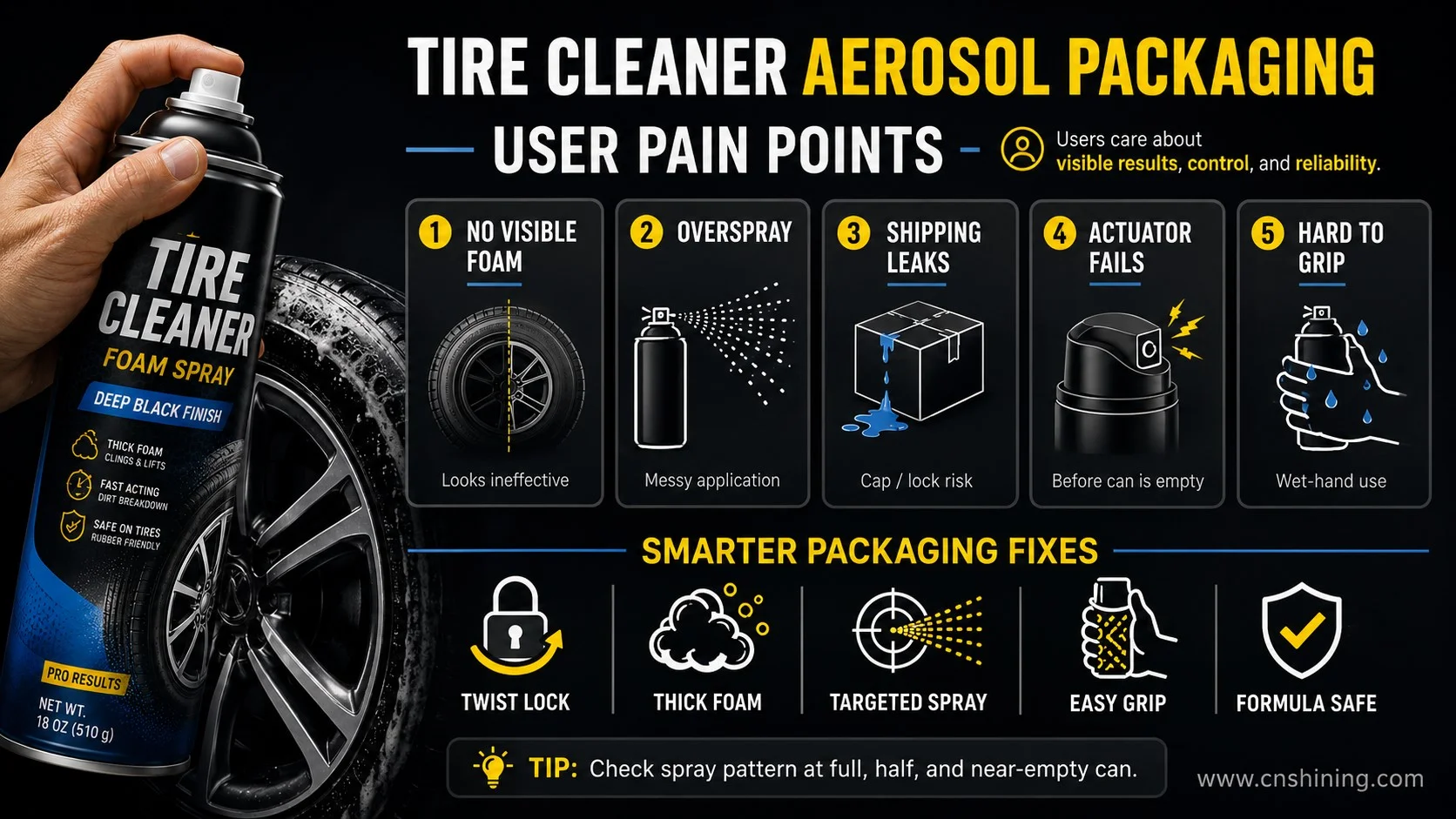
Users do not complain about nonionic surfactant selection. They complain when the product does not visibly work, sprays everywhere, leaks during shipping, or the actuator fails before the can is empty. Public product claims and review summaries point to the same needs: visible foam, less brushing, less wiping, deeper black finish, and predictable spray.
| Source type | Confirmed high-frequency need or complaint | Packaging / engineering implication |
|---|---|---|
| Retail product pages and review summaries | Users want visible effect, less brushing, less rinsing, and uniform deep black appearance. | Actuator and valve must deliver stable foam from early life to near-empty can. |
| Product claim language | Brands repeat safe-on-wheels, spray-and-walk-away, thick foam, and color-changing foam. | Users worry about wheel damage, messy overspray, and whether the product is working. |
| E-commerce transport view | Actuator suppliers now offer e-commerce-capable and lockable designs. | Leakage, accidental discharge, and loose caps are large enough to deserve early design work. |
| Sustainable packaging view | Lower resin, low-carbon aluminum, and hoodless formats are being promoted. | Material reduction must not reduce locking reliability or wet-hand handling. |
The most practical packaging improvements are engineering-based, not cosmetic. First, upgrade from a basic button to a hoodless twist-to-lock actuator with tactile and audible confirmation. This helps e-commerce shipping, storage, and wet-hand use.
Second, design spray patterns for the actual surfaces. Tire sidewalls need broad wet foam coverage. Wheel edges and brake-dust areas may need a more focused pattern. One nozzle geometry rarely gives the best result for both.
Third, make the can usable under dirty, wet, low-angle conditions. Anti-slip grip zones, matte ink areas, embossed locating rings, and large functional icons can reduce misuse. The user is usually working beside a wheel, not at a laboratory bench.
Fourth, validate lining, valve elastomers, stem materials, and gasket materials against each formula route. Acidic cleaner, alkaline cleaner, citrus-terpene solvent, and silicone clean-and-shine systems do not age the same way in the same package.
8. Shining Packaging: Actuators, Aerosol Cans and Valves for Tire Cleaner Aerosol
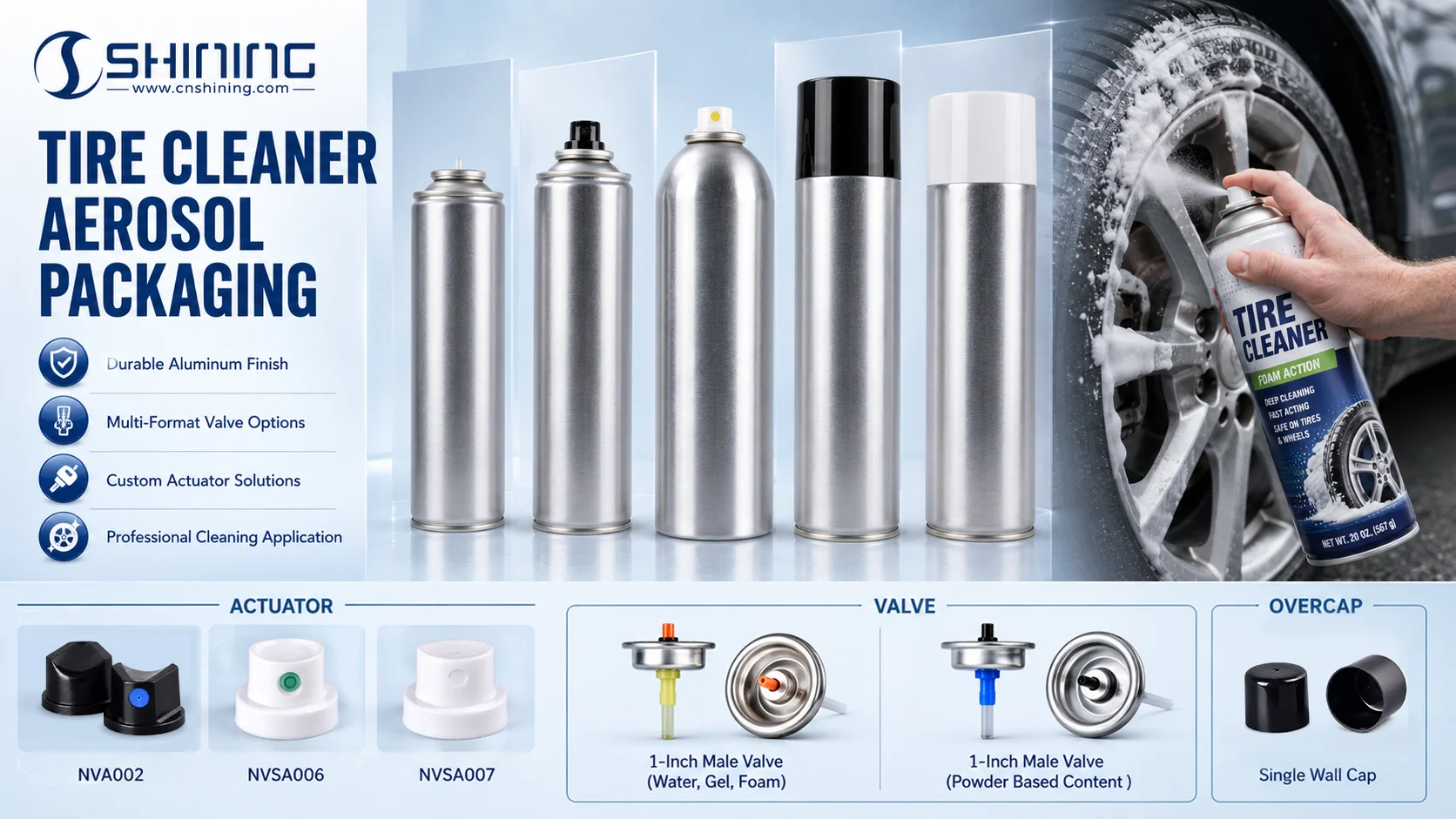
For a tire cleaner aerosol project, the package should be specified around formula behavior, not only around can diameter and fill volume. Shining Packaging’s relevant work sits in three practical component areas: actuators, aerosol cans, and valves. These parts decide whether the product leaves the can as controlled wet foam, fine spray, or a heavy film.
The actuator controls user feel, foam spread, overspray, and accidental discharge risk. A tire cleaner used through e-commerce should not rely on a loose overcap as the only protection. Lockable or hoodless structures are worth evaluating when leakage claims are likely.
The aerosol can and internal coating must be matched to the pH and solvent route. A neutral foam cleaner, strong alkaline cleaner, acidic wheel-heavy cleaner, and silicone-rich clean-and-shine formula may require different compatibility checks. Can corrosion, coating softening, pressure change, and odor pickup should be tested before scale-up.
The valve is not a commodity detail in this category. Stem, gasket, spring, dip tube, and vapor-tap choices affect foam density, spray duration, clogging risk, and discharge consistency. For tire cleaner aerosol, the valve system should be tested with the real propellant and final concentrate, not only with water.
The practical conclusion is simple: specify the aerosol package as a system. Formula, propellant, can lining, valve, and actuator should be validated together before pilot filling.
9. Closing Note
Tire cleaner aerosol is not won by stronger chemistry alone. The product sits at the intersection of surfactant chemistry, VOC rules, hazardous-goods logistics, can and valve compatibility, and actuator usability. The better product is the one that still cleans under low-VOC constraints, ships without leakage, sprays consistently, carries the correct label, and does not make the user fight the package.
10. FAQ: Tire Cleaner Aerosol
A tire cleaner aerosol is a pressurized package that discharges tire or wheel cleaning chemistry as foam, mist, or wet film. It includes the active cleaning liquid, propellant, aerosol can, valve, dip tube, and actuator. The package is part of the product because it controls foam density, spray pattern, storage stability, and transport classification.
Foam improves dwell time on the vertical tire sidewall. Longer contact helps surfactants and solvents soften road film, old dressing, and embedded soil before the liquid runs off. Foam also gives visible feedback. Users can see where the product has landed and whether coverage is uniform, which reduces over-application and missed areas.
No. A tire cleaner aerosol mainly removes soil, road film, and old dressing. A tire shine or dressing focuses on appearance, blackness, gloss, UV resistance, and film durability. Some retail aerosols combine cleaning and shine, but the formulation priorities differ. Cleaners need soil removal; dressings need controlled film formation and low sling.
Aerosol products must consider solvents and propellants together. In California, Tire or Wheel Cleaner has different VOC limits for aerosol and nonaerosol formats. Moving a trigger-spray cleaner into an aerosol can usually requires reformulation. The solvent package, propellant, valve output, foam quality, and long-term can stability must be checked as one system.
Neutral to mildly alkaline systems are common when the product needs to balance cleaning and wheel safety. Public patent material describes neutral alkaline tire and wheel cleaner designs around pH 6.5–9.5. Light alkaline cleaners often work well on organic grime and road film. Strong alkaline or acidic products clean harder but need stricter compatibility checks.
Brake dust and mineral contamination are handled by a combination of acidity, chelation, dispersion, and surfactant action. Chelants bind metal ions and help keep them in solution. Dispersants reduce redeposition. Acidic systems can be faster on inorganic residue, but they raise surface compatibility and misuse concerns on sensitive wheels or exposed metals.
The actuator controls spray feel, foam width, output rate, and accidental discharge risk. Tire cleaner is often used with wet or dirty hands and shipped through e-commerce channels. A weak actuator can leak, clog, misfire, or change pattern across the can’s life. Lockable and hoodless structures can reduce transport and storage problems.
Useful tests include can corrosion, internal coating compatibility, valve gasket swelling, spray pattern stability, foam density, clogging, pressure change, and leakage after vibration or temperature cycling. Testing should use the final concentrate and propellant. Water-only trials rarely reveal the real behavior of solvents, alkalinity, silicone residues, or surfactant foam systems.
Aerosol packaging is now part of compliance, cost, and retail platform evaluation. Aluminum cans can be recycled repeatedly, and recycled aluminum requires far less energy than primary aluminum. Hoodless or reduced-resin actuators can reduce plastic use, but they must still prevent accidental discharge. Material reduction cannot weaken locking, sealing, or user control.
The main risk is treating the product as only a formula project. Tire cleaner aerosol is a packaged chemical system. A strong formula can still fail through VOC non-compliance, valve clogging, can corrosion, unstable foam, leakage in shipping, or unclear labeling. The safer development path is to validate chemistry and packaging together.