
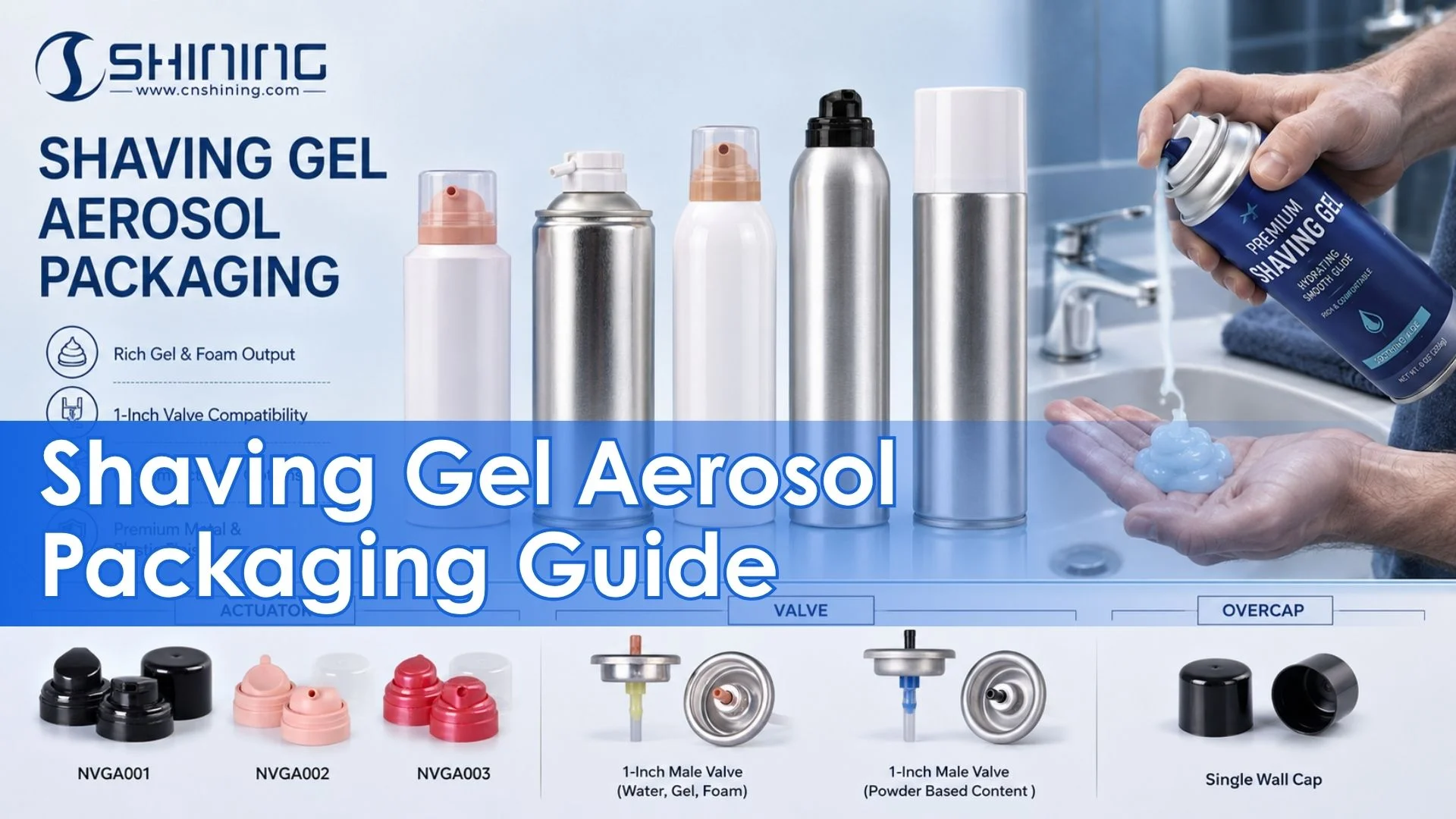
Aerosol shaving gel is a pressurized wet-shaving system, not just a gel packed in a metal can. The product leaves the valve as a gel or high-viscosity emulsion gel, then turns into foam on the skin after spreading or rubbing. This delayed expansion is the reason terms such as post-foaming shave gel, self-foaming shave gel, aerosol shave gel, and gel-to-foam shaving gel appear across patents, retail descriptions, and packaging specifications.
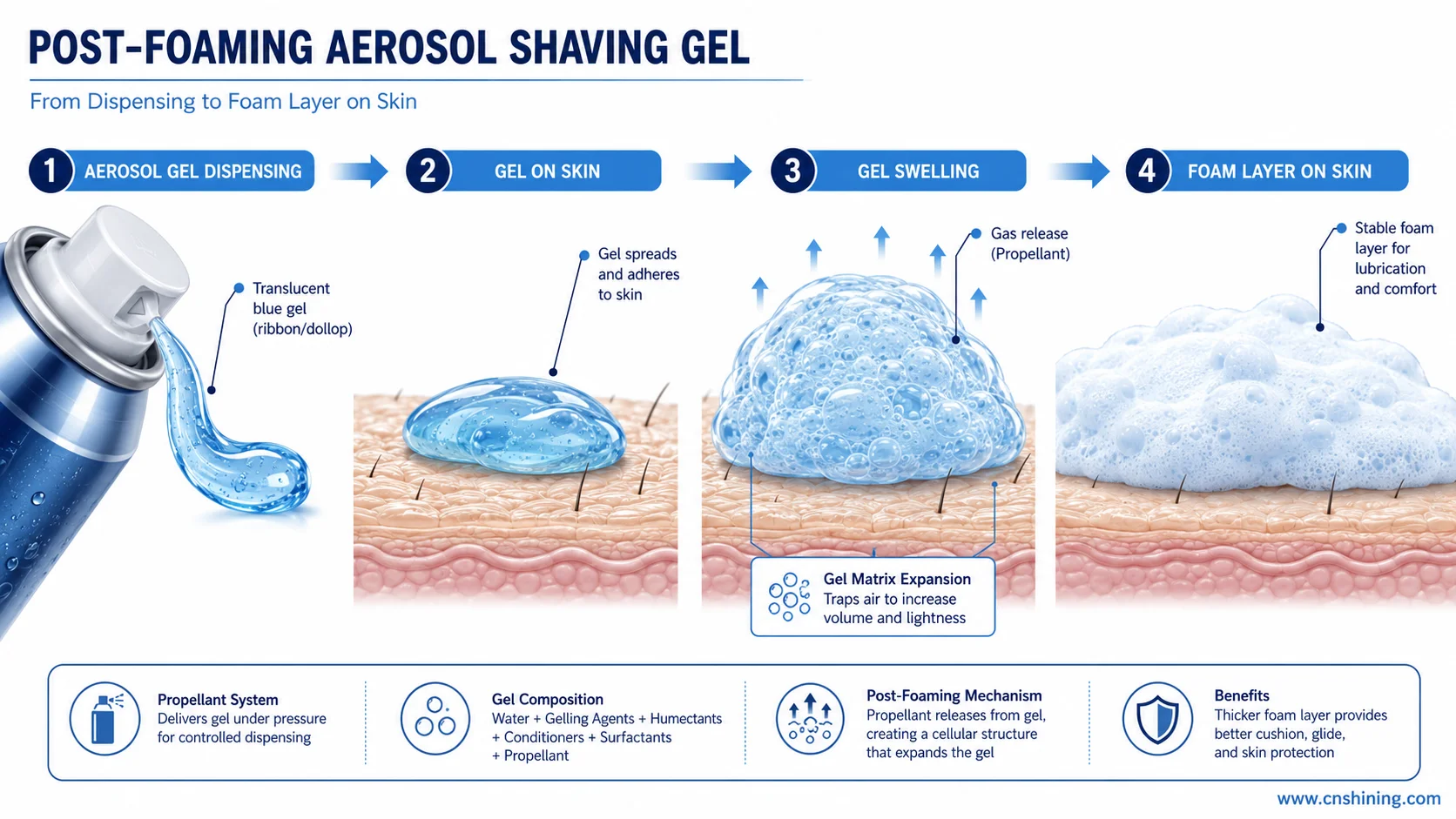
The technical center is simple: pressure release, volatile foaming-agent flash-off, and relaxation of the emulsion-gel network. Inside the can, water phase, fatty acid or surfactant system, oil phase, rheology modifier, and propellant stay in a pressurized balance. Once the actuator is pressed, the valve opens. Pressure drops. Isopentane, isobutane, or related volatile components expand. The gel volume increases and a lubricating foam layer forms on the skin.
The product has clear advantages over shaving cream, ready-made aerosol foam, and brush soap: quick start, better lubrication, higher skin contact, optional transparent or semi-transparent visual control, and room for sensitive-skin upgrades. The weak points are just as clear: nozzle blockage, actuator residue, leakage or empty-can complaints, rust rings in bathrooms, razor clogging from thick gel, and tighter pressure from VOC, microplastic, propellant, and packaging rules.
1. Product Definition and Post-Foaming Mechanism
1.1 How the System Works
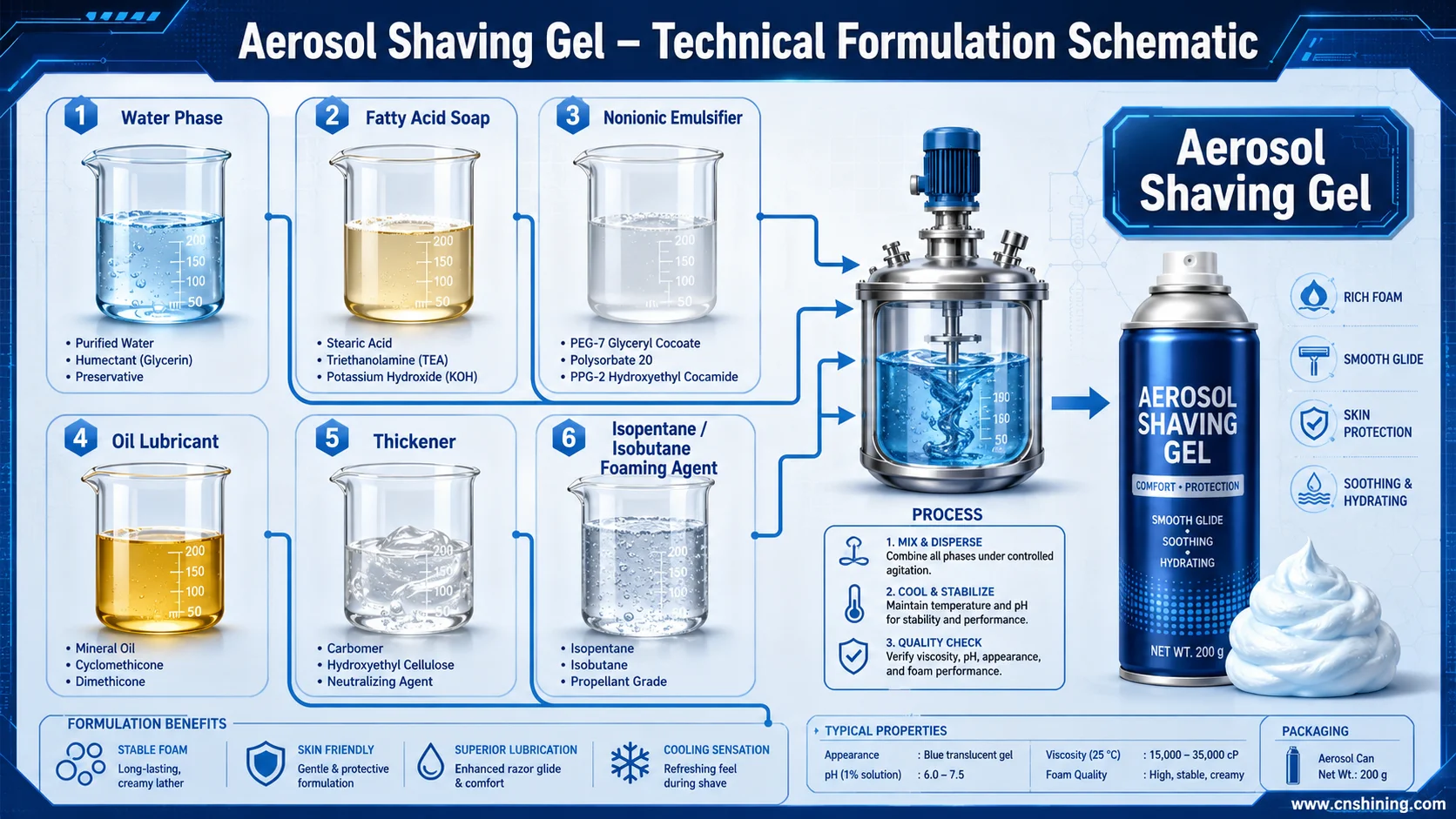
The product is a pressurized multiphase system. The can normally contains four functional groups:
- Continuous phase: mostly water.
- Lubrication and film-forming phase: fatty acid soap, fatty alcohol, nonionic surfactant, mineral oil, silicone, or polyether silicone.
- Rheology control: cellulose gum, hydroxyethylcellulose, carbomer, PEG polymer, or related gel builders.
- Foaming and propulsion: isopentane, isobutane, butane-propane blends, or compressed air/nitrogen in Bag-on-Valve structures.
Inside the can, the formula stays as a microemulsion, emulsion gel, or high-viscoelastic gel. When the actuator is pressed, the valve opens. The product moves from high pressure to atmospheric pressure. Volatile components flash off and expand, pushing the gel into a foam or cream-like layer.
The cleanest way to describe the sequence is:
Pressurized can system: water phase + oil phase + thickener + foaming agent / propellant
→ actuator pressed
→ valve and stem open
→ instant pressure drop
→ volatile component vaporizes
→ gel volume expands
→ user spreads gel on skin
→ delayed foam film forms
→ lubrication, blade cushioning, and beard softening
1.2 A Key Distinction
Not every shaving gel is aerosol. Not every aerosol shaving product is gel. Transparent contour gels are often sold in pump bottles or tubes. Traditional aerosol shaving foam comes out as ready-formed foam. Post-foaming aerosol gel sits between them. It keeps part of the gel feel and lubrication, then builds foam cushioning after spreading. That middle position is its practical value.
2. Comparison with Adjacent Wet-Shaving Products
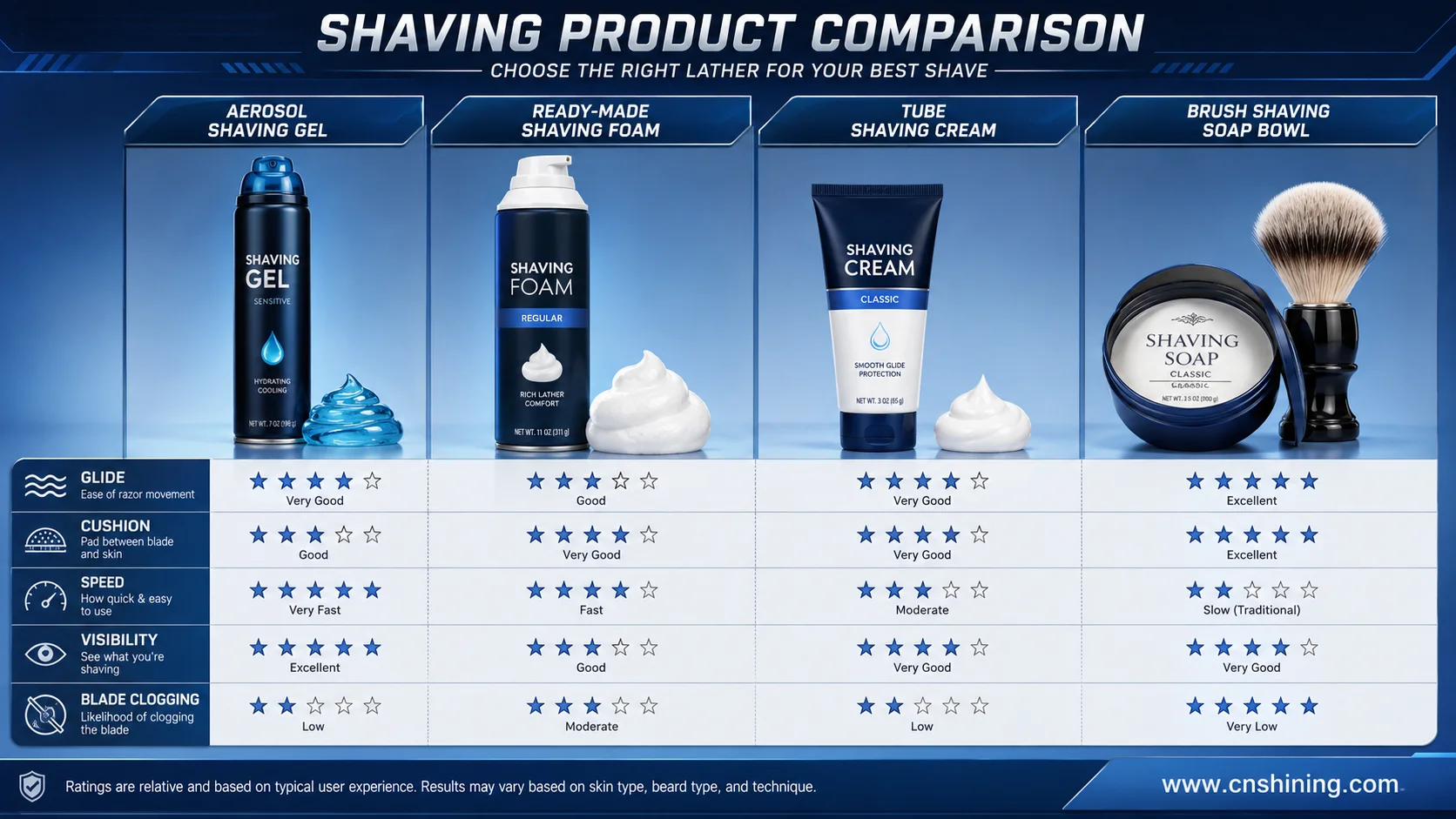
The value of aerosol shaving gel is concentrated. It is faster than brush soap, usually feels thicker and slicker than ready-made aerosol foam, and gives more cushioning than low-foam transparent gel. That is why it fits male facial shaving, female body shaving, and sensitive-area grooming.
| Dimension | Aerosol Shaving Gel | Traditional Shaving Foam | Tube / Jar Shaving Cream | Brush Shaving Soap |
|---|---|---|---|---|
| Dispensed state | Gel, then foam | Ready-formed foam | Semi-solid cream | Solid or soft soap, brush lathered |
| Start speed | Very fast | Fastest | Medium | Slowest |
| Lubrication / thick glide | High | Medium | Medium to high | High, if lathered well |
| Blade cushioning | High | Medium | Medium to high | High |
| Contour visibility | Medium; better in clear types | Low | Low to medium | Low |
| Sensitive-skin upgrade space | High | Medium | High | High, formula dependent |
| Tool dependency | Low | Low | Low | High |
| Razor clogging risk | Medium to high | Low to medium | Medium | Depends on lather quality |
| Packaging issues | Aerosol valve, pressure, rust ring, transport limit | Similar aerosol issues | Lower pressure risk | Lowest packaging pressure risk |
| Best fit | Fast wet shaving, sensitive skin, body shaving, upgraded daily shave | Fastest basic shave | Care feel and cost balance | Traditional wet shaving and blade control |
This table describes average category behavior, not the absolute performance of one SKU. The clear conclusion is that aerosol shaving gel is not the only premium answer. It is a strong compromise between speed, lubrication, cushioning, and care feel.
Consumers do not usually pay for “more foam” by itself. They pay for less razor drag, less irritation, softer after-feel, and a faster shaving rhythm. They complain when the nozzle blocks, the can leaks, the bottom rusts, the gel clogs the razor, or the fragrance and alcohol irritate the skin.
3. Formulation System, Key Ingredients and Technical Terms
3.1 Useful Formulation Classes
The most useful classification is not men’s versus women’s. It is structure and foaming mechanism.
3.2 Soap-Based Post-Foaming Gel
This is the classic route. Fatty acids such as palmitic acid, stearic acid, or myristic acid are neutralized with triethanolamine, aminomethyl propanol, sodium hydroxide, or potassium hydroxide to form a soap system. Isopentane, isobutane, or related materials provide post-foaming expansion. A representative patent range includes fatty acid, liquid paraffin, polysiloxane polyether copolymer, volatile post-foaming agent, and water.
3.3 Nonionic / Soap-Free Post-Foaming Gel
This route aims to reduce soap harshness and drying. A soap-free post-foaming gel may use water, insoluble fatty alcohol, nonionic emulsifier, volatile self-foaming agent, and non-volatile paraffinic hydrocarbon. The patent text for US6916468B2 post-foaming shave gel is useful because it explains the “substantially free of ions” direction and the irritation concern around classic soap systems.
3.4 Transparent / Low-Foam Contour Gel
Clear shave gel is often not aerosol. It matters because it sets user expectations for beard-line visibility and edge control. A transparent gel structure may rely on humectants, carbomer, neutralizer, conditioning polymers, aloe-type systems, and low-foam design. The transparent shaving gel formulation patent is a useful reference for this contour-control direction.
3.5 Sensitive-Skin / Alcohol-Free Care Gel
This is the most active commercial direction. The product claim language usually focuses on fragrance-free, alcohol-free, hypoallergenic, oat, chamomile, aloe, panthenol, allantoin, or vitamin E. The technical task is to lower irritation without losing glide, foam stability, valve compatibility, and can corrosion resistance.
3.6 Functional Ingredients and Typical Ranges
| Ingredient Class | Common Materials | Main Function | Typical Level |
|---|---|---|---|
| Water phase | Water | Continuous phase and solvent | 60–90% in soap-free patent systems; often main phase in other systems |
| Fatty acids | Stearic acid, palmitic acid, myristic acid | Soap formation, foam, cushion | 5–35%; often 8–16% |
| Neutralizer | Triethanolamine, aminomethyl propanol, KOH, NaOH | Neutralizes fatty acid and controls pH | 2–18%; often 4–8% |
| Nonionic emulsifier | Fatty alcohol ethoxylates | Stabilizes oil/water structure and can reduce irritation | 0.2–10%, system dependent |
| Silicone surfactant | Polysiloxane polyether copolymer | Improves foam, spreading, and glide | 0.2–6%; often 1–3% |
| Fatty alcohol | Myristyl alcohol, cetyl alcohol | Structure, viscosity, skin feel | 2–20%; often 3–10% |
| Humectant | Glycerin, sorbitol, propylene glycol | Moisture retention and beard softening | Often 2–12% |
| Oil / lubricant | Liquid paraffin, mineral oil, glyceryl oleate | Blade glide and friction reduction | 1–10% |
| Thickener / gel former | Hydroxyethylcellulose, carbomer, PEG-90M, PEG-23M | Gel stability and rheology control | Often 0.2–3%; some patents allow higher limits |
| Foaming / propellant system | Isopentane, isobutane, butane, propane | Dispensing, post-foaming, expansion | Usually 0.5–10%; older spray-to-gel concepts may run wider |
| Soothing agents | Oat, chamomile, aloe, allantoin, panthenol, vitamin E | Low-irritation and skin-care positioning | 0.1% to several percent; commercial levels often not disclosed |
| Preservative, fragrance, color | Phenoxyethanol, parabens, fragrance, dyes | Microbial control and sensory identity | Regulation and brand-position dependent |
3.7 Representative Formula Routes
Classic soap-based post-foaming aerosol gel: water, palmitic/stearic/myristic acid, triethanolamine, glycerin or sorbitol, light liquid paraffin, hydroxyethylcellulose, isopentane/isobutane, a small amount of silicone polyether surfactant, soothing agent, and preservative.
Soap-free nonionic sensitive-skin system: water around 70–80%, C14–C16 insoluble fatty alcohol, high- and low-EO fatty alcohol ethoxylates, self-foaming agent, non-volatile mineral hydrocarbon, and optional conditioning agent.
Transparent care-gel concept: aloe gel, glycerin, propylene glycol, sodium PCA, panthenol, carbomer, sodium hyaluronate, polyquaternium-10, allantoin, and TEA neutralization. This route is more relevant to visibility and contour control than to classic aerosol post-foaming.
3.8 Technical Terms
| Term | Plain Meaning | Commercial Implication |
|---|---|---|
| Post-foaming | Foaming happens after the gel leaves the can | Combines gel feel with foam cushioning |
| Self-foaming agent | Volatile liquid that expands after pressure release | Controls expansion speed, foam feel, and residue risk |
| Actuator | Press button or dispensing head | Controls hand feel, cleanliness, and clogging risk |
| Valve stem | Flow path from valve to actuator | Affects stable dispensing and actuator fit |
| Side-opening stem | Stem with lateral outlet design | Can reduce premature foaming and nozzle mess |
| Gel-to-foam | Gel becomes foam during use | Easy consumer wording for post-foaming behavior |
| BOV | Bag-on-Valve system | Separates product from compressed gas propellant |
| Continuous valve | Dispenses while pressed | Common fit for shaving gel usage |
| Mounting cup | Valve cup crimped to the can | Important for sealing, pressure resistance, and recyclability |
| Inner coating / lacquer | Protective can lining | Controls corrosion, compatibility, and metal migration risk |
| Clean-dispense actuator | Actuator designed to reduce residue | Directly addresses blocked or dirty nozzle complaints |
4. Regulatory, Standards and Transport Safety
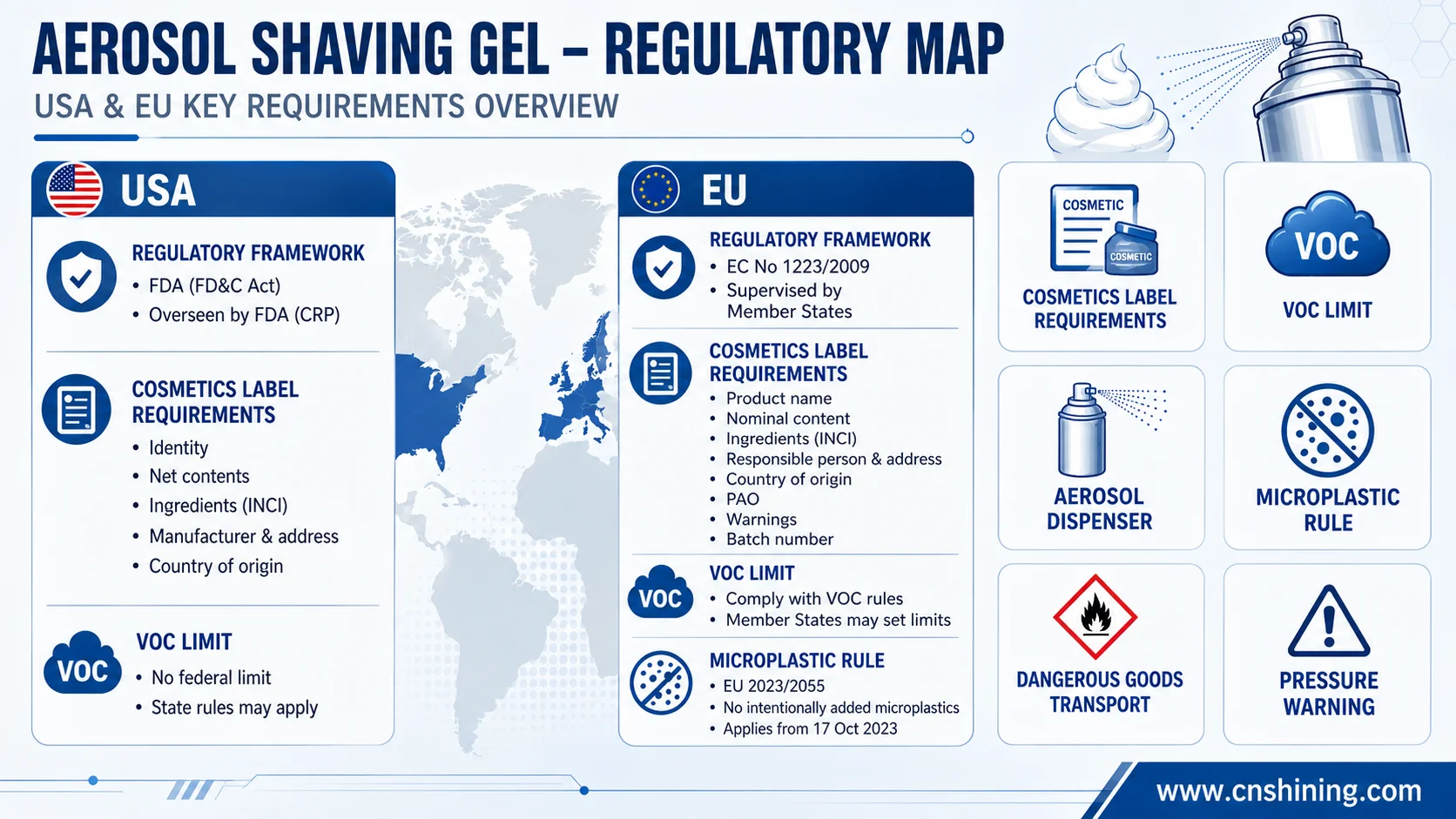
4.1 United States
In the United States, shaving gel is normally handled under the cosmetics framework. Cosmetic labeling is tied to FDA rules, including the FD&C Act and the Fair Packaging and Labeling Act, as described by the FDA cosmetic labeling regulations.
For pressure-container warnings, the self-pressurized nature of aerosol cosmetics also matters. 21 CFR Part 740 covers cosmetic product warning statements, including references relevant to self-pressurized containers.
VOC control is another layer. The 40 CFR Part 59 consumer product VOC table lists a 5 wt% VOC limit for shaving creams. In practice, product developers also need to check state-level rules such as California consumer product regulations when formulating aerosol wet-shaving products.
4.2 European Union
In the EU, the cosmetic product is first governed by Cosmetic Products Regulation (EC) No 1223/2009, covering safety assessment, responsible person, notification, restricted substances, and labeling duties.
Aerosol shaving gel is also a pressure dispenser. It must be considered under the Aerosol Dispensers Directive framework. Environmental compliance has become more demanding. The EU 2023/2055 REACH restriction on synthetic polymer microparticles affects intentionally added microplastic particles and introduces reporting and transition obligations. PPWR also brings aerosol dispensers into the broader packaging and packaging waste framework.
4.3 Transport and Storage
Aerosol shaving gel usually falls into dangerous-goods handling because it is a pressurized container. The IATA Dangerous Goods Regulations define air-transport classification, marking, packaging, and documentation requirements for dangerous goods. Heat exposure is the most basic but often underestimated risk. A container may leak, lose pressure, or fail if storage and transport conditions are poorly controlled.
5. Technology Trends, Top Brands and Packaging Improvements
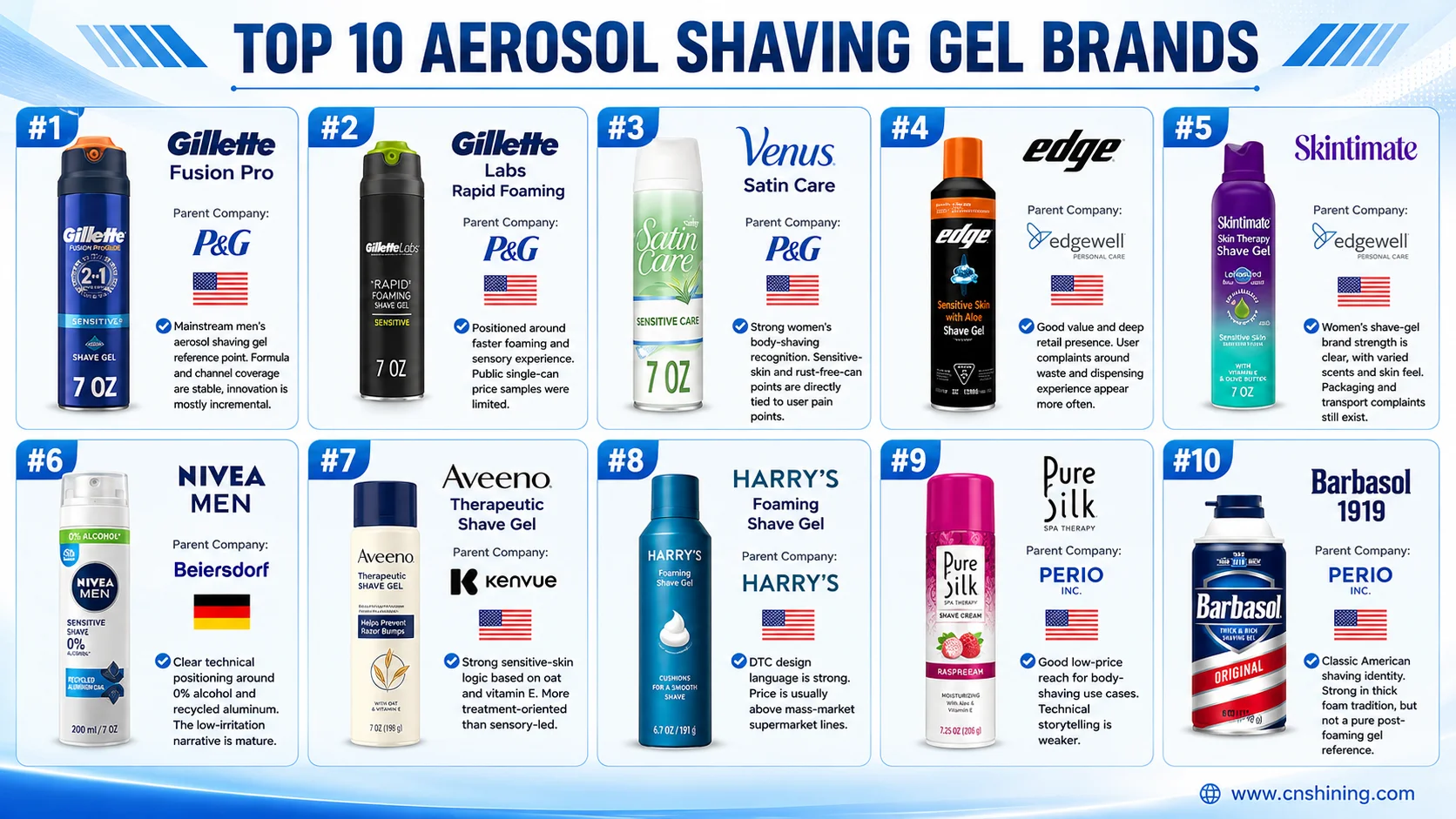
5.1 Top 10 Aerosol Shaving Gel Brands
| Brand | Country | Parent Company | Typical Size | Price Range | Technical Comment |
|---|---|---|---|---|---|
| Gillette Fusion Pro | USA | P&G | 7 oz | about $5.24–$6.99 / can | Mainstream men’s aerosol shaving gel reference point. Formula and channel coverage are stable; innovation is mostly incremental. |
| Gillette Labs Rapid Foaming | USA | P&G | 7 oz | about $6.99–$8.79 / can | Positioned around faster foaming and sensory experience. Public single-can price samples were limited. |
| Venus Satin Care | USA | P&G | 7 oz | about $3.97–$6.97 / can | Strong women’s body-shaving recognition. Sensitive-skin and rust-free-can points are directly tied to user pain points. |
| Edge | USA | Edgewell Personal Care | 7 oz / 9.5 oz | about $3.89–$4.64 / can | Good value and deep retail presence. User complaints around waste and dispensing experience appear more often. |
| Skintimate | USA | Edgewell Personal Care | 7 oz | about $3.25–$3.76 / can | Women’s shave-gel brand strength is clear, with varied scents and skin feel. Packaging and transport complaints still exist. |
| NIVEA MEN | Germany | Beiersdorf | 200 ml / 7 oz | about $4.99–$5.00 / can | Clear technical positioning around 0% alcohol and recycled aluminum. The low-irritation narrative is mature. |
| Aveeno Therapeutic | USA | Kenvue | 7 oz | about $4.47 / can | Strong sensitive-skin logic based on oat and vitamin E. More treatment-oriented than sensory-led. |
| Harry’s Foaming | USA | Harry’s Inc. | 6.7 oz | about $5.74–$6.29 / can | DTC design language is strong. Price is usually above mass-market supermarket lines. |
| Pure Silk | USA | Perio Inc. | 7.25 oz | about $2.27–$6.81 / can | Good low-price reach for body-shaving use cases. Technical storytelling is weaker. |
| Barbasol | USA | Perio Inc. | 6 oz / 10 oz | about $2.47–$2.49 / can | Classic American shaving identity. Strong in thick foam tradition, but not a pure post-foaming gel reference. |
5.2 Observed User Pain Points
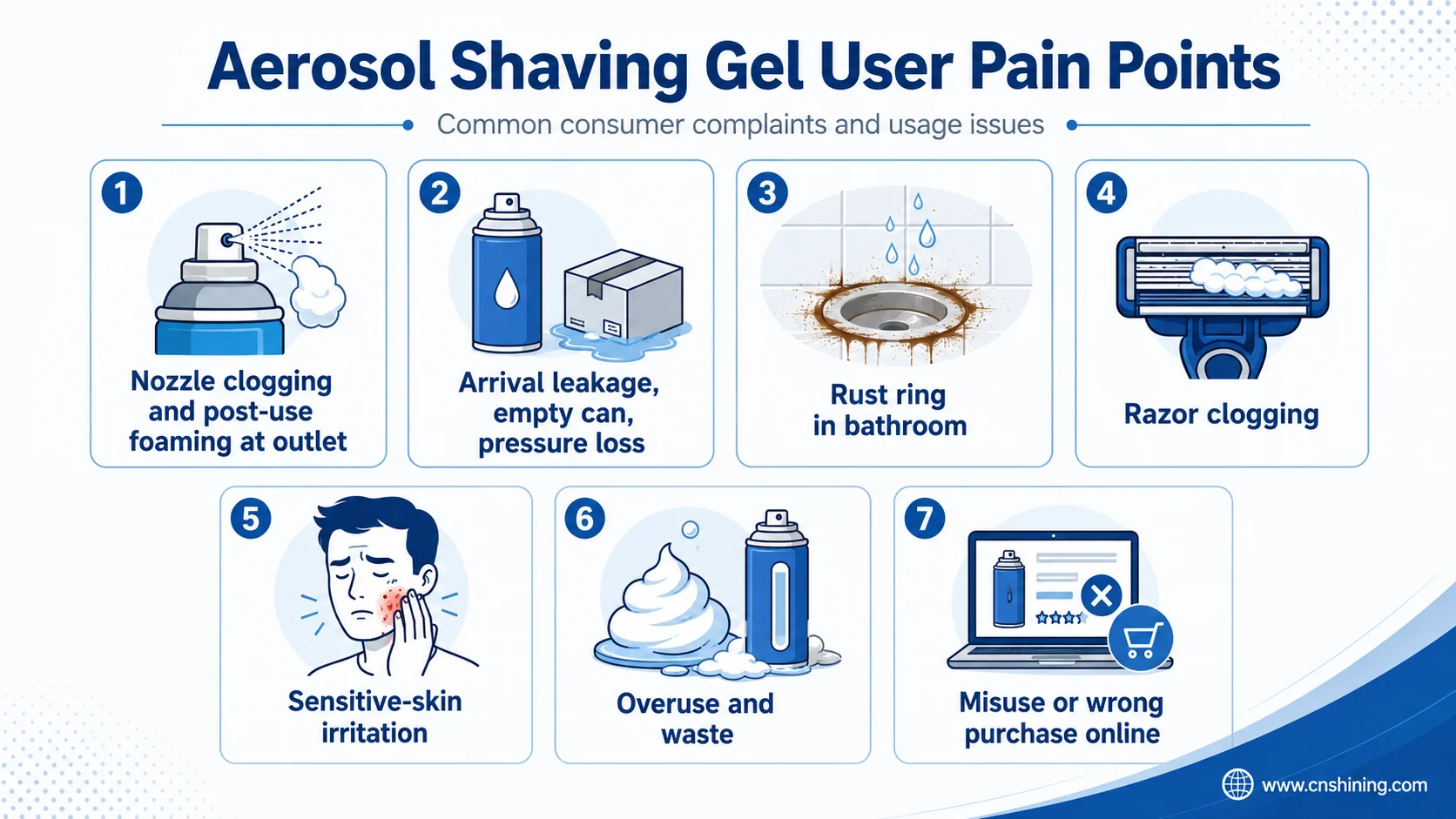
| Short Quoted Signal | Interpreted Pain Point | Evidence Strength |
|---|---|---|
| “It arrived spilled.” | Transport leakage and weak packaging protection | High |
| “doesn’t gum up my razors” | Razor clogging is a known comparison point | Medium |
| “the container was completely empty it was just a can” | Empty can, pressure loss, filling issue, or leakage | High |
| “My bottle was defective” | Valve or container defect | High |
| “use unscented to reduce irritation” | Fragrance irritation and sensitive-area discomfort | Medium |
| “prevents rust stains formed in shower” | Rust-ring problem has become accessory-market visible | Weak to medium |
| “keeps the bottom of the can off of surfaces” | Can-bottom rust ring | Medium |
| “clogged or stuck shaving cream can” | Nozzle clogging, residue, or low pressure | Medium |
5.3 Packaging-Oriented Solutions
| User Pain Point | Likely Packaging Root Cause | Recommended Engineering Response | Business Value |
|---|---|---|---|
| Nozzle clogging and post-use foaming at outlet | Residue in post-valve channel, premature foaming, actuator geometry mismatch | Use post-foaming gel actuator, flexible flow path, side-opening stem, optimized orifice and residue control | Fewer complaints, cleaner use, less waste |
| Arrival leakage, empty can, pressure loss | Valve seal, crimp tolerance, cup seal, poor e-commerce protection | Improve mounting cup and crimp control, run drop and heat-cycle testing, add protective caps or fitted cartons | Lower returns and fewer negative reviews |
| Rust ring in bathroom | Can bottom coating or material not suited to standing water | Use rust-resistant bottom design, bottom ring, waterproof base, or improved external coating | Direct bathroom-use differentiation |
| Razor clogging | Expansion ratio and rheology too heavy; high single-shot discharge | Coordinate actuator flow restriction with gel rheology; aim for controlled ribbon output, not lump discharge | Cleaner shaving and easier rinsing |
| Sensitive-skin irritation | Fragrance, alcohol, high alkalinity, or packaging compatibility issue | Use alcohol-free and fragrance-free lines, review particles under microplastic rules, specify low-migration lining | Higher repeat purchase and lower compliance risk |
| Overuse and waste | Continuous valve with large actuator travel | Use limited-travel actuator or stronger tactile feedback | Better perceived value in household use |
| Misuse or wrong purchase online | Unclear pack information | Show post-foaming behavior, body area, sensitive-skin status, heat warning, recycling and storage posture clearly on pack | Lower after-sales cost and fewer complaints |
If investment has to be prioritized, the first four packaging areas should be: clean-dispense actuator, rust-resistant bottom, e-commerce leakage validation, and BOV or low-GWP trial line. These address the four common words behind complaints: blocked, leaked, rusted, and not sustainable.
6. Product Fit: Shining Packaging Actuators, Cans and Valves
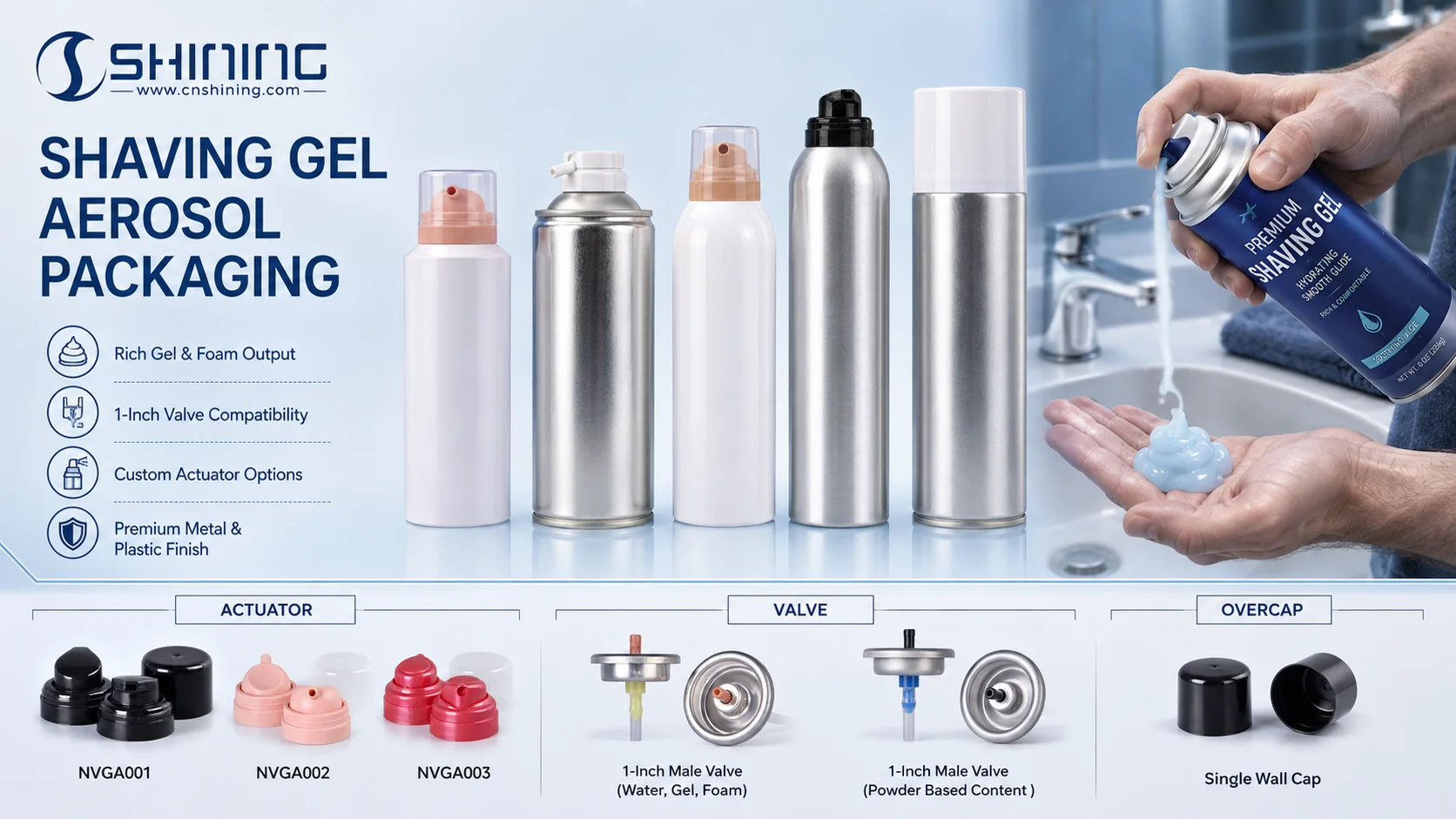
For aerosol shaving gel, packaging should be treated as a matched dispensing system. The actuator, valve, stem, mounting cup, can body, inner coating, and bottom protection all affect the same user experience. A good formula can still fail if the actuator traps gel in the outlet. A good-looking can can still fail if the bottom rusts in a wet bathroom. A stable valve can still disappoint if the output stream is too thick and blocks the razor.
Shining Packaging’s work around actuators, aerosol cans, and valves is relevant to this product category because the common failure modes are packaging-linked. For post-foaming shave gel, the actuator needs controlled flow and a clean outlet. The valve needs stable sealing, suitable stem geometry, and compatibility with higher-viscosity gel. The aerosol can needs pressure safety, inner coating compatibility, corrosion control, and a surface finish that survives humid bathroom handling.
The practical packaging brief is not complicated:
- Actuator: control discharge shape, reduce residue, and avoid gel building up around the nozzle.
- Valve: match product viscosity, foaming timing, and filling process; keep pressure and flow stable.
- Aerosol can: provide pressure resistance, corrosion protection, decoration space, and recyclability.
- System testing: include hot storage, drop testing, leak testing, valve compatibility, rust-ring observation, and repeated-use dispensing checks.
7. Conclusion
Aerosol shaving gel is a mature pressure-packaged wet-shaving product. Its technical value is still valid: gel discharge, delayed foam formation, strong lubrication, and good cushioning. Its commercial value is also clear: faster shaving, lower drag, sensitive-skin positioning, and better care feel.
The next stage will not be decided by who makes the biggest foam. It will be decided by who controls valve reliability, actuator cleanliness, rust resistance, leakage performance, formula mildness, and sustainable packaging compliance. The weak points are already visible in user complaints. The engineering tools already exist. The work is in matching them correctly.
8. FAQ: Aerosol Shaving Gel
Aerosol shaving gel normally leaves the can as a gel or high-viscosity emulsion gel and foams after spreading on skin. Traditional shaving foam is already foam when it exits the nozzle. The gel route gives more lubrication and skin contact, but it also creates higher risk of actuator residue, delayed bubbling at the outlet, and razor clogging if rheology is not controlled.
The expansion comes from pressure release and volatile foaming agents. Inside the can, materials such as isopentane or isobutane remain in a pressurized formula. When the valve opens, pressure drops rapidly. The volatile phase vaporizes, expands the gel network, and creates foam after spreading. This timing has to be controlled so foaming happens on the skin, not inside the actuator.
Clogging usually comes from gel residue in the actuator channel, premature post-foaming near the outlet, or mismatch between gel viscosity and actuator geometry. High solids, thick polymers, and heavy gel discharge can make the problem worse. A clean-dispense actuator, suitable valve stem, controlled orifice, and repeated-use testing are more useful than only adjusting the formula.
Bag-on-Valve can be suitable when the goal is to separate the product from compressed air or nitrogen and reduce direct propellant contact. It may support cleaner positioning and better product evacuation. The challenge is product texture. A post-foaming gel still needs the right discharge force, flow rate, foam behavior, and actuator design. BOV is a system choice, not a simple valve swap.
Typical systems use water as the main phase, fatty acids or nonionic emulsifiers for structure, glycerin or sorbitol for humectancy, mineral oil or similar lubricants for blade glide, and thickeners such as hydroxyethylcellulose, carbomer, or PEG polymers. Soap-based systems use neutralizers such as triethanolamine. Sensitive-skin systems often reduce fragrance, alcohol, and harsh soap effects.
Blade clogging happens when gel viscosity, expansion ratio, and single-shot output are too high for easy rinsing. A thicker gel can feel protective, but it may collect between multi-blade cartridges. The fix is not just “make it thinner.” The formula rheology, foaming speed, actuator flow rate, and discharge pattern should be tuned together to produce a controlled ribbon and washable foam layer.
Rust rings usually come from long-term contact between the can bottom and standing water on bathroom surfaces. Coating damage, weak bottom protection, or poor drainage can accelerate staining. The issue is packaging-related and visible to users. Rust-resistant bottom design, better external coating, plastic bottom rings, or bathroom-friendly bases can reduce complaints without changing the shaving formula.
The product sits across several regulatory layers. It is a cosmetic, so cosmetic safety, labeling, ingredient restrictions, and claims rules apply. It is also a pressurized aerosol dispenser, so pressure-container rules, warnings, and transport requirements apply. In some markets, VOC limits, microplastic restrictions, packaging waste rules, and dangerous-goods logistics can affect both formulation and packaging decisions.
Wet shaving can stress the skin because the blade removes hair while contacting the outer skin layer. Fragrance, alcohol, high alkalinity, or aggressive surfactants may increase stinging and dryness for sensitive users. Fragrance-free and alcohol-free positioning reduces likely irritants. The formula still needs enough lubrication, foam stability, preservation, and packaging compatibility to work reliably in aerosol format.
Packaging approval should include valve compatibility, actuator cleanliness, discharge consistency, hot storage, cold storage, leakage, drop testing, repeated-use residue checks, can corrosion, inner coating compatibility, and bathroom rust exposure. First-shot appearance is not enough. Post-foaming gels can show delayed problems after standing, warm storage, transport vibration, or repeated daily use by consumers.