
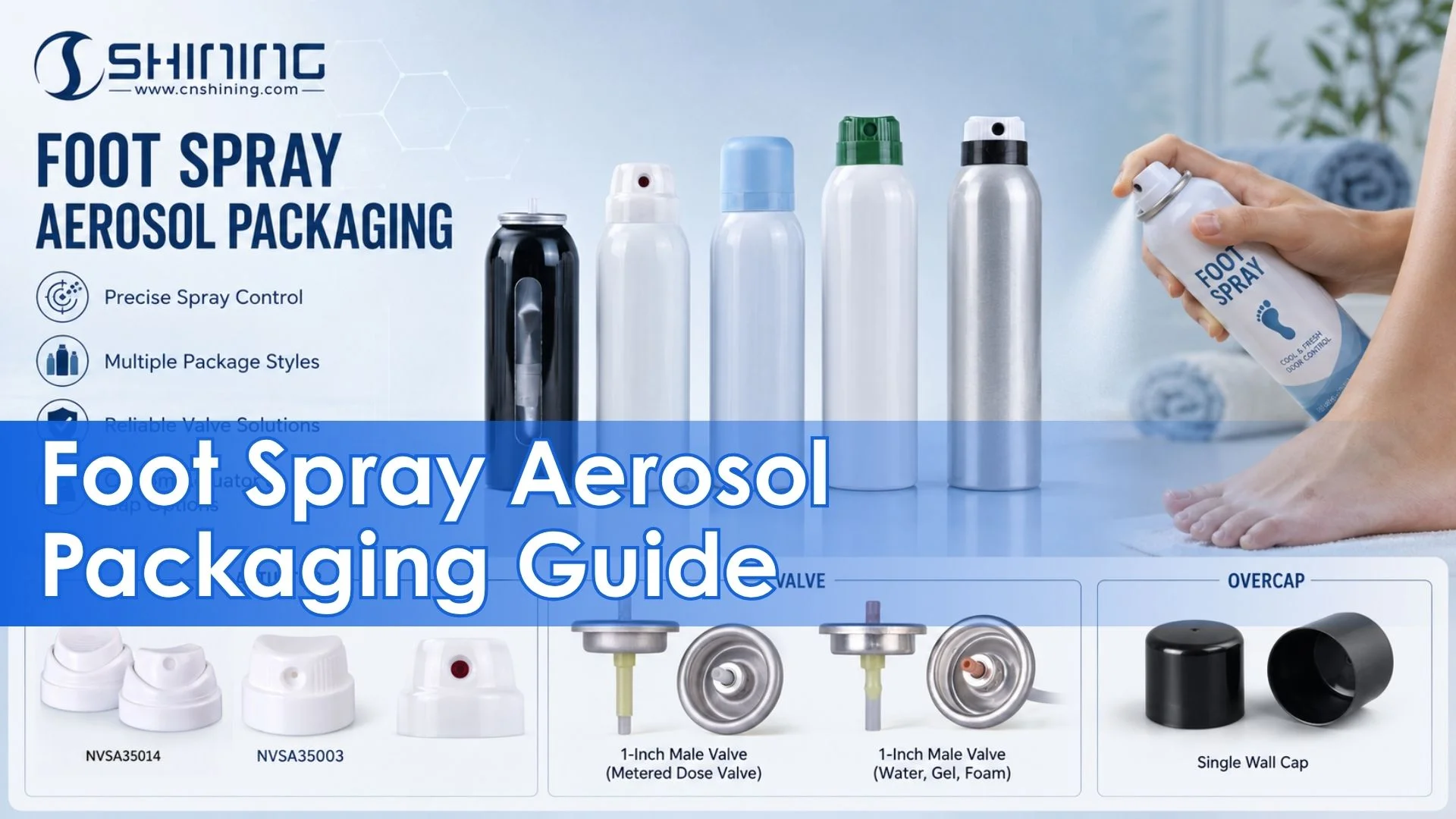
A foot aerosol spray is not just foot care formula in a can. It is a pressure-driven dispensing system that must handle powder suspension, fast drying, odor control, antifungal claims, flammability, transport rules, and repeated consumer use.
In this article, foot aerosol spray means a pressurized metal aerosol package that releases droplets or powder mist through a valve and actuator for foot deodorizing, moisture control, antiperspirant care, antifungal use, or soothing foot care. It does not include ordinary manual pump sprays or loose foot powder products.
Public products show three main product lines: deodorizing and moisture-absorbing powder aerosols, OTC antifungal sprays or powder sprays, and a smaller but growing group of microbiome or natural odor-management sprays.
1. What Makes Foot Aerosol Spray a Useful but Sensitive Format
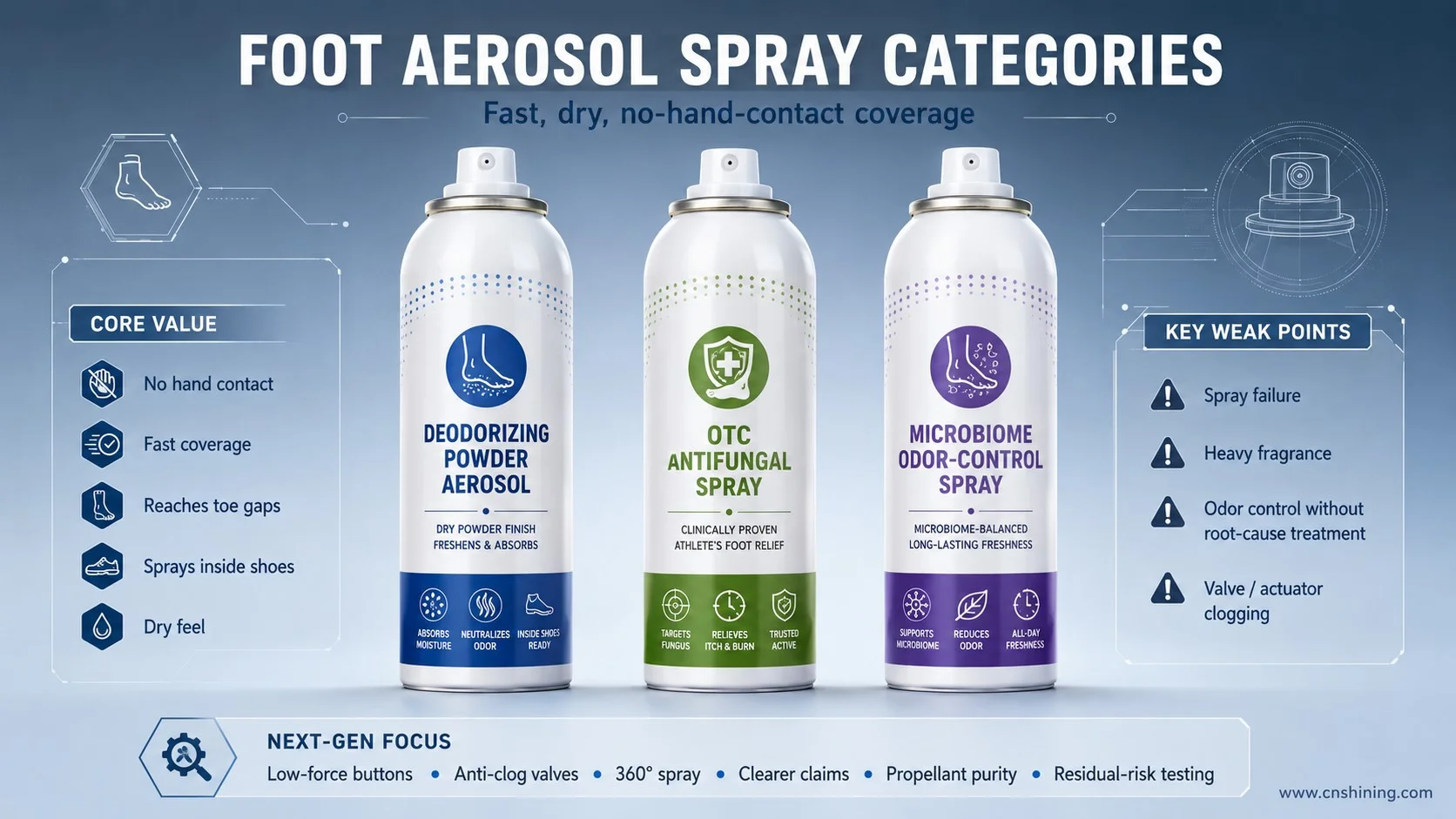
The core value is simple: no hand contact, fast coverage, access to toe gaps and shoe interiors, and a dry feel. That is why aerosol powder sprays continue to exist beside creams, loose powders, roll-ons, and pump sprays.
The long-term weak points are also clear. Public user feedback repeatedly points to spray failure, heavy fragrance, and products that control odor without solving the root cause. Comments such as “hard to spray,” “nothing comes out,” and “the spray top quits working before half the can is gone” point less to formula theory and more to valve, actuator, powder suspension, and quality-control problems.
For the next generation of foot deodorant spray, antifungal foot spray, and foot powder aerosol products, the best investment is not another fragrance variant. It is more likely to be low-actuation-force buttons, anti-clog valves, 360-degree spray performance, cleaner claim segmentation, high-purity propellant control, and better residual-risk testing.
2. Definition and Working Mechanism
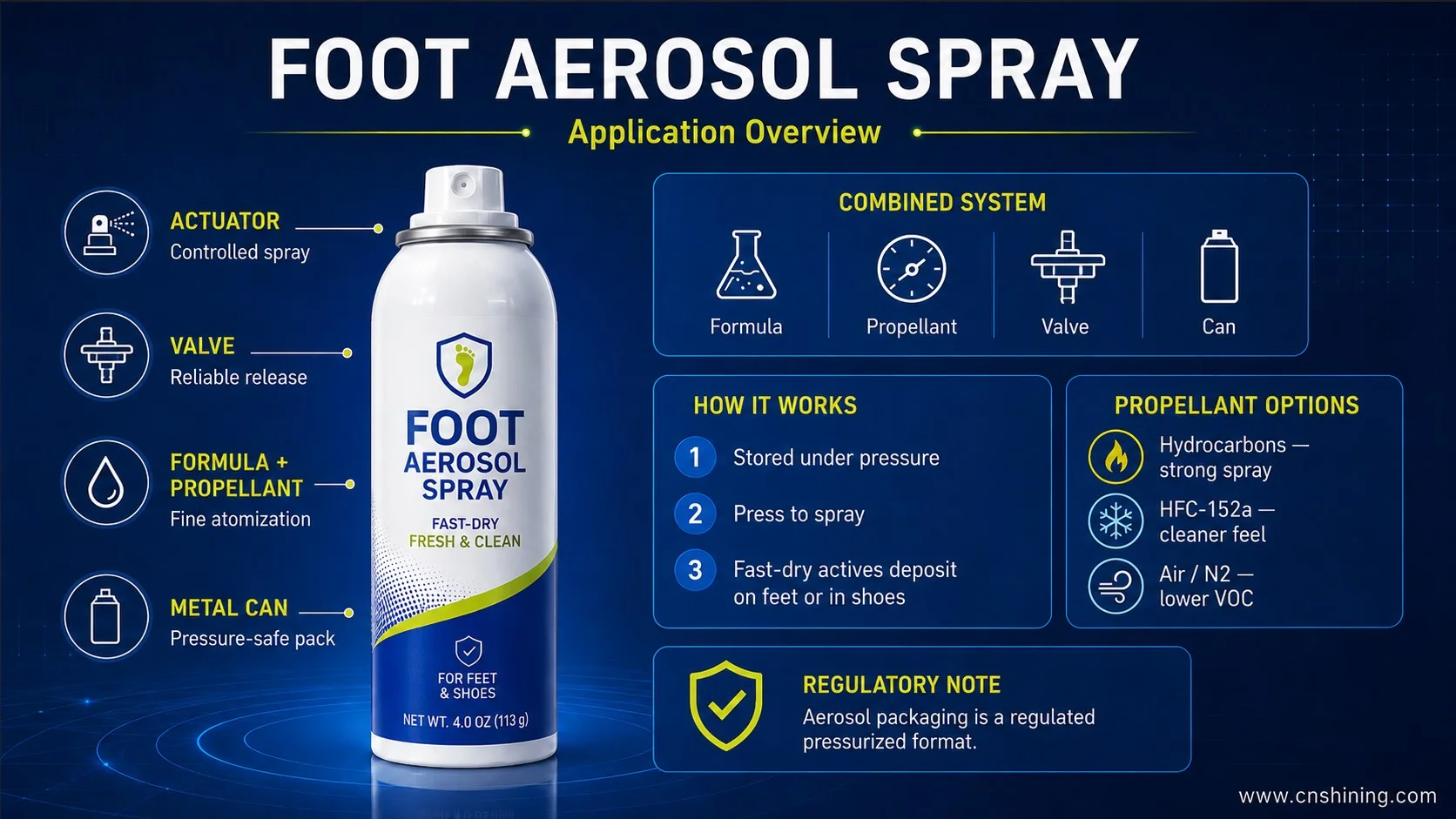
A foot aerosol spray is a combined system: formula concentrate + pressurized driving system + valve/actuator atomization parts + metal container. The U.S. Department of Transportation describes aerosols as pressurized containers that use compressed gases to expel liquids, pastes, or powders from the container through a safe shipping context in its aerosol shipping guidance.
The working sequence is direct:
- The can holds the concentrate and propellant under pressure.
- The user presses the actuator.
- The valve opens and the formula moves through the valve and nozzle.
- Pressure drop, turbulence, and partial flashing break the product into mist or powder spray.
- Volatile alcohol or propellant evaporates quickly.
- Absorbent particles, deodorizing agents, or drug actives deposit on the skin or inside the shoe.
For foot products, atomization has two practical points. First, liquefied propellants can flash during pressure drop and help break the formula into finer droplets. Second, in powder suspension systems, the volatile phase leaves first and the deposited layer can contain corn starch, kaolin, zinc oxide, magnesium stearate, or similar powder carriers.
| Propellant System | Public Evidence | Commercial Advantage | Main Limitation |
|---|---|---|---|
| Liquefied hydrocarbons | OTC antifungal powder sprays often use isobutane. | Low cost, strong spray force, good powder aerosol fit. | Flammable. More attention needed for transport, storage, and warnings. |
| HFC-152a | Used in some no-mess foot powder spray examples. | Supports clear or lower-residue sensory profiles. | Climate pressure and dangerous-goods management remain concerns. |
| Compressed air or nitrogen | Used in compressed aerosol and BOV systems. | Lower VOC narrative, product-propellant separation, smoother spray. | Higher packaging cost and more complex filling setup. |
The EU Aerosol Dispensers Directive also reminds manufacturers that aerosol packaging is a regulated pressure package, not only a beauty or foot care format.
3. Market Size, Growth and Regional Pattern
| Public Market Scope | Recent Baseline | Forecast | Growth Signal | How to Use It |
|---|---|---|---|---|
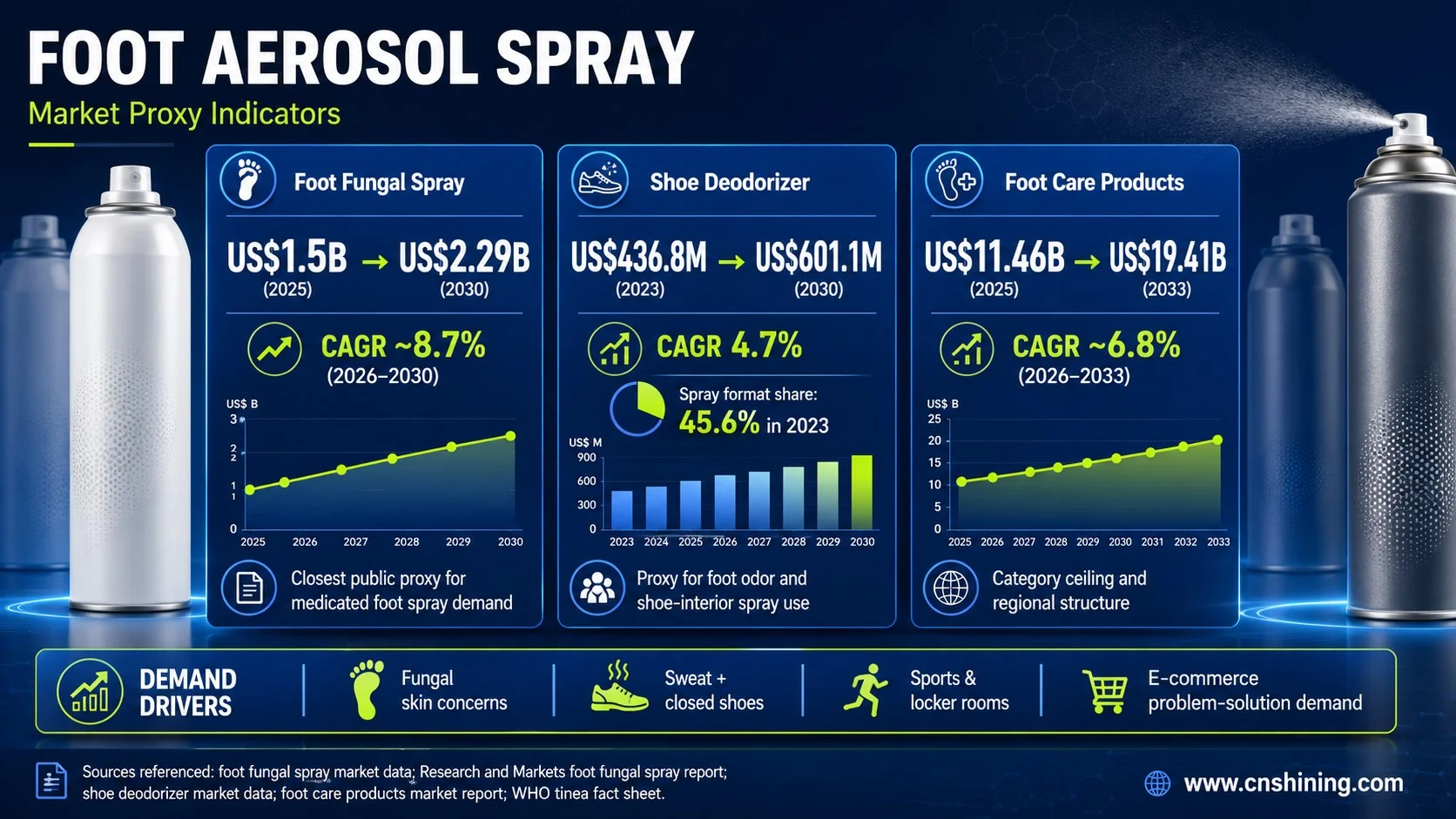
| Global foot fungal spray | 2025: US$1.5 billion; 2026: US$1.64 billion | 2030: US$2.29 billion | 2026–2030 CAGR around 8.7% | Closest public proxy for medicated foot spray demand. Source: foot fungal spray market data. |
| Global foot fungal spray report | Same class of market definition | 2026 report view | OTC access and skin-compatible formulations are named growth factors. | Useful for cross-checking the medicated spray trend. Source: Research and Markets foot fungal spray report. |
| Global shoe deodorizer | 2023: US$436.8 million | 2030: US$601.1 million | 2024–2030 CAGR 4.7%; spray format held 45.6% in 2023. | Good proxy for foot odor spray and shoe-interior use. Source: shoe deodorizer market data. |
| Global foot care products | 2025: US$11.46 billion | 2033: US$19.41 billion | 2026–2033 CAGR around 6.8% | Useful for category ceiling and regional structure. Source: foot care products market report. |
Demand is driven by real problems. Tinea, including athlete’s foot, is recognized by WHO as part of the fungal skin infection burden in its ringworm and tinea fact sheet. Sweat, closed shoes, sports footwear, locker rooms, and e-commerce problem-solution shelves all support the growth of foot deodorant spray, antifungal foot spray, and shoe deodorizer spray.
4. Product Comparison, Formulation Routes and Terms
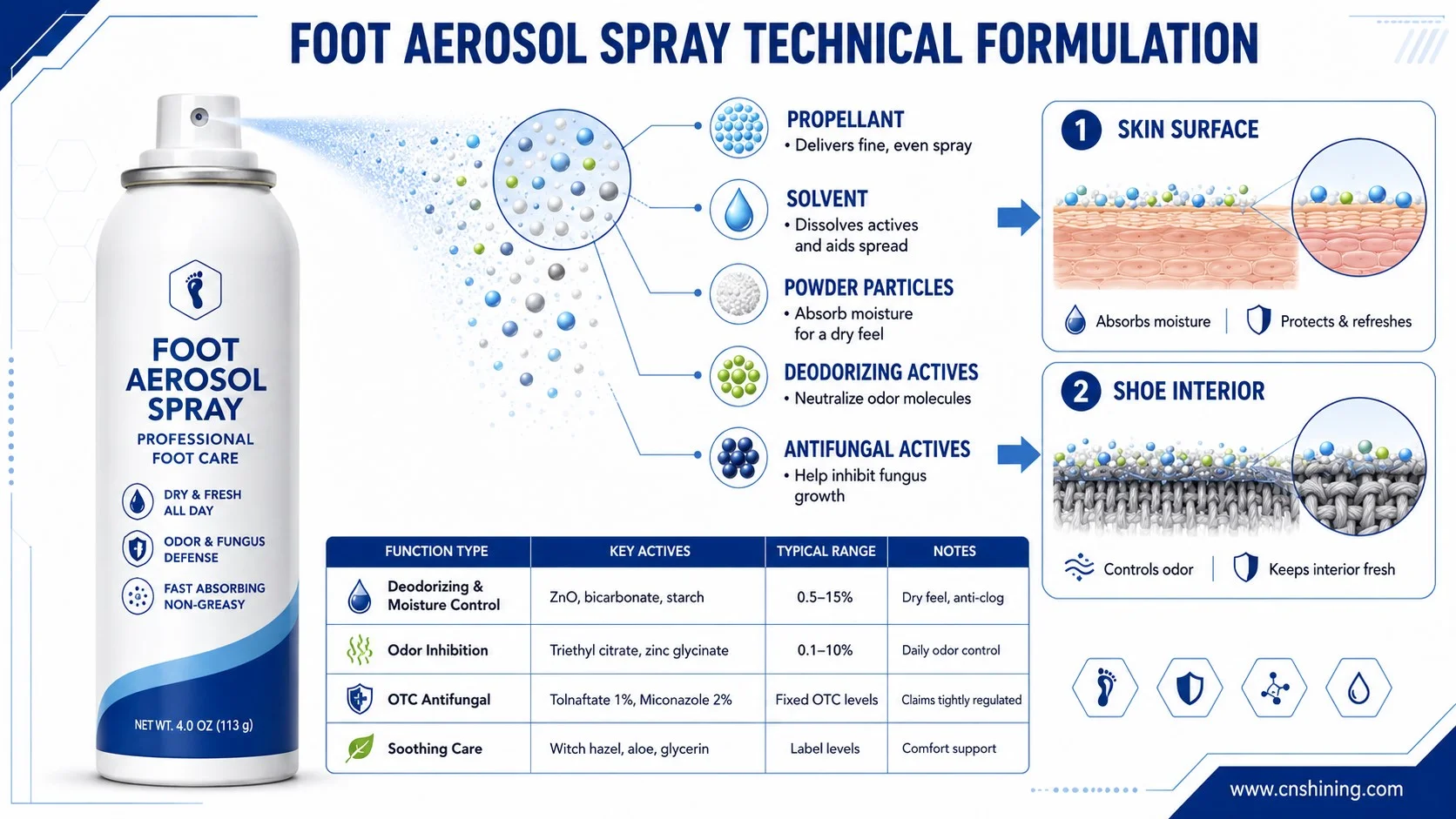
Foot aerosol spray survives because it is an efficiency tool. It is not always the strongest treatment format. It wins on speed, hygiene, toe-gap coverage, shoe-interior use, and dry touch. It loses when the need is precise long-contact treatment, heavy moisturization, or thick occlusive repair.
| Format | Coverage Speed | No-Touch Hygiene | Toe Gap / Shoe Reach | Dry Feel | Residue Risk | Best Use Case |
|---|---|---|---|---|---|---|
| Aerosol spray | Very high | Very high | Very high | High | Medium, depends on powder and nozzle | After sports, before going out, shoe plus foot treatment. |
| Loose foot powder | Medium | Medium | Medium | High | High dusting risk | Low-cost moisture absorption and shoe powdering. |
| Cream or ointment | Low | Low | Medium | Low | Low | Cracks, keratinized skin, high-residence antifungal treatment. |
| Roll-on | Low to medium | Low | Low | Medium | Low | Targeted antiperspirant application. |
| Manual pump spray | Medium to high | High | Medium to high | Medium | Low to medium | Travel size, water-based microbiome or hydrating foot mist. |
Commercial products and patents point to five main formulation routes.
| Function Type | Common Actives / Core Ingredients | Public or Typical Range | System Notes |
|---|---|---|---|
| Deodorizing and moisture absorption | Zinc oxide, sodium bicarbonate, starch, kaolin, fragrance, quaternary materials. | Micronized zinc oxide at 0.5%–15% appears in deodorant aerosol patent examples. | Needs dry feel, low white residue, and strong anti-clog design. |
| Odor inhibition | Triethyl citrate, zinc glycinate, zinc ricinoleate, alcohol, ethylhexylglycerin. | Patent examples describe zinc glycinate at 0.1%–10% and triethyl citrate at 0.1%–7%. | Better fit for daily odor management with less “medicated” sensory profile. |
| Antiperspirant foot care | Aluminum salts such as aluminum chloride hexahydrate. | The International Hyperhidrosis Society notes stronger levels may be needed for feet than underarms in its antiperspirant basics. | Irritation control is not optional, especially on compromised skin. |
| OTC antifungal | Tolnaftate 1%, miconazole nitrate 2%. | DailyMed examples show antifungal powder spray labeling and inactive systems in the miconazole nitrate powder spray aerosol label. | Regulatory claims are tight. Packaging and experience become large spaces for differentiation. |
| Soothing or microbiome-oriented | Prebiotic or probiotic extract narratives, witch hazel, glycerin, essential oils, aloe. | Public labels usually disclose ingredients, not precise percentages. | More about long-term odor management than fast antifungal treatment. |
| Component Block | Indicative Share | Technical Role |
|---|---|---|
| Propellant | 30% | Provides pressure and spray force. |
| Solvent phase | 15% | Supports dispersion, drying and actives delivery. |
| Absorbent / carrier powder system | 40% | Creates dry feel, moisture uptake and deposition. |
| Functional actives | 10% | Odor control, antifungal, or sweat-control function. |
| Fragrance and processing aids | 5% | Sensory balance, suspension aid, oxidation control. |
Consumers do not feel a formula table. They feel whether the product sprays smoothly, dries fast, leaves white residue, works inside shoes, and does not fail halfway through the can.
| Term | Simple Explanation | Commercial Meaning |
|---|---|---|
| Aerosol | A pressurized package that expels liquid or powder with gas. | Drives packaging, transport, and safety complexity. |
| Propellant | Gas or liquefied gas that supplies spray pressure. | Affects spray feel, cost, VOC profile, and sustainability story. |
| Concentrate | The functional formula inside the can. | Controls stability, actives delivery, and deposition. |
| Valve | The sealing and dispensing control component. | Determines clogging risk, leakage risk, and formula compatibility. |
| Actuator | The user-pressed spray button or spray head. | Defines actuation force, plume shape, and ergonomic feel. |
| 360° valve | Valve structure that can spray when inverted. | Useful for soles, toe spaces, and shoe interiors. |
| BOV | Bag-on-Valve; product and propellant gas are separated. | Supports cleaner systems but raises cost and filling complexity. |
| Plume | The shape and spread of the spray cloud. | Affects coverage, residue distribution, and perceived mess. |
| Spray rate | Output per unit time. | Affects dosage perception, can life, and repeat purchase timing. |
| OTC monograph | U.S. nonprescription drug rule framework. | Relevant once athlete’s foot treatment or prevention claims appear. |
5. Regulatory and Compliance Requirements
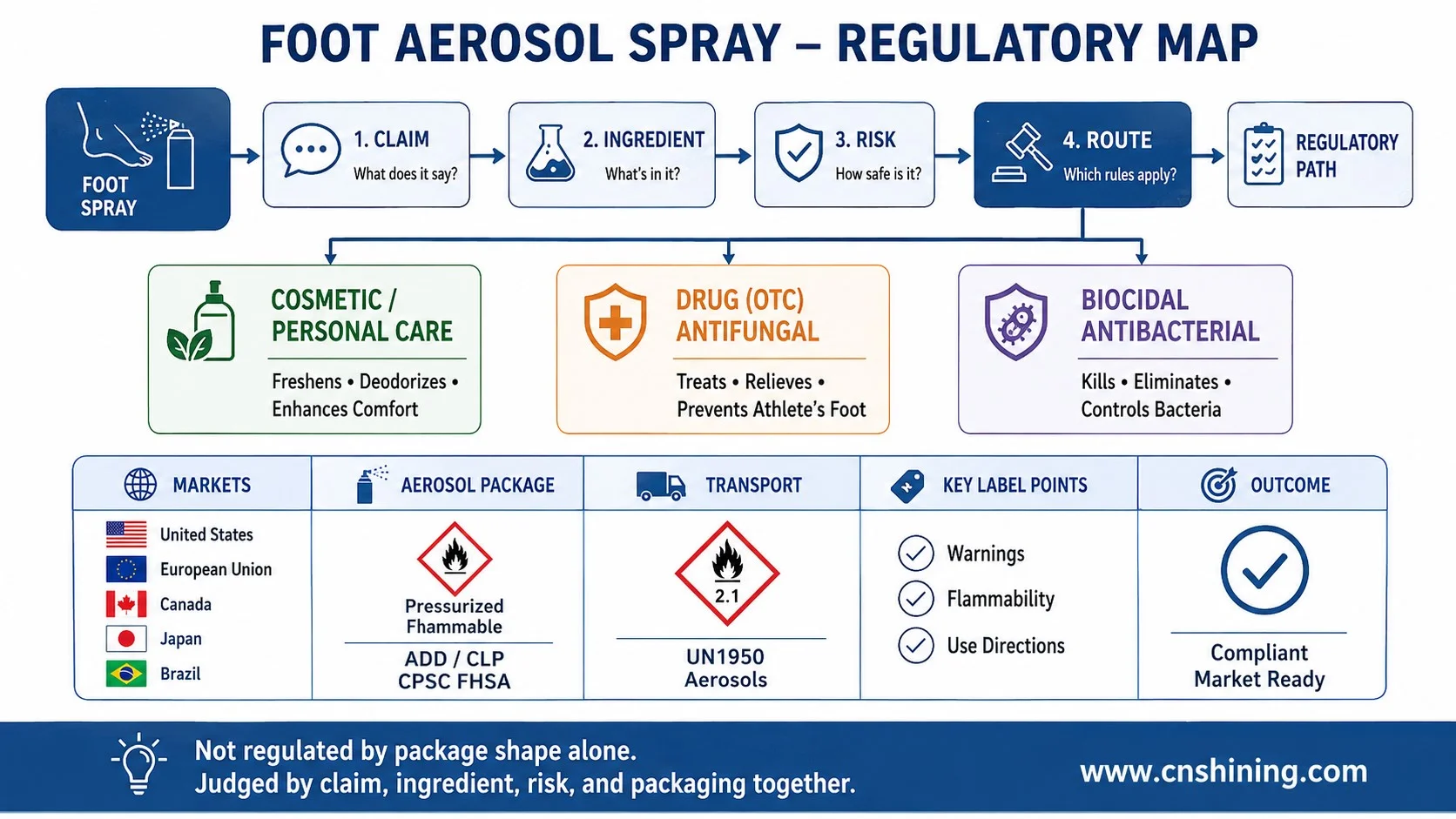
The core compliance rule is short: foot spray is not regulated by package shape alone. It is judged by claim, ingredient, risk, and packaging together.
A spray that says “freshens feet” may follow a cosmetic or personal-care route. A spray that says “treats or prevents athlete’s foot” enters drug logic in the U.S. A spray that says “kills bacteria” may trigger biocidal review in Europe. The formula might look similar. The regulatory route may not.
| Market | Cosmetic / Personal Care Path | Drug / Biocidal Path | Aerosol Packaging Requirements | Key Label Points |
|---|---|---|---|---|
| United States | General FDA cosmetic expectations for ordinary deodorizing or freshening claims. | Antifungal claims use OTC logic under OTC Monograph M005. | Household hazard labeling and flammability issues may interact with CPSC FHSA requirements. | Drug Facts, active level, warnings, flammability, use duration, and age statements. |
| European Union | Cosmetics follow Regulation (EC) No 1223/2009. | Strong antibacterial or killing claims may move toward biocidal logic. | ADD and CLP considerations apply to aerosol dispenser and hazard communication. | Responsible person, INCI list, warnings, flammable/pressurized container symbols. |
| Canada | Cosmetics follow Canadian Cosmetic Regulations. | Therapeutic claims may leave cosmetic territory. | Pressurized containers are separately addressed. | English/French labeling, ingredient declaration, warning and notification logic. |
| Japan | Ordinary cosmetics may be notified. | Some deodorant or functional claims may be quasi-drug and need approval under PMDA quasi-drug procedures. | Packaging and label requirements must match local rules. | Japanese label, careful claim wording, quasi-drug approval where needed. |
| Brazil | Cosmetics and personal hygiene products are regulated under ANVISA. See ANVISA cosmetics and personal hygiene guidance. | Higher-risk products may need pre-market approval. | Aerosol and dangerous goods handling need local logistics review. | Portuguese label, category classification, notification or authorization route. |
The most common mistake is designing the product as personal care but writing the front label like a drug. Another mistake is treating the package as cosmetic packaging while ignoring aerosol hazmat classification.
6. Latest Technology, Patents and Packaging Direction
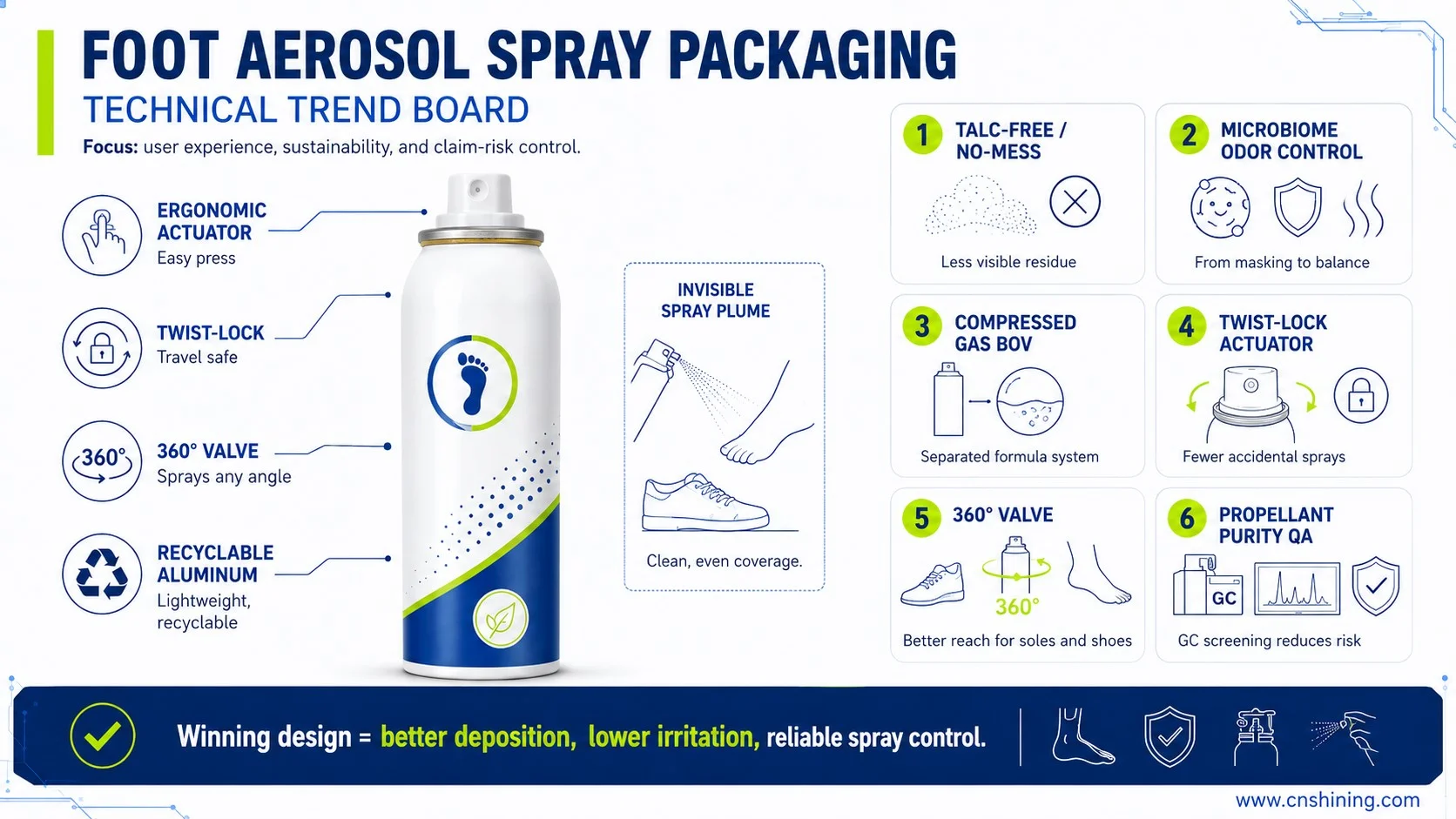
The interesting technology movement is not a new fragrance. It is tighter control of user experience, sustainability pressure, and claim risk.
| Trend | Evidence Type | Meaning for Foot Aerosol Spray |
|---|---|---|
| Talc-free / no-mess / invisible | Public commercial products use these claims. | The question is no longer only “does it work?” It is “does it leave white powder on skin, floor, and shoes?” |
| Microbiome odor narrative | Probiotic or microbiome-style public product positioning. | Moves the story from masking odor toward longer-term odor ecology. |
| Compressed gas and BOV | Supplier systems show formula-propellant separation. | Good fit for mild, premium, low-VOC, or water-rich systems. |
| Less-material actuator and lock function | Shining’s aerosol actuator uses hoodless and twist-to-lock concepts. | Useful for travel, fewer accidental sprays, and reduced overcap material. |
| 360° or up/down valves | Public catalog includes 360° aerosol valve options. | Very practical for soles, toe gaps, and shoe interiors. |
| Propellant purity and QA | The FDA published a Lotrimin and Tinactin benzene-related spray recall. | Supplier audit and incoming GC release are not paperwork. They are brand-risk controls. |
| Lower-GWP propellant migration | AstraZeneca publicly discusses pMDI transition to near-zero GWP propellant. | Relevant as a transferable aerosol trend, but foot spray mass production evidence is still thinner than inhalation devices. |
Patent directions are also practical. US7078023B1 points to micronized zinc oxide foot and shoe deodorant aerosols with zinc oxide ranges around 0.5%–15%. US8685380B2 describes deodorant spray logic using triethyl citrate and zinc glycinate. US10993890B2 addresses antifungal external-use systems, and US10076474B2 shows aerosol antiperspirant composition and device optimization thinking.
The message is consistent: competition is not only about changing one active. It is about deposition efficiency, irritation control, propellant compatibility, valve reliability, and user operation habits.
7. Top 10 Foot Aerosol Spray Brands
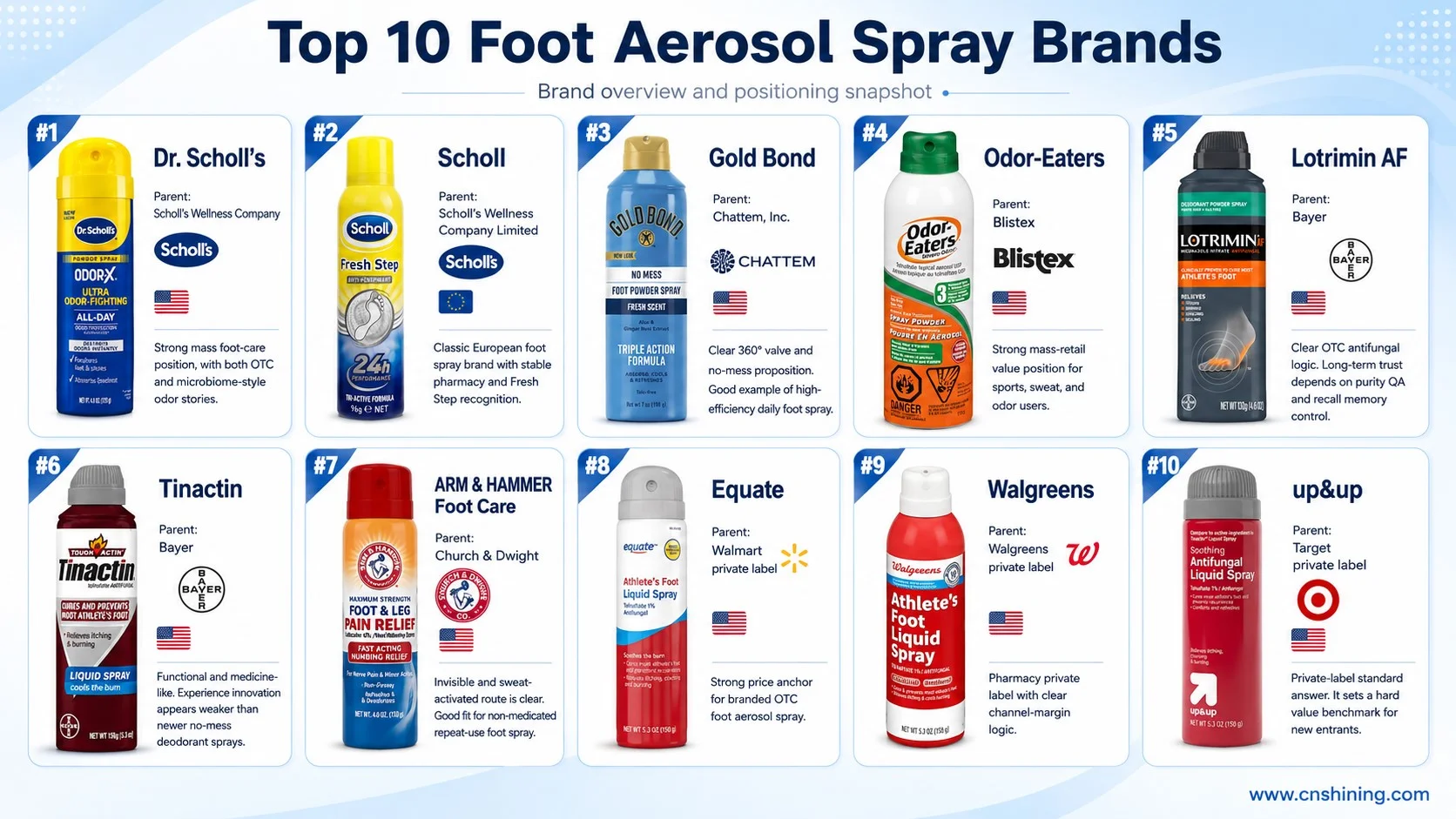
| Brand | Country / Main Market | Parent / Operator | Common Size | Observed Price Range | Direct Technical Comment |
|---|---|---|---|---|---|
| Dr. Scholl’s | U.S. | Scholl’s Wellness Company | 4.0–4.7 oz | about 4.97$–6.99$ | Strong mass foot-care position, with both OTC and microbiome-style odor stories. |
| Scholl | Europe | Scholl’s Wellness Company Limited | 150 mL | about 4.01$ | Classic European foot spray brand with stable pharmacy and Fresh Step recognition. |
| Gold Bond | U.S. | Chattem, Inc. | 7 oz | about 6.77$–7.97$ | Clear 360° valve and no-mess proposition. Good example of high-efficiency daily foot spray. |
| Odor-Eaters | U.S. | Blistex | 4 oz | about 4.89$–4.92$ | Strong mass-retail value position for sports, sweat, and odor users. |
| Lotrimin AF | U.S. | Bayer | 4.6–5.6 oz | about 8.77$–9.64$ | Clear OTC antifungal logic. Long-term trust depends on purity QA and recall memory control. |
| Tinactin | U.S. | Bayer | 5.3 oz | about 6.99$ | Functional and medicine-like. Experience innovation appears weaker than newer no-mess deodorant sprays. |
| ARM & HAMMER Foot Care | U.S. | Church & Dwight | 7 oz | about 7.69$ | Invisible and sweat-activated route is clear. Good fit for non-medicated repeat-use foot spray. |
| Equate | U.S. | Walmart private label | 4.6 oz | about 3.98$–6.73$ | Strong price anchor for branded OTC foot aerosol spray. |
| Walgreens | U.S. | Walgreens private label | 4.6 oz | about 11.49$ single; about 20$ for two | Pharmacy private label with clear channel-margin logic. |
| up&up | U.S. | Target private label | 4.0–5.3 oz | about 3.59$–6.39$ | Private-label “standard answer.” It sets a hard value benchmark for new entrants. |
8. User Pain Points and Packaging Brief
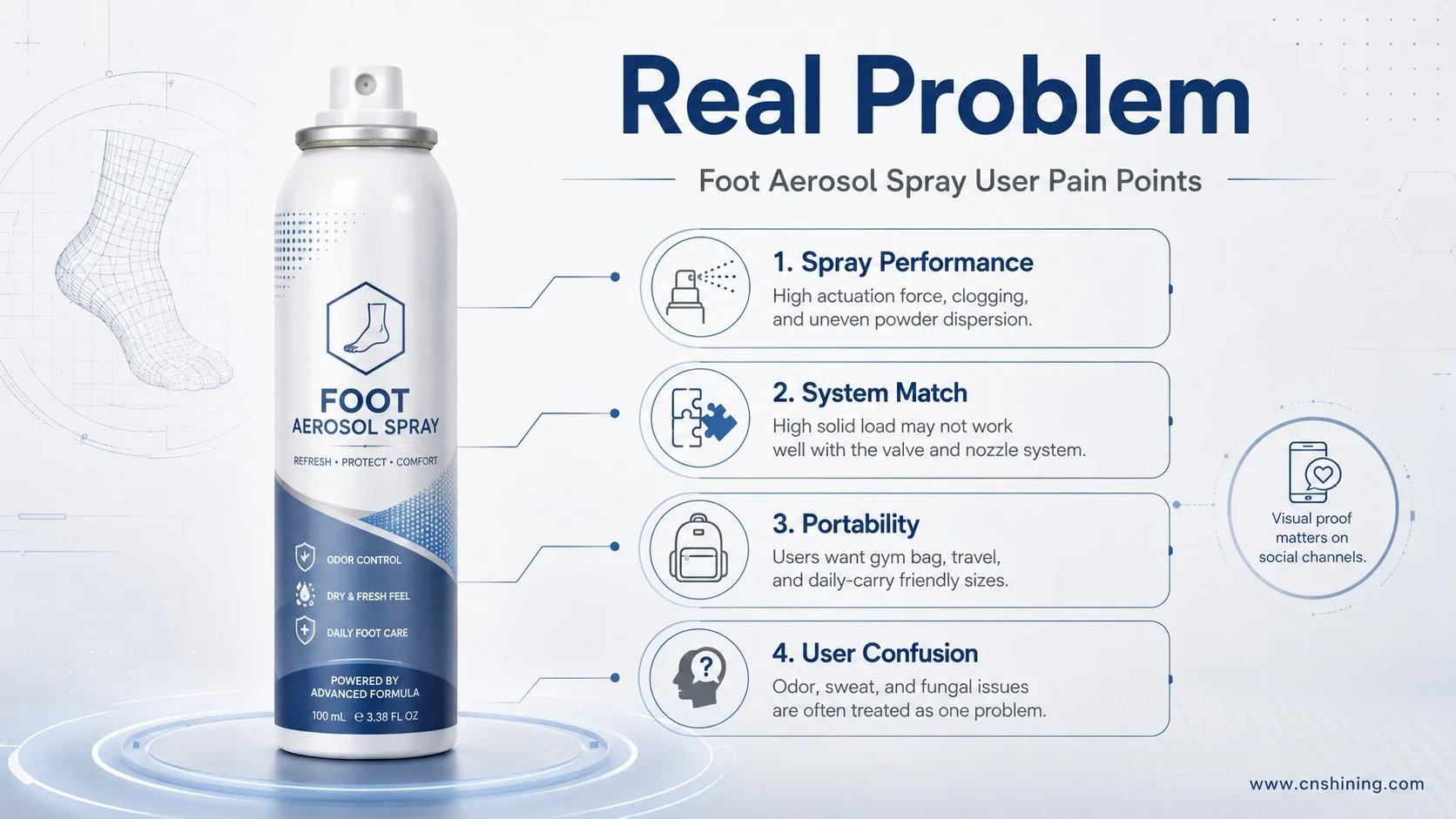
User complaints cluster in four places: spray failure, heavy scent, unclear treatment expectations, and travel inconvenience. These are not minor issues. They are where packaging can either preserve or waste formula value.
| Platform Signal | Real Problem | Packaging / Product Response |
|---|---|---|
| Amazon-style complaints: hard to open, hard to spray, bottle stops spraying. | High actuation force, clogged valve, poor powder dispersion, or nozzle mismatch. | Larger finger pad, lower actuation force, anti-clog nozzle, better particle-size control. |
| Walmart-style complaints: top quits working before half the can is gone. | High solid load and valve/nozzle system are not matched well. | Valve-formula DOE, shake-ball addition, optimized filtering, spray-cycle clog testing. |
| TikTok Shop-style travel-size requests. | Portability gap. Consumers want gym bag, travel, and daily-carry options. | Develop 50–75 mL travel version. Consider pump mist for low-risk travel format if needed. |
| Reddit-style frustration: sprays do not solve the root cause. | Users mix odor, sweat, and fungal infection into one problem. | Separate front-label paths: odor / sweat / fungus. Do not hide clinical limits. |
| YouTube-style instant odor content. | Visual proof matters in social channels. | Show sole spraying, toe-gap access, shoe-interior spray, and dry-residue behavior. |
| Priority | Recommendation | Why It Comes First |
|---|---|---|
| High | Low-force actuator with larger finger pad and lock function. | Directly addresses hard pressing, accidental spray, and travel use. |
| High | Anti-clog design for powder systems: orifice, filter, dip tube, ball, and powder D90 control. | Stops the most damaging complaint: product left in the can but no spray output. |
| High | 360° valve or up/down valve. | Foot soles and shoe interiors are awkward angles. Inverted spraying is practical, not decorative. |
| Medium | Main can plus travel format. | Matches gym, work, and travel behavior. |
| Medium | Internal coating compatibility testing by formula family. | Alcohol, essential oils, organic acids, aluminum salts, and fragrance systems do not behave the same inside metal cans. |
| High | Propellant purity QA and benzene release standard. | This is legal, brand, and consumer-trust risk control. |
9. Packaging Hardware Fit: Actuators, Aerosol Cans and Valves from Shining Packaging
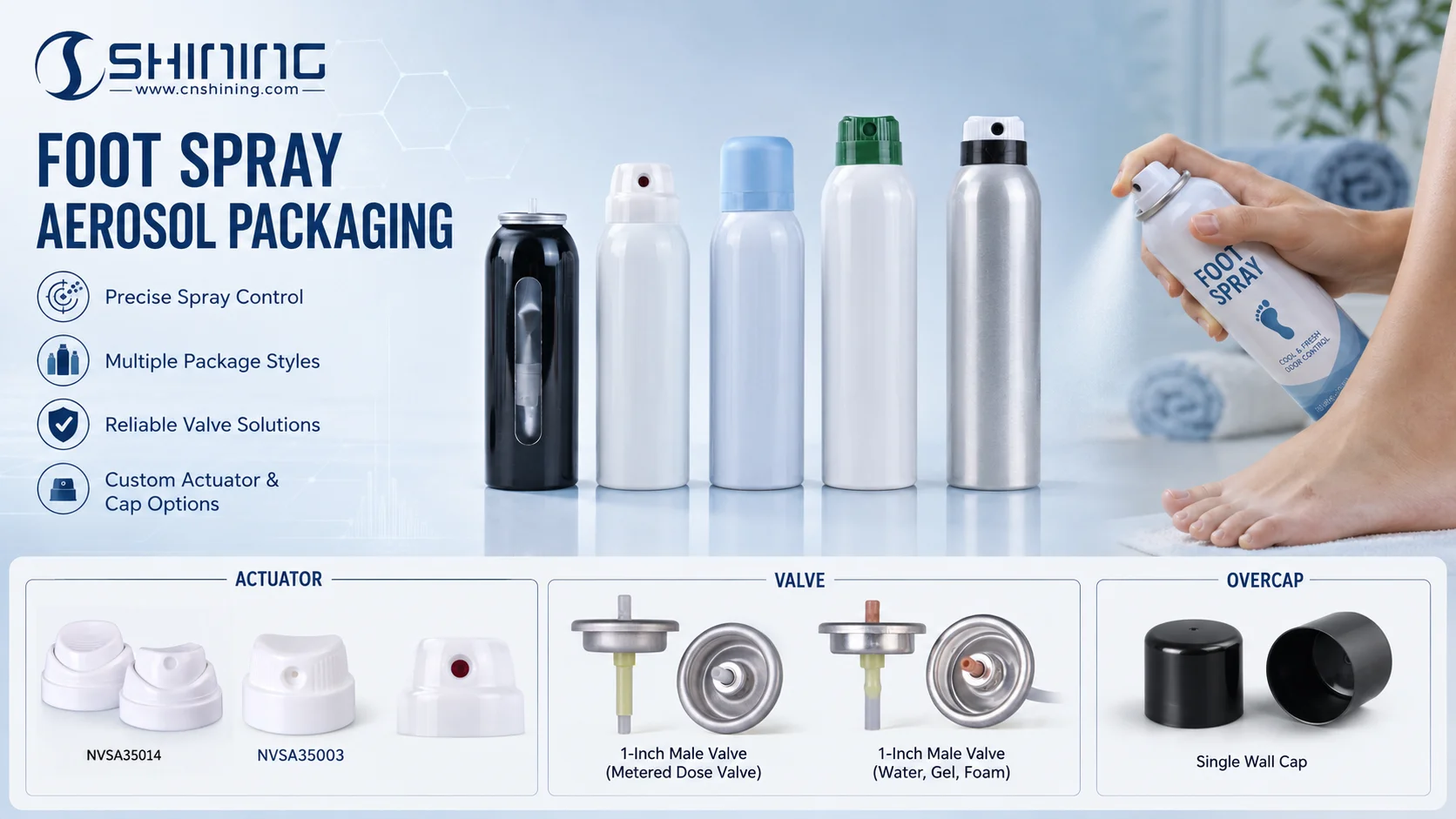
For foot aerosol spray, packaging hardware has to be selected around the formula. A powder-heavy foot deodorant spray will stress the valve and actuator differently from a clear alcohol-based foot mist or a BOV water-rich spray.
Shining Packaging fits into this discussion on the hardware side: actuators, aerosol cans, and valves. For this category, the useful questions are practical:
- Can the actuator reduce finger fatigue for users who spray soles and shoe interiors?
- Can the valve handle powder suspension without clogging during repeated use?
- Does the can and internal coating match alcohol, fragrance, essential oil, or active systems?
- Is 360° spray needed for the final use case?
- Can the package pass filling, leakage, storage, drop, and transport checks without changing spray quality?
This is where a packaging brief should be specific. “Foot spray aerosol can” is too broad. A better brief states: formula type, solid content, propellant, target spray rate, desired plume, whether inverted spraying is required, expected can size, actuator force range, fragrance level, and clog-cycle test target.
10. Closing Technical Takeaway
Foot aerosol spray is a compact system problem. The formula matters, but the package decides whether the formula reaches the foot, the toe gaps, and the shoe interior in a usable way. The strongest near-term improvements are not vague: anti-clog powder dispensing, lower-force actuators, 360° spray, cleaner claim separation, propellant purity control, and can/valve compatibility testing.
11. FAQ: Foot Aerosol Spray
A foot aerosol spray is a pressure package that combines concentrate, propellant, valve, actuator, and metal can. The system releases droplets or powder mist for deodorizing, moisture control, antifungal use, or foot comfort. It is different from a manual pump because pressure, flammability, valve compatibility, spray rate, and atomization behavior become part of the product design.
Powder foot sprays carry solid particles such as starch, kaolin, zinc oxide, or similar absorbent materials. These particles can settle, bridge, or block small valve and nozzle passages. Clogging risk increases when particle size, suspension stability, valve orifice, filter design, and shaking behavior are not matched. A fresh-can spray test alone is not enough.
Feet are not sprayed like underarms. Users often spray soles, toe gaps, and shoe interiors at awkward angles. A 360-degree or up/down valve allows inverted or angled spraying with less performance loss. This improves real use, especially when applying powder spray under the foot or into footwear before sports, work, or travel.
No. A deodorant foot spray mainly manages odor, moisture, or sensory freshness. An antifungal spray is linked to treatment or prevention claims such as athlete’s foot and may require OTC drug compliance in markets like the United States. Mixing odor, sweat, and fungal infection claims on one label creates regulatory and consumer-expectation problems.
Common systems include liquefied hydrocarbons such as isobutane, HFC-152a in some no-mess products, and compressed air or nitrogen in compressed aerosol or BOV formats. Each option changes spray force, dry feel, residue, flammability, cost, filling method, transport classification, and sustainability pressure. Propellant choice should be made with the formula, not after it.
Bag-on-Valve separates the product from compressed air or nitrogen outside the bag. This can protect sensitive or water-rich formulations from direct propellant contact and support smoother spray performance. It may fit microbiome, soothing, low-VOC, or premium foot spray concepts. The tradeoff is usually higher package cost and more demanding filling equipment.
The can may still contain formula, but the dispensing path can fail. Common causes include powder settling, blocked nozzle holes, poor valve selection, insufficient shaking, incompatible thickening or suspension systems, or inconsistent filling quality. A good development program tests spray cycles after storage, heat aging, cooling, repeated use, and partial-can conditions.
They should treat them as three different user problems. Odor control often uses absorbents, deodorizing chemistry, fragrance, or microbiome positioning. Sweat control may need antiperspirant actives and irritation testing. Fungal treatment requires drug-style actives and label discipline. Clear claim separation reduces wrong purchases and avoids implying medical effects where the product is not regulated as medicine.
Key tests include valve clog-cycle testing, spray rate measurement, plume and residue evaluation, leakage testing, can coating compatibility, corrosion screening, actuator force measurement, drop and storage stability, shake-redispersion behavior, and propellant purity release. For powder systems, aged-can testing is especially important because settling behavior changes after storage and transport.
A usable brief should state formula type, solid content, target active, propellant, can size, desired spray rate, plume width, residue expectation, fragrance level, inverted spraying need, actuator force target, valve type, internal coating requirement, transport market, and claim path. Without these details, suppliers may choose hardware that sprays well in trial but fails in real use.