
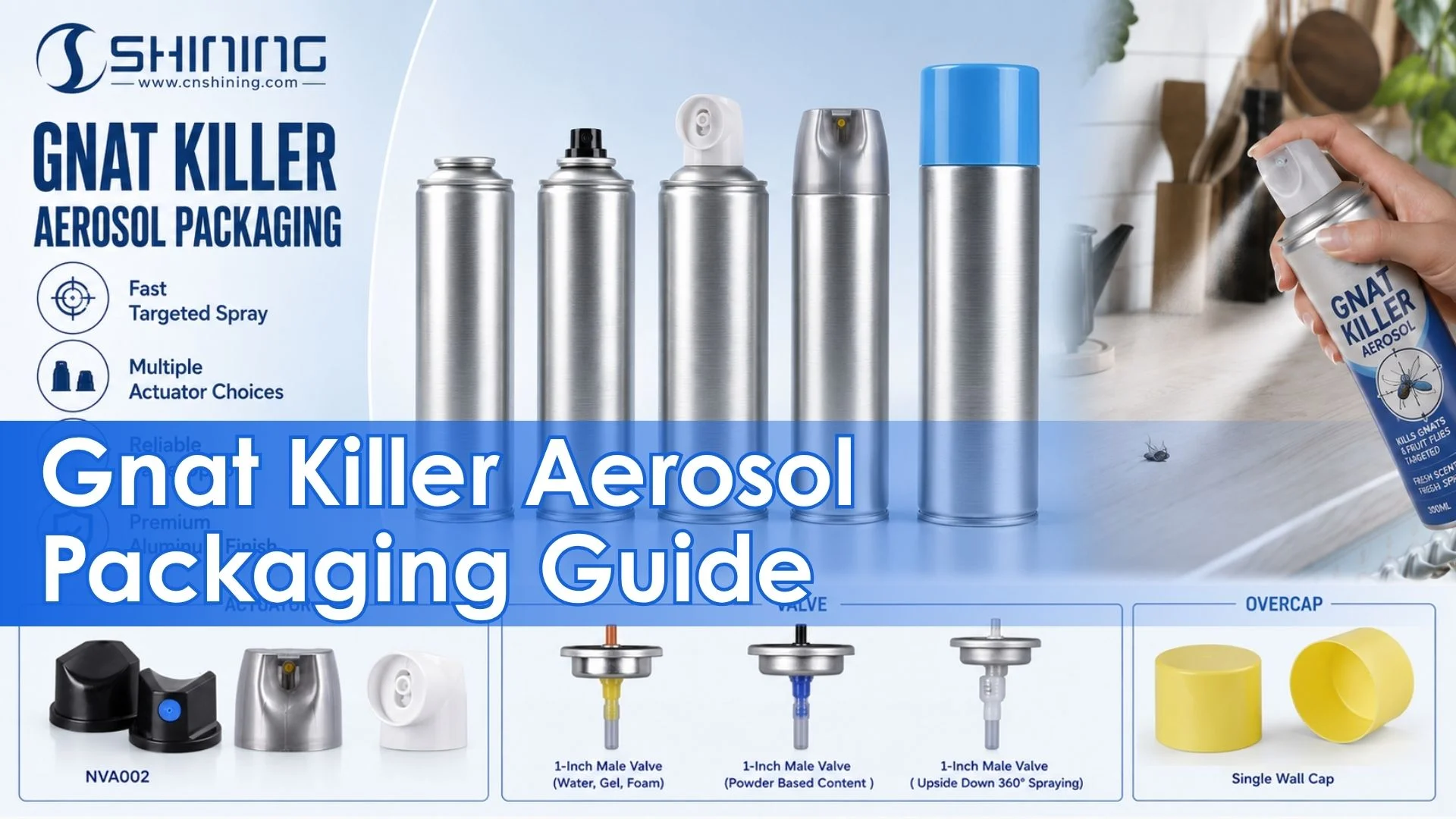
A gnat killer aerosol spray is usually not a formal regulatory class. It is a retail and e-commerce term for instant-kill aerosol or pressurized spray products aimed at small flying insects. In real labels, “gnats” may sit beside fruit flies, flies, mosquitoes, small flying moths, and other flying insects. That creates a technical problem: the buyer expects one spray to solve several different pest situations.
In practice, the category is split into two formulation routes. The first route uses pyrethrins or synthetic pyrethroids, sometimes with piperonyl butoxide, to deliver fast knockdown. The second route uses plant-derived actives such as geraniol, lemongrass oil, rosemary oil, cornmint oil, and surfactant systems. The second route often fits low-odor household expectations, but it also brings more complaints around oil residue, heavy scent, wet application, and poor spray pattern.
1. Product Definition, Target Pests, and Use Scenarios
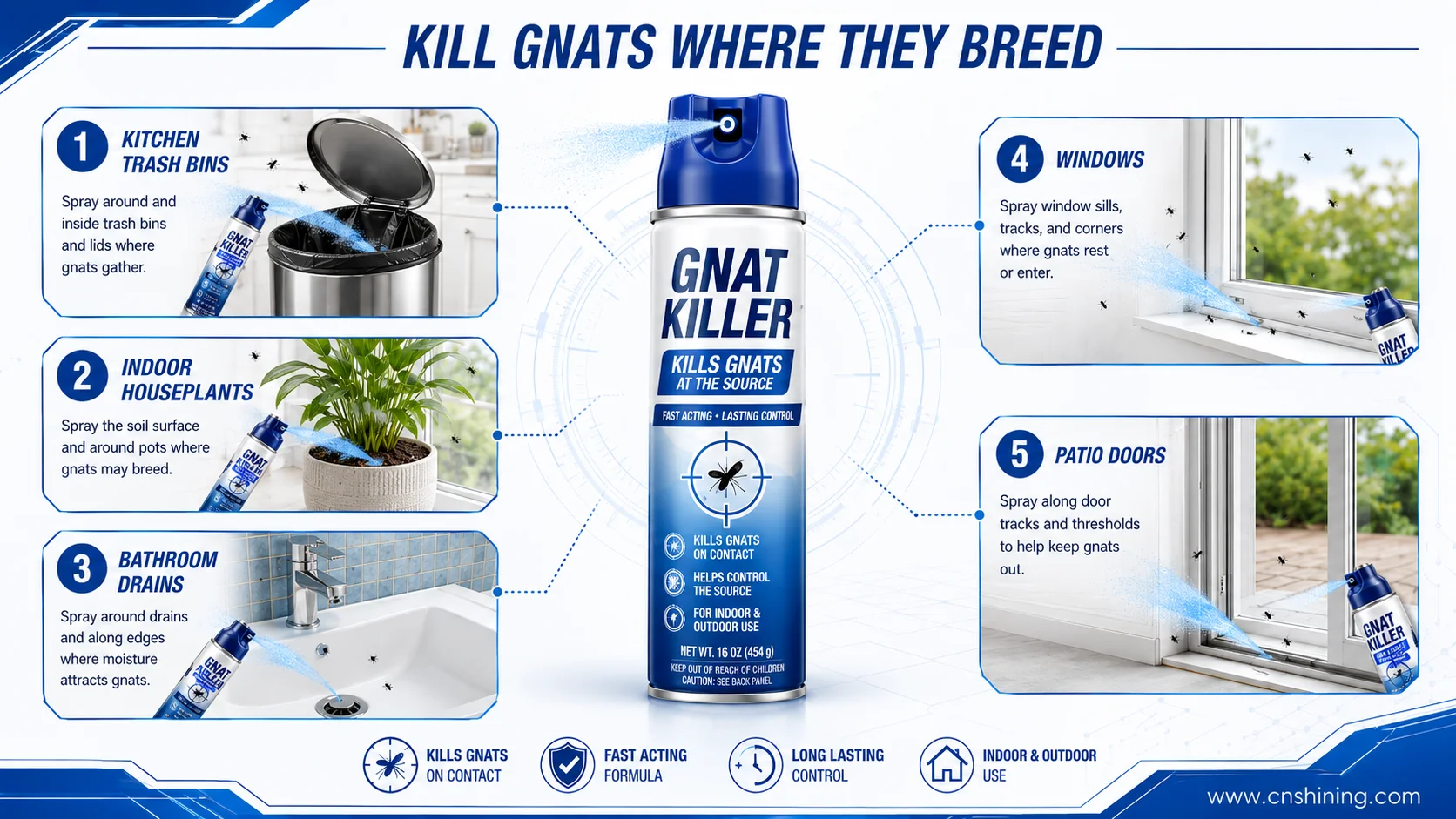
Commercially, gnat killer aerosol spray refers to instant-use products for homes, patios, balconies, kitchens, trash areas, window gaps, basements, bathrooms, and houseplant zones. The label rarely treats “gnat” as one precise insect. It is normally a functional claim for small flying insects that users want to knock down immediately.
For indoor plants, “gnats” most often means fungus gnats. The adult flies are visible, but the source is usually larvae developing in moist organic growing media. That is why an aerosol spray may reduce adult nuisance but cannot be treated as full source control. If larvae remain in the potting mix, new adults will appear again.
In broader outdoor use, “gnat” may also include biting midges or no-see-ums. The CDC describes biting midges as very small flies, often less than 3 mm long, and notes that they may be called no-see-ums in common language (CDC biting midge reference).
| Target Object | Common Label Wording | Typical Scene | Technical Note |
|---|---|---|---|
| Fungus gnats | Fungus gnats / gnats | Houseplants, greenhouses, seedling trays, moist substrate | Adults can be sprayed down, but the source is often in the growing medium. |
| Fruit flies and kitchen small flies | Fruit flies / gnats | Kitchens, bins, counters, drains | Consumers often call these insects “gnats.” |
| Non-biting small flying insects | Non-biting gnats / small flying moths | Screens, doors, lights, entry points | This is a common retail flying-insect claim. |
| Biting midges / no-see-ums | Biting midges / no-see-ums | Patios, grass, water edges, outdoor seating | More related to outdoor nuisance and personal exposure. |
2. Chemical and Physical Killing Mechanisms
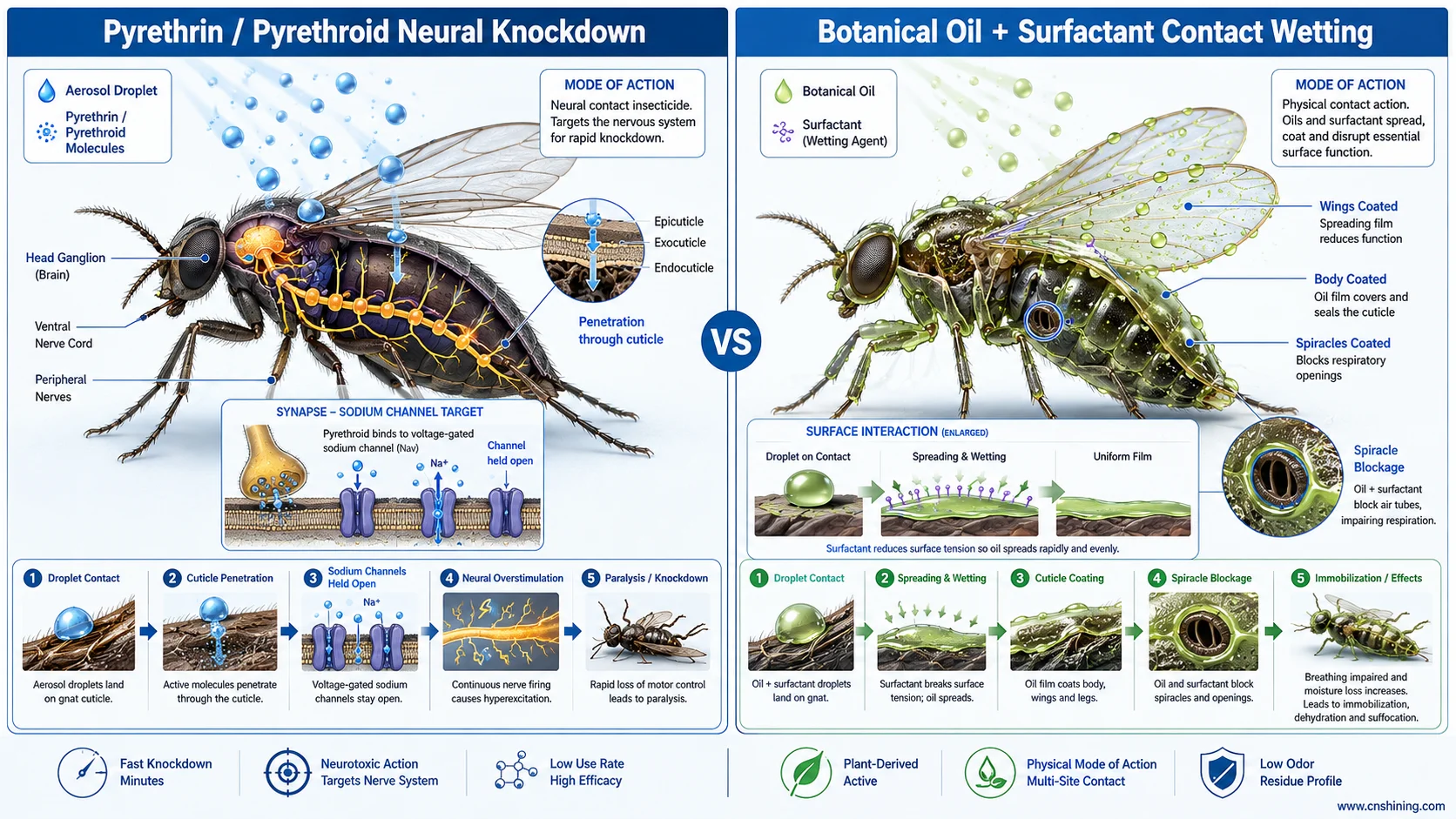
Traditional pyrethrin and pyrethroid systems act mainly through insect nerve disruption. They interfere with voltage-gated sodium channels, causing over-excitation, paralysis, and death. Piperonyl butoxide is not the main insecticidal active. It is a synergist that reduces insect metabolic detoxification and improves pyrethrin or pyrethroid performance.
Botanical systems work differently. They depend on a mixture of active molecules in essential oils, often helped by surfactants that wet the insect body. Research continues to evaluate essential oils and their bioactive compounds as lower-impact insect control tools (essential oil insecticidal activity study). The commercial difficulty is not the concept. It is stability, odor control, residue, droplet size, and repeatable spray performance.
CO2 and attractant systems are more common in traps than in handheld aerosols. Public patent literature treats CO2 mainly as a lure signal in trap or device ecosystems, not as the main body of a retail gnat aerosol (CO2 insect control device patent).
3. Formulation Classes, Functions, Limits, and Safety Notes
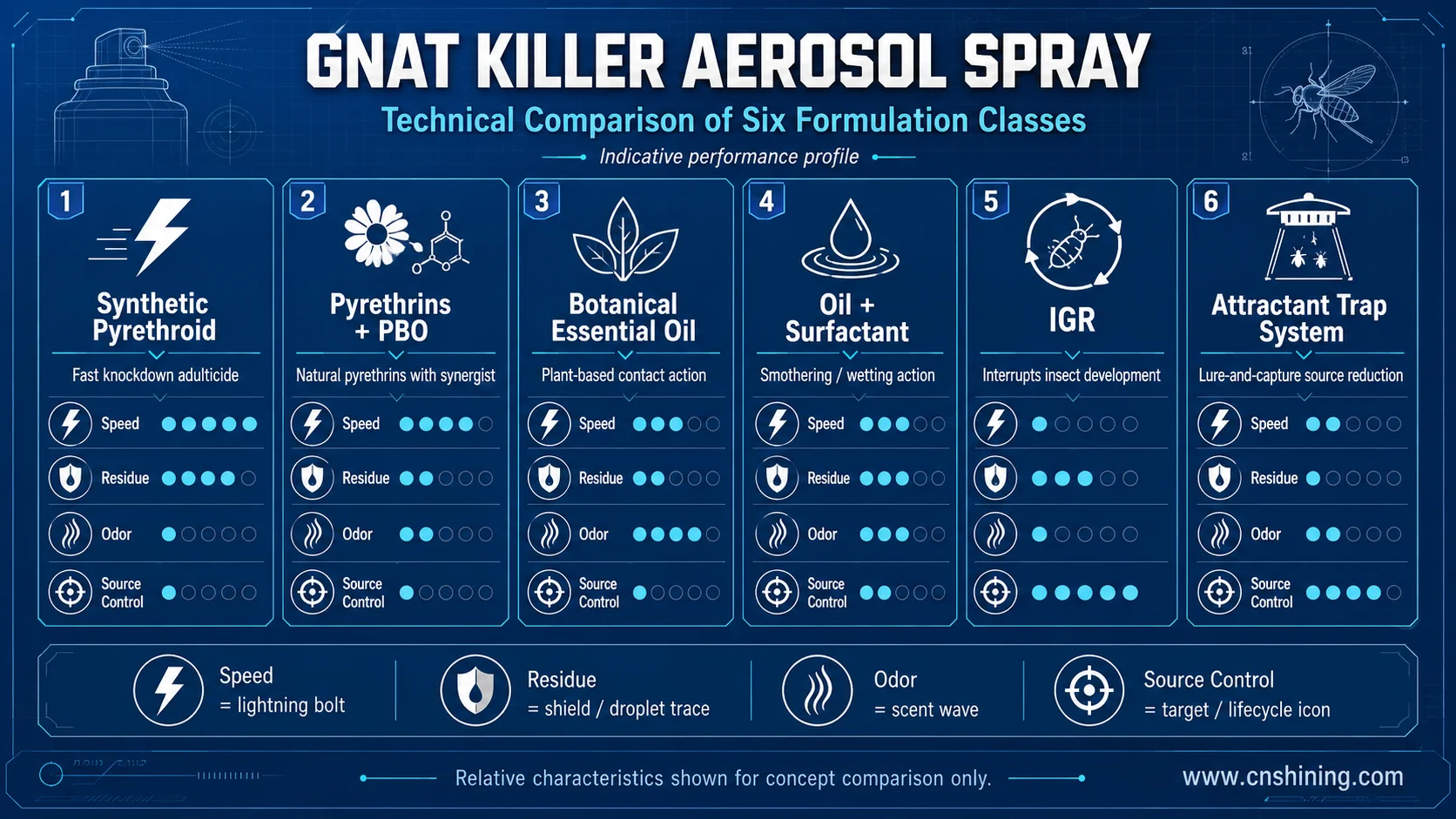
| Formula Class | Public Examples | Main Function | Advantages | Limits | Safety Notes |
|---|---|---|---|---|---|
| Synthetic pyrethroids | Flying insect aerosols | Fast knockdown, space spray, some surface residual control | Low cost, fast effect, mature consumer understanding | Odor and ventilation concerns; environmental risk communication needed | Labels commonly require ventilation and precautions around fish, aquatic organisms, and bees. |
| Natural pyrethrins + PBO | CB-80 type commercial aerosols | Fast knockdown for professional space treatment | Botanical-source narrative with quick knockdown | Shorter residual profile; inhalation and flammability controls remain relevant | The CB-80 SDS identifies pyrethrins and piperonyl butoxide and classifies the product as a flammable aerosol. |
| Botanical essential oil systems | Geraniol, lemongrass, rosemary, cornmint systems | Contact kill, sensory repellency, household-friendly positioning | Lower traditional chemical odor perception | Oil film, strong fragrance, direct-hit dependence, stability pressure | Plant-derived does not mean zero risk for every pet or sensitive user. |
| Essential oil + surfactant blends | SLS plus rosemary and cornmint style systems | Wetting, contact kill, easier surface cleanup | Fits kitchen and living-space expectations | Users may complain about streaming, wet spray, or residue | Spray pattern and output rate become part of the safety profile. |
| IGR-led or IGR-assisted systems | Not common in mainstream retail gnat aerosols | Inhibits immature insect development | Better lifecycle logic | Lower instant-kill satisfaction; more education needed | More common in broader pest programs than in simple gnat aerosol SKUs. |
| CO2 / attractant systems | Traps and lure devices | Attracts and captures target insects | Good for background control | Weak instant-kill effect | Closer to a trap ecosystem than to handheld aerosol spraying. |
From a product development view, “more natural” is not a full answer. Users judge four things fast: does it knock insects down, does it stain the room, does the odor take over the space, and does the nozzle behave. For botanical formulas, packaging and spray quality can decide whether a technically valid formula is accepted or rejected.
4. Market Size, Trend Signals, and Category Boundaries
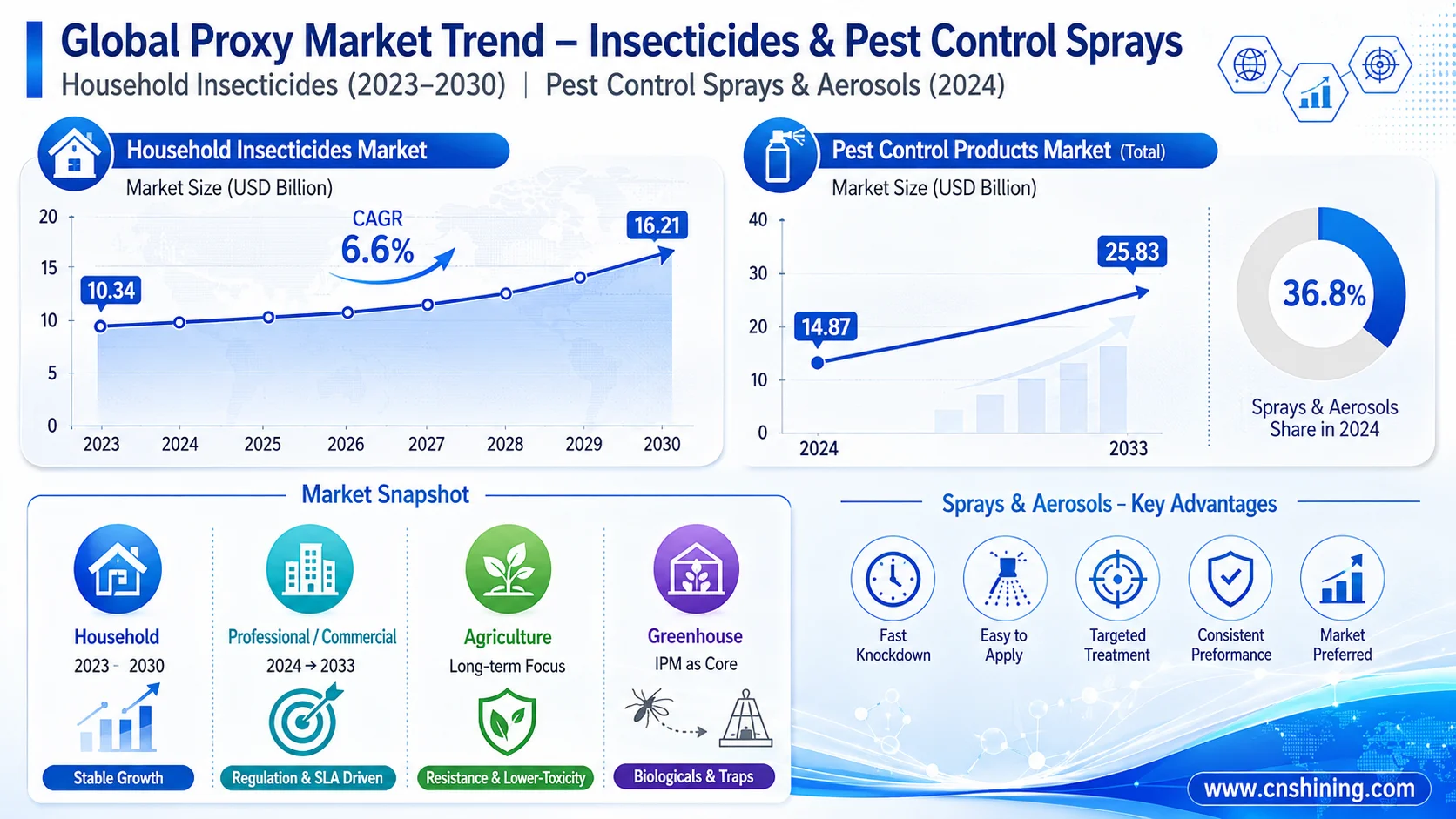
Public data indicates that the global household insecticides market was about USD 10.34 billion in 2023 and is projected to reach about USD 16.21 billion by 2030, with a CAGR around 6.6% (household insecticides market proxy). A broader pest control products market estimate places the 2024 global market at about USD 14.87 billion and 2033 at about USD 25.83 billion; sprays and aerosols accounted for about 36.8% in 2024 (pest control products market report).
| Segment | Public Scale | Trend Judgment | Technical Conclusion |
|---|---|---|---|
| Household | Household insecticides: about USD 10.34B in 2023 to about USD 16.21B in 2030 | Stable growth; sprays and aerosols remain familiar carriers | Main retail base for gnat killer aerosol spray |
| Professional / commercial | Pest control products: about USD 14.87B in 2024 to about USD 25.83B in 2033 | Driven by regulation, food-area controls, service efficiency, and SLA pressure | Labels, stable spray output, and treatment cost per area matter more |
| Agriculture | Large insecticide market, but not a direct gnat aerosol match | Resistance management and lower-toxicity programs are gaining weight | Adult-only aerosol treatment has limited strategic role |
| Greenhouse / protected growing | Independent gnat aerosol scale not specified | Biological controls, BTI, nematodes, microbial tools, and traps gain attention | Fungus gnat control shifts toward IPM, not just more aerosol cans |
The category is therefore split in character. Retail gnat aerosol is an experience-driven fast-moving product. Greenhouse fungus gnat control is closer to a system problem: monitoring, moisture control, larval treatment, and adult suppression.
5. Top 10 Gnat Killer Aerosol Spray Brands
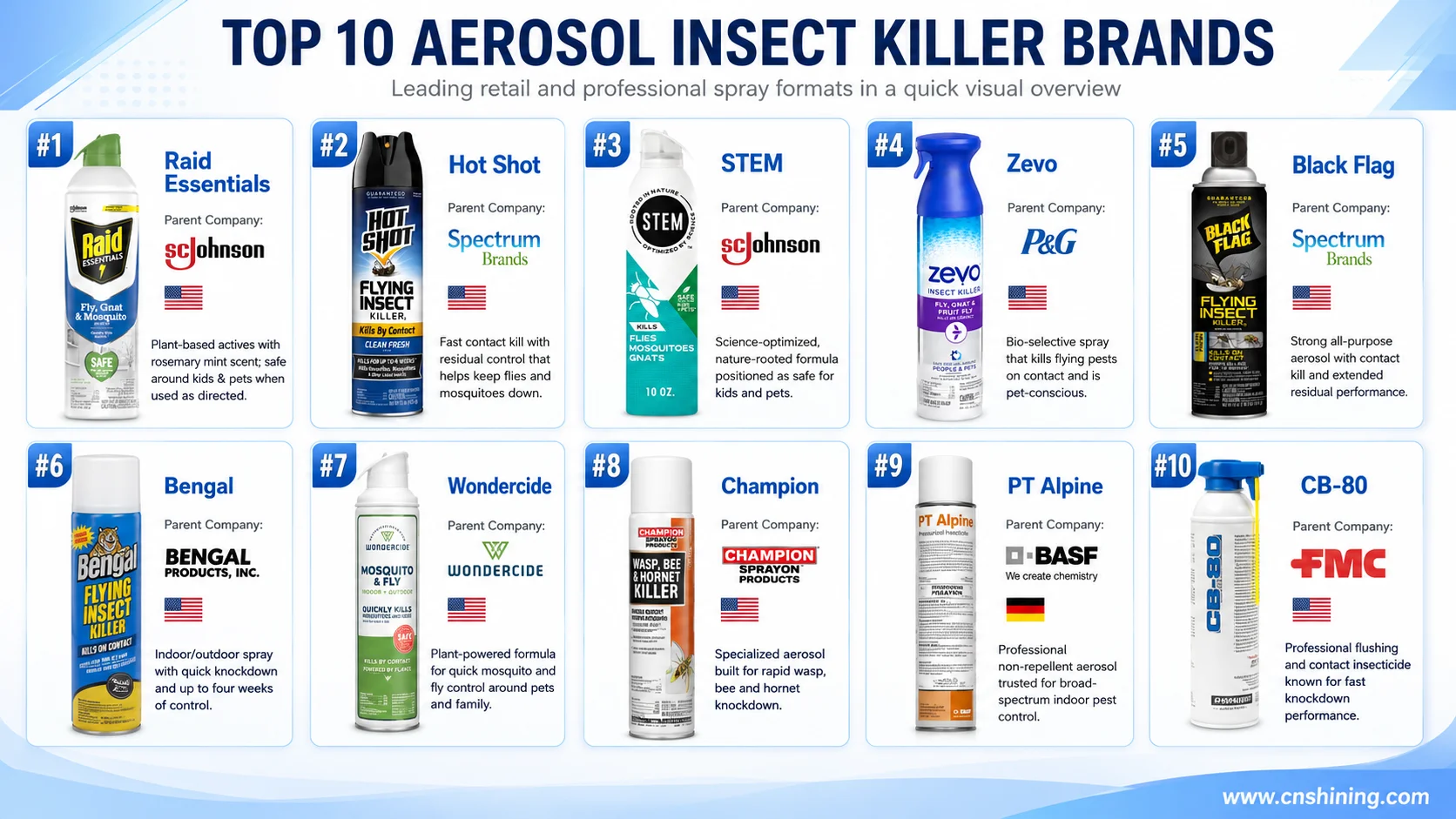
| Brand | Country | Parent Company | Common Size | Market Price Range | Technical Comment |
|---|---|---|---|---|---|
| Raid | United States | S.C. Johnson | 15 / 18 / 20 oz | about $7–11 | Mature fast-kill route with strong label, channel, and consumer familiarity. |
| Hot Shot | United States | United Industries / Spectrum Brands | 15 / 18.75 oz | about $4–5 per can | Low-price, high-coverage retail product for price-sensitive users. |
| STEM | United States | S.C. Johnson | 10 / 12 oz | about $7–8 | Strong botanical positioning, but residue and scent are frequent user issues. |
| Zevo | United States | Procter & Gamble | 10 oz | about $8–10 | Strong household packaging language, with divided feedback on nozzle and spray stream. |
| Black Flag | United States | United Industries / Spectrum Brands | 18 oz | about $5–8 | Traditional route with stronger residual-control positioning. |
| Bengal | United States | Bengal Products Inc. | 16 oz | about $12 per can equivalent | Known in southern and outdoor-use contexts. |
| Wondercide | United States | Wondercide | 10 oz | about $13 | Essential-oil route with clear natural-product positioning. |
| Champion Sprayon | United States | Chase Products Co. | 18 oz | about $6–9 | Industrial and commercial aerosol manufacturing background. |
| PT Alpine | Germany / US | BASF | 14 oz | above about $22 | Professional pest-control positioning with higher unit cost. |
| CB-80 | United States | FMC Corporation | 17 oz | about $36–44 | Classic professional pyrethrins + PBO fast-knockdown route. |
6. Regulatory and Compliance Points
6.1 United States and Canada
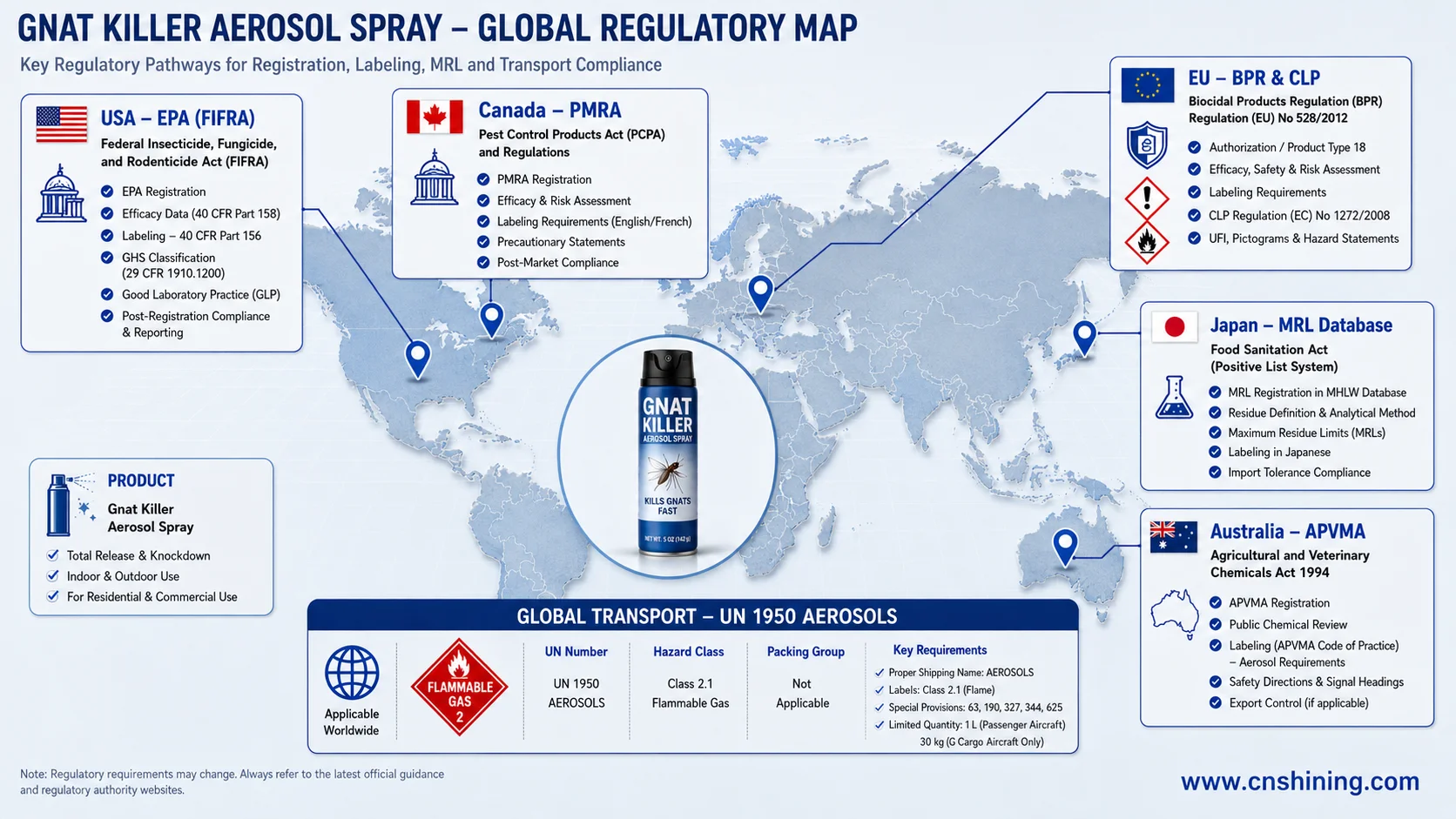
In the United States, the practical entry point is EPA registration and FIFRA label compliance. EPA product registration search is the starting point for checking registered pesticide products (EPA registered pesticide product search). EPA also explains pesticide labeling requirements, which turn registration decisions into enforceable use directions, restrictions, and precaution statements (EPA pesticide labeling requirements).
Food-handling use is more sensitive. For pyrethrins, eCFR 40 CFR 180.128 gives a tolerance framework for residues in food-handling establishments (pyrethrins residue tolerance rule). If a spray is intended for commercial kitchens or back-of-house areas, the use-site wording becomes as important as the knockdown claim.
Canada should not be treated as a simple US-label translation project. PMRA policies and label process documents provide a separate framework for pesticide product labels and domestic-class presentation (Canada PMRA policies and guidelines).
6.2 European Union and United Kingdom
In the EU, a gnat aerosol may touch multiple rule sets: BPR for biocidal product authorization, CLP for hazard communication, and aerosol dispenser rules for the pressurized container. The ECHA BPR page gives the legislative basis for biocidal products (ECHA Biocidal Products Regulation legislation).
Older actives show where the market is moving. ECHA’s PIC factsheet for dichlorvos shows the EU’s restrictive position on some older organophosphate routes, while other synergist systems may still have defined approval pathways (ECHA PIC factsheet reference). For food or crop-related claims, the EU pesticides database gives active-substance and MRL search functions (EU pesticides database).
6.3 Asia-Pacific, Latin America, and Transport
Australia and New Zealand have harmonised aerosol label guidance through APVMA (APVMA aerosol labelling guidance). Japan maintains an official MRL database for agricultural chemicals (Japan pesticides MRL database).
Transport is often underestimated. Aerosols are hazardous materials, commonly handled under UN 1950 and limited-quantity logic. The US DOT aerosol fact sheet states that aerosol products are considered hazardous material and explains limited-quantity packaging and hazard communication points (US DOT aerosol shipping fact sheet).
7. Alternative Control Methods and User Pain Points
| Method | Main Target Stage | Speed | Residual / Continuity | Fungus Gnat Source Control | Main Advantage | Main Limit |
|---|---|---|---|---|---|---|
| Aerosol / pressurized spray | Adults | Fast | Short to medium, depending on surface residual claim | Low | Strong “see it, spray it” satisfaction | Often kills adults without solving larvae in substrate |
| Light / sticky trap | Adults | Medium | Continuous 24/7 capture | Low to medium | Low odor and suitable for background control | Cannot remove a heavy breeding source alone |
| Electric zapper | Adults | Medium | Continuous | Low | Visible capture feedback | Not always suitable for kitchen, indoor plant, or quiet living spaces |
| Fogger / total release | Mainly airborne adults | Fast | Depends on formula | Low | Covers a larger volume at once | Higher ventilation and exposure-management burden |
| Bait | Feeding flies | Medium | Medium | Limited for gnats | Good persistence for selected fly species | Not the main route for fungus gnats or non-biting gnats |
| Biological control | Larvae | Medium | High | High | Targets the breeding source | Less immediate than spray; education burden is higher |
The best practical combination is usually not one tool. Aerosol spray removes visible adults. Traps handle background capture. Houseplant or greenhouse cases need larval source control. This explains why spray-and-trap bundles are more technically honest than a single “one-can-solves-all” claim.
User Pain Points Seen in Retail Feedback
| Pain Point | Frequency Judgment | Severity Judgment | Reason |
|---|---|---|---|
| Slow kill, repeated spraying, only wetting insects | High | High | Directly damages the user’s “does it work?” perception. |
| Oil film, slippery floor, wall or surface residue | High | High | Creates indoor dissatisfaction, especially in kitchens and living rooms. |
| Nozzle failure, streaming instead of fine mist | Medium-high | High | A failed actuator makes even a valid formula feel unusable. |
| Strong scent or disliked fragrance | Medium-high | Medium | Tolerance varies by user, but indoor acceptance depends on it. |
| Pet concerns, especially birds and aquariums | Medium | High | Misuse can become a serious brand and safety issue. |
The single most practical retail improvement is clear: improve fine mist, uniform output, controllability, and low residue. Complaints about streaming actuators and oily deposits can pull down a formula that otherwise performs reasonably well.
8. Packaging Improvement, Aerosol Hardware, and Shining Packaging Fit
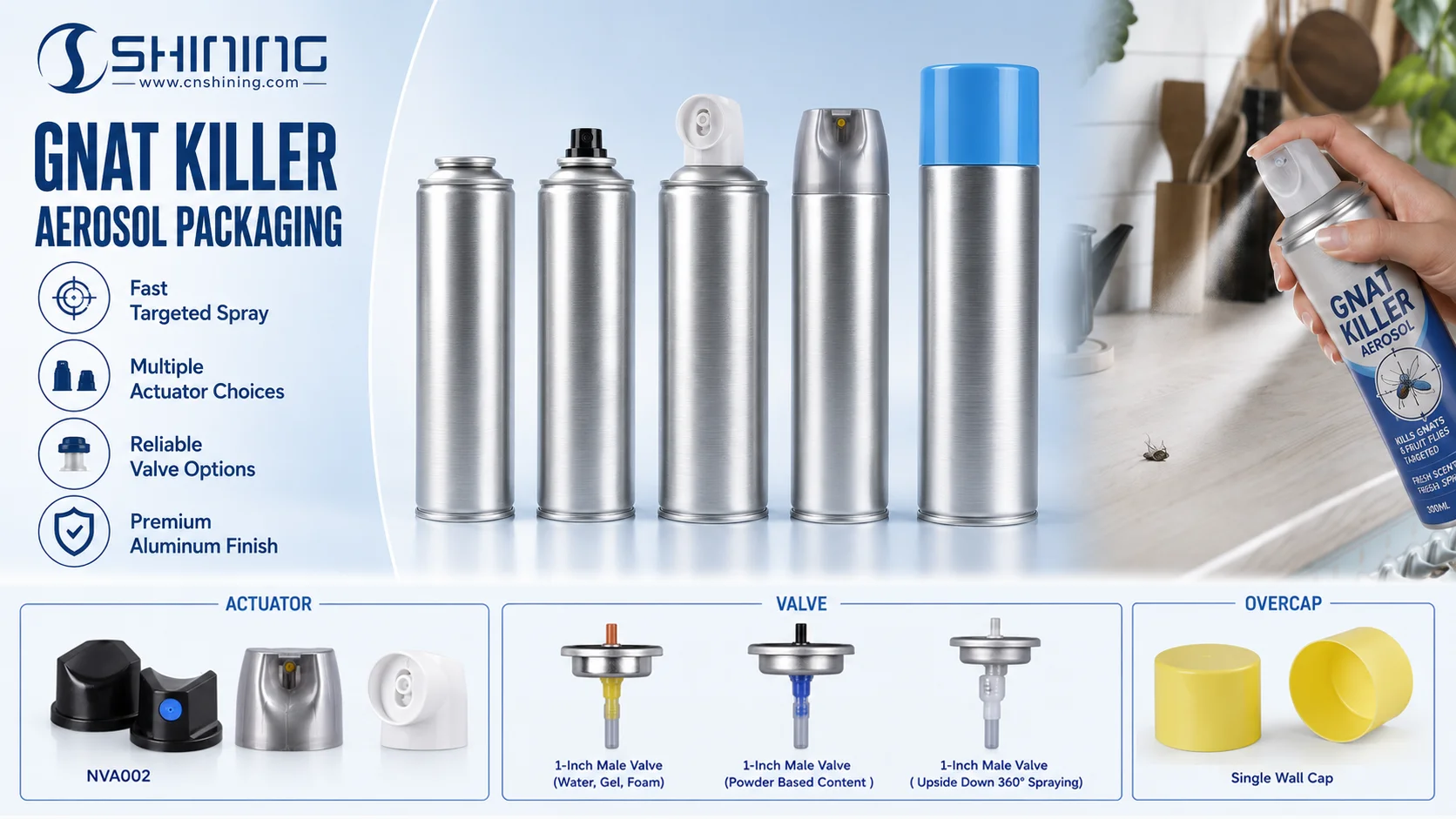
For gnat killer aerosol spray, packaging is not decoration. It controls droplet size, output rate, target accuracy, leakage risk, storage stability, and the user’s first impression of whether the product works. The actuator, valve, and aerosol can must be treated as one delivery system.
Shining Packaging fits this part of the problem through practical aerosol hardware: actuators, aerosol cans, and valves. For botanical or surfactant-heavy formulas, the key checks are spray pattern consistency, clogging tendency, valve compatibility, inner coating compatibility, and output control. For pyrethrin or pyrethroid aerosols, the same hardware discipline helps with space spray, directional spray, and reduced mis-spray.
| Improvement Direction | Pain Point Addressed | Technical Implementation | Cost / Feasibility |
|---|---|---|---|
| Redesign actuator and orifice combination | Streaming, poor reach, nozzle failure | Fine atomizing orifice, optimized swirl chamber or pre-orifice, anti-clog geometry | Low to medium cost; high feasibility |
| Make ON/OFF and first-use steps visible | Mis-spray, wrong operation, poor grip | High-contrast icons, lock ring, tamper film, shoulder-area instruction | Low cost; high feasibility |
| Use controlled-output valves for botanical formulas | Too much liquid, residue, strong scent | Short-stroke or metered-style output to reduce each spray dose | Medium cost; medium-high feasibility |
| Upgrade can material and inner coating | Corrosion, formula discoloration, essential-oil compatibility | Aluminum can or more compatible lining; run extraction and corrosion tests | Medium cost; medium feasibility |
| Improve ergonomic targeting | Hard-to-aim spray, hand fatigue | Finger-rest actuator, guided spray direction, slimmer can profile | Low cost; high feasibility |
| Add residue and cleaning icons | Wrong user expectation | Front-panel reminders: wipe after use, avoid plants, food-contact surfaces, and floors where required | Low cost; high feasibility |
9. Recent Development and Patent Direction
The recent technical direction is clear. Botanical and lower-toxicity alternatives are still gaining attention, but the hard work is moving from actives to delivery. Essential-oil research highlights formulation problems such as volatility, stability, controlled release, and synergist design (essential oil pest management review).
Delivery-system patents are also relevant. One recent aerosol spray device patent describes a canister, active solution reservoir, propellant flow, and venturi nozzle arrangement (aerosol spray device patent). This direction matters because many botanical systems are sensitive to compatibility, clogging, and over-application.
Controlled-release essential oil work also points to a future where gnat control may not mean only a larger can. It may mean smaller, better-metered dosing, trap coordination, or sustained release near breeding or entry points (sustained-release essential oil microemulsion study). At the same time, exposure research keeps pressure on household insecticide design to be more precise and better ventilated (household insecticide exposure study).
For US minimum-risk positioning, developers should also check whether a product truly fits the EPA 25(b) exemption conditions. The exemption is not a free claim area; ingredients and labeling boundaries still matter (EPA minimum-risk pesticide framework).
10. Actionable Development Priorities
| Priority | Recommendation | Expected Benefit |
|---|---|---|
| High | Fix actuator and spray-stream consistency first | Reduces one-star reviews caused by “cannot use it” failures. |
| High | Develop a lower-residue version for botanical products | Addresses the most visible indoor-use complaint. |
| High | Separate adult knockdown and larval source control in packaging copy | Reduces false expectation that one adult spray removes the breeding source. |
| Medium | Create spray + trap starter SKUs | Matches the real use pattern and supports longer background control. |
| Medium | Add clearer bird, aquarium, food-area, and plant-soil restriction icons | Reduces misuse risk and customer-service pressure. |
| Medium | Build professional-grade low-clog valve platforms | Improves repeat use and service-provider confidence. |
11. Technical Glossary
| Term | Plain Technical Meaning | Commercial Meaning |
|---|---|---|
| Fungus gnats | Small flies common in houseplant and greenhouse growing media | Adult spray alone rarely solves the source. |
| Knockdown | Fast paralysis or fall-down after exposure | Shapes first user impression of efficacy. |
| Residual control | Continued effect left on a treated surface | Can reduce reapplication, but may raise residue concerns. |
| Pyrethrins | Botanical insecticidal actives from chrysanthemum sources | Botanical source does not remove safety obligations. |
| Pyrethroids | Synthetic pyrethrin-like insecticides | Fast and mature, but exposure and environmental labels matter. |
| PBO | Piperonyl butoxide, a synergist | Boosts performance while increasing regulatory and label complexity. |
| IGR | Insect growth regulator | Fits lifecycle control better than instant adult kill. |
| Space spray | Spray into room air, not only onto a surface | Requires ventilation and exposure control. |
| Contact kill | The spray must hit the insect body | Demands good atomization and aimability. |
| UN 1950 | Hazardous goods classification commonly used for aerosols | Affects warehousing, transport, fulfillment, and returns. |
12. Conclusion
Gnat killer aerosol spray is best understood as an adult knockdown and user-experience product. It can remove visible flying insects quickly, but it does not automatically solve fungus gnat larvae in moist substrate or recurring breeding sources. This distinction should be visible on packaging, product pages, and FAQ copy.
The next useful product upgrade is not louder fragrance or broader claims. It is a better delivery system: stable fine mist, controlled output, lower residue, clear pet and food-area warnings, and a practical connection to traps or larval source control. For aerosol packaging teams, the actuator, valve, and metal can are no longer secondary components. They are part of the efficacy story.
13. FAQ: Gnat Killer Aerosol Spray
No. It is usually a retail description, not a strict regulatory class. In labels and online listings, “gnats” may cover fungus gnats, fruit flies, non-biting gnats, small flying moths, and sometimes mosquito-like nuisance insects. For registration and label review, the exact active ingredient, target pest, use site, and claim wording matter more than the retail phrase.
Aerosol spray mainly knocks down adult flies. Fungus gnat larvae usually develop in moist organic potting media, greenhouse substrates, or seedling trays. If the substrate remains wet and larvae survive, new adults will keep emerging. The spray may be working on visible adults, but the breeding source remains untreated. Moisture control and larval management are needed.
Pyrethrins are insecticidal actives derived from chrysanthemum sources. Pyrethroids are synthetic compounds designed to act in a similar nerve-disrupting way. Both can deliver fast knockdown against flying insects. The practical difference is not only origin. Label restrictions, residual behavior, odor, toxicity communication, environmental risk, and formulation stability must all be checked during development.
Piperonyl butoxide, often called PBO, is a synergist rather than the main killing active. It works by reducing the insect’s ability to metabolize pyrethrins or pyrethroids. This can improve knockdown performance. The trade-off is added label and regulatory complexity. Product teams should treat PBO as a functional chemical choice, not as a simple performance shortcut.
Many botanical systems rely on essential oils and surfactants. These materials can wet insect bodies effectively, but they may also leave oily film on floors, counters, or walls. A high output valve or poor actuator can make the problem worse by over-applying liquid. Low-residue formulation work must be matched with controlled spray output and droplet design.
Gnats are small, mobile, and hard to hit directly. If the actuator produces a stream instead of a fine mist, the user may miss the target or over-wet nearby surfaces. Spray pattern affects efficacy, residue, scent intensity, and perceived product quality. For this category, actuator design and valve output are part of the insect-control system.
Traps and aerosols solve different parts of the problem. Aerosols give immediate adult knockdown when insects are visible. Light or sticky traps provide continuous background capture and monitoring. For fungus gnats, neither tool alone fully handles larvae in the growing medium. The strongest technical approach is often spray for adults, trap for monitoring, and source control for larvae.
Check whether the label allows the intended use site. Food-handling areas may require removing or covering food, washing utensils or contact surfaces, ventilating the area, and avoiding use while food is exposed. A product that works in a home living room may not be acceptable in a commercial kitchen. Label language controls the legal use case.
Many insecticide aerosols require precautions around pets, birds, fish tanks, ponds, and aquatic environments. Pyrethroid and pyrethrin systems can be especially sensitive for aquatic organisms, while fragrance and solvent exposure may also concern sensitive pets. Good packaging should make these restrictions visible, not buried. Clear icons reduce accidental misuse and post-use complaints.
Start with actuator pattern, valve output rate, clogging behavior, can compatibility, and inner coating stability. Then test after heat aging, cold storage, repeated partial use, and real handling. For essential-oil formulas, also check corrosion, elastomer swelling, scent change, and residue after spraying. Packaging failure can make an effective formula look ineffective to users.