
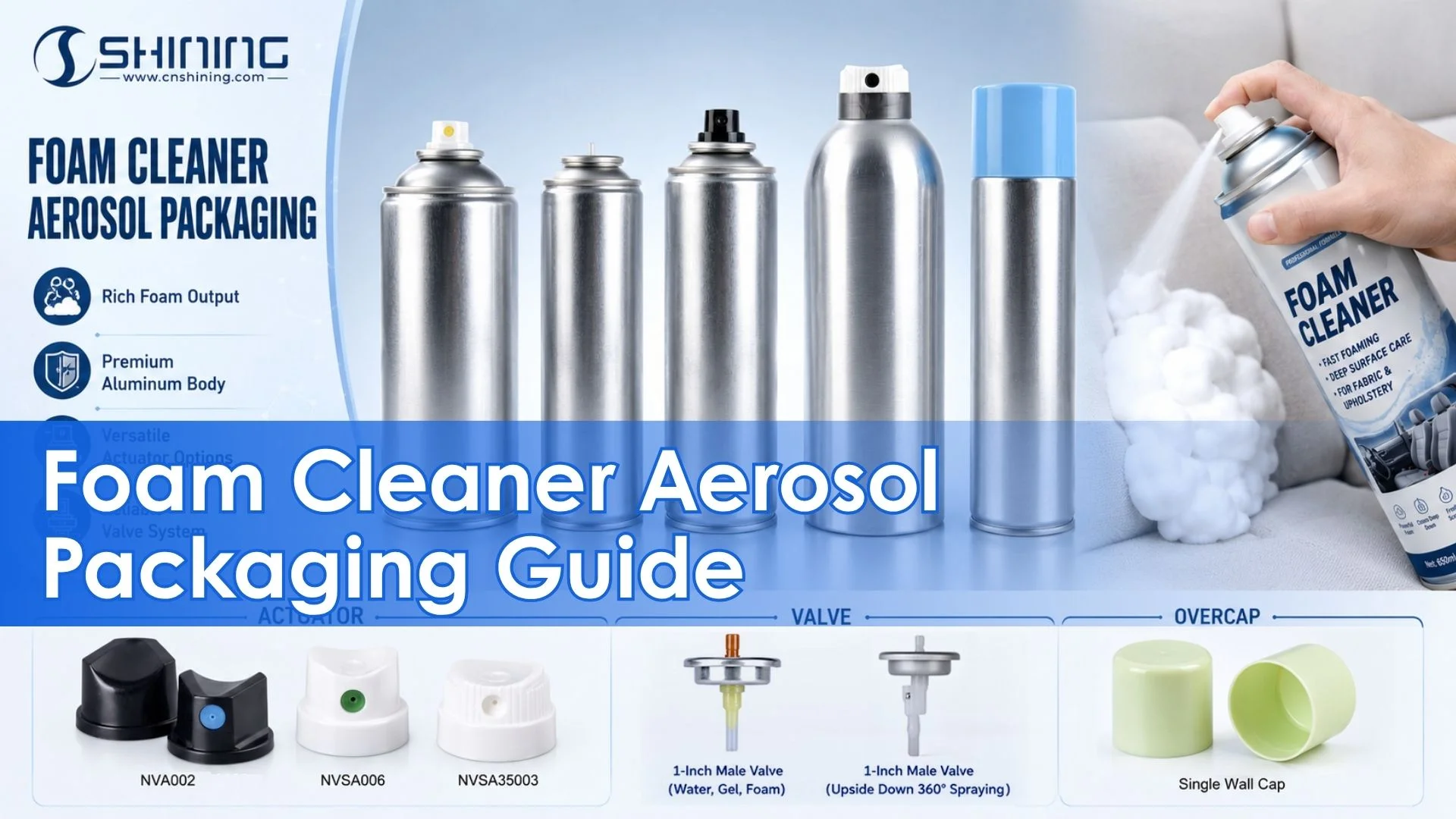
Foaming aerosol cleaner, aerosol foam spray, no-drip glass foam, upholstery foam cleaner, coil cleaning foam, and hard-surface foam aerosol all describe the same engineering problem: a cleaning formulation must leave a pressurized package as a controlled foam, stay on the target surface long enough to work, and then break down without excessive odor, streaking, or residue.
A foam cleaner aerosol is not simply liquid cleaner packed into a metal can. It is a pressure-packaged cleaning system. The formulation, propellant, valve, actuator, dip tube, inner coating, and can geometry all influence the final foam. For vertical glass, bathroom panels, automotive fabric, HVAC coils, and local industrial cleaning, the value of foam is clear: better surface cling, longer dwell time, less run-off, and more precise placement.
1. Definition and Working Mechanism
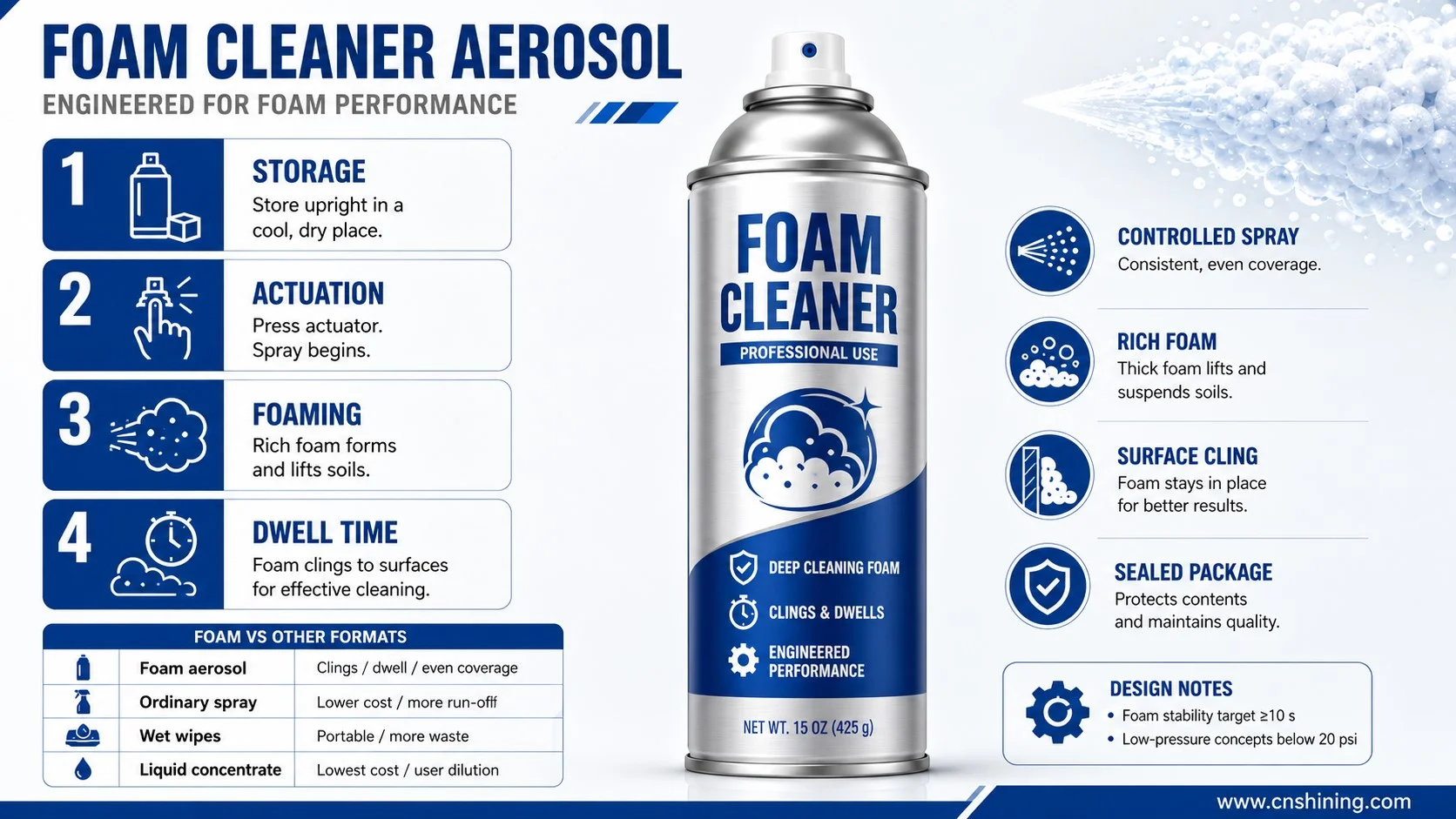
From an engineering view, the working sequence can be divided into four steps. First, the can stores a cleaning concentrate. Typical components include water, surfactants, co-solvents, chelating agents, pH regulators, fragrance, and preservatives. In a standard aerosol, product and propellant share the same container. In Bag-on-Valve aerosol systems, the product is held in a pouch while the propellant remains outside the bag.
Second, the user presses the actuator. The valve opens, and internal pressure drives the product through the dip tube and valve stem. Third, the product foams during discharge. Propellant flash-off, air entrainment, and actuator geometry define foam cell size, wetness, spray width, and surface cling. Fourth, the foam remains on the surface for a controlled period and then collapses. During that dwell time, surfactants and solvents contact soil more effectively.
The source report notes that US8927479B2 treats foam stability of at least 10 seconds as a design target for an aerosol bathroom cleaner. EP3697374B1 shows low-pressure foaming concepts, dip-tube and Bag-on-Valve structures, and pressure ideas below 20 psi.
The commercial logic is simple. Foam quality is a terminal-use performance metric. It is not controlled by chemistry alone. A brand may use similar surfactant chemistry to another product, but the user will judge spray control, foam stability, residue, odor, and final wiping feel.
| Format | Main Advantages | Main Limits | Better-Fit Scenarios |
|---|---|---|---|
| Foam aerosol | Better vertical cling, longer local dwell time, convenient use, sealed package, even coverage | Pressurized container constraints, flammability and VOC rules, refill flexibility is limited | Glass, bathroom walls, automotive interiors, coils, local industrial cleaning |
| Ordinary spray | Lower cost, broad formula space, refill systems are easier | Run-off, short dwell time, visible overspray | General hard surfaces and daily touch-up cleaning |
| Wet wipes | Portable, pre-dosed, low overspray | Higher unit cost, more solid waste, weaker efficiency on large areas | Portable spot cleaning |
| Liquid or concentrate | Lowest unit cost, suitable for bulk and institutional channels | Dilution depends on users, cleaning is wetter, experience is less immediate | B2B back-of-house cleaning and professional dilution systems |
The aerosol value proposition is still built on controlled dispensing, uniform application, hygiene, and convenience. Yet the category is being challenged by Bag-on-Valve, dosing systems, and refill formats. Foam aerosol keeps its advantage where cling and dwell time solve a real cleaning problem.
2. Growth Drivers and Technical Limits
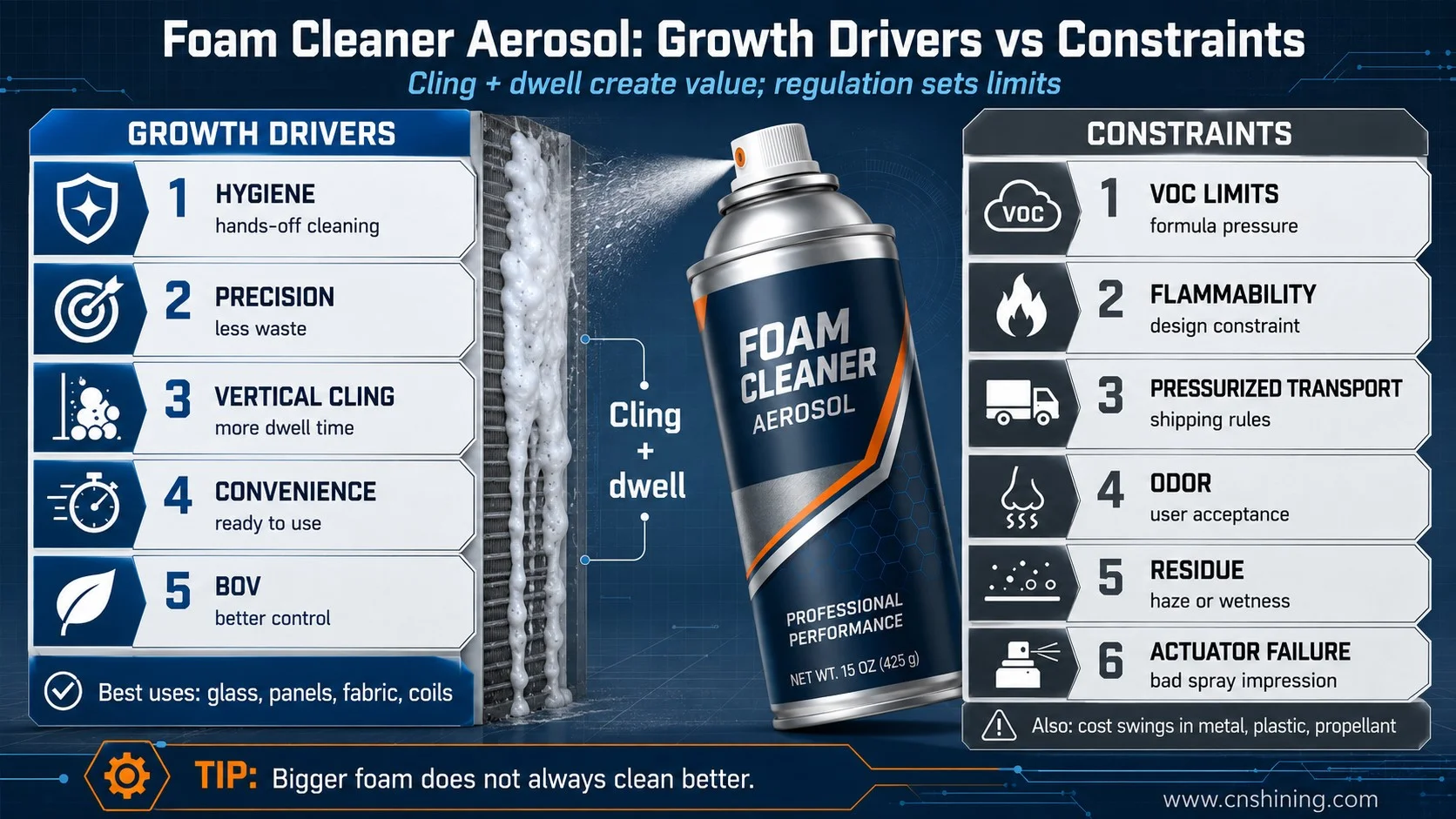
Growth comes first from convenience and hygiene. Glass doors, bathroom vertical panels, car seat fabric, condenser coils, evaporators, and local machinery cleaning all benefit from “cling plus dwell.” This is where foam makes sense. It reduces run-off and gives the chemistry time to work.
Packaging upgrades are the second driver. Bag-on-Valve, lightweight metal cans, lower-GWP propellants, and better lockable actuators allow the format to keep convenience while responding to sustainability and transport pressure.
The limits are just as clear. The first limit is regulation: VOC caps, flammability classifications, chemical inventory status, labeling, and transport rules all affect product design. The second is cost: aluminum, steel, plastic, and propellant price swings move the margin. The third is user experience. If the product smells too strong, leaves haze, clogs, sprays wet, or fails near the end of the can, the user sees one failed product, not five separate engineering variables.
3. Formula Routes, Component Functions and Safety Notes
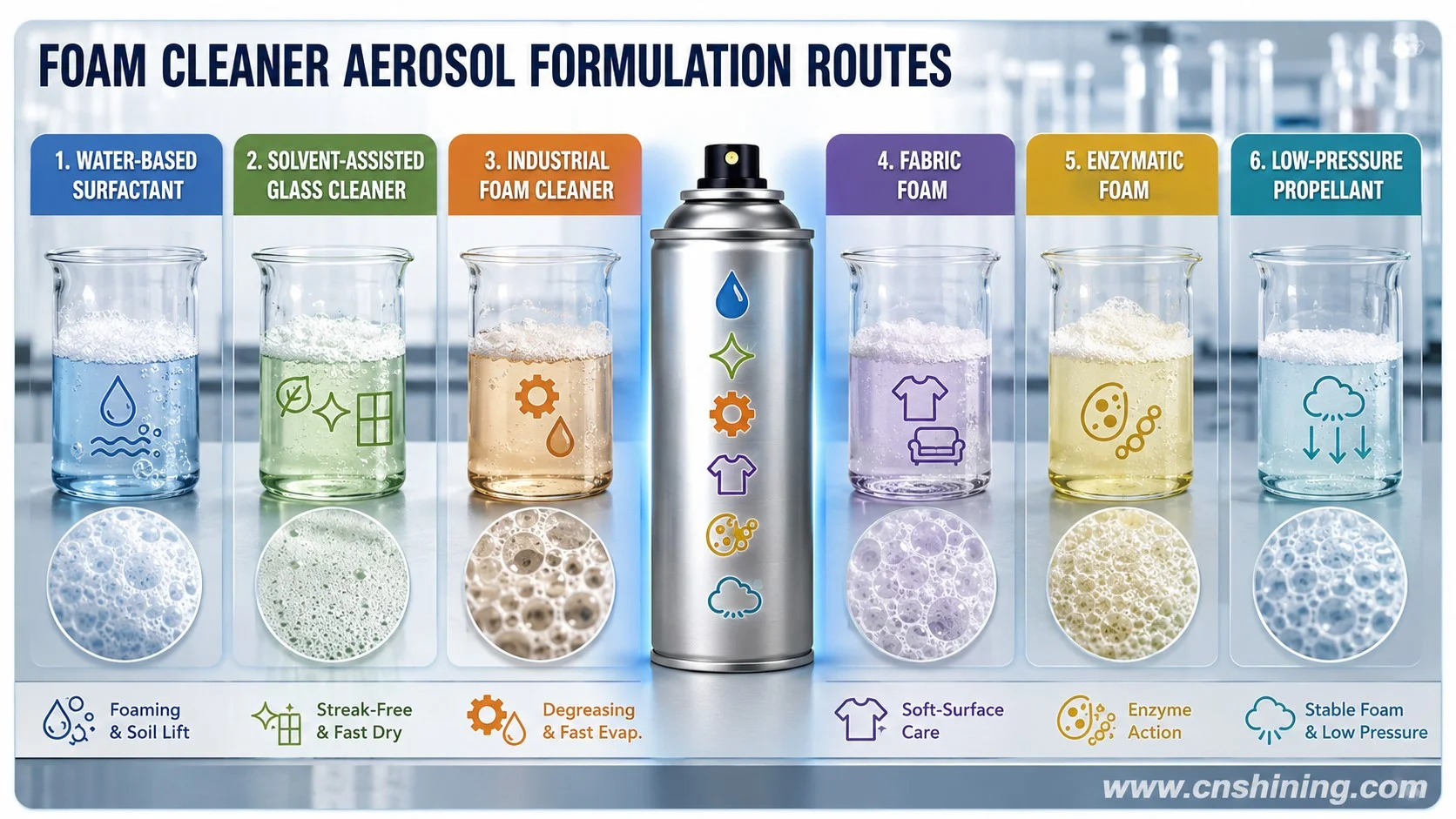
Foam cleaner aerosol has no single standard formula. The stable core is surfactant chemistry, supported by solvents, chelants, pH control, foam-structure control, propellant choice, and package compatibility. A detergent formulation review on surfactants and builders also supports this basic direction: surfactants and builder systems remain central to cleaning performance.
| Formula Route | Typical Composition | Publicly Visible Concentration Clues | Main Function | Safety / Toxicology Notes |
|---|---|---|---|---|
| Surfactant-led water-based foam | Water, anionic / nonionic / amphoteric surfactants, small amount of co-solvent | Mechanical foaming patents mention surfactant 0.05-10 wt.%, water at least 80 wt.%, and foam-enhancing solvent 0.1-5 wt.% in many examples, as shown in US20050003990A1. | Wetting, emulsification, soil lift, foaming | Usually milder, but weak on heavy oil and mineral scale unless supported by stronger chemistry or better dwell. |
| Solvent-assisted glass / hard-surface foam | Ethanol, isopropanol, 2-butoxyethanol, surfactant, water, propane / butane | Sprayway glass cleaner SDS lists 2-butoxyethanol 2.5-10%, ethanol 2.5-10%, butane 1-2.5%, and propane 1-2.5%. | Fingerprints, oily film, smoke film, faster dry-down | NIOSH data for 2-butoxyethanol notes inhalation and skin absorption routes. Hydrocarbon propellants are flammable. |
| Industrial solvent-surfactant-water foam | IPA, glycol ethers, propane / butane, surfactant, water | Interflon Foam Clean aerosol SDS lists propane 2.5-<10%, isopropanol 2.5-<10%, butane 2.5-<10%, and 1-methoxy-2-propanol 1-<2.5%. | Oil, fingerprints, quick evaporation, dry industrial cleaning | IPA is flammable and eye-irritating. Hydrocarbon propellants drive pressure and flammability classification. |
| Fabric / interior high-water foam | Water, anionic surfactant, polymer, small amount of solvent and propellant | 3M Scotchgard fabric and upholstery foam SDS shows water 85-90%, isobutane 3-7%, organic acid ester salts 1-5%, styrene maleic anhydride copolymer 1-5%, SLS 1-5%, HFC-152a 1-3%, and 2-BE below 0.5%. | Soft-surface cleaning, lower wetting feel, shorter drying time | Residue and odor control matter more than visual foam density. HFC propellants face climate-pressure in many markets. |
| Enzymatic foam | Amylase / protease, high-foaming surfactants, amphoteric thickener, solvent, preservative or antimicrobial agent | US5998342A describes enzyme 0.05-12%, organic solvent 0.5-40%, high-foaming surfactant 0.5-25%, betaine thickener 0.5-25%, antimicrobial agent 0.001-3%, and TEA 0.05-15%. | Protein, starch, lipid, and organic soil breakdown; useful in some professional pre-cleaning cases | Some antimicrobial or preservative systems need care. ATSDR toxicology data for glutaraldehyde identifies irritation and sensitization concerns. |
| Low-pressure propellant / foaming system | Butane isomers, isopentane, compressed air, CO2, N2O, N2, HFO or HCFO options | EP3697374B1 describes low-pressure foaming or propellant levels commonly around 1-15% or 1-20%, with target pressure ideas at or below 20 psi at 21°C. | Foam density, stability, hand feel, safer pressure window, possible 360° use | Honeywell Solstice HFO-1234ze data positions the propellant as low-GWP, low photochemical reactivity, and nonflammable. |
3.1 Component Function Breakdown
Surfactants wet, emulsify, disperse, and build foam. Alcohols and glycol ethers cut oily film and help drying. Chelants help with calcium and magnesium ions in hard water. pH regulators decide cleaning strength and material compatibility. Polymers and thickeners improve hang time, anti-redeposition, and fabric feel. Fragrance and preservation systems affect odor perception and shelf stability. Propellant supplies pressure, but it also shapes the final foam.
3.2 Common Technical Terms
| Term | Plain Technical Meaning | Commercial Relevance |
|---|---|---|
| Bag-on-Valve | One-way aerosol system separating product from propellant | Higher evacuation, 360° use, cleaner formula isolation |
| Actuator | Pressed top component that controls discharge | Defines spray width, dose feel, pattern, and lock function |
| Valve cup | Metal cup fixing the valve to the can opening | Controls sealing reliability and filling compatibility |
| Dip tube | Tube moving liquid from can bottom to valve | Affects clean emptying and residue inside the package |
| Foam stability | Time before foam collapses | Defines dwell time and vertical cling |
| Evacuation rate | How much product leaves the package before failure | Directly affects user satisfaction near end of life |
| VOC | Volatile organic compound | Touches regulation, odor, dry-down, and low-emission positioning |
| GWP | Global warming potential | Steers propellant selection and sustainability claims |
| Under-the-cup gassing | Gas filling under the valve cup | Useful for controlling low-pressure system windows |
| Twist-to-lock actuator | Actuator with a lock function and no separate cap in some designs | Reduces accidental discharge during transport and e-commerce handling |
| Inner coating / lacquer | Protective coating inside the metal can | Determines corrosion resistance with water, solvents, alkalinity, and propellant |
| Spot / wide pattern | Narrow or broad dispensing mode | Helps balance local stain work and large-area cleaning |
4. Regulatory and Standards Framework
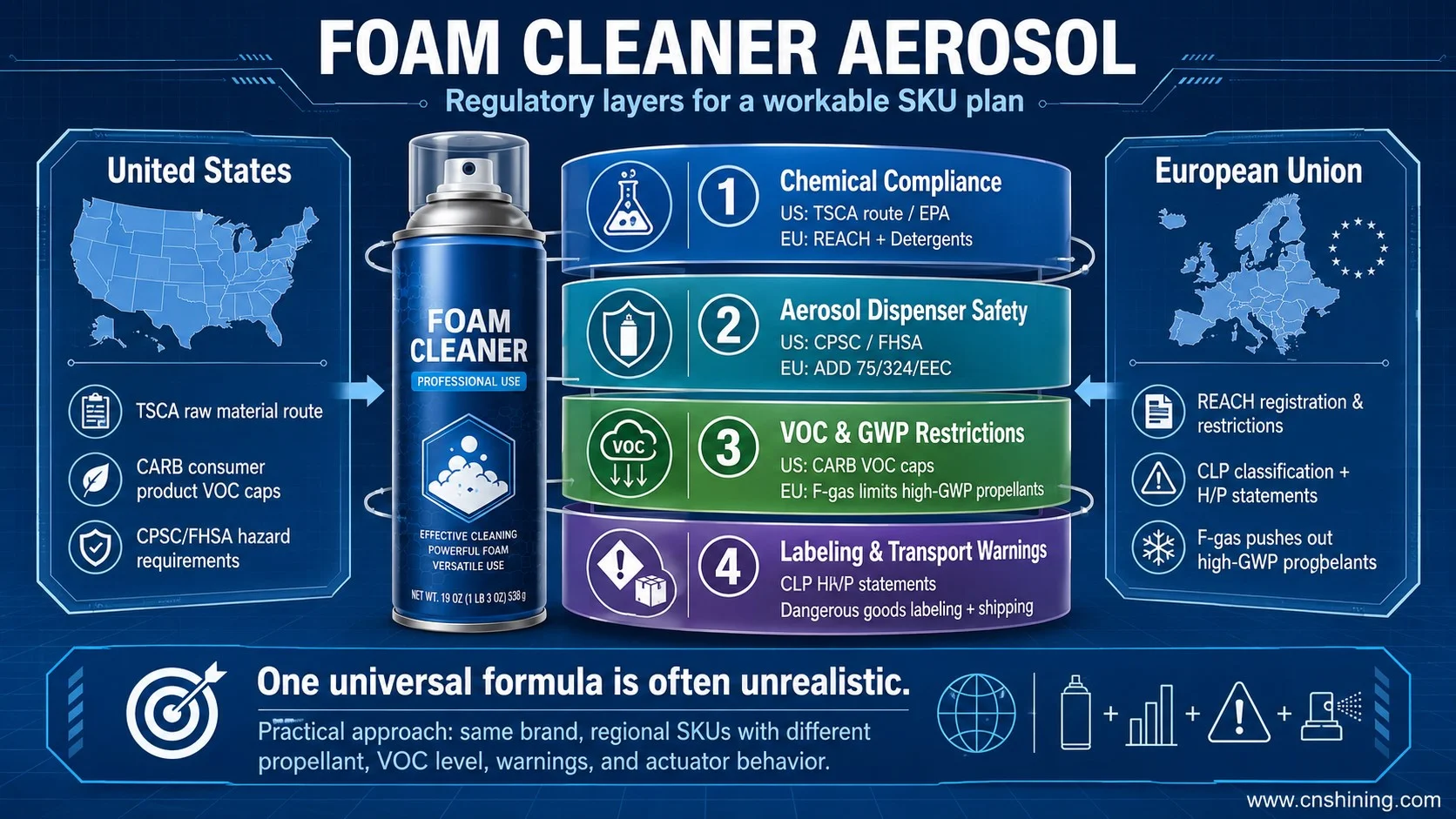
Foam cleaner aerosol is controlled by overlapping requirements. The practical burden is not only “can it foam?” The real work is fitting formula, packaging, labeling, propellant, transport, and regional compliance into one workable SKU plan.
| Region | Key Rules / Standards | Direct Effect on Foam Cleaner Aerosol |
|---|---|---|
| United States | TSCA Inventory, EPA Safer Choice, CARB Consumer Products Regulation, CPSC / FHSA 16 CFR Part 1500 | Raw materials need a TSCA route through the EPA TSCA Chemical Substance Inventory. CARB can set VOC caps for consumer products, including aerosol carpet and upholstery cleaner categories under CARB consumer product regulations. |
| European Union | REACH 1907/2006, CLP 1272/2008, Aerosol Dispensers Directive 75/324/EEC, Detergents Regulation 648/2004, F-gas 2024/573 | REACH Regulation 1907/2006 controls registration, restrictions, and supply-chain communication. CLP sets classification and H/P statements. F-gas pressure pushes high-GWP propellants out of many long-term plans. |
For a global brand, one universal formula is often unrealistic. The more practical structure is the same brand architecture with several regional versions: different propellant choices, VOC levels, warnings, and possibly different actuator behavior.
5. Top Brands and Consumer Pain Points
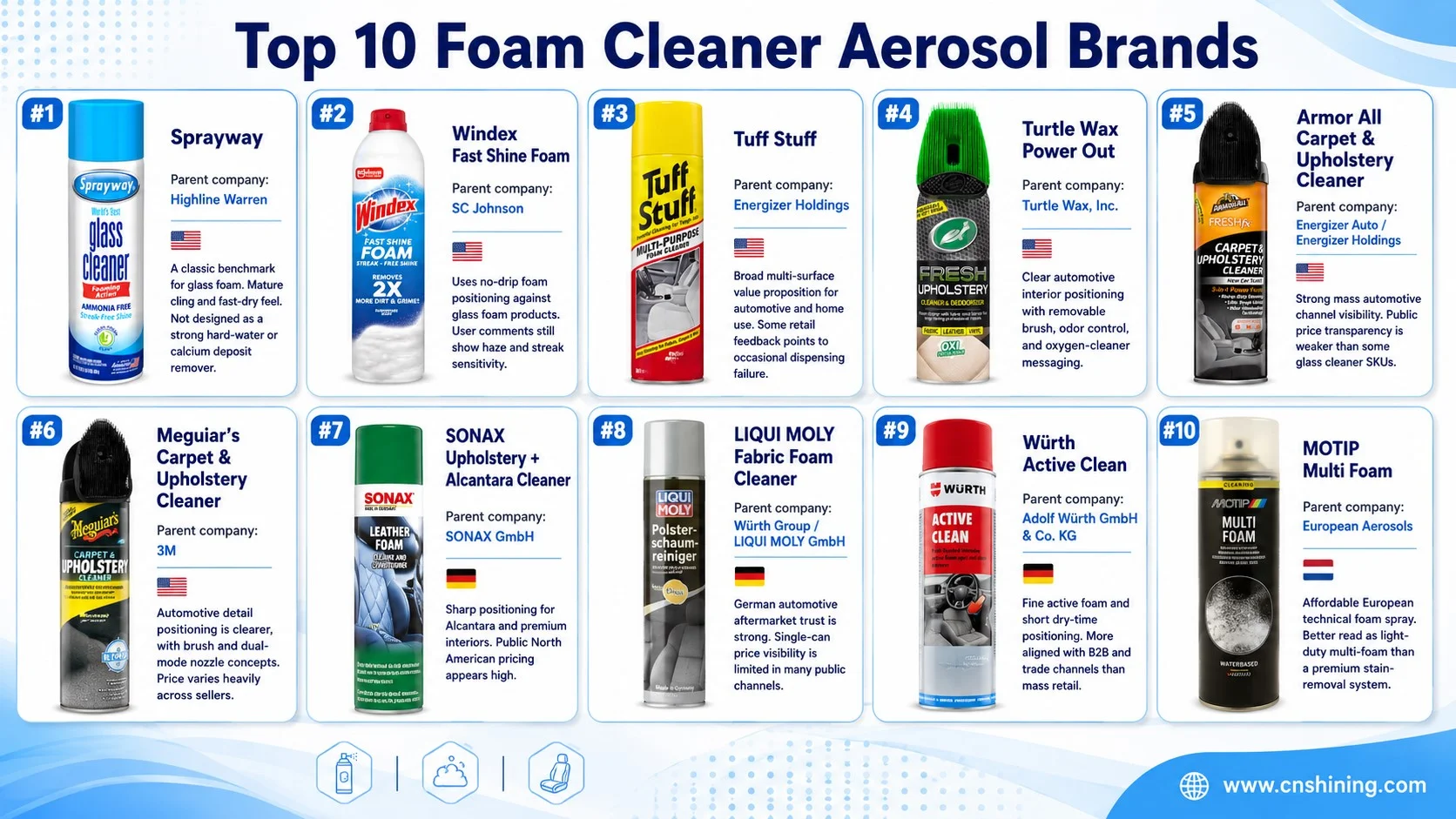
There is no public, verified global sales ranking for foam cleaner aerosol. The following table is better read as 10 high-visibility brand samples across household glass, automotive interior, professional cleaning, and technical foam spray. Prices that cannot be read consistently from public pages remain marked as unspecified.
| Brand | Country / Region | Parent Company | Typical Can Size | Visible Retail Price Range | Technical Comment |
|---|---|---|---|---|---|
| Sprayway | United States | Highline Warren | 19 oz | about 2.48-4$ per can | A classic benchmark for glass foam. Mature cling and fast-dry feel. Not designed as a strong hard-water or calcium deposit remover. |
| Windex Fast Shine Foam | United States | SC Johnson | 19 oz | about 3.48$ per can | Uses no-drip foam positioning against glass foam products. User comments still show haze and streak sensitivity. |
| Tuff Stuff | United States | Energizer Holdings | 22 oz | about 4.47-8$ per can | Broad multi-surface value proposition for automotive and home use. Some retail feedback points to occasional dispensing failure. |
| Turtle Wax Power Out | United States | Turtle Wax, Inc. | 18 oz | about 8.99-18.12$ per can | Clear automotive interior positioning with removable brush, odor control, and oxygen-cleaner messaging. |
| Armor All Carpet & Upholstery Cleaner | United States | Energizer Auto / Energizer Holdings | 22 oz | about 5.97-7.09$ per can | Strong mass automotive channel visibility. Public price transparency is weaker than some glass cleaner SKUs. |
| Meguiar’s Carpet & Upholstery Cleaner | United States | 3M | 19 oz | about 6.57-15.68$ per can | Automotive detail positioning is clearer, with brush and dual-mode nozzle concepts. Price varies heavily across sellers. |
| SONAX Upholstery + Alcantara Cleaner | Germany | SONAX GmbH | 250-400 mL | about 24.64-34.99$ per can | Sharp positioning for Alcantara and premium interiors. Public North American pricing appears high. |
| LIQUI MOLY Fabric Foam Cleaner | Germany | Würth Group / LIQUI MOLY GmbH | 300 mL | about 6.90$ per can | German automotive aftermarket trust is strong. Single-can price visibility is limited in many public channels. |
| Würth Active Clean | Germany | Adolf Würth GmbH & Co. KG | 500 mL / 500 g | about 15.99$ per can | Fine active foam and short dry-time positioning. More aligned with B2B and trade channels than mass retail. |
| MOTIP Multi Foam | Netherlands | European Aerosols | 500 mL | about 4.88-5.68$ per can | Affordable European technical foam spray. Better read as light-duty multi-foam than a premium stain-removal system. |
Consumer Pain Points Seen Across Public Feedback
| Pain Point | Technical Reading | Likely Root Area |
|---|---|---|
| Weak effect on hard-water marks or calcium deposits | Glass foam and descaling foam are different products. A neutral or mild solvent-surfactant glass foam will not remove mineral scale well. | Formula route and pH / chelation strategy |
| Haze, streaking, or white residue | Users tolerate very little visible film on glass. Slight surfactant residue or over-wet spray becomes obvious after drying. | Surfactant level, solvent balance, actuator wetness, wiping instructions |
| Strong odor | High instantaneous VOC release, solvent odor, fragrance load, and over-fine aerosolization can all raise perceived odor. | Solvent system, propellant system, actuator output rate |
| Aerosol can fails to dispense | Users read this as a bad product. Engineering causes may include valve tolerance, stem contamination, clogging inserts, or narrow pressure window. | Valve, actuator, foam insert, filling process |
| Chemical smell and sticky residue on fabric | Fabric systems fail when dose is too high, residue dries tacky, or odor remains trapped in porous material. | Formula solids, polymer choice, dosage, drying behavior |
| Short visual cleaning effect after viral-style foam use | A large foam collapse can look convincing for a few seconds, but long-term surface feel depends on actual soil removal and residue control. | Cleaning chemistry, dwell time, wipe-off process |
The pattern is consistent. Consumers describe one “product problem,” but the root causes split into three groups: formula issues, packaging issues, and formula-packaging coupling issues. Odor, residue, and dispensing instability are the three problems most likely to damage repeat purchase.
6. Packaging Engineering Improvement Routes
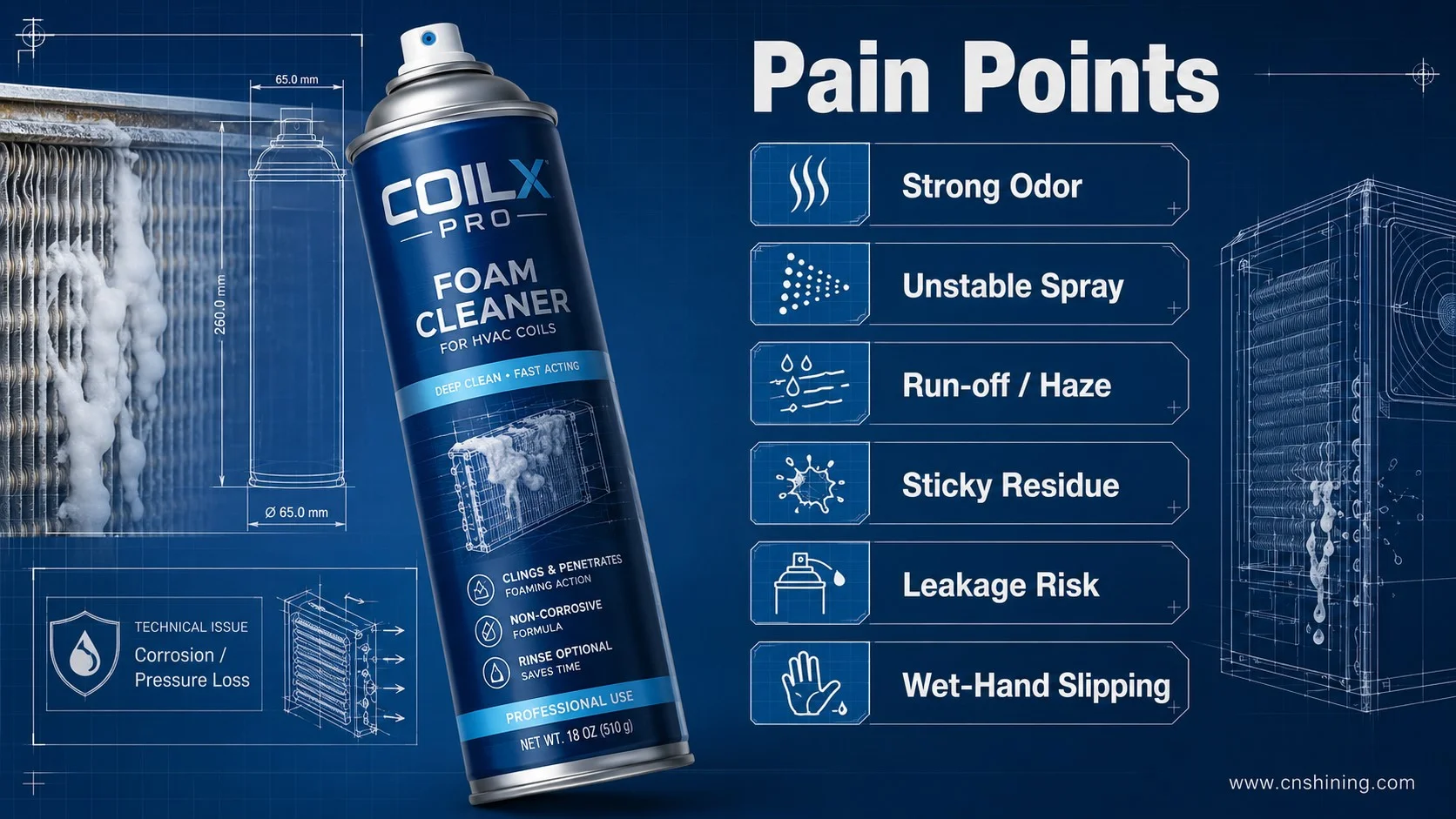
The following routes are engineering judgments based on the pain points above and on visible packaging trends such as Bag-on-Valve, low-pressure dispensing, lockable actuators, lightweight cans, refill systems, and connected dispensing.
| Pain Point | Likely Cause | Packaging / Valve / Actuator Route | Expected Effect |
|---|---|---|---|
| Strong odor | High dose per press, fine atomization, airborne VOC peak | Lower-output metered valve, narrower pattern, wetter foam instead of fine aerosol foam, BOV + compressed gas for premium lines | Lower first-use odor peak and better indoor perception |
| No discharge or unstable spray | Valve tolerance, stem contamination, insert clogging, narrow pressure window | More robust valve platform, anti-clog foam insert, wider channel actuator matched to viscosity | Fewer early misfires and fewer end-of-can complaints |
| Run-off or glass haze | Too-wet discharge, unstable foam, uneven fan pattern | Low-pressure foam generation, optimized air entrainment, more even fan foam for glass | Better vertical hold and lower visible residue |
| Fabric residue or tack | Over-dosing, local over-saturation, unstable final sprays | Spot / wide dual-mode nozzle, higher evacuation rate, BOV for premium fabric products | Cleaner dose control for both stain work and large-area use |
| E-commerce leakage or accidental spray | Weak cap protection, poor lock feedback | E-commerce capable aerosol actuator with twist-to-lock or hoodless structure | Less accidental discharge, less secondary packaging, fewer logistics complaints |
| Wet-hand slipping | Smooth round can, glossy print, bathroom or car use conditions | Matte grip varnish, narrowed waist, tactile grip zone, wet-hand direction icons | Better hand control and fewer drops |
| Internal corrosion, odor drift, pressure loss | Wrong inner coating for water, alcohol, alkalinity, or surfactant system | Separate coating validation for glass, fabric, industrial, and high-water alkaline routes | Better shelf stability and more predictable final-can performance |
6.1 Valve and Actuator Direction
The actuator is now more than a button. It defines dose, pattern, locking behavior, hand feel, and complaint risk. A practical portfolio split is clear: standard metal can plus optimized foam actuator for mass-market SKUs; BOV plus low-pressure compressed gas or low-GWP propellant for higher-value lines.
6.2 Can Form, Printing and Inner Coating
Lightweight metal packaging is a clear direction. For foam cleaner aerosol, the practical value is not only lower metal use. It is also transport weight, premium print surface, and a more credible packaging efficiency story.
Inner coating should not be treated as one universal choice. Glass foam, fabric foam, industrial degreasing foam, and high-water alkaline foam have different corrosion and odor-drift risks. BPA-NI polyester, acrylic, or equivalent coatings need validation against pH, solvent, surfactant, propellant, and storage temperature.
7. Shining Packaging Components for Foam Cleaner Aerosol
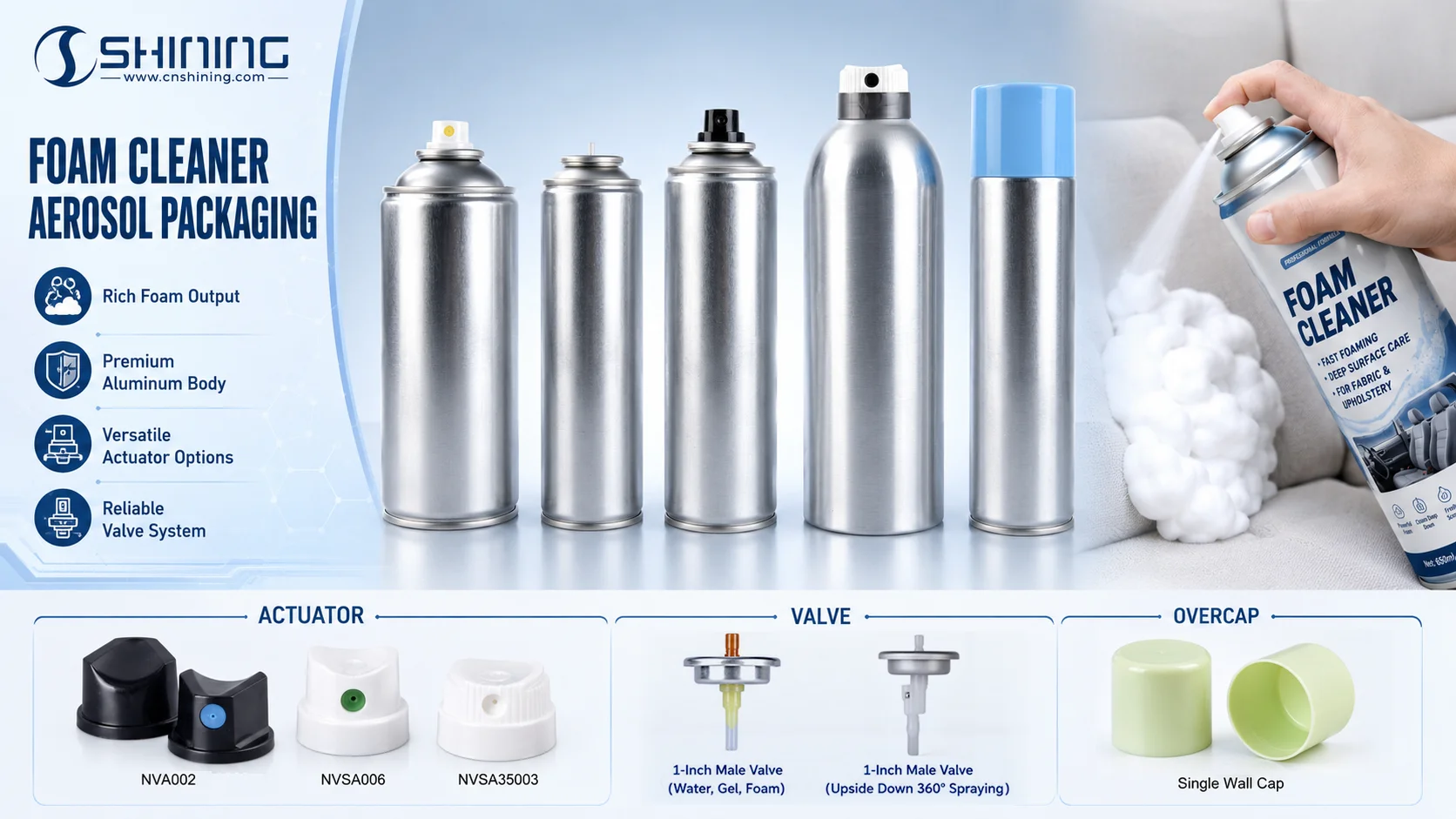
For foam cleaner aerosol, Shining Packaging should be discussed at the component level, not as a generic packaging claim. The product experience depends on three linked parts: actuator, aerosol can, and valve. If one part is mismatched, the foam may spray too wet, clog after storage, lose pressure near the end, or leave more residue than the formula developer expected.
The actuator should be selected around spray width, foam wetness, finger force, anti-clog geometry, and lock function. The valve should match formulation viscosity, propellant pressure, desired output rate, and evacuation target. The aerosol can needs correct material, neck finish, internal coating, pressure rating, printing, and corrosion resistance. For water-rich, alcohol-containing, alkaline, or surfactant-heavy foam cleaner systems, compatibility testing is not optional. It is where many “formula problems” are found to be packaging problems.
A practical Shining Packaging development route is to test the same formula through several actuator-valve combinations, then compare foam height, dwell time, spray weight per second, vertical run-off, odor burst, clogging after thermal storage, and final-can evacuation. This keeps discussion grounded in measurable behavior rather than subjective foam appearance.
8. Practical Takeaway
Foam cleaner aerosol will not be won by making “one more foam.” The useful engineering direction is tighter system control: low-GWP or low-pressure propellant options, BOV or more robust valve platforms, dual-mode actuators, coating selection by formula family, lightweight metal cans, and a parallel refill strategy where the channel supports it.
The three user-sensitive metrics are still simple: odor, residue, and dispensing stability. If those are measurable, repeatable, and tied back to actuator, valve, can, propellant, and formulation decisions, foam cleaner aerosol becomes a controlled technical product rather than a visual foam effect.
9. FAQ: Foam Cleaner Aerosol Packaging and Performance
A foam cleaner aerosol is a pressurized cleaning system that releases a formula as foam or foam spray through a valve and actuator. The package normally includes a metal or composite pressure container, propellant, dip tube, valve cup, valve stem, and foam actuator. Performance depends on the combined behavior of formula, propellant, valve, actuator, and can coating.
Foam has a higher apparent structure than ordinary liquid spray, so it clings to vertical or complex surfaces for longer. This increases dwell time and reduces run-off. The cleaning chemistry has more time to wet, emulsify, and loosen soil. The effect is most useful on glass doors, bathroom walls, automotive fabrics, coils, and localized industrial surfaces.
No. Propellant supplies pressure, but it also affects foam formation, spray wetness, discharge rate, odor release, flammability classification, and end-of-can behavior. Hydrocarbon propellants can support strong discharge but raise flammability concerns. Compressed gas, BOV, and low-GWP options can change foam texture and regulatory positioning, but require different valve and actuator matching.
Haze usually comes from residue left after water, solvent, and volatile components evaporate. Causes may include excessive surfactant, incompatible polymer, over-wet discharge, hard-water interaction, uneven fan pattern, or poor wipe-off behavior. Glass exposes these defects quickly. A small residue level that is acceptable on fabric can be very visible on mirrors and windows.
Usually not well. Hard-water marks and calcium deposits are mineral soils, while many glass foams are built around surfactants and fast-drying solvents for fingerprints, smoke film, and oily residue. Mineral scale normally needs stronger acidity, chelation, or a descaling route. Treating glass foam as a descaler creates unrealistic user expectations and avoidable complaints.
Common causes include valve contamination, actuator insert clogging, formula viscosity drift, poor propellant pressure window, dip-tube blockage, corrosion particles, or mismatch between foam insert geometry and formula solids. The user sees one failure. Engineering should check fill quality, valve tolerance, actuator channel size, thermal storage behavior, and final-can evacuation rate together.
Bag-on-Valve is useful when product-propellant separation, higher evacuation, 360° use, or cleaner formula isolation matters. It can help premium or sensitive foam systems where stable output and lower propellant contact are valued. It is not automatically the lowest-cost route. The decision depends on formula value, target price, pressure behavior, and required user experience.
The actuator controls spray pattern, foam wetness, finger force, dose per press, lock behavior, and clog risk. A formula that performs well through one actuator can fail through another. For foam cleaner aerosol, actuator selection should be validated by spray weight, foam cell structure, vertical run-off, odor burst, clogging after storage, and user hand feel.
VOC limits affect solvent level, propellant choice, drying speed, odor, and cleaning strength. Reducing VOC content may require more water, different surfactants, lower vapor-pressure solvents, compressed gas, BOV, or different wiping instructions. The trade-off is technical, not only regulatory. A low-VOC product still needs enough soil removal, foam stability, and acceptable dry-down.
Useful tests include spray rate, foam height, foam collapse time, vertical run-off, pattern width, actuator force, clogging after thermal aging, can corrosion, pressure retention, evacuation rate, residue after drying, odor perception, and compatibility with intended surfaces. Testing should compare several actuator-valve combinations, not only several formulas. The package defines the final foam.