
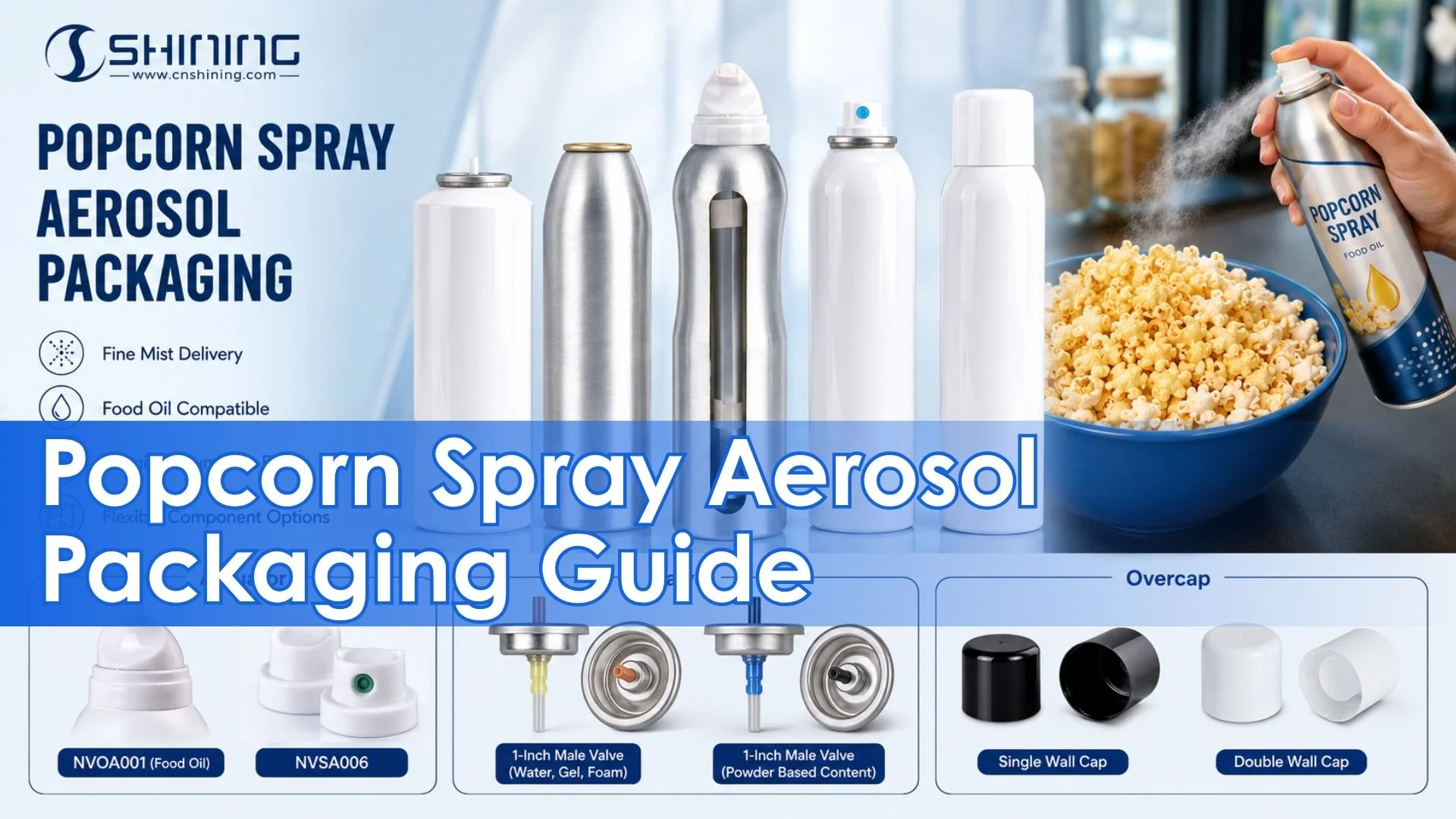
Popcorn aerosol spray sits between butter-flavored cooking spray, seasoning spritz, air-powered canister, and food-grade aerosol dispenser. That boundary matters. If the product is analyzed too broadly, it disappears inside the cooking spray market. If it is defined too narrowly, many retail products that consumers compare directly are missed.
1. Product Definition and Working Mechanism
1.1 Definition Boundary
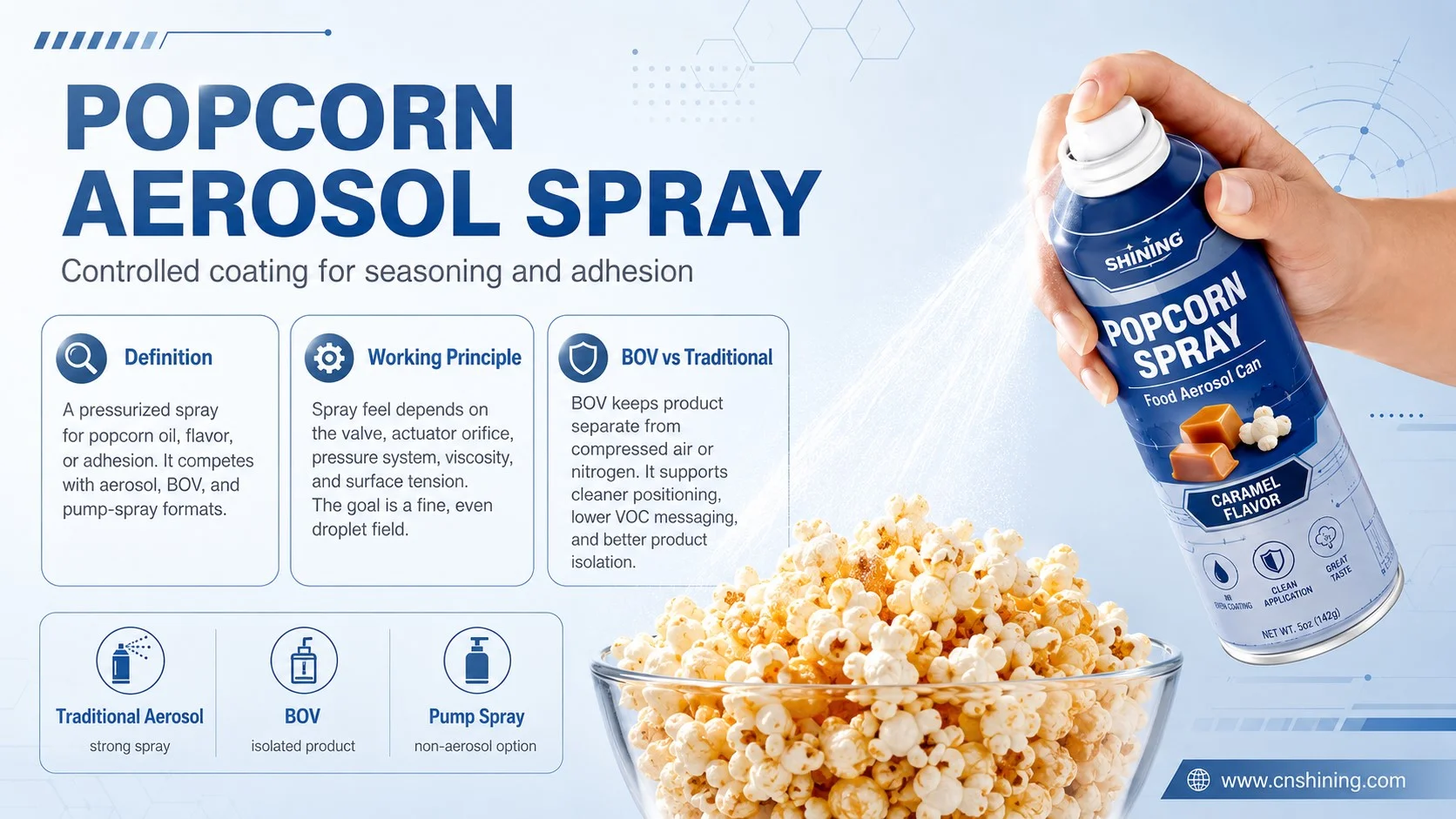
Strictly, popcorn aerosol spray refers to popcorn seasoning or adhesion products delivered by a pressurized container through an actuator. Retail practice is less tidy. Three product forms compete in the same consumer mind:
| Format | Typical Drive System | How It Competes |
|---|---|---|
| Traditional aerosol | LPG, CO2, N2, N2O, or compressed air | Strong spray force, established aerosol supply chain, higher transport and perception burden |
| BOV / air-powered canister | Product separated from compressed air or nitrogen | Cleaner label narrative, lower VOC angle, better isolation between product and propellant |
| Spritzer / nearby spray | Pump spray or non-aerosol spray mechanism | Often sold near popcorn seasoning and judged by the same coverage and adhesion expectations |
Formulation routes also split into two common patterns. The first is a short oil-based route, such as canola oil plus natural flavor and annatto. The second is a water-oil emulsion route, using water, vegetable oil, salt, lecithin, xanthan gum, acid, emulsifiers, and preservatives. Cooking sprays such as PAM may add soy lecithin and dimethyl silicone for release and anti-foaming behavior.
1.2 Working Principle
Spray feel is controlled by valve structure, actuator orifice geometry, pressure system, liquid viscosity, surface tension, and pressure decay inside the container. Shining Packaging notes that aerosol valves include housing, stem, spring, gaskets, and mounting cup; each affects product performance and consumer perception.
For popcorn, the target is not the strongest jet. The target is a controlled droplet field. The spray should be fine enough for even coating, slow enough to avoid wet patches, and adhesive enough to help salt or powder stay on the popped kernel surface.
1.3 BOV Versus Traditional Aerosol
In BOV packaging, the product sits inside a flexible bag connected to the valve. The space outside the bag is charged with compressed air or nitrogen. Product and propellant do not mix. Traditional aerosol systems more often allow the product and propellant system to work together inside the container.
BOV can reduce oxidation risk, support multi-angle use, and fit lower-VOC positioning. It also creates terminology confusion. Some BOV products are commercially treated as aerosols, while some technical documents point out that not every BOV system truly aerosolizes the product in the same way.
2. Drivers and Restraints
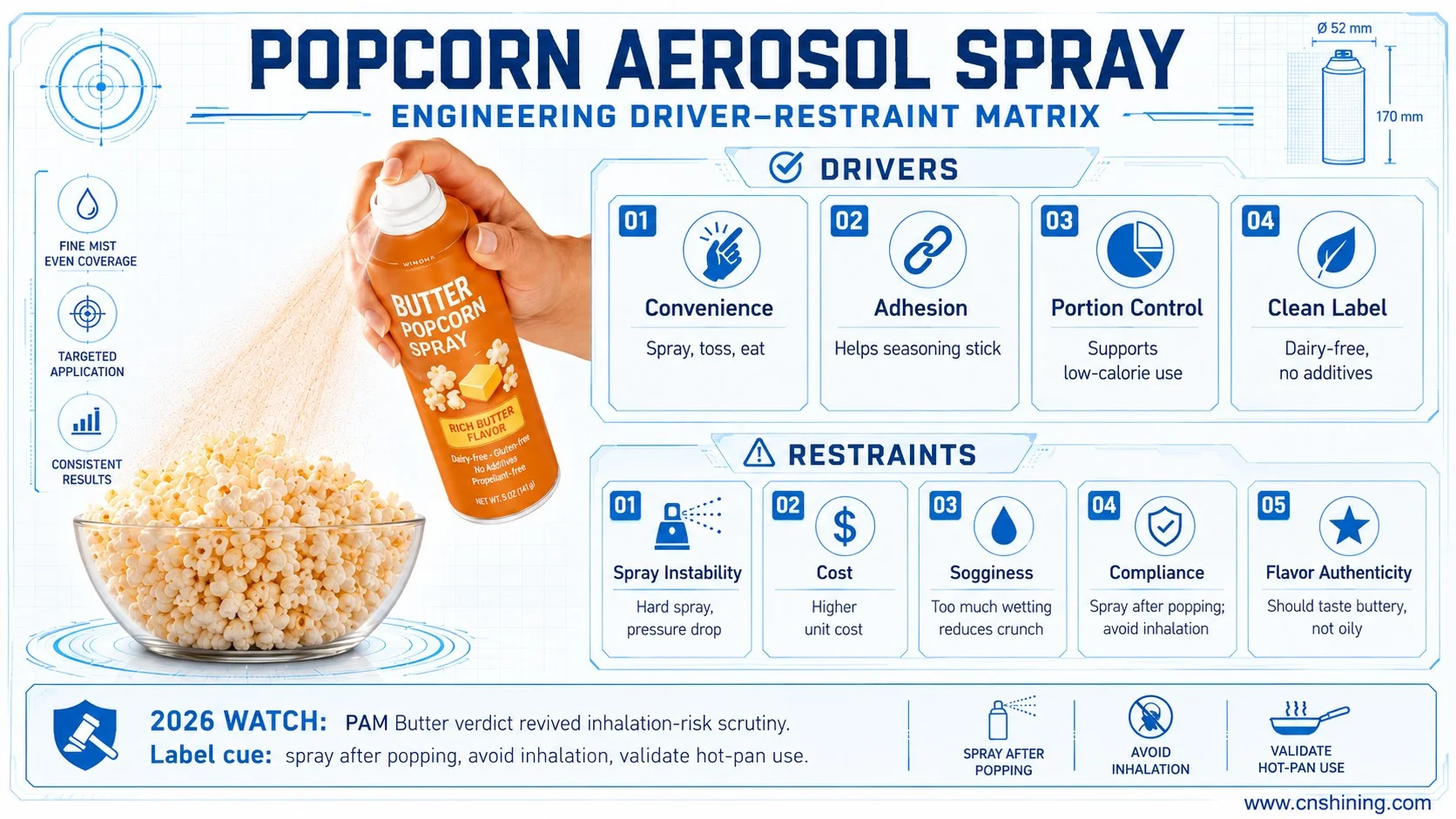
The first driver is convenience. Users want to spray, toss, and eat. The second driver is adhesion. Dry seasoning often falls to the bottom of the bowl unless a thin oil film is present. The third driver is calorie and health positioning, especially for products that claim low calorie, dairy-free, gluten-free, non-GMO, no additives, or propellant-free design.
The restraints are more mechanical than marketing teams like to admit. High unit cost matters. Perceived chemical character matters. Spray inconsistency matters even more. A product that sprays too hard, loses pressure late in use, wets popcorn, or tastes like oil rather than butter will not be saved by a clean front label.
The 2026 PAM Butter verdict also brought butter-flavor aerosol products back into the “popcorn lung” discussion. Conagra said the product had been diacetyl-free for nearly two decades and planned to contest the verdict, but the case shows why inhalation risk, warning adequacy, and flavor-chemical communication cannot be ignored. See public reporting on the 2026 PAM verdict.
3. Formulation Routes and Comparable Solutions
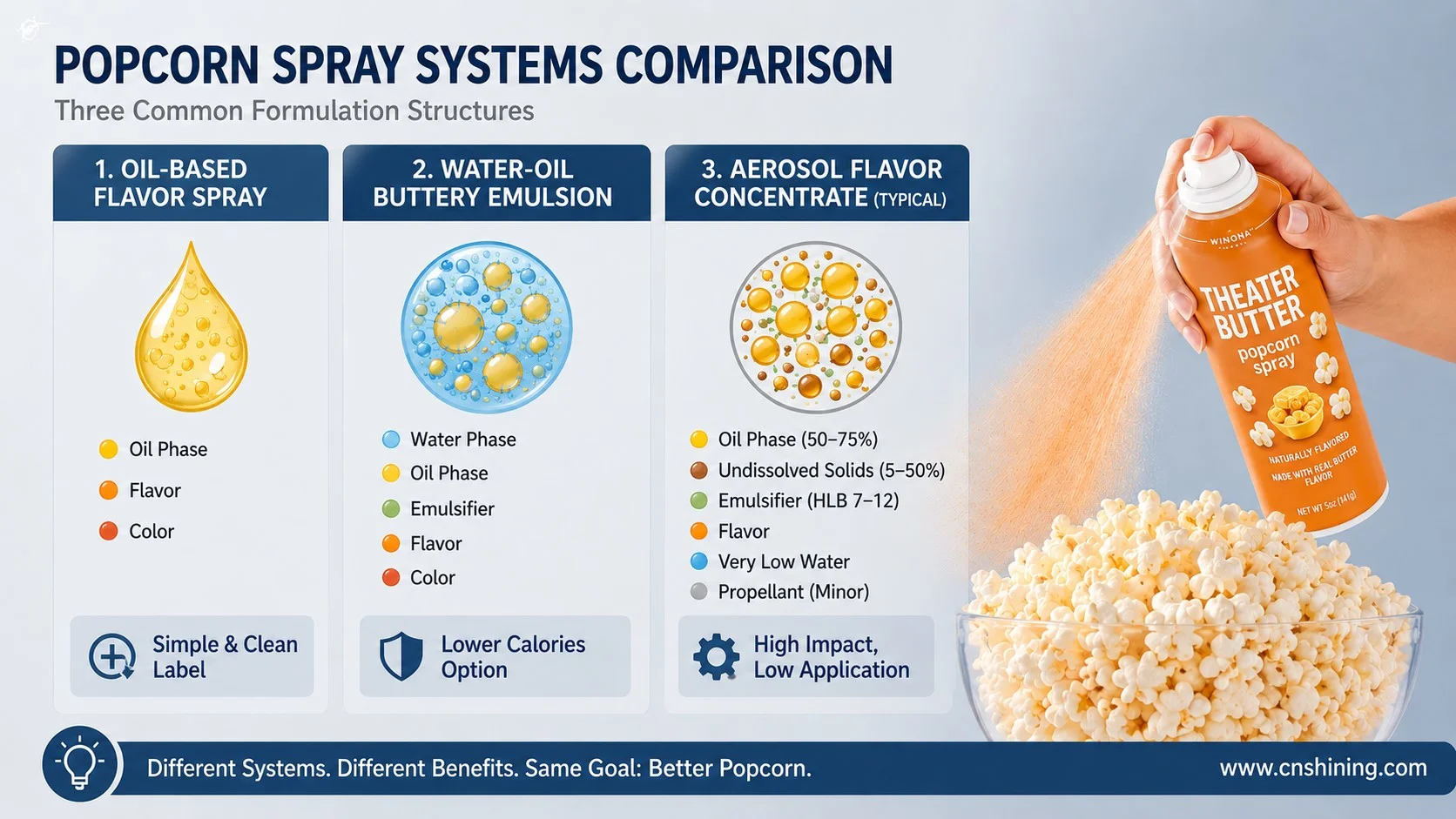
Popcorn spray is not one formulation. Public examples show at least three structures.
| Route | Typical Structure | Strength | Weak Point |
|---|---|---|---|
| Short oil-based flavor spray | Canola oil or other carrier oil, natural flavor, annatto or other color | Short ingredient list, clear clean-label story | Must balance flavor impact against greasiness and wetting |
| Water-oil buttery emulsion | Water, soybean oil, salt, gum, lecithin, acid, emulsifier, preservatives | Low-calorie-per-spray positioning is easier | Higher stability burden and stronger packaging compatibility demand |
| Traditional aerosol flavor concentrate | Oil, undissolved solids, emulsifier system, little water, minor propellant | High flavor impact and visible coating at low application | Sedimentation, particle size, valve clogging, and corrosion risk |
A 1988 food aerosol patent described a popcorn-applicable flavoring composition with 50–75% edible oil, 5–50% undissolved solids, an emulsifier system with HLB 7–12, very low water, and a minor amount of propellant. This is not a current brand formula, but it explains why valve clogging, particle suspension, and spray pattern control are technical risks. See aerosol-type food patent references.
3.1 Functional Ingredient Logic
| Function | Common Public Ingredients | Main Role |
|---|---|---|
| Propellant / pressure medium | Compressed air, nitrogen, CO2, LPG in traditional routes | Controls spray force, droplet size, and transport classification |
| Oil / carrier | Canola, soybean, olive, coconut, MCT | Carries flavor and forms the adhesion film |
| Flavor | Natural flavor, butter flavor, garlic oil, onion oil | Creates theater butter, garlic, sweet, or spicy profile |
| Emulsifier | Soy lecithin, polysorbate 60, sucrose esters | Stabilizes water-oil systems and improves dispersion |
| Stabilizer | Xanthan gum, cellulose gum, colloids | Reduces separation and improves mouthfeel |
| Preservative / antioxidant | Potassium sorbate, sodium benzoate, EDTA, natural antioxidants | Controls microbial risk and slows oxidation or flavor loss |
| Color | Annatto, beta carotene | Supports butter-color expectation |
| Processing aid | Dimethyl silicone in some cooking sprays | Foam control and pan-release support |
3.2 Comparison With Adjacent Solutions
| Solution | Coverage | Seasoning Adhesion | Portion Control | Cost | Best Use Case |
|---|---|---|---|---|---|
| Popcorn aerosol spray | High, if actuator and valve are correct | High | High, but easy to over-apply | Medium to high | Home theater popcorn and air-popped popcorn |
| Non-aerosol liquid pump spray | Medium | Medium to high | Medium | Medium | Lower hazmat burden and lighter packaging |
| Dry seasoning powder | Low to medium | Low unless oil film is present | Medium | Low | Low-cost strong flavor applications |
| Refillable oil mister | Medium | Medium | Medium to high | Low over long use | General kitchen oiling, not flavor-led popcorn |
The spray format wins when it delivers even coating, seasoning adhesion, and fast theater-style flavor. It loses when transport complexity, price, nozzle complaints, or wet texture become more visible than the eating benefit.
4. Technical Terms Used in Popcorn Aerosol Spray
| Term | Plain Explanation | Commercial Meaning |
|---|---|---|
| Actuator | The button or spray head pressed by the user | Controls hand feel, spray pattern, leakage, and targeting |
| Valve | The release system controlling liquid and gas flow | Affects consistency, residual product, and complaint rate |
| BOV | Bag-on-valve packaging separating product from pressure medium | Supports clean-label and low-VOC narratives |
| Continuous spray | Output continues while the actuator is pressed | Good for bowl coating, but requires user education |
| Metered dose | Fixed output per actuation | Useful when calorie visualization or functional dosing matters |
| HLB | Hydrophilic-lipophilic balance of an emulsifier system | Impacts emulsion stability and clogging risk |
| Propellant | Gas or liquefied gas that drives product out | Impacts cost, odor, flammability, transport, and sustainability perception |
| UN1950 | Dangerous goods identifier commonly used for aerosols | Impacts transport, storage, and e-commerce fulfillment |
5. Regulatory Compliance and Technical Evolution
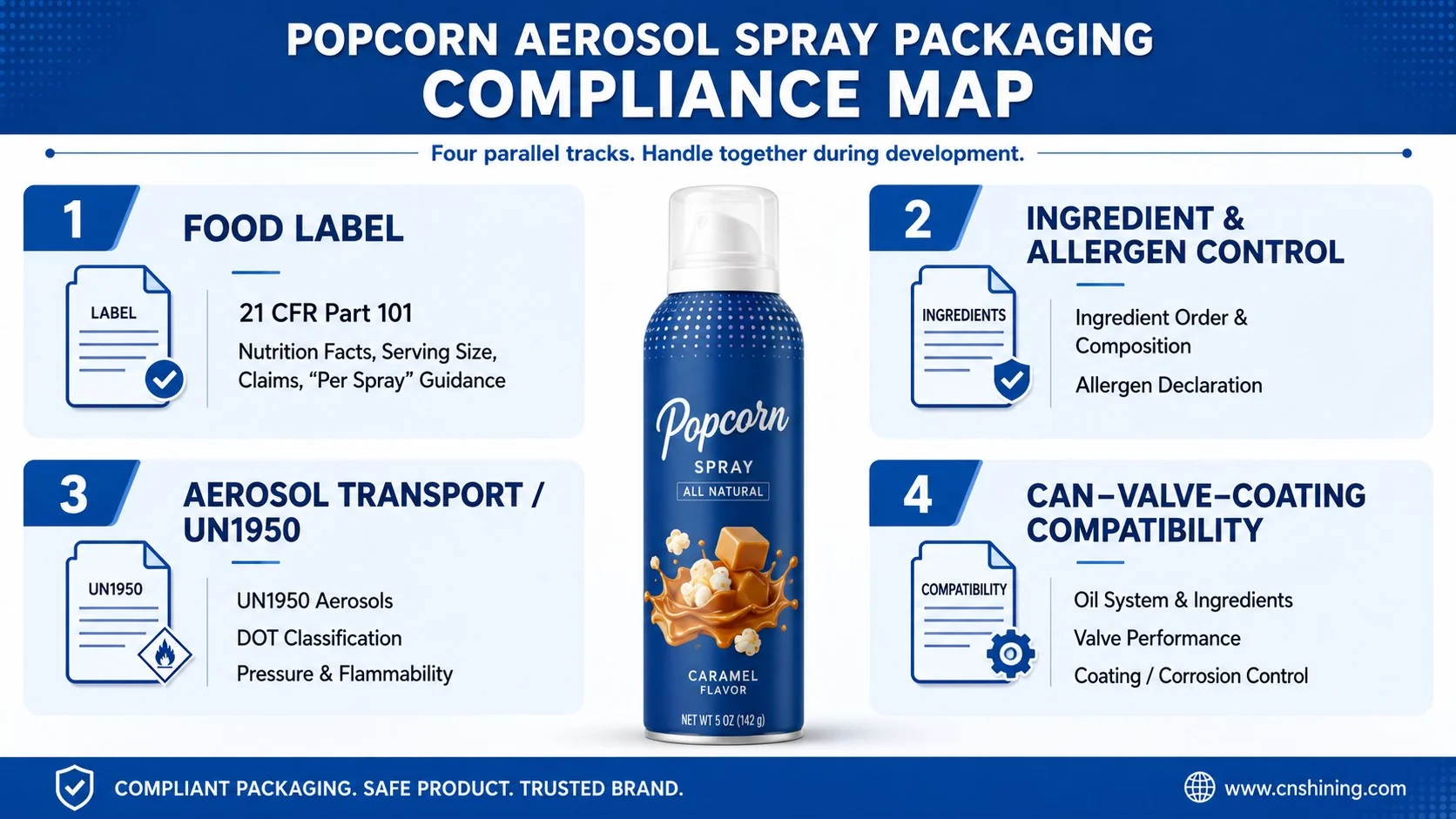
Compliance has four parallel tracks. Treating it as a label-only job is risky.
| Track | Key Questions | Technical Risk |
|---|---|---|
| Food law | Ingredient order, nutrition facts, allergens, claims, serving size | “0 calorie per spray” may be challenged if real use is much higher |
| Packaging compatibility | Oil flavor, acidic water phase, garlic or chili flavor, can coating, gasket, spring | Corrosion, swelling, off-odor, discoloration, valve failure |
| Transport | Aerosol classification, pressure, flammability, UN1950 status | Higher storage, cross-border, air shipment, and e-commerce burden |
| Consumer information | Use distance, spray timing, bowl layering, post-pop use, inhalation warning | Misuse, soggy texture, burnt popcorn, trust loss |
For the U.S., food labeling requirements sit under 21 CFR Part 101. See 21 CFR Part 101 food labeling rules. Transport classification follows a different regulatory path. The two must be handled together during development, not after the formula is finalized.
Regional Compliance Snapshot
| Region | Food / Formula Focus | Packaging / Transport Focus | Practical Difference |
|---|---|---|---|
| United States | FDA labeling, nutrition, allergen declaration | DOT aerosol definition and hazardous goods rules | Serving size and “per spray” claims need careful explanation |
| Canada | Food label and ingredient control | TDG and UN1950-related container requirements | Container design and transport standardization are prominent |
| European Union | FIC, additives, flavorings, food contact materials | Aerosol Dispensers Directive and ADR | Label and packaging systems are both reviewed closely |
| Japan | Food Labeling Act and Japanese retail label | High-pressure container and logistics rules | Japanese nutrition and allergen statements must be precise |
| Brazil | ANVISA packaged food labeling | Dangerous goods and packaging transport rules | Portuguese label and MERCOSUR alignment matter |
6. Technology Direction: Air, BOV, Metering and Locking
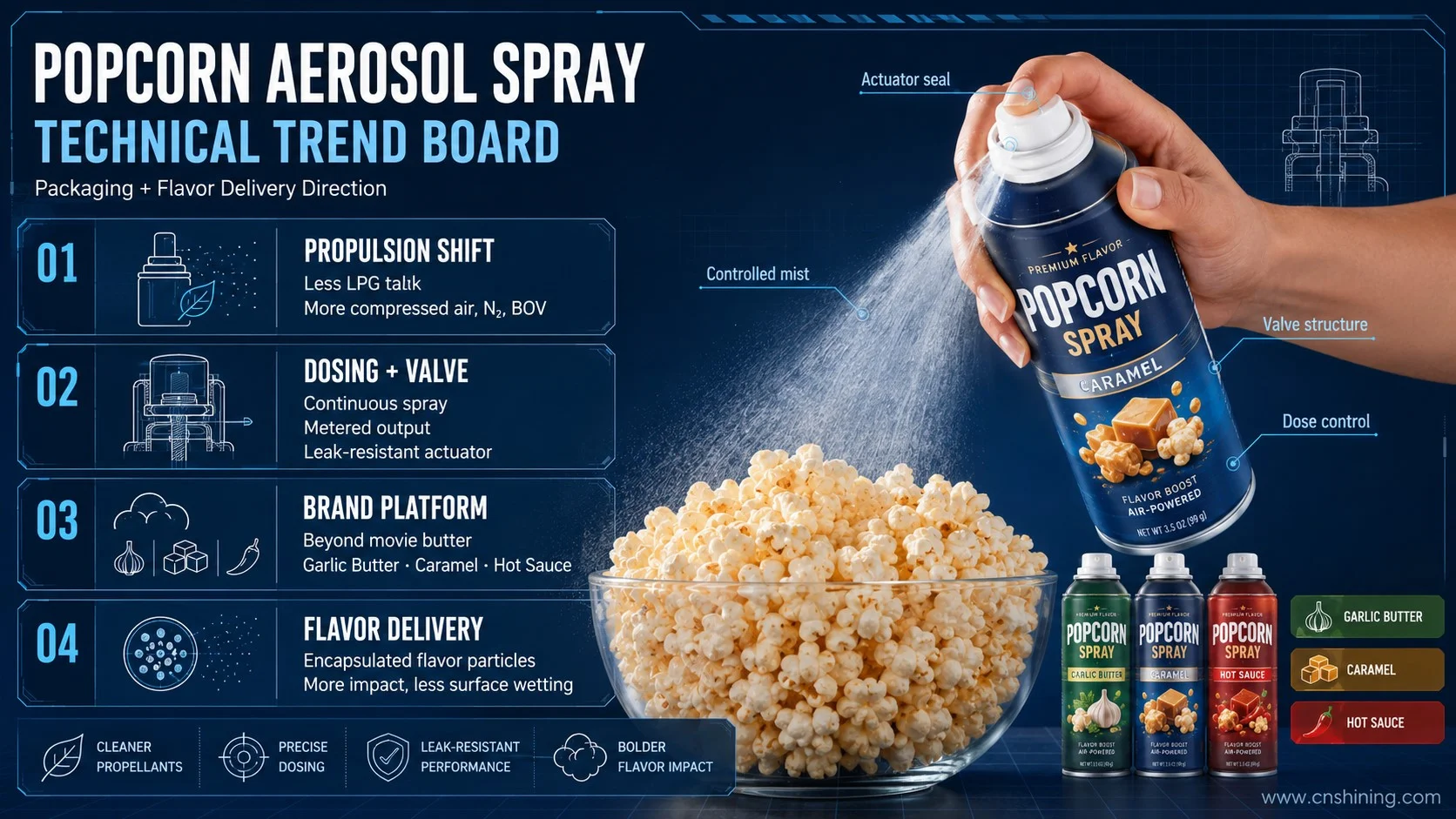
The direction is clear: less reliance on LPG narratives, more attention to compressed air, nitrogen, BOV, metered dosing, and leak-resistant actuator structures. Shining Packaging describes Press’Air as a continuous spray valve using compressed air or inert gas instead of LPG.
Brand activity supports the same direction. Winona moved beyond original butter flavor into Garlic Butter, Caramel, and Hot Sauce variants. That shows a shift from “movie-theater butter only” into a broader snack enhancement platform. See the Winona Garlic Butter release.
Flavor delivery technology is also moving beyond simply spraying oil. Spray-Tek’s 2025 patent news describes plant-derived wax, fat, and surfactant systems that create encapsulated flavor particles, pastilles, or prills for targeted release. That is not automatically a popcorn aerosol format, but the method is relevant when teams want stronger flavor impact without wetting the popcorn surface. See the Spray-Tek flavor delivery patent report.
7. Shining Packaging Components for Popcorn Aerosol Spray
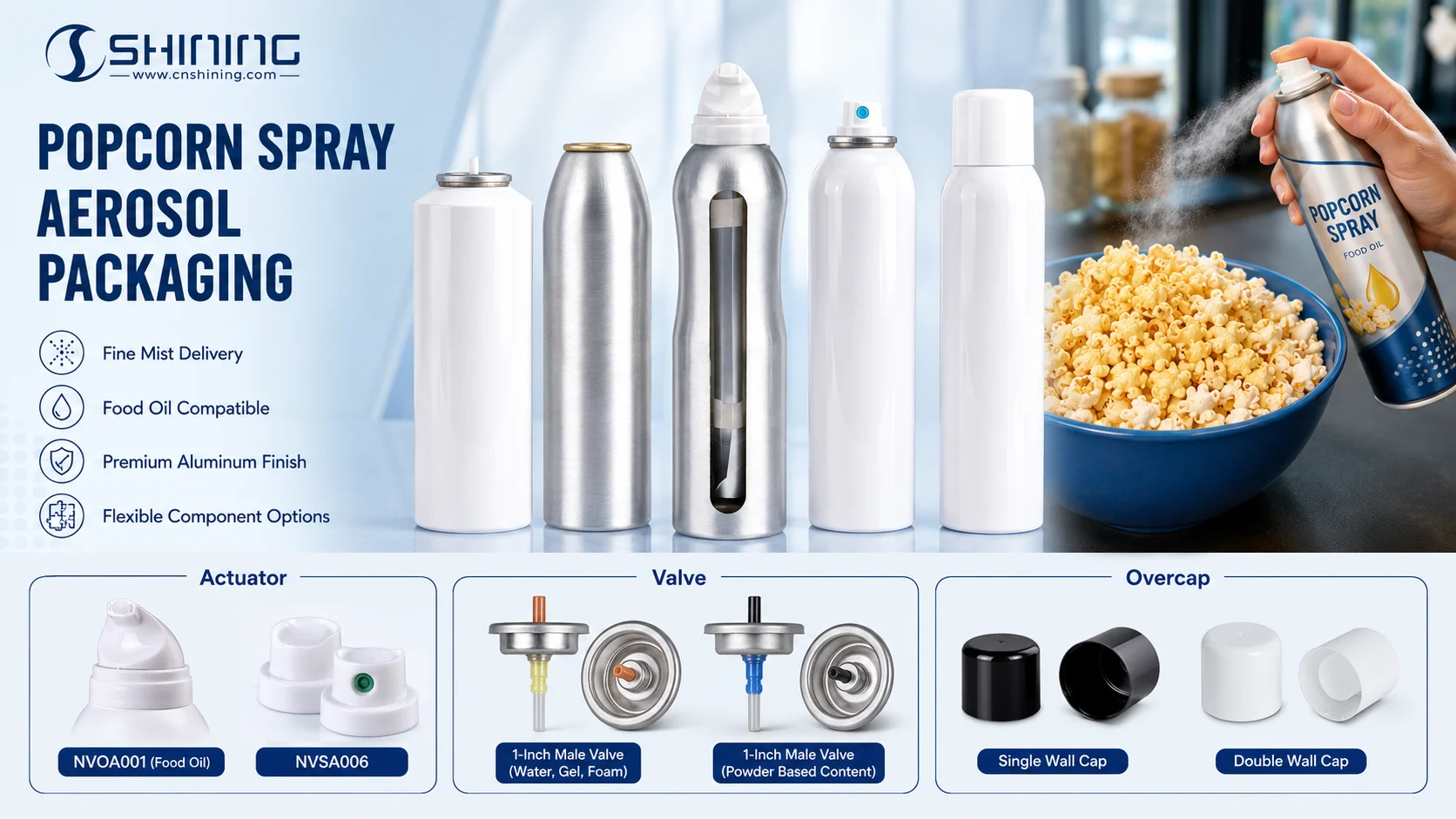
For a popcorn aerosol spray project, the packaging components are not neutral hardware. The actuator controls the consumer’s first judgment: spray width, force, direction, and hand feel. The valve controls repeatability, output rate, residual product, and late-life pressure behavior. The aerosol can must match the oil, flavor system, water phase, internal coating, pressure specification, and logistics route.
In this context, Shining Packaging is relevant at the component level: aerosol cans, actuators, and valves used for food aerosol and nearby spray applications. For popcorn spray, component selection should start from the eating problem, not from a catalog part number. Does the spray need a wide fan? Does it need lower output to avoid sogginess? Is BOV or compressed air required for the claim structure? Is the flavor oil aggressive toward gaskets or internal lacquer?
A practical development sequence is simple: define the formula viscosity and oil/water structure, screen valve output, tune actuator spray pattern, validate can coating and gasket compatibility, then run drop, leakage, heat, storage, and transport tests. This avoids the common failure where a good flavor formula is paired with a nozzle that sprays like paint.
8. Top 10 Brands and Positioning
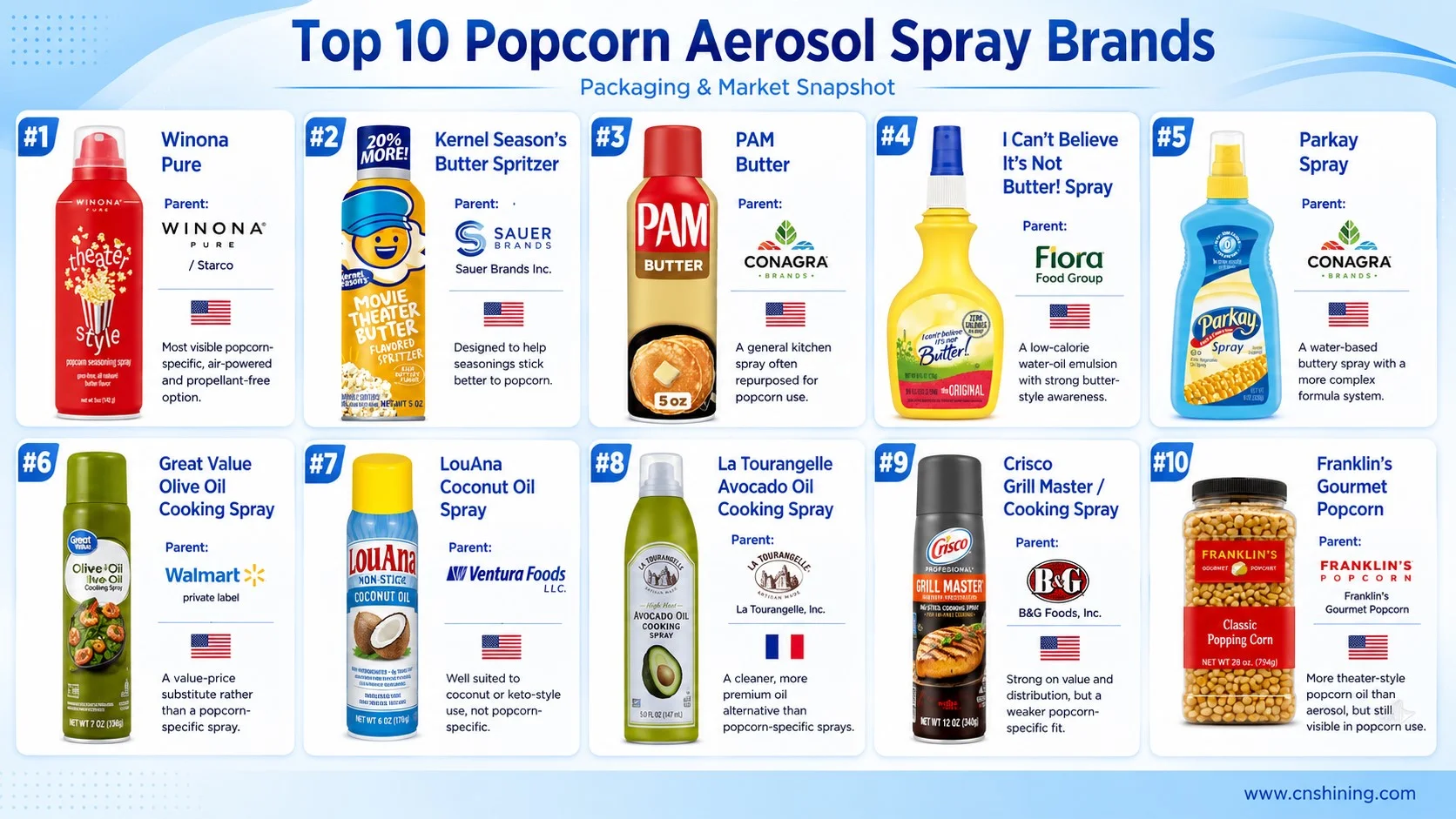
The table below is kept as a separate brand section because the segment is small and several brands are not pure popcorn aerosol spray brands. Some are kitchen spray brands that consumers use for popcorn. Where ownership, origin, or price was not stable in public pages, it is marked as not publicly verified.
| Brand | Country | Parent / Operator | Common Size | Public Price Range | Technical Comment |
|---|---|---|---|---|---|
| Winona Pure | U.S. | Winona Pure; Starco as marketer of record | 5 oz | about 4.84$ single; about 9.68$ two-pack | Most visible popcorn-specific, air-powered / propellant-free route |
| Kernel Season’s Butter Spritzer | U.S. | Sauer Brands Inc. | 5 oz | about 4.43$ single; about 8.86$ two-pack | Strong focus on helping seasoning stick |
| PAM Butter | U.S. | Conagra Brands | 5 oz | about 3.98$ | General kitchen spray; popcorn use is cross-scenario migration |
| I Can’t Believe It’s Not Butter! Spray | U.S. | Flora Food Group | 8 fl oz | about 4.48$ | Water-oil emulsion route with low-calorie mindshare |
| Parkay Spray | U.S. | Conagra Brands | 8 oz | about 2.48$ | Water-based buttery spray with a more complex formula system |
| Great Value Olive Oil Cooking Spray | U.S. | Walmart private label | 7 oz | about 4.74$ | Price anchor substitute, not popcorn-specific |
| LouAna Coconut Oil Spray | U.S. | Ventura Foods, LLC | 6 oz | about 11.56$ | Fits coconut or keto-style use, not popcorn-specific |
| La Tourangelle Avocado Oil Spray | France | La Tourangelle, Inc. | 5 fl oz | about 5.68$ | Cleaner oil substitute, more premium than popcorn-specific |
| Crisco Grill Master / Cooking Spray | U.S. | B&G Foods, Inc. | 12 oz | about 4.82$ | Strong value and distribution, weaker popcorn fit |
| Franklin’s Gourmet Popcorn | U.S. | Franklin’s Gourmet Popcorn | 30 oz oil | about 34.99$ | More theater-style oil than aerosol, but visible in popcorn use |
9. User Pain Points and Packaging Fixes
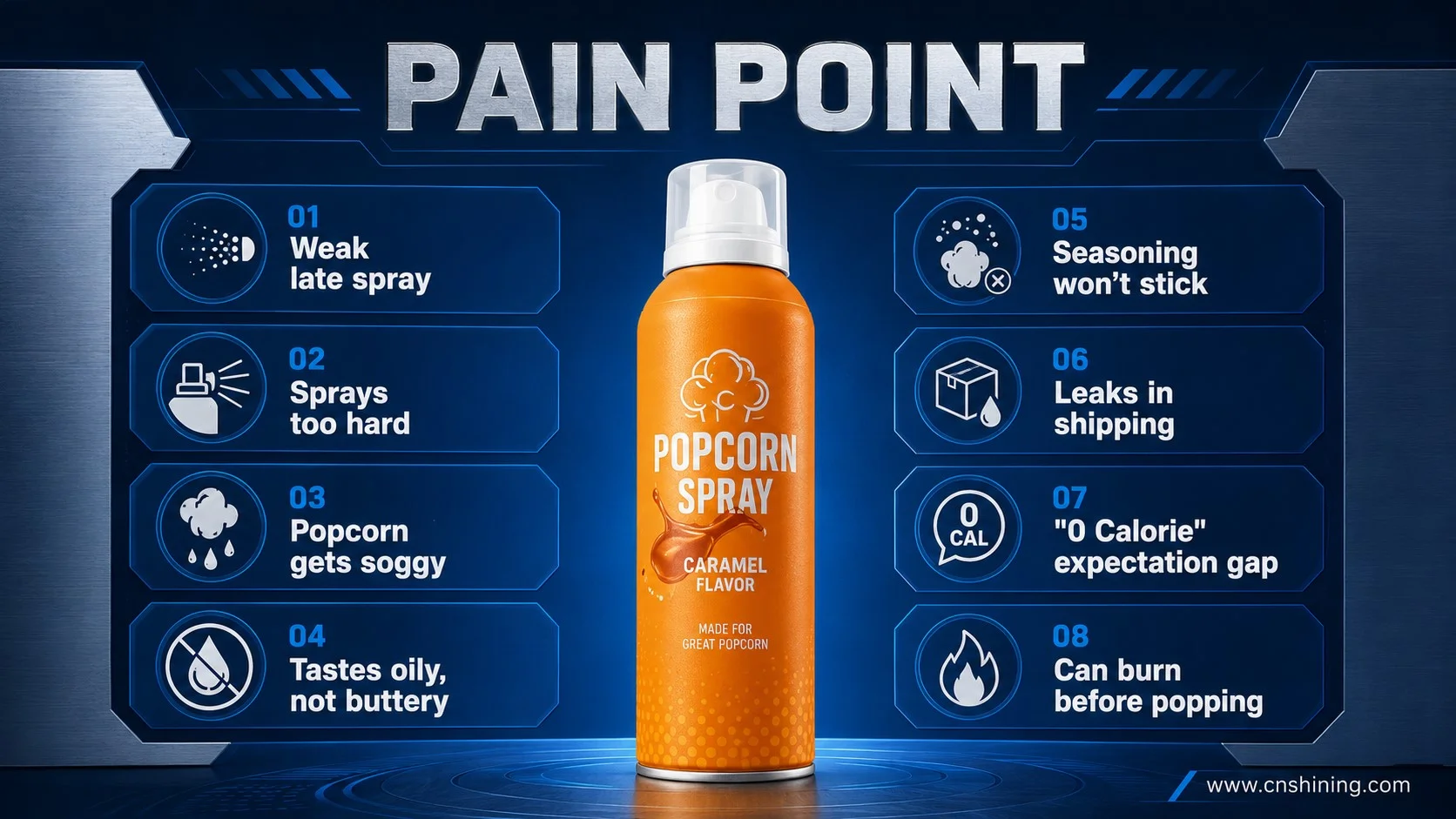
Public Amazon, Walmart, and Reddit samples point to the same technical complaints: unstable spray, too much force, oil-like flavor instead of butter, poor salt adhesion, soggy texture from over-application, confusing “0 calorie” serving size, and misuse before microwave popping.
| Pain Point | Likely Technical Cause | Packaging or Label Fix |
|---|---|---|
| “Runs out of accelerant” or weak late spray | Pressure decay, valve/propellant mismatch, poor fill control | Validate output curve; consider BOV or more stable compressed gas system |
| Spray comes out too hard | High output actuator, narrow orifice, high internal pressure | Use wider fan actuator, lower output valve, or flow restrictor |
| Popcorn becomes soggy | Droplets too large or user applies too much in one layer | Add layered spray instruction; tune droplet size and output rate |
| Flavor tastes like oil, not butter | Carrier oil dominates flavor impact or flavor oxidizes | Improve flavor protection, oxygen control, and coating compatibility |
| Seasoning still does not stick | Film is too thin, uneven, or poorly distributed | Spray in layers: popcorn, spray, powder, toss, repeat |
| Leakage in shipping or bags | Cap, actuator, or locking structure not e-commerce ready | Use hoodless twist-to-lock or clearer lock/unlock tactile design |
| “0 calorie” expectation gap | Serving size is too small versus real use | Show typical bowl-use calories, not only fractional spray serving |
| Burning when used before microwave popping | Wrong use case and insufficient instruction | State clearly: apply after popping unless pre-pop use is validated |
10. Conclusion
Popcorn aerosol spray is a small but real niche. It is clearest in North America, where popcorn consumption, air-popped popcorn habits, and retail distribution support the use case. The category’s weak point is not demand logic. It is execution.
The products that hold repeat purchase will solve three problems at the same time: controlled spray, credible butter or seasoning flavor, and clear use education. BOV, compressed air, nitrogen, hoodless locking actuators, metered valves, and better front-label instructions all point in the same direction. This category will not be rebuilt by flavor alone. It will be rebuilt by packaging engineering.
11. FAQ: Popcorn Aerosol Spray
Popcorn aerosol spray is a popcorn-focused seasoning or adhesion product delivered through a spray system. It may use a traditional pressurized aerosol, BOV, compressed air canister, or nearby spritzer format. The common technical purpose is even surface coating on popcorn, usually for butter flavor, oil film formation, or dry seasoning adhesion.
No. Cooking spray is the larger category and is often designed for pan release or general kitchen oiling. Popcorn aerosol spray is narrower. It targets popped kernels, flavor distribution, and seasoning adhesion. Some cooking sprays are used on popcorn, but that does not make their market data equal to popcorn-specific spray demand.
Valve design controls output rate, pressure behavior, residual product, and spray consistency over the can’s life. Popcorn is sensitive to uneven application. Too much output creates wet, greasy patches. Too little output does not help seasoning stick. A stable valve is needed before the flavor formula can perform properly.
The actuator defines spray angle, droplet distribution, force, and user control. A narrow or aggressive actuator can make the product feel like spray paint and can scatter oil outside the bowl. A wider, softer fan pattern usually fits popcorn better because it supports layer-by-layer coating with less risk of soggy texture.
BOV separates the product from compressed air or nitrogen by placing the formula inside a flexible bag. This can reduce direct propellant contact, support multi-angle use, and fit low-VOC or propellant-free positioning. It also helps with oxidation control, which matters when the product contains flavor oils or sensitive butter-type notes.
Sogginess usually comes from excessive liquid loading, large droplets, or applying too much product in one area. The problem may be formula-related, but it is often packaging-related. Output rate, actuator geometry, and user instructions all matter. Layered spraying with shaking between layers can reduce local wet spots.
Oil taste dominates when the carrier oil is too noticeable, flavor impact is weak, or oxidation changes the flavor profile. Butter-type flavor also needs the right color and aroma balance. Packaging compatibility matters because aggressive flavors can interact with internal coating, gasket materials, or oxygen in headspace during storage.
They can be compliant when based on defined serving sizes, but they create user trust risk when the serving is far smaller than real popcorn use. A label based on a fraction of a second may not reflect a full bowl. Clear typical-use guidance reduces misunderstanding and supports better portion control.
Testing should cover formula stability, valve output curve, actuator spray pattern, can coating compatibility, gasket and spring resistance, oxidation, corrosion, leakage, drop performance, heat exposure, and transport classification. Sensory testing should include real popcorn use, because pan-spray performance does not predict seasoning adhesion on popped kernels.
The strongest upgrade is usually a matched valve-actuator system tuned for lower, wider, more controllable output. BOV or compressed air can support cleaner positioning, but poor spray geometry will still fail. For e-commerce, a twist-to-lock or hoodless lock actuator can also reduce leakage and accidental discharge complaints.